Planning as Quantified Boolean Formula
Michael Cashmore
1and
Maria Fox
2and
Enrico Giunchiglia
3Abstract. This paper introduces two techniques for translat-ing bounded propositional reachability problems into Quantified Boolean Formulae (QBF). Both exploit the binary-tree structure of the QBF problem to produce encodings logarithmic in the size of the instance and thus exponentially smaller than the corresponding SAT encoding with the same bound. The first encoding is based on the iterative squaring formulation of Rintanen. The second encoding is a compact tree encoding that is more efficient than the first one, requir-ing fewer alternations of quantifiers and fewer variables. We present experimental results showing that the approach is feasible, although not yet competitive with current state of the art SAT-based solvers.
1
Introduction
Planning as Satisfiability is one of the most well-known and effec-tive techniques for classical planning:SATPLAN[8] was an award-winning system in the deterministic track for optimal planners in the first International Planning Competition (IPC) in 1998, the 4th IPC in 2004, and the 5th IPC in 2006. The basic idea is to encode the ex-istence of a plan withn+ 1(or fewer) steps as a propositional (SAT) formula obtained by unfolding,ntimes, the symbolic transition re-lation of the automaton described by the planning problem. In recent work [14], the basic SAT approach has been improved by equipping the solver with planning-specific variable and value-ordering heuris-tics that are similar to the helpful actions filter of FF [6]. This is very effective for solving planning problems in the SAT framework. In general, SAT-based planning, though quite successful, suffers from the problem that it is easy to come up with problems in which the number of steps required is large, making it impossible to even en-code the original problem as a propositional formula. The same prob-lem arises in bounded model checking [1]. The use of compact en-coding as Quantified Boolean Formulae (QBFs) combined with the use of QBF solvers has been proposed [7, 11, 4] as a way to over-come this problem4. In particular, [13, 7] present an encoding that is logarithmic inn, resembling the proof of the PSPACE-hardness of solving QBFs [15, 16].
Here we introduce two techniques for translating bounded propo-sitional reachability problems into Quantified Boolean Formulae (QBF). Both of the translations that we present exploit the PSPACE complexity of the QBF problem to produce encodings that are loga-rithmic inn, and thus exponentially smaller than the corresponding
1University of Strathclyde, Glasgow, G1 1XH, UK,
email: [email protected]
2King’s College London, London, WC2R 2LS, UK,
email: [email protected]
3Universit di Genova, 16145 Genova (GE), Italy,
email: [email protected]
4It should be noted that the QBF encodings of symbolic reachability
lems presented in [4, 11] have size polynomial in the makespan of the prob-lem, and thus possibly exponential in the number of variables.
SAT encodings with the same bound. By encodings logarithmic in nwe mean that when encoding the existence of a plan withn+ 1 steps we require onlyO(logn)variables, rather thanO(n)as would be required in SAT. The existence of these encodings forms the first step to finding compact QBF encodings of planning problems that are more efficient than SAT encodings. The first encoding we present is a recursive formulation similar to that presented in [13]. We make no novelty claims for the first encoding - we are using it simply as an example of the standard recursive formulation which we contrast with our second encoding. The second encoding that we present re-duces redundancy in the first formula and istree structured. It is more efficient than the first one in that:
1. the QBF that encodes the existence of a plan of length n has one fewer universal quantifier. This means that an encoding with the same number of quantifier alternations will captures twice the makespan, and
2. even when the two formulations have the same number of univer-sal quantifiers, it necessitates far fewer variables.
We refer to the first encoding as theFlat Encodingand the second as theCompact Tree Encodingthroughout this paper. In order to deter-mine the effectiveness of the two encodings we run a preliminary ex-perimental analysis showing that the Compact Tree Encoding tends to perform better on hard problems, solving (or proving unsolvable) many instances that cannot be solved (or proved unsolvable) by the Flat Encoding within the 30-minute time bound that we allowed. Fur-thermore, our results show that the Compact Tree Encoding is much faster (often by at least one or two orders of magnitude) than the Flat Encoding on a large number of instances from classical planning benchmark domains. We show through these encodings that the QBF approach to classical planning in general is feasible. To the best of our knowledge, this is the first attempt in the literature to demonstrate this. We also stress that although we include a direct comparison with state-of-the-art planning as satisfiability techniques, we do not claim that the approaches discussed here are competitive. Indeed, such a comparison is not fair, given the maturity of the research in SAT and in planning as SAT, compared to the maturity of the much younger field of research in QBFs (and of course of classical planning as QBF, starting with this paper). Our goal is to demonstrate that QBF-based encodings are feasible for planning and to encourage further research into making them competitive. Consequently we focus on comparing the new Compact Tree Encoding with the Flat Encoding throughout this paper, comparing with SAT at the end of Section 4.
After some preliminaries in Section 2 the two encodings will be introduced in Section 3. Section 4 will detail the experiments run on these encodings and discuss the results, beginning with time based comparisons and moving onto memory consumption. Finally we conclude in Section 5.
Luc De Raedt et al. (Eds.) © 2012 The Author(s).
This article is published online with Open Access by IOS Press and distributed under the terms of the Creative Commons Attribution Non-Commercial License.
2
Preliminaries
Quantified Boolean Formula
Formally, the language of QBFs extends propositional logic by al-lowing for universal (∀) and existential (∃) quantification over vari-ables (in our case, fluents and actions). Semantically, ∀x.ϕ(resp. ∃x.ϕ) can be interpreted as(ϕx∧ϕ¬x)(resp.(ϕx∨ϕ¬x)), where ϕx(resp.ϕ¬x) is the formula obtained fromϕby replacingxwith (resp. ⊥).5The process of substituting∀x.ϕ(resp. ∃x.ϕ) with
(ϕx∧ϕ¬x)(resp.(ϕx∨ϕ¬x)) is calledexpansion. By expanding all quantifiers, each QBF can be reduced to (possibly an exponen-tially larger) propositional formula. When every variable is quanti-fied, such an expansion reduces to a Boolean combination ofand ⊥and is thus equivalent to eitheror ⊥. The QBF formula ex-pands recursively into a tree-structured representation where all of the propositional variables are at the leaves. Expansion therefore pro-duces an and-or tree that accords to the semantics of the QBF.
The Planning Problem
LetFandAbe two finite sets representing the sets offluentsand
actionsrespectively. Astate(resp.(complex) action) is an interpreta-tion of the set of fluents (resp. acinterpreta-tions). In the following, we useXto denote the whole set of variables, i.e., the set of fluents unioned with the set of actions.
Aplanning problemis a tripleI, τ, G where
• I is a Boolean formula overF and represents the set of initial states;
• τis a Boolean formula overX∪XwhereX={x:x∈X}is a copy of the set of variables and represents thetransition relation of the automaton describing how (complex) actions affect states (we assumeX∩X=∅);
• Gis a Boolean formula over F and represents the set ofgoal states.
The above definition of the planning problem differs from the tra-ditional ones in which the description of the effects of actions on a state is described in an high-level action language such as STRIPS. We prefer this formulation because the techniques we are going to describe are independent of the action language used. The only as-sumption that we make is that the description is deterministic: there is only one state satisfyingIand the execution of a (complex) action αin a statescan lead to at most one states. More formally, for each statesand complex actionα, any two interpretations extend-ings∪αand satisfyingτinterpret in the same way the variables in F={f:f∈ F}.
3
Encoding planning problems as QBFs
Consider a planning problemΠ =I, τ, G . As standard in planning as satisfiability, the existence of a parallel plan with makespannis proved by building a propositional formula withncopies of the set of variables. In the following,
• byXαwe denote one such copy of the set of variables;
• byI(Xα)(resp.G(Xα)) we denote the formula obtained from I (resp.G) by substituting eachx ∈ X with the corresponding variablexα∈Xα;
5and⊥are the logical symbols we use for truth and falsity.
• byτ(Xα, Xβ)we denote the formula obtained fromτ by sub-stituting each variablex ∈ X with the corresponding variable xα ∈ Xα and similarly eachx ∈ X with the corresponding xβ∈Xβ.
Forn≥1, theplanning problemΠwith makespannis the Boolean formulaΠndefined as
I(X1)∧ n
i=1
τ(Xi, Xi+1)∧G(Xn+1) (n≥0) (1)
and aplan forΠnis an interpretation satisfying (1).
However, since the plan existence problem is a PSPACE-complete problem [3] the size of (1) can be exponential in the number of flu-ents - making it impossible to even build (1) in practice. QBFs are a promising alternative representation language given that:
1. there exists an encoding of the planning problem with makespann as QBFs which are polynomial in the number of fluents (assuming, as we do, a deterministic transition relation), and
2. there is a growing interest in developing efficient solvers for QBFs; see, for example, the report from the last QBF competition [12].
Flat Encoding
Theflat encodingof a planning problemI, τ, G with makespan n= 2kis the formula:
I(XI)∧Ek(XI, XG)∧G(XG) (2)
wherek≥0is thefolding parameterandEk(XI, XG)is defined as follows (in the following, given two finite setsXαandXβ of vari-ables,∃XαXβ denotes the result of existentially quantifying each variable inXα∪Xβ, and(Xα↔Xβ)stands for(∧x∈Xxα↔xβ)):
Ek(XI, XG) :=∃Xst∀y∃XsXt(
(¬y⇒((Xst↔Xt)∧(XI↔Xs)))∧ (y⇒((Xst↔Xs)∧(XG↔Xt)))∧ Ek−1(Xs, Xt) )
ifk >0, and
E0(XI, XG) :=∃X1∃X2
((XI↔X1)∧τ(X1, X2)∧(X2↔XG))
whenk = 0. The correspondence between (1) and the Flat Encod-ing is clear whenk = 0. Whenk >0, by expanding the universal quantifiers we find the same correspondence. Intuitively, the branch formed by expandingydivides the formula intoEk(¬y)andEk(y), each representing one half of the total timesteps. AsXst remains above this branch it is used to link these two halves together with equality constraints.
The above formulation involves(3k+ 2)|X|existential variables andk universal variables. Further, the Flat Encoding can be con-verted into prenex conjunctive normal form (corresponding to the QDIMACS format used by most QBF solvers) with4(2k+ 1)|X|+ |τ|clauses, where|τ|is the number of clauses in the transition rela-tion of the original planning problem.
Proposition 1 For eachk≥0, ifn= 2kthe existential closures of (1) and the Flat Encoding are equivalent.
Compact Tree Encoding
We now describe a new encoding which removes redundancy and requires considerably fewer variables than the Flat Encoding.
Intuitively, the Flat Encoding describes a one-to-one correspon-dence between the states traversed and theleavesof the expansion corresponding to the QBF. The leaves of the expansion are composed of the values of the innermost existentially quantified variables. By contrast, in our second encoding, the Compact Tree Encoding, there is a one-to-one correspondence between the states traversed and the nodesof the tree corresponding to the QBF. Every existentially quan-tified layer in the QBF is used to represent at least one distinct state. Given a QBF formula withk universal quantifiers, the new en-coding is a tree of depthkwhich removes all redundancy from the formula, by only specifying equivalent states once. The key novelty of this encoding is in the traversal of its tree structure, in which edges are encoded from each leaf node to one of the nodes in each of the preceding layers of the tree. This leads to a formula that encodes
2k+1transitions in a tree withklayers. The formula is quadratic in kbecause every edge to and from levelirequiresk−i−1terms to express the context which is the assignment to the variables in the intervening layers. While the Flat Encoding does not require these contexts and therefore is linear ink, twice as many variables are re-quired to enforce the equivalence of sets of existentially quantified variables on different branches as are required in the Compact Tree Encoding to describe the traversal of the tree.
TheCompact Tree Encodingof a planning problemI, τ, G with makespann= 2k+1is the formula:
I(XI)∧Qk(XI, XG)∧G(XG) (3)
where
Qk(XI, XG) :=∃Xk∀yk. . .∃X1∀y1∃X( ( (k
i=1¬yi)⇒τ(XI, X) ) ∧( (k
i=1yi)⇒τ(X, XG) ) k
i=1( ( (¬yiji−=11yj)⇒τ(X, Xi) ) ∧( (yii−1
j=1¬yj)⇒τ(Xi, X) ) ) )
This formula states that the goal stateGGis reachable in2k+1 ap-plications of the transition relation. Onlyk+ 1states are quantified (XktoX1andX).
The Compact Tree Encoding (3) has k universal variables and
(k + 1)|X| existential variables. Further, with (3) we check the existence of plans having makespan equal to2k+1, i.e., twice the makespan allowed by the Flat Encoding for the corresponding num-ber of quantifier alternations. The conversion of (3) to prenex con-junctive normal form has 2(k + 1)|τ| clauses. Although this has more clauses than the Flat Encoding and in some cases requires more memory it can be seen in Section 4 that in practice it does not make the problem more difficult to solve.
The correspondence between the Compact Tree Encoding and (1) is again found when expanding the universally quantified variables. Unlike the Flat Encoding however, when expandingyk,Xkdoes not link the two halves of the plan using equality constraints, but instead with two transition relations -Xkrepresenting a distinct state in the solution to the planning problem.
Proposition 2 For eachk≥0, ifn= 2k+1the existential closures of (1) and the Compact Tree Encoding (3) are equivalent.
Proof: We prove, by induction onk, thatQk(XI, XG)is equiva-lent to (1) withn= 2k+1
k= 0: In this case,Qk(XI, XG)becomes
∃X(τ(XI, X)∧τ(X, XG))
and the thesis trivially holds.
k=p+ 1: By expanding the outermost universal quantifier,yp+1,
(k
i=1¬yi)⇒τ(XI, X)becomes false in one branch of the ex-pansion, (Qk,yp+1), and(ki=1yi) ⇒ τ(X, XG) in the other, (Qk,¬yp+1).
In addition
p+1
i=1
( (¬yi
i−1
j=1yj)⇒τ(X, Xi)) ∧((yii−1
j=1¬yj)⇒τ(Xi, X)) )
is reduced to
p
i=1
( (¬yi
i−1
j=1yj)⇒τ(X, Xi)) ∧((yii−1
j=1¬yj)⇒τ(Xi, X)) )
with two clauses falling out when i = p+ 1: (pi=1yi) ⇒ τ(X, Xp+1) in (Qk,yp+1) and(
p
i=1¬yi) ⇒ τ(Xp+1, X) in (Qk,¬yp+1).
After expansionQk(XI, XG)becomes
∃Xp+1(
∃Xp∀yp. . .∃X1∀y1∃X(
(p
i=1¬yi⇒τ(XI, X))∧
(pi=1yi⇒τ(X, Xp+1))∧
(p
i=1 ( (¬yi∧ji−=11yj)⇒τ(X, Xi) ) ∧( (yi∧i−1
j=1¬yj)⇒τ(Xi, X)) ) )∧ ∃Xp∀yp. . .∃X1∀y1∃X(
(p
i=1¬yi⇒τ(Xp+1, X))∧
(p
i=1yi⇒τ(X, XG))∧
(p
i=1 ( (¬yi∧ i−1
j=1yj)⇒τ(X, Xi) )∧
( (yi∧i−1
j=1¬yj)⇒τ(Xi, X) )) ))
By induction hypothesis,
∃Xp∀yp. . .∃X1∀y1∃X( (p
i=1¬yi⇒τ(XI, X))∧
(p
i=1yi⇒τ(X, Xp+1))∧
(pi=1 ( (¬yi∧ i−1
j=1yj)⇒τ(X, Xi) )∧
( (yi∧i−1
j=1¬yj)⇒τ(Xi, X) )) )
is equivalent to
∃X
1. . . X2p+1−1(τ(XI, X1) ∧2p+1−2
i=1 τ(Xi, Xi+1)∧τ(X2p+1−1, Xp+1))
The second half of the expansion can be equated to a similar expression in an analogous fashion - with the exception that the chain of transitions are betweenXp+1andXG, as they represent the second half of the plan. Thus, by combining the conjunctions we get
∃X1. . . X2p+2−1(τ(XI, X1)
∧2i=1p+2−2τ(Xi, Xi+1)∧τ(X2p+2−1, XG))
Figure 1. Times on problems solved with DEPQBF using the Compact Tree Encoding and Flat Encoding, times in ms.
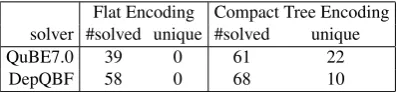
Flat Encoding Compact Tree Encoding solver #solved unique #solved unique
QuBE7.0 39 0 61 22
[image:4.609.212.411.278.324.2]DepQBF 58 0 68 10
Table 1. Number of solved problems using the Compact Tree Encoding and Flat Encoding.
Abstract Example
The following simple abstract example emphasises the difference be-tween the Compact Tree Encoding and the Flat Encoding.
If we build an expression containing two universal quantifiers us-ing the Compact Tree Encodus-ing, we express the existence of a plan of makespan 8. Below is a simple example,
∃X2∀y2∃X1∀y1∃X·(
(¬y2∧ ¬y1⇒τ(I, X)) ∧ (y2∧y1⇒τ(X, G)) ∧ (¬y2∧y1⇒τ(X, X2)) ∧ (y2∧ ¬y1⇒τ(X2, X)) ∧
(¬y1⇒τ(X, X1)) ∧ (y1⇒τ(X1, X)))
It should be noted that the last two transitions are both invoked twice: once in the context wherey2is true and once in the context where it is false. The other transitions are all invoked once, account-ing for all 8 transitions.
By contrast, two universally quantified variables using the Flat En-coding produces:
∃X1∀y1∃X2∃X3·(
(y1⇒I↔X2∧X1↔X3)∧
(¬y1⇒X1↔X2∧X3↔G)∧ ∃X4∀y2∃X5∃X6·
((y2⇒X2↔X5∧X4↔X6)∧ (¬y2⇒X5↔X5∧X3↔X6)∧
∃X7∃X8·
(X5↔X7∧X8↔X6∧τ(X7, X8))))
The single transition is invoked in all of the contexts generated by assignments toy1andy2. This is only 4 contexts, so the encoding expresses the existence of a plan of 4 transitions.
It can be seen that by expanding the universal quantifiers in both Flat and Compact Tree Encoding, we get propositional formulae in which the Compact Tree Encoding has twice as many transition re-lations. The Flat Encoding uses twice as many variables as the Com-pact Tree Encoding for the same number of universal quantifiers, and encodes only half as many transitions.
4
Results
We ran some experiments to form a number of comparisons, hoping to show that:
• the Compact Tree Encoding uses less memory, and less time than the Flat Encoding,
• the QBF approach uses less memory than SAT,
• there exists a problem that can be represented using QBF, but can-not be built in practice with SAT, due to memory limitations.
In general, we do not expect that the QBF approach is competitive with SAT in terms of time, but include a comparison to illustrate this gap in performance.
For these we used encodings of STRIPS-style planning problems from the IPC benchmarks;depots, driverlog, freecell, gripper, op-ticaltelegraph, philosophers, pipesnotankage, rovers, tppandzeno. These were solved with a variety of solvers in a number of experi-ments.
The problems were solved using Quantified Boolean Formula as follows:
DEPQBF QuBE7
domain CTE Flat CTE Flat SATPLAN’06
average smoothed average smoothed average smoothed average smoothed average smoothed
average average average average average
depots 281 292 283 201 1994 1211 563 329 1944 1427
driverlog 217 186 539 293 772 527 432 245 2090 2193
gripper 68 89 126 135 145 182 384 306 437 496
freecell 495 501 143 175 765 802 365 279 2087 2613
philosophers 105 70 669 370 54 51 344 240 902 763
pipesnotankage 401 313 377 220 1910 871 965 468 2095 2194
[image:5.609.57.272.268.418.2]rovers 524 314 573 392 597 422 835 558 2061 1577
[image:5.609.319.533.291.438.2]Table 2. Memory used solving problems using SATPLAN’06, the Compact Tree Encoding (CTE) and Flat Encoding, solving QBFs with DEPQBF and QUBE7; sizes to the nearest MB.
Figure 2. Average memory usage over time per domain (smoothed average), SAT and QBF encodings, solving QBFs with DEPQBF; memory
in (kb)
Figure 3. Times on problems solved using the Compact Tree Encoding with various solvers against SAT, times in ms.
was considered. This was repeated for each pairing of formula and solver.
Comparing the Flat with the Compact Tree
Encoding
The encodings were solved using DEPQBF [10] and QUBE7 [5]. QUBE7 was used as, although it is not the latest version, we have a modified version that allows for easier plan extraction. We do not present a resolution based solver in these results, such as QUANTOR -3.0 [2] because it resolves the formula to SAT and hence it performs similarly to our SAT based encoding. We found that DEPQBF used far less memory in solving these encodings, and that, although the results are mixed, the smallest memory footprint is found when us-ing the Compact Tree Encodus-ing and DEPQBF. As a result DEPQBF will be used primarily in the discussion and figures. Figure 1 com-pares times (in ms) for solving the Compact Tree Encoding and Flat Encoding with DEPQBF.
All problems from the benchmarks listed above were tested, with only problems solved by both techniques included in the figure 1. This comparison shows that the Compact Tree Encoding dominates the Flat Encoding in time. Table 1 reinforces this, showing the
num-ber of problems solved overall using each encoding. The column uniquein Table 1 displays the number of problems solved by an en-coding that were not solved by the alternate enen-coding.
Memory Comparison
The memory used for each approach was recorded. For each domain every problem was attempted, under the same time limits and on the same machines as previous experiments. Problems with greater than 5120 grounded fluent and action variables were not attempted. The memory use is displayed in Table 2 and Figure 2.
As can be seen from the tables, all QBF-based approaches use far less memory than SAT.
The minimum amount of memory used is ideally the amount of space taken once the problem is grounded and translated into a boolean formula. As should be expected this is much smaller in the QBF form. The maximum amount of memory used behaves errati-cally in the results for QUBE7 (when compared to the SAT results). This is due to the way in which QUBE7 approaches the problem: the size of learned cubes can grow very large if the initial guesses to the solution are far from correct and a lot of backtracking is involved. This is often the case in thedepotsdomain, in which QUBE7 per-formed very poorly.
Comparison with SAT
The experiment carried out to compare the Compact Tree Encod-ing with the Flat EncodEncod-ing was repeated usEncod-ing a SAT based planner. SATPLAN’06 was used for this as it uses the same actions-only translation of the plan graph and states to boolean formula as the encodings described here [9]. Alternative representations of state, improvements in Planning level constraints and modifications to the solver have all been shown in improve the effectiveness of SAT based planners [9, 17, 14]. We do not compare against more sophisticated SAT based planners as we are concerned only with the gap in perfor-mance between QBF and basic, unenhanced SAT approaches, and so choose a SAT planner with the same state and transition representa-tion as our QBF implementarepresenta-tion. It should be noted however that these improvements are also applicable to QBF-based approaches with little or no modification.
The results are shown in Figure 3.
Although on some smaller problems the QBF approach is faster, overall it scales much more poorly than the SAT-based planner. How-ever, this is only the first step of future work in QBF representation and solving for planning - the Compact Tree Encoding provides a foundation upon which more competitive, and more efficient QBF planners can be built.
5
Conclusions
In this paper we have presented methods for encoding reachability problems (specifically, propositional planning problems), as QBFs. We described two alternative encodings. The first encoding, the Flat Encoding, is an equivalence-based encoding based on [13]. The sec-ond encoding, the Compact Tree Encoding, uses fewer universal and existential quantified variables than the first when encoding problems with a given makespan. In fact, for plans encoded with the same depth of universal quantification, the Compact Tree Encoding de-scribes a plan of double the makespan of that described by the Flat Encoding. We have experimented with sets o f problem instances taken from the IPC benchmarks, and we have shown that the second encoding leads to faster solution (and proof of unsolvability) of the harder problems in these sets.
SAT-based planners work on encodings in which every variable represents some aspect of the Planning problem. However, in the Flat Encoding the majority of the variables are redundant - essentially serving only as machinery to allow the problem to be represented in QBF. In the Compact Tree Encoding we include only variables that represent distinct aspects of the underlying Planning problem, much like SAT. We consider this to be the more natural translation of Planning to QBF, as well as the more elegant. We find this
ex-citing because, as our results show, it holds the potential for marked improvement in the performance of planners based on QBF-solving.
REFERENCES
[1] A. Biere, A. Cimatti, E. Clarke, and Y. Zhu, ‘Symbolic model checking without BDDs’, inProceedings of the Fifth International Conference on Tools and Algorithms for the Construction and Analysis of Systems (TACAS ’99), pp. 193–207, (1999).
[2] Armin Biere, ‘Resolve and expand’, inProc. SAT, pp. 59–70, (2004). [3] Tom Bylander, ‘The computational complexity of propositional
STRIPS planning’,Artif. Intell.,69(1-2), 165–204, (1994).
[4] Nachum Dershowitz, Ziyad Hanna, and Jacob Katz, ‘Bounded model checking with QBF’, inSAT, pp. 408–414, (2005).
[5] Enrico Giunchiglia, Massimo Narizzano, and Armando Tacchella, ‘QUBE: A system for deciding quantified Boolean formulas satisfia-bility’, inProc. of the International Joint Conference on Automated Reasoning (IJCAR’2001), LNAI 2083, pp. 364–369, (2001). QUBE is available atwww.mrg.dist.unige.it/star/qube.
[6] J¨org Hoffmann and Bernhard Nebel, ‘The FF planning system: fast plan generation through heuristic search’,J. Artif. Int. Res.,14, 253–302, (May 2001).
[7] Toni Jussila and Armin Biere, ‘Compressing BMC encodings with QBF’,Electr. Notes Theor. Comput. Sci.,174(3), 45–56, (2007). [8] Henry Kautz and Bart Selman, ‘Planning as Satisfiability’, in
Proc. ECAI, pp. 359–363, (1992).
[9] Henry Kautz and Bart Selman, ‘Pushing the envelope: planning, propo-sitional logic and stochastic search’, inProc. AAAI-96, pp. 1194–1201, (1996).
[10] Florian Lonsing and Armin Biere, ‘Depqbf: A dependency-aware qbf solver’,Journal on Satisfiability, Boolean Modeling and Computation (JSAT),7, 71–76, (2010).
[11] Hratch Mangassarian, Andreas G. Veneris, and Marco Benedetti, ‘Ro-bust QBF encodings for sequential circuits with applications to verifica-tion, debug, and test’,IEEE Trans. Computers,59(7), 981–994, (2010). [12] Claudia Peschiera, Luca Pulina, Armando Tacchella, Uwe Bubeck, Oliver Kullmann, and Ines Lynce, ‘The seventh QBF solvers evalua-tion (QBFEVAL’10)’, inProc. SAT, (2010).
[13] Jussi Rintanen, ‘Partial implicit unfolding in the Davis-Putnam proce-dure for Quantified Boolean Formulae’, inProc. LPAR, volume 2250 ofLNCS, pp. 362–376, (2001).
[14] Jussi Rintanen, ‘Heuristics for planning with SAT’, inProceedings of the 16th international conference on Principles and practice of con-straint programming, CP’10, pp. 414–428, Berlin, Heidelberg, (2010). Springer-Verlag.
[15] Walter J. Savitch, ‘Relationships between nondeterministic and de-terministic tape complexities’,J. Comput. Syst. Sci.,4(2), 177–192, (1970).
[16] Larry J. Stockmeyer and Albert R. Meyer, ‘Word problems requiring exponential time: Preliminary report’, inSTOC, pp. 1–9, (1973). [17] Zhao Xing Yixin Chen and Weixiong Zhang, ‘Long-distance mutual