The W
INDY
Domain – A Challenging Real-World Application of Integrated
Planning and Scheduling
David Pattison
and
Wenbin Xie
and
Francis Quail
Centre for Intelligent Asset ManagementDepartment of Electronic and Electrical Engineering, University of Strathclyde Royal College Building, 204 George Street, Glasgow G1 1XW
{firstname.lastname}@strath.ac.uk
Abstract
Many renewable sources of energy can harness greater up-time and power output when located in remote and poten-tially hostile locations. One example of this iswind power, wherein turbines positioned at offshore locations can expe-rience higher and more sustained windspeeds than their on-shore counterparts. However, these traits also lead to in-creased load and degradation upon components, which in turn means that regular maintenance is required. While on-shore maintenance costs are relatively trivial, the costs asso-ciated with offshore maintenance can be several orders-of-magnitude greater.
Traditionally, the scheduling of these repairs is performed by hand using a set of pre-determined plans for specific fault-categories (e.g. trivial/minor/major component replacement). This paper formulates this problem as a PDDL domain which encapsulates all of the individual pre-defined plans in a sin-gle representation, such that multiple levels of response can be integrated in a single plan. The domain presented is com-plex in that it contains not only numeric and temporal plan-ning aspects, but that a subset of the domain is heavily geared towards pure scheduling. We include performance results on how a state-of-the-art planner performs on various example scenarios.
Introduction
As nations strive to meet their renewable-energy commit-ments, many are focussing on large-scale deployment of wind power as a fast and convenient means to achieve this. However, obtaining planning permission for wind-farms in an onshore context is a notoriously difficult process, with residents surrounding the proposed site often objecting to the installation. This can lead to wind-farms being located in sub-optimal areas, resulting in turbines failing to produce the desired power output and uptimes resulting from low wind-speeds.
One solution to this which has only become viable in re-cent years, is to move wind-based productionoffshore. Here, windspeeds are both higher and more consistent through-out the year, while the lack of residential impact allows for larger and greater numbers of turbines to be installed. These benefits allow operators to reduce the cost-per-kilowatt-hour
Copyright c2013, Association for the Advancement of Artificial Intelligence (www.aaai.org). All rights reserved.
(kWh), making wind power a more attractive option to alter-natives such as solar or tidal energy.
Unfortunately, the remote nature of offshore wind-farm sites makes performing maintenance a difficult-task, with limited resources and higher costs potentially offsetting any benefits of lowering the cost-per-kWh. The job of arrang-ing these maintenance operations is performed by a member of the turbine-operator staff (or whomever holds the mainte-nance contract), and is normally done by hand.
This paper presents a formulation of the above problem in the context of automated planning and scheduling (P&S). By allowing automated plan generation, the potential for com-pany costs to be minimised is greater, along with the obvious benefits of replanning when required. The WINDYdomain reflects the complexity of the problem at hand and provides a useful benchmark for real-world applications of P&S. The domain has been constructed in collaboration with an indus-trial partner operating within the wind sector, in order that aspects such as cost and duration of maintenance actions are correctly modelled.
The remainder of the paper is as follows. First, we in-troduce the offshore maintenance problem in further detail such that the scale and costs associated with the problem can be realised. We then present a PDDL 2.2 encoding of the problem (Edelkamp and Hoffmann 2004) which enables us to capture the original repair-plans in a flat representa-tion. Basic features of the domain are then evaluated before conclusions and proposed future work on the problem are given.
Problem Overview
Site B
Site A
P
P
F
H
W
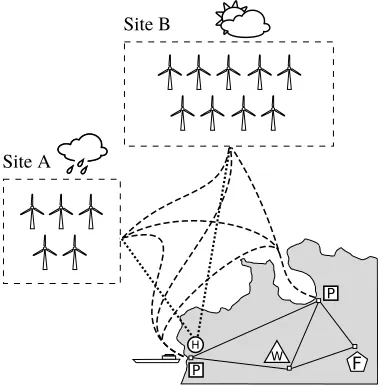
Figure 1: A typical wind-farm maintenance problem. Ships can sail along dashed routes, while helicopters can only leave from airports and move between wind-farms. Both ships and aircraft must Enter the site before being able to move amongst turbines, andExitin order to return to port, making each wind-farm a restricted portion of the state-space. Nodes are labelled as follows:H– heliport,P– sea-port,W– warehouse,F– factory.
2010).
When a maintenance operation is required, the associated plan is hand-built by a logistics expert within the company. The objective of this expert is to minimise the cost associ-ated with the operation, whilst also minimising the down-time of the failed turbines. However, they must also con-sider variables such as the availability of ship and helicopter crew; the location of replacement parts; weather conditions and sea-state.
As there are many components which can break inside the turbine, there are naturally varying degrees of maintenance intervention. For example, a simple manual reset or visual inspection of a component can be performed on-site in less than an hour, while a blade replacement takes several days and require a large vessel. Beyond this, the replacement of a gearbox or nacelle can involve multiple large-scale ships being on-site for weeks. To this end, companies associate these maintenance operations with generalfault categories, and produce generic plans1which can be applied as needed. Due to their pre-defined nature, execution and integration of more than one plan at-a-time can be a difficult process and prone to sub-optimality in the final plan.
While the correct allocation of resources is critical to re-solving faults, the primary concern for the wind-farm opera-tor is the cost involved in the repair. While an onshore gear-box replacement may cost thousands of pounds in labour, the cost of a similar offshore operation can be several orders-of-magnitude greater (Concerted Action on Offshore Wind
1
These generic plans can be thought of asliftedplans, where groundings are specific to the task-at-hand, and additional actions may be needed to achieve the goal.
[image:2.612.78.268.54.247.2]Energy in Europe 2001; Minguez et al. 2011), meaning per-forming maintenance on turbines which fail regularly is not economically viable. For this reason, operators often prefer to leave malfunctioning turbines in an offline state until the annual wind-farm-inspection window arrives, or a sufficient number of failures occur that the cost outlay is worthwhile. This results in large plans being constructed which can be heavily weighted towards scheduling. Indeed, given the pre-defined nature of the existing maintenance plans, the prob-lem can often be one of pure scheduling, where resources are allocated on an hourly basis and the plan can last for weeks. Figure 1 provides an overview of a simple domain structure. One further complication which arises in the context of offshore wind maintenance are the constraints imposed by the weather. For example, helicopters cannot fly in low vis-ibility or winds greater than 30mph and can only carry a small number of passengers, while ships cannot sail when wave heights exceed 3 metres. Additionally, work crews cannot operate on turbines during the hours of darkness or while the turbine is in operation.
The problem described above contains many complex fea-tures which require an expert in scheduling to be perma-nently on-staff. Clearly, it would be beneficial to have an automated solution to the construction of plans which can achieve multiple maintenance goals at varying degrees of complexity and integration. We present the WINDYdomain as a possible solution to these issues2, which captures the majority of these characteristics and allows for multi-goal P&S of turbine assets.
Domain Encoding
Planning offers an elegant solution to the automation of this process, allowing the possibility for plans produced to be op-timal in cost/revenue lost, maximise parallelism and achieve multiple goals. In addition, plans can be generated offline3, as many maintenance tasks have an organisation period last-ing days, weeks or even months.
The WINDYdomain is split into two encodings (WINDY -COMPLEX and WINDY-SIMPLE), which respectively sat-isfy and partially-satsat-isfy these constraints. This is done for tractability reasons which will be detailed shortly. In both cases, the domain includes the majority of PDDL 2.2 features, with WINDY-COMPLEX only excluding derived-predicates.
At a basic level, resources such as vehicles and crew are represented using fluents, while predicates are used to en-capsulate the traditional transportation network and the lo-cation/condition of various turbine components. Planning at this propositional level is possible, but would forces ac-tions to have the same cost, making the plan optimal only in length and not monetary cost which is the true objective.
Both metric and temporal aspects are required to move the domain closer to the real-life counterpart, wherein each task is dependent upon the costs involved in renting/buying
2
The domain and problem files
de-scribed in this paper are available from
http://www.cis.strath.ac.uk/∼pattison/windy 3
equipment and the time required to perform each task. For example, a jack-up barge which is required to perform ma-jor maintenance operations may take a day to reach a re-mote site and costs hundreds-of-thousands of pounds to lease per-day. However, even this encoding assumes that plans can run continuously (i.e. 24 hours-a-day), some-thing which health-and-safety laws do not allow. There-fore, timed-initial-literals (TILs) are also required to repre-sent weather constraints, such as low and high tide; forecast windspeeds and wave heights, and sunrise and sunset. With-out TILs, the true costs of a reasonable-length plan cannot be correctly estimated (e.g. helicopters cannot fly within the farm after sunset).
The above constraints are encapsulated in WINDY -SIMPLE. This representation is suitable for a decision-support role in that plans can be generated relatively quickly which show the approximate form of the maintenance plan. However, in this form these plans must be considered un-optimised for the true problem, as they cannot accurately model equipments costings. Therefore, WINDY-COMPLEX
includesrequired concurrency (RC) (Cushing et al. 2007) as a way of forcing the cost of equipment rentals to be min-imised.
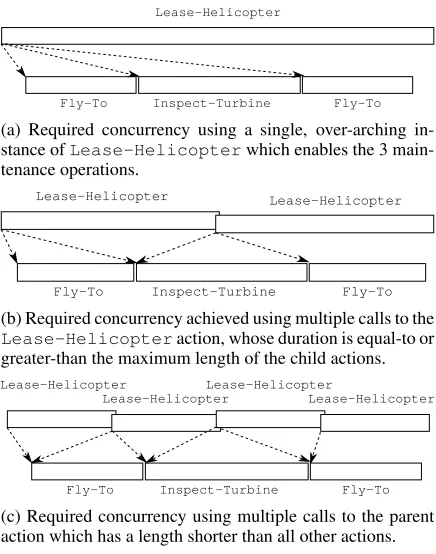
To elaborate, vehicles such as barges and helicopters can only be used once they have been leased from their owner. The period over which the lease applies varies from one ve-hicle to another, with helicopters available on an half-day ba-sis, while jack-up barges normally require at-least a 24-hour commitment. Further, with the time required to reach many wind-farms greater than the duration of a singleLease, the planner must support not only RC, but also that multiple
Leaseactions overlap to ensure that the vehicle is avail-able over the entire duration of the task. Figure 2 demon-strates this behaviour, where actions enabling RC are re-ferred to asparentactions, and actions which must execute within the duration of these actions are called thechild ac-tions. WINDY-COMPLEX models this behaviour using nu-meric fluents which act assemaphores for other actions – as long as the number of concurrent leases on a vehicle is greater-than zero, the action can execute.
The use of RC is also the only way in which accurate cost-modelling can be attained – with the duration of these ac-tions directly related to the cost of the overall operation. For example, without RC, helicopters can fly to the windfarm then hover indefinitely while repairs are performed, despite having only 9 hours of fuel. Similarly, ships are “free” once they have reached the site. A list of the more important do-main features and their PDDL equivalent is given in Table 2.
Scheduling Subproblem
Recalling that the construction of maintenance plans is cur-rently performed by scheduling resources against generic pre-defined plans, it is natural to expect there to be a large element of scheduling in the PDDL encoding. This is pri-marily represented by the repair tasks which are undertaken on turbines, once all ship and crew are at the wind-farm site. This is captured by “sandboxing” actions which can be performed at wind-farm sites, from the rest of the
state-Lease-Helicopter
Inspect-Turbine Fly-To Fly-To
(a) Required concurrency using a single, over-arching in-stance ofLease-Helicopterwhich enables the 3 main-tenance operations.
Lease-Helicopter Lease-Helicopter
Inspect-Turbine Fly-To Fly-To
(b) Required concurrency achieved using multiple calls to the
Lease-Helicopteraction, whose duration is equal-to or greater-than the maximum length of the child actions. Lease-Helicopter
Inspect-Turbine Fly-To Fly-To
Lease-HelicopterLease-HelicopterLease-Helicopter
[image:3.612.330.548.50.327.2](c) Required concurrency using multiple calls to the parent action which has a length shorter than all other actions.
Figure 2: Required concurrency under different assump-tions, where arrows indicate that the parent action is needed to execute the child action.
space. This is achieved by forcing vehicles toEnterand
Exit wind-farm sites. Maintenance actions can only be performed once inside the site, at which point the underlying transportation problem is simplified to allow movement be-tween any turbine for a fixed cost and duration. For instance, several ships leave port and sail for siteA. Upon arriving at the site, they must each execute the Enteraction, which enables them to move between turbines and perform repairs. Movement between turbines is not restricted – there is no route-finding aspect, as the site is assumed to be sufficiently small that the time required is trivial in comparison to the duration of maintenance tasks themselves.
The removal of the route-finding problem and by restrict-ing engineers to only carry out work on turbines within wind-farms allows for high parallelism to exist, through the allocation of engineers and ships to the various turbine as-sets throughout the working day. Such integrated scheduling problems are something which planners have traditionally ignored or failed to detect.
Excluded Features
Problem 1 2 3 4 5 6 7
Manual Resets 3 3 3 3 3 3 3
Inspections - 3 3 3 3 3 10
Minor repairs - - 2 3 3 3 3
Moderate repairs - - - 2 2 2 2
Major repairs - - - - 1 1 1
Constraints - - - High Winds High Winds
[image:4.612.146.470.52.148.2]Planning Time 7 87 95 378 486 427 1668
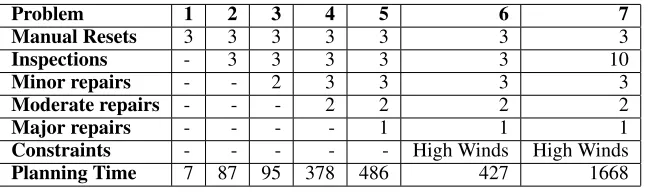
Table 1: Results of runningOPTICacross various sample problems on WINDY-SIMPLE. Planning time is expressed in seconds.
Problem Requirement PDDL Feature
Logistics requirements Predicates/numeric fluents Long-term plans Durative-actions
Environmental aspects Timed-Initial-Literals Cost/Revenue tradeoff Maximise/minimise metrics Resource movement Transportation dynamics Resource allocation Scheduling dynamics Cyclic plans Goals same as initial state
Table 2: The various requirements of the wind maintenance problem domain, and their respective feature encoding in PDDL 2.2.
be resolved without the relevant equipment being ordered prior to departure from land, making modelling this unnec-essary.
Domain Evaluation
In order to evaluate the WINDY domain, several problems scenarios were constructed ranging from simple inspection of a few turbines, through to large-scale maintenance inter-vention operations. We use the OPTIC planner for testing (Benton, Coles, and Coles 2012), as it is the only known planner to support all required domain features (for both WINDY variants). To make planning with TILs tractable, we take advantage of thetime-window abstraction function-ality previously demonstrated in (Tierney et al. 2012), which allows the planner to recognise day/night cycles and ad-just plans accordingly. Timings reported are taken from a 2.8GHz machine with 4GB of memory.
For WINDY-SIMPLE, it is possible to produce relatively long-term plans within a reasonable amount of time, as shown in Table 1. However, as OPTIC is non-optimising, these can be unnecessarily expensive (even after being ap-propriately scheduled). For instance, both a helicopter and workboat may be leased for maintenance operations when in reality only the workboat is required. This can be somewhat mitigated by artificially limiting the vehicles and resources available to the planner, which could still be considered ac-ceptable in a decision-support context, albeit not ideal.
However, in the case of WINDY-COMPLEX, despite sup-porting all requirements,OPTICis unable to find plans for all but the most trivial of problems. This is due to the inability to chain RC parent actions of the form given in Figure 2c, without resorting to best-first-search from which the plan-ner rarely returns. Without this functionality, plan cost must be computed as a post-processing step, potentially leading
to poorly-informed decisions during search. For example, once leased, a jack-up barge is free to use on all mainte-nance tasks including those which would be better suited to a fast helicopter drop-off.
Discussion and Future Work
We have presented the WINDY domain as a real-world ap-plication of integrated temporal P&S. The domain has been developed in co-operation with an industrial partner in the wind asset-management sector, as an initial investigation into the optimisation of maintenance scheduling, whilst also simplifying the process through automation. Follow-up work to this will see the integration of the domain and a plan-ner with a live wind-asset-management system. By closely integrating the domain with a planner, it is expected that some of the restrictive modelling problems currently present will be overcome.
The domain currently uses the total cost of repair as an optimisation metric, however, it cannot incorporate the rev-enue lost from offline turbines. As such, plans often disable turbines as the first action, despite this not being needed for several hours, days or even weeks. For such revenue losses to be included, a continuous PDDL+ model would be re-quired (Fox and Long 2001).
While WINDY-COMPLEXadheres to the PDDL 2.2 defi-nition, onlyOPTICoffers support for the features used, and cannot generate plans beyond relatively trivial maintenance operations without user intervention. In order for the do-main and associated output to be accepted by do-maintenance planners, aspects such as concurrency must be maximised to allow for minimisation of costs, whilst also optimising any solutions produced. This makes WINDYa useful benchmark for future planners incorporating RC, and more generally as a real-world cost-minimisation problem.
Finally, one feature of the problem which has not been ex-plored in this paper is that goals often appearincrementally. For example, while a plan may be constructed for July which achieves the desired maintenance goals, a new fault may ap-pear in June which requires attention. This moves the prob-lem towards one of replanning and potentially opportunistic planning, as the previous solution may have been resource-heavy and costly to produce, making replanning from start an inelegant process.
Acknowledgements
References
Benton, J.; Coles, A. J.; and Coles, A. I. 2012. Tempo-ral planning with preferences and time-dependent continu-ous costs. In Proceedings fo the Twenty Second Interna-tional Conference on Automated Planning and Scheduling (ICAPS-12). AAAI Press.
Concerted Action on Offshore Wind Energy in Europe. 2001. Offshore wind energy – ready to power a sustainable Europe. Technical report, European Commission.
Cushing, W.; Kambhampati, S.; Mausam; and Weld, D. S. 2007. When is temporal planning really temporal? In Pro-ceedings of the 20th international Joint Conference on Artif-ical Intelligence, IJCAI’07, 1852–1859. San Francisco, CA, USA: Morgan Kaufmann Publishers Inc.
Edelkamp, S., and Hoffmann, J. 2004. PDDL2.2: The lan-guage for the Classical part of the 4th International Planning Competition. Technical Report 195.
Fox, M., and Long, D. 2001. PDDL+: An extension to PDDL2.1 for modelling planning domains with continuous time-dependent effects. Technical report, Department of Computer Science, University of Durham.
IEC. 2005. IEC 61400–1 Wind Turbines – Part 1: Design Requirements. International Organization for Standardiza-tion, Geneva, Switzerland, 3rd edition.
Minguez, R.; Martinez, J.; Castellanos, O.; and Guanche, R. 2011. Component failure simulation tool for optimal elec-trical configuration and repair strategy design of off-shore wind farms. InOCEANS, 2011 IEEE - Spain, 1–10. Renewables Advisory Board. 2010. Value breakdown for the offshore wind sector. Technical report.