City, University of London Institutional Repository
Citation
:
Tan, L.H.T. and Ward, G. (2008). Rehearsal in immediate serial recall. Psychonomic Bulletin & Review, 15(3), pp. 535-542. doi: 10.3758/PBR.15.3.535This is the accepted version of the paper.
This version of the publication may differ from the final published
version.
Permanent repository link:
http://openaccess.city.ac.uk/4270/Link to published version
:
http://dx.doi.org/10.3758/PBR.15.3.535Copyright and reuse:
City Research Online aims to make research
outputs of City, University of London available to a wider audience.
Copyright and Moral Rights remain with the author(s) and/or copyright
holders. URLs from City Research Online may be freely distributed and
linked to.
City Research Online: http://openaccess.city.ac.uk/ [email protected]
Rehearsal in immediate serial recall
Lydia Tan1 and Geoff Ward2
1City University
2University of Essex
Correspondence to:
Lydia Tan, Geoff Ward,
Department of Psychology, Department of Psychology,
City University, University of Essex,
Northampton Square, Wivenhoe Park,
London, Colchester,
EC1V 0HB, CO4 3SQ,
UK UK
Telephone: +44 207 0408379 +44 1206 873799
Fax: +44 207 0408090 +44 1206 873590
E-mail: [email protected] [email protected]
Main word count = 3, 984 words
Abstract
We report for the first time overt rehearsal data in immediate serial recall
(ISR) undertaken at three presentation rates (1 s/word, 2.5 s/word and 5 s/word).
Two groups of participants saw lists of 6 words for ISR and were required either to
engage in overt rehearsal or to remain silent after reading aloud the currently
presented word during list presentation. Typical ISR serial position effects were
obtained for both groups, and recall increased with slower rates. When participants
rehearsed, they tended to rehearse in a cumulative forwards order up to serial
position 4, after which the amount of rehearsal decreased substantially. There were
similarities between rehearsal and recall data: both broke down towards the end of
longer sequences, and there were strong positive correlations between the maximum
sequence of participants’ rehearsals and their ISR performance. We interpret these
data as suggesting that similar mechanisms underpin rehearsal and recall in ISR.
In the immediate serial recall (ISR) task, participants are presented with
sequences of to-be-remembered items, and immediately after the last item has been
presented, must try to recall as many of the items as possible in the same order as
that in which they were presented. Performance on ISR is typically characterized by
extended primacy effects and small recency effects.
It is widely acknowledged that participants may rehearse during ISR,
especially if the presentation rate is slow. For example, the working memory model
assumes that rehearsal, via an articulatory control process, refreshes memory traces
which would otherwise undergo rapid decay in the phonological store (Baddeley,
1986). The opposing processes of decay and rehearsal have been widely used to
explain a number of phenomena such as memory span performance, the
phonological similarity effect and word length effect (e.g., Baddeley, Lewis &
Vallar, 1984; Baddeley, Thomson & Buchanan, 1975).
One of the ways in which experimenters to date have examined the role of
rehearsal has been to restrict the amount of rehearsal during ISR by requiring
participants to engage in articulatory suppression (i.e., continuously repeating a
word such as “the” aloud) during list presentation. The key finding that the
phonological similarity effect and word length effect are eliminated under
articulatory suppression with visually presented items has been critical in specifying
the detailed architecture of the working memory model (e.g., Baddeley & Lewis,
1984; Baddeley et al., 1984).
Many formal computational models similarly assume that rehearsal occurs
during ISR (e.g., Burgess & Hitch, 1999; Henson, 1998; Page & Norris, 1998).
Burgess and Hitch’s (1999) Phonological Loop model implements rehearsal in the
Primacy model of Page and Norris (1998) similarly models rehearsal as a
cumulative process, and considers rehearsals of list items simply to be more recent
re-presentations of these items. They assume that participants rehearse in a
cumulative forwards order until such a point in the list when rehearsal cannot be
completed before the next item is presented. There is empirical evidence that a
cumulative forwards order rehearsal strategy can enhance the primacy effect. Palmer
and Ornstein (1971) required participants to rehearse items covertly, either
cumulatively or in most recent pairs. They found that performance on a subsequent
serial probed recall task was strongly affected by participants’ rehearsal strategy,
with much larger primacy effects being obtained in the cumulative rehearsal
conditions.
Despite the widespread assumption that rehearsal plays an important role in
ISR, it is perhaps surprising that no evidence exists as to which words (if any)
participants actually rehearse during the task. The present experiment therefore
sought to investigate directly participants’ patterns of rehearsal in ISR. This was
done using the overt rehearsal methodology, in which participants were asked to
rehearse aloud during list presentation (Rundus, 1971; Tan & Ward, 2000). Clearly,
knowledge of the actual patterns of rehearsals used by participants in ISR would
enable us to examine directly the assumptions inherent in models of ISR. For
example, one could determine whether Page and Norris (1998) are correct in
assuming that participants rehearse in a cumulative forwards order until they can no
longer rehearse the sequence prior to the next item being presented. In addition, a
detailed understanding of participants’ rehearsals in ISR would allow us to examine
whether there might be similarities between the mechanisms underpinning rehearsal
The overt rehearsal method necessitated that we presented the words at a
slower rate than is typically used in ISR tasks. We used three different presentation
rates (fast, medium and slow) in order to vary the amount of rehearsal that occurred
across conditions. The effect of presentation rate in ISR has been shown to be
ambiguous. In some cases, a slower presentation rate leads to poorer recall (e.g.,
Conrad & Hille, 1958), whereas in other studies, slower presentation rates lead to
superior recall (e.g., Mackworth, 1962). These contradictory findings may perhaps
be due to the two counteracting effects of rehearsal and retention interval: slower
presentation rates are associated with increases in retention interval, but typically
also lead to increased rehearsal (which should improve recall). In addition, a silent
control group was used in order to determine whether the requirement to rehearse
aloud had any effect on recall performance.
A final advantage of using the overt rehearsal method was that we could
examine directly the effect of rehearsal on recall for each presentation rate and serial
position. If rehearsal improves recall by decreasing the functional retention interval,
then we should see positive benefits of rehearsal on ISR performance to the extent
that forward cumulative rehearsal has been completed successfully throughout the
list.
Method
Participants. Forty students from the University of Essex participated in this
experiment.
Materials. The materials were selected from the Toronto Word Pool (Friendly,
Franklin, Hoffman & Rubin, 1982) and consisted of 290 disyllabic nouns, four to six
Kucera and Francis (1967) norms. From this word pool, 48 experimental lists were
randomly selected for each participant, each consisting of 6 words. Three additional
practice lists of 6 words were similarly generated. No participant received the same
word twice during the experiment. The materials were presented using the application
Supercard on an Apple Macintosh computer.
Design. A mixed design was used. Type of rehearsal (overt vs. silent) was a
between-subjects factor. There were two within-between-subjects factors: presentation rate (fast, 1
s/word; medium, 2.5 s/word; and slow, 5 s/word) and serial position (1-6).
Procedure. The participants were randomly assigned to two groups of 20, and were
tested individually. Following the instructions, each participant saw a total of 3
practice lists followed by 48 experimental lists of 6 words for immediate verbal serial
recall. Participants in the overt rehearsal conditions were asked to rehearse aloud any
words from the list that they were currently thinking of, whereas participants in the
silent condition were told to remain silent after reading aloud each word. Each list
began with a warning tone, followed after 3 seconds by the presentation of a six-word
list. The words were presented visually one at a time in the center of the computer
screen, and participants were required to say each word aloud as it appeared on the
screen. A series of three beeps at the end of each list signalled the beginning of a
15-second recall period. Participants were instructed to recall in forwards serial order,
and to say “blank” if they could not remember an item in the list. At the end of the
recall period, a tone sounded and participants were prompted to continue with the
next list by clicking the mouse. The presentation rates for the fast, medium, and slow
conditions were: 1 s/word (0.25 s on, 0.75 s off), 2.5 s/word (1.75 s on, 0.75 s off) and
5 s/word (4.25 s on, 0.75 s off) respectively. The presentation rates were blocked,
and this same ordering of presentation rates was used in the three practice trials at the
start of the experiment.
Results
Recall
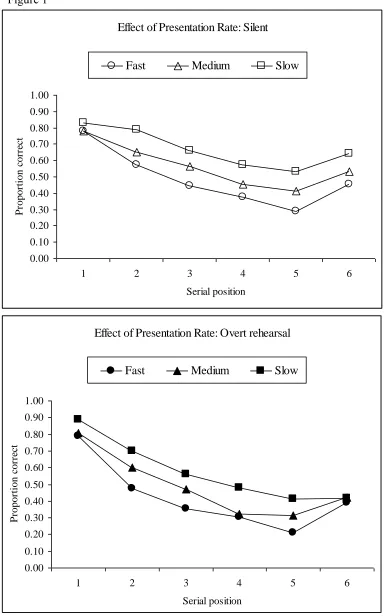
Serial Position. The proportion of items recalled at each serial position for
each condition is shown in Figure 1. We used the standard method of ISR scoring in
which each response was considered to be correct if it was output in the same absolute
serial position as it was input (with each “blank” response counting as an output serial
position). A 2 (Rehearsal type: overt or silent) x 3 (Presentation rate: fast, medium or
slow) x 6 (Serial position: 1-6) mixed ANOVA was performed. This revealed a
significant main effect of presentation rate, F(2, 76) = 32.22, MSE = 1.76, p < .0001,
and serial position, F(5, 190) = 109.05, MSE = 3.22, p < .0001, but not of rehearsal
type, F(1, 138) = 2.88, p > .05.
The rehearsal type x serial position interaction was significant, F(5, 190) =
3.23, MSE = .095, p < .01, as was the presentation rate x serial position interaction,
F(10, 380) = 3.36, MSE = .047, p < .001. However, the 2-way rehearsal type x
presentation rate interaction was not significant (F < 1), nor was the 3-way rehearsal
type x presentation rate x serial position interaction, F(10, 380) = 1.21, p > .05.
Despite these two-way interactions, roughly similar serial position curves are
found across presentation rate and rehearsal conditions. Figure 1 shows comparable
levels of performance in the silent and overt rehearsal conditions, significant and
extended primacy effects at all three presentation rates and a one-item recency effect
under fast and medium presentation rates. The main differences are that there was a
slightly larger difference between serial positions 3 and 4 in the overt rehearsal
general lack of recency may at first be surprising given that each item was spoken by
the participant upon presentation. However, any modality effect that one might expect
to see may have been abolished by the participants’ spoken rehearsal and recall,
which may have acted as a stimulus suffix.
--Figure-1-about-here--
Distribution of Rehearsal Strategies
We analyzed the patterns of rehearsal obtained from each of the three
presentation rates of the overt rehearsal conditions. We borrowed the term rehearsal
set (RS) from the overt rehearsal literature in free recall (e.g., Rundus, 1971; Tan &
Ward, 2000) to refer to the set of words that is rehearsed after the presentation of each
stimulus item. For example, the set of words in RS 4 at the slow presentation rate
refers to those words rehearsed in the 5 s immediately after the onset of the fourth
word in the list.
We defined four different rehearsal strategies that could be used during a RS.
A “fixed” rehearsal strategy refers to the strategy of rehearsing only the most recently
presented item. A “full cumulative” rehearsal strategy refers to the strategy of
rehearsing in the correct order all of the items presented to date. A “partial
cumulative” rehearsal strategy refers to that of rehearsing in the correct order only
some of the items presented to date. Finally, any other pattern of rehearsal is
categorized under “other”.
To illustrate how these definitions were applied in practice, suppose a
participant was presented with the sequence “A B C D E F”, where the letters A to F
sequence of rehearsals immediately following presentation of word D) then a
participant was deemed to have used a fixed rehearsal strategy if they rehearsed “D”
or “D D” or indeed repeated solely “D” any number of times. A full cumulative
rehearsal strategy was deemed to have been used if somewhere in RS 4 participants
rehearsed the string “A B C D” in that exact order. That is, rehearsals “D D A B C D”
or “A B C D A B C D” or “A B C D A B” would also be deemed full cumulative
rehearsals, whereas rehearsing “A B D C” or “A B C C D” would not. Similarly, a
partial cumulative rehearsal strategy was deemed to have been used if somewhere in
RS 4 participants rehearsed “A”, “A B” or “A B C” in these exact orders, such that
rehearsing “D A B C”, “A B D D” would be considered partial cumulative rehearsals
but “D B C” would not. Finally, “other” referred to any other pattern of response.
--Figure-2-about-here--
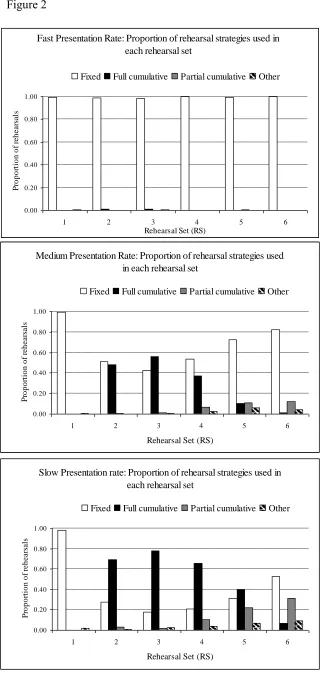
Figure 2 shows the distribution of rehearsal strategies used at each RS for each
of the different presentation rates. There are four main points to make. First, at fast
rates, there was little time to rehearse, and essentially all the rehearsals are of the most
recently presented item (fixed rehearsal). Second, at medium and slow rates there was
substantial cumulative rehearsal early in the list. Over RSs 2-4, participants adopted a
full cumulative rehearsal strategy approximately 45% of the time at the medium rate
and approximately 70% at the slow rate, but there were still significant amounts of
fixed rehearsal (over 40% for medium rate and around 20% for the slow rate). Third,
towards the end of the list at RSs 5 and 6, the amount of cumulative rehearsal
decreased and the amount of fixed rehearsal increased. Finally, there was little
the end of the list at the slow rate. These other responses are hard to generalize, but
many contained forward-ordered sequences such as “45” or “456”.
Rehearsal and Recall
The relationship between rehearsal and recall was examined in three separate
analyses. First, for each trial, a score was calculated that refers to the maximum length
of sequence that was rehearsed. A score of 4 on this measure refers to a trial in which
the participant rehearsed the first four words (but neither the first five nor all six
words) in the list in the correct sequence at some point during the trial, whereas a
score of 1 on this measure refers to a trial in which the participant adopted a fixed
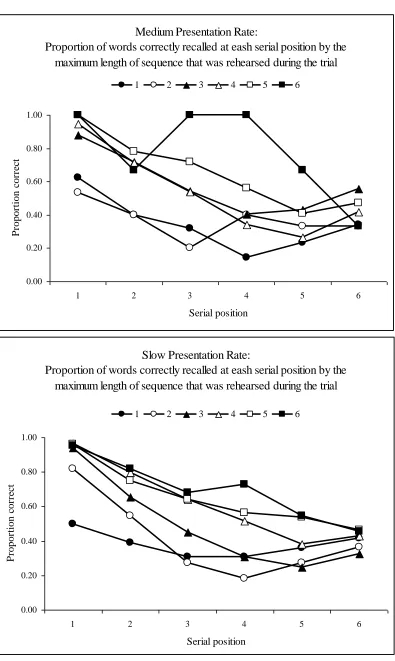
rehearsal strategy throughout the trial. Figure 3 shows the relationship between this
measure and ISR performance. There was not enough rehearsal to merit analysis at
the fast presentation rate, and so the upper panel refers to data from the medium
presentation rate and the lower panel refers to data from the slow presentation rate. As
can be seen from the data at both presentation rates, as the maximum sequence
rehearsed increases, so ISR performance increases.
--Figure-3-about-here--
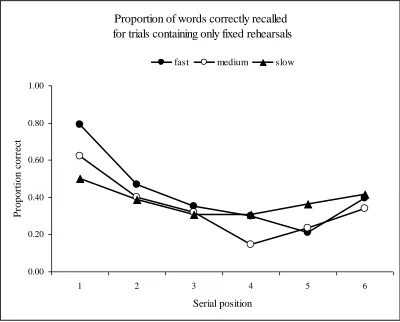
Second, Figure 4 shows the ISR data across all three presentation rates in
which participants adopted a fixed rehearsal strategy throughout the trial. Contrary to
the overall advantage of slower presentation rates on ISR performance, participants
performed better at the faster presentation rates throughout the first half of the list.
--Figure-4-about-here--
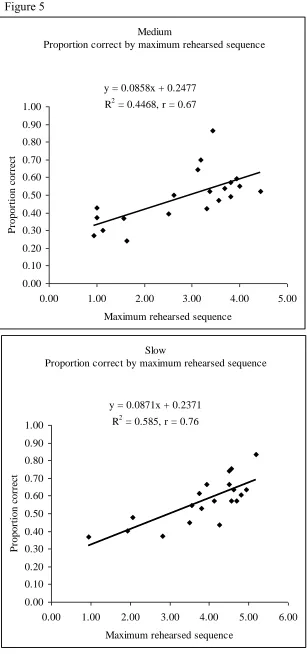
Finally, an analysis of individual differences was conducted. The mean
proportion of words correctly recalled in ISR and the mean maximum number of
words rehearsed correctly in sequence were calculated for each participant for the
medium and slow presentation rates. There were strong positive correlations between
the maximum rehearsed sequence length and the overall proportion correct for both
the medium (r = .67, R2 = .45, p = .001) and slow (r = .77, R2 = .59, p < .001) rates.
--Figure-5-about-here--
Table 1 shows these correlations for each serial position. As can be seen, these
correlations were relatively high for serial positions 1-4, and were reduced at serial
positions 5 and 6.
--Table-1-about-here--
Discussion
There are four main findings from the current experiment. First, considering
the rehearsal data, when participants are asked to rehearse aloud during ISR, they tend
to adopt either a fixed rehearsal strategy or a cumulative forwards order strategy. At
fast presentation rates (and to a lesser extent at slower rates), participants tend to
rehearse only the currently presented item (the fixed rehearsal strategy). However, at
slower rates, when this does not take place, they tend to rehearse in cumulative
forwards order. That is, they rehearse the maximum possible sequence of items in
forwards serial order during each RS, up to RS 4. At RSs 5 and 6, however,
sequence lengths of 4 and below), or else rehearse shorter sequences of later items.
These patterns of rehearsals are consistent with the assumptions of Page and Norris
(1998): participants rehearse early items in a cumulative forwards order throughout
the early part of the list, but towards the middle of the list, they are unable or
unwilling to rehearse complete sequences of items.
Second, ISR performance was superior overall at the slow presentation rate
compared to the fast presentation rate. However, the precise relationship between
presentation rate and recall appears complex. A slow rate might be expected to reduce
recall due to the increased retention interval but also increase recall due to the
increased opportunity to rehearse. Our data suggest that, on average, the increase in
accuracy afforded by participants’ rehearsals in our study more than offset the
reduction in accuracy attributable to longer retention intervals. When one considers
ISR performance across presentation rates in the absence of cumulative forwards
rehearsal (Figure 4), we find that recall accuracy is indeed reduced with slower
presentation rates. However, many participants tended to engage in rehearsal at
slower rates, and within each slower rate, ISR performance increased with increased
forwards order rehearsal (Figure 3). Furthermore, there are strong positive
correlations between the rehearsal of sequences of words and their subsequent recalls,
suggesting that increased rehearsal counteracts the effects of increased retention
interval at slower rates.
Third, the general shape of the serial position curve in ISR was similar for all
presentation rates, including the fast rate, in which there was little or no rehearsal.
This suggests that the extended primacy observed in ISR need not always be a direct
consequence of increased rehearsal (see also e.g., Coltheart & Langdon, 1998). This
1971; Tan & Ward, 2000), in which there is a close relationship between rehearsal
and extended primacy effects. Rather, we believe that other factors, such as the order
of recall, which was identical across all presentation rate conditions, has a large effect
on the shape of the serial position curve in ISR (e.g., Tan & Ward, 2007).
Finally, our demonstration that performance breaks down in rehearsal and
recall in similar ways provides support for the idea that similar mechanisms underpin
rehearsal and recall in ISR (Burgess & Hitch, 1999). Rehearsal of sub-span length
lists (4 items or fewer) when it is attempted is near perfect in our data, matching the
near-perfect recall performance that is normally found on such short lists (Miller,
1956). However, when the list length increases to 5 or 6 items, rehearsal is no longer
perfect. Earlier items can still be rehearsed in their correct order, but rehearsal tends
to break down towards the end of the list. (This may simply be an artifact of the
limited time available to rehearse all items during the inter-stimulus interval). We
observe that this pattern is suggestively mirrored in the recall data.
One difficulty with interpreting the positive correlations observed between
overt rehearsals and subsequent recalls is that a number of alternative factors could
lead to relations being seen between rehearsal and recall even if the former is not
causing the latter. A number of potential confounds include subject-selection effects,
item-selection effects, or trial-by-trial fluctuations in motivation or attention.
Apparent correlations between rehearsal and recall could reflect the fact that more
able participants rehearse more and then recall more than less able participants.
Alternatively, participants may be more motivated on some lists than others or find
some words to be more easy to rehearse and remember than others. The controlled
rehearsal procedure (Murdock & Metcalfe, 1978), and the yoked rehearsal procedure
recall. In these procedures, recall is similar when participants can freely select which
words to rehearse, and when they are presented with schedules of repetitions over
which they have no control.
Overall, we have provided for the first time detailed descriptions concerning
the words rehearsed during ISR. This information can be used to help constrain and
test different computational models of ISR. More specifically, the data here tend to
support the assumptions regarding participants’ rehearsal strategies in the Primacy
Model (Page & Norris, 1998), and provide evidence that certain similarities exist
between rehearsal and recall (Burgess & Hitch, 1999). The examination of the
similarities and differences between rehearsal and recall in ISR mirrors recent
examinations of the similarities and differences between rehearsal and recall in free
recall (Laming, 2006; Tan & Ward, 2000). It is often assumed that ISR can be
differentiated from free recall because of the requirement for forwards serial order
recall in the former but not in the latter. However, over the last ten years or so there
has been emerging evidence for the tendency for forwards order output even in free
recall (Beaman & Morton, 2000; Bhatarah, Ward & Tan, in press; Howard & Kahana,
1999; Klein, Addis & Kahana, 2005; Ward, Woodward, Stevens & Stinson, 2003),
and we believe there are grounds for suggesting that the processes underpinning the
recall and rehearsals in free recall and ISR may be more similar than has hitherto been
References
Baddeley, A.D. (1986). Working memory. Oxford: Clarendon Press.
Baddeley, A.D., & Lewis, V.J. (1984). When does rapid presentation enhance digit
span? Bulletin of the Psychonomic Society, 22, 403-405.
Baddeley, A.D., Lewis, V.J., & Vallar, G. (1984). Exploring the articulatory loop.
Quarterly Journal of Experimental Psychology, 36A, 233-252.
Baddeley, A.D., Thomson, N., & Buchanan, M. (1975). Word length and the structure
of short-term memory. Journal of Verbal Learning and Verbal Behavior, 14,
575-589.
Beaman, C. P., & Morton, J. (2000). The separate but related origins of the recency
and the modality effect in free recall. Cognition, 77, B59-B65.
Bhatarah, P., Ward, G. & Tan, L. (in press). Examining the relationship between free
recall and immediate serial recall: The serial nature of recall and the effect of
test expectancy. Memory and Cognition.
Burgess, N., & Hitch, G. (1999). Memory for serial order: A network model of the
phonological loop and its timing. Psychological Review, 106, 551-581.
Coltheart, V., & Langdon, R. (1998). Recall of short word lists presented visually at
fast rates: Effects of phonological similarity and word length. Memory &
Cognition, 26, 330-342.
Conrad, R., & Hille, B.A. (1958). The decay theory of immediate memory and paced
recall. Canadian Journal of Psychology, 12, 1-6.
Friendly, M., Franklin, P. E., Hoffman, D., & Rubin, D. C. (1982). Norms for the
Toronto Word Pool. Behavior Research Methods and Instrumentation, 14,
Henson, R.N.A. (1998). Short-term memory for serial order: The start-end model.
Cognitive Psychology, 36, 73-137.
Howard, M. W. & Kahana, M. J. (1999). Contextual variability and serial position
effects in free recall. Journal of Experimental Psychology: Learning, Memory,
& Cognition, 25, 1-19.
Klein, K. A., Addis, K. M., Kahana, M. J. (2005). A comparative analysis of serial
and free recall. Memory & Cognition, 33, 833-839.
Kucera, H., & Francis, V. W. (1967). Computational analysis of present-day
American English.Providence, RI: Brown University Press.
Laming, D. (2006). Predicting free recalls. Journal of Experimental Psychology:
Learning, Memory, and Cognition. 32, 1146-1163.
Mackworth, J.F. (1962). Presentation rate and immediate memory. Canadian Journal
of Psychology, 16, 42-47.
Miller, G. A. (1956). The magic number seven plus or minus two: Some limits on our
capacity to process information. Psychological Review, 63, 81-97.
Murdock, B. B., & Metcalfe, J. (1978). Controlled rehearsal in single-trial free recall.
Journal of Verbal Learning & Verbal Behavior, 8, 665-676.
Page, M.P.A., & Norris, D. (1998). The primacy model: A new model of immediate
serial recall. Psychological Review, 105, 761-781.
Palmer, S.E., & Ornstein, P.A. (1971). Role of rehearsal strategy in serial probed
recall. Journal of Experimental Psychology, 88, 60-66.
Rundus, D. (1971). Analysis of rehearsal processes in free recall. Journal of
Tan, L., & Ward, G. (2000). A recency-based account of primacy effects in free
recall. Journal of Experimental Psychology: Learning, Memory, and
Cognition, 26, 1589-1625.
Tan, L., & Ward, G. (2007). Output order in immediate serial recall. Memory &
Cognition, 35, 1093-1106.
Ward, G., Woodward, G., Stevens, A., & Stinson, C. (2003). Using overt
rehearsals to explain word frequency effects in free recall. Journal of
Experimental Psychology: Learning, Memory, and Cognition, 29,
Acknowledgements
Table Captions
Table 1. Table of correlations between the proportions of words recalled in the correct
serial order and the maximum sequence length to which the words were rehearsed, for
the words presented in each of the six serial positions and for both the medium and
Figure Captions
Figure 1. The serial position curves for immediate serial recall of words presented at
fast, medium and slow presentation rates in the silent condition (top panel) and overt
rehearsal condition (bottom panel).
Figure 2. Data from the overt rehearsal conditions. The distribution of rehearsal
strategies used during each Rehearsal Set (RS), plotted separately for the fast (top),
medium (middle) and slow (bottom) presentation rates. A rehearsal set refers to the set
of words that was rehearsed immediately after the presentation of each word, such that
RS 4 refers to the set of words rehearsed immediately after the presentation of the
fourth word in the list. The different rehearsal strategies are described fully in the main
text.
Figure 3. Data from the overt rehearsal conditions. The mean proportion of words
recalled in the correct order plotted as a function of serial position and the maximum
rehearsed sequence length during the trial. A score of 5 on this measure indicates that at
any point during a trial, the longest sequence of words rehearsed in correct serial order,
starting from the first, was five. Data in the upper panel are for the medium presentation
rate and data in the lower panel are for the slow presentation rate.
Figure 4. Data from the overt rehearsal conditions in which only the fixed rehearsal
strategy was used throughout the trial. The mean proportion of words recalled in the
Figure 5. Data from the overt rehearsal conditions. Scatterplots showing the
relationship between the mean proportion correct ISR performance and the mean length
of the maximum sequence of words rehearsed in the correct serial order, for the
Table 1.
Presentation Rate
Medium Slow
Serial Position r r2 r r2
1 **.62 .39 ***.81 .65
2 **.62 .38 *.53 .28
3 *.54 .30 **.63 .39
4 **.68 .47 **.68 .46
5 .33 .11 *.48 .23
6 .31 .09 .25 .06
Figure 1
Effect of Presentation Rate: Overt rehearsal
0.00 0.10 0.20 0.30 0.40 0.50 0.60 0.70 0.80 0.90 1.00
1 2 3 4 5 6
Serial position P ropor ti on cor re ct
Fast Medium Slow
Effect of Presentation Rate: Silent
0.00 0.10 0.20 0.30 0.40 0.50 0.60 0.70 0.80 0.90 1.00
1 2 3 4 5 6
Serial position P ropor ti on cor re ct
Figure 2
Fast Presentation Rate: Proportion of rehearsal strategies used in each rehearsal set
0.00 0.20 0.40 0.60 0.80 1.00
1 2 3 4 5 6
Rehearsal Set (RS)
P ro p o rt io n o f re h e a rs a ls
Fixed Full cumulative Partial cumulative Other
Medium Presentation Rate: Proportion of rehearsal strategies used in each rehearsal set
0.00 0.20 0.40 0.60 0.80 1.00
1 2 3 4 5 6
Rehearsal Set (RS)
P ro p o rt io n o f re h e a rs a ls
Fixed Full cumulative Partial cumulative Other
Slow Presentation rate: Proportion of rehearsal strategies used in each rehearsal set
0.00 0.20 0.40 0.60 0.80 1.00
1 2 3 4 5 6
Rehearsal Set (RS)
P ro p o rt io n o f re h e a rs a ls
Figure 3.
Medium Presentation Rate:
Proportion of words correctly recalled at eash serial position by the maximum length of sequence that was rehearsed during the trial
0.00 0.20 0.40 0.60 0.80 1.00
1 2 3 4 5 6
Serial position P ropor ti on cor re ct
1 2 3 4 5 6
Slow Presentation Rate:
Proportion of words correctly recalled at eash serial position by the maximum length of sequence that was rehearsed during the trial
0.00 0.20 0.40 0.60 0.80 1.00
1 2 3 4 5 6
Serial position P ropor ti on cor re ct
Figure 4
Proportion of words correctly recalled for trials containing only fixed rehearsals
0.00 0.20 0.40 0.60 0.80 1.00
1 2 3 4 5 6
Serial position
P
ropo
rt
ion
cor
re
ct
Figure 5
Medium
Proportion correct by maximum rehearsed sequence
y = 0.0858x + 0.2477 R2 = 0.4468, r = 0.67
0.00 0.10 0.20 0.30 0.40 0.50 0.60 0.70 0.80 0.90 1.00
0.00 1.00 2.00 3.00 4.00 5.00
Maximum rehearsed sequence
P rop or ti on c or re ct Slow
Proportion correct by maximum rehearsed sequence
y = 0.0871x + 0.2371 R2 = 0.585, r = 0.76
0.00 0.10 0.20 0.30 0.40 0.50 0.60 0.70 0.80 0.90 1.00
0.00 1.00 2.00 3.00 4.00 5.00 6.00
Maximum rehearsed sequence