Data Matters
DataSHIELD: taking the analysis to the data,
not the data to the analysis
Amadou Gaye,
1Yannick Marcon,
2Julia Isaeva,
3Philippe LaFlamme,
2Andrew Turner,
1Elinor M Jones,
4Joel Minion,
1Andrew W Boyd,
1Christopher J Newby,
5Marja-Liisa Nuotio,
6,7Rebecca Wilson,
1Oliver Butters,
1Barnaby Murtagh,
8Ipek Demir,
9Dany Doiron,
2Lisette Giepmans,
10Susan E Wallace,
8Isabelle Budin-Ljøsne,
3Carsten Oliver Schmidt,
11Paolo Boffetta,
12Mathieu Boniol,
12Maria Bota,
12Kim W Carter,
13Nick deKlerk,
13Chris Dibben,
14Richard W Francis,
13Tero Hiekkalinna,
6,7Kristian Hveem,
15Kirsti Kvaløy,
15Sean Millar,
16Ivan J Perry,
16Annette Peters,
17Catherine M Phillips,
16Frank Popham,
18Gillian Raab,
14Eva Reischl,
17Nuala Sheehan,
8Melanie Waldenberger,
17Markus Perola,
6,7,19Edwin van den Heuvel,
20John Macleod,
1Bartha M Knoppers,
21Ronald P Stolk,
10,22Isabel Fortier,
2Jennifer R Harris,
3Bruce HR Woffenbuttel,
22,23Madeleine J Murtagh,
24yVincent Ferretti
2,25yand Paul R Burton
2,24y*
1
School of Social and Community Medicine, University of Bristol, Bristol, UK,
2Maelstrom Research
Group, Research Institute of the McGill University Health Centre, McGill University, Montreal, Canada,
3Norwegian Institute of Public Health, Oslo, Norway,
4Department Statistical Science, University
College London, London, UK,
5Department of Infection, Immunity and Inflammation, Health Sciences,
University of Leicester, Leicester, UK,
6Institute for Molecular Medicine Finland (FIMM), University of
Helsinki, Helsinki, Finland,
7Unit of Public Health Genomics, National Institute for Health and Welfare,
Helsinki, Finland,
8Department of Health Sciences, University of Leicester, Leicester, UK,
9Department
of Sociology, University of Leicester, Leicester, UK,
10Department of Epidemiology, University Medical
Center Groningen, Groningen, The Netherlands,
11Institut fu¨r Community Medicine, University
Medicine of Greifswald, Greifswald, Germany,
12International Prevention Research Institute, Lyon,
France,
13Telethon Kids Institute, University of Western Australia, Perth, WA, Australia,
14School of
Geosciences, University of Edinburgh, Edinburgh, UK,
15Norwegian University of Science and
Technology, Levanger, Norway,
16HRB Centre for Diet and Health Research, Department of
Epidemiology and Public Health, University College Cork, Cork, Ireland,
17Research Unit of Molecular
Epidemiology, Research Center for Environmental Health, Neuherberg, Germany,
18MRC/CSO Social
and Public Health Sciences Unit, University of Glasgow, Glasgow, UK,
19University of Tartu, Estonian
Genome Center, Tartu, Estonia,
20University Medical Center Groningen, Medical Statistics, Groningen,
The Netherlands,
21Centre of Genomics and Policy, McGill University, Montreal, Canada,
22University
Medical Center Groningen, LifeLines Cohort Study, Groningen, The Netherlands,
23Department of
Endocrinology, University Medical Center Groningen, Groningen, The Netherlands,
24School of Social
VCThe Author 2014; all rights reserved. Published by Oxford University Press on behalf of the International Epidemiological Association 1929 This is an Open Access article distributed under the terms of the Creative Commons Attribution Non-Commercial License (http://creativecommons.org/licenses/by-nc/4.0/), which permits non-commercial re-use, distribution, and reproduction in any medium, provided the original work is properly cited. For commercial re-use, please contact [email protected]
Advance Access Publication Date: 26 September 2014 Original article
at University of Strathclyde on January 14, 2016
http://ije.oxfordjournals.org/
and Community Medicine, University of Bristol, Bristol, UK and
25Ontario Institute for Cancer Research,
Toronto, Canada
*Corresponding author. E-mail: [email protected] †
These authors contributed equally to this work.
Accepted 15 August 2014
Abstract
Background:
Research in modern biomedicine and social science requires sample sizes
so large that they can often only be achieved through a pooled co-analysis of data from
several studies. But the pooling of information from individuals in a central database that
may be queried by researchers raises important ethico-legal questions and can be
con-troversial. In the UK this has been highlighted by recent debate and controversy relating
to the UK’s proposed ‘
care.data
’ initiative, and these issues reflect important societal
and professional concerns about privacy, confidentiality and intellectual property.
DataSHIELD provides a novel technological solution that can circumvent some of
the most basic challenges in facilitating the access of researchers and other healthcare
professionals to individual-level data.
Methods:
Commands are sent from a central analysis computer (AC) to several data
computers (DCs) storing the data to be co-analysed. The data sets are analysed
simultan-eously but in parallel. The separate parallelized analyses are linked by non-disclosive
summary statistics and commands transmitted back and forth between the DCs and the
AC. This paper describes the technical implementation of DataSHIELD using a modified
R statistical environment linked to an Opal database deployed behind the computer
firewall of each DC. Analysis is controlled through a standard R environment at the AC.
Results:
Based on this Opal/R implementation, DataSHIELD is currently used by the
Healthy Obese Project and the Environmental Core Project (BioSHaRE-EU) for the
feder-ated analysis of 10 data sets across eight European countries, and this illustrates the
opportunities and challenges presented by the DataSHIELD approach.
Conclusions:
DataSHIELD facilitates important research in settings where: (i) a
co-analysis of individual-level data from several studies is scientifically necessary but
gov-ernance restrictions prohibit the release or sharing of some of the required data, and/or
render data access unacceptably slow; (ii) a research group (e.g. in a developing nation)
is particularly vulnerable to loss of intellectual property—the researchers want to fully
share the information held in their data with national and international collaborators, but
do not wish to hand over the physical data themselves; and (iii) a data set is to be
included in an individual-level co-analysis but the physical size of the data precludes
direct transfer to a new site for analysis.
Key words: DataSHIELD, pooled analysis, ELSI, privacy, confidentiality, disclosure, distributed computing, intellec-tual property, bioinformatics
Key Messages
• DataSHIELD provides a solution when ethico-legal considerations prevent or impede data-sharing and analysis.
• It promotes and facilitates collaborations by empowering data owners and affording them better control over their data.
• DataSHIELD has the potential to protect the intellectual property of researchers in institutions and countries with
limited resources, thus enabling more balanced collaborations with wealthier partners.
• It also improves the governance and management of data by allowing them to be maintained locally.
at University of Strathclyde on January 14, 2016
http://ije.oxfordjournals.org/
Introduction
The analysis of complex interrelated datasets containing demographic, social, health-related and/or biological infor-mation derived from large numbers of individuals has become pivotal to the investigation of disease causation and to the evaluation of healthcare programmes and inter-ventions. However, the daunting sample sizes needed to provide adequate statistical power1–3 often exceed the provision of any one single study. Furthermore, if major re-search funders are to optimize return on their investment of public or charitable money, it is crucial that researchers other than those who originally created a particular data set are able to access and work with those data.4These two impera-tives underpin the active encouragement of ‘data sharing’— across several studies, or from a single data source—which is central to contemporary bioscience.5The data to be shared may be derived from large epidemiological studies, from smaller research projects and/or from healthcare or adminis-trative records. They may originally have been intended for research or for direct support of patient care or public health. There is no doubt that liberating and integrating such infor-mation to support medical research has the potential to gen-erate enormous future health benefits. But substantive challenges exist, and the sharing of data—particularly individual-level data, also known asmicrodata6—raises im-portant societal and professional concerns.
In the UK, these concerns were recently highlighted by controversy surrounding thecare.dataproject.7,8At a soci-etal level they include real and perceived frailties of infor-mation governance when a research database containing potentially sensitive personal information about individ-uals is made accessible to any third party including re-searchers.4 However, these broader societal concerns are closely—though not precisely—mirrored in the disquiet of some professional health researchers regarding the unfet-tered sharing of valuable scientific data that they believe exist primarily because they have made a substantial in-vestment of their own time, effort and scientific thought to creating and managing them. In both instances, individuals for whom the data to be shared are valuable and poten-tially sensitive (personally, or as intellectual property) worry that, once they have been physically ‘shared’, there will be a significant loss of control over their subsequent exploitation. In support of this thesis, we have noted9that researchers are often more than willing to share the infor-mation contained in their data—because this enhances the quality and quantity of their own scientific output by pro-viding opportunities for national and international collab-oration. But they are sometimes less keen to hand over the physical data themselves,9because even with ethically and legally binding safeguards in place, the loss of governance
control over the data themselves and the intellectual prop-erty they represent can be seen as seriously problematic. This is particularly so for data creators with limited re-sources for managing and scientifically exploiting their own data—e.g. researchers in developing countries. Effective and acceptable solutions must be found to all of these problems if we are to optimize evidence-based pro-gress in stratified and conventional medicine.
Many technical and policy measures can be enacted to render data sharing more secure from a governance per-spective and less likely to result in loss of intellectual prop-erty. For example, data owners might restrict data release to aggregate statistics alone, or may limit the number of variables that individual researchers might access for speci-fied purposes. Alternatively, secure analysis centres, such as the ESRC Secure Data Service,10and SAIL,11represent major informatics infrastructures that can provide a safe haven for remote or local analysis/linkage of data from selected sources while preventing researchers from down-loading the original data themselves. However, to comple-ment pre-existing solutions to the important challenges now faced, the DataSHIELD consortium has developed a flexible new way to comprehensively analyse individual-level data collected across several studies or sources while keeping the original data strictly secure. As a technology, DataSHIELD uses distributed computing and parallelized analysis to enable full joint analysis of individual-level data from several sources—e.g. research projects or health or administrative data—without the need for those data to move, or even be seen, outside the study where they usually reside.12 Crucially, because it does not require underpin-ning by a major informatics infrastructure and because it is based on non-commercial open source software, it is both locally implementable and very cost effective.
Co-analysis of data from several studies/sources is often conducted using study-level meta-analysis (SLMA),13–15 using conventional meta-analysis to combine results gener-ated by each study separately.16,17In contrast, individual-level meta-analysis (ILMA)involves the physical transfer of data from each study to produce a single central database that is then analysed as if it were a conventional multi-centre data set.16,17Unfortunately, both SLMA and ILMA present significant problems.12,16,17 Because SLMA com-bines analytical results (e.g. means, odds ratios, regression coefficients) produced ahead of time by the contributing studies, it can be very inflexible: only the pre-planned ana-lyses undertaken by all the studies can be converted into joint results across all studies combined. Any additional analyses must be requestedpost hoc. This hinders explora-tory analysis,16 for example the investigation of sub-groups, or interactions between key variables. In
at University of Strathclyde on January 14, 2016
http://ije.oxfordjournals.org/
contrast, ILMA is very flexible, but ethico-legal consider-ations can impede access to individual-level data. Thus, re-search may be delayed if formal data access procedures are protracted, or may have to be postponed while participants have reconsented.18,19ILMA may even be impossible if con-sent forms prohibit individual-level data being con-sent to exter-nal researchers, or if privacy legislation precludes sharing of data across national or jurisdictional boundaries.12,20,21
[image:4.612.322.544.58.215.2]DataSHIELD circumvents these problems. First, it can be set up to be mathematically equivalent to ILMA,12,22,23 while avoiding the attendant governance, legal or societal concerns.21,24 Individual-level data never cross, and are never visible outside, the firewall of their home study.12,20,24 Jones et al.22 explain why fitting a general-ized linear model (GLM) under DataSHIELD produces exactly the same results—not just a good approximation— as a GLM fitted to a single database containing the individ-ual-level data from all studies combined. This is confirmed empirically in the current article by the comparison of the output of a GLM model fitted initially via DataSHIELD on all studies separately, and then through R on the pooled data (i.e. the separate data sets stacked together into one table). Second, however, DataSHIELD can also be configured to mimic a secure SLMA but without the need to ask individ-ual studies to undertake their own analyses. Under DataSHIELD, any non-disclosive analysis may therefore be re-quested at any time without physically sharing data. DataSHIELD can also protect intellectual property when data producers are keen for external researchers to query and work with their data but do not wish to lose ultimate control by physically transferring their data. This can even apply to a sin-gle study—sinsin-gle-site DataSHIELD—which may be viewed as being a particularly simple and cost-effective way to construct a ‘secure data enclave’ within which data can be comprehen-sively analysed but not accessed. For all of these reasons, DataSHIELD encourages ‘true’, equal-status collaboration.
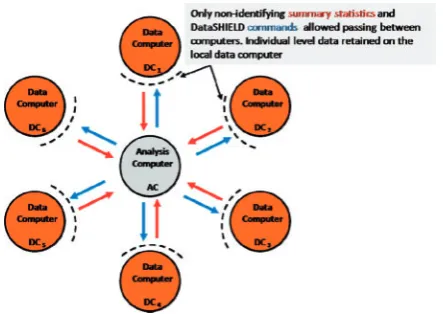
Figure 1 illustrates the basic IT infrastructure for a hypothetical DataSHIELD implementation for co-analy-sing six studies. The individual-level data themselves re-main on ‘data computers’ (DCs) at their home bases. A central ‘analysis computer’ (AC) is used to issue com-mands to enact and control the analysis. As a by-product of its underlying structure, DataSHIELD can enhance gov-ernance and data management because data are locally maintained by their producers who typically know them best; that is, it encourages storage, updating and sharing of complex multi-class data from ongoing studies through a federated rather than a centralized architecture. However, this does not deny the important complementary role of large centralized repositories specializing in archiving par-ticular classes of data, such as the European Genome-Phenome Archive25 or the UK Data Service.10 As an
additional consequence of its structure, DataSHIELD can also avoid the need to move very large data sets. Finally, be-cause all data remain unobserved at their home repository, DataSHIELD can mitigate some of the dilemmas arising from findings of actionable clinical significance in individ-uals.26Specifically, external researchers cannot, in principle, produce results pertaining to individual participants. Rather, individual clinical results can only be generated by investiga-tors working with data from their own study and these inves-tigators should be covered by formal internal policies.
DataSHIELD offers both opportunities and challenges. It has been known for several years that it works in prin-ciple,12,22but its practical implementation and utilization on an IT platform that can be used by non-expert re-searchers has proved to be challenging. This paper de-scribes the application platform that has now been developed. It explains each of the fundamental steps in a typical DataSHIELD analysis and outlines the key elements of the infrastructure that underpins these steps. Illustration is based on a real-world setting in which DataSHIELD is currently being used to analyse data for a pan-European consortium: the Healthy Obese Project (HOP).27 Finally, we briefly discuss a potential future role of DataSHIELD in circumventing some of the privacy and confidentiality concerns arising—as undercare.data7,8—when progress in biomedical science might be accelerated if researchers could easily access and co-analyse data held in multiple sources, including healthcare, social or governmental data, that may have been administratively generated.
Methods
The IT infrastructure
The IT infrastructure required to carry out a DataSHIELD analysis comprises three main components: a computer ser-ver at each source study hosting an Opal database;28
Figure 1. Typical DataSHIELD setting for a pooled individual-level
analysis.
at University of Strathclyde on January 14, 2016
http://ije.oxfordjournals.org/
the statistical programming environment(R29); and DataSHIELD-specific R libraries installed on the data ser-vers (data computers¼DCs) and on the client computer (analysis computer¼AC). Opal is a core database applica-tion for biobanks and epidemiological studies developed by the Maelstrom Research group30 in collaboration with OBiBa, an international software development project cre-ating open-source software for Biobanks.31 Opal, R and DataSHIELD are open source and freely available.
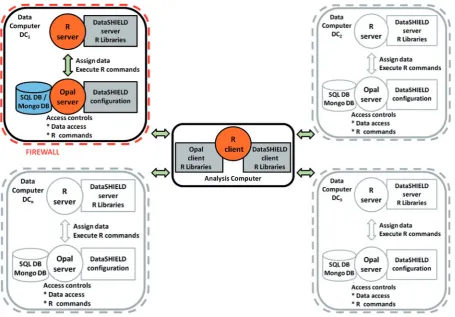
Instances of Opal, the R server and the DataSHIELD server-side R libraries are implemented behind the firewall of each data owner’s DC (Figure 2). The AC is used to en-act and control the distributed analysis. The DataSHIELD client-side R libraries are installed on the AC (Figure 2). A DataSHIELD platform consists of at least one AC com-municating with a number of DCs or with just one DC (i.e. single-site DataSHIELD).
DataSHIELD process explained
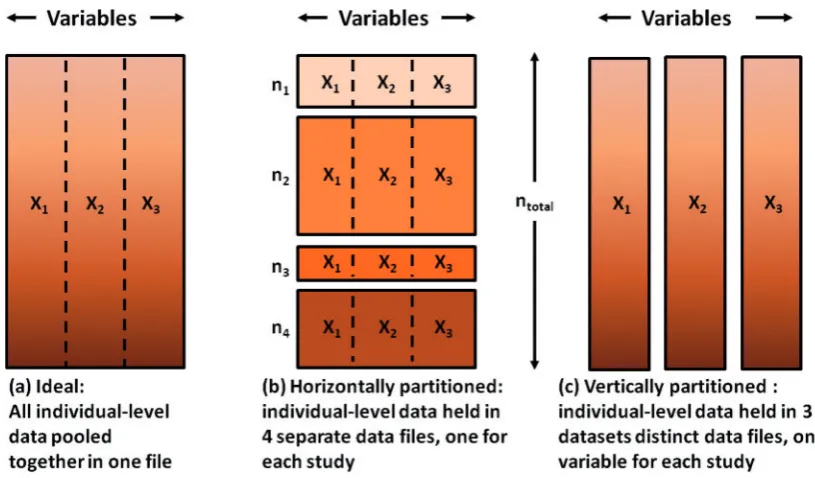
DataSHIELD as described in this article is intended for the pooled analysis of‘horizontally partitioned’ data, i.e. con-tributing sources hold the same variables but on different individuals (seeFigure 3b). A new version of DataSHIELD is currently being developed for ‘vertically partitioned’
data where various sources hold different variables on the same individuals (seeFigure 3c). This uses an overlapping range of secure approaches to secure data integration and retains the same fundamental principle: leave the data where they are but analyse them as if they were combined in one database.
As for any co-analysis, shared data must be harmonized first. The harmonization phase of the HOP project32 within BioSHaRE-EU33 (described in detail else-where27,34,35) is functionally independent of DataSHIELD itself (Table 1, step 0).
DataSHIELD functions
[image:5.612.80.536.57.374.2]The fundamental building blocks of DataSHIELD are its client-side and server-side functions. As illustrated in Figure 2, server-side functions reside in the modified R en-vironments located behind the firewall of the DC at each individual study. It is the server-side functions that actually process the individual-level data at the distinct repositories. The outputs from server-side functions (non-disclosive study-level statistics) represent the only information that ever leaves a DC, and this is why we can claim that DataSHIELD allows full analysis of individual-level data without those data ever having to be moved, or even
Figure 2.Overview of the IT infrastructure required for a DataSHIELD process. The settings are the same in all DCs so only one is highlighted in
this figure. at University of Strathclyde on January 14, 2016
http://ije.oxfordjournals.org/
rendered visible, outside their study of origin. Client-side functions reside on the conventional R environment on the AC. Client-side functions call and control server-side func-tions and combine information across different repositories when required. All DataSHIELD functions require ap-proval under a technical and governance process including external independent evaluation.
DataSHIELD secure analyses
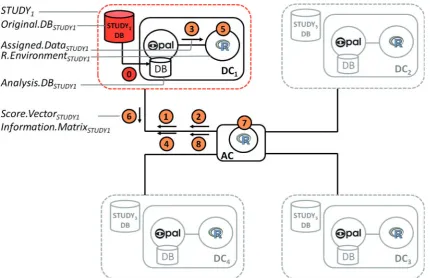
An iterative analysis (e.g. fitting a generalized linear model [GLM]) is illustrated in Figure 4: its steps are detailed in Table 1.The same process is triggered simultaneously in all four DCs. The process iterates through steps 5–8 until the combined coefficient estimates remain unchanged be-tween two iterations (according to a pre-defined tolerance criterion). Once convergence is achieved the AC uses the final score vectors and information matrices from all data sets to provide definitive estimates of regression coefficients, their standard errors and other non-disclosive model out-puts. One-step analyses are analogous to iterative analyses but do not require repeated loops. For example, to construct a contingency table, each study generates its own table in one step—this is inherentlynon-disclosive—and the AC inte-grates these to produce a combined table.
Disclosure control—examples
Some functions that are not intrinsically disclosive can nevertheless be problematic in certain settings. Thus, a contingency table with 1–4 observations in any one cell is often viewed as providing a potential disclosure risk.21To address this problem under DataSHIELD, each DC tests
any contingency table it creates and will only return a full table to the AC if all cells are empty or contain at least five observations. All the AC knows is that it has received an incomplete table which is so constructed that nothing dis-closive can be inferred—Sub-setting—e.g. by sex, age or phenotypic sub-type—is crucial in statistical analysis. But repeated sub-setting may produce sub-groups that are so small that results based on that subset (e.g. a mean) might potentially be disclosive. Under DataSHIELD, therefore, it is not possible to generate a subset data set containing 1–4 observations. However, this rule may be relaxed or made more stringent at the request of the principal investigator who is seen as taking responsibility for the overall analysis. The DataSHIELD project is currently working on govern-ance rules for sub-setting.
Results: DataSHIELD at work
Analyses of data from the Health Obese Project
[image:6.612.98.506.55.294.2]The Healthy Obese Project (HOP)27,32 is part of the BioSHaRE-EU project.33It aims to identify individuals who are ‘healthy obese’ (HO), defined as having a body mass index>30 in the absence of any of the common metabolic sequelae of obesity—e.g. hypertension, hypercholesterol-aemia, impaired glucose tolerance or diabetes—in order to study the biological and environmental correlates of HO. Since HO is relatively uncommon, any single study contain-ing all requisite measures is likely to have inadequate statis-tical power. DataSHIELD provides an effective way to enact a secure federated co-analysis of the multiple studies involved in HOP. This section briefly describes how
Figure 3.Graphical view of pooled data (a), horizontally partitioned (b) and vertically partitioned data (c).
at University of Strathclyde on January 14, 2016
http://ije.oxfordjournals.org/
T able 1. Detailed explanations of the steps in DataSHIELD proces s Step Explanation Input data Output data Output location Visibility (0) Prelim inary and prerequi site step Strictly spea king, this step is not part of a DataSH IELD analy sis pro cess; it is, how -ever, a prerequisite for any va lid ana lysis that pools multipl e data sets. Each con tri-buting study (e.g. STUD Y1 ) identifi es the requi site variabl es and crea tes any new harmo nized variabl es need ed in the co m-bined ana lysis. These harm onized variabl es are then transferr ed from the study’s data -base ( Or iginal .DB STUDY1 ) to ada taba se linked to the Opa l server ( Analy sis.DB STUDY1 ) Al l vari ables he ld in Or iginal .DB STUDY1 Variabl es req uired for com-bined analy sis. No data that may pote ntia lly be dire ctly identifying [e.g. a full UK postco de, a full dat e of birt h, or an ID that is equ ivalent to an ID av ailabl e els ewhere (e.g. a nati onal he alth system number)] unles s such a vari -able is essential to the required ana lysis A new analy sis SQ L data base linked to an Opa l serv er: Analy sis.DB STUDY1 , located on a server co ntrolled by the same researchers w h o run the origi nal study Invi sible outs ide STUD Y1 (1) Login to colla bo-rating servers The user logs into the colla boratin g servers throu gh secu red web services, using th e credenti als pr ovided to them. This aut hen-ticati on ensures that only users authori zed by the access body (e.g. an ana lysis access panel put in pla ce by the co nsortiu m) can actua lly carry out an analysi s A comm and with a speci fic publ ic/priv ate ke y pai r No data are return ed, the co n-nection is estab lished Not appl icabl e No indi vidual -level server-sid e data are ever vi sible to the user after log in (2 and 3) Requ est and transfer of the shared data to the analysi s zon e (2) The us er send s a co mmand to request the specifi c data to ana lyse. This co uld be all the variabl es or speci fic variabl es sto red in Analy sis.DB STUDY1 . (3) DataSH IELD extra cts data from Analy sis.DB STUDY1 and transf ers it ( Ass igned.D ata STUDY1 ) to the local R inst ance ( R. Envi ronment STUDY1 )o f STUD Y1 con trolled bythe rese archers of STUD Y1 Al l or some of the variabl es in An alysis.D BSTUDY1 A data frame (an R data struc-ture) with all variabl es or part of the variabl es in Analy sis.DB STUDY1 R.E nvironme ntSTUDY1 be hind the firewa ll control led by the same scientists wh o run STUD Y1 Indiv idua l-lev el data inv isible outside STUD Y1 . Aggre gat ed data inv isible outside STUD Y1 ex cept via approv ed Data SHIELD comm ands 24 (4) Starti ng the ana-lysis (i.e. sending command to fit a GLM mod el) The rese arch er sitting at the ana lysis com-pute r (AC) sends an R comm and to ever y study telling it to fit one iteratio n of a gen-eralized linea r modellin g fitting proced ure (the iter ative reweigh ted least-s quares algo-rithm), incl uding first-‘guessed’ esti mates at wh at the ulti mate set of regression coeffi cients will be A sho rt set of inst ructio ns co m-pletely unr elated to any data in any stud y wh ich con tains the model to fit and an arbi -trar y strin g of num bers rep-rese nting the first-gu essed co efficient estima tes Instructi ons abou t the model to fit and the coeffi cient esti -mates are received by R.Envi ronment STUDY1 R.E nvironme ntSTUDY1 The mo del to fit and the co efficient esti-ma tes are visi ble outs ide STUD Y1 but are non-sensit ive (Con tinued)
at University of Strathclyde on January 14, 2016
http://ije.oxfordjournals.org/
T able 1. Continued Step Explanation Input data Output data Output location Visibility (5) Car rying out the ana lysis loca lly (i.e.en act one iter-ation of a GLM fit) Each data compu ter respo nds to the inst ruc-tions sent from the AC in step 4 by running a single iteratio n of aGLM fit. This fitting is car ried out in R.En vironm ent STUDY1 using th e first co efficient estimat es as star t-ing pos ition. Two mat hematic al prod ucts of this analysi s are call ed the score vector and the info rmatio n matri x Instructi ons as in step 4 A score vector (e.g. Scor e.V ecto rSTUDY1 ) and an inform ation ma trix (e.g. Info rmatio n.Matr ixSTUDY1 ) are calcu lated by each stu dy R. Environ ment STUDY1 Score.V ector STUDY1
and Informati
on.M atr -ixSTUDY1 carry no ind ividually iden-tifying or sensiti ve dat a and are only vi sible outs ide stu dy 1 via a lega l D ataSHI ELD Co mmand (6) Sum ma ry statis -tics returned to the ana lysis compu ter DC 1 transmit s Scor e.V ect orSTUDY1 and Info rmatio n.Matr ixSTUDY1 to the analysi s comp uter Scor e.V ecto rSTUDY1 and Inform ation .Ma trix STUDY1 are sent Scor e.V ect orSTUDY1 and Info rmatio n.Matr ixSTUDY1 are received An alysis comp uter Score.V ector STUDY1
and Informati
on.M atr -ixSTUDY1 are now vi sible to outs ide w orld but they car ry no ind ividu-al ly iden tifying or sen sitive info rmatio n (7) Co mbining the summ ary stat istics returned b y the DCs The analysi s compu ter add s up the score vec-tors and inform ation ma trices from all DCs , div ides the first sum by the latt er (tech nical ly, a ma trix mul tiplicati on) and uses the result to upda te the co efficient esti-ma tes using the conventi onal upda ting al-gorith m call ed the Itera tive Reweighted Least Squar es (IRL S) al gorithm 36 Scor e vectors and inform ation matrices from all DCs New coefficient estima tes An alysis comp uter All visib le to outs ide w orld, but car ry no sensiti ve info rmatio n (8) Rep eat step 4 with updated coeffi cients The same pr ocess as in step 4 re-s tarts; the ana lysis comput er comm ands the DCs to fit the sam e mo del with the upda ted coeffi -cie nt estima tes Same as per step (4) Same as per step (4) Sa me as pe r step (4) Same as per step (4) Keep repea ting steps 5-8 until the model is almo st unc hange d (judg ed by appropri ate co nvergence criteri on) bet ween iteratio ns—the mod el is then sai d to hav e conver ged
at University of Strathclyde on January 14, 2016
http://ije.oxfordjournals.org/
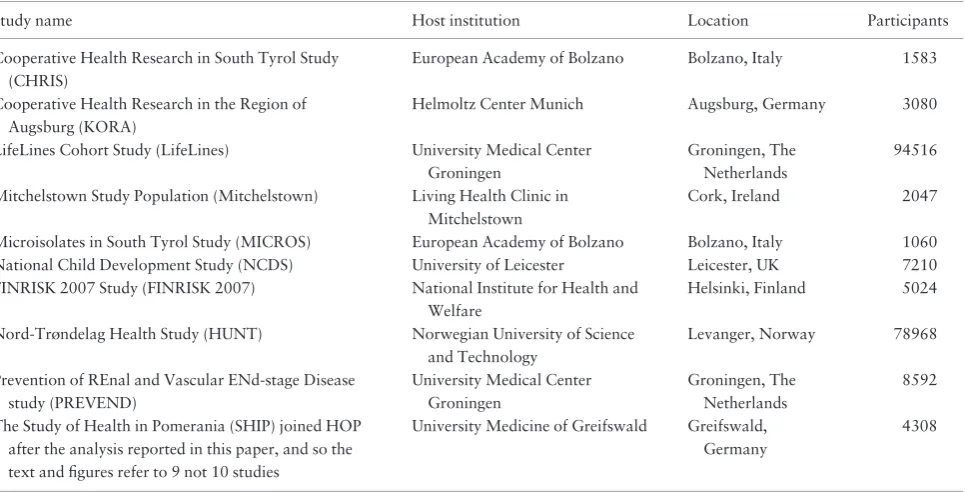
DataSHIELD was implemented for this application. At the time of writing, HOP involves 10 studies across eight Euro-pean countries (Table 2) sharing 96 harmonized variables.
Figure 5schematizes the DataSHIELD analysis of HOP data. Under HOP, communications between the AC and the DCs pass through the BioSHaRE-EU33 MICA37 web portal. This ensures that links can only be made through a designated IP name. Such a portal is not a pre-requisite for a DataSHIELD analysis, but it further enhances security. In the Hop settings the Analysis Computer is just used to login to the HOP portal where the client functions are installed and from where the actual analysis is ran.
Examples of DataSHIELD commands
Although the examples in this section are real as they use real data from the HOP project, they are included here for il-lustrative purposes only. For the sake of conciseness—and to maintain consistency across all examples—we include only four of the available studies in these examples. Throughout this section the DataSHIELD commands, in bold and italic font, are preceded by explanations and followed, where there is any, by the output of the command, in italic font.
Histogram plots
Figure 6illustrates the output from a DataSHIELD histo-gram plot of HDL cholesterol for each of the four studies
(Figure 6A) and for the pooled data (Figure 6B). The DataSHIELD functionds.histogramfilters the informa-tion returned from each study to remove bars based on a count of between 1 and 4. This means that potentially disclosive outliers are not shown on the plot. It however reports the number of invalid cells in the original grid density matrix used to produce the graph. For all DataSHIELD commands, the ‘type’ argument indicates whether to report results for each study separately (type5’split’) or across all studies, the default behaviour.
ds.histogram(’D$LAB_HDL’,type5’split’)
ds.histogram(’D$LAB_HDL’)
ncds: Number of invalid cells (cells with
counts>0 and<5) is 53
finrisk: Number of invalid cells (cells with
counts>0 and<5) is 72
micros: Number of invalid cells (cells with
counts>0 and<5) is 55
kora: Number of invalid cells (cells with
counts>0 and<5) is 75.
Quantiles
[image:9.612.93.524.56.334.2]The DataSHIELD function ds.quantileMean returns means and critical quantiles for quantitative variables. Unlike the conventional summary function in R, the
Figure 4.Overview of a DataSHIELD process. Each of the 8 steps and the terms used to refer to the key components and data exchanged between AC
and DCs are detailed inTable 1.
at University of Strathclyde on January 14, 2016
http://ije.oxfordjournals.org/
DataSHIELD function does not return the minimum and maximum values because these may be disclosive.
The results below were obtained by running the command on the quantitative age variable encoding age in years:
One and two-dimensional contingency tables
One-dimensional tables. The output below is generated by the DataSHIELD function ds.table1D, applied to a categorical variable holding BMI in three classes—for all studies combined. In addition to the counts in each cat-egory, the function also reports column percentages, row percentages and global percentages. To save space, only counts are shown here. The function also reports on the ‘validity’ of each study data set (full results being reported only for studies where the table is entirely non-disclosive, i.e. no table cells have counts between 1 and 4). As the last component of the output—$VALIDITY.WARNING— each source is flagged as having only valid data, or at least some invalid data.
ds.table1D(’D$PM_BMI_CATEGORIAL’)
$‘TOTAL.VALID.DATA.COUNTS for variable
PM_BMI_CATEGORIAL‘
ncdsfinrisk micros kora TOTAL
1 2453 1777 539 972 5741
2 2905 2096 364 1279 6644
3 1733 1151 157 812 3853
TOTAL 7091 5024 1060 3063 16238
$VALIDITY.WARNING
[1] ‘ALL STUDIES VALID’
Two-dimensional tables.The functionds.table2D gen-erates two-dimensional contingency tables. Here, the cat-egorical BMI variable is tabulated against gender. The functionds.table2Dalso produces column percentages, row percentages, global percentages and validity informa-tion. It also runs chi-square tests for homogeneity on (nc-1)*(nr-1) degrees of freedom for each study and for all studies combined, where nc is the number of columns and nr the number of rows.
ds.table2D(’D$PM_BMI_CATEGORIAL’,
’D$GENDER’)
$‘COMBINED.VALID.DATA.COUNTS–
PM_BMI_CATEGORIAL (rows) V GENDER (cols) ‘
0 1 TOTAL
[image:10.612.67.550.74.320.2]1 2036 3705 5741
Table 2.Healthy Obese Project collaborating studies and shared number of participants at the time of this work
Study name Host institution Location Participants
Cooperative Health Research in South Tyrol Study (CHRIS)
European Academy of Bolzano Bolzano, Italy 1583
Cooperative Health Research in the Region of Augsburg (KORA)
Helmoltz Center Munich Augsburg, Germany 3080
LifeLines Cohort Study (LifeLines) University Medical Center Groningen
Groningen, The Netherlands
94516
Mitchelstown Study Population (Mitchelstown) Living Health Clinic in Mitchelstown
Cork, Ireland 2047
Microisolates in South Tyrol Study (MICROS) European Academy of Bolzano Bolzano, Italy 1060 National Child Development Study (NCDS) University of Leicester Leicester, UK 7210 FINRISK 2007 Study (FINRISK 2007) National Institute for Health and
Welfare
Helsinki, Finland 5024
Nord-Trøndelag Health Study (HUNT) Norwegian University of Science and Technology
Levanger, Norway 78968
Prevention of REnal and Vascular ENd-stage Disease study (PREVEND)
University Medical Center Groningen
Groningen, The Netherlands
8592
The Study of Health in Pomerania (SHIP) joined HOP after the analysis reported in this paper, and so the text and figures refer to 9 not 10 studies
University Medicine of Greifswald Greifswald, Germany
4308
at University of Strathclyde on January 14, 2016
http://ije.oxfordjournals.org/
2 3826 2818 6644
3 1807 2046 3853
TOTAL 7669 8569 16238
$CHI2.TESTS.FOR.HOMOGENEITY
X2-value df p-value
ncds 350.12295 2 9.370602e-77
finrisk 139.05465 2 6.377738e-31
micros 34.21016 2 3.726980e-08
kora 98.49705 2 4.089196e-22
ALL VALID
STUDIES
COMBINED 604.93484 2 4.365851e-132
Generalized linear models (GLMs)
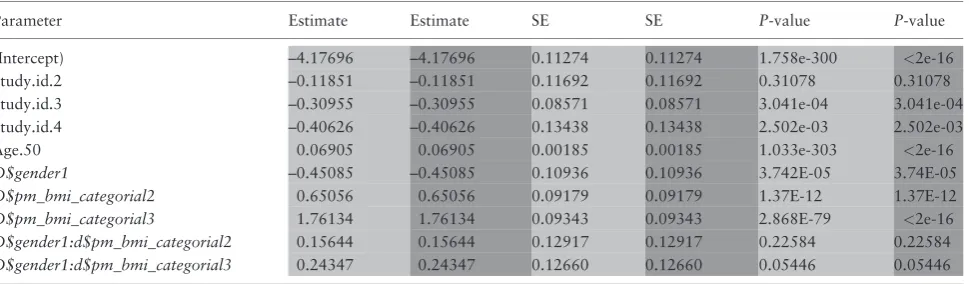
Because we wanted to directly compare the results of a GLM analysis under DataSHIELD with the corresponding results obtained from a conventional R-based GLM analysis—i.e. with the raw data from all sources physically combined in one database (Table 3)—our GLM example is based on four of the HOP studies that explicitly allowed their data to be physically shared within the HOP consor-tium, as well as to be analysed via DataSHIELD: NCDS,38 KORA,39LifeLines40and Mitchelstown.41
The DataSHIELD GLM function, ds.glm, is currently constructed to fit linear regression (Gaussian family, identity link), logistic regression (binomial family, logistic link) and Poisson regression (Poisson family, log link). It can easily be extended to encompass other combinations of errors and links. Because it is based around the conventionalglm func-tion in R, it can fit categorical factors as well as quantitative covariates, and can make use of the full array of R
[image:11.612.326.536.153.446.2]model-fitting operators in specifying the formula—e.g. *meaning all possible interactions between a categorical covariate and another covariate, or-1meaning remove the regression con-stant. Intermediate summaries of the fitting process can be printed out after each iteration but, for the sake of concise-ness, they are not reported here; only the final results
Figure 6.Histogram plots of the variable ‘LAB_HDL’ for each study (A) and for the pooled data (B).
Figure 5.For the Healthy Obese Project, communications between AC
and DCs were channelled through a trusted portal.
at University of Strathclyde on January 14, 2016
http://ije.oxfordjournals.org/
[image:11.612.70.542.501.713.2](i.e. after the model has converged) are included in the out-put below. In order to enhance its illustrative value, the par-ticular model we have fitted contains study-specific terms allowing for heterogeneity in the baseline risk of disease and have used the * operator to specify an interaction between GENDER and a three-level factor encoding BMI. In add-ition, we compare the estimates and confidence intervals from the GLM fitted using DataSHIELD with their equiva-lents from the same GLM fitted directly to a combined data-base into which the individual-level data from each study have been physically pooled. This provides empirical
con-firmation of the precise theoretical equivalence of the two approaches.22 It should be noted that when variables are initially transferred from Opal into the DataSHIELD R en-vironment at each source, they are by default placed in a data frame denoted ‘D’. For the purposes of clarity here, these variables all have names that are capitalized, and the prefix ‘D$’ tells R to read them from the data frame. In con-trast, all new variables created by transformation during the DataSHIELD session itself have been given lower-case names—these sit outside ‘D’(at root level in the DataSHIELD R environment) and are not preceded by ‘D$’.
Application in other settings
In this paper we have illustrated the use of DataSHIELD in a setting involving research-focused analysis of data that were originally collected for research purposes. But it could potentially be of equal value in settings involving co-ana-lysis of data from multiple health service or other
[image:12.612.67.552.87.229.2]administrative databases, or the joint analysis of research data with administrative data. It is for these purposes that major infrastructural projects7,8 like care.data7,8 and se-cure data-sharing infrastructures10,11 have been proposed and developed. For example, the aim ofcare.datawas to amalgamate medical information on individuals from Table 3.Comparison of the critical outputs of the same GLM model fitted using DataSHIELD (in light shading) and using
standard R with the physically pooled data (in dark shading)
Parameter Estimate Estimate SE SE P-value P-value
(Intercept) –4.17696 –4.17696 0.11274 0.11274 1.758e-300 <2e-16 Study.id.2 –0.11851 –0.11851 0.11692 0.11692 0.31078 0.31078 Study.id.3 –0.30955 –0.30955 0.08571 0.08571 3.041e-04 3.041e-04 Study.id.4 –0.40626 –0.40626 0.13438 0.13438 2.502e-03 2.502e-03 Age.50 0.06905 0.06905 0.00185 0.00185 1.033e-303 <2e-16
D$gender1 –0.45085 –0.45085 0.10936 0.10936 3.742E-05 3.74E-05
D$pm_bmi_categorial2 0.65056 0.65056 0.09179 0.09179 1.37E-12 1.37E-12
D$pm_bmi_categorial3 1.76134 1.76134 0.09343 0.09343 2.868E-79 <2e-16
D$gender1:d$pm_bmi_categorial2 0.15644 0.15644 0.12917 0.12917 0.22584 0.22584
D$gender1:d$pm_bmi_categorial3 0.24347 0.24347 0.12660 0.12660 0.05446 0.05446
DataSHIELD derived estimates rounded to same decimal places as standard R estimates. To avoid confusion, it should be noted that at a very early stage of the HOP analysis, the name of the categorical BMI variable was misspelt as ‘…CATEGORIAL…’. As that misspelling is now entrenched in all of the harmonized data sets etc. we chose not correct it for this paper.
SE, standard error.
at University of Strathclyde on January 14, 2016
http://ije.oxfordjournals.org/
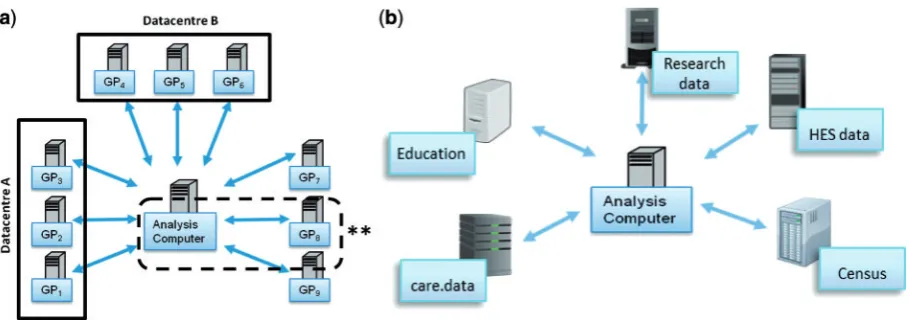
various administrative sources, including general practice (GP) records, into a single research database held by the Health and Social Care Information Centre and made available to approved researchers. Though some of the concerns that led to the suspension ofcare.datarelated to the possibility of commercial entities such as pharmaceut-ical and insurance companies being approved as customers, a central concern was protection of patient confidentiality. If they are ever to succeed, projects like care.data must therefore overcome two fundamental data-sharing chal-lenges. First, they must find a safe and appropriate way to allow researchers to analyse data drawn from particular healthcare or other administrative data sources, including GP medical records, wherein the risk of breaching patient confidentiality is reduced to an absolute and acceptable minimum. Depending how many sources need to be ac-cessed, this could potentially be achieved through a con-ventional—or single-site—application of horizontal DataSHIELD (Figure 7a). The second challenge is to se-curely combine information relating to individuals from a primary source (e.g. from a particular research project, or from GP medical records) with other health or administra-tive records on the same individuals, using record linkage and co-analysis. This is essential if some of the required data are not directly available from the primary source (e.g. hospitalization data, or education data). In such a set-ting, a vertical implementation of DataSHIELD can play a useful role (Figure 7b), although it is out of the scope of this paper to discuss vertical DataSHIELD in detail. In principle, DataSHIELD could provide a means to reassure the public that their data were being used in a secure man-ner. However, important challenges remain: (i) ongoing technical refinement of the functionality of the vertical im-plementation of DataSHIELD; (ii) extensive discussion with data-providing agencies—including government— and relevant governance committees to ensure that they
are all comfortable with application of DataSHIELD to po-tentially sensitive administrative data; and (iii) consider-ation of whether, in any particular setting, the agencies involved will be willing and able to devote the time and resources required to prepare and document data ready for vertical DataSHIELD use. Our future work includes a focus on addressing these challenges.
Discussion
DataSHIELD enables co-analysis of several collaborating studies or data sources as if the data from all individuals in all studies were directly accessible but, in reality, these data remain completely secure behind the firewalls of their host computers. This is of significant value in several set-tings: (i)where ethico-legal or governance restrictions pro-scribe individual-level data release, or make permission for such release excessively time-consuming to obtain; (ii) a re-search group is particularly vulnerable to losing intellectual property (e.g.in a developing nation) but wishes to freely share the information held in its data without physically sharing the data themselves; and (iii)the underlying data are too large to be physically shared.
[image:13.612.81.536.56.216.2]All components of the combined platform (Opal/ DataSHIELD) are open source and available without re-striction or payment. Both the installation and the config-uration require minimal specialist IT expertise: researchers with no IT background have already installed Opal with-out major difficulties by following the wiki documentation available online.42DataSHIELD is therefore attractive for researchers with limited resources. An extensive suite of functions already exists, but development work continues and we recently started developing a Graphic User Interface that requires no prior knowledge of R to run a DataSHIELD analysis.43 The newest software release of Opal incorporates an important enhancement. Specifically,
Figure 7.Illustration of DataSHIELD set-up for the analyses of: (a) horizontally partitioned data (similar data, different individuals) held in GP
data-bases and/or data centres. (**Single-site DataSHIELD); and (b) vertically partitioned data requiring record linkage between different types of data on the same individuals held in a variety of data archives.
at University of Strathclyde on January 14, 2016
http://ije.oxfordjournals.org/
DataSHIELD analysis is now truly parallelized: every com-mand is sent simultaneously to all DCs—previously, each command necessarily completed on one DC before being sent to the next. This substantially speeds up analysis, par-ticularly with many studies or time-consuming functions. If processing speed is particularly critical, further time may be saved by distributing the data from a large study across several Opal servers. If there are actual problems with the Opal instance at a given DC, then a message is sent to the data owner to correct that problem (e.g. the version of the libraries currently installed is not up to date, or the ser-ver is down). Crucially, if one or more of the data serser-vers are unusable, the user can temporarily exclude them from analysis while they are repaired or updated.
Because in DataSHIELD potentially disclosive com-mands are not allowed, some analyses that are possible in standard R are not enabled. In essence, there are two classes of limitation on potential DataSHIELD functional-ity: (i) absolute limitations which require an analysis that can only be undertaken by enabling one of the functional-ities (e.g. visualizing individual data points) that is explicitly blocked as a fundamental element of the DataSHIELD philosophy. For example, this would be the case for a standard scatter plot. Such limitations can never be circumvented and so alternatives (e.g. contour and heat-map plots) are enabled which convey similar information but without disclosing individual data points; (ii) current limitations which are functions or models that we be-lieve are implementable but we have not, as yet, under-taken or completed the development work required. As examples, these latter include generalized linear mixed models44 (including multi-level modelling45,46) and Cox regression.47
Despite its potential utility, implementation of DataSHIELD involves significant challenges. First, al-though set-up is fundamentally straightforward, applica-tion involves a relatively steep learning curve because the command structure is complex: it demands specification of the analysis to be undertaken, the studies to use and how to combine the results. In mitigation, most complex server-side functions are now called using simpler client-server-side functions and we are working on a menu-driven implemen-tation. Second, like anyco-analysis involving several stud-ies, data must be adequately harmonized27,34,35 and the proposed work must comply with governance stipulations in every study. Third, good research governance demands that any published analysis can precisely be replicated. We are therefore developing systems to automatically identify the particular DataSHIELD release used for a given ana-lysis. In addition, each data provider must unambiguously record the particular freeze of data they contributed. These fundamental issues apply in many settings other than
DataSHIELD, but because the project could be damaged if early users were to encounter serious scientific or govern-ance problems, application has so far been restricted to re-search groups with whom we are fully collaborating. This means we can provide active advice and support relating both to implementation and application. We plan to enable independent use as early as possible. Fourth, in undertak-ing a standard DataSHIELD analysis it is assumed that the data truly are horizontally partitioned, i.e. contributing sources hold the same variables but on different individuals (see Figure 3b). So far DataSHIELD has been applied in settings where individual participants in different studies are from different countries or from different regions so it is unlikely that any one person will appear in more than one source. However, going forward, that cannot al-ways be assumed. We have therefore been consider-ing approaches to identify and correct this problem based on probabilistic record linkage. In the genetic setting the BioPIN48 provides an alternative solution. Ongoing work is required. Fifth, despite the care taken to set up DataSHIELD so that it works properly and is non-disclosive, it is possible that unanticipated prob-lems (accidental or malicious) may arise. In order to iden-tify, describe and rectify any errors or loopholes that emerge and in order to identify deliberate miscreants, all commands issued on the client server and enacted on each data server are permanently logged.
Data sharing platforms, such ascare.data, that enable powerful integrative analysis of research data as well as data generated by activity in the health service, from dis-ease or death registries or from other administrative or governmental sources, have the potential to generate great societal benefit. Most crucially, they can provide an im-portant route for production of the raw ‘evidence’ needed for ‘evidence-based health care’. But, to be pragmatic, many of the routinely collected healthcare and administra-tive databases will have to undergo substantial evolution before their quality and consistency are such that they can directly be used in high-quality research without exten-sive preparatory work. By its very nature, such preparation—which typically includes data cleaning and data harmonization—cannot usually be undertaken in DataSHIELD, because it involves investigating discrepan-cies and/or extreme results in individual data subjects: the precise functionality that DataSHIELD is designed to block. Such work must therefore be undertaken ahead of time by the data generators themselves—and this is demanding of time, resources and expertise that—at present -many administrative data providers may well be unwilling and/or unable to provide. That said, if the widespread us-ability of such data is viewed as being of high priority, the required resources could be forthcoming. Then the primary
at University of Strathclyde on January 14, 2016
http://ije.oxfordjournals.org/
challenge will be to find effective solutions to the profes-sional and societal challenges presented by the need to en-sure that all work with individual-level data is rendered adequately secure. These solutions must respect and protect individual autonomy and confidentiality while facilitating the scientific progress from which everybody benefits. This conundrum is well recognized as demon-strated in the series of articles under the heading Dealing with Data inSciencein 2011,49and more recently in a re-view article exploring the combination of multiple health-care databases for postmarketing surveillance of drug and vaccine safety.50 Furthermore, these challenges and potential solutions provide a crucial focus for professional organizations aimed specifically at enhancing our capacity to make effective use of the rapidly accumulating body of available data in the arenas of health and social care, gov-ernmental administration and biomedical and social re-search. These organizations include major pan-European infrastructural projects in large-scale biomedical sciences such as: ELIXIR51 and BBMRI (the Biobanking and Biomolecular Resources Research Infrastructure52,53);
EAGDA(the Expert Advisory Group in Data Access) set up by four major UK funders (Wellcome Trust, MRC, ESRC and Cancer Research UK); the Public Population Project in Genomics and Society54 and most recently, the
Global Alliance for Genomics and Health.55
DataSHIELD provides a radically different way to keep sen-sitive data from multiple sources completely confidential while maintaining their full scientific utility; it could prove to be an invaluable complement to other more conventional approaches.
No single approach can provide a perfect universal solu-tion to the challenges arising from the complex interplay between professional and societal wishes, needs and con-cerns as healthcare and research data become ever richer, increasing both their power for good and their potential risk of disclosure. However, DataSHIELD provides im-portant opportunities that neatly complement other approaches. It has already been proven to work in prin-ciple,12,22and this paper now addresses the equally taxing problem: how to make it work in practice. DataSHIELD now provides a real opportunity to follow the advice of Kahn in Dealing with Data56to move the ‘computation to the data, rather than the data to the computation’.56
Funding
This work was supported through funds from: the European Union’s Seventh Framework Programme BioSHaRE-EU, grant agreement HEALTH-F4-2010-261433; the Welsh and Scottish Farr Institutes funded by MRC; joint funding from MRC and Wellcome Trust comprising a strategic award underpinning the ALSPAC
project and an infrastructural grant entitledThe 1958 Birth Cohort Biomedical Resource – facilitating access to data and samples and enhancing future utility; and the BBMRI-LPC project (EU FP7, I3 grant).
Conflict of interest:None declared.
References
1. Burton PR, Tobin MD, Hopper JL. Key concepts in genetic epi-demiology.Lancet2005;366:941–51.
2. Spencer CC, Su Z, Donnelly P, Marchini J. Designing genome-wide association studies: sample size, power, imputation, and the choice of genotyping chip.PLoS Genet2009;5:e1000477. 3. Zondervan KT, Cardon LR. Designing candidate gene and
gen-ome-wide case-control association studies. Nat Protocols
2007;2:2492–501.
4. Walport M, Brest P. Sharing research data to improve public health.Lancet2011;377:537–39.
5. Burton PR, Hansell AL, Fortier Iet al. Size matters: just how big is BIG? Quantifying realistic sample size requirements for human genome epidemiology.Int J Epidemiol2008;38:263–73. 6. Gomatam S, Karr A, Reiter J, Sanil A. Data dissemination and
disclosure limitation in a world without microdata: a risk-utility framework for remote access analysis servers. Stat Sc
2005;20:163–77.
7. Hoeksma J. The NHS’s care.data scheme: what are the risks to privacy?BMJ2014;348:g1547.
8. McCartney M. Care.data: why are Scotland and Wales doing it differently?BMJ2014;348:g1702.
9. Demir I, Murtagh MJ. Data sharing across biobanks: epistemic values, data mutability and data incommensurability. New Genet Soc2013;32:350–65.
10. UK.Data.Service.About Secure Access. http://ukdataservice.ac. uk/get-data/secure-access/about/what-is.aspx (7 March 2014, date last accessed).
11. Ford DV, Jones KH, Verplancke JPet al. The SAIL Databank: building a national architecture for e-health research and evalu-ation.BMC Health Serv Res2009;9:157.
12. Wolfson M, Wallace SE, Masca Net al. DataSHIELD: resolving a conflict in contemporary bioscience—performing a pooled analysis of individual-level data without sharing the data.Int J Epidemiol2010;39:1372–82.
13. Newton-Cheh C, Johnson T, Gateva Vet al. Genome-wide asso-ciation study identifies eight loci associated with blood pressure.
Nat Genet2009;41:666–76.
14. Repapi E, Sayers I, Wain LVet al. Genome-wide association study identifies five loci associated with lung function. Nat Genet2010;42:36–44.
15. Zeggini E, Weedon MN, Lindgren CMet al. Replication of gen-ome-wide association signals in U.K.Samples reveal risk loci for type 2 diabetes.Science 2007;316:1336–39.
16. Petitti DB. Meta-analysis, Decision Analysis and Cost-Effectiveness Analysis: Methods for Quantitative Synthesis in Medicine. 2nd ed. New York: Oxford University Press; 2000. 17. Sutton AJ, Kendrick D, Coupland CA. Meta-analysis of
individ-ual- and aggregate-level data.Stat Med2008;27:651–69. 18. Burman W, Daum R, Janoff Eet al. Grinding to a halt: the effects
of the increasing regulatory burden on research and quality im-provement efforts.Clin Infect Dis2009;49:328–35.
at University of Strathclyde on January 14, 2016
http://ije.oxfordjournals.org/
19. Malfroy M, Llewelyn CA, Johnson T, Williamson LM. Using pa-tient-identifiable data for epidemiological research. Transfus Med2004;14:275–79.
20. Burton P, Wolfson M, Masca N, Fortier I. Datashield: Individual-level meta-analysis without sharing the data.
J Epidemiol Commun Health2011;65:A37.
21. Wallace SE, Gaye A, Shoush O, Burton PR. Protecting personal data in epidemiological research: DataSHIELD and UK law.
Public Health Genom2014;17:149–57.
22. Jones EM, Sheehan NA, Masca N, Wallace SE, Murtagh MJ, Burton PR. DataSHIELD-shared individual-level analysis with-out sharing the data: a biostatistical perspective. Norsk Epidemiologi2012;21:231–39.
23. Jones EM, Sheehan NA, Gaye A, Laflamme P, Burton P. Combined analysis of correlated data when data cannot be pooled.Stat2013;2:72–85.
24. Murtagh MJ, Demir I, Jenkings KNet al. Securing the data econ-omy: translating privacy and enacting security in the develop-ment of DataSHIELD.Public Health Genom2012;15:243–53. 25. EGA.European Genome-Phenome Archive. https://www.ebi.ac.
uk/training/online/course/genomics-introduction-ebi-resources/ european-genome-phenome-archive-ega (13 March 2014, date last accessed).
26. Wallace SE. The needle in the haystack: international consortia and the return of individual research results.J Law Med Ethics
2011;39:631–39.
27. Doiron D, Burton P, Marcon Yet al. Data harmonization and federated analysis of population-based studies: the BioSHaRE project.Emerg Themes Epidemiol2013;10:12.
28. OBiBa. Opal [Opal is OBiBa’s core database application for bio-banks or epidemiological studies].2012. http://www.obiba.org/ node/63 (24 June 2014, date last accessed)
29. Ihaka R, Gentleman R. R: A language for data analysis and graphics.J Comput Graph Stat1996;5:299–14.
30. Maelstrom. Maelstrom Research. https://www.maelstrom-re search.org/ (4 March 2014, date last accessed).
31. OBiBa.Open Source Software for Biobanks. http://www.obi ba.org/?q¼node/1 (04 March 2014, date last accessed). 32. Healthy Obese Project.Healthy Obese Project. 2013. https://
www.bioshare.eu/content/healthy-obese-project (19 March 2014, date last accessed).
33. BioSHaRE-EU. BioSHaRE.eu. https://www.bioshare.eu/ (19 June 2014, date last accessed).
34. Fortier I, Burton PR, Robson PJ et al. Quality, quantity and harmony: the DataSHaPER approach to integrating data across bioclinical studies.Int J Epidemiol2010;39:1383–93.
35. Fortier I, Doiron D, Little J et al. Is rigorous retrospective harmonization possible? Application of the DataSHaPER approach across 53 large studies. Int J Epidemiol
2011;40:1314–28.
36. Kuk A, Cheng Y. The Monte Carlo Newton-Raphson Algorithm.J Stat Comput Sim1997;59:233–50.
37. OBiBa.Mica. http://obiba.org/node/174 (4 March 2014, date last accessed).
38. Power C, Elliott J. Cohort profile: 1958 British birth cohort (National Child Development Study).Int J Epidemiol2006;35: 34–41.
39. Wichmann H, Gieger C, Illig T. KORA-gen-resource for popula-tion genetics, controls and a broad spectrum of disease pheno-types.Gesundheitswesen2005;67:S26.
40. Stolk RP, Rosmalen JG, Postma DSet al. Universal risk factors for multifactorial diseases.Eur J Epidemiol2008;23:67–74. 41. Kearney PM, Harrington JM, Mc Carthy VJ, Fitzgerald AP,
Perry IJ. Cohort Profile: The Cork and Kerry Diabetes and Heart Disease Study. Int J Epidemiol20132013;42:1253–62. 42. OBiBa. Opal documentation. 2014. http://wiki.obiba.org/
display/OPALDOC/Home (27 June 2014, date last accessed). 43. Gaye A, Burton WY. DataSHIELD Online Interactive
Terminal. 2014. https://www.bioshare.eu/datashieldgui/ (29 June 2014, date last accessed).
44. Breslow N, Clayton D. Approximate inference in generalized lin-ear mixed models.J Am Stat Assoc1993;88:9–25.
45. Goldstein H. Multilevel mixed linear modelling analysis using iterative generalized least squares.Biometrika1986;73:43–56. 46. Burton P, Gurrin L, Sly P. Extending the simple linear regression
model to account for correlated responses: an introduction to generalized estimating equations and multi-level mixed model-ling.Stat Med1998;17:1261–91.
47. Cox DR. Regression models and life-tables. J R Stat Soc
1972;B;34:187–220.
48. Nietfeld JJ, Sugarman J, Litton JE. The Bio-PIN: a concept to im-prove biobanking.Nat Rev Cancer2011;11:303–08.
49. Hanson B, Sugden A, Alberts B. Making data maximally avail-able.Science2011;331:649.
50. Trifiro` G, Coloma P, Rijnbeek P et al. Combining multiple healthcare databases for postmarketing drug and vaccine safety surveillance: why and how?J Int Med2014;275:551–61. 51. Elixir.Elixir, Data For Life. 2014. http://www.elixir-europe.org/
(27 June 2014, date last accessed).
52. BBMRI-ERIC. Managing Resources for the Future of Biomedical Research. http://bbmri-eric.eu/ (27 June 2014, date last accessed).
53. BBMRI-LPC. Helping Europeans Get Healthier. http://www. bbmri-lpc.org/ (27 June 2014, date last accessed).
54. Public Population Project in Genomics and Society. P3G HOME. http://p3g.org/.
55. Global Alliance 4 Genomics and Health.Web site.2014. http:// genomicsandhealth.org/
56. Kahn SD. On the future of genomic data. Science
2011;331:728–29.
at University of Strathclyde on January 14, 2016
http://ije.oxfordjournals.org/