1
Reverse Knowledge Transfer in Emerging
Market Multinationals:
The Indian Context
Abstract
This study examines knowledge acquisitions of Indian multinationals via overseas mergers and acquisitions. Specifically, the paper examines the effects of the perceived subsidiary capability, parent absorptive capacity, and the relevance of the target knowledge on reverse knowledge transfer. Using firm level data from a survey of Indian multinationals (with overseas acquisitions), we find that perceived subsidiary capability, knowledge relevance and absorptive capacity positively influence reverse knowledge transfer. The results also highlight the moderating role of knowledge relevance and the mediating effects of absorptive capacity.
2
1.
Introduction
Transferring knowledge to the headquarter represents a major objective of emerging markets multinational enterprises (EM-MNEsi) while setting up subsidiaries, especially in developed countries (Lou and Tung, 2007). Surprisingly however, few studies have explicitly focussed on reverse knowledge transfer (RKT) – knowledge flow from the subsidiary to the parent (Ambos et al., 2006), especially within EM-MNEs. Thus, recently scholars have called for more research on RKT in EM-MNEs (c.f. Mudambi et al., 2014; Rabbiosi and Santangelo, 2013). In contrast to the ‘forward diffusion’ (Thite et al., 2012) of knowledge in the context of multinationals from the developed world (DMNEs), the ‘reverse diffusion’ is more pertinent to EM-MNEs owing to their latecomer disadvantages and their constant attempts to overcome these disadvantages. These disadvantages and other liabilities associated with their home countries (Demirbag et al., 2010; Mellahi et al, 2010) prompt these latecomers to fall back on strategic alliances, JVs (Joint Ventures) and M&As (Mergers & Acquisitions) even with their global competitors (Bonaglia et al, 2007; Lou and Tung, 2007; Mathews, 2006) as a means of catching up rapidly and acquiring the vital competitive advantage required in global markets. Given the relevance of the catching up strategies displayed by EM-MNEs that could be attributed largely to RKT, and the lack of studies pertaining to RKT in the EM (emerging market) context, it is important to explore the same in EM-MNEs.
3
explore RKT, the context of this study also warrants consideration of the nascent theoretical perspectives on EM-MNEs to determine the factors that are pertinent in emerging markets. This is because unlike DMNEs, EM-MNEs have a different set of motives and factors to consider when they establish international linkages (Bangara et al., 2012; Madhok and Keyhani, 2012). The springboard perspective (Luo and Tung, 2007) focusses on these differences and further discusses the propensity of EM-MNEs in seeking knowledge and capabilities residing with their more competent overseas subsidiaries, to overcome their own disadvantages and thus expedite their global ambitions. This suggests that EM-MNEs’ decision to engage in RKT is largely driven by their desire to springboard and what prompts them to engage in RKT is very closely linked with what would help them springboard. Hence in this study, we focus on subsidiary capability and the relevance of the knowledge (held by subsidiary) as decisive factors that prompt them to engage in RKT and abet their attempts to springboard. In addition, for RKT to materialise, it is also crucial that the receiving parent unit focuses on its absorptive capacity, which reflects its ability to absorb this knowledge. Even though this direct effect has been analysed in prior studies (Ambos et al., 2006), how EM-MNEs develop their absorptive capacity remains largely unexplored. The LLL perspective has been used in this study to identify the factors that could potentially cater to the development of absorptive capacity in EM-MNEs. This perspective explores EM-MNEs’ emphasis on cumulative learning when they establish their external linkages. A focussed learning environment with adequate infrastructure could potentially contribute to this cumulative ongoing learning in EM-MNEs, and improve their absorptive capacity. This enhancement of absorptive capacity further improves their attempts at engaging in RKT. One of the contributions from this study is this mediating role of absorptive capacity, which has not been accounted for by prior studies.
4
parents to better utilise their absorptive capacity to engage in RKT, they need to appreciate the connectedness of the target knowledge to their operations and business environment. Similarly, even when the knowledge targeted is from a highly competent subsidiary, for the parent to be interested in this knowledge, it needs to recognise the relevance of this knowledge in terms of its implications and potential benefits. Hence the relevance of the target knowledge for the EM-MNE could be very influential in determining the dynamics of RKT in terms of its moderating role on absorptive capacity and subsidiary competence. Although the extant literature has looked at the direct effects of knowledge relevance (Yang et al., 2008), this study makes a vital contribution by exploring this moderating role of knowledge relevance.
The relevance associated with knowledge could potentially have different implications for EM-MNEs when it comes to each of the different knowledge flows such as technological, marketing and general management know-how, which have been considered for this study. Relevance may be more decisive for certain knowledge flows such as marketing know-how when compared to technological know-how, since it is relatively more location bound and context-specific in nature. Although previous research has looked at the effects of knowledge relevance on RKT (c.f. Yang et al., 2008), it has not considered how the effect of knowledge relevance varies for different types of knowledge flows. An additional contribution of this study is that it explores this differential influence of knowledge relevance on the different types of knowledge flows.
2.
Theory and Hypothesis Development
2.1
Perspectives on EM-MNEs
5
scene, EM-MNEs have seen to be resorting to springboarding (Luo and Tung, 2007) and learning from their international linkages (Mathews, 2006). These perspectives stress on the aggressive and risk taking overseas acquisitions of EM-MNEs which is not strictly incremental but is recursive and much focussed on organisational learning. These EM-MNEs are more often seen to be taking a leap of faith when it comes to their international operations especially in the developed markets as they do not have the conventional advantages (reputed brand names, technological know-how, research and organisational capabilities) that many of their advanced competitors have. However, in this process they have also realised that they cannot compete in these markets on cost advantage alone and neither do they have the time nor the resources to build such advanced organisational capabilities from scratch. Hence their overseas ventures were deliberate efforts to rapidly acquire such strategic assets (intangibles) that will lend them the much needed legitimacy and competitive advantage in the global marketplace, which is often referred to as springboarding. These strategic assets are vital for EM-MNEs in competing with their global rivals in international as well as domestic markets. The LLL framework further draws our attention the significance of learning attached to the international linkages of EM-MNEs (Mathews, 2006). This cumulative learning materialises from repeatedly leveraging the resources from their international linkages. RKT thus plays a significant role in enhancing the ownership advantages of EM-MNEs by way of this cumulative learning from their overseas subsidiaries. Drawing from these theoretical frameworks viz. springboard perspective (Luo and Tung, 2007) and LLL framework (Mathews, 2006), it is evident that ‘reverse diffusion’ or RKT is likely to be more prominent in EM-MNEs than in DMNEs. In the context of EM-MNEs, Indian MNEs have been one of the active acquirers (viz. Tata, Reliance, Infosys and Birla) with a dominant presence in the developed markets (Sethi, 2009). Further, 78% of the Indian acquirers cite “learning new or advanced technology from the acquired company” as the top three reasons for their overseas acquisitions (Kale, 2009). Hence this study attempts to explore RKT in the context of Indian MNEs.
2.2
Reverse Knowledge Transfer & EM-MNEs
6
et al., 2014; Najafi-Tavani et al., 2012; Rabbiosi, 2011; Yang et al., 2008). RKT in a cross border scenario could be defined as the extent of knowledge and skills that flow from the overseas subsidiaries to their parent units at home (Ambos et al., 2006; Gupta and Govindarajan, 2000). Most of the studies on RKT explored the effects of organisational mechanisms/characteristics like coordination, integration and socialisation and relational aspects like shared values. However, considering that this study is located in an EM context, the focus is largely on what the EM-MNEs are actively seeking through RKT viz. knowledge, competencies and capabilities.
7
Moreover, in addition to subsidiary capability and knowledge relevance, it is also pertinent that headquarters have the capability to receive this knowledge and use it for their own benefit. This is where the absorptive capacity (Cohen and Levinthal, 1990, Lane and Lubatkin, 1998; Gupta
and Govindarajan, 2000; Zahra and George, 2002)of the receiving unit, which in this case is the
parent EM-MNE, comes into the picture. While prior studies have established the positive effects of parents unit’s absorptive capacity on RKT (Ambos et al., 2006), it is also worthwhile to understand the how the EM-MNEs are in the process of continuously enhancing their absorptive capacity in their attempts to catch up. EM-MNEs are likely to have considerable knowledge gap with many of their advanced subsidiaries and hence it is pertinent that they develop their absorptive capacity to be able to take the full of advantage of the incoming knowledge. Thus we focus on parent level attributes that contribute to the development of absorptive capacity in EM-MNEs. Again drawing from the LLL perspective (Mathews, 2006), EM-MNEs have a steady focus on cumulative learning from their linkages with international networks. Having an organisational environment that encourages and rewards learning is crucial for EM-MNEs, since according to the LLL framework they are involved in recursive catching up attempts by acquiring strategic resources and learning from their international networks. Besides having a conducive learning environment, it is also pertinent that they also have the adequate tools and the knowledge infrastructure that will aid them in their learning. This includes collaborative tools that facilitate interactions between employees (who are geographically distant) and locate useful knowledge sources within the MNE network and experts in these areas (Alavi and Leidner, 2001; Gold et al., 2001). Hence this study also takes into account two factors at the parent level viz. learning environment and technical knowledge infrastructure that contributes to the development of absorptive capacity of the Indian parent and subsequently analyses this mediating effect.
8
to affect RKT in the EM context of India, namely knowledge relevance, absorptive capacity of the parent, and the perceived subsidiary capability on RKT.
2.3
Absorptive Capacity
9
capacity, the more likely they are to foresee the potential of the subsidiary’s knowledge and the more likely that they will engage in RKT. Hence we posit that the parent unit’s absorptive capacity is strongly associated with RKT.
Hypothesis 1 (H1) – Reverse knowledge transfer from overseas subsidiary to the Indian parent will be positively related to the absorptive capacity of the parent.
Organisational units that have a greater focus on learning and better research orientation tend to allocate more resources for the same and as a result are more likely to develop higher absorptive capacities (Cohen and Levinthal, 1990; Lane et al., 2001; Pak and Park, 2004). Effective learning refers to the firm’s “ability to transfer what one has learned to novel tasks that embody similar underlying principles” (Bereby-Meyer et al., 2004, p. 142). An effective learning environment facilitates the development of a corporate culture that allows flexibility towards learning, an organizational structure that allows both innovativeness and new insights (Fiol and Lyles, 1985). Such an environment contributes towards degree of openness in the firm’s culture, flexibility in the organisation and the senior management’s commitment to learning (Hamel, 1991) which in turn improves the receptivity to learning. The ability to learn and an environment that rewards learning are expected to cater to the recipient’s ability to absorb the transferred knowledge (Cohen and Levinthal, 1990) which subsequently helps in the development of the firm’s absorptive capacity. Based on the LLL framework (Mathews, 2006), MNEs from the EM of India look towards their overseas counterparts to learn and develop their absorptive capacity and for this it is necessary to have the right corporate environment that facilitates and encourages learning. Thus, we propose that:
Hypothesis 2 (H2) – Absorptive capacity of the Indian parent will be positively related to the presence of an effective learning environment.
10
et al., 2002) promotes collective learning (Hong et al., 2006) which in turn facilitates the development of the unit level absorptive capacity. Such an infrastructure also facilitates communication (Gold et al., 2001) and enables the different parties to collaborate effectively even when they are geographically dispersed (Demirbag and Glaister, 2010). In the case of MNEs from India, they are not only culturally dissimilar from their overseas subsidiaries, but are also geographically distant from their network of subsidiaries. ICT (Information and Communication Technology) has always played a crucial role in shrinking these distances and facilitating global operations of MNEs. This analysis suggests that technical infrastructure enhances collaboration and collective learning from their overseas subsidiaries and in the process aiding the development of the parent Indian MNEs’ absorptive capacity. Thus, we propose that:
Hypothesis 3 (H3) – Absorptive capacity of the Indian parent will be positively related to the presence of an effective technical knowledge infrastructure.
2.4
Perceived Subsidiary Capability
11
incumbents. EM-MNEs are relatively newcomers compared to their often well established, highly competent and experienced subsidiaries in developed markets. Additionally, the capabilities possessed by these competent overseas subsidiaries could prove to be vital in their catching up efforts and their attempts at springboarding. Hence for the EM parent, if it perceives the subsidiary to have superior capabilities, it is likely to also associate this perception with the subsidiary possessing valuable knowledge, which could be potentially beneficial to the whole MNE. For MNEs from EM like India, such subsidiaries are considered the fountainhead of knowledge that could be vital in overcoming their weaknesses and third world image and also to provide them with a more level playing field with their global competitors. Thus, we posit:
Hypothesis 4 (H4) – Reverse knowledge transfer from the overseas subsidiary to the Indian parent will be positively related to the perceived subsidiary capability (as rated by the parent).
2.5
Knowledge Relevance
Knowledge attributes of the target knowledge plays a vital role in knowledge flows. In particular the attractiveness of knowledge is considered a major pulling force as far as the recipient units are concerned (Gupta and Govindarajan, 2000). This attractiveness is linked to the relevance and non-duplicative nature of the knowledge. Gupta and Govindarajan (2000) argued that knowledge relevance is a necessary condition for knowledge flow to occur (see also Schulz, 2001). Knowledge is considered relevant when it connects and builds on existing knowledge (Schulz, 2003) and permits new inferences or interpretations (Sperber and Wilson, 1986). Knowledge relevance is more likely to play a crucial role for RKT than in conventional knowledge flows
(Yang et al., 2008). This is because in RKT, the parent needs to be persuaded to engage in RKT
12 Hypothesis 5 (H5) – Reverse knowledge transfer from overseas subsidiary to the parent India MNE will be positively related to the perceived relevance of the knowledge to the parent (as rated by the parent).
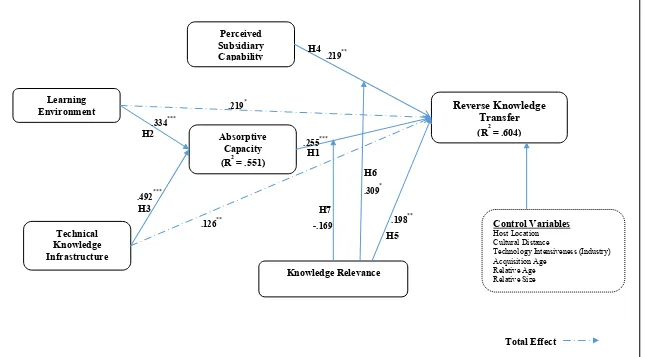
Our hypotheses are captured in our framework shown in Figure. 1. In addition to the direct effects discussed in the earlier sections, we also aim to explore the interaction effects of knowledge relevance. This aspect of knowledge is significant because knowledge also evolves through the continuous incorporation of new knowledge into existing knowledge (Schulz, 2003). Knowledge thus has the capability of changing other knowledge that is related to it. Hence it would be interesting to explore how this aspect of knowledge affects the relationship of absorptive capacity and perceived subsidiary capability on RKT. The ability of the recipient unit to absorb knowledge to a large extent depends on the prior knowledge that this unit has (Gupta and Govindarajan, 2000). Hence the effect of absorptive capacity on RKT is also likely to vary based on the nature or characteristic of the target knowledge. When this prior knowledge held by the parent is related to the subsidiary’s knowledge, the effect of absorptive capacity in aiding RKT improves. This is because at higher levels of knowledge relevance, the development of absorptive capacity is likely to be associated with a better understanding of the inbound knowledge and superior ability to use this knowledge which then gets translated to a greater probability of engaging in RKT. However, when this relatedness or knowledge relevance is less, absorptive capacity’s effect on RKT is likely to diminish. This means that the more the prior knowledge is related to the target knowledge, the greater will be the positive effect of absorptive capacity on RKT.
13
capability has knowledge that is more relevant to the parent unit, then it becomes a more attractive proposition for the parent thus increasing their interest in this target knowledge. Thus knowledge relevance is likely to improve the positive effect that perceived subsidiary capability has on RKT.
Hypothesis 6 (H6) - Knowledge relevance positively moderates the relationship between RKT and perceived subsidiary capability.
Hypothesis 7 (H7) - Knowledge relevance positively moderates the relationship between RKT and absorptive capacity
3.
Methodology
When it comes to Indian MNEs, there are several interesting aspects with regards to their internationalisation viz. prominence of south-north acquisitions, greater geographical dispersion, are mainly majority owned acquisitions and are mostly by MNEs from the private sector (Kumar, 2008; Nayyar, 2008; Pradhan, 2007; Sethi, 2009). Hence the target sample for this study was Indian MNEs with overseas M&As.
3.1
Data Collection
For this study, we identified a set of 329 Indian MNEs as the sampling frame; specifically focussing on those which have overseas M&As. We chose the latter entry mode because Indian MNEs tend to enter foreign markets, particularly in developed markets, via such acquisitions
(Pradhan, 2007). The focus on Indian MNEs is based on a number of reasons which include i)
significant boom in OFDI (Outward Foreign Direct Investment) since 1990s ii) evidence of learning by Indian MNEs from foreign associations (Chittoor and Ray, 2007; Elango and Pattnaik, 2007) iii) the significant dominance of Indian OFDI in developed countries (Sethi, 2009) . The list of Indian MNEs for this study has been compiled from two of the iiiFICCI reports
(FICCI, 2006; FICCI & Grant Thornton, 2010). These reports cover the M&As by Indian MNEs between 2000 and 2010 and have also been supplemented by some other reportsiv. The Indian
14
study since the acquisition spree by Indian MNEs in the developed countries gathered momentum since 2003 (Nayyar, 2008). These MNEs are from a variety of industries with a majority of them from the IT& IT enabled Services (25%) and Pharmaceutical & Biotechnology (15%) sector.
A questionnaire was vadministered to managers of these 329 Indian MNEs. To improve the response rates, follow up calls were made and emails were sent to these respondents. Following data collection for 6 months, responses were received from 114 respondents of which, 101 were found to be usable and the others were discarded as they were invalid or had large portions of incomplete data. The firm level response rate is 31%. To check for non-response bias with the data, t-test (independent sample) was performed to check whether the non-respondent and respondent firms differed in terms of a few relevant firm related parametersvi (Ambos and
15
still significant and was greater than the method based variance suggesting that common method bias is unlikely to be an issue for this study.
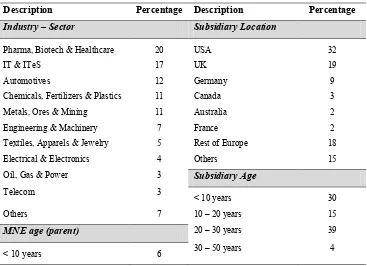
[image:15.612.124.491.433.699.2]Prior studies on knowledge flows have largely chosen respondents that include heads of organisations and functions (Bjorkman et al., 2004; Gupta and Govindarajan, 2000; Simonin, 2004) since they have a bird’s eye view of the operations and more specifically on the subsidiary operations and post integration activities. Also, most nodal studies on RKT focus on the recipient or the parent unit perspective (Ambos et al. 2006; Rabbiosi 2011). Along the same lines, the respondents chosen for this study also consist of senior level respondents (71%) viz. viiCEOs, COOs, CIOs, VPs, GMs and Business Heads. The middle level managers (29%) include those heading departments or functions within their organisations, who have more of an operational perspective related to RKT. Additionally, services of research teams in India were utilised to identify these potential respondents based on the extent of their involvement with the international operations and engagement with subsidiaries. The respondent profile is provided in Table. 2. The mean age of the respondent MNEs is 37 years. The average tenure of the respondents with the specific organisation is 9 years.
Table 1: Respondent Characteristics
Description Percentage Description Percentage
Industry – Sector Subsidiary Location
Pharma, Biotech & Healthcare 20 USA 32
IT & ITeS 17 UK 19
Automotives 12 Germany 9
Chemicals, Fertilizers & Plastics 11 Canada 3 Metals, Ores & Mining 11 Australia 2 Engineering & Machinery 7 France 2 Textiles, Apparels & Jewelry 5 Rest of Europe 18 Electrical & Electronics 4 Others 15 Oil, Gas & Power 3 Subsidiary Age
Telecom 3
< 10 years 30
Others 7 10 – 20 years 15
MNE age (parent) 20 – 30 years 39
16 10 – 20 years 28 50 – 100 years 8
20 – 30 years 29 > 100 years 4 30 – 50 years 17 Respondent Position
50 – 100 years 12
Senior Management 71 > 100 years 8 Middle Management 29
No. of employees (Parent) Respondent Experience with the MNE
< 1000 29 > 20 years 8
1000 – 5000 43 15-20 years 13
5000 – 10,000 9 10 - 15 years 17
> 10,000 19 5 – 10 years 29
< 5 years 33
3.2
Measures
The survey was conducted at the organisational unit level, specifically to capture the parent EM-MNE perspective, who is the recipient unit in this study (Ambos et al., 2006; Rabbiosi, 2011). Most of the questions are based on 7 point Likert scales from the literature. Appendix has been provided with the scales that have been used to measure the constructs used for this study.
17
location of the subsidiary was categorised into four groups – (i) USA & Canada (ii) UK, France & Germany (iii) rest of Europe and (iv) othersix. Depending on the type of industry that the firm belongs to, the dynamics of knowledge flows also vary (Cho and Lee 2004). The knowledge and technology intensive industries are more likely to pursue knowledge flows aggressively. Hence, industry level controls were also included by categorizing the parent MNE into three groups – (i) high technology & high-tech knowledge intensive (ii) medium technology & knowledge intensive and (iii) low technology & less knowledge intensive. This categorisation is based on the xNACE code (for respondent firms) that depends on their industrial sectors and has been used in other similar studies (Garcia-Manjon and Romero-Merino, 2012).
3.3
PLS Modeling
18
3.4
Results
3.4.1 Measurement Model
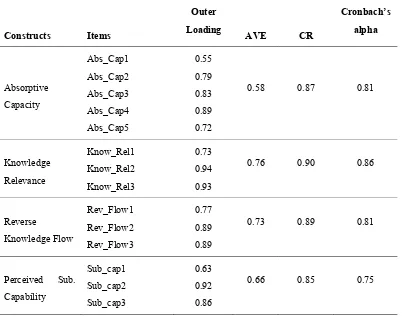
[image:18.612.108.510.376.693.2]The measurement model involves testing the reliability and validity of each of the reflective measures for all the constructs. The items all load > 0.55 as shown in Table 3 and are all significant (p ≤ .001) and additionally the items load highest on the construct it measures when compared to its loading on other constructs (Chin, 1998). This establishes the individual item reliability. To establish the convergent validity and the composite reliability of the scale the following criteria have to be satisfied; Cronbach’s alpha ≥ 0.7 (Nunnally, 1978), (CR) Composite Reliability ≥ 0.7 (Bagozzi and Yi, 1988) and (Average Variance Extracted) AVE ≥ 0.5 (Bagozzi and Yi, 1988). The results of the test provided in Table 3 indicate that these conditions have been satisfied.
Table 2: Results of Validity & Reliability Tests
Constructs Items
Outer
Loading AVE CR
Cronbach’s alpha Absorptive Capacity Abs_Cap1 Abs_Cap2 Abs_Cap3 Abs_Cap4 Abs_Cap5 0.55 0.79 0.83 0.89 0.72
0.58 0.87 0.81
Knowledge Relevance Know_Rel1 Know_Rel2 Know_Rel3 0.73 0.94 0.93
0.76 0.90 0.86
Reverse Knowledge Flow Rev_Flow1 Rev_Flow2 Rev_Flow3 0.77 0.89 0.89
0.73 0.89 0.81
Perceived Sub. Capability Sub_cap1 Sub_cap2 Sub_cap3 0.63 0.92 0.86
19 Tech. Knowledge Infrastructure Tech_Knowl_Infra1 Tech_Knowl_Infra2 Tech_Knowl_Infra3 Tech_Knowl_Infra4 Tech_Knowl_Infra5 Tech_Knowl_Infra6 Tech_Knowl_Infra7 Tech_Knowl_Infra8 0.75 0.77 0.58 0.73 0.70 0.69 0.80 0.64
0.51 0.89 0.86
Learning Environment Learn1 Learn2 Learn3 Learn4 Learn5 Learn6 0.83 0.84 0.89 0.85 0.78 0.76
0.68 0.93 0.91
All outer loadings are significant at p < .001 (Item names and descriptions are provided in the Appendix)
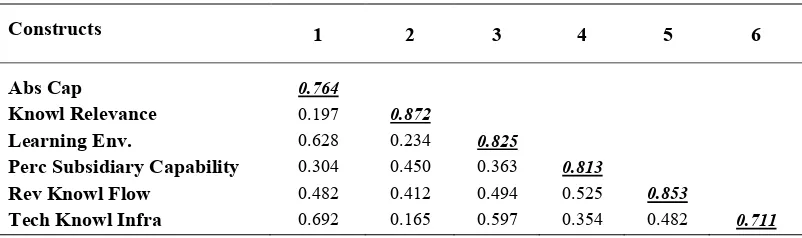
[image:19.612.106.507.520.639.2]Discriminant validity was checked with the Fornell-Larcker criterion (Fornell and Larcker, 1981) as provided in Table. 4. According to this criterion, if the correlations for the specific construct with other constructs (off diagonal) are less than the diagonal element (which indicates the construct’s correlation with its own items – square root of AVE), then it indicates discriminant validity of the construct. Table. 4 illustrates that this condition holds good for all the latent constructs in this study.
Table 3: Correlation Matrix for assessment of Discriminant Validity
Constructs 1 2 3 4 5 6
Abs Cap 0.764
Knowl Relevance 0.197 0.872
Learning Env. 0.628 0.234 0.825
Perc Subsidiary Capability 0.304 0.450 0.363 0.813
Rev Knowl Flow 0.482 0.412 0.494 0.525 0.853
20
3.4.2 Structural Model
PLS structural models are evaluated with R2 estimates, path coefficients and their t-statistics. R2
estimates indicate predictive power of models and R2 values of .67, 0.33 and 0.19 suggest that
21
Figure 1: PLS-SEM Path Modelxi
Reverse Knowledge Transfer
(R2 = .604) Perceived
Subsidiary Capability
Absorptive Capacity (R2 = .551)
Knowledge Relevance H1
H5 H4
H2
H3
H6
H7
Technical Knowledge Infrastructure Learning Environment
Control Variables
Host Location Cultural Distance
Technology Intensiveness (Industry) Acquisition Age
Relative Age Relative Size Org. Distance
.255***
-.169 .219**
.198** .334***
.309* .492***
Total Effect .219*
22
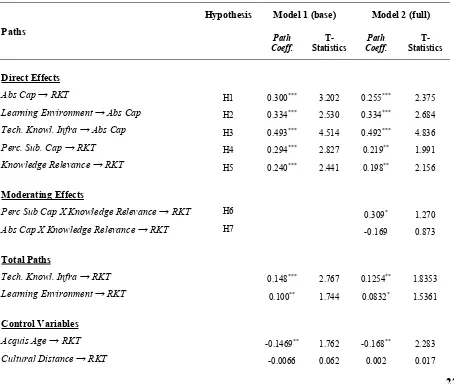
[image:22.612.83.537.331.715.2]Five sets of models were analysed as indicated in Tables 5 and 6. Models 1 (without moderation) and 2 (with moderation) were used to test the hypotheses that were developed for this study. We found support for all (six) hypotheses except H7. In both models, absorptive capacity (H1, β = .255 at p ≤ .01), perceived subsidiary capability (H4, β = .219 at p ≤ .05) and knowledge relevance (H5, β = .198 at p ≤ .05) have a significant positive impact on RKT. The positive effects of learning environment (H2, β = .334 at p ≤ .01) and technical knowledge infrastructure (H3, β = .492 at p ≤ .01) on absorptive capacity were also supported. These total effects of these two variables on RKT have also been provided in figure 1. In terms of the moderating effects, only the moderating effect of knowledge relevance on the positive relationship of perceived subsidiary capability on RKT (H6, β = .309 at p ≤ .1) was supported while it was not supported for absorptive capacity (H7, β = -.169 at p = .19).
Table 5: PLS-SEM Path Modelling Results
Paths
Hypothesis Model 1 (base) Model 2 (full)
Path
Coeff. Statistics T- Coeff. Path Statistics
T-Direct Effects
Abs Cap → RKT H1 0.300*** 3.202 0.255*** 2.375
Learning Environment → Abs Cap H2 0.334*** 2.530 0.334*** 2.684
Tech. Knowl. Infra → Abs Cap H3 0.493*** 4.514 0.492*** 4.836
Perc. Sub. Cap → RKT H4 0.294*** 2.827 0.219** 1.991
Knowledge Relevance → RKT H5 0.240*** 2.441 0.198** 2.156
Moderating Effects
Perc Sub Cap X Knowledge Relevance → RKT H6 0.309* 1.270
Abs Cap X Knowledge Relevance → RKT H7 -0.169 0.873
Total Paths
Tech. Knowl. Infra → RKT 0.148*** 2.767 0.1254** 1.8353
Learning Environment → RKT 0.100** 1.744 0.0832* 1.5361
Control Variables
Acquis Age → RKT -0.1469** 1.762 -0.168** 2.283
23
High Tech Ind → RKT 0.1016 0.711 0.121 0.829
Med Tech Ind → RKT 0.1027 0.684 0.160 1.042
Organisational Distance → RKT 0.0106 0.094 -0.057 0.558
Relative Age → RKT 0.1141* 1.321 0.107* 1.240
Relative Size → RKT 0.0764 0.984 0.045 0.632
Location1 → RKT 0.1939* 1.518 0.115 0.840
Location2 → RKT 0.0749 0.530 0.020 0.150
Location3 → RKT 0.1307 0.909 0.132 1.002
R2 (for RKT)
.498 .604
R2 (for Abs Cap)
.551 .551
*
p ≤ .1, **p ≤ .05, ***p ≤ .01 (p from tdist (t, df = 499, one-tailed))
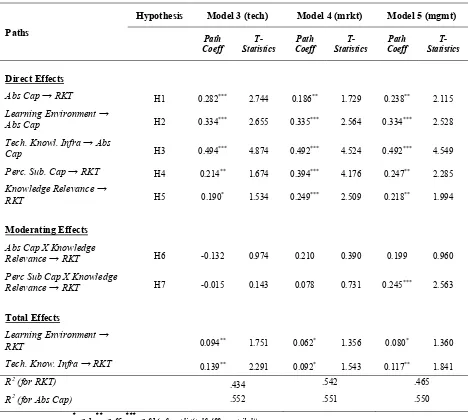
In addition, model 2 was tested separately for the three different knowledge components namely technological (model 3), marketing (model 4) and management (model 5) that were used to measure RKT, perceived subsidiary capability and knowledge relevance. This additional comparative analysis (table 6) was done to understand whether the model behaved differently for the different knowledge types that were considered.
The results indicate that Model 2 has the maximum explanatory power for RKT (R2 = .604) and
the GoF (goodness of fit) value for this model (.355) is in the medium to large range (Tenenhaus et. al., 2004). The interaction effects have enhanced the explanatory power (R2) in model 2 from model 1. Further, f2 was computed (Chin, 1998) to check the extent of improvement of R2 on
model 2 over model 1 and it was found to be .21 which indicates medium effect (≥ .15). The R2
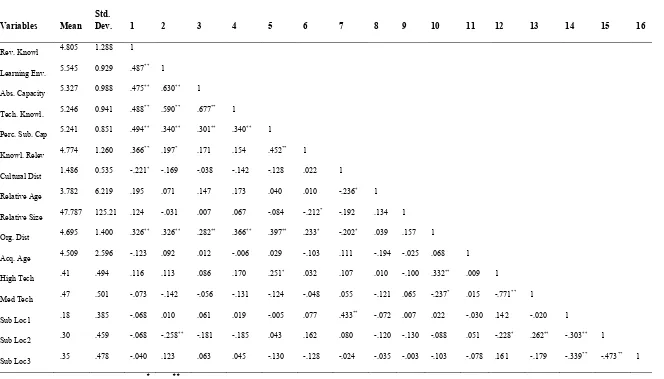
(= .55) values for absorptive capacity also indicates the predictive power of learning environment and technical knowledge infrastructure together in accounting for the variance in absorptive capacity. The correlation matrix is provided in Table 7 in the Appendix along with the mean and standard deviation for all the variables. The VIF (Variance Inflation Factor) was also checked (< 10) to confirm that multi-collinearity is not a potential issue with this analysis (Hair et al., 1995). Further, because of the relatively low sample size, post-hoc statistical power was calculated
(Cohen, 1988) based on the R2 estimates obtained, the number of predictors used in the model
24 Table 6: xiiAdditional PLS Analysis
Paths
Hypothesis Model 3 (tech) Model 4 (mrkt) Model 5 (mgmt)
Path Coeff
T-Statistics
Path Coeff
T-Statistics
Path Coeff
T-Statistics
Direct Effects
Abs Cap → RKT H1 0.282*** 2.744 0.186** 1.729 0.238** 2.115
Learning Environment →
Abs Cap H2 0.334*** 2.655 0.335*** 2.564 0.334*** 2.528 Tech. Knowl. Infra → Abs
Cap H3 0.494*** 4.874 0.492*** 4.524 0.492*** 4.549 Perc. Sub. Cap → RKT H4 0.214** 1.674 0.394*** 4.176 0.247** 2.285
Knowledge Relevance →
RKT H5 0.190* 1.534 0.249*** 2.509 0.218** 1.994
Moderating Effects
Abs Cap X Knowledge
Relevance → RKT H6 -0.132 0.974 0.210 0.390 0.199 0.960 Perc Sub Cap X Knowledge
Relevance → RKT H7 -0.015 0.143 0.078 0.731 0.245*** 2.563
Total Effects
Learning Environment →
RKT 0.094** 1.751 0.062* 1.356 0.080* 1.360 Tech. Know. Infra → RKT 0.139** 2.291 0.092* 1.543 0.117** 1.841
R2 (for RKT)
.434 .542 .465
R2 (for Abs Cap) .552 .551 .550
*
p ≤ .1, **p ≤ .05, ***p ≤ .01 (p from tdist(t, df=499, one-tailed))
3.4.3 Mediating Effects
25
(β = .294 at p ≤ .001). Then in the next model, two more paths were added; (i) technical knowledge infrastructure was linked as a predictor to absorptive capacity and (ii) absorptive capacity was linked as a predictor to RKT. It was seen that the strength of technical knowledge infrastructure → RKT was less and the significance levels also dropped (β = .147 at p ≤ .1). The other two paths technical knowledge infrastructure → absorptive capacity (β = .693 at p ≤ .001) and absorptive capacity → RKT (β = .212 at p ≤ .05) were also significant. This indicates the partial mediation of absorptive capacity on the relationship between technical knowledge infrastructure and RKT. Similar analysis was done to test the mediation of absorptive capacity on the relationship between learning environment and RKT. In the first model, it was seen that learning environment → RKT was significant (β = .356 at p ≤ .001). In the second model, after adding the additional paths, it was seen that learning environment → RKT reduced in strength and significance (β = .253 at p ≤ .05). The other two relationships, learning environment → absorptive capacity (β = .628 at p ≤ .001) and absorptive capacity → RKT (β = .166 at p ≤ .1) were also significant. This again indicates partial mediation of absorptive capacity on the relationship between learning environment and RKT even though it is not as prominent as in the earlier mediation effect.
4.
Discussion
For EM-MNEs, acquiring knowledge-based assets is one of the primary motives behind their accelerated internationalisation attempts as suggested by the springboard perspective. In this regard, many of their overseas subsidiaries especially in the developed markets are valuable sources of organisational competencies and other technological capabilities, which are much sought after. Yet, there is limited understanding of the factors that determine the knowledge flows to parent units in EM from their overseas subsidiaries. The purpose of this study was to address this research gap and develop a model to explore and test RKT in relation to the factors that are pertinent in an EM context.
26
knowledge outflows from subsidiaries also suggest that knowledge outflows were significantly higher from subsidiaries that are highly rated with respect to their capabilities (Monterio et al., 2008; Noorderhaven and Harzing, 2009). In the case of MNEs from EM like India, according to the IB literature, one of the main motives of their internationalisation strategy is to acquire the knowledge that they lack (Kale, 2009; Luo and Tung, 2007; Mathews, 2006). Hence based on their acquisition strategy, they are likely to invest more of their efforts on RKT from their more competent subsidiaries. This is even more prominent when it comes to the acquisitions of EM-MNEs in the developed economies which are often termed as knowledge seeking OFDI (Kedia et al., 2012). Such knowledge seeking acquisitions pursued in the West are also a vital and major part of Indian OFDI, since these subsidiaries in developed markets are generally perceived to be more competent. The fact that the parent perception of the subsidiary capability drives RKT is also an indication of their commitment towards augmenting their knowledge base and closing the knowledge gap to compete more effectively with their global competitors.
The results indicate that the positive effect of perceived subsidiary capability on RKT will be stronger with greater knowledge relevance. This means that for Indian MNEs, the more the relevance of the knowledge associated with the subsidiary, the greater will be the extent of RKT from an overseas subsidiary that is perceived to be more capable by the parent. This further suggests the importance of knowledge relevance in international knowledge transfers involving
organisational units from both developed and emerging economies. However, knowledge
27
portfolios through their acquisitions. This could be one of the potential reasons for the results produced by this study and warrants further investigation on the links between MNE diversification and the effects of knowledge relevance.
Prior studies on the knowledge transfer indicate that the recipient’s absorptive capacity has a positive effect on knowledge flow (Ambos et al., 2006; Mahnke et al., 2005; Pak and Park, 2004). However, the results were not fully supported for lack of significance in certain other studies (Gupta and Govindarajan, 2000; Szulanski et al., 2004). Researchers have attributed this inconsistency in results to the differences in operationalisation of absorptive capacity (Minbaeva, 2007). This study indicates that the parent Indian unit’s absorptive capacity has a positive influence on RKT. Absorptive capacity indicates the capability to assimilate and utilise external knowledge and this has more of an effect on knowledge flows when the recipient and source units are not equals in terms of their knowledge possessions (Cohen and Levinthal, 1990). Hence this construct is likely to have more of a prominent effect in this study where the recipient unit is from the EM of India and most of their overseas subsidiaries are from developed markets. There could be a considerable gap in terms of their knowledge possessions and EM-MNEs are in the process of closing this knowledge gap with these knowledge acquisitions. Further, drawing from the learning perspective, this study suggests that a good learning environment and technical knowledge infrastructure facilitates the development of absorptive capacity in Indian MNEs. IT enabled technologies help organisations collaborate with geographically dispersed units (Alavi and Leidner, 2001; Almeida et al., 2002; Gold et al., 2001) and thus become more aware of knowledge residing in other units. The positive effects of technology based mechanisms on knowledge flows also suggest their effectiveness (Ambos and Ambos, 2009; Hong et al., 2006). Such mechanisms increase the ability of the Indian MNEs to recognise knowledge that is bound to be useful for them, which will make it easier for them to assimilate and use it for their own benefit. Since Indian MNEs are generally found to be very IT savvy, it is also natural that most of these Indian MNEs rely on IT enabled technologies to improve their absorptive capacity.
28
exchanges. Such an environment creates a frame of mind in employees where they are more willing to accept changes and new knowledge which in turn is crucial for the development of absorptive capacity. The LLL framework (Mathews, 2006) also discusses the continuous focus that EM-MNEs have on cumulative learning through leveraging the resources acquired through external linkages. The focus of Indian MNEs on learning environment and knowledge infrastructure provides further evidence of their focussed catching up strategies (Luo and Tung, 2007) and developing their absorptive capacity to effectively engage in RKT.
29
differences help organisations fine tune their organisational mechanisms that facilitate knowledge flows in line with the nature and type of the target organisational knowledge.
5.
Conclusions
This study takes a fresh look at the process of RKT in the context of MNEs from India. The study proposes a framework that brings together factors such as knowledge relevance, perceived subsidiary capability and parent absorptive capacity that are vital to RKT in the context of EM-MNEs. In addition to these direct effects, the study also seeks to contribute to our understanding of the mediating effect of absorptive capacity, and the development of the same in parent Indian MNEs - by means of having a corporate environment conducive to learning and having an effective technical knowledge infrastructure. The study also reveals the importance of knowledge relevance in RKT further by further exploring the moderating effects. Knowledge and learning have always played a central role in the internationalisation of firms (Pla-Barber and Alegre, 2014) and more so in the case of EM-MNEs (Kedia et al., 2012) and in this regard this study has several implications for academics and practitioners.
30
Demirbag and Yaprak, 2015). This is one of the initial studies that suggest the need to take into account these emergent perspectives in exploring RKT and establishes the significance of the links between RKT and the attempts of EM-MNEs to springboard.
The findings of this study also throw light on the persuasive role of knowledge relevance that is particularly vital for EM-MNEs, when they attempt to transfer knowledge from overseas subsidiaries in host countries that have different business and organisational environments. The findings suggest that knowledge residing with their competent subsidiaries is of more interest to Indian MNEs, when they can see the relevance of this knowledge. The study also reveals that the effect of relevance is not the same for the different types of organisational knowledge. This warrants studies that also explore the effects of various determinants on the individual components of RKT. For instance, the effect of knowledge infrastructure on the flow of technological know-how is more prominent when compared to the flow of marketing know-how. This implies that it is essential for future studies to account for the contextual nature and other attributes of the knowledge in conjunction with organisational mechanisms and characteristics to be able to fully understand RKT.
31
32
References
Alavi, M., and Leidner, D. E. (2001). Review: Knowledge Management and Knowledge Management Systems: Conceptual Foundations and Research Issues. MIS Quarterly, 25, 1, 107-136.
Almeida, P., Song, J., and Grant, R. M. (2002). Are Firms Superior to Alliances and Markets? An Empirical Test of Cross-Border Knowledge Building. Organization Science, 13, 2, 147–161.
Ambos, T. C., Ambos, B., and Schlegelmilch, B. B. (2006). Learning From Foreign Subsidiaries: An Empirical Investigation Of Headquarters’ Benefits From Reverse Knowledge Transfers. International Business Review, 15, 294-312.
Ambos, T. C., and Ambos, B. (2009). The impact of distance on knowledge transfer effectiveness in multinational corporations. Journal of International Management, 15, 1–14.
Bagozzi, R. P., and Yi, Y. (1988). On the evaluation of structural equation models. Journal of the Academy of Marketing Science, 16, 1, 74–94.
Bangara, A., Freeman, S., and Schroder, W. (2012). Legitimacy and accelerated internationalisation: An Indian perspective. Journal of World Business 47, 623–634.
Barney, J. B. (1991), Firm resources and sustainable competitive advantage. Journal of Management, 17, 99–120.
Baron, R. M., and Kenny, D. A. (1986). The moderator-mediator variable distinction in social psychological research: Conceptual, strategic and statistical considerations. Journal of Personality and Social Psychology, 51, 1173-1182.
Bereby-Meyer, Y., Moran, S., and Unger-Aviram, E. (2004). When performance goals deter performance: Transfer of skills in integrative negotiations. Journal of Organizational Behavior and Human Decision Processes, 93, 142-154
Björkman, I., Barner-Rasmussen, W., and Li, L. (2004). Managing Knowledge Transfer in MNCs: The Impact of Headquarters Control Mechanisms. Journal of International Business Studies, 35, 5, 443-455.
Bonaglia, F., Goldstein, A., and Mathews, J. A. (2007). Accelerated internationalization by emerging markets’ multinationals: The case of the white goods sector. Journal of World Business, 42, 369.
33
Chang, S.-J., Witteloostuijn, A. V., and Eden, L. (2010). From the Editors: Common Method Variance in International Business Research. Journal of International Business Studies, 41, 178-184.
Chin, W. W. (1998). The partial least squares approach to structural equation modelling. In Marcoulides, G. A. (Ed.), Modern methods for business research (pp. 295–336). Lawrence Erlbaum Associates, New Jersey.
Chittoor, R., and Ray, S. (2007). Internalization paths of Indian pharmaceutical firms - A strategic group analysis. Journal of International Management, 13, 338-355.
Cho, K. R., and Lee, J. (2004). Firm Characteristics and MNC's Intra-network Knowledge Sharing. Management International Review, 44, 4, 435-455.
Mellahi, K., Demirbag, M., Collings, D., Tatoglu, E., and Hughes, M. (2013) Similarly different: a comparison of HRM practices in MNE subsidiaries and local firms in Turkey, International Journal of Human Resource Management, 24, 12, 2339-2368
Cohen, J. (1988). Statistical Power Analysis for the Behavioral Sciences (2nd Edition). Hillsdale, NJ: Lawrence Earlbaum Associates.
Cohen, W., and Levinthal, D. (1990). Absorptive capacity: a new perspective on learning and innovation. Administrative Science Quarterly, 35, 128–152.
Cool, K., Dierickx, I., and Jemison, D. (1989). Business Strategy, Market Structure and Risk-Return Relationships: A Structural Approach. Strategic Management Journal, 10, 6, 507-522.
Cuervo-Cazura, A. (2012). Extending theory by analyzing developing country multinational companies: Solving the Goldilocks debate. Global Strategy Journal, 2, 3, 153-167.
Demirbag, M., and Yaprak, A. (2015). Conclusions and future research directions: lessons learned from the rise of Emerging Market Multinationals, in Demirbag, M., and Yaprak, A. (Eds). Handbook of Emerging Market MNEs, Edward Elgar, 260-269.
Demirbag, M., and Glaister, K. (2010) Factors determining offshore location choice for R&D projects: A comparative study of TRIAD regions, Journal of Management Studies, 47, 8, 1534-1560
Demirbag, M., Sahadev, S., and Mellahi, K. (2010). Country image and consumer preference for
emerging market economy products: the moderating role of consumer materialism. International
Marketing Review, 27, 2, 141-163.
Demirbag, M., Tatoglu, E., and Glaister, K. (2009). Equity-based entry modes of emerging country multinationals: Lessons from Turkey, Journal of World Business, 44, 4, 445-462.
34
Elango, B., and Pattnaik, C. (2011). Learning Before Making the Big Leap Acquisition Strategies of Emerging Market Firms. Management International Review, 51, 461–481.
Fang, Y., Jiang, G.-L. F., Makino, S., and Beamish, P. W. (2010). Multinational firm knowledge, use of expatriates, and foreign subsidiary performance. Journal of Management Studies, 47, 1, 27-54.
Fey, C. F., and Furu, P. (2008). Top management incentive compensation and knowledge sharing in multinational corporations. Strategic Management Journal, 29, 12, 1301-1323.
FICCI and Grant Thornton. (2010). Investing in the European Union – lists the M&A by Indian MNEs in the European Union during 2005 to 2010.
FICCI. (2006). Study conducted on 306 foreign acquisitions by Indian firms from January 2000 to June 2006.
Fiol, C. M., and Lyles, M. A. (1985). Organizational Learning. The Academy of Management Review, 10, 4, 803-813.
Fishbein, M., and Ajzen, I. (1975). Belief, Attitude, Intention, and Behavior: An Introduction to Theory and Research. Reading, MA: Addison-Wesley.
Fornell, C., and Larcker, D. F. (1981). Evaluating Structural Equation Models with Unobserved Variables and Measurement Error. Journal of Marketing Research, 18, 39-50.
Fox, S. (2000). Communities of Practice, Foucault and Actor-Network Theory. Journal of Management Studies, 37, 6, 853–67.
Garcia-Manjon, J. V., and Elena Romero-Merino, M. (2012). Research, development, and firm growth. Empirical evidence from European top R&D spending firms. Research Policy, 41, 1084– 1092.
Gold, A. H., Malhotra, A., and Segards, A. H. (2001). Knowledge Management: An Organizational Capabilities Perspective. Journal of Management Information Systems, 18, 1, 185–214.
Grant, R. M. (1996). Toward a Knowledge-Based Theory of the Firm. Strategic Management Journal, 17, 109-122.
Gupta, A. K., and Govindarajan, V. (1991). Knowledge Flows and the Structure of Control within Multinational Corporations. Academy of Management Review, 16, 768-792.
Gupta, A. K., and Govindarajan, V. (2000). Knowledge Flows within Multinational Corporations. Strategic Management Journal, 21, 473-496.
35
Hair, J. F., Sarstedt, M., Ringle, C. M., and Mena, J. A. (2012). An assessment of the use of partial least squares structural equation modeling in marketing research. Journal of the Academy of Marketing Science, 40, 414–433.
Hakanson, L., and Nobel, R. (2001). Organizational Characteristics and Reverse Technology Transfer. Management International Review, 41, 4, 395.
Hamel, G. (1991). Competition for Competence and Inter-Partner Learning WithinInternational
Strategic Alliances. Strategic Management Journal, 12, 83-103.
Harzing, A.-W., and Noorderhaven, N. (2006). Knowledge flows in MNCs: An empirical test and extension of Gupta and Govindarajan’s typology of subsidiary roles. International Business Review, 15, 195–214.
Hennart, J-F. (2012). Emerging market multinationals and the theory of the multinational enterprise. Global Strategy Journal, 2, 3, 168–187.
Henseler, J., Ringle, C. M., and Sinkowics, R. R. (2009). The use of partial least squares path modeling in international marketing. Advances in International Marketing, 20, 277-319,
Hofstede, G. (1980). Culture’s consequences. Sage, Beverly Hills.
Hong, J. F. L., Easterby-Smith, M., and Snell, R. S. (2006). Transferring Organizational Learning Systems to Japanese Subsidiaries in China. Journal of Management Studies, 43, 5, 1027-1058.
Hulland, J. (1999). Use of Partial Least Squares (PLS) in Strategic Management Research: A Review of Four Recent Studies. Strategic Management Journal, 20, 2, 195-20.
Johansson, J. K and Yip, G. S. (1994). Exploiting Globalization Potential: U.S. and Japanese Strategies. Strategic Management Journal, 15, 8, 579-601.
Jormanainen, I., and Koveshnikov, A. (2012). International Activities of Emerging Market Firms A Critical Assessment of Research in Top International Management Journals. Management International Review, 52, 691–725.
Kale, P. (2009). The Global Indian Firm: Growth & Value Creation through Overseas Acquisitions. The Indian Journal of Industrial Relations, 45, 1, 41-53.
Kale, P., Singh, H., and Raman, A. P. (2009). Mergers & Acquisitions Don’t Integrate Your Acquisitions, Partner with Them. Harvard Business Review.
36
Kogut, B. and Zander, U. (1992). Knowledge of the firm, combinative capabilities, and the replication of technology. Organization Science, 3, 383-397.
Kogut, B., and Singh, H. (1988). The effect of national culture on the choice of entry mode. Journal of International Business Studies, 19, 3, 411–432.
Kostova, T., and Roth, K. (2002). Adoption of an organizational practice by subsidiaries of multinational corporations: Institutional and Relational effects. The Academy of Management Journal, 45, 1, 215-233.
Kumar, N. (2008). Internationalization of Indian Enterprises: Patterns, Strategies, Ownership Advantages, and Implications. Asian Economic Policy Review, 3, 242–261.
Lane, P. J., Salk, J. E., and Lyles, M. A. (2001). Absorptive Capacity, Learning, and Performance in International Joint Ventures. Strategic Management Journal, 22, 1139-1161.
Lane, P.J., and Lubatkin, M. (1998). Relative Absorptive Capacity and Interorganizational Learning. Strategic Management Journal, 19, 5, 461-477.
Liang, H., Saraf, N., Hu, Q., and Xue, Y. (2007). Assimilation of Enterprise Systems: The Effect of Institutional Pressures and the Mediating Role of Top Management, MIS Quarterly, 31, 1, 59-87.
Liao, H., Liu, X., and Wang, C. (2012). Knowledge spillovers, absorptive capacity and total factor productivity in China’s manufacturing firms. International Review of Applied Economics, 26, 4, 533-547.
Lohm¨oller, J. B. (1989). Latent Variable Path Modeling with Partial Least Squares. Physica, Heidelberg.
Luo, Y., and Tung, R. L. (2007). International expansion of emerging market enterprises: A springboard perspective. Journal of International Business Studies, 38, 481–498.
Lyles, M. A., and Salk, J. E. (1996). Knowledge Acquisition from Foreign Parents in International Joint Ventures: An Empirical Examination in the Hungarian Context. Journal of International Business Studies, 27, 5, 877-903.
Madhok, A., and Keyhani, M. (2012). Acquisitions as entrepreneurship: asymmetries, opportunities, and the internationalization of multinationals from emerging economies. Global Strategy Journal, 2, 26–40.
37
Mathews, J. A. (2006). Dragon multinationals: New players in 21st century globalization. Asia Pacific Journal of Management, 23, 5–27.
Mellahi, K., Demirbag, M., Cavusgil, T., and Wade, D. (2010). Marketing Strategies of Emerging Economies Multinationals - Part 1. International Marketing Review, 27, 2.
Minbaeva, D. B. (2007). Knowledge Transfer in Multinational Corporations. Management International Review, 47, 4, 567 – 593.
Minbaeva, D. B., Pedersen, T., Bjo¨rkman, I., Fey, C. F., and Park, H. J. (2003). MNC knowledge transfer, subsidiary absorptive capacity, and HRM. Journal of International Business Studies, 34, 586–599.
Monteiro, L. F., Arvidsson, N., and Birkinshaw, J. (2008). Knowledge Flows within Multinational Corporations: Explaining Subsidiary Isolation and Its Performance Implications. Organization Science, 19, 1, 90–107.
Mudambi, R., Piscitello, L., and Rabbiosi, L. (2014). Reverse Knowledge Transfer in MNEs: Subsidiary Innovativeness and Entry Modes. Long Range Planning, 47, 1-2, 49-63.
Muthusamy, S. K., and White, M. A., (2005). Learning and Knowledge Transfer in Strategic Alliances: A Social Exchange View. Organization Studies, 26, 3, 415–441.
Najafi-Tavani, Z., Giroud, A., and Sinkovics, R. R. (2012). Mediating Effects in Reverse Knowledge Transfer Processes. Management International Review, 52, 3, 461-488.
Nayyar, D. (2008). The Internationalisation of Firms from India: Investment, Mergers and Acquisitions. Oxford Development Studies, 36, 1, 111- 131.
Nonaka, I., and Takeuchi, H. (1995). The Knowledge Creating Company. New York: Oxford University Press.
Noorderhaven, N. G., and Harzing A. W. K. (2009). Factors Influencing Knowledge Flows within MNCs. Journal of International Business Studies, 40, 509-526.
Nunnally, J. (1978). Psychometric theory, 2nd ed. McGraw-Hill, New York.
Pak, Y. S., and Park, Y-R. (2004). A Framework of Knowledge Transfer in Cross-border Joint Ventures - An Empirical Test of the Korean Context. Management International Review, 44, 4, 417.
38
Pla-Barber, J., and Alegre, J. (2014). The role of knowledge and learning in internationalization. International Business Review, 23, 1, 1–3.
Podsakoff, P. M., MacKenzie, S. B., Lee, J. Y., and Podsakoff, N. P. (2003). Common method biases in behavioural research: A critical review of the literature and recommended remedies. Journal of Applied Psychology, 88, 879-903.
Pradhan, J. P. (2007). Trends and Patterns of Overseas Acquisitions by Indian Multinationals, MPRA Paper, http://mpra.ub.uni-muenchen.de/12404/.
Rabbiosi, L. (2011). Subsidiary roles and reverse knowledge transfer: An investigation of the effects of coordination mechanisms. Journal of International Management, 17, 2, 97-113.
Rabbiosi, L., and Santangelo, G. D. (2013). Parent company benefits from reverse knowledge transfer: The role of the liability of newness in MNEs. Journal of World Business, 48, 1, 160– 170.
Ramamurti, R. (2012). What is really different about emerging market multinationals? Global Strategy Journal,2,1, 41-47.
Richey, R. G., and Autry, C. W. (2009). Assessing interfirm collaboration/technology investment tradeoffs - The effects of technological readiness and organizational learning. The International Journal of Logistics Management, 20, 1, 30-56.
Ringle, C. M., Sarstedt, M., and Straub, D. W. (2012). A Critical Look at the Use of PLS-SEM in MIS Quarterly. MIS Quarterly, 36, 1, iii-xiv.
Ringle, C. M., Wende, S., and Will, S. (2005). SmartPLS 2.0 (M3) Beta, Hamburg, http://www.smartpls.de.
Schulz, M. (2003). Pathways of Relevance: Exploring Inflows of Knowledge into Subunits of Multinational Corporations. Organization Science, 14, 4, 440-459.
Schulz. M. (2001). The Uncertain Relevance of Newness: Organizational Learning and Knowledge Flows. The Academy of Management Journal, 44, 4, 661-681.
Sethi, D. (2009). Are multinational enterprises from the emerging economies global or regional? European Management Journal, 27, 356–365.
Simonin, B. L. (1999). Transfer of Marketing Know-How in International Strategic Alliances: An Empirical Investigation of the Role and Antecedents of Knowledge Ambiguity. Journal of International Business Studies, 30, 3, 463-490.
39
Simonin, B. L., and Özsomer, A. S. (2009). Knowledge Processes and Learning Outcomes in MNCs: An Empirical Investigation of the Role of HRM Practices in Foreign Subsidiaries. Human Resource Management, 48, 4, 505–530.
Sperber, D., and Wilson, D. (1986). Relevance: communication and cognition. Harvard University Press, Cambridge, MA.
Szulanski, G., Cappetta, R., and Jensen, R. J. (2004). When and How Trustworthiness Matters: Knowledge Transfer and the Moderating Effect of Causal Ambiguity. Organization Science, 15, 5, 600–613.
Teece, J. T., Pisano, G., and Shuen, A. (1997). Dynamic Capabilities and Strategic Management. Strategic Management Journal, 18, 509-533.
Tenenhaus, M., Amato, S., and Esposito Vinzi, V (2004). A global goodness-of-fit index for PLS structural equation modeling. In Proceedings of the XLII SIS Scientific Meeting (pp. 739–742). Padova: CLEUP.
Thite, M., Wilkinson, A., and Shah, D. (2012). Internationalization and HRM strategies across subsidiaries in multinational corporations from emerging economies—A conceptual framework. Journal of World Business, 47, 251–258.
Van Wijk, R., Jansen, J. J. P., and Lyles, M. A. (2008). Inter- and intra-organizational knowledge transfer: A meta-analytic review and assessment of its antecedents and consequences. Journal of Management Studies, 45, 4, 830-853.
Williams, C. (2009). Subsidiary-level determinants of global initiatives in multinational corporations. Journal of International Management, 15, 92–104.
Wold, H. (1975). Soft Modeling by Latent Variables; the Nonlinear Iterative Partial Least Squares Approach. In J. Gani (Ed.), Perspectives in Probability and Statistics (pp. 520–540), Papers in Honour of M.S. Bartlett, Academic Press, London.
Yang, Q., Mudambi, R., and Meyer, K. E. (2008). Conventional and Reverse Knowledge Flows in Multinational Corporations. Journal of Management, 34, 882.
40
APPENDIX
Scales
(1) Reverse Knowledge Transfer (using a 7-point Likert scale ranging from 1= “Not at all” to 7= “A very great deal” in three knowledge areas (Gupta and Govindarajan, 2000))
Our subsidiary provides us with knowledge and skills (repeated for technological,
marketing and management knowledge with items Rev_Flow1, Rev_Flow2 and Rev_Flow3 respectively)
(2) Knowledge Relevance (using a 7-point Likert scale (Yang et al., 2008) ranging from 1= ‘Not at all’ to 7 = ‘A Very Great Deal’)
Prior to the acquisition, how similar was the knowledge held by your subsidiary when
compared to yours (repeated for technological, marketing and management knowledge
with items Know_Rel1, Items Know_Rel2, Items Know_Rel3 respectively)
(3) Technical knowledge infrastructure (using a 7-point Likert scale (Gold et al., 2001) ranging from 1 = ’Strongly Disagree’ to 7 = ’Strongly Agree’)
We have clear rules for formatting or categorizing knowledge (Tech_Knowl_Infra1)
We use technology that allows us to monitor its competition and business partners
(Tech_Knowl_Infra2)
We use technology that allows employees to collaborate with overseas units
(Tech_Knowl_Infra3)
We use technology that allows people in multiple locations to learn as a group
(Tech_Knowl_Infra4)
We use technology that allows us to search for new knowledge (Tech_Knowl_Infra5)
We use technology that allows us to map the location of specific types of knowledge
(Tech_Knowl_Infra6)
We use technology that allows us to retrieve and use knowledge (Tech_Knowl_Infra7)
We use technology that allows us to generate new opportunities in conjunction with its
partners (Tech_Knowl_Infra8)
41
We (Parent) have the academic background to understand our subsidiary’s knowledge
(Abs_Cap1)
We (Parent) have better capabilities for adopting new techniques than our competitors
(Abs_Cap2)
We (Parent) provide various education programs for employees (Abs_Cap3)
We (Parent) allocate financial resources for new ideas and research (Abs_Cap4)
We (Parent) provide frequent training programs abroad (Abs_Cap5)
(5) Perceived Subsidiary Capability (using a 7-point Likert scale (Harzing and Noorderhaven, 2006) ranging from 1 = ‘far below when compared to others’ to 7 = ‘far above the others’)
How do you evaluate your subsidiary’s capabilities relative to other units in your MNE
network (repeated for technological, marketing and management knowledge with items
Sub_cap1, Sub_cap2 and Sub_cap3 respectively)
(5)Learning Environment (using a 7-point Likert scale (Richey and Autry, 2009) ranging from 1 = ‘strongly disagree’ to 7 = ‘strongly agree’)
We (Parent) provide employees with the opportunity to learn new skills (Learn1)
Your employees are rewarded for using on the job what they have learned in training
(Learn2)
Training is encouraged in your organization to develop the skills needed for advancement
(Learn3)
Employees in your organization are open to new ideas and suggestions (Learn4)
Your employees are rewarded for learning different approaches to solving problems
(Learn5)
In your organization supervisors and co-workers help reschedule work so that employees