A ROBUST, PRECISE AND FLEXIBLE TRACKING ALGORITHM
BASED ON IMS AND SWAD
G. Di Caterina and J. J. Soraghan
Department of Electronic and Electrical Engineering, University of Strathclyde, Glasgow, UK
ABSTRACT
The improved mean shift (IMS) algorithm can effectively track a colour target undergoing fast motion and complete occlusion. Instead template matching based on the sum of weighted absolute differences (SWAD) can track a target pre-cisely, even under partial occlusion. To take advantage of both trackers, this paper presents a novel tracking algorithm that, on one side, further improves the IMS and extends it to a more general and flexible framework; on the other side, the proposed algorithm incorporates SWAD minimisation to increase the precision of the tracking results. Experimen-tal results demonstrate that such an algorithm can robustly and precisely track targets with fast motion and in com-plete occlusion, more than conventional mean shift, IMS and SWAD-based trackers taken separately.
Index Terms— visual tracking, improved mean shift, sum of weighted absolute differences
1. INTRODUCTION
Target tracking is a key element in many visual systems and several tracking algorithms have been proposed in the liter-ature, as reported in [1]. The improved mean shift (IMS) described in [2] has been shown to be fast and effective in tracking a colour target with fast motion, undergoing pro-longed complete occlusion and in complex scenarios. How-ever a weakness of this algorithm, as of the original mean shift tracker introduced in [3, 4], is its low precision during track-ing. In other words, the IMS can effectively locate a target in consecutive frames, but the computed target positions are not very precise, with a sort of shaking effect on the overall track. A further limitation of the IMS is that, as it stands, it does not offer much room for improvement, to incorporate additional metrics or techniques for comparing the target model with a target candidate in the current frame.
Template matching based on the sum of weighted absolute differences (SWAD) is a simple, but yet precise tracking al-gorithm, as demonstrated in [5, 6]. However, although being very efficient over a set of frames wherein the target template is visible and does not change drastically, it dramatically fails when the target has very fast motion and is subject to com-plete occlusion.
To overcome the weaknesses of both IMS and SWAD-based trackers, while retaining and combining their strengths, in this paper we present a novel tracking algorithm which can precisely track very fast targets, in complex scenarios, also after prolonged complete occlusion. The novelty of the al-gorithm proposed in this paper is therefore three-fold: first, the IMS is generalised to obtain a more flexible framework, wherein it is easy to incorporate further matching metrics and techniques; second, the IMS initialisation and restart point selection procedures are improved, to make them more data-independent; third, the SWAD is combined with the novel IMS-based framework, to guarantee tracking precision to the overall algorithm.
The rest of the paper is organised as follows. Section 2 de-scribes the novel tracking algorithm, including improved ini-tialisation and SWAD-based stabilisation. Experimental re-sults are reported in section 3, while section 4 concludes the paper.
2. TRACKING ALGORITHM
2.1. Overview
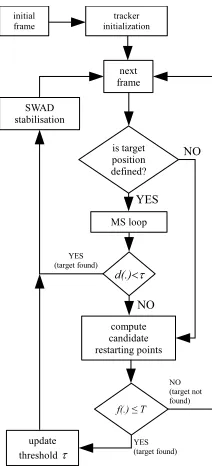
A flowchart of the proposed tracking algorithm is shown in Figure 1. The target to track is directly selected in the initial frameF0, in position y0. Then the initialisation step
com-putes the target model, represented by the target histogram Q, fromF0; it also computes an initial value for the
thresh-oldτ, which is the smallest distanced(·) =p1−ρ(·), as in [2], between the target histogramQand any other object in the frame, other than the target itself.
After the acquisition of a new frame Fi, the algorithm
checks if the positionyi−1of the target in the previous frame
Fi−1 is defined, i.e. the target has been found in the
pre-vious frame. Although this check is trivial for i = 1, it is indeed necessary wheni > 1. In fact, if the target has not been found inFi−1, the algorithm proceeds directly to the
computation of candidate restarting points inFi. If the
posi-tion inFi−1is defined, a single step of the conventional MS
tracker, referred to as “MS loop” in [2], is executed; such a loop computes the new possible target positionyiin the cur-rent frame, starting from previous positionyi−1, withd(yi)
Fig. 1. Flowchart of the tracking algorithm.
and the target candidate found inyi. The distanced(yi)is
then compared with the thresholdτ, computed as described in the initialisation step in section 2.2. Ifd(yi)< τ, the correct
target is found and the algorithm tries to further improve the precision of the track by applying template matching based on SWAD, in a small neighbourhood ofyi, as described in
section 2.4. Ifd(yi) ≥ τ, one of the three following cases
may have occurred:
1. the target found by the MS loop is the correct one, but its appearance has changed, possibly due to light changes or partial occlusion;
2. the actual target has moved substantially from the pre-vious position, so the MS loop has lost the target and the returned positionyibelongs to the background;
3. the real target is completely occluded, i.e. not visible, andyibelongs to the occluding object.
To check which of the three conditions above is true, a set ofLrestarting points{xl}l=1..L is computed within the current frameFi, with a procedure similar to the initialisation
step, and described in section 2.3. After that, any additional metric f(·) can be applied to verify whether any of these points belongs to the target,f(xl) ≤T, or not,f(xl) > T. If yes, the target is deemed as found, τ is updated and the SWAD-based stabilisation takes place. Iff(·)> T, the target is not found and the algorithm proceeds directly to the next frame.
2.2. Tracker initialisation
The outputs of the initialisation step are the thresholdτ and the target colour distributionQ. WhileQis computed as
de-scribed in [4], the initial value ofτis obtained as follows. For a colour target, it is possible to compute in every frameFi the distanced(·)between the target modelQand a candidate distributionP(xn)in a generic point xn inFi. Assuming that the target colour distribution does not change significantly over a certain number of frames, it is clear that the smallest value of d(·) is obtained when xn belongs to
the actual target. Therefore the distanced(·)betweenQand the background, i.e. any other object in the frame, is always higher than the distance betweenQand the actual target. This suggests that it is appropriate to setτequal to the smallest dis-tance betweenQand the background. In this way, ifd(·)≥τ, the tracker is likely to have lost the target and most likely is following another object in the background.
To compute the initial value of the thresholdτ, the dis-tribution P(xn) should be computed for every point xn in
the frameF0not belonging to the target. As this approach is
clearly not practical in terms of computational speed even on very fast machines, the distributionP(·)is computed only in a small number of candidate points{xl}l=1..L belonging to the background. The selection of such points is based on the presence in a neighbourhood aroundxlof colours peculiar to
the selected target.
As a first step to the selection of{xl}l=1..L, the range of discriminative colours of the target is determined. The posi-tion[rm, gm, bm]of the maximum inQis given by:
[rm, gm, bm] = arg max r,g,b∈[1,β]
(qrgb) (1)
whereqrgb is a generic bin in the colour histogramQ. The
discriminative colours in the selected target are identified by a set of bins qrgb around [rm, gm, bm] inQ. The
distribu-tion probabilities inQ of the selected range of colours are backprojected onto the initial frameF0, similar to [7]. Kernel
density estimation is then applied to the backprojected prob-ability image, using the Epanechnicov weighting kernelk(x) [8] as in [3]. In the estimated density function obtained, local maxima correspond to points where there is a high concen-tration of target discriminative colours, i.e. where the visible target is more likely to be. Therefore theLhighest local max-ima belonging to the background, and not the target, are se-lected as candidate points{xl}l=1..L. For each pointxl, the
MS loop is executed to obtain a value ofd(·)associated with xl. Finally, the initial value ofτ is set equal to the smallest
d(·)for all the candidate points{xl}l=1..L: τ= arg min
{xl}l=1..L
(d(xl)) (2)
2.3. Restarting points and additional metricf(·)
[image:2.612.122.228.69.302.2]The flexible aspect of the novel algorithm presented in this paper is represented by the further comparisonf(·)≤T, as in Figure 1. Heref(·)can be any metric or matching technique, not even necessarily based on colour. The only assumption is that for any two points,xtg belonging to the target andxbg
belonging to the background, it holds that:
f(xtg)≤T < f(xbg) (3)
whereTis the separation element, i.e. threshold, between any
{f(xtg)}and
f(xbg)
The usage off(·)transforms the IMS from [2] into a ro-bust framework, where the MS loop is an efficient procedure to select a reduced number of candidate points{xl}l=1..L, to be tested with any metricf(·)of choice. A simple example forf(·)isf(·) =d(·). In this caseT =τand the proposed algorithm reduces to the basic IMS, with improved initialisa-tion and SWAD stabilisainitialisa-tion.
If it exists anyxn∈ {xl}l=1..Lfor whichf(xn)≤T, the
target is considered as found and its new position isyi =xn.
The thresholdτis then updated as:
τ=min(τ, τ′) (4)
whereτ′is the minimum distanced(·)computed over the sub-set of the L restarting points not belonging to the target found in positionxn.
2.4. SWAD-based stabilisation
To improve the precision of the tracker over a group of con-secutive frames in which the target has been found, a stabil-isation step based on the minimstabil-isation of the SWAD metric [5] is added to the algorithm, as shown in Figure 1. For this purpose, the algorithm keeps a target templateTi. However,
as the stabilisation step is performed only when the target has been found in the current frameFiand the target positionyi
is available,Tiis left undefined whenyiis not available. For a set of consecutive frames whereyi is defined and therefore the target is visible, the templateTiis re-initialised in the first frame of the set and the SWAD stabilisation is car-ried out. For the following frames in the set,Ti is updated using an infinite impulse response filter approach.
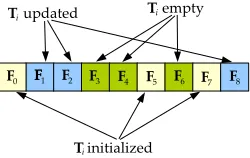
A visual representation of such a process is given in Fig-ure 2, where a set of9consecutive frames is depicted. Frames where the target is not found are referred to as U-frames (F3–
F4,F6), while frames whereyiis defined are referred to as
D-frames (F0–F2,F5,F7–F8). As it can be seen, the target
templateTican be:
• empty – in all the U-frames (F3–F4,F6);
• re-initialised – in the first D-frame after a U-frame (F0,
F5,F7);
• updated – in the consecutive D-frames (F1–F2,F8).
SWAD matching is performed on gray scale images, so if the current frameFiis a D-frame, a gray scale versionFgrayi of it is computed.
Fig. 2. A set of9 consecutive frames. FramesF3–F4,F6
are U-frames, i.e. the target is not found. FramesF0–F2,
F5,F7–F8are D-frames, i.e. the positionyiof the target is
[image:3.612.375.500.72.151.2]defined.
Table 1. Target area corner coordinates and relative initial frames.
TOP-LEFT BOTTOM-RIGHT FRAME S1 (303,741) (329,757) #23 S2 (304,743) (326,759) #14 S3 (277,654) (299,676) #1 S4 (191,76) (217,88) #111 S5 (222,611) (250,629) #474 S6 (42,137) (58,153) #1
When the templateTi is re-initialised, it is set equal to a portion ofFgrayi aroundyi. The dimensionshT ×wT of
Tiare equal to the current target sizehi×wi. The template
dimensions stay the same for all the following D-frames, until Tiis re-initialised.
The actual SWAD matching is performed in every D-frames, except whenTi is re-initialised. By minimising the
SWAD coefficientψ(v, z)over row indexvand column index z, the position of the best matchTˆi−1forTi−1inFgrayi is
obtained. This position becomes the final target position in the current frameFi. After this, the template is updated as:
Ti= (1−α)Ti−1+αTˆi−1 (5)
whereα ∈ [0,1]is a blending factor. As we are mainly in-terested in stabilising the position of the target across single pairs of D-frames, higher weight in (5) can be given to the best matchTˆi−1, rather than the previous templateTi−1.
There-fore the blending factorαshould have a value higher than0.5. In the current implementation of the tracker, it isα= 0.8.
3. EXPERIMENTAL RESULTS
To evaluate the performance of the novel algorithm proposed in this paper, with respect to the conventional MS, IMS and SWAD-based tracking, six standard video sequences have been used: (S1) S3-Multiple flow-time14.46-view1, (S2) S3-Multiple flow-time14.52-view1, (S3) L2-time14.55-view4, (S4) S3-Multiple flow-time14.13-view1, (S5) S2-L1-time12.34-view5 from [9], and (S6) the Table Tennis test sequence from [10]. Pixel coordinates, in the format
0 10 20 30 40 50 60 70 80 90 0
100 200 300
absolute error in pixels
frames MS IMS SWAD NEW (a) S1
0 10 20 30 40 50 60 70
0 100 200 300 400
absolute error in pixels
frames MS IMS SWAD NEW (b) S2
0 20 40 60 80 100 120
0 50 100 150 200 250
absolute error in pixels
frames MS IMS SWAD NEW (c) S3
0 20 40 60 80 100 120
0 100 200 300
absolute error in pixels
frames MS IMS SWAD NEW (d) S4
0 50 100 150 200 250 300 350 0
100 200 300
absolute error in pixels
frames MS IMS SWAD NEW (e) S5
0 5 10 15 20 25 30 35 40 0 20 40 60 80 100 120
absolute error in pixels
frames MS IMS SWAD NEW (f) S6
[image:4.612.56.557.71.310.2]Fig. 3. Graphs of the tracking results.
Table 2. Mean absolute error (in pixels).
µ MS IMS SWAD NEW
S1 143.30 87.88 40.03 38.07 S2 243.24 108.52 76.13 33.69 S3 91.65 12.18 77.52 4.87 S4 121.36 38.55 59.19 37.43 S5 56.30 8.35 54.17 7.10 S6 24.16 2.13 26.08 2.27
alongside the number of frame wherein the target is initially selected. Ground truth for these targets has been gathered through manual labeling.
Here the novel algorithm is indicated with “NEW”. As it can be appreciated from the graphs in Figure 3, the MS loses the target in each sequence; this is confirmed by its absolute error diverging, especially in Figure 3(a), (b), (c), (d) and (f). The SWAD drifts and loses the target in S1, S2, S3 and S4, while the fast motion of the ball is the cause of the fail of SWAD in S6. In S5, SWAD can track the target until it goes out of the field of view; when that happens, SWAD fails and it is not able to recover the target, once it is visible again.
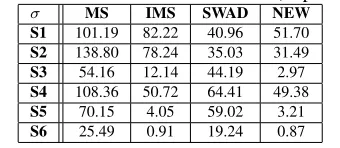
On the contrary, IMS and NEW can successfully track the target in all the sequences. However, as it can be noticed from the values of mean absolute error and standard deviation re-ported in Table 2 and 3, NEW has the lowestµandσin S1-S5, while IMS performs slightly better in S6. Nonetheless, in S6, IMS is better only for≈0.13, while NEW is almost twice as accurate in S1-S3. Concerning precision, i.e. standard devia-tion, NEW is more precise than IMS in all sequence.
[image:4.612.94.256.364.444.2]These results prove that, as it stands, the novel algorithm
Table 3. Standard deviation of error (in pixels).
σ MS IMS SWAD NEW
S1 101.19 82.22 40.96 51.70 S2 138.80 78.24 35.03 31.49 S3 54.16 12.14 44.19 2.97 S4 108.36 50.72 64.41 49.38 S5 70.15 4.05 59.02 3.21 S6 25.49 0.91 19.24 0.87
presented in this paper is already more accurate and precise than MS, IMS and SWAD, even when it is simplyf(·) = d(·), as in its current implementation. It is expected that the tracking performance of the novel algorithm can be further improved by adopting a more accurate metric forf(·).
4. CONCLUSION
[image:4.612.351.521.371.445.2]5. REFERENCES
[1] A. Yilmaz, O. Javed, and M. Shah, “Object tracking: a survey,” ACM Computing Surveys, vol. 38, no. 4, pp. 1–45, 2006.
[2] G. Di Caterina and J. J. Soraghan, “An improved mean shift tracker with fast failure recovery strategy af-ter complete occlusion,” inIEEE International Confer-ence on Advanced Video and Signal-Based Surveillance, 2011, pp. 130–135.
[3] D. Comaniciu, V. Ramesh, and P. Meer, “Real-time tracking of non-rigid objects using mean shift,” inIEEE Conference Computer Vision and Pattern Recognition, 2000, vol. 2, pp. 142–149.
[4] D. Comaniciu, V. Ramesh, and P. Meer, “Kernel-based object tracking,”IEEE Transactions on Pattern Analysis and Machine Intelligence, vol. 25, no. 5, pp. 564–577, 2003.
[5] G. Di Caterina and J. J. Soraghan, “Adaptive template matching algorithm based on SWAD for robust target tracking,” IET Electronics Letters, vol. 48, no. 5, pp. 261–262, 2012.
[6] G. Di Caterina, I. Hunter, and J. J. Soraghan, “DSP embedded smart surveillance sensor with robust SWAD-based tracker,” inAdvanced Concepts for Intelligent Vi-sion Systems. 2012, vol. 7517 ofLecture Notes in Com-puter Science, pp. 48–58, Springer Berlin / Heidelberg. [7] M. J. Swain and D. H. Ballard, “Indexing via color
his-tograms,” inIEEE International Conference on Com-puter Vision, 1990, pp. 390–393.
[8] B.W. Silverman, Density estimation for statistics and data analysis, Chapman and Hall, 1986.
[9] PETS 2009, “Benchmark Data,”
http://www.cvg.rdg.ac.uk/PETS2009/a.html, 2009. [10] “Xiph.org – derf’s test media collection,”