A Stochastic Model for Internal HIV Dynamics
Nirav Dalal, David Greenhalgh
∗, Xuerong Mao
Department of Statistics and Modelling Science
University of Strathclyde
Glasgow G1 1XH, U.K.
Abstract
In this paper we analyse a stochastic model representing HIV internal virus dynamics. The stochasticity in the model is introduced by param-eter perturbation which is a standard technique in stochastic population modelling. We show that the model established in this paper possesses non-negative solutions as this is essential in any population dynamics model. We also carry out analysis on the asymptotic behaviour of the model. We approximate one of the variables by a mean reverting process and find out the mean and variance of this process. Numerical simulations conclude the paper.
Keywords: HIV virus dynamics, Brownian motion, stochastic differ-ential equation, Itˆo’s formula, asymptotic behaviour, mean reverting pro-cess.
1
Introduction
Since its discovery in 1981, HIV has spread relentlessly throughout the world and now is a major epidemic worldwide. HIV spreads by attacking the immune system, in particular by depleting the CD4 cells. The pathogenesis of HIV infection is a function of the virus life cycle, the host cellular environment, and quantity of virus in the infected individual. Factors such as age or genetic differences among individuals, the level of virulence of an individual strain of virus, and co-infection with other microbes may influence the rate and severity of disease progression.
Cells with CD4 receptors at the site of HIV entry become infected and viral replication begins within them. The infected cells can then release virions or infected cells can undergo lysis to release new virions, which can then infect additional cells. CD4 cells, the primary targets of HIV, become infected as they encounter HIV. Active replication of HIV occurs at all stages of the infection. Over a period of years, even when little virus is detectable in the blood,
significant amounts of virus accumulate within infected cells. This interaction between the virus and the immune system is called HIV internal viral dynamics. In this paper we will formulate a stochastic model for this host virus interaction. Modelling the interaction between HIV-1 virus and CD4 cells has been a major area of research for many years [4,10,11]. Mathematical models have come to play an important part in biological systems. Mathematics makes it possible to make predictions about the behaviour of the system. We try to obtain some analytical results for the stochastic model posed in this paper. In particular we derive expressions for the expected value and the variance of the limit process.
There are real benefits to be gained in using stochastic rather than deterministic models. Real life is stochastic rather than deterministic, particularly when modelling biological phenomena such as internal HIV viral dynamics. This is because different cells and infective virus particles reacting in the same environment can often give different results. In this paper we model the effect of environmental stochasticity on some of the model parameters. Stochastic models produce more useful output than deterministic models as by running a stochastic model many times we can build up a distribution of the predicted outcomes, for example the number of infected cells at time t, whilst a deterministic model will just give a single predicted value. Having a distribution for the predicted outcomes is more versatile as it helps us examine practically important essentially stochastic quantities, for example the variance of the number of infective virus particles at a given time and the probability that the infective virus particles have died out at a given time, which cannot be examined using deterministic models. Even quantities such as the expected values of the number of cells can be more accurately modelled using stochastic models because they include the effect of random variation on these quantities which deterministic models cannot.
Other work by Dalal, Greenhalgh and Mao [9] introduces stochasticity into a model of AIDS and condom use via the technique of parameter perturbation which is standard in stochastic population modelling. They show that the model established in the paper possesses non-negative solutions as desired in any population dynamics. They also carried out a detailed analysis on asymptotic stability both in probability one and inp’th moment. Our results reveal that a certain type of stochastic perturbation may help stabilise the system.
sufficient criteria for the local asymptotic stability of the infected equilibrium and global asymptotic stability of the viral-free equilibrium are given.
Many mathematical models have been developed to describe the viral dynamics of HIV-1, mostly using a system of ordinary differential equations. Perelsonet al. [28] tried to estimate the length of the life cycle of the virus. Korthals Altes et al. [16] concentrated on the question of whether it was advisable to stimulate CD4 cell response. They found that only when the virus has a low basic reproductive number does the number of CD4 cells at the moment of infection influence the outcome of infection. Di Mascio et al.
[10] provided a statistical characterisation of transient viraemia observed in 123 patients, suggesting that patients have different tendencies to show transient viraemia during the period of viral load suppression. Ding and Wu [11] modelled the effect of Reverse Transcriptase Inhibitor drugs as inhibition rates of cell infection and Protease Inhibitor drugs as inhibition rates of infectious virus production based on the biological mechanisms of these two different types of drugs. They showed that the two viral decay rates are monotone functions of the treatment effects of these antiviral therapies.
We start the paper by proving the positivity of the solutions which is a very important property for any model on population dynamics which uses stochastic differential equations. We then focus on the stability aspect of the three variables in question. We show that under certain conditions the number of infected cells and virus particles will both almost surely tend to zero (their disease free equilibrium value). We introduce a mean reverting process and show that the number of healthy cells tends in probability to this mean reverting process. Hence the number of healthy cells is stable in distribution. We then give details of the parameters of the mean reverting process. Finally we present a section on simulations of the system and end the paper with our conclusions.
2
Deterministic model
This process of HIV-1 pathogenesis can be slowed down or reversed to a certain extent by Highly Active Antiretroviral Treatment (HAART). Primarily HAART inhibits the process of virus particle formation. This keeps the viral load down and in turn increases the quantity of CD4 cells. The model we are going to study is a stochastic model of viral dynamics including the effect of HAART.
delays, combination antiretroviral therapy, and the dynamics of both infected and uninfected T cells. They showed that for less than perfect drug effect, the value of the death rate of productively infected cells is increased when data is fitted with delay models compared to the values estimated with a non-delay model. They also provided some general results on the stability of the system.
Very recently Ciupe et al. [7] discussed the dynamics of HIV-1 infection consisting of three distinct phases starting with primary infection, then latency and finally AIDS or drug therapy. In this paper the dynamics of primary infection and the beginning of latency was modelled. They showed that allowing for time delays in the model better predicts viral load data when compared to models with no time delays. They also found that the model of primary infection predicts the turnover rates for productively infected T cells and viral totals to be much longer than those observed from patients receiving antiviral drug therapy. However, they also showed that with the data available the results are highly sensitive to the chosen model. They compared the results using analysis and Monte Carlo techniques for three different models and showed how each predicts rather dramatic differences between the fitted parameters.
We propose the following three dimensional model to describe the viral dynamics in the presence of HIV-1 infection and HAART:
dx1(t)
dt = λ−δx1(t)−(1−γ)βx1(t)x3(t), dx2(t)
dt = (1−γ)βx1(t)x3(t)−ax2(t),
and dx3(t)
dt = (1−η)N ax2(t)−ux3(t)−(1−γ)βx1(t)x3(t)
with suitable initial conditions. This model captures mathematically the viral dynamics of HIV-1 virus interacting with CD4 cells. The model is represented diagrammatically by Figure 1.
< Figure 1. >
Figure 1. Box diagram representing cell and virus dynamics.
x1(t) is the concentration of uninfected cells;
x2(t) is the concentration of infected cells;
x3(t) is the concentration of virus particles;
(1-γ) is the reverse transcriptase inhibitor drug effect; (1-η) is the protease inhibitor drug effect;
λ is the total rate of production of healthy cells per unit time;
δ is the per capita death rate of healthy cells;
β is the transmission coefficient between uninfected cells and infective virus particles;
a is the per capita death rate of infected cells;
N is the average number of infective virus particles produced by an infected cell in the absence of HAART during its entire infectious
lifetime;
u is the per capita death rate of infective virus particles.
Note that when a single infective virus particle infects a single uninfected cell the virus particle is absorbed into the uninfected cell and effectively dies. Hence the term (1−γ)βx1x3appears in all the three equations.
It is clear that the above model has a unique disease-free equilibrium given by (λ/δ1,0,0). Each newly infected cell entering the disease-free equilibrium
remains infected for time (1/a) and during this time produces (1 − η)N
infective virus particles. As an approximation assuming that the system is still near the disease-free equilibrium each infective virus particle survives for time (u+ (1−γ)βλ/δ) and during this time infects
(1−γ)βλ δ
u+ (1−γ)βλδ =
(1−γ)βλ δu+ (1−γ)βλ
cells. R0, the basic reproduction number, is defined as the expected number
of secondary infected cells caused by a single infected cell entering the disease-free population at equilibrium. Here a secondary infected cell is a cell which is infected by an infective virus particle which is produced by the initial infected cell. Hence
R0=
(1−γ)βλN(1−η) (δu+βλ(1−γ)) .
R0 can also be interpreted as the expected number of secondary infected
The deterministic model has been analysed by Tuckwell and Wan [30]. They show that ifR0≤1 then the disease-free equilibrium is the unique equilibrium
and if R0 > 1 then as well as the disease-free equilibrium there is a unique
endemic equilibrium given by
x∗1 =
u
β(1−γ)[N(1−η)−1],
x∗
2 =
βλ(1−γ)N(1−η)−βλ(1−γ)−δu aβ(1−γ)(N(1−η)−1) ,
x∗
3 =
βλ(1−γ)N(1−η)−βλ(1−γ)−δu
(1−γ)βu .
Moreover if R0 < 1 the disease-free equilibrium is locally asymptotically
stable, whilst ifR0>1 then the disease-free equilibrium is unstable whilst the
unique endemic equilibrium is locally asymptotically stable. Thus if R0 < 1
we expect the number of infected cells and infected virus particles to die out and the number of uninfected cells to approachλ/δ, whilst ifR0>1 we expect
the number of uninfected cells, infected cells and infective virus particles to approach their unique endemic equilibrium values.
Perelsonet al. [28] studied a simplified version of our deterministic model. They assume that the number of uninfected cells is constant. They later introduce drug treatment and fit the model to data. Bonhoefferet al. [4] analyse a simplified version of our deterministic model where the term (1−γ)βx1(t)x3(t)
is neglected as an approximation. They do not include any stochastic effects. They show that there is a basic reproduction number R0 which determines
the behaviour of the system. For R0 ≤ 1 there is a unique disease-free
equilibrium which is locally asymptotically stable but for R0 > 1 there is a
unique endemic equilibrium. They later modify the basic model to include the effect of resistance. Di Mascioet al. [10] take the simple deterministic model of Bonhoeffer et al. and modify it to introduce the effect of HAART in a similar way as we have done. They later discuss another model and fitting their models to data. Nelson and Perelson [25] outline the basic model discussed by Bonhoefferet al.[4]. They discuss modification of this basic model to summarise the effects of drug therapy on virus concentration and introduce a time delay into the model. The model is then fitted to data.
3
Stochastic Model Derivation
There are a range of mechanisms through which CD4 cell death takes place. This includes syncytium formation and apoptosis among other things [23]. The clearance rate of virions can be caused by a variety of factors including binding and entry into cells and immune elimination [28]. Since both the death rates of the cells and the virus are affected by many complicated biological phenomena we think that there is randomness involved in these death rates.
Taking these factors into account we introduce randomness into the model by replacing the parametersδ,aandubyδ→δ+σ1B˙1(t), a→a+σ1B˙1(t)
andu→u+σ2B˙2(t). This is only a first step in introducing stochasticity into
the model. Ideally we would also like to introduce stochastic environmental variation into the other parameters such as the transmission coefficientβandλ, the total rate of production of healthy cells per unit time, but to do this would make the analysis much too difficult.
Hence we get the following system of stochastic differential equations:
dx1(t) = λ−δx1(t)−(1−γ)βx1(t)x3(t)dt−σ1x1(t)dB1(t),(1)
dx2(t) = (1−γ)βx1(t)x3(t)−ax2(t)dt−σ1x2(t)dB1(t), (2)
and dx3(t) = (1−η)N ax2(t)−ux3(t)−(1−γ)βx1(t)x3(t)dt
−σ2x3(t)dB2(t) (3)
with suitable initial conditions.
Here B1(t) and B2(t) are independent standard Brownian motions. When
there is randomness in parameters such as the disease death rate it is a standard technique to introduce environmental noise into the parameters in this way [3,5,14,21,22]. Note that the intensity of the noiseσ and the Brownian motion
B(t) are the same for uninfected and infected CD4 cells, but different for CD4 cells and virus particles. This is because whilst the biological factors affecting the death rates of infected and uninfected CD4 cells can be expected to be very similar, different biological factors affect CD4 cells and virus particles.
Hence although in the absence of detailed biological data it is possible that the intensity of the noise σ and the Brownian motion B(t) are different for uninfected and infected CD4 cells it is plausible as a first simplifying approximation to assume that these are the same. As CD4 cells and virus particles are much more different biological entities it seems much more possible that both σ and B(t) are different between CD4 cells and infective virus particles.
Note that the situation with no infected cells and no infective virus particles present
(x1, x2, x3) = (λ/δ,0,0)
is an equilibrium point in the deterministic model but not for the stochastic model. In the stochastic model the last two co-ordinates (x2, x3) = (0,0) are
4
Non Negative Solutions
It is important that we do not have to worry about negative values when dealing with a model of population dynamics is concerned. Hence we first prove the positivity of the solutions.
In this paper, unless otherwise specified, we let (Ω,F, P) be a complete probability space with a filtration{Ft}t≥0 satisfying the usual conditions (i.e.
it is increasing and right continuous whileF0contains allP-null sets). LetB(t)
be the one dimensional Brownian motion defined on this probability space. Also letR3
++ = {x∈ R3 :xi >0 for all 1≤ i≤ 3} and letx(t) = (x1(t), x2(t),
x3(t)).
Before proving the main theorem we put forward a lemma.
Lemma 4.1 The following inequality holds
u≤2(u+ 1−log(u))−(4−2 log 2) ∀ u >0.
Proof: Define, foru >0,
f(u) =u+ 2−2 log(u).
f(u) has a minimum atu= 2. The result follows.
We now prove the main theorem.
Theorem 4.1 Assume that 0< γ,η <1 and thatδ, λ, a, u, N andβ are positive
real numbers. Then for any initial value x0 ∈R3++, there is a unique solution
x(t) to Eqns (1) - (3) on t ≥ 0 and the solution will remain in R3 ++ with
probability 1, namelyx(t)∈ R3
++ for allt≥0 almost surely.
Proof: Since the coefficients of the equation are locally Lipschitz continuous,
for any given initial valuex0∈R3++ there is a unique local solutionx(t) on t∈
[0,τe), where τeis the explosion time [2,13]. To show this solution is global, we
need to show that τe =∞ a.s. Let k0 ≥ 0 be sufficiently large so that every
component of x0 lies within the interval [1/k0, k0]. For each integer k ≥ k0,
define the stopping time
τk= inf{t∈[0, τe) :xi(t)6∈(1/k, k) for somei, 1≤i≤3},
where throughout this paper we set inf∅ =∞(as usual ∅ denotes the empty set). Clearly,τk is increasing ask→ ∞. Setτ∞= limk→∞τk, whenceτ∞≤τe
a.s. If we can show thatτ∞ =∞ a.s. then τe = ∞and x(t) ∈R3++ a.s. for
all t ≥ 0. In other words, to complete the proof all we need to show is that
τ∞=∞a.s. For if this statement is false, then there is a pair of constantsT >
0 andǫ∈(0,1) such that
Hence there is an integerk1≥k0such that
P{τk ≤T} ≥ǫ for all k≥k1. (4)
Define aC2-functionV :R3
++→R++ by
V(x) =
3
X
i=1
[xi+ 1−log(xi)].
The non-negativity of this function can be seen fromu+1−log(u)≥0, ∀u >0. Using Itˆo’s formula we get,
dV(x(t)) =
1− 1
x1(t)
λ−δx1(t)−(1−γ)βx1(t)x3(t)
+
1− 1
x2(t)
(1−γ)βx1(t)x3(t)−ax2(t)
+
1− 1
x3(t)
(1−η)N ax2(t)−ux3(t)−(1−γ)βx1(t)x3(t)
+σ21+
σ2 2
2
dt+σ1(2−x1(t)−x2(t))dB1(t)
+σ2(1−x3(t))dB2(t)
=
λ−δx1(t)−(1−γ)βx1(t)x3(t) + (1−γ)βx1(t)x3(t)
−ax2(t) + (1−η)N ax2(t)−ux3(t)−(1−γ)βx1(t)x3(t)
− λ
x1(t)
+δ+ (1−γ)βx3(t)−
(1−γ)
x2(t)
βx1(t)x3(t) +a
−(1−η)N ax2(t)
x3(t)
+ u+ (1−γ)βx1(t) +σ12+
σ2 2
2
dt
+σ1(2−x1(t)−x2(t))dB1(t) + σ2(1−x3(t))dB2(t).
Hence
dV(x(t)) ≤
λ+δ+a+u+σ2 1+
σ2 2
2 + (1−η)N ax2(t) + (1−γ)βx3(t)
+ (1−γ)βx1(t)
dt+σ1(2−x1(t)−x2(t))dB1(t)
+σ2(1−x3(t))dB2(t).
Writec1=λ+δ+a+u+σ12+
σ2 2
By Lemma 4.1,xi ≤2(xi+ 1−log(xi)) so (1−η)N ax2(t) + (1−γ)βx3(t) +
(1−γ)βx2(t)≤c2V(x). Therefore
dV(x(t)) ≤ (c1+c2V(x))dt+σ1(2−x1(t)−x2(t))dB1(t) +
σ2(1−x3(t))dB2(t).
Hence
dV(x(t))≤c3(1 +V(x)) +σ1(2−x1(t)−x2(t))dB1(t) +σ2(1−x3(t))dB2(t)
wherec3 = max(c1,c2). Therefore ift1≤T,
Z τk∧t1
0
dV(x(t)) ≤
Z τk∧t1
0
c3(1 +V(x(t))) dt
+
Z τk∧t1
0
σ1(2−x1(t)−x2(t))dB1(t)
+
Z τk∧t1
0
σ2(1−x3(t))dB2(t).
This implies that,
EV(x(τk∧t1)) ≤ V(x0) +E
Z τk∧t1
0
c3(1 +V(x(t)))dt,
≤ V(x0) +c3t1+c3E
Z τk∧t1
0
V(x(t))dt,
≤ V(x0) +c3T+c3E
Z t1
0
V(x(τk∧t))dt,
= V(x0) +c3T+c3
Z t1
0
EV(x(τk∧t))dt.
By the Gronwall inequality,
EV(x(τk∧T)) ≤ c4 (5)
wherec4= (V(x0) +c3T)ec3T.
Set Ωk ={τk ≤T} fork≥k1 and by (4),P(Ωk)≥ǫ. Note that for every
ω∈Ωk, there is somei (1 ≤i≤3) such thatxi(τk, ω) equals either kor 1/k,
and henceV(x(τk, ω)) is no less than the smallest of
k + 1 - log(k) and (1/k) + 1 - log(1/k) = (1/k) + 1 + log(k).
Consequently,
It then follows from (4) and (5) that,
c4 ≥ E[1Ωk(ω)V(x(τk, ω))]
≥ ǫ([k+ 1−log(k)]∧[(1/k) + 1 + log(k)]),
where 1Ωk is the indicator function of Ωk. Letting k → ∞ leads to the
contradiction∞> c4 =∞. So we must therefore haveτ∞=∞a.s.
In the next section we look at the asymptotic behaviour of the system and try to obtain some more analytical results.
5
Asymptotic Behaviour
For the deterministic system the disease free equilibrium is (λ/δ, 0, 0). Recall that this is not an equilibrium point for the stochastic model where (x2, x3) =
(0,0) is still a stochastic equilibrium but the first co-ordinate instead of being fixed atλ/δfollows a stochastic process which varies around the valueλ/δ. First we considerx2(t),x3(t) and find the conditions for exponential stability. Then
we obtain the stability in distribution ofx1(t).
Definition 5.1 ([19] , p.119) Let(Ω,F, P)be a complete probability space with
a filtration{Ft}t≥0 which is right continuous andF0 contains allP-null sets.
Suppose that 0 ≤ t0 < T < ∞. Let x0 be an Ft0-measurable R
d-valued
random variable such that E|x0|2 < ∞. Let f : Rd ×[t0, T] → Rd and
g:Rd×[t
0, T]→Rd×mbe both Borel measurable withf(0, t) = 0andg(0, t) = 0
for allt≥t0. Consider thed-dimensional stochastic differential equation of Itˆo
-type
dx(t) =f(x(t), t)dt+g(x(t), t)dB(t) (6)
ont0≤t≤T, with initial valuex(t0) =x0. Write x(t;t0, x0) for the value of
the solution to this equation at timet.
The trivial solution of equation (6) is said to be almost surely exponentially stable if
lim
t→∞sup
1
t log|x(t;t0, x0)|<0 a.s.
for allx0∈Rd.
Theorem 5.1 Under the following two conditions:
(i) 2[(1−η)N a−a]−σ2 1 <0;
(ii) [((1−η)N a−a)−u]2 <(σ2
2+ 2u)(σ21−2[(1−η)N a−a]);
x2(t)andx3(t)are almost surely exponentially stable in the sense thatx2(t)and
Proof: From equations (2) and (3) considerd x2(t) +x3(t).
d x2(t) +x3(t) =
(1−γ)βx1(t)x3(t)−ax2(t) + (1−η)N ax2(t)−ux3(t)−
(1−γ)βx1(t)x3(t)
dt−σ1x2(t)dB1(t)−σ2x3(t)dB2(t).
Let x = (x2, x3) and V(x) = log x2+x3 for x2, x3 ∈ (0,∞). Using Itˆo’s
formula we get,
dV(x(t)) =
(1−η)N ax
2(t)
x2(t) +x3(t)
− ax2(t)
x2(t) +x3(t)
− ux3(t)
x2(t) +x3(t)
−1
2
σ12x22(t)
(x2(t) +x3(t))2
−1
2
σ22x23(t)
(x2(t) +x3(t))2
dt
− σ1x2(t)
(x2(t) +x3(t))
dB1(t)−
σ2x3(t)
(x2(t) +x3(t))
dB2(t).
Simplifying we get
dV(x(t)) = 1
2(x2(t) +x3(t))2
2 x2(t) +x3(t) (1−η)N ax2(t)−ax2(t)
−ux3(t)
−σ12x22(t)−σ22x23(t)
dt
− σ1x2(t)
(x2(t) +x3(t))
dB1(t)−
σ2x3(t)
(x2(t) +x3(t))
dB2(t).
We can write the term
2 x2(t) +x3(t) (1−η)N ax2(t)−ax2(t)−ux3(t)−σ12x22(t)−σ22x23(t)
in the following way
x2(t) x3(t)
2 (1−η)N a−a
−σ2
1 (1−η)N a−a
−u
(1−η)N a−a
−u −2u−σ2 2
x2(t)
x3(t)
.
Hence we can writedV(x(t)) as
dV(x(t))
= 1
2(x2(t) +x3(t))2
x2(t) x3(t)
2 (1−η)N a−a
−σ2
1 (1−η)N a−a
−u
(1−η)N a−a
−u −2u−σ2 2
x2(t)
x3(t) dt
− σ1x2(t)
(x2(t) +x3(t))
dB1(t)−
σ2x3(t)
(x2(t) +x3(t))
Now consider the matrix
2 (1−η)N a−a
−σ2
1 (1−η)N a−a
−u
(1−η)N a−a
−u −2u−σ2 2
.
As the above matrix is negative-definite with largest (negative) eigenvalueλmax
then
x2(t) x3(t)
2 (1−η)N a−a
−σ2
1 2 (1−η)N a−a
−u
2 (1−η)N a−a
−u −2u−σ2 2
x2(t)
x3(t)
≤ λmax x22(t) +x23(t)
= − λmax
x22(t) +x23(t)
.
Therefore
dV(x(t)) ≤
− λmax 1 2(x2(t) +x3(t))2
x22(t) +x23(t)
dt
− σ1x2(t)
(x2(t) +x3(t)) dB1(t)
− σ2x3(t)
(x2(t) +x3(t)) dB2(t). (7)
As 0.5(x2
2 + x23) ≥ x2x3 we can write − (x22 + x23) ≤ − 0.5(x2 + x3)2.
Substituting this in inequality (7) we get
dV(x(t)) ≤ −1
4|λmax|dt−
σ1x2(t)
(x2(t) +x3(t)) dB1(t)
− σ2x3(t)
(x2(t) +x3(t))
dB2(t),
d log(x2(t) +x3(t)) ≤ −
1
4|λmax|dt−
σ1x2(t)
(x2(t) +x3(t))
dB1(t)
− σ2x3(t)
(x2(t) +x3(t))
dB2(t).
Integrating the above inequality and using the fact that
lim sup
t→∞
1
t|Bi(t)|= 0 fori= 1,2, Mao [19],
we get
lim sup
t→∞
1
t log x2(t) +x3(t)
≤ −1
4
λmax
<0 a.s.
Hence x2(t) → 0 and x3(t) → 0 a.s. as t → ∞. This completes the proof of
Note that Theorem 5.1 does not assume anything about R0, in particular
it does not assume thatR0<1. Note also that the conditions of Theorem 5.1
cannot possibly be satisfied in the deterministic model whenσ1=σ2= 0.
The constraints on the variances in Theorem 5.1 (i) and (ii) have no obvious biological meaning in themselves. However note that the expression (1−η)N a
is the per capita rate at which an infected cell produces virus particles in the presence of HAART. Under the condition (1−η)N < 1, i.e. an infected cell produces on average less than one infective virus particle during its entire infectious lifetime, which implies thatR0<1, the first condition in Theorem 5.1
will always be true. If the variancesσ2
1andσ22are large enough these conditions
will always be satisfied. This is an interesting result as it says that if the noise variances are large enough then the populations of infected cells and infective virus particles will always die out, whatever the other parameter values, even if
R0>1. Thus the behaviour of the stochastic system with added environmental
noise can be very different than the behaviour of the basic deterministic system. We now concentrate onx1(t). We shall eventually show that x1(t) is stable
in distribution in the sense that it stabilises around the mean valueλ/δ. To do this we introduce a new stochastic process z(t) which is defined by its initial conditionz(0) =x1(0) and the stochastic differential equation
dz(t) = λ−δz(t)
dt−σ1z(t)dB1(t).
We shall show that in the limit ast becomes largex1(t) can be approximated
byz(t) so
lim
t→∞ z(t)−x1(t)
= 0 in probability.
To help with the proof we introduce another functionyǫ(t) which is defined by
the initial conditionyǫ(0) =x1(0) and the stochastic differential equation
dyǫ(t) = λ−(δ+ǫ)yǫ(t)dt−σ1yǫ(t)dB1(t). (8)
Theorem 5.2 Under the conditions of Theorem 5.1,
lim
t→∞ z(t)−x1(t)
= 0 in probability.
Proof: The original equation is
dx1(t) =
λ−δx1(t)−(1−γ)βx1(t)x3(t)
dt−σ1x1(t)dB1(t).
First we prove that
lim inf
t→∞
x1(t)−yǫ(t)
Therefore consider
d x1(t)−yǫ(t) =
−δ x1(t)−yǫ(t)+ǫyǫ(t)−(1−γ)βx1(t)x3(t)
dt
−σ1 x1(t)−yǫ(t)dB1(t)
=
−(δ+ǫ) x1(t)−yǫ(t)+ ǫ−(1−γ)βx3(t)x1(t)
dt
−σ1 x1(t)−yǫ(t)
dB1(t).
The solution is given by
x1(t)−yǫ(t) = ψ(t)
Z t
0
ψ−1(s) ǫ−(1−γ)βx
3(s)x1(s)ds
where
ψ(t) = exp
−
δ+ǫ+σ
2 1
2
t−σ1B1(t)
.
Using the result of Theorem 5.1 where it has been shown thatx3(t)→0 a.s. as
t→ ∞we can write, for almost allω∈Ω ∃ T =T(ω) such that
x3(t)<
ǫ
(1−γ)β ∀ t≥T.
Hence for allω ∈Ω, ift > T, then
x1(t)−yǫ(t) = ψ(t)
Z T
0
ψ−1(s) ǫ−(1−γ)βx 3(s)
x1(s)ds
+
Z t
T
ψ−1(s) ǫ−(1−γ)βx
3(s)x1(s)ds
.
Hencex1(t)−yǫ(t)≥ ψ(t)κ(T) where
κ(T) =
Z T
0
ψ−1(s) ǫ−(1−γ)βx3(s)x1(s)ds.
Clearly|κ(T)|<∞andψ(t)→0 a.s.
Therefore
lim inf
t→∞ x1(t)−yǫ(t)
≥ 0 a.s. (9)
Next we prove lim inft→∞ z(t) –x1(t)≥0 a.s. For this consider
d z(t)−x1(t) =
−δ z(t) − x1(t)+ (1−γ)βx1(t)x3(t)
dt
−σ1 z(t)−x1(t)
This implies that
d z(t)−x1(t)≥ −δ z(t)−x1(t)dt−σ1 z(t)−x1(t)dB1(t).
Letξ =z −x1. Hence
dξ(t)≥ −δξ(t)dt−σ1ξ(t)dB1(t).
For anyω ∈Ω either
ω∈Ω1 = {ω:ξ(t0)>0 for somet0≥0}
or ω∈Ω2 = {ω:ξ(t)≤0 for allt≥0}.
Forω ∈Ω1 then lett1 = sup{t: t≥t0 andξ(t)>0}. Ift1<∞then in
[t0,t1]
dξ(t) = −δ+f(t)
ξ(t)dt−σ1ξ(t)dB1(t) (10)
wheref(t)≥0 is a random variable. The solution of (10) is given by
ξ(t) = ξ(t0) exp
Z t
0
−δ+f(s)−σ
2 1
2
ds−σ1B1(t)
> 0.
Hence
ξ(t1) = ξ(t0) exp
Z t1
t0
−δ+f(s)−σ
2 1
2
ds−σ1B1(s)
> 0.
Thusξ(t) >0 in [t1,t1 +δ1] for some δ1 >0. This is a contradiction. Hence
t1 =∞andξ(t)≥0 for allt ≥t0. So lim inft→∞ξ(t)≥0 a.s.
It remains to consider the caseω ∈Ω2 whereξ(t)≤0 for allt ≥0. Then
dξ(t) = −δ−f(t)
ξ(t)dt−σ1ξ(t)dB1(t) (11)
wheref(t)≥0 is a random variable. The solution of (11) is given by
ξ(t) = ξ(0) exp
Z t
0
−δ−f(s)−σ
2 1
2
ds−σ1B1(t)
= 0.
Hence lim inft→∞ ξ(t)≥0 a.s. That is
lim inf
t→∞ z(t)−x1(t)
≥0 a.s. (12)
Next considerd(yǫ(t)−z(t)).
d yǫ(t)−z(t)=
−δ yǫ(t)−z(t)−ǫyǫ(t)
The solution is written as
yǫ(t)−z(t) = −ǫexp
−
δ+σ
2 1
2
t−σ1B1(t)
Z t
0
exp
δ+σ
2 1
2
s+σ1B1(s)
yǫ(s)ds.
Note thatyǫ(s)≥0 as it is a solution of a linear stochastic differential equation
(8) which can be solved explicitly to give
yǫ(t) = λ
Z t 0 exp −
δ+ǫ+σ
2 1
2
(t−s)−σ1 B1(t)−B1(s)
ds. (13)
Therefore
yǫ(t)−z(t)
=ǫ
Z t
0
yǫ(s) exp
−
δ+σ
2 1
2
(t−s)−σ1 B1(t)−B1(s)
ds.
SinceB1(t)−B1(s)∼N(0, t−s) we write
E
exp
−σ1 B1(t)−B1(s)
=
Z ∞
−∞
e−σ1u 1
p
2π(t−s)e
−u2
/2(t−s)du,
= p 1
2π(t−s)
Z ∞
−∞
exp
−
1 2(t−s) u
2+ 2(t−s)σ 1u
du,
= p 1
2π(t−s) exp
σ2
1(t−s)
2 Z ∞ −∞ exp − 1 2(t−s)
u+ (t−s)σ1 2 du. Hence E exp
−σ1(B1(t)−B1(s))
= exp
σ2
1(t−s)
2
. (14)
Therefore
E
yǫ(t)−z(t)
= ǫE Z t
0
yǫ(s) exp
−
δ+σ
2 1
2
(t−s)−σ1(B1(t)−B1(s))
ds = ǫ Z t 0 E
yǫ(s) exp
−
δ+σ
2 1
2
(t−s)−σ1(B1(t)−B1(s))
ds = ǫ Z t 0 E
yǫ(s) exp
−
δ+σ
2 1
2
(t−s)
E
exp[−σ1(B1(t)−B1(s))]
ds
asyǫ(s) is independent ofB1(t)−B1(s),
= ǫ Z t
0
Taking the expectation of (13) and using (14) we see that
Eyǫ(t) = λ
Z t
0
exp{−(δ+ǫ)(t−s)}ds
≤ λ
δ+ǫ.
Substituting this result in (15) we get
E
yǫ(t)−z(t)
≤
λǫ δ+ǫ
Z t
0
exp{−δ(t−s)}ds
≤ λǫe
−δt
(δ+ǫ)δ(e
δt−1).
Hence we can write
lim
ǫ→0tlim→∞E
yǫ(t)−z(t)
= 0.
This implies that
lim
ǫ→0tlim→∞
yǫ(t)−z(t)
= 0 in probability. (16)
Combining (9), (12) and (16) we obtain the required assertion. This completes the proof of Theorem 9.
In the next section we try and obtain some more information about the mean reverting process.
6
Mean Reverting Process
As we are approximating the process x1(t) by z(t) we wish to find some
information about the process z(t). We try and do that here by finding the parameters of the process such as the mean and the variance.
The mean reverting process is given by
dz(t) =
λ−δz(t)
dt−σ1z(t)dB1(t).
The explicit solution of the above equation is given by
z(t) = z(0) exp
−
δ+σ
2 1
2
t−σ1B1(t)
+λ Z t 0 exp − δ+σ
2 1
2
(t−s)−σ1 B1(t)−B1(s)
ds.
Taking the expectation and using (14) we get
E z(t)
=z(0)e−δt + λ
δ
Hence taking the limit we get
lim
t→∞E z(t)
=λ
δ.
To find the second moment considerV(z(t)) =z2. Using Itˆo’s formula we get
d z2(t)
= σ12−2δ
z2(t)dt+ 2λz(t)dt−2σ1z2(t)dB1(t).
Therefore
z2(t) =z2(0) +
Z t
0
σ21−2δ
z2(s)ds+ 2λ Z t
0
z(s)ds−2 σ1
Z t
0
z2(s)dB1(s).
Taking expectation we get
E z2(t)
=E z2(0)
+
Z t
0
σ12−2δ
E z2(s) ds+ 2λ
Z t
0
E z(s) ds.
Differentiating with respect totwe deduce that
d dtE z
2(t)
= (σ21−2δ)E z2(t)
+ 2λE z(t) .
d dt
n
E z2(t)e−(σ2 1−2δ)t
o
= 2λE z(t) e−(σ2
1−2δ)t.
Integrating and multiplying bye(σ2
1−2δ)twe deduce that
E z2(t)
=E z2(0)
e(σ12−2δ)t+ 2λ e(σ 2 1−2δ)t
Z t
0
e−(σ2
1−2δ)sE z(s)ds.
Now substituting the value ofE z(s)
in the above equation we see that
E z2(t)
= E z2(0)
e(σ21−2δ)t+ 2λ e(σ 2 1−2δ)t
Z t
0
e−(σ2 1−2δ)s
z(0)e−δs + λ
δ 1−e
−δs
ds.
Simplifying we get
E z2(t)
= E z2(0) e(σ2
1−2δ)t+ 2λ e(σ 2 1−2δ)t
z(0)
Z t
0
e−(σ2
1−2δ)se−δsds
+λ
δ Z t
0
e−(σ2 1−2δ)s
1−e−δs
ds
,
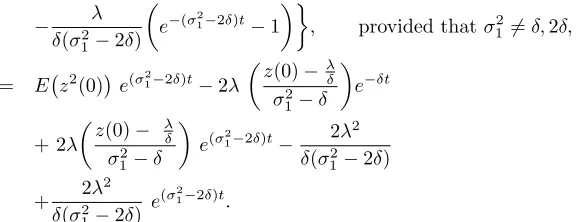
= E z2(0) e(σ2
1−2δ)t
+2λ e(σ12−2δ)t
−
z(0)−λ
δ
σ2 1−δ
e−(σ2
1−δ)t−1
− λ
δ(σ2 1−2δ)
e−(σ2
1−2δ)t−1
, provided thatσ216=δ,2δ,
= E z2(0)
e(σ12−2δ)t−2λ
z(0)−λ
δ
σ2 1−δ
e−δt
+ 2λ
z(0)− λ
δ
σ2 1−δ
e(σ2
1−2δ)t− 2λ
2
δ(σ2 1−2δ)
+ 2λ
2
δ(σ2 1−2δ)
e(σ12−2δ)t.
Taking the limit we needσ2
1 <2δfor limt→∞E z2(t)<∞, when we obtain
lim
t→∞E z
2(t)
= 2λ
2
δ(2δ−σ2 1)
.
The above term is positive sinceσ2
1 −2δ < 0. Hence the asymptotic variance
of the mean reverting process is
lim
t→∞V z(t)
= 2λ
2
δ(2δ−σ2 1)
−λ
2
δ2 =
λ2σ2 1
δ2(2δ−σ2 1)
.
A similar argument shows that ifσ2
1 =δthen
lim
t→∞V(z(t)) =
λ2
δ2,
and ifσ2
1 ≥2δthen limt→∞V(z(t)) =∞.
Hence ifσ2
1<2δ then the limit process has finite varianceσ12given by
λ2σ2 1
δ2(2δ−σ2 1)
whereas ifσ2
1 ≥2δthen the limit process has infinite variance.
7
Simulations
According to our analytical results the infected cells and the virus particles are both exponentially stable and tend to zero under conditions specified in Theorem 5.1. Also we see that we can asymptotically approximate x1(t) by
z(t) where z(t) is the mean reverting process. We now try and support our analytical results by simulations. Our simulation programs have been written in FORTRAN and the results were verified by running them repeatedly and extensively checking the results.
[image:20.612.167.457.123.234.2]< Figure 2. >
model approaches the disease free equilibrium forR0 <1.
< Figure 3. >
Figure 3. Stochastic simulation corresponding to Figure 2.
To illustrate the stochastic effects clearly we performed simulations first for the deterministic case (Figure 2) and then for a corresponding stochastic simulation (Figure 3). The parameter values used have all been taken from published literature. δ, u,a have been taken from [4],N from [6], β from [27] andλfrom [26]. The parameter values for Figure 2 areβ= 1×10⁻⁸day−1dm3,
λ= 106day−1dm−3,N = 100 per cell,γ= 0.5,η= 0.5,a= 0.5 day−1,δ= 0.1
day−1 andu= 5 day−1. The initial values were x
1(0) = 10000 dm−3,x2(0) =
10000 dm−3andx
3(0) = 10000 dm−3. The corresponding stochastic simulation
Figure 3 uses the same parameter and initial values but additionally has σ1
= 0.1 and σ2 = 0.1. It is straightforward to verify that with these parameter
valuesR0= 0.495<1 and that the conditions of Theorem 5.1 are not satisfied.
As can be clearly seen from Figures 2 and 3 both x2(t) and x3(t) tend
to zero exponentially in both the deterministic and stochastic models. These simulations and others suggest that whenR0 for the deterministic model is less
than one, in the stochastic model bothx2(t) andx3(t) tend to zero exponentially
even if the conditions of Theorem 5.1 are not satisfied. Comparing Figures 2 and 3 one can also see the stochastic effects very clearly.
< Figure 4. >
Figure 4. Distribution ofx1(t) at large timet.
< Figure 5. >
Figure 5. Distribution ofz(t) at large timet.
Figures 4 and 5 represent the histograms of the values of x1(t) and z(t)
respectively. The parameter values and the initial values are the same as in Figure 2 but this time we took σ1 =σ2 = 0.01. These values were recorded
at a single large time t = 9000 days from one thousand different realisations of each of the two stochastic processes. Comparing these figures we see that the distribution of both the variables x1(t) and z(t) at large times look very
similar. The variables are distributed around the mean value of λ/δ, the actual value being 107. A two sample Kolmogorov-Smirnov test for equality of
8
Conclusions
In this paper, we have considered a stochastic model describing the viral dynamics of HIV-1 infection. We first proved the positivity of the solutions. Then we looked at the stability aspect of the model. We proved that the numbers of infected cells and virus particles tended asymptotically to zero exponentially almost surely. We also showed thatx1(t) approached a mean reverting process
z(t) in probability. We then supported our analytical results with the help of simulations.
Most previously studied models of internal HIV dynamics in the literature have used deterministic differential equation models, ignoring stochastic effects. Perelson et al. [28] assumed that the number of uninfected cells was a constant and modelled the dynamics of infected cells and infective virus particles. Bonhoeffer et al. [4], Di Mascio et al. [10] and Nelson and Perelson [25] discuss models similar to our deterministic model, neglecting the term (1−γ)βx1(t)x3(t) as an approximation. Di Mascio et al. introduce HAART
and Nelson and Perelson introduce protease inhibitor drug therapy. Tuckwell and Wan [30] discuss and analyse our deterministic model including the term (1−γ)βx1(t)x3(t) and obtain equilibrium and stability results.
The only stochastic differential equation model which we are aware of for HIV internal viral dynamics is due to Tuckwell and Le Corfec [29] who use a stochastic differential equation model. Their model has similarities with ours but they use two types of infected cells, latently infected cells and actively infected cells. The variance terms are also different being functionally dependent on the variables. They explore the model using simulation only and do not give any analytical results.
Our work shows that stochastic differential equations give another option to model viral dynamics. By replicating the results from the deterministic case [8] and improving some we have shown that the stochastic model as discussed here adds another dimension to model viral dynamics. It adds a different perspective to this particular problem and gives researchers a different route which they can take in the future. As most real world problems are not deterministic including stochastic effects into the model gives us a more realistic way of modelling viral dynamics.
References
[1] Abell, M., Braselton, J. and Braselton, L. The effects of immunity and resistance on the development of AIDS, J. Math. Anal. Appl. 2007 333,
8-23.
[2] Arnold, L., Stochastic Differential Equations: Theory and Applications. 1972 Wiley, New York.
[3] Bahar, A. and Mao, X., Stochastic delay Lotka-Volterra model, J. Math. Anal. Appl., 2004 292, 364-380.
[4] Bonhoeffer, S., Shaw, G., May, R. and Nowak, M., Virus dynamics and drug therapy. Proc. Natl. Acad. Sci., 199794, 6971-6976.
[5] Braumann, C. A., Variable effort harvesting models in random environments: generalisation to density-dependent noise intensities. Math. Biosci., 2002177&178, 229-245.
[6] Callaway, D. and Perelson, A., HIV-1 infection and low steady state viral loads. Bull. Math. Biol., 20026429-64.
[7] Ciupe, M., Bivort, B., Bortz, D. and Nelson, P., Estimating kinetic parameters from HIV primary infection data through the eyes of three different mathematical models. Math. Biosci., 2006200, 1-27.
[8] Dalal, N., Applications of Stochastic and Ordinary Differential Equations to HIV Dynamics, Unpublished PhD Thesis, 2006, University of Strathclyde.
[9] Dalal N., Greenhalgh, D. and Mao X. A stochastic model of AIDS and condom use. J. Math. Anal. Applications , 200732536-53.
[10] Di Mascio, M., Ribeiro, R., Markowitz, M, Ho, D. and Perelson, A. Modelling the long-term control of viraemia in HIV-1 infected patients treated with antiretroviral therapy. Math. Biosci., 200418847-62.
[11] Ding, A. and Wu, H., Relationships between antiviral treatment effects and biphasic viral decay rates in modeling HIV dynamics. Math. Biosci., 1999
160, 63-82.
[12] Dixit, N. and Perelson, A., Complex patterns of viral load decay under antiretroviral therapy: influence of pharmacokinetics and intracellular delay. J. Theor. Biol., 2004 226, 95-109.
[13] Friedman, A., Stochastic Differential Equations and Their Applications. 1976 Academic Press, New York.
[15] Herz, A.V.M., Bonhoeffer, S., Anderson, R.M., May, R.M. and Nowak, M.A. Viral dynamics in vivo: Limitations on estimates of intracellular delay and virus decay, Proc. National Academy of Science USA, 1996 93,
7247-7251.
[16] Korthals Altes, H., Wodarz, D. and Jansen, V., The dual role of CD4 T helper cells in the infection dynamics of HIV and their importance for vaccination. J. Theor. Biol., 2002214, 633-646.
[17] Kovacs, J., Lempicki, R., Sidorov, I., Adelsberger, J., Herpin, B., Metcalf, J., Sereti, I., Polis, M., Davey, R., Tavel, J., Falloon, J., Stevens, R., Lambert, L., Dewar, R., Schwartzentruber, D., Anver, M., Baseler, M., Masur, H., Dimitrov, D. and Clifford, H., Identification of dynamically distinct subpopulations of T-lymphocytes that are differentially affected by HIV. J. Exp. Med.,1942001, 1731-1741.
[18] Li, D. and Ma, W. Asymptotic properties of a HIV-1 infection model with time delay, J. Math. Anal. Appl., 2007335, 683-691.
[19] Mao, X., Stochastic Differential Equations and Applications. 1997 Horwood Publishing Limited, Chichester.
[20] Mao, X., Yuan, C. and Zou, J., Stochastic differential delay equations of population dynamics, J. Math. Anal. Appl.,3042005, 296-320.
[21] Mao, X., Marion, G. and Renshaw E., Environmental Brownian noise suppresses explosions in population dynamics. Stoch. Proc. Appl.,972002,
95-110.
[22] Mao, X., Yuan, C. and Zou, J., Stochastic differential delay equations of population dynamics, J. Math. Anal. Appl., 2005304, 296-320.
[23] Mechanisms of CD4 cell destruction. www.aidsmap.com, 2006.
[24] Mohri, H., Perelson, A., Tung, K., Ribeiro, R., Ramratnam, B., Markowitz, M., Kost, R., Hurley, A., Weinberger, L., Cesar, D., Hellerstein, M. and Ho, D., Increased turnover of T-lymphocytes in HIV-1 infection and its reduction by antiretroviral therapy. J. Exp. Med., 2001194, 1277-1287.
[25] Nelson, P. and Perelson, A., Mathematical analysis of delay differential equation models of HIV-1 infection. Math. Biosci., 1792002, 73-94.
[26] Nelson, P., Murray, J. and Perelson, A., A model of HIV-1 pathogenesis that includes an intracellular delay. Math. Biosci.,1632000 201-215.
[28] Perelson, A., Neumann, A., Markowitz, M., Leonard, J. and Ho, D., HIV-1 dynamics in vivo: virion clearance rate, infected cell life-span, and viral generation time. Science,2711996, 1582-1586.
[29] Tuckwell, H.C. and Le Corfec, E., A stochastic model for early HIV-1 population dynamics. J. Theor. Biol.,1951998 , 451-463.
[30] Tuckwell, H.C. and Wan, F.Y.M., Nature of equilibria and effects of drug treatments in some simple viral population dynamical models. IMA J. Math. Appl. Med. Biol.,172000, 311-327.
[31] Verotta, D. and Schaedeli, F., Non-linear dynamics models characterising long-term virological data from AIDS clinical trials. Math. Biosci., 176