Energy efficiency and
the rebound effect
Dr Karen Turner, Department of Economics
Acknowledgements
The research reported in this paper is funded by the UK Economic and Social Research Council under the First Grants Initiative (ESRC ref: RES-061-25-0010). The author is also an ESRC Climate Change Leadership Fellow (ESRC ref: RES-066-27-0029) and the research reported here is part of a wider ongoing programme of economy-energy research at the Fraser of Allander Institute, including the EPSRC Supergen Marine Consortium (EPSRC ref: EP/E040136/1). An earlier version of this paper (titled ‘Mitigating the Rebound Effect: Do Increases in Energy Efficiency Improve Environmental Quality and Sustainability?’) was presented to the Public Hearing on Energy Efficiency Policy for End-Users, organised by the European Economic and Social Committee (EESC) and the Italian Council of Economy and Labour (CNEL), held in Rome in July 2009.
Introduction
In recent years the argument that rebound effects, triggered by economy-wide price and income effects, may partially or wholly offset reductions in energy consumption expected from energy efficiency improvements has gained a great deal of attention in both academic and policy arenas. In the UK, a report by the House of Lords (2005) raised the question as to whether this argument provides an explanation as to why total energy consumption in the UK hasn’t fallen in line with increased energy efficiency. In response, the UK Research Councils have funded research, first through the UK Energy Research Centre (UKERC) and now at the University of Strathclyde to investigate the conditions under which rebound effects may occur in the UK economy. The UKERC project involved an assessment of the evidence on rebound effects from increases in energy efficiency in production and/or in consumption, at both the micro level (direct and indirect rebound effects at the individual/firm level) and at the macro level (economy-wide rebound effects as a result of increased energy efficiency in any individual firm/sector etc) and is reported in Sorrell (2007). The current 3-year research project (ending September 2010) based in the Fraser of Allander Institute and Department of Economics at the University of Strathclyde, titled ‘An empirical general equilibrium analysis of the factors that govern the extent of
energy rebound effects in the UK economy’, focuses specifically on the issue of economy-wide rebound effects using empirical computable general equilibrium models of the UK and Scottish economies. The purpose of this paper is to provide an introduction to the rebound argument, drawing on evidence from the Scottish and UK models. It will be followed in the next issue of the Fraser of Allander Institute Economic Commentary, which will give more detailed results from the project.1
The rebound effect
The rebound argument (now commonly referred to as the Khazzoom-Brookes Postulate in recognition of two independent contributions by Brookes, 1990, and
Khazzoom, 1980) is not a new idea. Almost 150 years ago, in 1865 an economist named Stanley Jevons (Jevons, 1865) talked about a “confusion of ideas” regarding the productive use of fuel and diminished consumption. His argument was that if we increase the utility or benefit we get from something there is an impact on its implicit price. Thus, if we have an increase in (non price induced2) efficiency in use of energy, this lowers the implicit or effective price of energy (i.e. we can have more
consumption/production per physical unit of energy at any given price level). Moreover, if we have local supply of energy, the decreased energy requirement per unit of consumption/production) will put downward pressure on actual energy prices also, giving further impetus for rebound.
Note that this argument is not specific to energy. The same process would apply if, for example, there were an
improvement in efficiency in the use of labour (and perhaps the rebound argument is easier to grasp in that context – we don’t expect increased labour productivity to lead to mass unemployment; rather we expect economic activity, including employment, to benefit from what is basically a positive supply-side shock to the economy).
Ranges of the rebound effect
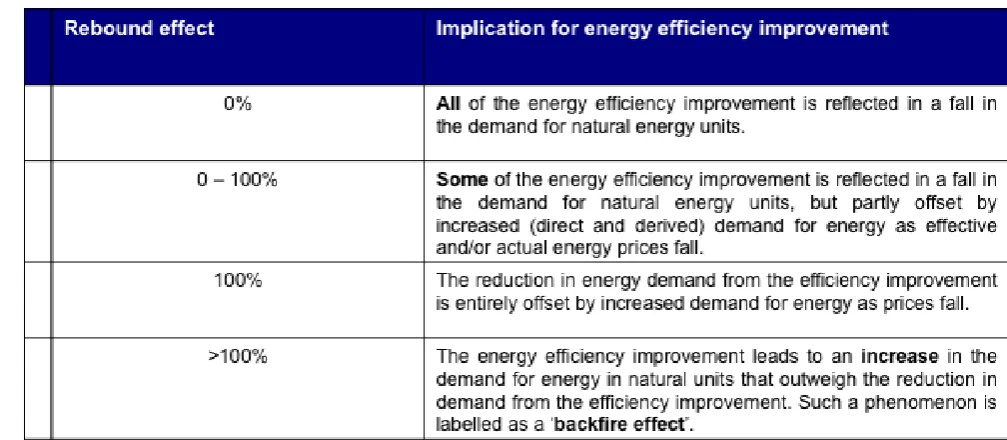
It is important to note that the presence of rebound effects in response to an increase in energy efficiency doesn’t necessarily mean the energy consumption will increase. It may just mean that we need to work harder to gain reductions in energy consumption from increased energy efficiency. Table 1 below shows four ranges of the rebound effect (see Turner, 2009, or Anson and Turner, 2009, for fuller details).
The 0% rebound (R) case would seem unlikely as this would seem to imply absolutely no price responsiveness in the economy whatsoever. However, as will be discussed in more detail in the second article from this project to be published in the next issue of the Fraser of Allander Institute Economic Commentary, our research has suggested that negative rebound effects (i.e. economy-wide reductions in energy consumption that are
Table 1: Ranges of the rebound effect
in the case of Scotland). This may occur as a result of negative multiplier effects in energy supply sectors as demand contracts in response to the initial efficiency improvement and/or disinvestment effects (shedding of capital stock) in energy supply if revenues fall with decreasing prices (see Turner, 2009, and Anson and Turner, 2009).
The 0-100% range means that we have positive rebound, but a net decrease in energy consumption. Thus, one possibility that was raised in the earlier presentation of this paper at an EU public hearing on energy efficiency policy3 is that it may be possible to adjust the size of the energy efficiency improvement to achieve a desired reduction in energy consumption. For example, with 20% rebound a 10% efficiency improvement would imply actual energy savings of 8%. If a 10% reduction in energy consumption is required, the 20% rebound effect would have to be
compensated for in setting the size of the energy efficiency improvement. In this simple example, a 10% reduction in energy consumption would require a 12.5% increase in energy efficiency with 20% rebound.4 Note that the magnitude of the rebound effect will be the same after the adjustment: we are simply compensating for it, not eliminating it. Moreover, as discussed below, in practice, the size of the rebound effect should be determined through economy-wide empirical analysis as is likely to vary depending on (a) the economy in question, (b) the type of activity targeted with an energy efficiency improvement, (c) costs associated with introducing the energy efficiency improvement and (d) passage of time (adjustment of the economy) following the introduction of the efficiency improvement. Thus, the actual compensation required to entirely offset rebound would be difficult to quantify, particularly given issue (d), as the economy may
take some time to adjust to a new equilibrium (see results below for Scotland)
.
However, no such compensation can be made in the bottom two cases in Table 1 where R is greater than or equal to 100%. Here the demand response to falling actual and/or implicit energy prices acts to entirely offset any energy savings from increased energy efficiency. Where we have a net increase in energy consumption (and, of course, energy-related pollution), this is an extreme case of rebound, referred to as backfire. Here a larger energy efficiency improvement will lead to a larger increase in energy consumption. Therefore, again, it is important to employ an empirical framework to quantify the economy-wide rebound effect: where backfire is a likely outcome, increasing the size of the energy efficiency improvement will be a counter-productive strategy.
The next question, then, is what determines the economy-wide/macro rebound outcome for any given improvement in energy efficiency?
Economy-wide demand and supply
responses to increased energy efficiency in
production sectors
Turner (2009), with attention on increased energy efficiency in production rather than final consumption (considered briefly later in this paper), identifies a number of economy-wide effects that have now become accepted in the wider literature. These are considered below.
1. The technical/efficiency effect, where we need less energy to produce a given unit of output.
However, as explained in the introduction above, this triggers a decrease in the effective and possibly the actual price of energy, which in turn leads to four different types of (direct and derived) demand responses, identified as effects 2-5 below:
2. Substitution effects, where energy is substituted for other inputs, as it is now effectively cheaper
3. Output/competitiveness effects (eg on exports) as local production costs (and thus output prices) fall as a results of this beneficial supply-side shock (note that this effect is the main source of positive GDP and employment effects in the sector targeted with the efficiency
improvement, and in the wider economy); and
4. Compositional effects, since different goods vary in their energy intensities we get a change in structure of output in the economy in favour of more energy intensive activities5
5. Income effects on household direct and indirect use of energy (even where households are not directly targeted with the efficiency improvement).
However, decreases in actual energy prices and falling demand may also trigger negative responses in energy supply. First, in response to the efficiency effect (effect 1) above, there will be:
6. Negative multiplier effects in energy supply sectors as demand for the output of these sectors falls, though these may be negated by the positive demand response under effects (2) to (5).
However, if the positive demand response to falling actual energy prices is not sufficient to prevent revenues from falling in energy supply sectors, it is possible that another negative supply effect may occur:
7. Disinvestment effects, where reduced demand leads to decreased actual energy (local and/or imported) prices and revenues - falling returns in energy supply activities sectors lead to capital disinvestment and contraction in the elasticity (responsiveness) of energy supply to changing demand.
The potential for disinvestment effects is discussed in Turner (2009), where we also argue that the basic
argument may also be applicable at the global level where, despite OPEC’s command of marginal supply, downward demand pressures do exert downward pressure on prices. A working paper by Wei (2009) considers the issue of supply responsiveness more generally. These issues will be discussed more fully in the second article on this project in the next issue of the Fraser of Allander Institute
Economic Commentary.
How important are each of these effects in
determining rebound? An empirical
question
The magnitude of rebound for any given efficiency
improvement depends on relative importance of effects 1-7 (1, 6 and 7 put downward pressure on energy demand, 2-5 put upward pressure on energy and other demands). This, in turn depends on the structure of the particular economy where the efficiency improvement occurs, openness to trade, demand responsiveness to changes in prices, supply constraints, which activities are targeted with the efficiency improvement etc, etc. This means that analysis of potential macro-level rebound effects for any particular economy requires an empirical economy-wide modelling framework for that economy. This is commonly referred to as applied or computable general equilibrium (CGE) analysis (see Sorrell, 2007, and Hanley et al, 2009, and/or Turner, 2009, for examples and fuller discussion).
It is important to note that rebound analysis, particularly system-wide rebound analysis is a relatively new area of research. Both theoretical work and empirical evidence limited but are currently gaining a great deal of attention in environmental and energy economics fields and the literature is growing rapidly along with research activity.
Current research at the Department of
Economics, University of Strathclyde
As explained in the introduction above, leading on from the UKERC work reported in Sorrell (2007), the Fraser of Allander Institute economy-energy modelling team have been funded by the UK Economic and Social Research Council to conduct a project titled ‘An empirical general equilibrium analysis of the factors that govern the extent of energy rebound effects in the UK economy’. The duration of this project is 3 years, from October 2007 to September 2010 (ESRC Reference: RES-061-25-0010). While the empirical work in this project has largely been focussed on the UK (e.g. Turner, 2009) and Scotland (Hanley et al, 2009, and Anson and Turner, 2009) – though there has also been some work on the Spanish case (see Hernandez and Turner, 2009) – we have been able to draw more general analytical insights to help development of the wider rebound research field, in both theoretical and empirical terms (e.g. the disinvestment effect identified above is established in Turner, 2009).
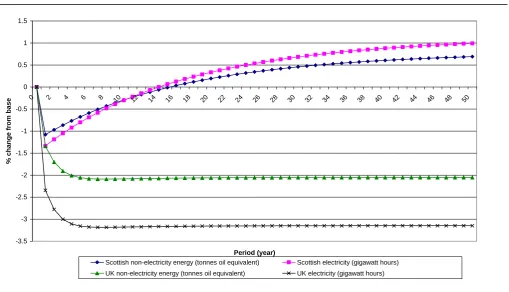
Figure 1: Percentage change in total energy consumption in Scotland and the UK in response to a 5% improvement in energy efficiency in all production sectors (applied to locally supplied energy)
Table 2: Long-run impact of varying the target of 5% energy efficient improvement in Scottish production (percentage changes from base year)
All sectors 1-25
Energy supply sectors 21-25
Non-energy supply sectors 1-20
Total electricity consumption Electricity rebound effect (%)
Total non-electricity consumption Non-electricity energy rebound effect (%)
1.15 131.6
0.81 134.1
2.34 249.5
1.60 243.8
-1.21 41.4
-0.82 34.8
See Appendix 1 for sector identification
Our key empirical result for Scotland, illustrated in Figure 1, is that we find large backfire effects when local energy supply targeted with efficiency improvement (these sectors are heavily traded) – see Hanley et al (2009). In contrast, in the UK case rebound is more constrained by supply response to falling prices, so that while the reduction in energy consumption is proportionately less than the increase in energy efficiency, there is still a net reduction (see Turner, 2009, for more details on the UK results.
Figure 1 shows the results of simulating a very simple 5% increase in energy efficiency in all production sectors of the
Scottish and UK economies respectively using our CGE models of the Scottish economy, SCOTENVI, and of the UK economy, UKENVI. In the initial stages of our research we have simulated very simple energy efficiency shocks as this allows us to identify and consider the key drivers of rebound effects. In these results we do not attempt to consider how the efficiency improvements may be achieved. This will be the focus of future research.
What the results in Figure 1 demonstrate is that, because of the system-wide response to falling actual and effective energy prices, particularly in an economy like Scotland (a producer and exporter of energy), reductions in energy
-3.5 -3 -2.5 -2 -1.5 -1 -0.5 0 0.5 1 1.5
0 2 4 6 8 10 12 14 16 18 20 22 24 26 28 30 32 34 36 38 40 42 44 46 48 50
Period (year)
%
c
hange
f
rom
bas
e
Scottish non-electricity energy (tonnes oil equivalent) Scottish electricity (gigawatt hours)
consumption due to increased efficiency are likely to be partially or even wholly offset by increased demand for energy (i.e. rebound effects will occur). Indeed, the Scottish results are particularly striking. While the amount of electricity consumed in Scotland initially falls (in the early stages the output of the Scottish electricity sector increases as a result of increased export demand), 15 years after the introduction of the efficiency improvement it has risen above its initial level. Non-electricity energy consumption follows a similar pattern, with the rise above the base year value occurring one period later.
There are two key clear implications of the results in Figure 1. First, it is important to examine the adjustment process of the economy in response to a shock such as increased efficiency in the use of energy in production. This is illustrated particularly in the Scottish case, where the short run impacts of the efficiency improvement are qualitatively different to the long run ones. Second, the qualitative difference in the Scottish and UK results demonstrate that it is important to carry out economy-specific empirical analysis.
As noted above, in the Scottish case the backfire effects (net increase in energy consumption across the Scottish economy) are driven by the fact that energy efficiency increases in all Scottish production sectors, including the relatively energy-intensive and heavily traded energy supply sectors. In Table 2, we show the long-run results of focusing the 5% increase in energy efficiency separately in energy supply and non-energy supply sectors (Appendix 1gives a breakdown of the production sectors identified in the Scottish model). We define the long-run equilibrium where population and capital stocks have fully adjusted to the shock (this is not quite achieved in the Scottish case in Figure 1, even after the 50 years illustrated, but more than 85% of the adjustment in energy consumption has taken place at this point in time). The third column of Table 2 shows that backfire does not occur when we do not include the Scottish energy supply sectors in the energy efficiency improvement.
Hanley et al (2009) present fuller sensitivity results for the Scottish case, including the impacts of varying what we assume about the degree of price responsiveness in direct and derived energy demands.
Factors that may dampen/mitigate rebound
What can we say now to help policymakers think about mitigating the rebound effect? First of all, it is important to remember that some degree of rebound in response to increases in energy efficiency may not be too problematic (certainly not enough to prevent us from attempting to increase efficiency, particularly in production, which will almost always lead to positive economic benefits in the activity where efficiency improves, and in the wider economy). It simply means that we are likely to have to work harder, factoring in rebound (which will require empirical analysis) when setting energy efficiency targets
to meet desired decreases in energy consumption (and rebound will differ across economies, and different production and consumption activities within each economy, with the implication that common targets for energy efficiency may not be possible - energy consumption targets may be more appropriate).
Having said this, there are a number of factors that will mitigate or otherwise affect the magnitude of rebound effects:
Price induced efficiency in energy use – e.g. energy taxes – won’t trigger rebound as above and could possibly be used in coordination with policies aimed at technological progress (which do), of course taking into account likely distortive effects (again, CGE analysis can be used for scenario analysis). Indeed, in the context of energy efficiency from technological progress, there may be potential for a ‘double dividend’ effect, depending on how revenues are recycled (see below).
The costs of introducing efficiency improvements will affect rebound – e.g. in production, if increased costs act to entirely offset reductions in effective price of energy, may mean zero or even negative rebound (see Allan et al, 2007). There is also an issue in terms of when costs are incurred (rebound effects will be triggered immediately)
The use of increased government revenues generated as a result of increased productivity will also affect rebound, eg:
Recycling as additional government expenditure – In Allan et al’s (2007) UK results, this leads to a composition effect in favour of less energy-intensive government demands
Lowering tax rates – Allan et al’s (2007) UK results suggest that this will exacerbate income effects driving rebound.
Alternatively, revenues could be directed towards subsidising investment activities etc that would facilitate increases in energy efficiency (linking back to the issue of costs in the previous bullet point).
The key issue here is that it is crucial to develop
Conclusions
This paper has considered the nature of what has come to be known as the ‘rebound’ effect in considering energy efficiency improvements as a means of reducing energy consumption (and associated pollutants, particularly greenhouse gas emissions), taking Scotland as an
empirical example. Our main conclusion is that the rebound effect is an empirical phenomenon and should be
considered on a case-by-case basis for energy efficiency improvements (a) in different economies; (b) in different sectors/activities of any one economy; (c) in the context of different methods that may be adopted to increase energy efficiency and their associated costs; (d) the adjustment process of the economy. The core conclusion is that any reductions in energy consumption are likely to be proportionately smaller than the energy efficiency improvement and in some circumstances the net effect of increased efficiency may be an increase in energy consumption. Two main recommendations are that (a) energy efficiency improvements should be a policy objective, given the economic benefits that will result throughout the economy, but that (b) empirical estimates of potential rebound effects must be factored into energy efficiency targets set in order to reduce energy consumption.
Finally, the reader is reminded that the results presented here are initial findings of the ongoing ESRC-funded project on examining the potential for and main drivers of rebound effects in the Scottish and UK economies. Fuller project details, outputs and results can be found at the project pages on the ESRC Today web-site, which can be accessed via the following link:
http://www.esrcsocietytoday.ac.uk/esrcinfocentre/viewawar dpage.aspx?awardnumber=RES-061-25-0010
There will be a non-technical presentation of final project results at a stakeholder seminar to be held in the late summer of 2010. If you would like to attend this seminar, and/or to be placed on our mailing list to receive our project newsletter and other updates, please contact the author at
____________________
References
Allan, G.J., Hanley, N.D., McGregor, P.G., Swales, J.K. and Turner, K.R. (2007) The impact of increased efficiency in the industrial use of energy: a computable general equilibrium analysis for the United Kingdom, Energy
Economics, 29, pp. 779-798.
Allan, G.J., De Fence, J., Eromenko, I., Lim, A., Gilmartin, M., McGregor, P.G., Swales, J.K. and Turner, K. (2008) The impact on the Scottish economy of reducing
greenhouse gas emissions in Scotland: Illustrative findings from an experimental computable general equilibrium model for Scotland, project report published by the Scottish Government, November 2008
(http://www.scotland.gov.uk/Publications/2008/11/13110942/ 0).
Anson, S. and Turner, K. (2009) Rebound and disinvestment effects in refined oil consumption and supply resulting from an increase in energy efficiency in the Scottish commercial transport sector, Energy Policy, 37, 3608-3620. 2009.
Brookes, L. (1990) The greenhouse effect: the fallacies in the energy efficiency solution, Energy Policy, 18, pp. 199-201
Hanley N.D., McGregor P.G., Swales J.K., Turner K. (2009) Do increases in energy efficiency improve environmental quality and sustainability?, Ecological Economics, 68, pp.692-709.
Hernandez, A.I.G. and Turner, K. (2009) Sensitivity of general equilibrium rebound effects from energy efficiency improvements to different specifications of the KLEM production function, working paper in preparation for presentation at the annual conference of the Regional Science Association: British and Irish Section, Limerick, Ireland, September 2009. Latest version available on request from [email protected].
House of Lords (2005) Energy efficiency, science and technology committee. 2nd report of session 2005–06, Volume 1 report. The Stationary Office, London. 2005.
Jevons, W.S. (1865) The coal question – can Britain survive?, first published in 1865, reprinted by MacMillan in 1906. (Relevant extracts appear in Environment and Changes, February, 1974)
Khazzoom, D.J. (1980) Economic implications of mandated efficiency in standards for household appliances, Energy Journal, 1, pp. 21-39.
Sorrell, S. (2007) The rebound effect: an assessment of the evidence for economy-wide energy savings from improved energy efficiency, UK Energy Research Centre. Link:
http://www.ukerc.ac.uk/Downloads/PDF/07/0710ReboundEffe ct.
Turner, K. (2009) Negative rebound and disinvestment effects in response to an improvement in energy efficiency in the UK Economy, Energy Economics, 31, 648-666, 2009.
Turner, K., Hanley, N.D. and De Fence, J. 2009. Do
productivity improvements move us along the Environmental Kuznets Curve? Strathclyde Discussion Papers in
Wei, T. (2009) A general equilibrium view of global rebound effects, CICERO Working Papers, 2009:02, download at http://www.cicero.uio.no/media/7218.pdf
____________________
Footnotes
1
More details on this project, along with all project outputs to date, can be found on the ESRC Today web-pages at
http://www.esrcsocietytoday.ac.uk/esrcinfocentre/view awardpage.aspx?awardnumber=RES-061-25-0010. Key project results to date can be found in Allan et al (2008), Hanley et al (2009), Turner (2009) and Anson and Turner (2009).
2
An example of a price induced change in energy efficiency may be the use of taxes to raise the price of and reduce demand for energy. This will not trigger the rebound effect. In this paper we are concerned with increased energy efficiency resulting from technological progress. However, price instruments such as energy taxes may be an appropriate tool to offset rebound effects and/or raise revenues that may be used to facilitate energy efficiency improvements.
3
An earlier version of this paper was presented to the Public Hearing on Energy Efficiency Policy for End-Users, organised by the European Economic and Social Committee (EESC) and the Italian Council of Economy and Labour (CNEL), held in Rome, July 2009.
4
Actual energy savings will equal (r-1)p, where p is the percentage increase in energy efficiency (e.g. 8%) and r=R/100 (i.e. in proportionate terms – e.g. 20% rebound means r=0.2). So, with 20% rebound a 10% efficiency improvement would imply actual energy savings of 8% (1-0.2=0.8 times 10). Thus, if instead of a target for energy efficiency, we have a target for reduced energy consumption - e.g. 10% - the energy efficiency improvement required to achieve this will be greater. If we want a an X% reduction in energy consumption, the required proportionate increase in energy efficiency will take the form of 1/(1-r) times X%. If we take X% to equate to 10%, this means that, if rebound were 20%, energy efficiency would actually need to increase by 12.5% (1/0.8 times 10).
5
[image:7.612.79.545.430.724.2]See footnote 2. This is why energy intensity in Figure 2 should be considered an imperfect proxy for energy efficiency.
Appendix 1: Sectoral breakdown of the 1999 Scottish AMOSENVI model
1 AGRICULTURE 1
2 FORESTRY PLANTING AND LOGGING 2.1, 2.2
3 FISHING 3.1
4 FISH FARMING 3.2
5 Other mining and quarrying 6,7
6 Oil and gas extraction 5
7 Mfr food, drink and tobacco 8 to 20
8 Mfr textiles and clothing 21 to 30
9 Mfr chemicals etc 36 to 45
10 Mfr metal and non-metal goods 46 to 61
11 Mfr transport and other machinery, electrical and inst eng 62 to 80
12 Other manufacturing 31 to 34, 81 to 84
13 Water 87
14 Construction 88
15 Distribution 89 to 92
16 Transport 93 to 97
17 Communications, finance and business 98 to 107, 109 to 114
18 R&D 108
20 Public and other services 115, 117 to 123
ENERGY
21 COAL (EXTRACTION) 4
22 OIL (REFINING & DISTR OIL AND NUCLEAR) 35
23 GAS 86
ELECTRICITY 85
24 Renewable (hydro and wind)