functions
M. Endres1, M. Cheneau1, T. Fukuhara1, C. Weitenberg1,2, P. Schauß1, C. Gross1, L. Mazza1,3, M.C. Ba˜nuls1, L. Pollet4, I. Bloch1,4, S. Kuhr1,5
1 Max-Planck-Institut f¨ur Quantenoptik, 85748 Garching, Germany 2
Laboratoire Kastler Brossel, CNRS, UPMC, Ecole Normale Sup´erieure, 75005 Paris, France
3 Scuola Normale Superiore, 56126 Pisa, Italy 4
Ludwig-Maximilians-Universit¨at, 80799 M¨unchen, Germany
5 University of Strathclyde, Department of Physics, SUPA, Glasgow G4 0NG, United Kingdom
Abstract Correlation functions play an important role for the theoretical and experimental characterization of many-body systems. In solid-state systems, they are usually determined through scattering experiments whereas in cold-gases systems, time-of-flight and in-situ absorption imaging are the standard observation techniques. However, none of these methods allow the in-situ detection of spatially resolved correlation func-tions at the single-particle level. Here we give a more detailed account of recent advances in the detection of correlation functions using in-situ fluorescence imaging of ultracold bosonic atoms in an optical lattice. This method yields single-site and single-atom-resolved im-ages of the lattice gas in a single experimental run, thus gaining direct access to fluctuations in the many-body system. As a consequence, the detection of correlation functions between an arbitrary set of lattice sites is possible. This enables not only the detection of two-site correlation functions but also the evaluation of non-local correlations, which originate from an extended region of the system and are used for the characterization of quantum phases that do not possess (quasi-)long-range order in the traditional sense.
1 Introduction
The use of ultracold atoms for the study of strongly in-teracting many-body systems has undergone remarkable development in recent years [1]. Prominent examples in-clude the achievement of the strongly interacting regime of bosonic and fermionic gases in optical lattices [2– 6] and studies of the BEC-BCS crossover by means of Feshbach resonances [7]. The success of this approach is based on the high degree of control that has been achieved over the system parameters. In particular, the
underlying Hamiltonian is usually known and its para-meters, such as the interaction strength or the effective mass, can be accurately determined and tuned over a large range. Furthermore, ultracold gases experiments offer versatile detection techniques, such as in-situ ab-sorption, in-situ phase-contrast, and time-of-flight ima-ging [4, 8–10]. The latter has been combined with spec-troscopic techniques, such as momentum-resolved radio-frequency spectroscopy and momentum-resolved Bragg spectroscopy [11, 12], to gain access to the excitation spectrum of the many-body system.
Recent advances in the high-resolution in-situ fluores-cence imaging of atoms in optical lattices [13–15] have pushed detection capabilities to the fundamental level of individual atoms. Specifically, this technique allows for the single-site-resolved detection of a lattice gas in the Bose-Hubbard regime [16, 17]. The Bose-Hubbard Hamiltonian is given by
ˆ
HBH=−J
X
hi,ji ˆ a†jaˆi+
U 2
X
i ˆ
ni(ˆni−1)−
X
i
µinˆi, (1)
where ˆa†i (ˆai) is the boson creation (annihilation) operator on lattice sitei, ˆni= ˆa†iˆai is the boson number operator, J is the hopping matrix element, U is the on-site interaction energy, µi is the local chemical po-tential, and the first sum runs over all nearest neighbors. The competition of the hopping and interaction process gives rise to a quantum phase transition between a superfluid and a Mott-insulating phase [16–18].
The high-resolution fluorescence experiments [13–15] are able to detect the on-site parity, mod2ni, where ni is the occupation number of site i (see Sec. 2.1). The average on-site parity has been used to study the superfluid-Mott insulator transition [14] and to develop an in-situ temperature measurement in the deep Mott-insulating limit [15]. The latter has recently been combined with amplitude-modulation spectroscopy,
forming a sensitive tool for the study of the many-body excitation spectrum, which was used to detect a ‘Higgs’ amplitude mode close to the superfluid-Mott-insulator transition [19, 20]. Furthermore, an antiferromagnetic quantum Ising spin chain has been simulated in a tilted optical lattice, where nearest-neighbor spin correlations map onto the average on-site parity [21], and an orbital excitation blockade could be directly observed [22]. The high-resolution technique can also be used to control individual atoms and to change Hamiltonian parameters on the level of individual lattice sites. In particular, it has been experimentally demonstrated that the spin of individual atoms in a Mott insulator can be addressed [23]. This technique has recently been employed to study a mobile spin impurity in a strongly interacting one-dimensional (1d) system [24].
In addition to the average on-site parity, high-resolution in-situ fluorescence imaging can be used to evaluate correlations between different lattice sites. We used this possibility to detect two-site and non-local correlations across the superfluid-Mott-insulator transition [25] and to image the spreading of correlations after a sudden change of the Hamiltonian parameters in the Mott-insulating regime [26].
Here we give a more detailed account of several technical and physical aspects of the detection of two-site and non-local correlations with a focus on the equilibrium situation in 1d [25]. In particular, we give a self-contained description of the core experi-mental apparatus and sequence (Sec. 2.1). Following this, we discuss the observable and the limitation of the detection technique in more detail (Sec. 2.2 and 2.3). Furthermore, we give a short introduction to the single-site-resolved detection of Mott insulators in the atomic limit [15] (Sec. 3) as far as it is needed for the understanding of the following chapters. After a general introduction to correlation functions (Sec. 4.1), we demonstrate how two-site correlation functions can be used for the detection of correlated particle-hole pairs (Sec. 4.2). We give a more detailed introduction to two-site parity correlation functions and particle-hole pairs than in Ref. [25] and show additional experimental data for two-site correlations as a function of the in-trap position. We continue with a detailed analysis of non-local order in the Bose-Hubbard model (Sec. 4.3) for which we show a pertubative result that we compare to numerical calculations. We finish with a short description of the experimental results for non-local correlations where our focus is on the role of three-site correlations.
2 Introduction to single-site- and single-atom-resolved detection
2.1 Experimental setup and sequence
2.1.1 State preparation The starting point of our
experiments was a two-dimensional (2d) degenerate quantum gas consisting of several hundred 87Rb atoms in the hyperfine state 5S1/2, F = 1, mF = −1, which was prepared in a single anti-node of an optical lattice in the vertical direction (see Fig. 1a). For details concerning the preparation procedure, we refer to the supplement-ary material of Ref. [25].
The vertical lattice was generated by interference between an incoming laser beam and its reflection from a vacuum window, which has a high-reflectivity coating for the laser wavelengthλL= 1064 nm, and the lattice spa-cing in the vertical direction wasalat=λL/2 = 532 nm. The laser frequency was red-detuned to the D2 and D1 line, yielding an attractive ac Stark potential [27]. The vertical lattice depth Vz was kept constant at approx-imately 21Er, where Er denotes the lattice recoil en-ergyEr=h2/(8ma2lat) withmbeing the atomic mass of 87Rb. Due to this tight confinement and an additional energy offset from gravity, tunneling of the atoms in the vertical direction was negligible for the duration of the experiment. Additionally, the vertical confinement was much stronger than the harmonic confinement in hori-zontal direction that results from the Gaussian beam shape. In this pancake-like geometry, the atom cloud formed a 2d degenerate Bose gas (see, e.g., Ref.[28]). Subsequently, the gas was loaded into a 2d optical lat-tice formed by two optical latlat-tice axes in the horizontal direction, which were created by reflections from mirrors outside of the vacuum chamber. The lattice spacing in both directions wasalat=λL/2 = 532 nm and the axes intersected at 90◦, resulting in a simple 2d square lat-tice. For the loading, the lattice depths were increased to values between 5Er and 23Er, following s-shaped func-tions with durafunc-tions of 120 ms (Fig. 1b). These lattice ramps were quasi-adiabatic, i.e. slow enough to keep the system close to its many-body ground state, as can be seen by the low defect density in the system (Sec. 3).
2.1.2 Fluorescence imaging We detected the atoms
in-situ using fluorescence imaging [15, 29]. The imaging was performed with a high-resolution objective, which was placed in front of the vacuum window that is also used as a mirror for the vertical lattice axis. The numerical aper-ture of the objective was NA = 0.68, yielding a spatial resolution of about 700 nm for an imaging wavelength of 780 nm.
x y z
optical lattice laser beams
mirror 1064 nm window 780nm
high-resolution objective (NA=0.68)
x y
a
16 µm
c
initial density distribution measured density distribution light-assisted collisions
imaging light d b
0 0 5 10
100 3000
Time(ms)
Lattice depth
(
Er
)
lattice-loading freezing fluorescence-imaging
15
Vy
[image:3.595.57.527.90.300.2]Vx
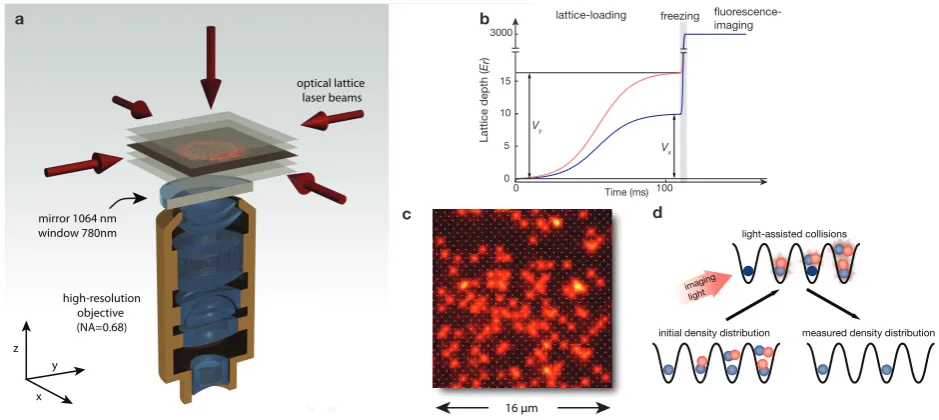
Figure 1 Experimental setup and fluorescence imaging. a, Schematic image showing the optical lattice geometry,
the 2d quantum gas and the high-resolution objective. The optical lattice setup consisted of two horizontal lattice axes (in the xand y-directions) and a vertical lattice axis (in thez-direction). The latter was created by reflection from a vacuum window with a coating that reflects the lattice wavelength (1064 nm) and transmits the imaging wavelength (780 nm). The 2d quantum gas was prepared in a single anti-node of the vertical lattice and is imaged with the high-resolution objective using fluorescence detection.b, Horizontal lattice depth during a typical experimental sequence. The loading into the square lattice is achieved by quasi-adiabatic s-shaped ramps with a duration of 120 ms. The final lattice depths inx- andy-directions Vx, Vy were independently controlled. For the detection, the lattice gas is frozen by rapidly increasing the lattice depths to approximately 3000Er.c, Typical fluorescence image of a dilute thermal cloud as seen on an EMCCD camera. Single atoms are visible with a high signal-to-noise ratio. White dots mark the sites of the 2d lattice created by the horizontal lattice axes.
d, Illustration of the parity-projection mechanism. Figs.aandcare from Ref. [15].
exponential ramp to ≈80Er with a duration of 0.2 ms that already fully suppressed the dynamics (not shown in Fig. 1b). The second ramp to≈3000Eris included to have sufficiently deep lattices for the imaging process. To image the frozen gas, we optically pumped the atoms from 5S1/2, F = 1 to 5S1/2, F = 2 and shone in ima-ging laser light with a red-detuning of ≈ 50 MHz to the free-space resonance of the 5S1/2, F = 2 to 5P3/2, F = 3 transition. The scattered photons were observed through the high-resolution objective and an additional lens, which focused the light on an EMCCD (electron-multiplying charge-coupled device) camera.
Typical fluorescence images show individual atoms in the 2d lattice (see Fig. 1c). We first discuss a dilute, non-degenerate cloud and turn to dense, non-degenerate clouds in Sec. 3. Approximately 5000 photons per atom are de-tected during an illumination time of about 1 s, resulting in a high signal-to-noise ratio. To achieve this, we had to suppress tunneling (or even loss) of the atoms during the illumination time. Such tunneling processes can oc-cur even in a very deep optical lattice of 3000Er if the atoms are thermally excited to higher bands as a result of the recoil heating by the imaging light. To suppress this thermally activated hopping, we laser-cooled the atoms by setting up the imaging beams in an optical molasses configuration, which resulted in sub-Doppler temperat-ures of≈30µK.
Note that the imaging process is destructive for the many-body state (see Sec. 2.3 for details). To collect stat-istics for a given observable, the experiment had to car-ried out repeatedly, starting with the preparation of the 2d degenerate gas.
2.2 Parity projection and parity operator
atoms undergo a pairwise collision. In general, the meas-ured occupation number can be written as mod2ni in terms of the actual occupation numberni. For later use, we define an on-site parity operator ˆsi with eigenvalues si that are±1 for odd (even) parity:
ˆ
si|nii=si|nii=
+1|nii ifni is odd
−1|nii ifni is even, (2)
where|niiis an on-site Fock state with occupation num-berni at sitei.
2.3 Description of the observable
2.3.1 Interpretation as a projective measurement The
described measurement technique detects more than just the average on-site parity but also captures the fluc-tuations and correlations in the system. An arbitrary many-body state|Ψi(not necessarily in the atomic limit) at zero temperature can be written as a superposition of products of on-site Fock states as
|Ψi=X {ni}
αn1,...,nN|n1, ..., nNi, (3)
where |n1, ..., nNi = Qi|nii and the sum runs over all possible configurations of on-site occupation numbers
{ni}= (n1, ..., nN).
The freezing of the density distribution and the sub-sequent scattering of imaging light can be interpreted as a projective measurement. It leads to a projection onto a specific state |Ψiproj = |n1, ..., nNi with a quantum mechanical probabilityp(n1, ..., nN) =|αn1,...,nN|
2.
2.3.2 Observable without parity projection We first
dis-cuss the situation as it would be without parity pro-jection. The crucial point is that the measurement would yield information about all occupation num-bers ni of the projected state |Ψiproj in a single ex-perimental run. In each iteration of the experiment, we would observe a new set of occupation numbers corresponding to a different |Ψiproj. In this way, we could gather an increasing amount of statistics and fi-nally reconstruct the full joint probability distribution p(n1, ..., nN) to observe a specific set of occupation numbers (n1, ..., nN) on all lattice sites. This includes more information than the average on-site density be-cause from the knowledge of p(n1, ..., nN), one could calculate all possible density-density correlation func-tions hQiMˆnii = P{ni}p(n1, ..., nN)QiMni, where the product runs over an arbitrarily chosen set of lat-tice sitesM.
2.3.3 Observable including parity projection
Includ-ing the parity-projection mechanism, the most gen-eral observable is the joint probability distribution pp(s1, ..., sN) to observe a set of on-site parities
(s1, ..., sN) on all lattice sites, where the si are eigen-values of the on-site parity operator as defined in Eq. 2. However, the full reconstruction ofpp(s1, ..., sN) is a de-manding task since it requires a very large number of ex-perimental repetitions. In practice, we evaluated various correlation functions using an additional spatial average in order to reduce the statistical noise on our data.
2.3.4 Limitation The detection technique can
not directly distinguish the pure state |Ψi =
P
{ni}αn1,...,nN|n1, ..., nNi, from a mixed state
de-scribed by the density operator
ˆ ρ=X
{ni}
|αn1,...,nN|
2Pˆ
|n1,...,nNi, (4)
with the projection operator Pˆ|n1,...,nNi = |n1, ..., nNihn1, ..., nN|. The reason is that both of these states yield the same joint probability distribu-tions p(n1, ..., nN) = |αn1,...,nN|
2 and pp(s
1, ..., sN). Therefore, the imaging technique, with or without parity projection, can not detect off-diagonal elements (i.e., coherences) of density operators written in the on-site number basis.
3 Single-site-resolved detection of dense, atomic-limit Mott insulators
3.1 Theoretical description of the atomic limit
The atomic limit of the Mott-insulating phase (J/U≈0) yields a particularly simple description because, neglect-ing the tunnelneglect-ing term, the Bose-Hubbard Hamiltonian can be written as a sum of on-site terms as
ˆ HBH≈
X
i ˆ Hi≡
X
i
U
2nˆi(ˆni−1)−µiˆni
. (5)
The eigenstates of the local Hamiltonian Hˆi are on-site Fock states |nii with eigenvalues E(ni) = U2ni(ni−1)−µini. The eigenstates of HˆBH are product states |ΨiJ/U=0 = Qi|nii with eigenener-gies E =PiE(ni). The ground state of the system is therefore found by minimizing E(ni) on each lattice site. This yieldsn0,i =dµi/Ue for the local occupation number in the ground state, wheredxeis the ceiling of x. The ground state is then
|Ψi0,J/U=0=
Y
i
|n0,ii. (6)
One of the crucial features of this state is that it shows no number fluctuations, i.e.,nˆ2
i
− hnˆii2 = 0. Number fluctuations only arise through thermal occupation of excited states by increasing or decreasingn0,i.
J/U
µ/U
0 1 2
Mott insulator
ni=2
Mott insulator
ni=1
superfluid
ni=2
ni=1
(J/U)c ni=1
ni=2
x y
a
b 2 µm
0 500 1000 1500 2000 2500 3000
Coun
ts
c
d
distance(alat )
signal (a.u.)
2
1 3 4 5 6
signal (a.u.)
20 µm
[image:5.595.58.276.91.410.2]0
Figure 2 Imaging Mott insulators in the atomic
limit. a,Sketch of the phase diagram of the Bose-Hubbard
model (Eq. 1) [16]. For smallJ/U, the system tends to be in a Mott-insulating phase divided into lobes with constant aver-age on-site occupation numbersni=hˆnii(white areas). For J/U larger than a critical value (J/U)c, the system is always superfluid (shaded blue area) and only lines with constantni exist (dashed lines). Inset: Sketch of the local average density of a trapped system in the atomic limit (J/U ≈0) that can be considered as a cut in the Bose-Hubbard phase diagram along the µ-direction (grey-shaded arrow). b, Upper panel: experimental fluorescence image of a Mott insulator in the atomic limit with an occupation number of two in its cen-ter. Lower panel: Reconstruction of the atom distribution in the lattice. The sites in the central region appear empty due to the parity projection mechanism. c, Reconstruction in a typical high-density region. Open circles mark the positions of single atoms as found by the reconstruction algorithm.
d, The reconstruction is possible even if the optical resolu-tion (about 700 nm) is slightly larger than the lattice spacing (alat= 532 nm). Five atoms on neighboring lattice sites are
sketched with their point spread functions (solid line, top panel). The sum of the signals (dashed line) shows only a broad feature. However, if one of the atoms is missing (lower panel) a dip in this feature appears. The reconstruction al-gorithm can therefore still distinguish the different occupa-tions in the two boxed areas inc. Figs.b,care from Ref. [15].
leads to a harmonic confinement in the center of the beams, and the local chemical potential is given by
µi=µ− 1 2m(ω
2 xx
2 i +ω
2 yy
2
i), (7)
whereµis the global chemical potential andωx,ωy are the trapping frequencies inx,y-directions andxi,yi de-note thex,y-positions of lattice sitei. We do not include a confinement term in thez-direction because our sys-tem is effectively 2d. The local chemical potential µi, going outwards from the trap center, therefore follows a cut at J/U ≈0 along the µ axis of the Bose-Hubbard phase diagram, starting at the global chemical potential µand going to lower local chemical potentials (Fig. 2a). As a consequence, the Mott lobes appear as concentric rings in a single experimental image.
3.2 Single-site resolved detection in the atomic limit
Experimentally, we reached the atomic limit by increas-ing the lattice depth of both horizontal lattices quasi-adiabatically (Sec. 2.1) until tunneling between neigh-boring sites is completely suppressed. For the data presented in Fig. 2, we used a final lattice depth of Vx = Vy = 23(1)Er yielding J/U ≈ 3·10−3, which is about a factor of 20 smaller than the critical value (J/U)c ≈ 0.06 for the superfluid-Mott-insulator trans-ition in 2d [31].
After this preparation, we took in-situ fluorescence im-ages of the system (Fig. 2b). The pictures show regions with almost constant occupation number and low de-fect probability, consistent with the description in terms of on-site Fock states. Remaining number fluctuations are attributed to thermal excitations of the system (see Ref. [15] for a detailed discussion).
In contrast to the image of a dilute thermal cloud shown in Fig. 1c, single atoms are not easily distinguishable in the dense regions of the Mott-insulating shells. However, the signal-to-noise ratio and the spatial resolution of our imaging procedure are sufficient to reconstruct the atom distribution in the lattice using a computer algorithm (Figs. 2c and d). The output of the algorithm is digital information in matrix-form containing the parity of the on-site occupation number for each lattice-site [15, 23].
4 Detection of correlation functions
4.1 Introduction to local and non-local correlation functions
4.1.1 Two-site correlation functions and local order
parameters The following introduction to local and
non-local order parameters follows in parts the discus-sion in Ref. [32]. Local order parameters are based on two-site correlation functions
where ˆAk and ˆBk+dare, so far, not specified local oper-ators acting at positionskandk+d. A system possesses long-range order in a two-site correlation function if
lim
d→∞C(d) =|C| 2
6
= 0. (9)
If this is the case, C is called a local order parameter. Typically, one studies the transition from an ordered phase, which possesses long-range order, to a disordered phase with C= 0. Examples include off-diagonal long-range order in a Bose-Einstein condensate defined as limd→∞hΨˆk†Ψˆk+di = |Ψ|
2
6
= 0, where Ψ is the macro-scopic wave function and ˆΨk† and ˆΨk+d are creation and annihilation operators. A simple example of magnetic order is ferromagnetic long-range order in the 1d trans-verse field Ising model, defined as
lim d→∞h
ˆ
SkzSˆk+dz i 6= 0, (10)
where ˆSz
k is thez-component of the spin operator. In a quasi-ordered phase, e.g., in low-dimensional sys-tems, we often find an algebraic decay of C(d) to zero and no finite value ofC (quasi-long-range order). A dis-ordered phase is then characterized by a faster, expo-nential decay ofC(d).
4.1.2 Multi-site correlation functions and non-local
or-der parameters Many phases that do not show
(quasi-)long-range order in the above sense still show non-vanishing long-range correlations in multi-site cor-relation functions of the type
O(l) =hAˆk
Y
k<m<k+l ˆ um
!
ˆ
Bk+li. (11)
This can be thought of as an extension of the two-site correlation function with a string of operators
Q
k<m<k+luˆm inserted between the endpoints. We call O(l) a non-local correlation function because it gathers information about an extended region with length l. A system possesses non-local order if
lim
l→∞O(l) =O 2
6
= 0. (12)
This definition is a generalization of string order
lim l→∞h
ˆ
Skz Y k<m<k+l
eiπSˆmz !
ˆ
Sk+lz i 6= 0, (13)
which was introduced in the context of spin-1 chains [33, 34]. This non-local correlation function detects a special type of anti-ferromagnetic order, which is hidden for a two-site correlation function (Fig. 4a). Following Refs. [32, 35], we will use the term string order also for the more general definition in Eq. 11 and Eq. 12.
Another example is the disordered, paramagnetic phase
in the 1d transverse field Ising model that shows a non-local order [36]
lim l→∞h
Y
k≤m≤k+d ˆ
Smxi 6= 0, (14)
where ˆSx
k is the x-component of the spin operator at sitek. This is in contrast to the ordered, ferromagnetic phase of the same model, which shows long-range order in a two-site correlation function based on ˆSz
k as defined in Eq. 10.
We will argue in Sec. 4.3 that 1d Mott insulators with unity filling possess a non-local order given by
lim l→∞h
Y
k≤m≤k+l ˆ
smi 6= 0 (15)
with the parity operator ˆsmdefined in Eq. 2.
This order parameter was introduced to study the trans-ition from the Mott insulating phase to a Haldane insu-lating phase that can occur if long-range interactions are included in the Bose-Hubbard Hamiltonian [37, 38]. The latter phase is characterized by an order parameter sim-ilar to the one in Eq. 13. In contrast, our focus is on the behaviour of the order parameter in Eq. 15 at the trans-ition from the Mott insulating to the superfluid phase within the standard Bose-Hubbard model (Eq. 1). Further examples of systems that possess non-local or-der are spin-1/2 lador-ders [39] and fermionic Mott and band insulators [40]. Recent theoretical studies explored the connection between non-local order and symmetries [35] and the connection to localizable entanglement [41– 44]. A measurement of the string order parameter of Eq. 13 using spin-dependent lattice potentials has been proposed in Ref. [45].
4.2 Detection of two-site correlation functions and particle-hole pairs
4.2.1 Particle-hole pairs In contrast to the atomic
limit, Mott insulators at finite J/U > 0 show number fluctuations even at zero temperature and are not de-scribed by simple product states as in Eq. 6. ForJ/U (J/U)c, these fluctuations appear in the form of cor-related particle-hole pairs, formed by an extra particle and a missing particle on two nearby sites. In the fol-lowing, we deal with a situation where the region of in-terest lies within the ni = 1 Mott-insulating lobe and the local zero-temperature state, in the atomic limit, is described by|Ψi0,J/U=0 =Qi|ni = 1i. The emergence of quantum-correlated particle-hole pairs can then be understood within first-order perturbation theory con-sidering the tunneling term as a perturbation. To first order, one obtains for the ground state
|Ψ˜i0∝ |Ψi0,J/U=0+ J U
X
hi,ji ˆ
The second term yields contributions of the schematic form ˆa†iˆaj|Ψi0,J/U=0 =
√
2|1,1, ...,0,2, ...,1,1i, with a sum over all positions and orientations of the particle-hole pair formed by the neighboring empty- and doubly-occupied sites. The state|Ψ˜i0yields a probability to find a particle-hole pair on neighboring sites proportional to (J/U)2.
Closer to the transition to the superfluid phase, higher-order perturbation terms become more important. Intu-itively, this leads to a rapid increase of bound particle-hole pairs and an extension of their size, eventually res-ulting in deconfinement of the pairs at the transition point. One might view this proliferation and extension of particle-hole pairs as the driving force for the superfluid-Mott-insulator transition. However, more complicated clusters of particles might also play an important role. We would like to stress that |Ψ˜i0 specifies the ground state of the system. Particle-hole pairs can therefore be regarded as virtual excitations. This should be distin-guished from actual excited states of the Mott-insulating phase, which are reached by increasing or decreasing the atom number by one.
4.2.2 Two-site parity-correlation functions For the
de-tection of correlations induced by particle-hole pairs, we exploited the fact that they have a finite spatial exten-sion. As a consequence, the appearance of a number fluc-tuation on a given site leads to an enhanced probability to find a fluctuation on a close-by site. This behavior is captured in a two-site parity-correlation function [25, 46]
Cp(d) =hˆskˆsk+di − hˆskihˆsk+di. (17)
In contrast to the general definition in Eq. 8, we subtract the term hˆskihˆsk+di, i.e., Cp(d) is a connected correla-tion funccorrela-tion or a cumulant. In this form, Cp(d) (for d6= 0) vanishes for all many-body states|Ψi=Qi|ψii, that are simple products of on-site states |ψii, because such states lead to a factorizationhˆskˆsk+di=hsˆkihsˆk+di. Therefore, we expect no signal for the ground state of the atomic limit (Eq. 6) and for the ground state of the non-interacting limit (U/J≈0), which is effectively de-scribed by a product of on-site coherent states [4]. Addi-tionally, thermally induced number fluctuations do not cause a signal in the atomic limit because the density op-erator for the finite-temperature ensemble is a product of on-site operators [47].
In contrast, the perturbation theory result in Eq. 16 shows a many-body state that is a superposition of product states that have either no particle-hole pair or a particle-hole pair at different positions. The nearest-neighbor parity-correlation function is thenCp(d= 1) = 16(J/U)2+
O[(J/U)4], which is directly proportional to the probability to find a particle-hole pair on neighbor-ing sites.
However, Cp(d) cannot be used to formulate an order parameter for the superfluid to Mott insulator trans-ition because Cp(d) shows a rapid decay withdin both
phases [25], which means thathsˆkˆsk+di ≈ hsˆkihsˆk+difor larged. Therefore, both phases cannot be distinguished withCp(d), in contrast to the non-local order parameter that we will discuss in Sec. 4.3. We useCp(d= 1) solely to detect quantum fluctuations that are introduced by particle-hole pairs in the Mott insulating phase.
4.2.3 Experimental results We analyzed two-site parity
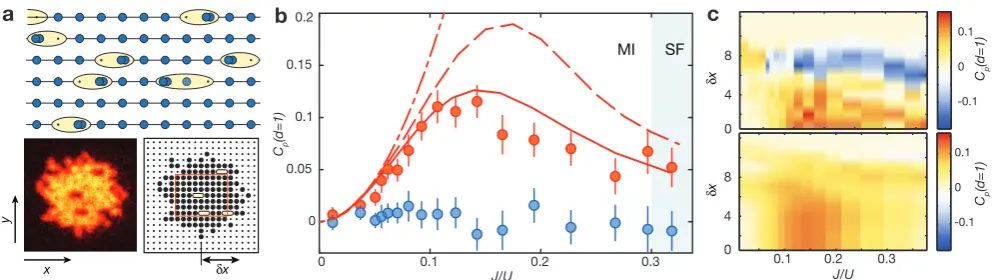
correlations in 1d systems. For this, we split the 2d quantum gas into parallel 1d systems by choosing a high final lattice depth iny-direction ofVy≈17Ereffectively inhibiting tunneling in this direction (see sequence in Fig. 1b and illustration in Fig. 3a). We varied J/U within these 1d systems by varying the final lattice depth in thex-direction fromVx≈4Er to Vx≈17Er. Due to the quasi-adiabatic preparation, we expect the system to be close to the equilibrium state for the final J/U values,
Typically, our samples contained 150−200 atoms in order to avoid Mott insulators of occupation numbers ni > 1. For small J/U values, we therefore probed the correlations within the ni = 1 Mott lobe. We first evaluated Cp(d = 1) for each nearest-neighbor pair of sites in a central region of 9×7 lattice sites by an ensemble average over 50−100 experimental repetitions. We then performed a spatial average over this central region. The spatially averaged signal can be written as PkR(hˆsksˆk+1i − hsˆkihsˆk+1i)/NR, where NR is the number of nearest-neighbor pairs of sites in the central regionR.
First, we recorded the nearest-neighbor correlations Cp(d= 1) for different values ofJ/U along the direction of the 1d tubes (red circles in Fig. 3b). ForJ/U ≈0, the nearest-neighbor correlations vanish within errorbars, compatible with the product-state description of the many-body state in this limit. As particle-hole pairs emerge with increasing J/U, we observe an increase of nearest-neighbor correlations. The appearance of a maximum in the signal can be understood from the fact that in the non-interacting limit (U/J = 0),Cp(d) also has to vanish. The precise location and value of this maximum is, however, hard to predict. Note that the maximum is reached for a J/U-value that is higher than the critical value in mean-field theory (J/U)1d
c,MF ≈ 0.09 but lower than the more precise critical value (J/U)1d
c ≈ 0.3 obtained with numerical methods [48, 49]. For a discussion of the comparison with the numerical calculation shown in Fig. 3b, we refer to Ref. [25]. Furthermore, we showCp(d= 1) as a function of the distance from the center of the 1d tubes (see Fig. 3c and figure caption).
In addition to the nearest-neighbor parity correlation Cp(d= 1), we also evaluated Cp(d) for distancesd= 0 and d = 2 in our 1d systems (see supplementary material of Ref. [25]). In contrast to Cp(d = 1), the on-site parity fluctuations Cp(d = 0) = hˆs2
y
x δx 0 0.1 0.2 0.3
0 0.05
0.1 0.15 0.2
J/U Cp
(d=1)
SF MI a
4 8
0 0.1 4
8
0.1 0.2 0.3
J/U 0
0
δ
x
δ
x
-0.1 0 0.1
-0.1
Cp
(d=1)
Cp
(d=1)
[image:8.595.46.544.93.233.2]b c
Figure 3 Nearest-neighbor correlations in 1d. a,Top panel: Schematic image of the density distribution for 0< J/U
(J/U)cwith parallel 1d tubes and particle-hole pairs aligned in the direction of the tubes. Bottom panel: Typical experimental fluorescence images forJ/U = 0.06 (left) and reconstructed on-site parity (right). Particle-hole pairs are emphasized by a yellow shading. b,1d nearest-neighbor correlations Cp(d= 1) as a function ofJ/U averaged over a central region of 9×7 lattice sites (box in lower right panel of a). The data along the tube direction (x-direction, red circles) shows a positive correlation signal, while the signal in orthogonal direction (y-direction, blue circles) vanishes within error-bars due to the decoupling of the 1d systems. The curves are first-order perturbation theory (dashed-dotted line), Density-Matrix Renormalization Group (DMRG) calculations for a homogeneous system at temperatureT = 0 (dashed line) and finite-temperature Matrix Product State (MPS) [41, 50] calculations including harmonic confinement atT = 0.09U/kB (solid line). The error bars denote the 1σ statistical uncertainty. The light blue shading highlights the superfluid phase.c, Cp(d= 1) as a function of the distance δxfrom the center of the 1d tubes (as shown by the arrow in the lower right panel of a). The experimental data (top panel) shows a positive correlation signal for intermediateJ/U and forδx.4 in accordance with the theoretical prediction based on MPS simulations (bottom panel). We attribute a negative experimental signal at the edge of the cloud (δx≈8) to shot-to-shot fluctuations of the cloud size. For the experimental data inc, we averaged the central 7 tubes and additionally averaged over data points with the same distanceδxto the left and the right of the center of the 1d tubes. The signal inbstems from an average overδx≤4 of the signal inc. Parts of Fig.a, and Fig.bare from Ref. [25].
to thermally induced fluctuations, and Cp(d = 0) increases monotonically with increasingJ/U saturating atCp(d= 0)≈1 in the superfluid regime. As a function of the distanced,Cp(d) drops rapidly and the numerical calculations predict only a small maximum of 0.01 in the next-nearest-neighbor correlation Cp(d = 2) at J/U ≈0.17, which is indiscernible from the statistical noise in our measurements [25].
4.3 Detection of non-local correlations in the Bose-Hubbard model
4.3.1 Perturbation analysis For the following
discus-sion of non-local order in the Mott insulating phase, let us define a string operator
ˆ Op(l) =
Y
k≤m≤k+l ˆ
sm, (18)
and the following notation for the string correlator
O2
p(l) =hOˆp(l)i. (19) With this, there is string order if
O2 p= lim
l→∞O 2
p(l)>0. (20)
In the atomic limit, at T = 0, the Mott-insulating ground state has the form |Ψi0,J/U=0 =
Q
i|ni = 1i.
For this state, one finds triviallyhOˆp(l)i= 1 and there-fore string order. We will now demonstrate that string order is stable with respect to finite tunnelingJ/U >0, based on the perturbation expansion in Eq. 16. All states that are summed up in the expansion are eigenstates of the local parity operator ˆsm. If no defect is encountered at sitem, ˆsmhas an eigenvaluesm= +1 and, if a defect is encountered, we findsm =−1. Therefore, the states in the expansion on the right hand side of Eq. 16 are ei-genstates of ˆOp(l) with eigenvaluesQk≤m≤k+lsm=±1. The sign of the eigenvalue depends on whether or not a particle-hole pair is cut at the ends of the string op-erator ˆOp(l). By this, we mean the following: Consider a state ˆa†iˆaj|Ψi0,J/U=0 which has a particle-hole pair at positionsiandj, wherei is the position of the particle and j the position of the hole. A particle-hole pair is cut if eitheriorj is within the interval [k, k+l] that is sampled by the string operator. If a single pair is cut, the eigenvalue of ˆOp(l) is−1, because we find an unpaired minus sign. In all other cases, the eigenvalue is +1 be-cause particle-hole pairs inside [k, k+l] lead to pairwise minus signs that cancel (Fig. 4b).
there-k+l k -+ + -+ + + + + -+ + + + ˆ
sm|Ψ=−1|Ψ
k+l k + + + + + + + + + -+ + + + b a ˆ sm ˆ sm
1no particle-hole pair cut
2particle-hole pair cut
2 2
ˆ
Sz
m 1 0 0 0 0 -1 0 0 0 1 0 0 0 0 0 0 -1 0 0 1 0
Spin 1 chain: hidden anti-ferromagnetic order
Mott insulator: parity order
|Ψ1
|Ψ2
x y z
2
0 0.1 0.2 0.3 0.4
0 0.2 0.4 0.6 0.8 1 J/U O p (l) 1 2 3 4 6 9 14 20 28 41 60 l
0.25 0.27 0.29 0.31
0 0.04 0.08 0.12 J/U Op
2 MI SF
c
k≤m≤k+l
ˆ
sm|Ψ1= +1|Ψ1
[image:9.595.57.280.89.436.2]
k≤m≤k+l
Figure 4 Illustration of non-local order and
numer-ical results. a, Hidden anti-ferromagnetic order in a spin-1
chain. Each spin withz-component +1 is followed by a spin with−1, with an arbitrary number of spins with 0 in between. This order is hidden for a two-site correlation function, but can be detected using the non-local correlation function in Eq. 13.b, Illustration of parity order in 1d Mott insulators. For states where all particle-hole pairs lie within the evalu-ation region [k, k+l] , the string operatorQ
k≤m≤k+lˆsmhas
an eigenvalue of +1 because the introduced pairwise minus signs cancel (upper panel). Only states which have a particle-hole pair extending out of the evaluation region yield −1 (lower panel).c,O2
p(l) as a function ofJ/U calculated with DMRG for a homogeneous chain (¯n = 1, T = 0) of total length 216. Lines showO2
p(l) for selected lengthsl(black to red colors). The dashed line shows the first-order strong coup-ling result O2
p(l) = 1−16(J/U)2. Inset: Extrapolated value O2
p = liml→∞O2p(l) together with a fit (black line) of the form O2
p∝exp −A[(J/U)c−(J/U)]−1/2
, which is char-acteristic for a transition of Berezinskii-Kosterlitz-Thouless type. Fig.cwithout the strong coupling result was first pub-lished in Ref. [25].
forepc = 4(
√
2J/U)2= 8(J/U)2 and the total probabil-ity not to cut a particle-hole pair ispnc= 1−8(J/U)2. Based on the argument of the previous paragraph, we can write
O2
p(l) =pnc−pc= 1−16(J/U)2. (21) This result is valid ifl≥2 and forJ/U(J/U)c. Con-sequently, we find liml→∞hOp2(l)i= 1−16(J/U)2>0. Therefore, Mott insulators in 1d at small J/U possess string order.
The previous analysis is expected to hold in a similar way in the whole Mott phase if higher order terms in the perturbation series are included. The crucial point is that for a given order (J/U)n in the Mott-insulating phase, defects appear in finite-sized clusters with a typ-ical extensionlc. For low orders of n, we expectlc ≈n. Within such clusters, the number of lattice sites with eigenvalue sm =−1 is always even because the applic-ation of the perturbapplic-ation operator ˆa†iaj, with i, j be-ing neighborbe-ing sites, can only change this number by
±2. For example, the application of ˆa†iaj on a state
|1,1, ...,1,0,2,1..,1,1i can create another particle-hole pair, destroy the particle-hole pair, or lead to states
|1,1, ...,0,1,2, ...,1,1i or |1,1, ...,0,3,0, ...,1,1i. In all cases, we find an even number of sites withsm=−1. If such a finite-sized cluster lies completely within the eval-uation region [k, k+l], it contributes only with an overall plus sign since the contribution of all sites withsm=−1 cancels pairwise. The string-correlation function O2
p(l) then takes on a constant value ifllc because clusters can only be cut at the ends of the evaluation region and the probability for such a cut stays constant as a func-tion of the lengthl.
4.3.2 Numerical analysis This intuitive view is
suppor-ted by a numerical analysis using DMRG (Fig. 4c, solid lines). The result from the strong coupling expansion
O2
p≈1−16(J/U)2(dashed line) agrees with the DMRG data for smallJ/Uvalues. The inset of Fig. 4c shows the extrapolated valuesOp2 = liml→∞O2p(l), which we cal-culated using finite size scaling (see supplementary ma-terial of Ref. [25] for details). We observe thatO2
p>0 in the Mott phase and that O2
p vanishes at J/U ≈ 0.3, which is compatible with the known numerical value of (J/U)c ≈ 0.3 for the critical coupling strength for the 1d superfluid-Mott-insulator transition [48, 49]. This analysis shows that 1d bosonic Mott insulators possess string order for all coupling strengthsJ/U <(J/U)c. Without going into details, we note that an analysis us-ing a Bosonization treatment yields an algebraic decay to zero of Op2(l) with l, in the superfluid phase, and an approximately exponential decay to a constant non-zero value, in the Mott-insulating phase [51]. Further-more, a mapping to a 2d interface model shows that
O2
p grows as O2p ∝ exp −A
(J/U)1d
c −(J/U)
2 4 6 8
0 0.1
0.2 0.3
0 0.5 1
l J/U
Op
(l)
2
a
b
0 0.1 0.2 0.3
0 0.04 0.08
J/U
<s s s >
12
3
c
> > >
SF MI
[image:10.595.53.271.75.361.2]0 0.2 0.4 0.6 0.8
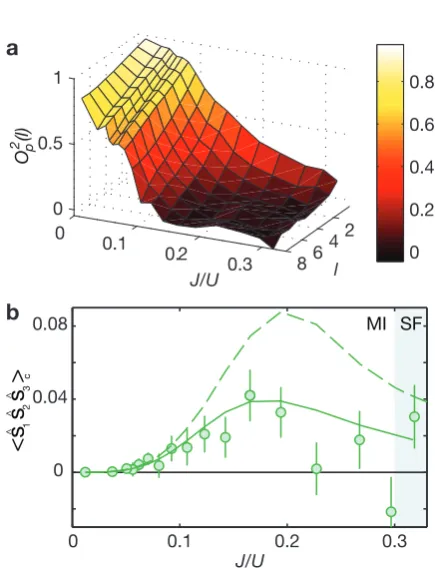
Figure 5 Experimental results for non-local
correla-tions. a, Experimental values ofO2
p(l) for lengths 0≤l≤8
b,Our experimental values for three site cumulanthˆs1sˆ2sˆ3ic (green circles) show the existence of three-site correlations in our system. The curves are DMRG calculations for a homogeneous system at T = 0 (dashed line) and finite-temperature MPS calculations including harmonic confine-ment at T = 0.09U/kB (solid line). Figs. a,b are from Ref. [25].
compatible with this behavior (inset of Fig. 4c). The 1d superfluid-Mott-insulator transition is of Berezinskii-Kosterlitz-Thouless type, and the latter scaling is the same scaling as for the opening of the Mott-insulating gap at the transition point [53].
4.3.3 Experimental results Our experimentally
ob-tained values ofOp2(l) for string lengthsl≤8 are shown in Fig. 5a. We observe a stronger decay ofOp2(l) withl compared to theT = 0 case because at finite temperat-ure, thermal fluctuations lead to minus signs at random positions and reduce the average value of O2
p(l). Des-pite this, we still see a strong growth of O2
p(l) once the transition from the superfluid to the Mott insulator is crossed, similar to the behavior in Fig. 4c. For a more detailed comparison with numerical results, we refer to Ref. [25].
Here we would like to stress that this signal cannot be explained with pure two-site correlations. To illustrate this, let us consider the simplest case of a string-type correlator including three siteshˆs1ˆs2sˆ3i, where ˆs1,ˆs2and ˆ
s3 refer to the parity of three neighboring sites on a 1d chain. Three-site correlations are captured by a
three-site cumulanthˆs1sˆ2sˆ3ic, defined as [54]
hsˆ1sˆ2ˆs3ic =hsˆ1ˆs2ˆs3i − hsˆ1ihsˆ2ihˆs3i
−Cp(1,2)hsˆ3i −Cp(2,3)hsˆ1i −Cp(1,3)hˆs2i, (22)
with two-site correlation functions Cp(i, j) = hsˆisˆji −
hsˆiihsˆji. The three-site cumulanthˆs1ˆs2sˆ3ic is a measure of the correlations between all three sites as it vanishes if one of the sites is not correlated with the others [54]. Ifhsˆ1sˆ2ˆs3icvanishes, Eq. 22 can be written ashˆs1sˆ2sˆ3i=
hsˆ1ihˆs2ihsˆ3i+C1,2hˆs3i+C2,3hsˆ1i+C1,3hsˆ2i. In this case,
hsˆ1sˆ2ˆs3idoes not contain more information than two-site and on-site terms. In contrast, a non-zerohˆs1ˆs2sˆ3ic sig-nals thathˆs1ˆs2sˆ3icontains additional information. Our experimental values for the three-site cumulanthsˆ1sˆ2ˆs3ic (Fig.5b) show a significant signal for J/U < 0.20, in quantitative agreement with the MPS calculation. In summary, for J/U ≈ 0, the string-correlation sig-nal is purely dominated by on-site terms while for 0.J/U.0.1, also two-site correlations (quantified by the cumulant in Eq. 17) start to play a role. In the range 0.1 .J/U .0.2, three-site correlations (quantified by the cumulant in Eq. 22) build up and also contribute to the string-correlation signal. In general, one expects higher-order correlations to play a more significant role in the vicinity of the phase transition. A study of cu-mulants including more than three sites is a matter of future investigations.
5 Discussion and outlook
We presented experimental and theoretical details for the single-atom and single-site-resolved detection of cor-relation functions in a strongly interacting 1d lattice sys-tem [25]. More specifically, we studied two-site and non-local parity correlations across the 1d superfluid-Mott-insulator transition.
In Ref. [25], we also showed the detection of two-site cor-relation functions across the 2d transition. It is an inter-esting question whether non-local correlation functions can also be used to detect the phase transition in 2d using a function O2p(A) = h
Q
iAˆsii that evaluates the product of on-site parities on an areaA. In contrast to the 1d situation, the boundary∂Aof the evaluation area grows when increasing the area. One can show that even for first order inJ/U, this leads to an exponential decay log[O2
p(A)] ∝ −∂A in the Mott-insulating phase. How-ever, the superfluid phase is expected to show a faster decay with log[O2
p(A)] ∝ −∂Alog(∂A), and the phase transition should be detectable by these different scal-ings [52].
in the 1d Mott insulating regime. It would be interest-ing to extend these studies to 2d systems, where the numerical calculation of out-of-equilibrium dynamics is demanding.
Another future direction is the site and single-atom-resolved detection of ultracold fermions in the Fermi-Hubbard regime. The measurement of correla-tions could then be used for a direct detection of anti-ferromagnetic order at low temperatures.
Additionally, in a recent experiment, we used the same technique to detect correlations between Rydberg atoms forming spatially ordered structures [55], showing that the general approach is not restricted to Hubbard-type physics. Furthermore, using off-resonant Rydberg-dressing [56, 57], an extended Bose-Hubbard model with longer-range interactions that features a Haldane insu-lating phase [37, 38] could be realized. This phase is ex-pected to show a non-local order similar to the hidden anti-ferromagnetic order in Eq. 13.
The possibility to measure higher-order correlation func-tions offers a precise way of characterizing different quantum phases. In the long term, however, one wishes to perform measurements that are not restricted to density-type correlation functions in order to detect coherences in the many-body state (see discussion in Sec. 2.3). Therefore, a major experimental step would be the single-site-resolved detection of the single-particle density matrix haˆ†iˆaji. Based on this, a long-term goal would be the direct measurement of correlators involving higher orders of creation and annihilation operators that do not resemble density correlations. One particularly in-teresting application is the investigation of entanglement in many-body systems [58]. Indeed, recent proposals sug-gested that single-site- and single-atom-resolved imaging could be used for the detection of entanglement in bo-sonic [59] and fermionic [60] systems. Possible applica-tions range from the detection of entanglement growth after quantum quenches to experimental investigations of area laws.
Acknowledgments
We thank Jacob Sherson for his contribution to the experimental setup. We acknowledge helpful discus-sions with Ehud Altman, Emanuele Dalla Torre, Mat-teo Rizzi, Ignacio Cirac, Andrew Daley, Peter Zoller, Steffen Patrick Rath, Wolfgang Simeth and Wilhelm Zwerger. This work was supported by MPG, DFG, EU (NAMEQUAM, AQUTE, Marie Curie Fellowship to M.C.), and JSPS (Postdoctoral Fellowship for Re-search Abroad to T.F.). LM acknowledges the econom-ical support from Regione Toscana, POR FSE 2007-2013. DMRG simulations were performed using code re-leased within the PwP project (www.qti.sns.it).
References
1. I. Bloch, J. Dalibard, and S. Nascimb`ene. Quantum
simulations with ultracold quantum gases. Nature
Phys.8, 267–276 (2012).
2. M. Greiner, O. Mandel, T. Esslinger, T. W. H¨ansch, and I. Bloch. Quantum phase transition from a su-perfluid to a Mott insulator in a gas of ultracold
atoms. Nature415, 39–44 (2002).
3. B. Paredes, A. Widera, V. Murg, O. Mandel, S. F¨olling, J. I. Cirac, G. V. Shlyapnikov, T. H¨ansch, and I. Bloch.Tonks-Girardeau gas of ultracold atoms
in an optical lattice. Nature429, 277–281 (2004).
4. I. Bloch, J. Dalibard, and W. Zwerger. Many-body
physics with ultracold gases. Rev. Mod. Phys. 80,
885–964 (2008).
5. R. J¨ordens, N. Strohmaier, K. G¨unter, H. Moritz, and T. Esslinger. A Mott insulator of fermionic
atoms in an optical lattice. Nature 455, 204–207
(2008).
6. U. Schneider, L. Hackerm¨uller, S. Will, T. Best, I. Bloch, T. A. Costi, R. W. Helmes, D. Rasch, and A. Rosch. Metallic and insulating phases of
repuls-ively interacting fermions in a 3D optical lattice.
Sci-ence322, 1520–1525 (2008).
7. M. Randeria, W. Zwerger, and M. Zwierlein (eds).
The BCS-BEC Crossover and the Unitary Fermi Gas. Lecture Notes in Physics, Springer, Vol. 836 (2012).
8. Y.-I. Shin, C. H. Schunck, A. Schirotzek, and W. Ketterle. Phase diagram of a two-component
Fermi gas with resonant interactions. Nature 451,
689–693 (2008).
9. N. Gemelke, X. Zhang, C.-L. Hung, and C. Chin.
In situ observation of incompressible Mott-insulating
domains in ultracold atomic gases.Nature460, 995–
998 (2009).
10. S. Nascimb`ene, N. Navon, K. J. Jiang, F. Chevy, and C. Salomon.Exploring the thermodynamics of a
universal Fermi gas.Nature463, 1057–1060 (2010).
11. J. T. Stewart, J. P. Gaebler, and D. S. Jin. Using photoemission spectroscopy to probe a strongly
inter-acting Fermi gas. Nature454, 744–747 (2008).
12. P. T. Ernst, S. G¨otze, J. S. Krauser, K. Pyka, D.-S. L¨uhmann, D. Pfannkuche, and K. Sengstock.
Probing superfluids in optical lattices by
momentum-resolved Bragg spectroscopy. Nature Phys. 6, 56–61
(2009).
13. W. S. Bakr, J. I. Gillen, A. Peng, S. F¨olling, and M. Greiner. A quantum gas microscope for
detect-ing sdetect-ingle atoms in a Hubbard-regime optical lattice.
Nature462, 74–77 (2009).
14. W. S. Bakr, A. Peng, M. E. Tai, R. Ma, J. Simon, J. I. Gillen, S. F¨olling, L. Pollet, and M. Greiner.
Probing the superfluid-to-Mott insulator transition
at the single-atom level. Science 329, 547–550
15. J. F. Sherson, C. Weitenberg, M. Endres, M. Cheneau, I. Bloch, and S. Kuhr. Single-atom-resolved fluorescence imaging of an atomic
Mott insulator. Nature467, 68–72 (2010).
16. M. P. A. Fisher, P. B. Weichman, G. Grinstein, and D. S. Fisher. Boson localization and the
superfluid-insulator transition. Phys. Rev. B 40, 546–570
(1989).
17. D. Jaksch, C. Bruder, J. I. Cirac, C. Gardiner, and P. Zoller. Cold Bosonic Atoms in Optical Lattices. Phys. Rev. Lett.81, 3108–3111 (1998).
18. S. Sachdev.Quantum Phase Transitions. Cambridge University Press, Cambridge, 2nd ed. (2011). ISBN 0521514681.
19. M. Endres, T. Fukuhara, D. Pekker, M. Cheneau, P. Schauss, C. Gross, E. Demler, S. Kuhr, and I. Bloch. The ’Higgs’ amplitude mode at the two-dimensional superfluid/Mott insulator transition.
Nature487, 454–458 (2012).
20. L. Pollet and N. Prokof’ev. Higgs Mode in a
Two-Dimensional Superfluid. Phys. Rev. Lett. 109,
010401 (2012).
21. J. Simon, W. S. Bakr, R. Ma, M. E. Tai, P. M. Preiss, and M. Greiner. Quantum simulation of
antiferro-magnetic spin chains in an optical lattice. Nature
472, 307–312 (2011).
22. W. S. Bakr, P. M. Preiss, M. E. Tai, R. Ma, J. Si-mon, and M. Greiner. Orbital excitation blockade
and algorithmic cooling in quantum gases. Nature
480, 500–503 (2011).
23. C. Weitenberg, M. Endres, J. F. Sherson, M. Cheneau, P. Schauß, T. Fukuhara, I. Bloch, and S. Kuhr. Single-spin addressing in an atomic Mott
insulator. Nature471, 319–324 (2011).
24. T. Fukuhara, A. Kantian, M. Endres, M. Cheneau, P. Schauss, S. Hild, D. Bellem, U. Schollw¨ock, T. Giamarchi, C. Gross, I. Bloch, and S. Kuhr. Quantum dynamics of a mobile
spin impurity. Nature Phys., advanced online,
doi:10.1038/nphys2561 (2013).
25. M. Endres, M. Cheneau, T. Fukuhara, C. Weiten-berg, P. Schauss, C. Gross, L. Mazza, M. C. Ban-uls, L. Pollet, I. Bloch, and S. Kuhr. Observation of Correlated Particle-Hole Pairs and String Order
in Low-Dimensional Mott Insulators. Science 334,
200–203 (2011).
26. M. Cheneau, P. Barmettler, D. Poletti, M. En-dres, P. Schauss, T. Fukuhara, C. Gross, I. Bloch, C. Kollath, and S. Kuhr. Light-cone-like spread-ing of correlations in a quantum many-body system.
Nature481, 484–487 (2012).
27. R. Grimm, M. Weidem¨uller, and Y. B. Ovchinnikov.
Optical dipole traps for neutral atoms. Adv. Atom.
Mol. Opt. Phys.42, 95 (2006).
28. Z. Hadzibabic, P. Kr¨uger, M. Cheneau, S. P. Rath, and J. Dalibard. The trapped two-dimensional Bose gas: from Bose-Einstein condensation to
Berezinskii-Kosterlitz-Thouless physics. New J.
Phys.10, 045006 (2008).
29. C. Weitenberg. Single-Atom Resolved Imaging and
Manipulation in an Atomic Mott Insulator. PhD
thesis, Ludwig-Maximilians-Universit¨at M¨unchen (2011).
30. J. Weiner, V. Bagnato, S. Zilio, and P. Julienne.
Ex-periments and theory in cold and ultracold collisions.
Rev. Mod. Phys.71, 1–85 (1999).
31. B. Capogrosso-Sansone, S. S¨oyler, N. Prokof’ev, and B. Svistunov. Monte Carlo study of the
two-dimensional Bose-Hubbard model. Phys. Rev. A77,
015602 (2008).
32. F. Anfuso and A. Rosch. Fragility of string orders. Phys. Rev. B76, 085124 (2007).
33. M. den Nijs and K. Rommelse. Preroughening tran-sistions in crystal surfaces and valence-bond phases
in quantum spin chains. Phys. Rev. B 40, 4709
(1989).
34. H. Kruis, I. McCulloch, Z. Nussinov, and J. Zaanen.
Geometry and the hidden order of Luttinger liquids:
The universality of squeezed space. Phys. Rev. B70,
075109 (2004).
35. D. P´erez-Garc´ıa, M. Wolf, M. Sanz, F. Verstraete, and J. I. Cirac. String Order and Symmetries in
Quantum Spin Lattices. Phys. Rev. Lett. 100,
167202 (2008).
36. J. B. Kogut. An introduction to lattice gauge
the-ory and spin systems. Rev. Mod. Phys.51, 659–713
(1979).
37. E. G. Dalla Torre, E. Berg, and E. Altman. Hidden
Order in 1D Bose Insulators. Phys. Rev. Lett. 97,
260401 (2006).
38. E. Berg, E. Dalla Torre, T. Giamarchi, and E.
Alt-man. Rise and fall of hidden string order of lattice
bosons. Phys. Rev. B77, 245119 (2008).
39. E. Kim, G. F´ath, J. S´olyom, and D. Scalapino.Phase transitions between topologically distinct gapped
phases in isotropic spin ladders. Phys. Rev. B 62,
14965–14974 (2000).
40. F. Anfuso and A. Rosch. String order and adiabatic
continuity of Haldane chains and band insulators.
Phys. Rev. B75, 144420 (2007).
41. F. Verstraete, M. Mart´ın-Delgado, and J. Cirac. Di-verging Entanglement Length in Gapped Quantum
Spin Systems. Phys. Rev. Lett.92, 087201 (2004).
42. F. Verstraete, M. Popp, and J. Cirac.
Entangle-ment versus Correlations in Spin Systems. Phys.
Rev. Lett. 92, 027901 (2004).
43. M. Popp, F. Verstraete, M. Mart´ın-Delgado, and J. Cirac. Localizable entanglement. Phys. Rev. A 71, 042306 (2005).
44. L. Venuti and M. Roncaglia. Analytic Relations between Localizable Entanglement and String
Correl-ations in Spin Systems. Phys. Rev. Lett.94, 207207
45. J. Garc´ıa-Ripoll, M. Martin-Delgado, and J. Cirac.
Implementation of Spin Hamiltonians in Optical
Lattices. Phys. Rev. Lett.93, 250405 (2004).
46. E. Kapit and E. Mueller.Even-odd correlation
func-tions on an optical lattice. Phys. Rev. A82, 013644
(2010).
47. F. Gerbier. Boson Mott insulators at finite
temper-atures. Phys. Rev. Lett.99, 120405 (2007).
48. V. Kashurnikov and B. Svistunov. Exact diagonal-ization plus renormaldiagonal-ization-group theory: Accurate method for a one-dimensional
superfluid-insulator-transition study. Phys. Rev. B 53, 11776–11778
(1996).
49. T. D. K¨uhner, S. R. White, and H. Monien.
One-dimensional Bose-Hubbard model with
nearest-neighbor interaction. Phys. Rev. B61, 12474–12489
(2000).
50. M. Zwolak and G. Vidal. Mixed-State Dynamics in One-Dimensional Quantum Lattice Systems: A Time-Dependent Superoperator Renormalization
Al-gorithm. Phys. Rev. Lett.93, 207205 (2004).
51. L. Mazza.Quantum Simulation of Topological States
of Matter. PhD thesis, Technische Universit¨at
M¨unchen (2012).
52. S. P. Rath, W. Simeth, M. Endres, and W.
Zwer-ger. Non-local order in Mott insulators, Duality and
Wilson Loops. arXiv:1302.0693v1 (2013).
53. T. K¨uhner and H. Monien. Phases of the
one-dimensional Bose-Hubbard model. Phys. Rev. B58,
R14741–R14744 (1998).
54. R. Kubo. Generalized Cumulant Expansion Method. J. Phys. Soc. Jpn.17, 1100–1120 (1962).
55. P. Schauß, M. Cheneau, M. Endres, T. Fukuhara, S. Hild, A. Omran, T. Pohl, C. Gross, S. Kuhr, and I. Bloch. Observation of spatially ordered structures
in a two-dimensional Rydberg gas. Nature490, 87–
91 (2012).
56. J. Honer, H. Weimer, T. Pfau, and H. B¨uchler. Col-lective Many-Body Interaction in Rydberg Dressed
Atoms. Phys. Rev. Lett. 105, 160404 (2010).
57. G. Pupillo, A. Micheli, M. Boninsegni, I. Lesanovsky, and P. Zoller.Strongly Correlated Gases of
Rydberg-Dressed Atoms: Quantum and Classical Dynamics.
Phys. Rev. Lett.104, 223002 (2010).
58. L. Amico, A. Osterloh, and V. Vedral.Entanglement
in many-body systems. Rev. Mod. Phys.80, 517–576
(2008).
59. A. Daley, H. Pichler, J. Schachenmayer, and P. Zoller. Measuring Entanglement Growth in
Quench Dynamics of Bosons in an Optical Lattice.
Phys. Rev. Lett.109, 020505 (2012).
60. H. Pichler, L. Bonnes, A. J. Daley, A. M. L¨auchli, and P. Zoller. Thermal vs . Entanglement En-tropy: A Measurement Protocol for Fermionic Atoms
with a Quantum Gas Microscope. arXiv:1302.1187v1
![Figure 2 Imaging Mott insulators in the atomiclimit. a,model (Eq. 1) [16]. For small Sketch of the phase diagram of the Bose-Hubbard J/U, the system tends to be in aMott-insulating phase divided into lobes with constant aver-age on-site occupation numbers](https://thumb-us.123doks.com/thumbv2/123dok_us/1660491.119604/5.595.58.276.91.410/imaging-insulators-atomiclimit-hubbard-insulating-divided-constant-occupation.webp)