City, University of London Institutional Repository
Citation: Gardner, Thomas (2011). The effect of electronically mediated sound on group
musical interaction: A case study of the practice and development of the Automatic Writing Circle. (Unpublished Doctoral thesis, City University London)This is the unspecified version of the paper.
This version of the publication may differ from the final published
version.
Permanent repository link: http://openaccess.city.ac.uk/1075/
Link to published version:
Copyright and reuse: City Research Online aims to make research
outputs of City, University of London available to a wider audience.
Copyright and Moral Rights remain with the author(s) and/or copyright
holders. URLs from City Research Online may be freely distributed and
linked to.
City Research Online: http://openaccess.city.ac.uk/ [email protected]
The effect of electronically mediated sound on group musical
interaction: A case study of the practice and development of the
Automatic Writing Circle
Thomas Gardner
Thesis submitted for the degree of Doctor of Philosophy
Table of Contents
List of Tables 3
List of Illustrations 3
Acknowledgements 4
Declaration 5
Abstract 6
Introduction 9
Section One 13
1. Definition of the main theories: Patterns which Connect and Patterns of Access.
13
1.1 Bateson and the analysis of communicational frames. 13
1.1.1 The immanent frame of ‘evolution plus environment’ 14
1.1.2 Iconic Communication 15
1.1.3 Linguistic communication 16
1.1.4 Self as icon and linguistic self 17
1.1.5 The meta-‐communicational hierarchy and the meta-‐linguistic hierarchy 18
1.1.6 The Double Bind 19
1.1.7 Summary 21
1.2 Extensions to Bateson’s analysis 22
1.2.1 Goffman : Situations containing Front and Back regions. 23
1.2.2 Patterns of Access – Mediatised communication 25
Section Two 29
Effects of mediatisation on sonic experience: theories of merging and splitting. 29
2.1 Performance: Intimate and Distant simultaneously. 29
2.1.1 Vibrato: An example of culturally constructed difference between close and
distant listening. 31
2.2 Merging and Splitting – A consequence of Electronic sound Mediation 34
2.2.1 Merging – the blurring of individual and group identities 35
2.3 Splitting: Introduction. 38
2.3.1 Splitting 1: In amplified performance 38
2.3.2 Reflexive relations 1: Sound director and performer identities in live
performance 42
2.4 Sound-recording and split roles 42
2.4.1 Splitting 2: schizophonia as creator of acoustic ecology. 44
2.4.2 Split 3. Schizophonia as creator of Musique Concrète 47
2.4.3 Rehabilitating schizophonia 50
2.5 Pressing play and record at the same time. 54
2.6 Conclusion 56
Section Three 59
Introduction 59
3.1.1 Borderlines and Touch 59
3.1.2 The politics of community 61
3.1.3 Boundaries under consideration 62
3.3 Two early histories—Entrainment and ‘the other’ 67
3.3.1 Ecosonic exercises and entrainment. 67
3.3.2 Ambient 69
3.3.3 Entrained pair and ‘Outsider’ 71
3.3.4 Summary 72
Chapter 3.4 Mary Ward Group 73
3.4.1 Initial group instrument 73
Chapter 3.5 Middle period – principal events. Negative instruments 88
3.5.1 Extending the Shadow metaphor 91
3.5.2 An instrument for reframing sound relationships 94
3.5.3 Summary 96
3.6 Final performances. 97
3.6.1 Seven further changes 97
3.6.2 The Helsinki performance 100
Conclusion 115
Summary 115
Mediatised silence 117
Epilogue 122
Introducing the Epilogue 122
Burying the singing bird – text and sound in ‘Lipsync’ 123
Role reversal in I slept by numbers 130
Summary 132
Appendix 1 – Computer Programming 134
Body and code in computer programs. 134
My own pragmatic considerations 135
A change in approach to making software. 136
Text based message structures 137
The signal network 139
Two Examples 140
1. Movement between sections in Lipsync – the ‘Section’ object 141
2. Gesture mapping in the Ouija board – ‘Sinetone-‐resynthesis’ 144
Summary 148
Bibliography 150
Note : Appendix 2 (Scores of Lipsync and I slept by numbers) and Appendix 3
List of Tables
Table 1 showing a summary of Meyrowitz’s principal arguments 27
Table 2 The three phases of the group 64
Table 3 Main categories of Ouija influences in the Helsinki performance 105
List of Illustrations
Figure 1 Soundnet 76
Figure 2 Daisyphone user interface 78
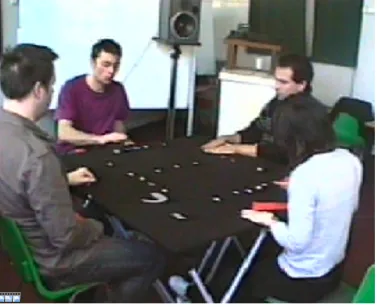
Figure 3 The First Ouija board in use 82
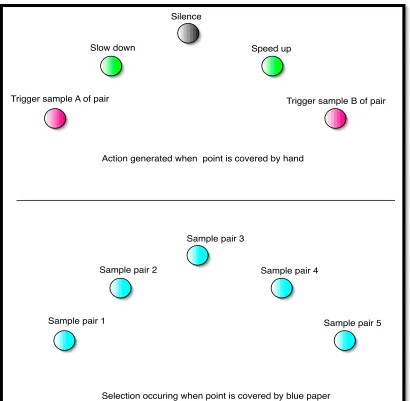
Figure 4 The Ouija points of an individual performer: a detailed view of the two functions of
the points in front of each player. 84
Figure 5 The Latest Ouija board showing the shadows of the performer’s hands. 90 Figure 6 Ouija Players Kirsten Edwards and Peter Coyte with the author in the foreground. 95 Figure 7: The performance layout for lipsync 124 Figure 8: Photo illustrating the position of the lip microphone, indicated by the arrow. 125 Figure 9: Principal chords used in Lipsync 127 Figure 10 Transcript of messages generated during 10 seconds of performance of 'Lipsync' 137 Figure 11 The interior of behaviour 13, showing the reception, routing, transformation and
generation of messages. 139
Figure 12 The matrix used in Lipsync to represent the signal network. 140 Figure 13 Part of the ‘Performance timing control’ screen for Lipsync 142 Figure 14 Some of the messages generated in the Continuation phase of the fifth section. 143 Figure 15 Part of a screen from the Ouija software showing the mapping of Ouija points to
synthesis modules. 145
Acknowledgements
There are many people that I wish to thank for the their help, support and perseverance while I brought this work to a conclusion.
My first thanks go to my partner Jo, who managed to put up with me and the inevitable moments of near insanity, and to our children Isaac and Sarah who have grown and thrived despite having a father in the grip of a PhD.
I would also like to express my deep appreciation to colleagues in the Automatic Writing Circle: Peter Coyte, Kirsten Edwards, Stephen Preston and Seth Ayyaz. Their friendship and musicality has been a source of unfailing pleasure and inspiration. In this group I would also like to include Taina Riikonen, whose generosity and insight have been invaluable.
I am very grateful to my initial supervisors, Simon Emmerson and Laurie Radford, who opened up so many vistas in my research, and to my final supervisor Denis Smalley, for his longstanding and consistent support over the duration of this work.
There are many other people whose encouragement and belief has helped me enormously, among them I would particularly like to mention Roger Lippin, whose awareness of the psychological terrain touched on by the thesis has been hugely beneficial. My colleagues in the Sound Art department at the London College of Communication—Salomé Voegelin, Chris Petter, Peter Cusack, John Wynne, Cathy Lane, David Toop and Angus Carlyle—have created an intellectually stimulating environment that both drew me into new areas and provided a context in which I could test my ideas.
Declaration
I grant powers of discretion to the University Librarian to allow this thesis to be copied in whole or in part without further reference to me. This permission covers only single copies made for study purposes, subject to normal conditions of
acknowledgement.
Abstract
The effect of electronically mediated sound on group musical
interaction: A case study of the practice and development of the Automatic Writing Circle
The interaction between musicians has been one of the traditional strengths of music: it stretches to include an audience and ritual participants but has its origins in group activity, the interpersonal responses of one musician to another. This thesis examines the way that electronic media have transformed the
interactions between musicians, particularly in the context of live performance. A central theme is the way in which mediatisation creates new splits within
previously integrated musical situations and also merges differences usually defined by physical boundaries.
The theories of Gregory Bateson on schizophrenia and Irving Goffman on Situationism are brought together to create a new understanding of the term ‘schizophonia’. This rehabilitated concept is proposed as the key to a creative exploration of new situations and discontinuities which make up group
performance in a mediatised environment.
In practical terms the exploration of new musical situations is documented in the following projects: the material created for the group ‘Automatic Writing Circle’ during its evolution over a period of six years (compositions, software, instruments), development of the Ouija Board (see below) and accompanying software, composition of the piece Lipsync (see below) and the earlier piece I slept by numbers for flute and live electronics.
The Ouija board
This is a new form of group musical instrument. Based on the real-time video analysis of shadows cast by the hands of performers, it reframes many of the conventions of traditional, tactile instrumental engagement.
It allows the relationship between sound material from loudspeakers
(location recordings, processed live sound, synthesised sounds, acousmatic pieces) and the embodied act of performance to be investigated more deeply. The tactile quality of traditional acoustic instruments is in contrast to this remote, shadowy form of engagement. It is a negative instrument, between two worlds, casting a human shadow on the acousmatic curtain.
series of works, some of which are discussed in detail in the following thesis.
Phase one: Networked ensemble. This resulted in two pieces, “North South East West” and “St Pancras Sound” (2005), in which sound and gesture
information are shared amongst a group of musicians using networking protocols.
Phase two: The design of the first group interactive instrument (called the ‘Ouija’) produced the work “Mary Ward in October” (2006). The initial
principles for this instrument were arrived at by replacing Schaeffer’s notion of the ‘objet sonore’ with that of a ‘relation sociale’.
Phase three: Initial research into links between acoustic instrumental performance and the electronically mediated Ouija board focussed on ideas of entrainment. This lead to further refinements of the Ouija instrument, to the work “Thames Wire” (2007) and to collaboration with the instrumental group ‘Ecosonic Ensemble’.
Phase four: A breakthrough in the design of the Ouija board (the use of shadow and its link to the dynamic contours of entrainment) lead to further changes in the relationship between performers, programming structures and performance, and resulted in the works ‘I see an A’ and ‘City Environment’ (2008).
Phase five: Charts the latest period of the Automatic Writing Circle (a merging of the Ecosonic ensemble and Ouija board players). The two works in this period,” Extended Silence” and “Die Alte Schmiede” (2009), demonstrate many of the changes in the relationships between players that stemmed from the breakthrough above. These include changes in the use of discourse within the group, changes in the relationship between rehearsal and performance, changes in the concept of improvisation and further changes in the instrument itself.
Compositions:
Lipsync: Piece for cellist, lips, and 6 channel live electronics. 14’00 Heine’s poem “Der Tod, das ist die kühle Nacht,” is spoken by the cellist while he/she plays. The divided body of the performer, one part speaking the other part playing, is the starting image. Various levels of synchronisation are explored: between action and speech, poetic idea and sonic image, acousmatic sound and live processing. These elements are linked by the romantic conceit that death is a heightened and transcendent state.
I slept by numbers: for flute and gestural performer (using touch sensors). 15’00
The piece employs two human performers (a flautist and a gestural
Introduction
An exploration of the ways in which relationships between musicians are changed by electroacoustic media
John Cage proposed a relationship between the sounds from new media and the sounds coming from earlier forms of music making:
As I see it, tape has brought about, in a very tangible way, a profound alteration of musical action, the consequences of which are not limited alone to tape but will affect all music, no matter how traditional the instrumentation. (Kostelanetz
1974:129)
Cage suggests that in some subtle but pervasive way our sense of all musical acts has undergone a sea change, brought about by the introduction of tape. Cage’s comment has a McLuhan-like ring to it. The sense of global change in musical action is a mirror of McLuhan’s sense of the global change in society brought about by the new media. As McLuhan suggested, it is not the content of the message that is most significant but the medium itself—‘The Medium is the Message’ (McLuhan, 2008, pp. 5).
My own particular interest has been in the way that new media have transformed the interactions of musicians, particularly in the context of live performance. These interactions include those which occur between acoustic musicians as well as those that occur between musicians using electronic sound. They include changes in the communicational environment which may be systemic, at an almost environmental level, as well as changes which are much more specific and can be utilised in a deliberate way.
It is this second area, of specific changes to the relationship between musicians, which has been a special focus. As a practising cellist, and also as an erstwhile professional computer programmer, I have been keen to explore the ways that these two forms of activity affect each other, and to develop an
patterns of connection between people (not between aspects of one person) that are the principal area of change.
The exploration of this area has been conducted in two related ways. The first is practice-based, working intensely with a group of musicians over a period of years, the ‘automatic writing circle’, and designing a new instrument, the ‘Ouija Board’ which integrates acoustic and electroacoustic performance. The second kind of exploration has been through the critical appraisal of various theoretical frameworks in which this work can be situated.
The practice based part of the work brings to the foreground the detailed experience of the contact between musicians using traditional instruments and the mediatised Ouija board. These experiences and their qualities can be overflowing and multidimensional, and therefore hard to analyse. However, the physicality and relative permanence of the Ouija instrument acts to underpin many of the
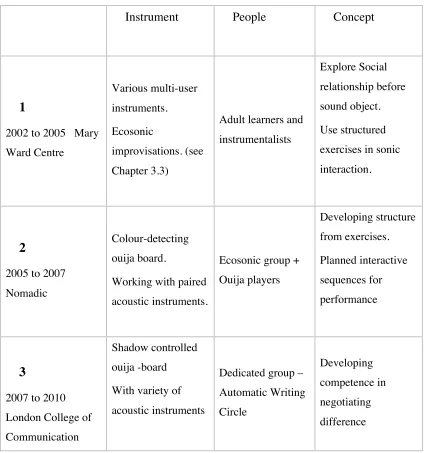
evanescent experiences, and give the associated ideas resolution and direction. As a consequence, this dissertation is able to chart the evolution of ideas associated with the instrument, and discuss the way in which changes impacted on the musical relationships between the performers. Four phases in the evolution of the instrument are examined, showing the breakthroughs and realisations that helped move the project from one phase to the next.
The second, more theoretical, strand elaborates a framework for analysing the way in which musical relationships are changed by electronic media. It draws first on the work of Gregory Bateson (2000), showing the way that our
understanding of a situation is influenced by the communicational context, involving the interpretation and resolution of the clashes between different levels of communication such as iconic (embodied, gestural) and symbolic (linguistic, textual). The initial study of Bateson’s ideas is then expanded to include
mediatised communication, referencing work by Goffman (1974, 1981), and Meyrowitz (1986) and includes a broad consideration of the discontinuities introduced by sound recording. This has a clear significance for the kind of musical performance that I am considering, as the social space of live interaction (the actual spaces and relationships in the room, hall) is transformed by the mediatised connections which are woven into it.
another.
Another category of mutual influence can be seen in the relation between verbal discussion and sonic improvisation in the workings of the Automatic Writing Circle (AWC)1. The dialogue in the AWC includes a meta-discourse
about the relationship of theoretical propositions to the actual embodied practice of making sound together. The group becomes a place in which the relevance or significance of theories (or theory in general) can be tested.
Also, in reverse, the musical improvisations of the AWC lead almost inevitably to discussion, often manifested as discussions about what was
significant or interesting in an improvisation. Awareness of the use and function of individual judgement, verbalised or not, has presented itself as a powerful tool in shaping our improvisational experience.
Between the theoretical and the practical there is also a huge conflict. The details of practice cry out to be theorised in different ways, and not to be cajoled and moulded into certain patterns. The practical experience can overwhelm and change the direction of any theoretical construct, and the rich anecdotal quality of experience demonstrates how many potentially important avenues are untapped.
I have attempted to give both the practical and theoretical sides of this equation adequate room in this dissertation, allowing phases of description and practical observation to have space, without the insistence that every observation should be recuperated into theory. Sometimes this observational narrative, tracing the evolution of the work, will show the intuitive connection between different areas even where this has not been explicitly drawn attention to. However, alongside this practical narrative is a theoretical framework, and the theoretical structure provides a way of highlighting those issues in the practical work which I consider to be most significant.
The layout of the thesis is as follows:
Section 1 – definition of the main theories
The first section examines the work of Bateson, particularly his theories on schizophrenia and the Double Bind. It also discusses the work of Goffman, and shows how Meyrowitz’s inclusion of medium theory gives a framework for understanding some of the transformations in the situation of live performers with
1 This is the group to which the author belongs and which explores musical interaction using
electronics.
Section 2 – overview of the main areas of investigation
Five chapters set out the more detailed terrain in which the research occurred—instrumental performance, live electronics, soundscape and musique concrète. They relate these areas to the theory of schizophrenia outlined by Bateson and provide a mid-range mapping between the many particular details of practice-based work and the more abstract implications of theory.
Chapter one looks at ways in which acoustic instrumental performers exploit the difference between the sound produced directly by their instrument and the sound as it is modified by the surrounding acoustic space. Chapters two and three investigate the types of merging and splitting that occur in instrumental identity when mediated by live electronics, whilst chapter four traces the changing identity of a notional ‘sound recordist’ incarnated first as Pierre Schaeffer then as Murray Schafer. The final chapter proposes a rehabilitation of schizophonia.
Section 3 – Practice-based research
Six chapters give a detailed account of the evolution of the Automatic Writing Circle, the Ouija board and its relationship to performers.
Section One
1. Definition of the main theories: Patterns which Connect and Patterns of Access.
In this chapter I will outline two related areas of theory which provide a framework for considering the complex interactions that occur in live electronic music. These can best be described as ‘patterns which connect’ and ‘patterns of access’. The two areas can be considered as complementary, one dealing with the extension of communicative interaction and the other with its necessary
constraints.
The first, which concerns the extended interrelationship of communicative patterns, is derived from the work of Gregory Bateson. It focuses on the study of the richly interrelated levels of communication which exist in any living
environment, for example in an ecology, a society, or in a family. The second, derived principally from the work of Irving Goffman and Joshua Meyrowitz, focuses on the significance of the separation which exists between different
communicative environments, which is conceived initially in terms of the physical barriers to perception that exist between one social situation and another.
Of particular importance in both areas is the way in which they suggest a link between the perceptions of the individual and the communicational environment of the group. The negotiations of difference, both in terms of the medium of communication and the politics of social interaction is central to the later
description of processes which have occurred in the Automatic Writing Circle and to an analysis of the effects of electroacoustic sound on group interaction.
1.1 Bateson and the analysis of communicational frames.
Historically located in the 1960s and 70s, Gregory Bateson’s theories represent a high point in the critical integration of research into perception and communication. His distinctive way of thinking about the relationship between them led to the formation of a well articulated epistemology.
Weakland, Jackson, and Watzlawick, the Milan school of Palazzoli) and in artificial intelligence (Maturana 1987). In musical research his work is reflected most directly in the new fields of bio-musicology (Cross 2003) and evolutionary musicology. Chris Small’s influential book ‘Musicking’ (1998) uses some of his ideas as a base.
This thesis will itself draw on and extend certain lines of his work. Of particular relevance is Bateson’s notion of framing, and the description of the kinds of frame within which communication takes place. Bateson’s external
‘frame’ has a clear connection with Wittgenstein and his proposition that language creates the limit and frame for knowledge. But Bateson’s theory has a more
biological basis, in that communication is not formed out of language games alone, but develops from biological and social relationships. 2 A deepening of
Bateson’s theory occurred in the analysis of schizophrenic communication in the ‘Double Bind’, and this will be discussed shortly. However, before this, a more detailed description of the origin of his theories of communication will be in order.
1.1.1 The immanent frame of ‘evolution plus environment’
The primary scientific place in which this biological frame is articulated is the theory of evolution, which Bateson reinterpreted as the survival of the
individual plus the environment. It is not necessary to explore this in depth, only to suggest that the theory of evolution provides a rich environment in which to discuss theories of mind and of interpersonal interaction.
Bateson cites Lamarck (Bateson 1973: 403), a pre Darwinian theorist of evolution, as the first to devote an entire work of evolutionary theory to ideas about the evolution of mind. Bateson considered this valuable because it reversed the hierarchy in which mind had been seen, no longer placed on a ladder that descended from the supreme mind of God down to man and onward down to the smallest creatures. Lamarck, and later Darwin, suggesting instead that the biological world may be the explanation of mind, rather than the product of it. In short, mind can be seen as a product of the evolutionary plus environmental system, and not a separate transcendental entity.
2
In a similar way Bateson’s theory of communication begins by examining the types of message that animals can exchange based on their mutual context in the environment, and works up through higher levels which exist by virtue of learned but changeable social and linguistic frames.
1.1.2 Iconic Communication
The essay “Redundancy and Coding” (Bateson 1973) is a discussion of evolutionary and other relations between the communication systems of man and other animals. It begins by observing that there is a distinction between the kinesic and paralinguistic form of communication used by animals (and humans), and the verbal language used by humans alone. The difference consists particularly in the nature of the ‘frame’ which makes the communications intelligible.
The way in which animals communicate with each other is through an ‘embodied metaphor’. A dog threatens you with its bare fangs, which would be the objects used in a real attack. A cat wishing to be fed acts out its dependency on you, meowing and twisting around your feet. A bird indicating that there is a general threat acts as if it was personal, making angry and attacking gestures. These kinds of communication can be called iconic, in that the message material stands as an icon for the thing that it refers to. They work in a ‘part for whole’ way, in which a part of the phenomenon or sequence is used and taken as an icon for the whole. Thus, exposed fang stands for attack, dependency stands for ‘feed me’, ‘I am angry’ stands for ‘look out there is a threat around’.
Several things can be said about this state of communication:
• The individual giving the message is always part of it, is always a subject in the message.
• The message always refers to the relationship between the giver and the receiver. There is no possibility of referring to relationships of which the subject is not a part.
• Intensities and magnitudes in the action relate to intensities and magnitudes in the thing referred to.
• The communication is a proposition not an assertion, and it always refers to the here and now, not something far away in place or time.
revealed in slips of the tongue or unconscious, inadvertent actions. The
communications which come from paralinguistic or kinesic actions are hard to falsify. If you love, hate, or respect someone it will be most quickly revealed in this kind of communication, and conscious goals will not easily distort it. The fact that verbal language has not made paralinguistic and kinesic communication obsolete in human communication can be seen as an indication of the fact that they serve complementary purposes. The kind of here-and-now communication of relationship enabled by use of the body (founded on the shared evolution in a common environment) saves linguistic communication from having to take on that burden.
1.1.3 Linguistic communication
Linguistic communication suggests that a message can be placed in something other than the ‘I – you’ interactional pattern, and in order to do this there needs to be a way of framing the context of the communication so that it can be understood. Because the communication no longer derives meaning from the embodiment of the individual emitter, there needs to be a way of creating a ‘virtual context’, something that says ‘this is a map’ and ‘this is the way that the elements on it are to be related to a territory’.
One could say that language allows communication to occupy a mobile, displaceable context. Linguistic communication can detach itself from its
grounding in iconic, self-referencing contexts, and move into a world of symbolic reference. A shift has occurred in which ‘self-reference’ no longer refers to an individual biologically-embodied speaker referring to herself3 in her environment,
but to the language system referring back into itself. The system of signs which make up language becomes the ‘self’ to which reference has to be made. This leads to the distinct features of linguistic expression which differentiate it from iconic communication. Some of these features are listed below:
• The ability to refer to events and places which are remote in time or in place.
• The ability to refer to situations which are not centred on the self.
3 In order to avoid singular/plural mismatches of the type ‘the speaker referring to themselves in
• The ability to make indicative assertions (statements which assert their own truth).
• The ‘digital’ nature of the word symbol, which needs no proportional or qualitative relation to the object it refers to i.e. the word ‘loud’ does not need to be spoken loudly, the word ‘hot’ has no need to radiate more heat than the word ‘cold’.
Whilst it is easy to give a list of features of linguistic communication, and to distinguish them from the features of iconic communication, there exist very deep questions about the actual way language achieves this separation, and the way language succeeds in pointing to or referring to things.
1.1.4 Self as icon and linguistic self
Particularly paradoxical is the status of the ‘icon’ in language. In the
embodied communication that we have been calling ‘iconic’, the actual bodily self of the organism is presented as part of the communication. In evolving the ability to use language there is the suggestion of some kind of transformation of this ‘self’ icon, a suggestion that linguistic competence evolves out of a re-framing of the self.
Lacan (1993) has famously proposed a theory of how children move to embrace the ‘symbolic order’ of language. He suggests that a child facing the Oedipal conflict (the impossibility of possessing the parent of the opposite sex) engages with the symbolic order of language as a way of resolving the conflict, of incorporating the ‘other’ in a symbolic sense. The symbolic order allows the desired parent to feature in a symbolic form alongside the symbolic representation of the self. Thus the relationship can be internalised and the loss overcome.
In another theory Pines (1995) describes the process by which the child and mother construct a pseudo-conversation. From the start, mother and child
participate in social interaction and use turn-taking dyadic exchanges to pattern their communication. The rhythm of these pre-verbal exchanges is shaped by sensitivity and reciprocal awareness. (It has been noted that depressed or insecure mothers tend to impose a false rhythm on the exchanges.) They form a basis from which the child can build a concept of self inside a proto-linguistic exchange. The acknowledgement of the self by the other in conversation allows the basic building blocks of self-representation, object representation and a linking effect to be
The two theories of Lacan and Pines propose different ways of negotiating the separation between the body used as an icon in communication, and the symbolic icon used in language. The dimensions of this separation can be seen in many other ways too: it is, for example, an area of critical interest in the analysis of the separation between a musician and the sound produced, which is the subject of the later part of this thesis. Bateson proposed a distinction based on the meta-linguistic hierarchy of language and the meta-communicational hierarchy of iconic communication.
1.1.5 The meta-‐communicational hierarchy and the meta-‐linguistic hierarchy
The methods by which a sentence points to a subject are always affected by a process of remote reference, relying on a meta-linguistic structure.
A message, of whatever kind, does not consist of those objects which it denotes. (‘The word ‘cat’ cannot scratch us’). Rather, language bears to the objects which it denotes a relationship comparable to that which a map bears to a
territory. Denotative communication as it occurs at the human level is only possible after the evolution of a complex set of metalinguistic (but not verbalised) rules which govern how words and sentences shall be related to objects and events. (Bateson 1973 :153)
Certain kinds of meta-linguistic code may be picked apart in semiotic (Nattiez 1990) or structural (Chomsky 1988) analysis, but these analyses
themselves depend on unspoken codes of how they relate to the territory, adding a further level. This spiral can go on forever. The separation of the ‘deep rules’ from the surface structure which Chomsky aimed for in structural linguistics is an attempt to avoid this paradox and to reserve a place for the ‘deep rules’ in a universal space.
Another version of this recursive experience can be encountered in any conversation since there will always be a meta-communicational dimension to it. Thus, whatever the supposed subject of a conversation, it may also be considered to be about the actual relationship between the people. An apparently simple statement such as “Those bunches of flowers look nice” could, because of its timing and context, be interpreted by the other person as suggesting the start of courtship, or as a reproach for not bringing flowers.
Any particular act of communication will consist of multiple layers,
example, in the way that one statement can frame and contextualise another (“we love each other”… “said Bush to Bin Laden”…“in the film I saw last night”…“or wished I had”). But they exist equally in the non-linguistic aspects of a
communication. For example, in conversation, if somebody changes the subject, pauses, interrupts, leans forward, talks faster – these changes in the pattern of the conversation all act to create contexts for what is being communicated, and to modify the meaning of the communication.
The rupture between iconic and linguistic communication can be seen as the first in a series of separations that can occur in language, each one representing a context that supplements the other. An essential quality of this is that one message can be changed in its meaning by placing it inside a new context.
A comparatively surprising consequence is that this state of affairs defies the usual presumptions of objective enquiry. To study an object or process it is
necessary for the object to be separated from its larger environment. However, it appears that in the world of communication, the larger environment will always be available to transform the meaning of the smaller one – the part is always defined in relation to the whole.
Some of the particular consequences of this for the experience of the individual were studied by Bateson in his work on the Double Bind (Bateson 1973). Later, this study was elaborated in a far-reaching thesis on the nature of communication.
1.1.6 The Double Bind
The Double Bind (Bateson 1973) is the study of schizophrenia in a family. In particular, it marks the way that stark conflicts between levels of communication employed by the parents can create mental illness in the children. Bateson
proposed that, in the case of a schizophrenic, the communication patterns of the family can be seen to have created the schizophrenia; that the mental illness of the individual was placed in the individual by the communicational environment that they are in, and by their inability to question, change or frame the context.
He looks at the situation from two viewpoints, that of the individual schizophrenic patient, and that of the relationship between the patient and their family. From the point of view of the patient, the problem can be described as the lack of a strong sense of self or ego:
communicational mode to the messages he receives from other persons. (b) He has difficulty in assigning the correct
communicational mode to those messages which he himself utters or emits non-verbally. (c) He has difficulty in assigning the correct communication mode to his own thoughts,
sensations and percepts. (Bateson 1973 – Towards a Theory of Schizophrenia p.173)
The particular kind of communication featured in schizophrenia is the use of unlabeled metaphors. A speaker will avoid referring to any relationship, implicit or explicit, between himself and the person he is addressing, and he will avoid indicating whether the message is intended ironically, literally, as a joke or as a metaphor.
Bateson proposed that this manner of structuring dialogue came about as the result of a particular learning process which occurred within the family and which he labelled the ‘double bind’: a situation in which the patient or ‘victim’ is forced to misunderstand or ignore those aspects of a communication which serve as markers of context. Symptoms are caused by ‘the experience of being punished precisely for being right in one’s own view of a context’ (Bateson 1973 : 206). Bateson gives many examples, and they usually concern the mother of the patient, although he stresses that the events occur in conjunction with other members of the family.
He gives the example of a mother who is, for whatever reasons, unable to tolerate intimacy with her child and is, in addition, unwilling or unable to
acknowledge this feeling. The child is lonely and desires affection, and approaches the mother. The mother, wishing to avoid intimacy, suggests in a caring way that the child is tired and should go for a nap, even though the child is not tired. If the child follows her instructions and goes for a nap this will have the double
advantage for the mother of firstly making the child go away, and secondly satisfying her own need to feel that she had been caring.
To be close to the parent, he must sacrifice his right to indicate that he sees any meta-communicative incongruencies, even where his perception of these incongruencies is correct… The patient may know but must not tell, and thereby enables the parent to not know what he or she is doing. The patient is an accomplice in the parent’s unconscious hypocrisy. (Bateson 1973 :208)
The analysis of the Double Bind, and the many situations in which it occurs, gave Bateson a very clear picture of the mechanisms which are at work in the communicative relations between people. Particularly important was his
recognition of the way that the larger family system works to create the state of the individual within it. This observation lead Bateson and his co-workers Jackson, Haley and Weakland to develop the school of family therapy in which therapists engage with the communication systems in the family. The therapist acts to facilitate the discovery of new patterns of communication which restore the potential for individual growth and learning.
1.1.7 Summary
Thus far, this chapter has given an overview of Bateson’s theories of
communication, showing the importance of the frame in which the communication is judged to have taken place. In complex human interactions the frame includes elements of both iconic and linguistic communication. Becoming adept in the interpretation of communicational frames is a social skill of considerable
complexity, and one which begins in the earliest stages of childhood. The earliest learning about communicational frames begins in the family, and is powerfully influenced by systemic qualities of the communications within the family.
Bateson’s analysis of schizophrenia is particularly interesting because it allows a shift in perspective from the state of the individual to the state to the communicational environment of the group. Bateson argued that the patient’s inability to judge the context of communications is a consequence of the family’s deliberate and repeated misalignment of communicational levels, with the verbal level being used to subvert the message of the iconic level.
feature shaping the inner quality of musical experience, both at an individual and a group level.
1.2 Extensions to Bateson’s analysis
Bateson’s analysis of communicative levels provides a good starting point from which to consider the functioning of musical entrainment, and the links between physical and verbal communication. However, for my own work there is a limitation in that Bateson does not suggest any explicit ways in which the use of mediatised communication changes the quality or framework of entrainment.
For a useful and provocative extension of Bateson’s ideas into this realm, I will refer briefly to the work of Joshua Meyrowitz, particularly the arguments expressed in his book ‘No Sense of Place’ (1986) which offers an enlargement of Bateson’s ideas. In this book he gives an analysis of the ways in which the place-bound definition of a social situation is changed by the presence of mediatised environment. His analysis takes place in three major leaps.
The first is in the use of Erving Goffman’s situationist theories, which develop Bateson’s concepts of social framing (exhibited in the Double Bind theory and in his work with Systemic Family Therapy) into the analysis of ‘every-day’ social situations. Thus, rather than focussing on the pathology of misaligned communications (although he was a leader in the anti-psychiatry movement) Goffman looks at the complexities which occur in familiar social situations, and the ways in which the definition of a particular situation maintains itself.
The second leap involves a reworking of Goffman’s concepts so that the scene of these every-day encounters is no longer defined by the physical location of the encounter but by the social information that is available, thus making it possible to include electronically mediated communication.
The third leap looks at the way that the social information provided through electronic media redefines situations and leads to new kinds of behaviour. It draws on the media theories of Marshall McLuhan and applies these to the detailed analysis of situations.
For the remainder of this chapter I shall spell out more explicitly the way in which Meyrowitz takes up the work of Goffman and McLuhan.
1.2.1 Goffman : Situations containing Front and Back regions.
Like Bateson, Goffman makes great use of the distinction between iconic and linguistic communication. This is extrapolated in several ways, one of the most important of which is the distinction between information which is an
intended part of a communication and information which is hidden or inadvertent. This distinction is characteristic of the social performance of both individuals and of groups4. At the group level Goffman introduces some new terms to describe the
difference between intended and hidden information, and it is these that
Meyrowitz makes great use of, in particular, the distinction between Front and Back regions.
In his analysis of group identity Goffman describes the separation between consciously expressed and hidden information in terms of a front and back region, two distinct and separate physical places. Front regions are those places in which a social group is exposed to a public, and back regions are those in which the group is sheltered from the gaze or overhearing of an audience.
The ‘front’ is where the publically defined activities take place – i.e. classrooms for teaching, operating theatres and wards in hospitals, stages in theatres, court rooms in law etc. But these regions are complemented by regions with restricted access in which those whose performance is central to the situation are able to segregate themselves from their audience. Behaviour in the front and back regions will be different, precisely because in the back region there is freedom from the scrutiny of an audience.
Goffman describes a region as
any place that is bounded to some degree by barriers to perception. Regions vary, of course, in the degree to which they are bounded and according to the media of communication in which the barriers to perception occur. Thus, thick glass panels, such as are found in broadcasting control rooms, can isolate a
4 For example, when discussing personal communication Goffman makes the distinction between information which is ‘given’ and information which is ‘given off’. The expressions which the performer ‘gives’ are the intentional, primarily verbal symbols concerned with the communication of a narrow set of information. The expressions which the performer ‘gives off’ are primarily non-verbal, contextual and apparently unintentional (even though such communication can be
region aurally but not visually, while an office bounded by beaverboard partitions is closed off in the opposite way. (1959: 109)
For Goffman, the front region was an area in which the group would
maintain certain standards, defined as politeness and decorum, which suggest how an audience is handled and a sense of what is morally approved of. These
standards will be different in different situations, for example in a factory or office it is considered important to make a display of continuous alertness and work, whilst in a church, where the standards may be expected to be more severe, it is quite acceptable to daydream.
The back region Goffman defines as “a place, relative to a given
performance, where the impression fostered by the performance is knowingly contradicted as a matter of course” (ibid:114). The general sense of the back region is that it is an area in which the techniques, tricks and accessories of the performance may be openly revealed, and that it allows a regression from the standards of the front region. It also allows the group to display a less united front and discuss the shortcomings of members of the group, for example, how the ‘expressively inept can be schooled or dropped from the performance’ (ibid: 115).
Because people in a back region are able to depart from their public
character and also because secrets which sustain the performance are hidden there, it is particularly important for the back region to be kept separate from the
audience. The access to this region, treated as a physically separate space, is constrained by walls doors and corridors.
Goffman was interested in the some of the difficulties of protecting and defining this boundary, looking at various places in which the boundary is ill-defined. Most of the examples are of finely observed social discomfort caused by a permeability between the regions, for example in the front rooms of Scottish Crofters when welcoming strangers, or the forecourt of a petrol station which also has a garage for repairs, in bedrooms sharing thin party walls with neighbouring flats, or in the movements between kitchen and restaurant performed by waiters. Amongst these he also mentions the particular case of radio and television broadcasting
being maintained on the air. For technical reasons, then, the walls that broadcasters have to hide behind can be very treacherous, tending to fall at the flick of a switch or a turn of the camera. Broadcasting artists must live with this staging contingency (ibid :121)
These examples give a picture of the importance which the segregation of regions has in presenting a particular situation. The ability to restrict access to a back region is instrumental in allowing the front region to retain its prime role in defining the situation. As the example above shows, if a microphone is
inadvertently left live, if walls are too thin, if the ‘barriers to perception’ are not sufficiently strong, then back region behaviours may become public and
undermine the intended definition of the situation.
Whilst most of Goffman’s examples discuss the separation between regions as physical separations, based on place, this last example makes it clear that the separation does not have to be a physical one, but can be concerned with the pattern of information flow in more general sense. It is this aspect which is central to Meyrowitz’s thesis.
1.2.2 Patterns of Access – Mediatised communication
Meyrowitz’s argument is that one may substitute the place-based definition of a social situation with one that instead treats it as a pattern of ‘social
information’5. Since electronic media have the capacity to present much of this
social information, via sound and image, without the need for direct physical presence, this allows one to consider mediatised situations as an extension of place-based ones. The essence of both is that the regions in any situation are
defined by ‘barriers to perception’, whether this is maintained by a physical barrier like a wall, or by an electronic barrier like a routing or a switch.
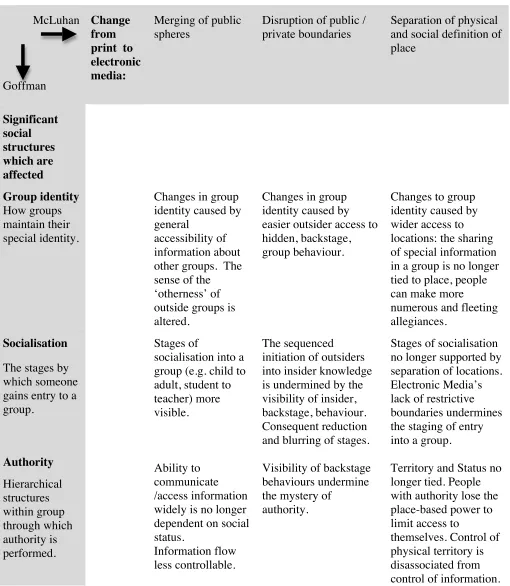
The diagram below offers a convenient way of visualising the overall relationship of elements in Meyrowitz’s argument (although it should be noted that Meyrowitz does not use such a diagram himself). The horizontal axis,
illustrating changes brought about by the movement from print based to electronic communication, is derived from the media theories of Marshal McLuhan, whilst
5 Social information is understood as the kind of information available when in the presence of
Table 1 showing a summary of Meyrowitz’s principal arguments
McLuhan
Goffman
Change from print to electronic media:
Merging of public spheres
Disruption of public / private boundaries
Separation of physical and social definition of place Significant social structures which are affected Group identity How groups maintain their special identity.
Changes in group identity caused by general
accessibility of information about other groups. The sense of the ‘otherness’ of outside groups is altered.
Changes in group identity caused by easier outsider access to hidden, backstage, group behaviour.
Changes to group identity caused by wider access to locations: the sharing of special information in a group is no longer tied to place, people can make more
numerous and fleeting allegiances.
Socialisation
The stages by which someone gains entry to a group.
Stages of
socialisation into a group (e.g. child to adult, student to teacher) more visible.
The sequenced initiation of outsiders into insider knowledge is undermined by the visibility of insider, backstage, behaviour. Consequent reduction and blurring of stages.
Stages of socialisation no longer supported by separation of locations. Electronic Media’s lack of restrictive boundaries undermines the staging of entry into a group.
Authority Hierarchical structures within group through which authority is performed. Ability to communicate /access information widely is no longer dependent on social status.
Information flow less controllable.
Visibility of backstage behaviours undermine the mystery of
authority.
Territory and Status no longer tied. People with authority lose the place-based power to limit access to
Meyrowitz draws on McLuhan’s earlier work to examine the shift from printed to electronic media. By comparing the characteristics of these two generations of media McLuhan created a position from which to observe
contemporary social conditions. He believed that the change from one medium to the other resulted in a fundamental alteration in our perceptual habits; a
consequence of a decline, after many hundreds of years, in the dominance of printed media. The sense of rapid change in human perception is in contrast with the much longer evolutionary timescale which underpins the social situations explored by Goffman. As with Bateson, with whom he worked and exchanged many ideas, Goffman was interested in the relationships between people expressed primarily through their spoken and physical behaviours, a focus in which
mediatised interaction is secondary.
Understanding the difference between these two viewpoints is critical in my own research. The question of how electronically mediated sound impacts on historically, even biologically, determined musical experience is a profound one6,
sharing many underlying conditions with the views described above. The way in which Meyrowitz constructs a framework for integrating these perspectives is of significance here, providing a useful initial model for the interactions of the Automatic Writing Circle. The following section explores the discourse as it relates to the relationship between the sound making of traditional acoustic musicians and electronic mediation.
6 Some recent strands of musicology, (evolutionary musicology and biomusicology), give
prominence to the search for the evolutionary roots of music. The research sees music as an innate and universal genetic gift with a deep evolutionary basis, equivalent in significance to the
Section Two
Effects of mediatisation on sonic experience: theories of merging and splitting.
The chapters in this section follow a trajectory which begins with acoustic instrumental performance and ends with a discussion of electronic sound-making. The object of this journey is firstly to explore potential relationships between acoustic and electronic sound, and secondly to discuss the kinds of creative split that already exist within these areas. My argument is not for a single theme of unification: rather, it is to show that the negotiation of splits and separations is an important part of the way that identity is constructed. Thus the analysis follows the main ideas of the previous section, which examined schizophrenic splitting in Bateson’s double bind theory, and the everyday splitting of Goffman’s situationist model.
An exploration of the themes of splitting and exposure are brought into play in several different areas; instrumental performance, amplified performance, live electronics, acousmatic composition, soundscape composition and sound
installations.
2.1 Performance: Intimate and Distant simultaneously.
We begin the movement between the genres mentioned above with an
examination of the way that a performing musician is placed within sound, both as producer and listener. The reflexive relationship created by the acoustic performer between the production of sound and its return from the environment provides the starting point for an examination of some of the changes that occur when
electronic mediation is brought into the process.
The potential for seeing the performing musician in a central position, recovering a balance distorted by electronic production, has been articulated by Murray Schafer in evangelical terms. In The Soundscape (1994) Schafer suggests that the highly immersive experience of listening with headphones may direct the listener towards a new integrity with himself, but “only when he releases the experience by pronouncing the sacred Om or singing the Hallelujah Chorus or even the “Star Spangled Banner” does he take his place again with humanity” (Schafer 1994: 119).
for example, sound offers a more immediate experience of multiple perspectives. Barry Blesser describes the activity of sound making as a kind of aural
illumination of the space and compares this relationship to the space with one based on vision, where
… because human beings do not possess an intrinsic means for generating light, a space does not react to our visual
presence, which manifests itself there only through interrupted or reflected light – as shadows or mirror images. (Blesser 2007 : 16)
Blesser makes the point that humans do not create the light with which they see, but they can create the sound by which they hear. The person making sound is “immersed in the space’s aural response. By responding to human presence, aural architecture is dynamic, reactive, and enveloping ”. (ibid)
I believe that acoustic musicians develop ways of dealing with the most extreme version of this simultaneous experience: the immediate source of the sound is within the body (generated by muscular action and, in the case of singing, interior vibration), but this is heard at the same time as the return from the outside environment, conditioned by the physical space and stylistic norms. The way that these two types of experience are combined into the semblance of a coherent whole is a complex process, dependent on multiple social and psychological factors as well as physical criteria.
In his analysis of the cognitive and social aspects of our sonic perception Blesser identifies one of the sources of complexity as the mix between an allocentric and an egocentric way of perceiving space:
Because an allocentric framework situates you within a fixed external environment, philosophically, it implies that reality exists apart from your self. In contrast, an egocentric framework situates your self at the center of an experiential universe where everything is interpreted relative to you. A cognitive map of space can be egocentric, allocentric, or some combination of both. The choice of framework modifies the experience of space. (ibid: 50).
relationship
More sophisticated procedures include those developed by Nordoff and Robbins (summarized in Rider and Eagle
1986:231-2) and involve the therapist mimicking the spontaneous musical behaviors of autistic children in
synchrony with them. In their experience, once a child realized his behavior was being mirrored by the therapist, “there was almost universally a laugh, a smile, or some observed affective change which seemed to indicate the children were willing to enter into a more therapeutic relationship. (Clayton et al. 2004: 230)
The psychoanalyst and music therapist Edith Lecourt has discussed the psychodynamic aspect of this balance in her article “Le sonore et les limites de soi” (Lecourt 1983), and employs a particularly direct term for it: the ‘self-sound interval’. This symbolises the way in which the distance between the inner
sounding self and the outer sounding self is in constant fluctuation7, partly related
to environmental context, but more deeply related to a sense of sonic self acquired over time, and particularly within the social circle of early childhood.
In the context of music therapy the analysis of the acoustic space passes from an experimental or positivist position to a qualitative and humanistic one. Perhaps more than any other field, music therapy brings situational factors of musical experience into the frame. The focus is less on music as an object and more about a reflexive understanding of the situation in which the music making occurs. (Ruud 2008).
2.1.1 Vibrato: An example of culturally constructed difference between close and distant listening.
Having thus made some general observations illustrating the interrelation between an intimate and distant experience of sound, I would like to provide a more detailed example of one way in which an aspect of musical performance, vibrato, can create a culturally determined relationship between them.
The nuances of vibrato form part of the code musicians use to distinguish
7 While writing this part of the thesis I suffered from a blocked right ear, leading to an
extraordinary amplification of the interior sound of my voice and a reduction in reflections from the exterior. This upset in balance is disorientating, and leads to a strange feeling of being
between different stylistically framed gestures, for example between Baroque and Romantic performance practice. Use of vibrato in this context is partly based on differences between the sound as it is at the point of performance (close or inside the performers body) and the way that it behaves in the room, thus becoming a significant tool for marking the social distance that exists between a performer and audience in the wider acoustic field. (Leech-Wilkinson 2009)
Vibrato is produced by an oscillating pitch, the physical consequences of which are felt particularly in two areas – the resonating body of the instrument and the reverberation of the enclosing space (hall, room etc).
In the resonating body of the instrument the oscillation can excite and vary some of the upper partials of the tone, while keeping other parts of the timbre stable. The result depends on the size and rate of the vibrato, on the base pitch to which it descends and on the intensity of the energy put into the instrument. Vibrato can be used to relieve or spread the intensity of a forced and bright sound and to add shimmering and colourful layers to the upper partials of the timbre.
The effect in the surrounding space is equally important. In a certain
resonant acoustic the diffused sound will come to resemble a noise band, with the varying pitch material sounding simultaneously. As the reverberations arrive at slightly different times, it becomes impossible to track the oscillating pitch in its moment by moment position, and the overall range of positions are heard
simultaneously.
Between these two places, the close and the far, will be a number of
intermediate points, where the reverberation of the room will emphasise different aspects of the spectrum. The key is that both these attributes of the sound, the close and the distant, are audible simultaneously by the performer, and by most of the audience8. The sound that the musicians produce is not just created with close
proximity in mind, but also with its distant effect. Particularly, it is about the kind of meaning that is carried by the difference between these two positions. The significance of this can be deduced from changes in the use of vibrato in Baroque and Romantic performance practice.
In Baroque styles there is a greater use of lifted notes (notes where there is a silence after them), in which the resonance of the room can be heard, and much less use of vibrato. When the performer plays a sustained tone without vibrato
8 The only audience members who will be unable to hear the direct sound along with the
there is a higher degree of fusion between the direct sound of the player and the reverberation. The lifting of the tone, or the addition of a moment of vibrato then becomes a way of clarifying the separation of the performer from the enclosing acoustic.
In Romantic performance practice there is much greater use of vibrato. The performer can maintain a continuous production of vibrated sound and still remain separated acoustically from its effect in the performance space. The performer is able to saturate the space more completely, whilst still having a way of coding the difference between himself and the enclosing environment.
Murray Schafer has suggested that the “desire to dislocate sounds in time and space” has been part of a historical trend in Western music:
the introduction of dynamics, echo effects, the splitting of resources, the separation of soloist from the ensemble and the incorporation of instruments with specific referential qualities (horn, anvil, bells, etc.) were all attempts to create virtual spaces which were larger or different from natural room acoustics (Schafer 1994: 91)
The use of vibrato in Romantic performance practice can be seen to
participate in a similar trend, creating a human acoustic presence which saturates yet remains distinct from the room in which it occurs.
My own experiences of baroque and romantic performance practice make it clear that musicians are able to conceptualise differences between close and distant sound and hold these as elements in a culturally constructed relationship between an interior self and an exterior reflection. This relationship is not simply a matter of physics, or a subsidiary hurdle in learning to play an instrument, it is fundamental: one is learning to play the room and the space as well as the
instrument, learning a culturally significant way of hearing oneself from a distance whilst monitoring what occurs within.
The important point here is that the listening of the musician to the return of the sound from the outside is directed by culturally defined priorities – it is not the reverberation per se that the musician is listening to, but those aspects of the sound in which a deliberately created relationship between sound made and sound
returned can be discerned. Sounds that are heard may include many ‘objective’ aspects which are unclassified or ignored, but will also include certain key
around qualities of attunement and processes of mutual engagement.
2.2 Merging and Splitting – A consequence of Electronic sound Mediation
If one of the cultural complexities for a performing musician is the
simultaneous interpretation of the inner and outer forms of experience, then this is increased dramatically by the use of electronic media. The far reaching effects can be difficult to describe. However, an initial analysis in terms of Goffman’s
frontstage and backtage and Meyrowitz’s extension of this into processes of splitting and merging is helpful.
In the case of merging, electronic media breach the barriers between front and backstage areas, creating new social situations with new interpretations of behaviour. I wish to emphasise the idea that ‘front and backstage’ behaviours are in a mutually interlinked collaboration, co-defining each other. The regions are separate, and have well-defined barriers to perception between them (the backstage is partially hidden and usually has restricted access) but this is a necessary condition for their mutual functioning.
In Goffman’s book The Presentation of Self in Everyday Life (1959) he somewhat playfully analyses a number of group social situations in terms of their front and backstage behaviours, identifying the role played by the backstage in supporting the performance presented in the front. Although front and back stage are physically separated from each other with walls or other barriers to perception, they are interdependent, working together to create the environment in which ‘front’ behaviour can take place.
Meyrowitz discusses what happens when electronic media are introduced and backstage areas become opened to the public by microphones, loudspeakers, cameras, television, internet and other media. In this case he suggests that new staging areas appear. One of these is a new ‘merged’ position, where audiences are able to see the backstage and the front stage simultaneously, observing previously hidden kinds of behaviour and transitions that occur when performers move between them. This draws the backstage into the front stage, with versions of backstage behaviour being sanctioned and made visible in the front, as if the standards of decorum had been loosened. 9
Two other new areas occur as a result of processes of ‘splitting’: in which the
9 A straightforward example given by Meyrowitz is the case of the news presenter—backstage
banter, joking and chatter between presenters has become part of the performance. It is a blend of fake and real behaviour, but has become an established part of the televised performance.