The place of useful learning
The University of Strathclyde is a charitable body, registered in Scotland, number SC015263
RCUK Open Access Report – 2014/2015
Introduction
This report summarises the expenditure of the RCUK block grant that was received by the University of Strathclyde for the period of 2014/2015.
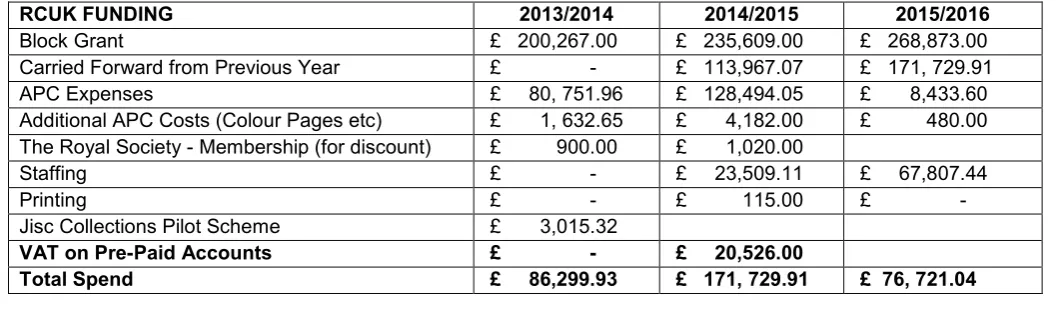
The University received a block grant of £200,267 for 2013/2014, of which £114,570 was unspent, and carried forward into 2014/2015. The University received an additional block grant of £235,609 for the period of 2014/2015, bringing the total amount available to £350,179. The University spent £157,320 during the period of 2014/2015, leaving the amount of £192,859 to be brought forward into 2015/2016.
The University has sought to increase engagement with academics, and to ensure that comprehensive procedures are in place to allow for the processing of Article Processing Charges (APCs) with minimal workload for academics. To this end, the University has employed 2 FTE, an Open Access Senior Librarian (January 2015), and an Open Access Advocacy Librarian (May 2015).
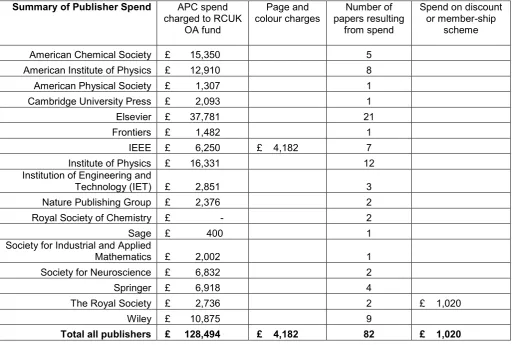
The number of APCs for the period of 2014/2015 has increased by over 70% from the previous year (from 48 to 82), it is anticipated that this will continue to rise as staff become more aware of the finances available for payment of APCs. Green OA deposits have also increased from the previous year, up 47%.
A large number of presentations have been given across the University, and meetings have been held with Department Heads and Research Directors.
The open access webpage is currently in the process of being redesigned in order to provide clearer and more user-friendly information on RCUK funding, and other material relating to open access.
Awareness has been further increased through the creation of a Twitter account, which tweets new articles that are uploaded to PURE, furthering the reach of scholarly research. Plans are in place to create an open access blog that will increase visibility and highlight the research produced by the University.
Expenditure
Table 1 provides an overview of the expenditure from the RCUK block grant since its introduction in
[image:2.595.32.561.600.757.2]2013*. The majority of finance spent from the RCUK fund has been on APCs.
Table 1: Overview of expenditure from the RCUK block grant.
RCUK FUNDING 2013/2014 2014/2015 2015/2016
Block Grant £ 200,267.00 £ 235,609.00 £ 268,873.00 Carried Forward from Previous Year £ - £ 113,967.07 £ 171, 729.91 APC Expenses £ 80, 751.96 £ 128,494.05 £ 8,433.60 Additional APC Costs (Colour Pages etc) £ 1, 632.65 £ 4,182.00 £ 480.00 The Royal Society - Membership (for discount) £ 900.00 £ 1,020.00
Staffing £ - £ 23,509.11 £ 67,807.44 Printing £ - £ 115.00 £ - Jisc Collections Pilot Scheme £ 3,015.32
VAT on Pre-Paid Accounts £ - £ 20,526.00
Total Spend £ 86,299.93 £ 171, 729.91 £ 76, 721.04
*Estimation based on existing costings.
Prepared by: Dawn Hibbert We have increased our total spend by 83%, and have increased the number of APCs paid from 48 in 2013/2014 to 82 in 2014/2015 (83%). This trend continues, with 15 articles already paid for during the 2015/2016 reporting period as of 19/08/2015. More academics are aware of the existence of the RCUK fund, and of the requirements and process to use these funds. It is expected that the number of requests for RCUK funding for article processing charges will continue to increase.
Table 2: Summary of RCUK block grant spend by publisher.
Summary of Publisher Spend APC spend charged to RCUK
OA fund Page and colour charges Number of papers resulting from spend
Spend on discount or member-ship
scheme American Chemical Society £ 15,350 5
American Institute of Physics £ 12,910 8 American Physical Society £ 1,307 1 Cambridge University Press £ 2,093 1 Elsevier £ 37,781 21 Frontiers £ 1,482 1 IEEE £ 6,250 £ 4,182 7 Institute of Physics £ 16,331 12 Institution of Engineering and
Technology (IET) £ 2,851 3 Nature Publishing Group £ 2,376 2 Royal Society of Chemistry £ - 2 Sage £ 400 1 Society for Industrial and Applied
Mathematics £ 2,002 1 Society for Neuroscience £ 6,832 2 Springer £ 6,918 4
The Royal Society £ 2,736 2 £ 1,020
Wiley £ 10,875 9
Total all publishers £ 128,494 £ 4,182 82 £ 1,020
Policy Compliance
From Scopus and our CRIS, PURE, 243 research outputs were located that were published during the period 1st August 2014 to 31st July 2015, this includes those that were published early online
during this timeframe.
The RCUK is still operating under its “transitional phase”. Reporting of compliance via the Green route therefore requires a maximum 12 month embargo period for STEM and 24 month embargo period for AHSS. Statistics were compiled for both the “transitional phase” embargoes, and the shorter embargoes (6 months STEM; 12 months AHSS) which are RCUK’s embargo target in the longer term. Tables 3, 4 and 5 set out the compliance data and the OA routes adopted to achieve compliance.
Using the 12/24 month embargo as per the transitional phase, 91% of Strathclyde’s research outputs
that were funded by RCUK were compliant. This is a significant improvement from Strathclyde’s
Concerted advocacy throughout the reporting year and the recruitment of 2 FTEs has been instrumental in improving institutional compliance and cultivating an "open scholarly communication" ethos at the institution. Local implementation of the HEFCE policy on Open Access has also ensured high levels of RCUK compliance via the Green route.
With the shorter embargo period of 6 months, compliance drops to 74%. This is largely due to most STEM journals operating embargo periods of 12 months or greater. Nevertheless, this data at least demonstrate that under stricter compliance conditions Strathclyde would still have exceeded RCUK’s 53% target. The higher proportion of Gold articles in 2014/2015 has ensured immediate OA has been delivered, and where Green OA has been adopted, the disciplinary nature of RCUK funded research at the University of Strathclyde (predominantly STEM orientated) means that compliant Green embargo lengths are often available.
It is encouraging to see a compliance rate based on 12/24 month embargo periods being close to double the compliance rate for the previous reporting period. Whilst academics are now more aware of what is required by RCUK, many fail to provide the grant number within the research output, and unfortunately some fail to acknowledge the funder at all.
It was discouraging to find that some academics are publishing with RCUK funded research in journals that are behind paywalls, and inaccessible, even by the Green route.
A number of articles were identified from Scopus, many of which were not in PURE, and would have failed to comply with HEFCE’s Open Access policy for the next REF if that were in effect. Given that these outputs form only a small percentage of the total research outputs that are published by Strathclyde academics, it is concerning that this may be a similar representation across the University. It is clear, however that a number of academics are yet to engage with PURE, and that despite often being emailed by the Repository team requesting the accepted manuscript, these emails do not elicit a response from many academics.
Table 3: Data on institutional compliance with the RCUK policy on OA (2014/2015).
6/12 month 6/12 month % 12/24 month 12/24 month %
Total Non-Compliant 64 26.3% 21 8.6%
Total Compliant 179 73.7% 222 91.4%
Table 4: OA route compliance.
6/12 month 6/12 month % 12/24 month 12/24 month %
Total Green 35 14.4% 78 32.1%
Total Gold 144 59.3% 144 59.3%
Total Non-Compliant 64 26.3% 21 8.6%
Table 5: Overall compliance based on 12/24 month embargoes versus RCUK's target of 6/12 months.
6/12 month 12/24 month
Green Open Access 35 78
Gold Open Access We Paid 62 62
Gold Open Access We Did Not
Prepared by: Dawn Hibbert
Compliance not Possible (pub policies or no funder
acknowledgement)
64 21
Total 243 243
Note: Although there were 144 gold published articles, the University of Strathclyde only funded 82 of these (other articles would likely be joint papers, with other institutes paying the article processing charge).
Challenges
Publishers failing to apply the correct licence and/or clearly identifying the research output as being Open Access
Lack of engagement from academics
Finance procedures for payment of APCs
Arduous reporting requirements of RCUK/JISC
Recommendations
Further advocacy/awareness raising
Pro-active approach to academics who have received funding, utilising PURE.
Follow up with non-compliant academics
Quarterly reports/checks of compliance to date
Update website (in progress)