Rochester Institute of Technology
RIT Scholar Works
Theses Thesis/Dissertation Collections
10-1-2011
Myths
Emily ZellerFollow this and additional works at:http://scholarworks.rit.edu/theses
This Thesis is brought to you for free and open access by the Thesis/Dissertation Collections at RIT Scholar Works. It has been accepted for inclusion in Theses by an authorized administrator of RIT Scholar Works. For more information, please [email protected].
Recommended Citation
RIT
Myths
byEmily Joy Zeller
A Thesis Submitted in Partial Fulfillment of the Requirements For the Degree of Master of Fine Arts
in Imaging Arts
School of Photographic Arts and Sciences College of Imaging Arts and Sciences
Rochester Institute of Technology Rochester, NY
October 2011
Approval:
Angela Kelly
Committee Chair Date
Carla Williams
Committee Member Date
Jessica Lieberman
Acknowledgements
None of this would be possible without the help and support of my committee,
Angela Kelly, Carla Williams, and Jessica Lieberman, as well as the other amazing
faculty I’ve had the privilege of working with. Thanks to my classmates for their
camaraderie on this journey, as well as insightful comments, support, and friendship.
Extra huge thanks goes to Bill Wells, for letting me dress him up in bark and show the
world, staying up late with me spattering glow-chalk, and his undying support, love, and
endurance through this whole process. Thank you to Geoff Munsterman, for your
proofreading and being the voice of reason through my many panics. And, of course,
thank you to my family. I know pursuing art is a risky choice, but thank you for your
tolerance and interest in what I’m doing. I’ll do my best to make you proud, and get a real
Myths
by
Emily Joy Zeller
B.A., Studio Art, Kenyon College, 2008 B.A., English, Kenyon College, 2008
M.F.A., Imaging Arts, Rochester Institute of Technology, 2011
Abstract
In this thesis I address a personal relationship with nature, femininity, and
coming-of-age in a patriarchal family through videos that rely on a synthesized definition
of myth to create multi-layered meaning with roots in the greater feminine discourse.
I create my own unique interpretation of myth by combining elements of
traditional Greek mythology, semiotic mythology, and the art and poems centered around
the myth of the female experience. Imbuing my videos with this mythic quality allows
the objects and actions depicted to transcend their signifiers, birthing multi-layered
meaning and encouraging a closer examination and personal connection with the viewer.
My experiences in this work stem from negotiating the realm of women, and trying to
Table of Contents
Acknowledgements ... ii
Abstract ... iii
List of Figures ...v
Chapter 1: Introduction ...1
Chapter 2: Synthesizing a Definition of Myth ...2
Chapter 3: Origins ...7
Chapter 4: Working Method ...8
Chapter 5:Myths – Thesis Exhibition ...12
Chapter 6: Influences ...21
Chapter 7: Reconnecting Myself - Conclusion ...24
List of Figures
Figure 5.1 Opening reception photo by Manolo Marquez ...13
Figure 5.2 Opening reception photo by Matt Chung ...14
Figure 5.3 Early still from Myth #1 ...15
Figure 5.4 Middle still from Myth #1 ...16
Figure 5.5 Ending still from Myth #1 ...17
Figure 5.6 Still from Myth #2 (Removal) ...18
Figure 5.7 Still from Myth #2 (Application) ...19
Figure 5.8 Still from Myth #2 (Ending) ...20
Figure 5.9 Early still from Myth #3 ...20
Figure 5.10 Still from Myth #3 ...21
Introduction
My mother succumbed to cancer when I was eleven. I suddenly found myself
with a father who knew nothing of raising a young girl, and coming-of-age in an
environment removed from the influence and instruction of women. Though I didn’t
think much of it at the time, this affected me greatly, and became the subconscious
driving force behind this thesis, which addresses a personal relationship with the natural
world, femininity, and coming-of-age in a patriarchal family. Only now have I begun to
negotiate the relationship of my body and myself to others, and question my role.
I create my own unique interpretation of myth by combining different
understandings of mythology, incorporating a synthesized definition to create
multi-layered meaning with roots in the greater feminine discourse. I draw from the Greek
tradition of using supernatural stories to explain natural occurrences, creating alternate
explanations of reality. From semiotic mythology, as explored by Stuart Hall and Roland
Barthes, I use the personal and public connotations of an object beyond its surface,
creating layered meaning deeper than the apparent action. From art and poems created by
women about their own experiences, as described by Estella Lauter in Women as Mythmakers, I focus on personal relationship with the body, negotiating and
understanding myself and my role in this world. Imbuing my videos with this mythic
quality allows the objects and actions depicted to transcend their base meaning, opening
them up for personal interpretation while creating a connection between the artist and
audience.
Through my exploratory and playful working method I work out what objects and
evolve into performances where I am the person enacting the scene, working with and
responding to the action I create. The final form is video, controlling the vantage point
and framing of the performance, while adding the progression of time as a key element in
the work.
Synthesizing a Definition of Myth
When Pluto fell in love with Persephone, her father Zeus told him to abduct her,
as her mother Demeter would never allow her to go to Hades. Pluto carried Persephone
away, and when Demeter finally found out about what happened, she demanded Zeus
make Pluto bring her daughter back. Though she was returned, Persephone ate
pomegranate seeds given to her by Pluto—and thus was forced to remain in the
underworld for two-thirds of the year, only able to return during part of the Spring and
Summer, when the land rejoiced with blooming flowers and life returned to the fields.
The myth of Persephone provided an explanation for the change in the seasons to ancient
peoples. My stories are equally fanciful, relying on the scenes enacted to create a
discourse within modern cultural mythologies: religious and spiritual beliefs, what
constitutes 'normal' relationships, and the taboo nature of female bodily maturity.1
When most people think of mythology, they think of Greek and Roman gods and
goddesses. While there are similar qualities I incorporate into my work—for example,
alternate stories for natural events, and using fiction to explain (or in place of) science—I
am not recreating or reinterpreting these myths directly. I look to them as a source of
inspiration, of how fiction can be loosely based in reality, and can be a source of comfort
1William Smith, “A dictionary of Greek and Roman biography and mythology, Perse’phone,” accessed
in explaining and understanding in situations where normal explanations fall short.
I also trace my definition of myth from theories of representation, based in
semiotics and a constructionist approach to discourse. The Swiss linguist Ferdinand de
Saussure developed the notion of signs, which Stuart Hall describes as is the “general
term we use for words, sounds or images which carry meaning...[and] make the
meaning-system of our culture.”2 Signs are broken down further into the signifier and signified,
which are the actual word/object/image and the concept, respectively. “Both [signifier
and signified] are required to produce meaning but it is the relation between them, fixed
by our cultural and linguistic codes, which sustains representation.”3 If we belong to the
same culture, “we are able to communicate because we share broadly the same
conceptual maps and thus make sense of or interpret the world in roughly similar ways.”4
Taking this a step further, French theorist Roland Barthes said that once the sign
was established, it could be expanded upon, linked to “broader, cultural themes, concepts
or meanings... Barthes called the first, descriptive level, the level of denotation: the
second level, that of connotation.”5 Denotation is essentially the base level of something;
what it is: the signifier. But connotation isn’t the signified (concept); it goes beyond that
into questioning what the sign means, and questioning the cultural interpretation of what
it is. This is what Barthes called myth. It is "fragments of an ideology...These signifieds
have a very close communication with culture, knowledge, history and it is through them,
2 Stuart Hall, Representation: Cultural Representations and Signifying Practices, Culture, Media and
Identities (London: SAGE Publications, 2003), 18.
so to speak, that the environmental world [of the culture] invades the system [of
representation]."6
So, when you look at an object, you identify on a base level what it is, but then
place it within the conceptual map of its surroundings. Stuart Hall describes conceptual
maps as “all sorts of objects, people and events…correlated with a set of
concepts…which we carry around on our heads.”7 These conceptual maps can be both
real and imaginary, tangible objects and made-up places. Culture, Hall claims, is what
allows you to identify the signs in the first place. He describes culture as “shared
meanings or shared conceptual maps,” and we are able to understand each other and
make sense of the world because “we share broadly the same conceptual maps…[and
thus] ‘belong to the same culture.’”8 The people who viewed my thesis exhibition are
living in America, in 2011, and most likely were raised as part of the middle class.
Though we all have different and unique experiences, we share roughly the same
conceptual maps, and belong to the same culture. I want the meaning of my videos to
evolve over time, to build and change, and to be relevant to the culture within which they
were created. I am using this idea of representation—this understanding of myth, as
opposed to the more dominant understanding involving Greek gods—to aid in
interpreting the full meaning of my videos. While there is a base action occurring (eg.
blowing bubbles) there is a second deeper meaning: the innocent action of blowing
bubbles is covering the subject and a white sheet in the bubble solution, which the viewer
can interpret as blood because of the color and liquidity of the substance. From here, the
iconography of a female with bloody sheets allows ideological and cultural
6Roland Barthes, Elements of Semiology, 1st ed. (New York: Hill and Wang, 1968), 91–2. 7Hall, 18.
interpretations. This can connote first menstruation, sexual violation, and first
intercourse, amongst other things. This could lead to deeper interpretation, such as the
subject’s relationship to her body, males, or the institution of marriage in the church.
I don’t make explicit in the works which of these I’m addressing or how much so
that the viewer may also make unique connections to their own experiences to add or
change the meaning. I offer a constructivist viewpoint9 on representation, that the
meaning isn’t solely inherent in the objects, or completely fixed by our culture. It is
relevant to (and reliant on) our time, the current ideology, the meaning I’m putting forth
in my works and the way the viewer interprets and understands it within their own
conceptual map. “Meaning has to be actively 'read' or 'interpreted'... The meaning we
take, as viewers, readers, or audiences, is never exactly the meaning which has been
given by the speaker or writer or by other viewers.”10 This difference and slight slippage
in meaning is what makes the videos interesting to me. I might intend certain meanings,
but other people may receive entirely different ones. The important point is the way this
approach [constructivist] to language unfixes meaning, breaking any natural and
inevitable tie between signifier and signified,” Hall writes. “This opens representation to
the constant 'play' of slippage of meaning, to the constant production of new meanings,
new interpretations.”11
There is a history of women artists as mythmakers, addressing the problem of
patriarchal myths. Some challenge the myths directly, some retell the myth from a female
9 Hall lists three theories of representation: reflective, intentional and constructionist. Reflective is the
belief that language reflects meanings inherent in the world—meanings are fixed in the objects. Intentional is the belief that the intended or personal meaning of something is what comes through. Constructionist is the belief that meaning is constructed through language, and the basis for the semiotic approach that I take. See Hall, 15.
character’s point-of-view, and some create their own myths out of conventions or tropes
that are indicatory of myths. I am interested in this last group. In Women as Mythmakers,
Lauter points out that “no individual makes a cultural myth, but many individuals
working along the same lines may do so if their work becomes known to a receptive
audience.”12 She examines trends in 1960s and 1970s female art and poetry, and explores
the repeated myths that appear. By looking at these reoccurring stories and images
created by women, we are better able to understand women’s shared experience in that
historical cultural moment. “If we think of myth as a structure for dealing with shared
crises of self-definition in the face of the unknown, we need only locate mythic stories
created by women in order to know which of our experiences have been the most critical
or enduring.”13 In creating and telling these stories from my experience as a young
female growing up in the early 00s, I am contributing to the current cultural mythology of
the female experience. While this groundwork may have been established and examined
in the 1960s through 1980s, it is certainly older than that, and most certainly continues on
into the future. It is important to remember through Barthes’ definition of myth that the
historical and cultural time period is crucial to making the links in representation, and
understanding and critiquing current ideology. In telling my story through these mythic
tropes, I am contributing to the greater discourse that exists in feminist art, adding a
viewpoint from my unique and potentially unifying position.
12Estella Lauter, Women as Mythmakers: Poetry and Visual Art by Twentieth-‐Century Women
(Bloomington: Indiana University Press, 1984), 18.
Origins
I never intended this work to be as personal as it has become, but looking over it,
I cannot help but notice how influenced it is by my life events, by things I've kept quiet or
ignored most of my life, that unintentionally appear in the finished works as clearly as if
I'd planned them that way from the start.
Five days after my eleventh birthday, my mother died of ovarian cancer. She had
been sick for at least two years prior to that, but when she went to local physicians
complaining of generally not feeling well, they dismissed it as a mental ailment and not a
physical one. When my father was finally able to get her into a hospital in the nearest
metropolitan area, they discovered the cancer had already spread to her pancreas, was all
through her abdomen, and not much could be done. My father suddenly had to care for
his ailing wife and three children as well as an equally ailing auto-part manufacturing
business. In the end, he was left with just us kids. My mother had always been the one to
take care of us and shelter us from my father's quick temper. He was the one who worked
long days to provide for us. He complained that he was accused of never being around for
events, but to me it was a good thing—he terrified me, and I liked it better when he was
at work. Suddenly, I was on the cusp of womanhood with no mother, a mourning and
angry father, and no idea what to do.
I spent the next handful of years in limbo between my father expecting me to
behave as an adult, and not wanting anything to be different from how it was, or how I
imagined it should be. I denied that anything was wrong to anyone who seemed
concerned, escaping into my mind and the woods that surrounded our house, learning
everything from my father, who was too wrapped up in his own grief and blaming anyone
and everyone for what had happened to notice, anyway.
What happened was traumatic, we all reacted differently, and we made it through.
My back story is important to this body of work, but that's not something I realized until
after I made it. When I really started looking at what I was making, there were elements
of womanhood, pain, suffering, patriarchal control, and destruction, as well as
relationships with nature and the imagination. I didn't always know what I was making,
as is described in my working method, but I knew by the way I felt and how I created
them that they had to be connected. I didn't realize until recently that what was
connecting them was my past. Everything I ignored and put behind me, everything I was
never willing to address or share because I didn't want to make a big deal of it has been
the subconscious driving force behind this work.
Working Method
My working method is best described as intuitive and exploratory. I come across
objects that interest me, usually for their inherent formal qualities, as with shape, color,
and texture, or their resemblance to another object with a different purpose. Their base
signifiers are usually rather unassuming, if visually interesting. I enjoy objects that are
able to connote other meanings and concepts, allowing the meaning of the object (and
thus the work) to branch out in different directions. I start playing with the objects almost
immediately, examining these connotations and connections, finding ways to shift or
complicate the established meanings, and add depth to my story. I tend towards objects
that are related to nature, are unusual, or link to memories of childhood. For example,
floor in the kitchen while my mother cooked, as well as of the “thunder and lightning"
produce misting system in the local grocery.14 Glow chalk holds mystery in its
self-illumination, and when spattered before allowing to harden into chalk it creates scapes of
stars or fireflies. However I use the item, it is almost always not its intended purpose, and
carries with it many levels of memory and meaning.
Though playing through my work and letting it evolve might appear easy or
natural, it was not always a comfortable method. In the past, I much preferred a hard and
fast idea with a strong statement I could outline from the start, allowing me to plan my
images and capture them with precision. This playful method afforded none of that
security, and it was often terrifying to not know if what I was spending so much time on
was even important enough to warrant it. Many ideas were killed before I even started
them. Eventually, I let myself explore and see where my interests would take me.
Essentially, it was this working method that allowed me to create work truly
meaningful to me, and hopefully others; because I wasn’t worried about what the work
needed to mean, it was able to define its own meaning.
Once I play with the objects enough to establish meaningful qualities, I determine
a rough course of action for my video. I use video mainly as a tool of documentation; the
art itself is what is being enacted in front of the camera, and that while I am able to
photograph still frames, the continuous video gives a feeling of authenticity to and a
greater understanding of what I am performing, as well as allowing for closer
examination of change over time and lessening the tedium of repetitive motions. With
video (as opposed to live performance) I am also able to control the point-of-view and
14(When the water misters came on for the produce, strobe lights went off above the fixtures and the
framing from which the audience enters the work, which is important as I want them to
start from the position of what I am imagining. I am in the moment, feeling what I am
trying to show, unfolding my actions for the audience. I am evolving my actions as I go,
responding to my surroundings and emotions. Though I am constructing these scenes and
attempting to create a discourse with modern myths, I am also attempting to make a real,
true connection with my audience by keeping myself open. Besides the personal
connection I want to establish, “forms that [tend] toward ritual performance and toward
the establishment of closer relationships between artist and audience...[are] highly
suitable crucibles for myth.”15
I use myself as the model in my work. This started out of necessity; often, I use
messy, awkward, or painful techniques. Gradually, the necessity transformed into
personal agency. It became important that I was the person acting out these scenes in
performances that are heavy with personal meaning. In a way, it helped me become more
comfortable in my own skin, and come to terms with emotions that are present in the
works by feeling them happen in real time. The physical pain that I feel when artichoke
scales are ripped from my skin translates to the emotional pain of being in a mentally
abusive relationship. My insecurities about my body are pushed aside as I lay naked
outside, allowing myself to be transformed into a mirror image of the sky above. I am
able to experience, acknowledge, and transcend these things through using myself as the
model. In a way, I'm creating a discourse with the works as I create them.
In my performances, I am either unclothed or minimally clothed. I want the female form
to be clear, but in a way that doesn’t really draw attention to itself. When I am nude, only
the most basic female form is visible—in Myth #1, for example, outlines appear over
time, but the entire form is obscured by glowing points of light. In choosing to not wear
any clothing, I am allowing myself to become vulnerable, to be acted upon or feel closer
to the forces surrounding me. When I am outside in the daylight, as in Myth #3, I am seen
full-figure wearing a simple shift dress, as generic a representation as I could make. It has
a definite female form like the muslin underclothes layer of old dolls, or the fabric body
holding together the china limbs, but it is not revealing. In this way, it is my play frock,
representing a more youthful mentality—I wear it when I blow bubbles, getting covered
in blood-red fluid, referencing the coming loss of innocence, but for the moment not
caring (or maybe just ignoring.)
I chose not to incorporate audio into these works because it was largely incidental.
When I imagine the scenes, they don’t have a soundtrack. I want the viewer to pay
attention to the gestures, the slow development, and the actions. The visuals are what
hold the meaning for me, and what I want the audience to interpret.
Myths - Thesis Exhibition
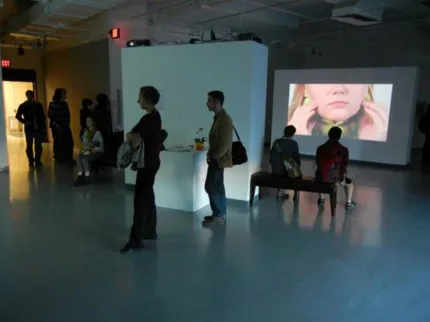
Figure 5.1 Opening photo by Manolo Marquez
My visual thesis, Myths, consists of three videos addressing my personal
relationship with the natural world, femininity, and power. The videos are projected
simultaneously on separate walls within the gallery, allowing the viewer space to interact
with the works separately, while still remaining aware of the others’ presence. This way
they are able to be singled out and considered, but can never be fully removed from their
surroundings, much like individual memories.
My goal for the installation was to keep it simple. Though I was only showing
three videos, they each needed enough space to properly project, accommodate groups of
[image:18.612.112.542.111.433.2]time while not feeling entirely cut off from the rest of the show. In order to achieve this, I
put all unattached equipment on the top of the title and statement wall, which was
positioned in the center of the room. Myth #2 and Myth #3were projected from atop this
wall, each onto its own moveable wall on either side. The ceiling-mounted projector,
unable to be moved, projected Myth #1 farther back in a slightly more enclosed space. In
order to keep the flow open, the moveable walls were positioned in such a way that the
viewer was able to see all the videos upon entering; the entire room was also visible from
the far space. In terms of video placement, Myth #1 is darker and slower-paced than the
other two, and benefited from both a more secluded (darker) space and less incidental
foot-traffic. Viewers were also able to stand farther back from the work, which could be
beneficial in interpreting the images.
Figure 5.2 Opening photo by Matt Chung showing Myth #2 at left in foreground and Myth #1 at right, in
[image:19.612.110.543.375.663.2]Myth #2 and Myth #3 which occupy the middle of the space and essentially face
each other are similar in tonal value and pacing, making them better suited for the central
area of the gallery. Lights were kept off, allowing the projected videos to illuminate the
space, keeping clarity and contrast at a maximum while also helping to create an
atmosphere for the show.
Though the videos are all related at their roots, each is its own entity, and they
don’t lead into each other. They can be viewed in any order, and thus were sequenced to
maximize clarity and gallery flow.
At the opening, people took the time to sit down and watch the videos in their
entirety. They often stayed for the next loop if they came in during the middle of it, or
watched the videos a few times. It surprised me that people were willing to take the time
to engage with the work, as often viewers get impatient. Any misgivings I had about
working in video instead of still images dissolved over the opening evening.
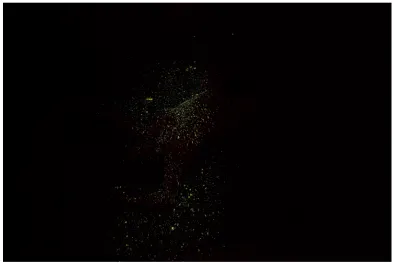
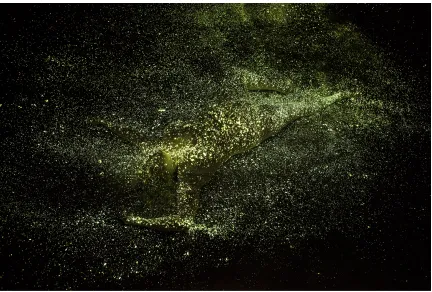
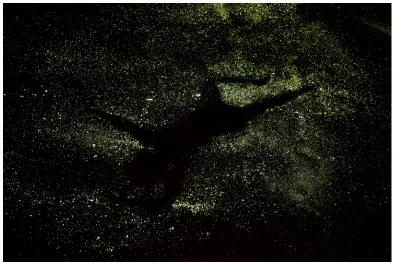
[image:20.612.128.522.429.692.2]Myth #1 depicts a slowly evolving image, where small dots of light emerge from
darkness and begin to cover the screen. They begin to show order: a line appears, a curve
forms. As time progresses, the viewer is able to make out a female form amongst the
apparent stars, one leg and arm outstretched, the others bent. Just as the form is the most
defined it starts to fade, leaving a silhouette on the ground, the absence of a body.
Figure 5.4 Middle still from Myth #1
The pacing of this video is much slower than the others, and much more
meditative. This reflects my inner state during its creation—laying on my back and
staring up at the night sky, focusing on holding still by trying to feel the earth’s rotation;
trying to feel connected to the earth. All the while, I am becoming visibly more connected
with the earth—or maybe, more accurately, the heavens. I tried to pick out constellations
in the sky, while posing my body as if I were one. Looking into the vastness of the stars
[image:21.612.111.543.208.500.2]Lucy Lippard writes: “When women use their bodies in their artwork, they are
using their selves: a significant psychological factor converts their bodies or faces from
object to subject."16 Although I am naked, I am the one placing myself in the image; I
have the agency. I am offering myself up to be objectified or not. I have accepted that I
may be objectified, but for myself I am the subject.
Figure 5.5 Ending still from Myth #1
Visually, the presence/non-presence of the body is striking. I am at once being
defined and illuminated by glowing light, but also covered in detritus, hidden within the
scene, and eventually, apparently, dissolved. Am I being immortalized in the night sky,
placing myself among the gods, or is my pose less one of a hunter and more that of a
crime scene victim? Is the feminine form that emerges one of the goddess, the creation of
the universe, or the black hole, the infertile silhouette of that which remains?
[image:22.612.128.522.208.472.2]
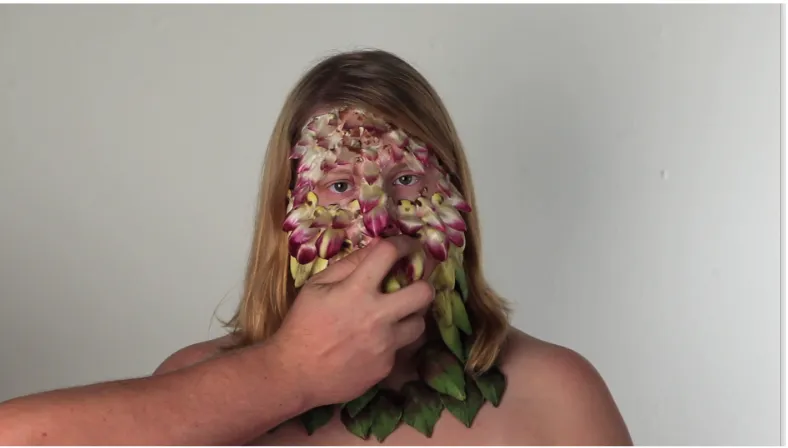
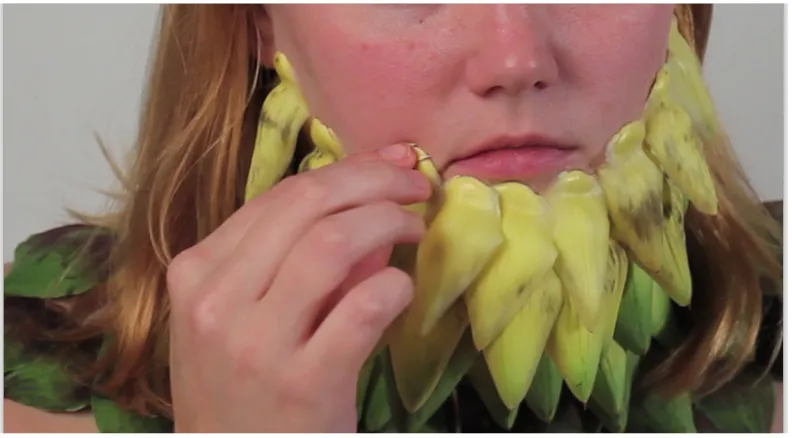
Myth #2 opens with a headshot of a female covered in artichoke petals that form a
sort of mask, headdress, or armor. The cut scene shows me applying individual artichoke
petals to my face in much the same way one would apply make-up. It is clearly a
painstaking process. Cut back to the covered face. A male hand reaches in and caresses it,
before pulling off a single petal. From here, the video cuts between me attaching the
petals to my face, and the disembodied male hand pulling them off with increasing
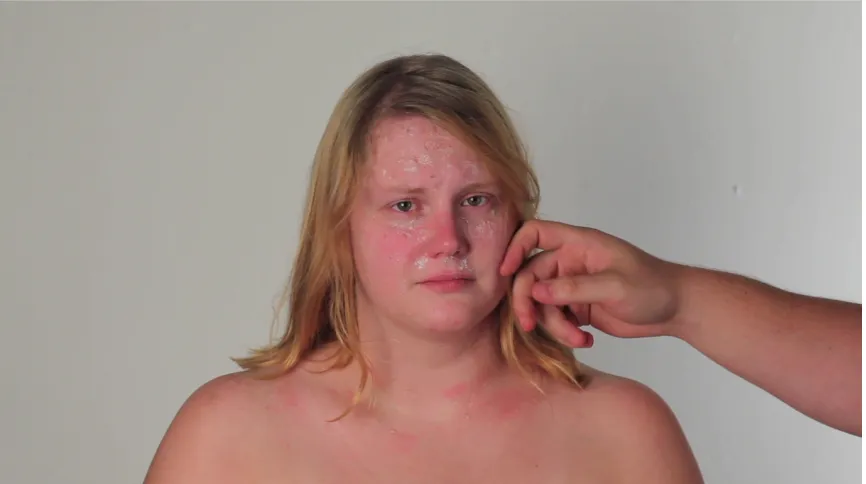
aggression. In the end, I am left stripped of the petals, clearly pained, and flinch as the
hand attempts to once again caress my face.
Figure 5.6 Still from Myth #2 (Removal)
According to Lauter’s research, transformations are common in the collective
vision of women mythmakers. The mask in particular functions as both a "façade and a
form of personal transformation... [it hides] the identity of the onlooker, yet mak[es] the
fantasy of success and failure a subject for public inspection."17 By using a non sequitur
for my mask (as opposed to something like make-up) I push the image into the realm of
[image:23.612.112.506.292.516.2]fantasy or myth. The artichoke is no longer sustenance, and its representation shifts. The
scale-like shape of individual leaves mimics armor, while the delicate coloring and shape
of the interior petals suggest a game of he-loves-me, he-loves-me-not as they’re plucked.
Figure 5.7 Still from Myth #2 (Application)
The relationship between the two figures depicted is a troubled and violent one.
While I am applying the petals, I am content and self-absorbed. While they are being
removed, my gaze is locked on the camera, only wandering nervously on occasion. I
stand by passively, letting this happen, implicating the viewer in this violence.
Negotiating the gaze in cinema, Laura Mulvey declares it is the “woman as
image, [and] man as bearer of the look… [the] active/male and passive/female.”18 The
female is performing for the man, who is always looking upon her. Myth #2 challenges
this idea by directing the gaze back out at the viewer. Though the audience may be of
mixed gender, they are all assuming the role of the male as defined by Mulvey. I am a
woman, performing for them. But the action on the screen is violent, and I appear to be
18Laura Mulvey, “Visual Pleasure and Narrative Cinema,” in Film Theory and Criticism: Introductory
[image:24.612.111.507.154.373.2]watching them as they gaze upon me. Normally, “the determining male gaze projects its
phantasy [sic] on to the female figure which is styled accordingly.”19 My gaze from the
screen helps to interrupt this fantasy, and the relationship is no longer simple
passive/active, male/female, viewer/performer dichotomies. Instead of the traditional
scopophilic relationship they expect, they are faced with personal implication and unease.
My gaze locks them in, causing them to question the power roles at play within the video,
and in the action of viewing it.
Figure 5.8 Still from Myth #2 (Ending)
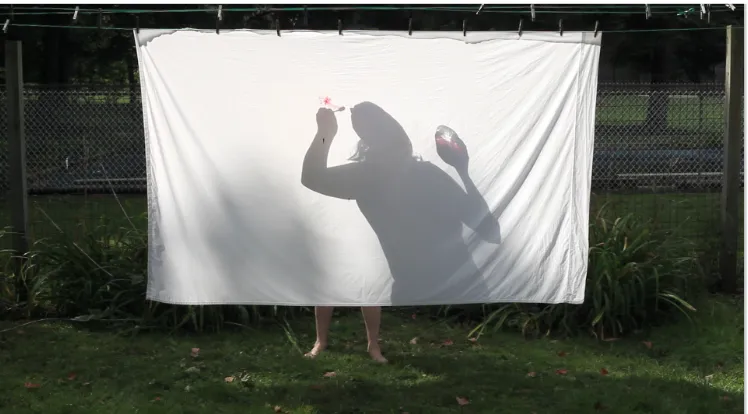
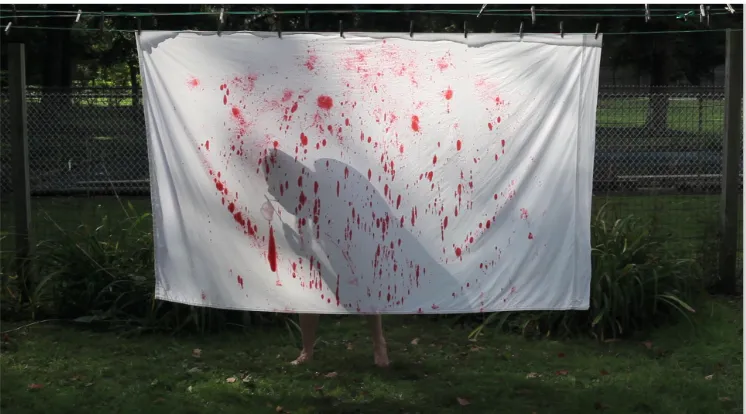
Myth #3 shows a female form behind a white sheet hanging from a clothesline,
her legs disjointed by the shadow cast from her body. She raises a wand and proceeds to
blow bubbles, which form pink spheres that stain the sheet blood red. As the spatter
grows, the disjointed body just keeps blowing, unmoved by the alarming appearance of
the sheet.
[image:25.612.111.544.266.508.2]Figure 5.9 Early Still from Myth #3
Blood and sheets are full of connotations in female mythology, all of which are
generally regarded as taboo. There is the shame and horror that comes from getting your
period while sleeping; waking up to find that you need to quickly try and remove the
stain before anyone else notices. Then there is rape, where often the victim is the one who
feels shame and responsible for what happened. There’s also the expectation of blood on
the marriage sheets in Christianity, signifying purity and chastity until marriage.
In some religions, including Orthodox Christianity, women are not permitted to
partake in the sacrament of Holy Communion during their periods, as they “represent and
emphasize the consequences of our fallen states.”20 Even young girls starting their
periods only a handful of years after their First Holy Communion are made to feel
unclean and as outcasts. Simply by being women, they are deemed unworthy by their
God one week out of the month.
20Orthodox Christian Information Center, “Menstruation, Emissions, and Holy Communion," accessed
[image:26.612.140.514.71.278.2]Figure 5.10 Still from Myth #3
Blood on sheets is either guilt-laden or shameful, and it shouldn’t be. I am
emphasizing this point, and drawing attention to the ridiculous taboo nature of these
subjects by keeping the action of the video light. The motion is ambivalent, and the
gestures playful. Though the red begins to spatter and drip, her mannerisms don't change.
She is either oblivious to the mounting stain's sinister quality, or choosing to ignore them
entirely.
Influences
I
am influenced by artists with conceptually strong, creative, playful work. Often,there are links to childhood, gender, and relationships with nature. Anthony Goicolea's
treatment of coming-of-age and Catholic guilt in his series You and What Army
(1999-2001) and video Act of Contrition (2003) provide an interesting foil; in his work I see
how an artist of the opposite gender chooses to represent similar themes.21 He also
creates mythologies, as in his video Septemberists (2006), where he shows the production
21Anthony Goicolea, “Anthony Goicolea”, accessed September 13, 2011,
[image:27.612.140.513.71.278.2]of clothing in a ritualistic, fanciful way—for example harvesting squid to create ink for
dye, sewing harvested wool to the lapels of jackets.22
Anna Gaskell's creepy renditions of young women in childlike clothing or play in
situations with unusual or unsettling actions also inspire me. She examines female
coming-of-age through a very Alice in Wonderland lens. Many of her images are framed
so as to dramatically cut the body into parts, causing unease in the viewer, and
emphasizing the body as a form (as opposed to a specific person). Similarly, I use the
disjointed or disguised feminine form, and also create fictions, though they are not as
directly linked to known stories.23
Female artists working with their own bodies also influence me, especially those
working with trace, or endurance. Though it was not intended, Myth #1 is a visual
referent of Ana Mendieta’s Silueta Series (1973-1980). In this series, Mendieta places her
body or a bodily form in the landscape. She is either present but camouflaged, or absent,
but has left a trace. She is both connecting with the landscape, and leaving her mark on it
when she leaves. The idea of having a presence, even when absent, is something that
pervades Mendieta’s work. Though her actions may be simple, it is their emotional
weight that makes them endure. In an article about Mendieta’s work, writer Blake
Gopnik reduces all art to “its purest essence… You do something to something, and
thereby leave a mark upon the world.”24 While this may indeed be true, what makes these
marks endure? Gopnik repeatedly likens art making to writing "I was here" on a wall,
22Anthony Goicolea, Septemberists, accessed September 13, 2011,
http://www.anthonygoicolea.com/NewAnthonySite/07_update/videos/septemberists.html.
23Thom Jones, Anna Gaskell: Story, 1st ed. (New York: PowerHouse Books, 2001).
particularly in the case of Mendieta.25 So why are her silhouettes in the landscape
anything beyond an egoist mark in the world? The answer lies in the emotion, passion,
and poignancy of the work. I convey stories and ideas that are poignant to me, and the
audience experiences this. Similarly, Mendieta made real connections with the land and
viewers through her work, and that is why it has endured.
Elin O’Hara Slavick also explores the trace of life-changing events in her work
about Hiroshima. She makes rubbings, prints, and images from the leftover radiation on
X-ray film, creating images that are beautiful and abstract, and betray the magnitude of
their subjects.26 Though I am not dealing with historical events, I am similarly showing
their traces—just not literally. In the same way “it’s hard to reconcile [the images] with
the immensity of the subject,”27 my actions (blowing bubbles) or materials (artichokes)
temper the seriousness of what they’re depicting. Any playfulness in the videos quickly
turns dark, as the sheet becomes bloody or the artichoke petals are ripped off my face.
Similar to Slavick’s work, I am approaching a traumatic situation in a way that is
unassuming or unexpected. I am letting my guard down in hopes of catching people
off-guard.
Many of my works involve some level of bodily endurance—laying in the cold
while getting spattered with liquid, having petals ripped from my face, or getting covered
with sticky bubbles. Though none of this quite approaches the level of endurance shown
by Marina Abramović in her performances, her work has helped me to better understand
what it is I am doing. In Rhythm 10 (1973), where she stabbed knives into the spaces
25Ibid.
26Brian Howe, “Elin O’Hara Slavick’s Hiroshima: After Aftermath,” Indy Week, December 30, 2009, sec.
Arts, http://www.indyweek.com/indyweek/elin-‐ohara-‐slavicks-‐hiroshima-‐after-‐ aftermath/Content?oid=1299545.
between her fingers, occasionally cutting herself but continuing on, she explored the state
of mind when performing. “Once you enter into the performance state you can push your
body to do things you absolutely could never normally do.”28 I encountered this
throughout my work. When I decided what needed to be done, it didn’t matter how it was
achieved. The artichoke petals wouldn’t stick, so I used super-glue. I needed a naked
female form, so I lay naked outdoors.
Throughout Abramović’s work there is also a theme of passivity and being acted
upon by others, as in one of her best-known works, Rhythm 0 (1974). Abramović invited
an audience to use objects on her that could produce pleasure or pain and remained
passive for the duration, even when participants began to cause her bodily harm.29
Though I do not demonstrate this level of passivity, I understand the state the artist must
be in to allow painful actions to be enacted upon them, as in Myth #2. My facial
expression might show pain, but I remain passive, allowing the action to happen.
Conclusion
In what I am calling ‘creative’ mythology...the individual has had an experience of his [sic] own—of order, horror, beauty, or even more exhilaration—which he seeks to communicate through signs; and if his realization has been of a certain depth and import, his communication will have the value and force of living myth—for those who receive and respond to it of themselves, with recognition, uncoerced.30
In this thesis, I portray my own stories and experiences through the synthesis of three
definitions of myth. In doing so, I share and address emotions and concepts that may
28Marina Abramović, interviewed by Janet Kaplan, “Deeper and Deeper: Interview with Marina
Abromović,” Art Journal 58, no. 2 (1999): 9.
29“Marina Abramović. Rhythm 0. 1974,” MoMA MULTIMEDIA, accessed October 3, 2011,
http://www.moma.org/explore/multimedia/audios/190/1972.
otherwise be difficult to feel, depict, or connect with. If what I am saying is important
enough it will connect with the experiences of other women, and endure. I hope that
together we will create a new myth.
Women in performance art often reference past artists’ work, perhaps to pay
homage to them or refresh the conversation. Abramović did this through her Seven Easy
Pieces in 2005, where she chose foundational acts of performance art and reenacted
them, as well as adding one of her own old works and a new one.31 In the early 90s
Nancy Spero reenacted performance works by Mendieta, and while “paying homage to
one’s female cultural forebears is a common trend in feminist practice […] in this case
Spero was commemorating the work of a much younger artist.”32 In Barthesian
mythology, the time period, conceptual map, culture, and ideology all affect meaning. So
while paying homage to the artists who paved the way for the discussion is most likely a
part of this, what is more interesting is that by doing so artists are renewing the
discussions and placing them within modern mythology. What something meant when it
was originally enacted might have an entirely different meaning now. Comparisons and
contradictions might be apparent where they weren’t before. The art might shed light on a
huge change in our thinking about subjects, or point out how little progress we’ve made.
I grew up in a family where feminism was a bad word, where I was removed from
the influence of strong women, and where I was made to feel ashamed of my gender.
Through Myths, I am sharing what holds “the value and force of living myth” to me.33I
31James Westcott, “ARTINFO: Marina Abramovic”, accessed October 3, 2011,
http://www.artinfo.com/news/story/1537/marina-‐abramovic/.
32Joanna S. Walker, “The Body is Present Even if in Disguise: Tracing the Trace in the Artwork of Nancy
Spero and Ana Mendieta,” Tate Papers Issue 11 2009: Joanna S. Walker, accessed October 3, 2011, http://www.tate.org.uk/research/tateresearch/tatepapers/09spring/joanna-‐walker.shtm.
am reconnecting with the realm of women, and inserting myself in the feminist discourse.
Though I knew some of Abramović's work before starting my thesis, many of the other
women I list as influences didn't come until later. My work was created largely on
personal feeling, and not until I investigated further for this thesis did I uncover such a
rich history of women working in similar ways. They influenced me after my work was
created, letting me know that my impulses were true and what I had to say as a female
was important. As I move onward, I am now able to do so with confidence, bolstered by
Selected Bibliography
Barthes, Roland. Elements of Semiology. 1st ed. New York: Hill and Wang, 1968.
Campbell, Joseph. The Masks of God, Vol. 4: Creative Mythology. Penguin
(Non-Classics), 1991.
Goicolea, Anthony. “Anthony Goicolea.” Accessed September 13, 2011. http://www.anthonygoicolea.com/.
---. The Septemberists. Accessed September 13, 2011.
http://www.anthonygoicolea.com/NewAnthonySite/07_update/videos/septemberis ts.html.
Gopnik, Blake. “‘Silueta’ of A Woman: Sizing Up Ana Mendieta.” The Washington Post,
October 17, 2004, http://www.washingtonpost.com/wp-dyn/articles/A35164-2004Oct15.html.
Hall, Stuart. Representation: Cultural Representations and Signifying Practices. Culture, Media and Identities. London: SAGE Publications, 2003.
Howe, Brian. “Elin O’Hara Slavick’s Hiroshima: After Aftermath.” Indy Week,
December 30, 2009, sec. Arts. http://www.indyweek.com/indyweek/elin-ohara-slavicks-hiroshima-after-aftermath/Content?oid=1299545.
Jones, Thom. Anna Gaskell: Story. 1st ed. New York: PowerHouse Books, 2001.
Kaplan, Janet. “Deeper and Deeper: Interview with Marina Abromović.” Art Journal 58,
no. 2 (1999): 6-19.
Lauter, Estella. Women as Mythmakers: Poetry and Visual Art by Twentieth-Century
Women. Bloomington: Indiana University Press, 1984.
Lippard, Lucy. From the Center: Feminist Essays on Women’s Art. New
York: E.P. Dutton, 1976.
“Marina Abramović. Rhythm 0. 1974.” MoMA MULTIMEDIA, n.d.
http://www.moma.org/explore/multimedia/audios/190/1972.
Mulvey, Laura. “Visual Pleasure and Narrative Cinema.” In Film Theory and Criticism:
Introductory Readings, edited by Leo Braudy and Marshall Cohen, 833-44. New York: Oxford UP, 2004.
Orthodox Christian Information Center. “Menstruation, Emissions, and Holy Communion.” Accessed October 10, 2011.
http://www.orthodoxinfo.com/praxis/menses.aspx.
Smith, William. “A dictionary of Greek and Roman biography and mythology, Perse’phone.” Accessed September 24, 2011,
http://www.perseus.tufts.edu/hopper/text?doc=Perseus:text:1999.04.0104:entry=p ersephone-bio-1.
Walker, Joanna S. “The Body is Present Even if in Disguise: Tracing the Trace in the
Artwork of Nancy Spero and Ana Mendieta.” Tate Papers Issue 11 2009: Joanna
S. Walker. Spring 2009.
http://www.tate.org.uk/research/tateresearch/tatepapers/09spring/joanna-walker.shtm.