City, University of London Institutional Repository
Citation
:
Castelló, X., Baronchelli, A. and Loreto, V. (2009). Consensus and ordering in
language dynamics. European Physical Journal B (The), 71(4), pp. 557-564. doi:
10.1140/epjb/e2009-00284-2
This is the unspecified version of the paper.
This version of the publication may differ from the final published
version.
Permanent repository link:
http://openaccess.city.ac.uk/2648/
Link to published version
:
http://dx.doi.org/10.1140/epjb/e2009-00284-2
Copyright and reuse:
City Research Online aims to make research
outputs of City, University of London available to a wider audience.
Copyright and Moral Rights remain with the author(s) and/or copyright
holders. URLs from City Research Online may be freely distributed and
linked to.
City Research Online:
http://openaccess.city.ac.uk/
[email protected]
arXiv:0901.3844v1 [physics.soc-ph] 24 Jan 2009
Xavier Castell´o,1 Andrea Baronchelli,2 and Vittorio Loreto3, 4
1IFISC, Institut de F´ısica Interdisciplin`aria i Sistemes Complexos (CSIC-UIB),
Campus Universitat Illes Balears E07122 Palma de Mallorca (Spain)
2Departament de F´ısica i Enginyeria Nuclear, Universitat Polit`ecnica de Catalunya,
Campus Nord B4, 08034 Barcelona (Spain)
3Dipartimento di Fisica, “Sapienza” Universit`a di Roma, P.le A. Moro 2, 00185 Roma (Italy) 4Fondazione ISI, Viale S. Severo 65, 10133 Torino (Italy)
(Dated: January 24, 2009)
We consider two social consensus models, the AB-model and the Naming Game restricted to two conventions, which describe a population of interacting agents that can be in either of two equivalent states (A or B) or in a third mixed (AB) state. Proposed in the context of language competition and emergence, the AB state was associated with bilingualism and synonymy respectively. We show that the two models are equivalent in the mean field approximation, though the differences at the microscopic level have non-trivial consequences. To point them out, we investigate an extension of these dynamics in which confidence/trust is considered, focusing on the case of an underlying fully connected graph, and we show that the consensus-polarization phase transition taking place in the Naming Game is not observed in the AB model. We then consider the interface motion in regular lattices. Qualitatively, both models show the same behavior: a diffusive interface motion in a one-dimensional lattice, and a curvature driven dynamics with diffusing stripe-like metastable states in a two-dimensional one. However, in comparison to the Naming Game, the AB-model dynamics is shown to slow down the diffusion of such configurations.
PACS numbers: 64.60.Cn, 87.23.Ge
I. INTRODUCTION
The formalism, ideas and tools from statistical physics and complex systems have successfully been applied to different disciplines of science beyond the traditional re-search lines of physics, ranging from biology, to eco-nomics and the social sciences [1]. In particular, there has been a fruitful effort in providing models of language dynamics, including dynamics of language competition [2], language evolution [3, 4] and semiotic dynamics [5, 6]. In the field of language competition, the Abrams-Strogatz model [2] has triggered the development of sev-eral models which take into account the competition of many [7, 8] or few [9, 10] languages. A review of some of these models can be found in [11]. Building up upon a proposal by Minett and Wang [12, 13], the AB-model is a model of two non-excluding options, in which agents can be in two symmetric states (A or B) and in a third mixed (AB) state of coexisting options at the individual level [14]. It has been used to study the competition be-tween two socially equivalent languages, where AB agents are associated to bilingualism. The model has been stud-ied in two-dimensional and small world networks [14] and in networks with community structure [15, 16]. The fi-nal state of the system is always consensus in one of the options, A or B.
In semiotic dynamics, the Naming Game [5, 6, 17] de-scribes a population of agents playing pairwise interac-tions in order tonegotiate conventions, i.e., associations between forms and meanings, and elucidates the mech-anisms leading to the emergence of a global consensus among them. For the sake of simplicity the model does
not take into account the possibility of homonymy, so that all meanings are independent and one can work with only one of them, without loss of generality. An exam-ple of such a game is that of a population that has to reach the consensus on the name (i.e. the form) to as-sign to an object (i.e. the meaning) exploiting only local interactions. However it is clear that the model, origi-nally inspired to robotic experiments [5], is appropriate to address general situations in which negotiation rules a decision process on a set of conventions (i.e. opinion dynamics, etc.). The Naming Game has been studied in fully connected graphs (i.e. in mean-field or homoge-neous mixing populations) [5, 6, 17], regular lattices [18], small world networks [19] and complex networks [20, 21]. The final state of the system is always consensus, but sta-ble polarized states can be reached introducing a simple confidence/trust parameter [22]. In this paper, we shall focus on the particular case in which only two options compete within the population [17, 22].
2
II. THE MODELS
We present here the two models considered in this pa-per: the generalized Naming Game restricted to two con-ventions [6, 22] and the AB-model [14], extended in such a way that confidence/trust is considered. In both mod-els, we consider a set ofN interacting agents embedded in a network. At each time step, and starting from a given initial condition, we select randomly an agent and we update its state according to the dynamical rules cor-responding to each model.
In the Naming Game [6, 17], an agent is endowed with an internal inventory in which it can store an a priori unlimited number of conventions. Initially, all invento-ries are empty. At each time step, a pair of neighboring agents is chosen randomly, one playing as “speaker”, the other as “hearer”, and negotiate according to the follow-ing rules:
• the speaker selects randomly one of its conven-tions and conveys it to the hearer (if the inven-tory is empty, a new convention is invented by the speaker);
• if the hearer’s inventory contains such a convention, the two agents update their inventories so as to keep only the convention involved in the interaction
(success);
• otherwise, the hearer adds the convention to those already stored in its inventory (failure).
Here we are interested in the particular case in which a population deals with only two competing conventions (sayAorB) [17]. We therefore assign to each agent one of the two conventions at the beginning of the process, preventing in this way further invention (that can happen only when the speaker’s inventory is empty). Moreover, we adopt the generalized Naming Game scheme [22], in which a confidence/trust parameterβdetermines the up-date rule following a success: with probability β the usual dynamics takes place, while with the complemen-tary probability 1−β nothing happens. The usual case is thus recovered forβ= 1. For brevity we shall refer to this setting (generalized Naming Game restricted to two conventions) as the 2c-Naming Game. In this simplified case, it is easy to see that the transition probabilities are the following [22]:
pA→AB =nB+
1
2nAB, pB→AB=nA+
1
2nAB (1)
pAB→A=
3β
2 nA+βnAB, pAB→B =
3β
2 nB+βnAB(2)
wherenj(j=A, B, AB) are the fraction of agents storing
in their inventory the conventions A, B or bothA and
B, respectively.
For the AB-model [14], an agent can be in three possi-ble states: A, choosing option A (using language A),B, choosing option B (using language B) or AB, choosing
both, A and B (using both languages, bilingual agent). An agent changes its state with a probability which depends on the fraction of agents in the other states,
nj (j=A, B, AB). The transition probabilities are the
following[24]:
pA→AB=
1
2nB, pB→AB =
1
2nA (3)
pAB→A=
1
2β(1−nB), pAB→B =
1
2β(1−nA) (4) An agent changes from the A or B state towards the AB state (equation (3)), with a probability proportional to the agents in the opposite option. The probabil-ity that an AB agent moves towards the A or B state (equation (4)) is proportional to the density of agents sharing that option, including those in the AB state (1−ni =nj +nAB; i, j =A, B, i 6=j). In this paper,
we extend the original model in analogy to the extension proposed for the Naming Game in [22]: an agent aban-dons an option or language according to the dynamics of the AB-model (changes fromABtoAorB) with a prob-abilityβ, while with a probability 1−β nothing happens. In the context of language competition, the parameterβ
can be interpreted as an inertia to stop using a language, and at the same time, as a reinforcement of the status of being bilingual, which was not taken into account in the original model (recovered by settingβ= 1).
In both models, a unit of time is defined as N it-erations, so that at every unit of time each agent has been updated on average once. To describe the dynam-ics of the system we use as an order parameter the
inter-face densityρ, defined as the fraction of links connecting
nodes in different states. When the system approaches consensus, domains grow in size, and the interface den-sity decreases. Zero interface denden-sity indicates that an absorbing state, consensus, has been reached. We also use the average interface density,hρi, whereh·iindicates average over realizations of the stochastic dynamics start-ing from different random initial conditions.
III. MACROSCOPIC DESCRIPTION
In Section II we have presented the microscopic de-scription of the 2c-Naming Game and the AB-model, i.e., the set of local interactions among the agents. In order to have a macroscopic description of the dynamical evo-lution of the system as a whole we derive the mean-field equations for the fraction of agents in each state. For the 2c-Naming Game one has [22]:
dnA
dt =−nAnB+βn
2
AB+
3β−1
2 nAnAB (5)
dnB
dt =−nAnB+βn
2
AB+
3β−1
2 nBnAB (6) andnAB= 1−nA−nB.
nA = 0, nB = 1, nAB = 0 and (3) nA = b(β), nB =
b(β), nAB = 1−2b(β) with b(β) =
1+5β−√1+10β+17β2
4β
(and b(0)=0). A non-equilibrium phase transition occurs for a critical value βc = 1/3. Forβc >1/3 consensus is
stable. Forβc<1/3 a change of stability gives place to
a stationary coexistence ofnA=nB and a finite density
of undecided agentsnAB, fluctuating around the average
values b(β) and 1−2b(β). In the Naming Game with invention, in fact, the one observed atβc= 1/3 is the first
of a series of transitions yielding the asymptotic survival of a diverging (in the thermodynamic limit) number of conventions asβ→0 [22].
For the AB-model one has:
dnA
dt =
1
2(−nAnB+βn 2
AB+βnAnAB) (7)
dnB
dt =
1
2(−nAnB+βn 2
AB+βnBnAB) (8)
andnAB= 1−nA−nB.
The stability analysis shows that there exist three fixed points: (1)nA = 1, nB = 0, nAB = 0; (2)nA = 0, nB =
1, nAB = 0 and (3) nA = f(β), nB =f(β), nAB = 1−
2f(β) withf(β) = 3β−
√
β(β+4)
2(2β−1) .
Notice that in both models, at β = 0 the third fixed point becomes a stable absorbing state in which the sys-tem reaches consensus in the AB-state.
Surprisingly, the two original models (β = 1) are equiv-alent in the mean-field approximation. There is just a different time scale coming from the prefactor 1/2 in the AB-model (equations (7) and (8)). The mean-field ap-proximation is exact in the thermodynamic limit, and valid for large systems in fully connected networks. How-ever, the two models differ at their local interactions (see equations (1-4) forβ= 1). To explore the effects of these differences at the microscopic level, in Section IV we in-vestigate, in a complete graph, the role of the parameter
β as described in equations (5-8), while in Section V we focus on the interface motion in regular lattices for the original caseβ= 1.
IV. PHASE TRANSITION
Here we consider the extension of the AB-model pre-sented above in a fully connected network, with the aim to explore a possible non-equilibrium phase transition in
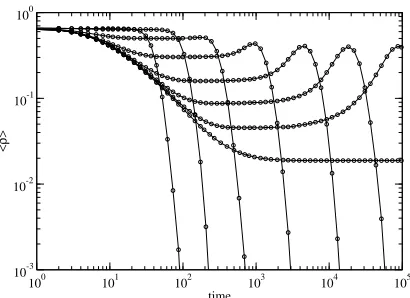
β similar to the one found in the 2c-Naming Game. In Figure 1 we show the time evolution of the average inter-face density,hρi, for different values of the parameterβ. For large values ofβ,hρireaches a plateau followed by a finite size fluctuation that drives the system to an absorb-ing state. However, forβ <∼0.01 we observe that afterhρi
reaches the plateau, it increases again, reaching a maxi-mum value after which a finite size fluctuation drives the system to consensus. In finite systems and forβ= 0, the system reaches a constant value ofhρi, a frozen state cor-responding to almost consensus in the AB-state, except
100 101 102 103 104 105 time
10-3 10-2 10-1 100
<ρ>
FIG. 1: AB-model: time evolution of the average inter-face density, hρi, in a fully connected network of N = 10000 agents for different values of β. From left to right:
β = 1.0,0.2,0.05,0.01,0.002,0.0005,0.0001,0.0. Averaged over 1000 runs.
10-3 10-2 10-1 100
β
101 102 103 104
tconv
102 103 104 N
30 40 50 60 70
[image:4.612.337.542.64.213.2]tconv
FIG. 2: AB-model. Top: scaling of the time of convergence withβfor N = 10000: tconv ∼β−1. Averaged over 200-800
runs depending on the value ofβ. Bottom: scaling of the time of convergence with system sizeN for β= 1: tconv ∼ln(N).
Averaged over 10000 runs.
for a small fraction of agents (less than 1% on average forN = 10000). This fraction decreases asN increases, and complete consensus in the AB-state is reached in the thermodynamic limit (see stability analysis in the pre-vious section). For β = 0, pAB→A = pAB→B = 0, so
the only possible evolution is that A and B agents move towards the AB state. At the last stage of the dynam-ics, whennAandnB approach to zero, as soon as one of
the two single-option densities, ni, vanishes, nj remains
constant (i, j=A, B, i6=j) becausepj→AB ∼ni, giving
rise to the small fraction of agents in the statej present in the frozen state. The time to convergence scales with beta astconv ∼β−1 (Figure 2-top), as observed for the
2c-Naming Game forβ > βc (tconv∼(β−βc)−1) [22].
[image:4.612.337.542.305.451.2]4
phase transition in the AB-model: atβ = 0, the system reaches trivially a frozen state (dominance of the AB-state, with complete consensus in the thermodynamic limit); while for β > 0 the final absorbing state is, as usual, consensus in the A or B option. Even though the two original models are equivalent in the mean-field approximation (caseβ= 1), we observe two different be-haviors when the parameterβis taken into account. This can be shown formally by looking at the time evolution of themagnetization,m≡nA−nB. For the 2c-Naming
Game and the AB-model, we have respectively:
dm
dt =
3β−1
2 nABm (9)
dm
dt =
1
2βnABm (10)
In equation (9), we can observe the origin of the non-equilibrium phase transition described in Section III for the 2c-Naming Game. The time derivative of the magne-tization, dm
dt, vanishes at the critical pointβc= 1/3. For
βc >1/3,sign(dmdt) =sign(m), and therefore |m| → 1:
the system is driven to an absorbing state of consensus in the A or B option. Forβc<1/3,sign(dmdt) =−sign(m)
and |m| → 0, giving rise to stationary coexistence of the three phases, with nA =nB and a finite density of
AB agents. For the AB-model, instead, we can see in equation (10) that for β > 0, sign(dm
dt) = sign(m) so
that consensus in the A or B option is always reached. The time derivative of the magnetization, dmdt, vanishes atβ= 0, where the dynamics gets stuck in an absorbing state corresponding to consensus in the AB state in the thermodynamic limit. Therefore, the phase transition observed in the 2c-Naming Game is not observed.
The reason of the difference shown above has to be found in the differences that these models have at the microscopic level. The fact that in the AB-model A and B agents do not feel the influence of AB agents is the key point which explains the different nature of the transition for this model. For the case β = 1, in the 2c-Naming Game the second term in equation (1) (influence of AB agents on the A or B agents) and the first term in equa-tion (2) (influence of the A or B agents on the AB agents) combine in such a way that the mean-field equations are equivalent to the ones in the AB-model. However, when
β <1 the combination of these terms originate the phase
transition from an absorbing final state towards a dy-namical stationary state of coexistence, as found in [22]. In Figure 2-bottom, we observe for the AB-model the scaling of tconv with the system size for β = 1:
tconv∼ln(N), indicating thattconvincreases slowly with
the system size. As expected, this compares properly to the same scaling already obtained for the 2c-Naming Game in [17], since the two models are equivalent in the mean field forβ = 1.
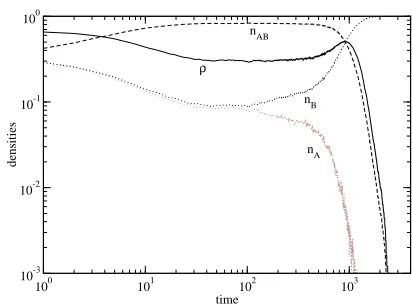
To understand the time evolution of the average in-terface density hρi shown in Figure 1 for β <∼ 0.01, we show in Figure 3 the time evolution ofρand the densi-ties of agents in each state,nA,nBandnAB, for a typical
100 101 102 103 time
10-3 10-2 10-1 100
densities
ρ
nAB
[image:5.612.335.541.62.215.2]nB nA
FIG. 3: AB-model. Density of agents in state A,nA
(dot-ted gray), in state B,nB (dotted black), in state AB,nAB
(dashed); and interface density,ρ(solid line) for a typical re-alization of the AB-model. In the plateau,nA ∼nB ≃0.1,
while the majority of agents are in the AB-state. Fully con-nected network,β= 0.01 andN= 10000 agents.
realization of the dynamics and a given small β. Be-cause of the inertia of the AB agents to move away from their state (smallβ), at the beginning we observe an in-crease ofnAB together with the corresponding decrease
ofnA,nB andρ. Then,ρand the three densities reach a
plateau. Most of the agents are in the AB state, while a competition between options A and B takes place, with
nA ≃nB < nAB. This metastable state lasts longer as
we increase the system size. At a certain point, however, a system size fluctuation drives the density of one of the two states (A in the figure) to zero, while the other (B in the figure) starts gaining ground. Since there are less and less agents in the state becoming extinct, and agents having one option do feel only the presence of agents in the opposite state, agents in the dominant state become more and more stable, until, when the other state disap-pears, they become totally stable. During this process, the interface density increases as nAB decreases. The
peak ofρcorresponds to the point wherenAB=ni
(be-ingithe state which takes over the whole system, B in the figure). When one of the states has vanished (A in the figure), the AB agents slowly move towards the re-maining state (B in the figure) and the system reaches consensus.
V. INTERFACE DYNAMICS: 1-D AND 2-D LATTICES
We study and compare here the interface dynamics in regular lattices with periodic boundary conditions for the two original models (β = 1). The 2c-Naming Game has been shown to exhibit a diffusive interface motion in a one-dimensional lattice, with a diffusion coefficient
one-dimensional lattice withNagents, we consider a sin-gle interface between two linear clusters of agents. In each of the clusters, all the agents are in the same state. We consider a cluster of agents in the state A on the-left and another cluster of agents in the B state on the right. We call Cm an interface of m agents in state C
(for clarity, here C labels an AB agent). Due to the dy-namical rules, the only two possible interface widths are
C0, corresponding to a two directly connected clusters
· ·AAABBB· ·, or C1, corresponding to an interface of
width one, · ·AAACBBB· ·. It is straightforward to compute the probabilityp0,1= 1/2N that aC0interface becomes aC1 in a single time step. Otherwise, it stays inC0. In the same way,p1,0= 1/2N. We are now inter-ested in determining the stationary probabilities of the Markov chain defined by the transition matrix
M =
1− 1 2N
1 2N
1
2N 1−
1 2N
(11)
in which the basis is{C0, C1}. The stationary probability vector, P = {P0, P1} is computed by imposing P(t+ 1)−P(t) = 0, i.e., (MT −I)P = 0. We obtain P
0 = 1/2, P1= 1/2. Since the interface has a bounded width, we assume that it can be modeled as a point-like object localized at position x = (xl+xr)/2, where xl is the
position of the rightmost site of cluster A, and xr the
leftmost site of cluster B. An interaction Cm → Cm′ corresponds to a set of possible movements for the central position x. We denote by W(x→ x±δ) the transition probability that an interface centered inxmoves to to the positionx±δ. The only possible transitions are: W(x→
x±1
2) = 1 4NP0+
1
4NP1. Using the results obtained for the
stationary probability vector we getW(x→x±12) = 1 4N.
We are now able to write the master equation for the probabilityP(x, t) to find the interface in position xat timet. In the limit of continuous time and space:
P(x, t+ 1)−P(x, t)≈δt∂P(x, t)
∂t , (12)
P(x+δx, t)≈P(x, t) +δx∂P(x, t)
∂x + (13)
+1 2(δx)
2∂2P(x, t)
∂x2
In this limit, the master equation reads:
∂P(x, t)
∂t =
D N
∂2P(x, t)
∂x2 (14)
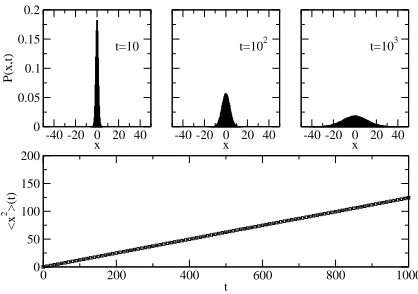
where the diffusion coefficient is D= 1/16 = 0.0625 (in the appropriate dimensional units (δx)2/δt). These an-alytical results are confirmed by numerical simulations. In Figure 4 we show the time evolution ofP(x, t), which displays a clear diffusive behavior. The mean-square distance follows a diffusion law hx2i = 2D
expt, with
Dexp = 0.06205 being the diffusion coefficient obtained
numerically.
-40 -20 0 20 40 x 0 0.05 0.1 0.15 0.2
P(x,t)
-40 -20 0 20 40
x -40 -20 0x 20 40
0 200 400 600 800 1000 t
0 50 100 150 200
<x
2 >(t)
[image:6.612.334.543.64.211.2]t=10 t=102 t=103
FIG. 4: AB-model: evolution of the position of an interface in a one-dimensional regular lattice. Top: time evolution of the distributionP(x, t). Bottom: time evolution of the mean square displacement hx2(t)i = 2D
expt. The value Dexp =
[image:6.612.314.564.297.482.2]0.06205 obtained from the fitting is in perfect agreement with the theoretical predictionD= 1/16 = 0.0625.
FIG. 5: Initial conditions with one half of the lattice in the A state, and the other half in the B state. N = 642 Top:
AB-model. Stripe-like metastable state. t=0, 100, 200 from left to right.Bottom: 2c-Naming Game: t=0, 50, 100 from left to right. Snapshots are selected taking into account the different time scale coming from the prefactor 1/2 in the meanfield equations (7) and (8).
Thus, the AB-model and the 2c-Naming Game display the same diffusive interface motion in one-dimensional lattices, but they differ in about one order of magnitude in the diffusion coefficient, indicating that in the AB-model interfaces diffuse much slower. It can also be seen that the growth of the typical size of the clusters isζ ∼
tα, with α≃ 0.5, leading to the well known coarsening
dis-6
0 1×10⁵
2×10⁵ t
0.0001 0.001 0.01 0.1
p(t)
[image:7.612.70.284.64.212.2]2c-Naming Game AB-model
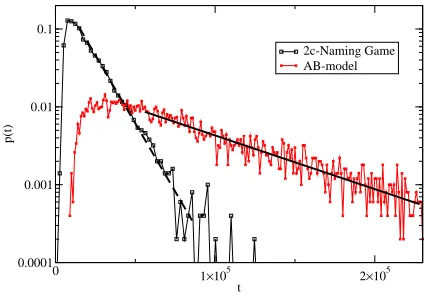
FIG. 6: Probability distribution for the time to reach con-sensus, starting with stripe-like configurations. Black: 2c-Naming Game, τN G ≃ 1.2×10⁴; gray: AB-model, τAB ≃
6.3×10⁴. Averages are over 5000 runs.
tributed options among the agents, both models present a coarsening ζ ∼ tα, α ≃ 0.5, with a curvature driven
interface dynamics [14, 18] and AB-agents placing them-selves at the interfaces between single-option domains. In Figure 5 we show snapshots comparing the two dynam-ics, starting from initial conditions where we have half of the lattice in state A, and the other half in state B. Given that the interface dynamics is curvature driven, flat boundaries are very stable. In both models these stripe-like configurations give rise to metastable states, already found in [14] for the AB-model: dynamical evo-lution of boundaries close to flat interfaces but with in-terfacial noise present. These configurations evolve by diffusion of the two walls (average interface density fluc-tuating around a fixed value) until they meet and the system is driven to an absorbing state. In the AB-model, also when starting from options randomly distributed through the lattice, 1/3 of the realizations end up in such stripe-like metastable states [14].We checked that the same turns out to be true also for the 2c-Naming Game. In the usual Naming Game with invention, on the other hand, stripes are better avoided since in that case the two convention state is usually reached when one cluster is already considerably larger than the other.
We show in Figure 6 the distribution of survival times for the two models, i.e., the time needed for a stripe-like configuration to reach an absorbing state. The distri-bution displays an exponential tail, p(t)∼e−t/τ with a
characteristic timeτ. The characteristic time for the AB-model is however larger than the one for the 2c-Naming Game (τAB > τN G), confirming that the AB-model
inter-face dynamics slows down the diffusion of configurations such as stripes in two dimensional lattices, or walls in one dimensional lattices. Notice that in both cases, the dif-ferences found are beyond the trivial different time scale corresponding to the prefactor 1/2 in the mean field equa-tions for the AB-model (equaequa-tions (7) and (8)).
VI. DISCUSSION AND CONCLUSION
We have analyzed and compared the 2c-Naming Game and the AB-model, originally defined in the context of language emergence and competition, respectively. We have shown that although these two models are equiva-lent in mean-field, their microscopic differences give rise to different behaviors. In particular, we have focused on (1) the extension of the models by introducing the param-eterβ, describing the inertia of the agents to abandon an acquired option, and (2) the interface dynamics in one and two-dimensional lattices.
As for the extension of the models incorporating the parameterβ, even though the original models are equiv-alent in the mean field approximation for β = 1, an important difference concerns the existence of a phase transition. While the 2c-Naming Game features a non-equilibrium phase transition between consensus and sta-tionary coexistence of the three phases present in the system, in the AB-model such a transition does not ex-ist, the model featuring a trivial frozen state for β = 0 (dominance of the AB-state, with complete consensus in the thermodynamic limit), and the usual consensus in the A or B state, for 0< β≤1.
As for the interface dynamics, we have shown in one-dimensional lattices that the AB-model has a diffusive in-terface motion analogous to the one already found in the 2c-Naming Game, but with a diffusion coefficient nearly one order of magnitude smaller. In two-dimensional lat-tices, we have studied the time evolution of stripe-like configurations, which are metastable in both models but have a larger life time in the AB-model. Both results indicate that in comparison to the 2c-Naming Game, the AB-model interface dynamics slows down the diffusion of these configurations.
It is interesting to discuss the implications of our re-sults on the AB-model in the context of dynamics of lan-guage competition. In the original AB-model (β = 1), the density of bilingual individuals remains small during the language competition process (around 20%), and in the end bilingual individuals disappear together with the language facing extinction. When introducing the pa-rameterβ, interpreted here as a sort of inertia to stop using a language, and, at the same time, as a reinforce-ment of the status of being bilingual, we observed the fol-lowing. Whenβis small enough, bilingual agents rapidly become the majority, while the two monolingual commu-nities compete between each other and have similar sizes. The smaller the parameter β, the larger the bilingual community is at this point. After this stage of coexis-tence, a symmetry breaking takes place and one of the two monolingual communities starts to grow, while the other looses ground. When this monolingual community faces extinction, the language spoken in that community survives in the bilingual community until this community also disappears.
the agents who speak just that language disappear, but the language does not, as it is still spoken in the society by the bilingual agents. Then bilingual agents disap-pear, too, which leads to the extinction of the language. Within the limited framework of the AB-model, in which there does not exist any political measure enhancing the prestige of an endangered language, these results come to support the idea that, in societies with two languages, the disappearance of a monolingual community using a language as its only way of communication could rep-resent the first step in the extinction of that language. The other language could indeed become eventually the only spoken one, as the bilingual agents would eventually end up using only the language spoken by the remaining monolingual community.
The dynamics of the original Naming Game as well as that of the AB-model are strongly affected by the underlying interaction network, as it has been shown in [14, 15, 16, 18, 19, 20, 21, 22] (times to consensus, apparition of trapped metastable states, etc). In order
to understand the implications of different complex so-cial networks (small world effect, community structure, etc) for the extension of the model presented here, it is worth investigating in future this extension in topologies of increasing complexity.
Acknowledgments
X. Castell´o acknowledges financial support from a phD fellowship of the Govern de les Illes Balears (Spain). A. Baronchelli acknowledges support from the DURSI, Gen-eralitat de Catalunya (Spain) and from Spanish MEC (FEDER) through project No: FIS2007-66485-C02-01. This research has been party supported by the TAGora project funded by the Future and Emerging Technologies program (IST-FET) of the European Commission under the European Union RD contract IST-034721.
[1] C. Castellano, S. Fortunato, and V. Loreto. Statistical physics of social dynamics. Reviews of Modern Physics, 2007. (in press) [e-print arXiv:0710.3256].
[2] D. M. Abrams and S. H. Strogatz. Modelling the dynam-ics of language death. Nature, 424:900, 2003.
[3] M.A. Nowak and D.C. Krakauer. The evolution of lan-guage. PNAS, 96(14):8028–8033, 1999.
[4] M. A. Nowak, N. L. Komarova, and P. Niyogi. Evolution of universal grammar.Science, 291(5501):114–118, 2001. [5] L. Steels. A self-organizing spatial vocabulary. Artificial
Life, 2(3):319–332, 1995.
[6] A. Baronchelli, M. Felici, V. Loreto, E. Caglioti, and L. Steels. Sharp transition towards shared vocabularies in multi-agent systems.Journal of Statistical Mechanics, P06014, 2006.
[7] D. Stauffer and C. Schulze. Microscopic and macroscopic simulation of competition between languages. Physics of Life Reviews, 2:89–116, 2005.
[8] T. Tesileanu and H. Meyer-Ortmanns. Competition of languages and their hamming distance. International Journal of Modern Physics C, 17:259–278, 2006. [9] K. Kosmidis, J. M. Halley, and P. Argyrakis. Language
evolution and population dynamics in a system of two interacting species. Physica A, 353:595–612, 2005. [10] D. Stauffer, X. Castell´o, V. M. Egu´ıluz, and
M. San Miguel. Microscopic Abrams-Strogatz model of language competition. Physica A, 374:835–842, 2007. [11] C. Schulze and D. Stauffer. Recent developments in
com-puter simulations of language competition.Computing in Science and Engineering, 8:60–67, 2006.
[12] William S-Y. Wang and James W. Minett. The invasion of language: emergence, change and death. Trends in Ecology and Evolution, 20:263–269, 2005.
[13] J. W. Minett and W. S.-Y. Wang. Modelling endangered languages: the effects of bilingualism and social struc-ture. Lingua, 118:19–45, 2008.
[14] X. Castell´o, V. M. Egu´ıluz, and M. San Miguel. Ordering dynamics with two non-excluding options: Bilingualism
in language competition.New Journal of Physics, 8:308– 322, 2006.
[15] X. Castell´o, R. Toivonen, V. M. Egu´ıluz, J. Saram¨aki, K. Kaski, and M. San Miguel. Anomalous lifetime dis-tributions and topological traps in ordering dynamics.
Europhysics Letters, 79:66006 (1–6), 2007.
[16] R. Toivonen, X. Castell´o, V. M. Egu´ıluz, J. Saram¨aki, K. Kaski, and M. San Miguel. Broad lifetime distribu-tions for ordering dynamics in complex networks. Physi-cal Review E, 2008. (in press) [e-print arXiv:0808.3318]. [17] A. Baronchelli, V. Loreto, and L. Steels. In-depth anal-ysis of the naming game dynamics: the homogeneous mixing case.Interntaional Journal of Modern Physics C, 19:785, 2008.
[18] A. Baronchelli, L. Dall’Asta, A. Barrat, and V. Loreto. Topology induced coarsening in language games.Physical Review E, 73:015102, 2005.
[19] L. Dall’Asta, A. Baronchelli, A. Barrat, and V. Loreto. Agreement dynamics on small-world networks. Euro-physics Letters, 73(6):969–975, 2006.
[20] L. Dall’Asta, A. Baronchelli, A. Barrat, and V. Loreto. Nonequilibrium dynamics of language games on complex networks. Physical Review E, 74(3):036105, 2006. [21] L. Dall’Asta and A. Baronchelli. Microscopic activity
patterns in the naming game. Journal of Physics A: Mathematical and General, 39:14851–14867, 2006. [22] A. Baronchelli, L. Dall’Asta, A. Barrat, and V. Loreto.
Nonequilibrium phase transition in negotiation dynam-ics. Physical Review E, 76(5):051102, 2007.
[23] J. D. Gunton, M. San Miguel, and P. Sahni.Phase Tran-sitions and Critical Phenomena, volume 8, chapter The dynamics of first order phase transitions, pages 269–446. Academic Press, London, 1983.