RESEARCH
Global survey of malaria rapid
diagnostic test (RDT) sales, procurement and lot
verification practices: assessing the use of the
WHO–FIND Malaria RDT Evaluation Programme
(2011–2014)
Sandra Incardona
1*†, Elisa Serra‑Casas
2†, Nora Champouillon
1, Christian Nsanzabana
1, Jane Cunningham
3and Iveth J. González
1Abstract
Background: Malaria rapid diagnostic tests (RDTs) play a critical role in malaria case management, and assurance of quality is a key factor to promote good adherence to test results. Since 2007, the World Health Organization (WHO) and the Foundation for Innovative New Diagnostics (FIND) have coordinated a Malaria RDT Evaluation Programme, comprising a pre‑purchase performance evaluation (product testing, PT) and a pre‑distribution quality control of lots (lot testing, LT), the former being the basis of WHO recommendations for RDT procurement. Comprehensive informa‑ tion on malaria RDTs sold worldwide based on manufacturers’ data and linked to independent performance data is currently not available, and detailed knowledge of procurement practices remains limited.
Methods: The use of the PT/LT Programme results as well as procurement and lot verification practices were assessed through a large‑scale survey, gathering product‑specific RDT sales and procurement data (2011–14 period) from a total of 32 manufacturers, 12 procurers and 68 National Malaria Control Programmes (NMCPs).
Results: Manufacturers’ reports showed that RDT sales had more than doubled over the four years, and confirmed a trend towards increased compliance with the WHO procurement criteria (from 83% in 2011 to 93% in 2014). Country‑ level reports indicated that 74% of NMCPs procured only ‘WHO‑compliant’ RDT products, although procurers’ transac‑ tions datasets revealed a surprisingly frequent overlap of different products and even product types (e.g., Plasmodium falciparum‑only and Plasmodium‑pan) in the same year and country (60 and 46% of countries, respectively). Impor‑ tantly, the proportion of ‘non‑complying’ (i.e., PT low scored or not evaluated) products was found to be higher in the private health care sector than in the public sector (32% vs 5%), and increasing over time (from 22% of private sector sales in 2011 to 39% in 2014). An estimated 70% of the RDT market was covered by the LT programme. The opinion about the PT/LT Programmes was positive overall, and quality of RDTs as per the PT Programme was rated as the number one procurement criteria.
Conclusions: This survey provided in‑depth information on RDT sales and procurement dynamics, including the largely unstudied private sector, and demonstrated how the WHO–FIND Programme has positively influenced pro‑ curement practices in the public sector.
Keywords: Malaria, Rapid diagnostic test, Quality control, Product testing, Lot testing
© The Author(s) 2017. This article is distributed under the terms of the Creative Commons Attribution 4.0 International License (http://creativecommons.org/licenses/by/4.0/), which permits unrestricted use, distribution, and reproduction in any medium, provided you give appropriate credit to the original author(s) and the source, provide a link to the Creative Commons license, and indicate if changes were made. The Creative Commons Public Domain Dedication waiver (http://creativecommons.org/ publicdomain/zero/1.0/) applies to the data made available in this article, unless otherwise stated.
Open Access
*Correspondence: [email protected]
†Sandra Incardona and Elisa Serra‑Casas contributed equally to this work 1 FIND, Geneva, Switzerland
Background
Rapid diagnostic tests for malaria (RDTs) play a critical role in malaria case management, especially in remote areas of malaria-endemic countries, where good-quality microscopy is not always available. Since their emergence on the market in the early 1990s, the number of malaria RDT brands has substantially increased [1]. However, malaria RDTs from different manufacturers can present wide variations, especially in terms of performance char-acteristics, and can be affected by sub-optimal transport or storage conditions [2, 3].
The World Health Organization (WHO) and the Foundation for Innovative New Diagnostics (FIND) coordinate a Malaria RDT Evaluation Programme aimed at monitoring the quality of RDTs along the sup-ply chain [4]. The Programme comprises pre-purchase performance evaluation (product testing, PT) and post-purchase quality control (lot testing, LT). The PT programme compares commercially available RDTs and publishes comparative data on performance, ease of use and stability, with 247 products having been evaluated as of 2015 [5–11]. This programme currently constitutes the basis of WHO procurement recommendations [12], and forms the laboratory evaluation component of the WHO Prequalification of Diagnostics Programme (WHO PQ). To achieve prequalification status, malaria RDTs not only need to fulfil the WHO recommended quality stand-ards in the PT programme, but also have to successfully undergo a product dossier review and an inspection of the manufacturer’s site(s) by the WHO PQ Programme. Prequalification will become a requirement for WHO procurement recommendation at the end of 2017. The lot testing (LT) programme evaluates samples of indi-vidual product batches (or ‘lots’) before distribution and use, thereby stimulating manufacturers to maintain RDTs at a consistently high-quality standard, but also increas-ing the confidence of RDT procurers and users. This LT service can be requested by any entity that would like to confirm the quality of RDT lots, i.e. the RDT manufactur-ers or various types of RDT procurmanufactur-ers such as Ministries of Health (MoH), National Malaria Control Programmes (NMCP), non-governmental organizations (NGO), pro-curement agencies and other international organizations (IO); RDT procurers can also ask the RDT manufacturers to handle the lot testing request as part of the procure-ment contract. Since 2007, more than 4000 malaria RDT lots have been tested at two WHO–FIND-recognized Lot Testing laboratories, based in The Philippines and Cam-bodia [13].
There has been a noticeable increase of malaria RDT sales worldwide (i.e, from 50 million in 2008, to 314 million in 2014 [14]), and market trends have been
documented in some publicly available reports. UNI-TAID’s annual Malaria Diagnostics Technology and Market Landscape report [15–17] describes the malaria RDT market in terms of demand, pricing and manufac-turer share, and the WHO Global Malaria Programme reports yearly updates of the total RDT sales from the main manufacturers [14]. However, neither of these reports publishes details on product-specific dynam-ics or country-specific procurement practices. In 2011, a survey conducted by FIND on 17 manufacturers pro-vided annual figures on the estimated proportion of high-quality products reaching the market, demonstrat-ing a general shift to better-performdemonstrat-ing malaria RDTs [18]; however, there has been no follow-up assessment of product-specific RDT sales since then. In addition, there is a critical knowledge gap around sales of RDTs in the private health care sector, where 40–60% of peo-ple seek care for febrile illnesses in some endemic coun-tries [19]. A snap-shot of RDT availability and quality in private health care outlets of six countries was pub-lished by Albertini et al. [20]. However complete and reliable data on overall procurement practices and RDT performance in this sector are not available. Similarly, estimates on the overall market coverage of the LT pro-gramme have been difficult to make due to lack of com-piled data on quantities of lots released or the sizes of production lots.
The survey presented herein was commissioned by FIND to better document the use of PT and LT pro-gramme results to inform procurement and lot veri-fication practices. The main objectives were to gather product-specific information of world-wide malaria RDT sales to public and private sectors, assess the use of PT results for the selection of RDT products, and to accu-rately estimate the coverage of the LT programme with reference to real lot-manufacturing output data. Addi-tionally, detailed information on RDT procurement and manufacturing practices was gathered in order to facili-tate interpretation of RDT market observations.
Methods
Survey target contacts
The survey comprised three different groups:
National Malaria Control Programmes/Ministries of Health All malaria-endemic countries for which country profile information was available in World Malaria Report [21] were contacted for this survey.
Malaria RDT procurers
in malaria RDT purchasing (procurement agents, fund-ing agencies, IOs and NGOs), actfund-ing either on a global or local context. ‘Global procurers’ included the major funding agencies [The Global Fund to Fight AIDS, Tuberculosis and Malaria (Global Fund), the US Presi-dent’s Malaria Initiative (US-PMI), World Bank] and major international RDT institutional buyers such as the Partnership for Supply Chain Management (PFSCM) in charge of the Global Fund Voluntary Pooled Pro-curement (VPP), John Snow International (JSI), United Nations Children’s Fund (UNICEF) or Médecins sans Frontières (MSF), among others. ‘Local procurers’ included country-based or regional offices of organiza-tions involved in RDT procurement that had previously submitted malaria RDT lots to the LT programme (as per FIND’s LT database).
Malaria RDT manufacturers
All companies that had participated in at least one of the PT rounds (Rounds 1 to 6) [5–10] were contacted for this survey.
Survey procedure and requested data
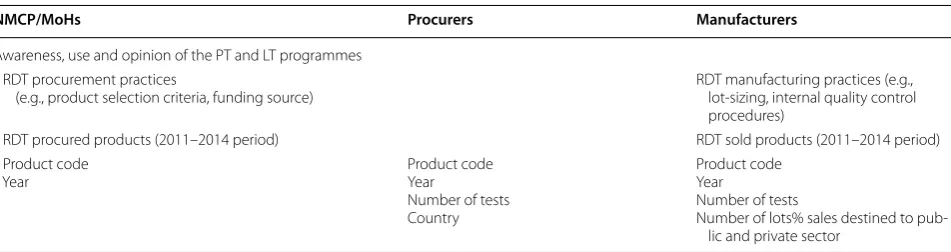
The survey was based on questionnaires sent by e-mail with subsequent follow-up by phone calls as required. Questionnaires included 10–13 predefined queries (Table 1, Additional files 1, 2 and 3) and were accompa-nied by a description of the survey objectives and some background about the PT and LT programmes. The NMCP/MoH questionnaires were made available in French and Spanish to francophone and hispanophone country contacts, respectively, and Portuguese versions were offered to lusophone countries upon request. The survey started in mid-November 2014, and was com-pleted in March 2015. All communications included a confidentiality statement, hence no product-specific nor company/organization-specific information can be made publicly available.
Additional data sources used for the analysis
The sales information gathered from RDT manufactur-ers, i.e. number of RDTs sold per each product code (or catalog number), and procurement information gathered from RDT procurers and NMCPs/MoHs, i.e. number of RDTs procured for each given RDT product code, were compared with the WHO–FIND data of the PT and LT programmes, to determine whether (1) sold/procured malaria RDTs fulfilled the quality requirements of the WHO RDT procurement recommendations, and (2) if they had been lot-tested before purchase and distribu-tion. This analysis obliged using the following additional data sources:
Results of the PT evaluations
All product data entries (sales or procurement) commu-nicated by the survey respondents were assigned to one of three categories, specifically, COMPLY/NOT COM-PLY/NOT TESTED based on the PT performance of the product on the year of the transaction [5, 6, 8, 9], i.e. it was verified if the product sold or procured did meet or not the quality requirements listed in the WHO rec-ommendations for procurement of RDTs [1, 12, 22, 23]; exact definitions are detailed further below. For the pur-pose of this study, the outcomes of the first four rounds of PT were taken into account (Round 5 results have not been included having only been published in July 2014 given there is always a delay before RDT procurers start using updated PT results).
Results of the LT evaluations
The number of lots evaluated per each product (identi-fied by product code) and year was extracted from the LT Programme’s database. Duplicated evaluations of the same lot (e.g., submitted by different requesters, pre- and post- shipment, etc.) were excluded for the computation. For the estimation of the LT coverage, the number of lots submitted to LT was compared to the number of lots sold
Table 1 Summary of data requested in the questionnaires for each survey category
NMCP National Malaria Control Programme, MoH Ministry of Health, PT product testing, LT lot testing, RDT rapid diagnostic test
NMCP/MoHs Procurers Manufacturers
Awareness, use and opinion of the PT and LT programmes RDT procurement practices
(e.g., product selection criteria, funding source) RDT manufacturing practices (e.g., lot‑sizing, internal quality control procedures)
RDT procured products (2011–2014 period) RDT sold products (2011–2014 period) Product code
Year Product codeYear
Number of tests Country
Product code Year
Number of tests
[image:3.595.60.536.579.705.2](as reported by the manufacturers). The available infor-mation on annual product-specific lot sizes allowed for estimates of the number of RDTs covered by LT.
The global fund price and quality reporting (PQR) system (downloaded on 5 May 2015 [24])
This publicly available database compiles information on purchases of health products executed with Global Fund resources. Procurement transaction details are entered by the grant recipients upon receipt of goods. As a con-sequence, this dataset presents some limitations, i.e., not totally complete, reporting delay, potential errors in data entry. However, the bulk of information contained in this database makes it still one of the most valuable sources of data for RDT procurement worldwide transactions.
Analysis and definitions
Qualitative data (i.e., text replies with suggestions and opinions) was classified into different categories of main comments (even if expressed in different ways). Detailed information provided through these replies cannot be disclosed due to its confidential nature. Quantitative data are provided in the form of aggregated figures as well, to preserve confidentiality. Country results are rep-resented according to WHO region categories: Regional Office for Africa (AFRO), the Americas (AMRO), Europe (EURO), the Eastern Mediterranean (EMRO), South-east Asia (SEARO), and the Western Pacific (WPRO). Manual data cross-checks were conducted to verify or complete information and to discard redundant entries received from different sources (e.g., PQR and IO direct reports). For compliance of RDT products with WHO procurement recommendations, products had to fulfill the following requirements: Panel Detection Score (PDS) for Plasmodium falciparum detection being ≥50% (for 2011 data) or ≥75% (for 2012–14 data), PDS for Plas-modium vivax detection (if applicable; i.e., combination tests) ≥75% for 2011–14 data, false positive rates <10%, invalid rates <5%. PT reports used as the reference were: Rounds 1–2 for 2011 data, Rounds 1–3 for 2012 data, and Rounds 1–4 for 2013–14 data. A few considerations should be taken into account: (a) sales data from manu-facturers that replied before end of 2014 and did not pro-vide full-year records for the last year were extrapolated by a prorated calculation based on available data, with corrections accounting for a 1% increase of the overall registered sales for 2014; (b) for the assignment of pro-curement transactions to a particular year, it should be noted that the datasets received from different procur-ers were not fully standardized, i.e., referring to different time points of the procurement process (date of order, date of shipment, date of delivery, etc.); (c) procurement transactions corresponding to different pack sizes (e.g.,
kits of 25, 30 or 50 RDTs of the same product) or for-mats (e.g., kits with single-use packs of RDTs) of a same product were grouped under a lumped product code; (d) for estimation of sales going to the public vs the private health care sector, manufacturers were asked to pro-vide an estimate of their sales going to the public sector on an annual basis, with a single estimate applicable to all products of the company (to facilitate reporting), and the remainder was estimated to go to the private sector. Product-specific analyses were done by using this esti-mate for all product codes hence not accounting for pos-sible differences in the sales to the public vs the private sector between products of the same company; (e) for the purpose of this study, the public sector was considered to refer to institutions procuring RDTs for a not-for-profit purpose, i.e. public institutions (e.g. Ministries of Health, National Malaria Programs, etc.), international organi-zations (e.g. UNICEF, UNDP, etc.), international NGOs (e.g. MSF) and major funding/procurement agencies (e.g. Global Fund-PFSCM, USAID-JSI, etc.) managing large-scale orders aimed at public sector supply. This definition would therefore exclude any orders destined to the pri-vate for-profit sector, e.g. pripri-vate clinics, pripri-vate medical device distributors, pharmacies or drug stores; and, (f) for one manufacturer, the annual number of lots evalu-ated by LT slightly exceeded the reported quantities of lots sold per year, probably because of possible time shifts between sales and lot testing. In this particular case, the estimations of RDT volumes covered by LT were adjusted to avoid over-reporting.
Results
Survey participants
NMCP/MoH survey data
Overall, 100 countries were contacted and replies were received from 79, including 11 who reported not to be using malaria RDTs (six AMRO, two EURO, one EMRO, one WPRO, one AFRO). Therefore, a total of 68 (68%) countries were included in the analysis. Three (4%) out of the 68 did not fully reply to one of the queries; however information on procured RDT products was provided by all 68 respondents. More than half of the NMCP/MoHs participating in the survey belonged to the AFRO region (38/68, 56%). Questionnaire respondents were mostly NMCP coordinators or country focal points for malaria diagnostics. Contributions from Central Medical Stores or National Laboratories (MoH) were also reported in a few questionnaires.
Procurers survey data
Six contacts were not directly conducting procurement, i.e. they were only operating as funding agencies or not currently purchasing malaria RDTs, which results in a final response rate of 48% (12/25). One (8%) out of the 12 respondents did not provide a fully completed ques-tionnaire. As for product data, nine (75%) of the 12 participants provided a duly-completed procurement transaction file for the 2011–14 period. Survey respond-ents were mostly procurement specialists/managers or quality assurance officers. Pharmacists and supply-chain coordinators also contributed for some organizations.
Manufacturers survey data
Forty-two out of 62 (68%) manufacturers responded to the questionnaire, including one who expressed concerns about sharing confidential data, and four considering that the survey was not applicable for their companies (e.g., not currently producing malaria RDTs). Therefore, a total of 37 (60%) questionnaires were returned and included in the analysis. Sales data were made available by 32 (86%) of the respondents (three companies had not sold RDTs, and two indicated confidentiality rea-sons), while the rest of questionnaire replies were fully completed by all participants except one (3%) that stated insufficient experience with the Programme (i.e., had just recently submitted a product for the first time). Among the respondents, 65% were companies based in Asia, 16% in North America and 11% in Europe (the remaining 8% corresponds to one Australian and two South African manufacturers). More than half of the replies were sent by the chief executive officer or product manager of a company. Feedback from the Regulatory Affairs or Qual-ity Assurance departments was also common, whereas direct replies from Overseas Sales and Marketing depart-ments were only received in a few cases.
Malaria RDT procurement
NMCP/MoHs
A total of 157 malaria RDT procurement transactions for the 2011–14 period were reported by the 68 NMCP/ MoHs included in the analysis. Overall, country respond-ents reported 31 different product codes, although there were four main products that accounted for more than half (53%) of the procurement transactions. For the whole survey period, each NMCP/MoH reported an average of 2.3 product codes (range 1–6), and overlap-ping of different products and product types (e.g., Pf-only, Pan/Pf) during the same year was found in 46 and 19% of the countries, respectively. The main sources of funding cited by NMCP/MoHs were the Global Fund and government funding (84 and 63% of reported cases, respectively), followed by other funding sources such as US-PMI, UNICEF and the World Bank (34, 21, and 15%
respectively). The government was largely responsible for the procurement process (e.g., Central Medical Store, Pharmacy department, NMCP, etc.) in 53% of the cases, and a procurement or funding agency such as the Global Fund, US-PMI or UNICEF conducted the procurement in 36% of the cases. When asking the NMCP/MoH con-tacts about knowledge about other organizations procur-ing RDTs in their country, nearly half of them (46%) cited examples such as NGOs, private distributors or interna-tional organizations.
Procurers
After pooling the data received from the nine respond-ing procurers, a total of 1065 transactions for the 2011– 14 period (representing 622,618,199 RDT units) were included in the analysis. Overall, 21% of these RDTs were directly purchased by principal recipients of fund-ing agencies (i.e., direct purchase to the manufacturer by country-based grant administrators), whereas the rest were mainly procured through procurement agents, major institutional buyers or IOs/NGOs central offices. The malaria RDTs reported in this survey group were dis-tributed in 78 different countries, with ten African coun-tries accumulating the 60% of the worldwide reported volumes. For the whole survey period, an average of 3.3 product codes (range 1–9) per destination country was reported. Overlapping of different product codes in the same year was observed in 60% of the countries (up to six different products in circulation), whereas different product types (e.g., Plasmodium falciparum-only, Pan/P. falciparum, etc.) were found to overlap during the same year in 46% of the countries. The presence of simulta-neous procurers (from two to six) distributing RDTs in a specific country and year was detected in 61% of the countries.
Manufacturer malaria RDT sales
Performance of procured RDTs according to PT results
Based on NMCPs/MoH procurement reports (2011–14) Within the list of 31 product codes reported by country respondents for the 2011–14 period, 19 met the WHO procurement criteria (61%), six products did not, and six were products not having been evaluated by the PT programme. However, overall, 136 (87%) of the NMCP-reported transactions corresponded to ‘complying’ RDT products, whereas ‘non-complying’ and ‘non-tested’ products were reported in 15 (10%) and six (4%) transac-tions, respectively.
The compliance of NMCPs/MoH with WHO criteria for RDT procurement was evaluated based on a country performance grade. Briefly, NMCP/MoHs were classi-fied as ‘high-compliers’ when all procured products com-plied with the recommendations, ‘medium-compliers’ when some products complied but others did not, or were not tested, and ‘low-compliers’ when all procured products did not comply or were not evaluated by the PT programme.
For the whole 2011–14 period, a total of 50 (74%) countries were categorized as ‘high-compliers’, whereas 18 (26%) showed ‘medium compliance’. Countries from AMRO, SEARO and WPRO were more frequently rated as medium-compliers (5/8, 4/7 and 3/7, respec-tively) compared to the NMCP/MoHs from the AFRO region (6/38). The annual breakdown of these data shows that most cases of ‘medium’ or ‘low compliance’ were observed in 2011, but then decreased, with only one AMRO and one WPRO country being classified as ‘medium-’ or ‘low-complier’ in the two last years of the survey (Fig. 2). None of the EMRO and EURO countries participating in this survey (n = 8) reported products that did not comply with WHO recommendations.
Countries procuring malaria RDTs with exclusive gov-ernment funding (n = 8) were more frequently rated as ‘medium-compliers’ (5/8) compared to NMCP/MoHs receiving total or partial funding from external donors (13/60); all countries reporting exclusive self-funding and rated as ‘medium-compliers’ (n = 5) were from AMRO, SEARO or WPRO regions. When the NMCP/ MoH performance analysis was done on an annual basis, a noticeable proportion of ‘medium-’ and ‘low-compliers’ was found in 2011 (9 and 21%, respectively), but a clear improvement of the compliance was observed over the four years (from 70% ‘high-compliers’ in 2011, to 97% in 2014) (Fig. 3).
Based on procurers’ reports (2011–14)
Among the total amount of procured RDTs reported for the whole survey period (i.e., 622.6 million RDTs), 17.2 million RDTs (3%) were not complying with the WHO criteria. As shown in Fig. 4a, most of the transac-tions involving procurement of non-complying products occurred during 2011 (16.4 million RDTs). More than half (54%) of the products that did not follow the WHO recommendations were directly procured by principal recipients of large funding agencies.
Based on manufacturers’ sales reports (2011–14)
Among the total sales transactions reported for the sur-vey period (i.e., 846.1 million RDTs), 49.7 million RDTs (6%) were not complying with WHO criteria and 25.1 million RDTs (3%) had not been evaluated by the PT programme. Between 2011 and 2014, the percentage of sold products complying with WHO criteria showed an increase from 83 to 93%, whereas the sales percent-age of non-complying products decreased from 14 to 3% (Fig. 4b).
Comparison of sales to the public vs the private health care sector
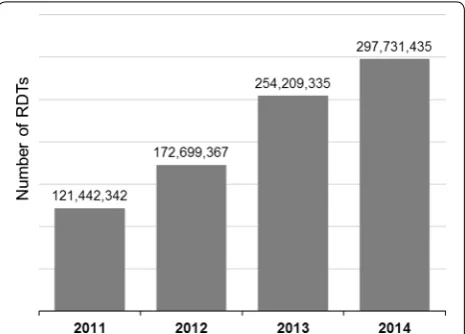
The RDT volumes reported for each product were split according to the estimated annual ratios of sales to the public sector provided by each manufacturer. For the whole survey period, the proportion of products that did not comply with WHO criteria or had not been evalu-ated was found to be higher within the private sector (32%) compared to the public sector (5%). Importantly, private sales accounted only for small fraction of the total reported transactions of this survey (around 16%), however, the absolute number of RDTs that did not meet WHO recommendations was still higher in the private sector sales (43 million RDTs) compared to the total pub-lic sector sales of non-compliant RDTs (32 million RDTs). A clear trend towards increased WHO compliance was observed for the public sector sales (from 84% in 2011, Fig. 1 Number of malaria RDT units sold annually (2011–14) as
[image:6.595.58.291.88.255.2]to 93%, 99% and then 98% in 2012, 2013 and then 2014, respectively) (Fig. 5) but, conversely, the percentage of products complying with the WHO recommendations was gradually decreasing in the private sector (from 78% in 2011, to 68%, 71% and then 61% in 2012, 2013 and then 2014, respectively).
The manufacturers’ reported presence in the pub-lic vs the private sector was found to differ according to the compliance of their marketed products with WHO criteria. For the 2011–14 period, between eight and 13 manufacturers were annually categorized as distributors of ‘high-scoring’ products (i.e., reporting higher sales vol-umes of complying RDTs), whereas 14–20 manufacturers were categorized as distributors of ‘low-scoring’ prod-ucts (i.e., delivering greater volumes of non-complying or not-tested RDTs). Distributors of ‘high-scoring’ prod-ucts were those reporting a wider presence in the public sector (63.9%) as well as accounting for the biggest pro-portion of market share (790 million RDTs; 93% sales), compared to distributors of ‘low-scoring’ products, with only 19.1% average sales destined to the public sector and also smaller market share (56 million RDTs; 7% sales). Fig. 2 Annual compliance of NMCP/MoHs with the WHO criteria for RDT procurement, per region (2011–14). Number of countries in each WHO region and compliance category, per year. Country performance was graded as ‘high‑compliers’ (all procured products complied with recommen‑ dations), ‘medium‑compliers’ (some products complied but others did not, or were not tested) and ‘low‑compliers’ (all products did not comply or were not evaluated by the PT programme). NMCP/MoH National Malaria Control Programme/Ministry of Health, AFRO WHO Regional Office for Africa, AMRO WHO Regional Office for the Americas, EURO WHO Regional Office for Europe, EMRO WHO Regional Office for the Eastern Mediterra‑ nean, SEARO WHO Regional Office for Southeast Asia, WPRO WHO Regional Office for the Western Pacific
[image:7.595.57.539.86.334.2] [image:7.595.56.291.424.603.2]Lot testing coverage
During the 2011–14 period, 2510 lots corresponding to 30 different products from 12 manufacturers were evalu-ated by the LT programme. Among them, three products had not been reported by the manufacturers participating in the survey, so the corresponding LT episodes (i.e., lot testing events of these particular products, n = 6) were not included in this analysis. Overall, 40% (2504/6295)
of the total number of reported lot sales was submit-ted to the LT programme (Table 2). The ten product codes with higher sales volumes had more than 70% of their lots evaluated, with only two exceptions for which 66 and 44% of lots were tested. The available informa-tion on number of lots and lot sizes was used to estimate LT coverage of the RDT sales volumes, showing that an estimated 70% of the global market is covered by the LT Fig. 4 Annual compliance of procured/sold malaria RDT products with the WHO criteria for RDT procurement (2011–14). a Percentage of RDTs procured per year, as reported by RDT procurers (e.g., funding agencies, procurement agents, NGOs, IOs); b percentage of RDTs sold per year. Com‑ pliance categories are based on the PT performance of the RDT product on the year of the transaction
[image:8.595.57.540.87.275.2] [image:8.595.59.539.343.580.2]Programme (Table 2). The amount of products covered by the programme showed an increase, from 69 million RDTs covered in 2011, to 211 million RDTs in 2014.
Awareness, opinions and suggestions about the PT/LT programmes
The reported awareness on the PT and LT programmes was high among procurers (91 and 100%, respectively) and slightly less among the NMCP/MoHs (82 and 85%, respectively). Regarding the interactive guide for malaria RDT selection [11], replies indicated that it is not yet a widely used tool (a 38% of countries and 42% of procurers do not use it or know about it). NMCP/MoHs were often not informed about the requirements set by their donors to select RDTs (i.e., more than 75% of the respondents that did not know about preconditions related to PT/ LT programmes (n = 34) were buying products through major funding agencies/IOs that strictly follow WHO procurement criteria). Only one-third of countries acknowledged mentioning the WHO–FIND malaria RDT evaluation in their national official documents (e.g., country guidelines for malaria diagnostic, technical spec-ifications for RDT procurement), whereas 75% (8/12) of the procurers refer to the WHO–FIND programmes in their Quality Assurance guidelines or tender documents.
Most survey participants (96/106; 91%) had a posi-tive opinion of WHO–FIND malaria RDT Evalua-tion programmes (all mean scores fell between 7 and 8, on a 0–10 scale). Twelve (22%) out of the 55 NMCP/ MoHs who provided comments explicitly pointed out the Programme’s usefulness to guide country decision-making. Manufacturers highlighted the contribution to the enhancement of customers’ confidence, as well as the impact that the PT programme had on the quality of their products, with 15 (42%) manufacturer respond-ents recognizing that it had triggered changes in their manufacturing and quality control procedures. Sugges-tions for improvement depended on the survey group. NMCP/MoHs were interested in a decentralization of the Programme and set up of country-based evaluation laboratories, while manufacturers’ recurrent demand was to increase availability of positive controls for manufac-turing and quality control purposes. Procurers advocated random sampling of tested RDTs, as well as an increased and improved diffusion of the Programme results (e.g., share lot-numbers, publish results of accessories’ evalua-tions, facilitate report interpretation).
Discussion
This large-scale survey allowed assessment of the influ-ence of both the PT and LT programmes on procure-ment and quality control practices, based on first-hand sales and procurement data. Considering that this survey was based on voluntary participation, the questionnaire response rates achieved for NMCP/MoHs (68%), manu-facturers (60%) and procurers (48%) were perceived as satisfactory. In addition, a number of non-responding contacts argued they were not applicable targets (e.g., countries not procuring RDTs, manufacturers not cur-rently producing malaria RDTs).
Volumes and types of RDTs being sold and procured worldwide
[image:9.595.56.290.113.333.2]The global sales volumes compiled through the manu-facturers’ survey (from 121 million RDTs in 2011, to 298 million in 2014) showed the same upward annual trend as reported in the WHO World Malaria Report (from 155 million RDTs in 2011, to 314 million in 2014), with the only difference that the sales reported here indicated a continued increase up to 2014 instead of a trend to stabi-lize after 2013 (i.e., 319 million RDTs reported by WHO in 2013) [14]. Market volumes compiled by WHO were moderately higher (i.e., 5–28% above sales reported in the present survey) although the number of surveyed manu-facturers was slightly lower (24–29 vs 32, respectively). One reason might be that manufacturers did not report a small part of their sales because the detailed informa-tion requested in this survey (e.g., product-specific data, Table 2 Annual coverage of the lot testing programme
(referred to reported RDT sales)
a Number of lots or RDTs that underwent the WHO-FIND malaria RDT lot testing, as per the lot testing database
b Number of lots or RDTs sold as per the survey data gathered from the RDT manufacturers
c Coverage of the Lot Testing programme, estimated by calculating the percentage of lots or RDTs that have been lot tested, relative to the total number of lots or RDTs sold in a given year
Evaluated by lot
testinga Delivered (reported sales)b Percentage of market
coveragec (%)
2011
Lots 334 1310 25
RDTs 68,842,861 121,442,342 57 2012
Lots 480 1525 31
RDTs 105,454,077 172,699,367 61 2013
Lots 908 1708 53
RDTs 208,914,128 254,209,335 82 2014
Lots 782 1752 45
RDTs 211,334,091 297,731,435 71 (2011–14)
Lots 2504 6295 40
number of lots) was not available or not included for other unknown reasons in their datasets (e.g., some miss-ing product codes were noted). Of note, the full sales data collected through these surveys can still be an underes-timation (i.e., missing manufacturers that do not partici-pate in PT and/or did not reply to the survey requests).
The malaria RDT procurement trends inferred from the survey data were also in accordance with the out-comes reported in the UNITAID Malaria Diagnostics Landscape reports [15–17]. Malaria RDT procurement records revealed a frequent co-existence of multiple RDT products in country, occurring in 46 and 60% of countries according to the NMCP/MoH and Procurers data, respectively, with up to six different product codes reported in the same year and country. Even more sur-prising was the overlapping of different product types (e.g., P. falciparum-only, Pan/P. falciparum) in the same year, reported for 19 and 46% of countries according to NMCP/MoHs and procurers’ datasets, respectively. This was unexpected since different product types require a different results interpretation because of the presence of different types of test lines, hence health care staff needs to be trained accordingly to avoid confusions. Sur-vey data also confirmed that in almost two-thirds of the countries there was more than one organization involved in RDT procurement. Overall, these results indicate that the different players of RDT procurement at national level do not necessarily coordinate or aim to procure the same product for the country. Importantly, unless train-ing programmes and supervision are well coordinated, concurrent use of different RDT products can seriously increase the risk of performance errors, especially among less-skilled malaria RDT end-users [25, 26].
Compliance of RDTs with WHO procurement criteria
Overall, compliance with WHO recommendations for selection of malaria RDT has been improving since 2011. The shift to better-performing products was observed in the three survey groups, and can be explained by mul-tiple factors. First, the increased awareness of the pro-gramme among malaria RDT procurers and country decision-makers has prompted changes on their selec-tion and purchasing criteria, including modificaselec-tions of the procurement policies by all major RDT funding agencies since 2010. This survey also shows that around 75% of RDT procurers include programme-based condi-tions in their tender documents or guidelines. Overall, this has probably contributed to the reduction of poor-performing products in the RDT market. More specifi-cally, several product-specific sales fluctuations detected in the market analysis (not disclosed) were closely asso-ciated with updated product results in PT evaluations. Second, PT has stimulated manufacturers to improve
the performance of their products. In this survey, almost half of the malaria RDT manufacturers acknowledged the introduction of manufacturing improvements triggered by the WHO–FIND programme, such as modifications on their lot-release procedures or internal quality control panels. In line with this, the great majority of products that were re-submitted to PT evaluation either improved or maintained their high score, and several products were discontinued after consecutive low PT scoring [5–10]. A product-specific sales analysis of the survey data (not dis-closed here) also indicates a clear increase in the relative market share of a few ‘popular’ products which have been consolidated during the last years as good PT performers and top-selling malaria RDTs. Finally, it should be noted that some malaria RDT products, including some of these ‘top-selling’ ones, have been prequalified by the WHO Prequalification of Diagnostics Programme (WHO PQ) [27]; this has also possibly influenced procurement prac-tice in some countries or by some procurers.
assortment in the retail sector reported here. However, the performance of RDT products sold in the private sector could not be precisely evaluated in the aforemen-tioned survey, since only the proportion of sales to the private sector (without product-specific identification) was collected; this should be the subject of a separate study.
Overall, African national authorities were those more familiar with the WHO–FIND programme and more frequently following the procurement recommenda-tions. Furthermore, the large majority of non-complying products reported by AFRO NMCP/MoHs were Pan/P. falciparum RDTs that were actually ‘non-complying’ for performance of the ‘Pan’ test band only, which would only be relevant for the detection of Plasmodium malar-iae and Plasmodium ovale cases (Plasmodium vivax rarely existing in those regions), hence the most criti-cal requirement of good performance for P. falciparum detection was still fulfilled.
Coverage of the RDT market by LT
This study provides the first market-based estimation on the global coverage of the LT programme since its imple-mentation in 2007. The analysis shows that 40% of sold lots and 70% of sold malaria RDTs were covered by the LT during the 2011–14 period. The difference among lot-based and RDT-based coverage estimations is due to bigger lot sizes of the product codes among the top sales, which also present higher LT coverage compared to the average. Manufacturers ensuring consistent high qual-ity are those dominating the market, and are probably more capable of investing in the expansion of produc-tion plants (i.e., produce larger lots for ‘big’ customers). The reported trend towards increasing LT coverage of the RDT market correlates with the gradual introduction (initiated in 2011) of new policies requiring mandatory lot-testing for the recipients of major donor agencies. The survey has shown that all major procurers use the LT sys-tem and are mostly convinced about its usefulness and relevance. Only a few NMCP/MoHs expressed concerns about the shipment costs and transport-associated delays attributed to the LT submission process.
Awareness and opinions about the programme
While the awareness on the WHO–FIND programmes was shown to be high among the surveyed stakehold-ers, some replies from NMCP/MoHs revealed lim-ited knowledge of the programmes. This finding can be explained, among other reasons, by the quick turnover of NMCP coordinators observed in many countries, but also by a limited involvement of MoH staff in the RDT selection process (e.g., decisions directly taken by fund-ing agency country offices). Reinforced communication
about the programmes to this target group would fur-ther improve awareness at country level and contribute to national authorities taking ownership of quality assur-ance of malaria RDTs used in their country. When asking for opinions about the programmes, partial bias towards positive rating may have occurred since questionnaires were not anonymous. However, in the ‘Suggestions for improvement’ section, complaints and dislikes were openly expressed, so respondents’ feedback was generally perceived as honest.
Limitations
local procurers are likely to be missing, affects to some extent the strength of the results reported here. Nota-bly, small-volume transactions conducted by in-country, small size market actors, are probably underestimated, and the coverages of the PT and LT Programmes are probably slightly underestimated as well.
Conclusions
The WHO–FIND Malaria RDT Evaluation programme has positively influenced procurement practices in the public sector between 2011–14. Malaria RDT products not in line with WHO recommendations seem to be mainly diverted to the private sector where capacity to enforce regulations and national policies is often insuf-ficient, as well as to countries procuring with exclusive government funding and (probably) limited awareness of the PT programme. Advocacy and communication about the WHO–FIND programmes among country-based stakeholders, including those from the private healthcare sector, and more cooperation with national regulatory authorities could help increase compliance with WHO recommendations for procurement of malaria RDTs across all health sectors. In a collaborative implementa-tion project in the private sector in five African coun-tries, FIND and WHO have successfully contributed to the inclusion of specific malaria RDT quality assurance activities in the national policy documents and advocated strongly for a health sector-wide approach to implemen-tation of these activities [29]. The survey reported here also revealed frequent concurrent use of different prod-ucts and even product types in the same country and the same year, which highlights the importance of well-coor-dinated training to avoid the risk of confusion at the end user level.
While the submission of products to LT evalua-tion is consistently increasing, an estimated 30% of the sold RDTs (60% of lots) are not yet covered, so there is still room for expansion of the LT programme; again, an increased communication targeted at national-level stakeholders and regulatory authorities would be ben-eficial. Work is now underway, under funding from UNI-TAID, to transition to a more sustainable country-based LT model, already requested by various countries, with a more simple LT procedure based on recombinant antigen panels [30].
Overall, the survey demonstrates that both the PT and LT programmes are widely used and contribute to an increased quality of malaria RDTs sold and pro-cured worldwide, with a large majority of stakeholders acknowledging their usefulness. The current ongoing work to transition both the PT and LT programmes to a more sustainable format is essential to ensure they can continue to play their important role.
Abbreviations
AFRO: WHO Regional Office for Africa; AMRO: WHO Regional Office for the Americas; EURO: WHO Regional Office for Europe; EMRO: WHO Regional Office for the Eastern Mediterranean; FIND: Foundation for Innovative New Diagnos‑ tics; IO: International Organization; LT: lot testing; MSF: Médecins sans Frontières; MoH: Ministry of Health; NGO: non‑governmental organization; NMCP: National Malaria Control Programme; PQR: The Global Fund Price and Quality Reporting; PDS: panel detection score; PT: product testing; RDT: rapid diag‑ nostic test; SEARO: WHO Regional Office for South‑East Asia; UNICEF: United Nations Children’s Fund; US‑PMI: US President’s Malaria Initiative; WHO: World Health Organization; WPRO: WHO Regional Office for the Western Pacific.
Authors’ contributions
SI, ESC, IG, and JC designed the study. SI and ESC developed the survey ques‑ tionnaires, with inputs from IG, JC and NC. ESC conducted the survey, the data analysis, and drafted the manuscript. NC contributed to analysis of LT‑related data. All authors read and approved the final manuscript.
Author details
1 FIND, Geneva, Switzerland. 2 Independent Consultant, FIND, Geneva, Swit‑
zerland. 3 Global Malaria Programme, World Health Organization (WHO‑GMP),
Geneva, Switzerland.
Acknowledgements
We would like to thank all survey respondents for their efforts in providing replies and data, and resolving any subsequent questions.
Competing interests
The authors declare that they have no competing interests.
Availability of data and materials
The datasets supporting the findings presented in this manuscript cannot be shared in a publicly available repository, since data were received under a strict confidentiality agreement. In order to preserve confidentiality, all results presented in the manuscript are in the form of aggregated figures.
Funding
This survey has been conducted with funding from UNITAID and from the JSI USAID|DELIVER PROJECT.
Publisher’s Note
Springer Nature remains neutral with regard to jurisdictional claims in pub‑ lished maps and institutional affiliations.
Received: 7 October 2016 Accepted: 9 May 2017
References
1. World Health Organization. Good practices for selecting and procuring rapid diagnostic tests for malaria. Geneva: World Health Organization; 2011.
2. Mouatcho JC, Goldring JPD. Malaria rapid diagnostic tests: challenges and prospects. J Med Microbiol. 2013;62:1491–505.
Additional files
Additional file 1. Questionnaire NMCP‑MoH (FIND survey). Template of
the survey questionnaire that was distributed among targeted NMCP/ MoHs.
Additional file 2. Questionnaire procurers (FIND survey). Template of the
survey questionnaire that was distributed among targeted RDT procurers.
Additional file 3. Questionnaire manufacturers (FIND survey). Template
• We accept pre-submission inquiries
• Our selector tool helps you to find the most relevant journal
• We provide round the clock customer support
• Convenient online submission
• Thorough peer review
• Inclusion in PubMed and all major indexing services
• Maximum visibility for your research
Submit your manuscript at www.biomedcentral.com/submit
Submit your next manuscript to BioMed Central
and we will help you at every step:
3. Chiodini PL, Bowers K, Jorgensen P, Barnwell JW, Grady KK, Luchavez J, et al. The heat stability of Plasmodium lactate dehydrogenase‑based and histidine‑rich protein 2‑based malaria rapid diagnostic tests. Trans R Soc Trop Med Hyg. 2007;101:331–7.
4. WHO‑FIND Quality Assurance of malaria RDTs. http://www.finddx.org/ quality‑assurance/quality‑assurance‑of‑malaria‑rdts. Accessed: 17 Apr 2016.
5. WHO–FIND. Malaria rapid diagnostic test performance‑results of WHO product testing of malaria RDTs: round 3 (2010–2011). Geneva: World Health Organization; 2011.
6. WHO–FIND. Malaria rapid diagnostic test performance‑results of WHO product testing of malaria RDTs: round 2 (2009). Geneva: World Health Organization; 2010.
7. WHO–FIND. Malaria rapid diagnostic test performance‑results of WHO product testing of malaria RDTs: round 6 (2014–2015). Geneva: World Health Organization; 2015.
8. WHO–FIND. Malaria rapid diagnostic test performance‑results of WHO product testing of malaria RDTs: round 4 (2012). Geneva: World Health Organization; 2012.
9. WHO–FIND. Malaria rapid diagnostic test performance‑results of WHO product testing of malaria RDTs: round 1 (2008). Geneva: World Health Organization; 2009.
10. WHO–FIND. Malaria rapid diagnostic test performance‑results of WHO product testing of malaria RDTs: round 5 (2013). Geneva: World Health Organization; 2014.
11. FIND. Interactive guide for high‑quality malaria RDT selection. http:// www.rdt‑interactive‑guide.org. Accessed 17 Apr 2016.
12. WHO Global Malaria Programme. Recommended selection criteria for procurement of malaria rapid diagnostic tests. Geneva: World Health Organization; 2016.
13. FIND–WHO malaria lot testing results: 2007. http://www.finddx. org/wp‑content/uploads/2016/02/FIND‑WHO‑Malaria‑lot‑testing‑ results‑2007‑2015.pdf. Accessed 17 Apr 2016.
14. WHO. World Malaria report 2015. Geneva: World Health Organization; 2016.
15. UNITAID. Malaria diagnostics technology and market landscape. 2nd ed. Geneva: UNITAID; 2014.
16. UNITAID. Malaria diagnostics landscape update. Geneva: UNITAID; 2015. 17. UNITAID. Malaria diagnostics technology and market landscape. 3rd ed.
Geneva: UNITAID; 2016.
18. WHO. World malaria report 2011. Geneva: World Health Organization; 2012.
19. McCombie S. Treatment seeking for malaria: a review of recent research. Soc Sci Med. 1996;43:933–45.
20. Albertini A, Djalle D, Faye B, Gamboa D, Luchavez J, Mationg ML, et al. Preliminary enquiry into the availability, price and quality of malaria rapid diagnostic tests in the private health sector of six malaria‑endemic countries. Trop Med Int Health. 2012;17:147–52.
21. WHO. World malaria report 2012. Geneva: World Health Organization; 2013.
22. WHO Malaria Policy Advisory Committee and Secretariat. Inaugural meet‑ ing of the malaria policy advisory committee to the WHO: conclusions and recommendations. Malar J. 2012;12:213.
23. WHO Global Malaria Programme. Information note on recommended selection criteria for procurement of malaria rapid diagnostic tests (RDTs). Geneva: World Health Organization; 2012.
24. The Global Fund. Price and quality reporting. http://www.theglobalfund. org/en/pqr. Accessed 5 May 2015.
25. Maltha J, Gillet P, Jacobs J. Malaria rapid diagnostic tests in endemic set‑ tings. Clin Microbiol Infect. 2013;19:399–407.
26. Jacobs J, Barbé B, Gillet P, Aidoo M, Serra‑Casas E, Van Erps J, et al. Har‑ monization of malaria rapid diagnostic tests: best practices in labelling including instructions for use. Malar J. 2014;13:505.
27. WHO‑PQ. Public reports of WHO prequalified IVDs (Malaria RDTs). http:// www.who.int/diagnostics_laboratory/evaluations/pq‑list/malaria/pub‑ lic_report/en/. Accessed 31 May 2016.
28. Poyer S, Shewchuk T, Tougher S, Ye Y, Gatakaa H, Njogu J, et al. Availabil‑ ity and price of malaria rapid diagnostic tests in the public and private health sectors in 2011: results from 10 nationally representative cross‑ sectional retail surveys. Trop Med Int Health. 2015;20:744–56. 29. UNITAID. Creating a private sector market for quality‑assured RDTs in
malaria endemic countries (2013–2016). Geneva: UNITAID. http://www. unitaid.eu/en/creating‑a‑private‑sector‑market‑for‑quality‑assured‑rdts‑ in‑malaria‑endemic‑countries. Accessed 31 May 2016.