Ref. Ares(2010)64503 - 08/02/2010
COOPERATION
European Union - Republic of Mauritius
JOINT ANNUAL REPORT
Final: Up-date:
2008
0
CONTENTS Executive Summary
1. Update on the political, economic, social and environmental situation
1.1 Update on the political situation 1.2 Update on the economic situation
1.3 Update on the poverty and social situation 1.3 .1 Gender and children issues 1.3 .2 Education and training 1.3.3 Health
1.4 Update on the environmental situation
2. Overview of past and on-going co-operation
2.1 Reporting on the financial performance ofEDF resources 2.2 Reporting on General and Sector Budget Support
2.3 Projects and programmes in the focal and non focal areas 2.3 .1 Projects and programmes in the focal areas
- Wastewater Sector Policy Support Programme (WSPSP)
-Sugar Sector Policy Support Programme (SPSP)
-Improved Competition for Equitable Development (GBS)
2.3.2 The development results achieved by projects and programmes in the non- focal area
- Decentralised Cooperation Programme
-Technical Cooperation Facility
2.3.3 The development results achieved by support ofNon-State Actors 2.4 Other cooperation
2.4.1 FLEX
2.4.2 Sugar Accompanying Measures and Protocol 2.4.3 Fisheries Agreement and Protocol
2.4.4 EIB
2.4.5 Regional Cooperation 2.5 Policy Coherence for Development
2.5.1 Sugar 2.5.2 Fisheries
2.5.3 Economic Partnership Agreements 2.5.4 Regional Cooperation
2.5.5 Joint EU-Africa Strategy
2.6 Dialogue in country with the national Parliaments, the local authorities and NSAs
2.7 Aid Effectiveness
Executive Summary
Mauritius has made significant progress in advancing the reform agenda since 2006/07 which has helped to cushion the economy from the global financial crisis to a large extent. In 2008, economic growth reached 5.2 %, slightly down from 5.4% in the preceding year. However, growth remains diversified with 3.2 % in tourism, 5.5 % in sugar, 7.5% in real estate and 11 %in construction and 13 %in banking. Moreover, the transport and communications sector continues to grow strongly at 7.1 %, including 15% growth in ICT. Investment as a ratio of GDP is expected to rise for a third consecutive year to 25.4 %, driven mostly by the private sector, including FDI which has reached MUR 7 billion at end October 2008.
The first impact of this global crisis on Mauritius has been modest, but depending on its depth and duration, this may have severe repercussions on the key sectors of the economy. As a response, and as part of the reform agenda, the Government introduced a two-year period Stimulus Package in December 2008 for an envelope of some MUR 10.4 billion to shore up economic performance and unlock an extra 1 to 1 Y2 % growth annually.
Regarding the European Commission assistance to Mauritius, more than 80% of its grants are channeled in the form of budget support to fmance the economic reform programme. The first general budget support programme, Improved Competitiveness for Equitable Development (ICED I), was launched in 2007 to contribute to the sustainable economic development of the country. The second phase of the programme, ICED II, is being funded from the EC Accompanying Measures (2008), and builds upon the results obtained during the ICED I with an additional focus on environment protection, more particular the wastewater sector. Mauritius also benefited from additional funds under the Fluctuation in Export Earnings (FLEX) mechanism to mitigate the adverse effects of instability of its agricultural export earnings. Sectoral budget support for the Wastewater Sector Programme under the 9th EDF which started in 2003/04 ended in 2007/08 whilst the Decentralised Cooperation Programme (DCP) supporting the Non State Actors will be completed in 2010 and will be succeeded by another programme under the lOth EDF.
In addition to the assistance from the EC, other external development partners, including the Agence Fran9aise de Developpement, (AFD), the African Development Bank (ADB), the UNDP and the World Bank (WB), have been supporting the government reform programme in the form of direct budgetary support as well as technical assistance to assist with the overall implementation of the economic reform programme. Coordination among external partners has progressed significantly with the holding of regular joint missions and consultations including an Annual Business Plan Meeting in February. The Government also held a Joint Country Programme Review in September, 2008 to improve dialogue process with its Development Partners.
stakeholders, especially with small planters. In 2008 consultations continued with NSAs in the context of the general economic reform programme. The NSAs also participated in discussions on the Decentralised Cooperation Programme. Moreover, meetings on the EC-Mauritius cooperation relationship in the context of the ETR conclusions and JAR 2006 as well as a mission of representatives of the European Economic and Social Committee offered the opportunity for NSAs to participate. Finally, a preliminary meeting was organised by the NAO's office and the Delegation on lOth March 2009 to discuss the first draft of the JAR 2008 and Government's commitments as regards to good governance. Participants included representatives of Mauritian NGOs, trade unions, various federations and relevant public institutions, local authorities and Ministries involved in cooperation activities with the EC. The meeting was well attended and the two EU members states present in Mauritius were also present. The Delegation is exploring options to restructure the dialogue with NSAs in order to render it more focussed on specific sectors and themes and to hold it at more regular intervals. The need of a structured mechanism for dialogue between NSAs, Government, private sector and donors has been raised on several occasions but no concrete proposal has been developed yet.
With regards to governance commitments, the Government remains fully committed to implement these as foreseen. At the same time, the African Peer Review Mechanism (APRM) was completed in 2008 and the Self Assessment Report and Programme of Action for Mauritius being finalised. A country Review Mission led by members of the APR pannel is expected in July 2009.
Commitments and disbursements under 9th EDF have proceeded as planned, with a total of€ 67,984,833 committed and € 60,398,299 disbursed, of which € 22,328,607 in 2008 as payments for the WSPSP (€ 4,301,422), the DCP (€ 4,658,016), TCF (€ 126,639).
1. Update on the political, economic and social situation 1.1 Update on the political situation and governance
During 2008, the political scene remained unperturbed. No national and local elections took place and the Government coalition led by the Labour Party maintained the majority in the National Assembly.
Important progress has been noted in the commitments taken under the governance profile, as detailed in the Mauritius lOth EDF CSP. Parliamentary democracy has been functioning smoothly and the new reforms of the judiciary proposed by Lord Mackay are being implemented since 2007. The Bill towards the restructuring the Supreme Court into a High Court of Appeal and a Court of Appeal has been finalised and the Attorney General's Office has been divided into three units with dedicated staff to each unit. As regards political governance, the Equal Opportunity Bill was passed in the National Assembly in December 2008, while a number of Bills, the Human Rights (Amendment) Bill, the National Preventive Mechanism Bill, the Police Complaints Bill and the DNA Bill are being finalized.
Consultations in view of the African Peer Review Mechanism (APRM) of the New Partnership for Africa's Development (NEPAD), which were launched in June 2007, has been completed and the Self Assessment Report and Programme of Action for Mauritius being finalised. A country Review Mission led by members of the APR panel is expected in July 2009.
A Public Enterprise Reform Unit has been set up within the Ministry of Finance and Economic Empowerment to oversee and coordinate the parastatal reform process initiated in 2007 and help create a parastatal performance and reform information system.
Progress made under the various governance commitments taken by the Government in the context of the lOth EDF programming is indicated at annex ...
1.2 Update on the economic situation
While most countries in the rest of the world have been facing recession due to the global financial crisis, the Mauritian economy has performed relatively well in 2008 with a GDP 5.2%, although slightly below the performance of 5.4% registered in 2007. The economic reform strategy initiated in 2006 has borne fruits and has put the economy back on a higher and balanced growth path and this despite of economic turbulences in the external environment. The effectiveness of the reforms and the robustness of the financial system have opened the economy and made it more versatile and resilient. The strengthening of the emerging sectors to diversify the economic base has created good capacity to offset the negative effects of external shocks. At the same time, the reforms have provided the fiscal space and have built up investor confidence crucial to cushion the adverse impact of the international financial and economic crisis.
Unemployment has declined. FDI has soared and private investment recovered fully from its worst performance in many years. The textile industry was no more mired in deep depression. Construction and tourism were booming. The seafood and the ICT sectors were doing well. A new wave of SMEs has been rising. New sectors are firming up their roots to become additional pillars. Jobs are being created at more than twice the rate prior to reforms. And net international reserves have increased.
In 2008, investment, exclusive of aircraft and marine vessel, grew by 6.5% compared to a high growth of 17.0% in 2007. Private sector investment which has been increasing since 2006 (15.2% in 2006 and 24.5% in 2007) slowed down in 2008 with a growth of 7.9%, mainly due to investment in hotels and IRS projects as well as in commercial and office buildings. Public sector investment on the other hand rebounded in 2008 with a growth of 0.4% after contractions in 2005, 2006 and 2007.
The unemployment rate fell from 9.1% in 2006 to 7.8% in 2008 as economic activities improved. On the other hand, the inflation rate for the calendar year 2008 was 9. 7% compared to 8.8% for the calendar year 2007. This was mainly due to high food prices which increased by 11.7% from 2007 to 2008.
Building on the reforms put in place in the 2007/08 budget, the 2008/09 budget has formulated a new wider programme, called the Attractive, Modem, Inclusive, Green and Open economy (AMIGO) plan, which sets out the agenda for action and outlines what the main elements of an economic development strategy over the next decade and beyond should encompass. A new approach to control fiscal space has been presented in the Public Debt Management Act 2008. As noted by the IMF in its latest Assessment letter (December 2008), under the impact of the fiscal reforms, the overall deficit was lowered to 3.4% of GDP in 2007/08 from 5.4% in 2005/06 while public sector debt was reduced to about 60 % of GDP in June 2008 from close to 70 % in June 2005.
In pursuit of a place among the top ten economies in the world on the ease of doing business, various procedures have been further simplified and the system of business licensing has been streamlined and simplified to make compliance easier, less time consuming and less costly. World Bank's Doing Business 2009 places Mauritius at the top in Africa and 24th world wide as compared to 29th in last year's report.
In 2008, food security has emerged as a critical issue. Given the limited land area, Mauritius is seeking to partner with other countries in the region to increase food production through a Regional Food Security Initiative (RFSI) that is viable, sustainable and operators of the private sector ready to engage investments. On the local front, a Food Security Fund has been established and a draft three year strategic plan for Food Security has been prepared. The plan includes the mobilisation of additional land resources, including in Rodrigues, with irrigation facilities to grouped small farmers; the production of crop, meat and milk; the upgrading of veterinary services, food technology laboratory; the construction of four fibre-glass fishing boats, the setting up of a fish cage-culture, the construction of one semi-industrial fibre-glass fishing boat and the training of skippers and mechanics.
In December 2008, government announced another series of measures under its additional stimulus package of MUR 10.4 bn in view of shoring up economic performance and contain the impact of the global financial crisis. The focus of the stimulus package is on fast-tracking and frontloading of existing public infrastructure projects, new investments in public infrastructure, accelerating private sector investment, improving business climate, building human resource capacity, and supporting vulnerable sectors such as the SME, export oriented & manufacturing and tourism. The economy is forecasted by the Government to grow by 4.0% with the implementation of the additional stimulus package. The IMF in its latest forecast projected a lower growth of around 2% which, given the international environment would still be an achievement.
procedures more transparent, efficient and accountable, a Procurement Policy Office has become operational since January 2008, under the Public Procurement Act 2006. However, certain operational aspects of the legislation may need to be revisited to improve them and Government has initiated the process for a review.
At the regional level, Mauritius initialed an EPA interim agreement in December 2007. The agreement covers a WTO Compatible Market access offer, a chapter on development as well as provisions on fisheries. Mauritius has been negotiating within the ESA region and so far 5 ESA countries i.e, Madagascar, Comoros, Seychelles, Zimbabwe and Zambia have initialed an EPA interim agreement. The ESA region was expected to conclude negotiations in 2008. However, given that discussions were not completed on several critical issues including services, trade related issues such as competition policy and investment; it was agreed at the last ESA Council meeting that negotiations would be extended to 2009. Negotiations are expected to continue in 2009 on all outstanding issues with a view to concluding a full and comprehensive EPA, namely, Customs and trade facilitation, Rules of origin, Trade defense mechanism, Outermost region, TBT and SPS, Services, Trade related issues, Investment, IPR, Agriculture, Development.
Mauritius regards trade liberalisation as an effective route to promote growth, development, and poverty reduction in Africa and elsewhere. Mauritius is actively supporting and participating in the establishment of an effective Free Trade Area (FTA) embracing CO MESA, SADC and EAC and wants to achieve a fully effective FT A within the region and eventually an FTA with the EU in the context of EP As and with the US as a natural evolution of AGOA. The Tripartite SADC-EAC-COMESA Summit in 2008 called for a harmonsied approach on trade policies and recommended the establishment of an enlarged FT A in the region. All these moves would serve to make the region attractive to foreign direct investment (FDI) and a subsequent integration of the region into the global economy.
Mauritius continues to strengthen ties with key trading partners including India with which a Comprehensive Economic Co-operation and Partnership Agreement is being negotiated. A PTA between Mauritius and Pakistan was signed in June 2007 and entered into force in November 2007. Discussions are underway between the two Parties on the conclusion of a FTA. Mauritius also obtained the third countries fabric derogation in 2008 under the US's African Growth and Opportunity Act (AGOA), after extensive lobbying. A Trade and Investment Framework Agreement (TIF A) has been signed with the US in 2006 and work is ongoing to operationalize the agreement with cooperation in selected sectors/themes.
1.2.1 Mauritius external sector External trade
Mauritius is a small export-oriented economy, which is dependent on fuel imports for local energy consumption, manufactured goods and food & live animals from abroad. Share of exports of goods in GDP for 2008 was 25.8%. Level of coverage of imports by exports in 2008 was 51.6% (including re-export). Trade deficit in 2008 represented 24% of GD P (including re-export values).
The major export products ofMauritius are apparel & clothing (40.2% of total exports in 2008), sugar cane (13.9%), fish and fish preparations (13.5%) and machinery and transport equipment (6.3%) (see table 1 in Annex I d). The most important export destination for Mauritius remains by far Europe, with 68% of total good exported. Mauritian goods are exported mainly to UK, France, USA, Madagascar, South Africa, Italy, Reunion and Belgium (see table 2 in Annex I d).
Mauritius is mainly importing mineral fuels and lubricants (21.4% of total imports in 2008), machinery and transport equipment (19.8%), manufactured goods (18.9%) and food and live animals (18%) (see table 3 in Annex I d). The imported goods come mainly from Asia, in particular from India (23.4%) and China (11.5%). Other important import countries for Mauritius are South Africa, France, Japan, Australia, USA, Spain, Germany (more details in table 4 in Annex I d).
Terms of trade
The Export Price Index (EPI) provides an overall measure of pure price changes (in Mauritian rupees) of domestically produced goods exported to other countries. The Import Price Index (IPI), on the other hand, measures price changes (in Mauritian rupees) of goods purchased from other countries (excluding transactions through the Freeport activities). The weights used for the compilation of the indices have been derived from trade data for the year 2002 while the year 2003 is used as reference year (i.e. 2003=100). A rise in this ratio indicates that the terms of trade have moved in favour of Mauritius. During the fourth quarter of 2008, export prices increased by 2.3% over the previous quarter while import prices went down by 8.6%. Consequently the terms of trade index increased by 8 percentage points to reach 75.
Foreign Direct Investment (FDI)
Foreign Direct Investment has increased four-fold between 2005 and 2008. This is partly attributed to the successful implementation of bold measures to improve the investment climate that were part of the first generation of economic reforms in Mauritius as from 2006. For 2008 the overall FDI level was slightly lower than 2007, it represented 4.1% of GDP. The financial sector attracted 40% of FDI in 2008, followed by hotel and tourism sector with 35% and real estate with 16.5%. Regarding the source countries, Europe, especially UK, continues to be the main provider of FDI. However in the recent past the inflow of FDI from India, United Arab Emirates and South Africa has increased substantially (see table 5 in Annex I d).
FDI inflows from Africa, Asia and America have increased significantly from 2006 to 2008. The countries with highest FDI increase are India, South Africa and USA. It seems that Mauritius is reaping the benefits of aggressive economic and diplomatic cooperation with the Asian countries, especially India, which has historical ties with the island. On the other hand a significant decrease in overall FDI inflow from Europe can be observed, which is connected with the economic slowdown especially in the UK.
Future Perspectives
Export of fish and fish preparations, one of the government's pnonty sectors for expansion, will increase as a share of total exports. It is worth mentioning that due to the increased pirates' activities in the Indian Ocean, there are many uncertainties for the fish industry in the whole region. Export of apparel & clothing, which amounted to 40% of total exports in 2008, is expected to decrease substantially in 2009 due to reduced demand in their main markets, i.e. UK and USA.
1.3 Update on the poverty and social situation
The Government is continuing its efforts of promoting an inclusive growth with balanced, sustainable economic development, by integrating the families who are at the margin of development, eradicating absolute poverty, and by further broadening the circle of opportunities. Although the proportion of population living in extreme poverty (defined as< 1$ per person per day) was less than 1% in 2006/07, Government is committed to combat poverty in all its forms and wherever it exists.
The Empowerment Programme has been an important tool to reskill those who have lost jobs in declining sectors, to reintegrate those who are left behind and to prevent those on the periphery from sliding into poverty. Since the 2008/09 Budget, the Empowerment Programme is run by a state-owned, not-for-profit company-the National Empowerment Foundation. An Eradication of Absolute Poverty (EAP) Programme is also in place to help fight the battle against poverty. This is an integrated development project to be executed within the 229 identified pockets of absolute poverty. The EAP Programme is being implemented though a five track partnership, bringing together the entire range of social partners, including, socio-cultural organizations, NGOs, the corporate sector, development partners and the various levels of government. The Trust Fund for the Integration of Vulnerable Groups is also playing a key role in facilitating the integration of the vulnerable groups in the mainstream of development.
UNDP is assisting the government to develop a Social Register (a database on actual and potential beneficiaries of social welfare programmes). Data from the 'Living Conditions Survey' (LCS), conducted by the Central Statistics Office through a co-funding from the Decentralised Cooperation Programme in November 2008, together with the 2006/2007 Household Budget Survey will be used to determine a national absolute poverty line and other income thresholds based on basic needs of household. The poverty line is expected from the UNDP consultant by June 2009.
Government has also revamped, consolidated and strengthened its social housing schemes. The traditional housing programmes have been strengthened through the construction of additional housing units. In parallel, a Social Housing Fund has been set up to receive and manage the 1,000 arpents ofland and improve financing for housing by developing and overseeing a new and ambitious programme to build new mixed housing communities on a PPP basis. Since its inception, the Fund has initiated activities relating to the rehabilitation ofNHDC estates and infrastructure for social housing and support for affordable housing to bring down the cost of mortgages.
Government's commitment to its social development is reflected in the remarkable progress achieved in meeting the Millennium Development Goals (MDGs). Mauritius's
ranking on the Human Development Index has moved from 0.662 in 1980 to 0.781 in 2000 to 0.804 in 2005. Mauritius has been able to meet most of the 8 Goals, except in the areas ofwomen in political decision-making and HIV/AIDS prevalence.
1.3.1 Gender and children issues
In line with the provisions contained in CEDAW (1984), SADC (1995/1998) and other Regional and International Instruments to which the Country adheres to, Mauritius is well equipped to combat discrimination related to gender, for instance, the Protection from Domestic Violence Act, the Sex Discrimination Act and recently the Equal Opportunities Act which was passed in December 2008. Mauritius is a party to the Beijing Platform of Action and has also identified gender-based violence as one of the critical priority areas at the Fourth World Conference on Women in Beijing. Mauritius has also signed the Protocol to the African Charter on Human and People's Rights on the Rights of Women in Africa and its ratification is in process.
On the local front, an Action Plan to Combat Domestic Violence was launched in November 2007, spelling out the roles and responsibilities of all stakeholders concerned to combat domestic violence.
Government has adopted a shift from the "Women in Development" approach to that of "Gender and Development" and has adopted a Gender Management System (GMS) derived from the 1995 Commonwealth Plan of Action on Gender and Development. Through the support of the UNDP and the ILO, a 'Capacity Building for Gender Equality and Empowerment of Women' project is being implemented to strengthen the National Gender Machinery (NGM) (2005-2009). The project adopts a multi-pronged approach that will in the long term create in Mauritius, an environment that will ensure the development of policies, legislation, fmancial and economic mechanisms that will promote gender equality in the social, economic and political spheres, and at the same time, enhance women's empoweri:nent.
Mauritius is poised to be one of the pioneering countries in the African region to implement principles of gender responsive budgeting. Government has approved a National Gender Policy Framework (NGPF) as an overarching framework that provides the guiding principles, broad operational strategies and institutional arrangements for achieving gender equality at the national level. The NGPF supports a strategic partnership at the levels of the media, private sector, civil society organisations and Government to promote gender equality. The Framework also calls upon each Ministry/Department and institutions to formulate their own sector-specific gender policy and as part of strategic budgeting initiatives, key entry points for engendering the programme based budgeting (PBB) exercise have been identified with pilot Ministries. To date 4 Pilot Ministries have formulated their sectoral gender policies.
Also, technical expertise will be provided to pilot Ministries to assist in the engendering of their respective non fmancial Programme Based Budgeting (PBB) exercise for the financial year 2010/2011 and to build their capacity on gender responsive budgeting. Given the success of the first pilot phase, four additional Ministries have been included in the pilot scheme.
To tackle the issue of high female unemployment and to create more opportunities and open greater space on the labour market for women, the Empowerment Programme and the Trust Fund for have continued to provide financial support, training and technical advice to women. In 2008, around 1900 female employment seekers registered with the Empowerment Programme have been trained and placed /obtained a job/ joined a business network/become self employed/benefited from the Circular Migration Programme.
The protection and development of children rank high in the agenda of the government. Mauritius has ratified several important international human rights and instruments, the latest being the Optional Protocol to the CEDA W, in October 2008. Mauritius ratified the Optional Protocol to the CRC on Involvement of Children in Armed Conflict on 12 February 2009. Moreover, the Government is also making necessary arrangements to introduce new legislations and amending existing ones prior to ratifying the Optional Protocol on Sale, Child Prostitution and Child Pornography.
The Child Protection Act 1994, which was amended in December 2005 to make provision for all cases of child trafficking, abandonment and abduction, was further amended in December 2008, to provide for a Child Mentoring Scheme in view of providing individual guidance and support to adolescents with behavioural problems who may also be prone to becoming victims of commercial sexual exploitation and child violence in general.
In line with Government programme 2005-2010, which highlights the need to strengthen the enforcement mechanism of the Protection from Domestic Violence Act, further amendments were brought to the Act in 2007, whereby provisions have been made for alimony, counseling instead of sentence and harsher penalties for failing to comply with court orders.
Since January 2008, crackdown operations have been conducted islandwise at regular intervals by Officers of this Ministry, the National Children's Council, the Brigade des Mineurs (Police Department), in collaboration with NGOs to ensure that young persons and students are attending schools during normal school hours. Such operations are seen to contribute to prevent young persons from playing truancy and loitering around thereby getting involved in illicit activities.
Moreover, the Ministry of Women's Rights, Child Development and Family Welfare (WRCDFW), has also step up activities under its various ongoing programmes, for instance the National Parental Empowerment Programme", the Outreach Programmes in deprived regions, the Community Child Protection Programme and the Day Care/Drop-in-Centre, the provision of psychological support and group therapy for the successful rehabilitation and reinsertion of children victims of sexual abuse and exploitation, and sensitization and awareness campaigns among others.
1.3.2 Education and Training
Mauritius is investing heavily in education to sustain its growth and promote its global competitiveness. Government is committed to ensure life-long employability and lifelong
learning will permit youngsters to receive an education which will render them equipped to deal with a world which is constantly posing new challenges.
An Education & Human Resources Strategy Plan (EHRSP) has been formulated, through EC funding, in line with the vision of providing access to learning opportunities for all and developing a human resource base to transform Mauritius into an intelligent nation state through the development of a culture of achievement and excellence. Central to this Plan is the universalisation of opportunities for quality education at all levels, right from pre-primary through to post-secondary education subsectors, and for the training sector.
A comprehensive and effective action plan to increase enrolment ratio at tertiary level is also being implemented. The short term actions will be accompanied by a medium term strategy to significantly increase the share of each cohort of primary students going to HSC and to tertiary education so as to double the enrolment ratio by 2015.
Government has also established a Human Resource Development, Knowledge and Arts Fund which finances physical infrastructure for tertiary education, projects to equip individuals with access to information, knowledge, technology, training and skills, student loan schemes and scholarships; schemes to encourage and support local artists; and initiatives to foster the arts and creativity.
A Second Chance Programme has been introduced to focus on skills which could facilitate selection by the Circular Migration programmes that are being set up with Canada and France and pursuing with other countries.
Government is continuing its support to ZEP schools to address the issues of poor educational achievement at the end of their primary school cycle and the high school drop out. The 2008/9 budget further consolidated the ZEP programme through the Eradication of Absolute Poverty (EAP) programme. The EP A/ZEP philosophy is based on the premise that positive reinforcement is required to create favorable learning conditions for children living mostly in less developed regions. Through this programme, government is offering a comprehensive package (food, clothing, housing, transport and access to early childhood care and education programs) directed to just over 7000 of the poorest families. While every effort is made to get 5000 children of pre-school age to register for young child integrated programs, parents from these families are encouraged to join in programs that include Parents Empowerment and functional literacy programs.
The Empowerment Programme has also been complementing the ZEP programme through community empowerment to facilitate, participation and improve performance of children from poor families. The activities of the Empowerment Programme have been scaled up to improve human resources capacity, through training and re-skilling programmes so as to ensure that employability and adaptability of the population.
Latest educational statistics revealed that pre-primary schools numbered 1,070 in March 2008 with an enrolment of 36,242 children (50% boys, 50% girls). The Gross Enrolment Ratio (number of students enrolled per 100 population aged 4 to 5 years) worked out to 94% with an average of 14 pupils per teacher. At the primary level, Gross Enrolment Ratio (number of students enrolled per 100 population aged 6 to 11 years) was 101% and
the pupil/teacher ratio 29.CPE pass rate which was 67.93% in 2006 dropped to 66.17% in 2007 but improved to 67.4% during 2008. On the other hand, CPE pass rate in ZEP schools declined from 36.5% in 2006 to 36.0% in 2007 and 35.9% in 2008Absenteeism rate in ZEP schools which was 15.7% in 2007 dropped to 12.9% in 2008. As regards HSC, the pass rate fell from 79.3% in 2006 to 77.8% in 2007 and rose slightly to 78.7% in 2008. In 2008, 54 tertiary institutions, both public aided and private, were operational as compared to 47 in 2006 and 51 in 2007. As regards enrollment, tertiary level enrolment was around 40% in 2007.
Government is also setting up a Regional Multidisciplinary Centre of Excellence (RMCE) as an integral part of the long term strategy to move Mauritius to a service hub for the region. The purpose of the RMCE is to provide a bilingual professional training and advisory facility in the area of Regional Economic Integration and would serve as a capacity building hub for the region, including COMESA, SADC, IOC and IGAD member countries as well as for the Small States Network for Economic Development (SSNED). Training areas would be wide-ranging to cover public sector capacity building needs of the region, without excluding the private sector dimension. Two training activities have already taken place in 2008 under the aegis of the RMCE, with the support of COMESA; the RMCE also benefited from the collaboration of AFD for one of the workshops. Given that the RMCE would rely on significant outsourcing of training, cooperation and exchange with other institutions is of special importance
1.3.3. Health
Health care in the public sector, from primary to curative care, and high-tech medical care, including amongst others cardiac surgery, angiography, renal dialysis and transplantation, corneal transplant and neurosurgery, is provided free of any cost at the point of use, to the entire population. The Republic of Mauritius endorsed the Alma-Ata Declaration on Primary Health Care (PHC) in September 1978. PHC has remained since then the linchpin of the health care system of the country and which aims at bringing about a more equitable distribution of health resources with greater accessibility to primary health care and its supporting services to the community. Secondary health care services are delivered through two hospitals at the district level and five regional hospitals.
All hospitals have their own laboratory departments for undertaking tests in bio-chemistry, haematology, histology, microbiology, parasitology and they also operate a blood transfusion service (except at district hospitals). The Central Health Laboratory caters on a large scale for pathological tests for both the public and private sectors. A specialised Virology Unit also operates under the aegis of the Central Laboratory. The hotel services in the health delivery system form an integral activity of the hospital services. The SAMU ambulance service operates at the existing five health regional levels.
The Cardiac Centre is managed by the Trust Fund for Specialised Medical Care. It is a 62-bedded institution, specialised in cardiac surgery, angioplasty and other cardiac interventions. Besides, only regional hospitals provide specific services for newborns and for children up to 12 years (paediatric).
Out of the total number of 1,444 medical practitioners in the country in 2007, 844, including 257 specialists, were employed in the public sector and the remaining 600 were practising exclusively in the private sector. This implies that there was one medical practitioner for approximately every 1,000 inhabitants. In 2007, 64 dentists were performing in the public sector and 164 in the private sector, whereas the total number of pharmacists both in the public and private sectors was 327.
On the health- related Millennium Development Goals (Goal 4: Reduce child mortality and Goal 5: Improve Maternal Health), Mauritius places maternal, neonatal and child health amongst its top priorities in its health agenda. Investments in the health of the mother and child, through the delivery of free services at the 144 peripheral health points, throughout the country, have largely contributed towards remarkable progress in attaining the health related MDGs. Under-five mortality rate (per 1000 live births) has decreased by 26% over the past seventeen years, from 23.1 in 1990 to 17.1 in 2007. Further, infant mortality rate (per 1,000 live births) has decreased by 25% from 20.4 to 15.3 over that period. The coverage rate for immunization against measles has increased from 85% in 1990 to 99% in 2007. The maternal mortality ratio was 36 per 100,000 live births in 2007. This ratio stood at 66 in 1990 with a lowest ratio of 15 in 2002. It is also worth noting that the proportion of births attended by skilled health personnel, 91% in 1990, stood at 99.6% in 2007.
On Goal 6: Combat HIV/AIDS, malaria and other diseases, it is to be noted that the first case of HIV and AIDS in Mauritius was detected in 1987. The estimated prevalence rate of the disease in the adult population is 1.8%, equivalent to 12,600 people living with the virus. The reported cases as at the end of 2008 were around 3,671 among Mauritians. 75% of them were infected through Injecting Drug Use and 22% were attributed to sexual intercourse. The National HIV and AIDS Strategic Framework 2007 - 2011 has been formulated in line with UNAIDS "Three Ones" guiding principles and in close collaboration with all stakeholders. Its implementation is at present underway. This Strategic Framework aims at re-engineering primary prevention activities for groups with high-risk behaviour and at improving the quality of life of people living with HIV I AIDS (PLWHAs) through integrated comprehensive clinical management of cases, care and support. A National AIDS Secretariat and a National Monitoring and Evaluation Unit were set up under the Prime Ministers' Office in 2007.
The Ministry of Health and Quality of Life is also implementing the Harm Reduction Strategies, namely the Methadone Substitution Therapy and the Needle Exchange Programme to reduce the prevalence of infection. Aggressive sensitization campaigns aiming at changing behaviours of targeted population and the setting up of sentinel surveillance are the milestones of ongoing strategies. The HIV and AIDS legislation ensures an effective legal framework to implement the Needle Exchange Programme, eliminate all forms of discrimination and stigma, assure the full enjoyment of human rights by people living with HIV and AIDS, voluntary counselling and testing and ensure the confidentiality oftest results.
The prevalence of tuberculosis in Mauritius is relatively low. Evidence-based information indicates that the incidence has remained stable during the past decade. It is around 15 to 100,000 people, a figure which is close to that of developed nations. Treatment of
tuberculosis is in accordance with the protocol laid out by the World Health Organisation and consists of short course chemotherapy which is standard. Fixed combination drugs have already been introduced. DOTS is being implemented in Mauritius since 1995. Anti-TB drugs are purchased from laboratories recommended by the World Health Organization
Mauritius eradicated malaria in 1973. Not a single case of indigenous malaria has been reported for period 1998-2008. Most of the preventive measures are carried out by Government Services. The population is encouraged to eliminate mosquito breeding grounds in immediate surroundings, seek medical attention in cases of fever and take prophylaxis when travelling to a malarious country. The malaria surveillance programme, which includes amongst others, surveillance in-vivo monitoring for resistance of malaria parasites to drugs, entomological surveillance, residual spraying and larviciding is being implemented on a sustainable basis.
1.4 Environment
In view of ensuring that development is both sustained and sustainable, government is putting a lot of emphasis on meeting the highest environmental standards and of developing Mauritius into a green economy. The 2008/9 Budget Speech announced the setting up of a Maurice Ile Durable (MID) Fund to support efforts to protect the environment through recycling, to encourage more efficient use of energy and to increase reliance on renewable energy. The implementation of these measures is expected to reduce the emissions of Green House Gases (GHG). Especially with regard to environmental sustainability in the tourism sector, the Government of Mauritius has introduced ambitious long term objectives in order to reach excellent environmental standards. One of these is the introduction of a solid Waste Management Authority. In addition, resource consumption is planned to be monitored steadily to improve consumption more efficiently in the future. Besides, the government also launches sustainability assessments and Energy Plans.
A new National Environment Policy (NEP) has been formulated to reconcile environmental sustainability with economic and social development, and with the ultimate goal of providing better quality of life to the Mauritian population. The new NEP 2007 was adopted by Government in February 2008 and implementation is in progress. Moreover, Mauritius, in collaboration with UNEP, has developed a National Programme for Sustainable Consumption and Production (SCP) for Mauritius for the period 2008-2013. SCP aims at fundamentally changing the way societies produce and consume, so as to promote social and economic development within the carrying capacity of ecosystems by improving efficiency and sustainability in the use of resources and production processes, and reducing resource degradation, pollution and waste. The Programme, comprising of some 44 projects to be implemented by various ministries, was approved by Government in August 2008 and is currently being implemented.
2008. The reviewed Environment Investment Programme component of the report comprises six priority projects as well as 24 other projects outline briefs, including their respective implementation schedule and year-wise estimated expenditure. A strategy for the Ministry of Environment and NDU, in the context of the Programme Based Budget for 2009-2011, is currently under preparation by consultants.
A Digest of Environment Statistics, published annually by the Central Statistics Office in collaboration with the Ministry of Environment and NDU and several other organizations, provides an update on the flora, fauna, atmosphere, water, land and human settlements. The second National Communication for Mauritius, under the United Nations Framework Convention on Climate Change, is currently under preparation. 2. Overview of past and on-going cooperation
Given the Government's plan to reform the entire economy, including the Sugar Sector, the EC support was characterised in 2007 by the introduction of a general budget support programme - Improving Competitiveness for Equitable Development (ICED), financed from allocations under the Sugar Budget Line and 9th EDF ETR top-up. In this context, EC and other development partners providing general budget support made tremendous progress toward donor coordination and harmonisation both during the planning and monitoring phases. Efforts have also been directed to improve coordination of the technical assistance provided to line Ministries through Annual Business Planning (ABP) exercises that are held in February since 2007.
Particular efforts were also directed to ensure that the phasing out of the two ongoing sector policy support programmes (wastewater and sugar) were accompanied by measures geared toward the sustainability and continued policy dialogue. A link has been ensured between the past and future budget support programmes through the introduction of two indicators related to sugar in the new ICED programme.
For the wastewater sector, efforts were mainly directed at supporting the institutional reform and setting up a comprehensive environmental monitoring and audit system at the national level. In addition, the existing donor coordination mechanism is committed to assist and support the development and implementation of the new National Sewerage Master Plan.
As regard to the sugar sector, after the signing of the "5 December 2007 deal" between government and the private sector, significant progress was made in the implementation of the Multi Annual Adaptation Strategy. As for the Decentralised Cooperation Programme, several calls for proposals were launched in 2008 with focus on poverty alleviation, good governance, SMEs and natural resource management in Rodrigues. Several agreements were negotiated to push forward the implementation of activities in collaboration with relevant local institutions such as the HRDC, the Trust Fund for Social Integration of Vulnerable Groups (TFSIVG), the Central Statistics Office (CSO) and other development partners' programmes, particularly UNDP.
2.1 Reporting on the financial performance of EDF resources Achievement of financial targets
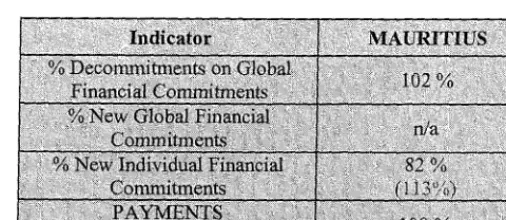
The table hereunder shows the achievement in percentage as at 31 December 2008.
New Individual Commitments (Achieved 82 %)
• As a result of the late approval of the two ICED I FLEX funded projects amounting up to 11,470,000 € were not committed contrary to what was anticipated in the January 2008 forecast. As both are on a regional budget this does not appear in HQ's achievement rates that show 113 % for individual commitments.
Payments (Achieved 109 %)
[image:17.628.115.368.151.261.2]• The disbursement of 3,612 m € for the waste water budget support and the replenishment of 3,2 m € for the DCP Programme estimates, both realised in December 2008, contributed to realise a payment rate above 100%.
Table comparing initial planning of the lOth EDF NIP (as per approved CSP
2008-2013) with the actual situation as per 31 December 2008:
Indicative Commitments Commitments Realised/ Disbursements allocation 101h planned in realised in planned realized in 2008
EDF(M€) 2008* (M€) 2008* (M€) (%) (M€) General Budget
Support 43.5 0 0 0 0
Non focal areas
- Support to NSAs 5.5 0 0 0 0
-TCF 2.0 0 0 0 0
Total A-envelope 51.0 0 0 0 0
Total B-envelope 12.4 0 0 0 0
Total 10m EDF
NIP 63.4 0 0 0 0
The draft identification fiches for the GBS III, TCF II and the DCP-Support to Non State Actors have been circulated to NAO for comments. The target to submit them to HQ is end of February 2009.
2.2 Reporting on General and Sector Budget Support
No global commitments were planned in 2008 for the lOth EDF. It is to be noted that the amendments (ICED I Part 2 & 3) both from Flex resources were signed in October 2008 for the amount of € 11.4 million. The 2008 allocation under the sugar accompanying measures was committed for the second general budget support programme of Mauritius. The wastewater sector budget support and sugar sector budget supports were completed
with success with a satisfactory level of disbursement. The last disbursement under the general budget support programme ICED I was made in December 2008. The Delegation also participated in joint donor missions and meetings to plan technical assistance and assess the implementation of the economic reform programme.
The programming process for the GBS has improved greatly in 2008 with the preparation of the GBS Road Map and the setting up of the GBS Preparation Committee. However this process needs to be further improved and refined in order to promote involvement of all implementing agencies in the programme, with a clear understanding of their role. Other donors also need to be more systematically involved in our programming process. Regarding technical assistance, donor coordination has been strengthened significantly but needs to be further improved especially to facilitate flow of information and complementarity. One way to achieve this is by setting up a Joint donors Pool for technical assistance.
Of a total of €64,552,531 committed in 2008, €36,000,000 was coming from Sugar Budget line. The amount of €36,000,000 was divided into a fixed tranche of €18,000,000 and a variable tranche of €18,000,000 respectively. The fixed tranche of €18,000,000 was fully paid, while only €15,300,000 was paid for the variable tranche, as the indicator for ZEP primary schools in terms of a reduced absentee rate and increased pass rate were both not met (absenteeism increased to 15.7% in 2007 as compared to 15.2% in 2006 and the pass rate decreased
by
0.6% from 36.6% in 2006 to 36.0% in 2007). The remaining €28,552,531 was divided as follows: € 8,742,531 under ICED I (9th EDF fund), € 300,000 Post Gamede project (B envelope), € 19,510,000 (Flex 2006) which was further divided into two equal fixed tranche of € 9,755,000 each. As far as disbursement is concerned, with the exception of one fixed tranche of € 9, 755,000, the remaining balance of € 18,797,531 was fully paid.2.3 Projects and Programmes in the Focal and non focal areas 2.3.1 Projects in the focal areas
Wastewater Sector Policy Support Programme
Following the Mid-term evaluation of the CSP in 2005, a 10M€ top-up was allocated to the wastewater sector and a rider to the Financing Agreement was signed in November 2006. The addendum comprised two additional tranches (4th for FY2006/07 and 5th for FY 2007/08). The fourth tranche for FY 2006/2007 was disbursed at the end of June 2007 (€ 8.6 million) following the donors meeting held in January 2007. The donors meeting to review progress in the sector in 2007 was finally held in February 2008. Particular attention was given to progress on institutional developments and the new Sector Policy Statement 2008-2013 which have experienced significant delays during 2007. Among the main conclusions of the donors meeting, there was the consensus reached over the need to maintain the sector donor coordination beyond EC's SPSP, and extend it to the water sector, and to reinforce and progressively expand the environmental monitoring to the whole island. Donors provided comments on the revised version of the draft Sector Policy Statement (SPS) submitted by the Government and it was agreed to finalize it by April 2008. Other issues discussed were the forthcoming delegation of the management
of operation and maintenance activities to a private firm, and the signing of MoUs between Wastewater Management Authority (WMA) and Ministry of Renewable Energy and Public Utilities (MREPU) as well as among WMA board and executive direction to clarify respective roles. The donors meeting also acknowledged progress in the implementation of the various National Sewerage Plan projects, although the level of capital investment remained below projections in successive years. This underperformance is primarily due to delays in the procurement and award of contracts. As a follow up to the two studies carried out in 2006, namely the Institutional Review and Tariff study, the SPS for the years 2008-2013 was reviewed at the donors meeting. The SPS has been approved by the Government, who subsequently raised the tariff as of 1
March 2008 with a view to ensuring the full cost recovery of operation and maintenance expenditure and 25% cost recovery of the depreciation costs. At the institutional level, work has been slow to clarify the respective roles of WMA, its board and the MREPU. MOUs were signed with delays only in July 2008, which led to postponement of the disbursement of the 5th tranche of budget support. On the other hand, WMA has strengthened its project implementation capacity through the recruitment of additional engineering staff. Further training to enhance efficiency is required, including for the MPU, with regards to project planning and financing management.
On the basis of the Donors meeting and further documentation, 5 out of the 6 performance indicators for the fifth tranche of budget support have been met: Indicators for house connections, access to the poor, industrial pollution control, implementation capacity and financial sustainability reached the forecasted targets. However the indicator on capital expenditure remained below target for the second consecutive year: i) total capital disbursement in FY2006/07 at MUR 1.125 billion against MUR 1.230 billion, and ii) capital budget for FY2007/08 at MUR 1.134 billion against MUR 1.379 billion set in the Financing Agreement. There has been also additional concern in the second half of 2008 regarding further delays for the evaluation and award of long awaited major reticulation contracts in Plaine Wilhems, despite the coming into force of the new procurement act effective as from 1st January 2008. The fifth tranche was disbursed in December 2008 to the amount of3.612M€, being the result of partial achievement for the 'Capital expenditure' indicator.
The technical assistance contract with DHV was extended up to December 2008 and reallocation approved through a rider in September 2007, in order to further assist WMA for operation and maintenance, performance indicators and control of pollution /accreditation of WMA laboratories. These tasks were carried out satisfactorily and conducted notably to enhanced WMA treatment plants activities, proposals of key performance indicators and recommendations for the environmental monitoring.
Sugar Policy Support Programme (SPSP)
factories, and new investments in flexi-factories. However, due to divergences about the implementation mechanism between the Government and the private sector, no progress in the sugar sector reform could be recorded until 5 December 2007, when the Government and the sugar corporate sector reached agreement on the way forward. The Agreement reached on 5th December 2007 was indeed signed on 22nd of April 2008, following vetting by the judiciary institutions of the Government and minor revisions. Following the agreement, the re-structuring of the sugar sector with regard to factory closure and VRS has progressed rapidly.
In April 2007, the Government adopted the "Outline of the Energy Policy 2007-2025-towards a coherent energy policy for the development of the energy sector in Mauritius" which outlines in broad terms the Government's long term vision for the energy sector while committing to an Action Plan for the short term. An energy study was jointly funded and carried out between August and December 2007 by EC and UNDPIUNEP. The aim of this study was to support the development of a 25 years comprehensive energy policy, including a master plan for renewable energy sources, which the Government has committed to adopt by mid-2008. The final report on the energy study was submitted to the government in June 2008. Government has proposed to adopt the recommendations of the study as its long term energy strategy with minor modifications on certain issues.
As such ambitious reform should occur without adverse impact on the environment, a Strategic Environmental Assessments (SEA) exercise financed under the EC Environment and Tropical Forest Budget line, was undertaken in 2007 to confirm and complete the findings and recommendations of the MAAS (Multi-annual Adaptation Strategy for Sugar Sector) pertaining to environmental issues. The SEA fmal Report provides recommendations for further actions to mitigate adverse impact of the implementation of the MAAS with regard to the key environmental aspects identified, namely: vinasse management, sugar cane burning, conversion of sugar cane lands to other agricultural uses - impact on water resources, conversion of sugar cane lands in difficult areas and disposal of coal ash. The proper implementation of mitigation and enhancement measures recommended within this SEA should ensure that any remaining adverse impacts on the environment would be offset by the environmental benefits of the MAAS. The follow-up of this study requires the continued involvement of the Government in order to ensure implementation of these recommendations. At the GBS preparation committee, it was proposed to have an indicator on environment related to the Strategic Environment Assessment for the sugar sector.
Finally, it is crucial to point out that despite the sugar sector restructuring programme being still in its implementation phase some notable achievements can already be declared. As such, three years in succession all the targets in the Financing Agreements have been met. Moreover, sugar refinery procedures are advancing very well allowing Mauritius to export at least 60% of white sugar as of2009.
Improved Competitiveness for Equitable Development (ICED I)- GBS
The Delegation and the NAO finalized the first General Budget Support programme, in close collaboration with other development partners, namely the World Bank, the Agence Francaise de Developpement and the African Development Bank. The new programme is
called Improved Competitiveness for Equitable Development, and it provides € 44.7 million in support of the economic and social reform programme of the Government for fiscal year 2007/2008. The ICED I programme is resourced from the additional allocation under the 9th End of Term Review (ETR) as well as the Sugar Accompanying Measures allocation for the year 2007. ICED I supports the overall economic reforms, and specifically the four pillars, namely improved public financial management, increased competitiveness and enhanced business environment, the restructuring of existing economic sectors and the promotion of new ones, and the implementation of social programmes to ensure equity and sustainability. Specific results expected under ICED I are reduction in government primary expenditure as percent of GDP, a progress in the restructuring of the sugar sector, re-employment of unemployed women and improved outputs in primary education in the Zone Eduction Prioritaire. The two Financing Agreements for ICED I were signed on 8 December 2007. The fixed tranche was disbursed in the third quarter of 2008 to the amount of € 27,042,531 (Financing agreements 9738/MAS and MU/SUGAR/2007/19104) on account of government having satisfied all the conditions for disbursement. However, the variable tranche was disbursed to the tune of € 15,300,000 out of a maximum of € 18,000,000 (FA MU/SUGAR/2007119104) in the last quarter of 2008 as one of the indicators related to education was not fully met (Reduce absentee rate by 1%/rom 15.2 %to 14.2% and increase pass rate by 0.5%from 36.5% to 37.0% in ZEP schools, worth£ 2. 7 mio).
An additional amount of€ 19.75 million, from FLEX 2006, was channeled through ICED I - Part 2. The funds were to be disbursed in two fixed tranches of € 9,750 million each for the year 2007/2008 and 2008/2009, upon verification of the established general conditions. An amount of € 9,755,000 (Financing agreement 9880/MAS) was disbursed in the third quarter of 2008. Further funds received under FLEX 2007 will be added to ICED I. The above is in line with the lOth EDF CSP which states that funds obtained from various instruments will be combined to support the economic reform programme through general budget support.
ICED II represents the second phase of the first GBS Programme for Mauritius. ICED II
will be funded from the EC Accompanying Measures for the Sugar Protocol countries budget line (EC AMSP) under which an amount of € 32,323,000 is indicatively available for the year 2008. Two meetings were held in February and March 2008 respectively to discuss the underlying framework of ICED II as well as key sectors to be supported. An AIDCO/DEV mission from EC Headquarters in early March 2008 also confirmed the general orientations, sectors, as well as implementation modalities of ICED II. The signing of the Financing Agreement is being awaited.
2.3.2 The development results achieved by projects in the non-focal area Decentralised Cooperation programme (DCP)
The Delegation noted significant progress with the Decentralised Cooperation Programme (DCP) during the reporting period, having successfully launched six calls for proposals covering all the targeted areas. There is also an increased involvement ofNSAs noted. Rules and procedures for the DCP have been simplified to the extent possible during the year and this greatly contributed to an increase of the popularity of the
programme. Furthermore, the DCP has, due to the multitude of individual projects in all parts of the country, positively contributed to the visibility and the positive image of the BCD in Mauritius.
The Non State Actors Capacity Building Programme (NSA CBP) was set up in August 2008 with technical assistance from UNDP. A Project Coordination Cell (PCC) including a project coordinator, communications and support officer and an International United Nations Volunteer manage the project. An advisory committee comprising of key donors and stakeholders has been set up and two meetings have been held since October 2008. Since its launch, the NSA CBP has taken on 23 trainers in Mauritius and 16 in Rodrigues to be trained as well as 36 non-state actors or beneficiaries in Mauritius and 22 in Rodrigues. A total amount ofEuros 302,500 is available for this project.
The Third Call for Proposal under the DCP was launched in November 2007 and was aimed at (1) poverty alleviation. A total number of 23 micro-projects received grants totalling 1.66m € in August 2008.
The Small Grants Window has also committed 966,511 € to 109 projects. The DCP extended the window until 31 March 2009, when the remaining 378,139 € is expected to be committed.
A sixth call for proposals was launched in October 2008, for the setting up of a Poverty Observatory; following a study carried out by a DCP short term expert, and after a stakeholders workshop in September 2008. It was recommended that the Analyst for the Poverty Observatory and the Poverty Observatory to be managed by a research body. In January 2008, the DCP approved the Mauritius Research Council to host the Poverty Observatory for a sum of 49,23 5 €.
(2) Promotion of good governance:
The Fourth Call for Proposal relating to Good Governance was launched in June 2008. 6 micro-projects were awarded a total sum of € 412,226 in December 2008. The DCP has also funded other projects under this component such as the publication of 8 Best practice guides by the Independent Commission Against Corruption for 12,510 €. Another 14,883 euros is expected to be disbursed over the coming months.
(3) Fight against unemployment and support to job creation: Following the three training studies which took place on the SME Sector, a 'Training and Re-Skilling' programme for cadre and low skilled workers was set up in collaboration with the Human Resource Development Council for an amount ofMUR 8 million or 186,000 €.
A fifth call for proposals aimed at the SME sector was launched in August 2008. A total of 15 micro-projects were awarded a sum of 1.2m €. Projects are currently under way.
(4) Improving natural resource management in Rodrigues:
The DCP is in the process of hiring 2 short term experts on Service delivery and Privatisation to carry out a feasibility study on the setting up of a Rodrigues Water Company. The consultants are expected to carry out the study from mid-February 2009.
Programme Estimate 2 ended in December 2008, and the DCP is now in the third and final PE3, which operates between January 2009 and March 2010 with a budget of 4.77m €, all of which is expected to be disbursed.
DCP Mid-Term Evaluation also took place in January to March 2009. The recommendations of the MTR will be used to prepare the next DCP.
Technical Cooperation Facility
During 2008, the Technical Cooperation Facility I (TCF I, signed for an amount of € 500,000) funded two studies on the development of long-term sector strategies for the education and energy sectors. Both sectors are focal areas of the EC General Budget Support Programme. In addition, a number of training and capacity building activities were sponsored under the Programme Estimate 2 of the Facility. The Technical Cooperation Facility II (TCF II) was signed in November 2007 for an amount of € 590,000 and the PE 1, for a programme value of Rs 2,240,000, became operational as from December 2008 and would last till December 2009.
2.3.3 The development results achieved by support to Non-State Actors
After cyclone Gamede hit Mauritius' main island in February 2007, an amount of € 300.000 was allocated from the Regional Envelope B to support the Government's post-Gamede Reconstruction Programme. The fund was channelled through a rider to the GBS Programme ICED-I (€ 8.7 million), which was sent to HQs in September 2007. The amount of€ 300,000 was disbursed in September 2008.
2.4 Other cooperation 2.4.1. FLEX
Mauritius was found eligible for compensation for export losses to the tune of € 19.51 million in 2006 and € 11.470 million in 2007 under the FLEX programme. These unforeseen funds are being channeled through the current general budget support programme to support the economic reform programme at the request of the Government of Mauritius. An amount of € 9,755,000 representing the first fixed tranche of 2007/2008 from Flex 2006 was disbursed in the third quarter of 2008. In addition, an amount of € 6,470,000 under ICED I Part 2 and € 5,000,000 under ICED I Part 3 respectively from Flex 2007 were approved in the last quarter of2008.
2.4.2. Sugar Accompanying Measures
Of the allocation of € 36 million for the financial year 2007/2008 under the EC Accompanying Measures for the Sugar Protocol countries (EC AMSP), € 18,000,000 (i.e
50%) was disbursed as fixed tranche and € 15,300,000 as variable tranche was disbursed
in 2008. This has been combined with an EDF amount of€ 8,742531 million (received as top-up after the end of term review of the 9th EDF, for the financial year 2007/2008). This constitutes a total allocation of € 42,042,531 million which was disbursed as General Budget Support under the Improved Competitiveness for Equitable Development Programme I.
2.4.3. Fisheries Agreement and Protocol
There is presently no Fisheries Protocol into force between Mauritius and the EC following the expiry of the 5th Protocol on 3rd December 2007. The main issues of