Economic Perspective 1
UNION REGOGNrnDN IN SCOTTISH ELECTRONICS by
Alan S p r o u l l , Department of Economics, Glasgow College of Technology John Maclnnes, Department of Social & Economic Research, University of Glasgow
"More people in S c o t l a n d a r e now employed in the e l e c t r o n i c s industry than in heavy engineering, s t e e l and coalmining. Scotland has somehow got i t s act together... (and) we want that magic t o be spread more widely throughout the country."
Kenneth Baker - former Minister of Information Technology, February 1984 (1)
This quote i l l u s t r a t e s the widely held view that the electronics industry will be a key engine of growth in the next 25 to 50 years. The government clearly sees the industry as a major source of wealth and employment creation which w i l l play an i n c r e a s i n g l y i m p o r t a n t r o l e in t h e Scottish economy as o i l declines in the 1990s.
The p r i o r i t y given by government to the industry i s r e f l e c t e d in the extensive promotional a c t i v i t y undertaken by the Scottish Development Agency (SDA) and Locate in Scotland (LIS). The l a t t e r i s an umbrella organisation set up in 1981 to coordinate efforts to promote Scotland as an i n d u s t r i a l location. S i g n i f i c a n t l y , the main focus of LIS a c t i v i t y has been the American market and the target market segments a r e e l e c t r o n i c s , energy and health care.
industry and Scottish u n i v e r s i t i e s and c o l l e g e s , the package of f i n a n c i a l incentives available, and a stable skilled labour force with "positive" a t t i t u d e s towards incoming electronics companies.
The s t r e s s given to t h i s l a s t factor in promotional activity p a r t l y r e f l e c t s the industry's need for specialised staff, graduates e t c . and p a r t l y the fading but widely held image of Scotland as an area of labour radicalism suffering frequently from industrial unrest.
Much i s made by t h e SDA, LIS and government spokesmen of the relatively low level of unionised plants in the industry, of the low s t r i k e record, and of the "progressive" and p o s i t i v e a t t i t u d e s of unions in those p l a n t s in which they are recognised.(2) In these attempts to a t t r a c t (especially) US companies the SDA a d o p t s the a t t i t u d e t h a t as t h e s e organisations appear to prefer non-union arrangements they should be advised how to follow this route. (3) Whether the image of Scottish e l e c t r o n i c s promoted by the SDA has influenced the development of the industry and attracted foreign investment i s d i f f i c u l t to say. Companies rarely admit to anti-unionism, or see t h e i r p o l i c i e s as non-union, rather they speak of 'dealing d i r e c t l y with the workforce1
or lack of workforce demand for union services.
In promoting Scotland as a location for foreign electronics firms, stress has been placed on t h e s i z e of the e x i s t i n g community of e l e c t r o n i c s companies, the b r o a d e n i n g r a n g e of h i g h q u a l i t y
recently estimated t h a t "perhaps 30 per cent" of the t o t a l S c o t t i s h e l e c t r o n i c s labour force i s unionised (4) a past president of the STUC put the figure a t "well below 50 per cent" (5) and speaking a t the s t a r t of recruitment campaigns in 1985 ASTMS o f f i c i a l s commented t h a t "ironically the electronics industry, one of B r i t a i n ' s few growth a r e a s , has been v i r t u a l l y untapped by the unions.... the crucial fact i s there has been very l i t t l e union organisation". (6)
The development of t h i s image of a poorly o r g a n i s e d i n d u s t r y with a "non-union culture" has undoubtedly been stimulated by the existence of a number of well-known American multi-national enterprises (MNEs) which have very a c t i v e l y and publicly r e s i s t e d u n i o n i s a t i o n . These companies operate a v a r i e t y of personnel p o l i c i e s i n c l u d i n g employee s h a r e ownership schemes, extensive finge benefits, payment by individual performance, provision of s t a f f f a c i l i t i e s , s o c i a l a f f a i r s and communications systems which inhibit union organisation. The companies argue t h a t they simply render unions redundant by providing superior employment conditions, while union o f f i c i a l s r e c r u i t i n g in the industry brand these p o l i c i e s a form of sophisticated indoctrination.
The o r i g i n of t h i s anti-union stance can be traced to a s t r a t e g y devised in the mid-1950s by a group of young technical entrepreneurs, dubbed the ' F a i r c h i l d 8', who founded F a i r c h i l d ' s semi conductor division in the o r i g i n a l ' s i l i c o n valley' in California. They sought t o avoid outside control of their business, whether from government, union or banks. Their attitude i s summed up by Philip Petersen, a member of the American E l e c t r o n i c s Association's labour r e l a t i o n s committee. He i s on record as s t a t i n g "we are united in believing there i s no place for unions i n t h i s i n d u s t r y . We w i l l r e s i s t a (unionisation) campaign and we see no need for t h i r d party i n t e r v e n t i o n with our employees." (7)
In some s e c t i o n s of the industry non-unionism i s t o t a l worldwide. The Semi Conductor Industry Association, the chip manufacturers trade a s s o c i a t i o n whose 52 members account for 95% of US output have no union c o n t r a c t s . None of the f i v e US c h i p makers in S c o t l a n d , Motorola,
National Semi, Hughes, General Instruments or Burr-Brown are unionised. In computer manufacture the US companies such as IBM, Hewlett Packard and Wang are non-union. As a r e s u l t the impression has grown up t h a t unionism in Scottish electronics i s weak, and that t h i s may represent part of a wider problem for unions of adapting to new technologies, new industries and new 'greenfield' plants.
The present government's views on the workings of labour and product markets a s s e r t s t h a t only f l e x i b l e m a r k e t s , responsive to changes in technology and product demand can provide the growth in employment and w e a l t h c r e a t i o n so necessary to the economic regeneration of the UK. Unions are i d e n t i f i e d as one of the main barriers to such flexibility and much of t h e employment l e g i s l a t i o n introduced since 1979 has been geared t o reducing the power and influence of the unions. I t i s therefore unsurprising that government ministers cite the electronics industry as an example of the way forward industrially.
But how r e a l i s t i c i s the image of low unionisation in the S c o t t i s h e l e c t r o n i c s industry? Is toe union's apparent failure in electronics symptomatic of an inability to keep pace with economic change and a portent of future union decline? Can the r e c o r d of e l e c t r o n i c s o u t p u t and employment be p a r t l y explained by i t s f l e x i b i l i t y and responsiveness free from t h e " c o n s t r a i n t s " imposed by union recognition?
In an a r t i c l e i n t h e February 1987 Commentary we showed that the employment growth of electronics in Scotland was not as s t r o n g a s many commentators have assumed. This paper attempts to throw some light on union organisation based on t h e r e s u l t s of a s u r v e y of e v e r y e l e c t r o n i c s company in Scotland which employed 11 or more people in 1984. Before the r e s u l t s are presented and conclusions drawn i t i s necessary t o briefly outline the characteristics of the industry.
Electronics in Scotland
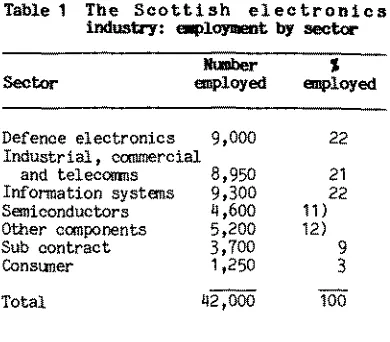
Tables 1 and 2 show the d i s t r i b u t i o n of employment in the industry by subsector and the ownership of the industry by
c o u n t r y of o r i g i n . I t can be seen t h a t over 75 per c e n t of t h e employees i n t h e i n d u s t r y a r e employed i n t h e 4 l a r g e s t p r o d u c t a r e a s : D e f e n c e E l e c t r o n i c s , I n f o r m a t i o n S y s t e m s , I n d u s t r i a l , Commercial and T e l e c o m m u n i c a t i o n s and Components ( i n c l u d i n g t h e p r o d u c t i o n of s e m i - c o n d u c t o r s ) . D e s p i t e t h e f a c t t h a t t h e f o u r p r o d u c t a r e a s a r e c u r r e n t l y of a l m o s t e q u a l i m p o r t a n c e i n employment t e r m s , p o p u l a r a n a l y s i s and d i c u s s i o n of t h e i n d u s t r y h a s focused m o s t l y on s e m i -conductor manufacture, an a c t i v i t y which accounts for approximately 10 per cent of e m p l o y m e n t . As t h e p r o d u c t i o n of i n t e g r a t e d c i r c u i t s l i e s a t t h e h e a r t of t h e i n d u s t r y t h e a t t e n t i o n d e v o t e d t o developments in semi-conductor production i s u n d e r s t a n d a b l e , and t o some e x t e n t j u s t i f i e d , b u t i t i s f a r from b e i n g t y p i c a l of t h e i n d u s t r y a s a w h o l e . A main f e a t u r e of t h e s e c t o r i s t h a t i t i s e n t i r e l y f o r e i g n owned. F i v e American MNEs, M o t o r o l a , N a t i o n a l S e m i c o n d u c t o r , G e n e r a l I n s t r u m e n t s , Hughes M i c r o -e l -e c t r o n i c s and Burr-Brown supply 90 p-er cent of the employment, with the Japanese firm NEC supplying t h e remainder. Each of t h e s e US c o r p o r a t i o n s a d o p t s a s t r o n g l y a n t i - u n i o n s t a n c e i n a l l o p e r a t i o n s w o r l d w i d e and t h e y h a v e s u c c e s s f u l l y r e s i s t e d r e c r u i t m e n t c a m p a i g n s and recognition claims i n Scotland and abroad. As noted above they a l l adopt progressive p e r s o n n e l p o l i c i e s which remove many of t h e t r a d i t i o n a l c a u s e s of s h o p - f l o o r f r i c t i o n , and by c l o s e l y monitoring l o c a l labour market terms they offer competitive wages and conditions.
Table 1 The S c o t t i s h e l e c t r o n i c s industry: employment by sector
Number % Sector employed employed
Defence electronics Industrial, commercial
and telecomms Information systems Semiconductors Other components Sub contract Consumer Total
9,000 8,950 9,300 4,600 5,200 3,700 1,250 42,000
Source: SDA (1985) "Industry P r o f i l e "
[image:3.523.55.250.433.604.2]While s i m i l a r c o n d i t i o n s apply i n many e s t a b l i s h m e n t s i n o t h e r s e c t o r s of t h e i n d u s t r y t h e r e i s no e v i d e n c e t o s u g g e s t t h a t s u c h m a n a g e r i a l s t r a t e g i e s a r e t y p i c a l or r e p r e s e n t a t i v e . The formation of employment p o l i c i e s and t h e form of employee r e p r e s e n t a t i o n adopted by f i r m s a r e i n f l u e n c e d by b o t h t h e g e n e r a l c h a r a c t e r i s t i c s of t h e i n d u s t r y and t h e s p e c i a l c h a r a c t e r i s t i c s of the firm.
Table 2 Number of p l a n t s i n e l e c t r o n i c s i n Scotland i n 1984 : by country of ownership
Country of Electronic plants
Ownership Number I
U S A 46 22 Netherlands 7 3 Rest of world 8 4 Total overseas owned 61 29 UK 149 71
Total 210 100
* I n c l u d e s only p l a n t s w i t h over 10 employees
The survey o f r e c o g n i t i o n i n S c o t t i s h e l e c t r o n i c s plants
(a) Methodology
our respondents was 357 employees, while the IDS figure i s 218 (8). Generally the f i t between the c h a r a c t e r i s t i c s of the survey respondents and the published data on the industry was close.
(b) Union recognition
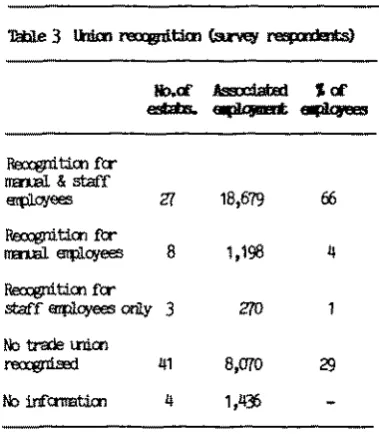
[image:4.527.93.283.195.413.2]Of the 83 establishments responding to the survey 79 supplied information on union recognition. Table 3 gives the main r e s u l t s .
Table 3 Union recognition (survey respondents)
No.of Associated t of estate, acflojnenb employees
Recognition for manual & staff
aipLoyees 27 18,679 66
Recognition for
manuaL employees 8 1,198 4 Recognition for
staff employees only 3 270 1
No trade unon
recognised 41 8,070 29
NoinfomBtion 4 1,436
While the majority of establishments did not recognise unions, recognition was strongly correlated with employment size, so that over 70 per cent of employment was in the p l a n t s which recognised unions. Recognition usually covered both staff and manual employees. The most widely recognised unions were the AUEW, TASS, EEPTU, ASTMS and TGWU. Most groups had more than one union. This showed t h a t multi-unionism was widespread. Only one plant recognised the EEPTU for both staff and m a n u a l e m p l o y e e s . One p l a n t recognised MATSA for both groups and four p l a n t s , employing about 650, recognised TASS in t h i s way. Three plants, employing about 200 workers recognised the EEPTU for manuals and no union for staff employees, and four p l a n t s employing about 700 workers recognised only the AUEW for manual workers. Unionisation in Scottish electronics i s therefore much higher than has usually been assumed and t h i s i s not
the r e s u l t of the widespread incidence of single union agreements or of new s t y l e agreements such as those used by the EEPTU in the Welsh electronics industry.
(c) Patterns of recognition
I n i t i a l r e s u l t s showed t h a t recognition v a r i e d w i t h s i z e of e s t a b l i s h m e n t , o w n e r s h i p , age and l o c a t i o n . No establishment with 25 employees or l e s s recognised unions, but over two thirds of those with 100 employees or more did so. Just over a t h i r d of both S c o t t i s h and f o r e i g n owned e s t a b l i s h m e n t s had r e c o g n i t i o n , but whereas in S c o t t i s h plants the relationship with size remained strong, so that over a half of employment was in unionised p l a n t s , t h e r e was a significant number of large American non-union p l a n t s , so t h a t n e a r l y t h r e e quarters of foreign-owned employment was in non-union p l a n t s . Table 4 shows the r e l a t i o n s h i p between age, ownership and recognition. The 1960s saw a massive influx ofjobs in US-owned establishments, virtually none of which recognised unions. This explains the low recognition figure f o r e s t a b l i s h m e n t s opened t h e n . Recognition in foreign owned p l a n t s has continued to be low, but t h i s does not e x p l a i n t h e f a l l in t h e coverage of recognition in plants opened in the 1970s and 80s. The explanation here i s a f a l l in the coverage of recognition in Scottish owned and Rest of UK plants which in turn i s associated with an increase in the number of small plants in these ownership g r o u p s . T h e r e w e r e s u b s t a n t i a l differences in the employment growth over the previous three years of establishments with and without recognition. The growth rate for unorganised plants at 90 per cent over the 3 years 1981-84 was some t h r e e times t h a t for those where recognition e x i s t e d . But s i n c e r e c o g n i t i o n was closely associated with several other f a c t o r s which strongly influence growth s u c h a s s i z e , a g e , o w n e r s h i p t h e differences in growth a t t r i b u t a b l e to r e c o g n i t i o n i t s e l f were not c l e a r . Recognition was also lower in new towns, but this was also the location of many of the types of establishments which one would expect to be non-union because of their size, ownership or age. In order to untangle these e f f e c t s we used l o g i t analysis - a type of s t a t i s t i c a l analysis t h a t helps d i s t i n g u i s h the s t r e n g t h s of each of the overlapping f a c t o r s t h a t appeared relevant to recognition.
Table* feoagoitian by age and omrSrip of plant SootH* Rest of IK Rrefgn J jobs J jcbs % jobs in ests. inests. i n e s t s . with Jobs with Jcbs with Jobs reoog. no. reoog. no. reoog. no.
Before 1950
1950-59
1960-69
1970-79
1980-84 80.9
100.0
9.0
46.2
41.3 173
650
379
1,136
1,087 100.0
100.0
90.2
68.0
87.0 10,424
1,175
2,551
857
1,437 100.0
100.0
0.6
91.2
0.0 720
517
5,497
845
182
(d) Factors affecting recognition in tbe surveyed plants
Work by Daniel & Millward (9) on data from the Workplace Industrial Relations Survey of 2,000 workplaces found that recognition varied with the size of the establishment, the s i z e of t h e e n t e r p r i s e and t h e p r o p o r t i o n of women working i n t h e e s t a b l i s h m e n t . In a d d i t i o n t o these general factors i t has been widely assumed i n t h e p u b l i c d e b a t e on S c o t t i s h e l e c t r o n i c s t h a t the age and n a t i o n a l i t y of ownership of a plant also influence the chances of recognition. We t e s t e d for ownership, age, s i z e , the proportion of p a r t - t i m e r s in t h e w o r k f o r c e , t h e proportion of women in the workforce and the proportion of employees on s t a f f conditions. The r e s u l t s indicated t h a t only two f a c t o r s from t h i s l i s t had a significant impact (at the 5% level): the s i z e of t h e e s t a b l i s h m e n t and t h e proportion of p a r t - t i m e r s . Other things being equal the l a r g e r the s i z e of an establishment the greater the probability t h a t unions w i l l be recognised; and the higher the proportion of p a r t - t i m e r s in the workforce the lower the probability of union recognition.
Due to the very large overlap between the percentage of part-time employees and the percentage of female employees (over 85?
of p a r t - t i m e r s are female) we tested the impact of these two f a c t o r s separately. Our r e s u l t s confirm those from the 1984 Workplace I n d u s t r i a l Relations Survey, (10) that the percentage of part-timers i s more important than the percentage of women in influencing the chances of unions being recognised.
The importance of s i z e i s unsurprising. I t i s a r e s u l t found in a l l UK s t u d i e s on the determinants of union recognition. The larger the establishment the lower i s the likelihood of employees being treated individually in the determination of their wages and conditions. They tend to be treated as members of groups with l i t t l e scope for the modification of decisions to t a k e account of s p e c i f i c i n d i v i d u a l c i r c u m s t a n c e s . Given t h i s s i t u a t i o n employees are more l i k e l y to come to the conclusion that the only way to influence the nature of decisions affecting them i s t o b a r g a i n c o l l e c t i v e l y r a t h e r than i n d i v i d u a l l y . Thus the demand for union representation i s likely to be greater in l a r g e r e s t a b l i s h m e n t s . Conversely employers in large organisations are more l i k e l y to value the r o l e unions can play as a c o l l e c t i v e v o i c e of employees' interests, objectives and grievances.
The response to t h i s demand by unions i s a l s o a f f e c t e d by t h e s i z e of t h e organisation. To the union the economics of r e c r u i t i n g and servicing members i s c r u c i a l l y l i n k e d t o the s i z e of the bargaining unit. The larger the number of members in a single bargaining unit (at one or more establishments) the lower i s the per c a p i t a cost involved and the g r e a t e r i s the likelihood of s u f f i c i e n t b a r g a i n i n g power t o allow e f f e c t i v e r e p r e s e n t a t i o n . Thus the l a r g e r i s the establishment the more l i k e l y i t i s t h a t e m p l o y e e s w i l l s e e k c o l l e c t i v e r e p r e s e n t a t i o n and the more l i k e l y i t i s t h a t unions w i l l be keen to provide such representation.
full timers; they are more likely to work unsocial hours and s p l i t shifts and may be less aware of the benefits that arise from union membership. These factors make i t more d i f f i c u l t for unions to r e c r u i t and service part-time members, thus if a union i s recognised in a plant i t may r e s i s t the growth of part-time employment leading to lower part-time work in unionised plants. I t i s also possible that a high proportion of part-timers i s indicative of a style of management that seeks maximum flexibility via the use of peripheral labour forms (such as temps, p a r t t i m e r s and s e l f -employed) and i s also anti-union for that reason. However the more likely reason i s t h a t a high percentage of p a r t - t i m e r s r e f l e c t s the employment policies pursued in p a r t i c u l a r s e c t o r s of the industry, such as chip manufacture, which have been traditionally anti-union.
Union recognition and employment change
One of the most s t r i k i n g r e s u l t s t h a t emerged from the survey was the difference in the rate of employment growth reported by u n i o n i s e d and n o n - u n i o n i s e d e s t a b l i s h m e n t s . To s e e w h e t h e r recognition was an independent factor in employment growth regression analysis was conducted to examine the r e l a t i o n s h i p b e t w e e n e m p l o y m e n t g r o w t h and establishment c h a r a c t e r i s t i c s available. T h e s e w e r e a g e , o w n e r s h i p , s i z e , proportion of p a r t - t i m e r s , proportion of employees on staff conditions, proportion of females in the labour force and whether the establishment recognised unions. None of these factors proved to be significant (at the 5% level) in affecting employment growth.
Again, t h i s i s not a s u r p r i s i n g r e s u l t . The extent to which an establishment increases i t s labour force i s mainly determined by any technical change i t introduces and the buoyancy of the market f o r i t s p r o d u c t s . The e c o n o m i c environment f a c i n g establishments in Scottish electronics varied s u b s t a n t i a l l y from one s e c t o r of the i n d u s t r y t o another. For example, the market facing the defence sector i s determined almost exclusively by public expenditure policy as i t a f f e c t s MOD spending. The market facing the micro chip manufacturers i s
influenced by t e c h n i c a l change which allows the incorporation of their products i n t o an ever wider range of goods. The market f a c i n g p r o d u c e r s of consumer electronics goods i s heavily influenced by the s t e r l i n g exchange r a t e as i t a f f e c t s the price competitiveness of imported r i v a l products, and so on. The economic environment i s the key determinant of e m p l o y m e n t g r o w t h and whether an establishment i s unionised or not appears to be largely irrelevant.
Conclusions
The most important finding in the study i s t h a t low u n i o n i s a t i o n i n S c o t t i s h e l e c t r o n i c s i s a myth. According t o our survey, seven out of ten e l e c t r o n i c s workers in Scotland work in factories and offices where unions are recognised. As we noted above, f o r e i g n f i r m s were s l i g h t l y u n d e r - r e p r e s e n t e d i n o u r respondents and Rest of UK firms slightly over-represented. This i s likely to mean t h a t t h e o v e r a l l f i g u r e for union recognition i s s l i g h t l y below our survey result. However, even if every firm which did not reply to our survey was non-union, (a p r o p o s i t i o n unsupported by our secondary information on non-respondent f i r m s ) 50 p e r c e n t of t h e workers in Scottish electronics would s t i l l work in p l a n t s with recognition. In turn t h i s f i n d i n g r e f l e c t s t h e c o m p l e x i t y of ' s u n r i s e ' industry which the survey has highlighted. Electronics i s not a l l new, not a l l p r i v a t e s e c t o r , not a l l high tech and c e r t a i n l y not a l l small businesses. In Scotland i t dates back t o the Second World War. The public s e c t o r , through direct intervention in the early days and through defence c o n t r a c t s and regional policy today, has been v i t a l for i t s development. Small businesses do exist in Scottish electronics, but the industry i s dominated by large MNPs and large plants.
The results suggest that the semiconductor sector of the industry i s indeed non-unionised, and t h a t only a minority of workers in US owned plants are unionised, but what must not be done i s to confuse t h e s e two s e c t o r s of t h e i n d u s t r y , important as they a r e , with the industry a s a whole. Defence e l e c t r o n i c s i n particular i s heavily organised. I t might
be argued t h a t since i t i s t h i s older s e c t o r of e l e c t r o n i c s t h a t i s b e s t organised, and t h a t t h i s in turn may reflect i t s relationship to public sector contracts, that the r e l a t i o n s h i p between high technology sunrise industry and non-unionism stands. Against this, two points can be made. The f i r s t i s t h a t there i s no clear trend for recognition over time: the 1960s was by far the worst period for the unions and the extent of recognition has increased strongly since then, albeit not to the very high levels found in older plants. Secondly, the presence of unions in the defence sector also places the unions in the centre of high technology, a t l e a s t as measured by emphasis on research and development, or the number or percentage of graduates employed.
The survey a l s o s u g g e s t s t h a t union recognition in electronics i s related not just to size but also to management style both in p a r t i c u l a r s e c t o r s and in particular periods or waves of investment. In other words high levels of recognition now do not necessarily imply continued high l e v e l s in the future. I t could be t h a t i f i n v e s t m e n t (most of i t from overseas) increases, then the non-union sector in Scottish electronics will grow. However, to p r e d i c t t h i s on the b a s i s of reports of the arrival of non-union firms would be to ignore the l e s s public but no less real growth of unionised employment in Scottish electronics. In fact i t would be making the same mistaken assumption t h a t has given r i s e to the myth of low u n i o n i s a t i o n i n t h e p a s t : t h a t t h e a c t i v i t i e s of a small number of high p r o f i l e foreign companies in p a r t i c u l a r sectors of the industry are typical of the industry as a whole.
Readers i n t e r e s t e d in further d e t a i l s of our a n a l y s i s , i n c l u d i n g t h e f u l l s t a t i s t i c a l data on which t h i s a r t i c l e i s based, can find these in our research paper Union Recognition in the Electronics Industry in Scotland a v a i l a b l e from the Centre for Research in I n d u s t r i a l Democracy and Participation, University of Glasgow and in a forthcoming Research Note in the B r i t i s h Journal of I n d u s t r i a l Relations.
Notes and References
1. Quoted in S i l i c o n Glen by A Hargrave, Mainstream Publishers, 1985. The claim in the quote i s not in fact accurate. In 1983/4 employment in shipbuilding was 29,000, c o a l 26,000 and s t e e l 19,500. (J R Firn and D Roberts) "High Technology I n d u s t r i e s " in Industry, Policy and the Scottish Economy edited by N Hood and S Young, Edinburgh University Press, 1984.
2. "Electronics in Scotland. Industry P r o f i t s " . Locate in Scotland 1984 Labour Performance of US Plants in Scotland, SDA, 1984.
3. Glasgow Herald, 25/7/85.
4. "Electronics and Development" Scottish Education for Action and Development p20, 1985.
5. Quoted i n A Hargrave, Mainstream Publishers, o p . c i t .
6. Scotsman, 10/5/85
7. Quoted in The Guardian, 7 July 1983.
8. Industry Department Scotland (1986) Employment in the Scottish Electronics Industry, 1978-85, Statistical Bulletin No C2.1
9. Daniel W W and Millward N (1983) Workplace I n d u s t r i a l R e l a t i o n s in Britain, Heinemann.