Int. J. Electrochem. Sci., 13 (2018) 472 – 484, doi: 10.20964/2018.01.22
International Journal of
ELECTROCHEMICAL
SCIENCE
www.electrochemsci.org
Sono-Electrocoagulation of Fresh Leachate from Municipal Solid
Waste; Simultaneous Applying of Iron and Copper Electrodes
Mojtaba Afsharnia1, Hamed Biglari1, Seyed Samira Rasouli2, Abdolreza Karimi3, Mojtaba Kianmehr4, * 1
Environmental Health Engineering Department, Faculty of Health, Gonabad University of Medical Sciences, Gonabad, Iran
2
Environmental Health Engineering Department, Faculty of Health, Mashhad University of Medical Sciences, Mashhad, Iran.
3
Department of civil engineering, engineering faculty, Qom University of Technology, Qom, Iran. 4
Environmental Health Engineering Department, Faculty of Health, Gonabad University of Medical Sciences, Gonabad, Iran.
*
E-mail: [email protected]
Received: 17 August 2017 / Accepted: 16 October 2017 / Online Published: 1 December 2017
Fresh leachate of municipal solid waste (MSW), is a kind of high-strength organic wastewater, so generally could lead to rapid and massive bioactivity of microorganisms. Fresh leachate (FL) often defined as a hazardous and heavily polluted wastewater. Thus, this study aimed to investigate treatment of fresh leachate from Municipal Solid Waste by Sono-Electrocoagulation process with duad applying of Iron and Copper electrodes for enhance the removal of COD and TSS. The effects of reaction time and voltage on COD and TSS removal has been studied. Sono-electrocoagulation process was found to be more efficient than ultrasonic waves and electrocoagulation processes in COD removal. The efficiency of COD removal was found to be 98% in the case of sono-electrocoagulation process. In the removal of Total Suspended Solids (TSS), electrocoagulation was found to be more efficient than other processes. The efficiency of TSS removal was found to be 79% in the case of electrocoagulation process. The COD and TSS removal increased with increasing reaction time and voltage. Sono-electrocoagulation was found to be efficient in fresh leachate treatment. The results show that ultrasound was significantly enhanced in the electrocoagulation process.
1. INTRODUCTION
The control of pollution and treatment and reuse of water in drought countries is very evident [1-4]. Fresh leachate, extracted from municipal solid waste in the waste collection vehicles, is a strong organic wastewater, so generally could lead to rapid and massive bioactivity of microorganisms and other important chemical pollutant [5-7]. MSW fresh leachate (FL), which is a robust wastewater, is rich in ammonia-nitrogen, heavy metals, organic matters, and/or inorganic salts. Thus, its direct discharge to receive water and soil could severely deteriorate it [5, 7]. Although some pollutants can be broken down via microorganisms, the restriction of usual biological processes (degradation is merely part of COD and restricted elimination of bio-refractory organic pollutants) has made it troublesome to satisfy the standards of correlative discharge [8]. Conventional leachate treatments can be divided into three main groups: (a) transfer of leachate: recycling and combined operation with domestic sewerage [9, 10], (b) biodegradation: anaerobic and aerobic processes [6, 11], (c) physical and chemical procedures: chemical oxidation [12], oxidative treatment of Fenton [13, 14], adsorption [2, 15-17], chemical precipitation [18, 19], coagulation/flocculation [20], air stripping and flotation/sedimentation [21, 22], and processes of membrane [23]. Advanced oxidation processes (AOPs) are broadly applied to degrade wastewater organic pollutants. AOPs consist of Ozonation, process of Fenton, photochemical oxidation, sonication, and combined processes. AOPs are on the basis of generation and utilization of hydroxyl radicals. Hydroxyl radicals are very unstable and reactive owing to their great oxidation capacity (+2.8 V) [24]. In recent years, it has been demonstrated that electrochemical catalytic oxidation possesses have many advantages [13]. One of the well-known electrochemical catalytic oxidation possesses is electrocoagulation (EC); in this process, complex combination of chemical and physical treatment processes with multiple reaction pathways as oxidation, coagulation, flocculation, precipitation, sedimentation, flotation, and air stripping occur [25, 26]. Organic pollutants’ degradation in wastewater appears to occur by EC. It is revealed that hydroxyl radicals have a crucial impact on the electrochemical catalytic oxidation process [26]. Appling EC process has plenty of merits like employing no external chemical reagents, no secondary pollution, simple, reliable, non-selective, and low sludge production, and applicable and cost-effective operation [25, 26]. At a suitable pH, the ions of metal can make broad ranges of metal hydroxides and coagulated species which destabilize and gather the suspended particles or absorb and precipitate dissolved contaminants [25]. Metal like iron (Fe) or aluminum (Al) in EC is commonly used for the direct current’s passage into wastewater, causing their dissolution [27-29]. This process produces metallic ions from the electrode, forming hydroxide that adsorbs and aggregates particles which are suspended, precipitate, and absorb dissolved pollutants. The electrochemical reactions contributing to the reactor can be stated as following [30, 31]:
Cathodic reactions; 3H2O + 3e- → H2+ 3OH -At high pH,
2M + 6H2O + 2OH → 2M(OH)4 +3H2 Anodic reactions;
M → M+n + ne
There is a paucity of studies on using copper in electrocoagulation (EC) process. Copper ions yielded by the process might have antimicrobial effects. As shown by Pourbaix diagram (E-pH), for pH >7, the process yields unsolved Cu2+ ions converted into Cu(OH)2(s) and CUO(s) and acts as coagulant [32]. Researchers are trying to combine different techniques and processes to improve treatment efficiency and reduce the administrative costs [33]. Sonication is one of the processes that its use is considered in conjunction with other processes [34, 35]. In sonication process, the energy of sound is applied to stimulate particles in samples for different aims. Ultrasound generates localized microenvironments with high-energy in a medium, based on the frequency. It is combined with electrochemical process to improve the system [31]. It may greatly contribute to processes of electrocoagulation since it enhances flocculation via intense mixing; also, it can form radicals which may increase the effectiveness of the processes of electrocoagulation or coagulation through chemical polishing of the flocs’ surface [25]. The efficiency of ultrasonic irradiation is on the basis of cavitation and advances in mass transfer. The process of hydrodynamic cavitation includes the growth, formation, and unexpected collapse of micro-bubbles. In aqueous solution, these gas bubbles cause thermal dissociation of water molecules into H+ and OH-. This powerful oxidant accounts for for tough conditions of oxidation [36]. In addition, when cavitation bubbles undergo asymmetrical implosion at the critical size, bubbles of a certain size can also become unstable and collapse, resulting in a forceful micro-jet of liquid. The ultrasonic cavitation micro-jet produces a strong stirring action in the solution, which further enhances the mass-transfer rate on the electrode surface. Micro jets and shockwaves have substantial effects on the electrode, which can dramatically enhance chemical reactivity. Thus, ultrasound is able to cleanse the surface of electrode and enhance transfer of mass [26]. Ultrasound irradiation along with electro-oxidation is influential for removing various organic pollutants, and it can have a synergistic effect [37, 24]. He et al. [38] studied sono-electrocoagulation process using aluminum electrodes in a double reactor. Over 97% of RB19 was removed at 18-mA/cm2 and at electrolysis duration of 60 min. Tran et al. [39] studied sono-electrochemical oxidation to remove ibuprofen from municipal wastewater; they obtained 77% removal through selecting 40 W of ultrasound power and a treatment time of 120 min. In this study, the sono-electrochemical treatment of fresh leachate of municipal Solid Waste by using new kind of pair electrodes (applying Iron and copper electrodes at the same time) was investigated.
2. MATERIALS AND METHOD
2.1. Preparing real samples
2.2. Experimental Set-up
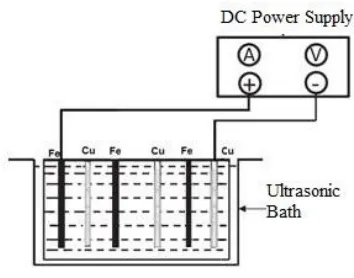
Figure 1 illustrates a schematic view of sono-electrochemical reactor, which is a Batch 2 L reactor with three pairs of iron and copper electrodes. There is a 3cm gap between the electrodes, which are connected through bipolar technique to a DC power supply (PS-303). Different voltages (10, 20, and 30 V) were induced to the reactor. The electrochemical cell was placed in an ultrasonic bath (Sonica-2200 ETH series) that generated 40 ± 5% kHz ultrasonic waves (360 W).
2.3. Experimental procedure
To examine efficiency of Sono-electrocoagulation process, the leachate samples were treated by a Sono-electrocoagulation reactor. Sampling was done at 15th, 30th, 45th, and 60th min after connecting electrical current and inducing the ultrasonic waves. The solution would be left for 5 min for sedimentation before sampling. The samples were also left for one hours for further sedimentation before COD, TSS, pH, and Electrical Conductivity were measured based on the guidelines. The effectiveness of each process is discussed in detail, separately and collectively, in what follows.
[image:4.596.213.390.395.534.2]2.4. Removal efficiency and Energy consumption
Figure 1. Scheme of experimental set-up
The removal efficiency of COD and TSS calculated as follow: COD Removal =
TSS Removal =
And The electrical energy consumption was calculated as follow: Energy consumption =
Where, t is reaction time (hr), Vc is voltage (V), I is electric current (A) and VR is electronic volume (L).
3. RESULTS AND DISCUSSION
3.1. The effect of time
3.1.1. Effect of time in removing COD
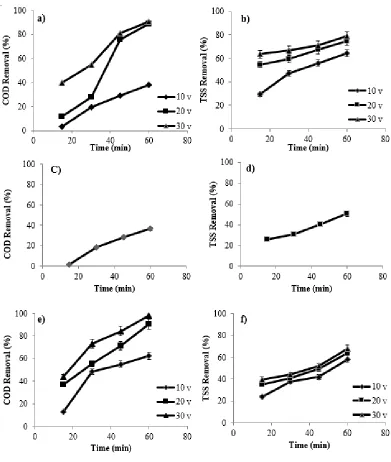
Ultrasonic processes are used to improve chemical properties of water [41]. However, the process is not adequate to oxidize contaminations found in wastewater containing complex organic and inorganic compounds. Therefore, to improve performance of ultrasonic technique, it has been used along with other oxidation processes including EC process [42, 43]. Figure 2 (a, c, e) shows COD removal performance by ultrasonic, EC and Sono-electrocoagulation processes at 10, 20, and frequency 30 V. The highest COD removal performance using ultrasonic waves (30 V), as a treatment method, was less than 40% in 60 min. Results indicated low efficiency of ultrasonic process in removing COD. Other studies have reported consistent results [44, 24, 45]. Sono-chemical decomposition of organic compounds in aquatic environment is a function of physicochemical properties of the contaminations. Decomposition of organic compounds happens due to extreme condition that is created by cavitation. In the case of residual chemical compounds in solution phase, the bubbles act as sources of free radicals that are introduced to the solution and react with the contaminations [41]. About 90% of COD was removed in the EC process (60 min and 30V). The three main processes that take place during EC process are electrolytic reactions on electrodes surface, formation of coagulants in aquatic phase, adsorption of solved or colloid contaminations on the coagulants and their removal through sedimentation or floatation [46]. Diagrams of ultrasonic and EC processes are pictured in figure 2. Shows Clearly, EC process with 90% COD removal performance at higher voltages outperforms ultrasonic process (36% removal at best). Consistently, Ren et al. reported that phenol removal performance of EC process (36%) was almost two times of that of ultrasonic process (16%) [24]. Somayajula et al. reported 80% reactive red decolorization efficiency achieved by EC process; while performance of ultrasonic process was less than 5% [45]. Apparently, coagulation process that takes place in EC process is more efficient in removing organic materials, than cavitation in ultrasonic process.
3.1.2. Effect of reaction time in removal of TSS
Figure 2 (f, d, b) pictures efficiency of ultrasonic, EC, and Sono-electrocoagulation processes in removal of TSS from fresh leachate (10, 20, 30 V). Highest TSS removal performance (79%) was achieved by EC process (30V, 60 min). Given the results, EC, in general, outperforms Sono-electrocoagulation process in TSS removal. This is probably due to the role of ultrasonic waves in breaking formed flocks in the EC process. Ultrasonic waves create pressure waves that cross the leachate and unleash great deal of energy, which in turn creates and fusion gas bubbles –i.e. cavitation phenomenon. This process yields energy, increases water temperature, and creates turbulent swirling flows in the environment [47, 48]. The generated energy breaks the flocks and decelerates sedimentation. However, it appears that with low frequency of the waves flocks breaking is limited to change in their size and no dissolution takes place [49]. Although, Sono-electrochemical process caused highest COD removal performance, it was not as effective with TSS removal. Taking into account the fact that the main processes in electrochemical reaction are electrolytic reactions, formation of coagulants, and adsorption and removal of solved or colloid contaminations by coagulants through sedimentation or floatation [46], increase in reaction time (Fig. 2) would increase COD and TSS removal performance thanks to increase in number of coagulants released. Babuponnusami et al. showed that increase in iron ions released from electrodes in the treatment process led to more decrease in COD [50].
3.1.3. Effect of different parameters
3.1.3.1. Temperature changes and its effect
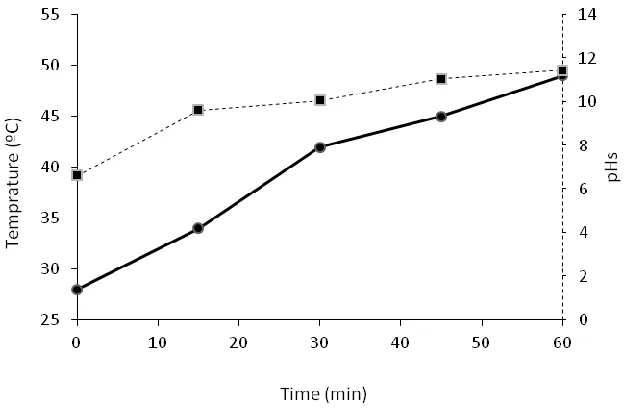
Temperature was measured frequently over the process of Sono-electrocoagulation. Along with increase in reaction time and increase in COD and TSS removal performance, temperature increased from 28ºC at beginning of the process to 50 ºC at the 60th
3.1.3.2. pH Changes and its effect
[image:8.596.142.454.425.630.2]Figure 3 illustrates changes of pH in Sono-electrocoagulation process at t = 0 to 60 min. In general, coagulation process highly depends on pH; so that, pH potentially could influence sedimentation of coagulants and size of the flocks [53, 54]. Effect of pH on coagulation process as the balance of two opposing force is featured by: 1- competition between hydrogen ions and the metal electrolysis byproducts to react with organic compounds; and 2- competition between hydroxide ions and organic anions to react with metal ions. The former happens at low pH, where pollutants removal rate is low and the organic acids sedimentation is halted. With higher pH value (like the cases reported here), hydroxide ions and organic compounds compete for reaction with metal ions and metal hydroxide sedimentation takes place normally [54]. The results showed that pH over Sono-electrocoagulation process increased from 6 at beginning of the process to about 7 at the 60th min. This might be due to generation of OH- ions in cathode reactions that increase pH throughout the EC process [32]. Increase in pH over the course of the process improves coagulation and increases COD and TSS removal performance (Fig. 4). With extremely high or low pH, EC process does not generate Fe(OH)2 and contamination removal efficiency decreases. Iron electrode is more efficient in neutral or slightly alkaline environment (pH = 6-9) [55, 56]. In addition, according to pourbaix diagram (E-pH) for copper, Cu2+ ions generated by electrical decomposition process are available in solved mode only with pH < 7, and increase in concentration of CU2+ ions limits the pH range in which the ions are found in solution phase. For pH>7, CU2+ cannot found and dehydration of Cu(OH)2(s) yields unsolved CUO(s) [32].
Figure 3. Changes in temperature and pH in Sono-electrocoagulation process
3.1.3.3. Electrical Conductivity changes and its effect
[image:9.596.146.455.245.448.2]
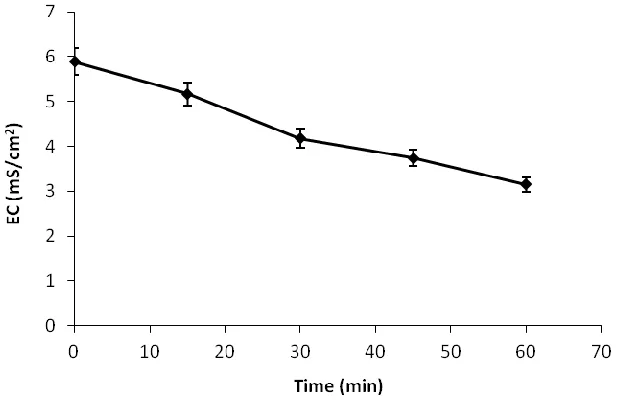
voltage and increase in Electrical conductivity [57]. Increase in electrical conductivity leads to increase of anodic dissolution and coagulant dose in solution [31]. Figure 4 pictures changes of electrical conductivity of the solution over 60 min of Sono-electrocoagulation process. As the results show, with increase in reaction time of Sono-electrocoagulation process and increase in removal rate of COD and TSS, electrical conductivity decreases. Similar results were reported in some study [36]. Taking into account that cavitation caused by ultrasonic waves generates large number of bubbles in the solution, it might decrease electrical conductivity of the electrolyte [57]. In addition, it seems that higher rate of COD removal in the treatment process reduces the viscosity of leachate and electrical conductivity in turn.
Figure 4. Electrical conductivity change during Sono-electrocoagulation process
3.2. Effect of voltage
In addition to increase in temperature with increase in voltage in EC process, increase in coagulant release into the solution increases COD and TSS performance (Fig. 2). Carvalho et al. reported similar results [58]. Likewise, increase in voltage increased COD removal in Sono-electrocoagulation, which is consistent with Chen et al. As noted earlier, this is due to increase in release of coagulants into the leachate, which is done through increase in voltage and reaction time [59].
3.3. Electrical energy Changes and its effect
in electrical energy consumption during the electrocoagulation process that results correspond with the results of the present study [61, 62, 56, 63].
Figure 5. Changes in electrical energy consumption and COD removal efficiency with different electrical conductivity values in Sono-electrocoagulation process
This economic feasibility of this method for treatment of wastewaters with high electrical conductivity reported in several studies [64, 65]. So it seems that, this process is an effective method for treatment of fresh leachate (a wastewater with high concentration of pollutants and electrical conductivity), that starts with simple equipment and the lack of need for chemicals, lower operating costs and can be used as a way to compete with other physicochemical methods proposed for leachate treatment.
4. CONCLUSION
Experiments on the removal of COD and TSS from fresh municipal landfill leachate by sono-electrocoagulation (with applying cooper electrodes) were carried out. The effect of reaction time and voltage on COD and TSS removal has been studied. The integrated process of sonication and electrocoagulation was found to be an effective system for the treatment of fresh leachate. Sono-electrocoagulation process removed 98% of COD and about 68% of TSS of fresh leachate (30 V, 60min). As shown by the results, increase in reaction time and voltage improved COD and TSS removal performance due to increase in the rate of released coagulants. Increase in temperature of reaction also influenced physicochemical properties of the solution (e.g. viscosity and vapor pressures), and improved Sono-electrocoagulation process. Sono-electrocoagulation process increased pH of the solution, so that given the pH range effective on iron coagulant and sedimentation pH of Cu2+, increase in pH value improved performance of Sono-electrocoagulation process. Moreover, electrical conductivity decreased over the course of Sono-electrocoagulation process due to formation of cavitation bubbles in the
[image:10.596.148.454.135.320.2]
solution and decrease in concentration of leachate. Thus, the sono-electrochemical process could be an effective technology for highly efficient treatment of municipal solid waste fresh leachate.
ACKNOWLEDGEMENTS
This research is resulted from MSc thesis and was partially funded by the Gonabad University of Medical Science, Gonabad, Iran. The authors are grateful to Deputy of Research and Technology and Department of Environmental Health Engineering for logistical and technical support. Also the Authors thank the dairy (Municipal Utilities, Iran) staffs for sampling assistance.
ETHICAL ISSUE
Ethical issues entirely have been considered by the authors and desperately tried to avoid plagiarism.
CONFLICT OF INTEREST
Authors declare that there is no conflict of interests.
References
1. H. Biglari, M. Saeidi, V. Alipour, S. Rahdar, Y. Sohrabi, R. Khaksefidi, M.R. Narooie, A. Zarei and M. Ahamadabadi, Int. J. Pharm. Technol., 8 (2016) 17900.
2. R. Khaksefidi, H. Biglari, S. Rahdar, M.M. Baneshi, M. Ahamadabadi, M.R. Narooie, A. Salimi, M. Saeidi and V. Alipour, Res. J. Appl. Sci., 11 (2016) 1404.
3. M. Moradi, Y. Safari, H. Biglari, M. Ghayebzadeh, M. Darvishmotevalli, M. Fallah, S. Nesari and H. Sharafi, Int. J. Pharm. Technol., 8 (2016) 17975.
4. S.A. Sajjadi, G. Asgari, H. Biglari and A. Chavoshani, J. Eng. Appl. Sci., 11 (2016) 1058.
5. H. Biglari, M. Saeidi, V. Alipour, S. Rahdar, Y. Sohrabi, R. Khaksefidi, M.R. Narooie, A. Zarei and M. Ahamadabadi, Int. J. Pharm. Technol., 8 (2016) 17856.
6. Z. Liu, Y. Dang, C. Li and D. Sun, Waste Manag., 43 (2015) 188.
7. J. Luo, G. Qian, J. Liu and Z.P. Xu, Renew. Sustain. Energy Rev., 49 (2015) 21.
8. S.M.D. Ghasimi, A. Idris, F. Ahmadun, B. Tey and T.G. Chuah, , J. Eng. Sci. Technol., 3 (2008) 256. 9. A. Del Borghi, L. Binaghi, A. Converti and M. Del Borghi, Chem. Biochem. Eng. Q., 17 (2003) 277. 10.S. Renou, J. Givaudan, S. Poulain, F. Dirassouyan and P. Moulin, J. Hazard. Mater., 150 (2008) 468. 11.H. Sun, Y. Peng and X. Shi, Bioresour. Technol., 177 (2015) 337.
12.P. Oulego, S. Collado, A. Laca and M. Díaz, Chem. Eng. J., 273 (2015) 647.
13.H. Biglari, M. Afsharnia, V. Alipour, R. Khosravi, K. Sharafi and A.H. Mahvi, Environ. Sci. Pollut. Res., 24 (2017) 4105.
14.T.F. Silva, R. Ferreira, P.A. Soares, D.R. Manenti, A. Fonseca, I. Saraiva, R.A. Boaventura and V.J. Vilar, J. Environ. Manage., 164 (2015) 32.
15.V. Oloibiri, I. Ufomba, M. Chys, W.T. Audenaert, K. Demeestere and S.W. Van Hulle, Waste Manag., 43 (2015) 335.
16.S. Rahdar, M. Ahamadabadi, R. Khaksefidi, M. Saeidi, M.R. Narooie, A. Salimi, H. Biglari and M.M. Baneshi, J. Glob. Pharma Technol., 9 (2017) 20.
17.M. Saeidi, H. Biglari, S. Rahdar, M.M. Baneshi, M. Ahamadabadi, M.R. Narooie, A. Salimi and R. Khaksefidi, J. Glob. Pharma Technol., 9 (2017) 13.
18.M. Amaral, H. Pereira, E. Nani and L. Lange, Water Sci. Technol., 72 (2015) 269.
20.C. Amor, E. De Torres-Socías, J.A. Peres, M.I. Maldonado, I. Oller, S. Malato and M.S. Lucas, J. Hazard. Mater., 286 (2015) 261.
21.W. Dastyar, T. Amani and S. Elyasi, Process Safety and Environmental Protection., 95 (2015) 1. 22.Z. Liu, W. Wu, P. Shi, J. Guo and J. Cheng, Waste Manag., 41 (2015) 111.
23.I. Demir, I. Koyuncu, S. Guclu, S. Yildiz, V. Balahorli, S. Caglar, T. Turken, M.E. Pasaoglu, R. Kaya and R. Sengur-Tasdemir, Sci. World J, 2015 (2015)
24.Y.-Z. Ren, Z.-L. Wu, M. Franke, P. Braeutigam, B. Ondruschka, D.J. Comeskey and P.M. King, Ultrason. Sonochem., 20 (2013) 715.
25.A. Raschitor, C.M. Fernandez, I. Cretescu, M.A. Rodrigo and P. Cañizares, Sep. Purif. Technol., 135 (2014) 110.
26.B. Yang, J. Zuo, X. Tang, F. Liu, X. Yu, X. Tang, H. Jiang and L. Gan, Ultrason. Sonochem., 21 (2014) 1310.
27.M.M. Baneshi, B. Naraghi, S. Rahdar, H. Biglari, M. Saeidi, M. Ahamadabadi, M.R. Narooie, A. Salimi, R. Khaksefidi and V. Alipour, IIOAB J, 7 (2016) 529.
28.R. Khosravi, H. Hossini, M. Heidari, M. Fazlzadeh, H. Biglari, A. Taghizadeh and B. Barikbin, Int. J. Electrochem. Sci., 12 (2017) 4745.
29.A.H. Mahvi, E. Bazrafshan and H. Biglari, E-Journal Chem., 9 (2012) 2453. 30.E. Bazrafshan, H. Biglari and A.H. Mahvi, Fresenius Environ. Bull., 21 (2012) 364. 31.P.M. Lakshmi and P. Sivashanmugam, Sep. Purif. Technol., 116 (2013) 378.
32.C. Barrera-Díaz, B. Frontana-Uribe and B. Bilyeu, Chemosphere, 105 (2014) 160. 33.J.R. Steter, W.R. Barros, M.R. Lanza and A.J. Motheo, Chemosphere, 117 (2014) 200. 34.C.-H. Weng, Y.-T. Lin and H.-M. Yuan, Sep. Purif. Technol., 117 (2013) 75.
35.H.-X. Zhang, X.-Y. Hou, S.-X. Xu, Z.-L. Li, H.-F. Yu and X.-H. Shen, Ultrason. Sonochem., 20 (2013) 1176.
36.F. Souza, C. Saéz, M. Lanza, P. Cañizares and M. Rodrigo, Sep. Purif. Technol., 149 (2015) 24. 37.Y.-Z. Ren, M. Franke, F. Anschuetz, B. Ondruschka, A. Ignaszak and P. Braeutigam, Ultrason.
Sonochem., 21 (2014) 2020.
38.C.-C. He, C.-Y. Hu and S.-L. Lo, Sep. Purif. Technol., 165 (2016) 107.
39.N. Tran, P. Drogui, L. Nguyen and S.K. Brar, J. Environ. Chem. Eng., 3 (2015) 2637.
40.W.E. Federation and A.P.H. Association, Am. Public Heal. Assoc. Washington, DC, USA., (2005). 41.M. Hosseini, E. Babalou and M. Afshar, Med. J. Oru., 14 (2004) 158.
42.G. Chen, Sep. Purif. Technol., 38 (2004) 11.
43.F. Asgharian, M. Khosravi‐ Nikou, B. Anvaripour and I. Danaee, Environ. Prog. Sustain. Energy., 36 (2017) 822.
44.M. Afsharnia, A. Torabian, G. Mousavi and M. Abduli Desalin. Water Treat., 48 (2012) 344. 45.A. Somayajula, P. Asaithambi, M. Susree and M. Matheswaran, Ultrason. Sonochem., 19 (2012)
803.
46.A. Aleboyeh, N. Daneshvar and M. Kasiri, Chem. Eng. Process. Process Intensif., 47 (2008) 827. 47.A. Gallipoli and C. Braguglia, Ultrason. Sonochem., 19 (2012) 864.
48.P. Jarvis, B. Jefferson, J. Gregory and S.A. Parsons, Water Res., 39 (2005) 3121. 49.C. Braguglia, M. Gagliano and S. Rossetti, Bioresour. Technol., 110 (2012) 43. 50.A. Babuponnusami and K. Muthukumar, Chem. Eng. J., 183 (2012) 1.
51.F. Bouhezila, M. Hariti, H. Lounici and N. Mameri, Desalination, 280 (2011) 347.
52.S. Giannakis, S. Papoutsakis, E. Darakas, A. Escalas-Cañellas, C. Pétrier and C. Pulgarin, Ultrason. Sonochem., 22 (2015) 515.
53.A. Bagga, S. Chellam and D.A. Clifford, J. Memb. Sci., 309 (2008) 82.
54.A. Tatsi, A. Zouboulis, K. Matis and P. Samaras, Chemosphere, 53 (2003) 737.
55.H.a.M. Casillas, D.L. Cocke, J.A. Gomes, P. Morkovsky, J.R. Parga, E. Peterson and C. Garcia, ECS Trans., 6 (2007) 1.
57.K. Xia, F. Xie and Y. Ma, Ultrason. Sonochem., 21 (2014) 549.
58.H.P. De Carvalho, J. Huang, M. Zhao, G. Liu, L. Dong and X. Liu, Alexandria Eng. J., 54 (2015) 777.
59.W.-S. Chen and C.-P. Huang, Ultrason. Sonochem., 21 (2014) 840.
60.A.S. Naje, S. Chelliapan, Z. Zakaria and S.A. Abbas, Int. J. Electrochem. Sci., 10 (2015) 5924. 61.H.B. Ammar, M.B. Brahim, R. Abdelhédi and Y. Samet, Sep. Purif. Technol., 157 (2016) 9. 62.A. Dalvand, M. Gholami, A. Joneidi and N. Mahmoodi, J. Color Sci. Technol., 3 (2009) 97. 63.A. Vlyssides, P. Karlis and A. Zorpas, Environ. Int., 25 (1999) 663.
64.O. Abdelwahab, N. Amin and E.Z. El-Ashtoukhy, J. Hazard. Mater., 163 (2009) 711. 65.M. Ahmadimoghadam and H. Amiri, J. Heal. Environ., 3 (2010) 185.
© 2018 The Authors. Published by ESG (www.electrochemsci.org). This article is an open access article distributed under the terms and conditions of the Creative Commons Attribution license