Int. J. Electrochem. Sci., 12 (2017) 2219 – 2231, doi: 10.20964/2017.03.28
International Journal of
ELECTROCHEMICAL
SCIENCE
www.electrochemsci.orgSynthesis and Application of
2’-(5-Bromo-2-hydroxybenzylidene) Toluenesulfonohydrazide as a Shift Base
Ionophore for Highly Selective Copper(II) Membrane Electrode
Illyas Md Isa1,2,*, Nazihah Mohd Noor1, Yusnita Juahir1, Norhayati Hashim1,2, Hapipah Mohd Ali3 1
Department of Chemistry, Faculty of Science and Mathematics, Universiti Pendidikan Sultan Idris, 35900 Tanjong Malim, Perak, Malaysia
2
Nanotechnology Research Centre, Faculty of Science and Mathematics, Universiti Pendidikan Sultan Idris, 35900 Tanjong Malim, Perak, Malaysia
3
Department of Chemistry, Faculty of Science, University of Malaya, 50603 Kuala Lumpur, Malaysia *
Email: [email protected]
Received: 9 September 2016 / Accepted: 10 January 2017 / Published: 12 February 2017
The construction of a potentiometric copper(II) ion electrode based on 2’-(5-bromo-2-hydroxybenzylidene) toluenesulfonohydrazide (5BrSALMeBSH) as an ionophore has been developed. The designed electrode having a different composition of poly(vinyl chloride) (PVC), plasticizers and ionophore showed that sensor with membrane composition 5BrSALMeBSH: PVC: DOP in the ratio of 7:40:56 (w/w) gave the best response. It exhibited a wide linear response with a Nernstian slope of 29.34 mV per decade over the concentration range of 1.0 x 10⁻⁵ – 1.0 x 10⁻¹ M Cu(II) ions. Under the optimized conditions, the electrode has a detection limit of 3.98 x 10⁻⁶ M and the working pH range of 3.0 - 6.0 with response time less than the 20s. The proposed electrode is stable for about two months and exhibits good selectivity for Cu(II) ions over Zn2+, Co2+ , Ni2+, Pb2+ , Mg2+ , Ba2+ , Ca2+ , Cd 2+, Ce3+, K+, Na+. Designation of this easy and inexpensive electrode was used to determine a copper ion in wastewater samples, and the results obtained shown a sync relation with spectroscopy method which is AAS method conducted.
Keywords: Copper(II) selective electrode, 2’-(5-bromo-2-hydroxybenzylidene) toluenesulfonohydrazide, potentiometry, polymeric membrane electrode
1. INTRODUCTION
used in domestic intention, agricultural, and industrial on account of its high chemical stability, electrical conductivity, capacity and plasticity to form alloys with many metals [1]. Apart from the heavy metals, copper is both as essential micronutrients and vital in a vast number of metabolic process and plays major functions to maintain DNA integrity. It prevents oxidative DNA which is damaged through copper containing superoxide dismutase and several DNA repair proteins [2]. Even though copper is an essential requirement for a healthy body, excessive concentration of copper can be detrimental, causing copper toxicity. The maximum tolerable level of the human body for copper is 2.0 mg L-1 [3,4]. Excessive absorption or lacking copper can cause the alteration in copper homeostasis at the cellular level in various ways and are linked to severe human diseases, for instance, cancer, Menke syndrome, Wilson’s diseases and Alzheimer’s [5-7]. Furthermore, exceeding a normal limit it will gather in the liver, causing vomiting, diarrhea, and transpiration, in which depending on its concentration, can cause death from bleeding [8,9].
In many biological systems and the industry, copper is crucially significant [10]. Thus careful monitoring of this object becomes clinical and environmental necessary to strictly control the concentration of Cu(II) ions and minimizes the harm from chronic and acute exposures. As a result, ion selective electrode(ISE) met with all the requirements needed such as inexpensive, quick and a reliable portable analytical technique. ISE are a versatile device which offers advantages such as fast response, reasonable selectivity, easy sample preparation and measurements, simple instrumentation, wide concentration range, and inexpensive materials [11-14].
Various efforts from analytical techniques have been proposed to provide a prompt, accurate and reliable determination of copper ions in environmental including atomic absorption spectrometry (AAS) [15], inductively coupled plasma-optical emission spectroscopy (ICP-OES) [16], flame atomic absorption spectroscopy (FAAS) [17], stripping voltammetry [18], and inductively coupled plasma-mass spectrometry (ICP-MS) [19]. All of these techniques may give accurate results, where it have high selectivity and low detection limit, but have disadvantages such as involve sufficient expertise, laborious and large-scale infrastructure back up. Besides, the operational cost and maintenance are high with costly materials and therefore is not suitable for routine analysis for large scale of environmental samples [20,21]. ISE are potentiometry sensor which is the electrochemical response is usually dominated by primary ion. Primary ion also known as analyte ion or target ion is one ionic species that are presented in the sample solution. According to theNernst equation, the potential of the electrode depends on the concentration of the primary ion [22].
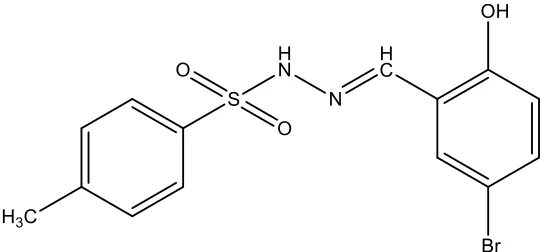
In this current research work, as depicted in Figure 1. 2’-(5-bromo-2-hydroxybenzylidene) toluenesulfonohydrazide (5BrSALMeBSH) was used as an ionophore to construct a Cu(II) ion selective electrode and its applicability for determination of Cu(II) in real samples were studied. This sensor showed specific features such as wide concentration range, fast response time, lower detection limit, sufficient lifetime, remarkable selectivity for Cu2+ over most common cations and near-Nernstian slope.
Figure 1. Structure of 2’-(5-bromo-2-hydroxybenzylidene) toluenesulfonohydrazide
2. EXPERIMENTAL
2.1. Chemicals and reagents
High molecular weight poly(vinyl chloride) (PVC) was obtained from Fluka Chemical (Switzerland). All analytical grade nickel(II) chloride, iron(II) chloride, iron(III) chloride, zinc chloride, cobalt(II) chloride, magnesium chloride, calcium chloride, potassium chloride, ammonia chloride, lithium chloride, sodium chloride, cerium(III) chloride, copper(II) nitrate, ethanol and tetrahydrofuran (THF) were obtained from Merck (Germany). All plasticizers dioctyl phthalate (DOP), Tetraethyl methylenediphosphonate (TMDP), bis(2-ethylhexyl) adipate (BEHA), bis(2-ethylhexyl) sebacate (BEHS), tris(2-ethylhexyl) phosphate (T2EP), ortho-nitrophenyloctyl ether (o-NPOE), dioctylphenylphosphonate (DOPP), and dibutyl phthalate (DBP), anion excluder sodium tetraphenylborate (NaTPB), and for pH adjustment hydrochloric acid (HCl) and sodium hydroxide solution were acquired from Aldrich (Germany). Freshly stocks Cu(II) solutions were prepared by dissolving suitable quantity of analytical grade copper(II) chloride from Merck (Germany) in distilled deionized water. A 4-methylbenzenesulfonohydrazine, 5-bromo-2-hydroxybenzaldehyde, and dimethylsulphoxide (DMSO) were used in synthesizing of 5BrSALMeBSH from Acros Organics (Belgium). Absolute ethanol was obtained from Fischer Scientific (USA).
2.2. Equipments
2.3. Synthesis of 2’-(5-bromo-2-hydroxybenzylidene) toluenesulfonohydrazide
2’-(5-Bromo-2-hydroxybenzylidene) toluenesulfonohydrazide ligand was synthesized by reflux process of 4-methylbenzenesulfonohydrazine (1.00 g) and 5-bromo-2-hydroxybenzaldehyde (1.08 g). The molar ratio of 4-methylbenzenesulfonohydrazine to salicylaldehyde is 1:1. This substance was refluxed in acidified ethanol (pH=4-5) for two hours. The colorless solution obtained has been concentrated in vacuum to give a crystalline solution. The product obtained filtrated, washed with ethanol, and dried over silica gel and recrystallize from absolute ethanol. The product confirmation will be determined by CHNS, NMR, and FTIR. The following data were found, yield: 72%. Melting point: 201 C. Anal. calc. for C14H13N2O3SBr: C, 45.53; H, 3.27; N, 8.07 %. Found: C, 45.54; H, 3.55; N, 7.59%. IR [max (cm-1) (KBr)]: NH 3131; C=N 1618;(CPh -O) 1288;as(SO2)1324;s(SO2) 1167. 1H NMR: (DMSO-d6, ppm) : 11.59 (1H, s, OH); 10.45 (1H, s, NH); 8.14(1H, s, N=CH); 6.88-7.76 (m, ArH); 3.35 (3H, s, CH3); 13C NMR: (DMSO-d6, ppm) 155.18 (C-OH); 143.68 (N=CH); 118.09-143.37 (Ar-C); 21.05 (CH3).
2.4. Preparation of electrode
The PVC membrane was constructed according to the similar method reported as previously [23-25]. The membrane was prepared thoroughly by using an appropriate quantity of plasticizer, PVC, and 5BrSALMeBSH in 5 mL of THF solution. Right after the addition of the THF, the solution was immediately stirred vigorously and then was poured to a glass ring of 3.5 cm diameter which was placed on a glass plate. The glass ring was covered by the filter paper to prevent dust and air streams from spoiling the mixture. The solution was left overnight at room temperature to allow slow evaporation of the solvent. The resulting membranes were detached from the glass plate which then cut into appropriate sizes and was glued to one end of a glass tube with Araldite® glue. Before their first use, the prepared electrode was then filled with the internal solution of 1.0 M CuCl2 and was conditioned for about 24 hours in a fresh 1.0 ×10⁻⁴ M CuCl2.
2.5. Potential measurements
The potential measurement was measured using potentiometer Orion 720 A+ and was carried out at 25±0.1°C temperature. The platinum wire was used to conducts electricity by immersing it in internal solution. 50 mL of CuCl2 serial solution with concentration range from 1.0 x 10⁻⁷ to 1.0 x 10⁻¹ M were prepared. Each solution was stirred, and potential was recorded when it became stable. Then, the graph of potential reading vs. logarithm function of Cu(II) concentration was plotted. All potential studies were carried out by using the following cell assembly set up.
3. RESULTS AND DISCUSSION
3.1. The potential response of the Cu2+ sensor
The 5BrSALMeBSH was synthesized as the similar method outlined by Ali et al. [26]. This ionophore illustrates complexation with Cu(II) ions, shows strong attraction towards Cu(II) ion. The primary requirement to prepare a sensor is an electroactive material used in the membranes should demonstrate stronger attraction for a specific metal ion. Different hard and soft donor atoms that exist in the chelating ring will affect the chemical and structural characteristics of the ionophore, thus promoting the selectivity and stability of the resulting complex, as well as forcing metal ions to adopt typical coordination geometry. Additional stability may resulted due to the presence of such donor atoms in the aromatic rings in the ionophores. To verify the suitability of the ionophore of 5BrSALMeBSH as electroactive material towards Cu(II) ions, a preliminary experiment was carried out. In preliminary experiments, the potential response of the PVC-membrane electrode based on 5BrSALMeBSH to various common metals, including heavy metals, alkali, transition and alkaline earth metals was measured. The potential responses of the most sensitive ion-selective electrode based on 5BrSALMeBSH are shown in Figure 2. As can be observed, all the tested cations except for Cu2+ ions show relatively weak responses with the ionophore which is the slope much lower than the expected Nernstian slopes of 29.5 mV per decade for divalent cation with the concentration range 1.0 x 10⁻¹ to 1.0 x 10⁻⁷ M.
[image:5.596.120.492.432.687.2].
[image:6.596.99.499.206.304.2]
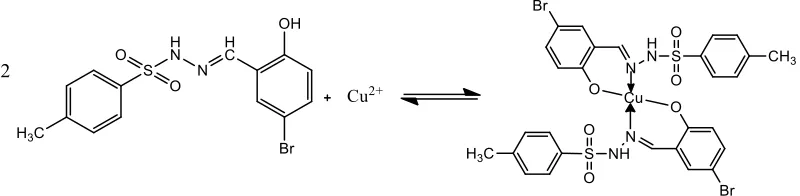
This behaviour may reflect on the prompt exchange kinetics of 5BrSALMeBSH-Cu(II) complex and the result of the selective tendency of the ionophore against Cu(II) ions in comparison to other metal ions. The lone pair of electron of the oxygen and nitrogen atoms that exist in the structure of 5BrSALMeBSH ionophore enable the Cu(II) ions to form interaction with the ionophore. Moreover, the appropriate size of Cu(II) ions may be responsible for a proper fitting condition for selective and stable complex formation. In Figure 3. the feasible mechanistic pathway of ionophore-metal complexation is shown.
Figure 3. Possible mechanistic pathway of ionophore-metal complexation
3.2. Working concentration and slope
[image:7.596.33.565.243.696.2]
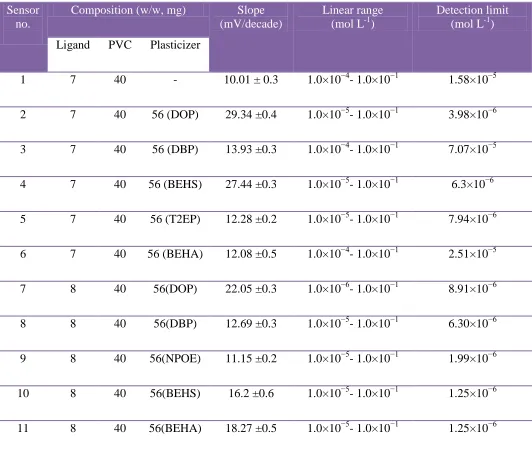
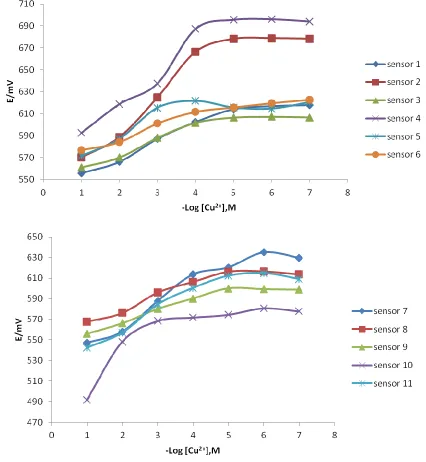
plasticizers to the membranes does significantly affect the performance of the sensors. Amongst the five plasticizers added, DOP improves performance of the sensor (No. 2) by incorporates 7 mg 5BrSALMeBSH as an ionophore, 56 mg dioctylphthalate (DOP) as a plasticizer, and 40 mg PVC as a neutral matrix as it exhibits the maximum working concentration range from 1.0×10⁻⁵ to 1.0×10⁻¹ M with an almost Nernstian slope of 29.34 mV decade−1 of activity. Due to a synergism between polarity and lipophilicity, it shows Nernstian’s slope, detection limit and concentration range is either decrease or increase when DOP is replaced with other plasticizers.
Table 1. Composition and response characteristics for Cu(II)-ISE based on 5BrSALMeBSH Sensor
no.
Composition (w/w, mg) Slope (mV/decade)
Linear range (mol L-1)
Detection limit (mol L-1)
Ligand PVC Plasticizer
1 7 40 - 10.01 ± 0.3 1.0×10⁻⁴- 1.0×10⁻¹ 1.58×10⁻⁵
2 7 40 56 (DOP) 29.34 ±0.4 1.0×10⁻⁵- 1.0×10⁻¹ 3.98×10⁻⁶
3 7 40 56 (DBP) 13.93 ±0.3 1.0×10⁻⁴- 1.0×10⁻¹ 7.07×10⁻⁵
4 7 40 56 (BEHS) 27.44 ±0.3 1.0×10⁻⁵- 1.0×10⁻¹ 6.3×10⁻⁶
5 7 40 56 (T2EP) 12.28 ±0.2 1.0×10⁻⁵- 1.0×10⁻¹ 7.94×10⁻⁶ 6 7 40 56 (BEHA) 12.08 ±0.5 1.0×10⁻⁴- 1.0×10⁻¹ 2.51×10⁻⁵
7 8 40 56(DOP) 22.05 ±0.3 1.0×10⁻⁶- 1.0×10⁻¹ 8.91×10⁻⁶
8 8 40 56(DBP) 12.69 ±0.3 1.0×10⁻⁵- 1.0×10⁻¹ 6.30×10⁻⁶
9 8 40 56(NPOE) 11.15 ±0.2 1.0×10⁻⁵- 1.0×10⁻¹ 1.99×10⁻⁶
10 8 40 56(BEHS) 16.2 ±0.6 1.0×10⁻⁵- 1.0×10⁻¹ 1.25×10⁻⁶
Figure 4(a) and (b). Potential response of membrane sensors based on 5BrSALMeBSH at different membrane composition and plasticizer
3.3. Response time and lifetime
[image:8.596.87.513.78.540.2]
concentrated solution. Thus, the static response time obtained was less than 20 s over the concentration range.
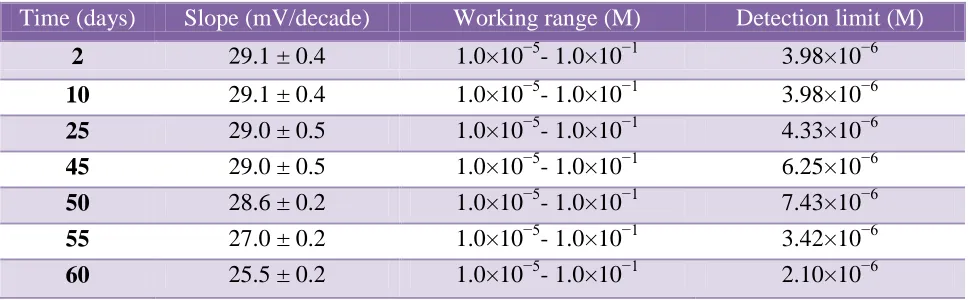
[image:9.596.57.541.380.530.2]The loss of one or more of its components while contacting with aqueous solutions is believed as the main factor responsible for the limited lifetime of a sensor. The degradation of the sensitivity in the polymeric membrane may be dependent upon the chemical stability and lipophilicity of the ionophores, which can result in the ligand leaking from the membrane. Sufficient lipoliphicity of ligand and plasticizers ensures stable potentials and long lifetimes [33]. The electrode’s performance was recorded on a daily basis over a period of eight weeks to determine the lifetimes of the proposed electrode. The lifetime of the membrane electrode depends on the Nernstian slope of the membrane. The drifting of the slope indicates the changes in the membrane composition due to the ion exchange processes in the presence of high concentration of interfering ions in samples, decomposition of the ionophores or added charged sites in the membrane and of leaching membrane components such as a plasticizer, and ionophore. Therefore, among all the membranes prepared, the lifetime of the membrane sensors comprising DOP sensor no. 2 can be used only for two months. The result obtained was summarized in Table 2 below.
Table 2. Performance of sensor no.2 at different time intervals.
Time (days) Slope (mV/decade) Working range (M) Detection limit (M)
2 29.1 ± 0.4 1.0×10⁻⁵-1.0×10⁻¹ 3.98×10⁻⁶
10 29.1 ± 0.4 1.0×10⁻⁵-1.0×10⁻¹ 3.98×10⁻⁶
25 29.0 ± 0.5 1.0×10⁻⁵-1.0×10⁻¹ 4.33×10⁻⁶
45 29.0 ± 0.5 1.0×10⁻⁵-1.0×10⁻¹ 6.25×10⁻⁶
50 28.6 ± 0.2 1.0×10⁻⁵-1.0×10⁻¹ 7.43×10⁻⁶
55 27.0 ± 0.2 1.0×10⁻⁵-1.0×10⁻¹ 3.42×10⁻⁶
60 25.5 ± 0.2 1.0×10⁻⁵-1.0×10⁻¹ 2.10×10⁻⁶
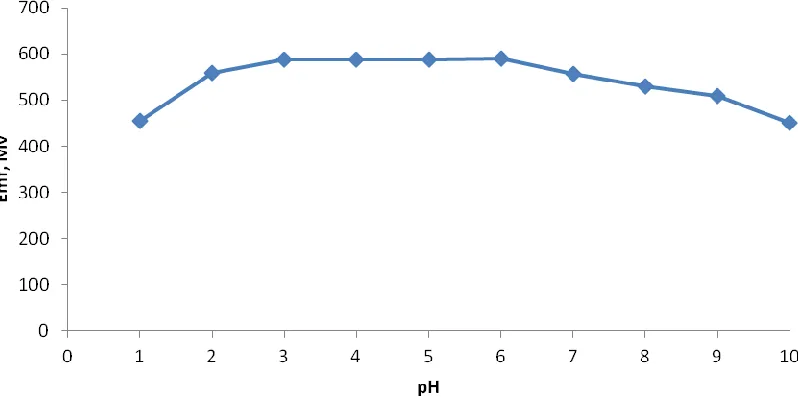
3.4 pH effect on electrode response
Figure 5. Effect of pH on the potential response of the optimized Cu2+ selective electrode
3.5. Effect of interfering ions on sensor performance
Selectivity coefficient, Kpot is the term used to describe the influence of interfering ion on the potential response behaviour of the ion selective membrane electrode. Selectivity is the most significant features as it will determine the level of the effectiveness of any sensor in real sample measurements. Thus in this research, the selectivity coefficients of the electrode towards different cationic species were evaluated by using fixed interference method (FIM) [35].
Based on this method, the selectivity coefficients were evaluated from solution containing a fixed concentration of interfering ion, 1.0 x 10⁻³ M such as Zn2+, Co2+, Ni2+, Pb2+, Mg2+, Ba2+, Ca2+, Cd2+, Ce3+, K+, Na+ and varying amounts of Cu2+ ions, 1.0 x 10⁻⁷ -1.0 x 10⁻¹ M. Each solution in the mixture needs to be maintained at pH 4. The selectivity coefficient is calculated from the following Nicolsky-Eisenman equation:
B A z
z B A
pot B A
K
,
a
/
(
a
)
/--- [1]
Table 3. The selectivity coefficients of various interfering cations for Cu(II) selective membrane electrode (sensor no.2).
Interfering ion Selectivity coefficient, Kpot
Zn2+ 1.25 x 10⁻³
Co2+ 3.98 x 10⁻⁴
Ni2+ 1.58 x 10⁻⁴
Ce3+ 5.01 x10⁻⁴
Mg2+ 2.51 x10⁻³
Ba2+ 3.55 x10⁻³
Ca2+ 1.0 x10⁻³
Cd2+ 7.08 x10⁻⁴
K+ 2.23 x10⁻³
Na+ 3.16 x10⁻³
Li+ 1.99 x 10⁻³
[image:11.596.182.415.112.374.2]Pb2+ 6.31 x 10⁻⁴
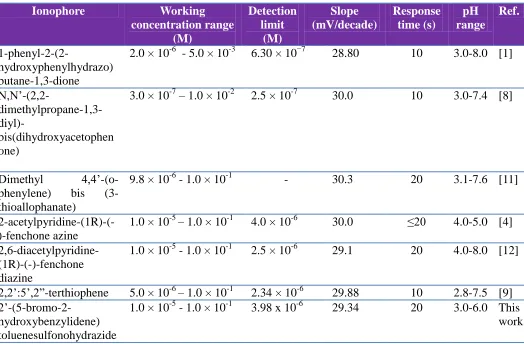
Table 4. Comparison of the proposed of Cu2+ ion-selective electrode with previous reported electrodes.
Ionophore Working
concentration range (M) Detection limit (M) Slope (mV/decade) Response time (s) pH range Ref. 1-phenyl-2-(2-hydroxyphenylhydrazo) butane-1,3-dione
2.0 × 10⁻⁶ - 5.0 × 10⁻³ 6.30 × 10⁻⁷ 28.80 10 3.0-8.0 [1]
N,N’-(2,2- dimethylpropane-1,3-
diyl)-bis(dihydroxyacetophen one)
3.0 × 10⁻⁷ – 1.0 × 10⁻² 2.5 × 10⁻⁷ 30.0 10 3.0-7.4 [8]
Dimethyl 4,4’-(o-phenylene) bis (3-thioallophanate)
9.8 × 10⁻⁶ - 1.0 × 10⁻¹ - 30.3 20 3.1-7.6 [11]
2-acetylpyridine-(1R)-(-)-fenchone azine
1.0 × 10⁻⁵ – 1.0 × 10⁻¹ 4.0 × 10⁻⁶ 30.0 ≤20 4.0-5.0 [4]
2,6-diacetylpyridine-(1R)-(-)-fenchone diazine
1.0 × 10⁻⁵ - 1.0 × 10⁻¹ 2.5 × 10⁻⁶ 29.1 20 4.0-8.0 [12]
2,2’:5’,2”-terthiophene 5.0 × 10⁻⁶ – 1.0 × 10⁻¹ 2.34 × 10⁻⁶ 29.88 10 2.8-7.5 [9]
2’-(5-bromo-2-hydroxybenzylidene) toluenesulfonohydrazide
[image:11.596.52.576.427.771.2]
3.6. Comparison with the previous work
Table 4. compared the performance characteristics of the proposed sensor based on different ionophores with those previously reported sensors. The data shows that the proposed membrane sensor is comparable and better selectivity as compared to most reported electrodes, the interference value of different ions is very less.
3.7. Analytical applications
The proposed membrane sensor (sensor no.2) was used to measure the Cu(II) cations under membrane laboratory conditions to determine the presence of copper in real samples which is different wastewater found from the industrial area in Perak.
[image:12.596.81.518.423.504.2]In order to validate the accuracy of the proposed sensor for determining Cu(II) in industrial wastewater samples, the obtained results were compared with the data acquired from atomic absorption spectroscopy (AAS). From the Table 5. it is observed that there is sync relation between the results obtained with an AAS method conducted. Thus, it confirmed the accuracy and precision of fabricated sensors in successful determination for Cu2+ in real samples.
Table 5. Determination of Cu2+ in wastewater samples (n=3) by Cu(II) selective membrane electrode (sensor no.2) and AAS.
Method Samples
Sample 1 Sample 2 Sample 3
Membrane electrode (ppm) 3.7±0.3 9.4±0.2 8.9±0.5
AAS (ppm) 4.0±0.2 9.9±0.1 9.2±0.3
4. CONCLUSION
The membrane assembly prepared using 2’-(5-bromo-2-hydroxybenzylidene) toluenesulfonohydrazide as membrane composition with plasticizer (DOP) exhibited linearity over a wide concentration range of 1.0 × 10⁻¹ to 1.0 × 10⁻⁵ M with Nernstian slope of 29.34 mV per decade, fast response time (less than 20s), long lifetime (about two months). This sensors shows good accuracy when compared with AAS instrumental method for determining Cu2+ in real samples.
ACKNOWLEDGEMENT
References
1. M. N. Kopylovich, K. T. Mahmudov, and A. J. L. Pombeiro, J. Hazard. Mater, 186 (2011) 1154. 2. J. Bai, Y. Chen, P. Li, D. Sun, and Y. Tang, JEAC, 754 (2015) 1.
3. I. Vopálenská, L. Váchová, and Z. Palková, Biosens. Bioelectron., 72 (2015) 160.
4. I. Isa, M. I. Saidin, M. Ahmad, S. Mustaffa, and S. A. Ghani, Int. J. Electrochem. Sci, 7 (2012) 9536.
5. A.S.M. Pujol, M.Cuillel, O.Renaudet, C.Lebrun, P.Charbonnier, D.Cassio, C. Gateau, P.Dulmy, J.Am.Chem.Soc., 133 (2010) 286.
6. E. Gaggeli, H.Kozlowski, D.Valensin, G.Valensin, Chem Rev., 106 (2006) 1995. 7. G.J Brewer, Chem.Res. Toxicol., 23 (2009) 319.
8. M. Ghanei-Motlagh, M. A. Taher, V. Saheb, M. Fayazi, and I. Sheikhshoaie, Electrochim. Acta, 56 (2011) 5376.
9. R. K. Mahajan and P. Sood, Int. J. Electrochem. Sci., 2 (2007) 832.
10.V. K. Gupta, a. K. Jain, G. Maheshwari, H. Lang, and Z. Ishtaiwi, Sens. Actuators, B, 117 (2006) 99.
11.V. K. Gupta, L. P. Singh, R. Singh, N. Upadhyay, S. P. Kaur, and B. Sethi, J. Mol. Liq., 174 (2012) 11.
12.I. Isa, M. I. Saidin, M. Ahmad, N. Hashim, and S. A. Ghani, Int. J. Electrochem. Sci, 8 (2013) 11175.
13.G. Dimeski, T. Badrick, A. S. John, Clin Chim Acta., 411 (2010)309.
14.V. K. Gupta, R. N. Royal, M. Al Khayat, P. Kumar, N. Bacheti, Talanta., 69 (2006) 1149. 15.M. A. Álvarez, G. Carrillo, Talanta, 97 (2012) 505.
16.B. Feist, B. Mikula, K. Pytlakowska, B. Puzio, F. Buhl, J. Hazard. Mater., 152 (2008) 1122. 17.E. L. da Silva, E. M. Ganzarolli, E. Carasek, Talanta, 62 (2004) 727.
18.S. K. Alpat, S. Alpat, B. Kutlu, O. Ozbayrak, and H. B. Buyukisik, Sens. Actuators, B, 128 (2008) 273.
19.I. Lavilla, M. Costas, S. Gil, S. Corderí, G. Sánchez, C.Bendicho, Talanta, 93 (2012) 111. 20.S. Chandra, D. Singh, and A. Sarkar, Chinese J. Chem. Eng. 22 (2014) 480.
21.E. Lindner and B. D. Pendley, Anal. Chim. Acta, 762 (2013) 1. 22.L. P. Singh and J. M. Bhatnagar, Talanta, 64 (2004) 313. 23.I.M. Isa, S. Ab Ghani , Talanta, 71 (2007) 452.
24.I. M. Isa, S. Mustafar, M. Ahmad, N. Hashim, S.A Ghani, Talanta, 87(2011)230.
25.N. Bakeman, I. M. Isa, N.M Ali, M.Ahmad, S.A Ghani, Int.J. Electrochem. Sci, 7(2012) 4574. 26.H. M. Ali, J. Yusnita, M. R. Rizal, and S. W. Ng, Acta Crystallogr. Sect. E Struct. Reports Online,
63 (2007) 2937.
27.T. Rostazin, E. Bakker, K. Suzuki, and W.Simon, Anal. Chim. Acta, 280 (1993) 197. 28.H.A. Zamani, Chinese Chem. Lett., 22 (2011) 701.
29.V. K. Gupta, A. K. Jain, S. Agarwal, and G. Maheshwari, Talanta 71 (2007) 1964.
30.E. Ammann, E. Pretsch, W. Simon, E. Lindner, A. Bezegh, And E. Pungor, Anal. Chim. Acta, 171 (1985) 119.
31.M. de los A, A. Perez, L.P. Martin, J.C. Quintana, M. Yazdani-Pedram, Sens. Actuators B 89 (2003) 262.
32.W. Zhang, L. Jenny, U.E. Spichiger, Anal. Sci. 16 (2000) 11. 33.M. Telting-Diaz, E. Bakker, Anal. Chem. 73 (2001) 5582.
34.R.P. Buck, V.V. Cosofort, E. Linder, Anal. Chim. Acta, 282 (1993) 273. 35.F.J. Sa’ez de Viteri, D. Diamond, Analyst 119 (1994) 749.