Int. J. Electrochem. Sci., 13 (2018) 6940 – 6957, doi: 10.20964/2018.07.65
International Journal of
ELECTROCHEMICAL
SCIENCE
www.electrochemsci.org
Fabrication of a three-dimensional electrochemical paper-based
device (3D-ePAD) for individual and simultaneous detection of
ascorbic acid, dopamine and uric acid
Nongyao Nontawong1, Maliwan Amatatongchai1*, Wanchai Wuepchaiyaphum1, Sanoe Chairam1, Saichol Pimmongkol2, Sirirat Panich3, Suparb Tamuang1 and Purim Jarujamrus1
1
Department of Chemistry and Center of Excellence for Innovation in Chemistry, Faculty of Science, Ubon Ratchathani University, Ubon Ratchathani 34190, Thailand.
2
Department of Physics, Faculty of Science, Ubon Ratchathani University, Ubon Ratchathani 34190, Thailand.
3
Faculty of Science and Technology, RMUTP, Bangkok 10800, Thailand. *
E-mail: [email protected], [email protected]
Received: 23 March 2018 / Accepted: 15 May 2018 / Published: 5 June 2018
We report the development of a three-dimensional electrochemical paper-based analytical device (3D-ePAD) for the individual and simultaneous determination of ascorbic acid (AA), dopamine (DA) and uric acid (UA). The device was fabricated by alkyl ketene dimer (AKD)-inkjet printing of a circularly hydrophobic zone on filter paper for application of aqueous samples coupled with screen-printing of the electrodes on the paper which was folded underneath hydrophobic zone. A self-assembled three-electrode system, comprising a graphite paste modified with Fe3O4@Au-Cys/PANI was fabricated on the patterned paper by screen printed through the pre-designed transparent film slit. The three electrodes of Fe3O4@Au-Cys/PANI modified graphite electrodes (Fe3O4@Au-Cys/PANI/GFE) on the layout paper were served as the working electrode, the reference electrode, and the counter electrode, respectively. Cyclic voltammetry (CV) was used to study the electrochemical mechanism of AA, DA and UA. The results indicated that a high sensitivity towards AA, DA and UA was observed. Our results suggested that coating the working electrode with anionic surfactant, SDS (1 mM, pH 2), provides the distinguishable oxidation peak potential of AA and did not overlap with the oxidation peak of DA and UA. As a result, simultaneous determination of these three molecules in a mixture can be achieved. Examples of individual quantification of DA and UA in pharmaceutical and urine samples were demonstrated using differential pulse voltammetry (DPV). Under the optimum condition, the developed 3D-ePAD gave a linearity ranged from 20 to 1,000 µM for both DA and UA. The detection limits were 2.19 and 1.80 µM for DA and UA, respectively. There are no significant matrix interferences in the analyzed samples which can be concluded that the proposed method is suitable for the quantification of DA and UA with sufficient accuracy and precision.
1. INTRODUCTION
Dopamine (DA), uric acid (UA) and ascorbic acid (AA) are important compounds of great biomedical interest, playing an essential role in human metabolism. These compounds commonly exist in human biological fluids, mainly in serum, blood, and urine. DA is a neurotransmitter within the central and peripheral nervous systems and always used as the significant clinical biomarker for the diagnostic function of human metabolism, cardiovascular, renal, hormone and central nervous systems [1-2]. In a healthy human, DA is found in the brain at ∼50 nmol g-1 and in extracellular fluids at 0.01– 1 µM. Abnormal levels are associated with Parkinson’s disease [1], and Alzheimer’s disease [2]. UA is the primary end product of purine metabolism while abnormal levels of UA related to symptoms of several diseases such as gout, hyperuricemia, and Lesch-Nyan illness [3]. This study also set out to determined AA or vitamin C, which is naturally antioxidants present in some foods such as fruits and vegetables. The most prominent role of AA is its immune-stimulating effect and preventing many diseases [4-5]. Therefore, the determination of these compounds is very important in pharmaceutical or biological fluid samples. Among the analytical methods reported so far for these three compounds determination, electrochemical technique represents one of the most attractive approaches due to their high sensitivity, low cost, portability, simplicity and ability to apply as a direct measurement in biological samples [6-9]. AA usually coexists with DA in extracellular fluid at a high concentration level, nearly 1,000 times higher than DA. Similarly, UA also recognizes as co-present at higher level than DA in biological fluids such as blood and urine. Moreover, DA, AA and UA can be oxidized at practically the similar potentials [6, 7]. Therefore, the peak overlapping as well as the presence at different level in samples made the selective quantification difficult to achieve. Thus, interference caused by AA is a challenge for the determination of DA and UA. Attempts to overcome this problem induced the used of various materials to modify the electrode surface such as polymer, metal or metal-oxide nanoparticles, and nanocomposites [7-9].
In the last decades, screen printing is a well-known fabrication method for the production of widely-used screen printed electrodes (SPE), which have been further modified with various materials by different methods [10-12]. Screen printing technique offers several advantages including low cost, easy to use, and disposable devices specially designed to work with microvolumes of samples. Advancements in miniaturization have led to the fabrication of the electrochemical analytical devices with screen-printing electrode on paper [13-20]. Paper, a commonly material seen in laboratories, has been extensively exploited as an attractive substrate for the development of cost-effective, disposable and portable electrochemical paper-based analytical devices (ePADs) [21-23]. Paper substrates offer many advantages for ePADs. Not only is paper widely available and inexpensive, but it is also lightweight, flexible, easy to modify chemically, acquire small volume of reagents and samples, and can be rolled or folded into 3D configurations to allow for more complex operations [13,16, 24].
electrodes. For analysis, the twin zones are brought into contact by folding the device along the central crease and double over on itself to form the 3D-ePAD. The Fe3O4@Au-Cys/PANI modified graphite screen-printed electrode (Fe3O4@Au-Cys/PANI/GFE) achieved selectively and simultaneously determination of DA and UA in the presence of AA through the use of the anionic surfactant, SDS, coated on the working electrode. The developed 3D-ePAD was successfully applied for the determination of DA in intravenous injection solutions and UA in urine samples. This device platform possesses several advantages, including low cost of material, flexibility, disposability, portability, in– house fabrication and the possibility for the mass production.
2. MATERIALS AND METHODS
2.1 Reagents and materials
All chemicals were analytical grade and all solutions were prepared in deionized-distilled water (Water Pro-PS, USA). Dopamine hydrochloride (DA), uric acid (UA), hydrogen tetrachloroaurate(III)tri-hydrate (HAuCl4•3H2O), 99.99%), N, N’-dicyclohexylcarbodimide (DCC), L-Cysteine (C3H7NO2S), tri-sodium citrate dihydrate (C6H5Na3O7•2H2O), sodium phosphate monobasic dihydrate (NaH2PO4·2H2O), sodium phosphate dibasic (Na2HPO4), ferric nitrate nonahydrate (Fe(NO3)3•9H2O), ferrous sulfate heptahydrate (FeSO4•7H2O) and graphite powder were purchased from Acros Organic (Geel, Belgium). Ascorbic acid (AA) and filter paper (Whatman no. 1) were obtained from Sigma–Aldrich (St. Louis, USA). Sodium dodecyl sulfate (SDS) was purchased from Loba Chemie (Maharashtra, India). All electrochemical measurements were carried out using an eDAQ potentiostat (EA161) equipped with an e-corder (model 210), and using e-Chem v2.0.13 software.
The solid form of alkyl ketene dimer (AKD wax88 konz), was dissolved in n-heptane (C7H16) and applied as hydrophobilizing agent on the 3D-ePAD surface. The 3D-ePAD was fabricated from A4 size Whatman filter paper (No.1) with a thickness of 0.180 mm and pore size of 11 µm by using an inkjet printer (Canon iP3680) modified with a custom-field printer cartridge containing 3%, w/v AKD [25].
2.2 Apparatus
Electrochemical measurements were performed on 3D-ePAD using an eDAQ potentiostat (model EA161, Australia) equipped with e-corder (model 210), and e-Chem software v2.0.13. For cyclic voltammetry (CV) and differential pulse voltammetry (DPV), we used a self-assembled three-electrode system, comprising a graphite paste modified with Fe3O4@Au-Cys/PANI as working, reference and counter electrodes. The carbon paste electrode (CPE) active surface area was approximately 0.051 cm2. Electrochemical measurements were performed in phosphate buffered solution (PBS, 0.1 M, pH 7).
composition of the nanocomposites were evaluated by Fourier transformed infrared (FT-IR) spectroscopy (Perkin Elmer, USA).
2.3 Synthesis of the Fe3O4@Au-Cys/PANI
2.3.1 Preparation of magnetite nanoparticles (Fe3O4)
Magnetite nanoparticles were prepared by co-precipitation as described in our previous works [26, 27]. Briefly, Fe(NO3)3.9H2O (0.02 mol) and FeSO4.7H2O (0.01mol) were dissolved in HCl (60 mL 0.2 M) with vigorous stirring under nitrogen atmosphere. NaOH solution (100 mL, 1.0 M) was then added dropwise to the suspension with vigorous stirring. Stirring was continued for another 2 h. The resulting black-brown precipitates (Fe3O4) were collected by magnetic decantation, washed three times with DI water, and then dried in a desiccator.
Although Fe3O4 nanoparticles possess high surface-to-volume ratios, they are easily oxidized in the air with the trend of highly aggregation, which could reduce conductivity. Therefore, we prepared gold coated magnetite (Fe3O4@Au) nanoparticles to avoid the aggregation or oxidation and plus further acquire excellent conductive of the combine nanocomposites. Moreover, gold nanoparticles also have been reported as superior materials to fabricate sensors because of their catalytic activity, high stability, easy surface functionalization, and excellent conductivity [26, 28].
2.3.2 Preparation of Fe3O4@Au
Fe3O4@Au nanoparticles were prepared by reducing Au3+ to Au0 on the surface of Fe3O4 using tri-sodium citrate as previously described [26-28]. Fe3O4 nanoparticles (30 mg) were dispersed in 10 mL deionized (DI) water in an ultrasonic bath for 30 min. The dispersion was transferred to a 250-mL round-bottom flask containing 40 mL of water. Then, HAuCl4 (20 mL, 0.1%) was added while stirring vigorously.Stirring was continued while the solution was brought to reflux. Then tri-sodium citrate (4 mL, 1 wt.%) was rapidly added to the boiling solution. The mixture was kept under reflux for further 15 min. During this process, the added Au3+ ion was reduced to Au0 on the Fe3O4 surface, to form red-brown Fe3O4@Au. The synthesized Fe3O4@Au nanoparticles were separated by magnetic decantation, washed three times with DI water, and then dried in a desiccator.
2.3.3 Preparation of Fe3O4@Au-Cys
2.3.4 Preparation of Fe3O4@Au-Cys/PANI
Method for preparation Fe3O4@Au-Cys/PANI was adopted from the method of Fe3O4@PANI by T. Wen [29]. Firstly, 30 mg Fe3O4@Au-Cys was dispersed in 30 mL of 1 M HCl by vigorous stirring and the dispersion solution was stirred for further 15 min. Then 1.5 mL of aniline was added into the solution and the solution was continuously stirred for 30 min. Subsequently, 3 mL of ammonium persulfate was added drop wise, and incubated for 3 h at 0-5 ºC. Then the dark green of Fe3O4@Au-Cys/PANI composites were formed. The nanocomposites were collected by an external magnetic field, washed by 1 M HCl, ethanol, deionized water sequentially. Finally, the nanocomposites were dried in a desiccator.
2.3.5 Preparation of Fe3O4@Au-Cys/PANI/GFE
Fe3O4@Au-Cys/PANI modified graphite screen printed electrode (Fe3O4@Au-Cys/PANI/GFE) was constructed by using this following method. Graphite powder (85 mg) and Fe3O4@Au-Cys/PANI (15 mg) with mineral oil (60 µL) were hand-mixed in a mortar to form a homogeneous paste. Subsequently, the composite was screen printed on the detection zone of pattern paper (Fig 1 b) through the transparent film mask.
2.4 Design and fabrication of a 3D paper-based electrochemical device
working electrode by passing current over it. The printed-paper was baked in an oven at 80 ºC for 60 min to form electrodes.
Scheme 1. (A) Schematic representation of the fabrication process of a 3D-ePAD (a) Patterns printed on paper. (b) The paper was baking at 105 °C for 120 min and cut into pieces after cooling. (c) Three-electrode system was screen-printed on the detection zone using graphite paste modified with Fe3O4@Au-Cys/PANI. (d) The magnification of the detection zone. (B) Schematic representation of the electrochemical analysis process.
B) Electrochemical
analysis
A) Fabrication of 3D-ePAD
2.4.1 Analysis using a 3D paper-based electrochemical device
For analysis, the twin zones are brought into contact by folding the device along the central crease and double over on itself (Scheme 1B.). The advantages for using the 3D-ePAD design are i) able to contain greater volume of standard/sample solution, ii) minimize the direct contact between the fabricated electrodes and sample in sample loading step and iii) very well impregnated of standard/sample solution on the fabricated electrode because of the paper fiber matrix provide high surface-to-volume ratio in the detection zone. After that, 20 μL of sample solution was dropped on detection zone and left to dry. Then 20 µL of 1 mM SDS (in PBS adjusted to pH 2 with 3 M HCl) was added to the 3D-ePAD and left at ambient temperature to the dryness. The electrochemical measurements were performed by either CV or DPV via the alligator clips contacted between the electrodes and the potentiostat.
2.5 Sample preparation
Dopamine (DA) samples, dopamine hydrochloride injection (DHI) solutions (250 mg per 10 mL solution) for intravenous infusion, were obtained from a local pharmacy. Urine samples for UA determination were collected from volunteer students. The samples were filtered through a 0.25-micron cellulose membrane and diluted appropriately with 0.1 M PBS. To ascertain the correctness of the results, real samples were analyzed by the standard addition method and then detected.
3. RESULTS AND DISCUSSION
3.1 Characterization of the Fe3O4@Au-Cys/PANI nanocomposites
4000 3500 3000 2500 2000 1500 1000 500
617
795
1282
1490
1551
1627
2924
3444
800
1137
1290
1488
1565
618
1406
1634
3412
638
1618
3420
Fe
3O4@Au-Cys/PANI
PANI
Fe
3O4@Au
Fe
3O4
d
c
b
a
Trans
mi
tt
anc
e
(%
)
Wavenumber (cm-1)
D)
C) Fe
3O
4@Au-Cys/PANI
B) Fe
3O
4@Au
A)
Fe
3O
4Figure 1. TEM images of (A) Fe3O4, (B) Fe3O4@Au and (C) Fe3O4@Au-Cys/PANI and (D) FT-IR spectra of a) Fe3O4, b) Fe3O4@Au, c)PANI and d) Fe3O4@Au-Cys/PANI.
[image:8.596.58.528.70.439.2]
3.2 Electrocatalytic behaviors of the modified graphite screen-printed electrodes
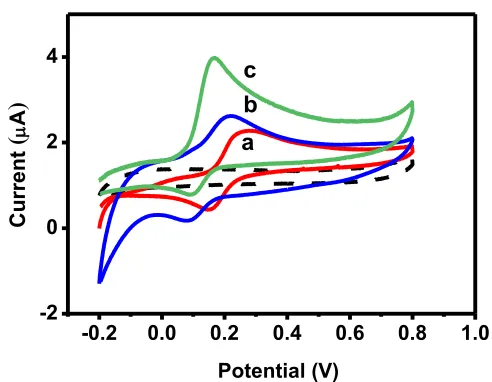
The electrochemical behaviors of the 3D-ePAD graphite screen printed electrodes modified with nanomaterials were investigated by cyclic voltammetry (CV). Fig. 2 depicts cyclic voltammograms for (a) Fe3O4/GFE, (b) Fe3O4@Au-Cys/GFE, and (c) Fe3O4@Au-Cys/PANI/GFE. The graphite screen-printed electrodes modified with Fe3O4, Fe3O4@Au-cys and Fe3O4 @Au-Cys/PANI display a pair of redox peaks which suggested that these nanomaterials are electroactive. The combined nanocomposites further acquired excellent conductivity. The Fe3O4 @Au-Cys/PANI/GFE produces the greatest oxidation peak current and the least oxidation peak potential of DA when compared to the Fe3O4/GFE and Fe3O4@Au-Cys/GF plots. We then conclude that Fe3O4@Au-Cys/PANI possesses the greatest enhancement in electrocatalytic activity and redox response. In our case, gold coated magnetite-containing polyaniline (Fe3O4@Au-Cys/PANI) provides an excellent electrical conductivity and excellent electron transfer to provide enhancement of current responses.
Figure 2. Cyclic voltammograms of 1 mM DA on (a) Fe3O4/GFE, (b) Fe3O4@Au-Cys/GFE and (c) Fe3O4@Au-Cys/PANI/GFE at scan rate 50 mV/s, respectively.
3.3 Loading of Fe3O4@Au-Cys/PANI composite
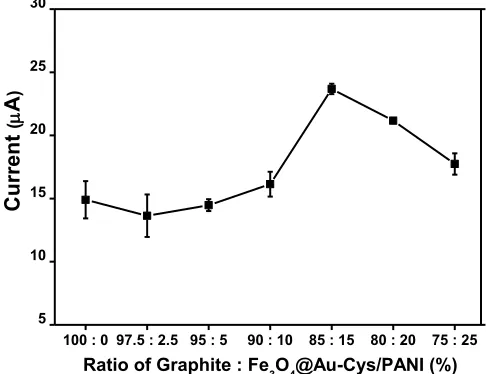
The amount of Fe3O4@Au-Cys/PANI nanocomposites loading on the electrode directly affects the sensitivity of the electrocatalytic oxidation of DA. Effect of the nanocomposite amount on electrochemical sensing towards 1 mM DA was also investigated in a 0.1 M phosphate buffer by varying the amount from 0 to 25%. As shown in Fig. 3, the voltammetry signal current increased when increasing the loading amount from 0 to 15% and no significant change shown when further increasing the amount up to 25%. Signal currents increase in the beginning when the amount of nanocomposites increased is resulted from good electrocatalytic activity and good conductivity of Fe3O4 @Au-Cys/PANI. However, as the amount of nanocomposites increased to more than 15%, higher
-0.2 0.0 0.2 0.4 0.6 0.8 1.0 -2
0 2 4
a b c
A
Cu
rr
en
t
(
A
)
[image:9.596.156.402.320.511.2]
100 : 0 97.5 : 2.5 95 : 5 90 : 10 85 : 15 80 : 20 75 : 25 5
10 15 20 25 30
Curr
ent
(
A
)
Ratio of Graphite : Fe3O4@Au-Cys/PANI (%)
[image:10.596.177.420.117.304.2]background currents were observed and attributed to the steady current signals. Thus, the optimum ratio between graphite powder and Fe3O4@Au-Cys/PANI nanocomposites is 85:15.
Figure 3. The effect of graphite powder and Fe3O4@Au-Cys/PANI ratio that used to make modified screen-printed graphite electrode on the current responses.
3.4 Coating of the electrode with SDS for the simultaneous determination
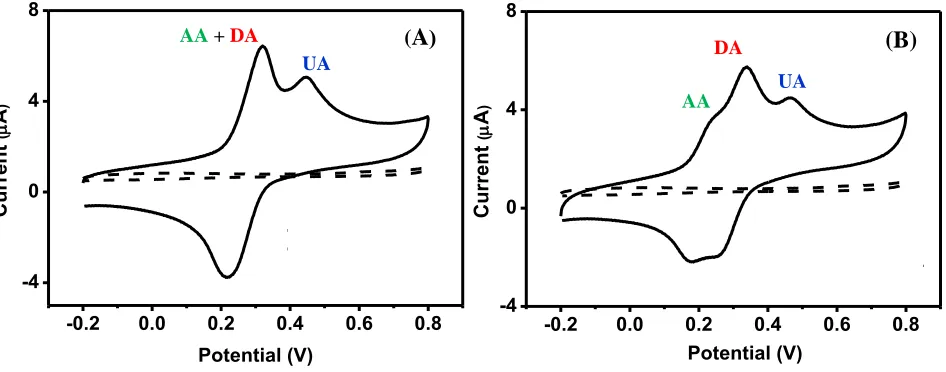
Figure 4. Cyclic voltammogram of the Fe3O4@Au-Cys/PANI/GFE in 0.1 M PBS (pH = 7) solution containing 1 mM of AA, DA and UA in conditions (A) without and (B) with coating electrode with SDS at a scan rate of 50 mVs-1.
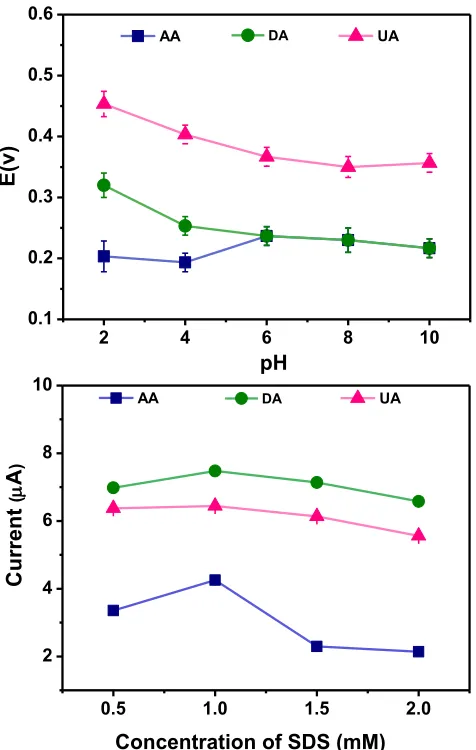
Due to the nearby oxidation potentials between AA and DA, efforts were made to distinguish AA and DA peaks on the Fe3O4@Au-Cys/PANI/GFE coated with SDS. The optimum pH and concentration of SDS solution used as the electrode modifying solution were investigated. The influence of pH of SDS modifier on the peak potential of AA, DA and UA molecules was tested in the pH range 2-10 at the Fe3O4@Au-Cys/PANI/GFE and the results are summarized in Fig. 5A. The oxidation of DA was more favorable as the pH increased, and therefore the distinguishment of oxidation peaks between DA and AA was diminished (Fig. 5A). Using pH 2 of 1 mM SDS modifier, it is apparently that the difference oxidation peak potentials of AA, DA and UA are enough to allow the simultaneous determination on the Fe3O4@Au-Cys/PANI/GFE. The effect of SDS concentration range from 0.5 to 2 mM on the current response was also investigated. From Fig 5B, the peak currents of the three molecules increased when SDS concentration increased from 0.5 mM to 1 mM, and decreased when further SDS concentration increased to 2 mM. For the electrode coating with SDS with the concentration higher than critical micellar concentration or CMC (3 mM) [34], the peak of AA is almost fade away (data not shown). In the case, SDS could be used as effective masking agent for AA to perform a quantitative determination of DA and UA in the samples with high AA content level. It should be noted that these proof-of-concept experiments were chosen to demonstrate the used of SDS to favor the oxidation of DA to achieve the distinguishable oxidation peaks between the DA and AA. We therefore selected the SDS concentration at 1 mM which provide the highest current response for AA, DA and UA. Therefore, it is concluded that the optimum conditions for individual and simultaneous detection of AA, DA and UA is Fe3O4@Au-Cys/PANI/GFE coating with 20 µL of 1 mM SDS (adjust to pH 2 with HCl).
-0.2 0.0 0.2 0.4 0.6 0.8 -4
0 4 8
(a)
background 1 mM AA+DA+UA without SDS
Current
(
A
)
Potential (V)
AA+ DA
UA
(A) )
-0.2 0.0 0.2 0.4 0.6 0.8 -4
0 4 8
(b)
Current
(
A
)
Potential (V)
background 1 mM AA+DA+UA with SDS
DA
UA
AA
[image:11.596.64.537.75.261.2]
Figure 5. Represent (A) the influence of pH in SDS solution used to coat the electrode surface on the peak potentials of AA, DA and UA. (B) the effect of the SDS concentration on the current of AA, DA and UA in conditions supporting electrolyte: 0.1 M PBS (pH=7) containing 1 mM of AA, DA and UA.
3.5 Calibration plot and the detection limit for simultaneous determination of AA, DA and UA.
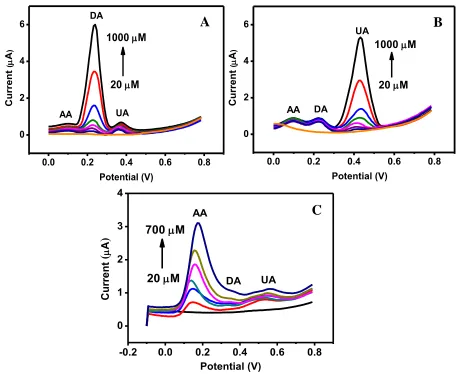
Based on the above CV results, the distinguishable oxidation peak potential of AA from DA and UA at the SDS modified Fe3O4@Au-Cys/PANI/GFE is enough for separation and simultaneous determination of the three molecules in a mixture. Differential pulse voltammetry (DPV) was selected as the technique for the enhancement of specificity and sensitivity for quantitative analysis of DA and UA in the presence of AA. Representative signal profiles for DA and UA and AA in the standard mixtures and calibration plot are depicted in Fig. 6. As shown in Fig. 6A, the response currents of DA increase as the concentration increased while the other two species remained constant. The analytical performance of the developed 3D-ePAD was assessed; the results are summarized in Table 1. The linear range was found to be 20-1,000 µM, with a correlation coefficient (r2) of 0.9916 and 0.9938 for DA and UA, respectively. The calibration plot for AA is linear ranged from 20 to 700 µM with the correlation of 0.9913. The estimated detection limits (S/N =3) are 3.20, 2.19 and 1.80 µM for AA, DA
0.5 1.0 1.5 2.0
2 4 6 8 10
Current
(
A
)
UA
DA
Concentration of SDS (mM)
AA
2 4 6 8 10
0.1 0.2 0.3 0.4 0.5 0.6
UA
DA
E(v
)
pH
and UA, respectively. %RSD calculated from the signals (n=5) of 20 µM of AA, DA and UA was less than 3.63%. This results suggested that the 3D-ePAD has an excellent precision.
[image:13.596.61.517.115.489.2]Figure 6. DPV of the Fe3O4@Au-Cys/PANI/GFE under the optimal condition for (A) DA of 20 – 1,000 µM in the presence of AA and UA at 80 µM and (B) UA of 20 –1,000 µM in the co-presence of AA and DA at 80 µM. (C) AA of 20 –700 µM in the co-co-presence of DA and UA at 80 µM.
Table 1. Analytical performances of the analysis on the developed 3D-ePAD.
AA DA UA
working range (µM) 20 - 700 20 - 1000 20 - 1000
calibration equation y = 0.0034x + 0.3581 Y = 0.0061x + 0.0787 Y = 0.0053x + 0.0559
correlation coefficient 0.9913 0.9916 0.9938
a
precision (%RSD), n=5 3.49 3.63 3.00
b
limit of detection (µM) 3.20 2.19 1.80
a
Calculated from the signals of 20 µM of AA, DA and UA
bCalculated from (3S/N).
0.0 0.2 0.4 0.6 0.8 0 2 4 6 UA DA AA
1000 M
20 M
Current ( A ) Potential (V) (b)
A
0.0 0.2 0.4 0.6 0.8
0 2 4 6 UA DA AA (c) Current ( A ) Potential (V)
20 M
1000 M
B
-0.2 0.0 0.2 0.4 0.6 0.8 0 1 2 3 4 (a)
700 M
[image:13.596.43.547.603.710.2]
Comparisons of the resulted from proposed method with the similar electrochemical methods are presented in Table 2. As the results showed, the proposed method is comparable to, or better the reported methods regarding linear range or limit of detection. The use of Fe3O4@Au-Cys/PANI/GFE also offers a wider range of linearity compared with previously reported for DA [13, 38, 39] and UA [36, 38, 40] determination, and lower limit of detection when compared with the values previously reported for DA [37, 39] and UA [35, 40, 41] determination. In addition, the major advantages of the Fe3O4@Au-Cys/PANI/GFE over previously reported devices are easy, in–house and fast fabrication, low cost of material, flexibility, portability, and high selectivity for the determination of DA and UA.
Table 2. Comparison of analytical performance of the Fe3O4@Au-Cys/PANI /GFE for determination of DA and UA, with literature reports of differently modified electrodes.
Method Linear range (µM) Detection limit (µM) Ref
DA UA DA UA
Pyrogallol red/CPE 1-700 50-1000 0.78 35 [35]
PtAu hybrid film/GCE 103 – 1,650 21 - 336 - - [36]
Nf-Fc/GCE 250–5,000 - 22.7 - [37]
Nf/p(FcAni)/CNTsPE 1-150 5-250 0.21 0.58 [38]
CNTs/ePAD 10 -100 - 10 - [39]
SPCE/ePAD 1-100 - 0.37 - [13]
PDE/ ePAD 0.1-700 - 0.04 - [19]
Au/ePAD - 50 - 200 - 20 [40]
carbon ink /ePAD - 30-2,000 - 80 [41]
Fe3O4@Au-Cys/PANI
GFE/ePAD 20-1,000 20-1,000 2.19 1.80 this work
CPE= carbon paste electrode, PtAu = platinum and gold, GCE=glassy carbon electrode, Nf-Fc = ferrocene bound Nafion,
Nf/p(FcAni)= Nafion /poly(m-ferrocenylaniline), CNTsPE= carbon nanotubes paste electrode, CNTs =multi walled carbon
nanotubes, ePAD =electrochemical paper-based analytical devices, SPCE = screen printed carbon electrode, PDE =
pencil-drawing electrode, Au =gold, Fe3O4@Au-Cys/PANI/GFE = Cysteine-gold coated magnetite nanoparticles core coated with
polyaniline modified graphite screen printed electrode.
3.6 Interference studies
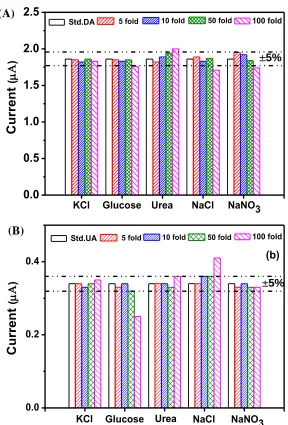
Figure 7. Selectivity of the Fe3O4@Au-Cys/PANI/GFE for DA and UA determination, comparison between the signal current obtained from of (A) 200 µM of DA (control) and (B) 50 µM of UA (control) and the current of the control with interfering substances. Dotted mark the ±5% signal alteration range.
3.7 Real sample analysis
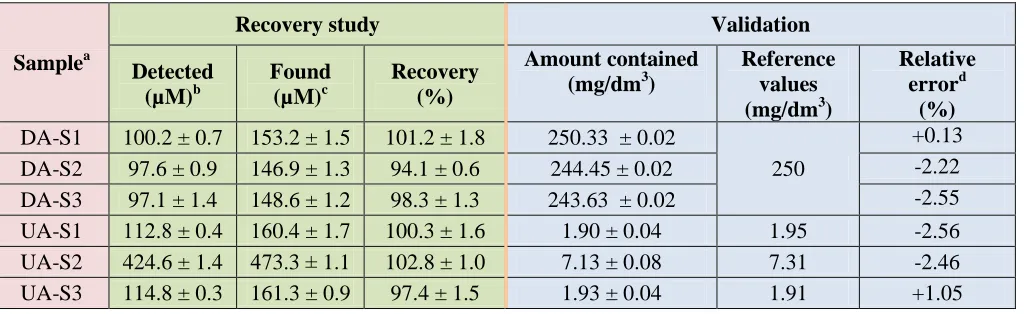
In order to evaluate the performance of the proposed 3D-ePAD, DA was analyzed in dopamine hydrochloride solutions for intravenous infusion (DA-S1, DA-S2 and DA-S3) and UA was analyzed in human urine samples (UA-S1, UA-S2 and UA-S3). The samples were diluted appropriately with 0.1 M PBS. The analyzed results obtained from the samples after diluted with the PBS were listed as the detected concentration in Table 3. The spiked concentration of 50 µM was also analyzed to investigate the accuracy of the method. The precision of the analytical process was evaluated by the repeatability of the process. The results are summarized in Table 2. The recoveries and RSDs of the proposed method were found in the range of 94.1-102.8 % and 0.6-1.8 %, respectively. The determined values
0.0 0.2 0.4
NaNO3 NaCl
Urea Glucose
Current
(
)
100 fold
50 fold 10 fold
5 fold Std.UA
(b)
KCl
0.0 0.5 1.0 1.5 2.0 2.5
NaNO3 NaCl
Urea Glucose KCl
(a)
100 fold
50 fold 10 fold
5 fold Std.DA
Current
(
) ±5%
±5% (A)
[image:15.596.154.442.91.516.2][image:16.596.46.558.264.421.2]
from the samples obtained from our proposed method are listed as the “amount contained” in Table 3. As can be seen in Table 3 the determined values from our method compared well with reference values obtained from DA labelled value (250 mg/dm3) and UA contents obtained from hospital results. The relative differences between data obtained from the 3D-ePAD and that derived from reference values are in the range of 0.1-2.6% and 1.1-2.7% for DA and UA, respectively. These results indicated that there are no significant matrix interferences in the analyze samples as well as this presented method is sufficiently accurate, precise and suitable for the quantification of DA and UA in the mentioned samples.
Table 3. DA and UA concentration in different samples (n=3) obtained from the proposed method and the reference values.
Samplea
Recovery study Validation
Detected (µM)b
Found (µM)c
Recovery (%)
Amount contained (mg/dm3)
Reference values (mg/dm3)
Relative errord
(%)
DA-S1 100.2 ± 0.7 153.2 ± 1.5 101.2 ± 1.8 250.33 ± 0.02
250
+0.13
DA-S2 97.6 ± 0.9 146.9 ± 1.3 94.1 ± 0.6 244.45 ± 0.02 -2.22
DA-S3 97.1 ± 1.4 148.6 ± 1.2 98.3 ± 1.3 243.63 ± 0.02 -2.55
UA-S1 112.8 ± 0.4 160.4 ± 1.7 100.3 ± 1.6 1.90 ± 0.04 1.95 -2.56
UA-S2 424.6 ± 1.4 473.3 ± 1.1 102.8 ± 1.0 7.13 ± 0.08 7.31 -2.46
UA-S3 114.8 ± 0.3 161.3 ± 0.9 97.4 ± 1.5 1.93 ± 0.04 1.91 +1.05
aDA-S1- DA-S3 are injection solutions and UA-S1- UA-S3 are urine samples.
bAmount found in the samples after dilution, X ± S.D.
cAmount found after spiked either 50 µM of DA or UA
d
DA contents form the samples compared with labeled value [250 mg (dm3)-1] and UA contents compared with value obtained from hospital results.
4. CONCLUSION
ACKNOWLEDGMENTS
Financial support from the National Research Council of Thailand (NRCT:2560A11702005), the Center of Excellence for Innovation in Chemistry (PERCH-CIC), Office of the Higher Education Commission (OHEC), Ministry of Education are gratefully acknowledged. Science Achievement Scholarship of Thailand (SAST) given to N. N. is also acknowledgements. The authors also would like to thank Department of Chemistry, Faculty of Science, Ubon Ratchathani University for research instrumental facility.
References
1. P. Song, O. S. Mabrouk, N. D. Hershey and R. T. Kennedy, Anal. Chem., 84 (2012) 412. 2. J. Bicker, A. Fortuna, G. Alves and A. Falcão, Anal. Chim. Acta, 768 (2013) 12.
3. V. V. S. E. Dutt and H. A. Mottola, Anal. Chem., 46 (1974) 1777.
4. J. Du, J. J. Cullen and G. R. Buettner, Biochim. Biophys. Acta, 1826 (2012) 443.
5. C. André, I. Castanheira, J. M. Cruz, P. Paseiro and A. Sanches-Silva, Trends Food Sci Technol., 21 (2010) 229.
6. H. Wang, F. Ren, C. Wang, B. Yang, D. Bin, K. Zhang and Y. Du, RSC Advances., 4 (2014) 26895.
7. Y. Zhao, Y. Gao, D. Zhan, H. Liu, Q. Zhao, Y. Kou, Y. Shao, M. Li, Q. Zhuang and Z. Zhu, Talanta, 66 (2005) 51.
8. A. A. Ensafi, M. Taei and T. Khayamian, Int. J. Electrochem. Sci., 5 (2010) 116. 9. J. Jiang and X. Du, Nanoscale., 6 (2014) 11303.
10.C. Karuwan, A. Wisitsoraat, D. Phokharatkul, C. Sriprachuabwong, T. Lomas, D. Nacapricha and A. Tuantranont, RSC Adv., 3 (2013) 25792.
11.M. Trojanowicz, A. Mulchandani and M. Mascini, Anal. Lett., 37 (2004) 3185.
12.K. F. Chan, H. N. Lim, N. Shams, S. Jayabal, A. Pandikumar and N. M. Huang, Mater. Sci. Eng. C., 58 (2016) 666.
13.P. Rattanarat, W. Dungchai, W. Siangproh, O. Chailapakul and C. S. Henry, Anal. Chim. Acta, 744 (2012) 1.
14.M. Santhiago and L. T. Kubota, Sens Actuators B Chem., 177 (2013) 224.
15.S. H. Lee, J. H. Lee, V.-K. Tran, E. Ko, C. H. Park, W. S. Chung and G. H. Seong, Sens Actuators B Chem., 232 (2016) 514.
16.W. Dungchai, O. Chailapakul and C. S. Henry, Anal. Chem., 81 (2009) 5821.
17.S. Ge, L. Zhang, Y. Zhang, H. Liu, J. Huang, M. Yan and J. Yu, Talanta, 145 (2015) 12.
18.Z. Nie, C. A. Nijhuis, J. Gong, X. Chen, A. Kumachev, A. W. Martinez, M. Narovlyansky and G. M. Whitesides, Lab Chip., 10 (2010) 477.
19.W. Li, D. Qian, Y. Li, N. Bao, H. Gu and C. Yu, J. Electroanal. Chem., 769 (2016) 72.
20.W. Li, D. Qian, Q. Wang, Y. Li, N. Bao, H. Gu and C. Yu, Sens Actuators B Chem., 231 (2016) 230.
21.J. A. Adkins and C. S. Henry, Anal. Chim. Acta, 891 (2015) 247.
22.A. K. Yetisen, M. S. Akram and C. R. Lowe, Lab Chip., 13 (2013) 2210.
23.D. M. Cate, J. A. Adkins, J. Mettakoonpitak and C. S. Henry, Anal. Chem., 87 (2015) 19. 24.J. C. Cunningham, P. R. Degregory and R. M. Crooks, Ann. Rev. Anal. Chem.,9 (2016) 183. 25.X. Li, J. tian, G. Garnier and W. Shen, Colloids Surf B Biointerfaces, 76 (2010) 564.
26.W. Sroysee, K. Ponlakhet, S. Chairam, P. Jarujamrus and M. Amatatongchai, Talanta, 156-157 (2016) 154.
28.S. Karamipour, M. S. Sadjadi and N. Farhadyar, Spectrochim. Acta Mol. Biomol. Spectrosc., 148 (2015) 146.
29.T. Wen, W. Zhu, C. Xue, J. Wu, Q. Han, X. Wang, X. Zhou and H. Jiang, Biosens. Bioelectron., 56 (2014) 180.
30.J. Li, D. Zhang, J-B. Guo and J. Wei, Chinese Journal of Chemical Physic, 27 (2014) 718. 31.Y. P. Dong,Y. Zhou, Y. Ding, X. F.Chu and C. M.Wang, Anal. Methods, 6(2014) 9367.
32.G. Alarcón-Angeles, S. Corona-Avendaño, M. Palomar-Pardavé, A. Rojas-Hernández, M. Romero-Romo and M. T. Ramírez-Silva, Electrochim. Acta., 53 (2008) 3013.
33.X.-L. Wen, Y.-H. Jia and Z.-L. Liu, Talanta, 50 (1999) 1027.
34.J. G. Manjunatha, M. Deraman, N. H. Basri, N. S. M. Nor, I. A. Talib and N. Atoallahi, C. R. Chimie, 17 (2014) 405.
35.A. A. Ensafi, A. Arabzadeh and H. Karimi-Maleh, Anal. Lett., 43 (2010) 1976. 36.S. Thiagarajan and S. M. Chen, Talanta, 74 (2007) 212.
37.A. S. Kumar, P. Swetha and K. C. Pillai, Anal. Methods, 2 (2010) 1962.
38.W. Sroysee , S. Chairam, M. Amatatongchai, P. Jarujamrus , S. Tamuang, S. Pimmongkol, L. Chaicharoenwimolkul and E. Somsook, J. of Saudi Chem. Soc., 22 (2018) 173.
39.T. H. da Costa, E. Song, R. P. Tortorich and J.-W. Choi, ECS J. Solid State Sci. Technol., 4 (2015) S3044.
40.R. F. Carvalhal, M. Simão Kfouri, M. H. de Oliveira Piazetta, A. L. Gobbi and L. T. Kubota, Anal. Chem., 82 (2010) 1162.
41.Y. Yao and C. Zhang, Biomed Microdevices, 18 (2016) 92.