ED-BAHAMAS
Joint Annual Report 2007
1 Update of the Political, Economic and Social Situation 2
1.1 Update on the political situation 2
1.2. Update of the economic situation 2
1.3. Update of the social situation 3
1.4 Update of the Environmental Situation 5
2. Overview of past and ongoing co-operation 7
2.1 Focal Sectors 7
2.2 Utilisation of Envelope B 8
2.3 Regional Cooperation 8
2.4 European Investment Bank 9
2.5 DGECHO 9
2.6 Policy Coherence for Development (PCD) 9
2.7 EU Strategy for the Caribbean 9
2.8 Donor coordination and harmonisation 10
2.9 Dialogue with the NSAs, local authorities and National Parliament 10
3. Conclusions 11
ANNEXES 12
a) Country at a glance:
1. Key macro-economic performance indicators
2. Key MDG indicators
3. Governance profile (same as 2006)
b) Annexes with a retrospective character: financial situation for:
I. 9th EDF and any previous EDFs as per closure of the financial year 2007 2. Regional projects
3. EIB projects
c) Annexes with a prospective character:
- Indicative time table for disbursements of 9'h EDF and previous EDFs d) Annexes on aid effectiveness
1. EAMR aid effectiveness questionnaire (not applicable)
1. UPDATE ON THE POLITICAL, ECONOMIC AND SOCIAL SITUATION
1.1 Update on the Political Situation
National elections were held in May 2007, which was the first in five years. The Free National Movement (FNM) is the new governing party in The Bahamas, having been returned to power after a five year absence. The party won 23 of the 41 seats in Parliament. The progressive Liberal Party (PLP) which was the governing party for the last five years won 18 seats. While there are other political parties, the PLP and the FNM remain the two dominant parties. The Right Honourable Hubert Ingraham succeeded the Right Honourable Perry G. Christie as the Prime Minister.
One of the major political and social challenges continues to be that of migration from Haiti and on a smaller scale from Jamaica and Cuba. The repatriation of illegal migrants is an expensive exercise for the Government of The Bahamas.
The Government of The Bahamas continues to provide resources to improve the interdiction efforts. There is also the upgrading and expanding of The Bahamas Defense Force Fleet, which is intended to facilitate the establishment of a permanent presence in the southern Bahamas, from which regular patrol using two vigilant crafts will be undertaken. To further assist in this effort four Interceptor crafts were received from the USA. Additionally, there is also the re-establishment of the Air Wing which should significantly improve detection and interdiction capability.
1.2 Update of the economic situation
The economy was forecasted to grow by 4.5% in real terms in 2007, supported by a rise in tourism-related foreign investment activities and further expansion in the construction sector. Domestic prices also rose by some 1.9% during 2007. As oil prices continued to rise during the twelve month period of 2007, inflation did likewise, as it jumped by 2.3%, over the corresponding period of 2006. The unemployment rate rose marginally from 7.6% in 2006 to 7.9% during 2007. The rise in the unemployment rate was in New Providence, Grand Bahama and other Family Islands. This rise in unemployment can be attributed to a loss of temporary jobs in the construction industry.
With regard to the 2007 National Debt, the Direct Charge on the Government as of the 3'd quarter 2007 stood at $2,546.9 million an increase of 6.2% over the $2,398.7 million that was recorded during the corresponding period of 2006. The major portion of the debt at the end of September 2007 was in Bahamian dollars and this was some 89.3% of total debt. As for the Bahamian dollar debt during this period it stood at $2,274.1 million, an increase of7.3%.
The contingent liabilities of the Government decreased by 15.1% to $440.0 million during the 3'd quarter 2007 when compared to $508.0 million shown during the corresponding period of 2006. The country's National Debt to date has increased by $81 million or 2.7% to reach $2,987.1 million.
With regard to the balance of payments on the current account the year to date figures continues to show signs of deterioration due to the domestic impact of oil and non-oil prices on the overall cost of living.
The highest priority given in the 2007/2008 Budget was to security and law enforcement. This encompasses the judicial system the Royal Bahamas Defence Force, the Royal Bahamas Police Force, Immigration, Prisons, Customs and the services available to young people. The total Recurrent Expenditure in 2007/2008 is $1,465 million. Recurrent revenue is $1,490 million representing an increase of 9.9% over the projected out-tum for 2006/2007 an increase of 10.6% over the original estimate for this year. The major components of Recurrent Expenditure are Debt Interest and Redemption which amount to $206 million. This is 14% of total Recurrent Expenditure.
During the first nine months of 2007 tourist arrivals were pegged at 3.5 million, a decrease of 4.4% when compared to the 3.6 million arrivals during the corresponding period of 2006. This apparent decrease can be attributed to the slow down in air arrivals which declined by 3.8% during the first three quarters of2007. The weakness of the U. S. Dollar when compared to the other global currencies should continue to improve the cost competitiveness of The Bahamian tourism product, relative to other European and Asian destinations.
However, uncertainty still remains over the impact of the Western Hemisphere Travel Initiative on visitors from the United States market.
Regarding the Financial Sector, a recent study showed that financial services industry contributes approximately 15% of the country's GDP.
At the end of 2007 liquidity levels in our banking system were $117 million which is significantly higher than the $39 Million at year-end 2006. On the other hand, official foreign reserves at the end of 2007 stood at $455 million, 45 million lower than $500 million recorded during 2006.
The Bahamas is in the process of updating its Trade Regime and on completion will apply for full membership in the WTO. The Bahamas participated in the negotiations of the Economic Partnership Agreement, and will sign on to the Agreement in June 2008.
1.3 Update ofthe social situation
There is a commitment to redoubling of efforts to deal with issues relative to social development. The Bahamas is listed at number 52 on the 2007 Human Development Index.
The Governments Urban Renewal Programme is still intact as it seeks to address the needs of the youth, all in an effort to reduce anti-social behaviour.
Progress to achieve the Millennium Development Goals are ongoing, some of the initiatives to advance these activities are as follows:
Eradicate Extreme Poverty: The Government will restart the stalled government housing programme for low and medium income families. It is also the aim of the Government to complete houses on which construction was stopped; repair additional number of poorly constructed houses and build additional housing units not only in New Providence but throughout most of the major Family Islands.
Achieve Universal Primary Education: The enrolment of primary education is still high. The transition rate of children being elevated from primary to secondary school level continues to hover over 95%.
The education youth and culture services during the budget allocation of 2007/2008 received some 18% or $265 million of the total Recurrent Expenditure.
The Government will commence the implementation of a planned School Improvement Programme, which is designed to bring renewed focus to core subject throughout the schools from Kindergarten to 12th grade and to supplement regular tuition through the expansion of
After-School Clubs and supervised study halls. It is also the intention of the Government to promote and support deeper cultural awareness and appreciation among all its citizens and in particular the young people. Additionally, the Government will continue to increase investment in cultural, sporting institutions and other organizations.
Promote Gender Equality and Empower Women: The Ministry of Education continues to promote programmes which address the underachievement of boys in the primary and secondary schools in both New Providence and Grand Bahama.
The Programme SURE which provides intervention for at risk male students is on-going. The Ministry of Education also continues to provide education at the high school level to teenage mothers through the PACE Programme.
Combat HIV/AIDS and other diseases: The leading cause of death of young Bahamians, in the age group 20-39 is AIDS. The objective of the National Programme is to reduce the incidence and impact of HIV and AIDS and other Sexually Transmitted Infections by providing a strategic approach to HIV prevention, education, clinical management, care, support, treatment and HIV/AIDS training.
The Bahamas is therefore committed to providing Antiretroviral Therapy (ART) to all those who are eligible, a programme made more affordable in recent years by the availability of lower cost antiretroviral medications due in large part to lobbying efforts by the Clinton Foundation, the Samaritan Ministries, the AIDS Foundation P AHO and UN AIDS. The foundation has been instrumental in negotiating lower prices.
In 2007, 59.72% of eligible HIV infected persons were receiving ART including 81.3% of antenatal clients and nearly 91.59% of paediatric clients. The prevalence of HIV in antenatal patients is 2%, while the overall HIV prevalence rate for The Bahamas is 3%. The prevention of mother-to-child (PMTCT) programme transmission has been reduced from 30% to 2%.
The Ministry of Health strategy of the decentralization of care from specialized unit to the Community Health Clinics seems to be working, as it has improved the access of treatment.
The AIDS Secretariat continues to work closely with the Ministry of Health and the Ministry of Education in on effort to develop appropriate instructional materials and programmes to teach awareness to HIV/ AIDS and other health related issues in schools, churches and communities. The Bahamas also serves as a resource centre for other Caribbean countries.
Ensure Environmental Sustainability: The Government recognizes the tremendous task of balancing economic development and environmental protection. Agencies are now working cooperatively to identifY and address environmental issues. Major development projects undergo scrutiny through an environmental impact assessment (EIA) review process to ensure that projects with any environmental concerns are either rejected or modified such that they are developed in a safe and sustainable manner.
The Government has recently appointed a National Energy Policy Committee, which is tasked with developing a national energy policy for The Bahamas. Key objectives for the policy are to lessen reliance on oil and pursue alternative energy sources.
Food Security: The Bahamas continues to benefit from a regional project funded by the Food and Agriculture Organization (FAO). Regional organisations such as the F AO are formed to address common concerns. The Department of Marine Resources in addition to managing the commercial fishing industry are also responsible for species and habitats in the marine environment.
Regulations are still in place to protect the Nassau Grouper and as such the grouper closed season has been extended now to some four months to allow for spawning. Work is also progressing regarding the conch and spiny lobster. Strategies have been put in place to enforce the fisheries laws and regulations particularly in those zones that are regarded as popular fishing areas. The fisheries inspectors have been monitoring these zones very close! y, to ensure that the fishing rules and regulations are followed. In 2006, The Government of The Bahamas had introduced legislation reducing catch limits for sport fisheries. That legislation has been amended slightly increasing the catch limits.
One major problem that continues to plague the fisheries sector is that of foreign poachers. However, The Royal Bahamas Defence Force continues to patrol these fishing zones for illegal foreign fishing. There is a low rate of deforestation in The Bahamas. The level of forest cover has remained unchanged over the past ten years, as no commercial exploitation is found in the pine forest. The hunting of wild birds is allowed but this is regulated under the Wild Bird Protection Act. There is also hunting of wild boars as well as the catching ofland crabs.
1.4 Update of the Environmental Situation
to cause coastal erosion and increased flooding of coastal communities. Wetlands, which are important to the regeneration of resources, are also expected to be negatively impacted by rising sea levels. The Bahamas has the third largest barrier reef in the world. The corals, which are integral to this eco-system are vulnerable to thermal stress and are regarded as having low adaptive capacities. They are likely to undergo bleaching and mortality as a result of the rise of sea temperatures. The frequency and intensity of tropical storms and hurricanes are also likely to increase.
Human settlements, infrastructure and development will also be impacted by heat stresses, water shortages, as well as increased variability affecting the entire Bahamas. Recent experiences with climate-related stresses resulted in significantly economic losses and dislocations of residents, as well as damages to the economy.
In response to this threat, The Bahamas continues to participate in the global efforts to address climate change as a Party to the United Nations Framework Convention on Climate Change (UNFCCC) and Kyoto Protocol. Currently, effort is underway to complete the second National Communication Report for submittal to the UNFCCC Secretariat. The Govermnent is also considering the clean development mechanism programme, where developed countries fund carbon sequestering projects in less developed countries. Support was given to developing a future regime under the Kyoto Protocol.
The Bahamas is also Party to the United Nations Convention on Biological Diversity (CBD); and is committed to preserving 20% of the country's combined terrestrial area by 201 0 and 20% of the marine area by 2012. The Govermnent is working alongside non-govermnental organizations to achieve this goal. This partnership has developed the National Implementation Support Partnership (NISP) Project to analyze gaps in financial and resource capacity towards achieving the goal. Effort is currently underway to prepare a master plan for the Program of Work on Protected Areas.
In 2007, the Govermnent of The Bahamas increased its funding to The Bahamas National Trust to One Million dollars per year. This will allow The Trust to more effectively manage the national park system, by hiring additional staff, implementing management plans, increasing support to local communities and providing access and infrastructure to park areas. The park system on Andros one of the major islands has hired a warden and a boardwalk with observation deck was constructed. Two boardwalks with viewing platforms were built in 2007, providing access to significant wetlands and binding platforms are part of $2 million overall conceptual plan for the park that will provide opportunities for outdoor recreation and education in a safe and structural environment.
Grand Bahama home to three national parks received significant attention in 2007. The BNT has also entered a partnership with Rare Conservation to implement an extensive 18-month education and awareness progrannne, focusing on wetlands, one of the most endangered ecosystems in the Caribbean. The nature conservancy continues to support the work of the BNT, building organisational capacity and providing support for national protected area system plan.
initiative with the American Museum of Natural History and the Ministry of Education, has produced an educational resource Treasures in the Sea.
2.0 Overview of past and ongoing co-operation
2.1 Focal Sector: Capacity Building in the Family Islands
a) Results
The 9th EDF support is fully targeted on a capacity building programme in the Family Islands.
The expected results of the 91h EDF support for the Bahamas are, among other things:
• Improved quality of Roads, Sea Defences, Airstrips and other infrastructure on Family Islands
• New maintenance scheme applied which is consistent with prevailing local weather, coastal and other conditions
The fundamental objective of the Bahamas Government development strategy has been to ensure sustainable economic growth. The strategy of the Government has been to expand the basic infrastructure across the entire country, with special emphasis on reducing disparities with the Family Islands. In addition to the regular services of roads, water, electricity, and telecommunications, the archipelago nature of the country renders harbours, airports and landing strips as critical infrastructure for the nation state.
There has been little or no progress in 2007 and consequently no implementation results can be reported at this stage.
b) Progress in activities
9th EDF Support to the Family Islands- 9 ACP BM 2 - € 6,830.000
This project aims at providing and rehabilitating infrastructure in the Family Islands, with the aim to stimulate economic growth and thus reduce the large socio-economic imbalances in the archipelago of the Bahamas.
In August 2006, the Government of The Bahamas (GoB) presented to the Delegation the designs of 3 projects being part of the Financing Agreement. The Delegation reviewed these designs but considered them seriously incomplete and requested that professional consultants be recruited to prepare them, as foreseen by the Financing Agreement.
During the mission in July 2007, the Ministry of Works informed the EC Delegation that they were working on the issue. As of December 2007, the EC Delegation is unaware of any progress made by GoB in the selection of consultants that will prepare the design and tender documents for the 6 sub-projects in the Family Islands. Consequently, no activities have been included in the forecast.
The projects mentioned above contribute to the overall objective of poverty reduction through the implementation of the infrastructure projects.
2.2 Utilisation of envelope B
Hurricane Frances: Rehabilitation works in Lowe Sound, North Andros Island (9ACP BM 3,
€ 600,000):
Results and progress in activities
The project aims at rehabilitating roads, bridges and seawalls in the community of Lowe Sound, which were damaged by hurricane Francis in 2004.
The tender opening for the works was held in November 2006. The tender failed, because the Government of the Bahamas (GoB) had not taken the comments on the draft dossier into account and there were some errors I omissions during the evaluation. Following feedback from Headquarters in June 2007, the ECD informed GoB in June 2007 that the works in North Andros have to be retendered. The tender also revealed that the costs of the works according to the preferred bidder were estimated at BSD 1.75 million (approx. € 1.3 million), of which € 460.000 was to be provided by the EDF.
During a mission in July 2007, the Ministry of Works informed the EC Delegation that they intended to propose to the GoB to fund the works with their own resources. Since then, there has been a silence from the part of GoB. Despite follow-ups by telephone to the Ministry of Works and the office of the NAO, the EC Delegation is unaware of any formal
correspondence on decisions or actions taken by GoB in this regard (status: December 2007). Consequently, no activities have been included in the forecast.
2.3 REGIONAL CO-OPERATION
Regional Law School (9 ACP RCA 18 & 19, € 1.689 million)
Results and progress in activities
The project aims at providing a new library for the Eugene Dupuch Law School in the Bahamas, with the objective to increase the capacity of legal education in the English-speaking Caribbean and thus provide favourable circumstance to strengthen regional integration.
The total costs of the new Regional Law School are estimated at € 9.3 million (equivalent to B$ 12.6 million). The total EDF-contribution is approx. € 1.7 million (equivalent to B$ 2.2 million). The GOB contribution is estimated at approx. € 7.6 million (equivalent to B$ 10.4 million).
Meanwhile, the Financing Agreement has been processed further in Headquarters, based on the original plan. It was signed by Caricom in November 2007.
2.4 EUROPEAN INVESTMENT BANK
Under the various Lome conventions, the EIB has lent € 51 million to projects in the Bahamas from own resources. By the end of2007, the outstanding portfolio amounted to € 10.9 million of which about 55% relates to water infrastructure with the remaining 45% relating to power generation and transmission.
The Water Infrastructure operations comprised two loans totalling € 22 million to improve the water and sewerage system on New Providence Island and to extend the provision of safe drinking water to the population on the Family Islands.
The power sector operations also comprised two projects, totalling € 29 million, to improve electricity transmission and to support environmental mitigating measures.
1n the financial sector efforts will be initiated with a view to establishing regional financial facilities (credit lines, guarantee and private equity facilities) providing indirect financing to small and medium sized enterprises in the Bahamas and the rest of the Caribbean.
2.5 DGECHO
The Bahamas are included in the regional DIPECHO operation under the IFRC (€ 591 000) entitled "Improving the preparedness of Caribbean communities to respond to disasters affecting their locality".
2.6 POLICY COHERENCE FOR DEVELOPMENT (PCD)
The EU-Bahamas cooperation is limited in scope and is focussed on support to the Bahamas Government development strategy to expand the basic infrastructure across the entire country, with special emphasis on reducing disparities with the Family Islands. Infrastructure development is the only area of cooperation.
2.7 JOINT EU STRATEGY FOR THE CARIBBEAN
The EU - Caribbean Partnership as expressed in the EU strategy for the Caribbean is
composed of three interrelated facets, shaping political partnership, addressing
socioeconomic and environmental vulnerabilities and combating poverty, inequality,
HIV
IAIDS and drugs.
The EU-LAC Summit is a major vehicle for political dialogue between the Caribbean
and the EU. This summit is biannual and none was held in 2007. The delegation has
supported the EU-CARIFORUM EPA negotiations by facilitating meetings and
participating in workshops throughout 2007. The Bahamas has been a part of these
negotiations.
The gth EDF NIP/CSP and the forthcoming IO'h EDF NIP/CSP are consistent with several aspects of the 2006 Communication on the EU strategy for the Caribbean region, particularly that of creating political dialogue and reducing inequalities through development cooperation. The EU strategy for the Caribbean was conceived as an instrument to assist countries in the region in achieving their long-term development goals in a self-sustaining manner.
2.8 DONOR COORDINATION AND HARMONISATION
No other major donor is present in the Bahamas.
Dialogue with the NAO: Limited missions are undertaken to the Bahamas. This has made communication more difficult and as a result the cooperation between the NAO's office the Delegation in Jamaica is not functioning as effectively as it could. The NAO's office moved to the Ministry of Finance in 2007. This has not had any significant impact on the relationship between the Delegation and the NAO.
2.9 Dialogue with the NSAs, Local Authorities and National Parliament
3. Conclusions
2007 was politically an eventful year with National Elections held in May. The Free National Movement (FNM) is the new governing party in The Bahamas, having been returned to power after a five year absence. The party won 23 of the 41 seats in Parliament. The Right Honourable Hubert Ingraham succeeded the Right Honourable Perry G. Christie as the Prime Minister.
Despite the turbulent external conditions, the Bahamian economy remained relatively stable in 2007 with a forecasted real growth of GDP of 4.5% in 2007. This was supported by a rise in tourism related foreign investment activities and further expansion in the construction sector. Domestic prices also rose by some 1.9% during 2007. As oil prices continued to rise during the twelve month period of2007, inflation increased by 2.3%.
There is a significant amount of poverty in the more remote south easterly islands of The Bahamas, namely, Acklins, Crooked, Mayaguana, and Long Cay islands revealed in the results of the first Living Conditions Survey done by the Department of statistics, several years ago, which was designed to measure the level of poverty in some of these islands. There is therefore considerable amount of infrastructure development that is required, which will allow for trade and invariably economic growth which should alleviate these pockets of poverty.
The European Commission-Government of Bahamas cooperation continues to be as in prior years, to reduce regional socio-economic imbalances in The Bahamas. Focus is on improving the infrastructure development of the south easterly islands of The Bahamas so as to bring them on the level of New Providence, Grand Bahama, Abaco and the other more developed islands. The thrust of the cooperation is to achieve sustainable economic growth and stability and the continuous improvements in living conditions. It is clear that the need for adequate infrastructure is the largest in the Family Islands. Infrastructure is the area in which the Government of The Bahamas has persistent needs for aid and is also an area in which the EC has a comparative advantage as a donor.
In terms of progress made on projects there has been little or no progress in 2007 and consequently no implementation results can be reported at this stage.
ANNEXES
Annex Al: Country at a glance: Key macro-economic performance indicators
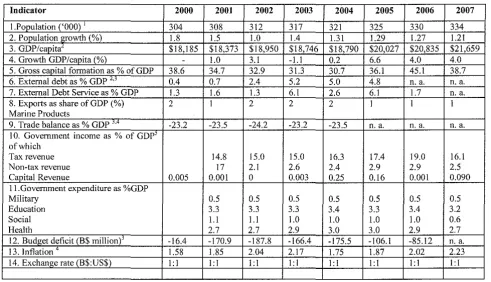
Table I. Economic Indicators 2000-2007
Indicator 2000 2001 2002 2003
!.Population ('000) 1 304 308 312 317 2. Population growth(%) 1.8 1.5 1.0 1.4 3. GDP/capita' $18,185 $18,373 $18,950 $18,746 4. Growth GDP/capita (%) - 1.0 3.1 -1.1 5. Gross capital formation as % of GDP 38.6 34.7 32.9 31.3 6. External debt as % GDP L,:; 0.4 0.7 2.4 5.2 7. External Debt Service as% GDP 1.3 1.6 1.3 6.1 8. Exports as share ofGDP (%) 2 1 2 2 Marine Products
9. Trade balance as% GDP 3
•4 -23.2 -23.5 -24.2 -23.2 I 0. Government income as % of GDP)
of which
Tax revenue 14.8 15.0 15.0 Non-tax revenue 17 2.1 2.6 Capital Revenue 0.005 0.001 0 0.003 ll.Govemment expenditure as %GDP
Military 0.5 0.5 0.5
Education 3.3 3.3 3.3
Social 1.1 1.1 1.0
Health 2.7 2.7 2.9
12. Budget deficit (B$ million); -16.4 -170.9 -187.8 -166.4 13. Inflation 1.58 1.85 2.04 2.17 14. Exchange rate (B$:US$) 1: 1 1:1 1:1 1:1
1 Department of Statistics
2000- 2030 All Bahamas Population Projection Report
2
Deparhnent of Statistics National Accounts Report 2007
3 Central Bank of The Bahamas Quarterly Economic Review 4 Department of Statistics 2007 Annual Review of Prices
2004 321 1.31 $18,790 0.2 30.7 5.0 2.6 2 -23.5 16.3 2.4 0.25 0.5 3.4 1.0 3.0 -175.5 1.75 1:1
5 Government Publications 2007/2008 Budget Communication by the Minister of Finance
2005 325 1.29 $20,027 6.6 36.1 4.8 6.1 1
n. a.
17.4 2.9 0.16 0.5 3.3 1.0 3.0 -106.1 1.87 1:1
2006 2007
330 334 1.27 1.21 $20,835 $21,659 4.0 4.0 45.1 38.7 n. a. n. a.
1.7 n. a. 1 1
n. a. n. a.
19.0 16.1 2.9 2.5 0.001 0.090
0.5 0.5 3.4 3.2 1.0 0.6 2.9 2.7 -85.12 n. a.
[image:13.598.54.545.167.448.2]Annex A2: Country at a glance: Key MDG indicators
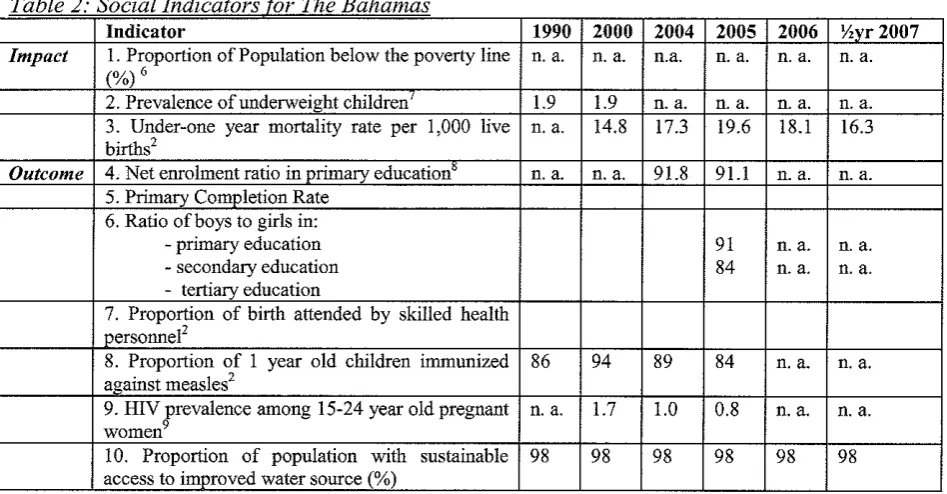
Table 2: Social Indicators for The Bahamas
Indicator 1990 2000 2004 2005 2006 Y,yr 2007
Impact I. Proportion of Population below the poverty line
(%) 6
n. a. n. a. n.a. n. a. n. a. n. a.
2. Prevalence of underweight children 1.9 1.9 n. a. n. a. n. a. n. a. 3. Under-one year mortality rate per
births2
1,000 live n. a. 14.8 17.3 19.6 18.1 16.3
Outcome 4. Net enrolment ratio in primary education' n. a. n. a. 91.8 9l.l n. a. n. a.
5. Primary Completion Rate 6. Ratio of boys to girls in:
- primary education 91 n. a. n. a.
- secondary education 84 n. a. n. a.
- tertiary education
7. Proportion of birth attended by skilled health personnel2
8. Proportion of 1 year old children immunized 86 94 89 84 n. a. n. a.
against measles2
9. HIV ,prevalence among 15-24 year old pregnant n. a. 1.7 1.0 0.8 n. a. n. a.
women
10. Proportion of population with sustainable 98 98 98 98 98 98 access to improved water source (%)
6
Department of Statistics Bahamas Living Conditions Survey, 200 I
7
Information Research Unit, Ministry of Health Basic Health Indicators 2007
8
Ministry of Education, Science and Technology 2006- 2007 The Bahamas National Education Statistical Digest, 4
[image:14.596.67.541.100.347.2]Annex A3: Country at a glance: Governance profile (same as 2006)
THE GOVERNMENT OF BAHAMAS HAS INDICATED THAT THE GOVERNANCE PROFILE FOR 2006 IS RELEVANT FOR 2007 ALSO. NO CHANGES HAVE BEEN MADE TO THE PROFILE.
POLITICAL/ DEMOCRATIC GOVERNANCE (VOICE AND ACCOUNTABILITY FOR WBJ)
Human Rights
Does the government have any particular problem to sign, ratify or Bahamas has not signed the International Covenant on Economic Social and Cultural transpose to domestic law human rights related global/regional rights nor the Convention against Torture.
conventions10? If so, why? Please provide comments on implementation of human rights ratified conventions.
Has the government signed and ratified the statute of the Bahamas has signed but not ratified the Rome Statute of the ICC. International Criminal Court? Has it signed bilateral immunity
agreements with third countries (USA)?
If death penalty has not been abolished, under which circumstances The death penalty remains in force in the Bahamas. The last execution in the Bahamas and grounds it is applied (military, sharia courts .. )? took place in January 2000, but death sentences continue to be handed down. Following
the fatal stabbing of a prison guard during a prison escape in January this year, there have been public calls for the resumption of executions and the Prime Minister has been reported as saying he supports a return to executions. In March 2006 the Judicial
Committee of the Privy Council (JCPC) decided to abolish the mandatory death sentence for those convicted of murder in the Bahamas. The UK-based JCPC, which is the highest court of appeal for most of the countries in the English-speaking Caribbean region, ruled that the mandatory death sentence is in violation of the Bahamian Constitution.
Previously in the Bahamas anyone found guilty of murder has been automatically
10
sentenced to death. The mandatory death penalty denies the accused involved the opportunity of having the court consider mitigating circumstances in his or her case. Do the watchdog public institutions (Ombudsman, Human Rights
Commission), in case they exist, have problems in exercising effective power?
Is the principle of non discrimination based on sex, race, colour, The government generally respected in practice the constitutional provisions for
language, religion, political or other opinion, national or social origin individual rights and freedoms regardless of race, place of origin, political opinion, creed, foreseen by the law and effectively guaranteed? If not what are the or gender. However, the constitution and the law contained certain provisions that
main problems? discriminated against women.
Social discrimination against homosexuals occurred. There was widespread homophobia and religiously based opposition to homosexuality. Although homosexual relations between consenting adults are legal, there was no legislation to address the human rights concerns of homosexuals, lesbians, bisexuals, or trans gender persons. The government actively promoted opposition to homosexuality. In September Miss Teen Bahamas was stripped of her title after she said she was lesbian. Also in September public school teachers punished students wearing clothing perceived to identify them as homosexual or advocates of homosexuality. There were continued reports of job termination following disclosure of sexual orientation, as well as discrimination in housing.
Are minorities' and indigenous peoples' political and cultural rights According to unofficial estimates, between 10 and 25 percent of the population are effectively protected? What are the main controversial issues (land Haitians or citizens of Haitian descent, making them the largest and most visible ethnic rights, political rights, .. )? minority. Many persons of Haitian origin lived in shantytowns with limited sewage,
garbage, law enforcement, or other infrastructure. Haitian children generally were granted access to education and social services, but some Haitians complained of discriminatory treatment in education. Anti-Haitian prejudice and resentment regarding continued Haitian immigration was common. Observers reported that efforts by the authorities to stem the influx of illegal Haitian immigrants, and efforts by politicians to appear tough on immigration, fuelled anti-Haitian attitudes. Interethnic tensions and inequities persisted, and observers believed tensions have escalated. Members of the Haitian community complained of discrimination in the job market, specifically that identity and work permit documents were controlled by employers seeking leverage by threat of deportation. Individuals born in the country to Haitian parents were required to pay the tuition rate for foreign students while waiting for their request for citizenship to be processed.
-Other relevant information, overall appreciation and summary of the main problems identified in this area
Fundamental Freedoms
Are the following fundamental freedoms recognised and effectively exercised by citizens (what are mains restrictions and problems if not respected)
- freedom of movement, including entering and leaving the country - the freedom of thought, conscience and religion
- freedom of expression
- freedom of information (are there restrictions to international media and to access to internet?)
- freedom of assembly and association (including meetings held by political opposition, demonstrations). Is the regulatory environment conducive for civil society organisations, professional associations, trade unions, political parties to operate
Other relevant information, overall appreciation and summary of the main problems identified in this area
C. Electoral Process
Were the last Presidential, parliamentarian and/or local electoral processes considered free and fair by EU and/or other international bodies? If not, what are the main obstacles? Please refer to the following elements to assess the electoral process.
- specific problems that undermine the independence, impartiality and credibility of the authority in charge of supervising the electoral processes
- electoral census and the voters' registration system - specific problems that undermine the principle of equal
campaigning opportunities (equal access for all contesting parties to the state-controlled media, availability of published and broadcast media in all constituencies, transparency of financing of political
Yes
Yes Yes
Yes, no restrictions.
Yes
groups I candidates)
- existence of mechanisms for checking and validating election results
- possibility to use recourse procedures
- possibility of requesting an authorised international election observation
-possibility for local observers (from independent NGOs or political parties) to operate
Other relevant information, overall appreciation and summary of the The law provides citizens with the right to change their government peacefully, and
main problems identified in this area citizens exercised this right in practice through periodic, free, and fair elections held
on the basis of universal suffrage.
D) Principles of constitutional democracy
Does the Constitution contain the principle of the separation of Yes. Executive-- prime minister, government. Legislative--bicameral Parliament (16
powers? appointed senators, 40 elected representatives). Judicial-Based on the British
system, with aUK-style hierarchy of courts: magistrates court, Supreme Court, Court of Appeal, and in some cases the UK Privy Council.
How does Parliament exercise its main powers? (legislative Normal powers of a representative democracy: Legislative functions, approval of functions, power to decide the national Budget, oversight of the budget, etc.
executive/government's action and capacity to dismiss the executive)
Are there any political parties or similar structures? If not, what are Yes, there are 2 political parties: Progressive Liberal Party (Government): Free
the main obstacles for their formation and functioning? National Movement (Opposition).
How the political parties ensure political pluralism? (their capability of being representative, their budget, ... )
Is the security system, including law enforcement institutions such as The civilian authorities generally maintained effective control over security forces. The police, armed forces, paramilitary forces, etc, under democratic Royal Bahamas Police Force (RBPF) maintains internal security, and the small Royal control and oversight by Parliament and civilian authorities? If not, Bahamas Defense Force (RBDF) is responsible for external security and some minor
what are the main obstacles? domestic security functions such as guarding foreign embassies and ambassadors. The
Ministry of National Security oversees the RBPF and the RBDF. The Police Complaints and Corruption Branch, which reports directly to the deputy commissioner, was
Other relevant information, overall appreciation and summary of the main problems identified in this area
action within the police system or, in some cases, criminal prosecution by the attorney general. Local attorneys and human rights observers expressed concern that the
complaints and corruption branch lacks the independent authority needed to impartially investigate allegations of abuse and misconduct, and that perceived lack of impartiality discouraged full reporting of complaints. Although the government appointed an
independent four-person committee to oversee the complaints and corruption branch and report directly to the minister of national security, the committee was not used pending passage of implementing legislation. The complaints and corruptions branch instead continued to report directly to the commissioner without independent oversight. Police officials insisted that their investigations were fair and thorough. A police officer involved in shooting or killing a suspect automatically is placed under investigation. There were 292 complaints against police during the year, compared with 330 in 2004. Of these 292 cases, authorities resolved 36, referred 68 referred to court, and had 188 still under investigation at year's end. Following investigations into complaints against police during the year, including unethical conduct, assault, wrongful arrest, and excessive use of force, authorities dismissed 2 officers and brought criminal charges against 15 officers. Charges resulted in two convictions, four acquittals, and nine cases under way at year's end. During the year police underwent training in human rights issues, including in-house training for officers on use of force, human rights, internal investigations of complaints against police, and corruption. Police officials believed that additional training is necessary to address continuing problems.
OVERALL ASSESSMENT OF COUNTRY SITUATION 2005-~ LEVEL(l To4)3
2006 FOR POLITICALIDEMOCRA TIC GOVERNANCE TREND (1 to 3) 2
POLITICAL GOVERNANCE/RULE OF LAW: JUDICIAL AND LAW ENFORCEMENT SYSTEM
What type of judicial systems (modern, religious, traditional, ... ) coexist in the country? What is their respective jurisdiction?
the Supreme Court, which handles most major cases. Magistrate's court decisions may be appealed to the Court of Appeal.
Do procedures of nomination, removal, sanctions and promotion The law provides for an independent judiciary, and the government generally respected ensure the independence of judges? this provision in practice. The governor general appoints judges on the advice, in most
cases, of the independent Judicial and Legal Services Commission.
Is the current system conducive to a performing judicial system Local legal professionals attributed most delays to slow police investigation and i
(appropriate salary, training, transparent disciplinary regulations, prosecution rather than a lack of judicial capacity, suggesting that prosecutors had little I
trained judges, equipped courts)? incentive to quickly bring a matter to trial while the accused were detained for long ' prison terms while awaiting trial. In addition to excessive pre-trial detention, local legal professionals continued to complain of outdated record keeping, delayed justice for victims, and a failure to update new laws on the books. There were isolated complaints of deviations from normal, fair court proceedings--particularly in civil matters--but there were no indications that this was a widespread problem.
Does the judicial system guarantee the right of every citizen to a fair The law provides for the right to a fair trial, and an independent judiciary generally trial? The following elements could be taken into consideration: enforced this right. Defendants enjoy a presumption of innocence until proven guilty and - Is the access to justice reasonably ensured (including its are permitted to question witnesses at trial. There is a functioning system of bail, but geographical coverage) and judicial decision taken in a reasonable individuals who could not post bail were held on remand for indefinite time periods. The
time? judicial system had a large backlog of cases, and delays reportedly lasted as long as four
- Is the system for appeal deemed effective? years.
In the exercise of its functions, does the law enforcement system In general the authorities conducted arrests openly and, when required, obtained (police, judges, penitentiary system) guarantee security of citizens judicially issued warrants. Serious cases, including those of suspected narcotics or and respect oflaw, while respecting human rights? Are penalties firearms offences, do not require warrants where probable cause exists. The law provides proportional to crimes? Do prison conditions respect human dignity? that a suspect must be charged within 48 hours of arrest. Arrested persons appear before a
magistrate within 48 hours (or by the next business day for cases arising on weekends and holidays) to hear the charges against them. Police can apply for a 48-hour extension upon simple application to the court and for longer extensions with sufficient showing of need. Some persons on remand claimed they were not brought before a magistrate within the 48-hour time frame. Although there is a functioning bail system, the law prohibits bail for repeat offenders and those accused of certain violent crimes. Judges sometimes
representation to destitute suspects charged with capital crimes. In a 2003 report AI estimated that 41 percent of inmates did not have legal representation at their trial. Local legal professionals and human rights observers believed that this lack of representation risked hasty convictions on the basis of unchallenged evidence, particularly in the case of poor or illiterate defendants.
Conditions at Fox Hill prison, the country's only prison, remained harsh. Overcrowding was a major problem. Following an internal investigation into October 2004 allegations of abuse of migrants at the detention centre, the government concluded that the
complaints were without merit. Amnesty International (AI) criticized the investigation as biased and incomplete.
Other relevant information, overall appreciation and summary of the main problems identified in this area
OVERALL ASSESSMENT OF COUNTRY SITUATION 2005-~ LEVEL (1 TO 4) 4
2006 FOR POLITICAL GOVERNANCE /RULE OF LAW TREND (1 TO
:J)
2CONTROL OF CORRUPTION
What are the sectors in which cases of corruption are reported? What There were isolated allegations of government corruption during the year. Eight matters kind of corruption is it? were reported to the complaints and corruption branch of the RBPF during the year,
(ie :customs, public procurement, revenue collection .. ?) resulting in criminal prosecutions for bribery and five pending investigations. The public
was concerned with any report of corruption but did not perceive corruption to be a widespread problem.
Does the country have an appropriated legal framework enabling to There were no laws providing for public access to government information. Members of fight against corruption? the local press complained that the government failed to regularly provide open access to
(ie Do national law criminalise active and passive corruption to/by a information, but the government did not respond to such criticism.
public official, Is an anti-corruption commission or other similar
institution in place, .. ?)
Is the national legal framework implemented?
Are the institutions adequately financed to fulfil their mandate?
What is the position of the country towards international law regarding the fight against corruption (UN conventions, Financial Action Task Force11)?
Bahamas has not signed the UN Convention against Corruption.
The Bahamas was identified as an NCCT in June 2000. The Bahamas subsequently enacted comprehensive anti-money laundering measures, made important progress implementing these measures, and was therefore removed from the NCCTs list in June 200 I. The Bahamas established a financial intelligence unit (FlU) that has been
successfully operational and was admitted into the Egmont Group in 200 I. The Bahamas required banks to establish a physical presence in the jurisdiction, and required all pre-existing accounts to be identified by 31 December 2002. The Central Bank established and began to implement an ambitious inspection programme, and the Attorney General's Office established an international co-operation unit. Since de-listing, the Bahamian FlU has continued to function effectively-receiving, analysing and forwarding STRs to law enforcement, and effectively exchanging information with foreign counterparts.
However, the FATF has continued to monitor the situation in the Bahamas in light of continuing and serious concerns expressed by FATF members regarding other areas of international co-operation. By December 2004, The Bahamas had made progress in this area and responded to all outstanding regulatory requests from FA TF members at that time and signed an agreement for future information exchange with the US Securities and Exchange Commission. Between January and May 2005, the FlU received 67 STRs, was in the process of analysing 55, and passed 8 on to the police force for investigation. The government also continued to respond productively to international requests for
information. Between February and May 2005, The Bahamas received 20 new regulatory requests (for a total of27 requests on hand), and had responded to 19.
The Bahamas has shown progress in implementing its anti-money laundering regime, and more recently has been addressing the ongoing concerns regarding international co-operation. The FA TF will continue to monitor the situation in The Bahamas for the time being; however, if The Bahamas continues to respond adequately to requests for
international co-operation, the FA TF will end monitoring in the near future.
The US Dept. of State's International Narcotics control Strategy Report for 2006 listed Bahamas as a jurisdiction of "primary concern" for money laundering.
II FA TF 40 recommendations on money laundering
Is the country contributing to F ATF -GAFI (Financial Action Task Force I Groupe d'action financiere)?
Is the country implementing FA TF /GAFI recommendations on money laundering and terrorism financing12?
Through which regional mechanisms13?
Bahamas is a Member of the CF A TF. The CF A TF is an organisation of states and territories of the Caribbean basin which have agreed to implement common counter-measures against money laundering. The Task Force was established as the result of two key meetings convened in Aruba in and Jamaica in the early 1990s. At the Aruba meeting in May 1990, the Caribbean nations developed nineteen recommendations- the "Aruba Recommendations"- that address money laundering from a regional perspective and which complement the worldwide standards embodied in the FATF Forty
Recommendations. The Jamaica Ministerial Meeting held in Jamaica in November 1992 led to the "Kingston Declaration", a statement by the Ministers which endorsed and affirmed their governments' commitment to implementing international anti-money laundering standards.
In November 1996,21 members of the CFATF entered into a Memorandum of
Understanding which now serves as the basis for the goals and the work of the CFATF. In this document, CF A TF members agree to adopt and implement the 1988 UN
Convention Against Illicit Traffic in Narcotic Drugs and Psychotropic Substances; endorse and implement the FATF Forty Recommendations and the CFATF Nineteen Recommendations; fulfil the obligations expressed in the Kingston Declaration as well as, where applicable, in the Plan of Action of the Summit of the Americas; and to adopt and implement any other measures for the prevention and control of the laundering of the proceeds of all serious crimes as defined by the laws of each Member.
To meet these objectives, the CF ATF engages in the following main activities: -Self-assessment of the degree of implementation of the FATF and CFATF recommendations.
F ATF 9 special recommendations fighting terrorism financing
http://www.fatf-gafi.org/document/51/0.2340.fT 32250379 32236920 35280947 I I I LOO.html
12
FA TF 40 recommendations on money laundering
htto://www.fatf-gafi.org/document/23/0.2340,fT 32250379 32236920 34920215 I I I LOO.html FA TF 9 special recommendatwns ngnung terronsm tmancmg
http://www.fatf-gafi.org/document/5l/0,2340.fr 32250379 32236920 35280947 I I I LOO.html
13
- Mutual evaluations of members.
- Co-ordination of, and participation in, training and technical assistance programmes. - Twice-yearly plenary meetings for technical representatives and an annual ministerial council meeting.
Does the country have a strategy or reforms addressing the main weaknesses identified here above? Are theses strategies I reforms integrated in the poverty reduction strategy?
Other relevant information, overall appreciation and summary of the main problems identified in this area
OVERALL ASSESSMENT OF COUNTRY SITUATION 2005-~ LEVEL(l T04)4
2006 FOR CONTROL OF CORRUPTION TREND (1 TO 3) 2
GOVERNMENT EFFECTIVENESS
A Institutional capacity
What are the main obstacles for public institutions (ministries, central The Bahamas Government has not devoted enough resources (maybe due to lack of bank, tender authority, audit) to exercise their power in an effective interest) to the management of EU development funds. They have a very poor record as manner? The following elements could be taken into consideration: regards efficiency in the implementation ofEU aid.
- is their mandate clearly defined? The government has expressed the need to improve the performance of the civil service, - do they dispose of qualified staff and adequate budgetary which it views as not providing adequate customer service. This view is shared by the
resources? private sector and civil society. The government is concerned that the civil service's
- is there an effective coordination between the central and local level performance is undermining its ability to manage the country's resources efficiently and
government? effectively, and compromising its ability to take advantage of opportunities and surmount
- is the national and local administration able to formulate and difficulties. implement policy initiatives?
- are they able to manage external aid?
- do they have the capacity to respond effectively to natural disasters?
Are the relevant competencies devolved to local authorities? government councils, elected by the people in the respective communities, which have Are appropriate resources (staff and budget) secured though been in operation for some ten years now.
allocations in the State's budget or through their own revenues?
Other relevant information, overall appreciation and summary of the main problems identified in this area
B. Public Finance Management (PFM)
Is there an up-to-date assessment of PFM in the country? no Describe ifthere are problems with:
- the realism of the budget document? - the execution of the budget?
- the comprehensiveness and the transparency ofthe budget ? - internal controls?
- external scrutiny and audit?
Is there a reform progranune to improve the quality of PFM? - If not, is one being drafted?
-If yes, Is there evidence of the authorities' commitment to its implementation
Is there evidence of a lack of transparency and/or effective exchange According to the OECD, in 2002 the Bahamas made a commitment to improve the of information for tax purposes ? transparency of its tax and regulatory systems and establish effective exchange of
information for tax matters with OECD countries by 31 December 2005. Are there harmful business tax regimes ?
OVERALL ASSESSMENT OF COUNTRY SITUATION 2005-~ LEVEL(l T04)3
2006 FOR GOVERNMENT EFFECTIVENESS TREND (1 TO 3) 2
ECONOMIC GOVERNANCE (REGULATORY CAPACITY FOR WBI)
Private sector/market friendly policies
Is the business climate attractive for private sector investment in The Bahamian Government has adopted a proactive approach to courting foreign
particular taking into account investors and has conducted major investment missions to the Far East, Europe, Latin
- The time and cost to start/end a company America, and Canada. The government paid particular attention to China in making
multiple trips to China to encourage tourism and investment.
The Bahamas offers attractive features to the potential investor: a stable democratic environment, relief from personal and corporate income taxes, timely repatriation of corporate profits, proximity to the United States with extensive au and telecommunications links, and a good pool of skilled professional workers. The Government of The Bahamas welcomes foreign investment in tourism and banking and has declared an interest in agricultural and industrial investments to generate local employment, particularly in white-collar or skilled jobs. Despite its interest in foreign investment to diversify the economy, the Bahamian Government responds to local concerns about foreign competition and tends to protect Bahamian business and labour interests. As a result of domestic resistance to foreign investment and high labour costs, growth can stagnate in sectors which the government wishes to diversify.
-The level of access to capital market ; Inadequate bank supervision -The customs regulations and the application of the rule
-The property regime -The labour regulations
-The unofficial payment for firms to get things done The Bahamian government generally follows a hands-off approach to business, but the U.S. Department of Commerce reports that "discretionary issuance of business licenses can result in a lack of transparency in decisions to authorize or to renew the authority of a business .... Obtaining required permits, especially immigration permits, can take an inordinate length of time." Labour laws can be burdensome,
especially for domestic business. According to the U.S. Department of State, "allegations of improper conduct on the part of Govermnent officials surface regularly ....
"
Other relevant information, overall appreciation and summary of the
main problems identified in this area
B. Management of natural resources
Has the country adhered to the EITI (Extractive Industries No
Transparency Initiative)? If not, what are the problems regarding the adhesion?
Has the country encountered any problems in the implementation of the EITI (programme, activities, creation of a EITI specific
department)?
In case the country is concerned by the illicit production and trade of n.a. "conflict diamonds", is the Govermnent involved in and cooperative with the Kimberly Process Certification System (KPCS)?
Has it put in place the appropriate controls to eliminate the presence of conflict diamonds in the chain of producing and exporting rough diamonds?
FLEGT (Forest Law Enforcement, Governance and Trade) No
Is the country affected by illegal logging and the trade in illegally-harvested timber? If yes, what steps has the govermnent taken to strengthen forest sector governance, and address underlying causes of illegal logging?
Has there been dialogue between the government and the Commission concerning the EU FLEGT Action Plan, and is the country a potential candidate for a partnership under the FLEGT Action Plan?
Does the country implement the FAO Code of Conduct for n.a.
OVERALL ASSESSMENT OF COUNTRY SITUATION 2005-
I
LEVEL (1 TO 4) 32006 FOR ECONOMIC GOVERNANCE TREND (1 TO 3) 2
INTERNAL AND EXTERNAL SECURITY (POLITICAL STABILITY AND ABSENCE OF VIOLENCE FOR WBI)
Internal stability/conflict
What kind of internal ethnic/regional conflict can be identified? Anti-Haitian prejudice and resentment regarding continued Haitian immigration was Please specify its causes and the ongoing conflict resolution process, common. Observers reported that efforts by the authorities to stem the influx of illegal
if any. Haitian immigrants, and efforts by politicians to appear tough on immigration, fuelled
anti-Haitian attitudes. Interethnic tensions and inequities persisted, and observers believed tensions have escalated. Members of the Haitian community complained of discrimination in the job market, specifically that identity and work permit documents were controlled by employers seeking leverage by threat of deportation. Individuals born in the country to Haitian parents were required to pay the tuition rate for foreign students while waiting for their request for citizenship to be processed.
Can signs of civil unrest be detected? If yes, which sectors of society are affected?
Other relevant information, overall appreciation and summary of the main problems identified in this area
External threats and global security
Is the country respecting international/regional agreements related to Antipersonnel Landmines, Explosive Remnants of War and illicit trafficking and spread of Small Arms and Light Weapons
Does the country respect international law and its regional Bahamas disagrees with the US on the alignment of the maritime boundary.
obligations Ill managmg external conflicts? Is the country The Government continues to monitor and interdict Haitian refugees fleeing economic
involved/affected by any external conflict? privation and political instability.
Is the country contributing positively (troop contributions to PK by UN) to the maintenance of peace in the world, continent, region? Is the country involved actively in peace mediations?
country have the institutional capacity/legislation to contribute to the fight against terrorism?
Does the country comply with and implement international norms and convention against the proliferation of weapons of mass destruction and their means of delivery?
Other relevant information, overall appreciation and summary of the main problems identified in this area
OVERALL ASSESSMENT OF COUNTRY SITUATION 2005-~ LEVEL(1 To4)3
2006 FOR INTERNAL/EXTERNAL SECURITY TREND (1 TO 3) 1
SOCIAL GOVERNANCE
Does the government have any particular problem to sign, ratify or transpose to domestic law the eight fundamental ILO Conventions14
No problem, Bahamas has ratified all these Conventions.
? If so, why? Please provide comments on implementation of ILO ratified conventions, in particular on children
Does the country have a National Strategic Plan to enable it to Yes. The Bahamas has National HIV/AIDS Programme. The AIDS Secretariat was respond to the challenges of HIV I AIDS e.g.; a national Coordination established by the Ministry of Health in 1998 to co-ordinate HIV/AIDS education, as
Committee etc.? well as to act as a resource centre and clearinghouse for information.
Where national strategies and structures exist to respond to the There seems to be strong political will to address the problem as well as commitment of challenges of HIV I AIDS, how far is there the political will and the public and private resources. Positive results have already been obtained.
commitment of domestic resources to ensure that they are effective?
Does the government have any particular problem to sign, ratify or Bahamas has ratified the CEDAW with reservations on Art. 2(a), Art. 9 par.2, Art. 16(h) transpose to domestic law the most important international and Art.29 par.! and is a Party to the Cairo Programme of Action and Beijing Platform conventions and declarations on gender equality?15 If so, why? for Action.
Please provide comments on implementation
14
Conventions on freedom of association and collective bargaining (conventions 97, 98) , on elimination of forced and compulsory labour (conventions 29, l 05), on elimination of discrimination in respect of employment (Conventions 100, 111), on abolition of child labour (Conventions 138, 182)
Has the country put in place strategies and structures to respond to Yes, Bahamas has adopted specific legislation on the issue. However, violence against the challenges of gender equality, e.g. a national strategic plan, a women continued to be a serious, widespread problem. The law prohibits domestic coordination committee or the like? violence, and the government generally enforced the law. However, domestic violence
laws do not provide penalties separate from other crimes of assault and battery, and the law does not criminalize sexual violence within a marriage. Police received an estimated one thousand domestic violence complaints for the year. Women's rights groups cited a general reluctance on the part of law enforcement authorities to intervene in domestic disputes. The police recognized domestic violence as a high priority, provided specialized training for all incoming officers, and offered continuing training in domestic violence. The police force specifically made efforts to increase awareness of domestic violence in the Family Islands. The courts impose various legal constraints to protect women from abusive spouses or companions. Advocates for women's rights saw a need to improve the effectiveness of enforcement of court orders and a need for improved legal aid for
women. Women's rights advocates also sought improvements to the domestic violence law, including criminalization of spousal sexual abuse.
Other relevant information, overall appreciation and summary of the main problems identified in this area
OVERALL ASSESSMENT OF COUNTRY SITUATION 2005-~ LEVEL (1 TO 4) 3
2006 FOR SOCIAL GOVERNANCE TREND (1 TO 3) 2
INTERNATIONAL AND REGIONAL CONTEXT
Regional integration
Niveau de mise en oeuvre des obligations nationales vis-a-vis de Bahamas is a member of CARICOM although it does not participate in the CARICOM !'agenda d'integration economique relatif, principalement, a Ia Single Market and Economy (CSME).
creation d'une zone de libre echange ou une union douaniere.
communautairelregional »
Niveau d'engagement dans les institutions regionales, notamment Bahamas participates in the CARICOM institutions and meetings. respect des obligations financieres du pays, et respect des decisions
juridiques des organes juridictionnels regionaux.
Coherence et compatibilite technique et juridique de Ia position du pays vis-a-vis des differents agendas regionaux auxquels il participe et niveau d'engagement dans le processus de rationalisation des RECs.
Other relevant information, overall appreciation and summary of the main problems identified in this area
Involvement in regional initiatives on governance and peer review mechanisms (such as APRM)
Is the country actively participating in regional initiatives on Bahamas participates in the Follow-up Mechanism for the Implementation of the
Inter-governance ? American Convention Against Corruption
Has the country acceded to the Africa Peer Review (APR) process? See above Is the country being reviewed or has it been reviewed?
Is APR programme of action integrated in the PRS, in the MTEF, etc
Other relevant information, overall appreciation and summary of the main problems identified in this area
Migration
Has the country been invited to deepen the dialogue with the EU No on the broad agenda of migration related issues contained in art.
13 Cotonou?
If yes, has it responded positively? Have interlocutors
been identified? Has an agenda for dialogue been proposed I agreed? Is there an open debate and good cooperation on the implementation of the readmission obligation?
In case where development aspects of migration have been identified as an important issue (e.g. brain drain I return of qualified nationals, remittances, relation with diaspora), does the country show