SOME PROBLEMS WITH SEISMIC REFLECTION TECHNIQUES
by
Gregory John Blackburn, B.Sc.(Hons.)
Submitted in partial fulfilment of the requirements for the degree of
Doctor
of, Philosophy.
UNIVERSITY OF TASMANIA
Hobart
1982
, This thesis contains no material which has been accepted for the award of any other degree or diploma in any university, and, to the best of my knowledge and belief, the thesis contains no copy or paraphrase of material previously published or written by another person, except where due
reference is made in the text of the thesis.
CONTENTS
2.1
3.1
4.1
5.1
6.1
R.1
A1.1
A2.1
A3.1
A4.1 Figures
Abstract
Acknowledgements
Chapter CONCLUSIONS
REFERENCES
Appendix 1 RAY TRACING SYSTEM 7 TWO DIMENSIONS
Appendix 2 RAY
TRACING USING FERMAT'S PRINCIPLE
Appendix 3
THOMPSON-HASKELL METHOD
Appendix 4
COMPUTER PROGRAM LISTING (MICROFILM)
Chapter 1 INTRODUCTION
Chapter 2 ERRORS IN VELOCITY CONVERSION FOR SIMPLE GEOLOGICAL STRUCTURES
Chapter 3 STATIC CORRECTION IN IRREGULAR OR STEEPLY DIPPING WATER-BOTTOM ENVIRONMENTS
Chapter 4 SEISMIC VELOCITY AND MIGRATION DETERMINATION
LIST OF FIGURES
Fig. 2.1 Idealised view of a reflection profile.
2.2 Schematic geological section depicting areas for
velocity analysis. 2.6
2.3 Schematic geological section showing actual raypaths
and hypothetical raypaths for a vertical CRP. 2.10 2.4 Schematic geological section containing a high velocity
inhomogeneity. 2.10
2.5 Schematic T 2 -X 2 plots for a reflector whose arrival time due to migration or raypath distortion problems is earlier than for the homogeneous case (A) or where the
arrival time is later than expected (B). 2.11 2.6 Wedge model with corresponding error-factor plot. 2.15 2.7 Unconformity model with corresponding zero-offset
raypaths and error-factor plots. 2.17 2.8 Selected gather locations along the unconformity model
for surface 6 and their corresponding time-difference
plots. 2.18
2.9 Unconformity variation-factor and gather plots at
selected gather locations. 2.19
2.10 Timing and depth errors for the unconformity model. 2.24 2.11 High velocity patch reef model with corresponding
zero-offset raypaths and error-factor plots. 2.25 2.12 Selected gather locations along the reef model for
surface 8. 2.26
2.13 Patch reef time-difference plots for surface 8. 2.26 2.14 Patch reef variation-factor plots. 2.28 2.15 Patch reef variation-factor plots. 2.28 2.16 High velocity fill channel model with corresponding
zero-offset raypaths and error-factor plots. 2.31 2.17 Gathers and time-difference plots for selected
locations along the surface of the high velocity fill
channel model for surface 5. 2.32
2.18 Gathers at E, and time-difference plots for the high
velocity fill channel base. 2.35
2.19 Selected gather locations for the high velocity channel
fill model along surface 8. 2.35
2.20 High velocity fill channel time-difference plots for
surface 8. 2.36
2.21 High velocity fill channel variation-factor plots. 2.36 2.22 Low velocity fill channel model with corresponding
zero-offset raypaths and error-factor plots. 2.38 2.23 Selected gathers and time-difference plots for surface
5 for the low velocity fill channel model. 2.39 2.24 Selected gathers and time-difference plots for surface
7 for the low velocity fill channel model. 2.39
. ii
iii List of Figures cont.
page
Fig. 2.25 Low velocity fill channel model variation-factor and
gather plots at selected gather locations for surface 7. 2.42
2.26 Synclinal model with corresponding zero-offset raypaths
and error-factor plots. 2.43
2.27 Selected gather locations for surface 6 and their corresponding time-difference plots for the synclinal
model. 2.44
2.28 Syncline model variation-factor plots at selected
gather locations. 2.44
2.29 Anticline model with corresponding zero-offset raypaths
and error-factor plots. 2.46
2.30 Selected gather locations for surface 7 for the anticline
model. 2.47
2.31 Selected gather locations for surface 6 and their
corres-ponding time-difference plot for the anticline model. 2.48
2.32 Anticline model variation-factor and gather plots at
selected gather locations. 2.49
2.33 Prograding delta model with corresponding zero-offset
raypaths and error factor plots. 2.51
2.34 Selected gather locations for surface 4 and their corresponding time-difference plots for the prograding
delta model. 2.52
2.35 Selected gather locations for surface 6 and their corresponding time-difference plots for the prograding
delta model. 2.55
2.36 Selected gather locations for surface 10 and their corresponding time-difference plots for the prograding
delta model. 2.56
2.37 Prograding delta model variation-factor curves at
selected gather locations for surface 6. 2.57
2.38 Prograding delta model variation-factor and gather plots
at selected gather locations for surface 10. 2.58
2.39 Timing and depth errors for the prograding delta model. 2.61
3.40 Shelf margin model and corresponding error-factor plot. 2.62
2.41 Seismic stratigraphic interpretation for line 1. 2.66
2.42 Seismic stratigraphic interpretation for line 2. 2.67
2.43 Seismic stratigraphic interpretation for line 6. 2.68
2.44 Seismic stratigraphic interpretation for line 7. 2.69
2.45 Location and depth structure maps for horizons 1 to 7. 2.70
2.46 Synthetic seismogram and velocity and density logs for
drillhole 5. 2.71
2.47 Time-depth curves, interval and average velocity plots
for drillhole 5. 2.72
2.48 Isochrons for the seismic stratigraphic sequences. 2.73
List of Figures cont.
iv
page Fig. 2.50 Interpreted stacking velocities and calculated stacking
velocities for seven horizons on line 6. 2.75 3.1 Earth model illustrating'raypaths to two horizons. 3.4 3.2 The relationships along source coordinate s, geophone
receiver coordinate g, offset coordinate f = g-s, and
mid-point coordinate g = (g+s)/2 (after Claerbout, 1976). 3.4 3.3 Geometry of a wavefront approaching receivers (after
Shah, 1973). 3.8
3.4 Earth model illustrating the shot replacement and
receiver replacement length. 3.8
3.5 Model of a deep water canyon overlying a series of
'horizontal layers. 3.11
3.6 Canyon model gather plots together with wavefront shot
and.geophone statics for three surfaces at four locations. 3.12 3.7 Velocity,profiles for the canyon model. 3.13 3.8 Seismic section together with its corresponding model for
and irregular water-bottom layer overlying a series of
sub-horizontal layers. 3.15
3.9 Velocity profiles for the irregular water-bottom model. 3.16 3.10 Irregular water-bottom model gathered plots together with
wavefront static curves for three surfaces at four
locations. 3.18
4.1 Schematic geological section showing actual raypaths and
hypothetical raypaths for a Vertical CRP. 4.2 4.2 Schematic geological section containing a high velocity
inhomogeneity. , 4.3
4.3 . Plane dipping layer model. 4.5 4.4 Hypothetical curved reflector model. 4.8 4.5 Synthetic CDP gathers and their stacking velocity
distribution. 4.9
4.6 Near, middle and far, traces for the synthetic gathers
generated at location A. 4.10
4.7 Near, middle and far traces for the synthetic gathers
generated at location B. 4.11
4.8 The seismic problem. Given a time trace, can reflection events A, B and C be placed in their correct spatial
position? 4.12
4.9 Three-dimensional plane dipping model. 4.16 4.10 Relationship between the perpendicular to a plane and
the profile line to the dip of the interface (0) and
' the directional angle. 4.17
• 4.11 Ratio of the stacking velocity to the overburden
List of Figures cont.
page Fig. 4.12 Raypath geometry for a diffracting point. 4.22
4.13 , Irregular water bottom layer model and its velocity
profile. 4.25
4.14 Selected traces for the gather at location A. 4.26 4.15 The relationship among source coordinate S, geophone
receiver coordinate g, offset coordinate 1 = g-s,
and midpoint coordinate y = (g+s)/2. 4.28 4.16 ' Geometry of a wavefront approaching receivers. 4.30
waves for three layered media (after Paige, 1973). 5.14 5.10 Amplitude reflectivities for models 1, 3, 4, 6, 7 and 8. 5.18 5.11 Phase reflectivities for models 1, 3, 4, 5, 6, 7 and 8. 5.19
5.19 Amplitude reflectivities for direct and total waves for
varying bed velocity ratios. 5.35
5.19 Amplitude reflectivities for direct and total waves for
varying bed velocity ratios. 5.35 5.20 Typical density ranges for various geological rock types. 5.35
5.21 Velocity-density relationships for common sedimentary rocks (after Gardner et al., 1974)
5.20 Typical density ranges for various geological rock types. 5.35
5.21 Velocity-density relationships for common sedimentary
rocks (after Gardner et al., 1974) 5.36
omain due to two reflectors having the same polarity and opposite
polarity. 5.6
5.4 Sequence composed of a number of thin layers. 5.6 5.5 Typical synthetic seismogram exhibiting no interference
effects (after Dunkin & Levin, 1973). 5.10
5.6 NMO corrected gather. 5.11
5.7 Raypath geometries for a thin layer. 5.13 5.8 Models of thinly laminated media and their corres-
ponding layer parameters. 5.13
5.9 Reflection coefficients for direct normal incidence
5.12 Amplitude variations for both the total and direct
waves for models 1, 4, 7 and 8. 5.21 5.13 Intrabed multiple raypaths. 5.21 5.14 Frequency-thickness amplitude reflectivity variations
for various incident angles - model 1. 5.25
5.15 Frequency-thickness phase reflectivity variations for an
incident angle of 1 degree - model 1. 5.27
5.16 Zero-phase and non-zero-phase wavelets (after Anstey,
1977). 5.30
5.17 Compressional velocity ranges for various geological
rock types. 5.32
5.18 Amplitude and phase reflectivities for varying bed
velocities. 5.33'
List of Figures cont.
Fig. 4.15 Ricker wavelet with a dominant frequency of 30 hZ and its frequency spectrum.
4.16 High velocity channel fill together with stacking and rms velocity curves and stacked sections for surface 8.
4.17 Selected gather locations for the high velocity channel fill model and their corresponding relative amplitudes for horizon 8.
page 4.20 4.22 4.23 5.4 5.5 4.23 5.4 5.5 on of the frequency content of the far trace
wavelets due to NMO correction of a CDP gather. 5.2 Uncorrected CDP gather illustrating that amplitude
variations are frequency as well as offset dependent. 5.3 Interference effects in frequency domain due to two
reflectors having the same polarity and opposite
polarity. 5.6
5.4 Sequence composed of a number of thin layers. 5.6 5.5 Typical synthetic seismogram exhibiting no interference
effects (after Dunkin & Levin, 1973). 5.10
5.6 NMO corrected gather. 5.11
5.7 Raypath geometries for a thin layer. 5.13 5.8 Models of thinly laminated media and their corres-
ponding layer parameters. 5.13
5.9 Reflection coefficients for direct normal incidence
waves for three layered media (after Paige, 1973). 5.14
5.12 Amplitude variations for both the total and direct
waves for models 1, 4, 7 and 8. 5.21 5.13 Intrabed multiple raypaths. 5.21 5.14 Frequency-thickness amplitude reflectivity variations
for various incident angles - model 1. 5.25 5.15 Frequency-thickness phase reflectivity variations for an
incident angle of 1 degree - model 1. 5.27 5.16 Zero-phase and non-zero-phase wavelets (after Anstey,
1977). 5.30
5.17 Compressional velocity ranges for various geological
rock types. 5.32
5.18 Amplitude and phase reflectivities for varying bed
velocities. 5.33
5.19 Amplitude reflectivities for direct and total waves for
varying bed velocity ratios. 5.35
5.20 Typical density ranges for various geological rock types. 5.35 5.21 Velocity-density relationships for common sedimentary
vi
List of Figures cont.
page
Fig. 5.22 Amplitude reflectivities for varying density contrasts
for models 1, 4, 7 and 8. 5.38
5.23 Phase reflectivities for varyind density contrasts
for models 1, 4, 7 and 8. 5.39
5.24 Amplitude variations for both the total and direct waves due to varying bed density ratios for models 1,
4, 7 and 8. 5.41
5.25 Amplitude variations for both the total and direct waves due to varying bed density ratios for models 1,
4, 7 and 8. 5.41
5.26 Amplitude and phase reflectivities for various thickness-bed velocity combinations using the model 1 type
parameters. 5.42
5.27 Comparison of conventional and broadband seismic data. 5.44
5.28 Phase spectrum for model 1. 5.46
5.29 Synthetic seismograms for various phase shifted pulses. 5.47
5.30 Coherence measurements used in NMO velocity
determination. 5.51
5.31 Cyclic buildup due to reflection from a single
interface. 5•54
5.32 Onset time variations due to absorption (after Anstey,
1977). 5.54
5.33 Reflection process for two interfaces illustrating
their interference effect. 5.55
5.34 Synthetic seismogram showing complex interference effects
and consequent onset time delay problems. 5.56
5.35 Time pulses for various incident angles showing the difficulties in trace correlation due to amplitude
and phase variations. 5.56
5.36 Intrabed and interbed multiples. 5.58
5.37 Log characteristics of a braided stream sequence. 5.59
5.38 Log characteristics of a beach-shoreface sequence. 5.59
5.39 Braided stream and beach-shoreface models. 5.60
5.40 Amplitude and phase spectra for the braided stream
and shoreface models. 5.61
5.41 Acoustic properties of the brine, oil and gas models. 5.64
5.42 Amplitude reflectivities for PP waves due to brine, oil
and gas saturated sands of varying thickness. 5.65
5.43 Phase reflectivities for PP waves due to brine, oil
and gas saturated sands of varying thicknesses. 5.66
5.44 Comparison of wave trace shapes for the oil, gas and
brine saturated sand models at different incident angles. 5.67
5.45 Comparison of wave trace shapes for oil and gas saturated
sands of varying thicknesses. 5.69
5.46 Time traces for Ricker wavelets having dominant
frequencies of 20, 40, 60, 80 and 100 hz and thicknesses
vi i
List of Figures cont.
page Fig. 5.47 Frequency thickness amplitude and phase reflectivity
variations for normally incident plane waves. 5.71
5.48 Time traces for Ricker wavelets having dominant
frequencies of 20, 40, 60, 80 and 100 hz and velocity contrasts of 0.8, 1.0 and 1.2 (corresponds to bed
velocities of 2536, 3170 and 3804 m/sec). 5.73
5.49 Normal incident amplitude and,phase reflectivities
for varying velocity contrasts. 5.74
5.50 Amplitude reflectivities for mode-converted PS waves
due to brine, oil and gas saturated sands of varying
thicknesses. 5.75
5.51 Phase reflectivities for mode-converted PS waves due
to brine, oil and gas saturated sands of varying
thicknesses. , 5.76
5.52 Four density and somic logs over a 120 m interval
representing varying gross oil columns and their' incident angle dependent amplitude reflectivity
spectra. 5.78
5.53 Density and velocity models for 120 m intervals and
their acoustic impedance logs. ' 5.79
5.54 Normal incident reflectivities for models 1 to 4. 5.80
5.55 Fourier frequency components at 5 hz intervals for
the model 1 shaped spectrum using the approximate
minimum phase (A) and zero-phase (B) spectra. 5.82
5.56 Cepstra (a) and complex cepstra (b) for models 1 to 4. 5.84
5.57 Comparison of the complex cepstrum and impedance log
for model 3. 5.85
5.58 Reflection and refraction of an incident' plane
'compressional wave at a boundary. 5. 91
5.59 PS:PP amplitude ratios for models 1, 4, 7 and 8. 5. 93
5.60 Transmissivity for models 1, 4, 7 and 8. 5. 914
A2.1 Two-dimensional geological model with curved boundaries. A2.2
A2.2 Flow diagram for computer program FERMAT. A2.8
A2.3 Flow diagram for function routine SIMUL. A2.9
A2.4 Three-dimensional geological model with curved boundaries. A2.10
[image:10.559.7.549.0.822.2]ix
ABSTRACT
Non-zero offset raypath tracing of primary P waves over a suite of geologically complex two-dimensional models illustrates that large errors occur in the conversion of stacking velocities to vertical velocities. Consequently (1) stacking velocities
may not be consistent for seismic lines shot over the same
area for different field configurations, (2) stacking velocities can vary greatly for a given spread length and different shot offsets, (3) rapid lateral changes in stacking velocities due to geological factors may disguise velocity information from
horizons overlain by irregularities, (4) the customary assumption that stacking velocities approximate root mean square velocities is not valid in areas of geological complexity, (5) fictitious time shifts and consequent timing and velocity errors are
introduced when conventional replacement statics are used, and (6) statics are time variant and surface inconsistent so that appropriate corrections should be made according to layer depth.
'Simple mathematical expressions are derived for velocity and depth migration determination in both steeply dipping and
'c omplicated overburden environments.
Model studies show that the amplitude, frequency and
wavelet characteristics of a reflector are dependent on both the reflector and overlying formations and may preclude definition of the reflecting surface. The use of CDP methods is detrimental in preserving these essential parameters. Interference due to thin layers results in reflectivities, transmissivities and
ACKNOWLEDGEMENTS
The project was supervised by Dr. John E. Shirley and Dr. Roger J. G. Lewis to whom I am indebted for guidance and assistance. I would also like to thank John and his wife, Jill, for their friendship and hospitality. Discussions with Dr. W. D. Parkinson, Dr. D. E. Leaman and Mr. K. Spence have proved a source of inspiration. I am deeply indebted to Mr. E. Stanford, Geophysical Manager of Esso Australia Ltd.,
who released velocity data, seismic sections and well information over one of their prospects. West Australian Petroleum Pty. Ltd. are also thanked for providing seismic sections.
To Dr. R. G. Richardson for his discussions, inspiration and friendship, and to Ms. J. Pongratz for her thesis production assistance I express my deepest and most sincere thanks.
The study was financed by a University of Tasmania Post-graduate Research Award.
Chapter 1
INTRODUCTION
page
I. INTRODUCTION 1 . 1
1.1
I. INTRODUCTION
This investigation of seismic wavepropagation through geologically complex regions began at a time when CDP based wave equation migration was gaining popularity amongst
exploration geophysicists and problems with migration in complex regions were becoming apparent. Migrated reflection events which appeared On a seismic section rarely corresponded to their true position in space. In areas of moderate dip
(up to 10 0 ) the seismic section approximated the structure with sufficient accuracy to be acceptable. For example the
distortion of anticlinal limbs in simply7fOlded sections was acceptable because the important crestal positions are
horizontal and were thus correctly, positioned.
Coherent seismic events could be transformed to approx-imate the true section by manual migration techniques such as using raypath charts .(Dobrin, 1976, p.240) or by collapsing diffraction curves (Ragedoorn, 1954). Rapid advancement in migration techniques beganwith the introduction of solutions to thewaVe equation to implement the migration process.
Claerbout, An a series of papers (Claerbout, 1970, 1971;
Claerbout & Johnson, 1971; Claerbout & Doherty, 1972), outlined a procedure for propagating a wave field Using finite
1.2
Velocity information in an undrilled region is determined from stacking velocities or by inversion techniques (e.g.Seislog). Dix (1955) developed graphical techniques for determining inter-val and rms velocities. The process has since been automated by performing hyperbolic searches for the maximum semblance of
coherent events for CDP gathered traces (Taner & Koehler, 1969). When used to convert the time section to a depth
section these resulting stacking velocities yield depths which are too large. Al-Chalabi (1973) found that stacking
velocities were accurate to better than 1 percent when the spread length/depth ratio did not exceed unity. He also
noted (Al-Chalabi, 1074) that the difference between stacking velocities and rms velocities increased with increasing
offset.
II. AIMS
Determination of a true depth picture and implementation of the wave equation migration procedure requires an accurate knowledge of the velocity variations within the earth. Thus this thesis was directed at the crucial velocity determination procedures and consideration of the implications of any
deviations from accepted theory. The aims of this thesis are:
(i) to study the effect of non-horizontal anisotropic
velocity layering on the conversion of stacking velocities to vertical velocities by ray tracing;
1 . 3
(iii) to investigate alternatives to the conventional replacement statics techniques. These techniques introduce possible time shifts, timing and velocity errors for long spreads or in regions of irregular near surface geology. Residual statics may also be time variant and surface inconsistent;
(iv) to use modelling techniques to determine the dependence of the amplitude, frequency and wavelet characteristics of an arrival on the section complexities and geological conditions at the reflector;
(v) to study the nature of reflections from thin layers and develop possible techniques for the extraction of the characteristics of these layers from the time traces; and
(vi) to derive mathematical expressions for calculating
velocity distributions and for performing depth migration in complex geological situations.
Initially it was hoped to apply some of the techniques developed to conventional field data but approaches to the
Australian companies or subsidiaries of Broken Hill Proprietary Co. Ltd., Delhi International Oil Corporation, Esso Australia Ltd., Shell Development Pty. Ltd., Utah Development Company, West, Australian Petroleum Pty. Limited, and Woodside
Petroleum Development Pty. Ltd. to obtain CDP gathered field , tapes were unsuccessful. However field situations on sections
supplied by Esso Australia Ltd. and West Australian Petroleum
Chapter 2
ERRORS IN VELOCITY CONVERSION FOR SIMPLE GEOLOGICAL STRUCTURES
I.
II.
III.
IV.
INTRODUCTION
SPREAD DESIGN PHILOSOPHY
VELOCITY MEASUREMENTS AND SOME GEOLOGICAL
CONSTRAINTS
GEOLOGICAL MODELS AND VELOCITY DETERMINATIONS
page
2.1
2.5
2.7
2.8
1. Stratigraphic Wedge 2.14
2. Unconformity 2.16
3. Patch Reef 2.23
4. Buried Channels 2.30
(a) High velocity channel fill 2.30
(b) Low velocity channel fill 2.37
5. Syncline 2.40
6. Anticline 2.45
7. Prograding Delta 2.50
8. Shelf Margin 2.59
V. MIGRATION VELOCITY ESTIMATES 2.59
VI. STACKING VELOCITIES DETERMINED FROM THREE- 2.60
DIMENSIONAL MODELS
2.1
I.
INTRODUCTION
Interpretation of seismic reflections and their
conversion to depth remains a key problem in seismic explor-ation - especially in geologically complex areas. The
difficulty of correctly interpreting geological structures on time sections was illustrated by May & Hron (1978).
Existing velocity estimation techniques based on layered media assumptions (Schneider & Backus, 1968; Taner & Koehler, 1969) are downgraded as the reflectors become curved or discontinuous (Taner et at., 1970; Miller, 1974).
The need for accurate velocity information and discrim-ination between primary and multiple reflections has prompted the use of the common depth point (CDP) method, often
with large shot-geophone offsets. Large offsets result in improved accuracy in the normal moveout (NMO) corrections, due to the large moveout, with resultant improved velocity deter-mination.
Levin (1971) showed that the NMO velocity obtained for a dipping interface overlain by a uniform medium, is always greater than the true medium velocity and is
V
NMO cos (1) where cp is the dip of the reflectorV is the true velocity.
For layered models with reflectors of arbitrary dip and curvature equation (1) often provides the only correction
2.2
In the presence of near-surface anomalies or where lateral velocity anomalies at depth have dimensions of the order of a CDP gather, large errors may occur in moveout based velocity estimates. As the spread is moved across such an anomaly differential traveltime variations are introduced at varying offsets within the CDP set, producing residual moveout errors.
Stacking velocities derived from the NMO correction of CDP gathers need have no physical relationship to
the true velocity distribution below the gather location. They are merely a variable defining the hyperbola which best fits the reflection alignment. For uniform horizontal layers and small offsets the stacking velocity approximates the rms velocity (Dix, 1955).
Shah & Levin (1973) examined the nature of the time-distance curves and velocities determined for models with sub-surface beds separated by plane-horizontal interfaces and noted that the NMO velocity increased monotonically as the spread length increased.
The arrival time (Tx) for various offsets (X) can be given by an infinite series of the form
Tx 2 = C1 C2X2
COO COO
(Taner & Koehler, 1969)
where the coefficients CI, C2, C3, depend on layer thicknesses and interval velocities.
2.3
velocity techniques are based on this truncation. The
stacking velocity equals the rms velocity only where the earth is homogeneous and the higher order terms in the series are zero. Shah & Levin (1973) and Al-Chalabi (1973, 1974) studied the effect on moveout velocities if further terms
are included in the expansion. Shah & Levin generated
horizontally layered sub-surfaces and noted that errors were less than 2 percent when a three-term expansion for T x 2 was used.
After studying over 1000 model cases with randomly generated velocities, Al-Chalabi (1973) found that when the spread length/depth ratio did not exceed unity all results were accurate to better than 0.5 percent. When the spread length/depth ratio increased to two none of the two-term truncation results were accurate to better than 3 percent. Al-Chalabi also showed that in 97 percent of these
cases, a three-term truncation was sufficient to improve the accuracy to better than 1 percent.
Al-Chalabi (1974) noted that the difference between the stacking velocity and rms velocity increased with increasing offset and decreased with increasing depth.
Levin (1979) noted that the P wave moveout velocity found from surface seismic data can deviate from the vertical P wave velocity to a value approaching the horizontal P wave velocity, the actual value depending on the elastic parameters and the spread length used for velocity determination. Levin studied wave propagation in transversely isotropic solids and
2.4
1) as long as the amount of anisotropy is less than 15
percent T 2 -X 2 plots are straight lines that yield moveout velocities lying between the velocities for primary (P) wave travel in the horizontal and vertical directions;
2) for small anisotropy and short spreads the P wave velocity found from a T 2 -X 2 plot is the P wave velocity in the
vertical direction; and
3) for large P wave anisotropy and greatly different values for Poisson's ratio, T 2 -X 2 data do not define a straight line.
In complex areas migration techniques have been used to take into account the deviation in raypaths (Gardner et al., 1974; Schneider, 1971; French, 1974). Velocity interpretation based on migrated data (Claerbout & Doherty, 1972; Sattlegger & Stiller, 1974; Schultz & Claerbout, 1978) has also helped reduce complications. In addition, Doherty & Claerbout (1976) showed that when data is migrated prior to velocity analysis, reflectors of arbitrary curvature can be treated as horizontal layers in velocity estimation procedures. They used finite difference approximations to the wave equation to derive a structure-independent velocity estimator for such models.
The difficulties of correctly interpreting geological
structures on time sections (May & Hron, 1978) and the potential errors in existing velocity techniques for curved or discontin-uous reflectors (Miller, 1974) illustrate that problems may
occur in complex geological areas. Consequently an analysis has been made of the precise contribution of these features on
2.5
I . SPREAD DESIGN PHILOSOPHY
The following requirements need to be satisfied in designing the field layout for CDP data collection: 1) attenuate multiples,
2) improve the signal-to-noise ratio, 3) avoid strong coherent noise,
4) retain vital shallow reflections, and 5) obtain reliable velocity information.
The seismic system is limited by the dynamic range of the recording instruments and consequently the overall requirement is to record target reflections, however contaminated, within this range.
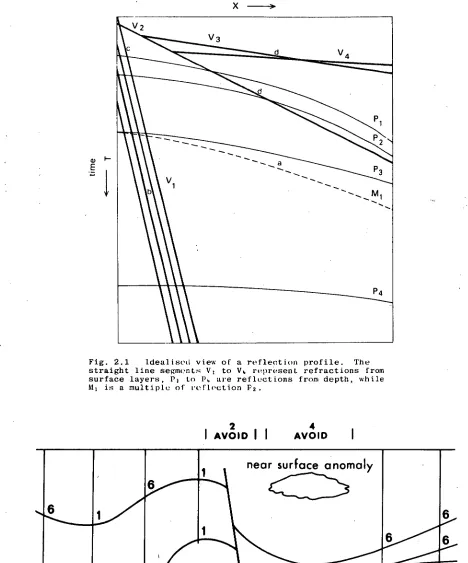
Figure 2.1 represents an idealised reflection profile. 'The straight line segments VI to Vy correspond to refractions
from surface layers. P I to Py are reflections from depth while M I ,is a multiple of the reflection P2.
Attenuation of multiple reflections is accomplished by the use of long spreads so that there is a large difference in residual moveout between the multiple and primary events (a on Figure 2.1). Strong'coherent noise can be avoided by an appropriate choice of offset (b on Figure 2.1). This will indirectly improve the noise ratio. The signal-to-noise ratio can also be increased by increasing the CDP fold. To record the shallow reflections it is imperative that the offset between the shot and nearest geophone be small (c in Figure 2.1). It must be noted that at early times stretching distortions due to NMO correction may be such that only a few traces may be stacked.
shot-receiver distance X --->
Fig. 2.1 Idealised view of a reflection profile. The straight line segments VI to Vy represent refractions from surface layers. PI to Py are reflections from depth, while MI is a multiple of reflection P2.
2 „ 4
I AVOID I I AVOID I
2.7
areas and at long distances strong, straight line. coherent noise occurs (d on Figure 2.1) so that the outer traces may have to be muted.
III. VELOCITY MEASUREMENTS AND SOME GEOLOGICAL CONSTRAINTS
If stacking velocities are to approximate rms velocities / very careful selection of the velocity gather location is
required. Hence -
1) Analyses are positioned at the crests and troughs of folds where conditions approximate uniform horizontal layering
(1 on Figure 2.2). Velocity determinations on the flanks (6 on Figure 2.2) yield velocity distributions which are unrealistically high (Levin, 1971);
2) Gather locations at levels where raypaths have passed through faulted or otherwise disturbed zones (area 2 on 'Figure 2.2) are to be avoided. Within this constraint an
analysis each side of the fault should be made;
3) Analysis at levels where there is obvious interference, for example pinchouts (area 3 on Figure 2.2), is to be avoided; 4) Locations where raypaths pass through an obvious
near-surface anomaly (area 4 on Figure 2.2) should also be avoided; 5) Velocity determinations over areas where fragmentary
reflections are visible at depth (5 on Figure 2.2) may have to be used if they provide the only velocity information at depth; and
6) Other locations should be selected with discretion.
The determination of velocity is critically sensitive to overburden complications. The following points (Anstey, 1977), are generally considered to be true:
a) a local velocity anomaly results in a
static variation in
2.8 b) the largest variations of stacking velocity occur in zones below the ends of anomalies,
C) the variations grow in magnitude and horizontal extent with depth below the anomaly s ,
d) if dip develops at depth, without lateral change of interval velocity in any layer, then the "depth point" for the far traces of the gather move up dip, the NMO
(AT) decreases accordingly and the stacking velocity increases from its "correct" value,
e) if there is no dip, but a smooth lateral change of
interval velocity in any layer, the far trace "depth point" on deeper layers moves in the direction' of the lower velocity, AT decreases and the stacking velocity increases from its
"correct" value,
f) in the general case involving both dip and lateral velocity change, the final effect on stacking velocities is an amalgam of both effects, and
g) whenever a more abrupt change of interval velocity occurs very large swings of stacking velocity occur.
IV.
GEOLOGICAL MODELS AND VELOCITY DETERMINATIONS
The author has developed a two-dimensional ray tracing program (Appendix 1) that allows curved reflectors and lateral velocity variations. Using this program model studies have outlined variations in stacking velocity due to geological structure and spread configuration. Two potential geological causes for velocity variations are defined:
2.9 For the purposes of this thesis this is called the
migration problem.. Consider the case where the zero offset
'ray arrives earlier than the true vertical ray. All the non-zero offset rays will arrive earlier than those for the common reflection point (CRP) below the gather. Hence the stacking velocity as determined from a T 2 -X 2 graph (taken as the square root of the reciprocal of the slope Of a least squares straight line through points on the graph) will be greater than that for the case of a CRP below the gather (Figure 2.3).
2. Errors in stacking velocity due to static variations as a result of overburden complications.
Consider the case (B) shown in Figure 2.4. The outer . traces pass through a lateral inhomogeneity, with higher velocity than the surrounding material. The time of arrival of the far traces is relatively early, so that the least squares best fit line differs from that for the homogeneous case [case (A)]. Thus in this situation the stacking velocity is larger than for the homogeneous case. This is called
the raypath distortion
problem.Offset and spread length induced velocity variations result from migration and raypath distortion problems.
Consider the case where raypath distortions produce earlier arrival times for the far traces than'would be expected for a horizontal layered-casejcase (A) in Figure 2.5]. For the situation in which short and long spreads have the same
shot-first receiver offset it is noted that the stacking
1 / VRMS 2
x
\ 1 / VSTACK 2
TO2
X TVERT 2
1/V RMS 2
T 2
VSTAC K 2
x
2
Fig. 2.3 Schematic geological section showing actual raypaths lines) and hypothetical raypaths for a vertical Cltl , (dashed lines). Corresponding T 2 - -2 A plots show that the zero-offset time is less than the vertical traveltime while actual stackir.g velocities are greater than the root mean square velocities for that location. This is
the migration problem.
A
x
2
sk/Pe = livnmo )A
//'
siope=(I/Vt?rns)
,/''/' ,/'
27r
slope
•
spread A
spread B
reflector
2
X
2.12 arelater than expected [case (B) in Figure 2.5] the stacking velocity for the short spread will be greater than that for the longer spread.
Simplified models of typical geological situations are illustrated in this section. Each gather consists of 72 traces with a geophone separation of 46 m and a shot-first receiver
offset of 46 m. The rays have been traced to within 1 m of the shot and receiver locations. The effect of geological
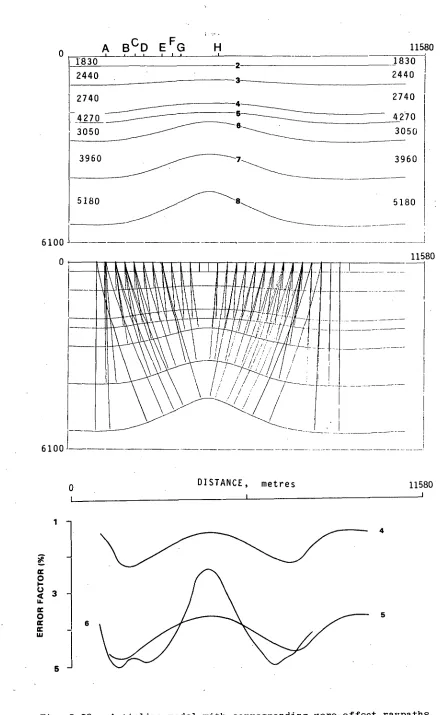
structure on stacking velocities has been determined using a fixed gather consisting of 24 traces with a shot-first receiver offset of 92 m and a spread length of 2195 m. To emphasize the variations in stacking velocity an error factor approach has been used where the factor is defined as the difference between the stacking velocity derived from ray modelling and the average velocity at the gather location divided by the stacking velocity. The.error factor is expressed as a percentage.
Two arbitrary spreads have been chosen to study the effect of spread length and offset on stacking velocity for the geological models.
The first consists of 24 traces, each having a geophone separation of 46 m. The shot-first receiver offset increases from 46 m to 1104 m in 46 m increments. The second spread consists of 48 traces (36 traces for some models) having the same receiver separation and offset variations as the first case. For convenience these are called short and long spreads. Stacking velocities for each of these spreads and for the range of offsets have been determined. In order to normalise the variation of stacking velocities with offset a variation factor is defined as the ratio of the
2.13 derived from ray modelling and the rms velocity to the rms
velocity, expressed as a percentage. Changes in the variation factor with offset or spread size will thus highlight areas 'exhibiting offset induced velocity problems.
It is necessary to determine what causes the velocity variations. For:uniform-horizontal layers and small offsets the stacking velocity approximates the rms velocity. Thus an excellent gauge can be formed by calculating the difference between the traveltime of the ray traced to a geophone and
the-traveltime calculated from
X 2
+T 2 ...(3)
V 2 rms. vert
where )Lis the shot to geophone distance
. 1/ is the rms velocity-
rms
T t is the vertical traveltime. ver
Migration type problems are manifest as time differences for zero offset (X = 0) while departures in time from this zero offset time difference result from raypath distortion. Diagrams based on these factors will be called time difference plots A negative time difference on these plots indicates that the traced ray arrives earlier than the ray calculated using the rMs-velocity and vertical traveltime.
Migration problems are evident when large variation
factors (and hence large:deViations of the stacking velocities from - rms-velocities)'occur for very small offsets, in
particular for the small: spread. Largechanges in the
2.14 affect the accuracy of stacking velocity determination; espec-ially when the geology is not composed of horizontal layers.
In the models, variation factors for both spreads have been plotted as a function of the shot-first receiver offset. Positive variation functions correspond to a stacking velocity, determined by ray tracing, greater than the rms velocity at the particular gather location. The value of the variation factor for a particular offset and spread shows the percentage error of the velocity determination for that location, while differences in the variation factors for the two spreads at the same offset highlight the effect of different spread
lengths on velocity accuracy. An increasing variation-factor value with increasing offset implies a progressively increasing stacking velocity. The converse is also true.
1. STRATIGRAPHIC WEDGE
Figure 2.6 shows a sandstone wedge (P velocity 4270 m/sec) surrounded by a lower velocity shale (3350 m/sec) and the
corresponding error factors for surfaces 5 and 6. Surface 5 can be divided into two distinct regions corresponding to the break in slope at the wedge apex. Applying equation (1) for surface 5 to the right of the wedge and assuming the region above the surface to be homogeneous so that surface 5 may be treated as a single dipping reflector, yields an
2290 2 22aa 3050
3050
3 3350
3350 4
4270
3350
4270 5
6
3350
SIOPHONE LOCATION, 2190
A
A
-30 0
4270
0
A BC
115800 DISTANCE , metres
11580
ERROR FAC
TOR (
%) 1 —
5
3
6
2.16 homogeneous there is an overall increase in the actual
error factors.
Similarly, for surface 6, the apparent error factor is 1.20 percent. As there are no dip breaks along this surface the actual error factor curve tends to be level about a
slightly higher base, with an anomalous zone around the wedge apex. CDP gathers and time difference plots for gathers at locations A (4880 m), B (5790 m) and C (6710 m) show an overall migration time lag of -15 milliseconds. Time
difference plots for the gather at B show a time difference increasing with offset, corresponding to the far traces arriving earlier than would be expected in a horizontally layered situation. This is clearly seen for the gather plot where the far traces travel through a larger portion of the higher velocity wedge material and results in a somewhat
larger stacking velocity and hence larger error factor. The gather at A, on the other hand, shows little time difference between near and far traces relative to the horizontal layered model. The gathered plot indicates that the time spent in the high velocity wedge by the far traces corresponds to that for the near traces. The gather at C is unaffected by the wedge.
2. UNCONFCRMITY
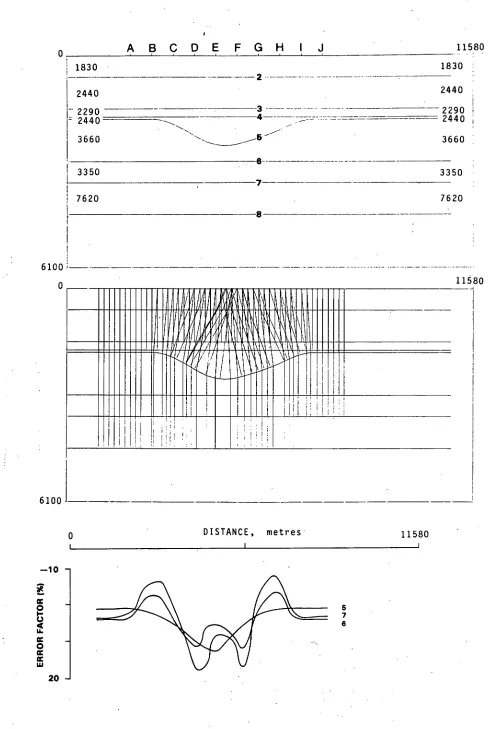
Figure 2.7 shows a simple unconformity. Error-factor plots for surfaces 5, 6 and 7 indicate that severe velocity problems occur for surfaces below the termination of a layer along the unconformity. The effect becomes greater for
deeper surfaces. Time-difference plots (Figure 2.8) for
A
B C E F GH I J
3510 3350 3050 2740
11580
1830 2440
2740
3350
3510 0
1830
2440
4270
3
111'11
111L1 A
11
1L1 i
1111■WAII 11/111/11111111/11M11/ IMII MII
1
I0 11580
4880
DISTANCE, metres
11580 1
Fig. 2.7 Unconformity model with corresponding zero-offset raypaths and
71:
1111111
■
tfik
.
-40
5
W-80
P
0 1320INIONE LOCATION; m 2190
A
-120 - AA,,Y
Fig. 2.8 Selected gather locations along the unconformity model for surface 6 and their corresponding
Mgr"
/
N
X — 9140 K 9140K
6400 F
7320 G 7320.G 6400F
5490 D
7
6
VARI
ATION FACTO
R,
X
4 5
3
5490 D
8230
8230
2
7 7
0 1100
1
OFFSET, metres
2.20 A (3350 m) to K (9140 m) the effect of time errors due to
migration, as determined from zero-offset raypath plots, increases. They account for a 40 msec error in timing at B (4270 m) and a 110 msec error at I (7920 m). Superimposed on these errors are• raypath distortions for the non-zero offset rays. The far traces for the gather at location A, for example, arrive later than would normally be expected with a consequent increase in stacking velocity and a smaller •
error factor for that gather. This is because the common reflector point has moved up dip, extending the path of the .far traces in the material above the unconformity. The converse is true at C (4880 m) where the far traces arrive earlier than would normally be expected due to the larger path length for these traces in the high velocity dipping layer between surfaces 5 and 6. However, at location D
(5490 m) the influence of the lower velocity layer between surfaces 4 and 5 retards the middle and far traces
thereby decreasing the error factor. The effect of this low velocity wedge diminishes as the gather location is
moved towards location F (7010 m). The far traces still arrive earlier than would normally be expected thereby
retaining high error factors. Gathers at G (7320 m),
H(7620 m) and I (7920 m) are affected by the additional low velocity wedge material between surfaces 3 and 4 which results in later arrival times as the traces cross over the wedge. Conversion to depth in such areas would be extremely difficult due to the large error in timing because of migration and the subsequent difficulty in conversion to true vertical velocities.
2.21. the long spread has been reduced to 36 traces, partly corres-ponding to the far trace muting routinely applied in
processing shallow reflections. The long spread has a shot-first receiver offset of 92 m and corresponds to the fixed spread configuration. Thus the variation factor values at each location should reflect the general trend of the error factor curve for the fixed spread. The difference in the numerical value results from the differing definitions of the two factors. Migration errors increase from locations A to K. This accounts for the progressively larger stacking velocities relative to the rms velocities and hence the increased positive variation factors with increasing
horizontal distance. Inaccuracies in velocity conversion of up to 7 percent may result. Deviations from this
general-isation are produced by the interplay of raypath distortion and migration problems.
The variation factors for the gather at D exhibit a 1 percent variation in velocity due to different spread lengths and the factors progressively increase with offset (1.5 percent change). This large variation is due mainly to the raypath distortions (Figure 2.9) associated with the wedge-shaped lower velocity layer between surfaces 4 and 5. The effect of this wedge diminishes for the gather at F and there is only a very slight increase of stacking velocities with offset distance. The 4.5 percent error derives mainly from migration errors. Due to the small raypath distortions variation factors for both long and short spreads are similar
(Figure 2.9).
2.22 decreasing stacking velocity. For small offsets the variation factor is constant but as the offset increases beyond 368 m it decreases due to the later arrival of the far traces through the low velocity wedge between surfaces 3 and 4. This delay, combined with the early arrival of the zero-offset time
relative to the true vertical time, results in the
7 percent inaccuracy in velocity conversion. For the larger spread there is a more gradual decrease in the variation factor due to the smearing effect of the increased CDP fold.
The progressive decrease in stacking velocity with offset is pronounced for the gather at J where there is a 3 percent decrease in the variation factor due to offset changes for the short spread. This decrease results from the influence of the lower velocity wedge material between surfaces 3 and 4. The relatively early arrival of the far traces, where one leg of the path does not pass through this wedge material, accounts for the progressive increase in stacking velocity for large offsets. The 2 percent difference in velocities for small offsets indicates potential problems in the choice of spread length sizes over such geological situations.
The raypaths for the gather at K are not influenced by terminating wedges so that raypath distortions are minimal and errors result mainly from migration problems. Thus stacking velocities determined for both spreads and for all offsets are similar. However velocity conversion errors are still large
(5.5 percent).
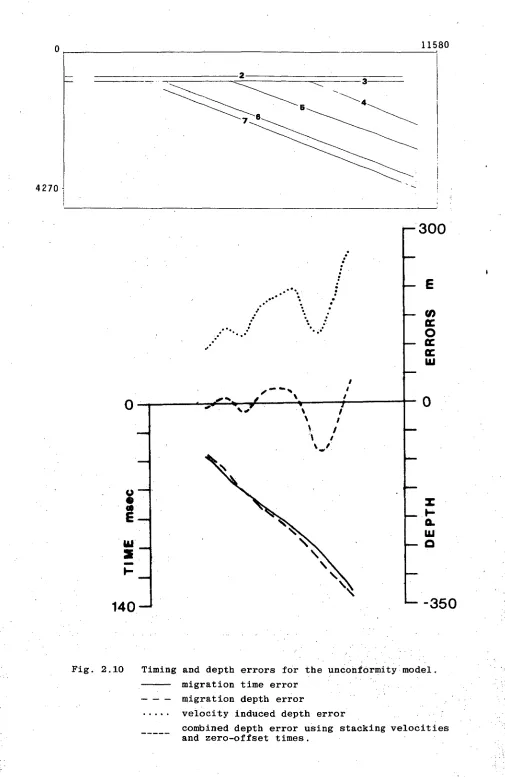
2.23 (Figure 2.10). These errors when translated into depth values• using true vertical velocities result in underestimates of between 90 and 340 m. Similarly, depths are overestimated by 90 to 260 m when calculated using measured stacking velocities and true vertical times. The partial cancellation of the velocity and timing errors in this particular model reduces the error in depth estimates to a range of only 130 m. The maximum errors occur for gathers above the termination of dipping beds along the unconformity surface.
3. PATCH REEF
Figure 2.11 is an illustration of a high velocity reef model but it could also represent an inhomogeneity in the section. Zero-offset raypaths are also shown. The gathers at A (2440 m) and C (2740 m) receive rays from two locations on surface 5, resulting in two potential stacking velocities. Fixed spread error factors (Figure 2.11) for horizons below surface 5 show large oscillations and stacking velocities less than the true vertical velocities may be obtained.
4270
[image:41.559.37.542.39.816.2]0 11580
Fig. 2.10 Timing and depth errors for the unconformity model. migration time error
migration depth error
velocity induced depth error
—L11_411
1\ ‘:. -•
• I
i L : ! _
i I i ' • 1 I
I 1 '11; I •
, _L
0
:6100
BD EF AC G H I
till I I I
• 11580
1830
2-
3
1830
2440
2740
.3050
5180
3660
4270 2440
2740
4
3050
--
---5 4570
5180 6
3660
7
6100 --- — -
11580
DISTANCE, metres 11580
Ii
20J
Fig. 2.11 High velocity patch reef model with corresponding zero-offset raypaths and error-factor plot.
A
iiit •
I • '
SZIMMINEN
S21111111111111111
Millgit
Mgt
SHOT-RECEIVER DISTANCE, metres
3290
4270 G
0
0
3960F
.-10
3200E
2590B
2900D 2740 c
m
i
llis
ec
on
ds
-40
mom
mot
kw
IMMUNE
\MON
INV"
\OF
Iv\vi
mop
III
swoon
vig. 2.12 Selected gather locations along the reef model for surface 8. Solid lines represent the fixed spread.
2.27
By E (3200 m) all traces pass through the reef, although there is a slight retardation of the far traces due to the shape of the reef edge. Raypath distortions tend to be minimal, but a time difference of -28 msec due to.migration affects the stacking velocity slightly. At location F
(3660 m) the far traces have been delayed considerably due to the sloping reef edge, decreasing the error factor. Migration errors are reduced to -13 msec. At location H
(4270 m) migration errors are minimal and there is only a slight retardation of the far traces so that the error factor returns to the horizontally layered value.
Error factors exhibit larger variations as the depth increases (Figure 2.11) because small time fluctuations
produced by inhomogeneities in the upper section have a more profound effect on the smaller NMO curves of the deep
horizons.
Variation factor changes for surface 8 are illustrated in Figures 2.14 and 2:15.
. For short spreads and small offsets the gather at B is still that of the horizontal case (Figure 2.12). However as the offset increases the far traces of this gather travel through the outer portions of the reef and consequently
arrive earlier than expected. Thus stacking velocities increase significantly and variation factors of up to 15 percent result. Due to the very rapid increase in
variation factors, velocity accuracies are strongly offset-dependent. The variation factor curve for the long spread
(Figure 2.15) shows a 2 percent offset-dependent variation but there is a large (up to 10 percent) difference in
25
20r
2590B
2900D
2740C
5
0
-5
2440A
4570 H
4270G 3200E 3960 3510F
0 1100
OFFSET. metres
5
0 1100
OFFSET, metres
20
15
2590B
2740C 2900D
3200E 2440A 0
4570 H
4270 G 3960
3510 F
4,11
Fig. 2.14 Patch reef variation-factor plots illustrating the percentage deviation of the stacking velocity from the rms velocity as a function of offset distance for a short spread at selected gather locations.
2.29 At C. more traces have transgressed the high velocity reef (Figure 2.12).
In considering the short spread it can be seen (Figure 2.14) that offset changes produce a 14 percent
change in the variation factor. For small offsets there is - an increase in the variation factor with offset but as the offset increases beyond 322 m the far traces consist of the earlier arriving reef traversing rays, so that stacking - velocities decrease markedly as more of these reef "packet" rays are included. The variation factor is reduced when the traces consist exclusively of reef "packet" rays. The greater length ofthe long spread allows more reef rays to be included in the stacking process. Inaccuracies in
velocity determination are still large, but these decrease with increased offset. The large difference in the variation factor for the same offsets illustrates the importance of choice of field geometry on the .overallvelocity accuracy.
By E migration errors are large (Figure 2.13). Because the time-difference plot becomes less negative with increasing . shot-receiver distance, stacking velocities are smaller than
rms velocities and variation factors are negative. The two spreads yield similar stacking velocities except for large offsets and for spread lengths where the effect of the much earlier arrival of the far traces becomes significant. Time difference plots for E and G also become less negative with increasing shot-receiver distance so that stacking velocities are less than rms velocities and the variation factors , are negative. The migration problem for the gather at G is -minimal. The small'increase , in variation factor for long
2.30 early arrival of the furthest traces at shot-receiver
distances greater than 2380 m (Figure 2.13).
Variation factors for the gathers at H and I are also negative and decrease by approximately 1 percent with offset because the time-difference plots show progressively less
negative values with increasing shot-receiver distance.
LL BURIED CHANNELS
(a) High velocity channel fill
Error factors for surface 5 (Figure 2.16) show a significant increase (10 percent) above the channel base. The asymmetry ol the error-factor curves results from the different side dips of the channels. Time-difference plots (Figure 2.17) show that migration problems become significant on the channel sides [gathers at D (4270 m), G (5490 m) and H (6100 )]. Raypaths for these gathers pass through a
smaller section of the channel fill than would be expected if the CRP was vertically below the gather location, so stacking velocities are large and error factors increase across the channel. Inspection of the zero-offset raypath plot (Figure 2.16) for surface 5 with a gather at location E indicates three potential CRP's. Figure 2.18 illustrates gathers for the three CRP's for this location, while the time-difference plot shows that although there is little error in determining the vertical traveltime, the far traces arrive much earlier (up to -20 msec across the gather) than the near traces and consequently have higher stacking
0 A B C DEF GH I J 11580
1830 1830
2
2440 2440
3
12290 4 2290
-- 4110 4110-
2740 --- 2740
0
3350 3350
7
8
6100
0 11580
111
1
011111111
III
41
41,819r/Uli MINIMA II 11 I
4"
1114
1
111
111141
DISTANCE, metres 11580
6100
6
5
8
50 -
Fig. 2.17 Gathers and time-difference plots for selected locations along the surface of the high -velocity fill-channeI model 'for surface 5. Solid lines - represent the fixed spread. — •
•
9
21902.33
Large oscillations of the error-factor curve for
surface 8 are typical of the effect of raypath problems due to the channel fill. The gather at A (2440 m) (Figure 2.19) shows very little migration error, but the far traces
arrive some 40 msec earlier than for the horizontal case
(Figure 2.20). Shifts in the CRP are necessary to accommodate the distortions produced by the far traces passing through the channel edges. Error factors of the order of 45 percent
result. At C (3050 m) migration problems for the zero-offset trace result in timing errors of -25 msec and the raypaths (Figure 2.19) occur as two distinct packets due to a large shift of the CRP. Again the far traces arrive sooner than expected, but the middle traces arrive later giving the gather a "banana bend" appearance.
The converse situation applies to the gather at location F (4880 m). The near traces, which travel through the base of the channel fill, arrive earlier than expected, while the
far traces (Figure 2.19) which pass through the channel sides and hence a smaller section of the channel fill, arrive later than expected. Time differences of 20 msec occur
between near and far traces (Figure 2.20) resulting in
low stacking velocities and negative error factors. Migration errors are small for this gather.
Error factors for horizons below the channel exhibit
2.34 lead to more significant errors because of the small NMO
associated with deeper horizons.
Large oscillations of the variation-factor curves (Figure 2.21) for surface 8 (Figure 2.16) depict the
significant effect of the raypath problems due to the channel fill. The errors for the gather at A are relatively small but increase for large offsets and the long spread due to
the earlier arrival of the far traces (Figures 2.19 and 2.20). Variation plots for the two spreads at location A show
discrepancies of between 5 and 10 percent (Figure 2.21). The large inaccuracies result from the much earlier arrival
of the traces as shot-receiver distance increases (Figure 2.20). Changes occur in variation factor of up to 14 percent for
the short spread and 8 percent for the long spread due to increasing offset.
Time-difference plots and gather plots at D and F show that the near traces which travel near the base of the channel fill arrive earlier than expected while the far traces,
because they pass through the channel sides and hence a
smaller section of the channel fill, arrive later than expected. Consequently stacking velocities are lower than rms velocities and variation factors are negative. Migration errors tend to be minimal. There is little variation in stacking velocity with offset for both spreads.
Variation factors for gathers at I and J are similar to those on the opposite channel side, except for the effect of the slight steeper channel side. These gathers are character-ised by large variation factors and large differences in
/ '
'I
W/W/V
/
/ ,
, .
---'', _----
mounn
1111,11/
‘7
41
\iff
-
r
0 GEOMIONE LOCATION, m 2190
Fig. 2.18 Gathers at E (4570 m) for the high velocity fill channel base illustrating non-zero offset raypaths for CRP's at A, B and C. Time-difference plots are also given.
A
30
20
10
VARIATION
FA
C
TO
R,
%
0
SHOT-RECEIVER DISTANCE, metres
Fig. 2.20 High velocity rill channel time-difference plots for surface to. Solid line represents the fixed spread.
\
2440B
--- --- _________
,., 6700 I 2440B 7320J
7320J
67001
1830A
1830)k•
5490 G
5490G
41.4 227700.B 1100
OFFSET, metres
Fig. 1.:.21 High velocity fill channel variation-factor plots illustrating the percentage deviation of the stacking velocity from the rms velocity as a function of offset distance for a short spread (dashed lines) and a long sprea6 (soliC. lines) at selected gather locations.
-id
2.37 (b) Low velocity channel fill
The zero-offset raypath plots (Figure 2.22) for the buried low velocity channel fill show migration of the CRP
for horizons below the channel to be opposite to that for the high velocity fill model.
Error factors for surface 5 indicate trends similar to • the high velocity fill channel and show a 12 percent increase over the channel base.
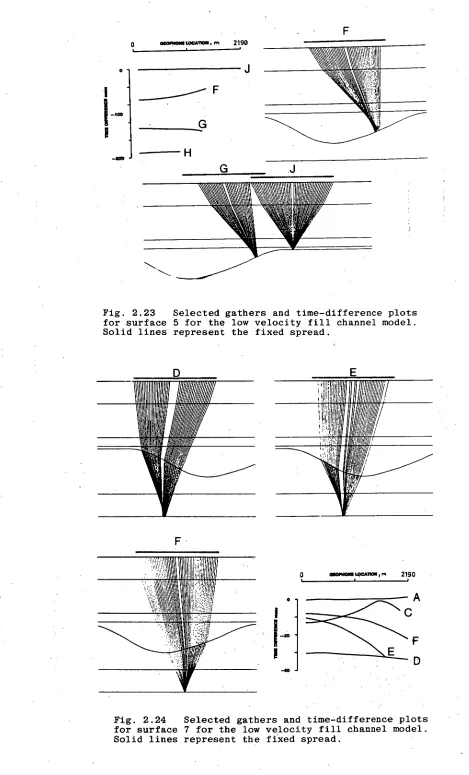
For gathers above the channel sides sampling of a smaller portion of channel fill than would occur for a vertical CRP results in migration errors of up to 190 msec (Figure 2.23). Raypath plots for gathers (Figure 2.23) illustrate this trend. The gather at F (4880 m) demonstrates a curious effect.
Here the far traces arrive much later than one would
expect, thereby making the stacking velocity lower. Because the zero offset ray arrives 70 msec earlier than a vertical ray, velocity determination by least squares line fitting of a T 2-X 2 plot will result in an excessively large stacking velocity.
Error factor trends for horizons deeper than the channel base tend to mirror the curves for the high velocity channel fill case. Comparison of zero-offset raypaths (Figures 2.16 and 2.22) for deep horizons indicates that for a high velocity channel
0 DISTANCE, metres 11580
5 7 6
0 ;
BCDE
FGH1830 • 1830
_
2
2440 2440
— 2290 3
4 ' 2440
3660 3660
6
3350 3350
7
7620 7620
8
11580
—10 — 6100
[image:55.559.41.530.23.752.2]6100
2190
[image:56.559.47.516.34.809.2]CISOPHONI LOCATION.
Fig. 2.23 Selected gathers and time-difference plots for surface 5 for the low velocity fill channel model. Solid lines represent the fixed spread.
OIMPNONII LOCATION rn 2190
Fig. 2.24 Selected gathers and time-difference plots for surface 7 for the low velocity fill channel model. Solid lines represent the fixed spread.
0
—ZOO
!Illi
ll
41
1
-, I
I,
F
I
I
i
Hild i
,
4■
...,,,,._
.'41/,/,/
2.40 more low velocity fill material, while the far traces
show a relative time decrease from travelling through a
larger proportion of the higher velocity underlying material. The main effect on the gather at D (3660 m) is a -30 msec difference between the zero offset and vertical traveltimes. Arrivals at the far traces are slightly earlier than for the horizontal case because the rays pass through more of the higher velocity underlying channel base material.
The earlier arrival of the far traces is more pronounced at locations E (4270 m) and F (4880 m) where up to 20 msec difference occurs across the traces.
Offset and spread length variation factors for horizons deeper than the channel base tend to mirror (positive curves are now negative) the curves for the high velocity channel fill model. Variation-factor curves for surface 7 (Figure 2.25) are similar,for both long and short spreads despite large overall inaccuracies in velocity determination over the channel.
These examples indicate that accurate velocity
determination of horizons at depth in areas of buried channels is far from easy and probably rarely achieved in normal
processing. When such models are contrasted with typical "simple" geological sections it may be readily appreciated that substantial errors are inevitable.
5. SYNCLINE
2.41 similar (in many respects) to those from the channel base in the previous channel-fill model. Zero-offset time plots illustrate the defocussing effect of synclines and the associated migration problems.
Error factors for surface 6 show large (5 percent) variations across the structure. Even the gather at A (1220 m), which is over an essentially horizontal section, shows variations due to the overburden geology (Figure 2.27). A slight but distinctive "banana bend" occurs;
traces with an offset of 1550 m or less show an increase in traveltime associated with a slightly slower return path on the synclinal base side. Beyond this distance a slight shift of CRP causes a relative decrease in traveltimes. As gathers move towards B (1980 m) the far traces arrive
much earlier than in the horizontal case, resulting in higher stacking velocities and larger error factors. By D (3660 m) migration errors are large (-65 msec) and the far traces arrive earlier than would normally be expected for the horizontal case, further increasing the error factor. At F (4570 m) migration errors are reduced, but the far traces still arrive much earlier than expected and once
again the error factors are large. The time-difference plots (Figure 2.27) show that migration errors are greatest on the slope of the syncline. The relatively early arrival of the far traces becomes more pronounced as the syncline is crossed, thereby increasing error factors.
The variation-factor plots (Figure 2.28) show a 12 percent • range across the syncline. These plots indicate that the
3
3666600 DD — 1830 A
6100 H
618310 0 0 A H
6700 I 3050C 3050C 6700 I
■•••••••
4270E
20
--- 4270E
15
10
Mt
5
4
4 a
0
-5
-10
••••••••••
0
OFFSET, metres 1100
[image:59.562.47.540.40.813.2]A