July 2006
Benjamin Cashore, Fred Gale, Errol Meidinger, Deanna Newsom Dorothy Scott, North Branford, CT Bryan Gillespie, Yale RIS
Yale Publishing Services Center 24 lb. Mohawk Satin, 30% recycled
Jane Coppock
The opinions, results, and interpretations of research contained in this volume are those of the editors and authors alone and do not necessarily reflect positions of the Yale School of Forestry & Environmental Studies, its collaborating partners or other institutions that contributed financially to the project.
Forest Certification in Developing
and Transitioning Countries
Benjamin Cashore, Fred Gale, Errol Meidinger, and Deanna Newsom,EDITORS
foreword
1 James Gustave Spethacknowledgements
3introduction: forest certification in
7analytical and historical perspective
Benjamin Cashore, Fred Gale, Errol Meidinger, Deanna Newsom
case studies
Asia Pacific
Regional Overview 25
Constance McDermott, Bill Maynard, Fred Gale, Ferdinandus Agung Prasetyo, Israel Bewang, Yati Bun, Dwi Rahmad Muhtaman, Mohd Shahwahid H.O., Morgan Wairiu
Indonesia 33
Dwi Rahmad Muhtaman, Ferdinandus Agung Prasetyo
Malaysia 69
Mohd Shahwahid H.O.
Papua New Guinea 99
Yati Bun and Israel Bewang
Solomon Islands 137
Morgan Wairiu
Eastern Europe and Russia
Regional Overview 163
Errol Meidinger, Vilis Brukas, Gerard Bouttoud, Maria Tysiachniouk, Rein Ahas, Ansis Actiņŝ, Hando Hain, Piotr Paschalis-Jakubowicz, Mara Kore, Peep Mardiste
Estonia 171
Rein Ahas, Hando Hain, Peep Mardiste
Latvia 203
Ansis Actiņŝand Mara Kore
Poland 235
Latin America
Regional Overview 297
Janette Bulkan, Deanna Newsom, Peter May, Dietmar Stoian,
Salvador Anta Fonseca, José Joaquín Campos, Fernando Carrera Gambetta, Julio Morales Cancino, Gustavo Pinelo, Lincoln Quevedo
Bolivia 303
Lincoln Quevedo
Brazil 337
Peter May
Guatemala 363
Fernando Carrera Gambetta, Dietmar Stoian, José Joaquín Campos, Julio Morales Cancino, Gustavo Pinelo
Mexico 407
Salvador Anta Fonseca
Sub-Saharan Africa
Regional Overview 435
Elizabeth Gordon, Richard Eba’a Atyi, Cori Ham, Polycarp Musimani Mwima, Gerald Eilu, Byamukama Biryahwaho, William Gombya-Ssembajjwe,
Felix Njovu, Benjamin Cashore
Gabon 443
Richard Eba’a Atyi
South Africa 477
Cori Ham
Uganda 507
Polycarp Musimami Mwima, Gerald Eilu, Byamukama Biryahwaho, William Gombya-Ssembajjwe
Zambia 535
Felix Njovu
conclusion
561Benjamin Cashore, Fred Gale, Errol Meidinger, Deanna Newsom
author biographies
593Foreword
James Gustave Speth, Dean
Yale School of Forestry & Environmental Studies
Ongoing environmental, social, and economic challenges facing the world’s forests have led to increasing concern regarding appropriate policy approaches. As evidence pointed to increasing deterioration of forest ecosystems and rampant forest destruction in many places, initial efforts beginning in the 1970s emphasized intergovernmental agreements. Results included the signing of the International Tropical Timber Agreement in 1983 and the launching of the Tropical Forestry Action Plan in 1985.
Environmental and social groups, frustrated with slow governmental responses, undertook two complementary efforts in the 1980s: launching boycott campaigns of wood products from certain regions of the world, such as undisturbed tropical rainforest and Canada’s remaining temperate old growth forests, while simultaneously supporting efforts to achieve a meaningful and binding global forest convention.
However, in 1993, following the failure of the Rio Earth Summit to achieve a global forest convention, the world of forest policy began to turn upside down. Many environmental groups, private foundations, and their allies decided to bypass intergovernmental efforts, which they reasoned to be a vast time sink with few results, and instead created a highly unusual policy instrument known as forest certification. Building on the Forest Principles agreed to at Rio, they created a multi-stakeholder “Forest Stewardship Council” that developed globally important principles and criteria of responsible forest management and provided direction to regional bodies whose job was to develop national and/or sub-national standards. Most importantly, they turned to market pressures – hoping that there would be enough demand on the part of customers for environmentally and socially friendly forest products that the FSC might have a meaningful impact in denting, ameliorating, or even reversing global forest deterioration.
forest certification, were unhappy with some FSC procedures and requirements. The result of this competition over certification programs has led to broader support for forest certification among forest companies and owners in North America and Europe, but limited support in developing countries — where some of the first and most persistent concerns about global forest deterioration were focused in the 1970s and still are today.
This book represents a comprehensive and rigorous effort to understand better how forest certification has emerged in developing and transitioning countries, regions that, despite their importance to global forest management, have until now received limited scholarly attention. Just how forest certification might emerge as a force for the promotion of sustainable forest management, and its potential role in limiting forest deterioration while promoting forest conservation is arguably one of the most critical questions facing environmental management today.
The book makes an important and significant contribution to addressing these questions for two reasons. First, it presents what is one of the most systematic and in-depth comparative analyses of contemporary forest policy and governance. Second, the decision by the editors to have the cases written by individuals from the countries being studied, and to hold a symposium on the results that linked practitioners and scholars, means that its influence on thepracticalquestions of our times will be much greater than the array of scholarly conferences that fail to disseminate, or translate, the meaning of their efforts to real world problems.
Acknowledgements
This book is the result of an incredible array of efforts on the part of countless individuals and organizations who recognized the importance of studying the role and impact of forest certification in developing and transitioning countries. Without their individual and collective efforts, this book would not have been possible. The range of people to whom we owe enormous gratitude is so great, and so rich, that we feel the need to apologize in advance for omissions that we will inevitably make. Nonetheless, the following is our first, though far from final, effort to give recognition for those who have made this venture possible.
Granting Agencies/Funders
We are grateful to the funders for this project, which includes research resources, staff time, and contributions to the symposium where early versions of chapters were presented. They include the International Tropical Timber Organization, the Yale University Council on Southeast Asia Studies, the Yale Center for the Study of Globalization, the Korein Foundation, the Rainforest Alliance, the World Wide Fund for Nature, Forest Trends, the World Bank, the German Organization for Technical Cooperation (Gesellschaft für Technische Zusammenarbeit – GTZ), South Cone, the US Forest Service-International Program, the Rockefeller Brothers Fund, the Ford Foundation, and the Merck and Surdna Foundations. We are especially grateful to individuals from these agencies whose intellectual and practical knowledge was beneficial in shaping our efforts. They include Amha bin Buang, Rebecca Butterfield, Jeff Campbell, Gerry Cooklin, Peter Dewees, Chris Elliott, Einar Elsner, Joseph Errington, Manoel Sobral Filho, Juergen Hess, Barbara Lang, Alex Moad, Augusta Molnar, Kristine Mooseker, Brian Mori, Eva Mueller, Michael Northrop, Amy Smith, Haynie Wheeler, and Ernest Zedillo.
Peer Reviewers
Commentators
For their role as commentators or moderators at the Yale University symposium in which the chapters were presented we thank Dan Brockington, Vilis Brukas, Gerard Buttoud, Rebecca Butterfield, Michael Conroy, Wes Fisher, Bill Maynard, Constance McDermott, Daniel Nepstad, and Rod Neumann. For their role as speakers we are grateful to Rebecca Butterfield, Michael Jenkins, Augusta Molnar, Chad Oliver, Pekka Patosaari, Michael Richards, Gerardo Segura, Dean Gus Speth, and Tensie Whelan, and especially Peter Dauvergne, whose recap of the entire conference was invaluable and greatly pushed forward our thinking and analysis.
Students
We are grateful to Yale students whose support and advice throughout the conference was invaluable. These include doctoral students Cristina Balboa (symposium advisor), Janette Balkan (note keeper and Latin American overview author), and masters students Laura Bozzi (whose role as lead masters student assistant was critical to the ultimate success of the symposium), Monika Kumar, Susan Mutambo, Patty Gonzales, Cecilia Blasco Hernandez, Arcady Kropov, and Corrina Steward. We are grateful to Keith Bisson, Beth Egan, Michelle Huang, and Maura Kathleen Leahy for assisting with the editing of initial case studies. Ashley Priscott from SUNY Buffalo also provided editing assistance. We are especially grateful for administrative support from Grace Bianciardi whose Herculean efforts were extremely appreciated, and explain our grief when she left to pursue further studies. Camille Rebello proved a highly efficient and reliable assistant who shepherded final formatting and editing of the entire book manuscript. We are grateful to her for her determination and perseverance.
Institutional Support
We also wish to thank individuals associated with our own universities and schools that continue to provide us with support and encouragement. At Yale, Ben Cashore thanks Dean Speth for his support and encouragement in linking the pursuit of rigorous scholarly analysis of forest certification to dissemination of its practical implications. He thanks Michael Conroy, who, during his time at Yale has contributed financially, intellectually, and personally in making the Program on Forest Certification world class. He thanks Barbara Bamburger, whose initial efforts were important in shaping the template and finding resources, Michael Washburn, who helped build the Program on Forest Certification during its early and formative days. He thanks his colleagues within the Global Institute of Sustainable Forestry for helping him understand the world of forestry, including Mark Ashton, Graeme Berlyn, Ann Camp, Lloyd Irland, Tim Gregoire, Florencia Montagnini, and Chad Oliver.
We are also grateful to Jane Coppock, editor of the Yale School of Forestry & Environmental Studies Publication Series, and Dorothy Scott, who does page layout for the Series, for their tireless work in making the final push to get this volume completed. At the University of Tasmania, Fred Gale thanks Professor Aynsley Kellow, School of Government, Associate Professor Marcus Haward, Head of School of Government and Dean Jan Pakulski, Faculty of Arts, for supporting his research into forest certification. He also acknowledges with gratitude the support of the Australian Research Council via its Discovery Grant program for research into forest and fisheries certification.
At SUNY Buffalo, Errol Meidinger thanks the Baldy Center for Law and Social Policy, which has provided support for much of his research in this field, and Dean Nils Olsen, who has consistently supported his efforts to blend research, teaching, and occasional administrative responsibilities. He also wishes to thank the Institute for Forestry Economics at the University of Freiburg, Germany, and particularly its Director, Prof. Dr. Gerhard Oesten, for providing a stimulating and hospitable environment for much of his research and thinking about forest certification.
At the Rainforest Alliance, Deanna Newsom thanks Tensie Whelan and Ana Paula Tavares of the executive office for their early commitment to the symposium and their recognition of the need to bring academics and practitioners together to tackle tough questions about certification. Rebecca Butterfield, Director of the Alliance’s TREES Program, brought her analytical acuity to many stages of symposium planning, in particular the research template. Daphne Hewitt of TREES and Eva Fernandez, Katherine Pierront, Jeff Hayward and Richard Donovan of SmartWood contributed their regional knowledge of certification issues and also helped identify excellent case study authors and peer reviewers.
Individuals Outside of Institutional Affiliations
Introduction: Forest Certification in
Analytical and Historical Perspective
Benjamin Cashore
Associate Professor, School of Forestry & Environmental Studies Yale University
230 Prospect Street, New Haven, CT 06511, USA [email protected]
Fred Gale
Senior Lecturer, School of Government University of Tasmania
Locked Bag 1340, Launceston, 7250 Tasmania, Australia [email protected]
Errol Meidinger Professor, School of Law State University of New York
719 O’Brian Hall, North Campus, Buffalo, NY, 14260-1100, USA [email protected]
Deanna Newsom
overview
In the last quarter century a growing body of scientific research has revealed that the world’s forests are under stress. Data collected on biodiversity, species decline and deforestation reveal widespread deterioration of forest ecosystem structure and func-tion. Research on social and community conditions has documented growing uncer-tainty about the ability of forest dependent communities to rely on forests for their livelihoods. Analyses of economic globalization and technological innovations have detailed an acceleration of forest exploitation alongside increasing uncertainty for domestic forest sectors about where global trends are headed. Taken together, exist-ing research has revealed a complex, yet fragile relationship between forest use and natural functioning forest ecosystems.
In the face of this body of knowledge, and consensus that many problems are intensifying, domestic and international governmental responses have been strongly criticized as woefully inadequate, and far too slow, to address the myriad problems facing global forest management.
Sources:
CERFLORCertificação Florestal. personal communication, Mrs Maria Teresa Rezende, mtrezende@inmetro. gov.br (data current as of 15/10/05, email of 15/10/05); LEILembaga Ekolabel Indonesia. Personal communication, Indra S. Dewi, [email protected] (data current as of 15/10/05, email of 26/10/05); MTCC Malaysian Timber Certification Council. Personal communication, MTCC (data current as of 15/10/05, email of 31/10/05); PEFCProgramme for the Endorsement of Forest Certification schemes. http://www.pefc.cz/register/statistics.asp (compiled 30/09/2005) (referenced 15/10/05); ATFS American Tree Farm System. Personal communication, ATFS operations manager (email of 22/08/2005); CSA Canadian Standards Association, Sustainable Forest Management. http://www.sfms.com/ (compiled 09/2005) (referenced 15/10/05); SFISustainable Forestry Initiative http://www.about sfb.org/generalPDFs/SFI
Certification_List_Website. pdf (compiled 6/8/2005) (referenced 15/10/05); FSC Forest Stewardship Council. http://www.certified forests.org/region.htm
Figure 1 Number of hectares under different certification standards
[image:15.576.109.509.88.349.2] [image:15.576.107.502.359.577.2]Why has the momentum behind forest certification been weak in most developing countries? Why have Eastern European countries been eager to adopt forest certifica-tion? Are there bottlenecks unique to developing countries that, if removed, could pave the way for widespread support in developing countries? What are the effects of certification — environmental, economic, and social — when it is adopted?
The purpose of this book is to shed light on these issues by turning our individual and collective research attention from developed country certification dynamics to developing and transitioning country dynamics. We do so with the knowledge that the promise of forest certification has yet to be fully realized. Indeed, if the barriers to its adoption elsewhere are not systematically analysed, understood and acted upon, forest certification could very well be assigned to the large waste bin of policy initiatives that failed to effectively address significant and persistent global commons problems. On the other hand, we are keenly aware that if certification does emerge as an enduring institution for addressing global forest management, its focus on transnational supply chains and globally traded commodities could provide a significant and more efficient way of addressing global problems than the existing interstate negotiations that currently dominate failed efforts to develop meaningful global forest management initiatives.
Following this section, the remainder of this introductory chapter proceeds in the following steps. After tracing the origins of forest certification, the next section com-pares two very different approaches to its implementation. In the final section, we explain the methodology we used to analyse the countries, justify our case study selection, and provide a brief overview of the book’s structure.
origins of forest certification
The origins of the Forest Stewardship Council (FSC) can be traced back to frustra-tion following three failed efforts to address forest problems through public policy and intergovernmental processes: the inability of the International Tropical Timber Organization (ITTO) to improve forest management practices in the tropics (Gale 1998); the collapse of talks at the United Nations Conference on Environment and Development (UNCED) on a global forest convention (Humphreys 1996; Bernstein and Cashore 2004); and growing concern over the potentially perverse effects of trop-ical timber boycott campaigns, which created incentives for governments in the South to convert “unproductive” forest land to other uses (Cashore, Auld, and Newsom, 2004; FAO 1993).
It was in this climate of frustration with both inter-governmental and environmental NGO initiatives that a network of individuals and organizations cohered around the idea of certification and labelling. In Oregon, a group called the Woodworkers Alliance for Rainforest Protection (WARP) formed in 1989 “to protect the entire forest ecosystem for the benefit of the inhabitants, the woodworking community and future generations” (Luthiers Mercantile Catalogue 1993).1
At a 1990 meeting of this group (WARP I), the idea of FSC emerged as a response to the “likely proliferation of certifiers” (Landis 1996: 189). WARP’s concern was shared by the New York City-based Rainforest Alliance, which had established its SmartWood Program in 1989 to certify timber from well-managed forests. With several auditing companies set to enter the budding certification movement in the early 1990s, RA too needed a set of forest certification standards to prevent consumer confusion and downward harmonization. Meanwhile, Friends of the Earth-UK’s Good Wood scheme, set up in 1987, was encountering difficulties tracking timber (Bartley 2003: 445), while another group, the Newcastle-based Ecological Trading Company sourcing “sustainable timber” from around the world, was running into similar difficulties (Viana et al. 1995: 144). By the early 1990s, a consensus in favour of forest certification had emerged along with recognition of the need for a global approach.
In building this global approach, proponents of FSC were influenced by the histo-ry of the organic movement. As Dudley et al.(1996) observe, the boom in organic food consumption generated a huge diversity of labels all claiming to be “organic,” but using slightly different criteria (Op. cit.: 146). The International Federation of Organic Agriculture Movements (IFOAM) was founded in 1972 to set minimum stan-dards for the organic industry and it was that idea that was transferred to FSC, although it was recognized at the outset that for FSC to be successful, “it would have
1
to be dealing with a much larger market share than is the case for organic food” (Ibid.). Another model that FSC built on was the International Organization for Standardization (ISO), a worldwide network of national standards organizations engaged in setting technical product standards. Although ISO’s standards focused on functionality rather than propriety, its model of global consultation in a quest for consistency helped to shape FSC’s vision and procedures.
Building on these experiences and influences, proponents of FSC formed an Interim Board in March 1992. With funding from the Austrian, Swiss, Dutch, British and Mexican governments as well as a number of NGOs (Bartley 2003: 448), a series of global consultations on forest certification occurred over a period of 18 months, with in-depth country and region assessments commissioned in Canada (British Columbia), Papua New Guinea, Sweden, the United States (Washington and Oregon), and elsewhere. The consultations were broadly positive on the need for FSC, and in October 1993, as noted, the Founding Assembly took place in Toronto, Canada. FSC quickly institutionalised itself, selecting British forester Timothy Synott as its first Executive Director, locating its offices in Oaxaca, Mexico, finalizing its draft Principles and Criteria, hiring staff and accrediting certifiers. Its early progress was closely monitored by industry around the world, and a two-pronged strategy emerged to neutralise a perceived threat. The first prong aimed to discredit FSC with-in with-industry and government by highlightwith-ing its environmental NGO roots, exclusion of businesses and governments, and costliness. The second prong involved establish-ing and/or endorsestablish-ing competitor programs to overcome these deficiencies — such as ISO’s 14001 Environmental Management Certification System (ISO 14001), the American Forestry & Paper Association’s Sustainable Forestry Initiative (SFI), the Canadian Standards Association’s Sustainable Forest Management System (CSA), Brazil’s CERFLOR scheme and many others. By the late 1990s, therefore, forest certi-fication bifurcated and companies could opt to be certified either under FSC’s per-formance-based scheme or under one or another competitor program.
approaches to certification
FSC’s Approach
Members play an important role in developing FSC’s policies and processes. At meetings of the General Assembly — which occur at least every three years — mem-bers put forward and debate resolutions concerning the organization’s constitution, structure and operation. General Assemblies can be lively affairs with a large number of motions debated and voted on, resulting in significant alterations at times to the organization’s operation. While some are appalled by what they see as a “chaotic” form of associational democracy, the approach keeps the organization in touch with its base and responsive to different constituency interests. A level of stability is achieved by requiring resolutions to earn at least 67 percent of the vote. While theo-retically possible for two chambers to ally and outvote a third, in practice the super-majority requirement means that there must be substantial support across all three for a resolution to pass. Individual members account for only 10 percent of the total vote of any chamber so formal power rests with FSC’s organizational members (Domask 2003; FSC 2005)
In addition to balancing constituency interests, FSC also redresses the inequity in resources and influence between developing and developed countries. New members from high-income countries are assigned to the Northern sub-chamber and those from low, middle, and upper-middle income countries to the Southern. The total vote of each chamber is split evenly between developing and developed country members, regardless of their actual numbers, ensuring that the interests of the South are taken into account. The approach is extended to FSC’s Board of Directors too, which is com-posed of nine directors — three from each chamber and at least four from the South. The FSC is not a certifying body: rather, it sets standards and accredits certifying bodies (CBs), licensing them to audit forest management operations on its behalf. It also regularly evaluates certifier performance and hears complaints from aggrieved groups. FSC’s Founding Assembly approved a draft set of Principles and Criteria (P&Cs) that enunciated a vision of “environmentally appropriate, socially beneficial and economically viable” forestry. That vision was conditionally endorsed at the 1993 Toronto meeting and finalised in June 1994 following further revisions of the P&Cs. Today, there are 10 Principles that are further elaborated in 56 Criteria. The P&Cs are a work in progress, evolving as knowledge of forest management develops. Principle 10 on plantations was only finalised in 1996; and Principle 9 was rewritten in 1998 to replace the concept of “primary forests” with “high conservation value forests.” Taken together, FSC’s generic P&Cs constitute the baseline standard against which a forest operation must be assessed.
Once certified, the timber cut from a forest moves through a complex chain that may include sawmillers, secondary manufacturers, wholesalers, retailers and final consumers. The length of the timber chain presents a problem for certification. How can a retailer or consumer be certain that the purchased forest product actually comes from a certified operation? To enable the FSC logo to be placed on a final forest prod-uct, the organization engages in “chain-of-custody” certification. Companies along the timber chain apply for a chain-of-custody certificate licensing them to receive, store, process and sell FSC-certified products. FSC not only accredits CBs to certify forests, therefore, it also licenses them to conduct chain-of-custody audits to secure the flow of FSC-certified timber through the product chain.
An important element of FSC’s approach is the accurate interpretation of its P&Cs in the forest. Although CBs may employ FSC’s generic standard to certify operations around the world, the Principles and Criteria are written at a high level of abstraction and need to be further elaborated in the form of indicators (and, sometimes, veri-fiers) to meet national and local requirements. Where no national or regional FSC standards exist, CBs use their own indicators. However, a core objective of FSC is to have national working groups undertake the development of indicators relevant to the state or provincial context.
The cost of certification is a critical issue that especially affects small operators, who confront the same fixed costs of certification as large operators — professional fees, team travel, accommodation, per diem, stakeholder consultations — but spread them over a much smaller volume of extracted timber. FSC has revised its approach over the years to accommodate small operators, with two options now available. One approach is group certification, where small operators join a cooperative or community forest association, with the collective body taking out FSC membership certification and ensuring that its members practice appropriate forest management. Costs are reduced because the CB need only audit a random sample of member operations. A second approach is FSC’s “Small and Low-Intensity Managed Forests” (SLIMF) certification system that permits CBs to streamline audit arrangements and reduce costs for operations under 100 ha and for low-intensely managed operations of up to 1000 ha.
Competitor Approaches
Pan-European Forest Certification scheme). While ISO is a single, globally applicable system, PEFC endorses national forest certification schemes like the Canadian Standards Association scheme (CSA), AF&PA’s Sustainable Forestry Initiative (SFI), Brazil’s CERFLOR scheme and the Malaysian Timber Certification Council (MTCC).2
Although not developed specifically for the forest sector, ISO 14001 is a scheme in widespread use around the world.3
ISO certification is available to middle and large companies interested in demonstrating a degree of commitment to environmental values. The scheme builds directly on the success of ISO’s 9000 quality management series, embracing a process approach to standard setting and implementation. Under ISO, a company adopts a continuous cycle of development, planning, implementation, monitoring and evaluation. Company managers are in control throughout the cycle and the entire approach is governed by the notion of “continuous improvement,” which requires that lessons learned in the current round to be applied in the next.
While good in theory, ISO’s approach places a great deal of faith in company management and in process, and promotes no substantive standard to benchmark performance against other operators. It is an incremental approach to achieving sustainable forest management that relies on the concept of continuous improvement, while remaining vague with regard to its extent, timeliness, and coverage. ISO does require companies to obtain third-party certification, however, and this renders its approach better than first- and second-party schemes or doing nothing.
Another FSC-competitor scheme is the Programme for the Endorsement of Forest Certification. PEFC’s origins lie in Europe, where efforts to establish FSC national standards in Finland, Sweden, Norway and elsewhere encountered strong resistance from small, farm-forestry operators concerned to protect private property rights and minimize costs. PEFC International was formally established in 1999 as an umbrella organization to evaluate and endorse national standards from around the world. Today, there are PEFC-endorsed standards in 20 countries, including Australia, Canada, Denmark, Finland, Germany, Norway and Sweden. Developing country schemes endorsed by PEFC include Chile’s CertFor and Brazil’s CERFLOR schemes. In North America, SFI emerged as an important forest certification standard for industrial forests. SFI was developed by the American Forestry & Paper Association (AF&PA) in response to the FSC “threat,” and at the outset was very much an in-house, second party, industry standard. While AF&PA members were committed to implementing SFI, the standard endorsed existing practices, and a third-party audit was not mandatory. Instead, a company’s CEO submitted a signed statement that the firm was in compliance. Unlike FSC’s complex membership arrangements for demo-cratic input from diverse constituencies, SFI was carefully controlled by AF&PA, enduring heavy criticism for its lack of consultation with external stakeholders.
In response to internal and external pressures, SFI implemented a large number of changes over the years to its program. In an effort to garner broader support, SFI increasingly distanced itself from AF&PA, establishing itself as a separate organiza-tion in 2000 as the Sustainable Forestry Board (SFB). In a further move towards
2
As of November 2005, the MTCC was a member of PEFC but had not yet applied to have its scheme endorsed by it.
3
achieving broader support, AF&PA restructured the SFB in 2002, reducing its own control from 40 to 33 percent, with the remaining two-thirds split between represen-tatives of conservation groups and the broader forestry community. In response to criticisms about lax enforcement, AF&PA encouraged members to undergo third party verification. Following periodic reviews of its standard, SFI has adopted a num-ber of revisions to better incorporate biodiversity objectives, although these remain weaker than FSC’s, as do its provisions on worker and indigenous peoples’ rights. In conclusion, and despite its attempts to restructure itself to become a broader-based, multi-stakeholder body, SFI remains under the control of the AF&PA and unrespon-sive to environmental and social concerns.
A second FSC competitor scheme in North America is the Canadian Standards Association (CSA) scheme, initiated in 1993 with funding from the Canadian Pulp and Paper Association (CPPA). CSA is an independent, non-governmental organiza-tion accredited to the Standards Council of Canada (SCC). In the past, CSA mostly focused on the development of narrow, technical standards for industry sub-sectors. However, in the 1980s CSA gained experience with the ISO 9000 quality management standard and played a lead role in the development of the ISO) 14001 series. When approached by the CPPA to develop a forestry standard, CSA built on these experi-ences and did not consider an alternative, performance-based approach (Elliott 1999). Like SFI, CSA was initiated by industry. It did, however, include environmental and indigenous representatives on the responsible technical sub-committee. The scheme was never accepted by Canada’s environmental and indigenous peoples’ network, however, and even struggled to gain acceptance from industry, which found its provisions onerous in comparison to ISO or SFI. Although based on an environmental systems approach to certification, CSA later added a more substantive, performance-based requirement by referencing the Canadian Council of Forest Ministers’ sustainable forest management guidelines. These guidelines were developed through the Montreal Process, a lengthy series of negotiations between forestry representatives of twelve countries over the meaning of sustainable forest management in the Americas and beyond.4
FSC competitor programs have emerged over the past decade in other regions of the world. In Latin America, Brazil’s Instituto Nacional de Metrologia, Normalização e Qualidade Industrial, known as INMETRO, developed the CERFLOR scheme while Chile’s CertFor Scheme was endorsed by the PEFC in 2004. In the Asia-Pacific, the two largest forest product exporters, Indonesia and Malaysia, have developed schemes known as the Malaysian Timber Certification Council (MTCC) and Lembaga Ekolabel Indonesia (LEI) respectively. In Africa, the African Timber Organisation has since the mid-1990s developed the Pan African Forest Certification scheme (PAFC). PAFC-Gabon was established in October 2004, and has joined the PEFC in anticipation of future endorsement. Meanwhile in Eastern Europe, schemes are being developed in Belarus, Estonia, Latvia, Lithuania, Poland and Russia for PEFC endorsement.
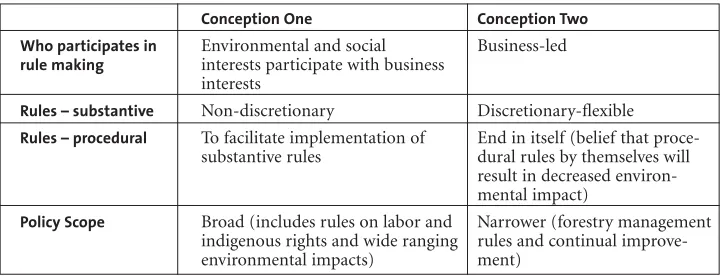
Key differences between FSC and competitor schemes are summarized in Table 1 below, based on who has rule-making authority and the nature and scope of the rules established. Table 2 compares FSC’s scheme with several competitors across a range of criteria to further illustrate differences.
4
Table 1 Different conceptions of forest certification
Conception One Conception Two Who participates in Environmental and social Business-led rule making interests participate with business
interests
Rules – substantive Non-discretionary Discretionary-flexible Rules – procedural To facilitate implementation of End in itself (belief that
proce-substantive rules dural rules by themselves will result in decreased environ-mental impact)
Policy Scope Broad (includes rules on labor and Narrower (forestry management indigenous rights and wide ranging rules and continual improve-environmental impacts) ment)
Source: Cashore 2002
Table 2 Comparison of FSC and FSC competitor programs
FSC PEFC SFI CSA
Origin Environmental Landowner (and Industry Industry groups, socially some industry)
concerned retailers
Types of Performance Combination Combination Combination standards: emphasis
performance or systems-based
Territorial focus International Europe origin, National/ National now international bi-national
Third party Required Required Optional Required verification of
individual ownerships
Chain of custody Yes Yes No Emerging Eco-label or logo Label and Logo Label and Logo Logo, potential Logo, potential
Terms:Performance-basedrefers to programs that focus primarily on the creation of mandatory on the ground rules governing forest management, while systems-basedrefers to the development of more flexible and often non-mandatory procedures to address environmental concerns.Third Partymeans an outside organization ver-ifies performance;Second Partymeans that a trade association or other industry group verifies performance;First Partymeans that the company verifies its own record of compliance.Chain of Custodyrefers to the tracking of wood from certified forests along the supply chain to the individual consumer. A logois the symbol certification programs use to advertise their programs and can be used by companies when making claims about their forest practices. An eco-labelis used along the supply chain to give institutional consumers the ability to discern whether a specific product comes from a certified source. NOTE: The PEFC is included in this table for comparative rea-sons, but it is difficult to make universal characterizations about program content or procedures, since they vary by country or sub-region (though they must meet the minimum level set by the PEFC Council).
[image:23.576.72.435.91.229.2]methodology
Although, as noted above, much has been written about certification’s first decade, the story has been told mainly by Northern academics reflecting on developed-country experiences. While sustainable forest management presents challenges to forest managers in the North — from the Boreal forests of Canada to the temperate rainforests of Tasmania — it does so in a context where the knowledge, infrastructure and institutional capacity exist to implement the transition should firms and governments wish.
The situation in Africa, Asia-Pacific, Eastern Europe, and Latin America is very different. Put simply, the task of sustainable forest management is much more challenging in these regions because it occurs in an unsupportive economic, political and social context. While some success stories exist, certification’s progress in these regions has been slow and uneven, reflecting, in various cases, a lack of resources, poor infrastructure, corrupt institutions, environmentally insensitive domestic and foreign markets, and domination by foreign corporations. While companies and governments in the North must face up to the challenge of sustainable forest management, it is those in the East and South who can be truly said to confront it. In this book, we not only seek to understand this struggle, but also to confront it as academics.
An examination of the amount of certified forest in developed and developing countries (see Figures 1 and 2, page 9) underscores the challenge that certification faces in the South. The top regions globally in terms of area certified under all schemes — North America and Western Europe — encompass most of the developed North including the United States, Canada, Sweden, the UK, and Germany. Of the almost 60 million hectares of FSC-certified forests in 2005, 52 percent were in developed countries, 32 percent in transitioning countries, and only 17 percent in developing countries (extra one percent due to rounding error). PEFC’s ratio is even starker. As of 2005, PEFC had about 193 million ha of certified forests5
, but only just over 7 million ha (3.6 percent) in developing countries (Brazil, Chile and Malaysia). Almost all the remainder was in high-income, developed countries, except for two in Eastern Europe (Czech Republic and Latvia). There is an irony here. Forest certification was initiated primarily to promote good forest management in tropical developing countries, but has been adopted by developed-country operators seeking a market advantage from their comparatively lower cost of compliance.
The South’s reluctance to embrace forest certification is also reflected in academic publications on the subject. The research literature has examined the instrument of certification in various ways: as a forum for political struggle and negotiation between actors over national forest policy (Elliott 1999); as an emerging system of civil-society regulation (Meidinger 2003); as systems of private self-regulation (Haufler 2001); as voluntary codes (Webb 2004); and as a non-state, market-driven system of legitimation (Cashore, Auld, and Newsom 2004). Although developing country case studies have not been completely excluded from these efforts, researchers have tended to focus on countries with large areas of certified forests. 5
These also happen to be the ones closest to hand — Canada, Germany, Sweden, the United Kingdom and the United States. In contrast, relatively little has been written on certification in developing and transitioning societies.6
Despite the challenges faced in the South and the academic focus on the North, forest certification must work in Eastern European and developing countries if it is to deliver on its promise. By bringing to light the difficulties experienced — and high-lighting some of the solutions adopted — this book expands our theoretical under-standing of forest certification’s effects.
The project evolved from discussions commenced in 2002 that consolidated them-selves in a plan to host a major symposium at Yale University. The symposium, enti-tled Forest Certification in Developing and Transitioning Societies: Social, Economic, Ecological Effects, took place from 10-13 June 2004. The major academic objective of the symposium was to develop a comparative database of the effects that certification was having in the South and Eastern Europe to complement work already done on developed countries. To this end, the editors developed a template to guide case study researchers on what information should be collected and how the research should be structured. Important secondary objectives of the symposium were the fostering of research capacity in developing and transitioning countries through the identifica-tion and commissioning of naidentifica-tionals to write the case studies, and the publicaidentifica-tion of the proceedings to ensure widespread availability.
Through 2003 and into 2004, the editors worked to secure funding to run the sym-posium. Early grants from the Rainforest Alliance and WWF International were very important in enabling the project to get underway, with major funding from the ITTO, the U.S. Forest Service, the World Bank and GTZ, the German development agency, critical to its occurrence. The three-day symposium hosted by Yale’s Program on Forest Certification was an outstanding success, with researchers from developing and transitioning countries presenting their case studies and working closely with their regional colleagues and the editors to compare results and identify common themes and challenges.
The symposium’s academic objectives placed considerable weight on the template developed by the editors, which was designed to compare the relative effectiveness of certification across different jurisdictions. Initially, the editors developed a very detailed template, but after concerns were expressed that it might be overly constraining and inflexible, the template was streamlined to consist of a relatively small number of core headings (see Box 1, next page).
The template was accompanied by a detailed explanation of the meaning of each heading, together with examples. Its purpose was to generate comparable studies of the effects of certification across countries and regions. Overall, the approach worked well, enabling this book to be read in one of three ways: sequentially to obtain an understanding of certification’s effects across countries and regions; regionally, to understand the opportunities and challenges to certification in Asia-Pacific, Africa, Eastern Europe and Russia, and Latin America; and thematically, to understand how certification emerged, the reactions of different actors, and its social, environmental and economic effects. The interested analyst can thus mine the case studies,
6
generating and testing hypotheses concerning certification’s effects in developing and transitioning societies. Our own effort to identify themes and make sense of the data is set out in the conclusion.
Box 1 Case study template
Introduction
Background Factors
1) Ownership and Tenure 2) Markets
The Emergence of Forest Certification
1) Initial Support 2) Institutional Design 3) Standards
4) Forestry Problems
5) Roadblocks and Challenges The Reaction to Certification
1) Forest Policy Community/Stakeholders 2) Forest Owners
3) Current Status of Forestland Certification 4) Current Status of the Certified Marketplace Effects of Certification
1) Power 2) Social 3) Economic 4) Environmental Conclusion
Countries were selected in a region as follows. Each editor was assigned to a specific region and was responsible for assessing candidates for possible inclusion. Criteria used in selecting countries into the project were:
(a) total forest area (relative to other countries and as a percentage of total land area of the individual country);
(b) level of forest certification activity (measured in hectares certified, number of chain-of-custody certificates, establishment of FSC national working groups, development of competing forest certification system); and
While it proved relatively straightforward to narrow down the countries to a smaller sub-set of eligible candidates, it proved quite difficult in some cases to identify national researchers with the background and knowledge to undertake the case studies. By networking with scholars and practitioners from around the world, a well-qualified group of researchers was eventually assembled, testifying to the power of the new telecommunications technologies of the Internet, email, and telecon-ferencing and to the feasibility of a new kind of global research. The countries eventually selected are set out by region in Table 3.
Table 3 Case study countries by region
Asia-Pacific Eastern Europe Latin America Sub-Saharan & Russia Africa Indonesia Estonia Bolivia Gabon Malaysia Latvia Brazil South Africa Papua New Guinea Poland Guatemala Uganda Solomon Islands Russia Mexico Zambia
A final methodological component was the Yale symposium itself. The formal presentation of the case studies at the plenary meetings (10-11 June) was comple-mented by in-depth regional and thematic workshops held on the following days (12-13 June). At the workshops, the editors and the case-study researchers were able to engage in deep discussion on the similarities, differences and policy challenges facing forest certification within and across the respective regions. At a final workshop, all researchers collaborated in a brainstorming exercise to identify emergent themes; that collaboration has continued in the preparation of shared introductions to the four regions.
In order to provide clarity, we have organized the book according to the four regions from which the case studies were drawn (we present the regions and individual case studies within them in alphabetical order) as well as providing regional overviews that place the cases within their broader geographical contexts. Taken together, the regional case studies tell a fascinating story of the role of forest certification in introducing new ideas about sustainable forest management, in developing alternative arrangements for multi-stakeholder processes, in identifying existing and potential impacts and bottlenecks, as well as the need for further, targeted research.
networks for wider participation by previously excluded groups. Just how forest certification shapes new forest policy norms, and whether, and how, it might continue to institutionalise itself as a meaningful form of global and domestic governance, represent the critical questions that we turn to, and detail, in the conclusion.
references
Bartley, Tim. 2003. “Certifying Forests and Factories: States, Social Movements, and the Rise of Private Regulation in the Apparel and Forest Products Fields.”Politics & Society31, 3 (September): 433-464.
Bernstein, Steven, and Benjamin Cashore. 2004. “Non-State Global Governance: Is Forest Certification a Legitimate Alternative to a Global Forest Convention?” In Hard Choices, Soft Law: Combining Trade, Environment, and Social Cohesion in Global Governance, edited by J. Kirton and M. Trebilcock. Aldershot: Ashgate Press. Cashore, Benjamin. 2002. “Legitimacy and the Privatization of Environmental Governance: How Non State Market-Driven (NSMD) Governance Systems Gain Rule Making Authority.”Governance15 4 (October): 503-529.
Cashore, B., G. Auld and D. Newsom. 2004.Governing Through Markets. New Haven: Yale University Press.
Domask, Joseph. 2003. “From Boycotts to Partnership: NGOs, the Private Sector, and the World’s Forests.” In Globalization and NGOs: Transforming Business, Governments, and Society, edited by J. P. Doh and H. Teegen. New York: Praeger. Dudley, Nigel, Jean-Paul Jeanrenaud, and Francis Sullivan. 1996.Bad Harvest? The
Timber Trade and the Degradation of Global Forests. London. Earthscan.
Elliott, Chris. 1999. “Forest Certification: Analysis from a Policy Network Perspective.” PhD thesis. Department de genie rural, Ecole Polytechnique Federale de Lausanne, Lausanne, Switzerland.
FAO. 1993.The Challenge of Sustainable Forest Management. Rome: FAO.
FSC. 2005. By-Laws and Statutes. Bonn: FSC International Centre, www.fsc.org, accessed November 2005.
Gale, Fred. 1998.The Tropical Timber Trade Regime. Basingstoke, Hampshire: Palgrave Macmillan.
Haufler, Virginia. 2001.Public Role for the Private Sector: Industry Self-Regulation in a Global Economy. Washington, D.C.: Carnegie Endowment for International Peace. Humphreys, David. 2005. “The Certification Wars.” Paper presented to the
International Studies Association Annual Convention, Hawaii, USA.
Humphreys, David. 1996.Forest Politics: The Evolution of International Cooperation. London: Earthscan.
Luthiers Mercantile Catalogue. 1993. W.A.R.P. http://members.shaw.ca/strings/ warp.htm, accessed November 2005.
Meidinger, E. 2003. “Forest certification as a global civil society regulatory institution.” In Social and Political Dimensions of Forest Certification, edited by E. Meidinger, C. Elliott and G. Oesten. Remagen-Oberwinter: www.forstbuch.com.
Moffat, Andrea C. 1998.Forest Certification: An Examination of the Comptability of the Canadian Standards Association and Forest Stewardship Council Systems in the Maritime Region.MES, Environmental Studies, Dalhousie University, Halifax, Nova Scotia.
Rickenbach, Mark, Rick Fletcher, and Eric Hansen. 2000. An Introduction to Forest Certification. Corvallis, OR: Oregon State University Extension Service.
Viana, Virgilio, Jamison Erwin, Richard Z. Donovan, Chris Elliot and Henry Gholz (eds.). 1996. Certification of Forest Products: Issues and Perspectives. Washington, D.C.: Island Press.
regional overview
Forest Certification in the
Asia-Pacific Region
Constance McDermott, Ph.D.
Program Director and Postdoctoral Associate Yale Program on Forest Certification,
Yale School of Forestry & Environmental Studies Yale University
230 Prospect Street, New Haven, CT 06511 USA [email protected]
Bill Maynard
Director, Global Forestry Services Inc 9B Jalan Setiapuspa, Medan Damansara, Malaysia
[email protected]; [email protected]; www.gfsinc.biz
Fred Gale, Ph.D.
Senior Lecturer, School of Government University of Tasmania
Locked Bag 1340, Launceston TAS 7250 [email protected]
Ferdinandus Agung Prasetyo
Researcher, Forest and Governance Program CIFOR
Jalan CIFOR, Situ Gede, Sindangbarang, Bogor Barat 16680, Indonesia
Israel Bewang, B.F.S. Forest Certification Officer
Foundation for People and Community Development Inc. (FPCD)
P.O. Box 297, MADANG 511, Saidor District, Madang Province,
Papua New Guinea [email protected]
Yati Bun, M.F.M. Executive Director
Foundation for People and Community Development Inc (FPCD)
P.O. Box 5134, Boroko, NCD, Papua New Guinea
Dwi Rahmad Muhtaman, M.P.A. Project Consultant, CIFOR IFC Office:
Bali Jeff Building
Jl. Raya Puputan 488, Renon, Denpasar 80226, Bali, Indonesia
Home Office:
Jl. Gaharu D17A, Kompleks Taman Darmaga Permai,
Cihideung Ilir, Ciampea, Bogor 16620, Indonesia
Mohd Shahwahid H.O., Ph.D. Director
Rainforest Academy Universiti Putra Malaysia
UPM 43400, Serdang, Selangor, Malaysia [email protected]
Morgan Wairiu, Ph.D. Director
Environmental Concerns Action Network of Solomon Islands
P.O. Box 327 Unit 49, NPF Plaza, Honiara, Solomon Islands
introduction
The tropical forests of Southeast Asia and Oceania are prized for their biodiversity and economic values. The prevalence of islands in the region contributes to high levels of species endemism as well as increased vulnerability to extinctions. The global economic demand for tropical timber, meanwhile, has fuelled myriad environmental problems, including deforestation, forest degradation and the loss of biodiversity. As a result of growing international environmental concerns, the world’s first forest certification took place in this region when SmartWood certified Perum Perhutani in Indonesia in 1990. Considerable efforts have been invested since that time to develop certification into a profitable enterprise capable of promoting improved forest practices. Many of the same problems that certification was designed to fix, however, have served to prevent its expansion.
similarities and differences
Ecology and Economy
A key geographic feature of the region is the Wallace line, which divides two major continental shelves with sharply distinct ecologies. On one side of the line are Peninsula Malaysia, the island of Borneo, Sumatra and central and western Indonesia. Across the line are the Moluccas, the entire island of New Guinea, and Solomon Islands. Within these two very broad areas there are also a vast number of critical and distinct ecological regions including hill forests, lowland forests and coastal swamp forests. Major commonalities between the four case study countries (Indonesia, Malaysia, Papua New Guinea, and Solomon Islands) include not only this tremendous biodiversity of their tropical forests, but also the rich cultural diversity of their human populations. The region’s island geography has played a major role in shaping this diversity. Solomon Islands and Papua New Guinea (PNG) encompass hundreds of islands, while the Indonesian archipelago numbers of 17,000. Malaysia is the one case study country with a land base connected to the Asian mainland, although it also includes two states located on the Island of Borneo.
Indonesia’s population (at 206 million in 2000) is almost ten times Malaysia’s (22 million), and much greater than either PNG (5 million) or Solomon Islands (0.4 mil-lion). Indonesia also has the largest forest area (105 million hectares) in comparison to PNG (31 million), Malaysia (12 million) or Solomon Islands (3 million).
improved forest industry statistics. In addition to making an important contribution to domestic GDP, forest product exports also earn foreign exchange amounting, in the case of Solomon Islands, to more than 10 percent of total exports (Brown and Durst 2003: 45).
China, Japan and South Korea are the largest importers of Asia-Pacific timber, although there are also niche markets for processed timber products in Europe and North America. While East Asia continues to dominate international trade in the region, the pattern of control of the forest resource has changed over the last three decades. Initially foreign companies owned most timber harvesting operations, and timber was exported as raw logs. This is no longer the case in Indonesia and Malaysia, due in part to active government policies promoting domestic forest industries and the development of value-added wood processing. Foreign logging companies still dominate in PNG and Solomon Islands, however, and exports consist of relatively unprocessed logs.
Deforestation and Forest Tenure
Deforestation in the Asia-Pacific has proceeded in a manner similar to other regions worldwide. Forest degradation begins with selective high grading of the most easily accessible areas. Once the most valuable timber species have been removed, logging becomes less selective and extends into more remote and often less fertile regions. The establishment of logging roads, together with the degradation of the forest resource, proceeds hand in hand with growth in the local human population and agricultural expansion. The end result is often deforestation, i.e. the complete loss of forest cover and conversion to other land uses. In this way, virtually all of the lowland dipterocarp forests in Malaysia and Indonesia have been logged out or are heavily disturbed.
It is estimated that roughly 30 to 40 million people are directly dependent on the forest resource in the region. These include large rural populations, many of whom depend on the forests for their subsistence needs. The official distribution of forest tenure, however, varies considerably between countries. The majority of forestlands in both Indonesia and Malaysia are government owned. In Papua New Guinea and Solomon Islands, in contrast, communal ownership dominates. Despite the differences in legal tenure arrangements, the lack of rural community capacity to capture economic benefit from the global timber trade is a problem shared by all four countries.
The Development of Forest Certification
While the FSC was involved in the region’s first certifications, both Indonesia and Malaysia have since developed their own national certification systems. In 1993, the same year as the Forest Stewardship Council’s founding meeting in Toronto, Indonesian industry and government interests began the process of developing the national Lembaga Ekolabel Indonesia (LEI) system. A few years later, the Malaysian government established its own process, leading to the eventual formation of the Malaysian Timber Certification Council scheme (MTCC). Both schemes are now fully developed, with their own forest certification standards, certifier accreditation, and review procedures. In the last two years both LEI and MTCC have redrafted stan-dards and adopted procedures in an attempt to make their schemes more compatible with FSC’s.
In Papua New Guinea and Solomon Islands, a different approach to certification has emerged. This system, known as Eco-forestry certification, was developed through the collaboration of Greenpeace New Zealand and a number of forest prod-uct buyers from New Zealand known collectively as the International Tropical Timber Group (ITTG). Eco-forestry certification represents a simplified, less costly form of certification designed specifically to help community forestry operations develop the skills and capital necessary to proceed to full certification. Despite the active development of these various certification systems in the Asia-Pacific case study countries, forest certification has proceeded very slowly in the region (see Table 1). Only one of the operations has been certified for longer than five years (the term of a single certification period) and all community-based operations that have been certified have subsequently not been re-certified.
Table 1 FSC certificates issued (as of June 2004)
Community Natural Forest Plantation Total
Indonesia 1* 1 1* 3
Malaysia 0 2 2 4
PNG 2* 0 0 2
Solomon Islands 2* 0 1 3
Totals 5 (-5*) 3 4(-1*) 12
*Either currently suspended or no longer certified.
Challenges to Forest Certification
All of the following case studies mention the absence of a market for certified products as a major constraint in the implementation of forest certification. The majority of exports in the region are sold within East Asian markets, where demand for “green” timber is minimal. China is currently the largest buyer of wood products in the Asia-Pacific, and Chinese demand for certified products is virtually non-exis-tent. Without an adequate market for certified products, timber producers have little economic incentive to pay the costs of certification.
The lack of local community capacity to own and manage forestry operations rep-resents another key factor shaping certification in the region and the case studies illustrate how this dynamic creates both opportunities and constraints for sustainable forest management. Opportunity lies in the potentially symbiotic relationship between development assistance donors and local communities. In such cases, donors provide communities with resources and capacity building in return for community adherence to sustainable forestry standards. Constraints to sustainable management, however, include continued dependence on foreign donor support and the relatively short-term nature of some donor-driven projects.
Forest tenure disputes, and/or disputes over resource distribution, profoundly influence the expansion of forest certification. Certification generally requires proof of clear tenure and use rights and long-term commitment to one particular forest management path. Logging in the region, however, is often conducted through short-term contracts between governments, local elites and foreign logging companies. Disputes are common between these logging contractors and local and/or indigenous rural populations.
Land ownership patterns vary considerably among the four case study countries. Most forestlands in Indonesia and Malaysia are government owned, while the majority of forestlands in Papua New Guinea and Solomon Islands are communally held. Regardless of official tenure arrangements, however, the growth of international commercial wood products trade represents a major economic shift away from traditional forest uses. Forest certification is often controversial under such circumstances, depending on whether it is seen as supportive of large-scale industrial logging or community-based resource uses.
Competing Certification Systems
Forest certification itself comes with its own potential for generating conflict. From the international to the local level, forest certification is of concern to an extremely broad range of interests, including international lending institutions, international environmental groups, various levels of international, national, and local government, large and small-scale forestry operations, forest workers, and rural and indigenous communities, as well as a range of international, national and state environmental and social interests. Relations between many of these groups have long been dominated by conflict and distrust. Hence, certification systems perceived as being controlled by any single interest will be viewed as unacceptable by competing groups (McDermott 2003).
In terms of the political economy of competing certification systems, the case studies highlight two distinct political strategies: the creation of national systems (in Indonesia and Malaysia) on the one hand, and the development of markets for community-based operations (in Papua New Guinea and Solomon Islands) on the other. In their respective case studies, Muhtaman and Prasetyo (Indonesia) and Shahwahid (Malaysia) explain how national certification systems developed in an effort to maintain sovereignty over forestry decisions. However, these national certification systems have been unable to garner a high level of support from diverse interests, including international environmental groups, local NGOs, indigenous peoples and rural communities. The authors go on to explain the very different strategies pursued by Indonesia and Malaysia to make their schemes more nationally and internationally legitimate.
In Papua New Guinea and Solomon Islands, where the majority of forestlands are communally owned, NGOs and local communities have been the drivers of forest certification. Bun and Bwang (PNG) and Wairiu (Solomon Islands) discuss the development of Eco-forestry certification as an alternative approach for community operations currently unable to afford certification under the FSC. Eco-forestry certification was created through negotiations between New Zealand buyers (ITTG), international NGOs, and community forestry operators. Through the Eco-forestry certification system, community forestry operators receive financial and technical support as well as premiums for their forest products in exchange for adherence to a simplified set of forest management standards. The case studies highlight, however, a key difference between the national systems and Eco-forestry certification, rooted in the balance of decision-making power in the different schemes. As reflected in the case studies, while many NGOs support the Eco-forestry certification scheme, they are adamantly opposed to the national certification systems in their current forms.
FSC-accredited certification. While step-wise approaches to certification are appealing in theory, the practical difficulty is to ensure that companies do, in fact, progress through the system and achieve the highest level of certification. If there is no systematic progression, the first step will become the de facto standard.
important questions facing the region
These case studies from the Asia-Pacific region raise many important issues concern-ing the utility and feasibility of forest certification. Among the most important are working out who has the greater power to influence the direction of certification in the region – producers like Indonesia and Malaysia or consumers like China and Japan? Another key issue is determining who will pay for certification when market demand and/or community capacity are lacking and in a context of systemic social problems related to land tenure, inequality, political instability, corruption and illegal logging. Further, proponents of certification in the region are beginning to pose the question of how demanding certification standards should be and whether a step-wise approach to certification can be crafted to ensure more widespread adoption of the approach. Finally, an important issue raised by the case studies focuses on the role that governments have and could play in decision-making in relation to certification.
references
Brown, Chris and Patrick B. Durst. 2003.State of Forestry in Asia and the Pacific–2003: Status, Changes and Trends. Asia-Pacific Forestry Commission, Food and Agricultural Organization of the United Nations, Regional Office for the Asia and the Pacific, Bangkok.
McDermott, Constance. 2003. “Personal Trust and Trust in Abstract Systems: A Study of Forest Stewardship Council Accredited Certification in British Columbia.” Ph.D. thesis, Department of Forest Resource Management, Faculty of Forestry, University of British Columbia, Vancouver.
* Dwi Rahmad Muhtaman, M.P.A., Project Consultant, CIFOR IFC Office: Bali Jeff Building Jl. Raya Puputan 488, Renon, Denpasar 80226, Bali, Indonesia
** Ferdinandus Agung Prasetyo Researcher, Forest and Governance Program CIFOR Jalan CIFOR, Situ Gede, Sindangbarang, Bogor Barat 16680, Indonesia [email protected]
Forest Certification in Indonesia
Dwi Rahmad Muhtaman* Ferdinandus Agung Prasetyo**
abstract
Tropical deforestation and forest degradation in Indonesia is a serious concern of many stakeholders. About 16 million hectares of forestland in concessions is degraded. In addition, the lack of clarity of land tenure rights and ownership has given rise to significant conflict, which also contributes to unsustainable forest management. In response, domestic and international organizations have put considerable pressure on Indonesia to improve forest management policies and practices.
In 1990, the first ever developing country certification was carried out in Indonesia, when SmartWood certified Perum Perhutani’s teak forest operation on the island of Java. In response to this and other NGO pressure, the Government of Indonesia established its own forest certification scheme – Lembaga Ekolabel Indonesia – in 1993. In 1998, LEI was officially established as a foundation and since then has conducted several certification assessments. LEI and FSC have also developed a Joint Certification Protocol (JCP) that obliges FSC to use both LEI and FSC criteria and indicators when conducting an assessment of a forest management operation.