E
LM
F
ARM
R
ESEARCH
C
ENTRE
Bulletin
with Technical Updates from
The Organic Advisory Service
Issue No. 77 March 2005
ELM FARM RESEARCH CENTRE
is an international research, advisory and educational organisation based in the UK.
The business of Elm Farm Research Centre is to develop and support sustainable land-use, agriculture and food systems, primarily within local economies, which build on organic principles, to ensure the health and wellbeing of soil, plant, animal, man and the environment.
www.efrc.com
Patrons of EFRC
Graham Pye
Peter Kindersley Jan Sundt The Lord Poole Juliet Kindersley The Countess of March and Kinrara
Director:Lawrence Woodward O.B.E.
Council of Management:
Chairman:Christopher Bielenberg
Trustees: Alexander Bielenberg James Cornford
Roger Harrison Rachel Hood James Skinner
Prof. Dr. Hartmut Vogtmann
Research Director: Prof. Martin Wolfe
Head of Operations:Dr Bruce Pearce
Bulletin Editors and Designers:
Lawrence Woodward, Pat Walters and Alison Walters
Reg. Charity No: 281276 ISSN 1367- 6970
AND SO THE NEW REGIME
BEGINS
Not with a bang - although more than a whimper: definitely muted though. The launch of the new Environmental Stewardship Scheme was a quiet, rather sombre affair. It crossed my mind that the launch party for one of TS Eliot's poem's might have had the same atmosphere. In fact his lines kept coming to mind - "We are the hollow men".
However, Defra's booklets and explanatory material looked good - some excellent drawings and pictures - and the content isn't to be sniffed at; £60 per ha under the Organic Entry Level Scheme and the chance of more under the Higher Level Scheme is very welcome. We had to hang around for ages but there was some decent display material and plenty of tea and biscuits -"We are the stuffed men" - before being led into another room.
A few of agriculture's great and good were on a platform - "Leaning together Headpiece filled with straw". Margaret Beckett spoke and then left. I didn't blame her, the thought crossed my mind. Don Curry was next, hailed as the guiding light - "Shape without form, shade without colour, Paralysed force, gesture without motion".
His famed report did not convince me and was too readily accepted - "The hope only Of empty men". Still the ESS has merit though not enough money - "Between the motion And the act". Curry speaks and unease mounts, then he says it: "a sustainable agriculture and competitive on the world market" -"Between the idea And the reality Falls the Shadow".
The others line up to follow the leader - "Here we go round the prickly pear". I decide to follow Margaret and leave full of grim thoughts - "this last of meeting places" where "Lips that would kiss Form prayers to broken stone" and of agriculture's future. Another of Eliot's poems forces itself on me - "The Waste Land".
T S Eliot (1925) The Hollow Men - website link http://www.cs.umbc.edu?~evans/hollow.html
1-7 Policy Food Miles Organic agriculture in the humid tropics
IFOAM consultation on organic principles Victory against Biopiracy! 8-12 Research The role of participatory processes in organic research programmes
Sustainable agro-ecosystems Defra research consultation Interrupted Brome More Organic taste tests
13-16 Technical Organic vegetable market stabilises New environmental payment schemes
17-19 Conference Food Quality and Health: Concepts and Methodologies Report
20 EFRC in 2005 Support EFRC’s new programme: Food and Farming within Finite Resources
In this issue
Food miles has once again become a topical issue. Three events in recent weeks have highlighted the problems associated with a food system that is based on global sourcing and complicated, transport-intensive supply chains.
The first has been described as the 'food miles
dilemma'i. Many organic foods are imported and some travel a long way to reach shops in the UK. The dilemma exists because one of the reasons why the consumer chooses organic is that the environmental benefits of organic production include less energy use and therefore lower greenhouse gas emissions. However, when imported, the transport involved, as well as refrigeration and packaging, produces greenhouse gases. If organic products are transported long-distance, particularly by plane, the emissions are far greater than the reduced emissions resulting from organic rather than
conventional farming.
Patrick Holden, director of the Soil Association has stated that: "We do not take into account how far food has travelled, but we might well do in the future.'' This is not a new issue - the first Food Miles Report was
published over ten years ago and in 2001 the
EFRC/Sustain report Eating Oilfocused on post-farm gate environmental impacts and organic food chains in particular.
The supply of organic foodstuffs has come to rely even more heavily than the conventional sector on global sourcing, with import levels remaining static at 56 per cent in 2003-04. The sourcing policy of the large supermarkets has played a significant role in the balance between UK produced and imported organic food. Members of HDRA are currently conducting a survey at supermarkets across the UK and recording the price, availability and source of organic produce. Initial results have shown that only 27 per cent of organic vegetables in supermarkets are UK sourced and no stores stocked UK organic broccoli, lettuce or sweet corn when in season.
Until 1999, the multiple retailers concentrated their efforts on marketing organic fresh fruit and vegetables and were yet to offer a comprehensive range of
organically produced meat products. With this in mind it is interesting to note that in 1999, 82 per cent of the organic fruit and vegetables consumed in the UK were imported whereas organic meat imports stood at 5 per cent. The following year, imports rose to 30 per cent
when the supermarkets became involved in marketing organic meat. This trend - of supermarkets importing organic meat has continued. In 2004 the Soil Association found that over 75% of the organic pork on sale in Asda was imported. In Tesco, only half the pork and less than half the organic beef was British.
'Food miles' has been used to compare and contrast the distance that food travels to reach the supermarket shelf and in alternative, more localised, systems such as farmers' markets. However, food miles is, and always has been, about more than distance. As a concept, it is intended to raise awareness of the changes taking place in the food system and highlight the consequences, which the consumer and policy-maker may not be aware of due to the lack of information. The aim has also been to highlight the fact that a truly sustainable food product is one in which the total environmental impact across the whole supply chain is minimised.
If the consumer wants a low-carbon food product then the best option is organic from a local box scheme or farmers' market where the produce is sourced locally, normally from within a 30 mile radius (see new study below). Many other box schemes have a 'no airfreight policy' and also source produce locally and from the UK when available.
It is not only the distance between farm and plate that is of concern;the consumer has become both physically and psychologically distanced from the processes and practices in the contemporary food supply chain.The link between the land, food producers and the consumer is lost. The shift to highly processed products has exacerbated the problem and has led to the situation in which the consumer has little information on the origin of food products or awareness of the social and
environmental impacts associated with food production and distribution.
The 'out of sight, out of mind' culture is at the heart of our current economic system and the process of globalisation. This seems to suit the large retailers, for what you don't know you don't worry about and, more importantly, you can't change. In terms of highlighting best practice, it also makes it virtually impossible to compare the environmental impacts associated with supermarket supply chains for particular foodstuffs and those of the local alternatives. As Richard Wakeford, Sustainable Development Commissioner and Chief Executive of the Countryside Agency, has noted - "It's
Policy
hard to find out how the food [the large chain stores] sell was produced, let alone where it's been in their giant distribution systems." The extent to which supermarkets are reluctant to provide information is demonstrated in a statement by Paul Bowtell of ASDA - "No supermarkets are going to give information on food miles; it is like giving a rope to hang yourself with."
Tracability and Food Safety
Distancing effects are at the heart of the second issue to hit the headlines - the contamination of over 600 processed food products with the dye Sudan 1, resulting in the largest product recall.
The latest episode of food contamination was discovered in June 2003, at which time it was thought that Sudan 1 was confined to spices imported from India. However, the cancer-causing red dye, used to adulterate low quality chilli powder, was found in ready-to-eat meals 20 months later in February 2005. Sudan 1 is normally used as a dye in shoe polish, industrial solvents and petrol. A Food Standards Agency (FSA) spokesman admitted, "We don't know how long Sudan 1 has been used in this way. People could have been eating it for many years." The products that the FSA attempted to recall included Tesco Finest Beef in Madeira, Waitrose and Pret a Manger Tuna Mayonnaise and Asda mini chicken bites. The range of foodstuffs affected was staggering and included vegetable soup, lasagne, shepherd's pie, caesar salad, bangers and mash and prawn cocktail.
This is yet another example of the inherent dangers associated with a food system that is industrialised, consists of complicated food chains and in which ingredients are sourced and food products distributed on a global scale. Traceability is even more difficult when a contaminated ingredient from one source is used in thousands of processed products, as with Sudan 1.
Food safety and the provision of quality produce of high nutritional content is something that the public should be able to take for granted. This is something that the modern food system has failed to deliver. Pesticide residues, BSE, salmonella and many other incidents have undermined public trust in the food they eat.
Contamination of a small farm or processing unit in which the products are distributed locally puts a number of people at risk but can be contained. However, when food products or livestock are produced on a large scale and are distributed nationally or globally, as in the case of the foot and mouth outbreak in 2001 and Sudan 1, a
large population is at risk and an outbreak can become extremely difficult to contain.
New evidence of the benefits of local
organic food
Food miles hit the headlines again in March following the publication of a study that considered the external costs of the food system by the University of Essex and City Universityii. These costs are a result of
industrialised farming, road freight distribution, shopping by car and waste generation and include ill-health resulting from air pollution, clean-up costs associated with the removal of pesticides and nitrate from drinking water and the environmental impacts of pollution and waste. They are described as being external as they are not paid for directly by the producer,
distributor, retailer or consumer.
The results of the study show that the external costs of a basket of food amount to £2.91 per person per week, 11.8% more than the price paid in the shop (£24.79).
The consumer should be aware that although the external costs of pollution do not appear on a supermarket receipt they will be part of their water and council tax charges as well as the NHS bill. Of even more concern is the fact that the food system is now a major contributor to climate change - the cost of which is beyond measure.
On a national level the financial benefits of adopting more sustainable production and distribution systems are substantial. If all farms were organic it would save £1.1bn a year, sourcing food locally would save £2.1bn and avoiding shopping by car a further £1.1bn; a total saving of over £4 billion.
This is the first attempt to quantify the external costs of the contemporary food system and estimate the
economic benefits of a shift to organic farming, local food systems and sustainable transport by reducing external environmental costs.
Andy Jones Senior Researcher
i. Terry Kirby -Shoppers who go the extra mile for food under
fire and the editorial Consumers should pay more attention to the real cost of food.The Independent 12th February 2005.
ii. J.N. Pretty, A.S. Ball, T. Lang, and J.I.L. Morison. Farm
costs and food miles: An assessment of the full cost of the UK weekly food basket. (2005) Food Policy (forthcoming) Centre for Environment and Society, University of Essex and
Department of Health Management and Food Policy, City University, London.
Introduction
Tropical rainforest ecosystems, such as those of Nicaragua, normally have a very high biodiversity, including rare and not yet described species. However, governments 'opened' rainforest regions for farmers and ranchers for political, social and economic reasons. Farmers also normally have a point of view or attitude which is contrary to biodiversity conservation - they simplify production to one or two crops on the same spot, usually cultivating only grains and tubers.
Lack of tradition (unlike other regions there is not the centuries of agricultural tradition in the rainforest regions) and bad advice, oriented towards short-term profits, has led farmers to destroy natural biodiversity and left little inclination to introduce biodiversity into agriculture.
Ecological agroforestry is a much more appropriate system for the region, which in the humid tropics should mean a highly diversified system of closely associated agroforestry crops.
Two principal challenges: (there are more!) ♦
♦ The mentality ... of small farmers, ranchers, decision makers, consultants, extensionists, NGOs Most small farmers in the region produce grains (maize, beans and rice), tubers (cassava and others) and may have some livestock: most of which is not appropriate for the humid tropics or the conservation of biodiversity. Their agricultural practices lead to diminishing soil fertility, over-exploitation, migration and a permanent move of the agricultural frontier. Existing biodiversity disappears and farmers do not easily accept new proposals such as eco-farming, based on trees and tree crops.
Most decision makers, consultants, extensionists and NGOs do not have any understanding of how natural cycles work in the humid tropics; and some do not care about the environment or the farmers' future. The short-term institutional, financial or political interests that dominate are also reflected by the farmers, who often have only a short-sighted vision of earning enough money to survive for the next three (beans!) to nine (cassava!) month period.
Farmers producing on the rainforest soils of south-east Nicaragua working since the Somoza dictatorship's so-called agrarian reform in the mid-sixties originally came from the semi-arid regions of western and central Nicaragua. They slash and burn, first the forest and then year by year their fields and pastures, and although
yields have gone down from maybe 40 'quintales' (1 q = 100 pounds) to eight or five or even three, they continue ... or they sell the land to cattle ranchers and then
illegally try to find new land in the protected areas. Their traditions of growing beans and corn are so strong that they do not see any alternatives, or they dream of
owning livestock, equally inappropriate for the rainforest soils. They considered trees their natural enemies, and they 'know' that each species needs its own place, needs 'clean culture' ('cultivo limpio'). They love the 'nice and beautiful' mono-cropping … as learnt from the North. Moreover they fall into the traps, put in place by business or politics; for example 'responding positively' to trade in hybrid 'improved seeds' from unknown origin, distributed by the government, instead of their locally selected traditional seeds.
♦
♦ Education ... the number one priority
Both La Esperanzita (a campesino school of organic agriculture in the humid tropics) and the organic farmers association 'Sano y Salvo - Safe and Sound' give
education with appropriate pedagogical methods a high priority and frequently spend more project funds on courses and workshops than on seeds and plants. Both organisations work with farmers to explain that the practices which currently dominate agriculture are not adequate for the place where they now live, work and cultivate; as they will stay in these regions and must live under the conditions of the forest, they must change their convictions and improve their knowledge.
Our training programmes, courses and workshops are not carried out by agricultural extensionists, instead we work 'campesino a campesino' (peasant to peasant): Our association's promoters and internal inspectors are also all smallholders. The training is very much practise oriented: learning by doing. We try to stay as far away as possible from mere skill teaching; instead education focuses a change of attitude towards life itself. Having understood, felt and thought about nature, the universe, the planet and the farmer's place on it, they treat soil life, tree life and forest life in a completely different way. Farmers begin to understand why what they do affects the life of the coming generations and how it interferes with world climate, and why the Dutch want to buy oxygen from them!
The farming families working on organic farms begin to feel that they, these poor people in the hinterland of a Third World country, really are the custodians of this 'biosphere of mankind', as UNESCO defined our region in 2003. They begin to accept this goal and respond
Policy
positively to the challenge, even though they are dependent on external help to put organic farming into practise. So the connection between biodiversity and organic agriculture is obvious: farmers learn to respect natural biodiversity and care for it, because it is the basis of agriculture and of carrying it out in a satisfying way. And they introduce biodiversity into their plots, taking care of their soil in the best way.
Practical challenges for the farmers and their organisation
Farming families live of the produce of their work in a direct way - they eat it - and they sell the produce to get the money for the other things one may need. So it is of course impossible to make them forest rangers: they need to practice agriculture and they should be able, and want to be able, to live from it with dignity. Organic agriculture has the means to help realise this ambition. Instead of annual reductions of yields, yields go up and production becomes more stable. Farmers in the North often accept lower yields when converting to organic production, but we convert to organic production out of the need to produce more!
Ecology demands diversity … and the farmers' economy responds to it: it stops the dependence of one or two products being the basis of the farming family's income. In the case of the humid tropics organic farmers grow some 40, 50 and even more crops: most of them for local and international markets and the rest providing
diversified nutrition for the family and other local consumers.
But to work this way, the farmer is confronted with some practical, technical and organisational challenges, too. In particular:
- He or she has to know the production details, life cycles, shadow tolerance, pruning necessities etc. of 40 or more crops.
- The organic farmers have to organise themselves in a very effective and sophisticated way, because no one farmer will produce enough of one product to sell it as organic - or certified organic.
- The farmers must produce marketable crops at the same time as the other members of the organisation, i.e. to have enough of the same product at the same time and of the same - certified - quality.
- Bad infrastructure and transportation problems, exacerbated in our case by difficult climatic conditions (i.e. heat and humidity), require processing at the place of origin.
- The organisation needs people to help manage the challenges of marketing locally, nationally and for export:
Some of these challenges seem to be difficult, but they
are real and normal in buffer zones of rainforest reservations. And one must overcome them, because to give up would mean to give up on saving biodiversity and give up on the farming families' future.
Conclusions
Organic agriculture in the humid tropics is necessary for keep biodiversity alive: for conservation one needs a high connectivity between natural forests and the surrounding areas. In agricultural areas this is only possible by retaining relatively high percentages of forest within the farms and by introducing biodiversity into agricultural management regimes. In the humid tropics even organic methods which are not suited to the local conditions, i.e. organic 'mono-cropping' or organic production of field crops instead of tree crops, lead to the destruction of soils and the biosphere.
Agriculture is an art. Therefore many efforts have to be undertaken to professionalize small farmers. It is also important for the public to be well informed, especially the consumers buying produce from biodiversity conservers.
To move from conventional and mono-cropping systems of agriculture to organic agriculture, including the protection of natural biodiversity and introduction of agro-diversity, in the first place requires a change of attitude. Therefore education and appropriate methods have priority, but to succeed these must consider small farmers academic level and their special ways of perception, their traditions and culture.
Saving biodiversity is 'a must' for mankind and for our civilization's survival on this planet. Agriculture is 'a must' too; so only agriculture which cares about
biodiversity, conserving nature and soil, is an option for the future. This obvious truth only has a chance to be accomplished when the farming community - especially if living and working close to the 'hotspots' of high biodiversity - gets the chance to produce food in sufficient quantity and of high quality on the same spot for centuries. If this fact is ignored by politicians, by development organisations and institutions, by society or by the farmers, the small holders all over the Southern world will destroy what was meant to be the basis for human life on Earth.
Policy
IFOAM, Manual of organic agriculture in the humid tropics, FiBL - Forschungsinstitut für biologischen Landbau (Research
Institute of Organic Agriculture), Suiza, 2004. was published in November 2004 in English and includes a case study on
Sano y Salvo. Sano y Salvo - Safe and Sound, First Small Farmers Association for Culture and Ecological Production in
the South Atlantic and Central Autonomous Region of Nicaragua see details on the website:
EFRC's Director, Lawrence Woodward, has been part of an international working party considering new principles for IFOAM. The proposals are now out for consultation.
Four principles have been created to identify organic agriculture: The principle of health; The ecological principle; The principle of fairness and The principle of care.
Each principle is articulated in a statement with an explanation. The principles all belong together to be used interdependently in consideration with the other
principles. Together, they have been composed to inspire action to make their vision a reality.
Principle of health
Organic Agriculture should sustain and enhance the health of soil, plant, animal and human as one and indivisible.
This principle is the foundation of organic agriculture. It states that the health of all living systems and organisms, from the smallest in the soil to human beings, are mutually dependent. Even though they are separate entities, they belong together and form larger entities. It builds on the shared origin of the words "whole" and "health" and stresses the integrity of living systems as a whole.
Health is the maintenance of physical, mental and social well-being and not simply the absence of disease or illness. It is a continual process that accumulates and distributes the materials and energy necessary for the function of all living organisms. Mutuality, resilience, self-regulation and regeneration are key characteristics of this process.
The role of organic agriculture whether in farming, processing, distribution or consumption is to sustain and enhance the process of health at all stages and levels.
Ecological principle
Organic Agriculture should be based on living
ecological systems and cycles, work with them, emulate them and help sustain them.
This principle roots organic agriculture within living ecological systems. It stresses that production is to be based on ecological processes instead of external inputs. Nourishment and well-being is achieved through the ecology of the specific production environment. For example, in the case of crops this is the living soil; for animals it is the farm ecosystem: for fish and marine organisms, the aquatic environment.
Production, through farming or wild harvesting, should
not be exploitative. It should be managed in accordance with the cycles that are observed in nature and all living systems. It should seek to enhance the properties of resilience, self-regulation and regeneration inherent in them. These cycles are universal but their operation is site specific. Therefore organic management must be adaptive and appropriate to local conditions, ecology, culture and scale.
This principle also applies beyond the farm to the processing, manufacturing, distribution and retailing of the products of organic agriculture. The concept of cycles should be applied to minimize resource inputs by enhancing reuse and recycling of materials and energy. Organic agriculture should also ensure that it does not adversely affect living systems, such as landscape, habitat, biodiversity, water or the general environment, which exist outside of its production areas.
Principle of fairness
Organic Agriculture should be built upon relationships that ensure fairness with regard to the common
environment and life opportunities.
This principle deals with human relations and relations between humans and other living beings. It stresses that organic agriculture should maintain and conduct these relationships in a manner that ensures fairness: a concept that includes the characteristics of equity, respect, justice and stewardship.
Its use and management of natural and environmental resources should not perpetuate social and ecological injustice. Instead, it should demonstrate how production and consumption can be socially and ecologically equitable and just by developing relationships built on fairness. Human relationships whether within or touched by organic agriculture should ensure fairness at all levels and to all parties - producers, farm workers, processors, distributors, traders or consumers - and should be seen to do so.
With regard to specific ecosystems and environmental resources, organic agriculture and all parties to it should acknowledge that rights and ownership are temporary and are ultimately held in trust for all living organisms and future generations. Its real environmental costs should be accounted for and should be transparent.
This principle insists that animals are provided with the conditions and opportunities of life that accord with their physiology, innate behavioral characteristics and well-being. Organic production systems should be constrained by the animal's needs - and not the other way around.
Policy
Principle of care
Organic Agriculture should be managed in a
precautionary and responsible manner to protect the health and well-being of current and future generations and the environment.
This principle primarily stresses the approach of organic agriculture to strategic and day-to-day management. Precaution and responsibility is called for, not risk assessment which is a narrow notion based on a narrow scientific or economic appraisal. By contrast care: precaution and responsibility encompass evidence and perspectives that can be scientific but can also be outside of the realm of science, have a moral content and a relevance to non-experts. This principle should govern management, development and technology choices in organic agriculture. Such a precautionary approach to decision-making will recognise that, even when the best
scientific knowledge is used, there is often a lack of knowledge with regard to future consequences and to the plurality of values and preferences of those who might be affected.
Organic agriculture is a living and dynamic system. It cannot be static and survive; it has to evolve in the face of both internal and external demands and conditions. Consequently, existing practices and technologies need to be reviewed and if necessary changed, new ones assessed and introduced. Efficiencies can be found and improvements made but this should not be at the risk of jeopardizing the health and well-being of current and future generations and the environment. This principle therefore, like the principle of fairness, depends on the involvement or representation of all stakeholders and it needs institutions of openness, transparency and participation.
Policy
Italian co-existence law
; Cereals & Dairy ManComs; Further changes in DG AGRI Italian Co-existence Legislation adopted:The Italian co-existence law was adopted in the Italian Parliament this week - the final step in the legislative process for this controversial dossier, which nearly split the ruling party in Italy.
The new rules require all 20 regions to have formulated their own individual coexistence plans by 31st Dec 2005, following guidelines drawn up by organic, conventional farming and biotech experts. GM farmers who contaminate other crops through negligence or non-adherence to the co-existence plans may face fines of between 2 500 and 25 000, according to the Italian law. Regions will be allowed to declare themselves "GM-free", and 13 of the 20 regions have already indicated that they will do so. Farmers who violate GM-free areas could face a prison sentence
Landmark Victory in World's First Case Against Biopiracy!!
European Patent Office Upholds Decision to Revoke Neem Patent
Munich, March 8, 2005. In a landmark decision, the European Patent Office upheld a decision to revoke, in its entirety, a patent on a fungicidal product derived from seeds of the Neem, a tree indigenous to the Indian subcontinent.
The historic action resulted from a legal challenge mounted ten years ago by three Opponents: the renowned Indian environmentalist Vandana Shiva, Magda Aelvoet, then MEP and President of the Greens in the European Parliament, and the International
Federation of Organic Agriculture Movements (IFOAM). Their joint Legal Opposition claimed that the fungicidal properties of the Neem tree had been public knowledge in India for many centuries and that this patent
exemplified how international law was being misused to transfer biological wealth from the South into the hands of a few corporations, scientists, and countries of the North. The EPO's Technical Board of Appeals dismissed an Appeal by the would-be proprietors, the United States of America and the company Thermo Trilogy, and maintained the decision of its Opposition Division five years ago to revoke the Neem patent in its entirety, thus bringing to a close this ten-year battle in the world's first legal challenge to a biopiracy patent.
For further information, contact:
Research Foundation for Science, Technology and Ecology:
Research
Introduction
The aim of the workshop was to explore and discuss the relevance of a participatory approach to organic farm research in general, taking some on-going projects as examples. The context for the workshop was to examine:
1) who is setting the research agenda and how? 2) are the organic research programmes addressing
the needs of farmers, growers and advisors, researchers and policy makers?
3) is the research addressing the needs of the wider organic movement?
4) how can wider stakeholder engagement with research be encouraged?
Summaries of the research approach of four contrasting 'participatory research' projects were presented.
Stakeholder Analysis
An exercise on Stakeholder Analysis was run by David Gibbon. This is the identification of a project's key stakeholders (persons, groups or institutions with interests in a project or programme), an assessment of their interests and the ways in which these interests affect project riskiness and viability.
A group exercise using CATWOE analysis was carried out - CATWOE stands for Customers of the process, Actors who carry out the process, Transformation (the process itself), Weltangshaung (world views that put the process in context), Owners (those who could stop the process) and Environmental constraints - by
brainstorming a list of projects or outcomes considered useful in order to advance the organic agenda. The exercise was useful in outlining the roles of participants in projects.
Discussion of Projects
Experiences with participatory research in four organic research projects, covering various sectors, were given.
♦ Participatory weeds project - Gareth Davies HDRA
♦ Participatory cereal variety project - Bruce Pearce EFRC
♦ Poultry - Josie O'Brien EFRC
♦ Farming Connect organic herbage seed project -Heather McCalman IGER
Participants were asked to evaluate the projects using a stakeholder approach to determine who was participating and in what capacity.
The results of the stakeholder analyses and project descriptions emphasised the importance of perceptions.
The participatory approach provides a different emphasis, is not a cheaper option, and can often take a great deal more organisation. The results can however be more rewarding and applicable, to farmers in particular.
Evaluation of different research approaches
In this energiser exercise, participants were asked to split into four groups and do a SWOT (strengths, weaknesses, opportunities and threats) analysis on each of four categories of research:
Contractual - researcher designed and implemented (farmer input minimal)
Consultative - researcher designed and implemented jointly (farmer manages trial)
Collaborative - joint consultation, researcher in control but farmer involved in planning and design and
implements trial
Collegial - fully participatory with design, implementation and evaluation by all partners
This emphasised the advantages and disadvantages of the different approaches to on-farm research. It should be appreciated that the research types form a continuum and are not discrete types and that different approaches might be necessary or desirable depending on the topic or issue being addressed.
Qualitative research and evaluation
A brief talk was given by Francis Harris of the University of Kingston on qualitative research and evaluation. A discussion indicated that the biologists present had not realised that social science approaches were also rigorous and involved corroboration and triangulation of information in order to build up reliable data sets.
Discussion of possible research ideas and issues arising from the day
Ideas of ways to move the participatory agenda forward included using participatory methods for research into climate change, local food production, biodiversity and health and developing ways of measuring the impacts of participatory projects.
Several issues arose during the meeting including the role that DEFRA plays - whether they are owners and/or actors of the process and how they cope with
participatory research internally.
A full version of this report can be found on the EFRC website htrticles.php&art_id=45
The role of participatory processes in
organic research programmes
Elm Farm Research Centre is currently involved in a project with social scientists at Middlesex University and the University of Kingston that is part of the new Rural Economy and Land Use (RELU) research programme.
This programme is encouraging the use of
interdisciplinary research in the area of sustainable rural development and is funded by biological (BBSRC), environmental (NERC) and social science (ESRC) research councils as well as DEFRA and SEERAD.
The project is a scoping study which draws on previous research from a range of disciplines including applied biology, agriculture, management studies, and sociology of science. The aim of this project is to understand the processes of innovation from the perspectives of farmers, and scientists working at the level of whole farm
systems. Through examining examples of successful interaction, the project will identify those factors that encourage collaboration between farmers and scientists.
The study will comprise of a review of the literature and the use of a series of case studies. The literature review will provide the material for a conceptual framework to be examined and tested through the project and will examine literature from agricultural research
methodologies, small business strategic management and
innovation, and the sociology of science.
In total 10 cases of farming enterprises working with scientists will be examined. These will be selected from existing and completed research projects, ensuring that there are a range of different approaches to interaction and different degrees of collaboration/ participation. The interactions will involve DEFRA funded research, research by levy boards and private sector research. While many cases will involve research for organic farming, other interesting examples of businesses participating with researchers for development of sustainable land use technologies will also be selected. Within each case study, semi-structured interviews will take place with four individuals having differing roles within the study, recognising that valuable knowledge is generated by employees as well as business owners and senior managers.
Interviews will be carried out over the next couple of months, and the project will be producing conclusions over the summer. Hopefully this project can help to determine how farmers and researchers can best collaborate to produce useful and rigorous results in a systems context, which can then guide methods used by future research projects. We will be reporting on this project and its progress in future Bulletins.
Research
Learning and research for sustainable agro-ecosystems by both
farmers and scientists.
A new EFRC research project
GM Sugar Beet Research Leaves Wildlife Short of Grub
New research on GM sugar beet published shows that different crop management will leave the UK's farmland wildlife short of food at some stage in the year.
The research carried out by the UK's only sugar beet research centre (Brooms Barn) shows that all three GM sugar beet management approaches so far proposed fail to provide weeds and weed seeds for farmland in every season.
"They can enhance weed seed banks and autumn bird food availability compared with conventional
management, or provide early season benefits to
invertebrates and nesting birds, depending on the system chosen"
Research published in 2003 on the Farm Scale Evaluations found that GM sugar beet spraying was significantly more damaging to wildlife than the management of conventional crops.
Brooms Barn used two techniques on the GM beet to increase weed cover or seed production -band spraying
in the early season or delayed spraying. Only one technique can be applied to the crop.
Commenting, Five Year Freeze Director, Pete Riley said "The choices offered by GM sugar beet cropping appear to offer farmland birds three options: insufficient food throughout the year, early season food or autumn food. This is bad news for resident birds which need food all year round. Brooms Barn's proposal makes sugar beet more complicated and they neglect to tell us how growing regimes will be monitored and enforced and crucially who will pay for these essential requirements. We doubt that this last ditch attempt to save GM sugar beet will have much credibility with regulators or farmers"
Reference: May M (et al) Management of genetically modified herbicide tolerant sugar beet for spring and autumn environmental benefit Proc. R. Soc. B. 19th January 2005.
For more information , calls to Pete Riley 07903 341065
Elm Farm Research Centre has been awarded a new project by Defra to undertake a public consultation on what should be delivered from publicly funded research into organic food and farming. This work will support the work of the ACOS R&D subcommittee and will be led by EFRC in conjunction with the Organic Centre Wales, SAC, Greenmount Campus, CAFRE and RULIVSYS.
This is an important piece of work for the organic sector in the UK that has been reinforced by Dr Christine Watson (Chair of the ACOS R&D subcommittee) when she recently told the first public consultation "This is a unique opportunity for organic stakeholders to speak to Defra and we can ensure that they will listen to the issues and aspirations that you tell us about".
The overall project objective is;
"To inform the ACOS R&D sub-committee in its work on identifying research priorities for the UK organic farming and food sector through the identification and analysis of the issues and aspirations that stakeholders feel should be addressed by publicly funded research into organic farming in the UK".
The project is being split into 4 sections. They are : a collation of existing research needs and priorities for organic farming; an updating of our previous work on research undertaken in the UK into organic farming; a public consultation with organic stakeholders throughout the UK and a study of the consultation process to identify and report strengths and weaknesses of the whole process. The project started at the beginning of
February and will be completed by the end of June.
The public consultation will be
undertaken using two approaches. The first is a series of public workshops. These will take place throughout England, Scotland, Wales and Northern Ireland (see table), however, spaces will be limited so book up early.
The meetings will take around 3 hours and all
stakeholders are encouraged to attend and participate. They are a real attempt by Defra to obtain the views of and to listen organic stakeholders needs and aspirations that can be addressed through research and development.
The second approach is to use a web based form. This will be used in a similar way to the workshops but can be used by stakeholders who cannot get to the
workshops. The form can be found at www.efrc.com. The outcomes of the workshops and the web
consultation will be analysed by the project team.
As far as we are aware, this is the first time that Government has consulted publicly on any agricultural research needs. It isfor this reason that the project will also include a study of the workings of the process.
We urge all stakeholders to participate.
Research
Defra Research Consultation
-Have your say, get involved, they want to listen!
Workshop location. Date and time Contact
The Kempen Room, The Maltings, Ship Lane, Ely, CAMBRIDGESHIRE, CB7 4BB
7th April 2005 2pm – 5pm
Gillian Woodward – EFRC 01488 658298
Nantyffin Motel, Llandissilio, Nr Clynderwen,
PEMBROKSHIRE, SA66 7SU.
12th April 2005 11am – 2.30 pm (lunch provided)
Sue.Fowler – OCW 01970 622248
Bowland Suite, Myerscough College, Bilsborrow, Preston, LANCASHIRE, PR3 0RY
12th April 2005 2pm – 5pm
Gillian Woodward – EFRC 01488 658298
Oakley Arms Hotel, nr. Blaenau Ffestiniog, GWYNEDD, LL41 3YU
14th April 2005 11am – 2.30pm (lunch provided)
Sue.Fowler – OCW 01970 622248
Westex Lounge, Royal Bath & West Show Ground, Shepton Mallet, SOMERSET, BA4 6QN
14th April 2005 2 – 5pm
Gillian Woodward – EFRC 01488 658298
Greenmount Campus, College of Agriculture, Food and Rural Enterprise, ANTRIM, BT41 4PU
20th April 2005.
11am – 3pm
Adrian Saunders – Greenmount Campus
028 9442 6765
Commonwork, Bore Place, Chiddingstone, Edenbridge, KENT, TN8 7AR.
26th April 2005 2pm – 5pm
Gillian Woodward – EFRC 01488 658298
The grass Bromus interruptus(interrupted brome) has the dubious honour of being classified as 'extinct in the wild'. 100 years ago this grass was a characteristic member of sainfoin, clover, hay meadows and other arable fields in southern England, scattered mostly south of a line from the Wash to the Severn estuary. It was discovered in Cambridgeshire in 1849, with a peak of records around 1920. However, the introduction of efficient seed cleaning techniques, use of more competitive crop varieties and the increasing use of nitrogen fertilisers and herbicides caused a rapid decline, and the last time interrupted brome was seen in the wild was in 1972.
The story does not end there. Fortunately a botanist took this grass into cultivation in 1963, just before it
completely disappeared from the English countryside. The grass was grown on and several populations, albeit arising from the one initial plant, are now held at various botanical gardens and institutions. From this it has been possible to 'bulk up' seed production, and as a result the Millennium Seed Bank at Wakehurst holds in excess of 82,000 seeds (although about 50% have just been used in a reintroduction trial in Cambridgeshire and
Oxfordshire).
The ex situ material offers us an excellent opportunity to reinstate this enigmatic grass back into the wild. The true origin of interrupted brome is speculative, but it is
unknown elsewhere in the world (there was an introduced short-lived population in Holland). DNA analysis has shown that interrupted brome is very closely related to soft brome (B. hordeaceus), and it may have arisen as a mutation of that species but further work on this question is needed. Kew has undertaken genetic fingerprinting studies on the surviving material and revealed that the grass has retained a higher than expected level of variability given the history of this plant; this bodes well for future reintroduction work.
Interrupted brome is a poor competitor and is soon crowded out by other more vigorous annual grasses and perennials, so regular disturbance (cultivation) are necessary to sustain it. The trials in Cambridgeshire and Oxfordshire are providing valuable information on the biology and management requirements of this grass, but there is still much to learn. Working together with farmers and Kew, English Nature hope to find many more reintroduction sites on chalky soils across southern England so once again this grass can populate its former range. We will be working to establish some
experimental sowings in the near future, if you are interested in growing this grass on your land we would be very interested in hearing from you.
Ron Porley (EN)
01635 268881 [email protected] Stewart Henchie (Kew)
020 8332 5530 [email protected]
Research
INTERRUPTED BROME (BROMUS INTERRUPTUS), AN
ENGLISH ENDEMIC GRASS
By Ron Porley, English Nature
Rare moss discovered at Elm Farm in Berkshire
The British Bryological Society with English Nature is conducting a 3-year survey of mosses and liverworts (bryophytes) of arable land throughout the British Isles to improve our knowledge of this neglected group and develop conservation measures. The survey is due to close in May 2005, and so far over 700 fields have been surveyed.
There are over 1000 different kinds of bryophytes found in the British Isles, and many grow in arable fields. Over wintered cereal stubble is ideal moss habitat. Mosses play an important role in soil stabilisation and nutrient recycling. A good field may have 20 or more different kinds, and some are very rare. Thus a number are included in the British Red Data Book as under threat, and three are priority Biodiversity Action Plan (BAP) species.
One such moss, Spreading-leaved beardless-moss
(Weissia squarrosa) was recently found on an organic over wintered stubble field at Elm Farm Research Centre. This moss is classified as Endangered in Britain and was last recorded in Berkshire in 1968. Until recently it had not been seen anywhere in Britain for more than 10 years, and therefore, although mentioned in the UKBAP, does not have a full Action Plan. Since the start of the arable bryophyte survey, Spreading-leaved beardless-moss has been found at a handful of sites on calcareous soils, mostly in the Cotswolds and Cambridgeshire. Arable mosses typically have ephemeral lifestyles and need regular disturbance (cultivation) to provide open ground so they can quickly establish from buried spores. Intensive agriculture, with heavy
applications of nitrogen and ever-earlier sowing dates put these tiny plants under pressure.
The link between taste, and the production of a food crop, needs to be explored, claim food scientists on the back of new research into the widely consumed potato.
Organically and conventionally grown potatoes may be told apart by flavour, say the US researchers, but only if the potato skins are left on.
According to lead author Matthew Kleinhenz, it may be the glycoalkaloids (natural protective agents in potato plants and tubers), which can impart a bitter taste, that are responsible for the perceived flavour differences, as glycoalkaloids are thought to move from outer (such as skin) to inner (such as flesh) layers of potatoes during boiling.
"The results provide additional evidence that linkages exist between the methods used to grow crops and the responses consumers may have when eating them,"said Dr Kleinhenz, based at the Department of Horticulture and Crop Science at Ohio University.
He believes science should investigate these linkages within the context of management systems, including organic. The goal would be to design cultivation systems that optimise the quality - sensory and nutritional
properties - of vegetables and other crops.
For the small study, a panel of fifteen taste testers was asked to evaluate boiled samples of potatoes that had been grown organically with compost, organically without compost or conventionally.
Dark Red Norland potatoes - the most popular redskin potato in the US - were evaluated.
The scientists used the 'triangle test' method to evaluate the panel's responses, which involves tasting three samples, two of which are identical and one of which is different. The test is repeated to ensure that the panellist is not identifying the 'odd one out' by luck.
But the panellists were merely looking for taste differences - they did not know how the potatoes had been grown.
When the potatoes had been peeled prior to cooking, panellists could not distinguish between the
conventionally and organically grown potatoes.
But when the skins were left on, according to the results, panellists tended to be able to identify a difference between the conventionally and organically grown potatoes. However, in similar tests, fewer panellists differentiated between organic potatoes grown with / without compost.
"The data suggest that, in this study, the ability of panellists to consistently differentiate samples depended on whether the skin of the tubers had been removed before boiling,"said Dr Kleinhenz.
Full findings are published in the February issue of the Journal of the Science of Food and Agriculture
Research
More Organic Taste Tests
Research on the link between food crop and taste
New professorships in organic farming go
to two researchers from the Louis Bolk
Institute
The creation of two new chairs in organic agriculture -one in Wageningen, the Netherlands, and the other in Kassel, Germany on 1st March 2005 - represents a major boost for the organic sector.
Plant breeding and cultivation expert Dr Edith Lammerts van Bueren will hold an endowed chair in Organic Plant Breeding at Wageningen, while Dr Ton Baars, biologist and livestock specialist, has been appointed Professor of Biodynamic Agriculture in Kassel (Witzenhausen).
EFRC sends them both our congratulations and good wishes for the future.
MASCOT
is the major long-term experiment comparing conventional and organic management for a 5-year stockless arable crop rotation of the whole Mediterranean area.MASCOT has been established in 2001 as part of the activities on organic farming research carried out at CIRAA by the University of Pisa and the Scuola Superiore Sant'Anna of Pisa, Italy.
Further details from:
Dr Paolo Bàrberi
Assistant Professor in Agronomy & Weed Science EWRS Scientific Secretary
Land Lab, Scuola Superiore Sant'Anna, P.za Martiri della Libertà 33
56127 Pisa, Italy
The UK organic vegetable market became more stable and self-sufficient during the 2003-2004 season, according to a study by HDRA.
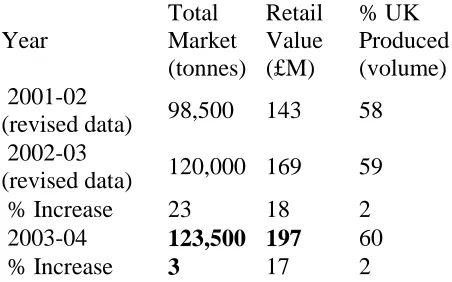
The UK Organic Vegetable Market study, funded by DEFRA, reports that 123,500 tonnes of organic
vegetables were traded during this period, representing a total retail value of £197 million. More than 40 packers and wholesalers were involved in this research, which aims to provide detailed information on the total market and supply of individual organic vegetable crops (see Table 1 below).
Chris Firth, Senior Business Analyst for HDRA, says: "Our research shows that the organic vegetable market continues to grow, with traded volumes rising by three per cent in 2003-2004. This does not compare to the dramatic increases of the year before, but does show that this market has stabilised and matured."
Although the market is expanding overall, the study has revealed substantial variation between individual crops and market outlets. For example, traded volumes of carrots and salads have increased about 25 per cent, while potato and cabbage volumes have fallen by around 12 per cent. Direct outlets have increased their share of the total organic vegetable market to 14 per cent. The number of box schemes and home delivery services has increased to 500, with a 20 per cent rise in sales, and the number of farmers' markets has also risen by 11 per cent.
Pre-packers have reported increased market demand, although at a lower rate than in recent years and with a better matching of demand and supply - hence their market share has remained similar at 67 per cent. On the other hand, the wholesale sector has reported problems sourcing sufficient volumes with good consistency, quality and organisation. This is reflected through a general decline in volumes sold through wholesalers.
Competition within the organic vegetable market is constantly increasing, according to the packers and
wholesalers interviewed as part of the study. This, combined with supermarket rivalry, has intensified price pressures.
[image:13.595.316.542.262.403.2]On a positive note, UK self-sufficiency has risen to an average of 60 per cent for organic vegetables. However, these percentages do vary on a crop-by-crop basis - from 97 per cent for swedes to 34 per cent for onions. Natalie Geen, co-author of the report, says: "The study suggests there may be potential for increasing UK sourcing of organic carrots, cauliflower and cabbage to approach
Table 1: Summary of results from 2003-04 organic vegetable market study
conventional levels. In contrast, organic lettuce and tomatoes already exceed the level of UK sourcing of their conventional counterparts."
Building upon this work, HDRA will perform an in-depth survey of direct outlets in the organic vegetable market in February. Forms will also be sent out to packers and wholesalers for the 2004-2005 season in April.
The 2003-2004 UK Organic Vegetable Market report will be available from HDRA in March, and previous reports are available at www.organicveg.org.uk.
For further details call Natalie Geen on 024 7630 8200 or email [email protected].
Technical
Organic vegetable market stabilises
A report by Roger Hitchings, Head of OAS and working on the project.
Year
Total
Market
(tonnes)
Retail
Value
(£M)
% UK
Produced
(volume)
2001-02
(revised data)
98,500
143
58
2002-03
(revised data)
120,000 169
59
% Increase
23
18
2
2003-04
123,500 197
60
% Increase
3
17
2
OAS Soil Analysis Service
Price increase
We are afraid that, with immediate effect, the price of our comprehensive analysis will rise from £51 to
£56.88 ( incl VAT) as a result of physical analysis cost increases passed on by our laboratory.
If you are not aware that there are some major changes taking place in the way that food producers are being supported you have either been holidaying on the planet Zog or had your head firmly buried in the sand. That said it is one thing to know that changes are taking place and it is another thing entirely to know exactly what the changes mean for organic producers. These were launched by the Government on 3rd March. The Environmental Stewardship Scheme (ESS) is a new agri-environment scheme that will provide funding to farmers and other land managers in England who deliver effective environmental management on their land.
The scheme is intended to build on the recognised success of the Environmentally Sensitive Areas (ESA) and the Countryside Stewardship Scheme (CSS). Both of these schemes have now closed as has the Organic Farming Scheme. The primary objectives of the ESS are to:
• conserve wildlife (biodiversity)
• maintain and enhance landscape quality and character
• protect the historic environment and natural resources
• promote public access and understanding of the countryside
Within these primary objectives the scheme also has these secondary objectives:
• genetic conservation
• flood management.
The new scheme has three elements:
•• Entry Level Stewardship (ELS)is a 'whole farm' scheme open to all farmers and land managers who farm their land conventionally. Acceptance will be guaranteed provided the scheme requirements can be met.
• Organic Entry Level Stewardship (OELS)is a 'whole farm' scheme similar to ELS, open to farmers who manage all or part of their land organically and who are not receiving aid under the Organic Aid Scheme (OAS) or the Organic Farming Scheme (OFS). Farms with a mix of organic and conventional land should be entered into OELS.
• Higher Level Stewardship (HLS)essentially replaces ESA and the CSS. It will be combined with ELS or OELS options and aims to deliver significant environmental benefits in high priority situations and areas.
ELS provides a straightforward approach to supporting
the good stewardship of the countryside. OELS takes a similar approach, but is geared to organic and organic/ conventional mixed farming systems. HLS is designed to build on ELS and OELS to form a comprehensive agreement that achieves a wide-range of environmental benefits across the whole farm. HLS concentrates on the more complex types of management where land
managers need advice and support and where agreements will be tailored to local circumstances. ELS and OELS go beyond what will be required under the Single Payment Scheme (SPS) cross compliance conditions. Entering into an Environmental Stewardship agreement will not remove any cross compliance obligations.
Implications for Organic and Converting farmers. So much for the preamble. Much of the above has been taken or gently paraphrased from the Defra website (www.defra.gov.uk/erdp/schemes/es/default.htm). Readers will not be surprised to hear that there are pages and pages of handbooks, maps, FAQs, guidance,
downloadable application forms, etc., etc. on the site. There is neither the time nor space to cover all this information in detail so the remainder of this article will focus specifically on what this new scheme has to offer the organic farmer. This review cannot hope to cover all the possible ups and downs given the time frame and future editions of the Bulletin will return to this scheme and others. I should also note that this article is focusing on the English scheme that has just been launched. We are still waiting for an announcement on the launch of the equivalent scheme for Wales - this will be known as Tir Cynnal.
One of the first key issues to note is that the Organic Farming Scheme has now closed to all new
applications under both the conversion and maintenance options. This scheme along with its predecessor, the Organic Aid Scheme, has supported the conversion process by attempting to compensate farmers for income foregone. The process of application was relatively straightforward in that the main points to settle were the respective types and areas of the land being applied for. No view was taken on the way in which that land was managed as this was considered to have been covered during the initial process of certification with a recognised organic inspection body. All new
applications for OELS support will have to follow the more involved approach outlined below.
Farmers applying to the OELSmust first ensure that the land is eligible and that all the land is registered on the Rural Land Register (RLR). It will already be on the
Technical
New Environmental Payments Scheme launched
RLR if the land has been registered through IACS or has been in receipt of payments from a range of ERDP agri-environment programmes. If land is unregistered on a non-IACS farm, contact must be made with the Rural Payments Agency (RPA) office in Newcastle (0845 603 7777, [email protected]. If part of the farm is IACS registered then additional land can be registered by contacting the IACS section of the local Rural Development Service (RDS) office. Unregistered land could include woodland, scrub and other marginal areas. Applicants must also have a Vendor Number -once again this will already be in place if the farm is IACS registered or is in receipt of ERDP scheme payments. A farm or small-holding that does not have a Vendor Number should contact the RPA using the above contact details.
The next step once the land is registered and a vendor number issued is to contact the relevant RDS office with name, address and CPH holding number. It is important to realise that applicants to the OELS will have to clear the same hurdles as ELS applicants before becoming eligible for the organic supplement and conversion top-up payments. It will first be necessary to prepare a simple record of environmental features on the farm -this will done using the Farm Environmental Record (FER) map issued by the RDS.
When pre-filled application form and maps are requested a 'points target' will be issued that will be related to the size of the farm (in essence this will amount to 30 points per hectare averaged across the farm for ELS). There is no minimum holding size for entry into the ELS (and hence the OELS). Applicants will be able to choose from a wide range of environmental management options each of which will earn 'points' towards the prescribed total. Options could include hedgerow management, low input grassland, buffer strips, management plans and options to protect soils.
Applicants will have the flexibility to decide how much of each option to have and where to site them on the holding until enough have been chosen to reach the 'points target'. Where relevant put the location of the chosen options on the Options map provided by RDS -note that this means that there will be two maps to return with the application (FER and Options maps). If enough ELS options are delivered entry into the scheme will be guaranteed. Applicants will be invited to consider certain local environmental priorities by referring to a description of the relevant Joint Character Area (JCA) in which the farm is situated. In conjunction with other agencies Defra has defined over 150 of these JCAs covering the whole of England - pdf documents for each JCA can be downloaded from the Defra website
(www.defra.gov.uk/erdp/schemes/els/making_most.htm).
This moderately complicated exercise will result in payment of £30/ha/yr for an initial five-year period. Applicants to the OELS will be required to achieve a target of 60 points per hectare in return for payments of £60/ha/yr. As noted the first 30 points/ha will need to be achieved by signing up for management options while the second 30 points/ha will automatically be granted by demonstrating that the land is under organic
management. This will involve the tendering of copies of the certificate of registration and schedule issued by the relevant certification body.
New entrants to organic farmingcan also apply for conversion payments in addition to the £60/ha/yr payments mentioned above. They will need to go through the same process as above and it must be done within 12 months of the initial application to the particular certification body. Payments will be £175/ha for all improved land (no distinction will be made for land that was formerly AAPS eligible) for the two years of conversion and £600/yr for top fruit (apples, pears and stone fruit but excluding cider apples) for three years. No conversion payments will be made for unimproved land though it should be noted that the definition of unimproved land has changed from that used for the Organic Farming Scheme. It is now defined as land that has not received inputs or been cultivated for the twenty years prior to the application.
Conclusions
For those that are eligible the OELS is clearly a scheme that should be taken advantage of. It offers both conversion and management payments at levels that could make a difference to farm viability. Over the first five years of an agreement that includes conversion payments the great majority of producers will receive more than they would have received under the Organic Farming Scheme. That said the ELS component of these payments is available to all producers. It also clearly will involve more work in putting together the initial application but this will apply to everyone who applies to Environmental Stewardship.
It is expected that organic producers will have few problems in offering sufficient management options to meet the ELS requirements because most of them should already be implemented under the organic standards. This will no doubt be the case but organic producers should not take this process for granted - there could be some farms that have not been fully diligent in this area. This article is not covering the Single Payment Scheme (SPS) but there could be further surprises for some organic producers when they come to assess soil
problems on their farms as part of putting together a Soil Management Plan.
Some potential problems have already been identified. One of the most serious concerns farms that are currently in long duration ESA agreements. Under the terms of Environmental Stewardship such land is not eligible for payments under the ELS or the OELS. This may seem reasonable in terms of ongoing payments as many of the ELS options may be supported by ESA payments. If such a farm wanted to convert to organic production, however, there would be no opportunity to access the conversion payments while the ESA agreement was in place. This despite the fact that significant areas of ESA land could fall into the OELS improved category. This could have significant implications for farmers
contemplating conversion in ESAs across England such as the Cumbrian Uplands.
A similar situation could apply to farms with
Countryside Stewardship Scheme agreements in place, although these are not whole farm agreements.
It will however be possible to apply for OELS on
non-agreement land and this will include conversion payments. Parcels of land that are larger than 15ha in the LFA will not be eligible for the OELS - these will have to be entered into the ELS and payments of £8/ha/yr will be made. Such parcels will, therefore, not be eligible for conversion payments though it is likely that much land in this situation would fall into the unimproved category and not be eligible anyway.
This has been a brief review of the ELS and OELS components of Environmental Stewardship and it is virtually inevitable that not all the key points have been covered.
Further information is available from the Organic Advisory Service, 01488 657600, [email protected]. You should also visit the Defra website from which a range of relevant documents can be viewed and/or downloaded as may details for the RPA and RDS offices can also be found here.
The next article in this series will look at the Higher Level Scheme in some detail.
Technical
New RPA customer service centre contact for enquiries on the single payment scheme
0845 603 7777
Award for Woodlands
Woodlands Farm has undergone an extraordinary change in the last eight years; what was once a high input, intensive all-arable farm in the Lincolnshire silt fens has transformed to become Soil Association Producer of the Year!Quite an achievement, particularly when you consider the fundamental changes that were needed to the whole system, everything from soil to customer.
Change is nothing new to Woodlands; during four generations this 690 hectare farm has led the way in UK potato production and many other aspects of conventional farming, including giving up livestock, while experiencing soil borne diseases requiring high use of agro chemicals and depleted organic matter. As is so often the case it was a new generation, in the form of Andrew Dennis, who made it all happen. Working with a Conversion Plan
developed with the Organic Advisory Service the farm has converted progressively using green manures and leys, introduced an arable rotation including cereals, potatoes, root crops and brassicas, developed a turkey enterprise and set up a herd of Lincoln Red cattle. During the last three years a vegetable box scheme has been introduced, now supplying fifteen hundred local customers and sheep have just arrived. The result is a thriving business, one that also welcomes the public throughout the year on the farm trail.
Woodlands Farm is a member of the OAS Organic Systems Development Group; the aim of this group to continually explore how to become better organic farmers, not just become more profitable but to apply all the principles of organic farming. The advisory service provided to the group includes a "Sustainability Audit" or benchmark, which helps to assess how effectively the farm is delivering on the objectives of organic farming and sets a clear target for those areas that need improvement. The Audit proved useful in clearly showing to the Producer of the Year judges how successfully this farm is operating throughout the farming system including its wildlife populations, avoidance of pollution, food miles, high employment and manure management as well as the more familiar production, financial and soil fertility benchmarking. Wm. Dennis & Sons was also a founding member of the Organic Arable Marketing Company Ltd (OAMG)