DEVELOPMENT AND ANALYSIS OF A FLUID POWER TEST FACILITY
by
I.F. Jones B.Sc., B.E.(Hons.)
Submitted in partial fulfilment of the requirements for the degree of Master of Engineering Science in the Faculty of
Engineering, University of Tasmania, Hobart.
January, 1972
Abstract
Introduction
Chapter 1 - Hydraulic Circuit and Instrumentation
1.1 Basic Hydraulic Circuit
5
1.2 The "System"
9
1.3
The Oil Cooling Circuit 101.4 Instrumentation 13
Chapter 2 - The Four-way Valves
2.1 Valve Mk I 22
2.2 Valve Mk I Modified 24
2.3 Valve Mk II 25
Chapter
3 -
Static Behaviour of the Valve3.1 Flow Equation 32
3.2 Flow Reaction Force 34
3.3
Experimental Results37
Chapter
4 -
Dynamic Behaviour4.1 Hydraulic Vibration Testing Machine Models
53
4.2 Models of The Experimental Rig77
4.3 Experimental Results 109
Conclusions 130
Appendices 135
Abstract
The work described in this thesis was undertaken as part of a
project to design and build an electro-hydraulic vibration testing
machine of unusual configuration using the limited manufacturing facilities of the departmental workshops of the Engineering School of the University of Tasmania. A sketch showing the basic concept of the
vibrator design is shown in Chapter 1.
Technical limitations concerning available means of measurement and manufacture resulted in the development of a series of four-way spool valves featuring thin axial flutes milled in the spool lands to limit the area gradient and allow ,a long stroke relative to the flow rating of the valve.
An experimental rig to measure spool forces and flow
characteris-tics under various static and dynamic conditions is described in detail.
Difficulties experienced in the operation of the rig are discussed together with suggested lines of rig development.
Digital simulation of hydraulic servo-mechanisms by the Runge
Kutta technique is examined in detail particularly with respect to
the causes of numerical instability. An alternative approach based
on the Method of Characteristics is also described and found to be
particularly useful for systems containing long pipelines. The latter
method is based on the velocity of pressure propagation in the fluid
media and the results of an experimental investigation to determine
this velocity as a function of pressure in a flexible high pressure
hose are presented.
INTRODUCTION
In essence this thesis describes the first attempt by the
Engineering Department of the University of Tasmania to enter the field of fluid power; in particular the field of high pressure oil power transmission and control. As such it possibly contains much rudimen-tary material. However this is included mainly as a background for those at a similar stage of development, or for those who follow.
The project had as its general aim the development of a variable flow, high pressure test facility to which hydraulic components and systems can be connected. However, as with any developmental project, it is preferable to have a more specific goal to work towards. This was the design and construction of a vibration testing machine to be
used for testing machines and structural components. It was to be a
small, compact unit consisting of an hydraulic servo-mechanism
amplifying the output from an electromagnetic exciter. The frequency range was to be from 5 to 250 Hz and the output was to approximate a sinusoidal waveform with low distortion. Furthermore the unit was to be capable of high force levels, the force approaching 5000 lbf at the
lower frequency limit.
With this specific aim in mind, it was therefore of considerable (1) interest to find a French design of vibration testing machine 5
shown below, which was very similar to that envisaged. The article accompanying the diagram however, gave very little useful information about the design or construction of the device. Nevertheless it was decided to aim for a final design very similar to this. This
decision ruled out the use of commercially available four-way valves for the control valve, and as a consequence the Engineering Department embarked on the development and construction of its own valve designs. At the same time the overall analysis of the servo-mechanism was
Cylinder
Driving
ehambers
DC coil oe, Low pressure outlet
A-C coil Valve epioel
Main piston
•
•
-peessure inlet
The analysis of such a servo-mechanism is of course in no way new.
As long ago as 19 47 Coombes analysed a similar system. But, because (2)
of the difficulty in solving the equations which result from assuming a
sinusoidal valve input, he used the rather interesting approach of assuming a sinusoidal output and deriving the required valve input.
(3)
Hoyle had more success by solving the problem with a sinusoidal
input for a simple servo-mechanism without feedback and with an
incompressible fluid. He obtained a series approximation to the solution
which was valid under certain conditions. However when he added
feed-back, the increased complexity forced him to use an analogue computer
(4)
to obtain a solution. Butler also obtained a solution for the
simple servo-mechanism with cavitation by numerical means. In fact
the equations both Boyle and Butler solved were similar to those
discussed in this thesis under the heading of "Solid-slug models".
However Butler makes no mention of numerical instability occuring as
the valve closes; a problem which caused considerable trouble in this
(5)
If compressibility is included in the models the equations
become even more difficult to solve. Consequently most of the models
which include it have been studied with the aid of analogue computers.
( 6 )
Martin and Lichtarowicz used this method to investigate the onset
of cavitation in a servo-mechanism similar to that studied here, but
without feedback. In this project it was unfortunate that a suitable
analogue computer was not readily available. A fast, digital computer
however, was, and consequently the solutions were attempted numerically. _—
This lead to many interesting problems in itself, such as numerical
instability.
Probably the most common method of solution is to linearize the
equations (7 ' 8)
.This has the great advantage that the conventional
techniques of control engineering may then be employed in the analysis.
The simple servo-mechanism without feedback was studied in this fashion
(9) ( 10 )
by Reeves while Ashley and Mills investigated a much more complex
servo-mechanism. The latter although not directly applicable to the
servo-mechanism studied in this thesis is of interest because of the
two-stage, flapper controlled valve used to control the ram. Ashley
and Mills showed that the flow behaviour of this type of valve does not
follow the classical dependence on the square root of the valve pressure
drop. In fact the load pressure has only a small effect on the flow;
a fact which could be of some value in a vibration tester. However the
most useful linearization in relation to this project is one by Lambert
and Davies (11). The servo-mechanism they studied is identical to that
in this project and the third-order, linearized model they derive has
been used later to compare with the results obtained by numerically
intergrating the non-linear equations of the system.
The main disadvantage with linearized models, however, is that
the linearization tends to remove some of the distortion in the waveforms.
this respect.
Electric motors
Needle valve
Measuring i tank
Accumulator
Pressur.
gauge
boll valve
Relie; valve
Filter
(i)
WaitrHYDRAULIC CIRCUIT AND INSTRUMENTATION
1.1 The Basic Hydraulic Circuit
A schematic diagram of the hydraulic circuit is shown in figure
1.1. Basically it consisted of a pump supplying oil at constant
pressure to a "system" under study. This "system" normally required highly irregularcflows, both of a relatively high frequency pulsating nature and of quite variable average flow rate. The accumulator. was included to smooth out the high frequency pulsations while the variation in average flow was overcome, initially, by the relief
.valve diverting excess oil from the fixed displacement pump back to
the reservoir, and later by a.pressure compensated variable
displace-ment pump. The
latter adjusted its output to maintain a "constant"supply pressure. TO monitor the supply pressure a Bourdon tube type
pressure gauge was connected to the supply upstream of the "full—flow" ball valve used to isolate the system from the supply.
Reservoir
Oil Cooler Main 14ydrau tic Circuit
Figure 1.1
From the "system" the oil could be taken through a needle valve,
which was used to apply back-pressures to the "system", to a two-way
valve which either directed the flow into the measuring tank or back
to the reservoir. Unfortunately this two-way valve was of the closed
.centre type; an open centre had been ordered but as there would have
been a considerable delay in its delivery a closed centre was accepted. This was a bad mistake for the interruption to the oil
flow as the valve passed through centre caused serious pressure
pulses which not only upset the operation of the "system" but could
also damage the pressure transducers used on the rig, particularly
if, as is anticipated, the supply pressure is increased. It would
be highly desirable to change this valve to an open centre type in
the near
future.
Filtering of the oil was accomplished by a filter in the return line.The other main feature of figure 1.1 is the oil cooling circuit
on the left. The cooling was achieved
by
passing cold water over a copper coil through which the oil was pumped. This circuit is(section 1.3) as it had many interesting
described in detail
laterfeatures in itself.
The oil used in the circuit was a light "hydraulic" mineral oil
•
(BP HLP65). It hadaddatives for antiwear, antirust, antifoam,
anti-oxidation and a pour depressant. At 100°F the specific gravity was
0.85 and the viscosity 33 centistokes.
Originally the pump, accumulator, relief valve and reservoir
were bought as a complete commercial unit. The pump was a fixed
displacement vane pump capable of pressures up to 2000.psi and a
maximum flow of between 3.5 and
4
gpm (imperial). The relief valve was adjustable and could be set to maintain, within limits, anypressure from 500 to 2000 psi.
There were several drawbacks with this unit. The main one was
the continuous, constant, high power input required by the fixed
displacement-pump. As this power was dissipated in the oil, it
represented a considerable heat input, and the oil temperature
relatively small maximum flow offered by this pump severely limited the
results that could be obtained. This was very apparent in the early
studies of the valve characteristics, for the valves had been designed
on the assumption of significantly higher. flows.
Late in the project it became possible to purchase a new pump.
The type chosen was a pressure Compensated, variable displacement,
piston pump capable of maintaining pressures from 200 to 3000 psi at
flows up to a maximum of over 6.5 gpm, Fortunately the motor supplied
with the original unit had been excessively large and it was possible
to use this same motor with the bigger pump.
This pump was found to be very satisfactory. Not only was the
maximum flow now of the order of that assumed in designing the valves,
but, because of the variable displacement, the average power input was
greatly reduced, even though the pump was larger. This lower average
power input was due to the considerable periods of time during which
the flow requirements of the "system" were only small. With the
fixed displacement pump this made no difference, for the flow not
required by the "system" was diverted to the reservoir by the relief
valve. However with the variable displacement pump the pressure
compensator shut down the flow, and hence power input, to suit the
requirements of the "system". This usually enabled the oil cooler to
maintain the oil temperature within reasonable limits. The pressure
compensator also meant that the relief valve was no longer really
necessary. Nevertheless it was left on the rig and set to operate at
a pressure approximately 50% above working pressure, which in this
case had been limited to 1000 psi by the original pressure transducers,
to safeguard against any pressure rise due to a malfunction in the
pressure compensator.
Some photographs of the experimental rig are shown in figure 1.2.
These show the rig set up for the dynamic tests on the four-way valve
At the extreme left, the rear of the oil cooler pump can be seen.
(b) The rocker arm can be clearly seen between the valve spool and exciter. The accelerometers are the small cylindrical objects at the end of the valve spool and exciter coupling. The large cylindrical device above tho valve is the displacement transducer.
Figure 1.2
1.2 The "System"
Up to.the present, the Y'Systet" has in the main, consisted of a four-way valve, described in detail in Chapter 2. As such the lt syst em U
was rather ill-defined with respect to the hydraulic circuit, for this
changed depending upon which valve characteristics were being studied
at any given time, To
facilitate these frequent
alterations to the circuit, high pressure flexible hoses were used to make connections,both within the "system" and to and from the supply. These hoses
were fitted with threaded steel couplings and consequently changes
could be carried out very easily and rapidly.
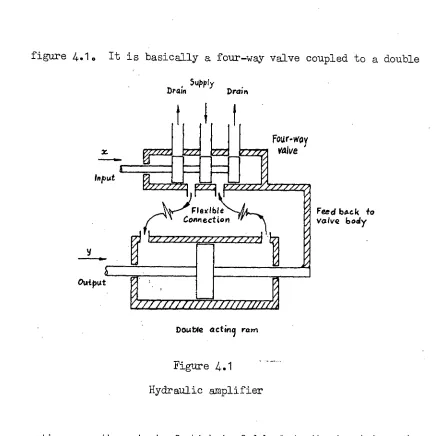
Eventually the "system" will be developed into the hydraulic
amplifier for the vibration tester. This will probably be similar to
the servo-mechanism shown in figure 1.3. In this a four-way valve
Supply brain Drain
Feedback to
valve body
Double 44thiff ram
Figure 1.3
A possible hydraulic amplifier for the vibration tester
controls the motion of a double-acting ram. By oscillating the
valve with an electromagnetic exciter the ram can be made to vibrate
•
1.3 The Oil Cooling Circuit.
Originally it was thought that the heat loss from the pipework
and particularly from the sides of the oil reservoir, might have been
sufficient to maintain a reasonable oil temperature. This also
appeared to be supported by the fact that the manufacturers of the
original unit had not mentioned nor included any form of oil cooling
for that unit. However it soon became apparent that there was almost
no cooling afforded. by heat loss from the pipework or reservoir and
the temperature rose at a rather disturbing rate while the motor and
pump were running. Presumably the painted surfaces of the reservoir
and the fairly still air conditions in the laboratory resulted in a
much lower heat transfer coefficient, between the surfaces and the
air, than expected. In fact an estimate was made of the likely
temper-ature rise assuming no heat loss to.the surroundings and this was found
to agree.reasonably well with the observed temperature rise of
approx-imately 2 F/min. This of course set a severe limit on the length of
run that could be made, for it was observed that for oil temperatures
-
above approximately 190°F, not only did the original pump, the vane
pump, become - excessively noisy but the relief valve also malfunctioned;
it appeared to stick intermittently. FUrthermore, the large
tempera-ture variation during a run caused significant differences to the
results obtained, under what were otherwise identical conditions. The
design of an oil cooler was therefore commenced. This was hampered
by the somewhat vague and.variable information on heat transfer
coefficients and it was no real surprise to find this first design in
error by almost an order of magnitude in heat transfer coefficient.
The design consisted of a coil of 3/8 in. diameter copper tube,
approximately 20 ft. in length, immersed in the oil reservoir. Through
this coil cold water was run. Measurements with this arrangement
showed a very poor cooling efficiency. The heat absorption was only
of the order of a third the heat input and the heat transfer coefficient
was less than 20 BTU/hr °F sqft. It was also noted that the heat
ficient was on the oil side of the coil. With a thermometer it was
observed that a thin, cool, viscous sheath of oil formed over the
coil and even though the oil in the reservoir was kept in constant
circulation by the steady flow of the vane gimp, it was not sufficient
to break up this insulating sheath of cool oil. This could be further
confirmed by vigorously moving the coil in the 'oil, which improved
the heat transfer.
Consequently the circuit was rearranged slightly. A small gear
pump was obtained and coupled to a variable speed motor. This was
then used to pump the oil through the coil,.which was now immersed in
cold flowing water. This showed a great improvement in heat transfer..
Measurements made with this arrangement indicated that the heat
transfer coefficient was approximately proportional to the oil flow,
and a coefficient of almost 100 BTU/111. °F sq ft. was measured at an
oil flow of 1 gpm; very considerably higher than with the coil
immersed in the oil: Unfortunately an attempt to measure the coef-
ficient at an oil flow of 1.5 gpm failed when the light flexible hose -
connecting. the pump to the coil came : off the pump fitting and resulted'
in oil being sprayed all over the room. Nevertheless it was considered
. that this arrangement would be satisfactory until the new pump arrived,
for although it did not remove all the heat being input, it removed
enough to extend the•useful run time by a factor of over three.
A further interesting observation was made with this arrangement.
At low temperatures the oil cooler could very nearly cope with the
heat inflow and the temperature could be kept rising at a low rate.
However when the oil reached a critical temperature of approximately
120 °F, the *oil seemed to rise in temperature much more rapidly and it t
Was difficult to reduce the temperature even by lowering the oil
pressure to below 500 psi. At this pressure the oil cooler should
have coped reasonably well. It could be
that
some form of "core" flownear the cold tube, wall, being quite viscous, could form a thin insulating
sheath, while the low viscosity hot oil from the reservoir might form
a high velocity jet down the centre of the tube. Unfortunately, as
this was not a primary aim of this project and time was running short,
no measurements were taken to confirm or disprove this apparent change
in oil cooler efficiency. However it is worth noting, perhaps for
future investigation, particularly as the temperature at which
itoccurs is close to that .at which the rig is usually run, namely 100°F.
This could also seriously upset the operation of any automatically
controlled oil cooling circuit using a similar arrangement.
With the arrival of the new pump the oil cooler was again
modi-fied to try and improve its efficiency. The old coil was cut into
two new coile and these were then coupled in parallel. The reasoning
behind this was as follows. With the same pressure drop across .the
coils as previously - it could not be increased because of the danger
of the hose slipping from the pump fitting - the flow would be increased,
for this pressure now acted across a shorter length of tube. Therefore
provided the heat transfer coefficient kept rising with flow, as
seemed likely from the measurements that had already been taken, the
total heat transfer would be greater, for the two coils together still
had the same surface area, but a higher coefficient. Measurements
taken with this new arrangement confirmed that for the same oil
velocity within the tubes the coefficient was the same. However the
improvement expected was not obtained. The cause of this was the small 0
flow capacity of'the oil cooler pump. The maximum flow, which now had
two paths to flow through, only resulted in an oil velocity within each
tube, of the same magnitude as previously. Consequently there was no
increase in the heat transfer coefficient, and hence no improvement in
efficiency. Of course the pressure drop across the coils had decreased,
but this was of little consequence,.except perhaps, for the improved
safety factor with regard to the hose connections;
This arrangement also suffered from another drawback. The hot oil .
of the cool oil in the reservoir, instead of mixing with it. This was
further aggravated by the oil cooler, for it drew off oil from the
bottom of the reservoir and returned it at about mid-height. Hence
there were two distinct layers in the reservoir; a hot layer at the
top and a reasonably cold layer towards the bottom, with a fairly well
defined interface. An attempt to mix these regions by discharging the
oil from the oil cooler into the reservoir above the oil surface, was
abandoned when it was found that the oil jet, impinging on the surface,
entrained a large amount of air which it was considered desirable to
keep
out
of the circuit.
A better technique would have been to draw
off the oil for the oil cooler, from near the top of the reservoir.
However, when the measuring tank on the rig filled with oil, the level
in the reservoir fell, and consequently the highest point that could
be used was about ' mid-height. Even so, this should have been an improve-ment.
It could be that an oil cooler in the main return line would be
a more suitable arrangement. In any case a new, or at least highly
modified design will be required if there is to be any possibility, at
high power inputs, of maintaining a constant oil temperature. There
is also no reason why it should not be automatically controlled.*
1.4 Instrumentation
1.4.1 Pressure.
Initially a great deal of difficulty was experienced in
obtaining pressure recordings. This was not so much a fault of the
pressure transducers themselves, but more a question of the reliability
of the associated electronic equipment. This was of fairly old vintage
and suffered from very poor drift and noise characteristics. These
transducers also, because of their small pressure range, fixed the
maximum supply pressure at 1000 psi.
* An investigation is currently being carried out on the feasability
of an oil cooler in the pump suction line. This would automatically
control the oil temperature at the pump inlet. Results to date have.
This allowed the experimental results already obtained to be used in
later work. The new transducers were of the diaphram-bonded strain
gauge type (MB Electronics Model 510A). But unlike others, which
required external bridge and amplifier circuits, these were completely
self contained. Built into them was a d.c. bridge circuit with
temper-ature and power supply compensation and a high gain d.c. amplifier.
The pressure range Was from 0 to 2500 psi (absolute), and the drift
and power supply compensation was excellent. No data was supplied
by the manufacturers on the dynamic performance of the transducers,
but this is expected to be more than adequate, as the electronics
um.amm.%
is all d.c. and 'the resonant frequency of the diaphram assembly is
stated to be greater than 20 KHz.
One of the most annoying aspects of these units, and a major
1
drawback, was, the need to isolate the input and output. This often
proved difficult to accomplish if several instruments were being run
off the same power supply. The reason was that if the output of
another instrument Were displayed together with the output of the
transducer, on, say, a dual beam CRO then it was possible to complete an electrical circuit from the output to the input of the transducer,
via the common earths on the CRO and the electrical circuit of the
other instrument. To overcome this, small, individual, floating
output, power Supplies are to be made for each transducer.
1.4.2 Flow
Although no flow meter as Such was used on the rig, average flows could be measured by directing the oil into a measuring tank
and timing a given level change. The oil level in the tank was
indi-cated by means of a clear plastic tube fixed to the outside of the
tank and connected to the inside at the top and bottom. However this
only showed the correct oil level under static conditions. During
flow measurements the oil level was changing continually and
difference between the oil levels in the tank and tube was needed to
create the oil flow into or out of the tube. This difference in
levels was obviously dependent on both the rate of change of the oil
level and the length of tube involved, i.e. on the oil flow and the
oil level. Measurements of this were made, at varying levels, by
suddenly stopping an oil flow into the tank and observing the subse-
quent
rise in oil level within the tube, as the oil in the tank and
tube came to equilibrium. These measurements showed that the
maxi-mum error
in a calculated flow, caused by ignoring this effect, was only of the order of 2%.1.4.3 Force on the Valve Spool
To measure the force being transmitted to the valve spool
a small, teel rocker arm was incorporated between the exciter and
spool. This can be readily seen in figure 1.2(b). The force was
y effered irom the deflection of the m. To measure the deflection, ar
strain gauges were glued to the upper and lower surface of the arm.
Originally these strain gauges were connected to a commercial strain
gauge unit, which used an a.c. bridge .circuit. However this unit
showed large drifts compared to the forces (more correctly strains)
being measured. The drift was of the order of + 1 lb compared to
the maximum flow reaction force of approximately 8 lb. The unit
also, because, of the low frequency carrier used, had large phase
shifts at frequencies well below 100 cps. It was therefore discarded
and replaced by a d.c. bridge circuit and small integrated circuit
d.c. amplifier. This worked well, although noise from the integrated
circuit tended to be a little large. Later some high gain, high .
stability preamplifiers were purchased and one of these was coupled
to the bridge in place of the integrated circuit. This was found to
be highly sati'sfactory.
1.4.4 Acceleration
Accelerations of both the valve spool and the exciter were
measured with small piezoelectric type transducers (Brael & Kjaer -
•
end of the valve spool and the other to the top of the moving element
of the exciter. The frequency response was limited by the
preampli-fiers coupled to the accelerometers (Brilel & Kjaer - type 2622) and
was flat within + 005 dB from 2 Hz to 10 KHz. These preamplifiers
also scaled the output to 10 Oh (g is the acceleration due to
gravity). Besides being used to measure the accelerations, these
accelerometers were incorporated in the feedback loop of the
vibra-tion exciter control. This is described later in secvibra-tion 1.4.6.
1.4.5 Displacement
In the static tests the displacement of the valve spool was
determined by the use of a dial gauge. This however had one fairly
serious drawback. That was, the dial gauge exerted a quite
signifi-cant force on the valve spool and this had to be allowed for in the
force measurements. Unfortunately this was complicated by the fact
that the force-displacement characteristic of this
gauge
sufferedfrom an hysteresis type effect. This caused the force exerted by
the dial gauge to differ depending upon which way the spool had been
moved to a given position. To a certain extent this was overcome
by tapping the valve body with a small hammer (this had to be done
in any case in order to overcome difficulties of valve sticking).
Displacements during dynamic tests were taken with a small
differential transformer displacement transducer (Hewlett Packard
Model 24DCDT 1000). Basically thiS consisted of a . transformer coil
assembly and a small core which, when displaced along the axis of
the coil assembly altered the coupling between the windings of the
transformer. This difference in coupling was used to produce an
output voltage proportional to the core position. To excite the
primary . winding of the transformer a d.c.-powered oscillator was used.
A quite compact, self-contained transducer was produced by
incorpo-rating the differential transformer, oscillator and demodulator all
within the one case. To transmit the valve spool motion to the core
The main disadvantage of this transducer was the very low
frequency of the oscillator. This meant the filter in the output
stage of the demodulator attenuated the output signal rather badly
and also introduced large phase shifts, at quite low frequencies.
To some extent allowance could be made for this as the nominal filter
characteristics and
3
dB point were specified by the manufacturer. However for this particular transducer the3
dB point occured at 100 Hz, whereas the rig was operated up.to 150 Hz. At thisfrequency the amplitude was approximately one half of what it should
have been and the phase shift was nearly 60 ° . It would be preferable
to have a transducer with a considerably higher internal carrier
frequency.
1.4.6 Exciter and Vibration Controller
The exciter was a conventional electromagnetic unit driven
by a power amplifier (MB Electronics PM-50 exciter, 2250 MB
ampli-fier), It had.a maximum force capability of 50 lb, if air cooling
was employed, and a maximum stroke of + 0.5 ins. The power amplifier
was driven by the output of the vibration controller.
The vibration controller was basically a sine wave signal
gener-ator, the output of which was controlled by a feedback loop (Brael
& Kjaer - type 1025). In this case the output from an accelerometer
on the valve Spool was used as the feedback signal to the controller.
The controller, if necessary, integrated this signal to give velocity
or displacement, and then rectified and filtered it to obtain an
average input. This was compared to a preset level and an error
signal used to control the output of the signal generator. Hence,
this differed from the type of controller usually associated with this
type of vibration equipment in that it only controlled the average
level of the vibration whether this was acceleration, velocity or
displacement; and in no way controlled the actual wave Shape. This
was somewhat of a disadvantage during the dynamic tests on the valve,
for the valve characteristics caused significant distortions to the
•
Normally the controller was used in a mode that maintained a
constant amplitude of only the acceleration, velocity or displacement.
However it also had facilities to enable a cross-over frequency to be
set at which the control changed from one input variable to another.
Either a constant displacement-constant acceleration, or constant
velocity-constant acceleration mode of operation could be selected.
For the dynamic tests on the valve, the former mode was used, i.e.
constant displacement-constant acceleration. The cross-over
frequency was slightly less than
55
Hz corresponding to a displace- ment amplitude of + 0.1 in and an acceleration of 30 g. Thefrequency range of the controller and exciter combined was from
5
Hz
to 10
KHz, However power requirements limited the maximum frequency
on
the experimental rig to 150 'Hz.1.4.7 Ultra-Violet Recorder and Preamplifiers
For the permanent recording Of most of the measured variables
on the experimental rig a U.V. recorder was used. This consisted
of a number of small galvanometers which deflected, by means of a
little mirror attached to. the galvanometer suspension, a fine spot
of ultra-violet light onto a sensitised paper. This paper could be
driven through the recorder at varying speeds. It was developed in
ordinary light leaving the trace quite visible.
If
required the paper could also be "fixed" although this was not normally necessaryprovided the paper was stored in a dark place (to stop further
-.development). The response of the galvanometers was flat to 300 Hz
which was quite adequate for most of the signals being recorded.
However some recordings, such as pressure, were so rapid that it was
necessary to use a CRO to observe them, particularly the amplitude,
as the galvanometers attenuated the peaks. The galvanometers were
electrically
damped
by controllingthe
output impedance of the preamplifiers used to drive them. -The preamplifiers were designed and built in the department using
integrated circuits. The original specification was for a d.c.
Feedback
from 0.1 to 10 and impedance matched to the U.V. recorder
galvano-meters which had a resistance of only 120n. It was also to have
very low electrical and temperature drifts. The circuit sketched in
figure 1.4 was built and tested. It was found to be quite
satisfac-tory provided the output impedance of the source driving it was not
too high. The reason for this was that the integrated circuit
required an input bias current of approximately 20 nA. This was
normally only important in the case of piezoelectric type transducers.
Operational
Amplifier
411,-
Rp - protection for galvanometer
- damp;ng resistance for
lalvanometer
Figure 1.4
Galvanometer preamplifier
However, some of the equipment it was anticipated using with
these preamplifiers was found to have a large d.c. offset voltage of
the order of 11 V. Consequently the specification had to be
modi-fied to allow a.c. coupling at the input and this, in fact, caused
very great problems. This was because of the bias current required
by the input stage of the integrated circuit. With a capacitor
coupling between the source and .input the only means of supplying
this current was via some form of bias resistor circuit. But the
specification required an input impedance - of greater than 1 M12.
itp Rd
IKA
Galvanometer
bias current was approximately 20 nA the voltage offset across this
resistance was then 20 mV. This was quite large compared to the
input signals expected. An idea of their range can be gained by
observing that the galvanometers required only about 60 mV for full
scale deflection and even at the lowest amplifier gain of 0.1 this
represented only 600 mV at the input. Relative to the smallest
signal expected the offset was a factor of three times larger! The
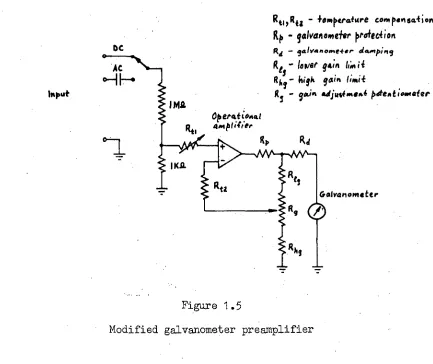
final compromise arrangement is shown in figure 1.5.
Input
DC
AC
HE"'
I MA
Operatienuti
emplWer
Rt,,Riz - temperature compensation
Rp - qalvanowlefer profettion
Rd - lolvono..e.tfir damping
Rts - lower qe;n Isii R1,1- high gain
- adjus4me..4 keteetimmefer
•
[image:23.580.86.519.304.668.2]•••
Figure 1.5
Modified galvanometer preamplifier
This was only moderately satisfactory because of the large
attenuation of signal at the input. This meant the signal being fed
to the operational amplifier was becoming comparable with noise and
consequently at gains greater than about 5 the noise at the output
became excessive. A further problem was that the circuit could only
be temperature . compensated for either d.c. or a.c. but not both as
the impedance'seen by the input to the operational amplifier was
the offset on switching from d.c. to a.c. it did not overcome the
problem and consequently the trace had a quite considerable offset
on switching over.
Nevertheless as a considerable amount of time
had
Abeen spent on this design it was decided
to make dowith it.
It
is perhaps of interest to note that several attempts have been made since, both to design another preamplifier or to buy areasonably priced commercial unit, which would satisfy the specifica-
tion,
but as yet none has been 'found
that
would be entirely
satisfactory.
CH.POT
THE FOUR-WAY VALVES
2.1 Valve Mk I .
At the time this project was comme ed a four-way, spool Valve
was already under construction in the dep tmental workshop. It had
a three land type spool as shown in the det 1 drawing, figure 2.1.
Essentially the valve consisted of three part..- A mounting flange and
outer body which had the threaded holes for the high pressure hose
fittings, an inner sleeve in which the valve pox' were machined, and
I
finally the valve spool itself. As it was not expe ed that a long
component life would be required, in the first valve design anyway, all
components were made from mild steel. This also meant they could be
easily machined. The close radial fit between the spool and sleeve
was achieved by first making them with a slight interference fit. The
sleeve was then honed and finally thespool and sleeve lapped. A
‘•
feature of this design was the ease with which it could be dismantled \.
or altered. Considerable modifications tO the valve characteristics, or even style, -could be made by siinply'machig' a new sleeve and spool.
An examination of this first valve design however showed that it
had many faults. The most obvious one was the asymetrical nature of
the valve ports (see section through sleeve, figure 2.1). With a-
supply pressure of 1000 psi . it was anticipated that the valve would
lock in the closed position due to the large side thrust caused by this. There was a.probleml too, of the end lands of the valve spool
fouling the drain holes. These drain holes had already been moved in
order to clear some "0" ring seals that had been placed between the
sleeve and body!. Farthermore a quick estimate of the flow characteristics
of the valve showed that the maximum flow would be developed at a
displacement of- only about 0.01 in. This Was thought to be somewhat
small for accurate measurements within the laboratory and particularly
•
lands. Nevertheless it was deeided to perservere with the fabrication
of this valve so • that the overall assembly of the hydraulic rig would
not be delayed. It was also expected that the experience gained, not
only in the manufacture of the valve components but also in the
opera-tion of the hydraulic rig ) would be of great benefit in later valve designs and experiments. At the same time, possible modifications to this valve were investigated in an attempt to see if some of these
difficulties might be overcome fairly simply. As well as this the
design of a completely new sleeve and spool (Valve Mk II) was
commenced.
As predicted, when the valve was tested on the rig, it was found
to lock as. it passed through centre. It could only be moved with a
great deal of difficulty and very large forces. Also the full flow
was reached within a very small valve travel as had been expected.
The leakage on the other hand appeared to be fairly small which was a
Very encouraging result.
2.2 Valve Mk I Modified
In order to overcome the large side thrust on the valve spool of valve Mk I, two more slots were cut around the valve sleeve at the central port position, as shown in figure 2.2. This balanced the
Figure 2.2
Section through central port of
pressure forces around the spool at this position. Unfortunately this
could only be done on the central port as the resultant slot at the
other two port positions would have touched the leakage drain holes!
In any case, as the design of the new spool and sleeve was
well
advanced it was decided to concentrate on the central port only, and
see how it behaved.
The valve was reassembled and connected to the high pressure
supply. Tests on this modified valve proved reasonably satisfactory
as far as the
forces required to move the Valve were concerned.However the pump could only manage to maintain 600 psi or less across
the valve, even in the fully closed position. It was suspected that
the majority of the flow was in fact leaking around the central land
of the spool, but at the same time it was thought some might have been
leaking between the sleeve and body. In order to determine just how
important this leakage around the sleeve was, the valve spool was
partially removed from the sleeve so that the large end land completely
blocked', the central port. The high pressure oil was again connected
---and the total leakage found to be very small, indicating that for all
intents and purposes the flow previously observed was all past the
central land.
A quick analysis of the flow and pressure drop showed that a
valve underlap of some four thousandths of an inch was required.
Consequently the valve was dismantled again and the sleeve and spool
carefully examined. This Showed that although the slot width and
spool land dimension Were very nearly identical, the two extra slots
that had been cut around the sleeve, were axially displaced by several
thousandths of an inch from the original slot. This together with the
small radial clearance was sufficient to account for the results .
observed (remembering that the port width was now three times larger).
2.3 Valve Mk II
It was decided if possible, in this design, to use the existing
-
it severely limited what could be done with the spool and sleeve. The
main problem was the very large flow obtained at only very small
displacements of a conventional type spool valve with large port widths.
For this valve it was felt that, for the full pump flow at the supply
pressure, a displacement approaching 0.1 in. was desirable. This was
because the tolerances that could be held on the sleeve and spool were
poor relative
to thosenormally maintained in this field. Also, for
accurate measurements of the spool displacement, particularly dynamic
measurements, within the laboratory, a reasonably large displacement .
was necessary. However this meant a total port width of less than
3/16 in.: The problem was therefore to either decrease the spool
diameter and hence port width, in the case of an annular groove type
porty 'or to machine several very small rectangular ports in the
sleeve. For the spool diameter it was decided that the minimum
'diameter that could be handled with any accuracy on the available
equipment was of the order of 0.5 in. or greater. Therefore the
desired maximum spool displacement had to be decreased unless very
small width ports could be made. However the latter appeared quite
difficult as the only convenient way of making a rectangular port was
by slotting across the sleeve, and the tolerances that needed to be
maintained to give the. required port width accuracy, with a spool
diameter greater than 0.5 in., were unrealistic.
By chance, .at about this time, a slotted or fluted spool
construction was discovered. This.had spool lands much longer than
the port size. Slots were then machined in the lands in such a way
. that the end of each slot just touched the edge of the port. See
figure 2.3. This allowed the actual port width in the sleeve to be
large and yet still present an effective port width, for the oil flow,
of just the combined width of the slots in the spool land. The one
major drawback with this technique was the difficulty in locating the
ends of the slots accurately. With this particular valve the problem
was partly overcome by measuring the average position of the ends of
SECT
Va
lve
Mk It
C
RO
S
S
SEC
TIO
Drain Supply, Drain
)
1
L
L/_,L1
1
44,,fr,z1 1/z/zzTo double actin, ram
to match. However with later valves which are to be hardened by heat
treatment, any distortion of the spool will result in non-uniformity
of the slot end-positions around the spool, as these will have to be
cut before hardening.
The other main feature that had to be considered was how many lands
to have on the spool. As already mentioned in the discussion of valve
Mk I, if a.three land construction were used the end ports could not
be placed uniformly around the sleeve as the resultant slot fouled the
leakage drain holes. Consequently the only valve spool that could be
constructed that would fit the existing outer body Was a two land type,
'shown in figure 2.3. This was very unfortunate as it left oil trapped
between the end caps and the valve spool. • Normally this type of valve
would be made with four lands as shown in figure 2.4. In this case
Figure 2.4
Conventional four land,. four-way valve - .
there was no room to place the extra two lands and this presented
difficulties in later experiments due to slight pressures built up in
these end chambers. These caused extra axial forces to be exerted on
the valve spool.-
As previously, the spool and sleeve were made from mild steel.
The radial fit was also obtained as before,-i.e. the spool was first
made an interference fit with the sleeve, the sleeve then honed and
- 29 -
were taken of the radial clearance. However the fit was certainly
reasonable, for the leakage flows were small, approximately 1.5% full
flow, as can be seen from the results presented in the next chapter.
In comparison the tolerances actually held on the other dimensions
were not very good. The ends of the slots were within approximately
+ 0.001 in. of each other and there was an average overlap of slightly
greater than 0.001 in. on the high pressure side of the valve lands
and an average underlap of approximately 0.001 in. on the low pressure
side of the lands. As
it turned out this was not very critical, for
the full flow displacement was relatively large, being approximately 0.1 in. Also the slot effective area was not strictly determined by
the displacement of the slot alone but by a throat area which was
also determined by the slot shape, as described in the next chapter. One further feature of the valve was the provision of an axial hole through the centre of the valve spool. This was done in readiness
for hydrostatic bearings on the spool', if these were required later.
This axial hole was to, carry oil from the high pressure. oil chamber to
several small radial holes drilled through the lands, between the slots, as shown in figure 2.5. Restrictions were to be screwed into.
r
e. A Relerisfion SCreWliciix.* lanai
Nigh pressure
eZ,43
,4
541thion AA
Figure 2.5
Hydrostatic bearing for valve spool.
to improve the efficiency of the bearing. In fact no such bearings were made for this valve, even though the experimental results indi-cated this was necessary. The reason was that at the time of these experiments a completely new valve, including a new outer body, was being designed. The necessary modifications and experimentation asso-ciated with these bearings was therefore not thought justified, partic-ularly as this old vnlve suffered from many other faults.
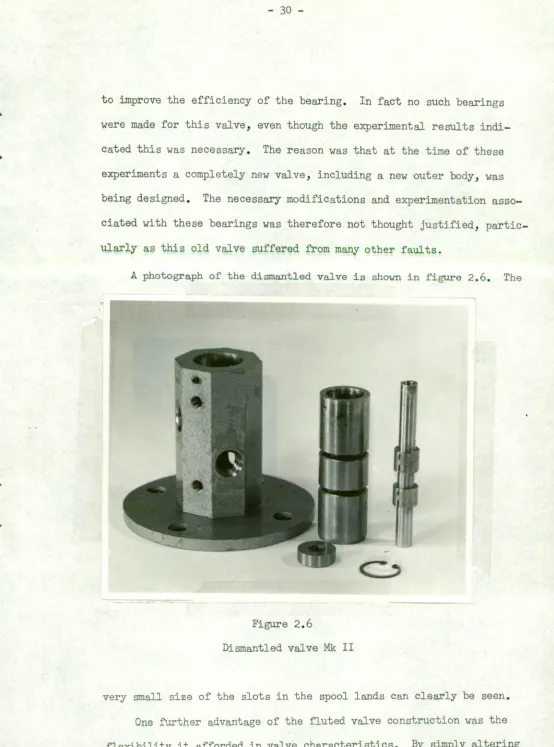
[image:33.580.13.567.27.774.2]A photograph of the dismantled valve is shown in figure 2.6. The
Figure 2.6
Dismantled valve Mk II
necessary. In fact something of this nature could possibly be used to
overcome problems of cavitation in the hydraulic amplifier of the
vibration test rig.
kfurther point of interest relevant to this section is the orifice
flow nomograph presented in appendix 1. This was found to be extremely
useful throughout the project.. It allowed very easy rapid estimates of
the flow behaviour of orifice-like restrictions to be made, and this
was particularly handy during the valve designs.
A small Algolcomputer program was written to produce the nomograph on the digital
incremental plotter coupled to the Elliott 503 computer at the
University. The program procedures or subroutines which were used to
plot the axes were written fairly generally so that almost any
nomo-graph could be produced with a minimum of time and effort.
CHAPTER 3
STATIC BEHAVIOUR OF THE VALVE
3.1
Flow Equation
If "steady-state" conditions are considered to exist within the
valve and the flow in the vicinity of the metering orifice is incom-
pressible,
non viscous and turbulent, then the flow will follow the
"orifice" equation:
where Q = rate of flow .
Cd = discharge coefficient
•
A =
valve orifice area• Sp = pressure drop across valve
• f = oil density
That this equation does in the behaviour of most valves of the type being considered here, i.e. valves with a . large
pressure drop. across an orifice type restriction, has been shown by
many workers in this area(78, 12) . Indeed, as will be shown later
in this chapter, the valve studied in this experiment was no exception.
In general the discharge coefficient, C d , is taken to be constant.
This is not strictly correct, particularly for very low pressure drops
or small valve openings (12). However other effects are usually much
more important than this in causing discrepancies between the measured
and calculated flows, and for most valves the assumption of Constant
C
d is very good. This was certainly true of the valve studied in this
experiment. For an orifice with sharp edges a coefficient of 0.6 - 0.65
is usually observed; for slightly rounded edges it is 0.8 - 0.9 and
varies somewhat. In respect to the fluted valve the metering orifice .
had as well as sharp edges a reasonably smooth flat "edge". See
figure 3.1. Therefore, for design purposes a coefficient of 0.7 was
assumed. This turned out to be close to the value actually measured,
60
el X 2 0. 52
.
_
8
40KO .120 .
actual displacement (0.001in) Figure 3.1
The valve metering orifice
A further point that needs examining more closely is the
relation-ship between spool displacement and orifice area for a fluted valve
spool. In the more conventional "square raand" type. spool valve the
orifice area is simply , .the product of the displacement and the port
width. However with the fluted design there is in fact a "throat" of
Considerably smaller area than the displacement times the port width.
This is clearly, shown in figure 3.1. Moreover this throat is not a
linear function of the displacement of the spool, as shown in figure 3.Z.
Figure 3.2
In this figure an effective displacement has been obtained by dividing
the throat area by the port width (strictly speaking, by the combined
slot width). This is the equivalent displacement that would be required
to give the same orifice area with a ttsquare_landtt spool. Figure
3.2,however, also shows that over the range of displacements expected, i.e.
displacements upAo 0.1 in., the effective displacement can be
approxi-mated quite well by
X
ec a c.4
where k = 0.52 approximately, for the valve considered
here.
In general k will be different for different valves and displacements.
The orifice area is therefore given by
A=kwx
where w = port (combined slot) width
and the flow equation becomes
C
d kW 3C.1?-61-
f
(3.2)4.4 As this equation is used later in deriving the equations for the
dynamic behaviour of the system, it is perhaps pertinent to comment on
the meaning of the 'steady-state" assumption, originally used in deriving
these equations. In the dynamic situation, steady-state conditions can
not in reality be said to exist. However it is assumed that the speed
with which the flow in the vicinity of the metering orifice changes,
due to variations in the upstream or downstream pressure, or due to
changes in spool position, is very much more rapid than the speed with
which these "external" changes occur. Hence at any instant during
changing conditions the flow through the valve is assumed to be the same
as the flow that would have resulted had
tho
same pressure drop andspool position existed during steady-state conditions.
3.2 Flow Reaction Force
Consider the schematic diagram, figure 3.3 showing one metering
Valve
spool
Figure 3.3
Section through spool valve
through duct B. In general the areas of the ducts and the chamber,
are large compared to the area of the orifice and consequently the
velocities are small with the exception of the velocity of the oil jet
passing through the orifice. This jet is not only of high velocity
but it enters duct B. at an angle, e 900, and therefore carries away
some axial momentum. This it could only have, gained from the "spool"
chamber and consequently there must be a reaction force onthe spool
which tends to close it. This is very briefly the Origin of the flow
reaction force.
Referring back to figure 3.3) provided the angle of the jet, 6,
is known, the axial force on the spool can be calculated. This force
'must be the net axial component of the rate of change of momentum of
the oil passing through the valve. Because the velocity of the oil
entering the chamber is very small compared to that of the jet leaving
it, the momentum flux entering' the chamber is usually ignored. The
momentum flux, MI leaving the chamber can be determined at the vena
contracta of the jet. It is
where v2 — - velocity at the.vena contracta.
By the Bernoulli equation
The axial force, Fp is given by the net axial change in momentum
--- flux, i.e.
F
Combining this with the flow equation (3.2) finally gives
F
----a
C
d
K w x
Sp cose (3.3)If the direction of flow is reversed so that the jet flows into,
the chamber from duct B, the equation still holds and the force still
tends to close the valve.
For a "square-land" valve when the valve opening, x, is small
compared with the Other dimensions of the chamber, but large compared
with the radial clearance, the angle, 6, is found to be approximately
69o (12)
. However, for the fluted valve under study, the land "edge"was nowhere near square l -the.angle.being about 350 as shown in figure
11
3.4.
The jet angle was therefore expected to lie somewhere between. •
these angles, probably closer to 350 than 69° due to the effect of
Port
Figure 3.4
Spool land edge angle
the slot on the flow'. As Shown later, the angle in fact was
Stlpply Back press/4u
valve
MeaSurms 'Fmk
1
—X
30 Experimental Results
3.3.1 Pressure-Flow Characteristics
Because of the peculiarities, of valve Mk II, particularly
in having only two lands, instead of the more usual four, it was
difficult to find a satisfactory way of coupling it to the rig, The
most satisfactory method seemed to be that sketched in figure 3.5.
However even this had the disadvantage that any difference between
Drai
Figure 3.5
. Hydraulic circuit for static tests
the oil pressures at the measuring tank and return line caused a
resultant force on the spool as these pressures were communicated to
the chambers between the end-caps and the spool lands. FUrtherMore
the leakage flow measured when the valve was closed was that across
the whole land, not just from the high
pressure
land to the valve port.Fortunately this was not a very great disadvantage in this case as the
only occasion for which the leakage flow could be measured was for.
"zero" back pressure. In all other cases the tack. pressure could not
be maintained with only leakage flow, as the outside edge of the land
opened the port to the end chamber and hence zero pressure. In any .case,
with "zero" back pressure . the - major part of the leakage flow should have
been from the high'pressure edge of the land to
the port as the.pressure
(Strictly speaking this was not quite correct, for the 'port did not
extend continuously around the sleeve and consequently between port
sections there would have been a slight pressure build up).
The "outside" land Characteristics, i.e. the characteristics from
the port to the end chamber, were net studied in this particular experi-
ment.
There were two reasons for this. Firstly, only thecharacter-istics across the "inside" lands were required for the dynamic studies
• anticipated with this particular valve. Secondly, as a result of the
two land construction, the results obtained for the "outside" lands were
: expected to be somewhat unreliable. This was because of the slight
pressure increase that would have been created in the end chamber due
. to the oil flow through it. This would have upset the flow reaction
'force readings .. .Also'the-large clearance between the .end-cap and the
• valve spindle would have resulted in a significant leakage flow pastthe
end-cap.:
• One further point that should be made about this valve is that the
characteristics of anymetering orifice cannot be assumed to remain
the same if the directionof oil flow is 'reversed. In fact it is very
likely that there willbe.a difference, for in one case the oil flows
• .through a convergent slot and throat into a fairly large duct, while for
the reverse flow,-the oil passes from the duct, through the throat into
a divergent slot. In all that follows the "inside" land characteristics
are considered for an oil flow out through the spool slots to 'the duct
or port.
. The raw data obtained from valve Mk iI,.with . a supply pressure, of
1000 psi, is shown plotted in figure 3.6. Positive flows were taken to
be flows through one port, while negative flows were through the other
port. At small flows the plots are reasonably linear; however at
higher flows there is a marked roll-off or saturation effect as it is
commonly called. At least some of this roll-off cah. be considered to
be due to pressure drops within the hoses and fittings both upstream
and downstream Of the valve. These caused a drop in the total.pressure
t_ =
en
Li-
stage, in assuming the total roll-off to be due to this cause, as the
valve need not have been linear. Indeed this Was one reason for
actually measuring the valve characteristics). With one exception the
hoses and fittings upstream of the valve were large and should
have
offered
only
a small resistance to the flow. The exception was at the
entry to
the valve where the oil passed through a i in, diameter hole into the central valve chamber. To estimate the likely pressure dropupstream of the valve, it was assumed that, as the e in. hole was the
most significant restriction, it caused mostof the pressure drop.- It
was then assumed to behave as a sharp edged orifice of the same
diameter.
Downstream of the experimental valve the oil had to flow through
several fittings and valves. However in this case the pressure drop
was measured directly by a pressure transducer placed just downstream
of the experimental valve. This made it possible to calculate an
equivalent orifice type restriction to represent the loses downstream
of the valve. It should be noted, however, that this was only
applic-able to the "zero" back pressure results. ( Strictly speaking, even
though these results were obtained with the back pressure valve fully
open, the back pressure was not zero due to the pressure drops down-
stream). For all other results the back pressure was maintained constant
by the back pressure valve irrespective of the ail flow. The hydraulic
circuit therefore looked somewhat like
figure 3.7
(a) in the case of zero" back pressure, and likefigure 3.7 (b)
in all other cases.•
•
Upstream Restriction due to restriction back preside valYf
Experimental
SuppIr pree. Valve ..••••••\ Drain pras.
(a)
Ups+ /vain
resfriction
ExPerimentel Valve
suPtlY l'•u. Back pres.(torestarri)
( 3 ) Figure 3.7
Hydraulic circuit for (a) "zero" back pressure,
C k w (x+x
d °ThiS explains the greater droop in the "zero" back pressure curve; the results in this case. had the added effect of A flow dependent pressure drop downstream, as well as upstream. The estimates of the pressure
drops upstream and downstream of the valve were used to evaluate the
approximate pressures that actually existed acrossthe metering orifice
of the Valve at any flow. This, together with the assumption. that the
valve behaved, at least to . a . first approximation in accordance with the
orifice equation (3.2), enabled a Correction to be made to , the flow
results to give an estimate of the flows that would have resulted had
there been no pressure drops Upstream or downstream That the valve
did behave, at least.t0.a first approximation, in accordance with the
orifice equation, can be 'deduced from the resultsalready presented- in
figure 3.6. In addition to this correction; a small correction was made
for the non-linearity of the orifice area with displacement. The
"corrected" results are plotted in figure 3.8. There-is:stiil .a small ,
'amount of roll-off at the higher flows. This Could no doubt be
elimi-nated by assuming:slightly higher losses. However this is hardly
justified in view of the assumptions, and estimates already made to
obtain these curveL. In new valve designs, one of Which is presently under construction, Provision has been made for pressure tappings into the valve body,to'enable the pressure drop across the metering orifice
tobeacCUrately measured.
Figure 3.8 also shows that the Valve wad . slightly•under lapped,
theextrapoIated flow curves reach zero flow l ignoring leakage, at
a small negative displacement, x This is'taken'into account . in -
some of the mathematical models. presented in chapter . 4 by displacing the Origin of the orifice flow equation as below:
The results presented in figure 3.8
( 3.4)
also Show that,. with the exception of •
the 600_ psi back pressure set, the coefficient of discharge is very nearly constant. The average value, excluding the 600 psi results, is
•11,
-43-
the case of the 600 psi set and this could explain why the discharge
coefficient in that case is lower, at 0.69.
It should be noted however, that these discharge coefficients, and
indeed figure 3.8 itself, do not in reality describe the actual,
physical valve. They represent the behaviour that would be expected
from a valve of similar design to the one discussed here : but
with a
linear displacement throat area characteristic and constant pressure
drop across the metering orifice. In chapter 4
results
from the mathe-matical models of the system are compared with those from the actualvalve, hoses and fittings, and as such figure 3.6 represents the
behaviour more correctly than this figure. The discharge coefficients
use in chapter 4, therefore, have been chosen so as to best
approxi-mate
the behaviour shown
in figure 3.6. Figure 3.8 is included mainlyto show that the actual metering orificev,does in fact behave in
accord-ance with
the orifice
equation, eventhough
itsphysical appearance is
more that of a restricting passage than an orifice.
3.3.2 Flow Reaction Force
As already mentioned, because valve Mk II had only two spool
lands, it was possible that significant errors could occur in the
flow reaction force measurements. These, could arise as a result of
different oil pressures within the chambers between the end caps of the
valve and the valve spool lands (see figure 3.5). In addition, during
the actual tests of the valve, two further effects were observed. The
most significant effect was the valve spool sticking, often called
hydraulic lock, particularly at high back pressures. To overcome this
it was necessary to lightly tap the valve body with a small hammer to
jar the spool free, This tapping, however, could itself introduce
bias into the results as it was found that tapping the side of the
valve body had very little effect; the tap had to be in an axial
direction and in the case of high back pressures it had to be
reason-ably heavy. The other significant effect was the force exerted on
the spool shaft by the dial gauge used tO Measure the spool position.
This was complicated by the fact that the dial gauge force, besides