by
Ian Edward Grey, B.Sc.(llons.)
Submitted in fulfilment of the requirements for the
Degree of Doctor of Philosophy
University of Tasmania Hobart
This thesis is dedicated
In this thesis the results of a study of the magnetic interactions in series of polynuclear complexes of
chromium(III), molybdenum(III), and vanadium(II) are reported. These comprise series of compounds of formula A3 1V12X9 (M = Cr(III), Mo(III); X = Cl, Br; A = univalent
cation) containing binuclear [M2X9 ] 3- entities and the compounds AVX3 (X = Cl, Br) containing infinite linear
1 chains (-VX 3-)n - .
Particular emphasis has been placed on the relation-ship between magnetic properties and the structure of the compounds. In this connection a survey has been made of previous investigations of magnetic interactions in poly-nuclear transition element complexes. It is evident that there is the need for a study of the variation of magnetic interactions in series of simple polynuclear complexes of closely related structures.
the magnetic properties and the proposed structures for the vanadium complexes. The magnetic data on the
compounds of formula AVX 3 is consistent with a structural model which involves pairing of vanadium atoms along an
infinite chain.
For all the compounds studied it has been possible to obtain useful information on the contributions of the different mechanisms for exchange by a comparison of the magnetic properties of related chloride and bromide
complexes. It is concluded that in the molybdenum
binuclear compounds, the dominant mechanism for spin-spin coupling is direct exchange between the molybdenum atoms. The various superexchange effects via the bridging halogens contribute no more than 10% of the total exchange. The relative contributions of the ferro- and antiferromagnetic superexchange mechanisms are very dependent on the
structure of the binuclear anion. The magnetic
inter-actions in the corresponding chromium complexes are weaker than in their molybdenum analogues by a factor of fifty. The magnetic properties of the vanadium(II) compounds are similar to those of the molybdenum binuclear complexes. In the former compounds, however, the superexchange via the bridging ligands forms a greater contribution to the total exchange. This is attributed to the shorter metal-ligand bonds in the A1/X
To the best of my knowledge and belief, this thesis contains no material which has been accepted for the award of any other degree or diploma in any University and contains no copy or paraphrase of material
previously published or written by another person, except where due reference is made in the text.
Acknowledgements
It is a pleasure to acknowledge the guidance and supervision of Dr. P.W. Smith who at all times has been very helpful and encouraging.
Thanks are due to Dr. A.F. Reid and Dr. D.E. Scaife of CSIRO, for permission to use the far infrared spectro-photometer. I wish to acknowledge the value of discussion with fellow research students of the Chemistry Department.
I am indebted to Mr. A. Valentine for help with thesis diagrams. Thanks are also due to the technical staff of the Chemistry Department, and especially
Mr. Bill Dixon.
Page Abstract
Acknowledgements
CHAPTER I: MAGNETIC INTERACTIONS IN POLYNUCLEAR
TRANSITION EIMENT COMPLEXES 1
CHAPTER II: MECHANISMS FOR EXCHANGE INTERACTIONS BETWEEN d 3 TRANSITION ELEMENT IONS
A. Introduction 9
B. General Magnetic Exchange Mechanisms
in Isolated Clusters 9
C. Exchange Mechanisms in Edge Sharing
Octahedra 13
D. Right Angle Exchange Interactions in
Face Sharing Octahedra 18
CHAPTER III: MAGNETIC STUDIES OF SOME BINUCLEAR COMPLEX HALIDES OF MOLYBDENUM( III)
AND CHROMIUM(III) 24 A. Chromium(III) Binuclear Complexes 25 B. Molybdenum(III) Binuclear Complexes 33
COMPLEXES OF CHROMIUM(III) AND MOLYBDENUM(III)
A. Review 55
B. The Effect of the Cation in A3M2X9
Compounds 60
C. Experimental 68
CHAPTER V: MECHANISMS FOR MAGNETIC EXCHANGE IN BINUCLEAR HALIDE COMPLEXES OF
CHROMIUM(III) AND MOLYBDENUM(III)
A. Molybdenum(III) Binuclear Complexes 80 B. Chromium(III) Binuclear Complexes 88 C. Complexes (H 30) 3 .Mo 2 C19 and
(Ph4As) 2 .H30.Mo 2 C19 91
CHAPTER VI: MAGNETIC AND STRUCTURAL INVESTIGATIONS OF SOME VANADIUM(II) HALIDE COMPLEXES
A. Introduction 94
B. Magnetic Studies on RbVX 3 97 C. Structural Studies on Compounds AVX3 101 D. Correlation of Magnetism and Structure
for AVX
3 113
E. Experimental 120
LIST OF REFERENCES 125
APPENDIX I 132
ELEMENT COMPLEXES
A. Introduction:
The magnetic behaviour of magnetically dilute transition
element compounds is now well understood (1-4). The theory
for these systems in which interaction between the metal
ions is negligible has been developed to a high degree of
sophistication and generally, experimental results can be
fitted very accurately by theory. In the case of
magnet-ically concentrated systems the situation is not so clearly
defined. Although the interaction between magnetic ions
has been the subject of many theoretical treatments, the
basic mechanisms of ferro- and antiferromagnetism are
poorly understood. These problems have been examined
mainly by physicists who have concerned themselves almost
exclusively with studies of ionic lattice compounds and
metals where the exchange interaction is propagated
through-out the crystal. Two distinct theoretical treatments have
been developed in which the magnetic electrons are
consider-ed either to be localizconsider-ed on the parent atoms as in the
Heitler-London-Heisenberg approach (1,5-7) or collective
as in the Molecular Orbital approach (8-10). The basis of
the former model is the concept of a spin Hamiltonian. The
- -2E J k
k=1 KPoIrs
where S i and S. are spin operators and J k is the exchange
integral between a pair of kth nearest neighbours.
The enormous mathematical complexity of such a
many-body problem prohibits the solution of this general
equation and in the studies of the properties of ionic
lattice compounds some drastic approximations have to be
made. The usual initial approximation is the restriction
to nearest neighbours only (k=1). As exchange
inter-actions generally fall off rapidly with increasing atomic
separation, this approximation is often justifiable and
the model has been used with some success in interpreting
the properties of such ionic compounds as perovskites and
spinels. However, it is entirely unsatisfactory for
explaining the magnetic properties of metals and
semi-conductors. Although the Molecular Orbital or Band Model
is better suited to a description of these substances,
there is no clear-cut solution to the problem and a more
accurate model probably involves mixing the
character-istics of both (11). Yet a third approach currently in
favour considers the d electrons in metals to be
local-ized on the parent atoms with the s electrons as itinerant
or conduction electrons providing the interaction between
The complexities associated with the interaction of a
large number of magnetic ions as in the above systems
are greatly reduced if the magnetic compound under study
is diluted with an isomorphous diamagnetic substance
(13). In this way the co-operative phenomena are
restricted to isolated clusters. If the magnetic ions are
randomly distributed throughout the host-lattice the
numb-er of pairs, triads, etc., can be calculated (14
Hence for such dilute systems the theory is fairly
straight-forward as only a small number of interactions have to be
considered.
Isolated clusters also occur naturally in some pure
compounds which are grouped under the general heading of
polynuclear complexes. Geherally the crystal structures
of polynuclear compounds are complex and thus the extension
of theories for these systems to magnetically concentrated
systems is not straightforward. However, they form an
important intermediate class for which the magnetic
prop-erties can be interpreted fairly precisely using the
local-ized electron model.
The simplest form of naturally occurring "isolated
cluster" is the binuclear complex of which copper acetate
monohydrate is the classical prototype in magnetic studies.
Copper ions occur in isolated pairs, bridged by four
0
apart (c.f. 2.56 A in the metal) and the complex exhibits
antiferromagnetic behaviour with an exchange integral
= -205 ° K (16). The occurrence of this structural type
has also been established for the acetates of chromium
(II) (17), molybdenum (II) (18) and rhodium (II) (19).
X-ray studies have since revealed binuclear entities in
many other transition element complexes (20-28), in
which the metals are bridged by n ligands (n = 0 -4).
Recent structural studies have also shown the presence
of trimeric and tetrameric "isolated clusters" in
transition element compounds (29-32).
As mentioned above, the magnetic properties of these
polynuclear complexes may be interpreted accurately using
the Heisenberg localized electron model. The development
of the spin Hamiltonian, as originally proposed by Van
Vleck, leads to formulae for the magnetic susceptibilities
which have been used with great success in fitting
experi-mental data for numerous "isolated clusters".
Starting from a simplified form of the spin
Hamiltonian
= -2JE 1-2
Earnshaw et al have calculated the magnetic moment as a
function of temperature for chains of magnetic centres of
spin S, each coupled to adjacent members only, by an
of 1/2, 1, 3/2, 2, and 5/2. (N = 10 members approximates
very closely to an infinite chain). Using these formulae
it has been possible to account for the
_antiferromagnet-ism of many binuclear and trinuclear complexes of copper
(II), chromium (III) and iron (III) (34-39).
Using a similar approach, Wojciechowski (40) has
derived expressions for the magnetic susceptibility of
dn .dm binuclear transition element systems (n,m = 1,2,3,
4,5) for both positive (ferromagnetic) and negative
ex-change integrals.
Very recently, Kakos and Winter have presented
sus-ceptibility expressions for a number of tetranuclear
clu-ster models (41). They have had some success in
apply-ing these formulae to account for the abserved magnetism
of some iron (III) halo alkoxides(41).
However, although the spin Hamiltonian forms the
basis for a well-developed mathematical procedure, this
approach gives no insight at all into the nature of the
exchange between the magnetic ions. In this context we
will follow the convention used by Goodenough (42) in
referring to all interactions which do not involve an
anion intermediary as direct cation-cation interactions
and those that do as cation-anion-cation interactions.
In the case of copper acetate monohydrate the
direct cation-cation interaction via both Cr(43) and
(44-46) bonds, and to cation-anion-cation interactions
via the acetate anions (47). Numerous papers have been
published in which these different approaches are examined
critically but the problem is not yet resolved.
In a comprehensive review, Kato et al discuss the
various mechanisms for exchange in a large number of copper
(II) binuclear complexes (48). As with copper acetate
monohydrate, it was not possible to assign specific
mech-anisms to many of these compounds. Some progress has been
made in the determination of exchange mechanisms for copper
(II) binuclear complexes by studying the variation of the
exchange integral as the electron donating ability of the
bridging atoms are altered. This may be achieved for
suit-able organic bridging ligands by changing the
electroneg-ativity of appropriate substituents. Hatfield and Paschal
have reported magnetic data for a series of 4-substituted
pyridine N-oxide complexes of copper (II) halides containing
oxy-bridged binuclear species (47). The exchange integral
was found to be very sensitive to the substituent on the
pyridine ring. The observed trends indicated a dominant
superexchange mechanism viaTT-overlap with the oxygen
orbitals. Similarly Ginsberg et al have interpreted the
antiferromagnetism of a series of 5-substituted
N(2-hydroxy-phenyl) salicylideneimine binuclear copper (II) complexes
integral shows a quite different dependence on the
sub-stituents and the results have been interpreted in terms
of direct metal-metal interaction between pairs of
vanadium atoms (49).
Lewis and coworkers have made a detailed study of
spin-spin interactions in polynuclear . transition-metal
complexes of iron (III) and chromium (III). The
observ-ed magnetic behaviour has been successfully interpretobserv-ed
on the basis of the dipolar coupling model (33-38).
However, the determination of the actual mechanisms for
coupling have been unsatisfactory. Such determinations
have been attempted on the basis of simple molecular
orbital theory. Most of the compounds studied however
have very complex structures with low symmetry at the
metal atoms, (e.g. five coordinated iron (III)1 making
detailed assignments of the ordering of molecular orbitals
very difficult. For some of the compounds the structure
of the binuclear unit is such that both superexchange and
direct exchange mechanisms are possible (35,36). Again,
the complexity of the systems and the lack of data on
related systems prevents estimates being made of the
relative contributions of each.
From this brief survey it is apparent that present
interpretations of mechanisms for spin-spin coupling in
TRANSITION ELEMENT IONS
A. Introduction:
In the following chapters the results of a detailed study of the magnetic interactions in polynuclear com-pounds of type A 3 M2X9 (M = Mo (III), Cr (III) ) and A1VIX
3 (m = v(II) ) are reported. Both series of compounds contain face-shared N EL- octahedra. To form a basis for understanding the magnetic properties of these com-pounds, the mechanisms by which the spins on adjacent magnetic ions couple will be reviewed in this chapter. From symmetry considerations a qualitative estimate is made of the various mechanisms for exchange between two octahedrally coordinated d 3 transition metal ions when adjacent octahedra share edges. Extension to the more complex case of face-sharing octahedra is discussed and the literature on "right-angle" exchange mechanisms in d 3 metal complexes is reviewed.
B. General Magnetic Exchange Mechanisms in Isolated Clusters:
The simple Hamiltonian of equation 1-2 forms the basis for calculations in isolated clusters. However, a
study of the Hamiltonian gives no insight into the actual
mechanisms by which the spins couple to give rise to the
typical ferro- and antiferromagnetic behaviour. As
mentioned in Chapter I, the simplest classification of
ex-change mechanisms is into those which involve an anion
intermediary and those that do not. According to Anderson
(50) however, there is no distinction in principle between
direct overlap and overlap via non-magnetic groups. He
considers coupling from a molecular orbital approach In
which the d orbitals of the magnetic ion are expanded by
mixing with suitable orbitals on the diamagnetic anion.
Thus even the traditional "superexchange" process can be
considered as a direct cation-cation transfer via expanded
molecular orbitals or alternatively, direct metal-metal
overlap is a special case of this general superexchange
mechanism.
The magnitude and sign of the general superexchange for
a given transition element isolated cluster depends on the
d electron configuration of the metal (orbital occupancy),
the symmetries of both the metal and anion orbitals, the
electronegativity of the anion, the radial extension of the
metal d orbitals (e.g. Cr-, M041/1) as well as other minor
factors (51). Concerning the sign of the interaction, three
(a) Overlap of half-filled orbitals:
• As an illustration, consider two 0r3+ ions separated
linearly by a diamagnetic ligand such as occurs when two
[CrX 6 ]3- octahedra share a corner. In Cr3+ each of the three t
2g orbita1s --1Th half filled; the e orbitals are
empty. There isiT overlap of the d yz with the anion py
orbitals as shown in Figure II-1.
Fig. II-1.
Transfer of an electron from p to d Ian Cr
1 can occur, yz
resulting in antiferromagnetic pairing (Pauli principle).
The remaining electron residing on X can then couple
antiferromagnetically with the unpaired d
yz electron on Cr
2' Since the transfer integrals carry an electron
without change of spin this mechanism can only occur if
the interacting electrons on the two metals are
magnitude of the exchange integral has been estimated
as (42):
J. (half-filled, half-filled) = -2 II-1
• ij
4S2U where S is the total cation spin,
U is the energy of the excited state of M 1
result-ing from the transfer of one electron to it and b ij is the
transfer integral, approximately proportional to the
orbital overlap.
(b) Overlap of a half filled and an empty orbital:
Consider that orbital n on M1 is empty and orbital
n' on M
2 is half filled. Electron transfer is spin
independent in this case unless there is an orthogonal,
partially occupied orbital, n", on M l . Transfer of an
electron to n on M
1 is then favoured if the transferred
electron is parallel to the spin of n". i.e., The system
is stabilized by ferromagnetic intraionic exchange within
M
1' The sign of the mechanism is thus positive. Its
magnitude is proportional to the intraionic exchange
constant.
jintra'
.2 J.
= + 2b
_ ij x intra
4S2U
This ferromagnetic coupling is weaker than case (a) by the
This is also ferromagnetic and depends on intraionic
coupling. As this case does not apply to d3 transition
metal ions it will not be discussed further.
The systems A 3M2X9 and AMX 3 .contain face shared
octahedra with approximately right angle
metal-ligand-metal angles. In order to discern the various mechanisms
of exchange it is of value to intially consider the
simpler right angle superexchange case of two
NX
6
1
3-
octahedra sharing an edge.C. Exchange Mechanisms in Edge Sharing Octahedra:
The symmetry relations between the d 3 metal orbitals
and the 90 0 anion orbitals which apply for two octahedra
sharing a common edge are illustrated in Figure 11-2.
The following relations exist:
orthogonal to don M 1 and d 2 - 2 on M
x y
nonorthogonal to dx2
-y2 on Mi and dxy on M2
orthogonal to d 2 2
x -y on M1 and dxy on M2 nonorthogonal to d
xy on M1 and dx_y2 on 1V12
Pz: orthogonal to dyz on M1 and dxz on M2
nanorthogonal to d on M1 and d
yz on M2 xz
Px:
Fig.II-2. Symmetry relations applying in edge sharing octahedra. (a) d(M1) - p z (ligand) - dyz (M 2 )
(b) dxy (M 1 ) - py (ligand) - dxy (M 2 ) (c) d
(c
)dx2_y2(m2)
Fig.II-2 (cont.)
From an examination of Figure 11-2 and the above relations the following mechanisms for spin-spin
coupling may be formulated:
1. Direct overlap of d orbitals (direct metal-metal bonding). This gives an antiferromagnetic inter-action.
2. Half-filled, empty orbital superexchange - py is nonorthogonal to the empty e g orbital, dx2_ y 2, on 152
and nonorthogonal to the half filled t 2g orbital, dxy , on MI . This represents the type (b) mechanism discussed in II-B and the resulting interaction is ferromagnetic. Similarly px overlaps d 2 x y - xy 2 on and d on M2, again giving a ferromagnetic interaction.
3. Half-filled, half-filled orbital superexchaage - p z overlaps the half filled t 2g orbitals - dxz on M1 and• dYz on M2 throughlT bonding. Antiferromagnetic super-exchange of the type described in case (a) above results.
4. Ferromagnetic exchange between dxy on MI and M2 - The ligand orbital p x overlaps dxy on 1V12 and is
ortho-gonal to dxy on Ml . Similarly, py overlaps dxy on Mi and is orthogonal to dxy on M2 . Ferromagnetic exchange
results.
magnitude is extremely small compared to the mechanisms
considered above and is ignored in this discussion.
Similarly, spin polarization or indirect exchange, as
formulated by Anderson, and other weaker effects are
neglected.
The mechanisms discussed which involve an anion
intermediary have been described above in terms of a
delocalization exchange mechanism, i.e., drift of an
electron from the anion to one of the cations. A second
superexchange mechanism is considered by some workers to be
as important as delocalization exchange (52-55). It is the
correlation exchange in which a pair of electrons in an
anion orbital interact and are excited . simultaneously to
form partial covalent bonds on opposite sides of the anion.
Nesbet (53) has calculated that it is a more important
contributionemdelocalization exchange in the
inter-actions in binary oxides (MiaO, FeO, CoO, and NiO). Anderson
claims that the correlation effect, although correct in
principle is very weak. However, the main correlation
mechanism for the d 3 /d3 right angle system-namely two
electrons from the same anion p orbital coupling
simult-aneously to a t 2g orbital on one metal and an e g orbital
on the other - has the same sign as the delocalization
mechanism (2) discussed above and so does not affect this
Octahedra:
Many polynuclear transition element complexes
containing face-sharing octahedra are now well
charact-erized. The detailed x-ray structures of a number of
complexes A 3M2 019 have revealed the presence of binuclear
complex anions4M 2X9V- In which two octahedra share a
face (20,21,56). Recently, the complex bis
(acetylacet-onato) nickel (II), [Ni 3 (acac) 6 ] has been found to contain
linear trinuclear clusters, resulting from the sharing of
faces of three adjacent octahedra (29). The structures of
many compounds of formula AMX
3 containing infinite chains
of face sharing octahedra have also been reported (57-61).
The justification for including these in the category of
polynuclear complexes is that the magnetic behaviour may be
accounted for using the dipolar coupling approach.
For these systems of face sharing octahedra, close
approach of the two metals is possible. In addition, the
trigonal field stabilizes a d orbital on each metal
directed along the metal-metal axis. Direct cation-cation
interaction is hence expected to be important.
A detailed description of the various mechanisms for
exchange via the bridging anions is not as simple as in
the case of edge-sharing octahedra. When two undistorted
consider the ligand p orbitals to be directed along the
metal-ligand binds. The simple orthogonal relationships
given in section II-C no longer hold. Ferromagnetic
exchange mechanisms of type II-C (4) above are then
formally forbidden. Calculations (62) show that this
type of interaction is dominant in the case of V24- (d 3 )
pairs interacting via 90 ° oxygen intermediaries () (*s in M 0). Huang and Orbach (63) stress that the orthogonality
of the spin polarized ligand orbital to the occupied cation
orbitals is essential for ferromagnetic exchange. For d 3
metals, this implies the cation-cation bond must lie along
a (110) axis (as in edge-sharing octahedra). This applies
in CrBr
3 which is ferromagnetic (64). Huang and Orbach
point out that in ruby, where chromium pairs share a face,
i.e., they are in a [111] configuration with respect to
one anotherw4ferromagnetic coupling would not be expected.
In order to interpret trends in the magnetic
inter-actions observed experimentally a simplified model is
however, obviously necessary. Ginsberg et al (65) were able
to give a qualitative understanding of the magnetic
inter-actions present in [Ni3(acac)6] by making the approximation
that the bridging Ni-O-Ni angles are all 90 ° (experimentally
the Ni-O-Ni angles vary between 76.5 and 89.3 ° ). Estimates
analogous symmetry relations to those given in section II-C for edge-sharing octahedra.
In the d 3 transition element complexes A 3 M2X9 and AVX
3 the metals are subject to a trigonal field which splits the degenerate ci orbitals into a singly degenerate a1g orbital and two doubly degenerate e orbitals. The a1g orbital is directed along the metal-metal axis, one pair of e orbitals (d d) are directed more or less yz mx along the metal-ligand bonds and the second pair of e g orbitals (dxy , dx2_y 2) is directed approximately perpendi-cular to the trigonal axis. Fig.II-3 illustrates two face sharing
pmurL.-.
octahedra with suitable cartesian coordin-ate systems centred on the metals and ligands. Exchange between the metals can then occur via the following mech-anisms:1. Direct exchange resulting from Oroverlap of the dz2 (a1g) orbitals on each metal atom. Strong
anti-ferromagnetism results if the metal-metal separation is small.
2. Antiferromagnetic superexchange between the half- filled d and d 2 xy x y - 2 orbitals on each metal via TV overlap with p z on the ligand.
3,
Ferromagnetic exchange from half-filled to empty orbitals via overlap with p x and P.results. As mentioned above, this mechanism is formally
forbidden in the case of face-shared octahedra but may
occur if the overlap between fkr and a half-filled
a
orbital is so small that the orbitals are effectively
orthogonal.
In any particular complex, all these mechanisms are
competing and depend critically on so many factors that
the resultant sign and magnitude of the exchange is
difficult to estimate. From symmetry considerations only,
Kanamori has determined that the resultant sign of the
various right angle superexchange mechanisms for
octa-hedrally coordinated d3 ions is positive (66).
Goodenough (42) has estimated that the sum of the
contrib-utions (2) and (3) above, together with correlation
superexchange is ferromagnetic and of magnitude 50°C for
right angle exchange through chlorides. Indeed, in the
layer compounds Cr01
3 and CrBr3 the large Cr-Cr separation
(3.44 1 in 0/.01
3)(67) precludes direct overlap as a major
mechanism and the 900 intralayer interactions are observed
to be ferromagnetic (64).
Huang (62) has investigated the exchange interaction
between V2-4-(d3) ion pairs in M 0, where they are at right angles to bridging oxygens. Quantitative estimates were
Fig.II-3. Coordinate systems on M (x,y,z) and X (x',y',z 1 )
(i) direct overlap of dxy on V
1 and V2 -
ant iferromagnetic. (mechanism (1). above).
(ii) exchange between dxy on V 1 and V 2 via the spin polarized ligand. This is ferromagnetic as p is non-orthogonal to dxy1) and orthogonal to dxy (V
2).
(mechanism D-(4) above). This contribution has not been considered by other workers, but Huang calculates it to be the dominant term.
(iii)Antiferromagnetic exchange between dxz on V 1 and d on V2 via TT overlap with pz on the oxygen.
Yz
(mechanism D(2) above). Again actual calculations revealed the very unexpected result, not obvious from symmetry
considerations alone, that due to the non-orthogonality of the d and d orbitals, a ferromagnetic term arose which
Yz xz
acted to cancel the nominally antiferromagnetic interaction. Ferromagnetic interaction between half filled and empty
HALIDES OF MOLYBDENUM (III) AND CHROMIUM (III).
The need for a detailed study on the relationship
between magnetism and structure in a simple system of
related polynuclear complexes has been emphasised in
Chapter I.
A suitable system for study is that comprising
complex halides of type A 3 M2X9 with M = Cr(III),
Mo(III), W(III); X = halogen; A = univalent cation,
containing binuclear (M2X9 P- complex anions. As will
be shown in later chapters, it has been possible to
study the variation of magnetic exchange with change of
metal-metal distance in this system by correlating
detailed x-ray structural data with magnetic
suscepti-bility measurements. The effect of polarizasuscepti-bility of
the ligand on superexchange'has been ascertained from a
study of both bromide and chloride complexes.
In this chapter, the results of magnetic studies
will be reported for a number of chromium (III)
bi-nuclear compounds, for which the magnetic interactions
are weak, and a range of molybdenum (III) complexes in
which strong spin-spin coupling occurs.
Few studies of the magnetic properties of compounds
(68) has presented results of temperature dependence studies on Cs3Cr2C19' Cs 3V2C19 and K3Ti2C149' The two former compounds exhibit Curie-Weiss behaviour
(VA = C/T +e) with (3' values of 330 and 100 0 respectively. The titanium compound shows typical antiferromagnetic
behaviour with a maximum in the susceptibility curve at 550 ° R. No attempt was made to determine the magnitude of the exchange integral in these compounds. The complex K3W
201 has been reported to be diamagnetic (69).
Wentworth and Saillant (70) have recently published sus-ceptibility data in the range 80-300 ° K for a number of enneahalodimetalates A M
2X (A = K,Rb,Cs; M= Cr,V,Ti,
W; X = Cl,Br,I). The results are not interpreted in any detail.
The only reported determinations of exchange inte-grals are for the compounds (Et 4N) 3 Cr 2 C19 with J =-5 ° K (35) and (Et 4N) 3V2 C19 with J = -57 0K. (71)
A. Chromium (III) Binuclear Complexes:
1.5
X c\J
0
1 . 0
0.5
100 200 300
Temperature (0K).
Fig.III-1: Reciprocal magnetic susceptibility versus temperature for
A. Rb 3 Cr 2 C19 , calculated curve for J = -13.3°K,
g = 1.95, Woc) = 0.
B. Cs3Cr2C19' calculated curve for J = -9.30,
g = 1.94, 1074) = 0.
C. Cs 3 Or 2 Br9 , calculated curve for J = -8.8°K,
1.5
1.0
10
0.5
0
Fig.III —2.
100 200
Temperature (°K).
A. K 3 Cr2 C1 9 , calculated curve for
J = —16.0°K, g = 1.99, N(cc) = 0;
B. (Et 4 N) 3 Cr2 Br9 , solid line is curve of
best fit to the experimental results.
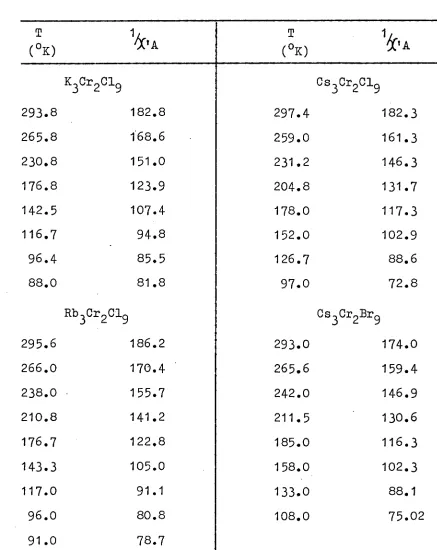
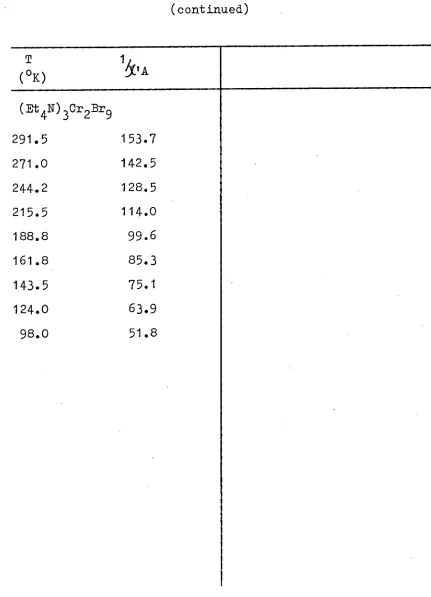
the calculated magnetic parameters are given in Table III -1. Actual susceptibility data are listed in Table 111-3 in the Experimental section.
The susceptibility curves in Figs.III-1,2 are linear over most of the temperature range studied but show a distinct curvature at the lowest temperatures measured. The amount of curvature is negligible for the Et 4N+ and Cs+ salts but increases quite markedly as the cation size is decreased to K+. The curves are typical of a complex with very weak antiferromagnetic interaction, i.e., very .
small J values. In Fig.III-3 theoretical curves are plotted for a binuclear d3 complex (g = 2.00, N(Z) = 0) for different values of the exchange integral, J. When J is very small ( -5°K), Curie-Weiss law is obeyed over the range 90-300°C with a small ervalue of As the interaction between the two ions is increased, deviations from the Curie Weiss law occur as shown by the increasing curvature of the lines below T= 100°K. Even at the small J value of -150K, the Curie Weiss constant has increased to 60°. The presence of the interaction is also indicated in the reduction of the magnetic moment from the spin-free value of 3.87 B.M. to 3.64 B.M. (J = -15°K).
Earnshaw and Lewis observed these slightly curved susceptibility curves for a number of binuclear chromium complexes with hydroxyl bridges (35). The results were
1.5
1 .0
k ,
-
0.5
0 100 n 200
Temperature ( - K). 300
Fig.III-3. Theoretical reciprocal magnetic susceptibility
versus temperature curves for a binuclear d3
'y1/41 ,1 K[42 + 15exp(6x) + 3exp(10x)
T 7 + 5exp( 6-x) + 3exp( 10x) + exp( 12 x)1+ N(c4) . III1
-
21, b 2where K = fa-P and • 3k
-J kT
The exchange interaction between the two metal ions is represented by the exchange integral -J, 2J being the energy separation between the singlet and triplet states. Earnshaw and Lewis obtained J values of —5 to -20 ° K with values of g typically 1.9 to 2.0 and N(cA)=.:50 x 10 -6 . They remarked on the extreme sensitivity of the theoret-ical curve to the value of g used.
In Table III-1 are listed values of g, J and N(0) for the theoretical curves of best fit to susceptibility data for the chromium binuclear halide complexes A 3 Cr2X9 .
-9.30 , i.e., a 10% change. It was hence necessary to make a careful appraisal of the accuracy of resulting
J values.
Results were obtained for duplicate determinations
on two separately prepared samples of each of the
complexes. It was noted that the absolute values of the
susceptibility on separately packed specimens of the
same sample agreed to 1%, whereas the values of the
susceptibilities obtained on different samples (separate
preparations) were in agreement to 1-2%. Calculations
of J on the different sets of results yielded values
which generally agreed to within 0.3 --1.0°K. Thus even
though quite reproducible susceptibility results could
be obtained, the values of J quoted in Table III-1 are
considered to have an associated error of about 0.5 -
0.8° K.
The only reported parameters in the literature for
comparison are J for (a 4N) 3 Cr 2 C19 (-5°K) (35) and Tc for Cs
3Cr2Cl9 (-25 °K) (72). This latter value is in
quite reasonable agreement with our value of 28.7± 2 °K.
Since the completion of this work, Wentworth and
Saillant (70) have published susceptibility data over
the range 80-300°K for the complexes AsOr„Cl 9
TABLE III-1
MAGNETIC PARAMETERS FOR A3Cr2X9
COMPLEX (oK) Tmax
(oK)
(010a
Er
effb
(300 ° K)
1.99 16.0 49.3 68 4.00
1.95 13.3 41.0 53 3.88
1.94 9.3 28.7 35 3.83
2.08 5 15.4 12 3.91
1.965 8.8 27.2 31 3.87
- 0 - -3 3.89
a. Constant from the Curie-Weiss equation: i(tA = C4. (T +a) -1
erably from those reported here. However, they report
that in the preparation of the complexes, Cr01
3 obtained
from Alfa Inorganics Inc., was used without further
purification. It has been observed in this laboratory
that samples of Cr01 3 from Alfa Inorganics contain
considerable ferromagnetic impurity. Using such a
sample for the preparation of the complexes, it was
possible to duplicate Wentworth and Saillant's results.
The resulting complexes showed field dependence and in
fitting the susceptibility equation III-1 1 required
unreasonable values of g (e.g., K3 Cr2 C19 - g = 2.15).
B. Molybdenum (III) Binuclear Complexes:
The magnetic susceptibility of powdered samples of
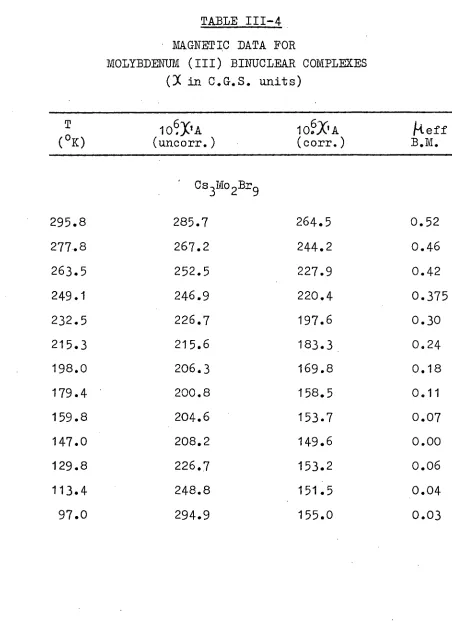
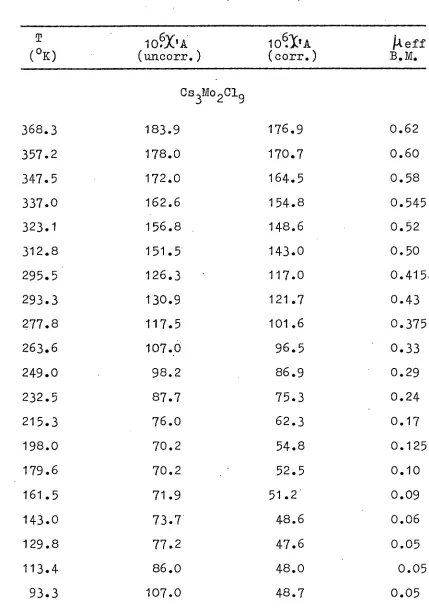
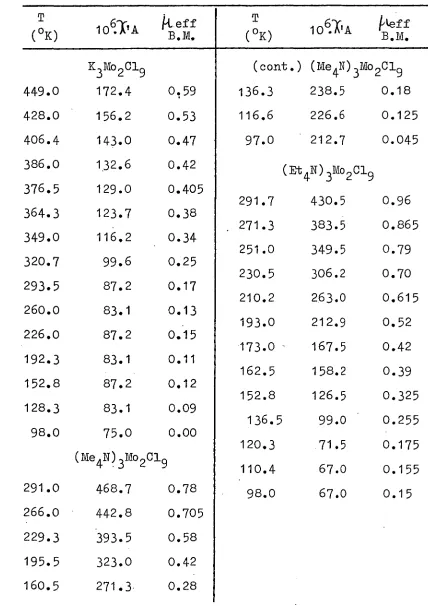
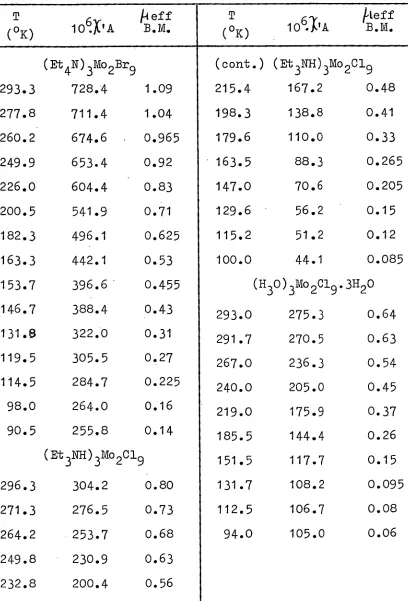
compounds A 3Mo 2X9 (A = K, CS, MS4N, Et 3NH I Et 4N, H30;
X = Cl and A = Cs, Et 4N; X = Br) has been measured in
the temperature range 90-400 oK. The results are listed
in Table 111-4 (Experimental). The susceptibilities for
the two caesium salts were corrected for the presence of
small traces of paramagnetic impurity. Both the measured
(uncorr.) and the corrected l -PA (corr.)
susceptibi-lities are listed in Table 111-4. The method of
correct-ing for the impurity has been described in detail
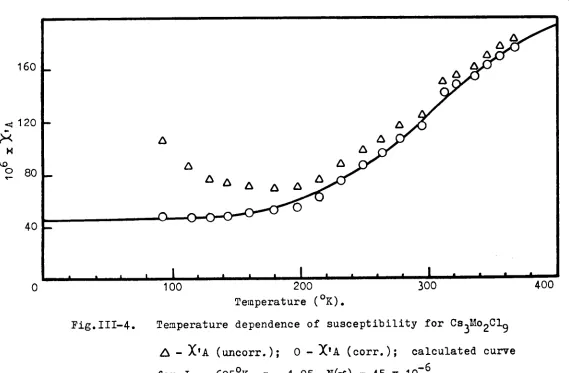
(Appendix). The susceptibilities (per NO atom) are
plotted as a function of temperature in Figs. III 4-7.
antiferromagnetic complex.
The application of the theoretical susceptibility expression III-1 to the fitting of these curves was simplified by substituting g values available from powder e.s.r. measurements on the complexes (73). The problem reduced to a least-squares fit including two variables, J and N (dg). Approximate values of N(X) were obtained from extrapolation of the experi-mental curves to T = 0 ° K. These initial values were then adjusted in steps of
5 x 10
-6 1
recalculating Juntil the best fit of equation III-1 to the experimental results was achieved.
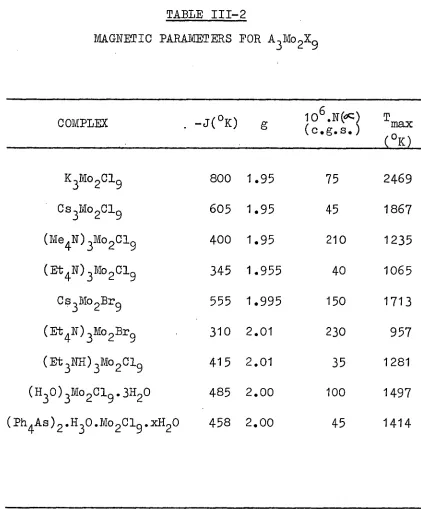
In Table 111-2, final values of g, -J (actually -J/k in ° K), N(0c) and T ( = -J/0.324) are listed. It
is difficult to estimate the magnitude of the error
associated with the exchange integral -J. On a basis of a precision of weight change of ± 0.01 mgms. (an average change being 2 mgms.), the limits of error are calcu-lated to be ± 10 - 20 ° for the range of temperatures studied. However, J is fixed by the position of the maximum in the susceptibility curve. For the potassium salt, T = 2470 °K and so the experimental results extend over only 116th of the susceptibility curve to
in T and hence J. For the salts with small cations max.
an error in J of --5eis probably not pessimistic. For
the salts with larger cations (smaller values of J) the
error in J will be correspondingly smaller.
From a study of the magnetic data summarized in
Tables 111-1,2, the expected variation of magnetic
exchange in the compounds A 3 1V12X9 with both change of
metal, M, and ligand, X, is apparent. However, it is
also apparent that the magnetic interactions in these
compounds are markedly dependent on the cation, A. For
both the chromium and molybdenum series, increase in the
size of the cation is accompanied by a decrease in the
magnitude of the exchange integral.
To obtain useful information on the different
exchange mechanisms from these trends, it is necessary
to be able to correlate the magnetic results with
structural data on the complexes A 3M2X9 . In the
follow-ing chapter, the results of detailed x-ray structural
studies on these complexes will be presented, to form a
basis for the interpretation of the magnetic data
TABLE 111-2
MAGNETIC PARAMETERS FOR A
3Mb2X9
COMPLEX —J( ° K) g 106.N() T
( ° K)
K3Mo 2 C19 800 1.95 75 2469 Cs 3Mo 2 C19 605 1.95 45 1867 (Me 4N) 3Mo2C19 400 1.95 210 1235 (Et 4N) 3 Mo 2 C19
345 1.955
40 1065Cs 3 Mo 2Br9 555 1.995 150 1713 (Et 4N) 3Mo2Br9 310 2.01 230 957 (Et 3NH) 3Mo2C19 415 2.01 35 1281
(H30)3Mo2C19.3H20 485 2.00 100 1497
[image:44.546.87.508.49.558.2]160
40
. I .
100 200 300 400
Temperature (°K).
[image:45.707.52.621.126.499.2]• •
300
1 . 1
100 200
Temperature ( ° K). 600
400
200
Pig. 111-5. Temperature dependence of susceptibility.
A. (Et 4N) 3 Mo 2 C19 , calculated curve for
J = -345 0 K, g = 1.955, 11c) = 40 x 10 -6 ;
B. (Et 4 N) 3 1.1o 2 Br9 , calculated curve for
200 400
300
100 200 300
Temperature ( ° K).
Fig.III-6. Temperature dependence of susceptibility.
A. (Me 4N) 3 Mo 2 C19 , calculated curve for
J = —400 ° K, g = 1.95, NW = 210 x 10 -6 .
B. Cs 3Mo 2 Br9 , calculated curve for
100
. I . . I . . I
100 200 300
Temperature ( ° K).
Temperature dependence of susceptibility. A. (H3 0) 3 Mo 2 C19 .3H2 0,calculated curve for J = -485 ° K, g = 2.00, N(0c) = 100 x 10-6 ;
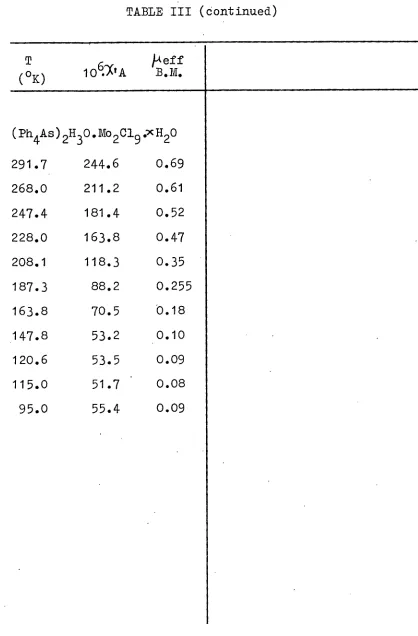
B. (Ph4As) 2 .H3 0.Mo 2 C19 .xH2 0, calculated curve for J = -458 ° K,
g =
2.00, 11(c‹) = 45 x 10-6.. The compounds Cs 3Mo 2X9 (X = Cl,Br) were kindly
supplied by Dr. A. G. Wedd.
The preparative procedure and results of analyses
have been described elsewhere and are given in Appendix
II
for the compounds (Et 3NH) 3Mo 2 C1 and (Et 4N) 3 11o 2X9
(X = Cl,Br).
1. Tripotassium tri-k-chloro-hexachlorodimolybdate (III).
It has been noted that the complexes A 3Mo 2 C19 , where
A is a small alkali metal cation, when prepared from
solution are contaminated by the corresponding mononuclear
complex A 3 MoC1 6 . Small amounts (<1%) of the mononuclear
species have a marked effect on the magnetic properties of
the binuclear species. The following solid-state method
of preparation is suitable for preparing compounds
A
3Mb2C19 free from the mononuclear complex.
Molybdenum (III) acid chloride solution (30m1s) was
evaporated to dryness. The resulting solid was
transfer-red to a nitrogen filled glovebox. About half the
stoichiometric amount of KC1 was finely powdered and the
molybdenum acid dimer added to the KC1 in three portions.
After the addition of each portion, the mixture was
intimately ground. The extremely hygroscopic acid dimer
the mixture gradually turned to a paste. It was then
vacuum dried and 50 mls. of "superdry" ethanol added.
This dissolved out the excess acid dimer. The insoluble
K
3Mo2019 was filtered off, washed with ethanol and dried under vacuum to a light orange-brown coloured powder.
A Debye-Scherrer powder x-ray photograph of the compound
showed no lines attributable to KC1. All lines could be
indexed on hexagonal cell closely resembling that for
Cs 3Mo 2 C1 9 (68).
Found: Mo', 30.2, 30.3; Cl, 50.7%.
K3 Mo 2 C19 requires Mo, 30,54; Cl, 50.78%.
2. Reaction between molybdenum (III) chloride and
tetra-phenyl arsonium chloride:-
Acid molybdenum (III) chloride solution (25 mls) was
evaporated to dryness. Three grams of tetraphenylarsonium
chloride (one third stoichiometric quantity) in 50 mls. of
dry ethanol was added dropwise to the solid acid dimer. A
pink crystalline precipitate formed immediately which was
filtered, washed with dry ethanol and vacuum dried.
Yield = 3.2 grammes. An infrared spectrum run on the
compound immediately after preparation showed the absence
of water. On exposure to air however the compound
rapidly took up -four moles of water (as indicated by the
molybdenum and chlorine analyses below). A sample which
the anhydrous (Pys) 2 H 3 0.Mo 2 C19 . Presumably there are holes in the structure, due to the poor packing of the
[Mo 2 019 ] 3- anions and the bulky (Ph 4As) -1- cations, which can easily be filled with water molecules, leading to a stabilization of the structure:
C H As Mo Cl Found 44.69 3.38 11.45 13.97 23.1 (Ph
4As)2H0.Mo20l9 : 44.46 3.34 11.56 14.80 24.61 (Ph
4As)2H0.Mo2Cl .4H2 0: 42.12 3.76 10.95 14.02 23.31 (Ph
4As)3.Mo2Cl9 52.06 3.64 13.53 11.55 19.21
3. Tri(tetramethylammonium) tri-R-chloro-hexachloro-dimolybdate (III).
The compound was prepared by the same method as for the tetraethylammonium salt. The complex is light orange in colour.
Found: C, 19.60; H, 5.01; Cl, 43.1; Mo, 26.2; N, 5.60%.
3Mo 2 C19 requires: 0, 19.68; H, 4.95; Cl, 43.51; Mo, 26.16; N, 5.73%.
4. Tri(oxonium)tri-i-t-chloro-hexachlorodimolybdate.
was maintained for 24 hours. The dry solid was a deep
red colour.
Found: Cl, 31.3; Mo, 51.0%. (H 3 0) 3Mo 2 019 .3H2 0
requires: Cl, 30.9; Mo, 51.2%. Mo:Cl - 1:4.42.
5.
Chromium trichloride:Chromium trichloride was used in the preparation of
the chromium complexes A 3 CrC1 6 and A 3 Cr2 C19 . As
detailed magnetic measurements were carried out on the
binuclear chromium complexes, it was essential that the
materials for the preparation of these compounds be
completely free from paramagnetic impurity. The most
satisfactory preparative method found was a modification
of the method given in Inorganic Syntheses (74). Hydrated
chromium (III) chloride is reacted with carbon
tetra-chloride at 62500. The reaction vessel is designed so
that ferromagnetic impurities such as iron compounds
distil away from the Cr01
3 and can be removed easily.
The product, in the form of small violet flakes, was
completely field independent over the range 300-90 oK. It
obeyed a Curie-Weiss law -)0A = 4 +0), Qr. -32 °.
Pleff = 3.89 B.M. at 300°K 04eff = 2.84J )A (T +0') ).
This was prepared by passing a bromine-nitrogen
mixture over powdered chromium metal (99.99%) at 800°C.
The compound was formed as large metallic flakes - olive
green by transmitted light, and dark brown by reflected
light. No field dependence of the susceptibility was
noted in the range 300-90°K. CrBr
3 obeyed a Curie-Weiss
law at high temperatures with( = -52 °. Slight
curvature was noted at temperatures 4. 100°K.
Isleff = 3.97 B.M. at 300°K. These results are in excel-lent agreement with the results of Hansen and Griffel (75).
7. Tricaesium tri-k-chloro-hexachlorodichromate (III):
Strong precautions were taken in this preparation to
remove all traces of water. Caesium chloride
(Koch-Light-99.99%) was maintained under high vacuum at 200 °C for four
hours prior to using. Stoichiometric quantities of CrC1 3
and CsOl (2:3) were accurately weighed (total weight= 2g.)
and intimately mixed in a nitrogen filled glovebox. The
mixture was transferred to a small silica tube (3 cm. x
1 cm.) which had been outgassed at 700 0 under vacuum. The
tube was sealed off at a vacuum of 10-6 ma. and placed in
a constant temperature furnace. The temperature was
increased to about ten degrees above the melting point of
for three days, then slowly cooled. The tube was
care-fully opened in the glovebox and found to contain a
glassy melt, which when broken open, was found to consist
of aggregates of violet hexagonal prisms.
All lines of the powder photograph for the complex
could be indexed on the hexagonal cell given by Ijdo
and Wessel (20).
Found: Cl, 38.6%. Cs 3 Cr 2 C19 requires: Cl, 38.83%.
The compounds K3Cr2C19 and Rb3Cr2Cl9 were prepared in
exactly the same way.
8. Tricaesium tri-k-bromo-hexabromodichromate (III):
This complex was prepared by a transpiration method.
A mixture of bromine and pure dry nitrogen was passed over
a mixture of CsBr : CrBr
3 (3:2) at 800 ° C. A temperature
gradient was maintained along the length of the tube and
the large hexagonal green crystals of the complex
deposited at the cool end.
Found: Br, 58.5%. Cs 3 Cr 2 Br9 requires: Br, 58.85%.
From powder photographs, the compound appeared to be
isos-tructural with Cs 3 Cr2 C19 . All observed lines could
be indexed on the basis of a bimolecular hexagonal unit
dichromate (III):
A 3:2 mixture of tetraethyl ammonium bromide and active" chromium tribromide were refluxed in acetyl bromide for an hour and the solution then cooled in ice. The green complex precipitated as small hexagonal prisms, which were filtered, washed with acetyl bromide and
vacuum dried.
Found: C, 23.6; H, 5.0; Br, 58.6; Cr, 8.45; N, 3.6%. C-24 HC N3 Cr2 Br9 requires: C, 23.75; H, 5.0; Br, 59.2;
60
Cr, 8.55; N, 3.5%.
Analyses:
Molybdenum and chromium were determined gravimetric-ally as the oxinate and as barium chromate respectively
(76). For those compounds with organic cations, moly-bdenum was also determined as Mo0 3 . Chlorine and bromine were analysed gravimetrically as the silver salt (77). Carbon, nitrogen and hydrogen were estimated by the
Alfred Bernhardt Mikoroanalytisches Laboratorium, Mulheim, Germany.
Magnetic Measurements:
and 400 ° K by the Gouy method. The general design of
the apparatus employed closely follows that of Figgis
and Nyholm(78). A 4 in. Newport Type A magnet was
employed in conjunction with a Stanton centre-zero
Type SM12 balance sensitive to 0.02 mgms. The field was
calibrated with CoHg (SON)4 and temperatures were
measured with a cillibrated copper-constantan
thermo-couple. The dependence of susceptibility on magnetic
field strength was checked at 3300 and 5770 oersteds; all
measurements reported were made at 5770 oersteds. Dia-
magnetic corrections were made in accordance with standard
K
3
Cr
2
Cl
9
293.8 265.8 230.8 176.8 142.5 116.7 96.4 88.0 295.6 266.0 238.0 210.8 176.7 143.3 117.0 96.0 91.0 182.8 168.6 151.0 123.9 107.4 94.8 85.5 81.8 186.2 170.4 155.7 141.2 122.8 105.0 91.1 80.8 78.7 Rb Cr2Cl9
MAGNETIC DATA FOR CHROMIUM (III) BINUCLEAR COMPLEXES ()( in C.G.S. units)
( ° K)
1L_
1)(T A ( o K) A
297.4 259.0 231.2 204.8 178.0 152.0 126.7 97.0 293.0 265.6 242.0 211.5 185.0 158.0 133.0 108.0
Cs
3
Cr
2
Cl
9
182.3 161.3 146.3 131.7 117.3 102.9 88.6 72.8 Cs 3 Cr2 Br9
[image:57.548.70.507.130.680.2]TABLE 111-3 (continued)
1 30A (EtN)
30r2Br9
291.5 153.7 271.0 142.5 244.2 128.5
215.5 114.0
188.8 99.6
161.8 85.3
143.5 75.1
124.0 63.9
TABLE 111-4 MAGNETIC DATA FOR
MOLYBDENUM (III) BINUCLEAR COMPLEXES (X in C.G.S. units)
10).1 A 10,9A keff
(uncorr.) (corr.) B.M.
' Cs3Mo
2Br9
295.8 285.7 264.5 0.52
277.8 267.2 244.2 0.46
263.5 252.5 227.9 0.42
249.1 246.9 220.4 0.375
232.5 226.7 197.6 0.30
215.3 215.6 183.3 0.24
198.0 206.3 169.8 0.18
179.4 200.8 158.5 0.11
159.8 204.6 153.7 0.07
147.0 208.2 149.6 0.00
129.8 226.7 153.2 0.06
113.4 248.8 151.5 0.04
TABLE III (continued)
( o K) ( uncorr. ) 10)(1 A. 10 6.1.tA (corr.)
eff B.M. Cs 3Mo 2 C19
368.3 183.9 176.9 0.62
357.2 178.0 170.7 0.60
347.5 172.0 164.5 0.58
337.0 162.6 154.8 0.545
323.1 156.8 148.6 0.52
312.8 151.5 143.0 0.50
295.5 126.3 117.0 0.415,
293.3 130.9 121.7 0.43
277.8 117.5 101.6 0.375
263.6 107.,0 96.5 0.33
249.0 98.2 86.9 0.29
232.5 87.7 75.3 0.24
215.3 76.0 62.3 0.17
198.0 70.2 54.8 0.125
179.6 70.2 52.5 0.10
161.5 71.9 51.2 0.09
143.0 73.7 48.6 0.06
129.8 77.2 47.6 0.05
113.4 86.0 48.0 0.05
[image:60.545.80.509.62.671.2]TABLE III (continued)
10 .A'A B.M. eff 10 6
.XA
tkeff B.M.449.0 428.0 406.4 386.0 376.5 364.3 349.0 320.7 293.5 260.0 226.0 192.3 152.8 128.3 98.0 291.0 266.0 229.3 195.5 160.5 468.7 442.8 393.5 323.0 271.3 0.78 0.705 0.58 0.42 0.28 291.7 . 271.3 251.0 230.5 210.2 193.0 173.0 . 162.5 152.8 136.5 120.3 .110.4 98.0 430.5 383.5 349.5 306.2 263.0 212.9 167.5 158.2 126.5 99.0 71.5 67.0 67.0 0.96 0.865 0.79 0.70 0.615 0.52 0.42 0.39 0.325 0.255 0.175 0.155 0.15 K3Mo2019
172.4 0159
156.2 0.53
143.0 0.47
132.6 0.42
129.0 0.405
123.7 0.38
116.2 0.34
99.6 0.25
87.2 0.17
83.1 0.13
87.2 0.15
83.1 0.11
87.2 0.12
83.1 0.09
75.0 0.00
(Me4N)3MO2019
(cont.) (Me4N)3Mo2C19
136.3 238.5 0.18
116.6 226.6 0.125
97.0 212.7 0.045
(Et4N)
[image:61.548.78.506.69.675.2](Et 4N) 3Mo 2Br9
293.3 728.4 1.09 277.8 711.4 1.04 260.2 674.6 0.965 249.9 653.4 0.92 226.0 604.4 0.83 200.5 541.9 0.71 182.3 496.1 0.625 163.3 442.1 0.53 153.7 396.6 0.455 146.7 388.4 0.43 131.5 322.0 0.31 119.5 305.5 0.27 114.5 284.7 0.225
98.0 264.0 0.16 90.5 255.8 0.14
(Et 3NH) 3Mo 2C19
296.3 271.3 264.2 249.8 232.8 304.2 276.5 253.7 230.9 200.4 0.80 0.73 0.68 0.63 0.56
106JOA B.M.
(°K) (oK)
',Leff
TABLE III (continued)
215.4 198.3 179.6
• 163.5
147.0 129.6 115.2 100.0 293.0 291.7 267.0 240.0 219.0 185.5 151.5 131.7 112.5 94.0 ( cent )
103A B.M. i•leff
(Lt31ffl)3Mo2C19
167.2 0.48
138.8 0.41
110.0 0.33
88.3 0.265
70.6 0.205
56.2 0.15
51.2 0.12
44.1 0.085
(H30) 3Mo 2C19 .31120
275.3 0.64
270.5 0.63
236.3 0.54
205.0 0.45
175.9 0.37
144.4 0.26
117.7 0.15
108.2 0.095
106.7 0.08
[image:62.551.100.508.67.668.2]keff (°K)106.1IA B.M.
(Ph
[image:63.548.80.498.37.673.2]X-RAY STRUCTURAL STUDIES ON A 3 M2X9 COMPLEXES OF CHROMIUM (III) AND MOLYBDENUM (III).
A. Review:
The structure of a binuclear transition element
complex of type A 3 M2X9 was first reported by Wessel and
Ijdo (20) for Cs 3 Cr 2 C1 9 . The complex has a bimolecular
hexagonal cell with a = 7.22, c =
17.93
A, and spacegroup P6 3 /mmc.
The structure is best described as hexagonal close
packing of caesium and chloride ions, which are
approx-imately the same size, to form layers CsC1 3 . The
chromium ions occupy two thirds of the octahedral sites
between layers, with chlorines as nearest neighbours.
The ordering of the layers is as shown in Fig.IV-1,
result-ing in pairs of chromium atoms. In the binuclear anions,
the chromium atoms are displaced away from the centres of
the octahedra to give a relatively large Cr-Cr separation
of 3.12 A (c.f. 2.5 A in the metal). The direct
metal-metal bond is expected to be negligible and in fact, the
compound exhibits normal paramagnetic behaviour, the room
temperature moment being reduced only slightly below the
spin-only value of 3.87 B.M. The electronic spectrum (80)
also closely resembles that for mononuclear PrC1 6 1 3- .
B A B C A C
(b)
Fig.IV-1. (a) Packing of cations A and ligands X to forai layers AX3.
(b) Ordering of layers in a unit cell for A
A detailed structural determination for K3W2C19 revealed that in the binuclear anion the tungsten atoms
are displaced towards each other to give a very short
W-W distance of 2.409 A (c.f. 2.74 A in the metal) (21).
The reported diamagnetism (69) is consistent with the
presence of a strong W-W bond.
In this laboratory, P.W. Smith has recently
determined the structure of 0s3Mo2019 (56). Although this compound has the same space group as 0s 30r2019 , the
binuclear unit is more closely analogous to that in K3W,01
4 9
in that the two molybdenum atoms are displaced towards each
other, giving a Mo-Mo separation of 2.68 A (c.f. 2.73 I in
the metal). The electronic spectra of the tungsten and•
molybdenum binuclear complexes, although generally similar
to the spectra for the [016] - compounds, show additional
peaks which apparently are due to essentially metal-metal
transitions (80).
The stability incurred by the formation of a
metal-metal bond is indicated by the existence of binuclear
pff2c19
1
3-
and No2C19 -13- ions in solution, whereas the corresponding chromium complex anion [Cr 201913- is not known in aqueous solution.The investigations reviewed here serve to illustrate
and on the structure of the binuclear anion has been
discussed in several reviews (70,81,82)
The results of the magnetic studies of Chapter III
and of spectral studies (83) on this system indicate
that the binuclear anion is also very sensitive to
change in the size of the cation, A. In fact,
increas-ing the cation size results eventually in a change of
the stoichiometry from A 3M2X9 to A 2 B1d2X9 B = H30 ,
M = Mo).
In this investigation the influence of the cation on
the structure of the binuclear anion has been examined
quantitatively by determining the three-dimensional
structure of K3Mo2C19 from a single crystal x-ray analysis
and comparing it with the structure of Cs 3Flo 2 C1
9 (56). Detailed correlations with powder data have enabled
important structural parameters for the other compounds
A
3M2X9 (M = Cr(III), Mo(III)) studied, to be determined. In the following sections the results of these x-ray
studies are discussed in detail to form a basis for the
understanding of the mechanisms for magnetic interactions
in
A3M2X9 binuclear complexes to be discussed in Chapter
TABLE IV-1
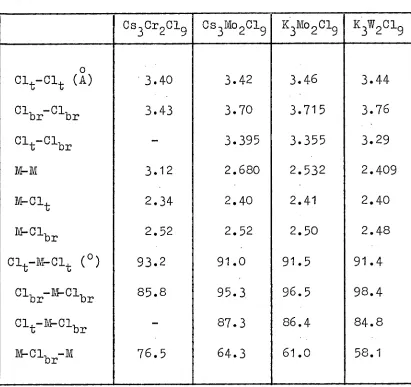
INTERATOMIC DISTANCES AND ANGLES FOR A3M2C19
0s3Mo201
9 K3Mo 2C19 K3W2C19
o
C1t-C1t (A) 3.40 3.42 3.46 3.44
01br-01br 3.43 3.70 3.715 3.76
01t-01br - 3.395 3.355 3.29
M-M 3.12 2.680 2.532 2.409
M-Clt 2.34 2.40 2.41 2.40
M-C1,r 2.52 2.52 2.50 2.48
01t-M-01t (°) 93.2 91.0 91.5 91.4
01br-M-01br 85.8 95.3 96.5 98.4
C1t-Id-CIbr - 87.3 86.4 84.8
The details of the single crystal x-ray structural
investigation on K 3 Mo 2 C19 are given in the Experimental
Section. Relevant structural parameters associated
with the complex anion [1\/1o 2 C19 1 3- , for both K 3Mo 2 C1 9
and Cs3Mo2Cl9 are compared in Table IV-1. Also listed
are the corresponding parameters for 0s 3 0r 2 C19 and
K
3W2 Cl9'
From Table IV-1 it is apparent that the change of
cation has negligible effect on the molybdenum-chlorine
bond lengths. However, on decreasing the size of the
cation from caesium to potassium, the
molybdenum-molybdenum bond length decreases from 2.68 to 2.53 A.
Also, although there is negligible change in the angles
associated with the terminal halogens, the
metal-bridging chlorine-metal angle is decreased from 64.3 °
to 61.0 ° .
The overall effect of the change of cation is thus
to "concertina" the [Mo
20l9]3- anion. Decreasing the
size of the cation, then has the same qualitative effect
as increasing the metal-metal bonding power of the central
metal, i.e. a compression of the M-X 3-M bridging
structure. This is illustrated by comparing with the
The effect of the cation on the structure of the
[M2X9 ]3- anion is easily seen from a study of the actual
three dimensional packing, illustrated in Figure
The structure contains two distinct cation sites,
design-ated as (A) and (B) in the diagram. Cation type (A), of
which there are two per molecular formula, is shared by
four [NI
2X9]3- anions. It has twelve nearest halogen
neighbours - two terminal halogens and one bridging
halogen from each of three lateral [M 2X9 ]3- units, and three terminal halogens from the fourth pd 2X91.13- anion. As the cation size is increased, the interstice can
expand to incorporate it both laterally (in the aa'
plane) by the movingqoart of the three lateral [M2X9 13-
units, and longitudinally, by the fourth [VW- anion
moving apart from the three lateral units.
Cation type (B), one per molecular formula, is
shared by only three lateral type [M2X9 ]3- anions. It
packs in the plane of the bridging halogen atoms and thus
is shared by two bridging and two terminal (one above and
one below) halogens from each of the three anions.
Cation site (B) is restricted with respect to change in
cation size. As the cation size is increased, again
there is lateral expansion of the three anionic units.
However to incorporate the longitudinal increase in cation
(B) cation site. This restriction is manifested in the chaigeover in stoichiometry from A 3M2X9 to
A 2 B M2X9 when one reaches a limiting cation size. For molybdenum complexes, it has been observed that the
cation EtN+ forms complexes of the former type while Ph
4As
+ gives rise to a complex of formula (Ph4As) 2 .(H 30).Mo 2 C19 .
To summarize, the effect of change of cation is to gitre rise to a trigonal distortion of the bridge structure of the complex anion. Increase in cation size results in an expansion of the binuclear unit. The increased metal-metal separation should result in a weaker direct magnetic interaction.
In the complexes A 3 M2X9 , as typified by K 3 Mo 2 C19 and Cs3Cr2Cl9' the metal atoms occupy special positions
2M in(1/3 1 2/3, z); (1/3, 2/3, 1/2 - z)
in the bimolecular hexagonal unit cells. The separation between pairs of metals in the binuclear anions is then simply (zz - 0.5) x c, where c is the length of the c axis. In an isostructural series of such complexes, the metal-metal separations would hence be in direct ratio to the lengths of the c axes.
• 4 • ••• .
•
• -
.• 5
•If • . • •;.-1
: '
' •
• • 1.
• •••
1.1. • • 1,e, •
•
• 00 I •
•
• ,"
s•i.. / It •
IA• • * • CATION SITE B • • .r• . .* • •.• •,•!. •
•11, 94'
• • •
•LF
• •
.• •••
.•• e ?C' • • .
I • •
Nt.
••••: .f. (*.
..Z " ' :■.** • a •• . ; • •• ; • / I
s s • • '` • ; 4 • • . • I •S , • • :
e• •••
a 4 • •• • • •• • • •
j A
• OA" • s • •
.;-• • • ;
• • •
. •
••• • •
r'. .
• d . . :
a • a •• •1 • •• :1 :0 i . •
f: I • %
A A.,......, .. •
•
• ..,
• . .
iPA: . , :•:•• . • .. i• • • .
ol • I •
• .. ;
4,, • :,
) - -,..;. • • • •••• • •
A „„,' • -
.• •
• •
•
4.,•••• •.•/;••• ••
I .
•1 •
• 1 g
:-/.
4
. • • .•. • ••• . •.• i ' ' •• • ' ... • ... * file
.; s :', . • •• ••( ••• : ;...• • $. •.% • • •••• • • • • • • • s. a2 - ,• I „
• 4.
, • • , • • • • • • • ( • • • • 'A' , • • •• • • • • • "i •. • a • • • .• . •
I.;
• • • • /./;.1 •f ZA, .• I .1 . .
A •• P •• . 4..
CATION SITE A I. • • 4. • ' • t '5 • ••• 6 ... -:...
• • •
• :P. ...
[image:73.551.81.520.49.665.2]..•
at
Fig.IV-2. Cation sites in A3M
perturbing forces on the packing of the atoms, i.e.,
geometrical packing alone must influence the variation
of cell dimensions in an isostructural series. The
presence of metal-metal bonding is such a perturbing
force and its variation in the series of complexes
studied implies they cannot be classed as members of
a strictly iso-structural series. This is illustrated
by the variation of the metal "z" cordinate from
K
3W2019 to Cs30r2019 in Table IV-2. The metal z co-ordinates show a definite relationship to the
metal-metal bonding, as represented by the magnetic exchange
integral, J. i.e., the larger the magnetic exchange
integral, the smaller is the metal z coordinate.
TABLE IV-2
COMPLEX K
3W2C19 K3Mo 2 C1 9 Cs 3Mo 2 C19 Cs 3 Cr 2 C1 9
z (Metal) 0.3241 0.3261 0.3265 0.3370