APPLICATION OF COCONUT FIBER-PP COMPOSITE FOR FABRICATION ON INTERIOR PART OF AUTOMOTIVE COMPONENT
NUR FADHILAH BINTI MAIDIN B041310105
BMCD
Email: [email protected]
Draft Final Report Final Year Project II
Supervisor: DR. MOHD AHADLIN BIN MOHD DAUD 2nd Examiner: DR. MOHD ASRI BIN YUSUFF
Faculty of Mechanical Engineering Universiti Teknikal Malaysia Melaka
APPLICATION OF COCONUT FIBER-PP COMPOSITE FOR FABRICATION ON INTERIOR PART OF AUTOMOTIVE COMPONENT
NUR FADHILAH BINTI MAIDIN
APPLICATION OF COCONUT FIBER-PP COMPOSITE FOR FABRICATION ON INTERIOR PART OF AUTOMOTIVE COMPONENT
NUR FADHILAH BINTI MAIDIN
This report is submitted
in fulfillment of the requirement for the degree of Bachelor of Mechanical Engineering (Design and Innovation)
Faculty of Mechanical Engineering
UNIVERSITI TEKNIKAL MALAYSIA MELAKA
ii
DECLARATION
I declare that this project report entitled “Application of Coconut Fiber-PP Composite for Fabrication on Interior Part of Automotive Component” is the result of my own work except as cited in the references.
iii APPROVAL
I hereby declare that I have read this project report and in my opinion this report is sufficient in terms of scope and quality for the award of the degree of Bachelor of Mechanical Engineering (Design and Innovation).
iv
DEDICATION
v ABSTRACT
vi ABSTRAK
vii
ACKNOWLEDGEMENT
Bismillahirrahmanirrahim,
Alhamdulillah. Thanks to Allah SWT, who with His willing give me the strength and healthy body to complete this Final Year Project with title “Application of Coconut Fiber-PP Composite for Fabrication on Interior Part of Automotive Component”. This final year project report was prepared and submitted in fulfillment of the requirement for the degree of Bachelor of Mechanical Engineering (Design and Innovation).
Firstly, I would like to express my gratitude and deep regard to my supervisor, Dr. Mohd Ahadlin Bin Mohd Daud for guide and assign me a lot of task during two semesters of Final Year Project. I also want to thanks the staff especially assistant engineer from Laboratory of Mechanical Engineering whom which gave me their cooperation, valuable information, suggestions and guidance during preparation the result for my study.
viii
TABLE OF CONTENT
CHAPTER CONTENT PAGE
APPROVAL ii
DECLARATION iii
DEDICATION iv
ABSTRACT v
ABSTRAK vi
ACKNOWLEDGEMENT vii
TABLE OF CONTENT viii
LIST OF FIGURES x
LIST OF TABLES xi
LIST OF ABBREVIATIONS xii
LIST OF APPENDICES xiii
CHAPTER 1 INTRODUCTION 1
1.1 Introduction 1
1.2 Background 1
1.3 Problem Statement 2
1.4 Objectives 2
1.5 Scope of Project 3
CHAPTER 2 LITERATURE REVIEW 5
2.1 Coconut Fiber 5
ix
2.2 Polypropylene (PP) composite 8
2.3 Coconut Fiber Reinforced Polypropylene (PP) composite
11
2.4 Surface Treatment 12
2.4.1 Alkaline Treatment 12
2.4.2 Silane Treatment 13
CHAPTER 3 METHODOLOGY 14
3.1 Introduction 14
3.2 Preparation of Raw Materials 16
3.3 Fabrication of Samples 18
3.4 Experiment 20
3.4.1 Tensile Test 20
3.4.2 Density Test 21
3.4.3 Hardness Test 22
3.4.4 Microstructure Analysis 23
CHAPTER 4 RESULT AND DISCUSSION 24
4.1 Introduction 24
4.2 Mechanical Properties of Composite 24 4.3 Physical Properties of Composite 28
4.4 Microstructure Analysis 29
CHAPTER 5 CONCLUSION AND RECOMMENDATION 32
5.1 Introduction 32
5.2 Conclusion 32
5.3 Recommendation 33
REFERENCES 34
x
LIST OF FIGURES
FIGURE TITLE PAGE
2.1 The molecule structure of crystalline cellulose 6
3.1 Flow chart of the methodology 14
3.2 The process of preparing the coconut fiber 15
3.3 The process of preparing the polypropylene powder 16
3.4 The fabrication process of composites 18
3.5 An Intron Universal Testing Machine 20
3.6 An electronic densimeter 21
3.7 An analogue Shore scale “D” type of Durometer 21
3.8 Detail of Indentor Extension and Display Adjustment 22
3.9 An auto fine coater 23
3.10 The Scanning Electron Microscope 23
4.1 The tensile stress against weight percentage of coconut 25
fiber 4.2 The maximum load against weight percentage of coconut 25
fiber 4.3 Graph of load against extension 26
4.4 The tensile stress against tensile strain 27
4.5 The percentage of fiber in the composite 29
4.6 The bonding between coconut fiber and polymer matrix 30
xi
LIST OF TABLES
FIGURE TITLE PAGE
2.1 Main types of plastic used in automotive 9
2.2 Typical properties of thermoplastic 10
3.1 The composition of CFB/PP composite 18
xii
LIST OF ABBREVIATIONS
ABS Acrylonitrile Butadiene Styrene ASA Acrylonitrile Styrene Acrylate
ASTM American Society for Testing and Materials
CFB Coconut Fiber
HDPE High-density Polyethylene
PA Polyamide
PC Polycarbonate
PBT Polybutylene Terephthalate
PP Polypropylene
PE Polyethylene
PET Polybutylene Terephthalate
PMMA Acrylic
POM Polyformaldehyde
PUR Polyurethane
PS Polystyrene
PVC Poly-vinyl-chloride
xiii
LIST OF APPENDICES
APPENDIX A1 Standard Test Methods for Density and Specific Gravity (Relative Density) of Plastics by Displacement
APPENDIX A2 Standard Test Method for Rubber Property: Durometer
Hardness
1 CHAPTER 1
INTRODUCTION
INTRODUCTION 1.1
This chapter explains the background, problem statement, objectives and scope of the project. Introduction is the first part of my project report that acquaint with the basic points of the research and the direction of my study.
BACKGROUND 1.2
2
Since 1950s, plant fiber have been used in automotive industry for making interior part of automotive component such as seat back, headliners, door panels, package trays, pillar and others (Promper, 2010). Among various types of plant fiber, coconut fibers have durability to withstand heat and it is more resistant to moisture compared to others fibers. Coconut fiber, otherwise known as coir fiber, is a natural fiber extracted as fiber bundles from the husk of coconut. Coconut fiber can be found between the internal shell and the outer coat of a coconut. Before surface treatment, the color of coconut fibers are pale and its wall contained a lot of lignin and cellulose. The purpose of treatment is to clean the surface by removing each impurity (Fior et al, 2015) and to investigate the effect of the treatment when reinforced with polypropylene (O.M.L. Asumani et al, 2012).
Surface treatments are often used to improve the performances of natural fiber reinforced composites by bridging the bonding between the fiber and matrix in composite materials. From previous studies, surface treatment can increase the aspect ratio, which results in better fiber matrix interfacial adhesion (Fior et al, 2015). There are various types of surface treatment to improve the compatibility between lignocellulosic fibers and polymer matrices such as alkali treatment, silane treatment, acetylation, benzoylation, peroxide treatment, permanganate treatment, and isocyanate treatment. Among various types of treatment, alkaline and silane treatment is the most popular solution for surface treatment of fiber. Alkaline treatment involves dipping the fibers in sodium hydroxide (NaOH) while silane treatment soaking the fibers in silanol and alcohol.
3 PROBLEM STATEMENT
1.3
Since the first production automobile was introduced in the last 120 years in Europe, the automobiles have become an important role in the economic development of the country. Due to the increasing of demand and automobile's production, this gave an impact to the health of the natural environment. This is because most of automobile’s manufacturers produce automobile components with synthetic fiber reinforcements in thermoplastic composites such as polypropylene (PP) and polyethylene. Synthetic fibers are often used in various industries, but it is very harmful to be used in automotive application because it cannot withstand heat, malleable and non-biodegradable characteristic.
In order to protect the earth from rapid aging, the natural fibers especially coconut fiber have recently become considerable attention as a substitute for synthetic fiber reinforcements in thermoplastics. An automotive component made from coconut fiber composites contributes for a better life quality due to recycling of the natural ingredient can cause to decrease fuel consumption and gases emission. However, the uses of natural fiber in fabrication of interior part of automotive components are may not necessarily be able to guarantee safety to users. Thus, this study was done to investigate the mechanical and physical properties of coconut fiber when reinforced with polypropylene (PP) composites.
OBJECTIVES 1.4
The objectives of this project are:
1. To investigate the mechanical and physical properties of coconut fiber reinforced with polypropylene (PP) as a matrix with varying fiber weight fraction.
4 SCOPE
1.5
5 CHAPTER 2
LITERATURE REVIEW
2.1 COCONUT FIBER
Coconut or coir fibers are extracted from fiber bundles that obtained from the outer layer of the coconut palm. The name ‘coir’ for coconut fiber is obtained from the Tamil and Malayalam word ‘Kavur’, which means rope. A single coir fiber has a coarse surface with mean width of 0.02 mm and a mean length of 2.5 mm. Coconut fiber has the highest lignin content compared to other fiber such as flax, hemp and wool (Jayasekara & Amarasinghe, 2010). The advantages of coconut fiber are that it is non-abrasive, porous, stiff, resilient, hydroscopic, viscoelastic, biodegradable, compostable and combustible (Ali, 2011). As a fiber, it has a high strength, low in energy conversation and has good insulation properties.
6 2.1.1 Structure of Coconut Fiber
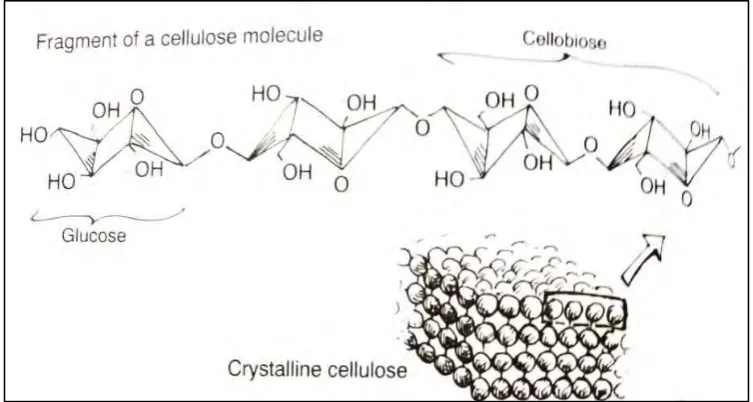
[image:21.595.134.511.424.625.2]Coconut fibers are found between the skin and inner shell of a coconut.Every single of fiber cells has a narrow, thick wall that consists of cellulose. Each cell has 1 mm long and 10 to 20 µm in diameter. The coconut fiber bundles have varies size depends on the place in which it is grown and also with the environment condition. According to Schnegelsberg (1999), coir fibers bundles can be divided into white coir, brown coir, bristle, omat, mattress and mixed. The immature’s fiber is white color, but once it grown it will become brown as a layer of lignin is deposited on their walls. By comparing between both types of fibers, fiber with brown color is stronger, thick and has high abrasion resistance. Both fibers are typically consists of 0.1 to 0.3 mm length. The fiber that contain more lignin and cellulose is more stronger because cellulose consist of thousands glucose unit that can stack to form crystalline with intramolecular hydrogen bonds providing a stable, hydrophobic polymer with high tensile strength (Akin, 2010). The Figure 2.1 below shows the molecule structure of crystalline cellulose.
7
2.1.2 Chemical Properties of Coconut Fiber
The main chemical components of coconut fiber bundles are cellulose, hemicellulose and lignin (Ali, 2011). These three types of composition can affect the properties of coconut fiber. Most of plant fibers consists more than 70% of cellulose. Cellulose is an inactive metabolism of structural carbohydrate and polysaccharide that consists of a linear chain of 𝐶6𝐻10𝑂5. Hemicelluloses occur
8 2.1.3 Applications of Coconut Fiber
Production based on coconut fiber have developed in many countries especially in India, Tanzania, Kenya, Bangladesh, Burma, Thailand, Sri Lanka, Nigeria, Ghana and Malaysia. The coconut fibers are widely used in making spinning of yarns, ropes, doormats, mattings, mattings, carpets, rugs, brushes and others (M. Kavita, 2015). In three decades ago, the application of coconut fiber has expanded extensively for the manufacture of interior part of automobile. This is because the coconut fibers have possibility to decrease weight and cause to better crash absorbance and sound insulation when applied to door trims, instrument panels, package trays, glove boxes, arm rests and seat backs (Szeteiova, n.d.). Apart from that, the coconut fiber also been used as a material in the fabrication of furniture, cabinets, boxes and vases and others (Ali, 2011). It also can be used to replace construction materials such as tiles, bricks, plywood, and asbestos and cement hollow blocks. In other engineering technology, coconut fibers are suitable to be used in composites for different purposes such as reinforcement of natural fiber and polymer as a substitute material.
2.2 POLYPROPYLENE (PP) COMPOSITE
9
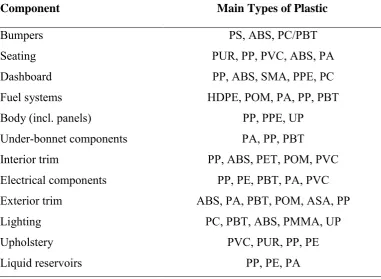
[image:24.595.116.498.393.672.2]In 1954, the first polypropylene was polymerized by Professor Giulio Nattain in Spain. Production of polypropylene expanded in a lot of application such as textiles, stationery, food container, automotive part and others. In 2013, the global market for polypropylene was spread about 55 million tonnes. Polypropylene is almost used to fabricate in all car’s component such as bumpers, doors, windows, headlight and side view mirror, trunk lids, hoods, grilles and wheel covers. Based on the Table 2.1 below, 32 percent out of total plastic used in car is polypropylene (Katarina, n.d). Production of polypropylene takes place by gas phase process in which involves exposing the propylene monomer to heat and pressure in the presence of a catalyst system. Polymerization is achieved at relatively low temperature and pressure and the product produced is translucent and ready in colored. Differences in catalyst and production conditions can be used to change the properties of the plastic.
Table 2.1: Main types of plastic used in Automotive
Component Main Types of Plastic
Bumpers PS, ABS, PC/PBT
Seating Dashboard Fuel systems Body (incl. panels)
PUR, PP, PVC, ABS, PA PP, ABS, SMA, PPE, PC HDPE, POM, PA, PP, PBT
PP, PPE, UP Under-bonnet components
Interior trim
PA, PP, PBT
PP, ABS, PET, POM, PVC Electrical components
Exterior trim Lighting
PP, PE, PBT, PA, PVC ABS, PA, PBT, POM, ASA, PP
PC, PBT, ABS, PMMA, UP
Upholstery PVC, PUR, PP, PE