Taverna Workflows: Syntax and Semantics
Daniele Turi, Paolo Missier, Carole Goble
School of Computer Science, University of Manchester, Manchester, UK
{
pmissier,dturi,cgoble
}
@cs.manchester.ac.uk
David De Roure
School of Electronics and Computer Science, University of Southampton, UK
[email protected]
Tom Oinn
European Bioinformatics Institute, Cambridge, UK
[email protected]
Abstract
This paper presents the formal syntax and the opera-tional semantics of Taverna, a workflow management sys-tem with a large user base among the e-Science commu-nity. Such formal foundation, which has so far been lack-ing, opens the way to the translation between Taverna work-flows and other process models. In particular, the ability to automatically compile a simple domain-specific process de-scription into Taverna facilitates its adoption by e-scientists who are not expert workflow developers. We demonstrate this potential through a practical use case.
1
Introduction
Past accounts of Taverna [OGAea06, SWAea07], a workbench for the definition and execution of scientific workflows, have been focusing mainly on its practical ap-plications to e-Science. However, a formal foundation of the Taverna model has so far been lacking. In this paper we fill this gap by presenting both the formal syntax of Taverna, and its operational semantics (Sections 2 and 3).
With this work, Taverna joins the ranks of other sci-entific workflow management systems for which formal models have been developed, notably Kepler [LABe05, MBL06] based on Process Networks [KM77], and BPEL [OVvdA+07], using Petri Nets. Some of the bene-fits of providing a formal syntax and semantics for a work-flow language are well-known, i.e., to apply process anal-ysis techniques [OVvdA+07], and to enable unambiguous mappings between models. Mappings, in turn, make inter-modeldataflow repositoriesa practical possibility. A recent
proposal for such a repository [HKS+07] uses Nested Re-lational Calculus (NRC) [BNTW95] to describe dataflows. As a further research contribution, in the second part of this paper (Section 4) we illustrate a less-explored practi-cal use of the workflow model, namely the formal descrip-tion of workflows that result from the automated transladescrip-tion from a high-level, domain-specific process model. This is motivated by the need to provide users who are not expert workflow developers, with a simple way to specify a stan-dard coordination among processors that they are familiar with.
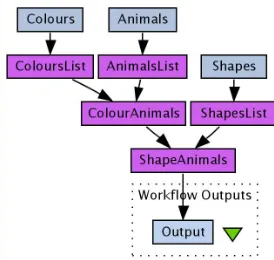
Informally, a Taverna workflow consists of a collection of processors with data and control links among them. Pro-cessors may have multiple inputs and outputs; a data link establishes a dependency between the output of a proces-sor and the input of another. A control link indicates that a processor can only begin its execution after some other processor has successfully completed its execution. Pro-cessors are implemented either as local Java classes, or as Web Services, with input and outputportsthat correspond to the operations defined in the service’s WSDL interface. The workflow execution engine schedules the invocation of the service operations, making sure that the dependencies are not violated, and manages the flow of data among the processors. A simple workflow, used as a running example throughout the paper, is shown in Figure 1.
pro-Figure 1. Workflow Diagram
gramming language to give a formal definition of a partic-ular workflow for the Ptolomey II system [LA03] (a pre-cursor to Kepler). The computational lambda calculus is obtained by augmenting the lambda calculus with suitable monads[Wad90] to model real-life behaviour of functional programs. The list operator, mapping a set A to the set L(A) of all lists formed with elements of the set A, is one such monad and Tavernaisthe corresponding compu-tational lambda calculus. This is a striking result, espe-cially since Taverna was not designed with the computa-tional lambda calculus in mind. Moreover, even relatively low level implementation details, such as the way Taverna deals with data cardinality mismatches, are accounted for by the theory.
2
Formal Syntax
2.1 Types
Taverna has base types likes, the set of strings; without loss of generality, we will considers to be the only base type. One can construct arbitrarily nested lists starting from the base types, ieL(s),L2(s), etc.1Taverna also allows for multiple inputs and outputs, hence products have also to be included. For instance:s×s,s×L3(s),L2(s)×s×s×L(s). Finally, we also need the 0-ary product type1for the special case of workflows with no output. Formally:
τ::=s|L(τ)|τ×τ|1
We useσandτto range over types.
In the example, ShapesList has two string inputs, string and regex, and one output split, a list of strings. Since data in Taverna is XML-formatted, the typess andL(s)are represented in the implementation using mime types, i.e., ‘text/plain’ and l(‘text/plain’), respectively. Given this simple type system, type mis-matches reduce to list nesting cardinality mismis-matches. As
1We writeLnfornapplications ofL.
we will see, some of these mismatches are dealt implicitly through iterations and wrapping.
2.2 Language
Contexts. A contextΓis a list of (typed) inputs:
Γ≡x1:σ1, . . . , xn:σn
where x1, . . . , xn are input variables of type σ1, . . . , σn. Given contextΓabove, we writeΓ, x:σto denote the con-textx1 :σ1, . . . , xn :σn, x:σ. Note that contexts can be
empty, i.e.,ncan be0. We writeType(xi) =σito denote
the type of variablexi.
For example, here is a context consisting of two input variables genes andurl, withType(genes) = L(s)and Type(url) =s:
genes :L(s),url :s
Workflows and Processors. We represent workflows with inputsΓand output of typeτassequentsof the form
ΓP :τ (1)
We extend the functionTypefrom variables (i.e., workflow inputs) to workflow outputs. Thus, in (1),Type(P) =τ. A workflow consists of a collection of processors with linked inputs and outputs. The remainder of this section formalises the linking process using asequent calculus, capturing the order in which the linking is done. The language accounts for the linking of processors with mismatching cardinalities, as in the example shown in§1.
Processors areaxiomsof the form
Γp:τ
A processor is a special case of a workflow. (Note the differ-ence between a workflow variableP and a processor con-stant p.) We use product types for multiple outputs. For instance, the KEGG serviceget enzymes by pathways ex-pects a pathway id as input and returns a list of enzyme ids as output. The sequent calculus notation for the correspond-ing Taverna processor is:
pathwayId :sget enzymes by pathways:L(s) (2)
In practice, each processor has a unique identifier, eg its WSDL address, instead of justget enzymes by pathways. Also note that:
Type(get enzymes by pathways) =L(s)
[image:2.612.98.235.24.154.2]processors using the quoted string itself. Thus, for instance, theconstant processorfor the string “foo” is:
“foo”:s (3)
Our example workflow in Figure 1 has three constant pro-cessors, namely:
“red, green”:s “cat, rabbit”:s
“square, circular, triangular”:s
The remaining five processors in the workflow are: x1:sColoursList:L(s)
x2:sAnimalsList:L(s) x3:sShapesList:L(s) x4:s, x5:sColourAnimals:s x6:s, x7:sShapeAnimals:s
Here is an example of a processor with no input and two outputs (a list of strings and a string):
p2:L(s)×s (4)
Note the product type. Conversely, here is a processor with two inputs and no output (the absence of output is denoted by the type1):
genes :L(s),url :sp3: 1
2.2.1 Syntax rules
Workflows are built using processors in conjunction with the following rules.
Pairing. We have seen in (4) that a processor with more than one output has product type. One can also obtain a product type by pairing two workflows, which amounts to having no link between them.
ΓP:σ ΓQ:τ
Γ P, Q:σ×τ (5) For instance, the pairing of (3) with (2) yields:
pathwayId :s
“foo”,get enzymes by pathways:s×L(s) (6)
Projections. The dual to pairing is to project. This is needed in order to select one of multiple outputs.
ΓP :σ×τ Γfst(P) :σ
ΓP :σ×τ
Γsnd(P) :τ (7) For example if we apply the second projection to (6) we get a workflow with the same type as (2) and, following the operational rules in§3, we can show that they have the same behaviour. Note thatn-ary products can be defined in terms of binary ones.
Simple Composition The basic rule of our calculus shows how to compose two workflows by linking one work-flow’s output to another workwork-flow’s input:
ΓP:σ Γ, x:σQ:τ
Γletx←PinQ:τ (8)
Note that theP andQabove are variables rather than con-crete workflows. Hence the rule applies to any pair of work-flows with matching types. The syntax:letx←P inQ stands for: “link the output ofP to the inputxofQ”. One can use the projection rule to select the intended output when therePhas more than one.
A simple example of this rule is the composition of (3) with (2):
letpathwayId ←“foo”in get enzymes by pathways:L(s)
This links the output of (3) to the only input of (2).
The Taverna workbench also supportsnested workflows, namely workflows that are reused inside another workflow. From the point of view of our formal language there is no difference with the workflow fragments we have used so far. It is just a naming convention.
Control link Control links denote that a processor (the controlled) cannot start execution before another processor (the controller) has terminated. This is type of sequential composition and can be easily simulated by adding to the controlled processor an extra new input of the same type as the output of the controller. Formally, sequential composi-tion is syntactic sugar for a let on a fresh variable:
P;Q ≡ letx←PinQ (9)
wherexdoes not occur inP nor inQ.
Taverna can deal with two dual types of cardinality mis-matches on the data, namely, when a listL(τ)is provided to a processor that expects input of typeτ, and viceversa, input of typeτis supplied instead ofL(τ). The following two composition rules account for these mismatches.
Iterative Composition. This rule uses a combination of composition and list replication. The list replication oper-ation takes an element aand a list[b1, . . . , bn] and maps
them to the list of pairs[a, b1, . . . ,a, bn]. Its type is thus
A×L(B)→L(A×B), for every pair of setsAandB.
ΓP:L(σ) Γ, x:σQ:τ
Γletx←PinQ:L(τ) (10)
For instance, if
is a processor giving a list of pathway ids, we can compose it with (2) using the above rule, obtaining:
letpathwayId ←pathways
inget enzymes by pathways:L2(s) (12)
Note that the input of (2) is a string therefore there is a car-dinality mismatch with the output of (11) which is a list: the rule ensures that the two can still be composed. The seman-tic rules presented in§3 define how that this is dealt with by iterations. Note that the output type of (2) was already a list of strings, so the type of the composition isL2(s), a list of lists of strings.
Wrapped Composition. This rule combines composition with the list wrapping operationup, which maps an element ato the one element list[a]. Its type isA→LA, for every setA.
ΓP:σ Γ, x:L(σ)Q:τ
Γletx←P inQ:τ (13)
This rule promotes the output of the first argument to a higher cardinality by wrapping it into a one-element list and then composes it. As an example, consider the String list unionlocal Java widget, taking two lists of strings in input and unioning them:
x1:L(s), x2:L(s)String list union:L(s) (14)
By composing the first input with, for instance, the string constant processor “red, green”, we get
x2:L(s)
letx1←“red, green”inString list union:L(s)
Flattening. The third canonical operation for lists flatten-ing, defined by the rule:
ΓP:L2(τ)
Γflatten(P) :L(τ) (15)
This flattens a list of lists into a single list. If we apply the latter to (12) we thus obtain the following, where the output is only one big list of pathways:
flatten(
letpathwayId ←pathways
inget enzymes by pathways) :L(s)
Note that, although not a primitive, Taverna has a local Java widget calledFlatten listthat does exactly this.
Cross Product The cross product iteration is syntactic sugar for double application of the iterative composition rule. Thus if we define
letx1x2←P1P2in ≡
letx1←P1in(letx2←P2inQ) (16)
we obtain the following derived rule:
ΓP1:L(σ1) ΓP2:L(σ2) Γ, x1:σ1, x2:σ2Q:τ Γletx1x2←P1P2inQ:L2(τ)
Dot Product In contrast with the cross product, the dot product is a primitive. This is the only rule that does not fol-low from the general computational lambda calculus frame-work.
ΓP1:L(σ1) ΓP2:L(σ2) Γ, x1:σ1, x2:σ2Q:τ Γletx1x2←P1P2inQ:L(τ)
(17)
In our example, if we set
• P1=letx1←“red, green”inColoursList
• P2=letx2←“cat, rabbit”inAnimalsList:L(s)
then
P1:L(s) P2:L(s) x4:s, x5:sColourAnimals:s letx4x5←P1P2inColourAnimals:L(s)
(18)
We conclude the section by presenting the formal syntax for the entire workflow in Figure§1:
letx6x7←
(letx3←“square, circular, triangular”inShapesList) (letx4x5←
(letx1←“red, green”inColoursList) (letx2←“cat, rabbit”inAnimalsList) inColourAnimals)
inShapeAnimals:L2(s)
3
Operational Semantics
rule for each syntactic rule in§2. These rules allow us to compute, on paper, what the outcome of running a work-flow is (see example in§3).
We use the notationP ⇓ uto denote that the workflow P successfully terminates with outputu. The latter can of course be a tuple of outputs and possibly contain lists.
In order to execute a workflow, this must beclosed, i.e., its context must be empty. Thus all the rules below apply for closed workflows.
Processors. Most processors are web services, hence their operational semantics is defined entirely by their in-put/output behaviour, since no structural inspection of their content is possible. We would for instance observe that if we provide the KEGG web service (see§2) with the path-way id “path:bsu00010” as input, the output consists of a list:
[ec:1.1.1.1, ec:1.1.1.2,ec:1.1.1.27, . . . ,ec:6.2.1.1]
Formally, we write this as:
letpathwayId
←“path:bsu00010”inget enzymes by pathways
⇓[ec:1.1.1.1,ec:1.1.1.2, ec:1.1.1.27, . . . ,ec:6.2.1.1]
This generalises to every closed processorP.
A special case is given by the string constant processors, whose semantics is the string itself, for example:
“red, green”⇓“red, green”
Finally, the ShapesList, AnimalsList and ColourLists processors all have the effect of splitting a string into a list of tokens: (using “,” as the regular expression):
letx1←“red, green”inColoursList⇓[“red”,“green”] (19)
letx2←“cat, rabbit”inAnimalsList⇓[“cat”,“rabbit”] (20)
Pairing. The semantics for the syntax pairing rule estab-lishes that if two workflowsPandQterminate with respec-tive outputsuandv, then the workflow pairP, Q termi-nates with pairu, vas output:
P ⇓u Q⇓v
P, Q ⇓ u, v (21)
Projections. Similarly for the two projections rules:
P ⇓ u, v fst(P)⇓u
P ⇓ u, v
snd(P)⇓v (22)
Flattening.
P ⇓[[w11, . . . , w1m], . . . ,[wn1, . . . , wnm]]
flatten(P)⇓[w11, . . . , wij, . . . , wnm] (23)
Thus the output of flatten(P) is obtained by removing the inner brackets from the output ofP.
The following rules deal with our three different forms of composition. Their application depends on the types in-volved.
Simple Composition. Let Q have input x, and Type(P) = Type(x). If P terminates with output u and if we send uthrough the inputxofQand obtainv, then their compositionletx ← P in Qalso terminates with outputv:
P⇓u Q[u/x]⇓v
letx←P inQ⇓v (24)
Note the notation Q[u/x]which stands for “substitute the valueufor the variablexinQ”.
Iterative Composition. IfType(P)isL(Type(x)), ifP terminates with a list valueu= [u1, . . . , un]and if eachQ
with ofuisubstituted forxterminates asvi, thenletx← P in Qterminates with output the listv = [v1, . . . , vn].
(Note that the vi’s might themselves be lists if that is the
type ofQ.) Formally:
P ⇓u {Q[ui/x]⇓vi}i=1..|u|
letx←PinQ⇓v (25)
Wrapped Composition. Conversely, let Type(x) be L(Type(P)). IfPterminates with outputuand ifQ termi-nates with valuevwhen the singleton list[u]is substituted forx, thenletx←P inQterminates withv:
P ⇓u Q[[u]/x]⇓v letx←P inQ⇓v
Cross Product Definition (16) and rule (25) imply the following:
P1⇓u P2⇓v
{Q[ui/x1][vj/x2]⇓wij}ij=1=1..n..m
|u|=n |v|=m letx1x2←P1P2inQ ⇓[[w11, . . . , w1m], . . . ,[wn1, . . . , wnm]]
(26)
write this as: ifP1 ⇓uandP2 ⇓vthen| u|=|v |. The rule is:
P1⇓u P2⇓v |u|=|v| {Q[ui/x1, vi/x2]⇓wi}i=1..|u|
letx1x2←P1P2inQ⇓w (27)
For example, using (19) and (20) and since the processor
ColourAnimalsconcatenates its two input strings, we have:
letx4x5←
(letx1←“red, green”inColoursList) (letx2←“cat, rabbit”inAnimalsList)
inColourAnimals⇓[“red cat”,“green rabbit”]
Example (continued) Here is the operational semantics of our entire example workflow:
letx6x7←
(letx3←“square, circular, triangular”inShapesList) (letx4x5←
(letx1←“red, green”inColoursList) (letx2←“cat, rabbit”inAnimalsList) inColourAnimals)
inShapeAnimals⇓
[[“square red cat”,“square green rabbit”], [“circular red cat”,“circular green rabbit”], [“triangular red cat”,“triangular green rabbit”]]
Note that the output of the workflow is, as expected from its type, a list of lists.
4
Application of the Taverna model:
work-flows as computed artifacts
One use of the formal Taverna language specification is to enable formal proofs that involve a workflow definition. An interesting example consists of an application scenario where users provide a high-level, declarative specification of a processP, which is then automatically translated into a Taverna workflowTP by a compilercomp. Given an apri-ori functional definitionfP()ofP, a formal specification forTP enables one to prove the correctness of the compiler
comp. In this section, we present the specification ofTP
for a particular case with practical applications in e-science. Note however that the complete proof is beyond the scope of the paper.
Producing a workflow specification as the result of a compilation step, rather than by direct user input, is desir-able whenever a family of workflows, all performing a sim-ilar function, can be described using few domain-specific,
user-friendly primitives. In such cases, it is possible to de-fine a workflow template and then specify rules for translat-ing the user specification into an instance of the template. By automating the translation process, we produce error-free workflows, at the same time reducing the burden to the user.
4.1 Quality workflows
A practical example of this scenario is provided by the Qurator framework for Information Quality management in e-Science, described in detail in [MEG+06]. Consider an e-scientist who has defined a workflow to perform some in silicoexperiment, and is aware that the quality of the re-sult can be adversely affected by the potentially poor quality of the data at some critical step in the process. The Qurator framework provides a simple way for the scientist to add a variety of tailormade quality filters to the original workflow, by specifying (i) which quality functions are to be applied to the data, and (ii) the quality control points in the origi-nal workflow where these functions are to be applied. This specification is known as aQuality View.
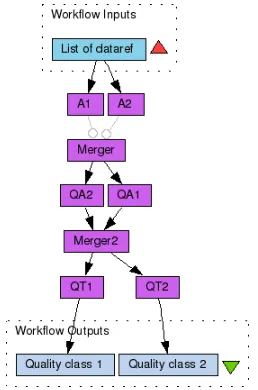
[image:6.612.363.492.385.580.2]Qurator provides an ontology of Information Quality functions as well as a simple, XML-based language to de-scribe Quality Views using the ontology classes. It also defines a workflow template that corresponds to a Taverna translation of a Quality View, and a compiler that takes a Quality View specification and computes an executable workflow, i.e., an instance of the workflow template.
Figure 2. Generic Quality Workflow
usingannotation processorsAi,i: 1. . . n, which associate metadata triples of the formname, class, valueto each input dataref. For example, C,q:coverage,32.5denotes an annotation with name C, type “q:coverage” (a reference to an ontology class) and value 32.5.
Next, a collection of quality functions processorsQAh, h: 1. . . l2take the annotations as input, and assign a score to each dataref. This is represented as a new annotation that is derived from the values for coverageC, along with those for other annotations.
Finally, the template accounts for yet a third layer of pro-cessors, denotedQTfor “Quality Testing”, which partition datarefs into quality classes according to logical expressions that predicate on the annotations accumulated through the previous steps. The classification{“accept”, “reject”}, for instance, can be used to indicate which data elements should be discarded from the workflow. In addition to filtering, more expressive classifications can be used, in combination with other types of actions. For example, colour labels can be assigned to data elements to indicate how they should be presented to the user. To accommodate such expressive-ness, Quality Views allow for the specification of multiple Quality Test processors.
A quality workflow is designed to be a sub-workflow em-bedded within a host scientific workflow, making the lat-ter “quality-aware”. In particular, the responsibility of per-forming the actual actions on the data is with the enclosing host workflow. Further details of the model, as well as of the example, are omitted for brevity.
4.2 Specification of Quality workflows
The following formal specification of a generic quality workflow is to be taken as an illustration of use of the Tav-erna model that may enable the formal proof of the Qurator Taverna translator.
Data annotations are represented as triples of the form name, class, value, of types×s×s, denoteds3.
Anannotation processorAi,i: 1. . . n, maps a datarefd to a list of annotation triples:
d:sAi:L(s3)
AQuality AssertionprocessorQAh,h: 1. . . l, computes a new annotation triple for a dataref, that is derived from a list of existing annotations previously computed by someAi:
y:L(s×L(s3))QAh:L(s×L(s3))
AQuality TestprocessorQTk,k: 1. . . r, assigns a qual-ity class label to a dataref according to the values of the available metadata, both primitive and derived:
w:s×L(s3)QTk:s×s
2These processors are calledQuality Assertionsin Qurator, hence the
termQA.
Note that the result of applying r independent Qual-ity Test processors is a list of lists of class-labelled datarefs, for instance [d1,“accept”,d2,“reject”] and [d1,“green”,d2,“red”](so thatd1is both “accept” and “green”, etc.).
The following rules define the quality workflow tem-plate.
Merging of annotations A Merger processor consoli-dates multiple list of annotation triples, each computed by a different annotation processor for the same input dataset, into a single list of annotations:
x1:s×L(s3). . . xn:s×L(s3)Merger:s×L(s3)
Composition of eachAiwithMergeruses a dot product to
provide multiple inputs toMergerin the correct order:
{D:L(s)Ai:L(s×L(s3))}i:1...n
x1:L(s3). . . xn :s×L(s3)Merger:s×L(s3)
D:L(s)letx1. . .xn ←A1. . .An
inMerger:L(s×L(s3))
The corresponding semantic rule is:
{Ai[e/D]⇓ai}i:1...n Merger[{d, aj/xi}j:1...n]⇓ d, a
(letx1. . .xn←A1. . .AninMerger)[e/D]⇓w
where w = [d1, a1. . .dm, am] includes the input
dataset along with the consolidatd annotations. We write
WF1to denote the resulting workflow up to this point. Computing Quality Assertions WF1is composed with a QA processorQAh,h:i . . . l, using simple composition:
D:L(s)WF1:L(s×L(s3))
yh:L(s×L(s3))QAh:L(s×L(s3))
D:L(s)letyh←WF1inQAh:L(s×L(s3))
Here is the corresponding semantics rule:
WF1[e/D]⇓w QAh[w/y h]⇓vh
(letyh←WF1inQAh)[e/D]⇓vh
wherevh= [d1, a1. . .dm, am]includes the new
anno-tations computed byQAh.
Merging of Quality Assertion values LetPQAh denote the workflow fragment resulting from this latest derivation rule. AMergerprocessor is again used to consolidate the annotations computed by allPQAh into a single list of anno-tations:
{D:L(s)PQAh :L(s×L(s3))}h:i...l
x1:L(s3). . . xn :s×L(s3)Merger:s×L(s3)
with semantics:
{PQAh[e/D]⇓vh}h:i...l
Merger[d,aj/xj}j:1...l]⇓ d,a (letx1. . .xn←PQA1. . .PQAlinMerger)[e/D]⇓v
wherev = [d1, v1. . .dm, vm]is the dataset with
con-solidated Quality Assertion annotation values.
Performing Quality Tests As a final step the resulting workflow, denoted WF2, is composed with each of ther Quality Test processorsQTkusing iterative composition:
D :L(s)WF2:L(s×L(s3)) w:s×L(s3)QTk:s×s
D:L(s)letw←WF2inQTk :L(s×s)
The corresponding semantics is:
WF2[e/D]⇓v QTk[di, ai/w]⇓ di, ci
(letw←WF2inQTk)[e/D]⇓[d1, c1, . . .dm, cm]
This step yields a set ofk : 1. . . rindependent workflows, denotedWF3,k:
WF3,k≡D:L(s)letw←WF2inQTk:L(s×s)
The final outputs from the entire quality workflow is ob-tained by pairing. Assuming w.l.o.g.r= 2, this is written:
D:L(s)WF3,1:L(s×s) D:L(s)WF3,2:L(s×s)
D:L(s) WF3,1,WF3,2:L(s×s)×L(s×s)
with corresponding semantics:
WF3,1[e/D]⇓u WF3,2[e/D]⇓v WF3,1,WF3,2[e/D]⇓ u, v
where each of the final lists represents an independent class labelling of the input dataset.
5
Conclusions and further work
We have presented two contributions in this paper, (i) a new formal syntax and semantics for the Taverna workflow management system, and (ii) an application of the formal-ism to precise characterizequality workflows that are au-tomatically generated from a simpler, domain-specific pro-cess model.
The main focus of current work is on extending the model to describe data streams, currently unavailable in Taverna but essential to deal with large volumes of data, and one the main new features to be offered in the forthcoming Taverna 2 management system.
References
[BNTW95] P. Buneman, S. Naqvi, V. Tannen, and L. Wong. Principles of programming with complex objects and collection types. Theor. Computer Science, 149(3), 1995.
[HKS+07] J. Hidders, N. Kwasnikowska, J. Sroka, J. Tyszkiewicz, and J. Van den Bussche. A formal model of dataflow repositories. In DILS, pages 105–121, 2007.
[KM77] G. Kahn and D.B. MacQueen. Coroutines and networks of parallel processes. InIFIP congress, 1977.
[LA03] B. Ludscher and I. Altintas. On providing declara-tive design and programming constructs for scien-tific workflows based on process networks. Techni-cal Report SciDAC-SPA-TN-2003-01, San Diego Supercomputer Center, 2003.
[LABe05] B. Ludscher, I. Altintas, C. Berkley, and el. Sci-entific workflow management and the kepler sys-tem.Concurrency and Computation: Practice and Experience, Special Issue on Scientific Workflows, 2005.
[MBL06] T. McPhillips, S. Bowers, and B. Ludscher. Collection-oriented scientific workflows for inte-grating and analyzing biological data. In Proceed-ings DILS, LNCS/LNBI. Springer, 2006.
[MEG+06] P. Missier, S. M. Embury, M. Greenwood, A. D. Preece, and B. Jin. Quality views: Capturing and exploiting the user perspective on data quality. In
VLDB, pages 977–988, Seoul, Korea, September 2006.
[Mog91] E. Moggi. Notions of computation and monads.
Inf. Comput., 93(1):55–92, 1991.
[OGAea06] T. Oinn, M. Greenwood, M. Addis, and M. Nedim Alpdemir et al. Taverna: Lessons in creating a workflow environment for the life sciences.Concurrency and Computation: Practice and Experience, 18(10):1067–1100, August 2006.
[OVvdA+07] C. Ouyang, E. Verbeek, W. M. P. van der Aalst, S. Breutel, M. Dumas, and A. H. M. ter Hofstede. Formal semantics and analysis of control flow in WS-BPEL. Sci. Comput. Program., 67(2-3):162– 198, 2007.
[Plo81] G. Plotkin. A structural approach to operational semantics. Technical report, Aarhus University, 1981.
[SWAea07] S.Pettifer, K. Wolstencroft, P. Alper, and T. K. Attwood et al. myGrid and UTOPIA: An integrated approach to enacting and visualising in silico experiments in the life sciences. InDILS, pages 59–70, 2007.