IT IS NOT WORTH LEARNING IF IT IS NOT REMEMBERED:
DESIGNING E-LEARNING TO INCREASE MEMORY
Paula C. Engelbrecht, Tamas Makany, Katie Meadmore, Richard Dudley and
Itiel E. Dror
School of Psychology University of Southampton
Southampton SO17 1BJ United Kingdom
Abstract
The collation, storage and retrieval of information are essential components of successful learning. Whether information is retained depends on a variety of factors, including how the information fits with an individual’s existing knowledge, the way in which information is presented, and its complexity. Some of these factors are under the direct control of the e-learning designers and developers. Investigating these factors and how they impact on memory is important and can enhance the quality of e-learning.
Evidence from cognitive neuroscience suggests that information is stored in a semantically meaningful manner. It follows that e-learning technologies, which either mimic how knowledge is structured in the mind or which allow individuals to organise their own exploration of the information space, should facilitate learning and memory. However, the ability to freely explore an information space is also more taxing on an individual’s cognitive resources. Learners would need to expend cognitive resources remembering where they have been, as well as on deciding where to go next. These additional demands may impede learning, especially for more complex information. Most critical to investigate is the trade-off between the ability to build knowledge according to the learners’ cognitive structures and style (which is also more engaging), on the one hand; and the extra cognitive load associated with giving learners more control and information, on the other hand.
In this study we investigated the relationship between information layout, complexity of information content, and memory. Seventy-six participants took part in the study. A third of them were presented with information that was laid out in a linear fashion: learners encountered the items of information in a fixed and constrained sequence. This layout provided a structure for remembering the presented information and minimised cognitive load. Another third of the participants were given full control; they could select the order in which they learned the different topics and could freely navigate between them. This layout increased cognitive load and eliminated context structure, but was also potentially more engaging and allowed for individual differences. The remaining third of participants received an intermediate version, giving some, but not total, control. All the participants studied eight topics, half of them were given relatively simple information on each topic, whereas the other half where given more complex information.
The acquisition and retention of the learned material was assessed in all the experimental conditions. We found that constraining both the amount of information presented to the learners and the degree of navigational freedom they are given enhances information acquisition and retention. These factors are further discussed in terms of Cognitive Load Theory (CLT). Finally, the implication and application to e-learning design is considered.
Keywords
E-Learning, knowledge acquisition, long-term memory, information complexity, web layout, cognitive load, retention of information.
1. INTRODUCTION
In common with all methods of instruction, e-learning applications are designed to facilitate knowledge acquisition. According to cognitive theory, knowledge is held in long-term memory (LTM), a system which is considered to be limitless both in terms of the amount of information it can hold, and in terms of the duration for which this information can be retained.
Successful learning involves the assimilation of new information in LTM. This requires that the new information is consolidated with old information in a meaningful manner. It follows that the retention of information in LTM is partially determined by how well it fits with an individual’s existing knowledge. The present study investigates how external factors which are under the direct control of e-learning designers and developers affect memory performance. Specifically, the study investigates the role of the complexity of the learning material, the layout of the information, and the interaction of these two factors on knowledge acquisition and retention.
The processes involved in understanding new information take place in working memory, a system which is limited in both capacity and duration. Due to these confines, working memory imposes limits on the amount of information that can be mentally represented and processed at any given moment. Cognitive load theory (CLT) has been developed to explain how working memory limitations affect knowledge acquisition. According to CLT there are two separate sources of cognitive load: intrinsic and extraneous.
Intrinsic cognitive load arises from the complexity of the learning material. This complexity is manifested by the number of interacting elements which need to be processed simultaneously [13, 9]. It has been argued that intrinsic cognitive load is an inherent property of the material being processed [7]. Yet, what constitutes complex information is in part determined by the domain knowledge already held in the learner’s LTM [5]. Experts in a given field possess the relevant domain knowledge to enable them to code multiple elements of information as one element, thereby allowing them to process more information simultaneously. Thus, rather than being an inherent property of the learning material, complexity arises from the interaction between an individual’s domain knowledge and the information content.
Extraneous cognitive load is generated by the representational format of the learning material (e.g. whether it is presented in a text or a diagram) [2]. As with intrinsic load, extraneous load is partially determined by individual differences. In support of this claim it has been found that the use of 3D models for instructional purposes poses a higher extraneous load on individuals with low spatial abilities than on individuals with high spatial abilities [5]. A further assumption about extraneous load is that it only has a negative impact for learning tasks which are high in intrinsic load, because an individual’s cognitive resources are depleted under these circumstances [13, 9]. This argument is substantiated by studies which found that the format of the learning material only affects learning performance under high intrinsic load [13, 3, 2]. For example, an investigation into how well students learn and apply knowledge that is presented to them either in a text-based (high extraneous load) or a diagrammatic (low extraneous load) format, found that the use of the text-based format only gave rise to inferior performance under high intrinsic load conditions [2].
In the current study, domain knowledge was accounted for by recruiting first year psychology students. These participants have comparable background knowledge of cognitive psychology - the domain from which the learning material was drawn. Intrinsic cognitive load was manipulated through the use of both simple and complex versions of the learning material. The simple version contained fewer elements which needed to be integrated into a coherent LTM representation. Thus, according to cognitive load theory, the simple version should give rise to superior knowledge acquisition because it is less taxing on the participants’ cognitive resources. However, the complex version can potentially give rise to a richer representation of the material.
The extraneous cognitive load was manipulated in this study through the use of different navigational layouts of the web pages containing the learning material. The assumption that the navigational layout of these pages should constitute an extraneous load is supported by the finding that visuospatial working memory is engaged when learning with multimedia material [4, 5]. For example, under dual-task conditions in which the distracter dual-task engages spatial cognitive processing, the beneficial effects of illustrations on the recall of scientific text disappear [4]. It has been argued that there are three cognitive tasks which contribute towards a hypertext users’ cognitive load, namely, navigational tasks (planning and executing routes), informational tasks (reading and comprehending information content) and task management (coordinating between the two) [6]. The navigational layout of the e-learning environment will affect the navigational task and task management.
Three different navigational layouts were used in the current study. The first, “linear” layout allowed only for a simple progressive navigation from one topic to the next. This layout is conceptualised as being low in extraneous load because the learners do not need to choose where to go next, nor do they need to remember which topics they have already read. The second, fully “interconnected” layout allowed learners to navigate freely from any content page to another by means of a list of all the topics displayed at the bottom of each page. This layout was considered to impose a relatively high extraneous load on the learners because they had to choose where to go next as well as remember which topics they had already read. The third, “star” layout had a central index page from which the content pages could be accessed. This layout was considered to impose an intermediate extraneous load on the learners because although they had to remember where they have been and decide where to go next, the presence of the index page separated the navigational from the informational tasks. Cognitive load theory would predict that under conditions of high intrinsic load (complex information content) the extraneous load (navigational layout) should affect memory performance. Under low intrinsic load conditions, on the other hand, the layout should not play a role.
2. METHOD
2.1 Participants
Seventy-six first year psychology students took part in this the experiment (11 of whom were male). The participants were recruited from an optional first year psychology course. They received course credits in exchange for their participation.
2.2 Materials
The experiment was run on personal computers attached to 15 inch flat screen monitors. A standard keyboard and mouse were used. During the experimental sessions the computers were running Microsoft Internet Explorer version 6.0 in full screen mode. In this mode no scrolling was required to read the learning content. The web pages and the algorithms employed to record user behaviour were programmed using the HTML, PHP, AJAX and JavaScript programming languages and the MySQL relational database management system.
There were eight content pages in total and they were presented in three different layouts. The Linear
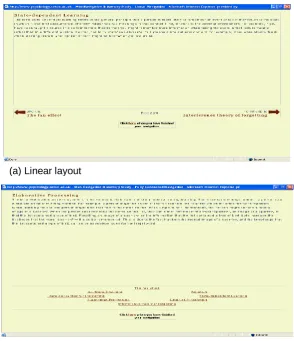
condition, as the name implies, allowed participants to navigate from topic to topic in a linear fashion. They could only navigate from one topic to another by pressing either the “forward” or the “back” arrow buttons (see Figure 1a).The order in which the topics were presented was randomly determined for each participant. In the Star condition the participants had to return to an index page whenever they wanted to move to a different topic. Finally, in the Interconnected condition the participants could freely navigate between pages without having to return to an index page first. In this condition, instead of having an index page, an index of the available topics was presented at the bottom of each content page (see Figure 1b). The order in which the topics were presented on the index page (Star condition) or on the bottom of each content page (Interconnected condition) was randomly generated for each participant.
contained a paragraph describing a relevant empirical study and a concluding paragraph which explained the broader implications of the phenomenon. The mean length of the simple descriptions was 140 words (range 117 – 176). The complex descriptions had a mean word count of 385 words (range 352 – 442). Each of the 8 topics filled one web page.
A questionnaire was designed to assess information retention and the participants’ experience in using their learning condition. The questionnaire contained a free recall question – “Please write as much or as little as you remember about each of the phenomena (even if this is only a name or an example)” which is reported and discussed in this paper.
2.3 Procedure
Upon arrival the participants were requested to sit in front of a computer terminal and to follow the instructions presented to them on the screen. After reading the consent form and answering some basic demographic questions, the participants were randomly allocated to one of the six treatment conditions. The algorithm which assigned the participants to the treatment conditions ensured an equal ratio of males and females and of age groups in each condition. There were six treatment conditions in total, reflecting the three different layouts (Linear, Star and Interconnected) and the two levels of complexity (simple and complex). The participants were given ample opportunity to explore the content pages. Once a participant had finished, indicated by shutting down the computer used, a questionnaire was administered. Most of the participants had finished reading and filling out the questionnaire after approximately 45 minutes. All of the participants were finished within an hour. After a two week delay the participants’ memory performance was reassessed using the same questionnaire.
(a) Linear layout
[image:4.595.150.445.359.701.2](b) Interconnected layout
3. RESULTS
The participants’ responses to the free recall question were scored by three independent markers. Overall the participants achieved a mean recall score of 11.95 (SE = 0.47, range 1 – 28) points. The
free recall data was analysed using a mixed design analysis of variance (ANOVA) with complexity (simple and complex) and layout (Linear, Star, Interconnected) as the between subjects variables and time (immediate, two week delay) as the within subjects variable.
Unsurprisingly, the ANOVA revealed a significant main effect of time on memory performance, F(1,70) = 242.56, p < .05. Immediately after study, the participants achieved a mean memory performance score of 15.25 (SE = 0.62) points. After a two week delay the participants mean memory performance was 7.89 (SE = 3.8) points. The ANOVA further showed a significant main effect of layout on performance, F(2,70) = 3.51, p < .05. A post hoc analysis of this data using a Bonferroni test revealed that the participants recalled significantly more information when it was presented to them in a linear layout (M = 13.1, SE = 0.82) than when it was presented in a fully connected layout (M = 10.02, SE = 0.73), p < .017. The performance of participants who had the information presented to them in a star layout (M = 11.38, SE = 0.81) did not differ significantly from the other two groups at p < .017. The main effect of complexity was also found to be significant, F(1,70) = 3.81, p < .05. Participants who were given simple information (M = 12.39, SE = 0.72) scored more highly on the free recall test than participants who were given complex information (M = 10.61, SE = 0.55).
The interaction between time and complexity was found to be significant, F(1,70) = 11.91, p < .05. Post hoc t-tests showed that immediately after study, the participants who were presented with simple information (M = 16.83, SE = 0.89) recalled more than those who were given complex information (M
= 13.4, SE = 0.72), t(74) = 2.91, p < .05. However, after a two week retention interval there was no longer a significant difference in recall performance between participants who studied the complex information (M = 7.83, SE = 0.51) and participants who studied the simple information (M = 7.95, SE = 0.57), t(74) = 0.16, ns. All other interactions failed to reach significance.
4. DISCUSSION
4.1 The effect of manipulating intrinsic cognitive load on retention
The present study explored the effects of manipulating intrinsic and extraneous cognitive load on knowledge acquisition and retention in an e-learning context. Intrinsic cognitive load was manipulated by generating a simple and a complex version of the learning content (low intrinsic load and high intrinsic load respectively). It was found that participants who studied the simpler version remembered more information overall than participants who studied the more complex version.
Cognitive Load Theory (CLT) posits that information which is low in intrinsic load is easier to integrate into coherent Long Term Memory (LTM) representations. Specifically, information which is low in intrinsic load imposes a lower demand on working memory and, therefore, increases the cognitive resources available for the formation of a LTM representation. This is consistent with the findings of the present study.
The recall advantage for simple over complex information was found to diminish with time. That is, after a two week interval no difference in retention was found between participants who had read the simple information and those who had read the complex information. This finding could be explained in terms of elaborative processing. The complex information content contained more disparate pieces of information; its mental representation is likely to capture at least some of these. Additional information could have acted as a retrieval cue for other pieces of information. Thus, because of their heterogeneity, the mental representations of the complex information contain multiple paths for LTM retrieval. This advantage in ease of retrieval might counteract the fact that the simple representations are more coherent. This would explain why participants in the simple and complex conditions showed comparable performance at the second retention test.
However, this explanation begs the question why this advantage was not apparent during the first retention test. One possible reason is that the complex information was not fully consolidated into LTM at the time of testing. In the context of exemplar based learning it has been argued that learners in general prefer a superficial processing-strategy and only engage in more effortful processing under ideal learning conditions [11]. The authors further argue that cursory processing of multiple examples might result in the learner being confused [11]. In the present study, cursory processing is likely to have been a sufficient strategy for the simple condition. However, in the complex condition, more active engagement with the material was required. Learning was therefore more time-consuming in the complex condition: not only was there more information to process, but it also took longer for participants to understand it and to draw connections between the different elements. It follows that, whereas the simple information may have already been consolidated at the time of first testing, for the complex information these processes may have still been ongoing.
An alternative explanation for the inferior performance of those participants in the complex condition is that they spent less time than their peers on completing the questionnaire. The participants read the information and completed the questionnaires simultaneously and in the same room. However, because they had less information to learn, participants in the simple condition completed the questionnaires before the participants in the complex condition. Participants in the complex condition may have been motivated to complete their questionnaires more hastily because they wanted to finish the experimental session at the same time as their peers. This could have caused these participants to provide less detail and information. At the time of second testing, all the participants started filling in the questionnaires at the same time, therefore no such factors were present.
4.2 The effect of manipulating extraneous cognitive load on retention
Extraneous cognitive load was manipulated by varying the level of cognitive engagement required to navigate the e-learning environment. Three different navigational layouts were created for this purpose: linear (low extraneous load), star (intermediate extraneous load) and interconnected (high extraneous load). The navigational layout was found to have an effect on retention. Specifically, it was found that participants who explored the information in the linear layout recalled more information than those who read the information in the interconnected layout. The star layout, although producing an intermediate level of performance, did not have a significant effect relative to the other two conditions.
These findings further support CLT. The linear condition imposed a low cognitive load on the participants and freed up working memory resources for the processes required for LTM formation. Conversely, the interconnected condition imposed more demands on working memory resources. Thus, under this navigation condition, fewer resources were available for the formation of mental representations.
CLT predicts an interaction between complexity (intrinsic load) and layout (extraneous load). Specifically, CLT predicts that the extraneous load manipulation should have a differential effect on performance in the high intrinsic load condition, but not in the low intrinsic load condition. No such interaction was found in the current study. Participants in both conditions were comparably affected by the extraneous load manipulation.
The lack of an interaction can be explained if one considers that people actively manage their task-related behaviour. Learners engage in task management activities which enable them to coordinate between navigational and informational tasks [6]. These task management activities allow participants in the high intrinsic load condition to focus on informational task performance at the cost of navigational efficiency. In previous studies the extraneous load manipulation (e.g. the format in which the learning material was presented) was intrinsic to the task and could not be ignored. However, this is not the case in the current study where ignoring the navigational layout to a certain extent should not directly affect performance on the learning task. This would explain why participants in the high intrinsic load condition were not more affected by the extraneous load manipulation than participants in the low extraneous load condition.
task-unrelated information and pursuit of task-unrelated goals might have increased the overall extraneous load for these participants.
4.3 Conclusions
Our findings have implications for the design of e-learning technologies for learners new to a field of study. Specifically, the learners’ navigational freedom should be restricted to free up cognitive resources for knowledge acquisition. Another design implication which could be drawn is that the information content should be kept as simple as possible to facilitate learning. However, this recommendation warrants further research because no retention advantage for simple over complex information was found after a two week delay. It is possible that after even longer delays an advantage for complex over simple information may be found. Such a finding would suggest that although simple information content eases acquisition of information, complex information is better retained. Thus, the provision of complex information may be preferable whenever long-term retention is the desired learning outcome.
Our study has illustrated that CLT provides a useful framework for understanding how e-learning design decisions - such as navigational layout and amount of information presented - will affect learning. However, an important shortcoming of CLT is that it does not take into consideration other important factors which affect learning, such as the learners’ task management activities and their motivation to learn. Although these notions could be conceptualised as different forms of extraneous load this is not to be recommended because it would diminish the theory’s predictive and explanatory powers. Instead we recommend that CLT should be integrated into a more comprehensive model of the learner which takes motivational and task management factors into consideration. Although some researchers have begun to examine aspects of this [12], further research is needed.
References
[1] Anderson, J. R. (1995). Cognitive Psychology and its Implications: Fourth Edition. New York: Freeman.
[2] Carlson, R., Chandler, P. & Sweller, J. (2003). Learning and understanding science instructional material. Journal of Educational Psychology, 95, 629-640.
[3] Chandler, P. & Sweller, J. (1996). Cognitive load while learning to use a computer program.
Applied Cognitive Psychology, 10, 151-170.
[4] Gyselinck, V., Cornoldi, C., Dubois, V., De Beni, R. & Ehrlich, M. F. (2002). Visuospatial memory and phonological loop in learning from multimedia. Applied Cognitive Psychology, 16, 665-685. [5] Huk, T. (2006). Who benefits from learning with 3D models? The case of spatial ability. Journal of
Computer Assisted Learning, 22, 392-404.
[6] Kim, H. & Hirtle, S. C. (1995). Spatial metaphors and disorientation in hypertext browsing.
Behavior and Information Technology, 14, 239-250.
[7] Kirschner, P. A. (2002). Cognitive load theory: implications of cognitive load theory on the design of learning. Learning and Instruction, 12, 1-10.
[8] Klein, K. & Saltz, E. (1976). Specifying the mechanisms in a levels-of-processing approach to memory. Journal of Experimental Psychology: Human Learning and Memory, 2, 671-679.
[9] Paas, F. & van Gog, T. (2006). Optimising worked example instruction: Different ways to increase germane cognitive load. Learning and Instruction, 16, 87-91.
[10] Schacter, D. L. & Graf, P. (1986). Effects of elaborative processing on implicit and explicit memory for new associations. Journal of Experimental Psychology: Learning, Memory and Cognition, 12, 432-444.
[11] Scheiter, K., Gerjets, P. & Schuh, J. (2004). The impact of example comparisons on schema acquisition: do learners really need multiple examples? In In Y. B. Kafai, B. Sandoval , N. Enyedy , A. S. Nixon, & F. Herrera (Eds.), Proceedings of the 6th International Conference of the Learning
Sciences, 457-464. Mahwah, NJ: Erlbaum.
[12] Schorr, T., Gerjets, P. & Scheiter, K. (2003). Analyzing effects of goal competition and task
difficulty in multiple-task performance: Volitional action control within ACT-R, In Proceedings of the
25th Annual Meeting of the Cognitive Science Society, 1053-1058.