Paper 167
7TH EUROPEAN DRYING CONFERENCE POLITECNICO DI TORINO
RECOGNITION OF INLET WET FOOD INTO THE DRYING PROCESS THROUGH A DEEP LEARNING APPROACH
Roberto Moscetti1, Simone Massaro1, Giovanni Chillemi1, Nico Sanna1, Barbara Sturm2, Swathi Sirisha Nallan Chakravatula1,Riccardo Massantini1
1Department for Innovation in Biological, Agro-food and Forest system
University of Tuscia, Via S. Camillo de Lellis snc, 01100 Viterbo, Italy Email: [email protected]
2Process and Systems Engineering in Agriculture Group, Department of Agricultural and Bisosystems Engineering, University of Kassel, Nordbahnhofstrasse 1a, 37213 Witzenhausen
Abstract
Deep learning was tested for its feasibility as CV tool for the analysis of inlet wet food into the drying process. In detail, convolutional neural networks (CNNs) were successfully applied for addressing the following tasks: (i) the semantic image segmentation of the inlet product; (ii) the inlet product classification for automatic selection of drying parameters. As a result, CNNs have been shown to be used for the development of smart dryers able to monitor and control the process.
Keywords: Python; Jupyter; artificial intelligence; machine learning; convolutional neural networks
1. Introduction
Among postharvest operations, drying is one of the oldest, typical, effective and viable preservation processes throughout the world. However, it is a relatively complex, dynamic, unsteady and nonlinear process that may suffer from the lack of adaptation to properties of wet material, which may be responsible for low quality end-product (Aghbashlo et al., 2015). Consequently, with the aim of circumventing this issue, new drying technologies must be designed around the quality attributes of the wet material.
Among emerging drying techniques, smart drying is one of the newest and most promising one. It is a multi- and inter-disciplinary sector which has potential to guarantee high value end-products by implementing innovative and reliable sensors, resources, tools and practices. Its recent development embrace various R&D areas, such as computer vision (CV) together with artificial intelligence, machine learning and deep learning (Moscetti et al., 2017), which deal with allowing computers to understand digital images and videos better than humans (i.e. colour, shape and size measurements as well as object segmentation, localization, detection and classification) (Li et al., 2015). Consequently, CV in combination with machine learning has the potential to be a powerful Process Analytical Technology (PAT) tool useful for enhancing the understanding and control of critical process parameters that impact on quality of the final product (van den Berg et al., 2013).
The main objective of the present study was to evaluate the feasibility of using convolutional neural networks (CNNs) for developing smart dryers able to recognise the inlet wet food into the drying process and to learn how to select the optimal operating conditions (i.e. relative humidity, temperature, air flow rate and duration of process) based on type and characteristics of the inlet wet food. Specifically, the deep learning algorithms were used to address the following tasks: (i) the semantic image segmentation of the inlet product (i.e., recognition between background and product pixels); (ii) the inlet product classification through the segmented image.
2. Material and methods
Nine species of fruits (i.e. apple, apricot, banana, cherry, kiwifruit, lime, nectarine, pear, plum) and nine species of vegetables (i.e. bell pepper, carrot, champignon mushroom, cherry tomato, cucumber, onion, plum tomato, potato, zucchini) were bought from a local market. Samples were washed and cut into slices of 3-mm thickness, except for apricot, cherry and plum fruits that were longitudinally cut in half. A flat scanner mod. CM2350 (Hewlett-Packard-HP, USA) was used to scan the digital image of the samples. Scanner profiling was performed using a ColorChecker Passport (X-Rite, USA), while image acquisition was carried out with the VueScan PE v9.2.11 software (Hamrick Software, USA). Each image was the average of 3 scans with a resolution equal to 2466×3498 (240 dpi and 8 bits per sRGB channel). One hundred samples per batch (i.e. class of product) were acquired. With the aim of circumventing unrealistic results, samples of each batch were randomly split in calibration and prediction subsets (70%) and (30%), respectively.
Image analysis and model development were both performed using interactive Jupyter Notebooks v5.7.4 developed in Python v3.7.2 programming language in combination with various Python packages. Specifically, (i) the conventional image segmentation was carried out with the OpenCV v3.4.5 library, while both (ii) semantic segmentation and (iii) image recognition models were computed using the fast.ai v1.0.51 library running on top of the PyTorch v1.0.1.post2 library. The U-Net fully convolutional network (Ronneberger et al., 2015) was used for training the semantic segmentation model (SSM). Image segmentation is an important step for measuring changes in colour, shape and size of the product so at to monitor quality loss and changes in moisture content during drying. Segmented images (i.e. image of product without background) were fed as input for a convolutional neural network (i.e. a CNN pre-trained on the ImageNet dataset) used for the development of image classification model (CM). The development of both models was tested on (i) a CPU mod. Ryzen 5 1400 (AMD Inc. CA, USA) and (ii) and a GPU mod. RTX 2070 8 GB (NVIDIA Corp. CA, USA). The GPU was used to boost the training step. CPU and GPU performances were compared in terms of time required to train the models. In both cases, a transfer learning approach was applied on a ResNet-34 model (ResNet-34, 2019). The vision.transform module of the fast.ai library was used to perform data augmentation (an image regularization technique) and then to make CNN models invariant to noise, translation, viewpoint, size and illumination of image through small random transformations, which did not change the content of the image itself but affected its pixel values.
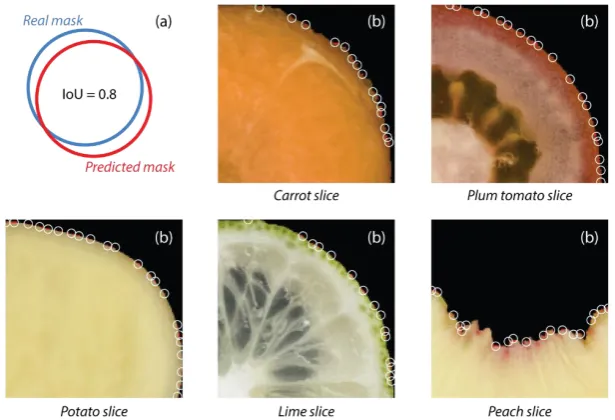
The SSM model performance was evaluated through the Intersection over Union (IoU) loss function. IoU consists of the ratio of the number of pixels in common between the target and prediction masks and the total number of pixels present across both masks (eq. 1):
IoU = target_pixels target_pixels predicted_pixels predicted_pixels (1)
The CM model was trained using the total error rate as loss function (eq. 2):
Total error rate = FP+FN
where, FP is the Type I error; FN is the Type II error; P and N are the number of real positive and negative cases in the data, respectively.
The optimal learning rates for both SSM and CM models were estimated using the Cyclical Learning Rates approach proposed by Smith (2015), while the optimal number of epochs was chosen at the point when calibration and cross-validation losses began to converge.
[image:3.595.95.505.271.436.2]Figure 1 shows the 2-step method used to develop both SSM and CM models. Step #1: the SSM model was retrained using masks obtained through conventional segmentation performed using an image thresholding method via the OpenCV library. Conventional segmentation is an operator-dependent and time-consuming process and thus the SSM model was developed to make the process simpler, accurate and automated. Step #2: samples were automatically cropped using the SSM model and then used as input for the development of the classification model. The CM model was retrained by replacing the ImageNet classifier in the last layer with a classifier having two new layers and many targets as the number of classes of the experiment (i.e. 18).
Fig. 1. Approach used to develop both SSM (step #1) and CM models (step #2).
3. Results and discussion
The best SSM model was retrained using the U-Net architecture with a learning rate of 5e-5 across 10 epochs and a batch size equal to 8. It showed excellent prediction performance in terms of Intersection over Union (IoU > 99%) (Figure 2).
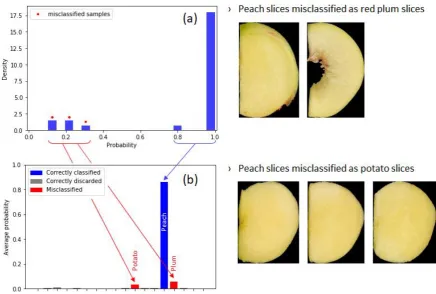
[image:3.595.144.452.528.738.2]The best CM model was obtained with a learning rate of 1e-3 across 3 epochs and a batch size equal to 64. It showed excellent total error rate in calibration (approx. 0.66%), cross-validation (approx. 0.99%) and prediction (approx. 0.81%). The total error rate was always due to peach slices misclassified as potato or red plum slices (Figure 3). Thus, further studies are needed for understanding the reason behind the misclassification of some peach slices and, thus, performing the fine-tuning the CM model for a more accurate peach slices recognition.
Fig. 3. Density histogram of the prediction probability for peach slices (a) and average prediction probabilities computed during peach slices recognition (b).
[image:4.595.135.464.582.671.2]Table 1 shows some preliminary performance results of commodity hardware based on CPU and GPU. Despite the entry level class of the gaming GPU, its computing performance (i.e. model training time) was extremely encouraging with respect to a multicore CPU. However, further benchmarking tests are ongoing on our computing facility to assess this performance scenario and a detailed progress report will be reported in further studies.
Table 1. Training performance: comparison between CPU and GPU
Model
Learning
rate Epochs Batch
Size
Runtime system
Training time (hh:mm:ss)
CMa 1E-03 3 64 CPU 00:07:47
GPU 00:00:26
SSMb 5E-05 10 8 CPU 09:46:00
GPU 00:22:31
aCM: classification model.
bSSM: semantic segmentation model.
4. Conclusions
Results obtained not only represent a step forward in the development of smart dryers able to recognise the inlet wet product, and to set the proper process parameters on its own or as a decision support system, but also lay the foundation for further researches on using computer vision system, alone or in combination with other sensors, as PAT tool to monitor and control smart drying processes.
Acknowledgements
The authors gratefully acknowledge [1] CORE Organic Plus consortium (ERA-NET action) and MIPAAF (Ministero delle politiche agricole alimentari e forestali - Italy) for financial support through the SusOrgPlus project (D.M. 20/12/2017, n. 92350) and [2] the ‘Departments of excellence 2018’ program (i.e. ‘Dipartimenti di eccellenza’) of the Italian Ministry of Education, University and Research (MIUR) for the financial support through the ‘Landscape 4.0 food, wellbeing and environment’ (DIBAF department of University of Tuscia) Moreover, our sincere thanks to Gianpaolo Moscetti for the English language revision of the manuscript.
References
Aghbashlo M., Hosseinpour S., Mujumdar A.S., 2015, Application of Artificial Neural Networks (ANNs) in Drying Technology: A Comprehensive Review, Dry Technol.33, 1397-1462.
LeCun Y., Bengio Y., Hinton G., 2015, Deep Learning, Nature. 521, 436-444.
Li J.B., Huang W.Q., Zhao C.J., 2015, Machine vision technology for detecting the external defects of fruits - a review. Imaging Sci J.63, 241-251.
Moscetti R., Raponi F., Ferri S., Colantoni A., Monarca D., Massantini R., 2017. Real-time monitoring of organic carrot (var. Romance) during hot-air drying using near-infrared spectroscopy, Food Bioprocess Technol.10, 2046-2059.
ResNet-34 Pre-trained Model for PyTorch., 2019, www.kaggle.com/pytorch/resnet34
Ronneberger O., Fischer P., Brox T., 2015, U-Net: Convolutional Networks for Biomedical Image Segmentation.
arxiv.org/abs/1505.04597
Smith L.N., 2015, Cyclical Learning Rates for Training Neural Networks. arxiv.org/abs/1506.01186