The Problem of Learning the Semantics of
Quantifiers
Nina Gierasimczuk
October 13, 2006
Abstract
This paper is concerned with a possible mechanism for learning the meanings of quantifiers in natural language. The meaning of a natural language construction is identified with a procedure for recognizing its extension. Therefore, acquisition of natural language quantifiers is sup-posed to consist in collecting procedures for computing their denotations. A method for encoding classes of finite models corresponding to given quantifiers is shown. The class of finite models is represented by appro-priate languages. Some facts describing dependencies between classes of quantifiers and classes of devices are presented. In the second part of the paper examples of syntax-learning models are shown. According to these models new results in quantifier learning are presented. Finally, the ques-tion of the adequacy of syntax-learning tools for describing the process of semantic learning is stated.
1
Introduction
According to an old philosophical idea, the meaning of a natural language con-struction can be identified with a representation of its denotation [Frege 1892]. This thought has been developed in the direction of identifying the mean-ing of an expression with a procedure for findmean-ing its extension [Tichy 1969, Moschovakis 1990, van Lambalgen, Hamm 2004, Szymanik 2004]. In the case of words: the meaning of “Poland” is the procedure of checking if the object in question satisfies conditions of being Poland. In the case of sentences: the meaning is a procedure for finding a sentence’s logical value. The meaning of “Alice has a cat.” is a procedure for checking if Alicia really has a cat. There-fore, we can say that someone understands a sentence (knows its meaning), if he knows a procedure for checking whether it is true or not.
is concerned with, namely procedures for finding denotations, become effective (algorithmizable).
2
Quantifiers
Many authors have already considered semantics of quantifiers from a com-putational point of view (see e.g. [van Benthem 1986, M. Mostowski 1998]); there have also been a few such attempts in linguistics (see e.g. [Suppes 1982, Cooper 1994, Bunt 2003]).
The presence and importance of quantifiers in natural language and con-sequently in linguistic research is beyond discussion. We use quantifiers very often in various contexts: “all”, “some”, “every other”, “half of”. . . examples can be multiplied. Computational semantics gives us an idea of the meaning of quantifier constructions. We know the meaning of the sentence:
1. Every other European is depressed
if we know how to check its logical value. The first solution for this sentence would be: we just count to two on our Europeans. One – normal, two – de-pressed, one – normal, two – depressed. . . . If this procedure is satisfied on the whole set of Europeans, then we can say that our sentence is true. If we made a wrong prediction somewhere and some “one” appeared to be depressed or some “two” was normal, we can conclude that the sentence is false in our universe of Europeans. Of course the meaning of “every other” explained above is not very obvious and common. In most usages of this quantifier we would say that “every other” is a more pictorial version of “exactly half” and means the same thing. This is the case especially when we have no natural ordering on our universe. Therefore let us now consider the second meaning of “every other”. In order to check whether every other European is depressed, we can execute one of following procedures:
1. Count Europeans; count depressed Europeans; ifNumber of Europeans= 2×Number of depressed Europeans, then the sentence is true, otherwise it is false.
2. Make Europeans stand in pairs: every normal European with a depressed European; if our pair-ordering does not leave any European alone, then the sentence is true, otherwise it is false.
Our example shows not only the trivial fact that some words or phrases are ambiguous, but also that we can use many non-equivalent procedures to operate “inside” one established meaning. Here arises the problem of identifying algorithms, which partially justifies our failures in explaining the phenomenon of synonymy (see [Moschovakis 2001, Szymanik 2004]).
con-ditions.1
We make here the not very controversial restriction to monadic quan-tifiers. This subclass we consider sufficient for linguistic considerations. Let us define quantifier as follows:
Definition 1 Let K be a class, closed under isomorphism, of finite models of the form (U, R1, . . . , Rn), where U 6=∅ andRi ⊆U, for i= 1, . . . , n. K is an
interpretation of monadic quantifier QK. For every model M and valuation ¯a
on M:
M|=QKx(ϕ1(x), . . . , ϕn(x))[¯a] ⇐⇒ (|M|, ϕ M,x,¯a
1 , . . . , ϕ
M,x,¯a n )∈K,
where|M|is universe of modelM, andϕM,x,¯a is a set indicated byϕinM with
respect to variable xby the valuation ¯a. QuantifierQK of type
(1,1, . . . ,1)
| {z }
n
binds one first-order variable inn formulae.
Let us give an example of a quantifier defined in the way described above:
Existential quantifier (∃) For allM:
M |=∃xϕ(x)[¯a]⇐⇒card(ϕM,x,a¯)≥1⇐⇒(|M|, ϕM,x,¯a)∈K E
The class of models KE which determines the interpretation of the exis-tential quantifier we define as follows:
KE={(|M|, R) :R⊆ |M| ∧R6=∅}
We have identified quantifiers with classes of appropriate finite models. This step allows us to encode models as words with certain features. Classes of models will be encoded as sets of words (languages). This encoding can be done by means of the concept of constituents (see [M. Mostowski 1998]).
Definition 2 The classKQ of finite models of the form(M, R1, . . . , Rn)can be
represented by the set of nonempty wordsLQover the alphabetA={a1, . . . , a2n}
such that: α ∈ LQ if and only if there is (U, R1, . . . , Rn) ∈ KQ and a linear
orderingU ={b1, . . . , bk}such that lh(α) =kand thei-th character of αisaj
exactly when bi∈S1∩ · · · ∩Sn, where:
Sl=
(
Rl if the integer part of 2jl is odd, U−Rl otherwise.
Such defined intersectionsS1∩ · · · ∩Sn are called constituents of the proper model. Charactersa1, . . . , a2n are names for these constituents. Our definition
says that thei-th character ofαisajexactly when elementbibelongs to thej-th
1
constituent. In other words,αuniquely encodes the model by giving information on the constituent to which every element belongs. We illustrate the idea for
n= 2. We considerM= (U, R1, R2), whereU={b1, b2, b3, b4, b5}. Our model is
represented by the wordαM =a1a2a4a3a3over the alphabetA={a1, a2, a3, a4}
which says that elementb1∈S1=U−(R1∪R2),b2∈S2=R1−R2,b3∈S4=
R1∩R2, andb4, b5∈S3=R2−R1.
Let us think of classes of monadic quantifiers as languages obtained by means of this encoding. We can now define what it means that some class of monadic quantifiers is recognized by some class of devices.
Definition 3 Let D be a class of recognizing devices, and Ω be a class of monadic quantifiers. We say that Daccepts Ωif and only if for every monadic quantifierQ:
(Q∈Ω ⇐⇒ there is some device A∈ Dsuch that Aaccepts LQ).
Using this definition, we can now recall the following results describing de-pendences between classes of quantifiers and classes of devices:
Theorem 1 [van Benthem 1984]QuantifierQis first-order definable ⇐⇒ LQ
is accepted by some acyclic finite automaton.
Theorem 2 [M. Mostowski 1998] Monadic quantifier Qis definable in the di-visibility logic F O(Dω) ⇐⇒ LQ is accepted by some finite automaton.
Theorem 3 [van Benthem 1986] Quantifier Q of type (1) is semilinear (ele-mentary definable in the structure(ω,+)) ⇐⇒ LQ is accepted by a push-down
automaton.
Additionally we can state that there are many natural language quantifiers which lie outside the contextfree languages [Clark 1996].
3
Learning
3.1
Identification in the limit
theory.2
This part of the paper is needed to establish final results.
Theidentification in the limit model [Gold 1967] shows what the process of learning can look like in general and what results we can obtain using it. This model describes the learnability of a given class of languages. One language from the class is chosen. The learner gains some information about it. The information can be presented in several possible ways (the data presentation method). The learner’s task is to guess the name of the language in question. Names of languages are simply grammars. The aim of the learner is to find a correct grammar for the presented sequence of linguistic data.
In each step of the procedure the learner is given a unit of data about the unknown language. Therefore, the learner always has only a finite set of information. In each step the learner chooses a name of a language.
The procedure is infinite. The language is identified in the limit if, after some time (finite but not specified in advance), the guesses remain the same and are correct. Identifiability concerns classes of languages. The whole class of languages is identifiable in the limit, if there is a guessing algorithm (learner) such that it identifies in the limit every language from this class. It is worth mentioning that the learner does not know when his guesses are correct. The learner proceeds infinitely, because it is not able to check if the next step won’t force it to change its decision.
Identification in the limit depends on three factors: data presentation method, naming relation and chosen class of languages.
The learner has the information presented in one of two ways:
Definition 4 A TEXT for language L is an ω-sequence, I, of words
α1, α2, . . .∈L, such that every word α∈Loccurs at least once inI.
Definition 5 An INFORMANT for language L is an ω-sequence, I, of elements of(A∗× {0,1}), such that for each α∈A∗:
(α,1) is in I if α∈L
(α,0) is in I if α6∈L.
The learner can use one of two naming relations:
Definition 6 AGENERATOR for language Lis Turing Machine,e, such that:
L={α∈A∗:{e}{α} ↓}.
Definition 7 ATESTER for language Lis Turing Machine that computes the function χL such that for each α∈A∗:
χL(α) =
(
0 ifα /∈L
1 ifα∈L.
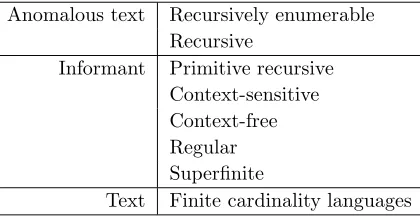
Let us now present Gold’s table of results for learnability and non-learnability of languages from the Chomsky hierarchy.3
2
For a detailed analysis of various learning algorithms see [Gierasimczuk 2005].
3
Anomalous text Recursively enumerable Recursive
Informant Primitive recursive Context-sensitive Context-free Regular Superfinite
[image:6.612.192.402.75.183.2]Text Finite cardinality languages
Table 1: Identifiability results. (Anomalous text is primitive recursive text with a generator naming relation. A superfinite class of languages is a class containing all finite languages and at least one infinite language.)
3.2
Syntax Learning Algorithms
We give here examples of learning algorithms effective for a certain class of languages. Firstly let us describe the L∗-algorithm proposed by Dana Angluin
[Angluin 1987]. In her paper she analyses the possibility of finite and effective identification of regular languages from an informant. The algorithm identi-fies the language by finding a deterministic finite automaton adequate for the unknown language. This procedure is controlled by the so-called Minimally Adequate Teacher. He answers two types of questions:
1. Membership queries: Is sequenceαin the unknown language?
2. Extensional equivalence queries: Is the deterministic finite automaton cur-rently being guessed by theL∗-algorithm extensionally equivalent4
to the deterministic finite automaton which corresponds to the unknown lan-guage being learned? If it is not, then the teacher gives a counterexample.
The algorithm L∗ is able to identify every regular language. L∗ works in time
polynomial in the number of states of the minimal dfafor the language being
learned and in the maximum length of the counterexample given by the teacher. The idea of learning with queries has been further explored, particularly in the direction of wider classes of languages. An example of such an attempt is the algorithm of Yasubumi Sakakibara [Sakakibara 1990]. It is a quite straight-forward translation of theL∗-algorithm described in the previous paragraph for
context-free grammars. TheLA-algorithm learns a given context-free grammar on the basis of so-called structural data: skeletons of derivation trees of the given grammar. The following facts allow identification in the limit:
1. The set of derivation trees of given context-free grammar is regular.
2. A regular set of trees is recognized by some tree automaton.
4
3. The procedure of changing derivation trees into their structural descrip-tions preserves the regularity of the set.
4. The problem of learning a context-free grammar from structural descrip-tions is therefore reducible to the problem of learning a certain tree au-tomaton.
It should be stressed that the aim ofLAlearning is not context-free language but some particular free grammar. It is known that for each context-free language there are infinitely many adequate grammars, therefore such a restriction is indispensable here.
4
Quantifier Learning
The problem of quantifier learning was raised and explored in [van Benthem 1986, Clark 1996, Florˆencio 2002, Tiede 1999]. These were similar to our attempts to use syntax-learning models to describe learning of the semantic aspect of language.
Persisting in the declared paradigm of computational semantics leads us to the assumption that acquisition of natural language quantifiers consists essen-tially in collecting procedures for computing their denotations. Additionally assumptions about the adequacy of finite models and restriction to monadic quantifiers gives us an opportunity to analyse many natural language quantifiers from the point of view of syntax-learning models. We can encode a quantifier and check its learnability according to results known from the field of inference theory. For instance, one such known fact is:
Theorem 4 [Tiede 1999] There are subclasses of F O quantifiers which are identifiable in the limit using text, e.g. the set of first-order left upward monotone quantifiers.
We now present similar results which can be inferred from previous considera-tions and theorems:
Proposition 1 The classes ofF O, F O(Dω)and semilinear quantifiers are not
identifiable in the limit using text but are identifiable using informant.
Proof This result follows directly form Theorems 1, 2, 3, and the fact that regu-lar and context-free languages are not identifiable using text but are identifiable
using informant.
Proposition 2 The monadicF O(Dω)-definable quantifiers are learnable using
the L∗-algorithm.
Proof By Theorem 2 every monadicF O(Dω)-definable quantifier can be rep-resented by the setLQ, which is accepted by some deterministic finite automa-ton. We know that deterministic finite automata are learnable by Angluin’s
L∗-algorithm. Therefore, the monadicF O(Dω)-definable quantifiers are
Proposition 3 Semilinear quantifiers of type (1) are learnable using the LA -algorithm.
Proof From Theorem 3 we know that a quantifier of type (1) is semilinear iff it can be represented by a setLQwhich is accepted by some pushdown automaton. Pushdown automata are a class of devices equivalent to context-free grammars, which are effectively learnable using Sakakibara’sLA-algorithm. Therefore, the semilinear quantifiers of type (1) are learnable using theLA-algorithm.
5
Conclusions
The approach presented in this paper can be treated as a strictly theoretical proposal. Nevertheless, let us now discuss some problems connected with mod-elling the natural process of semantic learning. First of all we can pose the question about the adequacy of tools of syntactic learning theory for describ-ing the process of semantic learndescrib-ing. Let us present some intuitions about the construction of semantic competence.
ability to check the logical value input: M andϕ;M|=ϕ?
ability to recognize Semantic inferential relations competence input: ¯ϕ,ψ¯; e.g. ¯ϕ`ψ¯?
ability to generate adequate descriptions input: M; find ¯ϕs.t. M|= ¯ϕ
The learnability models presented so far do not distinguish between the ability to check the logical value of a sentence and the ability to describe a given situation. There is of course a mutual translation between automata (testing devices) and grammars (generating devices). But are we allowed to treat these abilities as equivalent? Is it the case that if we can recognize the logical value of some sentence ϕ in a given model M, then we can also generate the sentence ϕ as the description of M? Some research concerning the relation between comprehension and production (equivalents of testing and generating) has already been done. It shows that the respective acquisitions of testing and generating competence are not parallel. First we can under-stand semantic constructions and only then are we able to use them in descrip-tions (see e.g. [Bates et al. 1995, Benedict 1979, Clark 1993, Fraser et al. 1979, Goldin-Meadow et al. 1976, Layton, Stick 1979]). Generating is more compli-cated than testing and the assumption of mutual reducibility of these two com-petences seems unrealistic.
The referential meaning of a sentenceϕis given by determining a method of establishing the truth-value ofϕin all possible situations. This kind of meaning is what we mainly refer to in this paper.
However, having a sentenceϕwe can establish its truth-value by means of in-ferences (recognized by our logical competence) betweenϕand other sentences. For example, knowing that a sentenceψ is true and ψ⇒ϕwe know thatϕis true; knowing that ϕis false and ψ⇒ϕwe know that ψ is false. In this way we determine the inferential meaning ofϕ.
Semantic learning models which are based on the syntax-learning approach seem to have no application in the case of learning inferential meaning. The nontrivial enterprise would be to describe possible learning mechanisms respon-sible for the acquisition of various semantic devices. Therefore we conclude that the learnability model presented so far is not compatible with the proposed de-scription of semantic competence. If one wants to propose a psychologically and linguistically plausible model of semantic learning, one must fight the aforemen-tioned subtle difficulties.
References
[Angluin 1987] D. ANGLUIN Learning Regular Sets from Queries and Counterexamples,Information and Computation 75(1987), pp. 87 – 106.
[Bates et al. 1995] E. BATES, P.S. DALE and D. THAL Individual Dif-ferences and their Implications, in P. Fletcher and B. MacWhinney (eds.) The Handbook of Child Lan-guage, Oxford 1995.
[Benedict 1979] H. BENEDICT Early Lexical Development: Compre-hension and Production, Journal of Child Language 6(1979), pp. 183 – 200.
[van Benthem 1984] J. VAN BENTHEMSemantic Automata,Raport of the Center for the Study of Language and Information, Stanford 1984.
[van Benthem 1986] J. VAN BENTHEMEssays in Logical Semantics, Rei-del Publishing Company, Amsterdam 1986.
[Bunt 2003] H. BUNT Underspecification in Semantic Representa-tions: Which Technique for What Purpose?,Proceedings of the Fifth International Workshop on Computa-tional Semantics 2003, pp. 37-54.
[Clark 1996] R. CLARK Learning First–Order Quantifiers Denota-tions. An Essay in Semantic Learnability, IRCS Tech-nical Report 1996, University of Pennsylvania, pp. 19 – 96.
[Cooper 1994] R. COOPER A Framework for Computational
Se-mantics, Edinburgh 1994.
[Florˆencio 2002] C.C. FLORˆENCIO Learning Generalized Quantifiers, Proceedings of Seventh ESSLLI Student Session 2002.
[Fraser et al. 1979] C. FRASER, U. BELLUGI, R. BROWNControl of Gram-mar in Imitation, Production, and Comprehension, Jour-nal of Verbal Learning and Verbal Behaviour 2(1979), pp. 121 – 135.
[Frege 1892] G. FREGE Uber Sinn und Bedeutung¨ , Zeitschrift f¨ur Philosophie und philosophische Kritik100(1892), pp. 25 – 50.
[Gierasimczuk 2005] N. GIERASIMCZUK Algorithmic Approach to the Prob-lem of Language Learning (in polish), MA Thesis, Warsaw University 2005, also to appear in: Studia Semiotyczne.
[Gold 1967] E.M GOLD Language Identification in the Limit, Infor-mation and Control 10(1967), pp. 447 – 474.
[Goldin-Meadow et al. 1976] S. GOLDIN-MEADOW, M.E.P. SELIGMAN and R. GELMAN Language in the Two Year Old,Cognition 4(1976), pp. 189 – 202.
[van Lambalgen, Hamm 2004] M. VAN LAMBALGEN, F. HAMM
Moschovakis’ notion of meaning as applied to lin-guistics, M. Baaz, S. Friedman, J. Krajicek (eds.), Logic Colloquium ’01ASL Lecture Notes in Logic 2004.
[Layton, Stick 1979] T.L. LAYTON, S.L. STICK Comprehension and Produc-tion of Comparatives and Superlatives,Journal of Child Language6(1979), pp. 511 – 527.
[Moschovakis 1990] Y. MOSCHOVAKIS Sense and Denotation as Algorithm and Value, in: J. Oikkonen and J. V¨a¨an¨anen (eds.) Lec-ture Notes in Logic 21994, pp. 210 – 249
[M. Mostowski 1998] M. MOSTOWSKIComputational Semantics for Monadic Quantifiers,Journal of Applied Non-Classical Logics 8(1998) no 1-2, pp. 107 – 121.
[Sakakibara 1990] Y. SAKAKIBARA Learning context-free grammars from structural data in polynomial time, Theoretical Com-puter Science75(1990), pp. 223 – 242.
[Suppes 1982] P. SUPPES Variable-Free Semantics with Remarks on Procedural Extensions, in: H. Bunt, I. Sluis, R. Morante (eds.)Language, Mind, and Brain1982, pp. 21 – 31.
[Szymanik 2004] J. SZYMANIK Computational Semantics for Monadic Quantifiers in Natural Language (in polish), MA Thesis, Warsaw University 2004, also to appear inStudia Semio-tyczne.
[Tichy 1969] P. TICHYIntension In Terms Of Turing Machines, Stu-dia Logica XXIV(1969), pp. 7 – 23.