arXiv:0906.1182v1 [cs.AI] 5 Jun 2009
Under consideration for publication in Theory and Practice of Logic Programming 1
The CIFF Proof Procedure for Abductive Logic
Programming with Constraints: Theory,
Implementation and Experiments
Paolo Mancarella and Giacomo Terreni Dipartimento di Informatica, Universit`a di Pisa
(e-mail:[email protected]) (e-mail:[email protected])
Fariba Sadri and Francesca Toni Department of Computing, Imperial College London
(e-mail:[email protected]) (e-mail:[email protected])
Ulle Endriss
Institute for Logic, Language & Computation (ILLC), University of Amsterdam (e-mail:[email protected])
submitted 23 January 2008; revised 23 December 2008; accepted 22 April 2009
Abstract
We present the CIFF proof procedure for abductive logic programming with constraints, and we prove its correctness. CIFF is an extension of the IFF proof procedure for ab-ductive logic programming, relaxing the original restrictions over variable quantification (allowedness conditions) and incorporating a constraint solver to deal with numerical constraints as in constraint logic programming. Finally, we describe the CIFF System, comparing it with state of the art abductive systems and answer set solvers and showing how to use it to program some applications.
(To appear in Theory and Practice of Logic Programming - TPLP).
KEYWORDS: Abduction, Constraints, Proof procedures.
1 Introduction
Abduction has found broad application as a powerful tool for hypothetical reasoning with incomplete knowledge. This form of reasoning is handled by labeling some pieces of information as abducibles, i.e. as possible hypotheses, that can be assumed to hold, provided that they are consistent with the rest of the given information in the knowledge base.
Console et al. 1991; Denecker and De Schreye 1998; Fung and Kowalski 1997). These differ in that they rely upon different semantics, the most common being the (gen-eralized) stable models semantics (Kakas and Mancarella 1990b) and the (three-valued) completion semantics (Kunen 1987). Many of these proof procedures en-rich the expressive power of the abductive framework by allowing the inclusion of integrity constraints (ICs) to further restrict the range of possible hypotheses.
ALP has also been integrated withConstraint Logic Programming(CLP) (Jaffar and Maher 1994; Jaffar et al. 1998), in order to combine abductive reasoning with an arithmetic tool
for constraint solving (Kakas et al. 2001; Kakas et al. 2000; Kowalski et al. 1998; Bressan et al. 1997) (in the sense of CLP, not to be confused with integrity con-straints). In recent years, several proof procedures for ALP with constraints (ALPC)
have been proposed, including ACLP (Kakas et al. 2000) and theA-System (Kakas et al. 2001). Important applications of ALP and ALPC include agent programming (Kakas et al. 2008; Kakas et al. 2004; Sadri et al. 2002), (semantic) web management applications (Toni 2001), planning and combinatorial problems (Wetzel et al. 1996; Kowalski et al. 1998).
Here we propose CIFF, another proof procedure for ALPC which extends the IFF procedure (Fung and Kowalski 1997) in two ways, namely (1) by integrating ab-ductive reasoning with constraint solving, and (2) by relaxing the allowedness con-ditions on suitable inputs given in (Fung and Kowalski 1997), in order to be able to handle a wider class of problems. The CIFF proof procedure has been implemented in Prolog in the CIFF System (Terreni 2008b).
CIFF features have been exploited in various application domains. In (Kakas et al. 2008; Kakas et al. 2004) CIFF has been used as the computational core for modelling an agent’s planning, reactivity and temporal reasoning capabilities based on a variant of the abductive event calculus (Kowalski and Sergot 1986a; Shanahan 1989). Also, a (slightly modified) prototype version of CIFF for checking and repairing XML web sites is currently under development (Mancarella et al. 2007; Mancarella et al. 2009; Terreni 2008a).
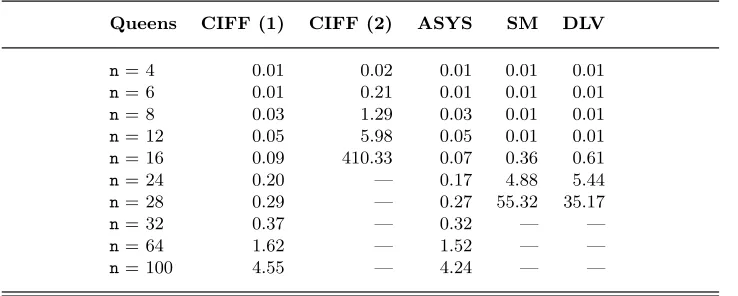
We have compared empirically the CIFF System to other related systems, namely the A-System (Kakas et al. 2001; Van Nuffelen 2004), which is the closest system from both a theoretical and an implementative viewpoint, and two state-of-the-art answer set solvers: SMODELS (Niemela and Simons 1997; Simons 2000) and DLV (Eiter et al. 1997; Leone et al. 2006). These solvers implement a different (answer set) semantics (Gelfond and Lifschitz 1991), but share with our approach the ob-jective of modeling dynamic and non-monotonic settings in a declarative (and thus human-oriented) way. The results of our tests show that (1) the CIFF System and the other systems have comparable performances and (2) the CIFF System is able to handle variables taking values in unbound domains.
This paper combines and extends a number of earlier papers: (Endriss et al. 2004b), defining an earlier version of the CIFF proof procedure, (Endriss et al. 2004a), (Endriss et al. 2005) and (Mancarella et al. 2007) all defining earlier versions of the CIFF System.
2 Abductive Logic Programming with Constraints
We present here some background on ALPC. We will assume familiarity with basic concepts of Logic Programming (atom, term etc.) as found e.g. in (Lloyd 1987). We will frequently write~tfor a vector of terms such ast1, . . . , tk. For instance, we
are going to writep(~t) rather thanp(t1, . . . , tk). Throughout the paper, to simplify
the presentation, we will assume that predicates cannot have the same name but different arities. Moreover, with an abuse of notation, we will often use disjunctions and conjunctions as if they were sets, and similarly for substitutions. In particu-lar, we will abstract away from the position of a conjunct (respectively disjunct) in a conjunction (respectively disjunction) and we will apply to disjunctions and conjunctions set-theoretic operations such as union, inclusion, difference and so on.
An abductive logic program is a tuplehP, A, ICiwhere:
• P is a normal logic program, namely a set ofclauses of the form: p(~s)←l1(~t1)∧. . .∧ln(~tn) n≥0
where p(~s) is an atom and each li(~ti) is a literal, i.e. an atom a(~t) or the
negation of an atoma(~t), represented as ¬a(~t). We refer top(~s) as thehead of the clause and tol1(~t1)∧. . .∧ln(~tn) as thebody of the clause. A predicate poccurring in the head of at least one clause inP is called adefined predicate and the set of clauses in P such that p occurs in their heads is called the definition set ofp.
Any variable in a clause is implicitly universally quantified with scope the entire clause.
• A is a set of predicates, referred to as abducible predicates. Atoms whose predicate is an abducible predicate are referred to asabducible atomsor simply as abducibles. Abducible atoms must not occur in the head of any clause of P (without loss of generality, see (Kakas et al. 1998)).
• IC is a set ofintegrity constraints which areimplications of the form: l1(~t1)∧. . .∧ln(~tn) → a1(~s1)∨. . .∨am(~sm) n, m≥0 n+m≥1
Each of theli(~ti) is a literal (as defined above) while each of theai(~si) is an
atom. We refer tol1(~t1)∧. . .∧ln(~tn) as thebody and toa1(~s1)∨. . .∨am(~sm)
as thehead of the integrity constraint.
Any variable in an integrity constraint is implicitly universally quantified with scope the entire implication.
Moreover, as is the convention in LP, we will assume as given aHerbrand universe, namely a set of ground terms. Further, we will refer to all ground atoms whose predicate belongs to the Herbrand signature ofhP, A, ICi and that can be built using terms in the Herbrand universe as the Herbrand baseofhP, A, ICi. Finally, we will refer toHerbrand termsas (ground and non ground) terms whose instances belong to the Herbrand universe. Then, a query Qto an abductive logic program hP, A, ICi is a conjunction of literals whose predicate belongs to the Herbrand signature of hP, A, ICi and whose arguments are Herbrand terms. Any variable occurring inQis implicitly existentially quantified with scopeQ.
A normal logic program P provides definitions for certain predicates, while ab-ducibles can be used to extend these definitions to form possible explanations for queries, which can be regarded asobservations against the background of the world knowledge encoded in the given abductive logic program. Integrity constraints, on the other hand, restrict the range of possible explanations. Note that, in general, the set of abducible predicates may not coincide with the set of all predicates without definitions inP (i.e. the set ofopenpredicates).
Informally, given an abductive logic program hP, A, ICi and a query Q, an ex-planation for a query Q is a set of (ground) abducible atoms ∆ that, together withP, both “entails” (an appropriate ground instantiation of)Q, with respect to some notion of “entailment”, and “satisfies” the set of integrity constraintsIC (see (Kakas et al. 1998) for possible notions of integrity constraint “satisfaction”). The notion of “entailment” depends on the semantics associated with the logic program P (there are many different possible choices for such semantics (Kakas et al. 1998)). The following definition of abductive answer formalizes this informal notion of ex-planation.
Definition 2.1 (Abductive answer)
An abductive answer to a query Q with respect to an abductive logic program hP, A, ICiis a pairh∆, σi, where ∆ is a finite set of ground abducible atoms and σ is a ground substitution for the (existentially quantified) variables occurring in Q, such that:
• P∪∆|=LP Qσ and • P∪∆|=LP IC
where |=LP stands for the chosen semantics for logic programming.
Given an abductive logic programhP, A, ICi, an abductive answer to a queryQ provides an explanation for Q, understood as an observation: the answer specifies which instances of the abducible predicates have to be assumed to hold for the (corresponding instances of the) observationQto hold as well, and, in addition, it forces such an explanation to validate the integrity constraints.
assignment of relations onD(ℜ) for each constraint predicate. We will refer to the set of constraint predicates inℜas theconstraint signature(ofℜ), and to atoms of the constraint predicates asconstraint atoms (overℜ).
The structureℜis equipped with a notion ofℜ-satisfiability. Given a set of (possibly non-ground) constraint atoms C, the fact that C is ℜ-satisfiable will be denoted as |=ℜ C. Moreover we denote as σ |=ℜ C the fact that the grounding σ of the
variables ofC overD(ℜ) satisfiesC, i.e.C isℜ-satisfied.
Anabductive logic program with constraints is a tuplehP, A, ICiℜwith all
compo-nents defined as above but where constraint atoms forℜmight occur in the body of clauses ofP and of integrity constraints ofIC. Also, queries for abductive logic programs with constraints might include constraint atoms (over ℜ). We keep the notion of Herbrand signature and Herbrand base as before.
The semantics of CLP is obtained by combining the logic programming semantics |=LP and the notion of ℜ-satisfiability (Jaffar and Maher 1994). We denote this
semantic notion as |=LP(ℜ) and we use it in the notion of abductive answer with
respect to an abductive logic program with constraints.
Definition 2.2 (Abductive answer with constraints)
An abductive answer with constraints to a query Q with respect to an abductive logic program with constraintshP, A, ICiℜis a tupleh∆, σ,Γi, where ∆ is a finite
set of abducible atoms,σis a ground substitution for the (existentially quantified) variables occurring in Qand Γ is a set of constraint atoms such that
1. there exists a ground substitution σ′
for the variables occurring in Γσ such thatσ′
|=ℜΓσand
2. for each ground substitution σ′
for the variables occurring in Γσ such that σ′ |=
ℜ Γσ, there exists a ground substitutionσ′′ for the variables occurring
inQ∪∆∪Γ, withσσ′⊆
σ′′
, such that:
• P∪∆σ′′|
=LP(ℜ)Qσ′′ and
• P∪∆σ′′|=
LP(ℜ)IC.
Example 2.1
Consider the following abductive logic program with constraints (here we assume that <is a constraint predicate ofℜwith the expected semantics):
P: p(X)←q(T1, T2)∧T1< X∧X<8
q(X1, X2)←s(X1, a)
A: {r, s}
IC: r(Z) → p(Z)
An abductive answer with constraints for the queryQ=r(6) is
h{r(6), s(T1, a)},⊘,{T1<6}i
Intuitively, given the queryr(6), the integrity constraint inIC would fire and force the atomp(6) to hold, which in turn requiress(T1, a) for someT1<6 to be true.
Considering a non-ground version of the query, for exampleQ=r(Y), the following is an abductive answer with constraints:
h{r(Y), s(T1, a)},{Y /5},{T1< Y, Y <8}i.
3 The CIFF Proof Procedure
The language of CIFF is the same of an abductive logic program with constraints, but we assume to have the special symbolsf alseandtrue. These will be used, in particular, to represent the empty body (true) and the empty head (f alse) of an integrity constraint.
The CIFF framework relies upon the availability of a concrete CLP structureℜover arithmetical domains equipped at least with the set{<,≤, >,≥,=.,6=}of constraint predicates whose intended semantics is the expected one1. The set of constraint
predicates is assumed to be closed under complement2. When needed, we will denote
byConthe complement of the constraint atomCon(e.g.X <3 isX ≥3). We also assume that the constraint domain offers a set of functions like +,−,∗. . . whose semantics is again the expected one.
The structure ℜ is a black box component in the definition of the CIFF proof procedure: for handling constraint atoms and evaluating constraint functions, we rely upon an underlying constraint solver over ℜ which is assumed to be both sound and complete with respect to|=ℜ. In particular we will assume that, given
a constraint atom Con and its complement Con, the formulae Con∨Con and Con → Con are tautologies with respect to the constraint solver semantics. We do not commit to any concrete implementation of a constraint solver, hence the range of the admissible arguments to constraint predicates (D(ℜ)) depends on the specifics of the chosen constraint solver.
The semantics of the CIFF proof procedure is defined in terms of Definition 2.2 where (1) the constraint structure ℜ is defined as above, and (2) the semantics of logic programming is the three-valued completion semantics (Kunen 1987) (we denote as|=3(ℜ)the notion of|=LP(ℜ)with respect to that semantics). We refer to
an abductive answer with constraints as a CIFF abductive answer. Recall that the three-valued completion semantics embeds the Clark Equality Theory (Clark 1978), denoted by CET, which handles equalities over Herbrand terms.
The CIFF proof procedure operates on a set of iff-definitions obtained from the completion (Clark 1978) of the defined predicates p1, . . . , pn in the Herbrand
sig-nature of hP, A, ICiℜ.
The completion of a predicatepwith respect tohP, A, ICiℜ is defined as follows.
Assume that the following set of clauses is the definition set ofpin hP, A, ICiℜ:
1
Here= is used for equality instead of =, the latter being used to stand for Clark’s equality as. shown later.
2
p(~t1) ← D1
.. . p(~tk) ← Dk
where each Di is a conjunction of literals and constraint atoms. Theiff-definition
ofpis of the form:
p(X~) ↔ [X~ =~t1∧D1]∨ · · · ∨[X~ =~tk∧Dk]
where X~ is a vector of fresh variables (not occurring in any Di or ti) implicitly
universally quantified with scope the entire iff-definition, and all other variables are implicitly existentially quantified with scope the right-hand side disjunct in which it occurs.
Note that the equality symbol = is used to represent Clark’s equality iniff-definitions. In the sequel, we will refer to = as the equality predicate and to atoms containing it asequality atoms3. Note also that input programs can not include = explicitly,
= being reserved for Clark’s equality iniff-definitions.
Ifpis a non-abducible, non-constraint, non-equality atom and it does not occur in the head of any clause ofP its iff-definition is of the form:
p(X~) ↔ f alse.
Definition 3.1 (CIFF Theory and CIFF Framework)
LethP, A, ICiℜbe an abductive logic program with constraints. TheCIFF theory
T hrelative tohP, A, ICiℜis the set of all the iff-definitions of each non-abducible,
non-constraint predicate in the language ofhP, A, ICiℜ. Moreover we say that a
CIFF framework is the tuplehTh, A, ICiℜ.
Example 3.1
Let us consider the following abductive logic program with constraintshP, A, ICiℜ:
P : p(T)←s(T) p(W)←W<8 A: {s}
IC : r(T)∧s(T) → p(T) The resulting CIFF theoryT his:
p(X) ↔[X=T∧s(T)]∨[X =W ∧W<8] r(Y) ↔f alse.
With explicit quantification, the theoryT hwould be:
∀X (p(X) ↔[∃T(X=T∧s(T)]∨[∃W(X =W∧W<8)]) ∀Y (r(Y) ↔f alse).
3
In particular, constraints of the formA=. B arenot equality atoms but they are (equality)
Note that T h includes an iff-definition for r even though r occurs only in the integrity constraintsIC. Moreover, there is no iff-definition for the abducible pred-icate s. To improve readability and unless otherwise stated, in the remainder we will write CIFF theories with implicit variable quantification.
Definition 3.2 (CIFF query)
A CIFF query Qis a conjunction of literals, possibly including constraint literals. All the variables in a CIFF query Q are implicitly existentially quantified with scope Q.
Allowedness. Fung and Kowalski (1997) require frameworks for their IFF proof pro-cedure to meet a number of so-calledallowedness conditionsto be able to guarantee the correct operation of their proof procedure. These conditions are designed to avoid problematic patterns of quantification which can lead to problems analogous tofloundering in LP with negation (Lloyd 1987). These allowedness conditions are primarily needed to avoid dealing with atomic conjuncts which may contain uni-versally quantified variables, and also to avoid keeping explicit quantifiers for the variables which are introduced during an IFF computation.
Informally, the problem arises when a universally quantified variable occurring in a clause occurs nowhere else in the body except, possibly, in a negative literal or in an abducible atom.
The IFF proof procedure for abductive logic programming (without constraints) has the following allowedness conditions:
• an integrity constraintA→B is allowed iff every variable in it also occurs in an atomic conjunct within its bodyA;
• an iff-definition p(X~) ↔ D1 ∨ · · · ∨Dn is allowed iff every variable, other
than those inX~, occurring in a disjunctDi, also occurs inside a non-equality
atomic conjunct within the sameDi;
• a query is allowed iff every variable in it also occurs in an atomic conjunct within the query itself.
As stated in (Fung and Kowalski 1997), the above allowedness conditions ensure statically that floundering is avoided. We will refer to a CIFF framework arising from an abductive logic program without constraints and to a query Q such that they are allowed as above asIFF allowed.
Also our CIFF frameworks hTh, A, ICiℜ must be allowed in order to guarantee
the correct operation of CIFF. Unfortunately, it is difficult to formulate appropri-ate allowedness conditions that guarantee correct execution of the proof procedure without imposing too many unnecessary restrictions. This is a well-known problem, which is further aggravated for languages that include constraint predicates. In par-ticular, adapting the IFF approach, the allowedness condition for an iff-definition would be defined as follows:
Definition 3.3 (CIFF Static Allowedness)
A CIFF framework hT h, A, ICiℜ is CIFF-statically allowed iff it satisfies the
• each integrity constraintA →B ∈ IC is such that every variable in it also occurs in a non-constraint atomic conjunct within its bodyA;
• each iff-definition p(X~)↔ D1∨ · · · ∨Dn ∈T h is such that every variable,
other than those inX~, occurring in a disjunctDi, also occurs in a non-equality,
non-constraint atomic conjunct within the sameDi.
A CIFF queryQisCIFF-statically allowed iff every variable inQalso occurs in a non-constraint atomic conjunct within the query itself.
Our proposal is to relax the above allowedness conditions, and to checkdynamically, i.e. at runtime, the risk of floundering. Some restrictions are still needed in order to ensure that the quantification of variables during a CIFF computation can be kept implicit, both for simplicity and for keeping the IFF style of behaviour. The new allowedness conditions for CIFF are defined as follows.
Definition 3.4 (CIFF Allowedness)
A CIFF framework hTh, A, ICiℜ is CIFF-allowed iff every iff-definition in Th is
allowed. An iff-definitionp(X~)↔D1∨ · · · ∨Dn is allowed iff every variable, other
than those in X~, occurring in a disjunctDi, also occurs inside an atomic conjunct
within the sameDi.
A CIFF queryQ isCIFF-allowed iff every variable in it also occurs in an atomic conjunct within the query itself.
Note that in this definition there are no restrictions concerning the integrity con-straints. Moreover, it is worth noting that for a query Q, the notions of IFF al-lowedness, CIFF static allowedness and CIFF allowedness forQare identical.
Example 3.2
The following CIFF framework is CIFF allowed (P1 is the original normal logic
program):
P1: p(Z)
p(Y)← ¬q(Y)
Th1: p(X)↔[X =Z]∨[X =Y ∧ ¬q(Y)]
q(X)↔f alse s(X)↔f alse A1: ⊘
IC1: Z=W → s(Z, W)
It is worth noting that the above CIFF framework is neither CIFF statically allowed nor IFF allowed (note that there are no constraints in it). Indeed, in Th1, the
P2: p(Z)← ¬q(Z, Y)
Th2: p(X)↔[X=Z∧ ¬q(Z, Y)]
q(X, Y)↔f alse s(X, Y)↔f alse A2: ⊘
IC2: q(Z, W) → s(Z, W)
The non-allowedness is due to the variableY inT h2which occurs only in a negative
literal.
The query Q = ¬q(V, a) is not CIFF allowed (and it is neither CIFF statically allowed nor IFF allowed) due to the variable V which occurs only in a negative literal.
Note that in some cases a CIFF framework which is not CIFF allowed can be turned into a CIFF allowed framework by adding explicit, though useless since trivially satisfied, constraints over thecriticalvariables (e.g.Y in Th2 above). For
instance, the above non CIFF-allowed framework can be modified by changing the first clause as follows:
P2: p(Z)← ¬q(Z, Y)∧Y =. Y
Note however that this can be done only if the critical variables such as Y above are meant to be variables ranging over the domain D(ℜ), i.e. they are constraint variables.
The following example shows how the IFF allowedness requirement forbids the use of the IFF proof procedure even for simple abductive frameworks where IFF could compute correct abductive answers.
Example 3.3
Consider the following CIFF framework:
P3: p(Y).
q(Z)↔r(Z)∧p(a) Th3: p(X)↔[X =Y]
q(X)↔[X=Z∧r(Z)∧p(a)] A3: {r}
IC3: ⊘
The above framework is not IFF allowed due to the variableY. Consider the query q(b). Intuitively there is a simple and sound abductive answer for q(b), i.e. r(b) and this could be computed by IFF, were it not for the allowedness restrictions it imposes on its inputs. Instead, the above framework is CIFF allowed and, as will become clear, the CIFF proof procedure returns exactly the correct answer.
Example 3.4
Abduction is a very interesting solution for modeling agent systems and agent
capa-bilities. In particular the Abductive Event Calculus (AEC) language (Kowalski and Sergot 1986b; Miller and Shanahan 2002) is a popular framework for modeling (among others)
planning capabilities of an agent through abductive reasoning. The following CIFF framework models a fragment of the AEC (definitions forinitandtermare omitted for simplicity).
AEC: holds(G, T)← happens(A, T1)∧init(A, G)∧
¬clip(T1, G, T)∧T1< T
clip(T1, G, T2)← happens(A, T)∧term(A, G)∧T1≤T∧T < T2
ThAEC : holds(X1, X2)↔ [X1=G∧X2=T ∧happens(A, T1)∧
init(A, G)∧ ¬clip(T1, G, T)∧T1< T]
clip(X1, X2, X3)↔ [X1=T1∧X2=G∧X3=T2 ∧
happens(A, T)∧term(A, G)∧T1≤T∧T < T2]
AAEC: {happens} ICAEC : ⊘
The above framework is neither an IFF framework due to the presence of constraint atoms, nor CIFF statically allowed due to the variable T in the first iff-definition and the variables T1 and T2 in the second iff-definition, violating the allowedness
restrictions stated in Definition 3.3. This is because these variables occur only in equality and/or constraint atomic conjuncts in the respective disjuncts. However the framework is CIFF allowed and CIFF can be used for reasoning with it, as done, e.g., in the KGP model (Kakas et al. 2008).
In the remainder of the paper, we will always assume that CIFF frameworks and CIFF queries are CIFF allowed. For simplicity, from here onwards, with the word allowed we meanCIFF allowed, unless otherwise explicitly stated.
3.1 CIFF Proof Rules
The CIFF proof procedure is a rewriting procedure, consisting of a number ofCIFF proof rules, each of which replaces a CIFF formula by another one.
In the remainder, a negative literalL=¬A, everywhere in a CIFF framework, in a CIFF query, or in a CIFF formula, will be written in implicative form, i.e.¬Ais written asA → f alse.
Hence, in this context a literal is either an atom Aor an implicationA→f alse. A special case of such implication is given by the next definition.
Definition 3.5 (CIFF Disequality)
A CIFF disequality is an implication of the form
X =t→f alse
Definition 3.6 (CIFF formula, CIFF node and CIFF conjunct) A CIFF formula F is a disjunction
N1∨. . .∨Nn n≥0.
Ifn= 0, the disjunction is equivalent to f alse. Each disjunctNi is aCIFF node which is of the form:
C1∧. . .∧Cm m≥0.
Ifm= 0, the conjunction is equivalent totrue. Each conjunctCiis aCIFF conjunct
and it can be of the form of:
• an atom (atomic CIFF conjunct),
• an implication (implicative CIFF conjunct, including negative literals) or • a disjunction of conjunctions of literals (disjunctive CIFF conjunct) where implications are of the form:
L1∧. . .∧Lt→A1∨. . .∨As s, t≥1,
where eachLiis a literal (possiblyf alseortrue) and eachAiis an atom (possibly f alseortrue).
In the sequel we will refer to L1∧. . .∧Lt as the body of the implication and to A1∨. . .∨Asas thehead of the implication.
In aCIFF node N, variables which appear either in an atomic CIFF conjunct or in a disjunctive CIFF conjunct are implicitly existentially quantified with scopeN. All the remaining variables, i.e. variables occurring only in implicative CIFF conjuncts, are implicitly universally quantified with the scope being the implication in which they appear.
Finally a CIFF node N can have an associatedlabel λ. We will denote a node N labeled byλasλ:N.
We are now going to present theCIFF proof rules. In doing that, we treat a CIFF node as a(multi)set of CIFF conjuncts and a CIFF formula as a(multi)setof CIFF nodes. I.e. we represent a CIFF formulaF =N1∨. . .∨Nn as
{N1, . . . , Nn}
where eachNi is a CIFF node, of the formC1∧. . .∧Cm represented by {C1, . . . , Cm}
where eachCj is a CIFF conjunct.
Example 3.5
Let us consider the following abductive logic program with constraintshP, A, ICiℜ:
The CIFF formulap∧(a→c) (composed of a single node) is represented by: {{p,(a→c)}}
The CIFF formula [a∧(a → c)]∨[b∧(a → c)], composed of two CIFF nodes (obtained in CIFF from the earlier nodes as will be seen later)N1 =a∧(a→c)
andN2=b∧(a→c) is represented by:
{{a,(a→c)},{b,(a→c)}}.
EachCIFF proof rule4operates over a nodeN within a formulaF and it will result in a new formula F′
. A rule is presented in the following form:
Rule nameφ Input: F, N OutputF′
Given: a set of CIFF conjunctsχinN
Conditions: a set of conditions overχandN
Action: {replace,replace all,add,delete}Ψ;markλ
TheGivenpart identifies a (possibly empty) set of conjunctsχ inN withinF. A ruleφcan be applied on a setχof conjuncts ofNsatisfying the statedConditions. We say φ is applicable to F and we call the set χ a rule input for φ. Finally, the Action part defines both a new set of conjuncts Ψ and an action (replace, replace all, add, delete or mark) which states, as described below, how F′
is obtained from F through Ψ. In the remainder we will omit to specify the Input part and theOutputpart.
Given a ruleφas above, we denote by
F N,χ
GGGGGGGGA
φ F′
theapplication of ruleφwithInputF, N,Givenχ, and OutputF′
. Abstracting from the particular action, F′
is always derived fromF replacing the nodeN by a set of nodes N, i.e.:
F′
=F− {N} ∪ N
We refer toN as theCIFF successor nodesofN and we refer to each nodeN′ ∈ N
as aCIFF successor node ofN. Each type of action definesN as follows: replace: N={(N−χ)∪Ψ}
replace all: N={[(N−χ)∪ {D1}], . . . ,[(N−χ)∪ {Dk}]}
where Ψ ={D1∨. . .∨Dk}
add: N={N∪Ψ} delete: N={N−Ψ} mark: N={λ:N}
4
Themarkaction does not change the elements inN but it marks the nodeN with the label λ.5 All the actions, apart from the replace all action, replace N by a
single successor node.
In the replace all action, Ψ consists of a single conjunct in disjunctive form, i.e. Ψ ={D1∨. . .∨Dk}. This action adds toF a setN ofk successor nodes, each of
them obtained fromN by deletingχand by adding a single disjunctDi.
We are now ready to specify the proof rules in detail.
In the presentation we are going to write~t=~sas a shorthand for t1 =s1∧ · · · ∧
tk=sk (with the implicit assumption that the two vectors have the same length),
and [X/~t~ ] for the substitution [X1/t1, . . . , Xk/tk]. Note that X and Y will always
represent variables.
Furthermore, in our presentation of the proof rules, we abstract away from the order of conjuncts in the body of an implication by writing the body of implications with the “critical” conjunct in the first position.
Recall that, in writing the proof rules, we use implicit variable quantification de-scribed in Definition 3.6.
The first proof rule replaces an atomic conjunct in a nodeN by its iff-definition:
R1 - Unfolding atoms
Given: {p(~t)}
Conditions: {[p(X~)↔D1∨ · · · ∨Dn]∈Th}
Action: replace{(D1∨ · · · ∨Dn)[X/~t~ ]}
Note that any variable inD1∨ · · · ∨Dn is implicitly existentially quantified in the
resulting formulaF′
.
We assume that variable renaming may be applied so that all existential variables have distinct names in the resulting CIFF node.
Unfolding can be applied also to atoms occurring in the body of an implication yielding one new implication for every disjunct in the corresponding iff-definition:
R2 - Unfolding within implications
Given: {(p(~t)∧B)→H }
Conditions: {[p(X~)↔D1∨ · · · ∨Dn]∈Th}
Action: replace{[(D1[X/~t~ ]∧B)→H], . . . ,[(Dn[X/~t~ ]∧B)→H]}
Observe that, withinF′, any variable in anyD
ibecomes universally quantified with
scope the implication in which it occurs. Also in rule R2renaming of variables is assumed, as discussed for R1.
5
As we will see later,λcan only be the labelundefined. When clear from the context, we will
The next rule is the propagation rule, which allows us to resolve an atom in the body of an implication inN with a matching atomic conjunct also inN.
R3 - Propagation
Given: {[(p(~t)∧B)→H], p(~s)} Conditions: { }
Action: add{(~t=~s∧B)→H }
Note that ifphas no arguments, (~t=~s∧B)→Hshould be read as (true∧B)→H. Thesplittingrule is the only rule performing areplace allaction. Roughly speak-ing it distributes a disjunction over a conjunction.
R4 - Splitting
Given: {D1∨ · · · ∨Dn}
Conditions: { }
Action: replace all{D1∨. . .∨Dn}
The following factoring rule can be used to generate two cases, one in which the given abducible atoms unify and one in which they do not:
R5 - Factoring
Given: {p(~t), p(~s)} Conditions: {pabducible}
Action: replace{[p(~t)∧p(~s)∧(~t=~s→f alse)]∨[p(~t)∧~t=~s]}
The next set of CIFF proof rules are the constraint rules. They manage constraint atoms and they are, in a sense, the interface to the constraint solver. They also deal with equalities and CIFF disequalities (see Definition 3.5) which can be delegated to the constraint solver if their arguments are in the constraint domainD(ℜ). The formal definition of the proof rules is quite complex, hence we first introduce some useful definitions.
Definition 3.7 (Basic c-atom)
Abasic c-atom is either a constraint atom, or an equality atom of the formA=B where A and B are not both variables, and each is either a variable or a term ranging over the chosen constraint domainD(ℜ).
As an example, X > 3 andX = 2 are both basic c-atoms, whereas X =Y and X =aare not (wherea6∈D(ℜ)).
Definition 3.8 (basic c-conjunct and constraint variable)
A basic c-conjunct is a basic c-atom which occurs as a CIFF conjunct in a node. A constraint variable is a variable occurring in a basic c-conjunct.
Definition 3.9 (c-atom and c-conjunct)
Ac-atomis either a basic c-atom or a non-ground equality atom of the formA=B such that all the variables occurring in it are constraint variables.
A c-conjunct is a c-atom which occurs as a CIFF conjunct in a node.
We are now ready to present the firstconstraint proof rule.
R6 - Case analysis for constraints
Given: {(Con∧A)→B} Conditions: {Conis a c-atom}
Action: replace{[Con′∧(A→B)]∨Con′}
where Con′ isA=. B ifConis A=B, andCon′ isConotherwise.
Observe that as Con is a c-atom, all the variables occurring in it are constraint variables, thus they are existentially quantified.
The next rule provides the actual constraint solving step itself. It may be applied to any set of c-conjuncts in a node, but to guarantee soundness, eventually, it has to be applied to the set of all c-conjuncts in a node. To simplify presentation, we assume that the constraint solver will fail whenever it is presented with an ill-defined constraint such as, say,bob≤5 (in the case of a numerical solver). For inputs that are “well-typed”, however, such a situation never arises.
R7 - Constraint solving
Given: {Con1, . . . ,Conn }
Conditions: {eachConiis a c-conjunct;
{Con′
1, . . . ,Con′n}is notℜ-satisfiable}
Action: replace{f alse}
As in the case of the previous rule, Con′
i is obtained fromConi by replacing all
occurrences of = with=..
The next proof rules deal with equalities (which are not constraint atoms to be handled by the constraint solver) and they rely upon the following rewrite rules which essentially implement the term reduction part of the unification algorithm of (Martelli and Montanari 1982):
(1) Replacef(t1, . . . , tk) =f(s1, . . . , sk) byt1=s1∧ · · · ∧tk =sk.
(2) Replacef(t1, . . . , tk) =g(s1, . . . , sl) byf alseiff andgare distinct ork6=l.
(3) Replacet=tbytrue.
(4) ReplaceX =tbyf alseift containsX.
(5) Replacet=X byX =t ifX is a variable andtis not.
In the following equality rewriting rules, we denote asE(e) the result of applying the above rewrite rules (1)-(6) to the equality e. If no rewrite rule can be applied thenE(e) =e.
R8 - Equality rewriting in atoms
Given: {t1=t2} Conditions: { }
Action: replace{ E(t1=t2)}
R9 - Equality rewriting in implications
Given: {(t1=t2∧B)→H } Conditions: { }
Action: replace{(E(t1=t2)∧B)→H }
The following twosubstitution rulespropagate equalities to the rest of the node. In the first case we assume that N= (X =t∧Rest).
R10 - Substitution in atoms
Given: {X =t, Rest}
Conditions: {X 6∈t;tis a Herbrand term} Action: replace{X =t, (Rest[X/t])}
R11 - Substitution in implications
Given: {(X=t∧B)→H }
Conditions: {X universally quantified;X 6∈t;tis a Herbrand term} Action: replace{(B→H)[X/t]}
Note that ifB is empty then (B→H)[X/t] should be read as (true→H)[X/t]. If none of theequality rewritingorsubstitutionrules are applicable, then an equality in the body of an implication may give rise to acase analysis:
R12 - Case analysis for equalities
Given: {(X =t∧B)→H }
Conditions: {(X =t∧B)→H is not of the formX =t→f alse;X6∈t;
X is existentially quantified;X =tis not a c-atom;
tis not a universally quantified variable;
tis a Herbrand term}
Action: replace{[X=t∧(B→H)]∨[X=t→f alse]}
The first condition of the rule avoids applying case analysis if the implication (X =t∧B)→H is of the formX =t→f alse. This is because, if it were applied, the resulting first disjunct would become [X=t∧(true→f alse)] which is trivially false, while the second disjunct would become X = t → f alse itself. The other conditions guarantee that none of the earlier rules are applicable.
The next rule moves negative literals in the body of an implication to the head of that implication:
R13 - Negation rewriting
Given: {((A→f alse)∧B)→H } Conditions: { }
Action: replace{B→(A∨H)}
Note that ifB is empty thenB →(A∨H) should be read astrue→(A∨H). The following arelogical simplification rules.
R14 - Logical simplification #1
Given: { true} Conditions: { }
Action: delete{true}
R15 - Logical simplification #2
Given: {(true∧B)→H } Conditions: {B is not empty} Action: replace{B→H }
R16 - Logical simplification #3
Given: { f alse→H } Conditions: { }
Action: delete{f alse→H }
R17 - Logical simplification #4
Given: { true→H }
Conditions: {H does not contain any universally quantified variable} Action: replace{H }
obtaina(f(Y)) as a conjunct in a node, thus leading to two main problems: (1) the variable quantification cannot be implicit and, even worse, (2) the semantics should be extended to the case ofinfinitely many instantiations of abducible atoms in an abductive answer.
The case where H does have a universally quantified variable is dealt with by the Dynamic Allowedness rule, which is used to identify nodes with problematic quantification patterns, which could lead to floundering:
R18 - Dynamic allowedness (DA)
Given: {B→H }
Conditions: {eitherB=trueorB consists of constraint atoms alone; no other rule applies to the implication}
Action: markundefined
Due to the definition of the other CIFF proof rules, the implication B → H to whichDAis applied to falls in one of the following cases:
1. B=trueand there is a universally quantified variable inH;
2. there is a constraint atom inB with an universally quantified variable occur-ring in it.
DAallows us to avoid obtaining infinitely many abducible atoms in an abductive answer. For example, let us consider an implication of the form X > Y → H such thatX is universally quantified. Depending onD(ℜ), there could be infinitely many instances ofX satisfying the c-atom and CIFF should handleall those cases. However, we believe thatDAcould be relaxed, in particular for those implications falling in case 2 above. Consider, for example, the following implication:
X >3∧X <100→a(X)
whereXis universally quantified andais an abducible predicate. IfD(ℜ) is the set of all integers, there is a finite set of abducible atoms satisfying the implication, i.e. the set{a(4), a(5), . . . , a(99)}. However,DAmarks a node with this implication as undefined due to the presence of X. The relaxation of DA is not in the scope of this paper.
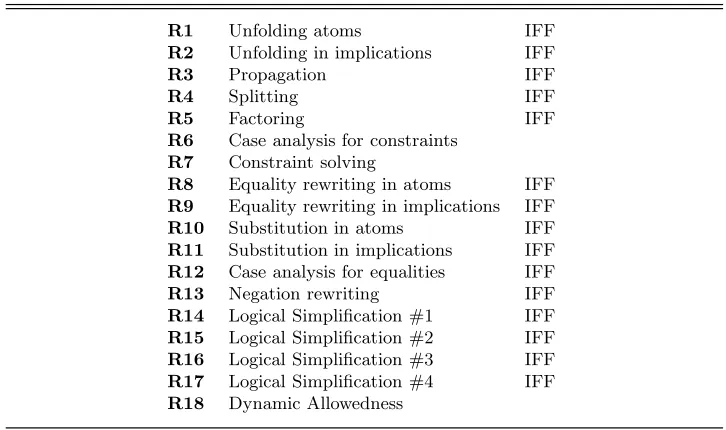
Table 1. CIFF proof rules
R1 Unfolding atoms IFF
R2 Unfolding in implications IFF
R3 Propagation IFF
R4 Splitting IFF
R5 Factoring IFF
R6 Case analysis for constraints R7 Constraint solving
R8 Equality rewriting in atoms IFF R9 Equality rewriting in implications IFF R10 Substitution in atoms IFF R11 Substitution in implications IFF R12 Case analysis for equalities IFF R13 Negation rewriting IFF R14 Logical Simplification #1 IFF R15 Logical Simplification #2 IFF R16 Logical Simplification #3 IFF R17 Logical Simplification #4 IFF R18 Dynamic Allowedness
3.2 CIFF Derivation and Answer Extraction
The CIFF proof rules are the building blocks of a CIFF derivation which defines the process of computing answers with respect to a frameworkhTh, A, ICiℜ and
a queryQ.
Prior to defining a CIFF derivation formally, we introduce some useful definitions.
Definition 3.10 (Failure and undefined CIFF nodes)
A CIFF nodeN which containsf alseas an atomic CIFF conjunct is called afailure CIFF node. A CIFF nodeN marked asundefinedis called anundefined CIFF node.
Definition 3.11 (CIFF selection function)
LetF be a CIFF formula. We define aCIFF selection function Sas a function such that:
S(F) =hN, φ, χi
where N is a CIFF node in F, φ is a CIFF proof rule and χ is a set of CIFF conjuncts in N such thatχ is arule input forφ.
In the sequel we assume that selection functions, given a CIFF formulaF, always select a triplehN, φ, χiwhenever a rule is applicable toF.
We are now ready to define aCIFF pre-derivation and a CIFF branch.
Definition 3.12 (CIFF Pre-derivation and initial formula)
Let hTh, A, ICiℜ be a CIFF framework, let Q be a query and let S be a CIFF
selection function. ACIFF pre-derivationforQwith respect tohTh, A, ICiℜandS
is a (finite or infinite) sequence of CIFF formulae F1, F2, . . . , Fi, Fi+1. . . such that
• F1={N1}={Q∪IC}, whereQandICare treated as sets of CIFF conjuncts,
(we will refer toF1 as theinitial formula of a CIFF pre-derivation)
• S(Fi) = hNi, φi, χii such that Ni is neither an undefined CIFF node nor a
failure CIFF node and
• Fi
Ni, χi
GGGGGGGGGGA
φi
Fi+1
The construction of a pre-derivation can be interpreted as the construction of an or-tree rooted atN1 and whose nodes are CIFF nodes. Roughly speaking, the whole
or-tree can be seen as a search tree for answers to the query. Note that all the variables in the query are existentially quantified in N1 because the allowedness
conditions of Definition 3.4 impose that each variable in Q occurs in an atomic conjunct ofQ.
CIFF formulasFiin a pre-derivation correspond to successive frontiers of the search
tree. Each derivation step is done by applying (throughS) theselected proof rule on a setχof CIFF conjuncts within a nodeN in a frontier. The resulting frontier is obtained by replacingN by the set ofsuccessor nodes N.
Definition 3.13 (Successor Nodes in a CIFF pre-derivation)
Let Dbe a CIFF pre-derivation for a queryQwith respect to a CIFF framework hTh, A, ICiℜand a selection functionS.
We say thatN is the set ofsuccessor nodes ofN in D, iff • S(Fi) =hN, φi, χii,
• Fi
N, χi
GGGGGGGGGA
φi
Fi+1, and
• for eachN′∈
Fi+1 such thatN′6∈Fi\{N}, thenN′∈ N.
Moreover we say that a node N′
inN is asuccessor node ofN in D.
Definition 3.14 (CIFF branch)
Given a CIFF pre-derivationD=F1, F2, . . . , Fi, Fi+1. . ., aCIFF branch Bin Dis
a (finite or infinite) sequence of CIFF nodesN1, N2, . . . , Ni, Ni+1. . .such that each
Ni∈Fi and eachNi+1 is a CIFF successor node ofNi in D.
The next step, finally, is the definition of a CIFF derivation.
Definition 3.15 (CIFF derivation)
Let hTh, A, ICiℜ be a CIFF framework, let Q be a query and let S be a CIFF
selection function. ACIFF derivation Dfor Qwith respect to hTh, A, ICiℜ and
S is a CIFF pre-derivation F1, F2, . . .such that for each CIFF branchBinDif
• S(Fi) =hNi, φ, χi, • S(Fj) =hNj, φ, χi, • Ni∈ B,
then φ6∈ {Propagation, Factoring, Equality rewriting in atoms, Equality rewriting in implications,Substitution in atoms}.
Informally, a derivation is a pre-derivation such that in each branch certain proof rules can be applied only once to a given set of selected CIFF conjuncts. This is because those rules can produce loops if they are applied repeatedly to the same set of conjuncts6. The concept of successor nodes in a pre-derivation is valid also
for a derivation. Where it has no impact, we will omit the selection function when we refer to a derivation.
Example 3.6
Consider the following frameworkhT h, A, ICiℜ:
Th: p↔true
A: {a}
IC : p → a
The following is a pre-derivation Dfor the queryQ=p.
F1= {{p,[p→a]}} [Init]
F2= {{p,[p→a],[true→a]}} [R3]
F3= {{p,[p→a],[true→a],[true→a]}} [R3]
.. .
The Propagation rule R3can be applied repeatedly to the integrity constraint giving rise to an infinite pre-derivation which should be avoided in a derivation7.
Definition 3.16 (Successor CIFF Derivation)
LetD=F1, . . . , Fi be a CIFF derivation, letSbe a CIFF selection function and let N ∈Fi. We say thatD′ =F1, . . . , Fi+1 is asuccessor CIFF derivation via N ofD
iff
• S(Fi) =hN, φi, χii,
• Fi
N, χi
GGGGGGGGGA
φi
Fi+1, and
• D′
is a CIFF derivation.
Definition 3.17 (Leaf and successful CIFF nodes)
LetD=F1, . . . , Fi be a CIFF derivation. A CIFF nodeN inFiis aleaf CIFF node
iff
• it is afailure CIFF node or • it is anundefined CIFF node or
• there exists no successor CIFF derivation viaN ofD.
6
Note, however, that they could be applied to differentcopiesof a set of conjuncts. 7
A leaf node which is neither a failure CIFF node nor an undefined CIFF node is called asuccessful CIFF node.
We are now ready to introduce the following classifications ofCIFF branches and CIFF derivations.
Definition 3.18 (Failure, undefined and successful CIFF branches)
Let Dbe a CIFF derivation and letB =N1, . . . , Nk be a CIFF branch in D. We
say thatB is
• asuccessful CIFF branch ifNk is a successful CIFF node; • afailure CIFF branch ifNk is a failure CIFF node;
• anundefined CIFF branch ifNk is an undefined CIFF node.
Definition 3.19 (Failure and Successful CIFF Derivations)
LetDbe a CIFF derivation.Dis called asuccessful CIFF derivation iff it contains at least onesuccessful CIFF branch.Dis called afailure CIFF derivation iff all its branches arefailure CIFF branches.
Intuitively, an abductive answer to a query Q can be extracted from a successful node of asuccessful derivation. Formally:
Definition 3.20 (CIFF Extracted Answer)
Let hT h, A, ICiℜ be a CIFF framework and let Q be a CIFF query. Let D be a
successful CIFF derivation for Qwith respect to hT h, A, ICiℜ. A CIFF extracted
answer from a successful nodeN of Dis a pair h∆, Ci
where ∆ is the set of abducible atomic conjuncts inN, andC=hΓ, E, DEiwhere: • Γ is the set of all the c-conjuncts inN,
• E is the set of all theequality atoms (i.e. equalities over Herbrand terms) in N,
• DEis the set of all the CIFF disequalities inN.
The soundness of the CIFF proof procedure with respect to the notion of ℜ -satisfiability and the three-valued completion semantics is the subject of the next section. The idea is to show that CIFF extracted answers correspond to abductive answers with constraints in the sense of Definition 2.2.
Example 3.7
Consider the following frameworkhT h, A, ICiℜ, obtained from the abductive logic
program with constraints of Example 2.1, and the following queryQ:
Th: p(T)↔T =X∧q(T1, T2)∧T1< X∧X<8
q(X, Y)↔X=X1∧Y =X2∧s(X1, a)
A: {r, s}
The following is a CIFF derivationDforQwith respect to hT h, A, ICiℜ:
F1= {{r(Y),[r(Z)→p(Z)]}} [Init]
F2= {{r(Y),[Z=Y →p(Z)],[r(Z)→p(Z)]}} [R3]
F3= {{r(Y),[true→p(Y)],[r(Z)→p(Z)]}} [R11]
F4= {{r(Y), p(Y),[r(Z)→p(Z)]}} [R17]
F5= {{r(Y), Y =X, q(T1, T2), T1< X, X <8,[r(Z)→p(Z)]}} [R1]
F6= {{r(X), Y =X, q(T1, T2), T1< X, X <8,[r(Z)→p(Z)]}} [R10]
F7= {{r(X), Y =X, T1=V, T2=W, s(V, a), T1< X, X <8,[r(Z)→p(Z)]}} [R1]
F8= {{r(X), Y =X, T1=V, T2=W, s(V, a), V < X, X <8,[r(Z)→p(Z)]}} [R10]
No more new rules can be applied to the only node inF8and this is neither a failure
node nor an undefined node. Hence, it is a successful node from which we extract the following answer:
h{r(X), s(V, a)}, Ci where C=hΓ, E, DEiis:
Γ : {Y =X, T1=V, V < X, X <8}
E: {T2=W}
DE: ⊘
Indeed, note that theabductive answers with constraints given in Example 2.1 are instances of the above extracted answer.
Example 3.8
Consider the following framework hT h, A, ICiℜ (where we assume a constraint
structureℜover integers with the usual relations and functions), and the following queryQ:
Th: p(X)↔X =Z∧a(Z)∧Z <5 A: {a}
IC : a(2) → f alse Q: p(Y)
The following is a CIFF derivationDforQwith respect to hT h, A, ICiℜ:
F1= {{p(Y),[a(2)→f alse]}} [Init]
F2= {{Y =Z, a(Z), Z <5,[a(2)→f alse]}} [R1]
F3= {{Y =Z, a(Z), Z <5,[a(2)→f alse],[2 =Z→f alse]}} [R3]
F4= {{Y =Z, a(Z), Z <5,[a(2)→f alse],[Z= 2→f alse]}} [R9]
F5= {{Y =Z, a(Z), Z <5,[a(2)→f alse],[Z6= 2∨[Z
.
= 2,(true→f alse)]]}} [R6]
F6= {{Y =Z, a(Z), Z <5, Z6= 2,[a(2)→f alse]},
{Y =Z, a(Z), Z <5, Z= 2. ,[a(2)→f alse],(true→f alse)}} [R4]
F7= {{Y =Z, a(Z), Z <5, Z6= 2,[a(2)→f alse]},
{Y =Z, a(Z), Z <5, Z= 2. ,[a(2)→f alse], f alse}} [R17]
Note that only the Case analysis for constraints rule (R6) can be applied to F4 because the variable Z is a constraint variable. Hence Z = 2 is a c-atom (see
No more rules can be applied to both nodes inF7. The first node is neither a failure
node nor an undefined node. Hence, it is a successful node from which we extract the following answer:
h{a(Z)},h{Y =Z, Z <5, Z6= 2},⊘,⊘ii
4 Correctness of the CIFF Proof Procedure
As anticipated in the previous section, the CIFF proof procedure is sound with respect to the three-valued completion semantics, i.e. each CIFF extracted answer is indeed a CIFF correct answer in the sense of definition 2.2. All the results stated in this section (and whose proofs are given in Appendix A) are based upon the results given in (Fung 1996) for the IFF proof procedure.
Theorem 4.1(CIFF Soundness)
Let hP, A, ICiℜ be an abductive logic program with constraints such that the
corresponding CIFF framework ishT h, A, ICiℜ. Leth∆, Ci, whereC=hΓ, E, DEi,
be a CIFF extracted answer from a successful CIFF node in a CIFF derivation with respect to hT h, A, ICiℜ and a CIFF query Q. Then there exists a ground
substitution σ such that h∆, σ,Γi is an abductive answer with constraints to Q with respect to hP, A, ICiℜ.
The proof of the theorem relies upon the following propositions. The first proposi-tion shows that given a CIFF extracted answerh∆, Cithere exists a substitution satisfying all the constraint atoms, equality atoms and CIFF disequalities inC.
Proposition 4.1
Let h∆, Ci be a CIFF extracted answer from a successful CIFF node N, where C=hΓ, E, DEi. Then:
1. there exists a ground substitutionθ such thatθ|=3(ℜ)Γ, and
2. for each such ground substitutionθ, there exists a ground substitutionσsuch that
θσ|=3(ℜ)Γ∪E∪DE
Example 4.1
Given Γ = {2 ≤ T, T < 4}, E = {X = f(Y), Z = g(V)} and DE = {(Y = h(W, V))→f alse}, we have that bothθ1={T /2}and θ2={T /3}satisfy Γ and
they contain all the possible assignments for T (given that D(ℜ) is the set of all integers). We can obtain a ground substitutionθ1σ(withσ=σDE∪σE) as follows:
1. σDE ={Y /r(c)}obtainingS1= ((E∪DE)θ)σDE= {X =f(r(c)), Z=g(V),(r(c) =h(W, V))→f alse}
2. the second step is to assign the corresponding terms toX andZ obtaining
3. finally we assign new terms with fresh functions to the remaining existentially quantified variableV, e.g.σE ={V /t(c)} obtaining
S3={f(r(c)) =f(r(c)), g(t(c)) =g(t(c)),(r(c) =h(W, t(c)))→f alse}
The setS3is clearly entailed by CET. Note that we do not care about the universally
quantified variableW in S3. This is because
(r(c) =h(W, t(c)))→f alse
is entailed by CET for any assignment to W, due to the fact that r and h are distinct function symbols.
Similarly, we can obtain another ground substitution usingθ2.
The next proposition directly extends the above result to the set ∆ of a CIFF extracted answer.
Proposition 4.2
Let h∆, Ci be a CIFF extracted answer from a successful CIFF node N where C =hΓ, E, DEi. For each ground substitutionσ′ such that σ′ |=
3(ℜ)Γ∪E∪DE,
there exists a ground substitution σwhich extends σ′
for the variables that are in ∆ but not inC such that
1. σ′⊆σ
2. ∆σ|=3(ℜ)∆∪Γ∪E∪DE.
The third proposition shows that the CIFF proof rules are indeed equivalence pre-serving rules with respect to the three-valued completion semantics. This a basic requirement to prove the soundness of CIFF.
Proposition 4.3 (Equivalence Preservation)
Given an abductive logic program with constraints hP, A, ICiℜ, a CIFF node N
and a set of CIFF successor nodesN obtained by applying a CIFF proof ruleφto N, it holds that:
P |=3(ℜ)N iff P |=3(ℜ)N∨
where N∨
is the disjunction of the nodes inN.
Corollary 4.1 (Equivalence Preservation of CIFF Formulae)
LethP, A, ICiℜbe an abductive logic program with constraints,F a CIFF formula
and S any CIFF selection function. Let S(F) = hN, φ, χi and F′
the result of applyingφtoN in F. Then:
P∪IC |=3(ℜ)F iff P∪IC|=3(ℜ)F′, i.e.
P∪IC |=3(ℜ)(F ↔F ′
).
Theorem 4.2(Soundness of failure)
Let hP, A, ICiℜ be an abductive logic program with constraints such that the
corresponding CIFF framework ishT h, A, ICiℜ. LetDbe a failure CIFF derivation
with respect to hT h, A, ICiℜand a queryQ. Then:
P∪IC|=3(ℜ)¬Q.
Note that there is a class of CIFF derivations for which a soundness result cannot be stated, i.e. all the derivations containing only undefined and failure branches. The meaning of such CIFF derivations is that for each branch, no CIFF answer can be extracted, but there are some branches (undefined branches) for which neither failure nor success is ensured. The presence of an undefined branch is due to the application of theDynamic Allowednessrule and, as we have seen at the end of Section 3.1, this could lead to infinite sets of abducibles in the answers.
Concerning completeness, CIFF inherits the completeness results for IFF in (Fung 1996) for the class of allowed IFF frameworks. In (Fung 1996), the only requirement for ensuring completeness is the use of a fair selection function, i.e. a selection func-tion that ensures that any node to which a proof rule can be applied is eventually selected in each branch of a derivation. This condition is also required in the case of CIFF. To illustratefairness, suppose we have the following iff-definitions
q↔p∨a p↔p
whereais an abducible predicate. Consider the queryqand an empty set of integrity constraints. After the unfolding of q, the IFF proof procedure would return the abductive answeraif the second disjunct is eventually selected, but it loops forever in the other case. A fair selection function ensures that the second disjunct is eventually selected during a derivation.
For the class of IFF allowed frameworks, a CIFF derivation is exactly an IFF deriva-tion as there are no constraint atoms in the framework. Moreover, the Dynamic allowednessrule can never apply in a derivation due to the following lemma, stat-ing that for the of class CIFF statically allowed frameworks and queries (see Defini-tion 3.3) there does not exist a CIFF derivaDefini-tion in whichDynamic allowedness is applied.
Lemma 4.1(Static Allowedness lemma)
LethP, A, ICiℜbe an abductive logic program with constraints such that the
corre-sponding CIFF frameworkhT h, A, ICiℜ and the queryQare both CIFF statically
allowed. Then, given any CIFF derivation F1, F2, . . . with respect to hP, A, ICiℜ
andQ, and any selection functionS: it is never the case thatS(Fi) =hNi, R18, χi
for anyFi, whereR18 is the Dynamic allowedness rule.
Indeed, the above lemma trivially applies also to IFF allowed frameworks. As a consequence, we can state the following result.
Let hP, A, ICiℜ be an abductive logic program without constraints such that
the corresponding CIFF frameworkhT h, A, ICiℜ and the queryQdo not contain
constraint atoms and they are IFF allowed.
If there exists an abductive answer with constraints h∆, σ,⊘ifor Q with respect to hP, A, ICiℜ, then there exists a CIFF derivation D for Q with respect to
hT h, A, ICiℜ and to a fair CIFF selection functionS such that
• h∆′
,h⊘, E, DEii, can be extracted from a successful CIFF node inD; and • there exists a ground substitutionσ′′
⊇σsuch that — P∪∆′
σ′′
|=Qσ′′
— P∪∆′σ′′|=IC
— ∆′σ′′⊆∆σ′′.
Considering the whole class of CIFF frameworks, we cannot formulate a full com-pleteness theorem for CIFF because, tackling the allowedness problem dynamically, we could obtain undefined derivations, even with afair selection function.
Example 4.2
Consider the following framework hT h, A, ICiℜ where we assume an arithmetical
constraint over integers in which>has the expected meaning:
P : p(Y)←a(Y)
Th: p(X)↔[X=Y ∧a(Y)] A: {a}
IC : V >2 → a(V)
The following is a CIFF derivationDfor the empty query. F1= {{[V >2 → a(V)]}} [Init]
F2= {undef ined:{[V >2 → a(V)]}} [R18]
The only rule applicable to F1 is the Dynamic allowedness rule due to the
presence of V in the constraint atom V > 2. Note that the existence of infinite values for V greater than 2 would give rise to an infinite set of abducibles arising from a(V) in the head of the implication.
However, we can state a weak completeness theorem for the CIFF proof proce-dure if we assume CIFF derivations without undefined branches. The result is analogous to the completeness result shown for the A-System (Van Nuffelen 2004; Kakas et al. 2001).
Theorem 4.4(Weak CIFF Completeness)
Let hP, A, ICiℜ be an abductive logic program with constraints with the
corre-sponding CIFF framework hT h, A, ICiℜ and let Q be a CIFF query. Let Dbe a
finite CIFF derivation with respect to hT h, A, ICiℜ andQ such that each branch
in Dis either a failure or a successful branch. Then:
1. ifP∪IC|=3(ℜ)¬Qthen all the branches ofDare failure branches; and
2. ifP∪IC 6|=3(ℜ)¬Q(i.e.P∪IC∪Qis satisfiable) then there exists a successful
The above result gives rise to the following completeness theorem for the CIFF proof procedure.
Theorem 4.5(Weak CIFF Completeness for CIFF statically allowed frameworks) Let hP, A, ICiℜ be an abductive logic program with constraints such that the
corresponding CIFF frameworkhT h, A, ICiℜand the queryQare both CIFF
stat-ically allowed. LetDbe a finite CIFF derivation with respect tohT h, A, ICiℜand
Q. Then:
1. ifP∪IC|=3(ℜ)¬Qthen all the branches ofDare failure branches; and
2. ifP∪IC 6|=3(ℜ)¬Q(i.e.P∪IC∪Qis satisfiable) then there exists a successful
branch inD.
All the correctness results so far focus on the three-valued completion semantics. However, it is worth noting that both IFF and CIFF are sound with respect to the well-founded semantics (van Gelder et al. 1991), since the well-founded model is a three-valued model of the completion of a logic program (van Gelder et al. 1991). However IFF (and thus CIFF for the class of IFF allowed frameworks) is not com-plete with respect to that semantics. Indeed, considering the iff-definition
p↔p
the negative literal ¬pholds with respect to the well-founded semantics whilepis undefinedwith respect to the three-valued completion semantics. Accordingly, both IFF and CIFF fail to terminate for the query¬p.
5 The CIFF System
The CIFF System is a SICStus Prolog8 implementation of CIFF. We rely upon
the SICStus CLPFD solver integrated in the platform. This is a very fast and reliable constraint solver for finite domains (Fern´andez and Hill 2000). The version of the system described here is version 4.0 whose engine has been almost completely rewritten with respect to older versions (Endriss et al. 2004a; Endriss et al. 2005), in order to improve efficiency.
Here we give a brief general description of the CIFF System. Further details can be found in (Terreni 2008a) and in the CIFF user manual (Terreni 2008b).
The main predicate, to be run at Prolog top-level is
run ciff( +ALP, +Query, -Answer)
where ALP is a list of .alpfiles containing an abductive logic program with con-straints9,Queryis a CIFF query andAnswerwill be instantiated to either a CIFF
8
http://www.sics.se/isl/sicstuswww/site/index.html 9
extracted answer (see Definition 3.20) or to the special atom undefined if an al-lowedness condition is not met. A CIFF extracted answer is represented by a triple, namely a list of abducible atoms ∆, a list of CIFF disequalitiesDEand finally a list of finite domain constraints Γ. The set of equalitiesE is not returned as the final substitution (inE) is directly applied by the system. Further answers are returned via Prolog backtracking. If no (further) answer is found, the system fails, returning the control to the Prolog top-level.
Each abductive logic program with constraints (ALPC) consists of the following components, which could be placed in any position in any.alpfile:
• Declarations of abducible predicates, using the predicateabducible. For ex-ample an abducible predicateabdwith arity 2, is declared via
abducible(abd( , )).
• Clauses, represented as
A :- L1, ..., Ln.
• Integrity constraints, represented as
[L1, ..., Lm] implies [A1, ..., An].
where the left-hand side list represents a conjunction of CIFF literals while the right-hand side list represents a disjunction of CIFF atoms.
Equality/disequality atoms are defined via =, \== and constraint atoms are de-fined via#=, #\=, #<, #=<, #>, #>=10. Finally, negative literals are of the form
not(Atom)whereAtomis an ordinary atom.
All the clauses defining the same predicate (here a predicate is identified by its name plus its arity) are preprocessed by the system in order to build the internal representation (an iff-definition). Each iff-definition is asserted in the Prolog global state in order to retrieve such information, when needed during a CIFF derivation, in a simple and efficient way.
The CIFF proof rules are implemented in CIFF 4.0 as Prolog clauses defining
sat(+State, -Answer), whereStaterepresents the current selected CIFF node.
Stateis initialized to the internal representation of theQueryplus all the integrity constraints in (all files in) theALPargument.
Throughout the computationStateis defined as:
state(Diseqs,CLPStore,Imps,Atoms,Abds,Disjs)11
where the aggregation of the arguments represent a CIFF node.Diseqsrepresents the set of CIFF disequalities, CLPStore represents the current finite domain con-straint store, Impsthe set implications,Atomsthe set of defined atoms,Abdsthe
10
Note that, whenever possible, disequalities in the system are managed through the operator \== rather than in the corresponding (and less efficient) implicative form.
11
set of abduced atoms and finallyDisjsis the set of disjunctive CIFF conjuncts in the node.
The predicatesatcalls itself recursively until no more rules can be applied to the currentState, thus instantiating theAnswer.
Finally a note on the implemented CIFF selection function. We use a classical Prolog-like selection function, i.e. we always select the left-most CIFF node in a CIFF formula. It is not afair selection function in the sense that it does not ensure completeness (see Section 4 for further details), but it has been found as the only possible practical choice in terms of efficiency. Without entering in technical details, this is mostly because, fixing the choice of the selected node in a CIFF formula as the left-most CIFF node, we can directly take advantage of the Prolog backtracking mechanism in order to switch to another CIFF node in case of failure.
Concerning the order of selection of the proof rules in a CIFF node, this is deter-mined by the order of the satclauses. If asatclause defining a CIFF proof rule, e.g.Unfolding atoms (R1), is placed before thesatclause defining e.g. Propa-gation (R3), then the system tries first to find a rule input forR1and, only if no such rule input can be found, then the system triesR3.
Below we sketch the most important techniques used to make the CIFF System an efficient abductive system. For further details on these topics, please refer to (Terreni 2008a).
Managing variables and equalities.Variables play a fundamental role in nodes in CIFF: they can be either universally quantified or existentially quantified. Uni-versally quantified variables can appear only in implications (which define their scope). Existentially quantified variables can appear in any element of the node, with scope the entire node. In the system the CIFF variables are Prolog variables, but to distinguish at run-time existentially quantified and universally quantified variables we use the Prolog facility of attribute variables (Holzbaur 1992), associ-ating to each existentially quantified variable anexistentialattribute. Moreover, whenever possible, we use the unification of Prolog for managing equality rewriting and substitutions, but we also implemented the Martelli-Montanari unification algo-rithm (Martelli and Montanari 1982) for managing, in particular, equality rewriting and substitutions involving universally quantified variables.
Many CIFF proof rules, for example, Propagation (R1) and Unfolding (R2, R3)rules, typically need to be followed by a set ofEquality rewriting (R8, R9) andSubstitution (R10, R11)rules. In the CIFF System, these “equality” rules are not treated at the same level of the other main proof rules, but rather they have been integrated within them in order to improve efficiency. In particular rules R8, R9,R10,R11 are applied transparently to the user (i.e. they are not defined as
designed to avoid repetitive application of CIFF proof rules, in particular Propa-gation (R3)andFactoring (R5), to the same rule input. Obviously, in order to manage even small-medium size problems, loop management needs to be efficient. We do not enter in details here, but just give a hint of the technique. Loop manage-ment is done by enumerating univocally each potential rule input component for R3andR5(e.g. implications forPropagationand abducibles forFactoring) in a CIFF node, maintaining them sequentially ordered throughout the computation. Then, we can (non-straightforwardly) avoid loops, applying proof rulesR3andR5 to appropriate rule inputs, following the order given by the enumeration.
The loop management required in a CIFF derivation for Equality and Substi-tutionrules is, instead, obtained (almost) for-free due to the integration of those proof rules in the other main proof rules as discussed above.
Constraint solving.Interfacing efficiently the CIFF System with the underlying SICStus CLPFD solver is fundamental for performance purposes. Despite a clear interface made available by the Prolog platform, the main problem in the interaction with the solver is that the solver binds variables to numbers when checking the satisfiability of the currentCLPstore(i.e. when theConstraint Solving (R7)rule is applied), while we want to be able to return non-ground answers. The solution adopted in the CIFF System tackles this problem through an algorithm which allows, when needed, to check the satisfiability of theCLPstoreas usual and then restores the non-ground values via a forced backtracking.
Groundable integrity constraints The main source of inefficiency in a CIFF computation is probably represented by integrity constraints. The main problem is the presence of universally quantified variables which potentially lead, through thePropagation rule, to a new implication in a CIFF node for each propagated variable instance. It is worth noting that even in a small/medium size CIFF appli-cation, the number of such implications resulting from integrity constraints easily grows, thus representing the main computational bottleneck.
To deal with this, we have incorporated within CIFF a specialized algorithm that can be applied to a wide class of integrity constraints, called groundable integrity constraints. Intuitively, an integrity constraintIisgroundable if the set of implica-tions obtained through the exhaustive application of CIFF proof rules (in particu-larUnfolding in implicationsand Propagation) on I is “expected to become ground” at run-time. For example, consider an integrity constraint of the form
p(X), q(Y)→r(X, Y)