WHAT VAGUE OBJECTS ARE LIKE*
We cannot trace with complete precision the outline of a cat, the
limits of a city, or the edges of a cloud. Might cats, cities,
clouds and other ordinary things really be vague, in the sense
that they lack sharp boundaries? It is widely thought that they
just cannot be. Vague things, it is thought, would be very queer:
they would have a shady presence, being somehow neither quite
there nor not there, and they would have vague identities, being
somehow neither quite identical to nor different from other
things. The idea that anything might really be vague is thought
to be more or less unintelligible.
In fact, I shall argue, the hypothesis that ordinary things
are vague can be taken quite seriously. It is intelligible, since
vague things need not have any sort of shady presence or dodgy
identity after all. It is plausible, since there is sometimes no
fact of the matter whether one thing is a part of another. And it
is readily acceptable, since indefinite parthood is substantially
compatible with received ideas about parts and wholes, as set out
in classical mereology. Arguably, as we shall see, this
hypothesis offers us our best shot at preserving sensible
everyday ideas about what there is in the world.
* I thank for helpful comments Dalia Drai, Terence Horgan, Dick
de Jongh, Jonathan Lowe, Carl Posy, Theodore Sider and Timothy
I shall proceed as follows. Section 1 contrasts the hypothesis
that ordinary things are vague with the orthodox view that
vagueness is all a matter of thought and language. Section 2
explains why it has been thought that there must be something
mysterious about the presence and identities of vague things, and
why it is wrong to think so. Section 3 shows how it can happen
that there is no matter of fact whether one ordinary thing is a
part of another. Section 4 categorizes vague objects and
motivates the introduction, in section 5, of a class of
abstractions, fuzzy boundaries. The final section 6 uses these
boundaries to construct a world of vague abstract objects whose
presence and identities are quite definite. The logic of this
world is not classical but, as we shall see, its part-whole
theory very nearly is.
1. Vague objects and representations
Take Tibbles, the cat. The one loose whisker used to be firmly
attached and soon it will drop off for good. Meanwhile it is a
questionable part, neither definitely in nor out. Or take the
city of Toronto. The tree in the outskirts is a questionable part
and so the city, like the cat, has no sharp boundary. Or take
just about any ordinary material object. Look closely and there
is always something tearing away or coming loose. Look even more
closely and there are always microscopic particles wearing off at
objects that lack sharp boundaries and in this sense really are
vague.
Even so there might be no vague objects. Instead of a vague
cat there might just be many precise quantities of animal tissue
that almost completely overlap, differing around the edges by the
odd whisker or hair. In this case each of these precise
quantities has a claim to be called ‘Tibbles’ but none has a
special claim, and this name fails to pick out any one candidate
in particular. Questionable parts of Tibbles are then just things
that are parts of some candidates but not others. Similarly there
might just be many precisely delimited localities, equally
deserving to be called ‘Toronto’, some including the questionable
tree, some not. In this case the names ‘Toronto’ and ‘Tibbles’
are vague. They fail to pick out any one particular thing. But
there is no vague city and there is no vague cat.
Orthodoxy has it that there are indeed no vague objects.
Words, thoughts, pictures and other representations are vague,
but apart from them the world is precise. Bertrand Russell was
the first to say that it is so. He argued that to think the world
is vague is to mistake properties of thoughts for properties of
things, and blamed Idealism for cultivating confused habits of
thinking that can lead to this sort of mix-up. One might as well
think, he scoffed, that the world is also muddleheaded.1 There is
no mistaking the appeal of this idea. Certainly the relation
1
Bertrand Russell, “Vagueness,” Australian Journal of Philosophy
between representations and what they represent is somewhat
indefinite, and if this fact by itself can explain the phenomena
of vagueness then it might seem idle to imagine any other
vagueness in the world. It might seem simpler and better to
suppose that, apart from representations in thought and language,
all things are precise.
But this orthodoxy is hard put to explain some of the
phenomena. Take an ordinary material object, say Tibbles.2 If
vagueness is all a matter of representation then there is no
vague cat. Instead there are many precise cat candidates that
only differ around the edges by the odd whisker or hair. Since
there is a cat, Tibbles, and since this orthodoxy leaves nothing
else for her to be, one of these cat candidates must then be a
cat. But if any is a cat then also the next one must be a cat, so
small are the differences between them. So all of the cat
candidates must be cats. The sensible idea that vagueness is all
a matter of representation seems to entail that wherever there is
a cat there are a thousand and one of them, all prowling about in
lockstep or curled up together on the mat. But that is absurd.
Cats and other ordinary things can come and go one at a time.3
2 I shall use 'object' broadly to cover organisms, cities and
abstract entities, as well as ordinary material objects.
3
Versions of this puzzle were suggested by Peter Unger in "The
Problem of the Many," Midwest Studies in Philosophy, 5 (1980):
411-468, and by Peter Geach in Reference and Generality, third
Someone might try to contain the outbreak of cats by
explaining that none of the candidates is a cat, but that is no
levelheaded thing to do. It follows that there is no cat, not
one, and by implication that there are no ordinary things at all
in the world: no babies, no bath water, nothing. Commonsense
balks.4 One might instead explain that although there are many
different candidates they are all one and the same cat.5 Or that
just one of them is a cat but there is no saying which, or that
although all the candidates are different cats this is no matter
since, so very similar, they are almost one and the same cat.6
These explanations do not fly in the face of commonsense; but
there are many of them and none is obviously right. One starts to
wonder, with all of this explaining away that orthodoxy has to
do, whether the hypothesis that ordinary objects are vague might
square up better with sensible ideas about what there is in the
world.7
4
But Peter Unger does not balk: “There are No Ordinary Things,”
Synthese, 41 (1979): 117-154.
5
Peter Geach illustrates the notion of relative identity with
his version of the problem of the many cats (op. cit.).
6
As David Lewis explains in “Many, but Almost One,” in K.
Campbell, J. Bacon and L. Reinhardt (eds.) Ontology, Causality,
and Mind: Essays on the Philosophy of D.M. Armstrong (Cambridge:
Cambridge University Press, 1993), pp. 23-42.
7
Others who think that various sorts of things might really be
2. Vague existence and identity
One obstacle to accepting the hypothesis that ordinary objects
are vague has been the notion that vague objects must be very
queer. In particular, it has been thought that they must have
some sort of shady presence, and indefinite identities. In this
section, we shall see that there is no good reason to think so.
The notion that vague objects must have a shady presence has
an origin in the notion that if there are to be questionable
parts then composition must be vague, in the sense that there is
sometimes no matter of fact whether it takes place. A part of a
Journal of Philosophy, 43 (1945): 477-486; Kit Fine, “Vagueness,
Truth and Logic,” Synthese, 30 (1975): 265-300, f. 10; Mark
Sainsbury, "Concepts without Boundaries," in R. Keefe and P.
Smith (eds.) Vagueness: A Reader (Cambridge Mass.: MIT Press,
1987), pp. 251-264; Michael Tye, “Vague Objects,” Mind, 99
(1990): 535-557; John A. Burgess, “Vague Objects and Indefinite
Identity,” Philosophical Studies, 59 (1990): 263-287; Peter van
Inwagen, Material Beings (Ithaca: Cornell University Press,
1990); Eddy Zemach, “Vague Objects,” Nous, 25 (1991): 323-340;
Richard Heck, “That There Might be Vague Objects (So Far As
Concerns Logic),” The Monist, 81, 2 (1998): 274-296; Peter
Simons, "Does the Sun Exist? The Problem of Vague Objects," in T.
Rockmore (ed.) Proceedings of the XX World Congress of
Philosophy, Vol. 2: Metaphysics (Bowling Green: Philosophy
Documentation Center, 1999), pp. 89-79; Michael Dummett, "Is Time
whole is something whose fusion with some other things makes up
this whole. So, one might think, when there is no matter of fact
whether one thing is a part of another, that must be because
there is no matter of fact whether the questionable part and some
other things compose to make it up.8 But then, one might think,
there can be no matter of fact whether something, a composition
of the questionable part and these other things, exists.9 Now
this idea is genuinely mysterious. How can something neither
quite be nor not be there? Must we imagine that the presence of
vague objects is somehow a matter of degree, like the intensity
of a beam of light?
There is no need, for such thinking is mistaken. In fact there
can be vague objects though composition is precise, and indeed
completely unrestricted. To see how, suppose that largely
overlapping with Tibbles there is a cat candidate - say Tibbles
8 Vann McGee claims that an argument for unrestricted composition
"presupposes" that there is no vagueness in the world. See his
“Kilimanjaro,” The Canadian Journal of Philosophy, 23 (1998):
141-163, p. 163. Peter Van Inwagen argues that questionable
parthood and vague composition go together in his op. cit., e.g.
p. 228. David Lewis seems to assume that unrestricted composition
is at odds with worldly vagueness in On the Plurality of Worlds
(Oxford: Blackwell, 1986). There, having rejected the idea of
vague composition, he claims that the only intelligible account
locates vagueness in thought and language. See p. 212.
9
minor - that is just like Tibbles except that the one whisker is
a definite non-part of her. Since the whisker is a questionable
part of Tibbles, we might suppose that there is no matter of fact
whether the whisker manages to compose with Tibbles minor to make
up Tibbles. Let it be so. The crucial point is that composition
can take place even so. The whisker can still compose with
Tibbles minor to make up something, it is just that the something
cannot be Tibbles but must be something else - say Tibbles major
- of which this whisker is a definite part, not a questionable
part. The suggestion is that questionable parthood need not
restrict composition at all, and the abstract vague world of
section 6 will bear it out. Although the things within this world
have fuzzy boundaries, there is always a matter of fact whether
any given ones compose because they always do. Composition is
completely unrestricted there, and nothing has any sort of shady
presence.
A second mystery surrounding vague objects has been the idea
that there can be no saying which are which, or how many there
are. The very identities of vague objects must be vague. This
idea led Russell to brush off the hypothesis that there are vague
objects with the remark that “things are what they are, and there
is an end of it,”10 and it led Gareth Evans to argue more fully
that since the identities of things are always definite, the
hypothesis that there are “objects about which it is a fact that
10
they have fuzzy boundaries” is incoherent.11 The objects of the
vague world of section 6 will refute this argument since not only
their presence but also their identities are quite definite. But
this matter ought not to hang over the discussion until the end.
In the rest of this section, I shall show that the argument from
definite identities is inconclusive.
I shall not call into question what I take to be the insight
at the center of both Russell's remark and Evans' argument, that
there is always a fact of the matter whether any given things are
one and the same. That there might sometimes be no fact of this
matter really is hard to imagine. Things are identical to
themselves but different from other things, and it is hard to see
how, somehow between itself and everything else, there can be
anything left for a vague object to be indefinitely identical to.
Talk about vague objects with indefinite identities really does
not appear to be talk about anything at all.
Antirealists, thinking truth is bound up with methods for
finding out, might disagree. For instance, a mathematical
intuitionist might think that there is sometimes no matter of
fact about the identities of choice sequences, conceived as
entities that are not fully determinate in advance.12 Perhaps,
11
Gareth Evans, “Can There be Vague Objects?” Analysis, 38
(1978): 208. See also Nathan Salmon, Reference and Essence
(Oxford: Basil Blackwell, 1982), pp. 243-246.
12
L.E.J. Brouwer described the construction by means of choice
despite appearances and arguments, the idea of indefinite
identities is at least coherent.13 Be this as it may, we shall
have no use for it here. For a long time the suspicion has
lingered that the idea that the world is vague has something to
do with Idealism. A later section argues that ordinary material
objects can be vague and, although the discussion there does not
require it, to ward off suspicion that some sort of antirealism
is involved we shall do well to rule out indefinite identities
from the start. This is of course not to say that identity
statements are always either true or false; they will still have
truth-value gaps, as they must, when singular terms do not
determinately denote.
The main problem with the argument from definite identities is
just that there is no reason to think that things with fuzzy
boundaries must have indefinite identities. Evans did not even
try to establish this crucial matter; perhaps it did not occur to
him that having a fuzzy boundary and having an indefinite
identity might be different things.14 However this may be, the
numbers, in “Über Definitionsbereiche von Functionen,”
Mathematische Annalen, 97 (1927): 60-75.
13
As Terence Parsons and Peter Woodruff argue in “Worldly
Indeterminacy of Identity,” Proceedings of the Aristotelian
Society, 95 (1995): 171-191
14
Mark Sainsbury was the first to distinguish them in print, in
omission hides a crucial difficulty with his argument that comes
to light as soon as we try to make good.
To establish that fuzzy boundaries make for indefinite
identities someone might reason as follows. Comparing a vague
Tibbles to a precise Tibbles-candidate we see that they exactly
agree as far as the definite parts and non-parts of Tibbles are
concerned. So any difference between them must be among the
questionable whiskers and hairs. But then, since there is no
saying whether these are parts of Tibbles, there is no saying
whether there is any difference at all between Tibbles and the
candidate. In other words, there is no matter of fact whether
Tibbles and the candidate are one and the same.
This reasoning overlooks something. If vagueness is a real
characteristic of things, in particular of cats, then the
possible differences between Tibbles and the Tibbles-candidate
are not confined to the questionable whiskers and hairs, and in
fact there is an obvious difference between them after all:
Tibbles is vague but the candidate is not vague. There can be no
question whether they are identical, for they definitely are two
different things, not one, and nothing in between.15 Evidently we
15 Leibniz' law says that if o=p, then whatever is true of o is
also true of p. Here I use the contrapositive, which might seem
unjustified. Truth must pass from the antecedent of an instance
of Leibniz' law to the consequent, but where there can be
truth-value gaps perhaps falsity need not pass the other way: arguably,
truth-have completed the argument from definite identities only by
setting aside the possibility that the vagueness of things is
real. Since its reality is just what is at issue, this argument
begs the question.
The argument from definite identities might be construed as an
attempt to show that nothing is vague in the special sense of
being indefinitely identical to something. Some have asked
whether objects can be vague in this special sense,16 and although
Evans speaks of objects with “fuzzy boundaries” perhaps he too
had this in mind. Be this as it may the argument, so construed,
remains inconclusive. It does not even touch the question whether
things can be vague in the core sense that they lack sharp
boundaries.
In summary, we can agree with Russell that things are what
they are. They are identical to themselves, different from other
things, and indefinitely identical to nothing. Still the world
might be vague since, for all anyone has said, also things
without sharp boundaries can have definite identities. Also they
can be "what they are." And there is an end of the argument that,
since identities are definite, the world must be precise.
value gap. Crucially, no one can say so in defense of Evans'
argument. It uses the contrapositive of Leibniz' Law to establish
that identities are always definite (op. cit.).
16
E.g. Francis J. Pelletier, in “Another Argument Against Vague
3. Questionable parts
In this section, I shall argue that ordinary material objects can
have questionable parts. I shall begin by contrasting them with
certain special material objects that apparently cannot have any.
I have in mind scatterable objects picked out by expressions like
‘some Styrofoam' and ‘all the soap in China', which we shall call
quantities of matter.17
We can grasp the notion of questionable parthood by thinking
of parts that have come loose and will be lost. But this will not
help us to grasp the notion of questionable inclusion among
quantities of matter because these cannot gain or lose parts.
Take say a quantity of soap, and separate some from the rest.
Afterwards the soap that you began with will still include the
separate part; it will still include it even if you send the
separate part somewhere else altogether, in which case some of
the soap will end up there and some will remain here. You can
scatter a quantity of something but, short of destroying it, you
cannot keep some of it from being included in all of it.
Quantities of anything – of matter, space, time or what have you
- have their parts essentially.
17
Helen Morris Cartwright discusses these objects at length in
“Quantities,” Philosophical Review, 79 (1970): 25-42. See also
Tyler Burge, "Truth and Mass Terms," The Journal of Philosophy,
69 (1972): 263-282, and Dean Zimmerman, "Theories of Masses and
Problems of Constitution," Philosophical Review, 104, 1 (1995):
This is one reason to think there must be more to part-whole
relations among material objects than just inclusion among
quantities of matter. Unless ordinary thinking is very mistaken a
cat can lose a whisker, and when it does the cat continues to
exist although the whisker is no longer a part of it. Part-whole
relations among organisms and other material objects, unlike the
relation of inclusion among quantities of matter, are temporally
variable. A further reason to think there must be more to
part-whole relations than material inclusion is that the matter of one
object can be included within that of another without their being
related as part to whole. Among the parts of a cat we count a
head and a tail, but we do not count the material content of an
arbitrarily marked out region within the cat. We do not count say
an arbitrary fusion of cat parts, a head-tail, if there is such a
thing.
It seems that, besides the eternal relation of inclusion among
quantities of matter, there is a fuller and temporally variable
part-whole relation among ordinary material objects. English
provides a handy distinction: an arbitrarily marked off portion
of cat is “some” of the cat and “part” of it, its matter included
in that of the cat, but it is not fully “a part” of the cat.18
Plausibly, if something is to be a part of the cat then, as well
as being some of the cat, it must play a suitable role in the
18
This observation is Richard Sharvy’s, in “Mixtures,” Philosophy
life of the cat - as the head and the tail taken separately both
do, but the head-tail does not.
Someone might say that there is no such temporally variable
part-whole relation at all. Causal relationships among things are
apt to change from time to time so, one might think, we honor an
eternal part of the cat as “a part” of the cat if and when it
plays a suitable role in the life of the cat, but that is it. The
alleged temporary parts are just eternal parts temporarily
playing suitable roles. If this is right, though, then cats are
no ordinary things. If a cat does not lose the whisker that drops
off or the carbon-dioxide molecule in respiration then it is a
highly scattered being. The cat is partly on the mat, partly
floating around freely, partly built into the shrubbery, and by
maturity it will have taken on the roughly the same size and
shape as the entire biosphere. But this is absurd. Organisms can
gain and lose parts.
This is why it is plausible that organisms are vague.
Organisms gain and lose their parts gradually. Since there is no
precise moment at which the whisker quits its role in the life of
the cat and drops off, it is plausible that it does not instantly
change from a part to a non-part but is, for a time, a
questionable part of the cat. Indeed it is plausible that
organisms, maintaining themselves in continuous metabolic flux,
are much more vague than meets the eye. A carbon-dioxide molecule
plays in the life of the cat. Plausibly it too is, for a time, a
questionable part of the cat.
How can material objects be vague if, as appears to be the
case, quantities of matter are precise? Not, we have assumed, by
being indefinitely identical to quantities of matter. But there
is another way. Suppose there is a special relation of
constitution, other than identity, in which say a statue stands
to a quantity of bronze, or a cat to a quantity of animal
tissue.19 Then material objects can be vague if they are
indefinitely constituted by quantities of matter without being
indefinitely identical to them. In this case there is a formal
parallel between the vagueness of representations, and on the
other hand the vagueness of indefinitely constituted objects. The
name ‘Tibbles’ is vague if there is no matter of fact which of
several candidates it picks out; the cat Tibbles is vague if,
having questionable parts, there is no matter of fact which of
19
Those who separate constitution from identity include Tyler
Burge, in op. cit., p. 278 and in “Mass Terms, Count Nouns and
Change,” Synthese, 31 (1975): 459-478; David Wiggins in Sameness
and Substance (Oxford; Blackwell, 1980), pp. 30-35; Jonathan
Lowe, in “The Problem of the Many and the Vagueness of
Constitution,” Analysis, 48 (1982): 27-30; Mark Johnston in
"Constitution is not Identity," Mind, 101 (1992): 89-105; and
several candidates constitutes her.20 If neither quantities of
matter nor identities are vague, the idea that ordinary material
objects are vague is about as good as the idea that they are
constituted by quantities of matter but not identical to them.
Just how good this is depends on another question. The
distinction between constitution and identity goes with the
doctrine that ordinary material things are continuants,
persisting through time and meanwhile undergoing changes. It is
with this distinction that one can explain how it is that a
continuant cat is made up of different quantities of matter at
different times. One who accepts the doctrine that ordinary
material objects are continuants ought to have no special
difficulty with the idea that they can be vague. The alternative
is that material objects persist through time only in the
improper sense that, like processes and events, they have earlier
and later temporal parts.21 If material objects have temporal
parts there is no need to distinguish constitution from identity.
We can explain that an object has a variable makeup insofar as it
is identical-for-a-while to each of several different quantities
20
Vague constitution has been proposed before as a solution to
the problem of the many. See Jonathan Lowe, op. cit., and Mark
Johnston, op. cit., p. 101.
21
This is the view of Goodman and Quine, “Steps Toward a
Constructive Nominalism,” Journal of Symbolic Logic, 12 (1947):
105-122. See also Quine, Word and Object (Cambridge MA: MIT
of matter, having a different temporal part in common with each
one. Then it is hard to see how material objects can be vague.
They must be as precise as the quantities of matter to which they
are, for a while, identical.
In conclusion, the hypothesis that ordinary material objects
are vague fits best within the doctrine that they are
three-dimensional continuants. The doctrine of temporal parts might
perhaps be made to admit vague objets anyway, by adding on a
distinction between constitution and identity, but such a
construction is liable to lack integrity. It might also be made
to admit them by allowing that there are vague quantities of
matter, or that identity is indefinite; then objects might be
identical-for-a-while to vague quantities, or
vaguely-identical-for-a-while to precise ones. Also these ideas are unattractive.
Let us now put organisms to one side, turning instead to
social entities such as cities, nations, clubs and families. I
shall argue that they can be vague because of indeterminacy in
the relations of belonging in which a city stands to its environs
and a nation to its territories, and the relations of membership
in which a club or family stands to the people that make it up.
Interestingly, we can speak of belonging, membership and parthood
in much the same terms. The Cook Islands “belong to” New Zealand
or else they are “a part of” that nation; someone “belongs to” a
family or club or else he is “a member of” or “a part of” it.
Without going into how these matters are related outside of
We shall concentrate on possession. Possession is sometimes
questionable because it is established on the balance of prima
facie claims. If you happen to find some trivial item then the
fact that you did makes it yours – unless someone else finds it
at the same moment, in which case the two of you will have
competing claims and it will be questionable whether the item is
yours. Similarly, what made the Cook Islands a part of New
Zealand was a legal act of annexation, undertaken in 1901 after
petitioning by the chiefs of the larger islands. As it happened
parthood was duly established on the balance of prima facie legal
reasons, but questionable parthood could have resulted had there
been a conflict of reasons. We can imagine a case. Suppose that,
having quarreled, half of the chiefs had petitioned New Zealand
for annexation but the other half Australia, and suppose that
each country had proceeded in a way that, had it proceeded alone,
would have resulted in its having sovereignty over the Cook
Islands. Then there would have been conflicting claims to
sovereignty and the Cook Islands would have been a questionable
part of New Zealand and also of Australia.
This explains how various materially extended things can have
fuzzy boundaries. In the following section, I shall distinguish
among varieties of vague things according to how deeply their
vagueness is compounded, and how deeply it is embedded within
their part-whole structure. This will motivate the notion of a
fuzzy boundary in section 5, and the construction of an abstract
4. Varieties of vague objects
Natural change is continuous. Just as there is no precise moment
at which say a molecule becomes a non-part of the cat, there is
none at which it becomes a questionable part, either. As well as
a first-order penumbra of questionable parts, of things so to
speak in limbo between parthood and non-parthood, a vague object
can have second-order penumbrae of objects that questionably are
questionable parts, in limbo either between parthood and
questionable parthood, or between questionable parthood and
non-parthood. There can be third-order penumbrae of objects in limbo
between penumbrae of lower orders, and so on. Ranking vague
objects according to the maximal orders of their penumbrae, we
can distinguish between objects of different orders of vagueness.
The continuous nature of change is one source of higher-order
vagueness. Where parthood is established on the balance of
reasons, as it seems to be in the case of countries, and where
questionable parthood is the result of conflicts between reasons,
conflicts between higher-order reasons are a further source.
Suppose there are secondary reasons that can resolve conflicts
between primary reasons, and with them questions about parthood,
by excluding primary reasons from the balance of reasons.22 In
this case, whether there is a conflict between primary reasons
22
Joseph Raz introduced “exclusionary reasons” in Practical
and whether one thing is a questionable part of another will turn
on which primary reasons go on the balance. Where higher-order
reasons conflict among themselves it can be questionable which
ones go on the balance, and therefore questionable whether one
thing is a questionable part of another.
This discussion of higher-order vagueness brings us now to the
notion of a sharpening of a vague object, which is to play a
central role in the coming sections. Penumbral objects have an
unclear status, in limbo between penumbrae of lower orders (we
count the categories of parts and non-parts as zeroth order
penumbrae). Now take any vague object and imagine hypothetically
clarifying the status of those objects within its highest-order
penumbrae, by distributing them among suitable penumbrae of lower
orders. For each way of doing this we can imagine a slight
sharpening of the object in question, an object that is less
vague by one order of vagueness. Do not imagine that a slight
sharpening is right there, largely overlapping with the vague
object whose sharpening it is. The vague object could have had
clearer relations to the objects within its penumbrae, and had
the world been slightly different – had the whisker been more
firmly attached, had the chiefs been less quarrelsome – it would
have had clearer relations to them. A sharpening of a vague
object is a possible object that does have clearer relations to
them.23
23
Slight sharpenings do not bring with them a new problem of the many.
We can say that the sharpenings of a thing are just it but in
another possible worlds.24 Or else we can say that they are its
counterparts there.25 The alternatives are familiar and so is the
use to which we shall put sharpenings, in the interpretation of
de re modal claims. I shall not say more about the nature of
sharpenings here because it does not matter, in the end, whether
there are any such things. In the following section, I shall
introduce a class of abstract objects, the fuzzy boundaries of
vague cats, countries and other things. Some of these boundaries
are sharper than others. What really matters is that we can
evaluate claims about how things would be, were they to have
boundaries that are sharper than their actual boundaries. If the
correct treatment of such counterfactual claims does not call for
possible objects, then all is well and good. Then sharpenings
will be suggestive fictions with a purely heuristic role.
Let us now turn to another matter. Both her head and a protein
molecule are parts of Tibbles, but they are parts of different
levels. A cat falls apart immediately into head, torso and tail,
but only after much further dismemberment do we finally reach
sharpenings are distributed among as many other possible worlds.
Nowhere are there many overlapping cat sharpenings.
24 Compare Saul Kripke, “Naming and Necessity,” in Donald Davidson
and Gilbert Harman (eds.), Semantics of Natural Languages
(Dordrecht: Reidel, 1972).
25
Compare David Lewis, “Counterpart Theory and Quantified Modal
molecules, atoms and so on. Her head is an immediate part of a
cat; molecules, atoms and so on are not. Of course, there is no
uniquely correct way to render things into their immediate parts,
and these in turn into theirs, and so on: there are more ways
than one to carve up a cat. In what follows, I presuppose some or
other hierarchy of parts.
Let us call a questionable immediate part any part of an
object that, intuitively speaking, has what it takes to be an
immediate part except that it is a mere questionable part. It is
a questionable part that would be an immediate part if it were a
part of the object in question; it is an immediate part of all
sharpenings of which it is a part. Then we can distinguish as
follows between two sorts of vague objects, according to the
level at which vagueness appears within their part-whole
hierarchies. An object is immediately vague if it has
questionable immediate parts. The vagueness of such an object is
manifest at the top level of its parts. Otherwise an object is
immediately precise. Any vagueness is to be found only at lower
levels of the part-whole hierarchy.
For instance Tibbles, like any normal cat, is immediately
precise. Her head is firmly stuck on and so are her paws, tail
and so on; she does have questionable parts, but they are just
whiskers, hairs, molecules and other things further down the
part-whole hierarchy. None of her questionable parts would be,
were it a part of Tibbles, a top-level part. She has no
immediately precise. At the borders there are questionable clods
of earth and clumps of grass, but there is nothing that, were the
borders sharpened up, could be counted among major geographical
regions, infrastructure systems and so on as an immediate part of
the country. There are no questionable immediate parts. New
Zealand, in the imaginary case of the territorial dispute about
the Cook Islands, is immediately vague. Among the questionable
parts of this nation there is a major geographical region, the
Cook Islands, which would be an immediate part, if it were a
part.
5. Fuzzy boundaries
Since the whisker is coming loose it is incorrect to assert:
The whisker is a part of Tibbles’ head.
It is also incorrect to assert:
The whisker is a part of Tibbles.
Suitable “many valued” truth tables can account for this, by
allowing these sentences to go with truth-value gaps, neither
true nor false.26 But truth tables cannot account for the fact
that it is correct to assert:
If the whisker is a part of Tibbles’ head, then it is a
part of Tibbles.
26
See Steven Blamey “Partial Logic,” of D. Gabbay and F. Guenthner (eds.) Handbook of Philosophical Logic, Vol. 3
since there is no truth-functional difference between this
sentence and another, gotten by substituting other constituents
with truth-value gaps. Acceptable truth tables do not call it
true because they do not call all of them true. So what makes
this sentence assertible? If not truth, what does it have that
its constituents and all of the unassertible substitution
instances lack?
It has super-truth, truth no matter how completely sharp
boundaries are drawn for everything, whisker, head and cat. In
this section, I shall introduce a class of abstract objects:
fuzzy boundaries, some sharper than others. At the end of this
section, I shall use these boundaries and their sharpenings to
illustrate the supervaluation of claims about vague objects.27 In
the final section, I shall use them to construct an abstract
domain of vague objects and to answer questions about vague
composition, existence and identity.
We can think of a sharp boundary as the vanishingly thin
outline of a precise object, perhaps as a suitable set of
27
Henryk Mehlberg first made such a proposal in connection with
vague singular terms in The Reach of Science (Toronto: University
of Toronto Press, 1958). Bas van Fraassen coined the term
'supervaluation' in “Singular Terms, Truth-Value Gaps, and Free
Logic,” The Journal of Philosophy, 63 (1966): 481-495. Kit Fine's
points.28 And we can think of a fuzzy boundary as the more or less
thick and fuzzy outline of a vague object, within which a range
of vanishingly thin outlines can be drawn. That is, we can think
of it as a constraint on the drawing of sharp boundaries. To
begin with, we can make this idea precise by thinking of a fuzzy
boundary as a set of sharp boundaries, the ones that it allows to
be drawn. To sharpen a fuzzy boundary is then just to choose from
among its elements.
This conception is familiar and good, but it is in two ways
too simple. Firstly, fuzzy boundaries so conceived do not reflect
the higher-order vagueness of objects. A suitable elaboration is
well known, though. We can let fuzzy boundaries be sets of
boundaries, sharp or fuzzy. Then the order of an object’s
vagueness will be reflected in the degree of nesting of its
boundary.29
A second way in which this conception is too simple is that it
does not require fuzzy boundaries to reflect the part-whole
structure of objects. To see why they ought to, imagine
sharpening up the boundaries of some vague objects by counting
questionable parts either in or out. Clearly we must consider
together any objects that are related as parts and wholes since,
28
Compare Richard Cartwright, “Scattered Objects,” in his
Philosophical Essays (Cambridge, MA: MIT Press, 1987), pp.
171-186.
29
Compare Kit Fine’s notion of an “n-th order boundary,” op. cit.
for instance, to count a loose whisker a part of Tibbles’ head
just is to count it a part of Tibbles. So far, though, there is
nothing to ensure this. We seem to be quite free to choose from
the boundary of the head an alternative that includes the
whisker, but from the boundary of the cat an alternative that
excludes it. To remove the illusion of such freedom we shall
further elaborate boundaries by adding internal boundaries, the
boundaries of parts. Later this will suitably constrain the
sharpening of boundaries.
Let us begin with a stock of simple boundaries. These are to
be the boundaries of mereological atoms and we shall assume that
they are sharp. Now, taking simple boundaries as our basis, we
shall inductively define successive levels of fuzzy boundaries.
At each successor level there are two sorts of complex
boundaries. There are non-empty sets of boundaries of lower
levels, marked as sharp collections. These are to be the
boundaries of immediately precise objects. And there are other
non-empty sets of boundaries of lower levels, marked as vague
collections. These are to be the boundaries of immediately vague
objects.
What is it for an object to have a boundary? Mereological
atoms have basic boundaries, and only they have them. An object
has a given sharp collection as its boundary if and only if this
object is immediately precise, each of its immediate parts has a
boundary within this collection, and each boundary within this
object has a given vague collection as its boundary if and only
if this object is immediately vague, each of its slight
sharpenings has a boundary within this collection, and each
boundary within this collection is the boundary of one of its
slight sharpenings.
Suppose Tibbles is immediately precise and, simplifying for
the sake of the illustration, that her immediate parts are just
head, torso and tail. Suppose also that each of these immediate
parts is immediately vague, having whiskers or hairs as its
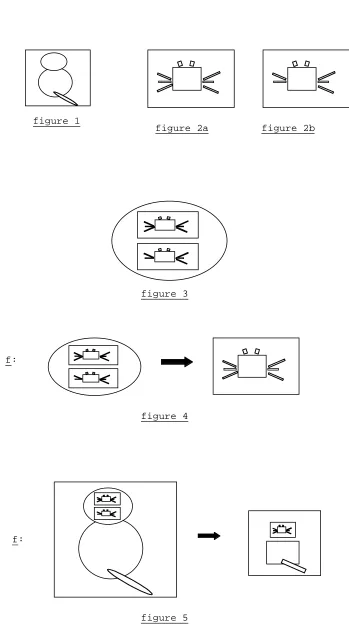
questionable immediate parts. Then, picturing sharp collections
as rectangles and vague collections as ellipses, Tibbles’
boundary is, as far as the outer two levels of structure are
concerned, as in figure 1. Continuing to oversimplify, suppose
her head has just a single questionable immediate part, the
whisker. Then it has just two slight sharpenings, with and
without. Secondly, let us declare the other parts of Tibbles'
head (two ears, another five whiskers and so on) to be honorary
atoms. The boundaries of the slight sharpenings of the head are
then as pictured in figures 2a and 2b. Finally, the boundary of
Tibbles’ head is the vague collection of figure 3, a detail from
figure 1.
Now let us turn to the “drawing” of sharper boundaries. I
shall describe incremental sharpening functions that, when
applied repeatedly to fuzzy boundaries, yield completely sharp
boundaries, within which there are no vague collections.
inwards, as we go replacing each vague collection with our choice
from among its elements. Choices are to be consistent: we shall
always choose the same element from any given vague collection,
irrespective of the context in which we run up against it. When
we run up against a sharp collection we pass straight to its
elements, since to sharpen up an immediately precise object is
just to sharpen up its immediate parts and then to put the
results back together as they were. When we reach a basic
boundary we stop, since these are already sharp.
Technically, a way of sharpening boundaries is a choice
function f that maps vague collections onto their elements: for
each vague collection V, f(V)∈V. For example, the choice function
f of figure 4 maps the boundary of Tibbles’ head onto the
boundary of the sharpening of which the loose whisker is a part.
Another, say g, maps this boundary onto the other alternative,
without the whisker. To extend choice functions to arbitrary
boundaries we put f(B) = B if B is a basic boundary, and f(S) =
[f(s):s∈S] if S is a sharp collection ('[' and ']', like
rectangles, enclose sharp collections).
In figure 5, f maps Tibbles’ boundary onto a precise boundary
within which the boundary of the whisker is embedded. Here,
oversimplifying, the result of a single application of f to the
boundary of Tibbles’ head is completely sharp. In general it
takes longer to achieve complete sharpness but we always get
there in the end, since each application of f reduces the degree
boundary B onto a completely sharp boundary f*(B), the complete
sharpening of B by f.30
Take some vague objects. We have seen how to sharpen up their
boundaries slightly using choice functions, and we can suppose
that there are, in other possible worlds, objects that have the
slightly sharper boundaries. Call these possible objects slight
sharpenings by these functions of these objects. Finite iteration
leads to completely sharp boundaries and complete sharpenings.
Now we can allow that a claim is super-true of some objects if it
is true no matter how they all get sharpened up. Letting
super-truth of claims about completely sharp objects be super-truth according
to some antecedently given evaluation scheme, super-truth passes
from claims about completely sharp objects to claims about vague
objects of ever increasing orders of vagueness, one order at a
time:
Super-truth condition: A statement about some vague objects is
super-true (super-false) if and only if, for every choice
function, it is super-true (super-false) of their slight
sharpenings by that function.
For instance:
The whisker is a part of Tibbles’ head.
30
For any sharp collections Si, let ∪iSi be the sharp collection
[s: for some i, s∈Si]. Now for any choice function f, f(∪iSi) =
∪if(Si). Provided ∪iSi is a boundary (the Si must be bounded in
their complexity, say finite in number) f*(∪iSi)= ∪if*(Si). We
is neither super-true nor –false. The complete sharpening of the
whisker by the earlier choice function f is a part of the
complete sharpening of Tibbles’ head by f, but the same does not
hold for the complete sharpenings by g. For the same reason:
The whisker is a part of Tibbles.
has a super-truth gap.31 But the "penumbral truth":
If the whisker is a part of Tibbles’ head, then it is a
part of Tibbles.
is super-true. This is just because any sharpening that like f
counts the whisker a part of the head must also count it a part
of the cat, since the head is a part, indeed an immediate part,
of the cat. Choice functions respect part-whole structure.
Fuzzy sets, having their elements to a greater or lesser
degree, are, like my fuzzy boundaries, a kind of vague abstract
object.32 Some think they can contribute to an understanding of
the composition and identity of vague objects.33 But there is a
31
I assume that ‘a part of’ expresses a relation among completely
precise objects that is at least as inclusive as the ancestral of
the immediate part-whole relation. Any immediate part of … an
immediate part of an object is to be a part of it.
32 Lofti Zadeh, "Fuzzy Sets," Information and Control, 8 (1965):
338-353.
33 Van Inwagen uses fuzzy sets to explain vague composition in his
op. cit., pp. 221-224. Jack Copeland uses them to explain vague
identity in "Fuzzy Logic and Vague Identity," The Journal of
familiar and crucial difficulty with the use of fuzzy sets to
explain vague composition. Standard many-valued interpretations
of fuzzy logic are truth functional.34 Such a treatment runs afoul
of penumbral truth.
What of the vagueness of singular terms? Supposing neither
Tibbles nor her head is vague, but instead the terms 'Tibbles'
and 'Tibbles' head' are, we can still say that the penumbral
sentence is super-true. Now we shall mean by this true on all
ways of resolving the reference of these terms. But we can say so
only if we can somehow coordinate the resolution of singular
terms which, like these two, pick out objects related as parts to
wholes (or which come to do so, as a result of resolution). The
idea is familiar in outline but the details have still to be
filled in.35 One cannot simply mimic this treatment since, unlike
these two, singular terms do not in general reflect the
part-whole structure of things.
Taken at face value, supervaluation does something amazing: it
reconciles vagueness with classical logic, finding truth-value
gaps where, in view of the super-truth of the law of the excluded
middle, it might seem that there can be none. But maybe this is
just a trick, worked by passing off as truth something that
34 Joseph Goguen, "The Logic of Inexact Concepts," Synthese, 19
(1969): 325-373.
35
See Hartry Field, “Quine and the Correspondence Theory”,
Philosophical Review, 83 (1974): 200-228; and see Kit Fine’s
really is no such thing. Arguably truth comes to a disjunction of
two sentences only if one of them is true, but a disjunction can
be super-true though neither is. Truth is disquotational, but
super-truth is not.36
I suggest that super-truth is not really truth but a
surrogate. The assertibility of a sentence turns its truth value
if it has one, but otherwise on its super-truth value. Indeed, it
appears that we cannot identify truth with super-truth if we
insist that identities are definite. In any interesting vague
world there will be some things that have some but not all
complete sharpenings in common. If super-truth were truth, then
the sentence expressing the identity of any two such objects
would, incorrectly, have a truth-value gap.
This completes the discussion of fuzzy boundaries. In the
following section, I shall use these boundaries to construct an
abstract world of vague objects. We shall see that there need not
be anything mysterious about vague objects. These ones do not
have any sort of shady presence or vague identities. In fact, as
we shall see, the idea that there are vague objects is compatible
with received ideas about parts and wholes, as set out in
classical mereology.
6. Vague Mereology
36
Compare Timothy Williamson, Vagueness (London and New York;
What is the part-whole theory of vague objects? We shall take the
classical theory as our starting point. Letting ‘part of’ be
primitive, one thing overlaps with another if they have some part
in common. One thing is a fusion of some others if and only if
any further thing overlaps with it, the fusion, if and only if
this further thing overlaps with one or other of the things
fused. A fusion is pieced together from the things fused, with no
part coming out of the blue. The first three basic propositions
of classical mereology are:
Transitivity: The parts of the parts of anything are parts
of it.
Unrestricted composition: Any things have a fusion.
Unique composition: Any things have a unique fusion.
A proper part of a thing is any part except the whole thing.
Mereological atoms cannot be identified from their proper parts
since they have none; but, according to the fourth basic
proposition, everything else can be identified from its proper
parts:
Extensionality: If any given things have proper parts, and
they have the same proper parts, then these things are
identical.37
Classical mereology does not say much about things. It does not
say whether they have temporal as well as spatial parts. Nor does
it say whether they are made up of atoms or can be divided
37
For a thorough survey of classical mereology see Peter Simons,
indefinitely. But it might be thought that classical mereology
says that things are precise. Certainly it has been thought, as I
noted in section 2, that if things have questionable parts then
composition must be vague, and thus restricted. It might also
seem that if things have questionable parts there ought to be two
things with the same proper parts but different questionable
parts, refuting extensionality. In this section, I shall show
that the four basic propositions of classical mereology do not
say that the world is precise.
I shall proceed by validating mereological propositions within
an abstract domain of vague objects. Two ideas underlie the
construction of this domain. The first is to take fuzzy
boundaries themselves as objects - as vague objects that are
their own boundaries. The second is to generalize the part-whole
and fusion relations from precise to vague objects using a sort
of ontological pendant of supervaluation. One thing - precise or
vague - will be a (generalized) part of another if it will be a
part no matter how both are made completely sharp. A
(generalized) fusion of some things will be something that is
pieced together from them no matter how everything in question is
made completely sharp. That is, it will be a thing such that any
complete sharpening of it is a fusion, in the classical sense, of
the corresponding complete sharpenings of the things fused.
Proper definitions will follow. Meanwhile, notice that I shall
not spell out generalized fusion, in analogy to the classical
I shall spell out both generalized notions in terms of
sharpenings and the classical part-whole relation.
Accordingly we now need some precise objects with a classical
fusion operation, some vague objects, and sharpening functions
that map the vague onto the precise objects. Firstly the:
Precise objects: These are non-empty sharp collections of simple
boundaries. The part-whole relation among them is
set-theoretic inclusion (⊆) and fusion is union (∪).
Clearly the part-whole theory of these objects is classical. In
defining the vague objects we shall run together all fuzzy
boundaries that, no matter how they are made completely sharp,
turn out to be of the same simple stuff. To compare the stuff of
sharp boundaries, (nested) sharp collections of simple
boundaries, we shall use an homogenizer H. This is a function
that turns any sharp boundary into a precise object, in the
above sense, by adding or removing structure as needed. For any
simple boundary B we put H(B) = [B]; and for any sharp boundary
S, we put H(S) = ∪s∈SH(s). We say that boundaries B and C are
equivalent if and only if for every choice function f: H(f*(B))
= H(f*(C)). B≈ is the class of all boundaries equivalent to B.
Now we have the:
Vague objects: These are equivalence classes S≈ of sharp
collections, S.
It remains first to define sharpening functions that map vague
onto precise objects, and then to extend the part-whole and
will take their sharpenings from their representatives: for any
choice function f we let f*(S≈), the complete sharpening of S≈ by
f, be H(f*(S)). Notice that f*(S≈) is always a precise object, in
the sense of this construction. We generalize the part-whole
relation by maximizing definite parthood and non-parthood. Thus
S≈ is a (definite) part of T≈ if and only if for each f:
f*(S≈)⊆f*(T≈), and S≈ is a (definite) non-part of T≈ if and only if
for each f: f*(S≈)⊄ f*(T≈). If neither a part nor a non-part, then
S≈ is a questionable part of T≈. Clearly these objects really do
have questionable parts. For example, letting A and B be basic
boundaries, it can be seen that [A]≈ is a questionable part of
[<B,[A,B]>]≈. (‘<’ and ‘>’, like the earlier ellipses, mark vague
collections.) For, letting f and g be such that f(<B,[A,B]>) =
[A,B] but g(<B,[A,B]>)= B, we see that f*([A]≈) = [A] ⊆ [A,B] =
f*([<B,[A,B]>]≈), but g*([A]≈) = [A] ⊄ [B] = g*([<B,[A,B]>]≈).
Although these objects are vague there is nothing shady about
their presence. They are fully there. There is nothing vague
about their identities, either: these objects are identical to
themselves, different from other things and they are indefinitely
identical to nothing. They refute Evans' argument from definite
identities that there cannot be any vague objects.
Let us say that an object is utterly vague if there is no
sharp line between any of its penumbral categories: not between
its parts and its non-parts, not between its parts and its
questionable parts, and so on. The vague objects of this
non-parts, and are not utterly vague. The construction could be
made to admit higher-order vagueness (most of the necessary
technical infrastructure is already there) but the fundamental
point would remain. The objects would still have sharp sets of
absolutely uncontroversial parts and non-parts - of things that
are in no sort of limbo at all.38 Even so, the vague objects of
this construction suit my purposes quite well. The idea that they
exist is intelligible, since they can be modeled with familiar
set-theoretic means. It remains to be seen whether the idea of
utterly vague objects can be made as intelligible.
Let us now verify the basic propositions of mereology. We
shall consider metalinguistic versions first. Formal versions
follow as consequences in the Technical Annex. To start with
there is:
Transitivity: If S≈ is a part of T≈ and T≈ is a part of U≈, then S≈
is a part of U≈.
I assume it is sufficient to show that any three objects that
verify the antecedent must also verify the consequent. Suppose S≈
is a part of T≈, and T≈ is a part of U≈. Take any choice function
f. Then f*(S≈) ⊆ f*(T≈) ⊆ f*(U≈) so, by transitivity of ⊆ and
arbitrary choice of f, S≈ is a part of U≈.
Given that we must reckon with truth-value gaps, transitivity
might be thought to require in addition that any three objects
falsifying the consequent of an instantiation will also falsify
its antecedent. But transitivity fails on such a double-barreled
interpretation of 'if..., then...'. For instance, letting A, B, C
and D be different atoms, choose S≈ = [<B,[A,B]>]≈, T≈ =
[<C,[B,C]>]≈, and U≈ = [<D,[C,D]>]≈. Then, as can easily be seen,
S≈ is a non-part of U≈. These three objects falsify the consequent
of the relevant instantiation. But it is neither the case that S≈
is a non-part of T≈, nor the case that T≈ is a non-part of U≈. To
falsify a conjunction is to falsify a conjunct, so these objects
fail to falsify the antecedent of this instantiation.
No two objects are each other's parts. Clearly, if S≈ is a part
of T≈ and T≈ is a part of S≈, then S≈=T≈. (Again, objects that
falsify the consequent need not falsify the antecedent:
[<A,B>,<C,D>]≈ and [<A,D>,<C,B>]≈ are different objects, but each
is a questionable part of the other.)
Now let us generalize the fusion relation and verify the
remaining basic propositions of mereology. We say that F is a
(definite) (generalized) fusion of some objects S1≈, S2≈, S3≈, … if
and only if for all f: f*(F) is a classical fusion of f*(S1≈),
f*(S2≈), f*(S3≈),…. F is a (definite) (generalized) non-fusion of
S1≈, S2≈, S3≈, … if and only if for all f: f*(F) is not a classical
fusion of f*(S1≈), f*(S2≈), f*(S3≈),…. Otherwise, F is a
questionable (generalized) fusion of S1≈, S2≈, S3≈, ….
Let us for the meantime restrict attention to vague objects
with representatives whose complexity lies below some given
finite upper bound. Then we have:
Unrestricted Composition: Any vague objects Si≈ have a fusion,
This follows directly from the fact that for any f, f*((∪iSi)≈) =
∪i f*(Si≈). This fact follows in turn from the earlier observation
that for any f and sharp collections Si, f*(∪iSi) = ∪i f*(Si),
together with the easily verified further observation that
H(∪iSi) = ∪iH(Si). The restriction to Si≈ such that the Si are of
limited complexity ensures that ∪iSi is also a suitable boundary,
and that (∪iSi)≈ is an object. Without this restriction we cannot
always be sure that ∪iSi is even a boundary; it will be if the Si
are finite in number, though, so even without this restriction
there are always finite fusions.
Here is a rigorous version of the informal example of Section
2, which suggests that questionable parthood need not restrict
composition. Let W be the boundary of Tibbles' loose whisker, and
let T- be the boundary of the rest of Tibbles. Let 'Whisker' be
[W]≈, let 'Tibbles minor' be [T-]≈, let 'Tibbles' be [<T-,[T,W]>]≈,
and let 'Tibbles major' be [T-,W]≈. Then Whisker is a questionable
part of Tibbles, and Tibbles is a questionable fusion of Whisker
and Tibbles minor. Even so Whisker and Tibbles minor fuse to make
something: Tibbles major.
The third basic proposition of classical mereology is:
Unique Composition: If F≈ and G≈ are generalized fusions of the
Si≈, then F≈ = G≈.
This can be seen as follows. Letting F≈ and G≈ be generalized
fusions of the Si≈, it follows from the properties of classical
with either also overlaps with the other. So for every f:
H(f*(F)) = f*(F≈) = f*(G≈) = H(f*(G), and so F≈ = G≈.
Existence, composition and identity are all definite, so there
is a classical principle that cannot hold true. Classically, one
object is a proper part of another if and only if there is a
difference: an object that does not overlap with the proper part,
whose fusion with it is equal to the whole. This principle
asserts a link between parthood and, on the other hand,
existence, composition and identity. There can be no such link
here, where parthood is sometimes questionable but these other
matters are always definite.
Finally, let us see that the vague domain is extensional. It
is sufficient to show that everything confirms to a:
Principle of proper parts: If some vague object has proper parts,
and each of its proper parts is a part of some second
object, then the object in question is also a part of this
second object.
Extensionality follows immediately since no two objects are each
other’s parts. We can demonstrate this principle within the full
domain of vague objects, with representatives of arbitrary
complexity.39 Notice that, even so, extensionality remains
substantially at odds with mereological vagueness, since it fails
if we restrict attention to the sorts of basic parts that we
ordinarily have in mind. Two vague objects might have the same
39
For reasons that have already been explained, we can now only
atoms or molecules as parts, say, but different atoms or
molecules as questionable parts. The less familiar proper parts
that make a difference between any two vague objects with proper
parts are provided by the following lemma:
Lemma: If S≈ is a proper part of T≈, then [<S,T>]≈ is also proper
part of T≈.
There are demonstrations of this Lemma and the Principle of
Proper Parts in the Technical Annex. The upshot of this section
is that the mereology of vague objects, unlike their logic, can
be very nearly classical.
Michael Morreau,
Figures:
figure 1
figure 2a figure 2b
figure 3
f:
figure 4
Technical Annex to "What Vague Objects are Like"
Demonstration of the Lemma
Let V be the vague collection <S,T>. Then for any f, either f*(V)
= f*(S), or f*(V) = f*(T). That [V]≈ is a part of T≈ is clear: for
any f, f*([V]≈) = H(f*([V])) = H([f*(V)]) = either H(f*(S)) or
H(f*(T)) = either f*(S≈) or f*(T≈). Either way, since S≈ is a part
of T≈, f*([V]≈) ⊆ f*(T≈). To see that [V]≈≠T≈, since S≈≠T≈ we can
choose f such H(f*(S)) ≠ H(f*(T)). Let f[V/S] be the choice
function that differs from f, if at all, only insofar as f[V/S](V)
= S. Since by the well-foundedness of boundaries V appears
neither within S nor within T, we now have: H(f[V/S]*([V])) =
H([f[V/S]*(S)] = H[f*(S)] = H(f*(S)) ≠ H(f*(T)) = H(f[V/S]*(T)). So
[V]≈≠T≈. This completes the demonstration of the lemma.
Demonstration of the Principle of Proper Parts
Supposing it is not the case that T≈ is a part of U≈, choose f
such that H(f*(T))⊄ H(f*(U)). Supposing T≈ has a proper part,
since U has a finite degree of nesting it is possible with
repeated use of the lemma to find a proper part [V]≈ of T≈ such
that T is an element of the vague collection V, but V does not
occur within U (nor, by the well-foundedness of boundaries, does
it occur within T). Now: f[V/T]*([V]≈) = H(f[V/T]*[V]) = H[f[V/T]*(V)]
= H(f[V/T]*(V)) = H(f[V/T]*(T)) = H(f*(T)) ⊄ H(f*(U)) = H(f[V/T]*(U))
= f[V/T]*(U≈). So [V]≈, though a proper part of T≈, is not a proper
part of U≈. This verifies the principle of proper parts, and with
Formal Mereology
Formal versions of the basic propositions of mereology follow
from the informal versions. Take a first-order language with
identity, a binary relation symbol ≤ (for "... is a part of...")
and a ternary ∑ ("... is a sum of ... and ..."). We also need a
sentential operator ∆ ("it is definitely the case that...").
Given a domain D of objects, an interpretation I maps each
relation symbol R onto a pair I+(R) and I-(R) of suitable
relations on D. For any I, I+(=) is identity and I-(=) is its
complement, difference. One interpretation J extends another, I,
if for each R, I+(R)⊆J+(R) and I-(R)⊆J-(R).
Given a set S of interpretations we introduce, for each I∈S, a
partial evaluation function vI that maps sentences onto
determinate truth values, T and ⊥. The clauses of the truth
definition concerning atomic sentences, quantifiers and
connectives other than → are standard in partial logic.40 The
remaining clauses are:
vI(ϕ→ψ) = T iff for each J that extends I:
if vJ(ϕ) = T then vJ(ψ) = T.
vI(ϕ→ψ) = ⊥ iff vI(ϕ) = T and vI(ψ) = ⊥. 41
40 See Blamey op. cit., page 3.
41 This two-sided intuitionistic interpretation of → was
introduced by R.H. Thomason in "A semantical study of
constructible falsity," Zeitschrift für mathematische Logik und
vI(∆ϕ) = T iff for each J∈S, vJ(ϕ) = T.
vI(∆ϕ) = ⊥ iff for some J∈S, vJ(ϕ) = ⊥.
With this truth definition evaluations are monotonic: if J
extends I and vI(ϕ) is a determinate truth value, either T or ⊥,
then vJ(ϕ) is the same value. An interpretation I∈S is the base
of S if each J∈S extends I; if I is the base of S then vI(ϕ)=T
iff for some - indeed each - J∈S, vJ(∆ϕ)=T.
Let us now interpret the language within a domain comprising
the earlier precise and vague objects. First, at the base we put
an I such that I+(≤) = {(d1,d2): for all choice functions f, f*d1 ⊆
f*d2}, and I
-(≤) = {(d1,d2): for all f, f*d1 ⊄ f*d2}. We put I +
(∑) =
{(d,d1,d2): for all f, f*d = f*d1∪f*d2}, and I
-(∑) = {(d,d1,d2): for
all f, f*d ≠ f*d1∪f*d2}. This interpretation I captures informal
truths about the domain. In particular, assuming that for each d
within this domain there is (or can be introduced) a suitably
interpreted individual constant d, we have: vI(d1≤d2)=T iff d1 is
a part of d2, and: vI(∑(d,d1,d2)=T iff d is a generalized fusion
of d1 and d2. Now for each choice function f there is an
interpretation, If, that extends I: If +
(≤) = {(d1,d2): f*d1 ⊆ f*d2},
If
-(≤) = {(d1,d2): f*d1 ⊄ f*d2}, If +
(∑) = {(d,d1,d2): f*d =
f*d1∪f*d2}, and If
-(∑) = {(d,d1,d2): f*d ≠ f*d1∪f*d2}.
We can express the basic propositions of mereology as follows:
Transitivity: ∀x,y,z(∆x≤y ∧ ∆y≤z → ∆x≤z)
Unrestricted (binary) composition: ∀x,y∃z∆∑(z,x,y)
Unique (binary) composition: