Other:
Davidson, J and Sainsbury, R orcid.org/0000-0002-1217-6818 (2008) Reporting changes in circumstances: tackling error in the Housing Benefit system - standard housing benefit cases. Corporate Document Services, Leeds.
[email protected] https://eprints.whiterose.ac.uk/ Reuse
Items deposited in White Rose Research Online are protected by copyright, with all rights reserved unless indicated otherwise. They may be downloaded and/or printed for private study, or other acts as permitted by national copyright laws. The publisher or other rights holders may allow further reproduction and re-use of the full text version. This is indicated by the licence information on the White Rose Research Online record for the item.
Takedown
If you consider content in White Rose Research Online to be in breach of UK law, please notify us by
Department for Work and Pensions
Research Report No 523
Reporting changes in
circumstances:
tackling error in the
Housing Benefit system
Standard Housing Benefit cases
Jacqueline Davidson and Roy Sainsbury
First Published 2008.
ISBN 978 1 84712 424 1
iii
Contents
Contents
Acknowledgements ... vii
The Authors ...viii
Summary ...1
1 Introduction ...5
1.1 Policy context ...6
1.1.1 Fraud and error across the social security system: the big picture ...6
1.1.2 Fraud and error in Housing Benefit ...7
1.1.3 Policy responses to date ...8
1.2 The aims and objectives of the study ...8
1.3 Research design and methods ...9
1.4 Sampling and recruitment ...11
1.5 Structure of the report ...12
2 Claimants’ knowledge and understanding of reporting changes in circumstances ...13
2.1 Awareness of the requirement to report changes in circumstances ...13
2.2 What kinds of change are reportable? ...14
2.2.1 Paid work ...15
2.2.2 Other changes to household income or capital ...16
2.2.3 Home and household changes ...17
2.3 Claimants’ sources of knowledge and views on their adequacy ...18
2.3.1 Official sources of information ...19
2.3.2 Claimants’ views on official sources of information ...19
2.3.3 Other agencies ...21
2.3.4 Informal and other sources of knowledge ...21
2.4 Discussion ...22
3 Reporting changes in circumstances: influences on behaviour ...23
3.1 Knowledge and understanding of the requirement to report changes ...23
3.1.1 Conceptualisation of ‘change’ in circumstances ...23
3.1.2 Concern to comply with obligations ...25
3.1.3 Perceived financial consequences of reporting a change in circumstances ...25
3.2 Understanding and experiences of the benefit system ...26
3.2.1 Understanding the benefit eligibility criteria ...27
3.2.2 Previous experiences of benefit administration ...27
3.2.3 Interaction of benefits and tax systems ...28
3.3 Context of the change in circumstances ...29
3.4 Discussion ...29
4 Experiences and consequences of reporting changes in circumstances ...31
4.1 Methods of reporting changes in circumstances ...32
4.2 Experiences of reporting changes in circumstances ...33
4.3 Consequences of informing about change ...34
4.3.1 Uncertainty ...34
4.3.2 Financial insecurity ...34
4.3.3 Stress, confusion and annoyance ...34
4.4 Experience of benefit overpayment and overpayment recovery...35
v
5 Conclusions, discussion and policy implications ...37
5.1 Introduction ...37
5.2 Barriers to reporting changes in circumstances ...37
5.2.1 Knowledge deficits ...38
5.2.2 Reporting channels ...39
5.2.3 Consequences of reporting a change in circumstances ...39
5.3 Policy implications ...40
5.3.1 Structural options ...40
5.3.2 Administrative options ...41
5.4 Concluding remarks ...42
Appendix Topic guides ...43
References ...59
[image:6.595.86.508.106.433.2]List of tables
Table 1.1 Housing Benefit losses due to fraud and error 2002 – 2007 (as % of benefit expenditure) ...7Table 1.2 Design of study ...10
Table 1.3 Achieved sample...11
List of figures
Figure 1.1 Total overpaid benefit expenditure between 2000/01 and 2005/06 ...7vii
Acknowledgements
Acknowledgements
Firstly, we would like to thank the research participants for their time and their commitment to the duration of the project. Thanks also to our colleague Katharine Nice for her help with the first round of interviews.
We are grateful for the assistance we have received from the Department for Work and Pensions, especially to the project manager, Richard Zaluski-Zaluczkowski in the Housing Research and Analysis Division.
The Authors
Dr Jacqueline Davidson is a Research Fellow at the Social Policy Research Unit, University of York. Her recent work includes exploring different routes onto Incapacity Benefit and her research interests include poverty, social security and the labour market, human need, gender, and comparative social policy.
1
Summary
Summary
Introduction
Whilst levels of fraud have consistently decreased in the benefit system, levels of claimant and official error have not, and the reduction of overpayments is now an important policy objective (Department for Work and Pensions (DWP) 2007). The estimated total of Housing Benefit fraud and error from October 2005 to September 2006 was £760 million (Audit Commission 2008), which represents just over five per cent of the £14 billion total 2005/06 expenditure on Housing Benefit. Of this, £170 million is estimated to have been lost through fraud, £430 million was overpaid because of claimant error and £160 million overpaid because of official error (DWP, 2007).
This report presents findings from a qualitative research project to explore Standard Housing Benefit claimants’ knowledge and understanding concerning changes in their circumstances and their obligations to report them and, as such, complements earlier research which considered a range of means-tested benefits including Jobseeker’s Allowance and Income Support (Irvine et al., 2008). The research was commissioned by the DWP and was carried out by the Social Policy Research Unit at the University of York in 2007-08.
Findings
Claimants’ knowledge and understanding of reporting changes in circumstances (Chapter 2)
Some people felt that official sources of knowledge on reporting changes in circumstances were not frequent enough, not detailed enough and that they were not presented in plain English. Increasing both the scope and the detail of official knowledge in relevant changes that should be reported for Housing Benefit purposes might therefore be helpful.
It could also be confusing for people when they move from one local authority to another and are not aware that there might be different procedures and administration processes. That there are such differences makes the task of fully informing claimants difficult on a national level.
Reporting changes in circumstances: influences on behaviour (Chapter 3)
A range of factors which might affect reporting behaviour was identified. Perceptions of the financial consequences of reporting a change could lead to not reporting changes which might have increased or decreased benefit. Some people recognised that their receipt of Housing Benefit was tied to their personal circumstances and thus reasoned that changes in their circumstances would therefore need to be reported. Previous negative experiences of benefit administration (delays in processing and waiting times), the apparently contradictory procedures and administration processes, and timelines of different benefit authorities (such as local authorities and Her Majesty’s Revenue and Customs which resulted in financial difficulties and unanticipated outcomes of reporting changes) could also be seen to influence behaviour and attitudes towards benefit authorities.
Such factors are not mutually exclusive and in practice they are, and will be, interrelated in their influence on reporting changes in circumstances. Moreover, some of the factors will be more or less relevant to different people at different times, and effects might be magnified where people claim several benefits and tax credits.
Experiences and consequences of reporting changes in circumstances (Chapter 4)
3
Conclusions and policy implications (Chapter 5)
The Getting Welfare Right strategy suggests that claimant error might be corrected by prevention (preventing wrong payments at the initial claim stage), claimant compliance (maintaining an accurate claim) and correction (identification and correction of wrong payments). The findings are most relevant to the second strand of this strategy, claimants’ compliance to maintain an accurate claim. Before claimants can maintain an accurate claim, they must first be aware of their full obligations. From the diversity in understanding highlighted in this report and other research, this is not currently the case and the possibility exists for increasing both the scope and the detail of people’s knowledge of changes they should report for benefit purposes.
Factors which might influence whether claimants reported changes in their circumstances were also looked at and it was found that previous negative experiences and a lack of trust in benefit administration in addition to procedures and (perceived) consequences of reporting a change (for example financial hardship and stress) might also influence reporting decisions. There is, therefore, scope for enhancing claimants’ experience of the benefits system on a number of levels because, for claimants, reporting changes in circumstances is not divorced from experiences of the wider benefit system. As formerly noted, some of these issues could be addressed by structural simplification of the benefits rules and procedures.
5
Introduction
1 Introduction
This report presents findings from a qualitative research project to explore Standard Housing Benefit claimants’ knowledge and understanding concerning changes in their circumstances and their obligations to report them and, as such, complements earlier research which considered a range of means-tested benefits including Jobseeker’s Allowance and Income Support (Irvine et al., 2008). The research was commissioned by the Department for Work and Pensions (DWP) and was carried out by the Social Policy Research Unit at the University of York in 2007-08.
Whilst levels of fraud have consistently decreased in the benefit system, levels of claimant and official error have not, and the reduction of overpayments is now an important policy objective (DWP 2007). The estimated total of Housing Benefit fraud and error from October 2005 to September 2006 was £760 million (Audit Commission 2008), which represents just over five per cent of the £14 billion total 2005/06 expenditure on Housing Benefit. Of this, £170 million is estimated to have been lost through fraud, £430 million was overpaid because of claimant error and £160 million overpaid because of official error (DWP 2007).
Twenty research participants were interviewed twice in the course of four months. During these qualitative interviews, data were collected on experiences of changes in circumstances that occurred prior to the initial interview and during the period of the research.
1.1
Policy context
Housing Benefit is an income-related benefit administered by local authorities on behalf of the DWP. People are eligible to claim Housing Benefit if they are liable to pay rent for accommodation that they occupy as their home. Claimants who are already in receipt of one of the other income-related social security benefits (including Income Support, Pension Credit or income-based Jobseeker’s Allowance) have an automatic entitlement to Housing Benefit and are referred to as ‘Passported’ claimants. They therefore do not have to provide the local authority with evidence of income or capital. However, Housing Benefit can also be claimed by people in employment but on a low income, and will receive the benefit if they satisfy the income and other eligibility criteria. They are known as ‘Standard’ Housing Benefit claimants in contrast with ‘Passported’ claimants.
As mentioned above, DWP commissioned an earlier piece of work looking at claimant error across a range of benefits (Irvine et al., 2008). As that project progressed, the experiences of the sub-sample of people receiving Standard Housing Benefit were identified as being distinctive and therefore warranted more detailed investigation. In contrast to recipients of Passported Housing Benefit they were in low-paid employment, or carers, or occasionally recipients of contribution-based Jobseeker’s Allowance. They also typically had no or very few dealings with Jobcentre Plus, but conducted most or all of the benefit business with their local authority.
In May 2007 there were 1.1 million recipients of Standard Housing Benefit in Great Britain (compared with 2.9 million recipients of Passported Housing Benefit).
1.1.1 Fraud and error across the social security system: the big picture
7
Figure 1.1 Total overpaid benefit expenditure between 2000/01 and 2005/06
Source: Getting Welfare Right (DWP, 2007)
1.1.2 Fraud and error in Housing Benefit
Systematic measurement of fraud and error in Housing Benefit has been carried out since 2002. Between April 2002 and September 2007 (the last date for which figures are available at the time of writing) official figures show that losses due to fraud and error had dropped slightly from five per cent of total expenditure to 4.8 per cent (i.e. £740 million in 2007). However, within that overall figure losses due to fraud had fallen by over half while losses due to claimant and official error had both risen. Table 1.1 presents data on losses over the period 2002 to 2007. (There is no separate analysis for Passported and Standard claimants however.)
Table 1.1 Housing Benefit losses due to fraud and error 2002 – 2007 (as % of benefit expenditure)
Source of losses Fraud % Official error % Claimant error %
April 2002 – March 2003 1.9 1.1 1.9
April 2003 – March 2004 1.4 1.2 2.3
April 2004 – March 2005 1.3 1.0 2.7
April 2005 – March 2006 1.0 1.4 3.1
April 2006 – March 2007 0.7 1.4 2.9
October 2006 – September 2007
0.9 1.3 2.7
Source: http://www.dwp.gov.uk/asd/asd2/fraud_error.asp
[image:16.595.91.506.676.795.2]Official figures are usually presented for the period April to March. However, Table 1.1 includes figures for the latest 12-month period from October 2006 to September 2007. These are interesting as they suggest that the steady downward trend in fraud losses might be coming to an end and that claimant error might be on a downward path from a peak of 3.1 per cent in 2005.
Official statistics also show that of the £320 million lost through claimant error in October 2006 to September 2007, nearly two-thirds (66 per cent) were due to only three causes: non-residency (£60 million) earnings (£100 million) and tax credits (£50 million).
1.1.3 Policy responses to date
In response to rising levels of error, the DWP has developed a strategy for reducing error which was published in January 2007 (DWP 2007). The strategy’s suggested approach for reducing claimant error is a combination of prevention, compliance and correction. For example, a ‘new awareness campaign’ was announced that is designed to increase knowledge of reporting requirements and to persuade claimants that their own interests are served by keeping their claims accurate and up to date (p.28). The strategy also notes that DWP needs to ‘look creatively at how to make it easier… to report changes in circumstances’. The strategy’s main recommendation on correcting incorrect benefit payments is to pilot a proactive approach to capturing information about changes in circumstances.
As this brief review has shown, the persistence of the problem of error in benefit payments has generated the need for further understanding about the behaviour and experiences of Standard Housing Benefit claimants who have changes in their lives. Standard Housing Benefit claimants, while they may be on a low income, are by definition, not Passported onto Housing Benefit through other means-tested benefits such as Income Support and this can reduce opportunities for system-generated automated reporting of changes in circumstances.
1.2
The aims and objectives of the study
The overall aim of the project was to increase our understanding of Standard Housing Benefit claimants’ reporting of changes in their lives and thereby inform policy development targeted at timely, accurate and relevant reporting of changes in circumstances.
The objectives of the overall study were focused on the key areas of:
• how claimants experience changes in circumstances;
• their knowledge and perceptions about reporting changes in circumstances; • their sources of knowledge;
• their experiences of reporting changes; and
9
To meet these objectives and address the emerging concerns of DWP, the following more detailed research questions were addressed:
• What issues are important in people’s lives when circumstances change?
• What are people’s knowledge and perceptions about reporting changes in
circumstances?
• How salient is reporting changes at these times?
• What do people know about their responsibilities to report changes in relation
to housing benefit?
• What are people’s attitudes towards reporting changes? • What motivates people to report changes?
• What time and effort are required to report changes?
• Are there particular issues for claimants in reporting changes of address?
• What dificulties, if any, are experienced in reporting changes to local
authorities?
• What do people know about the effects of reporting, or not reporting, different
changes?
• Are there barriers to reporting?
• What are people’s understanding and experiences of overpayments?
• How do people gain their knowledge and understanding about reporting? • What are their sources of knowledge?
• Do people have different experiences of reporting changes to the local authority
compared with other benefit authorities?
• How do people experience having Housing Beneit suspended?
• Are there differences in the experiences of private tenants and social housing
tenants?
• What would help or encourage people to report changes in circumstances?
The next section describes the design and methods chosen to address the research questions for these groups.
1.3
Research design and methods
Qualitative research methods were used to generate data. Because individual experiences of the Housing Benefit system were expected to vary considerably, and because of the potential for sensitive data, we chose to use individual interviews (rather than, for example, focus group interviews). Participants took part in a face-to-face in depth interview, and were followed up by telephone approximately four
months later. Interviews were semi-structured (see the Appendix) and so allowed an in-depth exploration of participants’ understandings and experiences.
Table 1.2 Design of study
Timing Method of data collection
Interview 1 December 2007 Face-to-face interview
Interview 2 March – April 2008 Telephone interview
The aim was to interview a sample of 20 Standard Housing Benefit claimants in three locations with different labour markets. In consultation with DWP, the following local authority areas were selected:
• Durham – an urban local authority;
• High Peak, Derbyshire – a rural local authority; and • Wandsworth – an inner city London Borough.
The first interview was used to collect data on the following:
• current circumstances;
• knowledge about the beneit system and responsibility for reporting changes in
circumstances;
• sources of knowledge;
• recent experiences of being a beneit recipient and changes in circumstances; • views and attitudes towards the local authority and other beneit authorities
(including Jobcentre Plus, Pensions Service);
• experiences of and views about overpayments; and • expectations of changes in circumstances.
Based on previous experience we defined ‘recent’ changes in circumstances as within the previous six months although in practice some people interviewed described experiences from further back than this. In the subsequent telephone interview we explored the following:
• changes in circumstances since the face-to-face interview;
• new experiences of dealing with the local authority and other beneit
authorities;
• changes in knowledge and sources of information; • changes in attitudes; and
11
Topic guides were developed for each of the two interviews in consultation with DWP. Interviews were recorded with permission and transcribed professionally for analysis. Transcripts were analysed using the Framework technique of thematic analysis (Ritchie and Spencer, 1994).
1.4
Sampling and recruitment
DWP drew a sub-sample of Standard Housing Benefit claimants for each of the three selected fieldwork locations. We then adopted a purposive sampling approach which used the following sampling criteria as agreed with DWP:
• location; • gender;
• work status (people in paid work or self employment or not); • age; and
• social/private landlord.
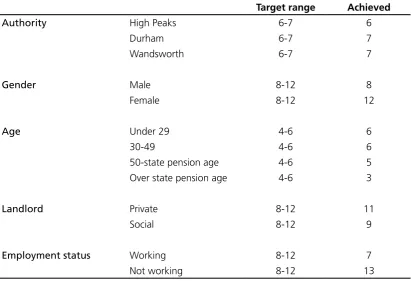
[image:20.595.93.505.449.730.2]Table 1.3 compares the achieved sample with the target sample.
Table 1.3 Achieved sample
Target range Achieved
Authority High Peaks 6-7 6
Durham 6-7 7
Wandsworth 6-7 7
Gender Male 8-12 8
Female 8-12 12
Age Under 29 4-6 6
30-49 4-6 6
50-state pension age 4-6 5
Over state pension age 4-6 3
Landlord Private 8-12 11
Social 8-12 9
Employment status Working 8-12 7
Not working 8-12 13
Although people were sampled from Housing Benefit databases, their actual experience of benefits and tax credits was much wider. During the course of the study some people had been in receipt of up to three or four different benefits and tax credits, which allowed us to explore experiences of reporting changes in circumstances to different benefit authorities, in particular Jobcentre Plus and Her Majesty’s Revenues and Customs, which administers tax credits. However, primarily we use examples to illustrate points from the data as they relate to Housing Benefit. We particularly focus on those issues which incur the largest amount of claimant error mentioned earlier: non residency, non reporting of earnings and non reporting of tax credits, in order to draw out policy lessons.
1.5
Structure of the report
The structure of the report is as follows. Chapter 2 considers claimants’ knowledge of the requirements to report changes in circumstances, and looks at the breadth and depth of their knowledge. The chapter also outlines the sources from which claimants acquire knowledge over time and their perceived usefulness.
Chapter 3 discusses the factors which might influence whether or not claimants report changes in their circumstances to Housing Benefit authorities. These include knowledge about the types of changes which should be reported, previous experiences of the benefit system and contextual factors surrounding the change.
The processes and procedures in the benefit system which can be seen to facilitate or hinder the timely and accurate reporting of changes in circumstances are the subject of Chapter 4. The range of methods used by claimants to report changes in their circumstances, the variety of people’s experiences and the subsequent impacts of reporting changes are considered.
Chapter 5 concludes the report by summarising the main findings and setting out some implications for policy to reduce claimant error.
A note on the use of verbatim quotations
13
2 Claimants’ knowledge
and understanding of
reporting changes in
circumstances
This chapter considers claimants’ awareness of their obligation to report changes in circumstances and looks at the breadth and depth of their associated knowledge. Data are drawn from people’s actual experiences within the course of the research study and examples they offered from the past. The chapter also outlines the sources from which claimants acquire knowledge over time and its perceived usefulness.
Section 2.1 looks at claimants’ broad understandings of their obligations to report changes for benefit purposes and also considers their perceptions of the time frame within which changes should be reported. Section 2.2 looks in more detail at the actual types of changes people thought might be reportable and their depth of knowledge. Section 2.3 presents the sources of claimants’ knowledge and views about the adequacy of those sources. The chapter concludes with a discussion in Section 2.4.
2.1
Awareness of the requirement to report changes in
circumstances
Most people in the study sample were aware that they were required to report changes in circumstances to their local Housing Benefit department. There were only a few claimants who had very little understanding of their obligations, but it is useful to understand their circumstances. One such person was living in supported accommodation for people with mental ill health. They said that their support worker would inform them when their circumstances had changed for benefit purposes. One other person found it difficult to engage with the question of what changes in circumstances might mean.
‘I suppose it could be like the health of me or…my wife, something like that but apart from that I can’t see anything really.’
(Male, 70s)
The above claimant and his wife were pensioners whose circumstances had been relatively stable for a number of years. Because of their housing situation (sheltered accommodation) they engaged relatively little with the local authority and could not remember receiving any information on what they should do if their circumstances were to change. As the couple perceived it, their rent was adjusted ‘automatically’ and the housing association and the local authority seemed to work together regarding adjustments and payments with little input from them. People had different understandings about when they should report change. One person perceived that they had a time period of 30 days to report changes in their working circumstances to the local authority.
‘I’ve seen it on the letter…‘If you have not let us know of a change within the first 30 days of it happening, why have you not done this?’ So obviously it’s from that, it’s from the forms.’
(Female, 20s)
Another person perceived that they had a two-week period within which to report changes. Other people had sometimes reported a change before it happened (for example moving house; a family member coming to live with them) or reported it one or two days after the change had happened (turning 60 years of age).
2.2
What kinds of change are reportable?
Although people were generally familiar with the obligation to report changes in their circumstances for Housing Benefit purposes, there were instances of lack of understanding of the types of changes which might be important to report, and some people thought that some more concrete examples might be given in literature.
Respondent: ‘It doesn’t really say, like, what changes, the changes are, really, but…So you have to…Yeah.’
Researcher: ‘…sort of, work those out yourself?’
Respondent: ’Yeah.’
(Female, 20s)
Some people seemed to operate with a general understanding that the obligation to report changes in their circumstances effectively meant that they should report any ‘extra money’ they might have in order that their benefit could be reduced or withdrawn.
‘It means basically anything, any increase in money is, I have to notify them, it’s probably going to result in a decrease in something that they give me.’
15
Other people exhibited understanding of particular changes in circumstance which could either increase, decrease, or stop their benefit. Some people mentioned a broad range of changes which might affect anyone’s benefit, whilst others mentioned changes in relation to themselves.
‘If I had a child, which I know that would never happen. If I had a job that, do you know what I mean, that would affect it big, big time…If I got married… If I had a partner living here, which I know I couldn’t because of my contract
[laughs], but things, yeah, things like that.’
(Female, 40s)
Some people mentioned more types of changes than others. The broad range of changes referred to by people is outlined in the following section. In all, there were differences in the scope of change that people could identify (for example, changes in work, family composition, health) as being important for Housing Benefit purposes and differences in the detail of change (for example, earnings disregards, number of hours worked, length of time that someone could stay with them without being considered resident).
2.2.1 Paid work
Most people had a broad understanding that paid work was important for Housing Benefit purposes. Starting work, increasing income from paid work or finishing paid work (being made redundant, or becoming ill for example) were all changes that people mentioned.
Some people in the sample who were working or self employed mentioned that they would report extra hours or extra money that they received from work. Some people experienced fluctuating wages, earnings and hours, and regularly informed the local authority when their paid-work circumstances changed. There was a range of understandings of the rules and practices here. Two couples who were self employed understood that their Housing Benefit depended on their income and that this meant they should present their earnings to the Housing Benefit authorities once a year rather than having to report them more regularly.
One other couple with fluctuating earnings had a broad understanding that their Housing Benefit would change if one partner’s hours fluctuated from 30 per week. To be ‘on the safe side’ they handed in all wage slips to the Housing Benefit authority once (or more) a month.
‘If I worked, like, a lot of hours more, ‘cause I only work, like, 30 at the minute, and it says on every form that you get, you know, “You must tell us if you work over, or you less your hours, because you’re probably claiming money that you’re not expected to have”.’
(Couple, 30s)
One person who moved between periods of paid work and full-time education filled in Housing Benefit forms every time a move was made from one status to another, but did not understand how their Housing Benefit fluctuated.
‘…some weeks I seem to, like, not get anything, and then, like, then I get something and it just seems to go up and down all the time. …Usually I get a letter from it. I just, sort of scan it. It just, sort of says, oh, you get this much now, or it’s gone up or it’s gone down and I just, sort of, just put it aside and not really look at it.’
(Female, 20s)
One person thought that relatively small amounts in wages, for example, 20 pence per hour, were too insignificant to make any difference to their Housing Benefit rate. Another was not sure about whether she should report working a couple of extra hours:
‘Well, I’m not sure. Well, I’m not actually sure, because if – to be honest, if I went to them one week and said, oh, you know, “I’ve done a few extra hours”, I might – they might take those hours and say, “Okay, that’s what you do every week”.‘
(Female, 20s)
One person mentioned the Incapacity Benefit permitted work rules and that they would be allowed to earn some money. Another said that he was allowed to work up to 16 hours and claim Housing Benefit. As we also found in the earlier study, while there was a broad understanding that paid work was important for Housing Benefit purposes, there was less recognition of the detail of what changes in paid work might count.
2.2.2 Other changes to household income or capital
Some people mentioned that they would inform the local authority if their financial circumstances were affected by income other than from work. For example, if they won money from the lottery, if they inherited money or someone gave them a large amount of money. Other people understood that they were obliged to present details of their annuities, savings and private pensions to Housing Benefit authorities and inform of any changes in them.
There were differences in how confident people felt in relation to specific rules. One retired person understood that:
‘…if something changes by a few pounds, you’ve got to notify them within 14 days.’
(Male, 70s)
Another person also claiming Incapacity Benefit was not sure of the capital limits but thought that they might have been around £5,000, over which 80 pence per pound would be deducted from benefit.
17
2.2.3 Home and household changes
As with paid work, there was a widespread understanding that changes in household circumstances would matter for Housing Benefit purposes. Having a child, getting married, having a partner come to live with you, having a spouse or partner move out, rent increases and moving home were all given as circumstances which would need to be reported to Housing Benefit authorities. Some people mentioned that renting out a room to a lodger or family member would need to be reported, and sometimes differentiated between paying lodgers and guests. Where they made this distinction they often did not see the need to inform Housing Benefit authorities if a friend or relative came to stay for a period of time and they were not contributing financially to the household.
‘If somebody comes to stay with you…like a relative, for a couple of weeks, that obviously is not going to be giving you any money, I don’t think that you do have to notify them with that…If it was just a family member coming to stay for a short while, I wouldn’t notify them, because, at the end of the day, they wouldn’t be paying me any rent, and they would just be staying here for a temporary amount of time. But, obviously, if there was somebody staying here that was renting a room, or in the property then, obviously, I would know that you would have to notify them of that, obviously, because you are taking some income in from that.’
(Female, 20s)
One person mentioned that they would inform Housing Benefit authorities if the time spent living in her rented property changes or if she started to stay away from home for long periods of time.
Others had informed Housing Benefit authorities when their rent on their private rented property had increased. Some had the excess met by Housing Benefit and some did not. One person mentioned that there was a time lag between the time at which her private landlord increased the rent and at which the local authority reviewed her Housing Benefit. She had to pay the shortfall in the interim. Some people in local authority rented accommodation perceived that their Housing Benefit and housing department worked together and sorted out rent increases and adjusted Housing Benefit without the claimant’s involvement. The claimant was then informed of the decision and of the recalculated contribution they were required to make to their rent (if any).
Some of the sample had recently moved home. There were differences here in when people informed and applied for Housing Benefit, but it should be noted here that for most of the people concerned this was a move into their first property (they had previously been staying with friends or family). Two people took on a private tenancy agreement and then informed Housing Benefit authorities that they had done so. One other person who was working part time and who was staying with a relative was subsequently offered accommodation by a private landlord who informed him that he would be eligible for Housing Benefit.
One couple had moved (from one private rented property to another) across local authorities in the period between the first and second research interview. They had informed their new local authority that they would be moving to their borough and had been told that they could not apply for Housing Benefit until they had moved. One other family was a week or so away from moving within their local authority borough and said that they would be informing Housing Benefit authorities once they had a definite moving date and a tenancy agreement for their new place.
2.2.4 Other changes
Some people did not think that they would need to inform Housing Benefit authorities about taking holidays, one of them arguing that their rent still had to be paid whether they were on holiday or not.
Becoming ill was mentioned by some people as a reportable change (perhaps to benefit authorities more generally, rather then Housing Benefit in particular). One person, however, understood that if they were to be awarded Disability Living Allowance they would be eligible for full Housing Benefit because they were classified as disabled. They also understood that Disability Living Allowance would not be taken into account for purposes of means-tested benefit calculations:
‘…that won’t actually affect my claim for Housing Benefit, even though I’ll be getting more money because I’m disabled, a lot more other criteria comes into it. It means that I’m automatically able to get Housing Benefit regardless of what other income comes into the house, because I’m disabled.’
(Male, 30s)
The major point to draw out from the section above is the range of knowledge claimants hold. It is perhaps useful to make a distinction between the scope of change for benefit purposes that people are aware of (for example, in terms of ‘work’; ‘income’) and in the detail of the changes (how much can I earn, how many hours can I work; how long can someone stay with me for?).
2.3
Claimants’ sources of knowledge and views on their
adequacy
19
2.3.1 Official sources of information
Most people had been given information in some form from official sources such as their local authority and/or the DWP. Some people commented that they had received information in a written format when they had first claimed Housing Benefit telling them that if their circumstances changed they were obliged to report it. Others mentioned that the obligation to report changes was on ‘every letter’ that was sent out to them about their benefit claim(s).
‘I know, that, anyway, from when – on the back of your – when they send you out your calculation thing from…April, yeah, when they send you out the calculation, it says on the back of the letter itself that if you have any – if there’s any changes in circumstances, a partner may come to live with you, or earnings go up, or anybody staying with you that’s earning, then you are to notify them ASAP.’
(Female, 20s)
Some people, like the person above said that their letters provided instances of the kinds of circumstances which might constitute a change, like a partner coming to live with them, or an increase in their earnings. Others however, said that they had only received written information telling them that they were obliged to report changes, but not the type of changes that were relevant. In the absence of official knowledge of this type, this could lead to people making common sense deductions about what mattered. One person said when asked about how they knew what changes to report for example said ‘Well that’s just me, my…my assumption.’ This has obvious implications for reporting changes correctly when the assumptions do not match statutory requirements.
There was a deal of diversity in whether people reported that their local authority conducted any kind of periodic review. Some people could not remember having been asked anything about whether their circumstances had changed since their claim first started. Others said that they received a form now and again asking whether their circumstances had changed. Yet others said that they periodically had someone out to visit them from the local authority.
A number of people also said that they received knowledge and information from visiting or telephoning the local authority office.
2.3.2 Claimants’ views on official sources of information
Whilst some people thought that listing the types of situations on written correspondence which might constitute a change, such as ‘a partner coming to live with you’ were informative enough, others thought that there could be more examples listed of the types of changes which should be reported for benefit purposes. One person recognised that there was a fine balance between not giving people enough information and giving them too much.
‘…they only put on a limited thing of what – if your circumstances change. …It could be definitely more detailed, obviously not getting into it too much because you just end up with a pamphlet and then you just get completely… you get completely lost.’
(Male, 30s)
Some people also said that some of the language used in official correspondence was not easy to understand and it would be helpful for correspondence to be written in ‘plain English’. They also commented that the forms were sometimes long with complex calculations on them.
‘…just simple plain English instead of everything being so complicated and long-winded.’
(Female, 50s)
‘…a lot of people don’t really bother looking at letters really, ‘cause it’s all down and it’s all about three pages long, and you’re just thinking, “What’s all these numbers?” And then sometimes it’s repeated, and you’re thinking, oh, I can’t be bothered to look at that.‘
(Female, 20s)
People held mixed views about periodic checks. Some people perceived that they were being checked up on to be sure they were not committing fraud. Other people said that they found home visits helpful because they could ask questions face to face about benefits, and they felt less likely to make mistakes with paperwork when the local authority officer was there to assist with filling it in.
Some people did say they would like to be ‘called in’ to the office for a periodic review with a local authority officer to check whether their circumstances had changed.
‘I would like to see, I know this human touch costs more, blah-blah-blah, ’cos it takes up more time. I would like to maybe be called in, not just me, everybody who’s on this or that or other, called in for like a chat in a room, instead of these tons of letters which cost the council money in postage, why not just send one saying, can you come in and bring any relevant documents, just to see if anything’s changed.’
(Male, 50s)
21
2.3.3 Other agencies
There were instances in the data of people having gained knowledge of Housing (and other kinds of) Benefit from a number of different agencies. For example, one person who fostered children had direct access to a welfare rights adviser. The adviser was used to explore the claimant’s circumstances in detail (regarding what benefits the family would be entitled to) and could be called on to discuss implications of any changes in the family’s circumstances. The person considered this as being extremely useful.
‘…the support I get through the fostering, I have a Welfare Rights Officer; I can ask for information, so I have a quick link, if you like, and a direct link, as opposed to having to make an appointment with somebody and go through that. So I know a bit more, but only about my circumstances.’
(Female, 40s)
Other people had got information about Housing Benefit from managers in their housing association, from care managers and social workers. Some people in private rented housing spoke of their landlord, or a letting or estate agent, having informed them of the existence of Housing Benefit. These were all considered useful sources of knowledge (and sometimes help in claiming) for people.
2.3.4 Informal and other sources of knowledge
People had also accrued knowledge from direct experience of using the benefit system as well as from their friends, family and acquaintances. Several people said that they had learned from being in the social security system, either because they were engaging with the benefits system for themselves or from assisting other family members and friends.
‘…picking it up along the way and somebody will say something and you go, “Oh, I didn’t know that”, and then somebody else will mention something the next time you phone up.‘
(Male, 30s)
People accrued knowledge from many sources simultaneously. Knowledge gained from one source sometimes prompted someone to seek, or challenge, knowledge from other sources. There were examples of people challenging official decisions because they had gained knowledge from family or friends or from welfare rights organisations, for example.
2.4
Discussion
This chapter has considered claimants’ understandings of their requirements to report changes in their circumstances and the sources of that knowledge.
In the earlier report (Irvine et al., 2008) we identified different ‘levels of understanding’ from people’s accounts of their knowledge of reporting changes in circumstances.
1. At the broadest level, there is the understanding that there is a requirement to report changes in your circumstances.
2. At the next level, there is a general awareness of the areas of life, in other words the circumstances, in which a change may need to be reported, for example, changes in employment, household composition or health.
3. Next, there is an awareness of the specific changes that must be reported, for example, if you stay in hospital for a certain length of time, or if you increase your weekly hours of work from 15 to 20.
We found the same patterns of understanding in this study of Standard Housing Benefit claimants. Claimants on the whole did have an understanding that they were required to report changes in their circumstances. However there was quite a wide variation in the range of knowledge in two important respects. Firstly, people differed according to the scope of changes they considered important to report (work, income, household circumstances etc), and secondly in the detail of those changes (amount of hours permitted; earnings; length of stays etc).
These findings were in part echoed in views on official sources of knowledge imparted to claimants. Some people felt that they were not frequent enough, not detailed enough and that they were not presented in plain English. Increasing both the scope and the detail of official knowledge in relevant changes that should be reported for Housing Benefit purposes might therefore be helpful.
23
3 Reporting changes in
circumstances: influences
on behaviour
This chapter discusses the factors which might influence whether or not claimants report changes in their circumstances to Housing Benefit authorities. The data presented in the chapter draws on claimants’ experiences prior to, and over the course of, the research. Section 3.1 presents findings on claimants’ knowledge and understanding about reporting changes in their circumstances. Section 3.2 looks at their understandings and experiences of the benefit system, and Section 3.3 discusses some contextual factors which might influence whether or not a change in circumstances is reported.
3.1
Knowledge and understanding of the requirement
to report changes
As outlined in Chapter 2, people held differing amounts of knowledge regarding the scope and detail of what changes in their circumstances might be important for Housing Benefit purposes. The following sections consider specific influences on their knowledge to report changes, such as how people conceptualise ‘change’ and how they recognised whether or not a particular change in a particular area of their lives might be relevant to report.
3.1.1 Conceptualisation of ‘change’ in circumstances
Before people can report a change in their circumstances, they have to recognise that change for Housing Benefit purposes has taken place. There was evidence to suggest that people might more easily recognise a relevant change in their circumstances when it moves them between statuses (for example from ‘not working’ to ‘working’). Claimants might find it more difficult to recognise changes within a status (working 18 hours a week instead of 16 for example) – which they might consider as a small or temporary alteration rather than a change.
Thus when asked what might constitute change, people usually offered examples of what might be considered as being major life events: moving house, a partner moving in to, or out of, the house or starting work.
‘…from not working to working I know that’s going to be a change that they need to know about.’
(Female, 20s)
‘…somebody might have given me loads of money. I might have got remarried. I might have had somebody move in as a lodger, and I’m getting money from them. You know, that is a change of circumstances.’
(Female, 50s)
‘…if I begin work again or…I move, or whatever.’
(Female, 50s)
One person for example, had reported their changed circumstances – having left their partner to go and live independently – in the hope that they would be able to claim Housing Benefit in their own right.
As said, some people considered small changes in their circumstances to be so insignificant as to be unimportant for benefit purposes. For example, the following person had received a pay rise but did not report it because she reasoned that it would not be important for benefit purposes.
‘No, ‘cause really, I can’t see how 20p extra an hour is really going to affect me, because I only do three and a half hours a day, 17 and a half hours a week.’
(Female, 20s)
Some people had recognised that change had occurred in their living circumstances but had, interestingly, not reported this to Housing Benefit authorities because their financial circumstances had not changed. For example, one person’s relatives had come to live in their accommodation indefinitely but she had not reported this because their names were not on the tenancy agreement and they were not contributing to the rent. Similarly, another person who had been doing voluntary work for some time had not informed Housing Benefit because it was only for a few hours per week, she did not receive any remuneration for it, and her Jobcentre Plus adviser was aware of what she was doing.
Respondent: ‘No, because I’m not doing any work. They want to know if you’re doing work.’
Researcher: ‘Paid work?’
25
The main implication to bring out regarding whether or not people report change here then is the potential mismatch between the requirements to report change set out in Housing (and other) Benefit legislation and the way that people in their everyday lives conceptualise and recognise change.
3.1.2 Concern to comply with obligations
Reporting behaviour was also influenced by claimants’ concern to comply with benefit regulations and to do the ‘right thing’. This concern can also be related to a desire to avoid the financial consequences of overpayments for late reporting (explored further in the next chapter).
‘Any changes, you know, whether it be small or whatever, you let them know, which I’m quite happy to do ‘cause I don’t want to be – I don’t want to have to repay money or get told off, I hate it [laughs] you know, it’s really – it’s just a stress I don’t need. …So it’s just easier to say, “Right, look, this is the situation, what happens now?”.‘
(Female, 20s)
Another person who had a family member move in to their accommodation with them had informed Housing Benefit authorities of the change prior to it taking place.
‘I’m one of those people that, sort of, I can’t have anybody – I’d hate anybody to tap on my shoulder and say, “Excuse me, you’re doing us out of money”, or anything, so, no, we went straight down to (the) council.‘
(Female, 50s)
There is some evidence to suggest that the concern to keep ‘themselves right’ can lead people to report the same change several times, or to report all changes and let Housing Benefit authorities decide whether or not they matter for benefit purposes. For example, one couple whose earnings fluctuated from month to month would take the same wage slips down to the local authority office on more than one occasion.
‘I’ll try and be ahead of them, and I’ll bring the wage slip in, and I’ll do this and I’ll do this, and I’ll be – to the point where I’m being, not annoying, but being persistent, and so they know, and then I know.’
(Male, 30s)
A concern to comply with benefit obligations can, provided people recognise change for benefit purposes, influence whether and when people report such changes in their circumstances.
3.1.3 Perceived financial consequences of reporting a change in circumstances
A further influence on whether people reported a change in their circumstances was the perceived rather than actual financial effects of reporting. For example, where people had moved to a more expensive rented property (or indeed, taken
on a rented property in their own right) they had needed increased financial assistance, but had not always received it from Housing Benefit.
One person was effectively staying full time with a friend rather than staying at their own rented property because they and their friend both had health problems and could be of assistance to each other. This person would have preferred to have moved out of their rented property and to have moved in with their friend but did not do so because they perceived that their contributory-based Incapacity Benefit claim would then be terminated and that their friend would be expected to support them financially.
‘I think they would stop my money…you know, they would stop my money.‘
(Female, 50s)
One person, who was not sure whether their current circumstances were being taken into account by benefits and tax credits authorities, did not enquire about whether they were receiving their full entitlement because of the fear that their Housing Benefit would be stopped. The claimant earned £90 per week from part-time work and from that contributed £25 per week towards his rent. He thought that he might have been eligible for Working Tax Credit and had been told from other benefit authorities that he would be eligible for more help than he was getting. However he did not apply for anything for fear that he would then have his Housing Benefit taken from him and that he would be unable to continue in his employment.
‘…they’ll stop paying us, won’t they? They’ll stop paying me rent and everything, so it’s…I’d rather keep me job, like, and just go on the way.’
(Male, 60s)
Perceived financial consequences then can influence whether or not someone reports a change in their circumstances. Perceptions need not necessarily be the same as actual consequences. It is perhaps timely to mention here that those people in the sample who had trusted and reliable sources of advice they could turn to outside of benefit authorities (for example, a welfare rights officer, or a member of the family who worked with the Citizens’ Advice Bureau) did so in order to check out the potential consequences of reporting a change in their circumstances, which they found helpful and reassuring.
3.2
Understanding and experiences of the benefit
system
27
3.2.1 Understanding the benefit eligibility criteria
Some people had said they found the rules and regulations of Housing (and other) Benefit(s) quite confusing, others said that they had learned about their benefit by being in the system:
‘Yeah, they were trying to tell me how they pay out, and how it’s paid to the landlord, and how it’s worked out over the year, and whether it’s paid a month in hand, and I just could not get my head around that. That’s what I really did struggle with, and so I had a couple of visits and, like, they were looking at me as if to say, “Well, we are explaining it really as simply as we can”.’
(Female, 40s)
Some people did link the receipt of benefit to varying degrees to their personal circumstances when reasoning what kinds of changes they would inform Housing Benefit authorities about.
‘The reason I’m claiming Housing Benefit’s because I’m on a low income, so if my income was to increase by any means.’
(Female, 40s)
‘Well I presume it’s because of my circumstances which basically, as I say I live on my own so it’ll be something to do with that, sort of that they’ve come to a figure, that people who probably don’t live on it, have come to a figure and that’s all you need.’
(Male, 50s)
One other person spoke about a contractual obligation that they perceived had been made when they had signed to receive Housing Benefit. That, they argued, included a ‘promise’ to inform the local authority of any changes in their circumstances.
Some people did not report a change when they perceived that the local authority would ‘already know’ about it, or where they experienced the updating in circumstances as ‘automatic’, for example one person told of how they were sent notification when their rent had gone up and their Housing Benefit had already been adjusted by the local authority. The person presumed that the local authority and the housing association had made adjustments for the increase in rent without their involvement.
3.2.2 Previous experiences of benefit administration
Negative experiences of benefit administration (whether related to informing about changes of circumstances or not) could influence both future reporting behaviour and people’s overall feelings towards the benefits system. For example, one person who would perhaps have been considered to be ‘non-resident’ at their accommodation did not inform Housing Benefit that they actually preferred
living with their friend because of their previous experience of reporting such a change. Previously, the claimant had informed authorities that they were moving in with their friend on a platonic basis and said that they had nonetheless lost their Incapacity Benefit. They recounted being visited by a benefits officer and asked whether or not they washed their clothes together, and whether the other people living in the street might say, if asked, that the claimant and their friend were a couple.
Some people also recounted the difficulties of finding out about Housing (and other) Benefit(s) or their problems experienced with their initial claim for Housing Benefit. Whilst, as mentioned in the previous chapter, some people felt that they had good rapport with members of Housing Benefit staff (this seemed especially so in rural areas), others commented that they did not have confidence in the level of staff knowledge. Some said that their claim had taken several weeks or months to process and that they had experienced financial difficulties in the time period, and sometimes overpayments which were difficult to pay back. One person who had incurred overpayments because of delays in processing her Housing Benefit application, and who moved in between low-paid work and benefit receipt said that they did not feel that they were being helped to help themselves:
‘It’s just the time that they actually take to assess your claim, really, to be honest. Even when they do have the notification as well, and it’s you phone up, and sometimes nobody knows what they’re doing…you’re having to constantly go over and over and over, which is really, really frustrating. sometimes, you’re having to – [sighs] I don’t know, you’re having to go out of your way to find out different things that they don’t advise you, to know what your rights are, and what you’re entitled to, to what you’re not entitled to.’
(Female, 20s)
People recounted offices losing claim forms up to three times in a row. One claimant described how they were caught in a ‘catch 22’ situation. Having applied for Housing Benefit they were informed that they would not get Housing Benefit until they had a written tenancy agreement. However, the letting agent and landlord would not give them a written tenancy agreement until they produced their first month’s rent.
3.2.3 Interaction of benefits and tax systems
29
‘I think it took about a month from me not working to actually receive any Income Support…the reason was they said that I was still in receipt of Working Tax Credits, but I wasn’t because I called them. …So then I had to go through the claim, you know, I had to go through the whole process of going through Income Support again and making a new claim. So obviously you’ve got to have your interview and, you know, they’re so booked up and it took a couple of weeks for the next interview, so before I knew it was about a month.’
(Female, 20s)
Taken together, such factors might be seen to militate against claimants’ confidence and trust in the benefits system.
3.3
Context of the change in circumstances
There was evidence of time being a potential influence on whether changes might be reported by people. For example, one person who could not work for a month because they had a respiratory illness did not inform Housing Benefit authorities of this change because of the relatively short length of time they were unwell compared with the length of time it would have taken Housing Benefit to adjust their claim.
Respondent: ‘I was off for a month, so I found it really difficult to pay for things as well. …I just couldn’t work. I just – I couldn’t really do anything. I just was relying on me mum to pay for things, to come over and do it.’
Researcher: ‘But you didn’t claim – you didn’t have another claim for benefit then?’
Respondent: ‘No. …‘Cause I thought, by the time I signed on anything, I would be, like, better.’
(Female, 20s)
Difficult personal circumstances could also affect whether changes in circumstances were reported. This was the case with the claimant who lived in supported accommodation for people with mental ill health for example, and whose support worker effectively monitored their claim and decided on, and informed about, changes in their circumstances.
3.4
Discussion
This chapter has outlined some of the factors which influence whether people report changes in their circumstances. The first part of the chapter highlighted that people may not conceptualise change the way that benefits authorities do. Claimants may more easily recognise a change from one status to another (from not working to working) than they would changes within a status (working 18 hours instead of 16). A concern to comply with benefit regulations was also seen to influence people’s behaviour.
Perceptions of the financial consequences of reporting a change could lead to not reporting changes which might have increased or decreased benefit. Some people recognised that their receipt of Housing Benefits was tied to their personal circumstances and thus reasoned that changes in their circumstances would therefore need to be reported. Previous negative experiences of benefit administration (delays in processing and waiting times, the apparently contradictory procedures and administrative processes and timelines of different benefit authorities/HMRC which resulted in financial difficulties and the unanticipated outcomes of reporting changes) could also be seen to influence behaviour and attitudes towards benefit authorities.
31
4 Experiences and
consequences of
reporting changes in
circumstances
This chapter considers the range of methods used by claimants to report changes in their circumstances. It also explores the variety of people’s experiences, and the subsequent impacts, of reporting changes. Taken together, these illustrate processes and procedures in the benefit system which can be seen to facilitate or hinder the timely and accurate reporting of changes in circumstances.
Some people (most especially those whose circumstances for benefit purposes were relatively straightforward) said that their experience of reporting, and the consequences of, change had been unproblematic. Others described having more negative experiences of reporting changes and the consequences of reporting, such as complex reporting procedures (especially where people were on more than one benefit and had to report the same change to multiple agencies), and administrative errors resulting in financial hardship, stress and uncertainty. This chapter draws lessons from the positive and negative experiences that people described.
Section 4.1 outlines the methods that people used to report changes in their circumstances to the local authority and other benefit authorities, and their experiences of using different channels. Section 4.2 explores the consequences for claimants once they had reported a change. Perceptions and experiences of overpayments are considered in Section 4.3, and Section 4.4 concludes the chapter with a discussion of the findings.