A Discourse Search Engine based on
Rhetorical Structure Theory
Pascal Kuyten, Danushka Bollegala, Bernd Hollerit, Helmut Prendinger, and Kiyoharu Aizawa
National Institute of Informatics, 2-1-2 Hitotsubashi, Chiyoda-ku, Tokyo, 101-8430, Japan. The University of Tokyo, 7-3-1 Hongo, Bunkyo-ku, Tokyo, 113-8656, Japan.
The University of Liverpool, Liverpool, L693BX, United Kingdom. [email protected],[email protected],[email protected]
Abstract. Representing a document as a bag-of-words and using keywords to retrieve relevant documents have seen a great success in large scale informa-tion retrieval systems such as Web search engines. Bag-of-words representainforma-tion is computationally efficient and with proper term weighting and document rank-ing methods can perform surprisrank-ingly well for a simple document representation method. However, such a representation ignores the rich discourse structure in a document, which could provide useful clues when determining the relevancy of a document to a given user query. We develop the first-everDiscourse Search Engine(DSE) that exploits the discourse structure in documents to overcome the limitations associated with the bag-of-words document representations in infor-mation retrieval. We use Rhetorical Structure Theory (RST) to represent a docu-ment as a discourse tree connecting numerous eledocu-mentary discourse units (EDUs) via discourse relations. Given a query, our discourse search engine can retrieve not only relevant documents to the query, but also individual statements from those relevant documents that describe some discourse relations to the query. We propose several ranking scores that consider the discourse structure in the doc-uments to measure the relevance of a pair of EDUs to a query. Moreover, we combine those individual relevance scores using a random decision forest (RDF) model to create a single relevance score. Despite the numerous challenges of constructing a rich document representation using the discourse relations in a document, our experimental results show that it improves the F-score in an infor-mation retrieval task. We publicly release our manually annotated test collection to expedite future research in discourse-based information retrieval.
1
Introduction
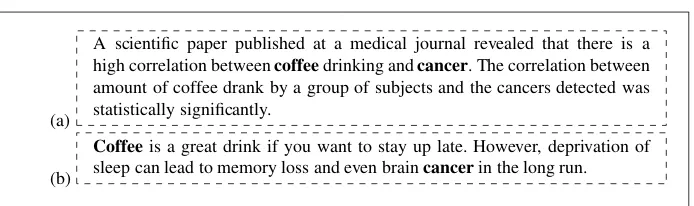
(a)
A scientific paper published at a medical journal revealed that there is a high correlation betweencoffeedrinking andcancer. The correlation between amount of coffee drank by a group of subjects and the cancers detected was statistically significantly.
(b)
[image:2.612.136.483.110.213.2]Coffeeis a great drink if you want to stay up late. However, deprivation of sleep can lead to memory loss and even braincancerin the long run.
Fig. 1.Two documents mentioning the two termscoffeeandcancer. Document (a) describes an EVIDENCE discourse relation between the two sentences, whereas in document (b), there is a CONTRASTdiscourse relation between the two sentences. For a user who searches for evidence that supports the claimcoffee causes cancer, document (a) is more relevant than (b).
becomes important. Although the BOW representation is attractive for its robustness and efficiency, which are indeed vital factors when considering the scale and the quality of the documents found on the Web, a natural question iswhether IR can benefit from linguistically rich document representations beyond the BOW approach?. We address this question by proposing and evaluating a document representation method based on the discourse relational structure in a document.
Despite its simplicity and popularity, the BOW representation of documents in IR systems ignores the rich discourse structure embedded in the documents, which can provide useful clues when determining the relevance of a document to a user query. For example, consider the two documents shown in Fig. 1. A user who is interested in evi-dence that supports the claimcoffee causes cancerwould benefit from the document (a) than the document (b). However, the BOW representations for each document contain both wordscoffeeandcancer. Consequently, a search engine that indexes documents represented as bags-of-words will be unable to differentiate the subtle differences of the relevancies of the documents to user queries.
Discourse theories such as the Rhetorical Structure Theory (RST) [14] represent a document using a set of discourse units, connected via a pdefined set of discourse re-lations (e.g. ELABORATION, CONTRAST, and JUSTIFICATION). For example in Fig. 1, the two sentences in document (a) and (b) are connected respectively through ELABO -RATIONand CONTRASTrelations. An IR system that utilizes the discourse structure of a document will be able to rank document (a) higher than (b) for the querycoffee causes cancer, thereby improving the user satisfaction. Discourse information has shown to improve performance in numerous related tasks in natural language processing (NLP) such and text summarization [13].
natural language texts are amenable to discourse parsers. For example, unlike newspa-per articles, scientific publications, or Wikipedia articles that are logically structured and proofread, most texts found on the Web do not possess a well-organized discourse structure. Third, relevance measures that capture the underlying discourse structure of documents are lacking. It is non-obvious as to which discourse relations are useful for IR. Fourth, there does not exist any benchmark test collections that are annotated with discourse information for IR. It is difficult to empirically evaluate the pros and cons of motivated IR systems at larger scales without having access to discourse-annotated test collections.
We proposeDiscourse Search, a novel search paradigm that goes beyond the sim-ple BOW representations of documents and captures the rich discourse structure present in the documents. First, we segment each document into Elementary Discourse Units (EDUs). An EDU is defined as a single unit of discourse and can be either a clause, a single sentence, or a set of sentences. Next, we identify EDU pairs that have some dis-course relations according to RST. Disdis-course relations proposed in RST are directional relations and distinguish the main and the subordinate EDUs involved, referred to as respectively thenucleusand thesatellite. Finally, all EDUs are arranged into a single binary tree structure covering the entire document. We index each sub-tree consisting of a pair of EDUs and a discourse relation. During retrieval time, we match a user query against this index and return pairs of EDUs as search results to the user. In particular, our discourse search engine goes beyond document-level IR and can retrieve the ex-act statements from the relevant documents. This is particularly useful when a single document expresses various opinions about a particular topic.
Our contributions in this paper can be summarized as follows.
– We develop aDiscourse Search Engine(DSE) that considers the discourse struc-ture present in documents to measure the relevance to a given user query. To our knowledge, ours is the first-ever IR system that uses RST to build a DSE.
– We propose three discourse proximity scores to measure the relevance of a pair of EDUs to a user query, considering the discourse structure in a document. More-over, we learn the optimal combination of those three scores using random decision forests.
– We create a test collection annotated with discourse information to evaluate discourse-based IR systems. Specifically, for each test query, the created test collection con-tains a ranked list of EDU pairs indicating their relevance to the query. Considering the immense impact that test collections such as TREC benchmarks has had upon the progress of the research in IR, we publicly release the created test collection to expedite the future research in discourse-based IR.
2
Related Work
For example, by using search session data, it is possible to accurately predict the user intent [16]. Our work in this paper is fundamentally different from this line of prior work, because we are analyzing the discourse structure in thedocumentsinstead in the
dialgouesbetween a user and a search engine.
Wang et al. [21] classified queries based on their discourse types and proposed a graph-based re-ranking method. In particular, they considered queries that describe an information need related to the advantages and disadvantages of a particular decision (e.g.What are the advantages and disadvantages of same-sex schools?). The relevance between a query and a document is measured using a series of proximity-based mea-sures. However, unlike our work, they do not consider the discourse structure present in the documents. Moreover, our DSE is not limited to a particular type of discourse queries, and supports a wide-range of queries.
Using semantic relations that exist between entities in a document to improve IR has received wide-attention in the NLP community. For example, in Latent Relational Search [4], given the two entitiesYouTubeandGoogleas the query, the objective is to re-trieve other pairs of entities between which the same semantic relations exist. Here, the semantic relation ACQUISITIONholds betweenYouTubeandGoogle. Therefore, other such pairs of entities where one of the entities is acquired by the other such as, Pow-ersetandMicrosoftare considered as relevant search results. Latent relational search can be classified as an instance of analogical search, where the focus is on the semantic relations between the entities and not the entities themselves. Latent relational search engines represent the semantic relations between two entities using a vector of lexical pattern frequencies, and measure the relational similarity between two pairs of entities by the cosine similarity between the corresponding lexical pattern frequency vectors. Interestingly, this approach can be extended to cross-language relational search as well. Miyao et al. [15] developed a search engine for Bio-medical IR by extracting the semantic relations that are common in the Bio-medical domain such as, the interaction between proteins, or side-effects of a drug. First, they apply a term extraction method to detect Bio-medical terms in the documents, and extract numerous features from an Head-driven Phrase Structure Grammar (HPSG) parse tree of a sentence. A bio-medical relation classifier is trained using the extracted features. Although semantic relations are useful as an alternative to the BOW representation, it is complementary to the discourse structure that we exploit in our DSE. Indeed, an interesting future research direction would be to combine both semantic relations and discourse relations to further improve the performance of IR systems.
3
Rhetorical Structure Theory
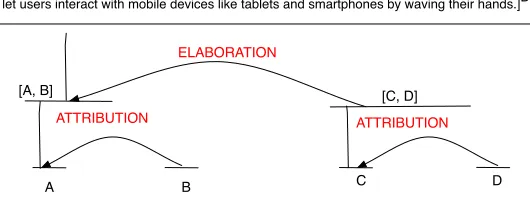
sin-[Apple has bought a 3-D sensor company]A [that helped build Microsoft's motion control system Kinect, stirring curiosity about what the tech giant might be up to behind closed doors
in Cupertino.]B [PrimeSense is an Israel-based company]C [that specializes in sensors that
let users interact with mobile devices like tablets and smartphones by waving their hands.]D
A B C D
[A, B] [C, D]
ATTRIBUTION ATTRIBUTION
[image:5.612.173.438.160.260.2]ELABORATION
Fig. 2.A discourse tree covering four EDUs.
gle or multiple EDUs in the latter case, the individual EDUs are related by a path of discourse relations. An example of a discourse tree is shown in Fig. 2, covering four EDUs, where ATTRIBUTIONrelations exist between the two EDUs in each sentence, and an ELABORATIONrelation holds between the two sentences.
Discourse trees can be automatically generated using discourse parsers such as SPADE [18], or HILDA [8]. SPADE produces sentence level discourse structures, whereas a complete discourse tree covering all the sentences in a document can be generated using HILDA. Because our goal is to represent entire documents considering their dis-course structures, we use HILDA as our preferred disdis-course parser. HILDA builds a single discourse tree by segmenting the document into EDUs using a Hidden Markov Model (HMM). Next, from these EDUs, a single discourse tree is built by discourse relation classification using Support Vector Machines (SVMs) [5]. HILDA’s classifies
18discourse relation types such as, ELABORATION, ATTRIBUTION, and CONTRAST.
4
Discourse Search Engine
Let us denote the discourse tree of a document dby T(d) = {(δn, δs, r(δn, δs))},
where a discourse relationr(δn, δs)holds between a nucleusδn and a satelliteδsin
the discourse tree. To simplify the notation, we will writerin place ofr(δn, δs), when
it is clear from the context as torholds between which two EDUs. For example, the document shown in Fig. 2 is represented by the set consisting of the three elements:
(A, B,ATTRIBUTION),(C, D,ATTRIBUTION), and([A, B],[C, D],ELABORATION). Here,[A, B]denotes the parent vertex of EDUsAandB. Givend, a discourse parser can be used to generateT(d).
Likewise, we define a discourse queryQas a three-valued tuple(qn, qs, r(qn, qs)),
where a discourse relationr(qn, qs)holds between the nucleusqn and the satelliteqs
a sequence labeller such as a conditional random field [11], to extract the two EDUs and the discourse relation between them. A more manual approach would be to provide a search front end where a user can enter the nucleus, satellite and select a discourse relation from a drop-down list. The DSE we propose can be easily incorporated with all of those approaches.
We model the relevancy of a discourse query Qto a document d as a function
f(Q, d), which is the summation of the product between adiscourse relation selector,
φ(Q, δn, δs, r)∈[0,1], and adiscourse proximity score,ψ(Q, δn, δs,T(d))∈[0,1],
over all EDU pairs in the discourse treeT(d)as follows
f(Q, d) = X (δn,δs,r)∈T(d)
φ(Q, δn, δs, r)ψ(Q, δn, δd,T(d)). (1)
For the document shown in Fig. 2, all possible combinations betweenδn andδs are
listed in Table 2. Next, we will discuss each of those factors in detail.
A DSE must consider the agreement between the discourse relationr(qn, qs)in the
query, and the relationr(δn, δs)between two EDUsδn,δsin the document. Moreover,
not all words are equally significant when considering the relevance between a query and a document. For example, frequent non-content words are removed from the queries using a pre-defined stop-words list by most search engines, and term-weighting scores such as tfidf, or BM25 are used to detect salient matches. We propose discourse relation selector,φ(Q, δn, δs, r), as a function that captures those two requirements. It is defined
as follows:
φ(Q, δn, δs, r) =s(qn, δn)s(qs, δs)I[r(qn, qs)∈l(δn, δs,T(d))]. (2)
Here,s(w, δ)is a salience score such as, tfidf or BM25 indicating the salience of a wordwin an EDUδin the discourse treeT(d), andI[r(qn, qs)∈ l(δn, δs,T(d))]is
the indicator function which returns1 if the discourse relationr(qn, qs)betweenqn
andqsappears in the discourse pathl(δn, δs,T(d))between EDUsδn,δsin the
docu-ment, and0otherwise. For example, the discourse path between EDUsAandCshown in Fig. 2 isA → [A, B] −−−−−−−−→ELABORATION [C, D] ← C. It contains the ELABORATION discourse relation betweenAandC. In our experiments, we used tfidf as the salience scores(w, δ), and consider the occurrences of query words in the EDUs extracted from the documents. Because a single document can contain multiple topics, we found it is more accurate to compute tfidfs over EDUs than entire documents. Using the Porter’s stemming algorithm1we perform stemming on the words in the documents before com-puting tfidf scores.
The location of the words used in the query in their appearance in the document is an important feature that influences the relevance of the document to the query. For ex-ample, if all the words used in the query appear within close proximity in the document, the higher is the relevance [1]. We adopt this intuition to discourse trees by proposing three types of discourse proximity scores forψ(Q, δn, δs)as we describe next.
The first of the three discourse proximity scores we propose,segment proximity,
ψseg(Q, δn, δs,T(d)), measures the distance between two EDUsδn,δsas the number
of discourse segments (EDUs) that appear in betweenδnandδsin the document. The
segment proximity is given by,
ψseg(Q, δn, δs,T(d)) = 1−
|t(δn,T(d))−t(δs,T(d))| −1
E(d)−2 . (3)
Here,t(δ,T(d))indicates the segment number (starting with 1 and counted from the beginning of the document) of the EDUδin the discourse treeT(d), andE(d)denotes the total number of EDUs in the document.ψseg(Q, δn, δs)is normalized by dividing
fromE(d)to remove any biases due to differences in document lengths. If two EDUs
δn,δsare closer to each other in the document, the higher their segment proximity will
be. For the example shown in Fig. 2, the four EDUs appear in the ordert(A,T(d)) = 1,
t(B,T(d)) = 2,t(C,T(d)) = 3, andt(D,T(d)) = 4in the document text. Therefore, for example,ψseg(Q, A, C) = 1−((|1−3| −1)/(4−2)) = 1/2.
Two EDUs that appear in distant locations on the surface text of a document, might have a direct discourse relation between them. Such EDUs appear close together on the discourse tree, despite being located far apart on the surface text of the document. The segment proximity would assign a low score for such related EDUs because it only considers the surface text and ignores the discourse tree structure. We propose path proximity,ψpath(Q, δn, δs,T(d)), as a measure that computes the closeness
be-tween two EDUsδn,δsover the discourse treeT(d)by the length of the discourse path
l(δn, δs,T(d))that connectsδntoδs. Specifically, path proximity is given by,
ψpath(Q, δn, δs,T(d)) = 1−
|l(δn, δs,T(d)| −1 log2E(d)
. (4)
Here, |l(δn, δs,T(d)| denotes the length of the discourse path connecting δn toδs,
and is measured by the number of discourse relations (ignoring the directions) along the discourse path. For example, the discourse path between EDUs AandC shown in Fig. 2, A → [A, B] −−−−−−−−→ELABORATION [C, D] ← C, contains one discourse relation, ELABORATION, resulting in a length of1. Thelog2E(d)term in the denominator is the diameter of the discourse tree (i.e. maximum distance between any two vertices), and is derived using the property that discourse trees are binary trees. For example, the path proximityψpath(Q, A, C,T(d))betweenAandCis computed as,
ψpath(Q, A, C,T(d)) = 1−
1−1 log24 = 1.
The first occurrence of an entity in a document often contains its definition. For ex-ample, in news text summarization, the first sentence baseline where the first sentence (also known as the lead sentence) is used as the summary of the document [13]. We translate this heuristic to measure the relevance of a query to a discourse tree by con-sidering the shortest segment distance from the first EDU to the two discourse unitsδn
andδsthat contain respectivelyqnandqs. We refer to this relevance score as theLead
EDU Proximityscore, which is given by,
ψlead(Q, δn, δs,T(d)) = 1−
min (t(δn,T(d)), t(δs,T(d)))−1
Similar to the segment proximity, we normalize the lead EDU proximity by dividing from the number of EDUs in the discourse tree to remove any bias due to the dif-ferences in document lengths. As an example, we compute the lead EDU proximity,
ψlead(Q, A, C,T(d)), between the two EDUsAandCin Fig. 2 as,
ψlead(Q, A, C,T(d)) = 1−
min(t(A,T(d)), t(C,T(d))−1
4−2 = 1−
min(1,3)−1 2 = 0.
Recall that the overall relevance of a queryQto a documentdis given by Equation 1 as the sum over the product of discourse relation selector,φ(Q, δn, δs, r), and each one
of the three discourse proximity scores,ψ(Q, δn, δs,T(d)). If there are no matching
discourse relations between the query and a pair of discourse units selected from the document, thenf(Q, d)will be zero. We can use this fact to speed up the computation of f(Q, d)in Equation 1 by not computing the discourse proximity scores for EDU pairsδn, δsfor whichφ(Q, δn, δs, r)is zero.
4.1 Combining Different Discourse Proximity Scores
Although we proposed three different discourse proximity scores for computing the rel-evance between a discourse query and a document it is not obvious as to the optimal combination of those discourse proximity scores that gives the best relevancy model. We model the problem of learning the optimal combination of discourse proximity scores as a learning-to-rank problem. Specifically, using a manually labeled dataset that lists a set of relevant documents for a discourse query, we follow a pairwise rank learn-ing approach and train a binary classifier to detect relevant query-document pairs (pos-itive class) from the irrelevant ones (negative class). Each query-document pair(Q, d)
is represented by a three-valued feature vector using the relevance scoresf(Q, d) com-puted using each discourse proximity score in turn. Next, a Random Decision Forest (RDF) [2] is trained using the ALGIB2 tool. The posterior probability,p(+1|(Q, d)), indicating the degree of relevance ofQtodis used as the combined relevancy score for the purpose of ranking documents retrieved for a discourse query3. All parameters of the RDF classifier are set to their default values as specified in ALGLIB.
4.2 Indexing and Query Processing
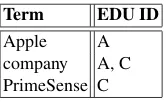
To efficiently process discourse queries, we create two inverted indexes: (1) an inverted index between all distinctn-grams in EDUs and the EDU IDs (similar to document IDs (urls) in traditional IR systems, we assign each EDU a unique ID) of the EDUs in which thosen-grams occur, (2) an inverted index between nuclei EDU IDs and their corresponding satellite EDU IDs paired with the corresponding discourse relations. For the document shown in Fig. 2, an excerpt of the first inverted index is shown in Table 1, whereas Table 2 shows the corresponding second inverted index. Given a user query
Q, we match the terms inqn andqsagainst the first index to find the matching EDUs.
2
http://www.alglib.net/dataanalysis/decisionforest.php#header3 3
Table 1.Excerpt of the inverted index betweenn-grams and EDU IDs for the document in Fig. 2.
Term EDU ID
Apple A
company A, C PrimeSense C
Table 2.Inverted index between nucleus EDU IDs and their corresponding satellite EDU IDs with discourse relations.
Nucleus EDU ID (Satellite EDU ID, discourse relations)
A (B, ATTRIBUTION), (C, ATTRIBUTION, ELABORATION), (D, ATTRIBUTION, ELABORATION)
B (C, ELABORATION, ATTRIBUTION), (D, ATTRIBUTION, ELABORATION)
C (D, ATTRIBUTION)
Next, we use the second index to compute the discourse proximity scores. Finally, the set of EDUs that matches with the user query is ranked according to the relevance score
f(Q, d), computed using Equation 1 and returned to the user.
5
Evaluation
Evaluating an information retrieval system is a complex task involving numerous as-pects such as, efficiency, accuracy, latency (indexing vs. query processing), scalabil-ity, and user satisfaction. Compared to keyword-based IR systems that have established evaluation measures and large test collections, discourse search is still in its early stages. To our knowledge, there does not exist an IR system that uses a document representation based on discourse relations, nor there exist benchmark test collections for discourse search. Therefore, an important contribution of our work is to create a test collection for evaluating discourse search engines for their accuracy. Section 5.1 describes the test collection we created for this purpose.
5.1 Dataset
We selected 10 online news articles covering news events related to major players in the IT industry such as (Apple,Google,Microsoft,FacebookandTwitter). We select ma-jor players in the IT industry to ensure our annotators, all graduate Computer Science students, would be familiar with the topic. Next, we generate a discourse tree,T(d), from each documentdusing the HILDA [8] discourse parser. Then, for each document we formulated a relevant queryQ(qn, qs, r(qn, qs))as (main entity,related entity, DIS
-COURSE RELATION). For example, a news article aboutMicrosoftthat introducesApple
as a competitor would result in the discourse query (Microsoft,Apple, ELABORATION). Finally, we extract multiple candidate EDU pairs(δn, δs)from each document that are
Table 3.Median values for discourse proximity scores
Grading ρµ−n total no. of instancesψsegψpathψlead
n= 2(irrelevant) 0 17 0.54 0.67 0.27
n= 2(relevant) 1 40 0.09 0 0.35
n= 4(irrelevant) 0 17 0.54 0.67 0.27
n= 4(less relevant) 1
3 18 0.06 0.42 0.87
n= 4(moderately relevant) 23 13 0.15 0 0.14
n= 4(highly relevant) 1 9 0.25 0 0
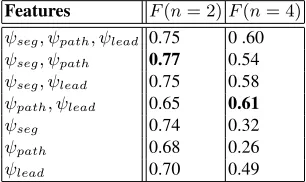
Table 4.RDF performance for classifying EDU pairs for a query.
Features F(n= 2)F(n= 4)
ψseg, ψpath, ψlead 0.75 0 .60
ψseg, ψpath 0.77 0.54
ψseg, ψlead 0.75 0.58
ψpath, ψlead 0.65 0.61
ψseg 0.74 0.32
ψpath 0.68 0.26
ψlead 0.70 0.49
Six annotators individually read and rank 3 to 5 documents using a web interface during a 45 minute session. Documents were randomly distributed among the anno-tators, and we ensured each document was annotated by 3 to 5 annotators. The web interface first showed the instructions, then the annotators were asked to read a doc-ument. When an annotator clicked a button stating the document has been read, new instructions were presented. Next, a query and a set of candidate EDU pairs extracted from the document were presented. Annotators will mark an EDU pair as either rele-vant or irrelerele-vant to a given query. Moreover, EDU pairs that are considered as relerele-vant are further ordered according to their relevance to the query. Candidate EDU pairs were presented as complete sentences instead of segments by expanding the nucleus and the satellite to cover the entire sentences. For example, the EDU pair(A, C)in Fig. 2 is presented as(AB, CD)to the annotators. If both EDUs are in the same sentence only one sentence is presented. Our dataset is publicly available4.
5.2 Results
Using the manually annotated dataset we created in Section 5.1, we evaluate the per-formance of the discourse proximity scoresψ(Q, δn, δs,T(d))we proposed in
Sec-tion 4, by measuring the agreement between human annotaSec-tions in the dataset and the relevance scores predicted byf(Q, d). We denote the reciprocal of the rank given by the annotatorai for the pair of EDUs(δn, δs), indicating its relevance to a queryQ
by π(ai, Q, δn, δs). The set of reciprocal ranks assigned by all annotators for a pair
of EDUs(δn, δs)indicating its relevance to a queryQis denoted byρ(Q, δn, δs) =
{∀i|π(ai, Q, δn, δs)}. We consider the majority vote,ρµ(Q, δn, δs), over the set of
re-ciprocal ranks as the final relevance score of an EDU pair(δn, δs)to a queryQ. Ties are
[image:10.612.230.383.246.337.2]resolved by selecting randomly between the majority reciprocal ranks. For example, if
ρ(Q, A, B) ={1 2,
1
2,0}thenρµ(Q, A, B) = 1
2. Considering the majority vote instead of the arithmetic mean has shown to improve the reliability when aggregating human ratings in annotation tasks [17]. For each query Q, we normalize the ρµ(Q, δn, δs)
values for all candidate EDUs (δn, δs) retrieved for Q to the range[0,1]by fitting
a uniform distribution. For example, given four EDU pairs, (A, B),(C, D),(E, F), and(G, H)retrieved for a queryQ, if an annotatoralabeled(A, B)as irrelevant and ranked(C, D)≺(E, F)≺(G, H)in the ascending order of their relevancy, then the normalized values of the four EDU pairs(A, B),(C, D),(E, F), and(G, H)will be respectively0,13,23, and1.
To measure median values forψseg,ψpathandψleadover all candidate EDU pairs of
all documents, we group instances(Q, δn, δs)intoncategories ofρµdenoted byρµ−n.
We consider two groups in particular: n = 2 (two-valued grading system indicating relevant vs. irrelevant instances), andn = 4 (four-valued grading system indicating irrelevant, less relevant, moderately relevant, and highly relevant instances). By consid-ering a coarse two-valued grading and a more finer four-valued grading, we can evaluate the ability of the proposed discourse proximity scores to detect different granularities of relevancies. Table 3 shows the median values of the three discourse proximity scores. We see that forn= 2, the EDU pairs ranked as relevant have a smaller medianψseg,
have a smaller medianψpath, and have a smaller medianψleadin the document. This
outcome mirrors the results from [20], where correlations have been found on proxim-ity of query terms in text and document relevance.n= 4case shows similar trends for
ψpath andψlead. However, forψseg we see that EDU pairs ranked as highly relevant
have a larger medianψsegthan EDU pairs ranked as less relevant.
We train an RDF classifier as described in Section 4.1, with the test collection as described in Section 5.1, using different combinations of discourse proximity scores as shown in Table 4. Inn = 2setting, we train a binary classifier, whereas a multi-class classifier is trained for then = 4setting. From the leave-one-outF scores shown in Table 4 we see that the combination ofψseg andψpathgives the best performance for
then = 2setting, whereas the combination ofψpathandψlead gives the best
perfor-mance for the n = 4setting. In particular, path discourse proximity is found to be a useful feature for detecting relevancy in both settings, which supports our proposal to use discourse trees to represent documents in information retrieval systems.
6
Conclusion
References
1. Baeza-Yates, R.A., Ribeiro-Neto, B.: Modern Information Retrieval. Addison-Wesley Long-man Publishing Co., Inc., Boston, MA, USA (1999)
2. Breiman, L.: Random forests. Machine Learning 45(1), 5 – 32 (2001)
3. Brooks, H.M., Belkin, N.J.: Using discourse analysis for the design of information retrieval interaction mechanisms. In: SIGIR. pp. 31–47 (1983)
4. Duc, N.T., Bollegala, D., Ishizuka, M.: Cross-language latent relational search: Mapping knowledge across languages. In: AAAI. pp. 1237 – 1242 (2011)
5. duVerle, D.A., Prendinger, H.: A novel discourse parser based on support vector machine classification. In: ACL. pp. 665–673 (2009)
6. Feng, V.W., Hirst, G.: Text-level discourse parsing with rich linguistic features. In: ACL. pp. 60 – 68 (2012)
7. Hernault, H., Bollegala, D., Ishizuka, M.: A semi-supervised approach to improve classifi-cation of infrequent discourse relations using feature vector extension. In: EMNLP. pp. 399 – 409 (2010)
8. Hernault, H., Prendinger, H., duVerle, D., Ishizuka, M.: Hilda: A discourse parser using sup-port vector machine classification. Dialogue and Discourse. An International Journal 1(3), 1–33 (2010)
9. Joty, S., Carenini, G., Ng, R.: A novel discriminative framework for sentence-level discourse analysis. In: EMNLP. pp. 904–915 (2012)
10. Joty, S., Carenini, G., Ng, R., Mehdad, Y.: Combining intra- and multi-sentential rhetorical parsing for document-level discourse analysis. In: ACL. pp. 486–496 (2013)
11. Lafferty, J., McCallum, A., Pereira, F.C.: Conditional random fields: Probabilistic models for segmenting and labeling sequence data (2001)
12. Lan, M., Xu, Y., Niu, Z.: Leveraging synthetic discourse data via multi-task learning for implicit discourse relation recognition. In: ACL. pp. 476–485 (2013)
13. Louis, A., Joshi, A., Nenkova, A.: Discourse indicators for content selection in summariza-tion. In: SIGDIAL. pp. 147 – 156 (2010)
14. Mann, W.C., Thompson, S.A.: Rhetorical structure theory: Toward a functional theory of text organization. Text 8(3), 243 – 281 (1988)
15. Miyao, Y., Ohta, T., Masuda, K., Tsuruoka, Y., Yoshida, K., Ninomiya, T., Tsujii, J.: Se-mantic retrieval for the accurate identification of relational concepts in massive textbases. In: ACL. pp. 1017–1024 (2006)
16. Sadikov, E., Madhavan, J., Wang, L., Halevy, A.: Clustering query refinements by user intent. In: WWW. pp. 841–850 (2010)
17. Snow, R., O’Connor, B., Jurafsky, D., Ng, A.Y.: Cheap and fast - but is it good? evaluating non-expert annotations for natural language tasks. In: EMNLP. pp. 254 – 263 (2008) 18. Soricut, R., Marcu, D.: Sentence level discourse parsing using syntactic and lexical
informa-tion. In: NAACL. pp. 149–156 (2003)
19. Subba, R., Eugenio, B.D.: An effective discourse parser that uses rich linguistic information. In: HLT-NAACL. pp. 566–574 (2009)
20. Tao, T., Zhai, C.: An exploration of proximity measures in information retrieval. In: SIGIR. pp. 295–302 (2007)
21. Wang, D.Y., Luk, R.W.P., Wong, K.F., Kwok, K.L.: An information retrieval approach based on discourse type. In: Natural Language Processing and Information Systems, vol. 3999, pp. 197 – 202. Springer Berlin Heidelberg (2006)