E U R O P E A N I N V E S T M E N T B A N H
EIB
NFORMATION
November 1992 · N° 74
ISSN 0250-3891
Loan monitoring at the
EIB
The raison d'être of the European Invest ment Bank, as the financial institution of the Community, is to further the attainment of EC objectives both within and outside the Community. The Bank adapts its eligibility criteria and loan formats in line with the changing needs of the economy with a view to facilitating the EC's transition towards economic and monetary union.
Unlike other EC institutions, the EIB serves Community interests through banking channels : it borrows on capital markets the resources required to finance its loans and therefore has to contend with the con straints inherent in its borrowing/lending activities. The ElB's particuler role is reflected in its procedures for deciding on and monitoring its loans. It is incumbent on the EIB to have a monitoring structure which provides its shareholders the Mem ber States of the Community and its len ders those subscribing to its bond issues with a guarantee of sound management and compliance with the Bank's remits.
Every decision to grant a loan taken by the Board of Directors, acting on a proposal from the Management Committee, is based on a detailed examination carried out during project appraisal; the latter involves an evaluation of the component parts of the investment and its place in the economy as seen from three points of view by: engineers in the Technical Advisory Service, economists in the Research Direc torate and analysts in the Directorates for Operations inside and outside the Com munity. At the same time the financial solidity of the promoter, borrower and guarantor and the soundness of the pro posed financing package are examined from a banking and legal standpoint.
DEN EUROPÆISKE INVESTERINGSBANK EUROPAISCHE INVESTITIONSBANK ΕΥΡΩΠΑΪΚΗ ΤΡΑΠΕΖΑ ΕΠΕΝΔΥΣΕΟΝ
EUROPEAN INVESTMENT BANK BANCO EUROPEO DE INVERSIONES BANQUE EUROPÉENNE D'INVESTISSEMENT
BANCA EUROPEA PER GLI INVESTIMENTI EUROPESE INVESTERINGSBANK BANCO EUROPEU DE INVESTIMENTO
<&U¿s
Contents
This strict approach to financing decisions is seen also in the monitoring mechanisms which the Bank has established. These are elements of an overall concept of project supervision, beginning with an evaluation before a decision on a loan and continuing until and beyond the final stage of project completion. Monitoring is thus an integral part of the life of the loan, its objective being to guarantee proper use of the funds advanced and to assess the results of the investment.
The most senior body in the ElB's monitor-ing structure is the Audit Committee, estab-lished by virtue of Article 14 of the Bank's Statute. This Committee consists of three members, appointed by the Board of Gov-ernors for a renewable three-year term on the grounds of their competence in this field. The Audit Committee bases itself on the work conducted by the Bank's Internal
Loan Monitoring at the EIB 1 As well as carrying out detailed appraisals of projects before deciding on a loan, the EIB closely follows up on the progress of investment it supports. Monitoring is an integral part of the life of a loan, ensuring the proper use of the funds advanced and the evaluation of the investment's results. Equally the ElB's own activities, like any bank's, are also closely controlled and monitored by internal and external bodies to reduce risks and enhance effectiveness. This article examines the structure of the ElB's monitoring and control mechanisms.
The EIB and the ECU 4
As the European Community's long-term financing institution, the EIB mobilises a large volume of funds on capital markets, for lending to investment projets furthering Community policy objectives. The Bank is the largest of the international financing institutions and operates in many different currencies. While the EIB, as a Community institution uses the ECU as its unit of account, it also borrows and lends in this currency. This article sketches out the important contribution the EIB has made to the development of the ECU.
EIB Financing in Central and Eastern
Europe 7
Audit Division, by the units responsible for loan monitoring and by an outside firm of international chartered accountants. The Board of Governors of the Bank approves the annual report, annual bal-ance sheet and profit and loss account, after hearing the views of the Audit Com-mittee in accordance with the Statute ( ). By signifying their approval, which is the final stage in monitoring activities during the fin-ancial year, the Governors reconfirm the management of the Bank by the Board of Directors and the Management Commit-tee.
MONITORING LOANS
The loan monitoring units, which are attached to the Directorates for Oper-ations inside and outside the Community, are responsible for the follow-up and monitoring of the Bank's loan and guaran-tee operations once the finance contract has been signed. The terms of the contracts concluded with the beneficiaries provide the legal basis for these activities; in addi-tion to other annexures, the contracts include a technical description of the pro-ject concerned and the measures taken to guarantee its compliance with relevant legislation, particularly that relating to environmental protection.
The controls range from administration of the loan to monitoring of work in progress on the project and an evaluation of its results once the project is operational ; they apply to all Bank operations, irrespective of their location or source of funding : the Bank's own resources or resources man-aged under mandate (from the European Development Fund, for certain loans to ACP countries, or from the Community budget, for certain loans to Mediterranean countries) (2).
Once the finance contract has been signed, an initial check is carried out, as a preliminary to disbursement, to ensure compliance with the legal and material conditions governing provision of the funds. In the case of projects financed in a number of tranches or of global loans extending credit for a large number of final beneficiaries, such checks are repeated at the time of each disbursement, in line with
progress on the project or drawdown of the global loan by the financial institution deploying the proceeds.
Such monitoring activity also embraces the consequences, during the life of the loan, of any financial, legal or technical devel-opments; in cooperation with the depart-ments which appraised the project and with the promoter, appropriate solutions are sought, compatible with the objectives underlying the ElB's financing decision. Such developments, their origin and impli-cations are the subject of an annual ana-lysis, the findings of which, after evaluation by the Management Committee, are noti-fied to the Board of Directors.
MANAGING THE FINANCIAL RISK
Since it operates with borrowed resources which must therefore be repaid, the EIB is obliged to conduct its operations in accordance with strict banking principles. It is largely thanks to this policy that the Bank is regarded in the financial markets as a first-class borrower. The credit-rating agencies, such as Moody's or Standard and Poor's, have consistently awarded the Bank their highest credit rating ("AAA"). Serving the interests of the Community, the EIB passes on to its borrowers the advant-ages it enjoys as a result of its excellent position on the financial markets.
EIB loans must also be backed by adequ-ate security, whether in the form of a con-ventional guarantee from a public institu-tion or first-class bank or based on the project itself: security provided by the pro-moter's parent company or associate, a charge on the assets of the promoter or of an associate or on the revenues of the pro-ject, etc.
During the life of the loan the financial risk is therefore carefully monitored by the Bank. Firstly, before any disbursement, a check is carried out on the validity of the guarantees provided for the operation. Subsequent developments in the pro-moter's and guarantor's financial situation are monitored constantly together with compliance with the terms of the contract. In the case of the Bank's regular borro-wers, data on the borrower itself, the amount of loans outstanding and the rate
of repayment are collated and processed in a data base specific to each operator. Furthermore, whenever necessary, for example in the case of operations finan-cially vulnerable because of developments in the project or the financial position of the promoter, special monitoring is under-taken. The risks are analysed and negotia-tions are entered into with the borrower, its guarantor(s) and joint backers, in order to find solutions which offer the best pros-pects for completing the project and defending the Bank's interests.
These procedures are also an integral fea-ture of the administration of loans in non-Community countries. In recent years, economic trends and, in many cases, pol-itical developments in a number of coun-tries have had a damaging effect on the financial performance of projects. The Bank has therefore tightened up monitor-ing of such projects and of any arrears, in order to be able to anticipate the conse-quences of such situations.
The Bank's loan portfolio, covering oper-ations both inside and outside the Com-munity, is the subject of a report submitted each year to the Management Committee of the Bank. It deals principally with the breakdown of loans outstanding by type of borrower, guarantee and sector and includes a study of the risks associated with each category. The report also contains a review of loans experiencing difficulty and of conclusions to be drawn from them for the future.
MONITORING WORK IN PROGRESS
A similar monitoring procedure is followed, mutatis mutandis, with regard to global loans in member and non-member coun-tries. It should be remembered that, in the case of global loans, the promoters of projects financed the "final beneficiaries" -do not, of course, have a direct contractual relationship with the EIB but with the finan-cial or banking intermediary to whom the global loan is granted.
This monitoring centres firstly on ensuring that the intermediaries respect the criteria on sectoral objectives and location of the final beneficiaries. Monitoring differs according to the relations built up between the Bank and each intermediary. Checks can therefore range from a systematic examination of the project appraisal dos-sier to approval of allocation lists sub-mitted to the EIB by the intermediary. Such checks are a condition for any disburse-ment from the credit line opened by the Bank with the intermediary.
Obviously, the financial performance of the intermediary is also examined in order to confirm the continuing solvency of the borrower and its ability to achieve the objectives of the ongoing global loan. The conclusions of such evaluations, relat-ing to both individual and global loans, are conveyed to the heads of the directorates concerned; the Management Committee, after examining them, forwards the conclu-sions in summary form to the Bank's Board of Directors.
EVALUATING THE COMPLETED PROJECT
Project evaluation reports, drawn up after a check on supporting documents and, most often, on-the-spot visits, are prepared once the project has been completed and is operational. On-the-spot visits are made by the units responsible for monitoring loans assisted, if necessary, by the techni-cal advisers concerned. This activity is par-ticularly important in the case of projects financed in third countries.
Monitoring prior to a final evaluation of projects centres on ensuring that the com-pleted project is in conformity with its tech-nical specification, evaluating the econ-omic and/or financial return on the investment and examining the financial position of the promoter. The purpose of these controls is to assess the impact of the
projects on the economic sectors or regions concerned, i.e. to check that the result is in accord with the Community objectives underlying the ElB's financing decision.
With regard to evaluation of the results of global loans, checks are carried out at the end of the loan allocation period to assess the degree of success - or failure - of small or medium-scale ventures financed from EIB allocations. Here again the nature of such checks depends on the closeness or otherwise of the Bank's association with the intermediary concerned; they range from a "periodic review", usually once every three years, for an established inter-mediary, to a more detailed examination involving several visits to undertakings in the case of a first global loan.
The Bank's Management Committee is kept closely informed of the results of such evaluations and of any resulting recom-mendations. The Bank is then in a position to judge the contribution it makes to the attainment of Community objectives in relation to the economy of Europe or of third countries. The ElB's managing bodies, therefore, place particular emphasis on the quality of the monitoring system applied and on adapting accordingly the metho-dology and organizational structure of the departments concerned.
INTER-INSTITUTIONAL OOPERATION
As the financial institution of the Com-munity, the EIB attaches the same import-ance to project implementation and moni-toring irrespective of the source of funds which it deploys as part of its Community remit. Operations financed by the EIB from funds managed under mandate from the Community are therefore also subject to the same monitoring procedures as those financed from the Bank's own resources (2).
Furthermore, the Bank also provides infor-mation for the authority mandating these funds - the Commission - and facilitates external checks on these resources, carried out by the Court of Auditors of the Euro-pean Communities through the mission, as they derive from the Com-munity budget or the European Development Fund (EDF). To this end, the EIB and the institutions concerned have, for several years, cooperated closely on the
practical arrangements for the Court of Auditors' verification of the use of such funds.
This cooperation has been the subject of an accord between the three institutions, signed in June 1989 and renewed in November 1992; it applies to operations covered by the Community budget guar-antee and those managed by the Bank under mandate from the Community. The accord sets out the practical arrangements to be followed for external Community monitoring of such operations; it attaches priority to documentary control and, in cer-tain specific cases, provides for the possi-bility of on-the-spot visits by auditors from the Court of Auditors and the Bank's Audit Committee working together on the same control mission.
INTERNAL UDIT
The Internal Audit Division is also consulted when rules and management systems are being drawn up for the various depart-ments, especially when they relate to the introduction of effective monitoring and security procedures, particularly in the field of data processing.
REGULARITY OF ACCOUNTS
In accordance with the Statute (Article 14), the Audit Committee is responsible for checking that the accounts of the Bank have been kept in a proper manner. The accounts consist of the balance sheet, the profit and loss account, the statement of Special Section, a statement of changes in the financial position as at 31 December and a number of annexes concerning the financial statements. The Audit Committee confirms to the Board of Governors that these various statements faithfully reflect the position of the EIB in respect of its assets and liabilities. To this end, the Com-mittee ensures that checks are carried out on the books, vouchers and documents which it deems relevant; it is assisted in this
task by an international firm of chartered accountants, Price Waterhouse.
This firm makes sure that the books and accounts have been prepared in accord-ance with internationally recognized accounting standards. It carries out a regu-lar and systematic audit and undertakes those sectoral auditing tasks which the Audit Committee feels should be entrusted toit.
The work of the chartered accountants is concerned mainly with the manner in which the general accounts of the Bank are kept and with the operation of the internal monitoring procedures applicable to the departments concerned. If necessary, ref-erence may also be made to checks car-ried out by the Internal Audit Division. Every six months, the firm of chartered accountants prepares reports on the accounting position as at 30 June and 31 December of each financial year.
The conclusions drawn from such work and from other in-house monitoring acti-vities are then discussed freely with the departments concerned; the Manage-ment Committee of the Bank - and,
through it, the Board of Directors - are kept informed of the outcome of these activities.
The EIB has set up monitoring structures tailored to its specific banking functions and Community remit. Nevertheless, how-ever precise and thorough monitoring sys-tems may be, they can never eliminate the risk element inherent in any lending activ-ity; this is particularly the case when lend-ing long term on a significant scale in a wide variety of sectors and countries and against an ever-changing economic back-drop. Consequently, the EIB pays consider-able attention to ensuring that its monitor-ing mechanisms are permanently adapted to developments in financial and invest-ment techniques with a view to pinpointing risk factors and reacting accordingly.
Article 9 (3) (e) and (f) of the Statute; the ElB's Statute forms an integral part of the Treaty of Rome.
Out of a total of 58.7 billion ecus lent from 1987 to 1991, EIB loans from own resources amounted to 57181 billion, or 97.3%. Financing from other resources, deployed under mandate, is accounted for off balance sheet in the "Special Section" and represented 1.58 billion, or 2.7% of EIB operations, over the past five years.
The European Investment Bank and the ECU
The past few weeks have seen a certain amount of turbulence on the financial markets, sparked off partly by uncertainty about ratification by some Member States of the Maastricht
Treaty on European Union. This affected the ECU in particular and indeed the capital market in this currency has since remained closed. Nonetheless, other segments of the ecu market are displaying a level of activity which attests to the genuine importance of this currency for market operators. The volume of trading on the Matif ECU futures market for example has continued to be high and interbank clearing activity in the currency has also remained lively, recording a daily average of 45.4 billion ECUs in October 1992, with a peak of 62.5 billion.
The world's leading international borrower, the EIB maintains a permanent presence on the capital markets. Its borrowing policy is marked by pragmatism and a flexible approach, contri-buting over many years now to the use of the ECU as a monetary instrument suited to the needs of its borrowers. The following article maps out the main stages in this policy, which has estab-lished the EIB as the world's largest user of the ECU.
The Maastricht Treaty on European Union establishes the framework and a timetable for the European Community's economic and monetary union, including the intro-duction of a single Community currency by
1999. The Member States currently use the ECU as a central element for measuring national currencies for the Exchange Rate
Mechanism of the European Monetary System. The Community's institutions also use the currency as their unit of account.
The European Investment Bank, as the Community's long-term financing institu-tion, has made a steadily increasing use of the ECU on both the assets and liabilities
sides of its balance sheet and is today the largest long-term borrower and lender of the currency. The ECU for the past three years has headed the list of 17 currencies in which the Bank works.
From its establishment in 1958, the EIB, like other Community institutions, has always used a unit of account in drawing up its balance sheet, as well as for the presenta-tion of its activities. Until 1974, the measure used was known as the "unit of account" (u.a.) and valued in terms of gold ('). Fol-lowing the breakdown of the gold stan-dard and the introduction of floating exchange rates, the ElB's Board of Govern-ors in 1974 adopted a new definition of the Bank's unit of account, as one identical to the European Unit of Account, defined as a basket of Member States' currencies (2).
Unit of Account, as the Bank's unit of account as from 1 January 1981. Advant-ages in using a unit based on a basket of currencies include a neutral expression of the Bank's financial activities, and a brake on rapid swings in balance sheet ratios, as would occur during periods of widely fluc-tuating exchange rates if denominated in a single domestic currency.
The ElB's subscribed capital is also expressed in ECU. Until recently, payment of the paid in portion of the subscribed capital was in the national currencies. To ensure the ECU value of these amounts remained constant, compensatory pay-ments are made, according to established rules, to and from the Bank, as required by Article 7 of its Statute. In 1989, the Board of Governors decided that Member States could have the option of paying in future capital contributions in ECU, and to con-vert past payments also into ECU. Currently about 75% of the paid in capital is effec-tively held in ECU.
BORROWING ECU
Long-term
To finance its lending, the EIB borrows the bulk of its resources on capital markets. The volume of the Bank's borrowing has steadily grown and is of a size, currently, that places it at the forefront of the group of international financing institutions. The currencies raised by the EIB match the requirements of its project promoters. In 1991, its total borrowing operations amounted to ECU 13.67 billion equivalent, of which the ECU accounted for 18.3% -ECU 2.5 billion (Table 4).
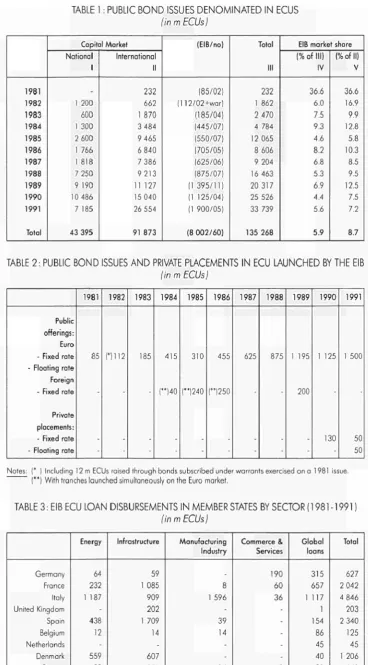
[image:5.595.205.574.52.718.2]The EIB launched its first ECU public bond issue (an 8 year bond with a 13.5% cou-pon) for ECU 40 million in June 1981, the second borrower ever to float an ECU issue, and the first European Community institution to do so. Since then its activities in the expanding ECU market have grown rapidly. Between April 1981 and the end of 1991, a total of ECU 92 billion in 60 issues has been raised on the international capi-tal markets, of which some ECU 8 billion was by the EIB, representing nearly 9% (Table 1)(3).
TABLE 1 : PUBLIC BOND ISSUES DENOMINATED IN ECUS
¡in m ECUs)
1981 1982 1983 1984 1985 1986 1987 1988 1989 1990 1991 Total Capital Market National 1
_
1 200 ¿00
1 300
2 600
1 766
1 818
7 250
9 190
10 486
7 185
43 395 International II 232 662 1 870 3 484 9 465 6 840 7 386 9213 11 127 15 040 26 554 91 873 (EIB/no) 185/02) (112/02+war) (185/04) (445/07) (550/07) (705/05) (625/06) (875/07) (1 395/11) (1 125/04) (1 900/05) (8 002/60) Total III 232
1 862
2 470
4 784 12 065
8 606
9 204 16 463 20 317 25 526 33 739
135 268
EIB market share (% of III)
IV 36.6 6.0 7.5 9.3 4.6 8.2 6.8 5.3 6.9 4.4 5.6 5.9
(% of II) V 36.6 16.9 9.9 12.8 5.8 10.3 8.5 9.5 12.5 7.5 7.2 8.7
TABLE 2: PUBLIC BOND ISSUES AND PRIVATE PLACEMENTS IN ECU LAUNCHED BY THE EIB
(in m ECUs)
Public offerings: Euro - Fixed rate - Floating rate Foreign - Fixed rate
Private placements: - Fixed rate - Floating rate
1981 85
-1982
m i2
-1983 185
-1984 415 (")40
-1985 310
H 2 4 0
-1986 455 (")250
-1987 625
-1988 875
-1989
1 195
200
-1990
1 125
130
-1991 1 500 50 50
Notes: (* ) Including 12 m ECUs raised through bonds subscribed under warrants exercised on a 1981 issue. (**) With tranches launched simultaneously on the Euro market.
TABLE 3 : EIB ECU LOAN DISBURSEMENTS IN MEMBER STATES BY SECTOR ( 1981 -1991 !
(in m ECUs I
Germany France Italy United Kingdom Spain Belgium Netherlands Denmark Greece Portugal Ireland Luxembourg Article 18 Total Energy 64 232
1 187
438 12 559 88 269 71 23
2 943
Infrastructure
59
1 085 909
202 1 709 14
-607 251 274 184 37 1
5 332
Manufacturing Industry
_
8 1 596-39 14
-14 173 6
-1 849
Commerce & Services 190 60 36
-8 7 12
-312 Global loans 315 657 1 117 1 154 86 45 40 81 232 26
-2 755
Total
627
2 042
4 846 203
2 340 125 45
The Bank has avoided market saturation or increased borrowing costs by adapting evolved from being fragmented and retail driven to a global and highly liquid sector of the international market. Initially, the EIB issues were launched under the lead man-agement of Belgium and Luxembourg banks for retail customers. As interest in the ECU began to develop elsewhere, the EIB expanded the range of its issues beyond countries that encouraged the ECU's development. Negotiations were entered into with authorities to enable quotation of ECU bond issues on some stock exchanges.
The ElB's policy of diversifying ECU issues has fostered the currency's
internationali-sation and allowed it to reach investors in new markets, both within the Community -France, Italy, Denmark, the Netherlands, and Germany - and outside - Austria, Hong Kong, Singapore, and in particular Switzerland and Japan. Issues also came to be aimed at not just retail investors, but also at specific target groups, such as sav-ings banks, pension funds, and insurance companies through public issues or private placements. The ElB's policy has been to foster the convergence of ECU bond mar-kets towards a unified global market struc-ture by ensuring its issues included an inter-nationally placed portion. Systematic quotation of its ECU issues on the Luxem-bourg stock exchange has helped avoid market segmentation.
By 1990, the international ECU bond market had become sufficiently unified and liquid to allow for a substantial increase in the size of issues. The ECU's credibility was also strengthened with the European Community's growing commit-ment to liberalization of financial markets and economic and monetary union. The EIB was among the first issuers to identify the evolution, and in January 1990 the Bank launched its first "¡umbo" ECU bond (10% of 1997) initially for ECU 500 million. Using a fungibility clause, the issue was gradually increased, and by May 1991 had reached a total ECU 1 125 million, making it one of the largest and most liquid international ECU issues (Table 2).
TABLE 4 : EIB BORROWINGS BY PRINCIPAL CURRENCY
(in m ECUs)
ECU DEM FRF ITL GBP ESP BEF NLG USD CHF JPY Other Total 1981 85 358 129 -107 -52 319 615 300 264 81 2 310 1982 112 586 177 -263 -79 413 745 345 387 97 3 205 1983 230 706 149 -176 -161 357 834 285 469 254 3 619 1984 555 632 175 108 285 -153 479 1 255 323 346 49 4 361 1985 731 674 369 342 218 -171 424 1 806 355 529 92 5 709 1986 897 879 413 594 304 -263 515 1 760 511 514 136 6 785 1987 807 1 153 464 639 142 -302 338 722 370 517 138 5 593 1988 1 329 1 545 854 652 752 237 473 500 308 556 314 147 7 666 1989 1 839 959 1 164 626 1 769 701 346 317 385 264 431 234 9 035 1990 1 765 1 124 1 114 851 1 331 614 330 528 1 574 818 771 175 10 996 1991 2 500 1 198 1 378 1 466 1 837 813 166 369 2 262 782 627 274 13 672
[image:6.595.31.574.322.575.2]Note: Medium-term and long-term fixed and floating rate bond and note issues as well as short-term operations and third-party participation in loans; after swap operations.
TABLE 5: EIB LOAN DISBURSEMENTS IN MEMBER STATES BY PRINCIPAL CURRENCY
(in m ECUsj
This technique of building large issues through successive additions was re-employed in January 1991, with an initial issue of 500 million (the 10% of 2001 ) which was increased to ECU 1 150 million the fol-lowing month providing liquidity in the sec-ondary market.
Against the recent background of increased interest rate volatility, the fungi-bility of "jumbo" issues allows subsequent tranches to be timed to coincide more closely with the ElB's lending as a hedging technique, allowing it to benefit from the competitive funding costs associated with more liquid issues. Taking advantage of the opening of ECU futures markets in France and the United Kingdom, the EIB has been able to make use of the Deferred Rate Set-ting technique (known as "spread-lock" in the US market) on its more recent ECU issues; a technique the Bank has used for a number of years in other markets. This technique enables the Bank to receive in its treasury the proceeds of an issue, while the cost of the funds are gradually established over a pre-set period subsequent to the launch, pari passu with fixing the interest rate for loan disbursements.
To the extent compatible with its asset-lia-bilities management, the EIB is making appropriate use of ¡umbo issues, providing the ECU market with benchmarks that are both liquid and easy to trade.
Short-term
The EIB has been active in the shorter end of the ECU market since 1984 with an ECU note programme, with maturities of between one and six months and sold directly by the Bank. The initial issue ceiling of ECU 100 million was increased in 1988 to ECU 400 million. In 1989, the EIB set up a commercial paper programme for a total ECU 200 million to meet increasing interest in variable rate loans from its project pro-moters. This Euro-CP programme is limited to issuing in ECU, in maturities of between one week and twelve months. Following several increases and the addition of a second programme, the total outstanding exceeds ECU 1 billion. The EIB also con-tinues to be an active player in the ECU deposit market.
EIB Financing in Central and Eastern Europe
For more than two years the EIB has been making available its finance, know-how and experi-ence for assisting development in Central and Eastern European countries (CEEC). Its loans for projects in this region complement the European Community's Assistance Programme PHARE which is managed by the EC-Commission and provides non-reimbursable aid.
EIB lending in the CEEC takes place in accordance with Article 18 of the ElB's statute under which the Governors, acting unanimously on a proposal from the Board of Directors, may authorise the Bank to grant loans for investment projects outside the Community. In decisions taken in November 1989 and April 1991, the Board of Governors authorised lending of up to 1 700 million ecus for investment projects in Bulgaria, the Czech and Slovak Federal Republic, Hungary, Poland and Romania.
At end of October 1992 total EIB lending in the region had reached 750 million ecus with loans provided in all five countries; further loans are expected to be signed before the end of the year.
Loans signed by end October 1992:
Bulgaria
Completion of coal-fired power station
Modernisation of the telecommunications network
million ecus 45 70
CSFR
Global loan to the State Bank for financing - via local banks - small and medium-scale manufacturing and tourism, as well as energy saving and environmental projects
Hungary
Modernisation and expansion of telecommunications network Electricity generation and distribution improvements
Global loan to Inter-Europa Bank for financing small and medium-scale manufacturing and tourism, as well as energy saving and environmental projects
Global loan to the National Bank of Hungary for financing - via local banks - industry, tourism and related services
Financing of roads and bridges
Poland
Modernisation and expansion of telecommunications network Global loan to Polish Development Bank for financing - via local banks - small and medium-sized enterprises in industry, agro-industry, industry-related services and tourism, as well as small-scale environmental protection and energy saving schemes
Expansion of gas production and distribution Modernisation of railway maintenance centres
Global loan to Export Development Bank for financing small and medium-sized enterprises in industry, agro-industry, industry-related services and tourism,
as well as small-scale environmental protection and energy saving schemes
Romania
Rehabilitation of two power stations
115
85
80 50
25
80 50 285
70
75 50 20
TOTAL CEEC
25 240
25
750
LENDING
As the EIB lends in the same currencies that it borrows, its capital market activity reflects the specific currency needs of its project promoters. The ElB's loan disbur sements in ECU, either as a single cur rency or in a currency mix, have ¡umped from ECU 158 million in 1981 to 3 billion in 1991. It disbursed some ECU 15 billion in 1991 in about 17 currencies (Table 5), of which 20% was in ECU, well ahead of the others. In the period 1981 1991, the Bank disbursed a cumulative amount of ECU 13 billion, representing on average 17% of its total disbursed funds.
While ECU loans have been made in all Member Countries, in terms of volume, disbursements have been uneven. It seems likely that the value of the ECU in the context of greater currency stability following the introduction of the Exchange Rate Mechanism of the EMS has in some areas made the ECU more attractive for borrowers as well as investors in bonds. The main demand from EIB borrowers has been in Italy, France, Spain, Denmark, and Portugal (Table 3).
THE EIB AND THE ECU BANKING
ASSOCIATION
As a major player in all sectors of the ECU market, the EIB has also been closely associated with the setting up of a clearing system for the "private" ECU (as opposed to the "official" ECU managed by the EC central banks). The clearing system which began operation in 1986, has been established by the ECU Bank ing Association to settle ECU transac tions amongst banks with a base in the Community. The EIB is a founder member of the EBA and nominates a vicepresi dent to the Association's Executive Com mittee. The clearing system consists of a communication and netting system oper ated by SWIFT (Society for Worldwide International Financial Telecommunica tions) and a settlement function run, as agent, by the Bank for International Set tlements (BIS) in Basel. The EBA's role also includes the general promotion and
development of the private ECU's use. The second stage towards economic and monetary union in the Maastricht Treaty establishes the European Monetary Institute (EMI) as of 1 January 1994. Among its tasks, EMI will "facilitate the use of the ECU and oversee its develop ment, including the smooth running of the ECU clearing system"!4).
CONCLUSION
While the EIB borrows and lends, after swaps, in 17 currencies, the ECU's importance is growing as it becomes the favoured currency for an increasingly diversified set of EIB borrowers. The EIB has contributed in the development of a widening range of ECU financing mech anisms. At the end of October 1992 the Bank's outstanding ECUdenominated borrowings amounted to 9.1 billion and outstanding ECUdenominated loans to 12.9 billion. While the ECU currently remains a basket of the EC Member States' currencies, the Maastricht Treaty has laid down the procedures and timetable for its conversion into an irre vocably fixed composition basket (5). The
EC Member States are to decide on the single currency to be introduced when establishing full economic and monetary union.
Ecu
Below are the ecu values in national curren cies, as at 30 September 1992. These rates are a p p l i e d to the fourth quarter in prepar ing financial statements a n d o p e r a t i o n a l statistics of the Bank:
Until 1974, 1 u.a. 0.88867088 grammes of
gold» US$1.
At the start, one European Unit of Account was equivalent in value to the International Mon etary Fund's Special Drawing Right and to the statutory unit of account used until then by the EIB.
Other sources of ECU: The EIB has also received ECU from the EC budget in the form of capi talised interest subsidies provided for certain loans in Italy and Ireland between 1979 and 1983 as part of arrangements covering these countries' entry into the European Monetary System. ECU have also come from the European Development Fund to cover interest subsidies on EIB loans made in the African, Caribbean and Pacific countries under the Lomé Conventions and from the Community's budget in countries in the Mediterranean region under the Financial Protocols concluded between the EC and coun tries concerned.
Treaty on European Union, Article 109f. I Treaty on European Union, Article 3a, 109g,
1091.4.
DEM GBP FRF ITL NLG ESP
1.97117 0.787381 6.66145 1730.69
2.22030 138.434
BEF LUF DKK GRD IEP PTE USD
40.6118 40.6118 7.63446 253.890
0.750078 175.448
1.39800
EIBInformation is published periodically by the European Investment Bank in nine dif ferent languages (Danish, Dutch, English, French, G e r m a n , Greek, Italian, Portuguese a n d Spanish).
M a t e r i a l which a p p e a r s in EIBInfor mation may be freely r e p r o d u c e d ; an acknowledgement a n d a clipping of any article published w o u l d be a p p r e c i a t e d .
100, bd Konrad Adenauer 12950 Luxembourg tei. 43791 telex 3530 bnkeu lu
fax 43 77 04 Department for Italy: Via Sardegna, 38 100187 Rome tel. 47191 telex 611130 bankeu i
fax 487 34 38 Athens Office: Amalias, 12 GR10557 Athens
tel. 3220 773/774/775
telex 222126 bkeu gr fax 3220 776 Lisbon Office:
Avenida da Liberdade, 144156, 8" Pl 200 Lisbon
tel. 342 89 89 or 342 88 48 telex 15576 bnkeu ρ
fax 347 04 87 London Office: 68, Pall Mall London SW1Y 5ES
tel. 071 839 3351 telex 919159 bankeu g
fax 071 930 9929 Madrid Office : Calle José Ortega y Gasset, 29
E28006 Madrid
tel. 431 13 40 telex 44670 bnkeu e fax 431 13 83
Representative Office in Brussels: Rue de la Loi 227
Β1040 Brussels
tel. 230 9890 telex 21721 bankeu b fax 230 58 27
Printed in Luxembourg by Imprimerie Centrale, 15, rue du Commerce, Luxembourg
IXAA92004ENC