This is a repository copy of
Measurement of the emission spectrum of a semiconductor
laser using laser-feedback interferometry
.
White Rose Research Online URL for this paper:
http://eprints.whiterose.ac.uk/119775/
Version: Published Version
Article:
Keeley, JT orcid.org/0000-0001-5251-6648, Freeman, JR, Bertling, K et al. (9 more
authors) (2017) Measurement of the emission spectrum of a semiconductor laser using
laser-feedback interferometry. Scientific Reports, 7. 7236. ISSN 2045-2322
https://doi.org/10.1038/s41598-017-07432-0
[email protected]
https://eprints.whiterose.ac.uk/
Reuse
Unless indicated otherwise, fulltext items are protected by copyright with all rights reserved. The copyright
exception in section 29 of the Copyright, Designs and Patents Act 1988 allows the making of a single copy
solely for the purpose of non-commercial research or private study within the limits of fair dealing. The
publisher or other rights-holder may allow further reproduction and re-use of this version - refer to the White
Rose Research Online record for this item. Where records identify the publisher as the copyright holder,
users can verify any specific terms of use on the publisher’s website.
Takedown
If you consider content in White Rose Research Online to be in breach of UK law, please notify us by
Measurement of the emission
spectrum of a semiconductor laser
using laser-feedback interferometry
James Keeley , Joshua Freeman , Karl Bertling , Yah L. Lim , Reshma A. Mohandas ,
Thomas Taimre , Lianhe H. Li , Dragan Indjin , Aleksandar D.
Rakić
, Edmund H.
Lin eld
,
A. Giles Davies & Paul Dean
The e ects of optical feedback OF in lasers have been observed since the early days of laser development While OF can result in undesirable and unpredictable operation in laser systems it
can also cause measurable perturbations to the operating parameters, which can be harnessed for
metrological purposes In this work we exploit this self mixing e ect to infer the emission spectrum
of a semiconductor laser using a laser-feedback interferometer, in which the terminal voltage of the
laser is used to coherently sample the reinjected eld We demonstrate this approach using a terahertz
frequency quantum cascade laser operating in both single- and multiple-longitudinal mode regimes, and are able to resolve spectral features not reliably resolved using traditional Fourier transform spectroscopy. We also investigate quantitatively the frequency perturbation of individual laser modes
under OF and nd excellent agreement with predictions of the excess phase equation central to the theory of lasers under OF
Optical feedback (OF) occurs when radiation emitted from a laser is relected by an external target and partially reinjected into the laser cavity1, 2. he efects of OF have been observed since the early days of laser development3,
and are well known to induce undesirable phenomena in lasers including increased intensity noise4, coherence
collapse5, chaotic behaviour6 and transitions between laser operating regimes7. Nevertheless, the optical
(homo-dyne) mixing that occurs between the reinjected radiation and the intra-cavity photon ield can also cause predict-able and measurpredict-able perturbations of the laser operating parameters that depend on both the phase and amplitude of the reinjected ield1, 2. he laser response to OF, which in the case of semiconductor lasers can be sensed via
the laser terminal voltage8, thus encapsulates information about the external cavity and the optical properties of
the target. his has led to the concept of laser-feedback interferometry (LFI)9, utilising the self-mixing efect, in
which a single laser device acts as a source, local oscillator, mixer, and shot noise-limited detector, thus form-ing a compact interferometric sensor. he experimentally simple nature of such schemes has motivated their use in a range of sensing applications9 including coherent imaging10, 11 and microscopy12, 13, distance-ranging14,
vibrometry15 and displacement sensing16, materials analysis17, 18, and Doppler low measurements19. Moreover,
the applicability of LFI has been demonstrated across a wide range of class-A and class-B laser systems span-ning from the visible to microwave region, and including gas lasers20, in-plane semiconductor diode lasers21,
vertical-cavity surface emitting lasers (VCSELs)21, 22, mid-infrared23 and terahertz (THz)-frequency11, 18, 24, 25
quantum cascade lasers (QCLs), interband cascade lasers26, iber27 and iber ring lasers28, and solid-state lasers29.
his remarkable universality of the self-mixing phenomenon and its intrinsic dependence on the electronic and optical properties of lasers has also enabled measurement of fundamental laser parameters, including the linew-idth enhancement factor (LEF)30, 31 and laser linewidth32, 33.
In this work we demonstrate a new modality of LFI in which changes to the terminal voltage of a THz QCL in response to an extension of the external cavity are used to infer the emission spectrum of the solitary laser, for both single- and multiple-longitudinal mode operating regimes. Whilst applicable across all types of semiconduc-tor lasers, our scheme ofers a simple alternative to Fourier transform infrared (FTIR) spectroscopy approaches typically employed for spectral characterisation of mid- and far-infrared lasers, and furthermore avoids the
School of Electronic and Electrical Engineering University of Leeds Leeds LS JT UK School of Information
Technology and Electrical Engineering The University of Queensland St Lucia QLD Australia School of
Mathematics and Physics The University of Queensland St Lucia QLD Australia Correspondence and requests for materials should be addressed to P D email p dean leeds ac uk)
Received: 3 March 2017
Accepted: 28 June 2017
Published: xx xx xxxx
www.nature.com/scientificreports/
reliance on slow, insensitive or cryogenically-cooled THz detectors. Central to our approach is the ability to recover interferometric voltage signals with a high signal-to-noise ratio in the regime of weak OF; in such regimes the spectral characteristics of the solitary laser dominate over those of the external cavity, supressing phenomena such as line splitting and mode hopping7, 34. his is made possible by the homodyne nature of the LFI scheme,
which inherently provides very high sensitivity, potentially at the quantum noise limit35. We also measure
quan-titatively, for the irst time to our knowledge, the frequency change of solitary laser modes under OF. We conirm the observation of small perturbations to the solitary laser emission frequency, and ind excellent agreement with predictions of the excess phase equation central to the theory of lasers under OF.
Results
Spectral characterisation by laser-feedback interferometry.
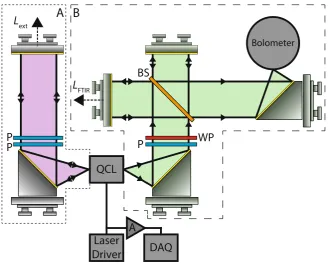
In our experiment a QCL emitting at~2.25 THz was used as the laser source (see Methods). Radiation from the front facet of the device was collimated and relected back to the laser cavity using a planar mirror, as shown in Fig. 1 (box A). Two wire grid polarisers were positioned in the external cavity to provide control over the level of OF to the laser; rotation of the second of these polarisers through an angle θ relative to the axis of the irst results in a power attenuation factor of cos4θ
in double-pass, enabling a range of feedback parameters to be achieved from C≈ 0 (no feedback) to C≈ 1.5. To perform spectral analysis using LFI the feedback parameter was set to C≈ 0.6, ensuring operation in the regime of weak feedback such that the spectral characteristics of the solitary laser dominate over those of the external cavity.
Figure 2(a) shows an exemplar interferogram recorded via the laser terminal voltage (see Methods), with the laser emitting in a single longitudinal mode, achieved at a dc drive current of Id= 725 mA. In this case the LFI voltage signal VLFI is described well by a rate equation reduction of the complex ield and carrier density
of lasers under OF, as irst presented in the seminal work of Lang and Kobayashi (L–K)36. his deterministic
formalism describes how changes in the intracavity ield amplitude under OF cause perturbation to the carrier density, which in turn modiies the instantaneous frequency of the laser. In the steady-state condition this model can be shown to reduce to a set of equations for the laser frequency and the threshold carrier density under OF (see Methods). he latter of these equations [Eq. (2)] relates directly to the observable LFI voltage, which varies approximately sinusoidally with the external cavity length Lext under weak feedback, as observed in Fig. 2(a).
Whilst analysis based on the L‒K equations is applicable only in the case of single-mode operation, models
including the efects of multiple longitudinal modes have also been developed1, 37. In fact, under the regime of
weak OF, the LFI signal can be approximated as a linear combination of signals arising from individual longi-tudinal modes of the solitary laser (see Methods)38, 39 in an analogous fashion to the interferogram recorded in
Fourier transform spectroscopy. Crucially, this provides a means to recover the emission spectrum of the source over a wide spectral bandwidth, through Fourier analysis of the LFI voltage signal recorded under extension of the external cavity. Figure 2(b) shows an interferogram recorded at a drive current Id= 950 mA, for which the
QCL
DAQ
L
extBolometer
L
FTIRLaser
Driver
BS
WP
P
P
P
[image:3.595.154.483.42.306.2]A
A B
Figure 1. Schematic diagram of the experimental system showing laser-feedback interferometer (box A) and
Fourier transform infrared (FTIR) spectrometer (box B), used for the purposes of spectral comparison. Wire grid polarisers (P) are employed to control the level of optical feedback in the laser-feedback interferometer. A quarter-wave plate (WP) and grid polariser provide optical isolation in the FTIR spectrometer. BS‒silicon beam
laser operates in multiple longitudinal modes. In this case, multiple periodicities can be observed in the measured voltage signal, corresponding to multiple frequencies propagating in the cavity that each resonate at diferent external cavity lengths, as described by Eq. (4).
To recover the spectral emission of the QCL a fast Fourier transform (FFT) of the LFI voltage signal was per-formed. For a cavity extension ∆Lext= 200 mm the resulting spectral resolution of the FFT is c/2∆Lext= 750 MHz.
We note, however, that LFI has been demonstrated previously in a THz QCL over an external path length of
>10 m40. As such the spectral resolution of our experiment could, in principle, be increased beyond 15 MHz.
Figure 2(c) and (d) show the normalised FFTs of the complete interferograms corresponding to data presented in Fig. 2(a) and (b), revealing the expected single- and multiple-longitudinal mode emission, respectively. From this data, a longitudinal mode spacing of ∆vFP= ~17 GHz is obtained, in agreement with that expected for a laser cavity
length Lc= 2.3 mm and active region efective refractive index n= 3.8 using the relation ∆νFP=c/2nLc. Figure 3
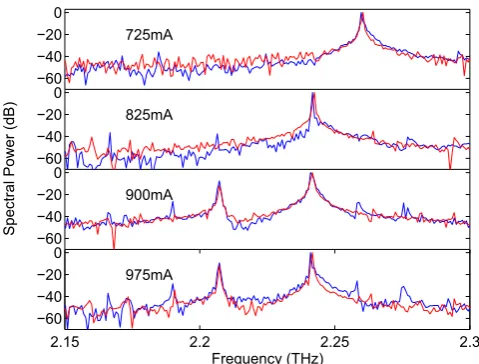
shows emission spectra recorded in this way for a range of laser driving currents, and plotted on a logarithmic scale to illustrate the dynamic range of the laser feedback-interferometer. he noise loor in our system is dominated by voltage noise at the input of the digital acquisition board, which is measured to be ~10 µV/√Hz. It is also worth
noting that the response of lasers under weak OF is typically greatest just above threshold and rolls of with increas-ing drivincreas-ing current25; in our system, voltage signal amplitudes up to ~40 mV were recorded ater ampliication. As
can be seen in Fig. 3, switching of the dominant mode from 2.258 THz to 2.241 THz is observed at low drive cur-rents, with multiple-mode emission dominating at larger drive curcur-rents, as is typical behaviour in QCLs.
In order to validate these spectral characteristics obtained by LFI, spectral measurements were also per-formed using a conventional FTIR spectroscopy setup based on a Michelson interferometer [see Fig. 1 (box B) and Methods]. In this case radiation was collected from the rear facet of the laser with the front facet blocked to prevent feedback of radiation from the laser-feedback interferometer. Figure 3 shows comparative spectral data obtained for the same driving currents used for the LFI characterisation, at the same spectral resolution of
V LFI
(mV)
|FFT(
V LFI
)|
181.5 182 182.5 183 183.5 184 184.5 −20
0 20 40
∆Lext (mm)
2.150 2.2 2.25 2.3
0.5 1
Frequency (THz)
182.8 183 183.2
0 5 10 15 20 25
a
b
0 0.1 0.2 0.3 0.4
c
[image:4.595.154.454.46.417.2]d
Figure 2. Interferograms recorded via the laser terminal voltage VLFI with the laser operating on (a) single and
www.nature.com/scientificreports/
750 MHz (achieved with a single-trip path length extension of ∆LFTIR= 200 mm). As can be seen, excellent
agree-ment with the LFI characterisation is obtained in terms of both the absolute frequency of lasing modes as well as the overall spectral features recovered.
Interestingly, it can also be observed that the LFI characterisation reveals weak lasing modes, with spectral powers ~−30 dB relative to the dominant mode, that are not immediately apparent in the FTIR spectrometer data, for example modes at 2.190 THz, 2.258 THz and 2.275 THz observed for Id≥ 900 mA. Whilst such efects could,
in general, occur due to the presence of OF in the laser-feedback interferometer, this is not expected in our case due to operating in the regime of weak OF. In fact, we have conirmed the presence of these lasing modes through FTIR measurements, but only under certain limited ranges of the interferometer path length (see Supplementary Information, Fig. S2). We therefore attribute this phenomenon to a propagation eiciency through our FTIR spectrometer that is highly sensitive to the alignment of the laser, which arises from the long optical path length (208 cm) from source to detector, coupled with the complex and frequency-dependent far-ield beam pattern of the THz QCL. As has been described elsewhere41–46 the radiation patterns of THz QCLs with surface plasmon
ridge waveguides are commonly characterised by multiple emission lobes, arising due to difraction from both the laser facet and substrate43–45, as well as prominent ring-like interference fringes in the far-ield. Several
interpreta-tions of these rings have been proposed, including aperture-like difraction of the waveguide mode43, interference
efects arising from relections from the cryostat windows44, 46 and laser submount46, and interference efects that
can be understood using a wire laser model that treats the QCL as a longitudinally-distributed source41, 42, 47.
Crucially, the angular direction of these interference fringes relative to the cavity axis is determined by the radi-ation wavelength and thus difers for diferent longitudinal cavity modes46. It can therefore be expected that
diferent longitudinal modes will propagate through our FTIR spectrometer with varying (frequency-dependent) coupling eiciencies to the detector entrance aperture, such that some modes can efectively be spatially iltered from the recorded spectrum. Indeed, this phenomenon of mode suppression in spectra recovered from our FTIR spectrometer has been conirmed experimentally (see Supplementary Information Fig. S1). Furthermore, this investigation conirms the presence of the weak laser modes that appear in the LFI spectra (at 2.190 THz, 2.258 THz and 2.275 THz, for example), although the mode intensities recovered using the FTIR spectrometer are found to depend strongly on the speciic alignment conditions, with almost complete mode suppression occur-ring in some cases. In contrast to the FTIR approach, the self-aligning nature of our LFI scheme appears to reveal the full spectral content of the laser emission consistently. It is also worth noting that our LFI approach ofers advantages in terms of measuring emission spectra when the laser is operating close to threshold. In such cases the output power, and hence the signal recovered by FTIR spectroscopy, is expected to be low. his is in contrast to the signal levels recorded by LFI, which are typically largest close to threshold25, 48.
Frequency perturbation under optical feedback.
As described by the L–K formalism, the modiication to the laser carrier population under OF that is responsible for the voltage signal exploited in our LFI approach also induces a perturbation to the laser frequency, v. his efect is encapsulated through the transcendental excess phase equation [see Eq. (1)], which predicts that the laser frequency under OF is perturbed from that of the soli-tary laser v0 by an amount dependent on the external cavity round-trip time τext, but within the bounds
ν ν ν πτ
∆ = 0− = ±C/2 ext. Crucially to our interferometric approach, ∆ν is small for weak feedback (C< 1) and
long cavity lengths (τ 1/ν
ext 0), such that the recovered spectral components of the laser emission deviate from
those of the solitary laser by less than the 750 MHz spectral resolution limit of the LFI measurement as deter-mined by the cavity extension ∆Lext.
Spectral Power (dB)
2.15 2.2 2.25 2.3
−60 −40 −20 0
975mA
Frequency (THz) −60
−40 −20 0
900mA −60
−40 −20 0
825mA −60
−40 −20 0
[image:5.595.155.395.44.226.2]725mA
Figure 3. Normalised emission spectra obtained by laser-feedback interferometry (blue) and FTIR
In order to conirm the frequency perturbation of individual laser modes under OF, spectra were recorded using the FTIR spectrometer for a series of external cavity lengths in the laser-feedback interferometer and for controlled levels of OF to the laser (see Methods). In this case a long path length extension of ∆LFTIR= 600 mm
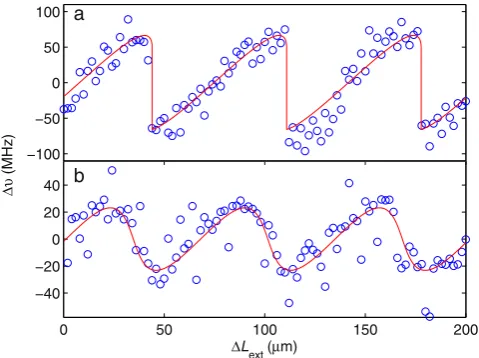
was used to attain a higher spectral resolution from the FTIR spectrometer. Figure 4(a) shows the frequency per-turbation of the laser cavity mode at ~2.241 THz, measured over a cavity extension in the laser-feedback interfer-ometer ∆Lext= 200 µm, for a feedback parameter C≈ 1.5. Under this moderate feedback the frequency of the
laser mode v varies almost linearly with Lext over a cavity extension ∆L ≈c/2ν
ext 0 before repeating this trend in
subsequent LFI fringes (which are also spaced by ∆Lext=c/2ν0). Figure 4(b) shows the equivalent behaviour
under weak OF, with C≈ 0.5. In this case the laser frequency oscillates approximately sinusoidally as a function of L
ext, and with a smaller amplitude of perturbation. It is important to note that the laser emission is not
domi-nated by external cavity modes in this experiment; rather, the perturbation to the laser carrier population under OF causes a periodic perturbation of the laser frequency with varying Lext, as described by the excess phase equa-tion [Eq. (1)], which serves to ensure matched phases for the outgoing and returning ield at the laser facet. To validate this description, the data was itted to Eq. (1) with C treated as a free parameter. For this itting procedure the linewidth enhancement factor α= 0 was assumed, as is typical for intersubband lasers for which the electron
subbands have parallel curvature in k-space31, 49. As is evident from Fig. 4, the excess phase equation reproduces
the data remarkably well in both cases, in terms of both of the dependence on Lext and the maximum amplitude of the measured frequency perturbation. From our measurements, it is also possible to analyse the frequency perturbation of the weaker mode at ~2.275 THz. In this case, similar results are obtained, revealing an amplitude of perturbation of ±~100 MHz for C≈ 1.5. Indeed, this similar behaviour for diferent cavity modes is expected from the excess phase equation [Eq. (1)], which predicts that the maximum frequency perturbation under OF depends only on the feedback parameter C and the external cavity round-trip time τext, and is independent of the
mode frequency.
Figure 5 shows the feedback parameter obtained from this itting procedure for varying degrees of ield atten-uation in the external cavity. he double-pass ield attenatten-uation factor plotted here is calculated from cos2θ. A
linear relationship is obtained, in agreement with the expected proportionality between C and R
ext [see Eq. (3)].
Also plotted is the maximum amplitude of frequency perturbation C/2πτ
ext determined from these fits.
Importantly, the perturbation ∆ν remains smaller than the spectral resolution limits of our LFI measurement for
all levels of OF achievable within our setup, such that these efects have negligible impact on the spectral data recovered using our LFI approach.
Conclusions
In summary, we have reported a new modality of laser-feedback interferometry in which changes to the terminal voltage of a semiconductor laser in response to an extension of the external cavity are used to infer the emission spectrum of the solitary laser. Whilst applicable across all types of semiconductor lasers, our scheme ofers a sim-ple alternative to Fourier transform infrared spectroscopy approaches typically employed for spectral characteri-sation of lasers operating in the mid- and far-infrared spectral region. We have demonstrated this approach using a terahertz-frequency quantum cascade laser source, for both single- and multiple-longitudinal mode operating regimes, and were able to resolve spectral features not reliably resolved using traditional FTIR spectroscopy. In this respect, our approach ofers a notable advantage compared to FTIR-based approaches to the spectral char-acterisation of THz QCLs. We have also reported the irst measurement, to our knowledge, of the frequency per-turbation of solitary laser modes under diferent levels of optical feedback, and found excellent agreement with predictions of the excess phase equation central to the theory of lasers under optical feedback.
∆υ
(MHz)
0 50 100 150 200
−40 −20 0 20 40
∆L
ext (µm)
−100 −50 0 50
100 a
[image:6.595.156.396.45.224.2]b
Figure 4. Frequency perturbation ∆v of the laser cavity mode at ~2.241 THz under optical feedback, measured
over a cavity extension in the laser-feedback interferometer ∆Lext= 200 µm, for feedback parameters (a) C≈ 1.5
www.nature.com/scientificreports/
Methods
Laser response to optical feedback.
he response of a laser subject to OF can be described using the well-established rate equation model for the complex ield and carrier density proposed by Lang and Kobayashi, which includes the inluence of feedback through a time-delayed ield term36. Under the steady-state conditionthese rate equations reduce to a set of equations for the laser frequency ν and the threshold carrier density n1, 9:
πτ ν −ν =C πντ + α
2 ext(0 ) sin(2 ext arctan( )), (1)
β πντ
− = −
n n0 cos(2 ext) (2)
where the subscript 0 indicates values for the solitary laser without feedback, α is the linewidth enhancement
factor, β represents the coupling rate of feedback relative to the rate of carrier density gain, and τ ext is the
round-trip delay in the external cavity given by τ =2L /c
ext ext , in which Lext is the external cavity length and c is the
speed of light in the external cavity. he dimensionless feedback parameter C is deined as
ε τ τ α = + − C R R R
1 (1 )
(3) ext L 2 ext L L
in which Rext is the relectivity of the external cavity mirror, RL is the relectivity of the emitting laser facet, τL is the
round-trip time for light in the laser cavity, and ε is the fraction of the relected light coupled coherently to the
laser mode that accounts for loss due to attenuation in the external cavity, spatial mode mismatch between the relected and the cavity mode, and other optical losses. Per the transcendental excess phase equation [Eq. (1)], the perturbed laser frequency under OF is close to that of the solitary laser for weak feedback (C < 1), such that
ν≈ν0. Eq. 2 elucidates the form of the LFI signal recorded via the perturbation induced on the laser voltage or
the emitted power under OF, both of which can be approximated as being proportional to the change in carrier density for small perturbations2.
his model based on the L‒K formalism inherently assumes lasing in a single longitudinal mode, in which
case the ac component of the linearized terminal voltage signal (the laser-feedback interferometry signal, VLFI) can be written as V =βcos(2πντ )
LFI ext, where amongst other factors β is proportional to the rate at which optical
feedback is coupled back into the laser cavity50. Nevertheless, for the case of a laser emitting on N longitudinal modes, the LFI signal can be approximated as a linear combination of signals arising from individual modes38, 39.
In this case, the ac component of the linearized terminal voltage signal can be expressed, in the case of weak feed-back, as
∑β
πν τ= =
V cos(2 )
(4) i N i i LFI 1 ext
where νi is the frequency of the ith mode of the solitary laser and βi is a prefactor relating to the intensity of that
mode (through the rate at which optical feedback is coupled back into it).
Quantum cascade laser source.
he THz QCL consisted of a 14 µm-thick bound-to-continuum activeregion51 emitting at ~2.25 THz (~133 µm), which was processed into a semi-insulating surface-plasmon ridge
waveguide with dimensions of 2.3 mm × 200 µm. he device was cooled using a continuous-low helium cryostat and maintained at a heatsink temperature of 25 K. At this temperature, the threshold current was 700 mA, and the device emitted a maximum power ~2.5 mW.
0 0.2 0.4 0.6 0.8 1
0 0.3 0.6 0.9 1.2 1.5
Field Attenuation, cos2θ
[image:7.595.158.360.46.197.2]C 0 25 50 75 100 125 C /2 πτ ext (MHz )
Figure 5. Feedback parameter C (let axis) obtained from itting the excess phase equation to measurements
Spectral characterisation using laser-feedback interferometry.
he emission from the laser was collimated using a 2-inch diameter f/2 of-axis parabolic relector and reinjected to the laser cavity using a lat pla-nar mirror. Two wire-grid polarisers were positioned in the collimated beam path, with the irst oriented parallel to the major axis of the elliptically polarised emission (i.e. parallel to the growth direction of the QCL hetero-structure), and the second orientated at an angle θ relative to the axis of the irst to control the level of feedback tothe laser. Interferograms were recorded by extending the external cavity over a distance ∆Lext= 200 mm, from a
cavity length Lext= 0.52 to 0.72 m, using a computer-controlled translation stage. he corresponding change in the
QCL terminal voltage due to feedback, VLFI, was ampliied using a 22 dB ac-coupled diferential voltage ampliier
and recorded at a sampling rate of 8 kHz (corresponding to 2 µm increments of the mirror position) using a 14-bit
digital acquisition board. To improve the signal-to-noise level of the system, ten measurements were averaged for each interferogram recorded. For these measurements, the rear facet of the laser was blocked to prevent any feedback of radiation from the FTIR spectrometer. No purging of the system was used.
Spectral characterisation using FTIR spectrometer.
Emission from the rear facet of the QCL wascollected using a 2-inch diameter f/2 of-axis parabolic relector, and coupled to a standard Michelson interfer-ometer arrangement employing a silicon beam splitter and helium-cooled germanium bolinterfer-ometer (see Fig. 1, dashed box). he planar mirror in the variable arm of the interferometer was translated over a distance of up to ∆LFTIR= 600 mm using a computer-controlled translation stage, and the corresponding detector signal was recorded at a sampling rate of 2.67 kHz (corresponding to 4 times the Nyquist frequency) using a 14 bit digital acquisition board. he total optical path length from QCL to detector was 208 cm at the furthest extension of the mirror. An isolator consisting of a polariser and quarter-wave plate were employed to prevent optical feedback to the laser from the FTIR spectrometer. No purging of the system was used. he noise loor in this system is dominated by voltage noise at the input of the digital acquisition board (~10 µV/√Hz), with the signal amplitude
scaling proportionally with emitted power, up to a maximum value ~1.4 V (at a drive current Id= 875 mA).
Measurement of frequency perturbation under optical feedback.
he external cavity length in thelaser-feedback interferometer was extended from Lext= 0.6198 to 0.6200 m in increments of 2 µm, and a single
FTIR measurement performed at each step using radiation coupled from the rear facet of the laser. In order to prevent coupling of radiation between the LFI and FTIR systems, the polariser in the FTIR spectrometer was ori-ented orthogonal to the irst polariser in the laser-feedback interferometer (i.e. orthogonal to the major axis of the elliptically polarised laser emission). Measurements were repeated with varying levels of OF in the range C≈ 0 to
C≈ 1.5, controlled through rotation of the second wire grid polariser. For these measurements, a driving current
Id= 825 mA was used. he precise frequency of the laser cavity mode at ~2.241 THz was extracted from the FTIR
spectra by itting the absolute magnitude of a cardinal sine (sinc) function and taking the centroid frequency.
Additional Data.
Additional data sets related to this publication are available from the University of Leeds data repository at https://doi.org/10.5518/138.References
1. Kane, D. M. & Shore, K. A. Unlocking Dynamical Diversity: Optical Feedback Efects on Semiconductor Lasers (Wiley, 2005). 2. Petermann, K., Laser Diode Modulation and Noise (Springer Netherlands, Dordrecht, 1988).
3. Kleinman, D. A. & Kisliuk, P. P. Discrimination against Unwanted Orders in the Fabry-Perot Resonator. Bell Sys. Tech. J41, 453–462 (1962).
4. Acket, G., Lenstra, D., den Boef, A. & Verbeek, B. he inluence of feedback intensity on longitudinal mode properties and optical noise in index-guided semiconductor lasers. IEEE Journal of Quantum Electronics20(10), 1163–1169 (1984).
5. Lenstra, D., Verbeek, B. & den Boef, A. Coherence collapse in single-mode semiconductor lasers due to optical feedback. IEEE Journal of Quantum Electronics21(6), 674–679 (1985).
6. Mork, J., Tromborg, B. & Mark, J. Chaos in Semiconductor Lasers with Optical Feedback: heory and Experimental. IEEE Journal of Quantum Electronics28(1), 93–108 (1992).
7. Donati, S. & Horng, R.-H. he Diagram of Feedback Regimes Revisited. IEEE Journal of Selected Topics in Quantum Electronics 19(4), 1500309 (2013).
8. Mitsuhashi, Y., Shimada, J. & Mitsutsuka, S. Voltage change across the self-coupled semiconductor laser. IEEE Journal of Quantum Electronics17(7), 1216–1225 (1981).
9. Taimre, T. et al. Laser feedback interferometry: a tutorial on the self-mixing efect for coherent sensing. Advances in Optics and Photonics7(3), 570–631 (2015).
10. Dean, P. et al. Coherent three-dimensional terahertz imaging through self-mixing in a quantum cascade laser. Applied Physics Letters 103(18), 181112 (2013).
11. Wienold, M. et al. Real-time terahertz imaging through self-mixing in a quantum-cascade laser. Applied Physics Letters109(1), 011102 (2016).
12. Dean, P. et al. Apertureless near-ield terahertz imaging using the self-mixing efect in a quantum cascade laser. Applied Physics Letters108(9), 091113 (2016).
13. Tan, Y., Wang, W., Xu, C. & Zhang, S. Laser confocal feedback tomography and nano-step height measurement. Scientiic Reports3, 2971 (2013).
14. Gagnon, E. & Rivest, J.-F. Laser range imaging using the self-mixing efect in a laser diode. IEEE Transactions on Instrumentation and Measurement48(3), 693–699 (1999).
15. Giuliani, G., Bozzi-Pietra, S. & Donati, S. Self-mixing laser diode vibrometer. Measurement Science and Technology14(1), 24–32 (2003).
16. Donati, S., Giuliani, G. & Merlo, S. Laser diode feedback interferometer for measurement of displacements without ambiguity. IEEE Journal of Quantum Electronics31(1), 113–119 (1995).
17. Rakić, A. D. et al. Swept-frequency feedback interferometry using terahertz frequency QCLs: a method for imaging and materials analysis. Optics Express21(19), 22194–22205 (2013).
www.nature.com/scientificreports/
19. Lim, Y. L. et al. Self-mixing low sensor using a monolithic VCSEL array with parallel readout. Optics Express18(11), 11720–11727 (2010).
20. King, P. G. R. & Stewart, G. J. Metrology with an optical maser. New Scientist17(323), 180–181 (1963).
21. Giuliani, G., Norgia, M., Donati, S. & Bosch, T. Laser diode self-mixing technique for sensing applications. Journal of Optics A: Pure and Applied Optics4, S283–S294 (2002).
22. Lim, Y. L., Nikolic, M., Bertling, K., Kliese, R. & Rakić, A. D. Self-mixing imaging sensor using a monolithic VCSEL array with parallel readout. Optics Express17(7), 5517–5525 (2009).
23. Mezzapesa, F. P. et al. Nanoscale Displacement Sensing Based on Nonlinear Frequency Mixing in Quantum Cascade Lasers. IEEE Journal of Selected Topics in Quantum Electronics21(6), 1200908 (2015).
24. Mezzapesa, F. P. et al. Photo-generated metamaterials induce modulation of CW terahertz quantum cascade lasers. Scientiic Reports 5, 16207 (2015).
25. Dean, P. et al. Terahertz imaging through self-mixing in a quantum cascade laser. Optics Letters36(13), 2587–2589 (2011). 26. Bertling, K. et al. Demonstration of the self-mixing efect in interband cascade lasers. Applied Phyics Letters103(23), 231107 (2013). 27. Blaize, S. et al. Phase sensitive optical near-ield mapping using frequency-shited laser optical feedback interferometry. Optics
Express16(16), 11718–11726 (2008).
28. Han, D., Wang, M. & Zhou, J. Self-Mixing Speckle in an Erbium-Doped Fiber Ring Laser and Its Application to Velocity Sensing.
IEEE Photonics Technology Letters19(18), 1398–1400 (2007).
29. Okamoto, S., Takeda, H. & Kannari, F. Ultrahighly sensitive laser‐Doppler velocity meter with a diode‐pumped Nd:YVO4 microchip laser. Review of Scientiic Instruments66(5), 3116 (1995).
30. Yu, Y., Giuliani, G. & Donati, S. Measurement of the linewidth enhancement factor of semiconductor lasers based on the optical feedback self-mixing efect. IEEE Photonics Technology Letters16(4), 990–992 (2004).
31. Green, R. P. et al. Linewidth enhancement factor of terahertz quantum cascade lasers. Applied Phyics Letters92(7), 071106 (2008). 32. Giuliani, G. & Norgia, M. Laser diode linewidth measurement by means of self-mixing interferometry. IEEE Photonics Technology
Letters12(8), 1028–1030 (2000).
33. Cardilli, M. C., Dabbicco, M., Mezzapesa, F. P. & Scamarcio, G. Linewidth measurement of mid infrared quantum cascade laser by optical feedback interferometry. Applied Physics Letters108(3), 031105 (2016).
34. Tkach, R. & Chraplyvy, A. Regimes of feedback efects in 1.5-um distributed feedback lasers. Journal of Lightwave Technology4(11), 1655–1661 (1986).
35. Giuliani, G. & Donati, S. Laser Interferometry in Unlocking Dynamical Diversity: Optical Feedback Efects on Semiconductor Lasers, edited by Kane, D. M. & Shore, K. A. (John Wiley & Sons Ltd, Chicester, 2005) pp. 217–256.
36. Lang, R. & Kobayashi, K. External optical feedback efects on semiconductor injection laser properties. IEEE Journal of Quantum Electronics16(3), 347–355 (1980).
37. Ryan, A. T., Agrawal, G. P., Gray, G. R. & Gage, E. C. Optical-feedback-induced chaos and its control in multimode semiconductor lasers. IEEE Journal of Quantum Electronics30(3), 668–679 (1994).
38. Jentink, H. W., Mul, F. F. Md, Suichies, H. E., Aarnoudse, J. G. & Greve, J. Small laser Doppler velocimeter based on the self-mixing efect in a diode laser. Applied Optics27(2), 379–385 (1988).
39. Lv, L. et al. Efect of external cavity length on self-mixing signals in a multilongitudinal-mode Fabry–Perot laser diode. Applied Optics44(4), 568–571 (2005).
40. Valavanis, A. et al. Self-Mixing Interferometry With Terahertz Quantum Cascade Lasers. IEEE Sensors Journal13(1), 37–43 (2013). 41. Hajenius, M. et al. Surface plasmon quantum cascade lasers as terahertz local oscillators. Optics Letters33(4), 312–314 (2008). 42. Salih, M. et al. Terahertz quantum cascade lasers with thin resonant-phonon depopulation active regions and surface-plasmon
waveguides. Journal of Applied Physics113(11), 113110 (2013).
43. Hübers, H.-W. et al. Terahertz quantum cascade laser as local oscillator in a heterodyne receiver. Optics Express13(15), 5890–5896 (2005).
44. Bründermann, E. et al. Turn-key compact high temperature terahertz quantum cascade lasers. Optics Express14(5), 1829–1841 (2006). 45. Richter, H., Rothbart, N. & Hübers, H.-W. Characterizing the beam properties of terahertz quantum-cascade lasers. Journal of
Infrared, Millimeter, and Terahertz Waves35, 686–698 (2014).
46. Röben, B., Wienold, M., Schrottke, L. & Grahn, H. T. Multiple lobes in the far-ield distribution of terahertz quantum-cascade lasers due to self-interference. AIP Advances6, 065104 (2016).
47. Orlova, E. E. et al. Antenna Model for Wire Lasers. Physical Review Letters96(17), 172904 (2006).
48. Donati, S. Responsivity and Noise of Self-Mixing Photodetection Schemes. IEEE Journal of Quantum Electronics47(11), 1428–1433 (2011).
49. Lim, Y. L. et al. Demonstration of a self-mixing displacement sensor based on terahertz quantum cascade lasers. Applied Phyics Letters99(8), 081108 (2011).
50. Roumy, J. A. et al. Efect of injection current and temperature on signal strength in a laser diode optical feedback interferometer.
Applied Optics54(2), 312–318 (2015).
51. Barbieri, S. et al. 2.9 THz quantum cascade lasers operating up to 70 K in continuous wave. Applied Phyics Letters85(10), 1674 (2004).
Acknowledgements
he authors acknowledge support from EPSRC (UK) (EP/J017671/1 and EP/J002356/1), the Royal Society, the Wolfson Foundation (WM110032, WM150029), the European Cooperation in Science and Technology (COST) (Action BM1205), the Australian Research Council (ARC) Discovery Projects funding scheme (DP 160 103910); and the Queensland Government’s Advance Queensland programme.
Author Contributions
P.D., K.B., T.T. and A.D.R. conceived the experiment. J.K. and P.D. performed the measurements. J.K., P.D., K.B., Y.L.L., T.T., D.I. and A.D.R. analysed and interpreted the data. J.F. developed the F.T.I.R. spectrometer and assisted with spectral measurements. L.L. and E.H.L. performed the M.B.E. growth of the QCL material. R.A.M. processed the QCL device. P.D., E.H.L. and A.G.D. supervised the development, optimization, growth, and fabrication of the QCL device. P.D. and J.K. wrote the paper with contributions from all authors.
Additional Information
Supplementary information accompanies this paper at doi:10.1038/s41598-017-07432-0
Competing Interests: he authors declare that they have no competing interests.
Publisher's note: Springer Nature remains neutral with regard to jurisdictional claims in published maps and
Open Access This article is licensed under a Creative Commons Attribution 4.0 International License, which permits use, sharing, adaptation, distribution and reproduction in any medium or format, as long as you give appropriate credit to the original author(s) and the source, provide a link to the Cre-ative Commons license, and indicate if changes were made. he images or other third party material in this article are included in the article’s Creative Commons license, unless indicated otherwise in a credit line to the material. If material is not included in the article’s Creative Commons license and your intended use is not per-mitted by statutory regulation or exceeds the perper-mitted use, you will need to obtain permission directly from the copyright holder. To view a copy of this license, visit http://creativecommons.org/licenses/by/4.0/.