•'·' '
COM(91) 230 final - SYN 346
Brussels, 1 August 1991
•. · ·= . . ... ,_.,
'{;::
. .
' Proposal for' a
COUNCIL 0 i·RECT,IVE
concerning ttlepostlng of workers In the framework of the provision of services
(presente~ py· the Commission).
EXPLANATORY MEMQRANDYM
Introduction
-1. In Its Action Programme relating to the implementation of the Community Charter of Basic Social Rights for Workers, the commission, under the chapter concerning the freedom of movement, referred to a "proposal for a Community Instrument on working conditions applicable to workers from another State performing work In the host country in the framework of the freedom to provide services, especially on behalf of a subcontracting undertaking".
The Commission considered that the free movement of services, capital, goods and persons will Increase considerably with the completion of the -single market bringing about a considerable number of employment
relationships which are to be temporarily performed In a Member State other than the State In the territory of which they are habitually performed. Thus, a new Intra-Community mobility of workers within their jobs, different from the traditional mobi I ity In search for new employment, Is increasingly growing within the European Community<1> in the framework of the economic freedoms, In particular, of the freedom to provide services.
2. In alI these cases the question arises as to which national labour legislation should be applied to undertakings which post a worker to carry out temporary work In a Member State. The solution to this question depends on which criteria are laid down by the conflict of law rules of the Member States for determining the appl !cable labour law. As the appl icatlon of these criteria varies under the existing rules of Member States, the outcome may be that the determination of the applicable law gives rise to legal uncertainty, and may give rise to distortions of competition between national and foreign undertakings making It difficult to anticipate the working conditions applicable to the undertakings Involved.
3. To increase legal certainty, to ascertain lri advance the working conditions applicable and to erradlcate practices which may be both detrimental to a fair competition between undertakings and prejudicial to the Interests of the workers concerned, a coordination of the law of the Member States Is needed. In doing so the Commission is in effect reaffirming its commitment to the principle of subsidiarity for, given the dimension, nature and effects of the task Involved, the objectives concerned can be undertaken more effectively in common than by the Member States acting separately.
(1) A. Lyon-Caen. "Le droit, Ia mobilite et les relations du travail :
I. The Internal market and the temporary mobility of manpower
4. The completion of the internal market and particularly the full
realisation of the freedom to provide services and the freedom of establishment may Increasingly lead undertakings to establish activities to a greater extent In other Member States and in this context to post their workers to carry out temporary work therein.
5. One of the prime sectors for the transnational external lzation of labour Is the services industry, which already accounts for half of the Community's production, 40% of jobs. and a third of exports. The services sector covers an Increasingly wide range of activities, such as building maintenance and cleaning, tour Ism, security, telecommunications and Information systems etc. Transnational subcontractIng is a I so developing In the construct ion sector, pub I i c works and the automobl le Industry. There are more and more Instances of firms based in one Member State and moving with their staff to another State to provide a service, or of firms sending their workers from theIr country of orIgIn to an·other Member State to work for a
legally distinct undertaking.
6. According to a report pub I i shed recent I y for the Commission of the European communltles<2> smal I and medium-sized enterprises (SMEs) are playing an increasingly influential role in international subcontracting. These may be "satellite" SMEs working for a small number of major clients, specialist SMEs in sectors requiring a high level of ski lis, or "competitive" SMEs producing in competition with major companies on highly diverse markets (e.g. informatics, capital equipment, etc.). The play of market forces at Community level is a major factor for such sma I I and medium-sized firms. One has on I y to· consider the opportunities offered by the single market in promoting the access of SMEs to public contracts through subcontracting arrangements<3>.
7. Used as an "external flexibility" instrument for firms, International subcontracting divides the process of producing a final product up into distinct operations carried out in a number of Member States. The "International segmentation of production processes" encourages multiple subcontracting and may require a new set of relations between clients and subcontractors, e.g. "partnership"-form arrangements.
8. The Internal market Is, according to Article Sa of the EEC Treaty, 'an area without Internal frontiers in which the free movement of goods, persons, services and capital is ensured In accordance with the provisions of the Treaty'. The dismantling of internal frontiers is already resulting In major corporate reorganisations within the Community, involving a significant Increase in mergers, takeovers, transfers and joint ventures, and leading to the growing concentration
(2) Subcontracting and integration of production processes In European industry. Commission of the European Communities 1989.
(3) COM(90) 166- Promoting SME participation In public procurement ih the Community.
t
of company ownership. The tot'al number of acQuisitions (majority holdings or mergers) effected by the· top 1000 European Industrial enterprises is constantly growing. A recent Commission report<4> shows that, over the 1980s, the number of such operations has doubled every three years, rising from 208 In 1984-85 to 492 In 1988-89. This kind of process is liable to stimulate the temporary expatriation of workers within groups of companies or within companies with multiple operations throughout Europe.
9. For a number of years, the problem of the conflict of law rules mainly concerned this type of worker, .the problem being how to decide which law was appl lcable to an employment relationship which was subject to international mobility and had links with different legal systems.
9.bis Fair competition. Many factors have an effect on the competitive situation of individual firms: eg. the attractiveness of the goods or services it offers, toe technical support it can provide, and Its costs. Among the influences on the latter are the level of investment, the productivity of both capital and the latter. Although pay can be an important element of a firm's costs, It is one element among many, and Is not normally considered as affecting fair competition.
A particular problem arises, however, where a Member State places obi lgations, notably with regard to pay, on firms based In and ~orking
on its territory, and these firms are faced with competition -for a specific task carried out within that same Member State- from a firm based elsewhere and not subject to the same obligations. Legitimate competition between firms is then overlaid by potentially distortive effects between national reQuirementes.
The Question is therefore one of finding a balance between two principles which find themselves In contradiciton. On the one hand, free competition between firms, including at the level of subcontracting across borders, so that the ful I benefits of the Single Market can be realised, including by firms based in Member States whose main comparative advantage Is a lower wage cost. On the other, Member States may decide to set and apply minimum pay levels applicable on their territory in order to ensure a minimum standard of I lving appropriate to the country concerned.
10. The Question of which law is applicable to the employment relationship would become meaningless If completion of the single market brought with It unification of national social laws. The fact is, though, that considerable disparities and divergences stilI exist.
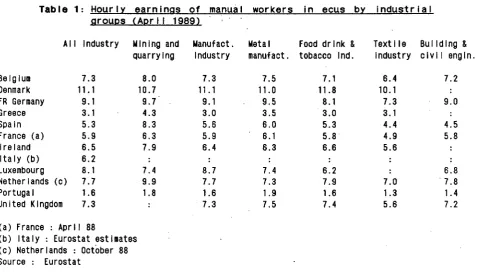
11. National differences In pay levels and working time are brought out by the f611ow•ng tables:
Table 1: Hourly earnings of manual workers in ecus by indus·trlal
groups CApri I 1989)
All Industry Mining and Manufact. Metal Food drink & Text lie Building &
Quarrying Industry manufact. tobacco Ind. Industry c I v I I eng In.
Belgium 7.3 8.0 7.3 7.5 7.1 6.4
Denmark 11. 1 10.7 11.1 11.0 11.8 10. 1
FR Germany 9.1 9.7 9.1 9.5 8.1 7.3
Greece 3.1 4.3 3.0 3.5 3.0 3.1
Spain 5.3 8.3 5.6 6.0 5.3 4.4
France (a) 5.9 6.3 5.9 6.1 5.8 4.9
Ireland 6.5 7.9 6.4 6.3 6.6 5.6
Italy (b) 6.2
Luxembourg 8.1 7.4 8.7 7.4 6.2
Netherlands (C) 7.7 9.9 7.7 7.3 7.9 7.0
Portugal 1.6 1.8 1.6 1.9 1.6 1.3
United Kingdom 7.3 7.3 7.5 7.4 5.6
(a) France :April 88
(b) Italy : Eurostat estimates (C) Netherlands : October 88 Source : Eurostat
In the construction industry there are a considerable number of posted workers. Recent figures provided by the European trade unions on wages in the construction Industry are· in I ine with these provided by Eurostat:
Table 2 : Hourly wages In ecu in 1990 In the construction Industry
Country Lowest level in Highest level in
coll.agreements coli. agreements
Belgium 6.46 ecu/hour 7.88 ecu/hour
Netherlands 6.69 8.44
Denmark 13.32 18.39
FR Germany 7.11 10.97
France 5.57
Portugal 1.50 3.00
Italy 5.70 7.95
Ire I and 5.00 5.47
Luxembourg 5.23 8.53
United KIngdom 4.10 4.93
Spain 5.25 8.00
Greece 2.12 2.52
Source European Federation of building and wood workers. Apr I I 1991.
7.2
9.0
4.5 5.8
[image:5.591.41.524.119.391.2]Minimum Wages
There are three main systems of regulating minimum wages in the Member States. The first system, applied In France, Spain,the Netherlands, Portugal and Luxembourg, Is based on a statutory national minimum wage.
In the second system, the minimum wage level is laid down by collective bargaining, either by national-level collective agreements establishing a general minimum wage -Belgium and Greece- or by industry-level collective agreements fixing specific minimum levels of pay- Denmark,
Italy and the Federal Republ lc of Germany.
In the United Kingdom and Ireland a qlfferent type- the third system-preval Is whereby specific minimum wages for certain sectors of Industry are laid down by Wages Councils (the United Kingdom) or Joint Labour Committees (Ireland).
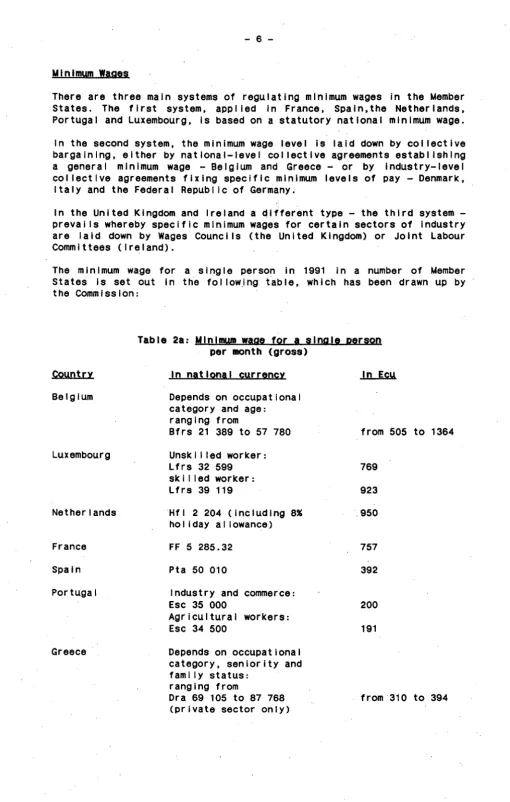
The minimum wage for a single person in 1991 in a number of Member States Is set out In the follow_ing table, which has been drawn up by the Commission:
CountrY Belgium Luxembourg Netherlands France Spain Portugal Greece
Table 2a: Minimum waae for a single person per month (gross)
In national currencY
Depends on occupational category and age:
ranging from
Bfrs 21 389 to 57 780
Unskl I led worker: Lfrs 32 599
skI lied worker: Lfrs 39 119
Hfl 2 204 (including 8%
hoI I day a I lowance)
FF 5 285.32
Pta 50 010
Industry and commerce: Esc 35 000
Agricultural workers: Esc 34 500
Depends on occupational category, seniority and fam I I y status:
ranging from
Ora 69 105 to 87 768
(private sector only)
In Ecu
from 505 to 1364
769 923 .950 757 392 200 191
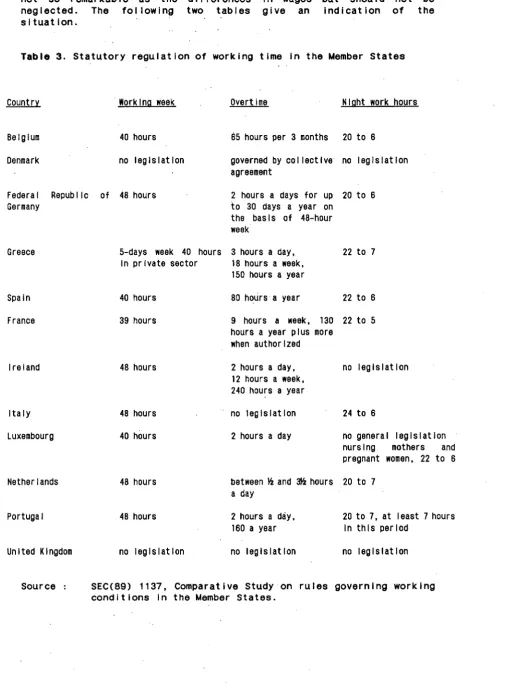
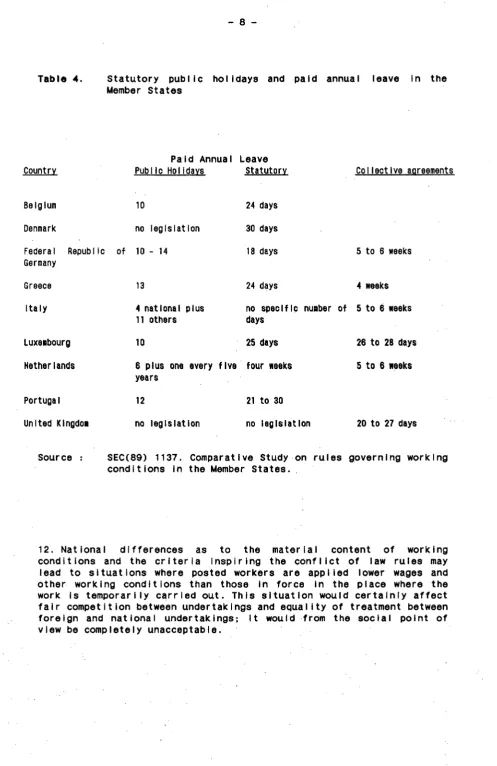
[image:6.595.38.548.30.832.2]The differences in other working conditions related to working time are not so remarkable as the differences in wages but should not be neglected. The following two tables give an Indication of the situation.
Table 3. Statutory regulation of working time In the Uember States
Country
Belgium
Denmark
Federal Repub lie Germany Greece Spain France Ireland Italy Luxembourg Netherlands Portugal
United Kingdom
Source
of
Working week overtime Night work hours
40 hours 65 hours per 3 months 20 to 6
no legislation governed by col lectlve· no legislation agreement
48 hours 2 hours a days for up 20 to 6 to 30 days a year on
the bas Is of 48-hour week
5-days week 40 hours 3 hours a day, 22 to 7
In private sector 18 hours a week, 150 hours a year
40 hours
39 hours
48 hours
48 hours
40 hours
48 hours
48 hours
no legislation
80 hoursa year 22 to 6
9 hours a week, 130 22 to 5 hours a year plus more
when authorized
2 hours a day, 12 hours a week, 240 hours a year
no legislation
2 hours a day
no legislation
24 to 6
no general legislation nursing mothers and pregnant women, 22 to 6
between ~ and ~ hours 20 to 7 a day
2 hours a day, 160 a year
no legislation
20 to 7, at least 7 hours In this period
no legislation
[image:7.594.45.562.106.794.2]Table 4.
Country
Belgium
Denmark
Statutory public hoi idays and paid annual leave In the Member States
Paid Annual Leave
Publ lc Holidays Statutory Col lectlve agreements
10 24 days
no legislation 30 days
Feder a I Repub lie of 10 - 14 Germany
18 days 5 to 6 weeks
Greece
Italy
Luxe1bourg
Netherlands
Portugal
United Klngdoa
Source
13
4 national plus 11 others
10
24 days 4 weeks
no spec If I c nu1be r of 5 to 6 weeks days
25 days 26 to 28 days
6 pI us one every f I ve four weeks years
5 to 6 weeks
12 21 to 30
no legislation no legislation 20 to 27 days
SEC(89) 1137. Comparative Study on rules governing working conditions In the Member States ..
[image:8.592.52.550.48.815.2]I 1. General legal framework and temoorarv postlngs
13. The criteria for determination of the law applicable to the employment contracts of workers posted abroad, which may favour, for example, the law chosen by the parties, the law of the place where the work is habitually carried out, or the law with which the contract has close connections, may vary from one State to another. Thus, the results differ according to the degree of distrust of those legal systems for the principle of freedom of choice in the determination of the applicable law or indeed according to the rigidity of the confl let of law rules of these systems : for example, the rigidity of the confl let r~les in Portugal as opposed to the flexibi I ity of the British system.
One point which is worth stressing is that it is difficult to achieve the completion of the internal market without unifying the conflict of . law rules. The disparity of national systems may in fact prove to be an
obstacle to the economic freedom envisaged by the Treaty.
14. With respect to the legal approach to the situation of temporarily~
seconded workers, the following instruments should be taken into account :
Council Regulation (EEC) No 1612(5) of 15 October 1968, the fourth recital of which expressly mentions workers "who pursue their
activitie~ for the purpose of providing services";
Council Directive 68/360/EEc<6> of 15 October 1968 on the abolition of restrictions on movement and residence for workers of Member States and their families within the Community, based on Article 49 of the EEC Treaty, which also covers the situation of
temporarily-seconded workers (Articles 6(3) and 8(1)(a));
Regulation (EEC) No 1408(7) of 19 June 1971 on the application of social security schemes to employed persons, to self-employed persons and to members of their fami I ies moving within the Community, which responds to the need to unify the rules of confl let of law. This Regulation lays down uniform rules for the appl icatlon of social' security legislation.
With respect to labour law, the following should be considered :
The Convent ion of Rome of 19 June 1980 on the law applicable to contractual obi igations<8>. Article 29 states that the convention wil 1 come into force in the international legal order and in those States who have rat if led it "on the fIrst· day of the third month following the deposit of.the seventh instrument of ratification, acceptance or app~oval" with the Secretary-General of the Council of the European Communities. An intergovernmental convention, the Convention of Rome received Its seventh ratification by the United Kingdom· on 29 January 1991. With this ratification, and with the accession of Greece to the Convention of Rome In 1988, It came Into force on 1 April 1991 and governs relations between those States
which have now deposited their Instruments of ratification (i.e. France, Italy, Denmark, Luxembourg, Greece, the Federal Republic of Germany, Belgium and the United Kingdom).
The proposal for an EEC Regulation presented to the Council on 23 March 1972 and the amended proposal presented to the Counci I on 28 April 1976. This proposal tried to introduce uniform conflict of law rules Into the Community as far as employment relationships with a foreign element were concerned. The existence and entry Into force of the Convention. of Rome, which also provides a general
legal framework for regulation of conflicts of law, prevented the adoption of this proposed Regulation In the future. In contrast, any proposal designed to deal with the particular position of seconded workers could be ·considered as an extension of the Rome Convention.
ILO Convention No 94 concerning labour clauses In public contracts, in particular Article 2, which determines the content of the clauses of such contracts. The Conveniton has been ratified by France, Spain, Italy, the Netherlands, Denmark and Belgium.
The specific nature of problems In relation to the provision of services can be seen in numerous judgments of the European Court of. JusticeC9>. In particular, the following sorts of questions have been raised : to what extent Is the freedom to provIde servIces subject to I imitations? (Case 270/80, John Webb); and, more recently, with respect to sub-contracting : can the conditions for hiring personnel in force in one Member State prevent a company situated in another Member State from offering services on the terrI tory of the former Member State? (Case C-113/89 Rush Portuguesa). Several general principles can be deduced from the case law of the Court :
The essential requirements of Article 59 of the Treaty became directly and unconditionally appl lcable on the expiry of the transitional periods.
These requirements abolish all discrimination by reason of nationality or place of establishment against the persons providing
the services.
The freedom to provide services is one of the fundamental principles of the Treaty and may be restricted only by provisions which are justified by the general good and Imposed on alI persons or undertakings operating in the Member States in which the service
is to be provided.
(9) CJ 3 December 1974 (Van Binsbergen 33/74) [1974] ECR 1309, para. 12; 24 October 1978 (Koestler 15/78) [1978] ECR 1975; 18 March 1980 (Debauve 52/79) [1980] ECR 833; 18 March 1980 (Coditel 62/79) [1980] ECR 881; 4 December 1986 (particularly "insurance", Commission v. FRG 20574) [1986] ECR 3765; 11 June 1987 (Bodin 241/86) [1987] ECR 2573 and others.
The principle of equality of treatment laid down in Article 60 of the Treaty of Rome does not mean that all national legislation applIcable to nationals of a Member State and usually appl led to the permanent activities of undertakings establ ished.thereln may be similarly applied in its entirety to the temporary activities of undertakings which are established in other States.
However, Community law does not preclude Member States from applying their legislation or col lectlve labour agreements entered Into by the social partners, relating to wages, working time and other matters, to any person who is employed, even temporarily, within their territ~ry, even though the employer is establ lshed in another State.
Whereas the activities of an undertaking providing services In another Member State are entirely or principally directed towards the terri tory of that Member State or have a permanent presence therein, that undertaking should not rely on the freedom guaranteed by Article 59 of the treaty tor the purpose of avoiding compliance
with the working conditions which would be applicable to it if established within that State.
The posting of Portuguese and Spanish workers to another Member State in the framework of the freedom to provide services is protected by Article 59 of the Treaty but is not covered (before 32.12.92) by Articles 1 to 6 of Counci I Regulation (EEC) No 1612/68 of 15 October 1968 relating to the free movement of workers within the Community. Workers seconded in the framework of a provision of manpower must be however provided with a work permit in as much as they are not Community nationals or they can not fully benefit from the free movement of workers.
15. The Convention of Rome is a necessary complement to the conventions relating to confl lets of jurisdiction, notably the Convention of Brussels of 27 September 1968 on jurisdiction and the enforcement of judgements in clvi I and commercial matters. The authors of a report<10) commissioned by the Commission of the European Communities have stated : "What Is the purpose of unifying the rules of judicial competence if the courts of each Member State continue to apply different laws? How is it possible to avoid forum shopping, If not by adding a new element to ·the unification of the European law of
jurisdiction : that of uniform rules 6n confl let of law".
16. Articles 6 and 7 of the Convention of Rome concern employment contracts. Article 6 lays down that, in the absence of a choice made by the parties, the contract of employment shall be governed :
by the law of the country in which the employee carries out his or her work In performance of the contract, even if he/she is temporarl ly employed in another country, or
If the employee does not habitually carry out his or her work in any one country, by the law of the country in which the place of business through which he/she was engaged is situated, or
If It appears from the circumstances as a whole that the contract of employment Is more closely connected with the law of another country, by the law of that country.
At any rate, "a choice of I aw made by the parties' sha II not have the result of depriving the employee of the protection afforded to him by the mandatory rules of the law which would be appl lcable in the absence of choice".
Article 7 of the Rome Convention does not provide any precise regulation; it provides for the application of mandatory rules, such as the public order rules of the forum State and .the mandatory rules of the law of another country with which the situation has a close connection. Article 7 does not however Indicate which rules are mandatory rules.
17. In order to Judge the expediency of the present propos a I for a Directive, It is necessary to measure what it offers over the Convention of Rome.
The conf I ict rules laid down by the Convent ion of Rome provide a general legal framework, whereas the proposed Directive Is specifically concerned with the situation of seconded workers and thus refines this legal framework.
The Convention I ays down genera I crIteria to determIning the I aw applicable and.- more importantly- enables the judge to make the contract subject to mandatory rules sometimes referred to as "directly applicable rules" applying at the place where the work is carried out (Article 7). Such immediately applicable rules are not Identified by the Convention of Rome. The proposal for a directive sets out to clarify this point by stipulating the body of rules covered by Article 7 of the Convention, I.e. the "public order rules" which constitute a hard core of minimum protect ion for workers on secondment.
The universal nature of the Convention of Rome adds to this general nature : the proposed Directive only applies to employment relationships temporarily carried out within the Community; the Convention of Rome applies to .all contractual relationships, whether or not they are carried out within the Community, as long as the matter is referred to a judge situated within the Community.
The proposa I for a DIrective, by 1 dent I fy 1 ng a "hard core" of mandatory rules, makes it clear that these constitute a minimum
threshold of protection only.
The Convention of Rome does not lay down conditions for the application of collective agreements containing mandatory provisions. The proposal for a Directive does.
are or will be contained In acts of the institutions of the European Communities or in national laws harmonlsed in implementation of such acts", Article 20· of the Convention of Rome recognises the supremacy of Community law.
18. Notwithstanding the entry into force of the Convention of Rome, the need for legal certainty and the need to eradicate discrimination between national and non-national undertakings and workers with respect to the application of certain working conditions, justify a Community proposal which, aiming at. clarifying Article 7 of the Rome Convention and with due respect for the principle of equality of treatment between national and non-national providers of services (Article 59, EEC Treaty) and between national and non-national workers (Article 7, EEC Regulation 1612), intends to create a hard core of mandatory rules laid down by statutes or by erga omnes collective agreements, without . disrupting the labour law systems of the Member States and particularly their legislative or voluntaristic approach and their collective bargaining systems.
I 11. Alms. Scope and material content of the proposal
19. The proposal for a Councl I Directive has the following objectives :
to remove obstacles and uncertainties which may impede the Implementation of the economic freedoms, particularly the free provision of services, by increasing legal certainty and allowing the clear Identification of the working conditions applicable to workers who carry out temporary work in a Member State other than the State whose law governs the employment relationship;
to coordinate the laws of the Member States with a view to setting up a list of mandatory rules which should be complied with in the host country by undertakings posting workers to perform temporary work. The proposal does not harmonize the material content of the rules classified as "mandatory" but identifies those rules making them compulsory for undertakings posting workers in a Member State other than the State in whIch they hab i tua 1 1 y work or where the establ lshment which engaged them is situated;
undertakings established therein, may be similarly appled in its entirety to the temporary activities of undertakings which are establ lshed in other Member States;
to protect the workers concerned from practices which may develop within the international framework of an Increasing use of external work and employment resources.
20. The proposal appl les to undertaKings which post a worker to carry out temporary work in a Member State other than the State, whether a Member State or otherwise, the law of which governs the employment
relationship.
21. According to Article 2 of the proposal, the undertakings covered by its scope must fal I within one of the fol towing three categories :
main contractor or subcontractors which, in the course of carrying out a contract for services, within the meaning of Article 60 of the Treaty, post a worker to carry out temporary work in the terri tory of a Member State on beha If and under the dIrect ion of that undertaking (the "Rush Portuguesa" situation);
temporary employment businesses which place a worker with a user undertaking operating in a Member State to carry out temporary work In so far as there is an employment relationship between the temporary remployment business and the worker (the "Seco" s I t ua t I on) ;
undertakings which place a worKer with one of their establ lshments or with another undertaking whether an associated undertaking or not. estab II shed In another Member State to carry out temporary work (intra-firm or intra-group mobi llty).
No distinction is made between workers is posted by a main contractor or by a subcontractor; nor is there a difference of treatment between undertakings posting workers in the framework of a public contract or a private one.
22. The three situations have a common element : a worker posted by an undertaking to carry out temporary work In a Member State other than the State the law of which governs the employment relationship concerned.
The Commission bel leves that the three above-mentioned cases should be
covered~ not only because they share a common problem relating to the
concerned would be deprived of the mandatory protection provided for by the Directive, had Article 2(c) been deleeted.
23. The combination and interdependance of Articles 1 and 2 makes it unnecessary to incorporate a I ist of exclusions such as commercial travellers, members of the travelling personnel of an undertaking which operates i nternat iona I transport services for passengers or goods by rail, road, air, internal waterway or by sea, and civil servants and eQuivalent personnel employed by public administrative bodies.
Material content
24. Article 3, which is the proposal's central provision, does not intend to harmonize the material rules of the Member States concerning labour law and working conditions, but to coordinate their conflcts of law rules in order to designate which mandatory rules in force in the host country must be re;;pected by an undertaking posting workers to carry out temporary work in that country. In that sense, this Is not a labour law instrument, but a proposal concerning international private law closely related to the freedom to provide services.
25. In drawing up the list of "hard core" protective working conditions to be observed by undertakings referred to in Articles 1 and 2, the Commission considered that a threefold reQuirement should be met :
the rules ought to be mandatory or compulsory In all, or the majority, of the Member States. That is the case with the provisions concerning the matters referred to In Article 3(b);
the rules ought to apply to all workers habitually employed in the same place, occupation and Industry. It would not be In conformity with Commun.l ty I aw to obI i ge a foreign provider of services to respect certain working conditions which are not binding on national or local undertakings. This reQuirement restricts the sources of law mentioned in Article 3(a) to "laws, regulations and administrative prov1s1ons, col lectlve agreements or arbitration awards which apply to the occupation and industry concerned to the extent that they cover.al I workers employed In the same occupation and industry".
the designation and application of the envisaged mandatory rules should be compatible with the temporary nature of the performance of work in the host country and consistent with the proposal's stated aims and objectives. In the 1 ight of this condition, mandatory rules concerning the form, suspension, alteration and termination of the contract of employment and workers' rights on information, consultation and participation are not delt with.
Legal basis
27. The Commission proposal Is based on Articles 57 (2) and 66 of the EEC Treaty In that they provide for "the coordination of the provisions·
laid down by law. regulation or adminstratlve action In Member States concerning the taking-up and pursuit of activities as self-employed persons" or as companies or firms formed In accordance with the law of a Member State and having their registered office. central administration or principal place of business within the Community.
In effect. the activities of the undertakings concerned consist of the provision of services. within the meanjng of Article 59 of the Treaty. effected by an undertaking In a Member State other than the State in which It is established.
The usual legal base for the coordination In the field of the provision of services Is Article 57, paragraph 2 to which Article 66 expressely
refers.
Proposal for a COUNCIL DIRECTIVE
concerning the posting of workers In the framework of the provision of services
THE COUNCIL OF THE EUROPEAN COMMUNITIES,
Having regard to the Treaty establishing the European Economic Community and, in particular Articles 57(2) and 66 thereof,
Having regard to the proposal from the Commission,(1)
In cooperation with the European Pari iament,C2)
Having regard to the opinion of the Economic and Social Committee,<3>
Whereas, pursuant to Article 3(c) of the Treaty, the abolition, as between Member States, of obstacles to freedom of movement for persons and services constitutes one of the objectives of the Community;
Whereas for the provision of services any restrictions based on nationality or residence requirements are prohibited under the Treaty with effect from the end of the transitional period;
Whereas the realization of the internal market offers a dynamic
environment for the provision of services and transnational subcontracting by inviting a growing number of undertakings to post their employees abroad temporarily to perform work on the territory of a State other than the State in which they are habitually employed;
Whereas the provision of services may take the form either of performance of work by the. provider of the service or the provision of manpower for use by an undertaking in the framework of a pub I ic or a private contract;
Whereas any such promotion of the transnational provision of services requires a climate of fair competition to exist which cannot be
attained without measures ensuring respect for the rights of workers;
Whereas the transnatlonallzatlon of the employment relationship raises problems with regard to the legislation applicable to the employment relationship and that It is in the best Interests of the parties to lay down the conditions governing the employment relationship envisaged;
Whereas Community I aw does not preclude Member States from app I y I ng . their legislation, or collective agreements entered Into by both sides
of industry to any person who Is employed, even temporarily, within
their territory, although his employer Is established In another Member State; whereas Community law does not forbid Member States to guarantee the respect of those rules by the appropriate means;
Whereas Counci I Directive 71/305/EEC of 26 July 1971 concerning the coordination of procedures for the award of public works contracts,{4) as last amended by Directive 89/440/EEc,<5) lays down strict rules on the verification of the aptitudes of bidders on the basis of their economic, financial or technical capacities;
Whereas Directive 89/440/EEC a~d Council Directive 90/531/EEC of 17 September 1990 on the procurement procedures of entitles operating in the water, energy, transport and telecommunications sectors,<6> Introduced a transparency clause whereby the contracting authority may provide tenderers with the necessary Information concerning working conditions appl.icable to the work envisaged;
Whereas ILO Convention 94 concerning social clauses In public contracts came into force on 2.0 September 1952;
Whereas the Convention on the law applicable to contractual obi igations opened for signature in Rome on 19 June 1980(7) by eight Member States
came into force on 1 April 1991 in those Member States;
Whereas its Article 3 establishes, as a general rule, the free choice of law made by the parties; whereas, in the absence of choice, the· contract shall be governed, according to Article 6(2), by the law of the country In which the employee habitually carries out his work in performance of the contract, even if he is temporarily employed in another country; or, if the employee does not habitually ·carry out his work in any one country, by the law of the country in which the place of business through which he was engaged is situated; unless it appears from the circumstances as a whole that the contract Is more closely
connected with another country, in which case the contract shall be governed by the law of that country;
Whereas, according to Article 6(1) of the said Convention, the choice of law made by the parties shal I not have the result of depriving the employees of the protection afforded to him by the mandatory rules of the law which would be applicable under paragraph 2 In the absence of choice;
Whereas, according to the principle of precedence of the Community law stated in its Article 20, the said Convention shall not affect the application of provisions which, In relation to a ·particular matter, lay down choice of law rules relating to contractual obi igatlons and which are or will be contained In acts of the Institutions of the European Communities or in national laws harmonized In implementation of such acts;
Whereas a minimal approximation of the labour laws of the Member States
has already taken place; whereas, however, there are stl II differences as to the social rights guaranteed by the national laws and the collective agreements In force;
Whereas, to this end, the laws of the Member States must be coordinated In order to lay down a nucleus of mandatory rules for minimum protect ion to be observed in the host country by employers who post workers to perform temporary work in the territory of a Member State where the services are provided;
Whereas the stability of employment relationships for short-term postings should not be hampered with respect to minimum rates of pay and minimum paid holidays; whereas there-fore an exception to certain provisions of the Directive should be provided for;
Whereas, however, a "hard core" of protective rules, clearly defined, should be observed by the provider of the services notwithstanding the duration of the worker's posting;
Whereas, to attain the alms and ob)ectlves_envisaged by this Directive, undertakings established outside the Community must be subject to the same "hard core" of protective rules with respect to their workers who carry out temporary work In the territory of a Member State;
Whereas this Directive Is without prejudice to national laws relative to the hiring out of workers, notably to the fUnctioning of temporary employment business, as well as to the entry, residence and employment of third country workers,
HAS ADOPTED THIS DIRECTIVE
Article 1
Article 2
This Directive appl les to the extent that an undertaking referred to in Art I c I e 1 :
(a) In the course of carrying·out a contract for work or services posts a worker to the territory of a Member State on behalf of and under the direction of that undertaking; or,
(b) being a temporary employment business places a worker with a user undertaking established or having a place of business in a Member State, In so far as there is an employment relationship between the temporary employment business and the worker during the period of posting; or,
(c) places a worker with one of its establishments, or with another undertaking located In a Member State, In so far as there Is an employment relationship between the former undertaking and the worker during the period of posting.
Article 3
1. Member States shall see to It that, whatever the law applicable to the employment relationship, the undertaking does not deprive the worker of the terms and conditions of employment which apply for work of the same character at the place where the work Is temporarily carried out, provided that :
(a) they are laid down by laws, regulations and administrative provisions, collective agreements or arbitration awards,
covering the whole of the occupation and industry concerned having an "erga omnes" effect and/or being made legally binding
(b) they concern the following matters :
(I} maximum dally and weekly hours of work, rest periods, work on Sundays and night work;
(I I}
(Ill)
(IV)
minimum paid holidays;
the minimum rates of pay, Including overtime rates and allowances, but excluding benefits provided for by private occupational schemes;
the conditions of hiring out of workers, In particular the supply of workers by temporary employment
businesses;
(V) health, safety and hygiene at work;
(vi} protective measures with regard to the working conditions of pregnant women or women who have recently given birth, children, young people and other groups
~njoylng special protection;
(vii} equality of treatment between men and women and prohibition of discrimination on the grounds of colour, race, religion, opinions, national origin or social background.
2. Paragraphs 1{b)(ll) and (Ill) shall not apply to employment relationships referred to In Article 2 when the length of the posting of the workers Is less than three months, within a reference period of one year from the beginning of the posting. In calculat lng the three month per lod, account should be taken of
any previous periods for which the post has been filled by a posted worker.
Article 4
Member States shal I bring Into force the laws, regulations and adminlstrat lve provisions necessary to comply with this Direct lve by 31 December 1992 at the latest. They shall Immediately Inform the Commission thereof.
When Member States adopt these provisions, these· shal I contain a reference to this Directive, or shall be accompanied by such reference at the time of their official publ lcatlon. The procedure for such reference shall be adopted by Member States.
Article 5
This Directive Is addressed to the Member States.
Done at Brussels, For the Council
24
-IMPACT ASSESSMENT FQBM
IMPACT OF THE PROPOSAL ON UNDERTAKINGS
WITH PARTICULAR REFERENCE TO SMALL AND MEDIUM-SIZED ENTERPRISES (SUEs)
Proposal for a Council Directive concerning the posting of workers In the framework of the provision of services
The proPosal
1. Taking account of the principle of subsidiarity, why Is Community · legislation necessary In this field and what are the main alms? ·
The proposal for a Directive alms to coordinate the laws of the Uember States with a view to establ lshlng a "hard core" of binding rules to be observed by undertakIngs whIch post theIr workers to another Uember State, generally termed the host country.
Such coordination, by Its very nature. cannot be achieved by Uember States acting Individually, and thus falls primarily within the Community's sphere of competence.
The Identification of binding provisions for minimum protection In force In the host country will counteract the legal uncertainty which surrounds the whole issue of posting abroad, the purpose baing to create conditions of fair competition between undertakings and to meet the needs of the workers.
The ImPact on undertakings
2. Who wll I be affected by the proposal?
By speciflcal ly aiming to cover situations In which suppl lers of services move with their employees to a Member State outside their country of origin, the proposal for a Directive directly targets a
large number of SUEs to which such situations apply.
As there Is clearly a structural link between the construction Industry and the posting of employees, undertakings In this sector will be specifically targeted by the proposal for a Directive.
However, promotion of the provision of services in a widening variety of sectors calls for the scope of the proposal for a Directive to be extended to cover all areas of employment.
3. What wl II undertakings have to do to comply with the proposal?
Where such provisions are the result of collective bargaining agreements or of arbItrators' awards "In force wIthIn the trade or industrial sector concerned", they must cover "alI the workers employed In the same trade and sector".
4. What economic effects Is the proposal likely to have?
on employment
The Identification of mandatory protective rules applicable to posted workers should remove some of the uncertainty surrounding the mobility of employment relationships which, given the present lack of clarity, Is not geared to providing satisfactory conditions for posting workers in the context of the completion of the Internal market. The proposal for a Directive Is designed to provide a more transparent legal framework for externallslng employment relationships and thus to ·promote the mobility element In the employment of such workers;
on Investment and the creation of new businesses
New businesses especially those in the service sector, will need to take account of the new code of practice laid down by the proposal for a Directive, whose rules will provide the necessary legal framework for setting up and developing such businesses In the light of the completion of the Single Market;
on the competitiveness of undertakings
By aiming to reduce differences In the costs of employing labour arising from existing disparities between national social laws, the proposa I for a DIrective is Intended to I ay down ground ru I es for undertakings. Although such rules may Increase the social costs of certain undertakings, they are nevertheless necessary for creating conditions of fair competition between undertakings.
5. Does the proposal contain measures to take account of the specific situation of smal I and medium-sized enterprises (reduced or different reQuirements, etc.)?
Consul tat ion
A. With emploYers and trade unions:
11.09.90 18.10.90 08.05.91
UNICE/CEEP - ETUC UNICE/CEEP - ETUC UNICE/CEEP - ETUC
22.10.90 TransPort: ra I I
road sea
Inland navigation civil av!at ion Fisheries
5.11.90 · Agriculture
HORECA (lnternat tonal Organlaat Jon of Hotel and Restaurant Associations)
Jww:.
9.11.90 Text lies
Footwear
12.11
.eo
bDU.8.5.91
8.5.91
Insurance Beta II trade Wboleaale·trade Telecom
construction- trade unions - employers
e.
With lndlytdual organisationsC.~.!. (France) (General Confederation of Labour)
CEC <European Confederation of Professional Staff) Consultation of employers' organisations by DG XXIII:
· Organisations consulted:
AECM (Association Europeenne des Classes Moyennes> Eurochambre
Eurogroup
UEAPUE (Union of Crafts and SUEs) UNICE (Union of Industries of the EC)
CECOP (European Committee of Workers' Production Cooperatives)
EUROPUI (European Committee for Small and Uedlum-Sized
Independent Enterprises)
EUSU (Union Europeenne des Classes Moyennes) CECD (European Retail Trade Confederation>
FEWITA (Federation of European Wholesale and International ·Trade Associations)
- CEDI (European Documentation and Information Centre)
CCACC (COm. Coord. des Associations des Cooperatives de Ia eommunaute Europeenne)
COM(91) 230 final
DOCUMENTS
EN
04
Catalogue number: CB-C0-91-323-EN-C
Office