Rochester Institute of Technology
RIT Scholar Works
Theses
Thesis/Dissertation Collections
2003
Effective and economical development and
implementation of environmental performance
evaluation in small and medium size enterprises
Hyunkee Bae
Follow this and additional works at:
http://scholarworks.rit.edu/theses
This Thesis is brought to you for free and open access by the Thesis/Dissertation Collections at RIT Scholar Works. It has been accepted for inclusion
in Theses by an authorized administrator of RIT Scholar Works. For more information, please contact
.
Recommended Citation
Rochester Institute of Technology
Effective and Economical Development and Implementation of
Environmental Perfonnance Evaluation in Small and Medium Size
Enterprises
By Hyunkee Bae
May 15,2003
Graduate Thesis submitted in partial fulfillment of the requirements for the degree of
Master of Science in Environmental, Health
&
Safety Management
Department of Civil Engineering Technology
Environmental Management
&
Safety
Rochester Institute of Technology
Rochester, NY
Approved by:
s.f.
16.03
REPRODUCTION PERMISSION STATEMENT
Effective and Economical Development and Implementation of
Environmental Performance Evaluation in Small and Medium Size
Enterprises
By Hyunkee Bae
I, "Hyunkee Bae" hereby grant permission to the Wallace Library of the Rochester
Institute of Technology to reproduce my thesis in whole or in part. Any reproduction will
not be for commercial use or profit. In addition, if the reader obtains any assistance from
this volume, he or she must give proper credit in his or her own work.
Signature:
, Date:
,
' r
::?
ACKNOWLEDGEMENTS
I
wouldlike
to
thank
Professors
John
Morelli,
Joseph M
Rosenbeck,
Jennifer
L
Schneider,
andMaureen Valentine. From
the
start yougenerously
shared ahuge
amountofwisdomand encouragement
based
on youryearsofexperience.Throughout
the
courseof
my
studies you coached meby
providing important
critical andtechnical
feedback
to
help
me succeed.Without
your guidancethis thesis
could nothave been
completed.I
wouldlike
to thank the
following
peoplefor
their
support,
especially in
the
form
ofprayers,
patience,
proof-reading
(of
course,
any
remaining
errors areentirely my
responsibility),
letters
ofrecommendation,
cheer-leading,
andfor just
being
goodexamples
to
emulate:Mom
andDad;
two
sisters andbrothers-in-law;
Korean Christian
Fellowship
club; my church;
andfriends Suck
Jung,
Sooyeon Jung. Without
yourlove I
Table
of
Contents
Reproduction Permission
Statement
ii
Acknowledgements
iii
Table
ofContents
iv
List
ofTables
viiList
ofFigures
viiiList
ofAppendix
ix
ABSTRACT
xCHAPTER 1 INTRODUCTION
1
1.1 Objectives
ofthe
Study
1
1.2 Significant
ofthe
Study
1
1.3 Limitation
ofTerms
2
1.4 Definitions
ofSmall
andMedium
sizeEnterprise
.21.5 Definition
ofTerms
4
CHAPTER 2 BACKGROUND
6
2.1 The
needfor Environmental Performance Evaluation
....62.2
History
ofEnvironmental Performance
Evaluation
6
2.3 Environmental Performance Evaluation in Various
Industry
Fields
7
CHAPTER 3 LITERATURE REVIEW
1 1
3.1 Overview
ofEnvironmental Performance
Evaluation
(EPE)
11
3.2 The Effects
ofPerformance Evaluation
1
1
3.3 The
Relationship
ofEPE
withEnvironmental
Management System
12
3.4 ISO
14031,
Environmental
Performance Evaluation
13
3.5
Methodology, Procedures,
andTechnology
to
Implement
EPE
14
3.5.1
Preliminary
activitiesandplaning
14
3.5.2 Review
anduse ofexisting information
16
3.5.3 Selection
ofindicators
andmetrics16
3.5.3.1 Characteristics
ofindicators
17
3.5.5 Collection
of environmentalperformancedata
26
3.5.5.1 Available
sources ofdata
26
3.5.6 Interpretation
andEvaluation
ofdata
27
3.5.6.1 Initial
evaluation ofdata
28
3.5.6.2 Mathematical
and statistical evaluation28
3.5.6.3
Reaching
interpretation
and evaluation29
3.5.7
Reports,
Records,
Documents,
andCommunication
ofthe
results ofEPE
29
3.5.7.1 General
characteristic30
3.5.7.2 Content
31
3.6 Environmental Performance
to
Small
andMedium
seizedEnterprises
31
3.7 Regulation
andLaws Related
to
EPE
34
3.8 Literature Review Conclusion
35
CHAPTER 4 METHODOLOGY
37
4.1 Description
ofMethodology
37
4.2 Procedures
38
4.3 Data Collection
38
4.3.1 Case Studies
38
4.3.2 Data Collection
39
4.3.3 Various
Management
Performance Evaluation Standards
39
4.4
Analysis, Interpretation,
andReport
40
CHAPTER
5
ANALYSIS
AND RESULTS
41
5.1
Environmental
Performance Reports in
severalIndustrial Fields
42
5.2 Characteristic
ofEPIs in
severalIndustrial
Groups Procedures
50
5.2.1
Management Performance Indicators
(MPIs)
50
5.2.1.1
The Most Useful
andLeast Useful Indicators
51
5.2.1.2 MPIs in Particular
Industry
Groups
57
5.3 Operation Performance Indicators
(OPIs)
66
5.3.1 OPIs in Particular
Industry
Groups
69
5.4
Environmental
Condition Indicators
(ECIs)
76
6.1.1 Economic Performance Indicators
81
6.1.2
Environmental
Performance Indicators
81
6.1.3 Social Performance Indicators
82
6.1.4
Applying
the
GRI Guidelines in Small
andMedium
sizeEnterprises
(SMEs)
85
6.2 GEMI (Global Environmental Management
Initiative)
87
6.2.1
Applying
the
ESAP
in Small
andMedium
sizeEnterprises
(SMEs)
90
6.3
INEM (International Network for
environmentalManagement)
91
6.3.1 Social Performance
92
6.3.2 Environmental Performance
93
6.3.3 Economic Performance
93
6.3.4
Applying
the
INEM
guidein SMEs
95
6.4 Appropriate Application
ofEnvironmental Performance
Evaluation
in SMEs
96
6.4.1 The Need
ofEnvironmental
Management System
96
6.4.2
Selecting
Management Performance Indicators
(MPIs)
98
6.4.3
Selecting
Operational Performance Indicators
(OPIs)
98
6.4.3 1.
Eco-efficiency
for Operational Performance Indicators
101
6.4.4 Type
ofIndustries
in SMEs
102
CHAPTER 7
CONCLUSION
104
7.1
Implementing
EPE
andRelationship
between EMS
andEPE
in SMEs
105
7.1.1
Implementing
in SMEs
withEnvironmental Management
System
105
7.1.2
Implementing
EPE
in SMEs
withoutEnvironmental
Management System
106
7.1.2.1 Plan
106
7.1.2.2 Do
108
7.1.2.3 Check
109
7.1.2.4
Act
109
7.2
Selecting
Environmental Performance Indicators in SMEs
109
7.2.1 Management Performance Indicators
(MPIs)
in SMEs
113
7.2.2
Operational
Performance Indicators
Implementing
in SMEs
114
7.3.
Implementing
EPE
in
severalIndustries
ofSME
116
List
of
Tables
1. Management Performance Indicatiors
(MPIs)
21
2. Operational Performance Indicators
(OPIs)
22
3. Environmental Condition Indicators
(ECIs)
24
4. EPE Content
for
Different
Audiences
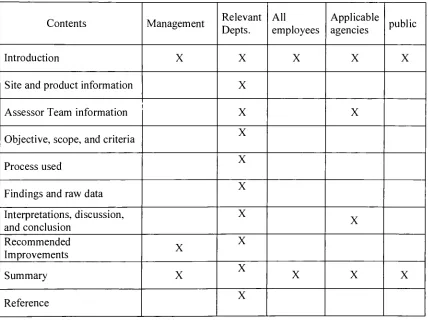
31
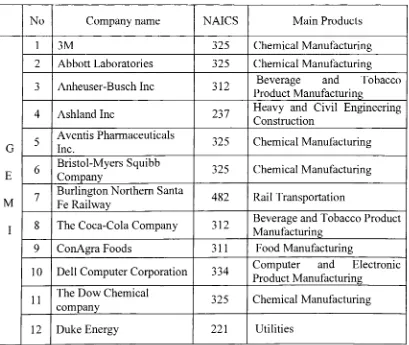
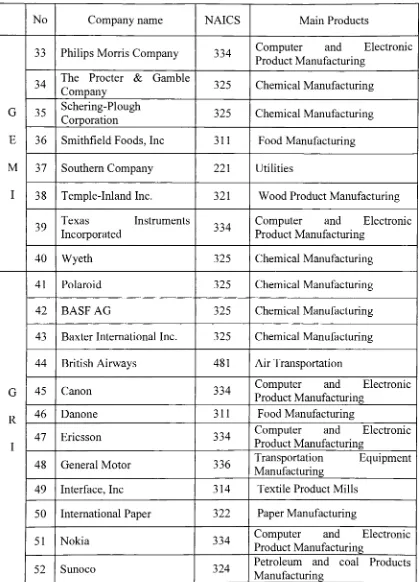
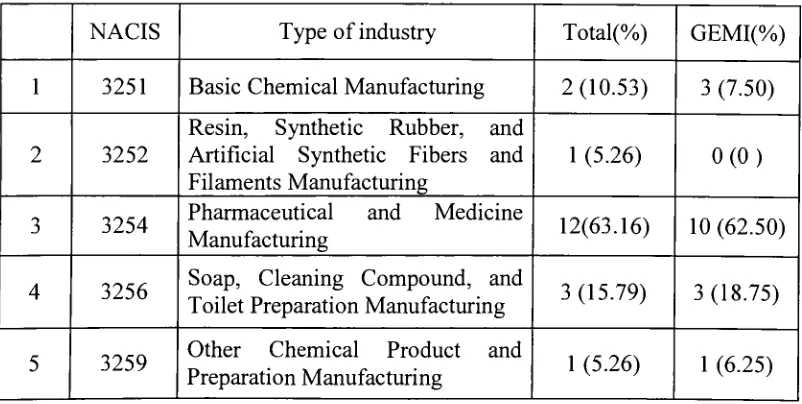
5. NACIS Code
ofSample Companies
43
6. The Distribution
ofIndustries Field
Reporting
Environmental Performance
47
7. The Distribution
ofChemical Industries
Reporting
Environmental Performance
48
8. Management Performance Indicators
(MPIs)
ofthe
Sample Companies
52
9. The Most
usefulFive MPIs among Samples
55
10. The Five lowest MPIs among Smaples
56
11. The List
andResults
ofOperational Performance Indicators
(OPIs)
Surveyed
67
12. The Present
ofECIs in Profit
andIndividual Companies
77
13. Examples
ofEconomic, Environmental,
andSocial Performance
in
the
GRI Guidelines
....83
List
of
Figures
1.
Environmental Performance Evaluation Procedures
15
2. The
Distribution
ofCode
ofNACIS
in
Sample Companies
48
3. The Distribution
ofNACIS
codesin Chemical
Industry
49
4. Type
ofBusiness
49
5. The
distribution
ofMPIs
ofthe
sampledCompanies
54
6. The Management Performance Indicators
(MPIs)
in Utilities
Industry
58
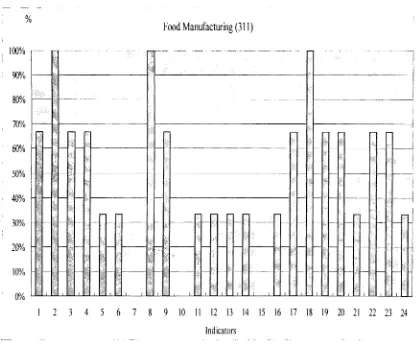
7. The Management Performance Indicators
(MPIs)
in Food
Manufacturing
59
8. The Management Performance Indicators
(MPIs)
in Beverage
andTobacco Product
Manufacturing
60
9. The Management Performance Indicators
(MPIs)
in Petroleum
andCoal Products
Manufacturing
61
10. The Management Performance Indicators
(MPIs)
in Chemical
Manufacturing
63
1 1
.The Management Performance Indicators
(MPIs)
in Computer
andElectronic Product
Manufacturing
65
12. The distribution
ofOperation Performance Indicators
(OPIs)
68
13.
Operational Performance Indicators
(OPIs)
in Utilities
Inductry
70
14.
Operational Performance Indicators
(OPIs)
in Food
Manufacturing
70
15.
Operational Performance Indicators
(OPIs)
in Beverage
andTobacco Product
Manufacturing
72
16.
Operational Performance Indicators
(OPIs)
in Petroleum
andCoal Products
Manufacturing
73
17.
Operational Performance Indicators
(OPIs)
in Chemical
Manufacturing Industry
74
18.
Operational Performance Indicators
(OPIs)
in Computer
andElectronic Product
Manufacturing
Industry
...7619. The
trend
ofECIs
in Each Main
Industry
78
20. The Flow
to
Evaluate Data
to
Determine Indicators
99
21. The
Plan-Do-Check-Act Cycle
List
of
Appendix
1. Several Definitions
ofSmall
andMedium
sizeEnterprises
(SMEs)
124
ABSTRACT
Nowadays,
diverse
interested
parties-non-governmental organizations
(NGOs),
regulators,
investors,
customers,
and otherstakeholders aredemanding
more meaningfulinformation
aboutorganizations'
environmental performances.
Regardless
of whether ornot
many
companieshave
a certifiedEnvironmental Management System
(EMS)
in-place,
they
arebecoming increasingly
interested
in
Environmental
Performance
Evaluation
(EPE)
as an effectivedecision-making
tool
for managing
the
environmental aspects oftheir
activities,
products and services.While large
companieshave
createddiverse
procedures,
methods,
and criteriadepending
on each organization's uniquesituation,
Small
and medium sizeEnterprises
(SMEs)
typically
do
nothave
enough resourcesto
create anddevelop
the
evaluationprocedures, criteria,
andindicators
by
themselves.
Accordingly,
mostSMEs
aroundthe
world notonly
do
notactively carry
out environmental performance evaluationslike large
enterprises,
but
alsodo
not establish environmental management systems.This
paper willhelp
SMEs
to
identify
anddevelop
economical methodologies and systemsfor
effectively
evaluating
environmental performance andto
develop
appropriateenvironmental performance
indicators. In
orderto
completethese
objectives,
severalEnvironmental Performance Evaluation
systems such asthe
Global
Reporting
Initiative
(GRI) Sustainability Reporting Guidelines,
the
Environmental Self-Assessment Program
ofthe
Global Environmental Management
Initiative
(GEMI),
the
International Network
for Environmental Management
(INEM)
Sustainability
Reporting Guide,
andISO
14031,
are compared and researchedto
identify
and perform appropriate environmentalperformance evaluation and
diverse
environmental performanceindicators
whichSMEs
can
implement.
Among
1 5
industry
groupsparticipatedin
this
survey, the
sixindustry
groups,
Utilities,
Food
Manufacturing,
Beverage
andTobacco Product
Manufacturing,
Petroleum
andCoal
Products
Manufacturing,
Chemical
Manufacturing,
Computer
andElectronic
Product
Manufacturing
industries
areactively
assessing
andreporting
their
environmental
establishing
andimplementing
anEMS,
like ISO 14001
andEPE,
because it
will assistthem
in gathering
relevantinformation
andassessing
their
respectiveperformance.Although
an organizationis
a small or mediumenterprise,
it
should notonly
considerfollowing
the
trend
of environmental management systemsin
useby
many
companiesin
around
the world,
but
alsotry
to
promote sustainabledevelopment
by
evaluating
their
performancemanaging business
aspects as well as environmental aspects.To fulfill
effective and substantial performance evaluation
in
SMEs,
they
shouldhave
systematicand
functional
management elementsin
place such as organizational structures and assignment of responsibilities.The P-D-C-A
cycle andEMS
like ISO 14001
willhelp
them to
effectively
evaluatetheir
environmental performance.Since SMEs
may
nothave
enough resources andcapability
to
evaluate and analyzetheir
performance,
they
should select anduse comparative simpletype
ofindicators
such asManagement Performance Indicators
(MPIs)
andOperational Performance Indicators
(OPIs)
according
to
ISO 14031
ratherthan
economic and social performanceindicators in
terms
ofthe
GRI
andINEM.
SMEs
can receive severalbenefits if
they
use effective and substantial environmentalperformance;
determine any necessary
actionsto
accomplishits
environmental performanceindicator;
identify
significant environmentalaspects;
identify
opportunitiesfor
better
management ofits
environmentalaspects;
identify
trends
in
its
environmentalperformance;
saving
environmental coststhrough
increasing
the
organizationefficiency
effectiveness;////ln rapid competitive globalmarkets, the
values ofcompanies'
environmental activities
have swiftly
andwidely
been
increasing
as significant economical and socialdimensions
aswellasenvironmentaldimension.
Accordingly,
SMEs
should response andfollow
the
globaltrends
and needs onenvironmentally
friendly
activities such as environmental management system andenvironmentalperformance evaluation so
that
they
continuously
develop
and survivein swiftly
powerfully
competitive global markets.Key
Words:
environmentalperformance;
Environmental
Management
System
(EMS);
Environmental
Performance Evaluation
(EPE);
decision-making;
environmentalaspects; Small
andMedium
sizeEnterprises
(SMEs);
criteria;
indicators;
economicalmethodologies;
system performanceindicators;
Global
Reporting
Initiative
(GRI);
sustainability;
reporting
environmental self-assessmentprogram;
Global Environmental Management
Initiative(GEMI)
International
Network
for
Environmental Management
(INEM);
ISO
14031;
identify;
develop
evaluate;
industries;
sustainabledevelopment;
P-D-C-A
cycle;
Management
Performance
1.0 Introduction
1.1
Objective
ofthe
Study
The
objectives ofthis
study
areto:
Identify
anddevelop
economical methodologies and systemsfor
effectively
evaluating
environmental performancein
small and medium size enterprises(SMEs)
involved
in
variousindustrial
categoriesincluding
electronicsmanufacturing,
telecommunications,
oil and gasindustry,
and powergeneration;
Develop
appropriate environmental performanceindicators for
eachcategory;
andDemonstrate
that
environmental performance evaluation canbe
usedto
help
SMEs
movetoward their
environmental goals.1.2
Significance
ofthe
Study
Recently,
many
forward-thinking
firms
andthe
public arepaying
more attentionto the
needto
better
manage environmentalimpacts,
such as greenhouse gasemissions,
bioaccumulation
oftoxic chemicals,
ozonedepletion.
They
also wantto
utilize and reportthe
outcomes ofmanaging
suchimpacts.
At
the
sametime,
diverse interested
parties-non-governmental organizations
(NGOs),
regulators,investors,
customers,
and other stakeholders aredemanding
more meaningfulinformation
about environmental performances andtrying
to
share a commoninterest
in
environmental performancein
spite ofthe
fact
that
no agreementhas
emerged onhow
to
measureit
and whatkinds
of criteria or standards areto
be
used.Environmental
Management
System,
such asISO
14001
andEco-Management
andAuditing
Scheme
(EMAS)
have been
implemented
in many
companies aroundthe
world since1996
for
ISO
14001.
Regardless
of whether or notthey
have
a certifiedEMS
in-place,
many
companies arebecoming
increasingly
interested
in
EPE
as an effectivedecision-making
tool
for
managing
the
environmental aspects oftheir activities,
products and services.However,
existing EMS
standards,
like
ISO
14001,
do
notToday,
aftermany large
companieshave implemented
EMSs,
most ofthem
have
tried
to
disclose
their
environmental performance reportsannually
in
orderto
usethe
results ofthe
environmental performance
for
business
strategies.However,
their
performance reportsmay
notbe
verified and comparableto those
of other organizationsbecause
the tools
they
usemay
be
very
subjective anddifferent.
Therefore,
setting
standards orindicators
to
verify
and compare environmental performance evaluationsamong
companiesmay
be
needed.Such
standards andindications
canhelp
the
publicto
understand whatthe
companiesdo,
how
much and what pollutionthey
generate,
andhow
muchtheir
environmentalquality
canimprove.
Many
companieshave
considered andincluded
environmental elements and performanceindicators
as considerationsfor business
decision making
sincethey
establishedtheir
EMSs.
Unfortunately,
there
is
nogenerally
accepted agreement onhow
to
measure environmental performance.Given
that
good environmental performanceis
nowhigh
onthe
agenda ofmany
firms,
the
lack
ofcomparable andcommonly
acceptedindicators is
a major obstacleto
continued progress.1.3
Limitation
ofthe
Study
The
scope ofthis
study
willbe
limited
to:?
General
procedures and methodsidentified in ISO 14031 Environmental
Performance
Evaluation
Guidelines;
and?
Various
types
of environmental performanceindictors
depending
on characteristic ofthe
organizations examinedin
this
study.It
will not:?
Be limited
to
only
organizationswithestablishedEMSs.
?
Verify
the
data
collectedfrom
organizationsexaminedin
this
study.?
Identify
the
effects of anEPE
reportin
public1.4 Definitions
ofSmall
andMedium
sizeEnterprises
There
aredifferent
definitions
of small and medium size enterprises(SMEs)
varying
according
to
objective andfields
ofstudy (see Appendix 1). The European Union
(EU)
defines SMEs based
>
less
than
250
employees and either>
an annualturnover
notexceeding 40
millionECU
or>
an annualbalance
sheettotal
notexceeding
27
millionECU,
and>
independent
enterprises,
i.e.
25%
or more ofthe
capital orvoting
right cannotbe
ownedby
alarger
enterprise"
(Ruth
Hillary,
1999)
There is
inconsistency
in
the
way SMEs
aredefined
among
the
studies carried outin
the
EU
eventhough the
EU
has
suchdefinitions
ofSMEs.
The European
Commission DG
XXIII
andOrganization
for
Economic
Co-operation
andDevelopment's
(OECD) Working Body
for SMEs define SMEs
asthe
following
size-classesbased
on employee numbers
>
micro-sized enterprise:1
~9
>
small-sized enterprise:10
~99
'r-medium-sized enterprise:
100
-499>
large-sized
enterprise:>500
SMEs
aredefined
as enterprises withless
than
500
employeesin
Case
Studies
in
Environmental
Management
performedby
The
International
Network
for
Environmental
Management
(INEM, http://www.inem.org),
the
worldfederation
of non-profit environmentalmanagement associations and cleanerproductioncenters.
The
other example ofdefinition
ofSMEs
is
that
SMEs
aredefined
by
the
International Organization
for Standardization
(ISO)
as companieswith
less
than
500
employees.(Poul BuchJensen, 1998,
http://www.inem.org/htdocs/iso/iensen-sme.html)
The
most common criterion usedto
define SMEs in
most studies relatedto
environmental casestudies as well as
business
case studiesis
the
number of employeesbecause it is
one ofthe
mostFor
this
research, I
have defined
SMEs
as enterpriseswithless
than
500
employees.I
think
the
threshold
of500
employeesis
properfor
wide application ofEPE;
comparison ofperformanceamong
severalenterprises;
andbeing
usedasthe
definition
ofSMEs in diverse
environmentalcasestudies.
It
shouldbe
noted,
however,
that
somecompanies onthe
high
end ofthis
scalemay
exhibitcharacteristics of
larger
companies.1.5
Definitions
ofterms
Indicator,
abasic
andimportant
part ofthe
EPE
process.This is
a verbaldescription
of some measurable environmental aspect or relatedfactor
to
be
assessed.Indicator
is
a generalterm that
refers
to
alltypes
ofindicators in
the management, operation,
and state ofthe
environmental systems.(ISO
14031,
W.LEE
KUHRE)
ISO 14001: Environmental Management Systems
-Specification
with guidancefor
use(ISO)
ISO
14031-Environmental
Performance
Evaluation:
a guideline and not a requirement of certification.(ISO)
Eco-Management
andAuditing
Scheme (EMAS):
A European community
schemeallowing
voluntary
participationby
companiesperforming industrial
activities,
establishedfor
the
evaluation andimprovement
ofthe
environmental performanceofindustrial
activities andthe
provision ofthe
relevantinformation
to
the
public.(Source:
Adapted
from:
European
Commission.
http://europa.eu.int/comm/environment/emas/emas_reg_en.htm)
Environment:
surroundingsin
which an organizationoperates,
including
air, water,
land,
naturalresources,
flora, fauna, humans,
andtheir
interrelation(ISO
14031)
Environmental Aspect:
Element
of an organization'sactivities,
products or servicesthat
caninteract
withthe
environment(ISO
14031)
Environmental
Performance Evaluation
(EPE):
Process
to
facilitate
managementdecisions
regarding
an organization's environmental performanceby
selecting
indicators,
collecting
andanalyzing
data,
assessing
information
against environmental performancecriteria,
reporting
andcommunicating,
andperiodically reviewing
andimproving
this
process.(ISO)
Environmental
performance:results of an organization's management ofits
environmental aspects(ISO
14031)
Environmental Condition
indicator (ECI): Specific
expressionthat
providesinformation
aboutthe
local,
regional,
national or global conditionofthe
environment(ISO
14031)
Environmental Impact:
Any
changeto the environment,
whetheradverse orbeneficial,
wholly
orpartially
resulting from
anorganization'sactivities,
products or services(ISO
14001)
Environmental
Performance Indicator (EPI):
Specific
expressionthat
providesinformation
aboutan organizations environmental performance
(ISO
14031)
Environmental Indicators (Els):
the
indicators for
the
state ofthe
environmentalOperational
performanceindicator (OPI): Environmental
performanceindicator
that
providesinformation
aboutthe
environmental performance of an organization's operationsManagement
performanceindicator (MPI): Environmental
performanceindicator
that
providesinformation
aboutthe
management effortsto
influence
an organization's environmental2.0
Background
2.1 The
needfor
anEnvironmental
Performance
Evaluation
(EPE)
EPE
is
away
to
measurethe
outcomes of an organization's management ofthe
environmental aspects of
its
activities, services,
and products sothat the
organization canidentify
and accomplishits
sustainabledevelopment
andinnovation
goals.For
an organizationthat
wishesto
have environmentally
friendly
activities,
services on a continuousbasis,
andproducts,
EPE
ofthe
mostimportant
and/or variable environmentalfactors
may
be
the
most cost-effective approach.The
characteristicsofan environmental performance evaluationinclude
the
following:
EPE
can provide management methodologies or processesfor
encouraging
an organizationto
measure andimprove
environmental performanceon a continuousbasis.
The
overallEPE
process cansupply
an organization with a meansto
procure and assemblereliable and verifiable
information
that
they
can reportto
interested
parties such asstakeholders,
NGOs,
government, customers,
investigators,
andinternal
customers.EPE
process can give an organization anopportunity
to
improve its
environmental aspectsand
impacts
andto
communicate environmentalinformation.
EPE
caninstigate
the
organizationto
identify
opportunitiesfor
the
prevention of pollutionand
help identify
strategicbusiness
opportunities..
EPE
can provide substantial and efficient environmentalindexes
orindicators
that
canbe
integrated into
performance evaluation ofbusiness
strategic andcompany
facilities.
EPE
can providethe
principal elementsto
make regular environmental performance reports.If
an organization wantsto
disclose
environmental performance reportsregularly,
the
organization should
have
explicit and objectiveindictors,
which will appearin
anEPE
report and willbe
recognizableby
interested
parties.EPE
can provide an organization with a performance evaluation systemfor
its
environmental
activities,
services,
or productsthat
canbe
assessed andintegrated into
business
and economic values..
EPE
can encourage small and medium size enterprisesto
acknowledgethe
needto
establishand
implement
an effective and properEnvironmental Management
System,
to
understand.fulfill,
and accomplish economic andbeneficial EPE
in
small and mediumenterprises.the
U.S
wasimproved
to
usethe
systematic environmentalimpact
assessmentprocesses,
whichhave
alot
ofapplicationto
EPE. In
1970s,
environmentalindices
were usedto
survey
travel
zones and air pollutionmodeling
results(Horowitz,
1995). Even
though this
was not referredto
asEPE,
it
embodied some of
EPE
concepts.An
environmentalindex
system was createdin
the
U.K.
from
1980
to
1988.
This
systemincluded
objective environmentalindicators
and opinion poll results usedto
influence
indicators
into
an aggregateindex
(Hope,
1922).
This
was one ofthe
first
reported attemptsto
gather environmentalindicators.
By
the
end ofthe
1980s,
riskassessments,
such ashealth
and ecological riskassessments,
began
to
be
popularly
used.Ecological
risk assessments are meaningfultools
applicableto
EPE.
Environmental
impacts
assessments relevantto
EPE
were proposedby
many
countriesby
the
beginning
ofthe
1990s. A study
to
appraisethe
financial
resources associated withthe
conceptionof sustainable
developments,
which are relatedto
EPE,
was conductedby
the
World Bank. The
study brought forth
several cost-effective environmentalimpact
assessment strategies which cansupplement
EPE
(Querini,
1993).
In
the
early
1990s,
the
substantialdevelopment
of environmental performance evaluationbegan
with workdone
by
TC
207. ISO 14031
was published as committeedraft
(CD)
in
1996,
and afirst
edition ofISO 14031
wasannouncedin 1999.
2.3 Environmental Performance Evaluation in
variousindustrial fields
Environmental
performance evaluationin diverse
industrial
fields
canbe
different
depending
on
their activities, services,
or products.In
other wordsbecause
they
have
different
environmentalburdens based
ondifferent
materials,
processes,
andproducts,
they
willcollect,
analyze,
andinterpret
different
indicators in
accordance withtheir
conditions and objectives.In
this
section, I
will
introduce
an example ofEPE
within afew
industries
such as electronicsmanufacturing,
telecommunications,
oil and gasindustry,
andpowergeneration.Electronics
Industry
First,
the
implementation
ofEPE
for
the
electronicindustry
may
be difficult because
most electronic products consist ofdifferent
sorts of parts and processes.The
generalEPE in
this
industry
caninclude
a wide range ofenvironmentalissues
such asEPIs
for:
chemical
exposure,
stackemission,
resourceuse,
waste water
treatment,
leak
detection,
above ground storage
tank containment,
processdischarge,
andgroundwater
monitoring
well.EPE
indicators in
electronicmanufacturing
shouldidentify
whether managementhas
providedthe resources, procedures,
and systems neededto
appropriately
control environmental aspects andimpacts
ofthe
organization.The especially important
characteristic ofthis
industry
is
the
rapid changes of electronic products.This may
makeit difficult for
electronicindustries
to
establish and collect effective and meaningfulindicators.
Telecommunications
Industry
Second,
the
key
point ofEPE
in
the telecommunicationindustry
is
the
hazardous
waste createdduring
operations anddecommissioning
offacilities.
Most
ofthe
indicators in
this
industry
may be
relatedto
hazardous
wastessuch as:mercury,
radioactive
tubes,
PCBs,
lead
acidbatteries,
andlead
sheathcable.EPE
for
the telecommunication
industry
can cover: manhole watermonitoring,
storm
water,
hazardous
and solid wastestorage,
chemicalexposures,
stack emissions
from
emergency
generator,
andconstruction of
switching
facilities,
installation
of pole and phonelines,
providing
the
service,
anddecommissioning
ofthe
facilities.
Oil
andGas Industry
Third,
the
main activitiesin
the
oil and gasindustry
areexploration,
drilling,
initial
processing
of
the product,
transportation,
and refining.According
to these activities, the
generalEPE
for
this
industry
are:production
wells;
processor
emissions;
secondary
containment andleak
detection in
storagetanks;
andleak
detection in
pipelines.Many
environmentalindicators
for
this
area canbe
createdcorresponding
to
several processes suchas:
accessroad
construction;
well
development
anddrilling;
installation
and operation ofproductionequipment and pipeline,
andproduct refining.
Power
Generation Technologies
Last,
most power generationtechnologies,
such ascoal,
hydroelectric,
fuel
oil,
naturalgas,
nuclear,
solar and windpower,
directly
influence
environmentalimpacts
andhave important
effects onEPE
indicators.
The
general elementsfor
EPE
in
this
area are:fugitive
dust
from
ashpile;
stack
discharge;
scrubber;
chemical
exposures;
fugitive dust from
fuel
pile;
air
quality,
cooling
waterdischarge;
andconstruction
offacility
substationsandlines,
fuel
unloading
andstorage,
power
generation,
and3.0 Literature
Review
3.1
Overview
ofEnvironmental
Performance
Evaluation
(EPE)
Many
organizationsaretrying
to
understand and assessthe
performance ofdiverse
activitiesin
orderto
improve
the
environmentalimpacts
associated withthem.
After many
organizationshave
established environmental management systemlike
ISO
14001,
they
acknowledgethe
needfor
an environmental performance evaluation ofdiverse implementation
ofEMS,
and wantto
report and understandhow
much and whatto
improve
in
their
environmentalimpacts,
how
to
avoidunnecessary
environmentalcosts,
andhow
to
integrate
EMS
activitiesinto business
strategiclike
decision
making
elements.The
ISO
14031-Envirornmental
Management-Environmental
Performance Evaluation Guidelines
were publishedin
1993 in
orderto
meetthe
related needs ofmany
organizations.Environmental
Performance
Evaluation
(EPE)
is
a continuous processthat
providesthe
feedback
necessary
to
effectively
controlan organization'sactivities, services,
and productsin
orderto
improve its
significant environmental aspectsand reducethe
impacts
representedby
them.
If
an organizationimplements
anenvironmentalmanagementsystem,
it
willbe
ableto
useenvironmentalpolicies,
objectives,
targets,
and other activitiesto
evaluate environmental performance.However,
if
an organization
does
nothave
an environmental managementsystem, the
EPE
can stillhelp
the
organization
to
do
the
following
things
(ISO
14031,
1999):
identify
its
environmentalaspects;
determine
whichaspectsit
willtreat
assignificant;
set criteria
for its
environmentalperformance;
assess
its
environmental performance againstthese
criteria.The EPE is
away
to
encourageanorganizationto
measure andimprove
environmental performancebased
on continuousdevelopment.
The
mostimportant
component ofthe
EPE
is
the
development
and selection of meaningful andsubstantial
indicators
such asEPIs, MPIs,
andECIs.
The
results ofEPE
canbe different
depending
on whichindicators
are usedin diverse fields
andhow
they
are used.3.2 The
effects ofEnvironmental Performance Evaluation.
Tracking
the
link between
environmental performance and managementeffort,
financial
investment;
Establishing
benchmarks for
environmental performancein business
strategicplanning
andmarketing;
Providing
external andinternal
environmentalreporting
and communication withinterested
parties such as
government,
NGOs,
customers,
investors,
and otherstakeholders;
Identifying
opportunitiesfor
the
prevention of pollutionthrough
identifying
basic
problem orroot
causes;
Helping
with eco-efficient managementEncouraging
an organizationto
establishEMS,
andmoving
anexisting EMS
toward
continualimprovement.
Supporting
environmentally
friendly
activities, service,
and products3.3 The
Relationship
between EPE
andEnvironmental Management System
The
originaldesign
ofthe
EPE
wasto
support andto
be
a part ofthe
larger
EMS
(CEEM,
July
1996).
If
an organizationhas
environmentalpolicies,
objectives,targets,
and other programsneeded
to
carry
out an environmental managementsystem, the
organization wouldbe
ableto
conduct efficientandbeneficial EPE
through
measuring
andmanaging
them.
Although
there
is
controversy regarding
whether anEMS
shouldbe in
placebefore
the
EPE,
anEPE
canbe implemented
with alimited
rangewhennoEMS
exists.It
thus
may
notbe
necessary
to
establish an
EMS for
anEPE.
In
fact,
an effectiveEPE
canhelp
an organizationto
establish andimplement
anEMS. "Others
saidthat
EPE
cannot stand alone orbe
there
before
the
EMS
is
set up.No
matter whichis first
or evenif
they
develop
in
parallel, the
EPE
canbe
usedto
help
identifying
aspects and
to
comeup
withthe
objectives,
targets,
criteria,
and environmental performance baselines"(ISO 14031 Environmental Performance
Evaluation,
W.Lee
Kuhre,
1997).
The ISO has
said
that the
EPE
shouldbe based
on asmany
ofthe
aspectsofthe
organization as areknown
atthe
time
(ISOATC
207/SC4, 1996)
The best
approach,
however,
is for
both EPE
andEMS
to
be implemented
together
and atthe
same
time
instead
ofbeing
done
independently
and/or sequentially.I
wouldlike
to
say
the
relationship
ofboth
is
collaborative notindependent.
If
an organization establishesonly
one ofthe
3.4 ISO
14031,
Environmental Performance Evaluation
Guidelines
ISO 14031
is
one ofthe
ISO
14000
series of guidancedocuments;
it
supportsthe
other system elements andis
not a requirement of certification.It
supportsISO
14001,
Environmental
Management
Systems
specification,
andISO
14004,
Environmental
Management System
-General guidelines onprinciple,
system andsupporting
techniques.
The
main goal ofISO 14031
is
to
encouragethe
use ofEPE
andto
improve
environmental performanceby
supplying information
aboutthe
results of environmentalpolicies, objectives,
andtargets.
EPE
catalyzes continualimprovement
of environmentalperformance,
encourages minimization of environmental aspects andimpacts,
andhelps
to
increase business-related benefits.
The
scope ofISO 14031
includes
organizationsofall, sizes,
types,
locations,
and complexities.The ISO EPE Subcommittee
(SC),
whichis
subcommittee ofTechnical
Committee 207 (the
ISO
committee responsiblefor
developing
the
ISO 14000
series ofstandards),
recommendsthat
EPE
should progressthrough
seven majorsteps:1
planning
activities,
2
collection ofdata,
3
analysis,4
conversioninto
indicators,
5
evaluation ofinformation,
6
comparison againstcriteriaand7
reporting.The
main activitiesfor
planning EPE
should emphasizethe
selection ofindicators. Significant
environmentalaspects andimpacts,
environmentalperformancecriteria,
environmentalinformation
including
severalregulations,
demands
and concerns ofinternal
and external stakeholders willbe
usedto
setthe
indicators.
The
general procedures ofimplementation
ofEPE
in
accordance withISO 14031:1999
arethe
following:
Plan:
(Step 1)
planning
EPE,
selecting indicators
for
EPE
Do: using
data information
whichincludes
-(Step
2)
collecting
data
relevantto the
selectedindicators.
-(Step 3)
analyzing
and(Step 4)
converting
data into information
describing
the
organization'senvironmentalperformance.
-(Step 7)
reporting
andcommunicating information
describing
the
organization'senvironmental performance.
Check
andAct:
reviewing
andimproving
EPE.
Indicators
for
EPE
in
ISO
14031
are environmental performanceindicators
(EPIs),
andenvironmental condition
indicators
(ECIs). EPI
is further divided into
management performanceindicators
(MPIs)
and operational performanceindicators
(OPIs).
3.5
Methodology, Procedures,
andTechnology
to
Implement EPE
There
is
no oneway
oruniversal methodfor
doing
EPE
that
will workfor
alltypes
and sizes ofindustry
in
all parts ofthe
world(CEEM,
July
1995). Evaluation
methodologies aredifferent
depending
on an organizations unique environmentalactivities, services,
and products.However,
the
mostimportant
and common steps areto
develop,
setup, collect,
andinterpret
meaningfuldata.
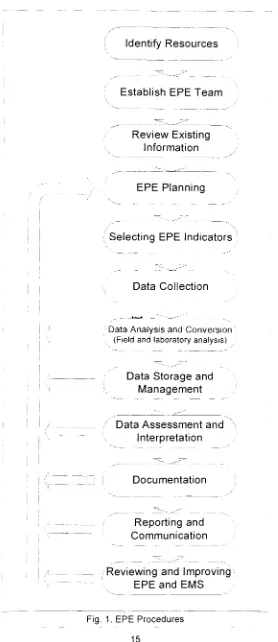
In
general,
Figure
1
represents environmental performance evaluation procedures.Figure
andtheories
usedin
this
step
were citedfrom ISO 14031
Environmental Performance
Evaluation,
W.Lee
Kuhre,
1997.
3.5.1
Preliminary
Activities
andPlanning
Identifying
criticalresources, e.g., staff,
money
andbudget,
computer,
files,
etc.Getting
commitment oftop
management:To successfully
andeffectively
implement
anEPE,
the
commitmentoftop
managementis
absolutely
necessary.Obtaining
necessary
resources:The necessary
resourcesmustbe
identified
and supplied.Forming
anEPE
team:
Team
members shouldinclude
environmental, production,
legal,
HR,
andriskdepartments.
Preparing
anEPE
Scope,
goals,
and objectives:the scope,
goals and objectives as abasic
boundary
ofthe
EPE
are setup in
the
early
stage ofthe
EPE
procedures.Determining
Major EPE
organization or subdivision:The
team
shoulddecide
onhow
they
will subdividethe task.
Identify
Resources
Establish
EPE Team
Review
Existing
Information
EPE
Planning
Selecting
EPE
Indicators
Data Collection
/
V
/Data
Analysis
andConversion
, (Field andlaboratory
analysis)Data Storage
andManagement
-
/
Data Assessment
andInterpretation
/-v
Documentation
Reporting
andCommunication
[image:28.514.122.400.64.706.2]working
documents,
procedures,
andtools
neededto
effectively
do
their
job
during
implementing
the
EPE.
3.5.2 Review
andUse
ofExisting
Information.
If
an organizationignores
anddoes
not reviewexisting
information
relatedto
anEPE,
the
organization must spend a
lot
ofmoney
andtime
to
getthe
information
by
other means.Organizations
must avoid such wasteful activities.They
shoulddo
the
following
to
getthe
mostbenefit:
Review
and usepolicies, goals, objectives,
targets,
and environmental criteria:If
anorganization
has
already
establishedenvironmentalpolicy, goals,
objectives,targets,
andvarious other environmental criteria,
the
organization shouldcollect,
review,
andincorporate
them
into
the
EPE
process.Review
the
useofenvironmentalaspectsandimpacts information:
an analysisofaspectswill make
the
EPE
more valuable and usefulfor
management.This step
promotesthe
development
ofuseful measurementdata
andthe
setting
of relevant worth.Review
and use otherbackground
materials:to
effectively
andbroadly
carry
outthe
EPE,
the
organization should review generaldocumentation,
existing
environmentalperformance
data,
environmentaldocumentation,
andoperational systemdocuments.
3.5.3 Selection
ofIndicators
andMetrics
The
principal roles ofEnvironmental
Management
Indicators
(EMIs),
Environmental
Performance Indicators
(EPIs),
andEnvironmental Indicators
(Els)
are as quantitative orqualitativedescriptors
to
expressenvironmental performance.Thus
they
arevery
important indicators for EPE.
a relative
indicator,
whichis
expressedin relationship
to
anothermeasure,a qualitative
indicator,
which utilizes a valuescale,
anda quantitative
indicator,
whichis
asimplenumerical metric.3.5.3.1 Characteristic
ofIndicators
To
accomplish successful and explicit results of anEPE,
an organization shoulddefine
andacknowledge
the
desirable
characteristics ofindicators
in
orderto
distribute indicators into
appropriate areas and
fields.
If
the
organization chooses and utilizes meaningful andbalanced
indicators
in
accordance withits
characteristics, the
results ofits
EPE
willbe
of much greater value.Accordingly,
the
organization should considerthe
following
guidelines.Indicators
should:be
representativeofthe true organization;
point
to
root causeofthe
impact;
helps
preventproblem;
be
understandable;
focus
on significantenvironmentalaspects;
promote
benchmarking;
be
consistentwithenvironmentalpolicy
andobjectives;
be
controllable andverifiable;
andprovide
for
cross-functionalcomparisons andlinkages.
The
indicators
and metrics should meetbusiness
goals and strategies.Improvement
should alsoprovideacompetitiveadvantage
together
withimproved
profitability.3.5.3.2
Selecting
Indicators
several
types
of methodsfor
selecting
indicators
that
canbe
usedeffectively
in diverse industries.
EPIs
shouldbe
ableto:
track
progresstoward the
organization'sgoals;
be
comparable with otherorganizations;
past environmentalimpacts,
and otherperformances over
time;
be
usedto
decide
onbusiness decisions
orbe
usedto
integrate
environmentinto
business
language;
have
confidentialbusiness
information
andreliability;
be
usedfor benchmarks in
long
term
business
strategy;
confirmwhether
the
organization complieswith regulationsandlaws;
be
usedfor
aninternal
incentive
standard.The
main approachesfor
selecting
indicators
for EPE
are:Cause
and effect approach: an organization candevelop
indicators
that
may
be
the
fundamental
orbasic
cause ofits
significant environmental aspects andimpacts.
Risk-based
approach: an organization candetermine
anddevelop
indicators
that
may
be
based
onconsiderations ofthe
risks whichthe
organization's managementdetermines is
related
to
specialactivities, products,
or services.Life
cycleapproach: anorganizationcandevelop
indicators
relatedto
inputs
andoutputsmaterials of product and significantenvironmentalaspects and
impacts for
the
entirelife
of a product.
Regulatory
orvoluntary initiative
approach: an organization canidentify
indicators
related
to
regulationsandvoluntary
performance requirements.Methods
for
selecting
indicators
can alsoinclude:
Plan-do-check-Correct,
cause-effect,
tracing
Plan-do-check-correct:
Plan-the
number of
training
programsidentified,
DO-the
number of
training
programsimplemented,
Check-the
averagetest score,
Correct-updates
to the
training
module.(ISO/TC207/SC4/JEG, 1996)
Cause-effect:
identify (a)
cause(s)
and effect orimpact
to
occur.This
canhelp
the
EPE
team to
consider significant or obviousissues.
Tracing
anindicator
through
management system(MS),
Operational System
(OS),
andSate
ofthe
Environment (SOE): Indicators
selected shouldshowthe
tracing
the
eventsthrough
MS, OS,
andSOE.
Input-Output:
This
methodincludes
measuring
afactor
ofinput
(an aspect)
andmeasuring
the
results of output(the
actiontaken).
Functional Aspect Analysis:
the
functional
analysis couldinclude
an assessment ofissues
such asflexibility,
ability
to
accomplishobjectives, coordination,
andability
to
solve problems
(ISO/TC/207/SC4/JWG, 1986)
3.5.3.3 Categories
ofIndicators
It may
be
necessary
to
categorizeindicators
in
orderto
reducethe
many
measurements andrelated
issues.
This category
mustbe flexible
withoutfixing.
For
example,
groups ofindicators
are:conformity,
systemand
implementation,
integration
ofissues,
economic
leadership,
andmanagement
(ISO/TC/SC4/JWG,
1996).
Indicators
canbe divided into
three
maintypes
as specifiedby
SC4,
managementsystem,
organization
to
assessthe
designs,
plans,
and actiontaken
by
management.The operating
systemstarts
its
role afterimplementing
management activities.The
outputderived
by
the
indicator
system canbe
usedto
establish newenvironmentalpolicy,
environmental objectives and
targets,
andimproved
operation systemfor
the
sustainabledevelopment.
Indicators
willbe
implemented
through
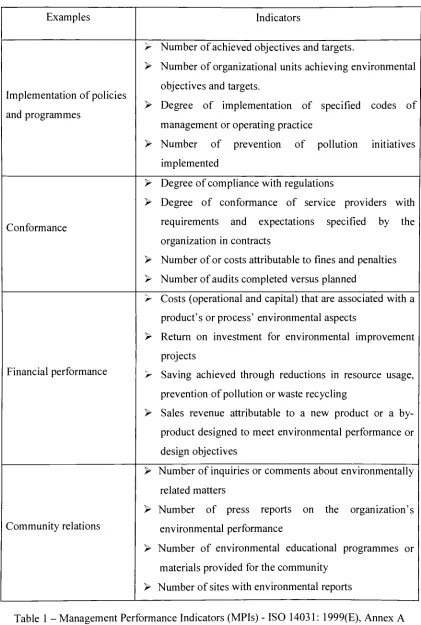
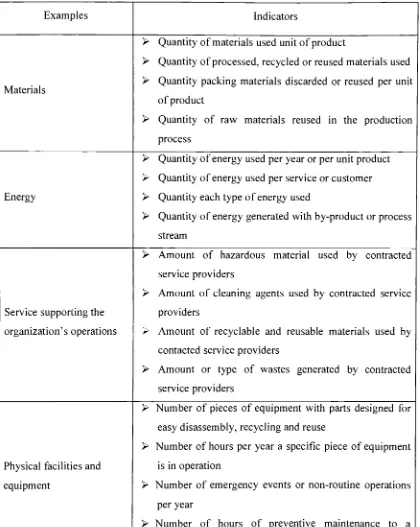
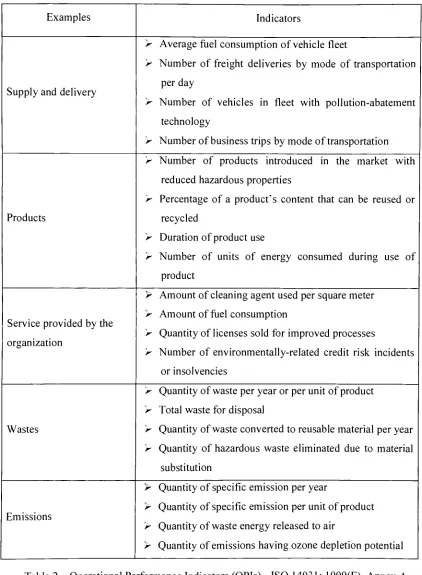
all system areas.Table
1,
Table
2,
andTable
Examples
Indicators
Implementation
of policiesand programmes
>
Number
of achieved objectives andtargets.
>
Number
oforganizationalunitsachieving
environmentalobjectivesand
targets.
>
Degree
ofimplementation
of specified codes ofmanagement or
operating
practice>
Number
of prevention of pollutioninitiatives
implemented
Conformance
>
Degree
of compliance with regulations^
Degree
of conformance of service providers withrequirements and expectations specified
by
the
organization
in
contracts>
Number
oforcosts attributableto
fines
and penalties>
Number
of audits completed versus plannedFinancial
performance>
Costs (operational
andcapital)
that
are associatedwith aproduct's or
process'
environmental aspects
>
Return
oninvestment
for
environmentalimprovement
projects
r-Saving
achievedthrough
reductionsin
resourceusage,
prevention of pollution or waste
recycling
>
Sales
revenue attributableto
a new product or aby
product
designed
to
meetenvironmental performance ordesign
objectivesCommunity
relations>
Number
ofinquiries
or comments aboutenvironmentally
relatedmatters
>
Number
of press reports onthe
organization'senvironmental performance
> Number
of environmental educational programmes ormaterials provided
for
the
community
[image:34.514.46.467.21.646.2]>
Number
of sites withenvironmental reportsTable 1
-Management
Performance Indicators
(MPIs)
-ISO 14031:
Examples
Indicators
Materials
>
Quantity
ofmaterials used unit of product>
Quantity
ofprocessed,
recycled or reused materials used>
Quantity
packing
materialsdiscarded
or reused per unitof product
>
Quantity
of raw materials reusedin
the
productionprocess
Energy
>
Quantity
ofenergy
used per year or per unit product>
Quantity
ofenergy
used per service or customer>
Quantity
eachtype
ofenergy
used>
Quantity
ofenergy
generated withby-product
or processstream
Service supporting
the
organization's operations
>
Amount
ofhazardous
material usedby
contractedservice providers
>
Amount
ofcleaning
agents usedby
contracted serviceproviders
>
Amount
of recyclable and reusable materials usedby
contacted service providers
>
Amount
ortype
of wastes generatedby
contractedservice providers
Physical
facilities
andequipment
> Number
of pieces of equipment with partsdesigned for
easy
disassembly,
recycling
and reuse>
Number
ofhours
peryeara specific piece ofequipmentis in
operation> Number
ofemergency
events or non-routine operationsper year
>
Number
ofhours
of preventive maintenanceto
aequipment peryear
Table
2
-Operational
Performance Indicators
(OPIs)
-ISO 1 403 1
[image:35.514.49.469.48.575.2]Examples
Indicators
Supply
anddelivery
>
Average fuel
consumption of vehiclefleet
>
Number
offreight deliveries
by
mode oftransportation
per
day
>
Number
of vehiclesin fleet
with pollution-abatementtechnology
>
Number
ofbusiness
trips
by
mode oftransportation
Products
V Number
of productsintroduced
in
the
market withreduced
hazardous
properties>
Percentage
of a product's contentthat
canbe
reused orrecycled
>
Duration
of productuse> Number
of units ofenergy
consumedduring
use ofproduct
Service
providedby
the
organization
> Amount
ofcleaning
agent used per squaremeter>
Amount
offuel
consumptiony
Quantity
oflicenses
soldfor
improved
processes
r-Number
of environmentally-related credit riskincidents
or
insolvencies
Wastes
>
Quantity
ofwasteperyear orper unit of productV
Total
wastefor
disposal
>
Quantity
of waste convertedto
reusable material per year>
Quantity
ofhazardous
waste eliminateddue
to
materialsubstitution
Emissions
>
Quantity
of specific emission per year>
Quantity
of specific emission per unit of product>
Quantity
of wasteenergy
releasedto
air [image:36.514.46.468.46.621.2]>
Quantity
ofemissionshaving
ozonedepletion
potentialTable 2
-Operational
Performance
Indicators
(OPIs)
-ISO
14031:
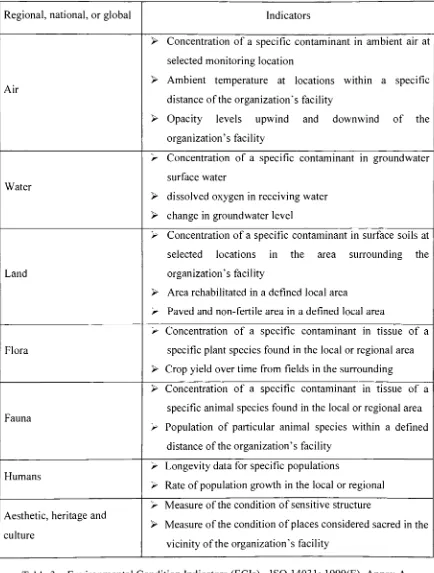
Regional,
national,
or globalIndicators
Air
>
Concentration
of a specific contaminantin
ambient air atselected
monitoring
location
>
Ambient
temperature
atlocations
within a specificdistance
ofthe
organization'sfacility
>
Opacity
levels
upwind anddownwind
ofthe
organization's
facility
Water
>
Concentration
of a specific contaminantin
groundwatersurface water
>
dissolved
oxygenin
receiving
water>
changein
groundwaterlevel
Land
>-Concentration
ofa specific contaminantin
surface soils atselected
locations
in
the
areasurrounding
the
organization's
facility
>
Area
rehabilitatedin
adefined local
area>
Paved
and non-fertileareain
adefined
local
areaFlora
>
Concentration
of a specific contaminantin
tissue
of aspecific plant species
found in
the
local
or regional areay
Crop
yieldovertime
from
fields in
the
surrounding
Fauna
>
Concentration
of a specific contaminantin
tissue
of aspecificanimal species
found
in
the
local
or regional area>
Population
of particular animal species within adefined
distance
ofthe
organization'sfacility
Humans
>
Longevity
data for
specific populations>
Rate
ofpopulation growthin
the
local
or regionalAesthetic,
heritage
andculture
>
Measure
ofthe
condition of sensitive structure>
Measure
ofthe
condition of places considered sacredin
the
vicinity
ofthe
organization'sfacility
Table
3
-Environmental
Condition Indicators
(ECIs)
-ISO 14031:
[image:37.514.40.474.49.622.2]3.5.4
Quality
tools
for development indicators
andfor interpretation
The quality
toolboxes
for
collecting,
interpreting,
andselecting
environmental performanceindictors
anddata
help
the
EPE
team
to
effectively do
their