Rochester Institute of Technology
RIT Scholar Works
Theses
Thesis/Dissertation Collections
2003
Understanding "photograph A"
Jun ku Yoon
Follow this and additional works at:
http://scholarworks.rit.edu/theses
This Thesis is brought to you for free and open access by the Thesis/Dissertation Collections at RIT Scholar Works. It has been accepted for inclusion in Theses by an authorized administrator of RIT Scholar Works. For more information, please [email protected].
Recommended Citation
Understanding "photograph
A"
Graduate Thesis
Master of Fine Arts
School of Photographic Arts and Sciences
Rochester Institute of Technology
By
Jun ku Yoon
Spring 2003
Thesis Board Members:
Angela Kelly, Thesis Chair, Associate Professor, SPAS
_ _ _ _ _ _ _ _ _ _ _ _
Date~
Elliott Rubenstein, Professor, SPAS
_ _ _ _ _ _
Date~
Tina Lent, Professor, College of Liberal Arts
THESIS RELEASE PERMISSION FORM
Rochester Institute of Technology
Understanding JJphotograph A"
I, Jun ku Yoon, hereby grant to permission to any individual or organization to reproduce
this thesis in whole or in part for non-commercial and non-profit purposes only.
Jun
1m
Yoon
Date
Contents
Acknowledgements iii
A Narrative inaframe 1
Description ofInstallation 5
Thepriordevelopmentto
"Understanding
photographA"
21
Narcologicalaspect oftheinstallation 36
Anarrativeoverthe frame 48
Works Cited 52
Acknowledgements
Iam
deeply
gratefultoprofessorAngelaKelly,
professorElliottRubenstein,
professorTimEngstromand SarahKankiewicz-Arkinsfor responding generouslyto myproposalandappearing
inmyvideo work. Ialsowanttoexpressmythanks tomythesiscommitteefortheirobservations,
opinions and advice.
Andtheend of all ourexploring
Willbetoarrivewherewestarted
Andknowtheplace forthefirsttime.
A
Narrative in
a
frame
Thefront doorwassage-green, shabby, yetmade ofsteel. Weleftit
intermittently
half wayopenforJonito travel outsidelike everycrossbreddog
intheneighborhooddoes. Withina slight variationJonihadafixedpattern ofher outingtime. Shewould alwaysreturnhome beforesix
around whichwe wouldfeedherandnever allowherout afterwards.
One
day
Joninever cameback. Aslong
as my memoryservesme,Jonihadstayed with uslongerthananyother
dogs,
chickens,ducks,
turkeys,
rabbits,goldfishand a cat we
had.
Sinceanimalsinourhome
would comeandgo,allmy
family
membersknewhow
todealwithJoni'sabsence,eachoneshowing his orherownidiosyncraticexpression oftheloss. As
always Iwasclinging
by
mom, calculatingtheintervalsbetweenher
sighandgulp, thendeterminedthe
intensity
of griefIwastodisplay.Reading
mymom'sfacewas akindof system
by
whichIverifiedmymoral idea.elo-quentof all.Icried: apurelyselfishcry,akindofmanifestationthatpro
claimedthevirtuosityofmy character.Itwas asilly beliefthatexhibiting suchlamentwas anobligatoryservice thateverybodyexpected fromme.
Nonetheless I
had held
thebeliefthroughoutmychildhood.Thatday
theentireneighborhood
heard
mecryingthrough thegreendoorwehad left open untilthemidnight.OnceJoni
had
deliveredpuppies-sevenmultifarious ones.
Among
allthe thingsIcould dowiththe puppies,whatIenjoyed mostwasputting
themintothestoriesIcame upwith.It wasakindofadolescentday
dreaming
over environment. Iknewasachildwhatit's liketobeanomniscient narrator how mighty hecanbewith theunchallenged author
ity
todispose characters andtoforcethemthrough thedramahewanted.Thestorieshadeverything: sin,judgment(orrealization), andreversal.
AsIchangedthe arrangementofperformers and propertieson stagesof
mystories, theperformers,sevenpuppies,had physicallytomovefrom spotstospots.Thecomposition of aplot seemedtobealways easierthan thephysicalduration Ineedtodraw fromthe
flimsy
trotof puppies.(Keeping
thepuppies stillwas,Iremember, aslaboriousascatchingahousefly
witha plasticbag)
ForthatreasonIoften got anxious and wornout.
(Only
if Iwouldhaveknown Icouldgeta pose fixed orderlyon aphotograph! intheseconddegree realitythatimmortalizesa slice of
time.)
Docilewasthename Igavethesmallest andspotlesspuppywhich
was
invariably
favoredby
meforthe protagonistofmystories,simplybecauseitsweakandinertmovement wasfoundtobemost amenableto
poses. Each
day
onlyDocileoutof seven puppieshad
developedthequixotic mind and style. Ofallthingsno other one's
morality
couldbeparTheoriginal photographis3"
x
4"
enoughtheremotionlessatthedecisivespots fromwhicha
boy
coulddeploy
variousnarratives,helping
thatsmallboy
tofermenthis
ownpeculiar ideaoftheworld whichwouldlater becomethefundamentalframeof
his
idealization. It isDocile'sinanimatemomentsthatanimatedmyjuvenileideaofeternalvalue.
Every
springby
thetime forsythiasstartedtobloomlittleyellowflowers ontheuphill road of ourneighborhood, mymomseemed tofeel
obligatedto
buy
rollfilmandtakepictures ofus,eventhoughshecouldn'talways
buy
onefor financialreasons.Spring
was abusy
season.Itwasabig
thing
forhertohave
flowersonthebackgroundwhentaking
pictures,thoughnone of usreallylikedthe
idea;
my brotherandIwouldthinkastoo
sissy. Thepictureherewas onetakenin
thespringtimewhenJonigavebirthsto
seven puppies.
Idon'trememberwho wasthe
behindthe camera,yet Ialmostvividly
recalltheimageofmyself
hustling
about,quiteperkyatfirstandslowly gettingtediouswiththecompositional
arrangementItriedtoperfect forthe shooting.
Vaguely
yetunmistakably Istillfeeltheresonance ofthefrustration fromthe
discrepancy
thatanyartistwould experiencebetweenhisideaandthe embodiment ofit. After
allthoseyearsofeducationinphotography,Istill wonderifa singleimage
canbe asurrogatefora narrative.But a small
boy
believedthatday
thereshould analchemiccompositionthatcould epitomize astory of
his
truly
abstractbutin "theway".Preparing
the foregroundwasrelatively
easy: mybrotherrecliningwithhis
head pillowing
onhis
leftpalm,thewas
fully
elaboratedwithsupportingactors andactresses, thepuppiesexcept
Docile,
thenarrator wasexperiencing
ablackout,
knowing
thatputting
Docilesimply behindthefront settingwouldleavetheprotagonistinconspicuous.
Thereneededtobe
something
toupholdthepositionofDocileaboveeverything
else.SoI,
the narrator,enteredintotheframe. Atransitionfromathird toafirstperson point of view: whentheobjective propertiesofthe
scenebecomethesubjective environment. Now Iwassquattingbehindmy
brotherinthemiddle ofthe
frame,
raisingDocile,
the protagonist, to thecentralpoint. Asthecompositional structurebecamecomplete, the
boy
was stillsensing somethingmissing, atouch thatwouldmakethestory
more palatable. Whatcould
top
thesensationalismofhuman flesh?Taking
myshirts off,Iwas
feeling
thebody
temperatureofDocileonmychestand chillbreezeofearly springonmy shoulder.
Every
time I lookatthe photograph,Ifeel myshouldersgraduallyresemblingthe onesintheimageas if I am
feeling
onthem theverychillbreeze ofthat spring. Idon't reallyrememberhowwe didwithallthose
sevenpuppies, evenDocile.Thephotographonlyremindsme ofthe
day
when someonetooka picture ofus, andhowIenjoyed as a
boy
thepupDescription
of
Installation
Installation: thelandscapeoftheartisfspsychology
It seemsthat
talking
aboutone's own art work withoutanyinstitutional
backup
takes alotof courage.Nonetheless,
when oneturns toan artinstitute forthetheoretical
facility,
hehas
alsotoundergo ceaseless confusion andself-contradictioninordertocustomize one's ownideasregard
ing
art. Inmy perplexingyearsof artinstitutions,
Iwould oftenfeel caughtup betweenincongruousideasonart;most ofthetimesmypsychological
exhaustion wouldbesummedupas thesyntheticidea. If there isone
thing
I
discovered,
it issuchapredispositionthat themimesis oftheworld wasconsidered as ananachronistic project.Theconcept of
imitating
theworldis,
itseems,now atthemercy ofthepsychologicalinsightsfrom anyonewhowanttotalkaboutit. As faras my institutionalexperience concernsit
approach-es. Platonicspeculation,which onceperpetuatedthe artworld,hasappar
entlygivenitsway totwentieth
century
ideassuch aspsychology,hermeneutics andstructuralism.
Institutionally
speakingarttoday
referstonothing butitself. "Artforarf s sake"
has
long
beenthecreed of artinstitution, eventhoughit
has
beencalledintoquestionby
postmodernism. Thecurrencyof phrase sometimeseven seemstobe overridingthemeaning
ofit,
asifthemusic marketismore attentiveto thecommodityvalueofBeethoven's
symphony
than toitsmusicalvalue.Althoughquestioningthevalidityofthissubjugating dictumseems out ofthe
fashion,
itwas necessary formetoinvestigatethequestioninordertounderstandhowit
has
inflectedmynotion aboutimage making
during
myyearsofinstitutions.The efforttoreflect artautogenouslywithinthereferenceofitselfhas only
extendedthe abstractionism, situatingartinstitutions inthe arena ofthe
theoriesoftwentieth century.Equippedwitha certainlinguistic
formula,
artistsingeneral seemtobe
becoming
more andmoreconformable to theunitarymarket forceinordertoestablish acurrencyofmeaningintheart
market. It
has
becomeagreat deal forartiststo communicateinanintelligible method thathas commensurabilitywith psychologicaltheories.
Maintaining
such anintellectuallevel,
art classes more oftenthannotlook likegrouppsychiatricsessionsinwhichthe artworkinthediscussioneasily
reduces to thevisualepitomeofan abstracttheory. Inan attempt tokeep
upintheprevailing trend, Inaturally developed a strategic attitude tobe fluidinthe settingofinstitutionalknowledge.Nevertheless,
theinstallation,
"Understanding
'photographA'"beganinthesuspicion ofmyunderstandingofart,
inquiring
intomyowntasteforart.The ideathat there couldbeafallacy
or anillusioninmy institutionalizedtastewas tome as
interesting
asitsoundsidiotic andhumorous.
Thewhole ideastart1.The institutionaleducation enables onetoexpand
his
languagefaculty.
2. Theexpansion of
one'
language
faculty
influences thecommandof
his
reasoning.3. One's
reasoning
capacitygovernstoconsiderable extenthis
psychology; thereforeinstitutionaleducation can alterinacertain
manner one's psychology.
4.Thealterationinone'spsychologycould
have
apossible reciprocal relation withthechangesinthemode ofhisperception.
5. One's tasteissubstantially basedonhisperceptionandrecogni
tion.
6.Thereforeinstitutions couldworkas aninstrumentalcause for
some changeinindividuals'
taste.
Basedon such a conjectural
idea,
theoutlineforthe installationtookaformofinvestigation intothepsychology oftheartist. Ina mischievous
excitement, Isurveyedmymiscellaneous memoriesconcerned with photo
graphs,and studiedthe topographicalaspect ofmy ownpsychologyI
have
developedinthecourse ofmyart education.Thestructureoftheinstallationwasplaned ontheconceptthat theenvironmentalfactof
installationwouldrhetoricallyequate thepsychologicallandscapeofthe
artist.
Postcards as aninvitation intoanarrative
Printing
andcirculatingpostcardsforart shows now seemstobe theinvariable fashionasinvitations to exhibitions, addressingthedatesand
locations ofexhibitions.ThepostcardImade servedprettymuchthesame,
usual
functions,
exceptIstartedfromitthepassage ofthenarrative oftheinstallation. The installation
"Understanding
'photographA' "exhibit-edintheSPAS
Gallery,
FrankE.GannettBuilding,
onthe RITcampusfromSeptemberfifththrough
fourteenth,
2002.Designing
forthepostcardandposter, I triedto
keep
everything
minimal, eliminatingall thecolors andeven
half
tones onthephotographonit.Itwas mycalculationthat
minimizing
informationwould enhancethe
legibility
ofthe message.Thegraphic ofitlooksalmosticonographic,
conveying asuccinctinformationwhichjuxtaposesanillus
tratedphotographpossiblytakenfroma
family
photoalbum andthetitle ofthe show
"Understanding
photograph A"Thejuxtapositionin itsplaincognizabilityimplies a cer
tain relationship betweentheillustratedphotograph andthe
word "photographA". Uponreadingthe postcard, it isnot
hard
toexpectthat theexhibition wouldpossiblyprovide anarrative aboutthephotograph onthepostcard.Forsuch an
implication,
disseminating
theinformationontheshowthrough thepostcards and posters was a quintessential com
ponent ofmyshow: whenviewersanticipate a narrative ^ntside ofthepostcard
about
^
photographonthepostcardisactuallywhen thenarrative ofthewholeexhibitioninitiates.Themajor functionofthepostcardwastopull
fromthepostcard recipientsthepresumptionthat thisshowisabout "pho
tographA" andpossiblythe "photographA"
istheone onthepostcard. -4PR
Understanding"photographA" JunkuYoon
Encountering
sevenimagesFigure1.
Epson Inkjet Print 35" x40"
The
gallery
space was shared with another graduatestudent,Jinwhan Choiwhose show, "hybridmosaic"
exhibitedinthe left halfofthe
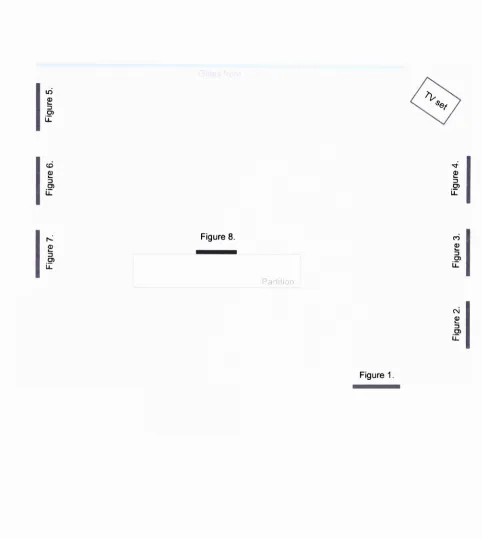
gallery. Inordertosecludeeach one's space we usedtwo wall-height,
woodenpartitionsthatdividedthewhole spaceinthemiddleintotwo iso
latedcubes. Ontherighthalfofthegalleryas a private spaceIplannedthe
installation,
"Understanding
'photographA'". Withtheaid ofanotherwooden partitionIwas able toarrangetheimagesas I
designedtheinstallation:sevenimagesaround walls as a
group,and one as an unrelated piece on thepartition.The
sevenimageswere takenwith4" x5"blackandwhitefilm
anddigitizedthrough afilmscanner and printed on
35"
x
40"
Epson inkjetpapers.
Neatly
mounted and coated ontowood panels, theimages in its
big
scale gives thesense ofcommercial
billboards,
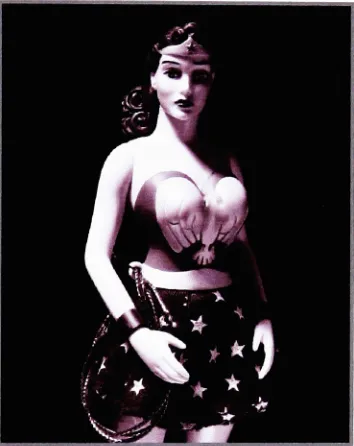
eachimageseems asiftopromotesomethingotherthan theimage itself. Thefirstimagethe
viewer encounters isthephotograph of a wonder woman
doll,
approximatelyasbig
as an adultfemale.The scale oftheimagewasdeliberately
calculatedtoanticipateviewers'
psychologicaljuxtaposition
betweenthe doll andtheviewer.In frontoftheimage thevieweristobe
confronted
by
alife-sizemannequin staringdirectly
attheviewer whiletheviewer realizestheparallelrelationshipinsizebetweenthemannequin
andthe viewer.Althoughthephotographedobject wasonlya
foot-tall,
aided
by
zonesystemtechnique and newdigitalgadgets,Iwas abletomaintain pristinedetails astoconvincethe vieweroftheverisimilitudeof
itsscale. Theviewermeetsthe super
heroine,
her
impeccably
smoothrub [image:15.552.38.215.223.446.2]patriot-Figure 2. & patriot-Figure 3.
EpsonInkjetPrint35" x
40"
icemblem.
Surrealistically
justagainsttheblackbackgroundthisplasticfigureclaimsitsacknowledged
identity,
theartificialityofeveryday.Despitethefactthatthereis
nothing
natural aboutthefigure,
somehownothingseems more natural than theconsumptionofthis
image. Who
among
us wouldfeelestrangedfromtheveryaesthetics ofthepopculture?
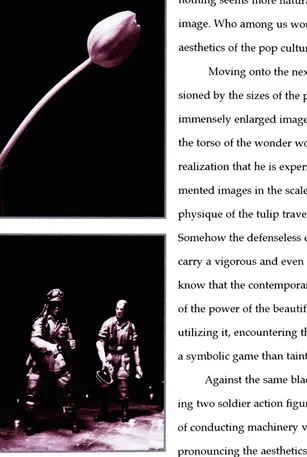
Moving
ontothenextimage,
thevieweris disillusioned
by
thesizes ofthephotographed objects. Heretheimmensely
enlargedimage of atulip,thebudaslargeasthe torso ofthewonderwoman,bringstheviewerto the
realizationthatheisexperiencingthe
tremendously
augmentedimages inthescale. The frailandvulnerable
physique ofthe
tulip
traversesobliquely ablack frame.Somehowthedefenselessexposure oftheflowerseems to
carryavigorousand even aggressive utterance. Aswe
knowthat the contemporarycommercialismiswellaware
ofthepower ofthebeautifulandnever shies away from
utilizing
it,
encounteringthebeautifulnowinduces more ofa symbolic gamethan taintlessappreciation.
Againstthe sameblack
backdrop
aremilitantlystanding
twosoldier actionfiguresthatappeartobeonthebrinkofconductingmachineryviolence.
Looking
unsatisfied,yetpronouncingtheaestheticsofregimentation, thesoldiers
appeartoposeademandof a certainorder,possiblyatotalitariansystem.
Noticing
thesamerepetitivebackgroundandthe simplified settings oftheobjects,itmightoccurto the viewerthat therecouldbeacertainconnec
tion amongthesymbolic meaningsof each object. Butitwas alsomy inten
tion toputtheviewerthroughthesequence ofimageswithout
letting
them [image:16.552.48.355.107.564.2]Figure 4. &Figure 5. Epson Inkjet Print 35"
x
40"
knowthecomplete scheme ofthe layout:itwasapremeditatedstaging in
thesequenceofthenarrativetoexpect fromtheviewer
his
ownpedanticspeculation onthoseimages.
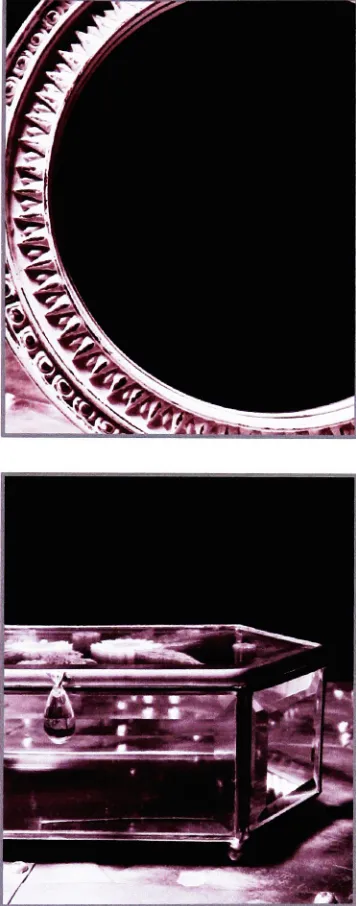
Thefourth imageisthemost abstract ofall,showing
only
afraction ofornamentedround-shapeframe,
possiblyanempty frame or a mirror.It is actuallyamirror with a
decorated framearoundit. The intendedsymbolicmeaning
fortheimage wasthemodern consciousness of representa
tion,
especially theconsciousnessintheact of representation.
Bearing
no reflectionintheframe,
the imageof 'void'mirrorillustrates its functionandthefunctionalone.Thus
theimageof ablankmirror
is,
Imight say,abouttherepresentation about representation. Throughouttheinstallation
thisframeof mirror playsananchor pointtowhich allthe
frequenciesofthenarrative arebroughttogetherrecurrent
ly.
Setting
themirrorimageasanarrator-agent, theinstallationmobilizes an
inquiry
forthegaze ofthecontemporarysociety,particularly forits interestthat
has
shiftedfromthesemanticapproachtothegrammaticalunderstanding ofthe
representation.*
Afterthemirror
image,
dueto thephysical conditionofthegalleryspace, the vieweristo travel acrossthe room
*
Iusedthewords,semanticapproach, toaddresstheold praxis of art consumption
whosemainfocuswasonreferentialcontentofartwork.As thetheoryof structuralism and
deconstructionism influenced theartenvironment,thestructuralformand style of artwork
have beengivencritical examinations.Thishascreateda new atmosphereinwhichthe
value ofinterpretationofartworkwasreconsideredin thecontext of structuralism.Instruc
turalism thenatureofrepresentationitselfbecamealocusofstudy,
developing
diverseopinions and systemsthatexplainthegrammaticalaspect ofanysignifyingorder.Oneof
such exampleswouldbe narratology(narratologystudiesthe nature,formand
functioning
of narrative regardless ofmediumofrepresentation.)Invisualartthis trend has been
reflectedin thereconsiderationofexhibitingspacewhich resultedinnew modes of repre
sentation such asFluxus,Earthart,Installationart,etc.
[image:17.552.37.215.82.535.2]The
Installation
go u.
h-<V
CD CU 3
05 CD
iZ
[image:18.552.39.521.86.625.2]3 CO
Figure 8. CO
cu
CO
Li-Partition
CN
CO
Figure 1.
Figure 6.& Figure 7.
Epson Inkjet Print 35"
x
40"
forthe continuation ofthe series ofimages. Anyonemight
have
an experience ofowningaoverlyembellished container, whosedue functionsomehowseems tooutweighany
actual need tostorage existing
belongs,
only makingitfunctionless.Although itsoundspreposterous tocombine
exuberantdecorationswithpracticality,suchfictive devices
doprevailintoday'
market, appealingto theromantic sen
sibilityof consumers.Asmall,cheap
jewelry
box,
metaphorically
insinuating
thecommodificationofsenti-mentalism,is
demanding
thedelicate attentionfromtheviewer as afifthsequence ofthe images.
Moving
onto the next, thereis theimageof a ubiquitous object,almost
banal,
yetitsuniqueidentity
isnevermistakable an old photograph. Encased ina wooden
frameisaKorean
family
ofthree generations,onlythegrandfather and motherin traditional Korean dresses. In
theparallellayoutwith otherimageswhosemetonymical
aspects are more orless
lexicographical,
the viewercouldguess thatitssymbolicmeaningcouldbeabout remem
brance or nostalgia.
Finally,
as thelastimageoftheorderIchose abronze statue ofBuddha. As
Christianity
has
inthe westernculture, Buddhismuntil recently
had
beenthefundamental domain oftheorientalaesthetics, desireandmorality. Therefore itrepresentssymbolicallytheartist's indigenoustradi
tionthatissufferingdisintegration.
Passing
through these sevenimagestheviewer might experiencethevigorousreasoning,
trying
toextractalog
icalrelation out ofthesequence. Itwasexactly myplantoputup atmos
phere ofa
customary
galleryspace,inducing
psychologicaltensionsaroundthe
intelligibility
oftheimages.Identification for"photographA"
Unrelatedto theseven
images,
a smaller printishung
on aseparatewoodpartition,whose gilded frame
instantaneously
discriminates thephotographfromother sevenimages. Iftheviewerisfamiliarwith19th
century photographyprocesses, hewould
identify
thisimageas aplatinumand palladiumprint,
directly
exposedfromtheoriginal negative. Forthosewithout such a sophisticatedtastefor19thcentury photography
process,I
intentionally
put on atitletag
with a description:untitled,platinumand palladiumprint, 7"
x17". Inordertofabricate thequasi-value of
the
image,
Iuseddeliberately
oneofthemostcumbersome andexpensiveprocesses,goingthrough
handing
with abulky
7"x 17"
camera and noto
riously toxicchemicalsforplatinum print.
Therefore,
elaboratingthephoto process and itstechnicalvalue wasadeliberate and also apt process
fortheconspiracyoftheinstallationtoenhance thedemand forthe special
attentiononthisparticularimage. Inthisdifferentiated framethe viewer
seesthesevenitemsfromthepreviousframes alltogetherplaced on a
metalswingtable.
Using
asinglespotlight, Iphotographed the tableinasullentone, casting very harshshadows and
isolating
theobjectsfromthebackground. The distinctive textureoftheplatinum print also accommo
datedthesoberstrain oftheimage.
Everything
intheframeisclearly identifiableandthearrangementseems tobepremeditated with some mathe
matical precision asinafilm-noirscene.
Nonetheless,
theorchestrationlooks out ofjoint. Thecomposition oftheall objectsinvokesacertaindis
turbance, a
feeling
aboutsomething completely artificial,fictitious
andgrotesque, asifoneisconfronted
by
Frankenstein'smonster.Is itthe"photographA"? Isitaboutthe
identity
oftheartist? The layoutofinstallationissupposedtoguidetheviewer to thinkofthe
image,
untitled,as "photograph
A",
sincethereis onlyoneimagedistinguishable fromthe othersbothin itsformatand medium.
However,
ifthisplatinum printisthe"photograph
A",
thereremain an unresolveddisagreement betweenthemainimageofthe
installation,
untitledandtheoneonthepostcard.Whichoneis "photograph A"? Andwhatrelationshipcouldtherebebetweenthe
two?
Figure 8.platinum and palladium print
7"
x
17"
Thevideomanualtotheartwork
Wherethequestionlingersisactuallythe transitionalpointofthe
narrative ofthe installation.The physicalenvironmentoftheinstallation
wasdesigned asthescenic properties ofthenarrative on whichtherever
sal ofnarrativewill unfold. The installationof eightimagesrepresents
metaphorically
theartisf s struggleforhisidentity. Thestruggleisstrenuouslyengaged withtheartisfs aspirationtounderstandthecollective
aspect of
his
characteristicswithinthecontext ofinstitutional knowledge.Theselection ofitemswas
highly
contrivedtothedegreethateachobjectcanbereducedto theregister ofthepost-moderncondition.Forthecoun
terplotofthe narrative, theactual installationspace wasintendedtobe
seeninawayas a simulation of artinstallation. Attheright corner ofthe
room,Iprepared a whiteTVandVCRcombo ona whitepedestal forthe
viewertoplayat willan8-minutevideotape.This isthe tangentialpoint at
whichtwodifferentinstancesofthenarrative are merging,
bringing
thecontrastbetweenthe twointo thecomplexityofthenarrative.As the
videotapestartsto roll, thenarrative about "photograph
A"
continues,
pulverizinganyprejudgmentabout"photograph A". Asweare familiar
with pre-information ofany blockbustervideotape, thevideotapebegins
with atextannouncing:
Duetotheidiomaticresponse ofthe viewer or
theartist'spost-experienceto thiswork,
thesignificance ofthis workissubjecttochange.
Please,
beadvised.Iwrotethis facetiousstatementinregardto thepostmodern fashion
in artconsumption,
implying
theartisf sconsiderationofthedeconstruc-tionsim.Thestatementinawayasks theviewertohave afreeassociation
withthework. At thesametimethisstatemententails avoicethat
addressesthelevelofnarration,
informing
theviewerofthewhereaboutsofthenarrativeprogress. It isalsothepointwheretheartist connotesfor
thefirsttimethat the stress onthe title
"Understanding
photographA"
wasn't put on "photographA"
buton "Understanding".Thewholeinstal
lationwas plottedtoillustrate theprocess ofappreciat
ing
photographs, nottoexpandtheimportanceof aparticular photograph. Thestatementissoonfollowed
by
an animatedtitle,
"Understanding
photographA",
andthen
by
anillustrationof ahuman
face. Onwhitebackgroundaboy's face fadesinasif ina2-D anima-Thisanimatedfigure
introduces himselfastheartist non Thefacewas posterizedinto fourtones andblurred in
Photoshop
tobeara cartoonish quality. Soonthisfacestarts
talking
inaboyish tone,identifying
himselfasthe artist oftheinstallationandthevideotapeas themanual to theinstallation. Afterabriefintroduction
by
theboy
to thevideomanual, thefaceisreplacedwiththe circleframe of mirror which
was thefourthsequenceofthe seven
images,
andit isalsotheobjectplaced onthe centeroftheplatinumprint. Thesignification ofthemirror
inthevideohasthesame connotation as itwasmentionedbefore: therep
resentation aboutrepresentation,morespecificallyit isabouttherepresen
tationreferringtoitsown art of signification.
Hovering
on whitebackgroundlike the
face,
themirrorisnowliterally
aframe (themirror) inaframe (theTVmonitor),whichshowsthevideoclip like amagicmirror
froma
fairy
tale, "Snowwhite".Thevideofootageonthemirror consists of sixchapters,eachone
ProfessorKelly
giving herreview
ontheplatinum
print.
The boy's
voiceoverisnar rating hisanec
doteabout
\Afonderwoman.
Thetitleofthis chapteris The
conjecturalcom -position of a
KITSCH-MAN(or
anidentity).
ProfessorElliott Rubensteinelab
oratingaboutthe possibleinterpre tationsofthepic
ture.
with atitle. The story linewas interlacedwithtwo differenttypesof
video clips
alternating
(type 1:thevideo footageofthree RITfaculty
members and oneRITgraduatestudentwhoaregiving theinterpretationsand
-^ reviews ontheplatinumprint, whichisnowinstalled in
thegallery. Type2: computergeneratedfootagewith a
voice-over
telling
privateanecdotesoftheboy
whoclaims tobe the artist.)
By
type 1 1triedtorepresenttheinstitutionalized understandingof a particular photo
graph(inthiscase theplatinum print). Thankstopro
fessorAngela
Kelly,
professorElliott RubensteinandprofessorTimEngstromwhoaregenerouslyresponded
tomyproposalforthe
installation,
IwasabletocreatevideofootageasIpre-visualized. Inthevideoeach fac
ultymemberextracts, in
his
orherown unequivocaleloquence, theintelligible issuesfromthesubjectmatter
andformalelements ofthe photograph, some reflecting
theirown psychological takeonthe
image,
yetturning
itsubtlyto the
history
ofhumanity. As Igainedthefootage,
Iwasverysatisfied withthesophistication oftheirspeech and moreoverwithhowstudious
they
lookonthemonitor.
Mischievously
yetwithoutanymal-intention,
I juxtaposedthemincontrast with an unfashionableandnaive utterances of a small
boy
whosestoryisuncouth andprovincial yet playful and comical.The
wholeideaofthejuxtaposition seems
ridiculously
incongruous and even
laughable;
forallthatitcreates apensivemoodinwhichthe whole expansion ofthe
videoboils downto thecardinal questionofthe
Theboy's voiceoveriscon trastingin his
anecdotethe
practiceofZen Buddhism in
Koreaand
corn-modifiedversion ofZenBuddhism
in U.S.overthe imageofRichard
Simmons.
ProfessorTim
Engstrommen
tioningthenarra
tive qualityofthe
picture.
After closing his commentaryon
the video, the
boystartssinging asongabout
Wfomderwoman.
Theanimated face fadesgradu
allyoutonthis
photograph.
tion,
how
tounderstand photographs? A silly butfundamentalquestion,veryexhaustivebutindispensa
ble. Even ifI
have
neverfoistedthequestion word forword, the whole plot oftheinstallationwasdesignedto
raise avalidity foran reexamination onthesocialland
scape ofthe consumption ofphotographs,andhoweas
ily
onesubordinateshis
owntaste toit.However,
noanswer
has
been devisedtobefound,
ratherIwishedthat thejuxtaposition invokesa complex psychological
momentinwhichtheobjective establishment andthe
subjective experience adulterate.
Afterthefinal chapter,whichis thefootageofpro
fessorTim Engstromgiving his opinion, themirror
transformsinto the
boy
face. Astheboy
finisheshis
closing,he hasasulkypausebefore
he
startstosingachildren'ssonginKoreanaboutWonderwoman.
Finally
thefaceiszoomedout,fading
graduallyouttobesuperimposed on a colorphotograph,which was the
one onthepostcard.Theroute ofthenarrativethatwas
initiatedfromapostcard
finally
returns to thesameimage.
Metaphorically,
thewholenarrative"Understanding
photograph A"has beentoldthrough
thechanneloftheartisf smemory
by
theyoungversionoftheartist whodwells
tunelessly
on an old photograph.
The
prior
development
to
"Understanding
photograph
A'Aparodyof oneself asanin-betweenpoint ofview
Gathering
andformulating
theideafortheinstallation,
IfoundmyselfinaCatch-22situation,because theinitiationofthemainidea
seemsto
betray
inthemethodtheverypurposeofthe idea(stripping
myselfofthehabitof
turning
toreductionismfor interpretations).Howcan one validate
his
ideaandsensibilitywithoutturning
toobjective measures?IfIturnaway fromthe reductionism,usingaprivate voice, theproj
ect wouldlookmore than
likely
narcissisticandvain,whereasthe use ofanobjective pointofview, asa scientificmethod,would make theautobio
graphicalwork soundlike a
dry,
pedanticself-portrait,whichis againstthemotivation ofthe work.
Secondly,
Ineedtoconsideranypossibleinterpretations tobeentailedfromtheaudienceofmywork.Sincetheinstallation
wasgoingtobein asense abouta speculation oninterpretation aswell,I
thoughtitwouldbeappropriatetorestrainfrom using anysignificative
elementsthataretooobvious toinvitethe systems oftheories forits inter
pretation;althoughIbelievedthatitwas notcompletely feasible.
According
toSusanSontag
inher
essay,Noteson"Camp",
artmay evadetheinterpretation
by
becoming
merely
decorative,
abstract,or aloudparody
asinpop art.Since itdidn'tseem possibletomakethenarrative merelydecorative orabstract, Idecidedtomakethenarrative aparodyof myself:
itwas a solutiontoavoidinterpretations basedon suspecttheories,atthe
same timea solutiontosituate thenarrativeinstancebetweenthe third
and firstperson point ofview(anarrativeinstanceneithertooscientific
nor stuck on oneself). The installation
"Understanding
photograph A"isa
narrative about one'staste,about one's sensibility, and mostof all about
one's theatricalizationofmemory;it isa process ofunderstanding self.
Howeverthe narrativehas
by
nomeansbeencomposedtoillustratethepseudo-intellectual knowledgeofself,ratheritisafarcicalcaricature of
one's autobiographicalconfession aboutthe
devastating
confusionhehas
gonethroughtounderstandhimselfand
his
relationtophotographicimages.Morespecifically, theinstallation isanillustration about one's
phe-nomenologicalunderstandingofwhatitmeans whenheis
looking
at photographs.
One's tasteas awindowtoone's consciousness
Thestate of
one'
taste isalwaystentative.Oneidentifies histaste
betweentherecollectionofthepastandtheseduction ofthenew. Itis the
yoga of choice:speaking fortasteislike walkingon abalance
beam;
falling
onto one side of
it,
one mightgetaccusedofbeing
too old-fashionedandstubborn,ontheotherside,of
being
rootless andfrivolous.However,
what makesita private affairis thefactthatboththeaccuser andtheaccusedareon animmediate levelthe same person. For
Sontag
"taste governsevery free
human
response."
Although
exercising
one'stasteistotally
subjective, theindividuality
oftaste tendstobegregarious,
establishing
certainarchitectureoftastewithin a society.Onbothindividual and sociallevelsthe treatmentoftaste
isserious and vigorous
business,
since theissueoftastebecomesmore andmoretheimageof
identity;
especiallyinacommodityculture whereonereflects
his
existencebaseduponshoppingpatterns. Tomaintain akeentasteistostaypreciseinobservation. It is impossibleto
display
one'stasteforacategorywithoutshowingthe
faculty
tounderstandit. Inthissensetherelationship betweentasteandunderstandingneeds tobeweighed.
Exhibiting
tastesappears tobeadelicatesocialbehavior.Talking
aboutsomeone'sbadtasteisacircumlocutoryexpressionofone'signorance.
Yet,
itispolitically wrongtoequate one's
dignity
with one'staste.Nevertheless,
modernism,inordertodiscriminate cheap tastes, hasgivena nameto thebadtaste kitsch. Andsoonpopculture putthisphenome
non on astage; makingitas agenre, "Camp"*. Given this understanding,
Ihave cometobelievethatscrutinizingand studyingone'stastewill
help
locatethewhereaboutsof
his
consciousness.*
Camp
isanaffectation or appreciationofmannersandtastescommonlythought to beartificial,vulgar,orbanal.AccordingtoSontag, "theessence ofCamp
isitsloveoftheunnatural: of artifice and
exaggeration."
The
Ugly
Duckling
(a kitschrealized)Themarketing
strategy
ofmagazinestoday
is ambassadorial,meaning
thetitlesof magazineshave
tobear diplomaticqualities.They
notonlyauthorizebehavioralcodesbutalso providethevirtual unionsofsovereign
sects,which requiredifferentattitudesforan access to each.
Hipping
throughamagazine, one might get puzzled over ads whoseimagesshow
nothing butattitudes,noproduct,nodenotativecopy.Moreoftenthannot
whatthoseimagesare
trying
to sellis themode of experience.Simply
imitating
the choreographies ofthemodels with aggressive attitudes, theconsumers get thebenefitofthewholepackage oftaste;therefore themanu
facturedidentitiesare realized.As industrialsocietiesmature, we
have
come to thepoint wherea super-express causeforaneffective
identity
isavailable at aslidingof a credit card.
Here,
claimingone's ownimage ismerely
becoming
an echo ofthe advertisement;onlythecredit cardbillisreal.Whensuch a socialphenomenonisprevalent andevenlooks natural,
talking
aboutkitschwouldonly soundpretentiousandfastidious. Itseemsnowtobemoreconsequentialtounderstandkitsch sensibility than todis
coursethe social effect ofkitsch. Oneofmypreviousvideoprojects,
"Constructing
achicken"
wasthe mainlocusofkitschstudy. Inthisproject
Istudied theaspectofkitschsoastoinquireintotheextent ofthe synthetic
nature ofmyidentity. Iworked onthisvideo projectforthewinterquarter,
2001
during
whichIexposed myselftothevarioustheoriesandhistories
ofart.Eventhoughithelps
lifting
themistyideaaboutself, sidlinginsidethelabyrinthoftheories was,from mypersonalexperience,nothingeffectual.
Thecriticaltheories andother continental philosophies thatI
had
comeacross,appearsinmyview, simplyscandalous. Intheprocess of rediscov
eringmyself onthe mapof such
historicity,
Iwasmentallyto experiencethecollapse ofthe
legitimacy
Ihad
believedtobetherein thesuccessionoftheKoreansensibility. Like inanyother thirdcountries, Korean'ssensibili
ty
has beenbeing
encroachedby
therelentlesstide oftheglobalization whoseaestheticsliesin theeffect of syncretism. ThetraditionofKoreahasslowly been
losing
thepotency
toinseminate itsspiritsintotheyounggeneration,
scorning
helplessly
overthecultural mutants ofitsdescendants,
the "kitsch-men".*Conversely,
younggeneration also suffersfromtheirony
intheintrospectionoveritsauthenticity. Ina senseitsounds muchlikeone ofAndersen's
fairy
tales,theugly duckling: one suffersfrom his self-reflectionthatdoesn'tresemblehis
mother;howeverthedifference fromthe originalfairy
taleisthatinthispost-colonial situationthemotheristherealbiologicalmother. Insteadof
discovering
one'strueidentity
inan authentic
background,
a"kitsch-man"
discovers
his
identity
intheprocess of synthesis.
Along
withthedevelopmentof suchideas,
Ialso fashioned myvisualidiomtoexplorethe psychological status of a"kitsch-man"
as a self-portrait. Uponengaginginpostmoderntheories,Iexam
inedmyideafortheidentificationforitsorigin:ideasaredissectedand get assorted
by
symptomsandfinally
diagnosedsuch as aFreudian,
aMarxist,
aLacanian,
etc. Itappearsfutiletoproclaim auniqueindividuality
ofidea inthearena of postmoderntheories;thereforehaving
opinions and attitudesbasedon selectedtheoriesis thematteroftaste. Here whatisleftof
the
individuality
isonlythe styleinthesynergetic approachtodifferent ideas,sponsoringculturalhybridity,
Postmodernsocieties,sponsoringcultural
hybridity,
commodifyideasforindividualsto adaptand synthesize.*
Iborrowedtheterm," kitsch-man"
fromCalinescu,Matei inhisbook,Five Facesof
Modernity. Calinescuusesthisterminhisillustrationofthephenomenonofkitsch,espe
ciallyinhistorico-sociologicalandaesthetic-moral approachforanunderstandingto the phenomenon.Akitsch-manis,accordingtoCalinescu,
"
onewhotends toexperience as
kitscheven nonkitschworksorsituations,one whoinvoluntarilymakes aparodyof aes theticresponse."
Suchacultural climate oftenincubates an outlandishsynthesisofindividu
ality. Inmyvideoproject,
"Constructing
achicken",I mainlyconcentratedonthesensibility of a "kitsch-man" who developsanidiosyncratic
identity
by
puttingtogether fragmentedunderstanding
ofhimself
fromdifferentperspectives. Iused chicken parts as a metaphorfor fractionalizedselves
whoseformulascomefrom different departments ofthemulticulturalism.
Combining
such piecesintoa wholeistheseriouspersonaltaskof a"kitsch-man". Inordertoincarnate thisliteralconcept effectivelyinto
video
images,
Ispecificallyturned toone ofmyvisualinterest,
the filmnoir.SincethevisualmetaphorsIcontrivedprincipallydelivertheconcep
tualideaabout
"kitsch-men",
Ihad alsotoworkseparatelyonthestylethatwould
bring
ontheemotions andintensity
topunctuatethe kitschsensibility. Forthis purposeIstudiedfilmnoir asthe mode ofsensibility.
Sensibility
as a genre(The studyoffilmnoir)Becauseofits diversestorypossibilities,and artistic and cinematic
traditions,some filmcriticsdon'tclassify filmnoiras agenrelike
they
wouldwiththewesternorgangster movies. Howeverthereisan element
thatpenetratesall offilmnoir its idiosyncraticstylization.Filmnoir,in
mostcases,dealswiththemoodof
disarray
andblackness. Its "narrativemethodistwisting,
indirect,
oftendeliberately
puzzling."
Theabstractrep
resentationin thisgenredoesnotrely onthe affinity betweentheobject
and the represented,butrather creates contextualunderstandingofthe
signedrelationship.
Every
sooftenthestory lineofthisgenredepends ontheuncertaintyofits
development,
and onsubtleandvaguevisual codetomaintainitsdistinctivestyle.
Certainly,
clear subject mattershouldbeThe basic
frameofthe
chickenwas
madeof chicken
wire and other
hardwareparts.
Preparingthe
visceral part of
thechicken.
(what actually
wasusedfor it
was a chicken
river.)
Insertingthe
preparedvisceral partinto the
metalframe.
Coveringthe
metalframewith
chickenflesh.
absentin itsgrammar. In other wordsfilmnoirisa genre thatisfree from
theoldideaof agoodtext,that the ideaor contentis tobe clearand
employsastyleofintendedmeaning.But infilmnoir therepresentationis
highly
connotative andit isdifficulttodrawa singleinterpretation.
However,
as filmnoirhas
beenacknowledged as a acceptedgenre, theimpliedcodes offilm
noirbeara certain psychologicalimplication. It doesnot
have
adirectassociation withthe object,butin itsarbitrariness,
ithasa metaphorical attachment.Sometimesaudiences shouldgraspthecontradictorycluesinorder
todrawthepsychic-analysis of a character.Forexam
ple, "reflectionsinmirrors andwindows are arecurrent
aspect of noiriconography.The double imagessuggest
schizophrenia and masquerade.
Noteverymodalityoffilmnoir'sgrammarhas
beenestablished withinthe
history
ofitspractice. Filmnoirborrowssome ofits codesfrom arthistory.
Early
filmsnoirsborrowsfromtheGermanExpressiondra
mas(rain-sweptemptiness illuminated
by
stray flashing
neon signs and afewdesertedstreets) Filmnoirusesthesamekindofsettingrecurrently: nightclubs,
hotels,
staircases, tenements,policestations, offices,docksand
drug
stores,factories,
warehouses,crumpling
mansions,
boxing
arenas, train stations,restaurants.Eventhough thesesettings
have
semanticmeaning,actuallytheseareused as componentsforcertain syn
tax. Eachone offilmnoiris
representing
a certain sensibility
thatisgrounded upon a particularconfiguration,whichisbound
by
thesemiotics ofthecinema.However,
itshouldbementionedthat thisconfiguration
totally
relies onthehistory
ofthearbitrarinessin itsrepresentational method asdescribedabove.
Understating
genre as a signifierInordertounderstandthelexicalvalue of genres orstyles,it isvery
helpful
torefertoRolandBarthes'ideaof"metalanguage". ForBarthes
everythingcanbe language as
long
asithasthestructured mannertocarrymeaning.When something (whetherit ispictorial orwritten) evokes a cer
tainimagefromconsciousness, theconnectional process canbeillustrated
as arelationship between "asignifieranda signified".Barthescontinues
"thesignifieristhe acousticimageandthe signifiedthe concept...There
arefunctionalimplications inthisrelationship."
This isthemostbasic
semiologicalsystem andBarthescallsitthe "language-object" system.
Thismode ofrepresentationestablishescondensedlexical meaningas it is
practicedrepeatedlyinthesociety.This iswhatBarthescalls a sign: an
inseparableassociation ofconcept and sound-image. Theembodiment of
signispossible
by
thehistory
oflanguage practice andinthistri-dimen-sional pattern (asignifier, a signifiedandasign) thesign(aestablished
representation) againfunctionas a signifier.Bartheslooksatthiswholelin
guistic system astheculprit of mythcreation. Below is his owndiagramof
whathecallsasecond-order semiologicalchain.
MYTH
Language
1.Signifier 2. Signified
3.Sign
I. SIGNIFIER II. SIGNIFIED
Stitchingup the
appliedchicken skintosealthe
wrap.
Screwingabolt intoa chicken
legfor bracket
ing.
Anewidentity was created as a result ofthecon struction.
The
functional
implicationsmadeby
asecond-orderchainacquires asignificationandit
has,
accordingtoBarthe,
"adouble function: itpoints out anditnotifies, itmakesusunderstandsomethingandit imposes iton
us."
The receptionof
meaning
canbeprocessedinmorethanone way.Thereare various waystosignifyoneconcept. It
means thata signified can
have
multifarioussignifiers."
The concept
is,
quantitatively,much poorerthan thesignifier."
Infilmnoirtherepeateduses ofdiverse settingoften
confuses spectatorsintermsofitspostulated reading.This
happens
becausespectatorstry
toattaintoa single plottedmeaningthrough themorethanone signifier.
However,
once aninterpretation ispulledout, themeaningisno
longerobscured onthelevel of myth.Aconceptdrawn out
ofthissystembecomesaconstitutingelement of myth.
Here "conceptualneologism"
isnot generatedinanarbi
trary
way:itsformation customarily dependsona"highlysensibleproportional
rule".*
Giventhis
idea,
throughusing recurringsignifiers,itbecomeseasiertoseewhy film
noir canbeviewedas adistinctivegenre eventhoughits
consistency liesonly in itsstyle. Itssystem ofcommunica
tionitselfbecomesasovereignmessage:itbecomes a suffi
cientfactorthatallowsone toderivea concept or anidea
from.Thegenre,filmnoir,hasasemiologicalsystemthatis very
sophisti-catedlyencoded.Thissystem as a messagedevelops intoa sign and then
again asignifier.
Barthes,Roland. Mythologies. Paris:HillandWag,1957.
Thepurpose ofstudying filmnoir(itslinguisticeffectas agenre)was
mainly tostylize thevisualidiomswith whichIexecutedmyvideoproject,
"Constructing
achicken".Adapting
filmnoir'svisual vocabulariesso asto createthesyntax ofmyown mode ofphotography, I broughtaboutan
eccentric pastiche of afilmnoir. Undera singlelight source,as intheinter
rogation scene fromasuspensemovie, two anonymoushandsagainstthe
black background aremoving
busily
and seriously, reconstructinga newchickenfromprepared carcasses of chickens
(by
stitching onechickenpartonto another). Theghastlyperformanceprogressesinanunreasonably
crudemanner,reflectingthenaive and unsophisticated consciousnessof
theconductor.
Ironically
thisvisuallyabominable process effectuates ablack,
yetfarcicalatmosphere. It isthe comical strain ofthevideoworkthat breda metaphorfora
black,
grotesqueconsummationof self. Forthesoundtrack to accommodatethevisualsequence, Iemployed the
avant-guardjazzfromthe
60s,
whose saxophone solo doesn'tfollowthemelodicstructureand furthermore breaks upthe conventionalmusictime.The off
beatprogression amplifies the
intensity
oftheblackscene, especiallyaccentuatingthegravenessofthe artistinhis willtoconstructself. Asthe
emotional complexitysaturatedintheblackness traverses alongthe
derangement ofthe free
jazz,
thissatirical video calls fornon-conventionalbutsincereempathy fromtheaudience.I feltelated overthevideobecause
itseemstobea newwaytoarticulate my hybridizedidentity.
Retrieving
memorythroughphotographsNostalgiaformeisan error of consciousness.Foroneconsciously
invitesthe mood,yetisnever able todispelthe
lingering
effectofitswhimsicality. It is an obstinate seizure caused
by
theintrinsic incompatibility
betweenone'simagesofthepresence and ofthepast. Howeverdisoriented oneremains,one alwaysneeds,I
believe,
todabbleintheflowofsuch emotional
tides,
sinceit istheseattacks of emotional seizurethatenable onetolegitimate theauthenticityof one's ownhistory.
-a genuine
waytodistinguishoneselffromeveryone else:avoidingsuch spasmodic
momentscauses theimpoverishmentofmemory,hence
losing
thegroundforthelegitimateidentity. Often in theSci-Fimovies
technology
cansurrogate allthehuman traits.Thememory isone offewthings leftthatsuggest
atraceof
human
quality. Forexample the movie,Blade Runnerprovidesthemoot question aboutmemory asameasureforthehumanness.The
moviebeginsas the
following
textscrollsup:Early
inthe21stCentury,
theTYRELL CORPORATIONadvancedRobotevolutionintotheNexus
phase-a
being
virtually
identicaltoahuman- knownasaReplican.The NEXUS 6
Replicantswere superiorinstrengthandagility,andatleast
equalin
intelligence,
to thegenetic engineerswho created them.Replicantswere usedOff-Worldas slave
labor,
inthehazardousexplorationandcolonizationofother planets.Aftera
bloody
mutiny
by
aNEXUS 6combat teaminanOff-worldcolony,Replicantsweredeclared illegalon earth-underpenaltyof
death. Specialpolicesquads-BLADE RUNNERUNITS
had
orderstoshoot to
kill,
upondetection,
anytrespassing
Replicant.Thiswasnot called execution. Itwas called retirement.
Inthefilmthephysicalaspectofthe
Replicants,
thegenetically
engineered surrogate
human
beings,
is virtually indistinguishable fromthatofactualhuman being. Inorderto
distinguish,
atestisgiven to theReplicants. Thetestisdesigned toevaluatethe testee'semotional respons
esbasedontheextent oftheirlife experience; theemotionaldevelopments
oftheReplicantsare limitedat most
by
fouryears, whichisthegeneticallydesignedtheirlife span.Thevery
interesting
part ofthemoviewas thattherewas an experimental
Replicant, Rachel,
whoisdifferent fromtheothers,because she hasanimplantedmemory.Afterthe test
by
abladerunner,
Rachel,
whose emotionhasthe depthoftime,
becomessuspicious ofher
ownidentity
and even ofher
memory. Inordertoverify herownmemoryRachel showsDecardan old photographtakenwhenshe was a
child withhermom. But it is useless,
he
tells Rachel thatit isthephotograph ofsomeoneelse, therealowner ofRachel'smemory.AtDecard's
insensitiveutteranceRachelrunsaway, thephotographdroppedonthe
floor.
Thisparticular scene provided me withapsychological paradigmin
whichItried to test thecredulityofmypersonal premisesabouttherela
tionship
between memory andphotographs.Rachel,
holding
outherphotograph towards
Decard,
triestoverify herprivatehistoricity. WasthisgesturereallytowardsDecardortowardsherself?Inthe same empathythat
has
beeninvokedby
the scene, Iaskedmyself:what significationdoes ithavewhenIam
looking
at animageofmyselfinaphotograph? FrommypointofviewwhatIseefromphotographsofmyselfisan ontological con
nectiontoapast, asopposed toananalytical example ofhowIwas. The
history
ofphotographyand the theoriesofreductionismare,fundamentally
speaking, extrinsictomyrelationtomyown photographicimages.Whenoneturns to theseobjectivestructure,onedoes nothing butskews or
impoverishesthe memory,because themore one objectifies
his
imagesofthe past, theless
he
becomes abletoexperiencehis
subjective selfhood.Rachel,
turning
to the scientificexplanationofherphotograph,starttodistrusthermemory,
her
past,thereforeher
identity. Roland Barthesoncewrotethatreadingtimefrom a photographisreading fromitthemost
poignantdetail thatpricks one's vulnerable emotion. Inthisfictitious
exampleitcouldbeinducedthat theway aphotographsisperceivedas a
mnemonicdeviceismoredirectand sensationalthananyotherlinguistic
system.
Revisiting
old photographs andtracing
backthepersonal courseoftimethroughthem, one cultivates on anontologicallevel his own mem
ory (withitsemotionalscars,joysof smallachievements,ineffable feelings
about smallmoments, etc.)It isaninimitable wayofexperiencing
person-hood,
whose signification systemoperatesdirectly
onthecorporal perceptionwithout recoursetoanysymbolicmeans.
Thelaughablepathos
This openingscenedoesn't
providea clue about whathe is
doing.
Asanintrospective inquisitionforself,Isetoutanothervideo project,
"Self-portrait"
(spring,
2001).OnthisprojectIutilized againthefilm-noirtraits Istudiedontheprevious projectforthephotographic approach.The
visual composition consistsoftheimageofmyself,
some old photographsof mine andthevideo footageof
Korean Warfarethatwas superimposedontheback
ground. In fades anassiduouslygrim
face,
probably toosedulousandrigidtobereal.Asthescenezooms out,
themanwith theface ispathetically struggling
(keep
ing
oneleg
jumping
over atoy
while theotherleg
isorbitingthe
toy
aroundhimself). What ishappening
in thesceneisquitecomical,yetthesuperimposedbackground imagesof warfaredidn'tmake
He isout of
breathdoing
whathe is doing.
Anoldfamily
photograph
beingexamined witha magnifier.
Footageof
Korean\Aaras
thelastscene.
thesituationhumorousorfarcical. This ironicaljuxtapositionmakesthe
video evenfunnier. Onthesurface of publicinteresttheworkisnot about
humoratall, nonetheless, whenzoomingonto anindividualgrain ofthe
historical event
(Korean
War),
the audienceisto experiencecertain
humor
as anempathy fortheindividual' awkwardstruggling. The
humor
here, however,
isnotaboutentertainment,
butratheritbears thequalityofunderstanding.Thesceneisfollowed
by
theblurredimagesofold photographs,which are examined with a magnifier.
Rhetorically,
themagnifier signifies averypersonal mean for struggling withtheemotional woundsleft
by
a particularhistorical event.Regardless of such sincere struggletocultivatehisidentity,
itseemsimpossible foranindividualtoremain untaintedfromtheruthless commodification ofthewesternindustrialsociety.Asan appendix to the video,Imadeeight
blackandwhite still photographs. Eachphotographisa
medium shot ofself-portrait, posingnaked asifapin-up model.Thislaughable parodywasintendedtoadd a satiri calmockeryinordertogivetheworka complexfinish.
Even ifmytwoprevious worksdon'tseemtobe
the-matically relatedto the
installation,
"Understanding
photographA",
thefoundationalcontextandthe stylizationof
"Understanding
photographA"hadbeen
developed,
to thesubstantialextent,intheprocesses ofthese twoprojects.
From theeightimagesthatwere addedto thevideowork,self-portrait 15"
x 19"
Narrtological
aspect of
the
installation
Theart practice as awayof narration
Walter Benjamin inhis famous essay, "Theworkofartinthe age of
Mechanicalreproduction",quotesPaul Valery:
"Ourfineartswere
developed,
their typesand uses wereestablished, intimesvery different fromthe present,
by
menwhose powerof action uponthingswasinsignificant incompari
sonwithours... Inalltheartsthereisa physical component
which can nolonger beconsidered ortreatedas itusedto
be,
which cannotremain unaffected
by
our modernknowledgeandpower..."
Still thisquoteslingersunresolvedinmymind.
Probably
it isthemostfundamentalyetthemostformidablequestionfor any artpractition
ershowto
identify
fineart within capitalism whose mode ofproductionisuniformly
governedby
the rationalconsciousnessofscience. Lyotardonceput "scientificknowledge doesnotrepresentthe
totality
ofknowledge,"
by
whichLyotardimpliesnarrativeknowledge(theold, customaryformofknowledge). Thepatternofknowledge inthetime "whenfineartwere
developed"
would requireverydifferent intellectualpraxisthan thatin
today. Itssuccession wasmainly dependentonthe transmissionofnarra
tive without
involving
anyscientific proof. Since itsvalidationdidn'tneedanyevidentialsystem, itcould,in itssimplicity, achievethe
totality
by
itself. Fineartisnow
losing
its indigenousground,ifssuffering fromanachronismintheprevalenceof scientific
knowledge,
whose structuralclarity only explains
fragmentary
information about art.Insuch anunsettledsituation our artisticimagination is crippled.Ourunderstandingof art
isgettingeven more nebulous
by
the advent ofpolitical correctness ofthemulticulturalism,whichhas been brought
by
thevibesof postmodernism.Postmodernismreflectspositively everycontour ofitsparticipants
and establishesitsgrid
by
juxtaposing
each andeveryindividuality
sideby
side. Itsaestheticslies inthepanorama ofdiversity
withoutany distinctive centralpoint. In thissociallandscape themeta-framework(thetotal
structurethatcontains and legitimateseverysingle constituents ofthesys
tem) isgrowingweakin itscommand andjustice. Lyotard oncediagnosed
thiscondition as
"incredulity
towardsmeta-narratives."Inordertoprevail
insuchanintricateconditionone needstomodifyoneselfconstantly tobe
comparableasheis situatedindifferentcontexts. Itseemsthatone also
needto trainoneselftoenduretheisolations causedfrom such conditions.
Postmodernconditionhas broughtabout such a psychological state where
voyeurism(eyesonothers) playsvery importantrolefor one's ownidenti
fication: nomatterhow bizarreonemayappear, itdeterminestherelative
geographicallocationof anotherin the grid ofitsown game. Howpeculiar
andcomplex eachoneappears,postmodernistsociety
has
itswaytointerpretitas anumberof
human
possibilities.In allfairnessone could appreciatetherange of
diversity
asthewhole underthenameofthepluralism,whichthe rhetoric ofpostmodernismvindicates.
Lacking
thenarrativeknowledgethatonce strengthenedthesocial
bond,
today'ssocietyoftenemphasizes
superficially
thevisualeffect ofitsmechanical structure.Themuseologicalconcern ofpostmodernism,stressing merelythevisualinter
est ofthe
diversity,
brings down anysubjectiveindividuality
to theequalobjective ground. In suchaconditioneverything becomes nothingbutan
instanceofthepostmodern possibility.Thetotalshowcaseofmulticultural
ismdoesn'tseemtocare much about thecause ofindigenous cultures and
theirsentimentality. Itseems tobeinfatuatedonlywiththe
displaying
effect ofthediversity.
Conceiving
thetotality
inthepostmodern conditionbecomes sodifficultthatonereadilytends to extendunderstanding only
towards theinstrumentalaspect ofthesociety.
Today'sartingeneral,I
believe,
resemblesmore andmorethesoftscienceinordertobeparallel withother social apparatus ofthecapitalism.
Eventhoughtheestablishment of societies
today
ismainly basedonthescientific
knowledge,
it ismyconvictionthat the functionof art shouldmaintaintoprovidethenarrativeunderstatingofthehumancondition.
But,
canthefine artstoday
evadethe structure of capitalism andtheinfluence ofitsmodeofproduction? As Marxpredicted, the
technology
anditsvelocityofproductionhastamedourimaginationand creativity.
Technology
evenhas
expelledabsurditythatusedtoenable usto thinkinasimpleandtotalsenseoutsidetherigid and complicated order of reason.
Reasonisnowthemostdominantinstitutional
methodology
we apply. Ithasexcluded mythology fromthe
history
anddifferentiatedalchemy
fromchemistry, andastrology fromastronomy. Alltheancient
understanding
ofhuman beingsand ancientculturalpractice
have
beenseveredfromcontemporary
culture. Thematerialtreatofthescienceisnowthemost powerful stimulationto the cultureprogression.
Theabundanceofkitschowes itsveryexistenceto themassproduc
tionof westernindustrialism.
Generally
kitschisregardedasbadtaste orafailedsubstitute forart.
But,
ifkitsch,
bearing
nospirit oftheartistin atotal sense,is justafailureofart,itmightberelevanttoreckonthatthe
history (utilizing
theobjective point ofviewas narrativelevel)
isalso afailure of
mythology.*
In otherwordsit is impotenttopassonthe indige
nous spirit ofthe culturedowntosubsequent generations. Is kitschthe
capitalism version of art?Doesfine art needthe sametreatmentas mythol
ogy,alchemyand astrology? Thequestions sound allabsurd,nevertheless
itseemsthat theconception of art neveryieldsto the
lucidity
insuchacondition.Allmypersonal efforttowardsunderstandingart,
however,
remainsinthesametrack, atrackofcommunicationin itstotality. Itmight
bemerelymy limited
faculty
toconceiveanyartworkintheformofanarrative,evenabstract artthatattempts toavoidanyplot. Even if it ispossi
ble nottohaveanarrative withinthe frameofartwork, theprocess ofdis
play alwaysinducesadesigned accessto the work,whichIthinkof as a
mode ofnarrative. In this
light,
myvideo andstill photographshavealwaysbeen inmy ownwayofnarration.
Considering
howthedisplay
effects would generatethecascade of
instances,
Iplannedthenarrative*The formulationofmyideaonkitschisbasedon reading: Adorno,Theodor. Thecultureindustry.New York:Routledge,1991.
Calinescu,Matei.Five FacesofModernity.Durham: Duke
University
Press,1987.Greenberg,Clement.ThecollectedEssaysandCriticism.Vol1;Avant-guardandKitsch.
Chicago: TheUniversityofChicagoPress, 1986.
Kulka,Tomas.KirschandArt. Pennsylvania: ThePennsylvania StateUniversity,1996.
Kundera,Milan. The Artofthe Novel. New York: GrovePress,1988.
Norberg-Hodge,Helena. Ancient Futures. New York:Sierra ClubBooks,1991.
Olalquiaga,Celeste.The Artificial Kingdom: A
Treasury
ofThe Kitsch Experience. Newstructureof
"Understanding
photographA"
SceneandActionratio
Inordertobuilda
hierarchy
ofinstances toconvey anarrative,Ineededtostudy themediaIwas
dealing
withandhowmedia generatesmodes of expression.To
being
with whatIhadtoconsider was wherethenarrative starts and whereitendsintermsofitsnarrativelevel (the levelat
which anexistent, event, or act ofrecountingissituated). Thenarrative
level ofmy particular case wasclosely relatedto thespace oftheinstalla
tion. Asthe installationtook theconventionalgallery space,expectingthe
customary