of Antibody Responses to a Flavivirus Antigen
Georgios Tsouchnikas,aJuergen Zlatkovic,aJohanna Jarmer,aJudith Strauß,a*Oksana Vratskikh,a*Michael Kundi,bKarin Stiasny,a Franz X. Heinza
Department of Virology, Medical University of Vienna, Vienna, Austriaa
; Institute of Environmental Health, Medical University of Vienna, Vienna, Austriab
ABSTRACT
The antibody response to proteins may be modulated by the presence of preexisting antigen-specific antibodies and the
forma-tion of immune complexes (ICs). Effects such as a general increase or decrease of the response as well as epitope-specific
phe-nomena have been described. In this study, we investigated influences of IC immunization on the fine specificity of antibody
re-sponses in a structurally well-defined system, using the envelope (E) protein of tick-borne encephalitis (TBE) virus as an
immunogen. TBE virus occurs in Europe and Asia and—together with the yellow fever, dengue, West Nile, and Japanese
enceph-alitis viruses—represents one of the major human-pathogenic flaviviruses. Mice were immunized with a dimeric soluble form of
E (sE) alone or in complex with monoclonal antibodies specific for each of the three domains of E, and the antibody response
induced by these ICs was compared to that seen after immunization with sE alone. Immunoassays using recombinant domains
and domain combinations of TBE virus sE as well as the distantly related West Nile virus sE allowed the dissection and
quantifi-cation of antibody subsets present in postimmunization sera, thus generating fine-specificity patterns of the polyclonal
re-sponses. There were substantially different responses with two of the ICs, and the differences could be mechanistically related to
(i) epitope shielding and (ii) antibody-mediated structural changes leading to dissociation of the sE dimer. The phenomena
de-scribed may also be relevant for polyclonal responses upon secondary infections and/or booster immunizations and may affect
antibody responses in an individual-specific way.
IMPORTANCE
Infections with flaviviruses such as yellow fever, dengue, Japanese encephalitis, West Nile, and tick-borne encephalitis (TBE)
viruses pose substantial public health problems in different parts of the world. Antibodies to viral envelope protein E induced by
natural infection or vaccination were shown to confer protection from disease. Such antibodies can target different epitopes in E
protein, and the fine specificities of polyclonal responses can differ between individuals. We conducted a mouse immunization
study with TBE E protein alone or complexed to monoclonal antibodies specific for each of the three protein domains. We
dem-onstrated that phenomena such as epitope shielding and antibody-induced structural changes can profoundly influence the fine
specificity of antibody responses to the same immunogen. The study thus provided important new information on the potential
immunomodulatory role of preexisting antibodies in a flavivirus system that can be relevant for understanding
individual-spe-cific factors influencing antibody responses in sequential flavivirus infections and/or immunizations.
S
everal mosquito- and tick-transmitted flaviviruses are
impor-tant human pathogens and have a subsimpor-tantial public health
impact in countries of endemicity (
1
). These include the yellow
fever (YF), dengue (DEN), West Nile (WN), Japanese encephalitis
(JE), and tick-borne encephalitis (TBE) viruses, all of which also
carry the potential to emerge in new, previously unaffected areas
(
2–6
). Flaviviruses have an envelope (E) protein that is oriented
parallel to the viral membrane and which forms a
herringbone-like icosahedral shell at the surface of mature virions. As revealed
by X-ray crystallography of soluble forms of E (sE) and
cryo-electron microscopy (cryo-EM) of whole virions, the basic
build-ing block of the icosahedral viral envelope protein lattice is an
antiparallel E dimer, with each monomer consisting of three
dis-tinct structural domains (DI, DII, and DIII;
Fig. 1
). Because of its
essential functions in virus entry (
7–9
), E is the main target of the
virus-neutralizing antibodies (Abs) that are responsible for
con-ferring long-lasting immunity after infection or vaccination (
10
).
As revealed by many studies performed with monoclonal
antibod-ies (MAbs) and polyclonal antibodantibod-ies, each of the three E domains
can induce neutralizing antibodies (reviewed in reference
1
), but
the dominance of antibodies to different domains in anti-E
re-sponses appears to be strongly affected by species-specific as well
as virus-specific factors. Antibodies to DIII contribute strongly to
the neutralizing response in mice but not in humans, and these
observations were made for both mosquito-borne and tick-borne
Received9 April 2015Accepted11 May 2015
Accepted manuscript posted online27 May 2015
CitationTsouchnikas G, Zlatkovic J, Jarmer J, Strauß J, Vratskikh O, Kundi M, Stiasny K, Heinz FX. 2015. Immunization with immune complexes modulates the fine specificity of antibody responses to a flavivirus antigen. J Virol 89:7970 –7978.
doi:10.1128/JVI.00938-15. Editor:M. S. Diamond
Address correspondence to Franz X. Heinz, [email protected].
*Present address: Judith Strauß, Institute for Multiple Sclerosis Research, Department of Neuroimmunology, Gemeinnützige Hertie-Stiftung and University Medical Centre Göttingen, Göttingen, Germany; Oksana Vratskikh, Laboratory of Humoral Responses to Pathogens, Department of Immunology, Institute Pasteur, Paris, France.
Copyright © 2015, American Society for Microbiology. All Rights Reserved.
doi:10.1128/JVI.00938-15
on November 7, 2019 by guest
http://jvi.asm.org/
flaviviruses (reviewed in references
11
and
12
). In addition to such
species-dependent phenomena, differences in
immunodomi-nance between different flaviviruses were also observed. In human
dengue virus infections, for instance, cross-reactive antibodies
di-rected to the conserved fusion peptide (FP) (
Fig. 1
) make up a
substantial portion of the total antibody response (
13
,
14
),
whereas this site is not comparably dominant in the response to
TBE virus infection or to TBE and YF virus vaccination (
15
,
16
).
Differences in the stability of E complexes at the virion surface, the
extent of proteolytic maturation cleavage of the second envelope
glycoprotein (prM) present in immature virions (reviewed in
ref-erence
17
), and the dynamics of epitope exposure by viral
“breath-ing” phenomena (
18–23
) may be responsible for such effects.
Because E is the target of potently neutralizing antibodies,
sol-uble or particulate immunogens of this protein have been
evalu-ated as experimental flavivirus vaccines (reviewed in references
24
and
25
). The use of antibody-antigen immune complexes (ICs)
has been proposed as a means for improving the immune
re-sponses to immunogens from a variety of resources (
26–35
), but
no such studies have yet been performed with flavivirus antigens.
We have therefore conducted a model immunization study in
mice and investigated the outcome of antibody responses to the
TBE virus E protein in complex with monoclonal antibodies
(MAbs) specific for each of the three domains of E. Potentially, the
presence of preexisting antigen-specific antibodies and the
forma-tion of ICs can have a variety of indirect, non-antigen-specific
effects, primarily mediated by the interaction of the Fc parts with
Fc receptors that are present on innate and adaptive immune cells
(reviewed in references
36
and
37
). Such interactions may lead to
an enhancement or a decrease of the overall antibody responses,
depending on the specific situation of infection or
immuniza-tion, the nature of the antigen, and the characteristics of the
antibodies in the ICs (
27
,
29
,
38–41
). The potential beneficial
nature of such general antibody-mediated effects may be a
means for designing more-effective immunization protocols,
e.g., to overcome impaired germinal center responses in the
elderly (
42
), or for developing therapeutic vaccines (
43
). In
addition, however, antibodies in ICs can also exert
epitope-specific effects and modulate the epitope-specificity of the antibodies
induced. Mechanisms such as epitope shielding or
antibody-mediated conformational changes have been proposed to
ex-plain the phenomena observed (
28
,
38
,
44
,
45
).
The immunomodulatory effect of ICs on the specificity of
an-tibody responses is difficult to measure because of the large
com-posite of antibody populations present in postimmunization sera.
In our mouse immunization study, we therefore combined
knowledge of the atomic structure of the TBE virus sE protein and
of the binding sites of MAbs to obtain information on
epitope-specific effects in the induction of antibodies upon IC
immuniza-tion in a structurally defined system. For dissecting the
specifici-ties of antibody populations induced, we exploited previously
established immunoassays using recombinant domains and
do-main combinations of E protein as well as a heterologous
flavivi-rus E protein that allowed us to quantify distinct antibody subsets
in polyclonal sera (
15
,
46
). Using ICs with MAbs specific for each
of the three E domains, we found neither an enhancing nor a
decreasing effect on the overall response but demonstrated a
spe-cific modulation of the fine spespe-cificity of antibodies induced by
two of the ICs. The mechanisms underlying these effects were
different and were identified as epitope shielding in the case of the
DIII-specific antibody and as antibody-mediated dissociation of
the E dimer in the case of the DII-specific antibody.
MATERIALS AND METHODS
Production and purification of TBE virus.Production of highly purified infectious virus was carried out essentially as described in reference47. In brief, primary chicken embryo cells were infected with TBE virus strain Neudörfl (GenBank accession no.U27495). The cell supernatant was har-vested 48 h postinfection and concentrated by ultracentrifugation, and the virus was purified by rate-zonal centrifugation followed by equilibrium sucrose density gradient centrifugation.
Expression and purification of recombinant proteins. (i) TBE virus sE, DI, and DIDII and WN virus sE.Recombinant TBE virus sE (amino acid [aa] 1 to 400), DI (aa 1 to 52 plus 8-Gly linker plus aa 137 to 192 plus 8-Gly linker plus aa 285 to 302), and DIDII (aa 1 to 302) proteins were derived from TBE virus strain Neudoerfl and WN virus sE (aa 1 to 400) protein from strain New York 99 (GenBank accession number
AF196835). All antigens were expressed in Schneider 2 (S2) cells with an enterokinase cleavage site and a double Strep (Trp-Ser-His-Pro-Gln-Phe-Glu-Lys) tag, using the pT389 vector (kindly provided by T. Krey and F. Rey, Institut Pasteur, France), as described previously (15,
16,46). All tagged proteins were affinity purified using Strep-Tactin columns (IBA), according to the manufacturer’s protocol.
SE for immunization was produced without a tag by introducing a stop codon after aa 400 of the sE sequence and purified by immunoaffinity chromatography using TBE virus-specific MAb B4.
(ii) DIII-TR fusion proteins: wt and lateral-ridge mut.For the ex-pression of DIII (aa 302 to 398) from TBE virus strain Neudoerfl, Esche-richia colistrain BL21 and the pET 32a Xa/LIC vector (Novagen) were used. DIIIs (wild type [wt] and mutant [mut]) were produced as fusion proteins with thioredoxin (TR) carrying a C-terminal His tag and purified via Ni2⫹ affinity chromatography as described previously (48). The DIII-TR lateral-ridge mutant (amino acid substitutions S309A and K333E) was constructed in analogy to the WN virus DIII-lateral-ridge mutant (49) and has already been described in detail in reference46.
(iii) The isolated DIII (containing a His tag) was produced by proteo-lytic cleavage performed with factor Xa of the TR fusion partner from DIII-TR as described previously for WN virus DIII (48).
Production and purification of MAbs and Fab fragments.Mabs IC3 (IgG2b), A3 (IgG1), and B4 (IgG1) (50,51) have specific TBE virus-neu-tralizing activities of 3.5g/ml, 23.3g/ml, and 70.9g/ml (the concen-trations of each MAb at which 50% neutralization is achieved [NT50]), respectively (52). They were purified from serum-free hybridoma cell culture supernatants using protein A or G Sepharose High Performance columns (GE Healthcare Life Sciences), according to the manufacturer’s instructions. Fab fragments were generated from purified MAbs by
pa-FIG 1Ribbon diagram of the soluble E protein dimer of TBE virus (Protein Data Bank [PDB] code1SVB; top view) with the location of epitopes of MAbs used in this study. Structural domains of sE are colored in red (DI), yellow (DII), and blue (DIII) and the fusion peptide (FP) in orange. Gray spheres indicate C␣atoms of residues involved in the binding of MAbs IC3, A3, and B4, as determined by the use of virus escape mutants (76,77) and engineered recombinant E mutants (52).
on November 7, 2019 by guest
http://jvi.asm.org/
[image:2.585.81.249.68.161.2]pain cleavage as described previously (53) and were purified by ion-ex-change chromatography followed by gel filtration.
Quality control of immunogens and recombinant proteins.The pu-rity of recombinant proteins and MAbs was controlled by Agilent 2100 bioanalyzer electrophoresis and/or 15% SDS-PAGE. The oligomeric structures of recombinant sE proteins of TBE and WN virus have been determined by cross-linking and sedimentation analyses in previous stud-ies (15,48), confirming TBE virus sE to be a dimer and WN virus sE to be a monomer. The correct folding of recombinant proteins has been dem-onstrated in previous studies (15,46).
Preparation of ICs for immunization.ICs were prepared by mixing the TBE virus sE protein and MAb IC3, A3, or B4 in a molar ratio of 1:5 in phosphate-buffered saline (pH 7.4) and incubating for 1 h at 37°C. One IC vaccination dose contained 5g sE and 37.5g of the respective MAb.
Mouse immunization.Mouse experiments were performed in strict accordance with the guidelines of the Federation of European Laboratory Animal Science Associations (FELASA) and Austrian federal law. The study was approved by the ethics committee of the Medical University of Vienna and the Austrian Federal Ministry of Science and Research (per-mit number BMWF-66.009/0237-II/3b/2011).
Groups of five C57BL/6 mice (Charles River Laboratories, Sulzfeld, Germany) were immunized intraperitoneally with 100l/dose/mouse of the IC twice with an interval of 14 days between immunizations and re-ceived a booster immunization 8 weeks after the last vaccination (Fig. 2A). The reference group was immunized with the sE protein alone, whereas control groups received only the respective MAb in the same amount and
concentration as used in the IC immunization. Blood samples were taken from the tail vein at different time points.
IgG– enzyme-linked immunosorbent assay (ELISA) for serum anal-ysis. (i) sE, DI, DIDII, and virion ELISA.Recombinant proteins (sE, DI, and DIDII) (50 ng/well) and 25 ng/well of purified whole TBE virus in carbonate buffer (pH 9.6) were coated overnight at 4°C onto Maxisorp 96-well plates (Nunc) and untreated 96-well microtiter plates (Nunc), respectively. Threefold serial dilutions of the mouse sera, starting at a dilution of 1:100, were added, and the reaction mixture was incubated for 1 h at 37°C. Bound antibodies were then detected using peroxidase-la-beled sheep mouse IgG conjugate or peroxidase-laperoxidase-la-beled rabbit anti-mouse IgG conjugate as described in reference54. Absorbance values were determined at 490 nm. As negative controls, eight sera from naive mice were included in all tests to determine cutoff values. These were defined as the mean absorbance values for negative controls plus 3 standard devia-tions, as recommended in reference55. This cutoff was used for titer calculations by curve fitting using a four-parameter logistic regression with GraphPad Prism 5 software (GraphPad Software Inc., San Diego, CA). Reactivities of sera with absorbance values below the cutoff were assigned a titer value of 50 (50% of the serum starting dilution). At least three independent experiments were performed for each serum to calcu-late geometric mean titers.
(ii) DIII ELISA (48).A rabbit anti-His tag antibody (50 ng/well; QED Biosciences) in carbonate buffer (pH 9.6) was coated onto 96-well Max-isorp microtiter plates (Nunc) overnight at 4°C. Then, 50 ng/well of the isolated DIII was added to the plates and the reaction mixture was incu-bated for 1 h at 37°C. Serial dilutions of mouse sera were applied as de-scribed above, and bound antibodies were detected using a peroxidase-labeled goat anti-mouse IgG conjugate (Pierce). Titer calculations were performed as described above.
(iii) DIII-TR (wt and mut) ELISA.DIII-TR (wt or mut; each 50 ng/ well) in carbonate buffer (pH 9.6) was coated onto Maxisorp 96-well plates (Nunc) overnight at 4°C. Serial dilutions of the mouse sera were added as described above, and bound antibodies were detected using per-oxidase-labeled sheep anti-mouse IgG conjugate. Titer calculation was performed as described above. For the determination of the percentage of DIII-lateral-ridge-specific antibodies of the total DIII antibody response, the following formula was used: 100⫺[(titer DIII-TR mut/titer DIII-TR wt)⫻100]. Statistical analyses were performed using unpairedttests, and differences were considered significant when thePvalues were less than 0.05.
Chemical cross-linking.SE, MAbs, Fab fragments, and ICs were pre-pared in TAN buffer (50 mM triethanolamine [TEA], 100 mM NaCl; pH 8.0) and incubated for 1 h at 37°C. Chemical cross-linking was performed essentially as described previously (56), using 10 mM dimethyl suberimi-date (DMS; Pierce). Cross-linking was stopped by the addition of etha-nolamine to reach a final concentration of 10 mM. Proteins were precip-itated with trichloroacetic acid (TCA), subjected to SDS-PAGE using 5% polyacrylamide gels under nonreducing conditions as described in refer-ence57, and stained with Coomassie blue R-250.
Statistical analyses of ELISA ratios.Ratios of titers obtained with each of the different ELISA antigens were calculated relative to those deter-mined with TBE virus sE. Log ELISA titers were analyzed by the use of a general linear model with log sE titers used as the offset values. Differences from the reference group values were tested by linear contrasts with Bon-ferroni correction and were considered significant atPvalues below 0.05.
RESULTS
Mouse immunization.
To study the effect of defined antibodies in
ICs on the specificity of antibody responses to the antigen, we
immunized mice (C57BL/6) with the purified dimeric TBE virus E
protein either alone or as a preformed complex with each of three
purified E-specific neutralizing MAbs. These recognize epitopes in
DI (MAb IC3), DII (MAb A3), and DIII (MAb B4) of E (
Fig. 1
) in
the context of the virus particle and react also with the dimeric
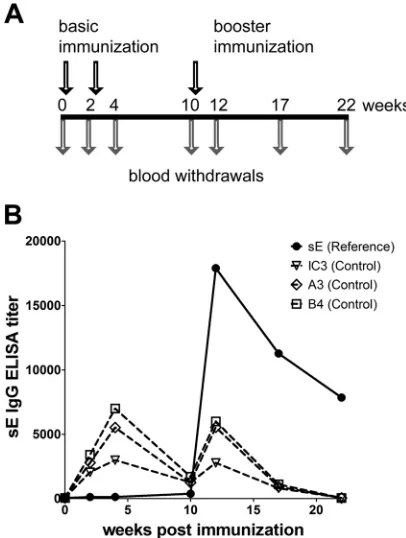
FIG 2Immunization schedule, antibody response induced by sE alone (ref-erence group), and detection of passively administered MAbs (control groups). (A) Immunization schedule. C57BL/6 mice (five mice per group) were immunized three times (arrows above time line) intraperitoneally (i.p.) with sE alone, with sE in complex with MAb IC3, A3, or B4, or with MAbs alone. Blood samples were taken at different time points (arrows below time line). (B) Results of ELISAs (using sE as an antigen) of serum pools from the sE-immunized reference group (solid line) and from control groups with pas-sively administered MAbs (dashed lines) at different time points after immu-nization.
on November 7, 2019 by guest
http://jvi.asm.org/
[image:3.585.60.263.67.336.2]form of sE, as well as with the isolated DI (MAb IC3), the isolated
DIII (MAb B4), and the isolated monomeric domain combination
of DI plus DII (DIDII) (MAb A3) (
15
).
With each of these immunogens, groups of five mice were
im-munized twice with an interval of 2 weeks between immunizations
followed by a booster immunization 8 weeks after the second
im-munization (
Fig. 2A
). In addition—to assess the persistence of
passively transferred antibodies in the blood, which could have
interfered with the analysis of immunization-induced
antibod-ies—we used control groups of mice administered each of the
MAbs without antigen at the same amount and concentration as
in the ICs. Blood samples were taken at several time points as
indicated in
Fig. 2A
, and the ELISA results (using sE as an antigen)
obtained with the sE-immunized reference group and the MAb
control groups are shown in
Fig. 2B
. The antibody response
in-duced by sE peaked at week 12 (2 weeks after the booster) and then
declined. The passively administered antibodies, however,
be-came undetectable only at week 22, and we therefore performed
all further analyses with samples of sE- and IC-immunized mice
obtained at this later time point.
Immunization with ICs does not change the extent of the
overall antibody response.
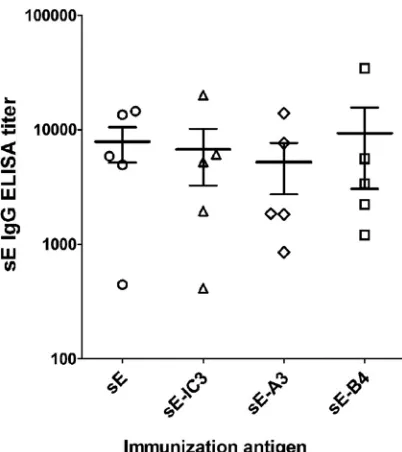
Single serum samples from all
indi-vidual mice immunized with sE alone, as well as with the ICs
sE-IC3, sE-A3, and sE-B4, taken at week 22 postimmunization,
were tested for specifically induced antibodies in ELISA using sE as
an antigen. The titers obtained for each single serum as well as
their means are displayed in
Fig. 3
. Despite substantial differences
in the results determined among the individual mice, no
signifi-cant differences in the mean serum titers were observed.
Effect on the fine specificities of antibody responses.
To find
out possible differences in the specificities of antibody
popula-tions in the polyclonal postimmunization sera, we performed
ELISAs with TBE virus sE and substructures thereof (DI, DIDII,
and DIII) and with purified whole TBE virus as well as with the
heterologous sE of WN virus for determining the extent of
cross-reactive antibodies. For all sera, we calculated the ratios of titers
obtained in the different ELISAs to the titers obtained in the TBE
virus sE ELISA. The mean values of these ratios obtained for the
reference group (mice immunized with sE only) were set to a value
of 1 (
Fig. 4A
), and all results are displayed as fold differences
relative to the mean values (
Fig. 4
).
No significant differences in the fine specificities of the
anti-body responses were found after immunization with the IC
sE-IC3 (
Fig. 4B
), in contrast to the results determined for the other
two groups, which displayed substantial deviations from the
pat-tern of the reference group (
Fig. 4C
and
D
). In the case of the
sE-B4-immunized group, the ratio of virion reactivity to sE
reac-tivity was significantly lower than in the sE-immunized
(refer-ence) group. For the other parameters, no significant differences
were found (
Fig. 4D
). After immunization with the IC sE-A3,
however, all fine-specificity parameters differed significantly and
were either increased or decreased in comparison to the reference
group parameters (
Fig. 4C
).
Evidence for epitope shielding by MAb B4.
We hypothesized
that the reduced serum reactivity with virion relative to sE found
with sera of IC sE-B4-immunized mice (
Fig. 4D
) could have been
the result of epitope shielding by MAb B4. In the context of the
virion, this epitope is part of the most exposed region of DIII (the
DIII lateral ridge) (
49
,
58
,
59
), whereas other parts of DIII are at
least partially buried at the virion surface. In contrast, in the
sol-uble form of E and the ICs thereof used for immunization, such
surfaces are accessible and can measurably induce antibodies in
ELISAs using sE or DIII as the antigen. A selective reduction of B4
epitope-specific antibodies due to epitope shielding could
there-fore potentially be revealed by a lower virion/sE ELISA titer ratio,
without affecting the DIII/sE ELISA titer ratio, as shown (
Fig. 4D
).
To test our hypothesis, we analyzed the sera of the IC
sE-B4-immunized group as well as the sera of the sE-sE-B4-immunized
refer-ence group in an ELISA using wild-type DIII and a mutant DIII
(
Fig. 5A
) as antigens. The latter contains two amino acid
substi-tutions at the lateral ridge of DIII that completely abolish binding
of MAb B4 (
46
). The titers obtained with the mutant and the wt
DIII were used to calculate the percentage of DIII-lateral-ridge
antibodies, as described in Materials and Methods, and the results
are shown in
Fig. 5B
. Consistent with the presumed epitope
shielding by MAb B4, the proportion of DIII-lateral-ridge
anti-bodies was significantly lower in the sE-B4-immunized mice than
in the reference group.
Evidence for antibody-mediated conformational changes by
MAb A3.
The differences in the ELISA reactivity patterns obtained
with sera from IC sE-A3-immunized mice and sera from the
ref-erence group patterns were quite dramatic, and all parameters
tested differed significantly (
Fig. 4C
). Antibody responses to all
three domains of E were affected (increase of the ELISA titer ratios
for DI/sE and DIDII/sE and decrease of that for DIII/sE),
substan-tially more cross-reactive antibodies were induced (WN sE/TBE
sE ELISA titer ratio), and a lower virion/sE ELISA titer ratio of the
response was observed. These data argued against a simple
shield-ing effect as described for MAb B4 but suggested a possible
anti-body-mediated structural change in the immunogen. We
there-fore analyzed the oligomeric structure of sE in the absence and
presence of different concentrations of MAb A3, using chemical
cross-linking and SDS-PAGE. The results are shown in
Fig. 6A
.
FIG 3sE-specific antibody response. ELISA titers (using sE as an antigen) of serum samples of each mouse immunized with sE, sE-IC3, sE-A3, and sE-B4 were determined. The horizontal lines show the mean titers, and the error bars represent the standard errors of the means.
on November 7, 2019 by guest
http://jvi.asm.org/
[image:4.585.62.263.64.290.2]Corresponding to its dimeric structure and previous work (
60
,
61
), cross-linking of sE yielded bands of E monomers (
⬃
50 kDa)
and dimers (
⬃
100 kDa) (
Fig. 6A
, lane 2). In the presence of MAb
A3, however, a concentration-dependent disappearance of the E
dimer band was observed, consistent with the dissociation of the E
dimer. The appearance of a band of
⬃
200 kDa indicated
cross-linking of sE monomers with the MAb (
Fig. 6A
, lanes 3 to 5).
Control experiments with MAbs B4 and IC3 (
Fig. 6B
) did not
provide evidence for such an antibody-induced dissociation of the
sE dimer. The patterns obtained with these MAbs (
Fig. 6B
, lanes 4
and 5) differed substantially from that obtained with MAb A3
(
Fig. 6B
, lane 3). Specifically, sE dimer bands were present as well
as an additional band at
⬃
250 kDa, corresponding in molecular
mass to a cross-linked complex of the sE dimer and the MAb.
To test whether the dissociation effect mediated by MAb A3
required bivalent binding to sE, we conducted a similar
experi-ment with the A3 Fab fragexperi-ment and—as a control—the Fab
frag-ment of the nondissociating MAb B4 (
Fig. 6C
). The bands
ob-served with Fab fragment B4 (
Fig. 6C
, lane 1) corresponded in
molecular masses to (i) sE monomers and the Fab fragment (both
⬃
50 kDa), (ii) sE dimers (
⬃
100 kDa), (iii) a complex of sE dimers
with one B4 Fab fragment (
⬃
150 kDa), and (iv) a complex of sE
dimers with two B4 Fab fragment molecules (
⬃
200 kDa). A
dif-ferent cross-linking pattern was obtained with the Fab fragment of
the dissociating MAb A3 (
Fig. 6C
, lane 2). Except for a band
cor-responding in molecular mass to an sE monomer-Fab fragment
complex (
⬃
100 kDa), none of the higher-molecular-mass
com-plexes were found after exposure of sE to Fab fragment A3. This
FIG 4Fine-specificity patterns of the antibody responses induced by sE and different ICs. Titer ratios of single sera (i.e., titers in ELISAs with different antigens relative to the titers in sE-ELISA), displayed as fold increase or decrease relative to the mean ratios of the reference group, were determined. (A) sE-immunized reference group. (B) IC sE-IC3-immunized group. (C) IC sE-A3-immunized group. (D) IC sE-B4-immunized group. Error bars indicate the standard errors of the means. Black stars indicate statistically significant differences from the reference group values (general linear model with Bonferroni-correctedPvalues; *,
P⬍0.05; **,P⬍0.01; ***,P⬍0.001).
on November 7, 2019 by guest
http://jvi.asm.org/
[image:5.585.104.489.65.492.2]pattern is consistent with an A3 Fab fragment-mediated
dissocia-tion of sE dimers, similar to that shown with the whole antibody.
DISCUSSION
In this immunization study, we demonstrated epitope-specific
ef-fects in the modulation of the fine specificity of polyclonal
anti-body responses to the TBE virus E protein, when applied as ICs
with two specific MAbs which have the same IgG subclass (IgG1).
The most dramatic alteration of this response was observed after
immunization with an IC containing a MAb directed against DII
(MAb A3;
Fig. 4C
). The change in a physical property of the
im-munogen, i.e., the dissociation of the E dimer by this MAb (
Fig. 6
),
provides a logical explanation for the altered specificity patterns
observed. Since the same dissociating effect was also shown with
the corresponding Fab fragment, possible influences of bivalent
binding or Fc-mediated interactions can be excluded in this case.
The MAb A3 epitope is located on the finger-like structure of DII,
involving residues of the b

-sheet and the bc-loop next to the
fusion peptide (FP) (
60
). The specificity pattern observed is fully
compatible with the antibody-mediated exposure of the FP which
is highly conserved and largely buried in the context of the E dimer
by interactions with a groove provided by DI and DIII (
Fig. 1
). By
the dissociation of the dimer, increased interactions of the FP with
B cell receptors become possible, consistent with higher
propor-tions of antibodies recognizing DII that are broadly flavivirus
cross-reactive (
Fig. 4C
). Similar epitope-specific
antibody-medi-ated structural changes have also been described for other viruses
(
62–64
). In the case of HIV, they were implicated in the enhanced
antigenicity of neutralizing antigenic sites involving the V3 loop of
gp 120 after immunization with ICs containing the HIV gp 120
(
28
,
65
).
The demonstration of TBE E dimer dissociation by MAb A3
FIG 5(A) Ribbon diagram of DIII (PDB code1SVB) in top and side views. The DIII mutant contains amino acid substitutions at positions 309 and 333, indicated as orange spheres. (B) Antibody response to the DIII-lateral-ridge epitope. Percentages of DIII-lateral-ridge ELISA antibodies in sera of mice immunized with sE or the IC sE-B4. The black star indicates a statistically significant difference between the values for the two groups (unpairedttest; *,
P⬍0.05).
FIG 6Chemical cross-linking (DMS) and SDS-PAGE of sE and ICs. Protein bands corresponding to MAbs and monomeric and dimeric forms of sE as well as complexes formed between the monomeric or the dimeric form of sE and MAbs/Fab fragments are labeled. (A) Cross-linking of sE in the presence of different concentrations of MAb A3. Lane 1, sE—not cross-linked; lane 2, sE— cross-linked; lanes 3 to 5, sE cross-linked in the presence of increasing concentrations of MAb A3 (molar ratios of MAb to sE, 1:1, 3:1, and 5:1); lanes 6 to 8, controls with MAb A3 (lane 6, sE plus A3—not cross-linked; lane 7, A3—not cross-linked; lane 8, A3— cross-linked). (B) Cross-linking of sE in the presence of MAbs A3, IC3, and B4. Lane 1, sE—not cross-linked; lane 2, sE— cross-linked; lane 3, sE cross-linked in the presence of MAb A3; lane 4, sE cross-linked in the presence of MAb IC3; lane 5, sE cross-linked in the presence of MAb B4. The molar ratio of MAb to sE was 3:1 in all cases. (C) Cross-linking of sE in the presence of Fab fragments B4 and A3. Lane 1, sE cross-linked in the presence of Fab fragment B4; lane 2, sE cross-linked in the presence of Fab fragment A3. The molar ratio of Fab fragment to sE was 5:1 in both cases.
on November 7, 2019 by guest
http://jvi.asm.org/
[image:6.585.60.266.64.211.2] [image:6.585.102.489.376.647.2]also provides a late explanation for enhancement phenomena
ob-served in competitive MAb binding studies used for epitope
map-ping (
53
). In the case of TBE virus, these analyses were conducted
with both whole antibodies and Fab fragments and had shown
that MAb A3 not only strongly increased the affinity of a broadly
flavivirus cross-reactive antibody (MAb A1) but—as revealed by
Scatchard analyses—also increased the number of binding sites,
fully compatible with a MAb A3 antibody-mediated dissociation
of E and concomitant exposure of the FP containing the MAb A1
epitope. Since the latter analyses were performed with purified
virions and not with isolated sEs, it can be concluded that MAb A3
dissociates E dimers also in the context of whole virions.
The phenomena observed with flavivirus E-antibody
com-plexes, such as the enhancement of antibody binding or the
mod-ulation of the specificity of antibody responses after IC
immuni-zation, have to be seen in the context of the dynamic nature of
proteins and protein complexes and their oscillation between
dif-ferent conformational states that can be stabilized by new
interac-tion partners. The flavivirus E protein may be especially prone to
such dynamic changes because of the flexibility of junctions
be-tween its domains (
66
) allowing adoption of a variety of
confor-mations that enable the structural changes and oligomeric
rear-rangements occurring during virus maturation, egress, and entry.
Antibody-mediated reorganizations of the oligomeric
struc-ture of E have been structurally defined by cryo-EM analyses of
whole dengue viruses in complex with Fab fragments (
21
). This
study showed that the binding of antibodies can shift the
equilib-rium structure of E at the virion surface to ensembles that are
strikingly different from those observed in the absence of
antibod-ies. The exposure of seemingly cryptic antigenic sites by breathing
phenomena can also have strong implications for the mechanisms
of antibody-mediated virus neutralization (
18
,
20
,
67–69
), and
antibody-induced disruption of dimer contacts between the FP in
one monomer and its accommodating pocket in the second
monomer by a dengue E DIII-specific antibody has been proposed
as an explanation for its neutralizing activity (
19
). It is presently
unknown whether the dissociating effect of MAb A3 is due to
antibody-mediated conformational changes that weaken E-dimer
interactions or due to the fixation of a monomeric state present in
a dimer-monomer equilibrium.
The immunomodulatory effects observed with MAb B4 are
most likely due to epitope shielding. Compared to those of MAb
A3, these effects were comparably subtle and reached statistical
significance only with a single parameter, the ratio of
virion-reac-tive antibodies to sE-reacvirion-reac-tive antibodies (
Fig. 4D
). Together with
the lacking capacity of MAb B4 to dissociate the E dimer, these
data argue against dramatic antibody-mediated structural
changes in the immunogen. Analyses with mutants of the exposed
lateral-ridge epitope in DIII (the binding site of MAb B4;
Fig. 5
)
rather suggest that the shift of antibody specificity is due to the
shielding of the epitope in the immunogen, thus restricting
acces-sibility for the B cell receptor to this specific site without impairing
the induction of antibodies to other accessible antigenic sites in
DIII. Such interactions can explain the relative reduction of levels
of virion-reactive antibodies compared to sE-reactive
antibod-ies in sera after IC sE-B4 vaccination, because—in contrast to
epitopes at the lateral ridge of DIII—substantial parts of DIII
are largely buried in the context of the closed virion shell but
are accessible in the sE dimer. The masking of B cell epitopes
has been proposed as a mechanism by which maternal
antibod-ies influence infant vaccine responses (
70
) and exert
determi-nant-specific modulatory effects on the specificity of antibody
responses (
71–74
).
It is possible that mechanisms like antibody-induced
confor-mational changes and epitope shielding also play a biological
role in a polyclonal situation by changing viral surface
struc-tures and the accessibility of certain epitopes. Such effects could
influence the antibody response in sequential flavivirus infections
or immunizations and—as a consequence—virus neutralization
or antibody-dependent enhancement of infection. Specifically, an
increase in the levels of cross-reactive, weakly neutralizing
anti-bodies could impair antibody-mediated protection and favor
pathological consequences of IC formation, similarly to those
de-scribed by Watanabe et al. (
75
) in a mouse model. In this context,
it is important that the compositions of antibody populations in
sera from different individuals and the immune dominances of
certain antibody populations can differ substantially (
15
,
16
), and
epitope-specific effects may therefore differ from individual to
individual. Such aspects can be addressed in future studies to
clar-ify their relevance in the complex and diverse settings of antibody
populations in polyclonal sera.
ACKNOWLEDGMENTS
We thank Andrea Reiter and Walter Holzer for their excellent technical assistance.
This work was supported by the Austrian Science Fund FWF (projects P25265-B21 and APW01212FW).
REFERENCES
1.Pierson T, Diamond M.2013. Flaviviruses.InKnipe DM, Howley PM, Cohen JI, Griffin DE, Lamb RA, Martin MA, Racaniello VR, Roizman B (ed), Fields virology, 6th ed (electronic). Lippincott Williams & Wilkins, Philadelphia, PA.
2.Bhatt S, Gething PW, Brady OJ, Messina JP, Farlow AW, Moyes CL, Drake JM, Brownstein JS, Hoen AG, Sankoh O, Myers MF, George DB, Jaenisch T, Wint GR, Simmons CP, Scott TW, Farrar JJ, Hay SI.2013. The global distribution and burden of dengue. Nature496:504 –507.http: //dx.doi.org/10.1038/nature12060.
3.Di Sabatino D, Bruno R, Sauro F, Danzetta ML, Cito F, Iannetti S, Narcisi V, De Massis F, Calistri P.2014. Epidemiology of West Nile disease in Europe and in the Mediterranean Basin from 2009 to 2013. Biomed Res Int2014:907852.http://dx.doi.org/10.1155/2014/907852. 4.Süss J.2011. Tick-borne encephalitis 2010: epidemiology, risk areas, and
virus strains in Europe and Asia—an overview. Ticks Tick Borne Dis2:2– 15.http://dx.doi.org/10.1016/j.ttbdis.2010.10.007.
5.Hanna JN, Ritchie SA, Phillips DA, Lee JM, Hills SL, van den Hurk AF, Pyke AT, Johansen CA, Mackenzie JS.1999. Japanese encephalitis in north Queensland, Australia, 1998. Med J Aust170:533–536.
6.Gardner CL, Ryman KD.2010. Yellow fever: a reemerging threat. Clin Lab Med30:237–260.http://dx.doi.org/10.1016/j.cll.2010.01.001. 7.Kaufmann B, Rossmann MG.2011. Molecular mechanisms involved in
the early steps of flavivirus cell entry. Microbes Infect13:1–9.http://dx.doi .org/10.1016/j.micinf.2010.09.005.
8.Pierson TC, Kielian M.2013. Flaviviruses: braking the entering. Curr Opin Virol3:3–12.http://dx.doi.org/10.1016/j.coviro.2012.12.001. 9.Smit JM, Moesker B, Rodenhuis-Zybert I, Wilschut J.2011. Flavivirus
cell entry and membrane fusion. Viruses3:160 –171.http://dx.doi.org/10 .3390/v3020160.
10. Pierson TC, Fremont DH, Kuhn RJ, Diamond MS. 2008. Structural insights into the mechanisms of antibody-mediated neutralization of fla-vivirus infection: implications for vaccine development. Cell Host Mi-crobe4:229 –238.http://dx.doi.org/10.1016/j.chom.2008.08.004. 11. Heinz FX, Stiasny K.2012. Flaviviruses and their antigenic structure. J
Clin Virol55:289 –295.http://dx.doi.org/10.1016/j.jcv.2012.08.024. 12. Dowd KA, Pierson TC.2011. Antibody-mediated neutralization of
fla-viviruses: a reductionist view. Virology411:306 –315.http://dx.doi.org/10 .1016/j.virol.2010.12.020.
on November 7, 2019 by guest
http://jvi.asm.org/
13. Beltramello M, Williams KL, Simmons CP, Macagno A, Simonelli L, Quyen NT, Sukupolvi-Petty S, Navarro-Sanchez E, Young PR, de Silva AM, Rey FA, Varani L, Whitehead SS, Diamond MS, Harris E, Lanza-vecchia A, Sallusto F.2010. The human immune response to Dengue virus is dominated by highly cross-reactive antibodies endowed with neu-tralizing and enhancing activity. Cell Host Microbe8:271–283.http://dx .doi.org/10.1016/j.chom.2010.08.007.
14. Lai CY, Tsai WY, Lin SR, Kao CL, Hu HP, King CC, Wu HC, Chang GJ, Wang WK.2008. Antibodies to envelope glycoprotein of dengue virus during the natural course of infection are predominantly cross-reactive and recognize epitopes containing highly conserved residues at the fusion loop of domain II. J Virol82:6631– 6643.http://dx.doi.org/10.1128/JVI .00316-08.
15. Jarmer J, Zlatkovic J, Tsouchnikas G, Vratskikh O, Strauss J, Aberle JH, Chmelik V, Kundi M, Stiasny K, Heinz FX.24 September 2014. Varia-tion of the specificity of the human antibody responses after tick-borne encephalitis virus infection and vaccination. J Virolhttp://dx.doi.org/10 .1128/JVI.02086-14.
16. Vratskikh O, Stiasny K, Zlatkovic J, Tsouchnikas G, Jarmer J, Karrer U, Roggendorf M, Roggendorf H, Allwinn R, Heinz FX.2013. Dissection of antibody specificities induced by yellow fever vaccination. PLoS Pathog
9:e1003458.http://dx.doi.org/10.1371/journal.ppat.1003458.
17. Pierson TC, Diamond MS.2012. Degrees of maturity: the complex struc-ture and biology of flaviviruses. Curr Opin Virol2:168 –175.http://dx.doi .org/10.1016/j.coviro.2012.02.011.
18. Austin SK, Dowd KA, Shrestha B, Nelson CA, Edeling MA, Johnson S, Pierson TC, Diamond MS, Fremont DH.2012. Structural basis of dif-ferential neutralization of DENV-1 genotypes by an antibody that recog-nizes a cryptic epitope. PLoS Pathog8:e1002930.http://dx.doi.org/10 .1371/journal.ppat.1002930.
19. Cockburn JJ, Navarro Sanchez ME, Fretes N, Urvoas A, Staropoli I, Kikuti CM, Coffey LL, Arenzana Seisdedos F, Bedouelle H, Rey FA.
2012. Mechanism of dengue virus broad cross-neutralization by a mono-clonal antibody. Structure 20:303–314. http://dx.doi.org/10.1016/j.str .2012.01.001.
20. Dowd KA, Jost CA, Durbin AP, Whitehead SS, Pierson TC.2011. A dynamic landscape for antibody binding modulates antibody-mediated neutralization of West Nile virus. PLoS Pathog7:e1002111.http://dx.doi .org/10.1371/journal.ppat.1002111.
21. Lok SM, Kostyuchenko V, Nybakken GE, Holdaway HA, Battisti AJ, Sukupolvi-Petty S, Sedlak D, Fremont DH, Chipman PR, Roehrig JT, Diamond MS, Kuhn RJ, Rossmann MG.2008. Binding of a neutralizing antibody to dengue virus alters the arrangement of surface glycoproteins. Nat Struct Mol Biol15:312–317.http://dx.doi.org/10.1038/nsmb.1382. 22. Midgley CM, Flanagan A, Tran HB, Dejnirattisai W, Chawansuntati K,
Jumnainsong A, Wongwiwat W, Duangchinda T, Mongkolsapaya J, Grimes JM, Screaton GR.2012. Structural analysis of a dengue cross-reactive antibody complexed with envelope domain III reveals the molec-ular basis of cross-reactivity. J Immunol188:4971– 4979.http://dx.doi.org /10.4049/jimmunol.1200227.
23. Pierson TC, Kuhn RJ.2012. Capturing a virus while it catches its breath. Structure20:200 –202.http://dx.doi.org/10.1016/j.str.2012.01.014. 24. Heinz FX, Stiasny K.2012. Flaviviruses and flavivirus vaccines. Vaccine
30:4301– 4306.http://dx.doi.org/10.1016/j.vaccine.2011.09.114. 25. Pierson TC, Diamond MS.2014. Vaccine development as a means to
control dengue virus pathogenesis: do we know enough? Annu Rev Virol
1:375–398.http://dx.doi.org/10.1146/annurev-virology-031413-085453. 26. Gosselin EJ, Wardwell K, Gosselin DR, Alter N, Fisher JL, Guyre PM.
1992. Enhanced antigen presentation using human Fc gamma receptor (monocyte/macrophage)-specific immunogens. J Immunol149:3477– 3481.
27. Manca F, Fenoglio D, Li Pira G, Kunkl A, Celada F.1991. Effect of antigen/antibody ratio on macrophage uptake, processing, and presenta-tion to T cells of antigen complexed with polyclonal antibodies. J Exp Med
173:37– 48.http://dx.doi.org/10.1084/jem.173.1.37.
28. Hioe CE, Visciano ML, Kumar R, Liu J, Mack EA, Simon RE, Levy DN, Tuen M.2009. The use of immune complex vaccines to enhance antibody responses against neutralizing epitopes on HIV-1 envelope gp120. Vac-cine28:352–360.http://dx.doi.org/10.1016/j.vaccine.2009.10.040. 29. Brady LJ.2005. Antibody-mediated immunomodulation: a strategy to
improve host responses against microbial antigens. Infect Immun73:671– 678.http://dx.doi.org/10.1128/IAI.73.2.671-678.2005.
30. Celis E, Chang TW.1984. Antibodies to hepatitis B surface antigen
po-tentiate the response of human T lymphocyte clones to the same antigen. Science224:297–299.http://dx.doi.org/10.1126/science.6231724. 31. Abdel-Motal UM, Wigglesworth K, Galili U.2009. Mechanism for
in-creased immunogenicity of vaccines that form in vivo immune complexes with the natural anti-Gal antibody. Vaccine27:3072–3082.http://dx.doi .org/10.1016/j.vaccine.2009.03.019.
32. Goins CL, Chappell CP, Shashidharamurthy R, Selvaraj P, Jacob J.2010. Immune complex-mediated enhancement of secondary antibody responses. J Immunol184:6293– 6298.http://dx.doi.org/10.4049/jimmunol.0902530. 33. Houston WE, Kremer RJ, Crabbs CL, Spertzel RO.1977. Inactivated
Venezuelan equine encephalomyelitis virus vaccine complexed with spe-cific antibody: enhanced primary immune response and altered pattern of antibody class elicited. J Infect Dis135:600 – 610.http://dx.doi.org/10 .1093/infdis/135.4.600.
34. Stäger S, Alexander J, Kirby AC, Botto M, Rooijen NV, Smith DF, Brombacher F, Kaye PM.2003. Natural antibodies and complement are endogenous adjuvants for vaccine-induced CD8⫹T-cell responses. Nat Med9:1287–1292.http://dx.doi.org/10.1038/nm933.
35. Villinger F, Mayne AE, Bostik P, Mori K, Jensen PE, Ahmed R, Ansari AA.2003. Evidence for antibody-mediated enhancement of simian im-munodeficiency virus (SIV) Gag antigen processing and cross presenta-tion in SIV-infected rhesus macaques. J Virol77:10 –24.http://dx.doi.org /10.1128/JVI.77.1.10-24.2003.
36. Heyman B.2003. Feedback regulation by IgG antibodies. Immunol Lett
88:157–161.http://dx.doi.org/10.1016/S0165-2478(03)00078-6. 37. Nimmerjahn F, Ravetch JV.2010. Antibody-mediated modulation of
immune responses. Immunol Rev 236:265–275. http://dx.doi.org/10 .1111/j.1600-065X.2010.00910.x.
38. Brady LJ, van Tilburg ML, Alford CE, McArthur WP.2000. Monoclonal antibody-mediated modulation of the humoral immune response against mucosally applied Streptococcus mutans. Infect Immun68:1796 –1805.
http://dx.doi.org/10.1128/IAI.68.4.1796-1805.2000.
39. Caulfield MJ, Shaffer D.1987. Immunoregulation by antigen/antibody complexes. I. Specific immunosuppression induced in vivo with immune complexes formed in antibody excess. J Immunol138:3680 –3683. 40. Coulie PG, Van Snick J.1985. Enhancement of IgG anti-carrier responses
by IgG2 anti-hapten antibodies in mice. Eur J Immunol15:793–798.http: //dx.doi.org/10.1002/eji.1830150810.
41. Wiersma EJ, Coulie PG, Heyman B. 1989. Dual immunoregulatory effects of monoclonal IgG-antibodies: suppression and enhancement of the antibody response. Scand J Immunol29:439 – 448.http://dx.doi.org /10.1111/j.1365-3083.1989.tb01143.x.
42. Zheng B, Switzer K, Marinova E, Wansley D, Han S.2007. Correction of age-associated deficiency in germinal center response by immunization with immune complexes. Clin Immunol124:131–137.http://dx.doi.org /10.1016/j.clim.2007.04.017.
43. Yao X, Zheng B, Zhou J, Xu DZ, Zhao K, Sun SH, Yuan ZH, Wen YM.2007. Therapeutic effect of hepatitis B surface antigen-antibody complex is associated with cytolytic and non-cytolytic immune re-sponses in hepatitis B patients. Vaccine25:1771–1779.http://dx.doi .org/10.1016/j.vaccine.2006.11.019.
44. Bouige P, Iscaki S, Cosson A, Pillot J.1996. Molecular analysis of the modulatory factors of the response to HBsAg in mice as an approach to HBV vaccine enhancement. FEMS Immunol Med Microbiol13:71–79.
http://dx.doi.org/10.1111/j.1574-695X.1996.tb00218.x.
45. Karlsson MC, Wernersson S, Diaz de Stahl T, Gustavsson S, Heyman B.
1999. Efficient IgG-mediated suppression of primary antibody responses in Fcgamma receptor-deficient mice. Proc Natl Acad Sci U S A96:2244 – 2249.http://dx.doi.org/10.1073/pnas.96.5.2244.
46. Zlatkovic J, Tsouchnikas G, Jarmer J, Koessl C, Stiasny K, Heinz FX.
2013. Aluminum hydroxide influences not only the extent but also the fine specificity and functional activity of antibody responses to tick-borne en-cephalitis virus in mice. J Virol 87:12187–12195. http://dx.doi.org/10 .1128/JVI.01690-13.
47. Heinz FX, Kunz C.1981. Homogeneity of the structural glycoprotein from European isolates of tick-borne encephalitis virus: comparison with other flaviviruses. J Gen Virol57:263–274.http://dx.doi.org/10.1099/0022 -1317-57-2-263.
48. Zlatkovic J, Stiasny K, Heinz FX.2011. Immunodominance and func-tional activities of antibody responses to inactivated West Nile virus and recombinant subunit vaccines in mice. J Virol85:1994 –2003.http://dx .doi.org/10.1128/JVI.01886-10.
49. Oliphant T, Nybakken GE, Austin SK, Xu Q, Bramson J, Loeb M,
on November 7, 2019 by guest
http://jvi.asm.org/
Throsby M, Fremont DH, Pierson TC, Diamond MS.2007. Induction of epitope-specific neutralizing antibodies against West Nile virus. J Virol
81:11828 –11839.http://dx.doi.org/10.1128/JVI.00643-07.
50. Heinz FX, Berger R, Tuma W, Kunz C.1983. A topological and func-tional model of epitopes on the structural glycoprotein of tick-borne en-cephalitis virus defined by monoclonal antibodies. Virology126:525–537.
http://dx.doi.org/10.1016/S0042-6822(83)80010-5.
51. Holzmann H, Stiasny K, York H, Dorner F, Kunz C, Heinz FX.1995. Tick-borne encephalitis virus envelope protein E-specific monoclonal an-tibodies for the study of low pH-induced conformational changes and immature virions. Arch Virol 140:213–221. http://dx.doi.org/10.1007 /BF01309857.
52. Kiermayr S, Stiasny K, Heinz FX.2009. Impact of quaternary organiza-tion on the antigenic structure of the tick-borne encephalitis virus enve-lope glycoprotein E. J Virol83:8482– 8491.http://dx.doi.org/10.1128/JVI .00660-09.
53. Heinz FX, Mandl C, Berger R, Tuma W, Kunz C.1984. Antibody-induced conformational changes result in enhanced avidity of antibodies to different antigenic sites on the tick-borne encephalitis virus glycoprotein. Virology133:
25–34.http://dx.doi.org/10.1016/0042-6822(84)90422-7.
54. Heinz FX, Berger R, Majdic O, Knapp W, Kunz C.1982. Monoclonal antibodies to the structural glycoprotein of tick-borne encephalitis virus. Infect Immun37:869 – 874.
55. Frey A, Di Canzio J, Zurakowski D.1998. A statistically defined endpoint titer determination method for immunoassays. J Immunol Methods221:
35– 41.http://dx.doi.org/10.1016/S0022-1759(98)00170-7.
56. Allison SL, Schalich J, Stiasny K, Mandl CW, Kunz C, Heinz FX.1995. Oligomeric rearrangement of tick-borne encephalitis virus envelope pro-teins induced by an acidic pH. J Virol69:695–700.
57. Maizel JV.1971. 5-Polyacrylamide gel electrophoresis of viral proteins. Methods Virol5:179 –246.http://dx.doi.org/10.1016/B978-0-12-470205 -9.50011-3.
58. Nybakken GE, Oliphant T, Johnson S, Burke S, Diamond MS, Fremont DH.2005. Structural basis of West Nile virus neutralization by a therapeutic antibody. Nature437:764 –769.http://dx.doi.org/10.1038/nature03956. 59. Oliphant T, Engle M, Nybakken GE, Doane C, Johnson S, Huang L,
Gorlatov S, Mehlhop E, Marri A, Chung KM, Ebel GD, Kramer LD, Fremont DH, Diamond MS.2005. Development of a humanized mono-clonal antibody with therapeutic potential against West Nile virus. Nat Med11:522–530.http://dx.doi.org/10.1038/nm1240.
60. Rey FA, Heinz FX, Mandl C, Kunz C, Harrison SC.1995. The envelope glycoprotein from tick-borne encephalitis virus at 2 A resolution. Nature
375:291–298.http://dx.doi.org/10.1038/375291a0.
61. Heinz FX, Mandl CW, Holzmann H, Kunz C, Harris BA, Rey F, Harrison SC.1991. The flavivirus envelope protein E: isolation of a solu-ble form from tick-borne encephalitis virus and its crystallization. J Virol
65:5579 –5583.
62. Clegg JC, Chanas AC, Gould EA.1983. Conformational changes in Sindbis virus E1 glycoprotein induced by monoclonal antibody bind-ing. J Gen Virol64:1121–1126.http://dx.doi.org/10.1099/0022-1317 -64-5-1121.
63. Koromyslova AD, Hansman GS.2015. Nanobody binding to a conserved epitope promotes norovirus particle disassembly. J Virol89:2718 –2730.
http://dx.doi.org/10.1128/JVI.03176-14.
64. Poignard P, Fouts T, Naniche D, Moore JP, Sattentau QJ.1996. Neu-tralizing antibodies to human immunodeficiency virus type-1 gp120 in-duce envelope glycoprotein subunit dissociation. J Exp Med183:473– 484.
http://dx.doi.org/10.1084/jem.183.2.473.
65. Kumar R, Tuen M, Li H, Tse DB, Hioe CE.2011. Improving immuno-genicity of HIV-1 envelope gp120 by glycan removal and immune com-plex formation. Vaccine 29:9064 –9074. http://dx.doi.org/10.1016/j .vaccine.2011.09.057.
66. Zhang Y, Zhang W, Ogata S, Clements D, Strauss JH, Baker TS, Kuhn RJ, Rossmann MG.2004. Conformational changes of the flavivirus E glycoprotein. Structure 12:1607–1618. http://dx.doi.org/10.1016/j.str .2004.06.019.
67. Dowd KA, Mukherjee S, Kuhn RJ, Pierson TC.2014. Combined effects of the structural heterogeneity and dynamics of flaviviruses on antibody recog-nition. J Virol88:11726 –11737.http://dx.doi.org/10.1128/JVI.01140-14. 68. Fibriansah G, Ng TS, Kostyuchenko VA, Lee J, Lee S, Wang J, Lok SM.
2013. Structural changes in dengue virus when exposed to a temperature of 37 degrees C. J Virol 87:7585–7592.http://dx.doi.org/10.1128/JVI .00757-13.
69. Fibriansah G, Tan JL, Smith SA, de Alwis AR, Ng TS, Kostyuchenko VA, Ibarra KD, Wang J, Harris E, de Silva A, Crowe JE, Jr, Lok SM.2014. A potent anti-dengue human antibody preferentially recognizes the conforma-tion of E protein monomers assembled on the virus surface. EMBO Mol Med
6:358 –371.http://dx.doi.org/10.1002/emmm.201303404.
70. Siegrist CA.2003. Mechanisms by which maternal antibodies influence infant vaccine responses: review of hypotheses and definition of main determinants. Vaccine 21:3406 –3412. http://dx.doi.org/10.1016/S0264 -410X(03)00342-6.
71. Jelonek MT, Maskrey JL, Steimer KS, Potts BJ, Higgins KW, Keller MA.
1996. Maternal monoclonal antibody to the V3 loop alters specificity of the response to a human immunodeficiency virus vaccine. J Infect Dis
174:866 – 869.http://dx.doi.org/10.1093/infdis/174.4.866.
72. Kurikka S, Olander RM, Eskola J, Kayhty H.1996. Passively acquired anti-tetanus and anti-Haemophilus antibodies and the response to Hae-mophilus influenzae type b-tetanus toxoid conjugate vaccine in infancy. Pediatr Infect Dis J 15:530 –535. http://dx.doi.org/10.1097/00006454 -199606000-00011.
73. Nohynek H, Gustafsson L, Capeding MR, Kayhty H, Olander RM, Pascualk L, Ruutu P.1999. Effect of transplacentally acquired tetanus antibodies on the antibody responses to Haemophilus influenzae type b-tetanus toxoid conjugate and tetanus toxoid vaccines in Filipino infants. Pediatr Infect Dis J 18:25–30. http://dx.doi.org/10.1097 /00006454-199901000-00008.
74. Panpitpat C, Thisyakorn U, Chotpitayasunondh T, Furer E, Que JU, Hasler T, Cryz SJ, Jr.2000. Elevated levels of maternal anti-tetanus toxin antibodies do not suppress the immune response to a Haemophilus influ-enzae type b polyribosylphosphate-tetanus toxoid conjugate vaccine. Bull World Health Organ78:364 –371.
75. Watanabe S, Chan KW, Wang J, Rivino L, Lok SM, Vasudevan SG.18 March 2015. Dengue virus infection with highly neutralizing levels of cross-reactive antibodies causes acute lethal small intestinal pathology without a high level of viremia in mice. J Virolhttp://dx.doi.org/10.1128 /JVI.00216-15.
76. Mandl CW, Guirakhoo F, Holzmann H, Heinz FX, Kunz C. 1989. Antigenic structure of the flavivirus envelope protein E at the molecular level, using tick-borne encephalitis virus as a model. J Virol63:564 –571. 77. Holzmann H, Stiasny K, Ecker M, Kunz C, Heinz FX.1997.
Charac-terization of monoclonal antibody-escape mutants of tick-borne enceph-alitis virus with reduced neuroinvasiveness in mice. J Gen Virol78(Pt 1):31–37.
on November 7, 2019 by guest
http://jvi.asm.org/
![FIG 1 Ribbon diagram of the soluble E protein dimer of TBE virus (ProteinData Bank [PDB] code 1SVB; top view) with the location of epitopes of MAbsused in this study](https://thumb-us.123doks.com/thumbv2/123dok_us/142941.20085/2.585.81.249.68.161/ribbon-diagram-soluble-protein-proteindata-location-epitopes-mabsused.webp)