Doug E. Brackney,a*Erin E. Schirtzinger,b*Thomas D. Harrison,aGregory D. Ebel,aKathryn A. Hanleyb
Arthropod-Borne and Infectious Diseases Laboratory, Department of Microbiology, Immunology and Pathology, Colorado State University, Fort Collins, Colorado, USAa ; Department of Biology, New Mexico State University, Las Cruces, New Mexico, USAb
To test the hypothesis that RNA interference (RNAi) imposes diversifying selection on RNA virus genomes, we quantified West
Nile virus (WNV) quasispecies diversity after passage in
Drosophila
cells in which RNAi was left intact, depleted, or stimulated
against WNV. As predicted, WNV diversity was significantly lower in depleted cells and significantly greater in
RNAi-stimulated cells relative to that in controls. These findings reveal that an innate immune defense can shape viral population
structure.
W
ithin hosts, RNA viruses exist as a dynamic population of
closely related viral variants termed a quasispecies. Because
quasispecies structure affects both pathogenesis and therapeutic
responsiveness, considerable attention has been devoted to
iden-tifying host responses that shape quasispecies diversity (
1
,
2
). To
date, the majority of this work has focused on the impact of
ver-tebrate adaptive immune responses on virus diversification,
par-ticularly with regard to single host viruses that establish chronic
infections (e.g., HIV and hepatitis C virus) (
3–7
).
Arthropod-borne viruses, such as West Nile virus (WNV [genus
Flavivirus
]),
transiently infect vertebrate hosts but establish chronic infections
in invertebrate vectors that lack adaptive immunity. Yet it is
known that arthropod vectors can still contribute to flavivirus
quasispecies complexity (
8
,
9
). Arthropods defend against viral
infections through several innate immune mechanisms, the most
important of which is the exogenous small interfering RNA
(exo-siRNA) pathway (
10
). This evolutionarily conserved pathway is
highly sequence specific, and single nucleotide mismatches
be-tween the siRNA and target sequence, as well as mutations that
alter secondary structure in the targeted sequence, can reduce or
abolish silencing efficacy (
11
,
12
). Both
Drosophila melanogaster
and mosquitoes lacking a functional exo-siRNA pathway are
sig-nificantly more susceptible and often succumb to viral infection
(
13–16
). Direct exo-siRNA targeting of the viral RNA genome has
been demonstrated for WNV in infected mosquitoes (
17
).
Fur-thermore, it has been observed that increased mutational diversity
is associated with intense exo-siRNA-mediated targeting of the
WNV genome in mosquitoes and that highly genetically diverse
WNV populations are more fit in mosquitoes (
17
,
18
). Together,
these findings suggest that due to its potency and sequence
speci-ficity, the RNAi pathway may shape the rate and mode of viral
evolution. Therefore, we directly assessed the impact of the
exo-siRNA pathway on shaping WNV populations passaged on cells
with either an intact, depleted, or stimulated exo-siRNA pathway.
To accomplish this,
Drosophila
S2 cells were treated with a
control double-stranded RNA (dsRNA), dsLuc, a dsRNA specific
for one of two major components of the exo-siRNA pathway,
Dicer-2 (dsDcr2) and Argonaute-2 (dsAgo2), or with anti-WNV
dsRNA (dsRNA directed to the same region of the genome as the
sequencing amplicons), using the soaking method (
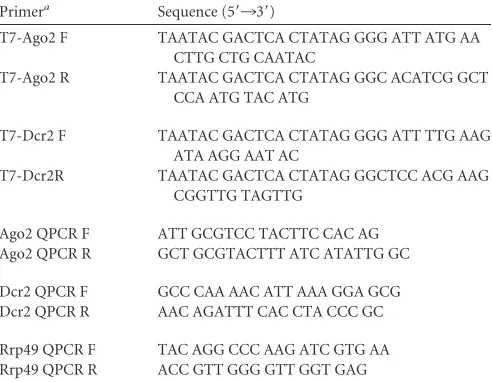
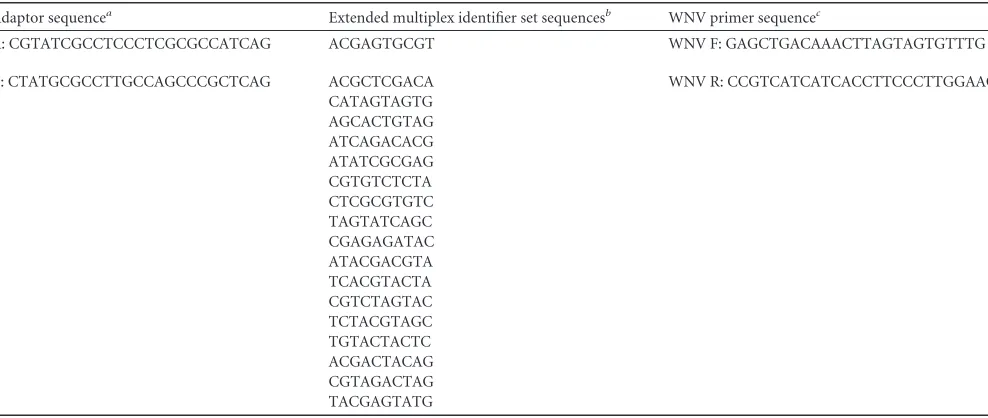
Tables 1
and
2
)
(
19–22
). Using this approach, we were able to achieve
⬃80%
sup-pression of each gene. One-step growth curve analysis of WNV
(derived from infectious clone NY99 [
23
]) following a triple
treat-ment of dsRNA (16 h prior to infection, 1 h postinfection, and 3
days postinfection [dpi]) revealed no significant difference in
WNV titers between the dsDcr2 and dsAgo2 and the dsLuc control
group, consistent with previously published findings (
20
).
Con-versely, when WNV-specific dsRNA was administered to the cells,
WNV titers were significantly reduced at early time points but
eventually rebounded to control-treated levels by 6 dpi (data not
Received9 September 2014Accepted17 January 2015
Accepted manuscript posted online28 January 2015
CitationBrackney DE, Schirtzinger EE, Harrison TD, Ebel GD, Hanley KA. 2015. Modulation of flavivirus population diversity by RNA interference. J Virol 89:4035–4039.doi:10.1128/JVI.02612-14.
Editor:K. Kirkegaard
Address correspondence to Doug E. Brackney, [email protected]. * Present address: Doug E. Brackney, The Connecticut Agricultural Experiment Station, Department of Environmental Sciences, New Haven, Connecticut, USA; Erin E. Schirtzinger, Kansas State University, College of Veterinary Medicine, Department of Diagnostic Medicine and Pathology, Veterinary Diagnostic Lab, Manhattan, Kansas, USA.
Copyright © 2015, American Society for Microbiology. All Rights Reserved.
[image:1.585.299.545.252.443.2]doi:10.1128/JVI.02612-14
TABLE 1List of primers used in this study
Primera Sequence (5=
¡3=)
T7-Ago2 F TAATAC GACTCA CTATAG GGG ATT ATG AA
CTTG CTG CAATAC
T7-Ago2 R TAATAC GACTCA CTATAG GGC ACATCG GCT
CCA ATG TAC ATG
T7-Dcr2 F TAATAC GACTCA CTATAG GGG ATT TTG AAG
ATA AGG AAT AC
T7-Dcr2R TAATAC GACTCA CTATAG GGCTCC ACG AAG
CGGTTG TAGTTG
Ago2 QPCR F ATT GCGTCC TACTTC CAC AG
Ago2 QPCR R GCT GCGTACTTT ATC ATATTG GC
Dcr2 QPCR F GCC CAA AAC ATT AAA GGA GCG
Dcr2 QPCR R AAC AGATTT CAC CTA CCC GC
Rrp49 QPCR F TAC AGG CCC AAG ATC GTG AA
Rrp49 QPCR R ACC GTT GGG GTT GGT GAG
a
Primer orientation: F, forward; R, reverse.
on November 7, 2019 by guest
http://jvi.asm.org/
shown). Because we had previously demonstrated the time course
of effective dsRNA-mediated silencing of Dcr2 and Ago2 protein
levels in S2 cells, suppression was confirmed by quantitative
re-verse transcription-PCR (qRT-PCR) in these studies (
24
).
Subsequently, we examined the effect of knockdown on WNV
population diversity. A 438-bp amplicon spanning the 5
=
[image:2.585.45.539.76.285.2]untrans-lated region (UTR)-capsid-premembrane of WNV from
popula-tions produced after a single round of infection or five passages in
TABLE 2Sequences of A and B adaptors, Roche Barcode identifiers, and WNV primers
Adaptor sequencea Extended multiplex identifier set sequencesb WNV primer sequencec
A: CGTATCGCCTCCCTCGCGCCATCAG ACGAGTGCGT WNV F: GAGCTGACAAACTTAGTAGTGTTTG
B: CTATGCGCCTTGCCAGCCCGCTCAG ACGCTCGACA WNV R: CCGTCATCATCACCTTCCCTTGGAAG
CATAGTAGTG AGCACTGTAG ATCAGACACG ATATCGCGAG CGTGTCTCTA CTCGCGTGTC TAGTATCAGC CGAGAGATAC ATACGACGTA TCACGTACTA CGTCTAGTAC TCTACGTAGC TGTACTACTC ACGACTACAG CGTAGACTAG TACGAGTATG
a
Barcodes A and B were added to the 5=end of every forward (F) and reverse (R) amplicon primer, respectively. bRoche Barcode identifiers were added 3=of the adaptors so that samples could be pooled.
c
Viral priming sequences found at the 3=end of the amplicon primers.
FIG 1WNV quasispecies diversity is reduced in RNAi-depleted cells and enhanced in cells pretreated with WNV dsRNA. Shown are the percentages of polymorphic sites normalized to read coverage during WNV passage 1 (p1) (A) and WNV passage 5 (p5) (B) in designated treatments. (C and D) Shannon-Wiener diversity (C) and evenness (D) of WNV p5 samples after passage in RNAi-depleted cells. Values represent the mean⫾standard error of the mean (SEM) from three independent replicates, with the exception of the dsDcr2 evenness group (D), in which one of the samples contained only one haplotype, and therefore the evenness was undefined. *,P⬍0.05, and ***,P⬍0.001, by two-tailed unpairedttest individually comparing experimental versus control treatments.
on November 7, 2019 by guest
http://jvi.asm.org/
[image:2.585.100.484.388.670.2]RNA interference (RNAi)-depleted and RNAi-intact S2 cells were
sequenced by pyrosequencing. Using the highly sensitive viral
variant caller V-phaser (
25
), we quantified two diversity estimates:
the percentage of polymorphic sites normalized to sequencing
coverage and the Shannon-Wiener diversity (
H
) and evenness (
E
)
estimates. No differences in percentages of polymorphic sites were
observed for populations of WNV derived from a single passage
(p1) in Dcr2- or Ago2-depleted cells (WNV p1) (
Fig. 1A
).
How-ever, when passaged five times (p5), WNV populations from cells
treated with dsDcr2 and dsAgo2 showed significant reductions in
the percentage of polymorphic sites compared to populations
pas-saged in cells treated with dsLuc (Dcr2,
P
⫽
0.03; Ago2,
P
⫽
0.03)
(
Fig. 1B
). Additionally, WNV populations passaged in
dsDcr2-and dsAgo2-treated cells were lower in both diversity dsDcr2-and
even-ness than the dsLuc controls, but these differences were not
[image:3.585.43.545.79.571.2]sig-nificant (
Fig. 1C
and
D
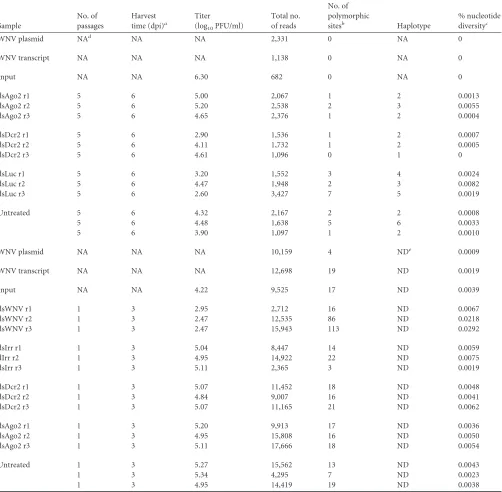
, respectively). Baseline error rates for the
TABLE 3Sample and sequencing characteristics and V-phaser output
Sample
No. of passages
Harvest time (dpi)a
Titer (log10PFU/ml)
Total no. of reads
No. of polymorphic
sitesb Haplotype
% nucleotide diversityc
WNV plasmid NAd NA NA 2,331 0 NA 0
WNV transcript NA NA NA 1,138 0 NA 0
Input NA NA 6.30 682 0 NA 0
dsAgo2 r1 5 6 5.00 2,067 1 2 0.0013
dsAgo2 r2 5 6 5.20 2,538 2 3 0.0055
dsAgo2 r3 5 6 4.65 2,376 1 2 0.0004
dsDcr2 r1 5 6 2.90 1,536 1 2 0.0007
dsDcr2 r2 5 6 4.11 1,732 1 2 0.0005
dsDcr2 r3 5 6 4.61 1,096 0 1 0
dsLuc r1 5 6 3.20 1,552 3 4 0.0024
dsLuc r2 5 6 4.47 1,948 2 3 0.0082
dsLuc r3 5 6 2.60 3,427 7 5 0.0019
Untreated 5 6 4.32 2,167 2 2 0.0008
5 6 4.48 1,638 5 6 0.0033
5 6 3.90 1,097 1 2 0.0010
WNV plasmid NA NA NA 10,159 4 NDe 0.0009
WNV transcript NA NA NA 12,698 19 ND 0.0019
Input NA NA 4.22 9,525 17 ND 0.0039
dsWNV r1 1 3 2.95 2,712 16 ND 0.0067
dsWNV r2 1 3 2.47 12,535 86 ND 0.0218
dsWNV r3 1 3 2.47 15,943 113 ND 0.0292
dsIrr r1 1 3 5.04 8,447 14 ND 0.0059
dIrr r2 1 3 4.95 14,922 22 ND 0.0075
dsIrr r3 1 3 5.11 2,365 3 ND 0.0019
dsDcr2 r1 1 3 5.07 11,452 18 ND 0.0048
dsDcr2 r2 1 3 4.84 9,007 16 ND 0.0041
dsDcr2 r3 1 3 5.07 11,165 21 ND 0.0062
dsAgo2 r1 1 3 5.20 9,913 17 ND 0.0036
dsAgo2 r2 1 3 4.95 15,808 16 ND 0.0050
dsAgo2 r3 1 3 5.11 17,666 18 ND 0.0054
Untreated 1 3 5.27 15,562 13 ND 0.0043
1 3 5.34 4,295 7 ND 0.0023
1 3 4.95 14,419 19 ND 0.0038
aSamples were harvested on the days postinfection (dpi) shown.
b
Number of polymorphic sites that were not present in the input. cPercentage of nucleotide diversity present at SNPs not found in the input.
d
NA, not applicable. eND, not determined.
on November 7, 2019 by guest
http://jvi.asm.org/
amplicon preparation and sequencing controls, which were
sub-stantially lower than those of the WNV populations themselves,
are presented in
Tables 3
and
4
.
The differences between WNV p1 and WNV p5 are consistent
with our previous findings that the selective pressures of RNAi
have a cumulative effect that is detectable only after viruses have
experienced relatively long (14-day) exposure to RNAi (
17
). As
with any study employing RNAi-mediated knockdown, the
po-tential for off-target effects must be considered (
26
,
27
); however,
because we used long dsRNA, we judge it unlikely that the
ob-served results are attributable to off-target effects (
28
). Another
possible confounder is that suppression of RNAi may have
af-fected other host factors that in turn influenced quasispecies
di-versity. For instance, it has recently been shown that the
expres-sion of Vago, a protein that suppresses WNV replication in
mosquito cells, is dependent on Dcr2 binding to dsRNA (
29
,
30
).
Interestingly, the same studies found that suppression of Ago2 did
not affect the expression levels of Vago (
29
). The fact that we
observed significantly reduced quasispecies diversity in WNV
pas-saged in both Dcr2- and Ago2-depleted cells supports the
conclu-sion that the exo-siRNA pathway directly modulates the
complex-ity of the viral mutant swarm.
We also predicted that stimulation of RNAi should increase
quasispecies diversity. As predicted, we observed a significant
in-crease in polymorphic sites in WNV populations from the cells
treated with dsWNV (3 dpi, p1) compared to the control (
P
⫽
0.0002) (
Fig. 1A
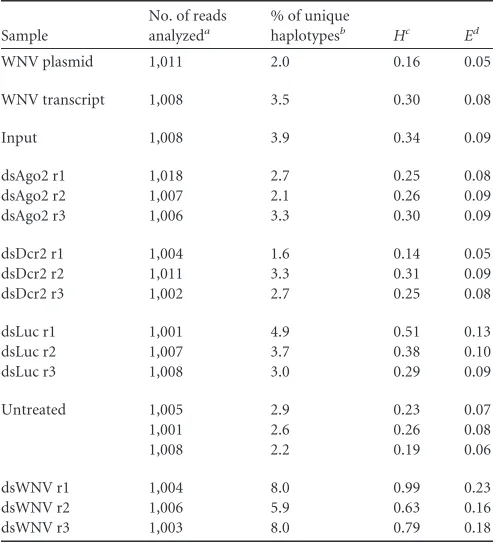
). The Shannon-Wiener diversity and evenness of
WNV from dsWNV-treated cells were also significantly greater
than those of the control (
Table 2
). These data support previous
findings that targeting viral genomes with siRNAs can lead to the
rapid emergence of escape mutants containing mutations within
the complementary sequence (
31
,
32
).
Thus, the results of this study reveal for the first time, a
mech-anism by which the innate immune system directly influences
quasispecies diversity of an RNA virus. In light of the controversy
surrounding two recent papers that reported an antiviral effect of
RNAi in undifferentiated mouse and hamster cells and suckling
mice, it would be particularly interesting to monitor WNV
quasi-species development in HEK-293 and Dicer-deficient HEK-293
cells to determine whether patterns in quasispecies diversification
differed from those observed in the RNAi-intact and
RNAi-de-pleted insect cells utilized in this study (
33–36
).
ACKNOWLEDGMENTS
This work was supported by funds from the National Institute of Allergy and Infectious Diseases, National Institutes of Health, under grant AI067380 and by Ruth L. Kirschstein National Research Service Award F32 AI084432-01 under the American Recovery and Reinvestment Act. Support was also provided by grants from the National Center for Re-search Resources (5P20RR016480-12) and the National Institute of Gen-eral Medical Sciences (8 P20 GM103451-12), as well as by pilot funds from the NMSU Genomics Core facility.
We declare that no competing interests exist for any of the authors. We thank Abhishek Prasad and Benjamin Dodd for their insightful discussions during the preparation of the manuscript and Brook Milligan and Peter Houde for assistance with pyrosequencing.
REFERENCES
1.Miura M, Maekawa S, Takano S, Komatsu N, Tatsumi A, Asakawa Y, Shindo K, Amemiya F, Nakayama Y, Inoue T, Sakamoto M, Yamashita A, Moriishi K, Enomoto N.2013. Deep-sequencing analysis of the asso-ciation between the quasispecies nature of the hepatitis C virus core region and disease progression. J Virol 87:12541–12551. http://dx.doi.org/10 .1128/JVI.00826-13.
2.Perales C, Iranzo J, Manrubia SC, Domingo E.2012. The impact of quasispecies dynamics on the use of therapeutics. Trends Microbiol20: 595– 603.http://dx.doi.org/10.1016/j.tim.2012.08.010.
3.Plauzolles A, Lucas M, Gaudieri S.2013. Hepatitis C virus adaptation to T-cell immune pressure. ScientificWorldJournal2013:673240.http://dx .doi.org/10.1155/2013/673240.
4.Woo HJ, Reifman J. 2012. A quantitative quasispecies theory-based model of virus escape mutation under immune selection. Proc Natl Acad Sci U S A109:12980 –12985.http://dx.doi.org/10.1073/pnas.1117201109. 5.Cale EM, Hraber P, Giorgi EE, Fischer W, Bhattacharya T, Leitner T, Yeh WW, Gleasner C, Green LD, Han CS, Korber B, Letvin NL.2011. Epitope-specific CD8⫹T lymphocytes cross-recognize mutant simian im-munodeficiency virus (SIV) sequences but fail to contain very early evo-lution and eventual fixation of epitope escape mutations during SIV in-fection. J Virol85:3746 –3757.http://dx.doi.org/10.1128/JVI.02420-10. 6.Erickson AL, Kimura Y, Igarashi S, Eichelberger J, Houghton M, Sidney
J, McKinney D, Sette A, Hughes AL, Walker CM.2001. The outcome of hepatitis C virus infection is predicted by escape mutations in epitopes targeted by cytotoxic T lymphocytes. Immunity15:883– 895.http://dx.doi .org/10.1016/S1074-7613(01)00245-X.
[image:4.585.40.288.96.368.2]7.Valkenburg SA, Quiñones-Parra S, Gras S, Komadina N, McVernon J, Wang Z, Halim H, Iannello P, Cole C, Laurie K, Kelso A, Rossjohn J, Doherty PC, Turner SJ, Kedzierska K. 2013. Acute emergence and reversion of influenza A virus quasispecies within CD8⫹T cell antigenic peptides. Nat Commun4:2663.http://dx.doi.org/10.1038/ncomms3663. 8.Jerzak G, Bernard KA, Kramer LD, Ebel GD.2005. Genetic variation in West Nile virus from naturally infected mosquitoes and birds suggests TABLE 4WNV p1 Shannon Wiener diversity and evenness and
percentage of unique clone estimates determined by manual alignment and analysis
Sample
No. of reads analyzeda
% of unique
haplotypesb Hc Ed
WNV plasmid 1,011 2.0 0.16 0.05
WNV transcript 1,008 3.5 0.30 0.08
Input 1,008 3.9 0.34 0.09
dsAgo2 r1 1,018 2.7 0.25 0.08
dsAgo2 r2 1,007 2.1 0.26 0.09
dsAgo2 r3 1,006 3.3 0.30 0.09
dsDcr2 r1 1,004 1.6 0.14 0.05
dsDcr2 r2 1,011 3.3 0.31 0.09
dsDcr2 r3 1,002 2.7 0.25 0.08
dsLuc r1 1,001 4.9 0.51 0.13
dsLuc r2 1,007 3.7 0.38 0.10
dsLuc r3 1,008 3.0 0.29 0.09
Untreated 1,005 2.9 0.23 0.07
1,001 2.6 0.26 0.08
1,008 2.2 0.19 0.06
dsWNV r1 1,004 8.0 0.99 0.23
dsWNV r2 1,006 5.9 0.63 0.16
dsWNV r3 1,003 8.0 0.79 0.18
aNumber of reads per subset used in determining the diversity estimates.
b
Percentage of mutant haplotypes calculated as (no. of haplotypes carrying at least 1 mutation relative to the most common haplotype/no. of reads)⫻100.
c
Shannon Weiner diversity (H) calculated as the absolute value of冱pi(lnpi), wherei signifies a unique haplotype.
d
Shannon Weiner evenness (E) calculated asH/ln(no. of haplotypes).
on November 7, 2019 by guest
http://jvi.asm.org/
quasispecies structure and strong purifying selection. J Gen Virol86: 2175–2183.http://dx.doi.org/10.1099/vir.0.81015-0.
9.Jerzak GVS, Bernard K, Kramer LD, Shi PY, Ebel GD.2007. The West Nile virus-mutant spectrum is host-dependent and a determinant of mor-tality in mice. Virology360:469 – 476.http://dx.doi.org/10.1016/j.virol .2006.10.029.
10. Prasad A, Brackney D, Ebel G.2013. The role of innate immunity in conditioning mosquito susceptibility to West Nile virus. Viruses5:3142– 3170.http://dx.doi.org/10.3390/v5123142.
11. Pusch O, Boden D, Silbermann R, Lee F, Tucker L, Ramratnam B.2003. Nucleotide sequence homology requirements of HIV-1-specific short hairpin RNA. Nucleic Acids Res31:6444 – 6449.http://dx.doi.org/10.1093 /nar/gkg876.
12. Westerhout EM, Ooms M, Vink M, Das AT, Berkhout B.2005. HIV-1 can escape from RNA interference by evolving an alternative structure in its RNA genome. Nucleic Acids Res33:796 – 804.http://dx.doi.org/10 .1093/nar/gki220.
13. Galiana-Arnoux D, Dostert C, Schneemann A, Hoffmann JA, Imler J-L. 2006. Essential functionin vivofor Dicer-2 in host defense against RNA viruses inDrosophila. Nat Immunol7:590 –597.http://dx.doi.org/10.1038 /ni1335.
14. Keene KM, Foy BD, Sanchez-Vargas I, Beaty BJ, Blair CD, Olson KE. 2004. RNA interference acts as a natural antiviral response to O’nyong-nyong virus (Alphavirus;Togaviridae) infection ofAnopheles gambiae. Proc Natl Acad Sci U S A101:17240 –17245.http://dx.doi.org/10.1073 /pnas.0406983101.
15. Myles KM, Wiley MR, Morazzani EM, Adelman ZN.2008. Alphavirus-derived small RNAs modulate pathogenesis in disease vector mosquitoes. Proc Natl Acad Sci U S A105:19938 –19943.http://dx.doi.org/10.1073 /pnas.0803408105.
16. Wang XH, Aliyari R, Li WX, Li HW, Kim K, Carthew R, Atkinson P, Ding SW.2006. RNA interference directs innate immunity against viruses in adult Drosophila. Science 312:452– 454. http://dx.doi.org/10.1126 /science.1125694.
17. Brackney DE, Beane JE, Ebel GD.2009. RNAi targeting of West Nile virus in mosquito midguts promotes virus diversification. PLoS Pathog 5:e1000502.http://dx.doi.org/10.1371/journal.ppat.1000502.
18. Fitzpatrick KA, Deardorff ER, Pesko K, Brackney DE, Zhang B, Bedrick E, Shi PY, Ebel GD.2010. Population variation of West Nile virus confers a host-specific fitness benefit in mosquitoes. Virology404:89 –95.http: //dx.doi.org/10.1016/j.virol.2010.04.029.
19. Feinberg EH, Hunter CP.2003. Transport of dsRNA into cells by the transmembrane protein SID-1. Science301:1545–1547.http://dx.doi.org /10.1126/science.1087117.
20. Chotkowski HL, Ciota AT, Jia Y, Puig-Basagoiti F, Kramer LD, Shi PY, Glaser RL.2008. West Nile virus infection ofDrosophila melanogaster induces a protective RNAi response. Virology377:197–206.http://dx.doi .org/10.1016/j.virol.2008.04.021.
21. Rogers SL, Rogers GC.2008. Culture ofDrosophilaS2 cells and their use for RNAi-mediated loss-of-function studies and immunofluorescence microscopy. Nat Protoc 3:606 – 611. http://dx.doi.org/10.1038/nprot .2008.18.
22. Xu J, Cherry S.2014. Viruses and antiviral immunity inDrosophila. Dev Comp Immunol42:67– 84.http://dx.doi.org/10.1016/j.dci.2013.05.002.
23. Shi PY, Tilgner M, Lo MK, Kent KA, Bernard KA. 2002. Infectious cDNA clone of the epidemic West Nile virus from New York City. J Virol 76:5847–5856.http://dx.doi.org/10.1128/JVI.76.12.5847-5856.2002. 24. Mukherjee S, Hanley K.2010. RNA interference modulates replication of
dengue virus inDrosophila melanogastercells. BMC Microbiol10:127.
http://dx.doi.org/10.1186/1471-2180-10-127.
25. Macalalad AR, Zody MC, Charlebois P, Lennon NJ, Newman RM, Malboeuf CM, Ryan EM, Boutwell CL, Power KA, Brackney DE, Pesko KN, Levin JZ, Ebel GD, Allen TM, Birren BW, Henn MR.2012. Highly sensitive and specific detection of rare variants in mixed viral populations from massively parallel sequence data. PLoS Comput Biol8:e1002417.
http://dx.doi.org/10.1371/journal.pcbi.1002417.
26. Aleman LM, Doench J, Sharp PA.2007. Comparison of siRNA-induced off-target RNA and protein effects. RNA13:385–395.http://dx.doi.org/10 .1261/rna.352507.
27. Jackson AL, Burchard J, Schelter J, Chau BN, Cleary M, Lim L, Linsley PS.2006. Widespread siRNA “off-target” transcript silencing mediated by seed region sequence complementarity. RNA12:1179 –1187.http://dx.doi .org/10.1261/rna.25706.
28. Myers JW, Chi JT, Gong D, Schaner ME, Brown PO, Ferrell JE.2006. Minimizing off-target effects by using diced siRNAs for RNA interference. J RNAi Gene Silencing2:181–194.
29. Deddouche S, Matt N, Budd A, Mueller S, Kemp C, Galiana-Arnoux D, Dostert C, Antoniewski C, Hoffmann JA, Imler J-L.2008. The DExD/ H-box helicase Dicer-2 mediates the induction of antiviral activity in Dro-sophila. Nat Immunol9:1425–1432.http://dx.doi.org/10.1038/ni.1664. 30. Paradkar PN, Trinidad L, Voysey R, Duchemin J-B, Walker PJ.2012.
Secreted Vago restricts West Nile virus infection inCulexmosquito cells by activating the Jak-STAT pathway. Proc Natl Acad Sci U S A109:18915– 18920.http://dx.doi.org/10.1073/pnas.1205231109.
31. Boden D, Pusch O, Lee F, Tucker L, Ramratnam B. 2003. Human immunodeficiency virus type 1 escape from RNA interference. J Virol 77:11531–11535.http://dx.doi.org/10.1128/JVI.77.21.11531-11535.2003. 32. Gitlin L, Stone JK, Andino R.2005. Poliovirus escape from RNA inter-ference: short interfering RNA-target recognition and implications for therapeutic approaches. J Virol79:1027–1035.http://dx.doi.org/10.1128 /JVI.79.2.1027-1035.2005.
33. Bogerd HP, Skalsky RL, Kennedy EM, Furuse Y, Whisnant AW, Flores O, Schultz KL, Putnam N, Barrows NJ, Sherry B, Scholle F, Garcia-Blanco MA, Griffin DE, Cullen BR.2014. Replication of many human viruses is refractory to inhibition by endogenous cellular microRNAs. J Virol88:8065– 8076.http://dx.doi.org/10.1128/JVI.00985-14.
34. Cullen BR, Cherry S, ten Oever BR. 2013. Is RNA interference a physiologically relevant innate antiviral immune response in mam-mals? Cell Host Microbe 14:374 –378. http://dx.doi.org/10.1016/j .chom.2013.09.011.
35. Li Y, Lu J, Han Y, Fan X, Ding SW.2013. RNA interference functions as an antiviral immunity mechanism in mammals. Science342:231–234.
http://dx.doi.org/10.1126/science.1241911.
36. Maillard PV, Ciaudo C, Marchais A, Li Y, Jay F, Ding SW, Voinnet O. 2013. Antiviral RNA interference in mammalian cells. Science342:235– 238.http://dx.doi.org/10.1126/science.1241930.
on November 7, 2019 by guest
http://jvi.asm.org/