UNIVERSITI TEKNIKAL MALAYSIA MELAKA
DEVELOPMENT OF VERTICAL BANDSAW MACHINE AND
JIG FOR CUSTOMIZED PLASTIC PRODUCTION
This report submitted in accordance with requirement of the Universiti Teknikal Malaysia Melaka (UTeM) for the Bachelor Degree of Manufacturing Engineering
(Manufacturing Process)(Hons.)
by
WAN MUHAMAD FARHAN BIN WAN ZIN
B051010129
880410-06-5383
DECLARATION
I hereby, declared this report entitled “Development of Vertical Bandsaw Machine and Jig for Customized Plastic Production” is the results of my own research
except as cited in references.
Signature : ………
Author’s Name : WAN MUHAMAD FARHAN BIN WAN ZIN
APPROVAL
This report is submitted to the Faculty of Manufacturing Engineering of UTeM as a partial fulfillment of the requirements for the degree of Bachelor of Manufacturing Engineering (Process) (Hons.). The member of the supervisory is as follow:
i
ABSTRAK
ii
ABSTRACT
iii
DEDICATION
iv
ACKNOWLEDGEMENT
First and foremost, I would like to express my highest appreciation to my supportive academic supervisor, Dr. Hadzley B. Abu Bakar. His supervision and support that gave me truly helps during the period of conducting my thesis. His never-ending supply of valuable advice and guidance has enlightens me and deeply engraved in my mind.
Next, I would like to dedicate my thankfulness to machinery laboratory technicians, who has been so warmth and kind to provide sincere assistance and good cooperation during the training period. Their co-operation is much indeed appreciated. In addition, I would like to thanks to FKP lecturers, for their assistance, which really spends their time to teach me a lots of knowledge regarding to the design development.
v
TABLE OF CONTENT
Abstrak i
Abstract ii
Dedication iii
Acknowledgement iv
Table of Content v
List of Tables ix
List of Figures x
List Abbreviations, Symbols and Nomenclatures xii
CHAPTER 1: INTRODUCTION 1
1.1 Background of Project 1
1.2 Problem Statement 2
1.3 Objective 3
1.4 Scope of project 3
1.5 Importance of Study 3
CHAPTER 2: LITERATURE REVIEW 4
2.1 Developing the Bandsaw Application 4
2.1.1 Materials of Choice 5
2.2 Component on Vertical Bandsaw Machine 6
2.2.1 Electric Motor 6
2.2.1.1 Sizing Electric Motor for Motion Control 6 2.2.1.2 Start and Running Torque Requirement 7 2.2.1.3 Running or Operating Torque Equation 8 2.2.1.4 Electric Motor Application and Operation 8
2.2.2 Bandsaw Blade 11
2.2.3 Bearings 11
2.2.3.1 General Application Guidelines 12
vi 2.2.3.3 Ball Bearings Application and Overview 13 2.2.3.4 Miniature Bearing Application 14 2.2.3.5 Thin Section Bearing Application 15
2.2.4 Gears 16
2.2.4.1 Basics 17
2.2.4.2 Type of Gear 18
2.2.5 Belting System (V-Belt) 22
2.2.5.1 Operation 22
2.2.5.2 Sizes 22
2.2.5.3 V-Belt Analysis 24
2.2.6 Shafts 25
2.2.6.1 Procedure for Design and Analysis of Shaft 26
2.3 Jigs and Fixtures 29
2.3.1 Application and Classification of Jig and Fixture 31
2.4 Location 32
2.4.1 Principle 32
2.4.2 Location Method 33
2.4.2.1 Location from Plane Surfaces 33
2.4.2.2 Location from Profile 34
2.4.2.3 Location from Cylinder 34
2.4.3 Calculation 35
2.5 Clamping 35
2.5.1 Principle of Clamping 35
2.5.2 Calculation 36
2.6 Fixture Design 37
2.6.1 The Fixture Design 37
2.6.2 Part Prints 37
2.6.3 Fixture Drawing 38
2.6.4 The Frame 38
2.6.5 Locator 39
2.6.6 Clamps 39
2.6.7 Bushings 40
vii
2.6.9 Fastener 40
CHAPTER 3: METHODOLOGY 41
3.1 Overview 41
3.2 Overall Methodology 44
3.2.1 Design Concept 45
3.2.1.1 Design of Vertical Bandsaw Machine 45
3.2.1.2 Design of Feeding Table 48
3.2.2 Design For Assembly 51
2.2.3 Selection of Materials and Processes 51
3.2.4 Best Design Concept 51
3.2.5 Design for Manufacture 51
3.2.6 Prototype 51
3.2.7 Suggestion for Simplification of Product 52
3.2.8 Identification Process 52
3.2.9 Detail Design for Minimum Manufacturing Cost 52
3.2.10 Production 52
3.3 Pugh Method 53
3.3.1 Concept Selection 53
3.4 Embodiment Design 56
3.4.1 Final Concept Selected 56
3.4.2 Material Selection for a New Product or New Design 56 3.4.3 Material Selection for Bandsaw Machine 57
3.4.3.1 Cover 57
3.4.3.2 Gear 59
3.4.3.3 V-Belt 59
3.4.3.4 Shaft 60
3.4.3.5 Bearings 60
3.5 Manufacturing Process Selection 61
CHAPTER 4: RESULT AND DISCUSSION 63
viii 4.1.2 Components Assembly of Vertical Bandsaw Machine 66 4.2 Development of Sintering Jig 68 4.2.1 Fabrication Process of Jig’s Frame 68 4.2.2 Fabrication Process of Jig’s Clamp 71 4.2.3 Joining Process of Jig’s Wheels 73
4.3 Analysis on Vertical Bandsaw Machine 74
4.3.1 Burr Formation 74
4.3.2 Cutting by Using Handsaw 74
4.33 Cutting by Using Bandsaw Machine 75
4.4 Discussion 77
4.4.1 Overview of Bandsaw Machine Development 77 4.4.2 Overview of Sintering Jig Development 77
CHAPTER 5: CONCLUSION 79
5.1 Conclusion 79
5.2 Recommendation 80
REFERENCES 81
ix
LIST OF TABLES
2.1 Standard Groove Dimension 23
2.2 Deep Groove Dimension 23
3.1 Pugh Method Table for Bandsaw Machine 54
3.2 Pugh Method Table for Sintering Jig 55
x
LIST OF FIGURES
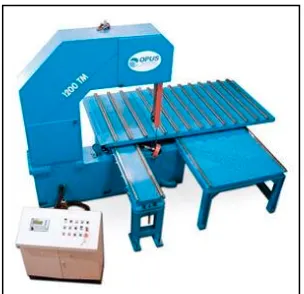
1.1 Vertical Bandsaw Machine with Feeding Table 2
1.2 Work piece Dimension 2
2.1 Cross Section of Synchronous Motor 8
2.2 Cross Section of Stepper Motor 9
2.3 AC Induction Motor Rotor 10
2.4 Spring and Swage Set 11
2.5 Variety of Bearings 12
2.6 Cross Section of Bearing 14
2.7 Miniature Bearing 15
2.8 Thin-section Bearings for Robots 16
2.9 Gearing System 16
2.10 Rotation of Gear 17
2.11 Cross Section of Worm Gear 18
2.12 Spur Gear 19
2.13a Helical Gear 20
2.13b Cross Helical Gear 20
2.14 Bevel Gear 21
2.15 Spiral Bevel Gears 21
2.1.6 V-Belts Pulley Sheave Sizes 23
2.1.7 Shaft with Bearing 25
3.1 Flowchart of Project Planning 42
3.2 Step Taken in a Design of a Vertical Bandsaw Machine 44
3.3 Bandsaw Design 1 45
3.4 Bandsaw Design 2 46
3.5 Bandsaw Design 3 47
3.6 Sintering Jig Design 1 48
xi
3.8 Sintering Jig Design 3 50
4.1 Measuring Process by Using Measuring Tape 64 4.2 Cutting Process of Bar Using Horizontal Bandsaw 64
4.3 Drilling Process 65
4.4 Measuring Process 68
4.5 Cutting Process of Material by Using Disc Cutter 69 4.6 Metal Inert Gas (MIG) Welding Equipment 69 4.7 The Frame Alignment and Stability is Checked by Using Water
Lever Scale 70
4.8 Clamp Locator 71
4.9 Threaded Screw 72
4.10 Steel Rod Handles for Threaded Screw 72
4.11 Wheel with a Lock Function 73
4.12 The Jig for Clamping the Customized Plastic 73
4.13 Large Burr Formation 75
4.14 Distortion Defect at the Joint of Sintered Plastic 75
4.15 Smaller Size of Burr Formation 76
xii
LIST OF ABBREVIATIONS, SYMBOLS AND
NOMENCLATURE
AC - Alternate Current
AISI - American Iron and Steel Institute ASB - Acrylonitrile-butadiene-styrene DC - Direct Current
HB - Brinell Hardness HR - Rockwell Hardness
PP - Polypro
PET - Polyethylene Terephthalate
1
1.1 Background of project
In Malaysia, the technology of polymer processing is improved drastically and one type of the polymer is the recycle plastic. The recycle plastic is widely used in the various applications. One of the recycle plastic application is in the constructing the structural support for load. The process that involve in production of customized plastic is the sintering process. The sintering process is conducted in the large sintering chamber. Therefore, the jig is needed in order to hold and press the customized plastic in the sintering chamber.
The main function of jig and fixture is to hold and locate the work piece for the various type of machining. Usually, the jig and fixture is used for the operation of small parts. The special jig is needed to hold and press the customized plastic due to large dimension of the structural support. The sintering process will be done by Department of Civil Engineering at the University Tun Hussein Onn Malaysia.
After the customized plastic is sintered, it must be cut into various sizes for the structural support platform. Usually, a plastic is cut by using laser cutting and water jet abrasive particle, however it is only ideals for the thin part dimension because the thickness of material can affected the cutting quality. The vertical band saw machine is the most suitable machine to cut the large dimension of recycles plastic with the minimum cost required.
INTRODUCTION
2 1m
1.2 Problem Statement
[image:18.595.245.397.585.732.2]The structural support for load is produced by using the customized plastic. The raw material of the customized plastic comes in a tubular shape with a length of 1 meter, and then it is sintered to create a dimension 1m x 1m x 1m (Figure 1.1). The structured of the structural support is honeycomb structure. In order to have a good joining between each customized plastic, it must be press uniformly during sintering process. Therefore, the special jig is needed to hold and press the customized plastic to produce a structural support.
Figure 1.1: Structural support (Hasanah, 2013)
Occasionally, structural support material is produced from the customized plastic, it is considered as a soft material and common technique to cut this material is by using a vertical bandsaw machine. However, most vertical bandsaw just enable to cut about 20-30cm height (Figure 1.2). To cut 1m x 1m x 1m height of product with the good surface finish, the machine have to be customized.
3
1.3Objectives
The main objective of this research is:
i. To develop a vertical bandsaw machine.
ii. To fabricate a jig for sintering process of customized plastic.
1.4 Scope of Project
This research and development is focus on the functionality of jig for the sintering process of customized plastic and the surface finish analysis of vertical bandsaw machine to cut the customized plastic plastic. The customize plastic that will be sintering and cut is Polypropylene (PP) with the dimension of 1m x 1m x 1m. The performance measure to be evaluated is clamping ability of the jig and the cutting ability of vertical bandsaw machine.
1.5 Importance of Study
4
2.1 Developing the bandsaw machine application
Band sawing uses a continuous band, welded to form a loop. The band sawing process is continuous. The band is tensioned between two pulleys-known as bandwheels-mounted on a bow (the nomenclature is derived from hack sawing). One of the band wheels is the “lay” or nondriven wheel. Generally, this wheel is arranged in an assembly which allows the band to be tensioned either mechanically or-more usually in modern machinery-via a hydraulic cylinder. The other wheel is driven by an electric motor and gearbox configuration. The band runs through a system of guides-usually roller bearings and preloaded carbide pads-to keep it running true through the material, mechanical variators arranged between motor and gearbox were employed to provide variable band speed. More recently, frequency-regulated motors feeding directly into the gearbox have become the normal.
Although a different design exist, bandsaws split into two basic configurations which are vertical and horizontal, it is based on the attitude of the band. Vertical machines are commonly used in tool room applications and in lighter structural applications. Heavy-duty billet sawing and the heavier structural applications favor the horizontal arrangement since this allows a closed, “box” type construction whereby the bow assembly runs in a gantry straddling the material and rigidly attached to the base of the machine. This setup allows maximum band tension and counteracts bow/blade deflection. Lighter-weight horizontal machines often employ a pivot-mounted bow which arcs in a similar fashion to the hack saw. (Manufacturing Engineering Handbook, 2004)
LITERATURE REVIEW
5 When developing a new design of vertical bandsaw machine for machining application, many of the time-tested classic design philosophies still apply. In addition, with the advent of new technologies, particularly in motor and hydraulic controls, many improvements and innovations are possible.
When embarking on a new design, one must consider many parameters which define the problem to be solved. Many of these parameters are dependent on each other and the design becomes an iterative process. First, one must consider the maximum live load to be deployed by the bandsaw mounting and the desired cutting speed.
2.1.2 Materials of Choice
At this point, the material for the bandsaw machine and feeding table must be decided. For most applications, steel is appropriate. If the bandsaw machine is meant to be transportable, aluminium may be the material of choice. For some rare applications such as a bandsaw machine is built to cut a high temperature workpiece, selected and expensive materials such as titanium may be considered. Each of these materials has their own unique characteristics and requires certain manufacturing techniques. Although some end-users may feel that steels would have a superior strength properties compared to aluminum, with a good method of machine development and minimal maintenance, an aluminum bandsaw’s structure can provide a good dimension stability of the machined work piece.
6
2.2 Components on Vertical Bandsaw Machine
2.2.1 Electric Motor
Basically, an electric motor is the most important part in the machine especially vertical bandsaw machine. The function of an electric motor in bandsaw machine is to rotate the bandsaw blade which is attached to the wheels. The blade must suitable to the bandsaw application so that the material being cut has good surface properties. Besides that, the determination of electric motor also important in order to reduce the machining time, production cost and labor cost. There is various type of electric motor in the market which is depending on its application.
2.2.1.1 Sizing Electric Motor for Motion Control
To size an electric motor for a particular drive application the designer must first analyze the mechanics of the drive application. The following must be determined: (Edge Engineering, 2006)
a) Friction of the bearings, or other mechanical elements. b) The weight or load to be driven by the electric motor.
c) Inertia of the mass to be moved or controlled. Acceleration and deceleration forces should be analyzed.
d) Mechanical system type and number of linkages.
Friction – The friction may be determined by estimation, component specification or by measuring by the use of a torque reading device or mechanism.
Weight or Mass – The mass may be calculated using 3D CAD, specific or direct measurement.
7 Mechanical System – There are roughly four categories of mechanical drive systems.
a) Direct drive b) Gear drive c) Tangential drive
d) Lead-screw or worm-gear
2.2.1.2 Start and Running Torque Requirements, and Calculations.
When determining the torque requirements for an electric motor, consideration should be given to the load and start time demands during the start duration, operating torque, and peak load torque. The starting torque is dependant on the number of times an electric motor will have to start in a given time, as well as, the duration of the start cycle. The actual start torque applied should be many times greater than the actual start torque required by the application. The greater difference in torque applied by the motor and the start torque required by the application, the faster the applied acceleration of the electric motor. The time duration required to accelerate an application from a dead stop to operating speed is given by the following:
T = ( N x WR2 ) / (Ta x 308)
Where:
T = Time (seconds)
N = Velocity at load (rpm)
Ta = Average torque during start (ft-lbs) WR2 = Rotating inertia (lbs-ft3)
W = Weight (lbs)
R = Radius of gyration (ft2)
8
2.2.1.3 Running or operating torque equation:
To = (5250 x HP) / N
Where:
To = Operating or running torque (ft-lbs) HP = Horse power delivered by electric motor N = Rotational velocity (rpm)
5250 = Constant converting horse power to ft-lbs
Use the peak horse power to determine the maximum operating torque.
2.2.1.4 Electric Motor Application and Operation
(i) Synchronous Motors