The
ha72
Core Gene of Baculovirus Is Essential for Budded Virus
Production and Occlusion-Derived Virus Embedding, and Amino Acid
K22 Plays an Important Role in Its Function
Huachao Huang,aManli Wang,aFei Deng,aDianhai Hou,aBasil M. Arif,bHualin Wang,aZhihong Hua
State Key Laboratory of Virology and Joint Laboratory of Invertebrate Virology, Wuhan Institute of Virology, Chinese Academy of Sciences, Wuhan, People’s Republic of Chinaa
; Laboratory for Molecular Virology, Great Lakes Forestry Centre, Sault Ste. Marie, Ontario, Canadab
ha72ofHelicoverpa armigeranucleopolyhedrovirus (a homologue ofac78) was identified as a conserved late baculovirus gene and characterized. HA72 localizes in the intranuclear ring zone. By generating mutants, we showed that HA72 is essential for budded virus (BD) production and occlusion-derived virus (ODV) embedding. HA72 also interacted with P33, a baculoviral sul-fhydryl oxidase. A point mutation of amino acid 22 from lysine to glutamic acid curtailed BV production and precluded ODV occlusion as well as interaction with P33.
B
aculoviruses are pathogens that infect insects from the ordersLepidoptera,Diptera, andHymenoptera(1). To date, 60 bacu-lovirus genomes have been fully sequenced, and all of them
con-tain the 37 core genes (2) that play critical roles in baculovirus
infection.ac78is a newly identified baculovirus core gene (2). A
previous study showed that deletion of the homologue ofac78
(bm64) in Bombyx mori nucleopolyhedrovirus (BmNPV)
pre-vented the production of infectious budded virus (BV) (3). Its
homologue inHelicoverpa armigeraNPV (HA72) was shown to be
a component of the occlusion-derived virus (ODV) envelope (4).
However, its role in the viral life cycle is still unclear, and the present study was undertaken to provide initial biochemical, mi-croscopic, and genetic characterizations of HA72.
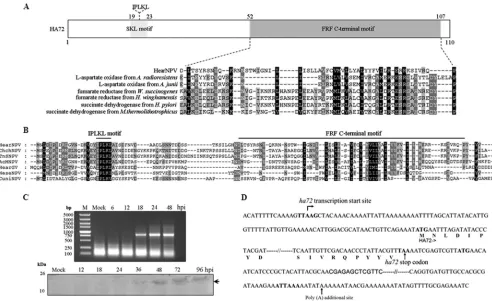
HA72 contains an IPLKL motif and a putative fumarate re-ductase flavoprotein C-terminal motif.Bioinformatics analysis
showed that HA72 has two recognized motifs (Fig. 1A): an IPLKL
motif at the N terminus, required for a peroxisome-targeting
sig-nal in plants (5), and a putative fumarate reductase flavoprotein
(FRF) C-terminal motif that has been implicated in electron
transfer in the oxidation-reduction process (6,7). The IPLKL
mo-tif is highly conserved in all baculoviral HA72 homologues, while the FRF-C is conserved at a low amino acid identity in all of the
baculoviruses (Fig. 1AandB).
Time course analyses of transcription and expression sug-gest thatha72 is a late gene.Reverse transcription-PCR (RT-PCR) and Western blotting were performed to assess the temporal
transcription and expression ofha72. The data summarized inFig.
1Cshow that transcription was first detected at 18 hours
postin-fection (hpi). A rabbit polyconal antibody against the full length of HA72 was used for Western blotting, and a specific
immunoreac-tive band was initially detected at 36 hpi, indicating thatha72is a
late gene. The gene-specific primerha72up-R (Table 1) was used
for 5=-random amplification of cDNA ends (5=-RACE) and,
con-sistent with the above data, sequencing of the 5=-RACE products
showed that expression of theha72transcript was initiated from
the first A of a late gene transcriptional start site motif, TTAAG at
87 nucleotides upstream of the predicted start codon. For the 3=
-RACE analysis, an oligo(dT)15three-site adaptor primer was used
for generating cDNA, and subsequent PCR amplification was
per-formed by using a three-site adaptor primer and anha72-specific
forward primer (Table 1). The 3=-RACE analysis showed thatha72
uses a polyadenylation signal motif, ATTAAA at 480 nucleotides
downstream of its stop codon (Fig. 1D). InAutographica
califor-nicamultiple NPV (AcMNPV),ac78expression is initiated at 12
hpi from the late transcriptional motif TTAAG, and its mRNA is
polyadenylated (8).
HA72 is essential for BV production, and lysine at position 22 plays an important role in its function.To generate anha72
-inactivated recombinant bacmid (bHaBac⌬72) as a tool to study
the function of HA72, a portion (bp 33 to 45) of the coding
se-quence was replaced withegfpunder thehsp70promoter and also
a Cmrcassette by utilizing homologous recombination. Briefly, an
upstream fragment was amplified using the primer pairha72up-F
andha72up-R. A downstream fragment was amplified with
prim-ersha72down-F andha72down-R. The amplicons were cloned in
the pKS-egfp-Cmrvector flanking anegfp-Cmrcassette. The linear
fragment, containingegfp, Cmr, and theha72flanking sequences,
was amplified with ha72up-F and ha72down-R and
subse-quently electroporated intoEscherichia coliBW25113
harbor-ing bHaBacHZ8 and pKD46.Polyhedrinwas reintroduced into
the originalphlocus (bHaBac⌬72-ph) to monitor morphogenesis
of the occlusion bodies (OBs). A rescue bacmid, bHaBac⌬72-72
R-ph, was also generated by using the Bac-to-Bac system to contain
theha72open reading frame (ORF) andphunder the control of
their native promoters. Theha72coding sequence was amplified
with ha72R-F and ha72R-R. In order to verify that the IPLKL
motif is important for HA72 function, mutants with replacement of its lysine (K, at position 22) with positively charged arginine (R) or negatively charged glutamic acid (E) were constructed and
des-ignated bHaBac⌬72-72K22E-ph and bHaBac⌬72-72K22R-ph,
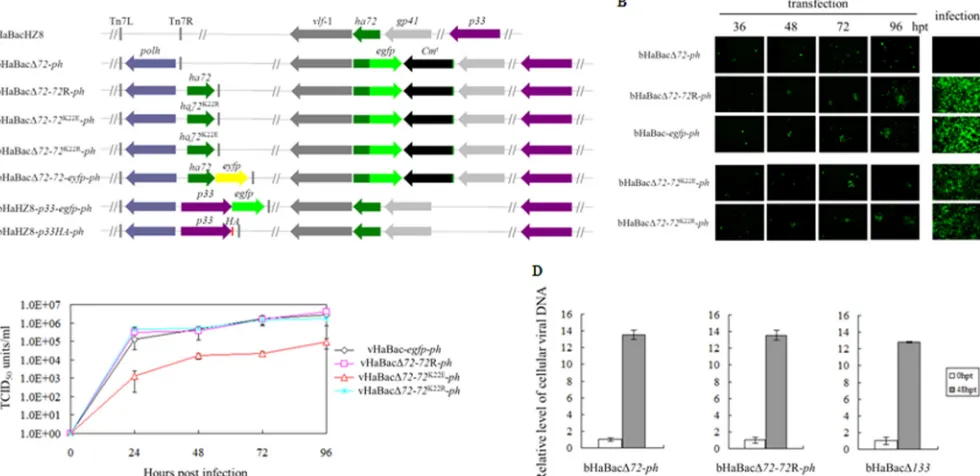
re-spectively (Fig. 2A). Anha72site-directed mutant was generated
by overlap extension PCR. For the K22E mutant, the first round of
Received14 August 2013 Accepted28 September 2013
Published ahead of print2 October 2013
Address correspondence to Zhihong Hu, [email protected].
Copyright © 2014, American Society for Microbiology. All Rights Reserved.
doi:10.1128/JVI.02281-13
on November 7, 2019 by guest
http://jvi.asm.org/
PCR entailed two parallel PCRs with the following primer pairs:
ha72R-F/ha72K22E-R and ha72K22E-F/ha72R-R. The second
round of amplification was performed withha72R-F andha72R-R
primers, using the annealed PCR products from the first round as the template. Similarly, the K22R mutant was generated with
primersha72K22R-F andha72K22R-R. All the primers used in this
studied are outlined inTable 1. Schematic diagrams for the
gen-erated constructs are shown inFig. 2A.
Cells transfected with bHaBac⌬72-ph showed only single
fluorescent cells, while neighboring green fluorescent cells were observed for cells transfected with the control bacmids
(bHaBac-egfp-ph and bHaBac⌬72-72R-ph) (Fig. 2B). When
the supernatants from the transfection mixtures were used to infect a second batch of cells, no infection was observed with
HaBac⌬72-ph, while control bacmids showed successful
infec-tion, suggesting that disruption ofha72leads to a defect in the
production of infectious BVs (Fig. 2B).
One-step growth curve assays were conducted to detect fur-ther effects of the recombinants on the production of progeny
virus. Comparable viral growth kinetics were observed with
vHaBac⌬72-72R-ph, vHaBac-egfp-ph, and vHaBac⌬72-72K22R
-ph, but statistical analysis showed that vHaBac⌬72-72K22E-phhad
significantly decreased BV titers from 24 hpi to 96 hpi
com-pared to the rescue virus, vHaBac⌬72-72R-ph (Fig. 2C). The
results indicated that K22 is needed for optimal production of infectious BV.
Inactivation of HA72 does not affect viral DNA replication.
Quantitative PCR was used to analyze the effect ofha72on viral DNA
replication by using the paired primersha39-F andha39-R.Heliothis
zea AM1 (HzAM1) cells were transfected with bHaBac⌬72-ph,
bHaBac⌬72-72R-ph, or the control bacmid, bHaBac⌬133, which
does not contain the membrane fusion protein F (9). At 0 h
posttrans-fection (hpt) and 48 hpt, intracellular viral DNA was extracted and
analyzed. The data outlined inFig. 2Dshow comparable levels of
DNA synthesis for all constructs, suggesting thatha72is not essential
for DNA replication.
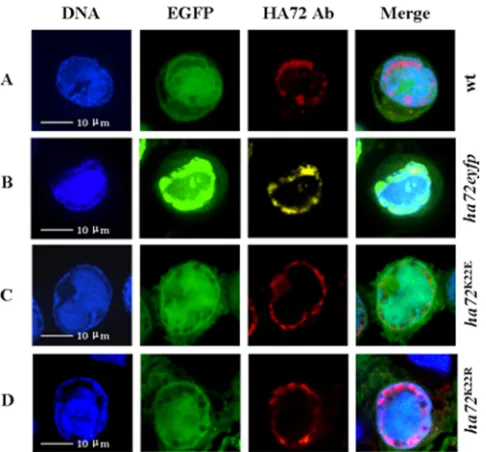
HA72 localizes in the intranuclear ring zone region during infection.Confocal microscopy was carried out on HzAM1 cells
FIG 1Characterization of HA72. (A) Map of HA72, showing the location of the IPLKL motif and a putative FRF C-terminal motif. An alignment of a portion of HA72 with representative sequences containing FRF C-terminal motifs is shown. GenBank protein accession numbers:WP_005405373.1,L-aspartate oxidase fromAcinetobacter radioresistensSK82;WP_004953071.1,L-aspartate oxidase fromAcinetobacter juniiNIPH 182;NP_907042.1, fumarate reductase from Wolinella succinogenesDSM 1740;WP_006801824.1, fumarate reductase fromHelicobacter winghamensisATCC BAA-430;WP_001941531.1, succinate dehy-drogenase fromHelicobacter pyloriGAM231Ai;WP_018153189.1, succinate dehydrogenase fromMethanothermococcus thermolithotrophicus. (B) Multiple sequence alignments ofHA72with selected baculoviral homologues. GenBank protein accession numbers:NP_075141.1, HearNPV;YP_249681.1,Chrysodeixis chalcitesNPV (ChchNPV);YP_308961.1,Trichoplusia nisingle NPV (TnSNPV);NP_054108.1, AcMNPV;YP_001649107.1, HearGV;YP_025153.1,Neodiprion sertiferNPV (NeseNPV);NP_203338.1,Culex nigripalpusNPV (CuniNPV). Alignments were constructed using the Lasergene program MegAlign and displayed with the GeneDoc software. (C) Temporal analysis ofha72transcription and expression. HzAM1cells were infected with vHaBac-egfp-ph, harvested at the indicated times, and subjected to RT-PCR (upper panel) or Western blot analysis (lower panel). A polyclonal antibody against full-lengthHA72that had been raised in rabbits was used in the Western blotting. (D) Illustration of the 5=- and 3=-RACE results forha72. The sequence ofha72with its flanking regions is shown. The late promoter (TTAAG), the start and stop codons, and the poly(A) signals are shown in boldface. The arrow indicates the location of the transcription initiation site forha72mRNA or the additional poly(A) site.
on November 7, 2019 by guest
http://jvi.asm.org/
[image:2.585.44.536.65.366.2]infected with vHaBac-egfp-phor vHaBac⌬72-72-eyfp-ph(Fig. 3A
andB). Fluorescence was captured at 48 hpi by using a laser
scan-ning confocal microscope (PerkinElmer UltraView VOX) with a laser wavelength of 488 nm for DNA (blue) stained with Hoechst 33258 (Beyotime), 561 nm for enhanced green fluorescent protein
(EGFP), 605 nm for rhodamine-conjugated secondary antibody (red; Chemicon), and 527 nm for enhanced yellow fluorescent protein (EYFP; yellow). HA72 was mainly localized to the ring
zone region (Fig. 3AandB). A small amount of fluorescence was
[image:3.585.39.560.76.245.2]also observed in the center of the nucleus (Fig. 3AandB). By
TABLE 1Primers used in the study
Primers Sequencea Restriction site(s)
Oligo(dT)15three-site adaptor primer 5=-CTGATCTAGAGGTACCGGATCCTTTTTTTTTTTTTTT-3=
Three-site adaptor primer 5=-CTGATCTAGAGGTACCGGATCC-3=
ha72-specific forward primer 5=- ATGAATTTAGATATACCCTACGA-3=
ha72up-F 5=-CCCGGTACCCGATAGAATTAAATTCTTTGTTCA-3= KpnI site
ha72up-R 5=-CCCCTCGAGGTGGACTATATTCCGCTAAAAT-3= XhoI site
ha72down-F 5=-GGGTCTAGACCGAGACGATCGTAGGGTA-3= XbaI site
ha72down-R 5=-GGGTCTAGAGATATCTGTGTCCAGTCGCAAATACC-3= XbaI and EcoRI sites
ha72R-F 5=-CGCCTCGAGAGCGACGTTCCTCAACGCT-3= XhoI site
ha72R-R 5=-CGCGCTAGCGTCCGTGGTCAATTCGAAAAT-3= NheI site
ha72K22E-R 5=-CTACGTTAAAATCGGATATAGCCAATTCTAGCGGAATATAG-3=
ha72K22E-F 5=-CTATATTCCGCTAGAATTGGCTATATCCGATTTTAACGTAG-3=
ha72K22R-F 5=-CTATATTCCGCTAAGATTGGCTATATCCGATTTTAACGTAG-3=
ha72K22R-R 5=-CTACGTTAAAATCGGATATAGCCAATCTTAGCGGAATATAG-3=
ha39-F 5=-GAAATGCGAATCAGACAGATTACTCG-3=
ha39-R 5=-CGCAACCTAACATTTGAGAACACAC-3=
aSequences of restriction sites are underlined.
FIG 2HA72 is essential for BV production but not DNA replication, and the K22E mutation curtails BV production. (A) Schematic diagrams of recombinant bacmids. Theha72ORF was partially replaced with anegfpand Cm resistance gene cassette from pKS-egfp-Cmr, which contains anegfpgene driven by anhsp70
promoter and a Cmrgene under the control of the T7 promoter, to generateha72-inactivated bacmid bHaBac⌬72. The recombinant bacmids bHaBac⌬72-ph,
bHaBac⌬72-72R-ph, bHaBac⌬72-72K22E-ph, bHaBac⌬72-72K22R-ph, and bHaBac⌬72-72-eyfp-phwere generated by Tn7-based transposition of the indicated
genes into thephlocus of bHaBac⌬72. bHaBac⌬72-p33-egfp-phandbHaBacHZ8-p33HA-phwere generated by Tn7-based transposition of the indicated genes into bHaBacHZ8. (B) Analysis of virus replication and BV production in HzAM1 cells. Fluorescence microscopy images were taken at various time posttrans-fection or at 120 hpi. (C) One-step growth curve analysis of recombinant viruses. HzAM1 cells were infected with vHaBac-egfp-ph, vHaBac⌬72-72R-ph, vHaBac⌬72-72K22E-ph, or vHaBac⌬72-72K22R-phat a multiplicity of infection of 5. Supernatants were harvested at the designated time points postinfection and
quantified for production of infectious BV by the endpoint dilution method. Data points represent average titers from triplicate infections. Error bars represent standard errors. (D) Real-time PCR analysis of viral DNA replication. HzAM1 cells were transfected with 3g bHaBac⌬72-ph, bHaBac⌬72-72R-ph, or control bacmid, bHaBac⌬133(null for thefprotein gene) through three experiments with three replicates per experiment. At the indicated time points postinfection, cells were collected to extract total DNA. Prior to quantitative PCR, DNA was digested with DpnI to avoid interference fromE. coli-derived viral DNA. Quantitative PCRs were carried out in triplicates, utilizing 1l of DpnI-treated DNA. Error bars represent the standard errors.
HA72 Is Essential for BV Production and ODV Occlusion
on November 7, 2019 by guest
http://jvi.asm.org/
[image:3.585.50.540.361.599.2]mutating K to R or E, we did not observe changes in the
intranu-clear localization of HA72 (Fig. 3CandD).
Deletion ofha72prevents ODV occlusion.Cells were
trans-fected with bHaBac⌬72-ph, harvested at 96 hpt, and prepared for
electron microscopy to observe the effects ofha72disruption on
any morphological alterations. Typical symptoms of infection, such as nuclear hypertrophy and the presence of an electron-dense virogenic stroma (VS), were observed. Nucleocapsids with a nor-mal appearance were also observed; however, they were not
em-bedded into OBs (Fig. 4A,B, andC). Therefore, inactivation of
HA72 prevented ODV occlusion.
The K22 mutation interferes with ODV occlusion. Transmis-sion electron microscopy (TEM) was also used to monitor the morphology of mutants generated from mutations in the IPLKL motif. In the K22E mutant, ODVs with a normal appearance were observed, but occlusion within OBs did not seem to take place (Fig. 4DandE). In contrast, in the K22R mutant, OBs with normal
ODV occlusion were observed (Fig. 4FandG), similar to the
con-trol viruses vHaBac⌬72-72R-ph (Fig. 4H and I) and
vHaBac-egfp-ph(Fig. 4JandK).
HA72 interacts with P33in vitroand colocalizes with P33 in infected cells.In order to investigate how HA72 participates in the process of ODV occlusion, a yeast two-hybrid (Y2H) assay was
employed to screen interactions of HA72 withHelicoverpa
armig-eraNPV (HearNPV) ODV structural proteins as described
previ-ously (10). We decided to test interactions with viral structural
proteins, because it had been shown already that HA72 is part of
the virion (4). The results showed that HA72 interacted with P33
(HA80) when it was expressed in the vectors containing either a
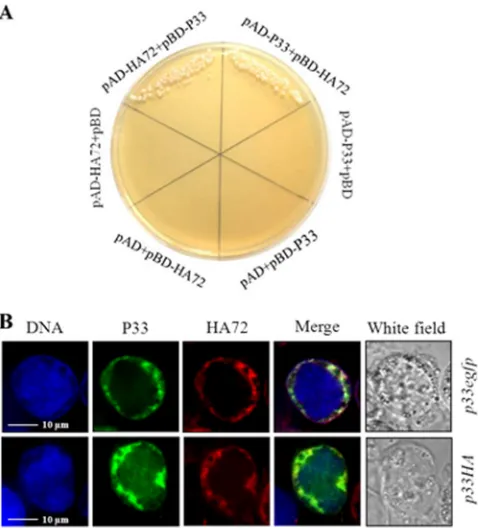
binding domain or an activation domain (Fig. 5A). The K22E
mutation abolished this interaction, while K22R did not affect the interaction (data not shown). During Y2H experiments, the inter-actions of HA72 with 38K or P49 were also detected but resulted in weak yeast growth (data not shown).
Recombinant bacmids bHaBacHZ8-p33-egfp-ph and
HaBacHZ8-p33HA-phwere constructed to study the
colocaliza-tion of HA72 and P33 (Fig. 2A). Confocal microscopy of cells
infected with vHaBacHZ8-p33-egfp-ph or vHaHZ8-p33HA-ph
showed that P33 is located at the rim of nuclei at 48 hpi (Fig. 5B).
For the hemagglutinin (HA)-tagged P33, the chimera was
primar-FIG 3Subcellular localization of HA72 in HzAM1 cells. Cells were infected with vHaBac-egfp-ph, vHaBac⌬72-72-eyfp-ph, vHaBac⌬72-72K22E-ph, or
vHaBac⌬72-72K22R-phat a multiplicity of infection of 5 and prepared for
confocal imaging at 48 hpi. For immunofluoresence assays, polyclonal antise-rum against HA72 was used as the primary antibody and stained with anti-rabbit IgG (A, B, and D) or observed via autofluorescence of HA72-EYFP chimera (B). DNA was stained with Hoechst stain. The panels on the right are merged images. Bars, 10m.
FIG 4TEM analysis. HzAM1 cells were transfected with bHaBac⌬72-ph(A to C) or infected with vHaBac⌬72-72K22E-ph(D and E), vHaBac⌬72-72K22R-ph
(F and G), vHaBac⌬72-72R-ph(H and I), or vHaBac-egfp-ph(J and K). Sam-ples were collected at 96 hpt or 96 hpi for TEM.
on November 7, 2019 by guest
http://jvi.asm.org/
[image:4.585.303.539.64.549.2] [image:4.585.43.286.65.291.2]ily probed with HA-tagged (6E2) mouse monoclonal antibody (Cell Signaling) and subsequently signaled with fluorescein
iso-thiocyanate-conjugated Affinipure goat anti-mouse IgG (H⫹L;
Proteintech). When anti-HA72 antibody was used as the probe, the colocalization of HA72 and P33 to the ring zone region was
observed (Fig. 5B). The colocalization result supported the
possi-bility of an interaction between HA72 and P33.
In summary, this study characterized the functions of a
bacu-lovirus core gene,ha72. We revealed that K22 is important for the
function of HA72, as the K22E mutation curtailed BV production and precluded ODV occlusion. As K22 is located at the conserved IPLKL motif, it will be interesting to see if the motif is important for protein function. Furthermore, protein-protein interactions showed that HA72 interacted with P33, a baculoviral sulfhydryl oxidase that plays an important role in BV production and
mul-tiple-enveloped ODV formation (11, 12). As HA72 contains a
putative FRF C-terminal motif, we suggest that HA72 and P33 work together in a redox process during baculovirus infection. At this stage, we are expending much effort to obtain enough soluble expressed HA72 to study its enzymatic activity, and we hope to demonstrate its possible role in the proposed redox process in the future. During the process of our manuscript submission, a
sim-ilar result was published by Tao et al. regarding AC78 (13). Our
data corroborate their data indicating that HA72/AC78 is a core baculoviral gene essential for the production of infectious BV and ODV occlusion but is not involved in viral DNA replication.
ACKNOWLEDGMENTS
This research was supported in part by the National Science Foundation of China (31130058 to Z.H.), the Ministry of Science and Technology of China (2009CB118903 and 2008DFB30220 to Z.H.), and a Chinese Acad-emy of Sciences visiting professorship for senior international scientists (2012T1S0019 to B.A.).
We thank Xiulian Sun for statistical analysis and Xijia Liu for making the polyclonal antibody against HA72.
REFERENCES
1.Miller LK (ed).1997. The baculoviruses. Plenum, New York, NY. 2.Garavaglia MJ, Miele SAB, Iserte JA, Belaich MN, Ghiringhelli PD.
2012. The ac53, ac78, ac101, and ac103 genes are newly discovered core genes in the family Baculoviridae. J. Virol.86:12069 –12079.http://dx.doi .org/10.1128/JVI.01873-12.
3.Ono C, Kamagata T, Taka H, Sahara K, Asano S-I, Bando H.2012. Phenotypic grouping of 141 BmNPVs lacking viral gene sequences. Virus Res.165:197–206.http://dx.doi.org/10.1016/j.virusres.2012.02.016. 4.Hou D, Zhang L, Deng F, Fang W, Wang R, Liu X, Guo L, Rayner S,
Chen X, Wang H.2013. Comparative proteomics reveal fundamental structural and functional differences between the two progeny phenotypes of a baculovirus. J. Virol. 87:829 – 839. http://dx.doi.org/10.1128/JVI .02329-12.
5.Raychaudhuri A, Tipton PA.2002. Cloning and expression of the gene for soybean hydroxyisourate hydrolase. Localization and implications for function and mechanism. Plant Physiol.130:2061–2068.http://dx.doi.org /10.1104/pp.011049.
6.Fritz G, Roth A, Schiffer A, Büchert T, Bourenkov G, Bartunik HD, Huber H, Stetter KO, Kroneck PM, Ermler U.2002. Structure of ad-enylylsulfate reductase from the hyperthermophilic Archaeoglobus fulgi-dus at 1.6-Å resolution. Proc. Natl. Acad. Sci. U. S. A.99:1836 –1841.http: //dx.doi.org/10.1073/pnas.042664399.
7.Mattevi A, Tedeschi G, Bacchella L, Coda A, Negri A, Ronchi S.1999. Structure of L-aspartate oxidase: implications for the succinate dehydro-genase/fumarate reductase oxidoreductase family. Structure7:745–756.
http://dx.doi.org/10.1016/S0969-2126(99)80099-9.
8.Chen Y-R, Zhong S, Fei Z, Hashimoto Y, Xiang JZ, Zhang S, Blissard GW.2013. The transcriptome of the baculovirus Autographa californica multiple nucleopolyhedrovirus in Trichoplusia ni cells. J. Virol.87:6391– 6405.http://dx.doi.org/10.1128/JVI.00194-13.
9.Wang M, Tan Y, Yin F, Deng F, Vlak JM, Hu Z, Wang H.2008. The F protein ofHelicoverpa armigerasingle nucleopolyhedrovirus can be sub-stituted functionally with its homologue fromSpodoptera exiguamultiple nucleopolyhedrovirus. J. Gen. Virol. 89:791–798. http://dx.doi.org/10 .1099/vir.0.83466-0.
10. Peng K, Wu M, Deng F, Song J, Dong C, Wang H, Hu Z. 2010. Identification of protein-protein interactions of the occlusion-derived vi-rus-associated proteins ofHelicoverpa armigeranucleopolyhedrovirus. J. Gen. Virol.91:659 – 670.http://dx.doi.org/10.1099/vir.0.017103-0. 11. Wu W, Passarelli AL.2010.Autographa californicamultiple
nucleopoly-hedrovirus Ac92 (ORF92, P33) is required for budded virus production and multiply enveloped occlusion-derived virus formation. J. Virol.84:
12351–12361.http://dx.doi.org/10.1128/JVI.01598-10.
12. Long C, Rohrmann G, Merrill G. 2009. The conserved baculovirus protein p33 (Ac92) is a flavin adenine dinucleotide-linked sulfhydryl ox-idase. Virology 388:231–235. http://dx.doi.org/10.1016/j.virol.2009.04 .006.
13. Tao XY, Choi JY, Kim WJ, Lee JH, Liu Q, Kim SE, An SB, Lee SH, Woo SD, Jin BR.2013. TheAutographa californicamultiple nucleopo-lyhedrovirus ORF78 is essential for BV production and general occlu-sion body formation. J. Virol. 87:8441– 8450. http://dx.doi.org/10 .1128/JVI.01290-13.
FIG 5Interaction and colocalization of HA72 and P33. (A) Results from the yeast two-hybrid assay revealed an interaction of HA72 and P33. The AD fusion plasmid and the BD fusion plasmid were used to cotransform AH109 yeast competent cells. The names of the cotransforming plasmids are indi-cated. (B) Immunofluorescent staining or autofluorescence images, showing colocalization of HA72 and P33. HzAM1 cells were infected with vHaBacHZ8-p33-egfp-phor vHaBacHZ8-p33HA-ph, and at 48 hpi HA72 was stained with rhodamine-conjugated antibody. Bars, 10m.
HA72 Is Essential for BV Production and ODV Occlusion