"I I We admit that to have read this report and it has followed the scope and quality in partial fulfillment of requirements for The Bachelor
Degree ofElectrical Engineering (Industrial Power)."
Signatme
Supervisor Name Date
~:
.
..
.
:EN. MOIID BIN MAT HANAFIAH
= .. .. .
~r~rC?.~
....
.
...
...
...
.
MOHO ARIFF BIN MAT HANAFIAH Ketua Jabatan
(Kawalan, lnstrumentul dan Autemasl) Fakulti Kejuruterun ElekiTik
DESIGN AND IMPLEMENTATION OF AN AUTOMATED LIQUID LEVEL CONTROLLER USING SENSOR AND PLC
ZAIA YU BINTI A. RAHMAN
This Report Is Submitted In Partial Fulfillment of Requirements For The Bachelor Degree of Electrical Engineering (Industrial Power)
Faculty of Electrical Engineering
Kolej Universiti Tekoikal Kebangsaan Malaysia
11
"Hereby the author declares that all the material presented in this thesis to be
the effort of the author herself Any kind of materials that is not the effort of the author has been stated clearly in the references."
Signature : ...
~
·
... .Author Name : ZAIA YU BINTI A.RAHMAN
lll
Dedicated to:
Mak, Ayah, Adik-Adik, Kak Na, Kak Rah, Kak Mah, Abang, family and my beloved
IV
ACKNOWLEDGEMENT
First of all, I would like to thank Allah the All Mighty, which with his bless, I
manage to complete this thesis.
I would like to express my greatest gratitude and smcere thanks to my
supervisor, En. Mohd AriffBin Mat Hanafiah, for accepting me as his project student and
for his valuable ideas, advice and help in the supervision and discussions of this Final Year Project. In fact, he gave me guidance when obstacles arise throughout this period
of time. Once again, I thank him for his tolerance and endeavors.
I am especially grateful to my mother, sister and all of my family, for all their
support and understanding along my study. Lastly, my grateful goes to all my colleagues
v
ABSTRACT
Design and implementation the automated liquid level controller using
ultrasonic sensor and programmed PLC (Programmable Logic Controller) is a reverse
engineering project, where level measurement can be defined as the determination of
the position of an existing interface between two media. The ultrasonic sensor will
provide the feedback information required to control the process based on a sound
wave emission source and the reflection of a sound wave pulse. The PLC is a self
contained, rugged computer designed to control processes and contains a
microprocessor that has been programmed to drive the output terminals in a specific
manner based on the signals from input terminals. Entirely this project consists two
main parts in term of software development for PLC (Programmable Logic
Controller), ladder diagram. For this project, the Omron SYSMAC CJ I H-series
Programmable Controllers is used with the programming language of CX-One
programmer. In term of hardware development it consists of sensor selection and
design for automated liquid level controller. This controller can be used to control the
water level in tank especially in plant, we have to maintain the water level in water
tank that used for emergency case from condensate and also can detect if the tank is
leaking.
vi
ABSTRAK
Projek Rekabentuk dan Pembangunan Sistem Kawalan Automatik
menggunakan 'PLC' bagi Ukuran Ketinggian Cecair dengan menggunakan pengesan
'Ultrasonic' adalah satu projek pembalikan kejuruteraan dimana ia menerangkan
bahawa ukuran ketinggian tersebut boleh dit:akrifkan sebagai penentuan kedudukan
atau kehadiran pennukaan diantara dua perantara. Pengesan 'Ultrasonic' yang
digunakan akan mengesan ketinggian cecair tersebut dengan menggunakan sistem
gelombang pantulan. 'PLC' adalah satu system kawalan proses dimana ia mempunyai
mikropemproses yang telah diprogramkan untuk menjalankan terminal output dalam
keadaan yang telah ditetapkan berdasarkan kepada isyarat daripada terminal input.
Projek ini mempunyai dua bahagian utama iaitu pembangunan program computer
untuk 'PLC'. 'SYSMAC CJIH-series Programmable Controllers' telah digunakan
disamping program daripada 'CX-One programmer'. Bagi pembagunan alatan pula,
ia termasuklah pemilihan pengesan yang akan digunakan dan juga rekabentuk system
yang dibangunkan. Alat kawalan ini boleh diaplikasikan dengan meluas terutamanya
dalam industri petro kirnia dimana ia sesuai digunakan untuk mengawal air di dalam
tangki yang digunakan untuk kecemasandan juga ia dapat mengesan air yang keluar
VII
C
O
NTENTS
CHAPTER TITLE
PAGE
PROJECT TITLE
iD
ECLARATION
iiDEDICATION
iiiACKNOWLEDGEMENT
ivABSTRACT
vABSTRAK
viCONTENTS
viiLIST OF ABREVIATIONS
XLIST
O
FT ABLES
xiLIST
O
F FIGURES
xiiLIST OF APPENDIXS
xviI
INTRODUCTION
1.0
Introduction1
1.1
Project Liquid Level Control system Using PLC and3
Ultrasonic Sensor
1.2
The project Objectives4
1.3
Benefit of Liquid level Controller System4
1.4
Scope project5
1.5
Problem Statement5
1.51
Manual control System6
Vlll
ll
CONTROL SYSTEM PR
O
JECT
2.0 Control System 8
2.1 Automation System 9
2.2 Process Control Industries 11
2.2.1 Batch process automation 11
2.2.2 Continuous control system 15
2.3 Level measurement 16
2.4 Flow Measurement 21
2.5 Sensor selection (Level) 26
2.6 Sensor selection (Flow) 34
2.7 Control Valve 40
2.8 On-off control system 42
2.9 PID (Proportional + Integral + Derivative) 45
2.10 PLC (Programmable Logic Controller) 54
2.11 Summary 68
m
METHODOLOGY
3.0 Stages to Design a Project 70
3.1 Basic concept for this project 71
3.2 System Concept 74
3.3 The liquid level-Flow control Function 75
3.4 The Prototype design and Built up 79
3.5 Hardware installation 81
3.6 AC Motor and Pump Assembly 82
3.7 Sensor Assembly 83
3.8 Valve Assembly 89
3.9 Control Panel Assembly 91
3.10 Touch Screen Panel 111
IV
SOFfW ARE DEVELOPMENT
v
4
.
0
System Design4.1
The 110 List4.2
Process Algorithm for PLC control4.3
CJ-series Analog Input Units4.4
The Ladder Diagram of Liquid Level ControllerTHE RESULT AND FUTURE WORK
5
.
0
The Result of Project5.1
The Project problems5.2
The Project future workProject Schedule
Conclusion
REFERENCES
APPENDIXS
115
116 116 117120
130
134
135
136
138
139
141
X
LIST OF ABBREVIATIONS
AC Alternate Current
ADCs Analog to Digital Converter
CPU Central Processing Unit
CX-P CX-Programmer
DACs Digital to Analog Converter
DC Direct Current
EEPROM Electrically Erasable Programmable ROM
EPROM UV Erasable PROM
FBD Function Block Diagram
IL Instruction List
110
Input/OutputLAN Local Area Network
LD Ladder Diagram
p
ProportionalPD Proportional + Derivative
PI Proportional + Integral
PID Proportional + Integral + Derivative
PLC Programmable Logic Controller
SFC Sequential Function Chart
xii
LIST OF FIGURES
NO
TITLE
PAGE1.0
An
example of atank
level control application2
1.1
Simple manual control system6
2.0
The real system of process control9
2.1
Basic structure of automated system10
2
.
2
General structure of an automated system10
2.3
Process control system for automated liquid level controller11
2.4
Water tank level continuous control15
2.5
Two alternative of level measurement17
2.6
Feedback control shows the continuous measurement21
2.7
Flow calculation in pipes23
2
.
8
Discrete Liquid level detectors27
2
.
9
Continuous sonic type level measuring units28
2.10
Continuous level sensor30
2
.
11
Omron electronics ultrasonic sensor30
2.12
Ultrasonic sensor operation31
2
.
13
Wider applications of ultrasonic sensor32
2.14
Top mounted sonic probe32
2.15
Ultrasonic detector with two sensors33
2.16
Various type of orifice plates35
2.17
Venturi flow36
Xlll
2.19 Across the pipe ultrasonic flow meter 39
2.20 Inline flow sensor 40
2.21 On-off valve 41
2.22 2/2-way solenoid valve 42
2.23 On-off system in a tank 43
2.24 Final control element and the control and controlled variable 44
2.25 Proportional functions eliminates offset 46
2.26 Integral functions compensates for rapid changes 48
2.27 Basic op-amps differentiator 50
2.28 Block diagram of a typical PID controller 52
2.29 Ideal PID position control 53
2.30 Block diagram of PID module 53
2.31 CJ 1 series PLC from Omron Electronics 55
2.32 Overall dimension for Cll series PLC 56
2.33 CJl G-CPU44H PLC units 57
2.34 System configuration 57
2.35 CJ1G-CPU44H CPU unit 58
2.36 Memory card used for program memory 59
2.37 A PLC and its related component 60
2.38 Analog
110
modules 622.39
110
units 622.40 Block diagram of a PLC 63
2.41 Ladder diagram language 65
2.42 Function block diagram 65
2.43 Instruction list language 66
2.44 Sequential function chart language 66
2.45 A single phase motor (split phase) using a capacitor with a centrifugal 69
Switch
3.0 Block Diagram of The Stages Design A Project 71
3.1 Typical overall batch
process
scheme 73XIV
3.3 Liquid level- flow determination system for this project 75
3.4 Model liquid level controller 76
3.5 Process Algorithm for LOCAL control 77
3.6 Process Algorithm for REMOTE control 78
3.7 A front view 3D design of Hardware Liquid Level Controller using Solid 79
Work
3.8 Basic design for the hardware 80
3.9 The back view 3D design of Hardware liquid level controller using Solid 81 Work
3.10 The fully hardware installation on the aluminum rack 82 3.11 A principle running the single phase motor (split phase) using a capacitor 83
with a centrifugal switch
3.12 The installation of the AC motor 83
3.13 Installation of ultrasonic sensor on the top of tank 84
3.14 Measurement variety materials 85
3.15 Sensing distance for E4PA-LS50-M1_N 85
3.16 Output circuit 86
3.17 Sensor
110
connector 863.18 Sensing possibility 87
3.19 Installation of INLINE flow sensor 88
3.20 Interconnection possibilities for inline flow sensor 89
3.21 Installation of Valve 90
3.22 Materials of valve 91
3.23 Construction circuit for hardware 92
3.24 The front side of control panel 92
3.25 Digital meter panel ( process meter ) 93
3.26 Nomenclature for process meter 93
3.27 Terminal arrangement 95
3.28 Connection for digital meter panel 95
3.29 Block diagram for process panel 96
XV
3.31 Operating parameter 98
3.32 Operation level setting 98
3.33 Initial setting value procedure 100
3.34 Advanced function setting level procedure 101
3.35 Protect level procedure 102
3.36 Installation of Batch Controller 103
3.37 Burkert Batch Controller 103
3.38 Electrical connection for batch controller 105
3.39 Connection of flow sensor to the panel version 105
3.40 Main menu of the batch controller 106
3.41 Batch A setting 107
3.42 Calibration setting 108
3.43 Calibration menu for BURKERT Batch Controller 8025 111
3.44 Touch screen panel 112
3.45 Touch screen panel design from computer 112
3.46 Designed using NS-Designer 113
3.47 RS232 DB9 serial cable 114
4.0 The whole system connected to the PLC 115
4.1 Input function block diagram 117
4.2 Input specification 118
4.3 Input Circuitry for analog input 118
4.4 Internal configuration for analog input 119
4.5 Voltage input disconnection 119
4.6 The Timer operation 125
4.7 Input numbers 126
4.8
110
refresh data 1274.9 Scaling output 129
5.0 Graph Setting value (L) versus time (s) 131
5.1 On-off control element 132
5.2 Continuous process for liquid level control 133
XI
LIST OFT ABLES
NO TITLE PAGE
2.0
Table shows the conversion between units18
2.
1
Volumetric flow rate24
2.2
Mass flow rate24
3.0
Output circuit87
3.
1
Function of every key94
3.
2
Indicator94
3.3
Operating procedure96
3.4
Function of the menus106
4.0
Input signal range126
5.0
Setting value versus time131
[image:16.487.21.229.199.484.2]XVI
LIST OF APPENDIXS
NO
TITLE
A
PLC Model CJIG, CPU type-CPU44H Datasheet
B
Ultrasonic Sensor Datasheet
C
INLINE Flow Sensor Datasheet
D
2
/
2 Way Solenoid Valve Datasheet
E
Omron K3MA
-
J-
A2
(
digitalmeter panel )datasheet
F
Burkert Batch Controller ( panel version )datasheet
CHAPTER!
INTRODUCTION
1.0 Introduction
Automatic control, by comparison with manual control system, applies to
those things that are achieved, during normal operation, without human intervention.
This type of control is used where continuous attention to system operation would be
demanded for a long period without interruptions. Automatic control does not,
however necessarily duplicate the type of control achieved by a human operator.
Equipment that employs automatic control is limited to only those things that can be
forecast by the input data. Terms such as closed loop control and feedback are
commonly used to describe automatic control functions.
The control of liquid level in tanks and flow between tanks is a basic problem
in the process industries. The process industries require liquids to be pumped, stored in tanks and then pumped into another tank. Many times the liquids will be processed
by chemical or mixing treatment in the tanks, but always the level of fluid in the
tanks must be controlled and the flow between tanks must be regulate. Often, the
tanks are so coupled together that the levels interact and this must also be controlled.
Level and flow control in tanks are at the heart of all chemical engineering systems. But chemical engineering systems are also at the heart of our economies.
2
• Petro-chemical industries
• Paper making industries
• Water treatment industries
Our lives are governed by level and flow control systems. For example,
medical physiology involves many fluid bio-control systems. Bio-systems in our
body are there to control the rate that blood flows around our body. The water closet
(We) toilet in your apartment or house is also a liquid level control system. The
swinging arm attached to the input valve of the we water tank allows water to flow
into the tank until the float rises to a point that closes the valve. This is the simple
and effective level control system for water tanks. Although the we toilet is now
common, but the we in one of the villages in London was in the Herrenhaus. It was
a thing of great wonder. Visitors would admire the automatic refilling of the we
tank much more than the beauty of the bouse and that beautiful countryside.
Tank level control systems are everywhere. All of our process industries, the
[image:19.476.32.438.38.621.2]human body and fluid handling systems depend upon tank level control systems.
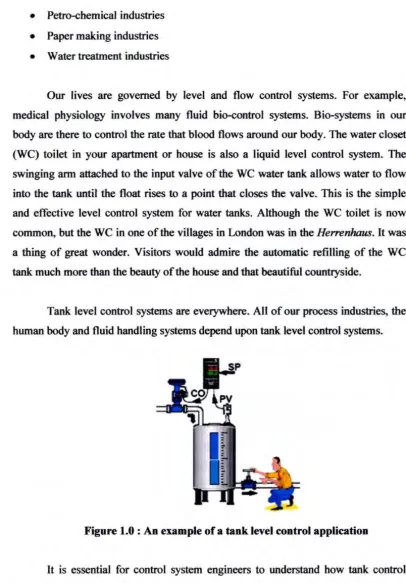
Figure 1.0 : An example of a tank level control application
It is essential for control system engineers to understand bow tank control
3
1.1 Project Liquid Level Control System Using PLC and Ultrasonic Sensor
This Project Liquid Level Controller System Using PLC and Ultrasonic
Sensor will be controlled using PLC (Programmable Logic Controller) as a
demonstration. The main concept used in this project is process control concept with industrial measurement techniques that consists of flow and level measurement. Nowadays, many liquid level control system used everywhere especially in chemical
industries. But the major function of the liquid level control system using PLC
controller is to measure the liquid level in tank continuously, not depend on the
highest or lowest point by giving the absolute value of measurement.
This liquid level controller system is not fully automatic system. This
hardware can be function as local and remote control. For the local control, this system contain of one batch controller from Burkert as that function as a main
controller, one Omron process meter (KJMA-J) to display the level measurement,
local button, start button and stop button. We have to set certain value to the batch
controller depend to the height of the process tank to allow the water flow through
the control valve. The setting value normally set in Liter, but we can choose whether to set it in cm3, US gallon or IMP gallon. Before that we have to setting all the
parameters in the batch controller. The further information about setting parameters
can be referred to the Chapter 3. Once, the power supply is on, the start button must
be pushed. Then, the water will pump from the storage tank to the flow sensor and then through the control valve. When the water comes to the process tank, the ultrasonic level sensor will detect the height of the water in that tank. The process
meter will display the value of height of the water in the process tank. The setting
parameter of process meter can be referred to the Chapter 3.
For the remote control system, programming PLC (Programmable Logic
Controller) will be used to operate this hardware. The programming used is the ladder diagram programmed and the continuous level measurement detected. By
4
1.2 The Project Objectives
Accurate measurements of level are essential to provide good control in the
process industries. Liquid level has no absolute value and is always relative to some
reference point such as the top and bottom of the tank. There are several reasons to
monitor the level of materials in containers can be divide to :
Monitoring
i. To control and measure the liquid level in tank continuously.
11. To ensure that enough material is available to complete a particular batch
production process.
m. To determine an inventory of the material in stock.
Safety
1. To prevent an industrial accident by overfilling an open container.
ii. To prevent the overfilling of a closed container or an enclosed system. This
situation could cause an overpressure condition that may result in a rupture
or explosion.
iii. To monitor tank for leaking.
Economy
i. Good level control of solid is also desirable; excessive built up in hoppers can
be expensive to clear.
1.3 Benefit of Liquid Level Controller System
In the oil and natural gas industries, liquid level measurement is necessary
have the following benefits;
i. Compute tank inventories of hydrocarbon liquid products and utility liquids. 11. Protect equipment such as columns, compressor, turbines and pumps from
5
m. Protect operating and maintenance personal against injury resulting from
hydrocarbon, corrosive or toxic liquid spillage.
iv. Protect the environment from the release of objectionable liquids into the
rivers and the sea.
v. Control phase separation processes and product loading operations.
1.4 Scope Project
The project scope for execution this project are ;
i. Design and develop the complete automated system that will control the
level by giving the absolute value and continuously in term of hardware
and software development.
ii. The hardware development consist of the ultrasonic sensor will detect the
level measurement and controlled by PLC, flow sensor that will detect the
flow rate ofliquid, control valve as the control element, pump and motor.
m. The software development consists of CX-One programme as the
programming language for Omron CJ 1 H-Series PLC unit and I will use the
ladder diagram and Instruction List programming languages for the PLC.
1.5 Problem Statement
The key characteristic of control is to interfere, to influence or to modify the process. This control ~ction or the interference to the process is introduced by an organization of parts (including operators in manual control) that, when connected
together is called the Control System. Depending on whether a human body (the
operator) is physically involved in the control system, they are divided into Manual
Control and Automatic Control. Due to its efficiency, accuracy and reliability,
automatic control is widely used in chemical processed. Therefore, for a control
system to operate satisfactorily, it must have the abilities of measurement,
1.5.1 Manual control system
Cold water
Hot water
l
.
'
••
'
'
t '
••
[image:23.476.60.426.105.403.2]'
.
'
'
'
'
'
.
'
'
'
'
\.
..
'.'
.
'
'
'
•
•
'
•
•
'
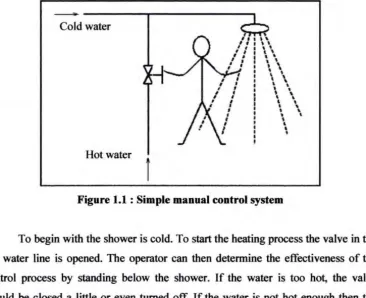
'Figure 1.1 : Simple manual control system
6
To begin with the shower is cold. To start the heating process the valve in the hot water line is opened. The operator can then detennine the effectiveness of the
control process by standing below the shower. If the water is too hot, the valve should be closed a Little or even turned off. If the water is not hot enough then the
valve is left open or opened wider. This shows the human aided control used before
the automated control system is recognized.
1.5.2 Automatic control system
Liquid level has no absolute value and always relative to some reference
point such as the bottom or top of the tank. It is the height or depth of a liquid above a reference point and is specific to a particular vessel.
. First we have the Controlled Variable. This is the basic process value being
regulated by the system. It is the one variable that we are special interested. In feedback control the controlled variable is usually the measured variable. An important concept related to the controlled variable is the Set point. This is the
7
system is to regulate the controlled variable at its set point. To achieve the control
objective there must be one or more variables we can alter or adjust. These are called
the Manipulated Variables. Conclusively, in the control system we adjust the
manipulated variable to maintain the controlled variable at its set point. This meets
the requirement of keeping the stability of the process and suppressing the influence
of disturbances.
The main purpose for this project is to measure the liquid level in tank