Density-dependent population dynamics in
Aedes
aegypti
slow the spread of
w
Mel
Wolbachia
Penelope A. Hancock
1*, Vanessa L. White
2, Ashley G. Callahan
2,
Charles H. J. Godfray
1, Ary A. Hoffmann
2and Scott A. Ritchie
31Department of Zoology, University of Oxford, South Parks Road, Oxford OX1 3PS, UK;2Bio 21 Institute, School of
Biosciences, University of Melbourne, Parkville, Vic. 3010, Australia; and3Australian Institute of Tropical Health and Medicine, James Cook University, Townsville, Qld 4878, Australia
Summary
1. Field release of endosymbiotic Wolbachia bacteria into wild Aedes aegypti mosquito populations is a promising strategy for biocontrol of dengue. This strategy requires successful
Wolbachia invasion through the mosquito vector population. Natural variation in mosquito fitness due to density-dependent competition for limited food resources may influence
Wolbachiainvasion. We know little about these effects, largely because our understanding of density-dependent dynamics in mosquito populations is limited.
2. We developed an empirical model ofA. aegypti–Wolbachiadynamics where food resources available to the developing larvae are limited. We assessed the extent of density-dependent regulation in our A. aegypti population using a Bayesian statistical model that estimates the temporal variation in mosquito fitness components. We monitored the spread of Wolbachia
and assessed the effect of the bacteria on larval fitness components.
3. We demonstrate that mosquito population growth is regulated by strong larval density-dependent variation in mosquito fitness components. Wolbachia spread was slowed by this heterogeneity in mosquito fitness, which reduces the capacity of the bacteria to invade. However, we found no evidence thatWolbachiaaffects larval fitness components.
4. Synthesis and applications. We demonstrate that the extent and form of density-dependent dynamics in the host population can have a major influence on Wolbachia invasion. These findings help explain slow Wolbachia invasion rates and indicate that the success of field release strategies for dengue control can depend on attaining high Wolbachia frequencies in the mosquito population.
Key-words: Bayesian statistical model, biocontrol, demography, dengue, density dependence, fitness, invasion, population dynamics, vector-borne,Wolbachia
Introduction
The transmission of parasites, pathogens and other infec-tious organisms can depend strongly on the fitness of their hosts (Lipsitch, Siller & Nowak 1996) and can be affected by heterogeneity in the hosts’ fitness driven by environmental variation (Reesonet al.2000). The extent to which the mean fitness of populations is regulated by their density is central to ecology (Siblyet al.2005). However, there are few studies of how density-dependent fluctuation in the hosts’ fitness interacts with the spread of infections (but see Washburn, Mercer & Anderson 1991; Altizer & Augustine 1997), and
these interactions can be complex and depend on the form of density-dependent regulation (Washburn, Mercer & Ander-son 1991; Altizer & Augustine 1997). The transmission rate of infectious organisms that can only spread between hosts by vertical transmission depends directly on their host’s fitness and they commonly confer a fitness advantage to their host in order to spread and persist (Lipsitch, Siller & Nowak 1996; Haine 2008). The dynamics of vertically transmitted infections are therefore likely to be sensitive to heterogeneity in the hosts’ fitness. Theoretical studies show a number of mechanisms by which density-dependent dynamics in the host population can alter the invasion potential of vertically transmitted micro-organisms (Altizer & Augustine 1997; Hancock, Sinkins & Godfray 2011) but these interactions have not been empirically demonstrated.
*Correspondence author. E-mail: [email protected]
©2016 The Authors.Journal of Applied Ecologypublished by John Wiley & Sons Ltd on behalf of British Ecological Society.
Wolbachia are maternally transmitted endosymbiotic bacteria that are widespread in insects and some other arthropods (Hilgenboecker et al. 2008; Zug & Hammer-stein 2012). Wolbachia increase their frequency through successive generations of the host population by manipu-lating the reproductive system of their host, most commonly using a mechanism known as cytoplasmic incompatibility (CI) (Laven 1956). CI causes inviability of offspring from matings between uninfected females and infected males, conferring a relative fitness advantage to infected mothers who are able to reproduce successfully with infected and uninfected males (Caspari & Watson 1959). The strength of this advantage depends on the
Wolbachia frequency in the (male) insect population. If theWolbachiafrequency is lower than a critical threshold, the benefits conferred by CI can be outweighed by fitness costs ofWolbachiainfection on the host insect which may include reductions in important fitness components, such as the fecundity, survival and juvenile development rate (Turelli 1994; Hancock, Sinkins & Godfray 2011). Thus,
Wolbachia invasion depends on an interrelationship between the hosts’ fitness and theWolbachiafrequency in the host population.
The application ofWolbachia to biocontrol of the den-gue virus is currently of great interest (Hoffmann et al.
2011; Walkeret al. 2011). The Aedes aegyptimosquito is the primary vector of dengue, which is the leading cause of insect-vectored viral (arboviral) disease in humans, infecting an estimated 390 million people per year across over 100 countries (Bhatt et al. 2013). The infection can cause severe illness and in some cases death, usually in children and young adults (Simmons et al. 2012).
Wolbachia infection has been shown to greatly reduce dengue transmission byA. aegyptiby inhibiting the devel-opment of the virus within the mosquito (Moreiraet al.
2009; Bianet al. 2010).Wolbachiado not occur naturally in A. aegypti (Xi, Khoo & Dobson 2005); however, cer-tainWolbachiastrains have been established in laboratory
A. aegypti colonies following transfer from their natural hosts Drosophila melanogaster and Aedes albopictus (Xi, Khoo & Dobson 2005; McMeniman et al. 2009; Walker
et al. 2011). In north-eastern Australia, the Wolbachia
strain wMel has been successfully established in wild
A. aegyptipopulations by releasing infected mosquitoes to drive the infection to near fixation (Hoffmann et al.
2011). Further releases are currently underway in high dengue incidence regions of South-East Asia and South America (see www.eliminatedengue.com).
We currently know very little about the ecological fac-tors that affect Wolbachia dynamics in wild A. aegypti
populations, which limits our ability to predict the inva-sion dynamics ofWolbachiain these field trials. A critical knowledge gap is our lack of understanding of the extent and form of density-dependent regulation in wildA. aegypti
populations. A. aegypti population dynamics are thought to be significantly influenced by density-dependent competi-tion for the limited food resources available to the developing
larvae (Dye 1984; Legros et al. 2009; Walsh et al. 2013).
A. aegypti rely on human blood to reproduce, and their larval habitat consists of water containers close to human dwellings, such as water storage jars and pot plant plates (Southwood et al. 1972). Experimental studies on
A. aegypti have demonstrated that multiple fitness compo-nents respond to changing larval density, with higher densi-ties resulting in lower survival and prolonged development of larvae, and smaller body size of surviving adults which reduces their potential fecundity (Barrera 1996; Walsh
et al.2011, 2013). However, these experiments studied sets of larval cohorts in isolation from the wider mosquito population. Wild A. aegypti populations have continuous and overlapping generations, which has made assessment of effects of natural variation in larval density on mosquito fitness components difficult and limited, particularly given our lack of knowledge of mosquito life-history parameters (Southwood et al. 1972; Dye 1984; Legros et al. 2009). This inhibits our ability to predict the impact of a range of mosquito vector control strategies (Phuc et al. 2007) including Wolbachiarelease strategies (Hancock, Sinkins & Godfray 2011).
Moreover, in A. aegypti,fitness costs of Wolbachia are typically considered under only low-density larval condi-tions with unlimited resources being available to all life stages (Xi, Khoo & Dobson 2005; McMeniman et al.
2009; Walker et al.2011). We therefore know little about the fitness costs of Wolbachia under more stressful conditions arising from larval resource competition (Ross
et al. 2014). It is important to better understand density-dependent dynamics in A. aegypti in order to predict the natural variation in mosquito fitness components that are critical to Wolbachia invasion and spread (Hancock, Sinkins & Godfray 2011; Walshet al.2011).
Here, we developed an empirical and mathematical model to assess the extent of density-dependent regulation in anA. aegyptipopulation where food resources available to the developing larvae are limited. We focused on three mosquito fitness components, larval survival and develop-ment time and adult female fecundity, which we estimated over time using a Bayesian statistical model. We assessed the relationship between these fitness components and the intrinsic variation in larval density that occurs in our
A. aegypti population, and find strong evidence for larval density-dependent variation in all three fitness components. We then monitored the spread of aWolbachiastrain (wMel) in ourA. aegypti population and assess the effects of the
Wolbachia on two fitness components, larval survival and development time, as larval density varies over time. We found that over most larval density conditionsWolbachia
Materials and methods
A N E M P IR IC A L M O D E LA . A E G Y P T IP O P U LA T IO N
Our model population of A. aegyptiwas housed in a semi-field cage of dimensions 59794 m designed to simulate the natural habitat of A. aegypti in north-eastern Australia (Darbro et al. 2012). The population was seeded from a cohort of 100 first-instar larvae that was hatched on 20 December 2013 from wild-caught eggs of anA. aegypti population located in Cairns, Australia. The population was maintained for a period of 194 days (about 65 months) by the regular schedule of activities described in Appendix S1 in Supporting Information. In sum-mary, adult females were allowed to feed on blood from a live human three times a week. A single container (a 5-L bucket filled with 2 L of water) provided an oviposition site for gravid females and habitat for their larvae. The larval container received regular addition of a fixed amount of food (032 g ground lucerne). The part of the container above the waterline was lined with red felt strips that collected the oviposited eggs. The egg strips were removed from the cage three times a week and after a 2 day per-iod of incubation were submerged in a yeast solution to stimulate hatching. All newly hatched larvae in the cohort were counted, a sample of 30 was retained, and the remaining individuals were placed in the semi-field cage larval container. After approximately 5 months (147 days) we ceased the recruitment of new larvae to the population and the remaining individuals either matured or died.A. aegyptipopulation dynamics were monitored throughout the time period by daily counts of all newly eclosed pupae and counts three times a week of all larvae (categorized as first, second, third or fourth instar). A sample of 20% of the pupae that eclosed on each day was retained (see below).
IN TR ODU CIN GWM E LW O L B A C H I A
A. aegypti larvae infected with wMel Wolbachia were obtained from the eggs of a semi-field cage colony which has fixedwMel infection and is regularly backcrossed with wild-caughtA. aegypti (Walker et al. 2011). We reared the wMel-infected larvae under similar conditions of larval density, age-structure and food avail-ability to those experienced in our semi-field cage population using the following procedures. The infected larvae were reared in a Controlled Temperature (CT) room at 26°C in a 5-L bucket containing the same amount of water and receiving the same food supply regime as the semi-field cage larval container habitat. A new cohort of wMel-infected first-instar larvae was hatched and added to the CT room rearing bucket on the same days that first-instar larvae were hatched in the semi-field cage population. The size of each new cohort of infected first-instar larvae was set to 700, which is close to the average first-instar cohort size of the semi-field cage population over the study period (524).
Starting from day 68, we began regular introductions ofw Mel-infected pupae into our semi-field cageA. aegyptipopulation (see Appendix S1). Three times a week, 16 infected pupae were randomly selected from the rearing bucket and placed in the semi-field cage. This rate of introduction is equal to approxi-mately one-third (289%) of the average rate of pupal eclosion in the semi-field cage population over the study period, and was chosen to approximate a rate of immigration that may plausibly occur in wild A. aegypti populations. The Wolbachia introduc-tions continued for 12 weeks. This time period was considered a
plausible time-scale for natural Wolbachia immigration into a wild (uninfected)A. aegyptipopulation.
We monitored theWolbachia frequency over time in both the first-instar larvae and pupae by testing all individuals in the samples of first-instar larvae and eclosed pupae for Wolbachia infection using real-time PCR (see Appendix S1; Leeet al.2012). TheWolbachiafrequency in each sample of first-instar larvae was used to estimate theWolbachiafrequency in each cohort of newly hatched first-instar larvae. The Wolbachia frequency in the eclosed pupae was estimated on a weekly time step, based on the frequency in the sampled pupae pooled over each week, in order to reduce the sampling error.
AS S E S S I N G D E N S IT Y - D E P E N D E N T P O P U LA T IO N
R E G U L A T I O N I NA . A E G Y P T I
We focused on three mainA. aegyptidemographic variables: first instar-to-pupal survival, larval development time and adult female fecundity. These fitness components are thought to be potential drivers of density-dependent population regulation in A. aegypti(Walshet al.2013), and are also critical determinants of the invasion potential of Wolbachia (Turelli 1994; Hancock, Sinkins & Godfray 2011). We aimed to assess the relationship between these three variables and the intrinsic variation in larval density that occurred in our A. aegypti population over time. This required estimation of these variables over time, which was performed using the following procedures.
Estimating larval survival and development time
Due to the overlapping generations in ourA. aegyptipopulation, larval development time and first instar-to-pupal survival could not be directly observed. Therefore, we developed a statistical demographic model informed by our observed larval and pupal abundances to estimate their values over time. This involved inference of the full distributions of the development times of the individuals within each larval cohort using a Bayesian Markov chain Monte Carlo (MCMC) Metropolis–Hastings algorithm, which is detailed in Appendix S2. In summary, for all larvae hatched on dayc(cohortc) the probabilities of pupating on dif-ferent daysi, pi,c, were assumed to follow a gamma distribution:
pi;c¼CðicTmin;gc;hcÞ eqn 1
wheregcandhcare the shape and scale parameters andTminis
the minimum development time, set to 5 days. The number of larvae in a cohort hatched on daycthat eclose as pupae on day i,Pi,c, was estimated by:
Pi;c¼H Yi
k¼cþ1
skpi;c eqn 2
whereHcis the number of larvae hatched on daycandskis the
proportion of the total larvae that survive from dayk1 to day k. We used a Bayesian model to estimate the parameters gcand hc for each cohortc. The likelihood function was informed by
data on the daily pupal eclosion, Pi, cohort hatch sizes Hcand
daily larval survival estimatesskbased on three counts per week
posterior distributions of means and standard deviations of the pupation probability distributions of larval cohorts (Appendix S2). Cohorts hatched in the same week were assumed to have the same pupation probability distribution, thus requiring the estimation of 38 parameters for the 19 weeks of hatching.
Estimating per-capita female fecundity
We estimated the per-capita female fecundity,kc, defined here as
the number of first-instar larvae hatched on day c per adult female old enough to potentially contribute offspring to this cohort.This procedure required estimates of the time lag between oviposition and hatching of eggs,h, the daily rate of pupal and adult survival,l, the minimum time required for adult females to mate, blood-feed and become gravid following emergence, TG,
and the time required for pupal development TP. We set
TG=4 days, TP=2 days and l=095 based on past studies
(McMeniman et al. 2009; Wong et al. 2011) and h=6 days based on our semi-field cage data (Appendix S5). Then:
kc¼ Hc
AG
ch
eqn 3
whereAG
i is the number of adult females in the semi-field cage
population on dayiwho are at leastTGdays old, estimated by:
AG
i ¼05
X
iTPTG
k¼0
Pklik1; iT
PþTG eqn 4
Our results are based on the per-capita female fecundity averaged over each week, kw¼Pc2wkc=nw, where nw is the
number of days in weekwon which eggs were hatched.
Our estimates of per-capita female fecundity over the time period following Wolbachia introduction were adjusted to con-sider only the subpopulation of uninfected females who did not have an incompatible mating with an infected male. This method-ology used data on theWolbachiainfection frequency in the sam-ples of first-instar larvae and eclosed pupae and is detailed in Appendix S4. In summary, we made two adjustments to the fecundity estimateskc(eqn 3). First, we excluded the estimated
number of infected adult females old enough to be potentially gravid and their offspring. The accuracy of this approximation benefited from the fact that the introduced infected females produced almost all of the infected first-instar larvae. Secondly, we excluded the estimated number of uninfected adult females old enough to be potentially gravid who had incompatible matings with infected males. These estimates made three simplify-ing assumptions: (i) the sex ratio in the semi-field cage population is equal; (ii) maternal transmission ofWolbachia is perfect; and (iii) the population is panmictic (random mating).
A S S E S S IN G E F F E C T S OFW O L B A C H I AON LARVAL
F IT NE S S COM P O NE NT S
We assessed effects ofWolbachia infection on two of our three focal mosquito demographic variables: first instar-to-pupal sur-vival and larval development time. Our data do not allow effects ofWolbachia on adult female fecundity to be assessed (see the Discussion). We used our model-predicted larval development time distributions together with the first-instar Wolbachia infec-tion frequency estimate for each cohort to forecast theWolbachia
infection frequency in the eclosed pupae over time. This forecast represents the null hypothesis that Wolbachiainfection does not affect the first instar-to-pupal larval survival or the larval devel-opment time. We note thatfL,c, the estimatedWolbachiainfection
frequency in each cohort of first-instar larvae c, follows a beta distribution Beta(hc,W+1, hc,U+1) where hc,Wandhc,U are the
numbers of newly hatched infected and uninfected first-instar larvae observed in the sample from cohort c. Then, on the jth draw from the posterior distribution ofPi,c(eqn 2), the expected
number ofWolbachia-infected larvae in a cohort hatched on day cthat eclose as pupae on dayi,Pði;jcÞ;W,is estimated by:
Pið;jcÞ;W¼fLðjÞ;cPði;jcÞ eqn 5
where fðLjÞ;c is the jth draw from the beta distribution. We estimated the distribution of Pi,W, the number of Wolbachia
-infected pupae that eclose on day i, using 100 000 draws from the posterior distribution.
AS S E S S I N G A D U L T B O D Y S I Z E V A R IA T IO N
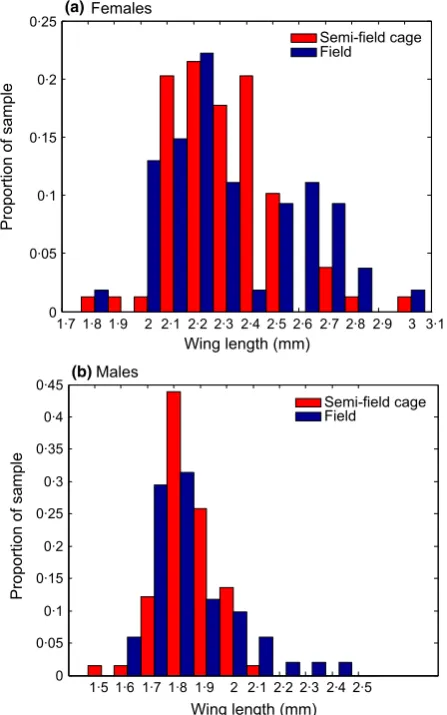
Adult body size, measured by wing length, is an important A. aegypti fitness component that is also known to vary in response to changing larval density, with higher density larval con-ditions resulting in smaller adults (Barrera 1996; Walsh et al. 2013). We measured the wings of a subsample of the adults that emerged from the pupae sampled from our semi-field cage popula-tion in weeks 1–10 using standard procedures (Williams et al. 2013). Wings were not measured from samples taken in the time period following Wolbachia introduction (weeks 11–28) to avoid contamination prior to PCR analysis. Our subsample comprised wings from 200 individuals obtained by selecting 20 individuals (10 of each sex) at random from each week of samples. We compare the wing length distribution of our samples and that of samples obtained from a previous field survey of A. aegypti pupae from Cairns, north-eastern Australia (Williamset al.2013).
Results
D E N S I T Y - D E P E N D E N T P O P U L A T I O N R E G U L A T I O N I N A . A E G Y P T I
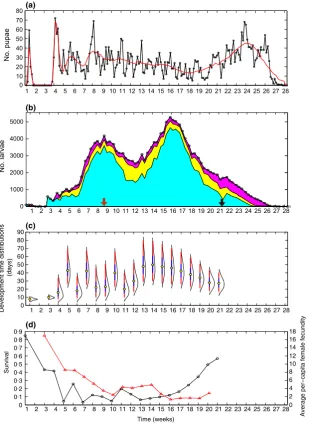
The daily rate of pupal eclosion displayed short-period fluctuations (Fig. 1a; black line) of typically less than a week, with greater variability in the initial 2 months of the time period and rising to a peak at the end of the study. In contrast, the total abundance of larvae increased rapidly over the first 2 months due to high daily larval survival that was estimated to be above 085 for the entire study period (Fig. 1b and Appendix S3). Following the commencement of Wolbachia introductions, a second, higher peak in larval abundance occurred (Fig. 1b).
The estimated development times of subsequent cohorts are much longer (up to 80 days), with much greater varia-tion in development times amongst individuals hatched in the same week. First instar-to-pupal survival declined rapidly over the first 4 weeks and remained low (~10%) for most of the study period before rising steadily in the final 4 weeks (Fig. 1d; black line). Both larval develop-ment time and first instar-to-pupal survival showed greater temporal variation in the first part of the period (weeks 1–12) compared to the latter part (weeks 13–21). This may be due to differences in the age-structure and growth rate of larval population between the first and lat-ter parts of the study period. Our estimates of per-capita female fecundity also displayed a clear temporal pattern, and were highest at the start of the season and lowest at the end of the season (Fig. 1d; red line). Per-capita female fecundity was strongly correlated with the weekly rate of growth in total larval abundance (r=084,N =16).
Having estimated these three demographic variables over time, we used generalized linear regression to assess
their relationship to the larval density that individuals experienced during development. In the case of larval development time, we used the mean of the estimated development time distribution for each larval cohort as the independent variable (Fig. 1c). All three demographic variables showed a highly significant relationship to larval density: Fig. 2 shows the fitted models and details of the methodology and results are given in Appendix S5. For the first instar-to-pupal survival and the mean develop-ment time of larvae from cohorts hatched in a given week, the covariate was the estimated average larval den-sity that the surviving pupae experienced over the course of their development (Appendix S5). For first instar-to-pupal survival, logistic regression gave a highly significant negative larval density coefficient (P<291016; McFad-denR2=068; Fig. 2a). Mean larval development time was described by log–log regression with a highly significant positive coefficient (P=339105; Adjusted R2=061; Fig. 2b). For the weekly average per-capita female fecun-dity, the covariate was the 3-week average larval density at 1 2 3 4 5 6 7 8 9 10 11 12 13 14 15 16 17 18 19 20 21 22 23 24 25 26 27 28 0
10 20 30 40 50 60 70 80 90
Development time distributions
(days)
1 2 3 4 5 6 7 8 9 10 11 12 13 14 15 16 17 18 19 20 21 22 23 24 25 26 27 28 0
0·1 0·2 0·3 0·4 0·5 0·6 0·7 0·8 0·9
Time (weeks)
Survival
0 2 4 6 8 10 12 14 16 18
Avera
g
e per−capita female fecundity
(a)
(b)
(c)
(d)
1 2 3 4 5 6 7 8 9 10 11 12 13 14 15 16 17 18 19 20 21 22 23 24 25 26 27 28 0
1000 2000 3000 4000 5000
No. larvae
0 1 2 3 4 5 6 7 8 9 10 11 12 13 14 15 16 17 18 19 20 21 22 23 24 25 26 27 28 0
10 20 30 40 50 60 70 80
[image:5.595.226.536.84.508.2]No. pupae
a lag of 3 days prior to the first day of each week (Appendix S5). A loglinear regression produced a highly significant negative coefficient (P=7391012; Adjusted R2=096; Fig. 2c).
Overall our A. aegypti population exhibited strong density-dependent population regulation, with higher larval densities being strongly associated with lower first instar-to-pupal survival, longer mean larval development times and lower per-capita female fecundity. This imposed considerable competitive pressure amongst individual larvae. The wide variation in development times amongst individuals of similar ages indicates high phenotypic variation in larval competitive ability (Fig. 1c).
W O L B A C H I AINF E C T ION DY N A M IC S AN D F IT N E S S
E F F E C T S
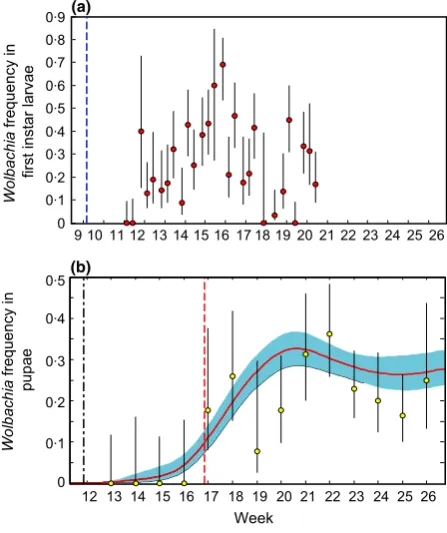
Wolbachia was first detected in the first-instar larvae 19 days after the introductions of infected pupae began (Fig. 3a). The observed infection frequencies in the first instar cohorts were below 05 for all but two cohorts that were hatched in weeks 15–16 (Fig. 3a). Wolbachia was first detected in the eclosed pupae exactly 5 weeks after its first detection in the first-instar larvae (Fig. 3b). This agrees well with our model prediction (Fig. 3b), indicating that the development times of these infected individuals do not differ significantly from those of other larvae in the same cohort. In the remaining weeks, the observed dynamics of Wolbachia in the eclosed pupae agree well with our model prediction with the exception of weeks 19 and 20. In these weeks, there is weak evidence that the
Wolbachiais under-represented in the pupae compared to the model prediction. The rate of pupal eclosion is at the lowest value of the season in these weeks (Fig. 1a), and the lowWolbachia frequency may be due to a period of larval starvation (see the Discussion). For the other weeks, there is no credible effect of Wolbachia infection on the first instar-to-pupal survival or the development time of the eclosed pupae (Fig. 3b).
Despite this similarity between infected and uninfected larvae with regard to these fitness components, the results
reveal powerful effects of density-dependent larval compe-tition on Wolbachia invasion. The rate of Wolbachia
spread is limited by the development times of the larval cohorts, and is slowed considerably by the protraction of 100 200 500 1000 2000 5000
51
0
1
5
2-week average larval density
Mean per-capity female
fecundity
100 200 500 1000 2000 5000
Average larval density
Mean larval development
time (days)
0
(a) (b) (c)
1000 2000 3000 4000
0·0
0
·2
0·4
0
·6
0·8
1
·0
Average larval density
Proportion of cohort surviving 51
0
2
0
50
51
0
3
0
[image:6.595.68.537.82.224.2]40
Fig. 2.The fitted generalized linear regression models of (a) first instar-to-pupal survival; (b) mean larval development time; (c) weekly mean per-capita female fecundity as functions of a covariate describing average total larval density. Red lines and black circles show the fitted models and data, respectively.
12 13 14 15 16 17 18 19 20 21 22 23 24 25 0
0·1 0·2 0·3 0·4 0·5
Week
Wolbachia
frequency in
pupae
9 10 11 12 13 14 15 16 17 18 19 20 21 22 23 24 25 0
0·1 0·2 0·3 0·4 0·5 0·6 0·7 0·8 0·9
Wolbachia
frequency in
first instar larvae
(a)
(b)
26
26
[image:6.595.310.534.338.605.2]larval development times due to the high intrinsic level of larval density-dependent competition (Fig. 1c). This effect was strongly exacerbated by the increase in larval density following the immigration of infected mosquitoes (Fig. 1b). Thus, the first cohorts that contained Wol-bachia-infected larvae experienced the longest develop-ment times (>5 weeks) observed over the entire study period (Figs 1b,c and 3). Further, the larval cohorts that experienced these increased density conditions had low survival, with the surviving adult females having low fecundity, relative to individuals that emerged at other times in the study period (Fig. 1d). Thus, the density-dependent response of the mosquito population demogra-phy to increasing larval density reduced the fitness of the entire population, and increased larval development times slowed the spread ofWolbachia.
WI NG LENGT H CO MPARI S ON
The distributions of male and female wing lengths obtained from a subsample of adults from our semi-field cage popu-lation (Fig. 4) were similar to those given by individuals sampled from wildA. aegypti larval container habitats in Cairns, north-eastern Australia (Williamset al.2013).
Discussion
We developed an empirical and mathematical model of
A. aegypti–Wolbachia dynamics under competitive condi-tions of limited larval food resources. The rate of Wol-bachia spread over time in our system was considerably slower than that expected based on the predictions of pre-vious studies that do not consider larval resource limita-tion (see Appendix S6; Hoffmann et al. 2011; Walker
et al. 2011). Our system showed highly variable and pro-tracted larval development times, whereas previous studies ofWolbachiadynamics inA. aegyptiassume a fixed larval development time of relatively short duration (Turelli 2010; Hancock, Sinkins & Godfray 2011; Hoffmannet al.
2011; Walker et al. 2011). We used our model’s forecast of the Wolbachia frequency in the eclosed pupae to esti-mate the effects of Wolbachia on larval fitness compo-nents in the presence of intrinsic larval demographic heterogeneity. We showed that the slow development and low survival of the Wolbachia-infected larvae was not caused by fitness costs of Wolbachia, but was a result of the reduced fitness and slow dynamics of the whole mosquito population (Fig. 1c). These density-dependent effects prevented the Wolbachia from attaining a high frequency over the study period of 4–5 months (during which 55 overlapping generations were created).
The slowing of Wolbachia spread caused by density-dependent competition in the mosquito population reduces the speed at whichWolbachiainvadesA. aegypti. Slowing the rate of increase inWolbachiafrequency is highly influen-tial because the fitness advantage conferred byWolbachiato its host is frequency-dependent. InA. aegyptiinfected with
wMel, CI is nearly complete (Walkeret al.2011), and the expected reduction in the average fecundity of uninfected females is almost directly proportional to the Wolbachia
frequency (Turelli 1994). Our study found that female fecundity varied by more than a factor of ten due to differ-ing levels of larval density-dependent competition, and simi-larly strong variation in other mosquito fitness components. Therefore, while theWolbachiafrequency remains at low-to-moderate levels, larval density-dependent variation in fitness throughout the mosquito population can potentially influence Wolbachia dynamics more strongly than fitness heterogeneity caused by Wolbachia. Our results therefore emphasize that density-dependent heterogeneity in mos-quito fitness components can have multiple interacting effects onWolbachiainvasion inA. aegyptipopulations and needs to be considered in models of Wolbachia dynamics (Turelli 1994; Hancock, Sinkins & Godfray 2011).
1·7 1·8 1·9 2 2·1 2·2 2·3 2·4 2·5 2·6 2·7 2·8 2·9 3 3·1 0
0·05 0·1 0·15 0·2 0·25
Wing length (mm)
Proportion of sample
Semi-field cage Field
1·5 1·6 1·7 1·8 1·9 2 2·1 2·2 2·3 2·4 2·5 0
0·05 0·1 0·15 0·2 0·25 0·3 0·35 0·4 0·45
Wing length (mm)
Proportion of sample
Semi-field cage Field
Females
Males
(a)
[image:7.595.62.286.302.660.2](b)
In designing strategies forWolbachiarelease, our results indicate that releases that attain a high infection fre-quency in the mosquito population will be critical to increasing both the speed and likelihood of Wolbachia
establishment. In addition to releasing large numbers of infected mosquitoes, manipulation of the availability of larval habitat and food resources in field populations could improve Wolbachia’s invasion potential. If the off-spring of the released mosquitoes experience low competi-tion for food they are more likely to have fast development (i.e. short generation time) and high survival and fecundity relative to the wild-type population (Fig. 2). This may be achieved by suppressing uninfected mosquito populations prior to release and also potentially during the release programme (Hoffmann 2014).
Our evidence for larval density-dependent population growth in our study population is based on strong associa-tions between larval density and three demographic variables (Fig. 2). However, other variables may also explain variation in these demographic rates over time. In particular, temperature is known to affect mosquito demo-graphic rates (Mohammed & Chadee 2011). For our popu-lation, we found that water temperature in the larval habitat was significantly associated with mean larval devel-opment time and per-capita female fecundity but explained a much lower proportion of the variance than larval density (Appendix S7). Our inferences are necessarily based on a single study population, for which we provide a robust description of population dynamics over an ecologically rel-evant time period. Additional replicated experiments could be undertaken to directly compare the importance of larval density onWolbachiainvasion rates across time.
While we found no significant costs ofwMel Wolbachia on larval fitness components, further research is needed to assess the fitness effects ofWolbachiain the presence of den-sity-dependent variation in mosquito fitness. Any effects of
wMel infection on larval survival and development time may not be have been detected given our sample sizes, particu-larly under the high larval density conditions experienced in our semi-field cage population. In weeks 19–20, our results suggest a possible reduction in the survival of infected larvae relative to uninfected larvae. During this time period, which follows the highest peak in total larval density, the rate of pupal eclosion is at the minimum value of the season (Fig. 1a,b). When food availability is extremely low and star-vation occurs in the larval population,Wolbachiainfection may reduce larval survival (Rosset al.2014).
Moreover, our study did not estimate effects of Wol-bachia on adult female fecundity, which is an important component in predicting Wolbachia invasion and spread (Turelli 2010). We could not estimate this effect because most of the Wolbachia-infected adults originated from a population external to our semi-field cage population. Therefore, we cannot reasonably assess effects ofWolbachia
on per-capita female fecundity, because any differences could be attributed to differences in the larval environment experienced by infected and uninfected subpopulations.
While our semi-field cage system aims to simulate similar intrinsic and extrinsic processes to those occurring in natu-ral A. aegypti populations, our system differs in some important ways from natural populations. Adult mosquito survival is expected to be relatively high in our semi-field cage compared to the higher risk conditions experienced by field populations (Muir & Kay 1998). Moreover, environ-mental conditions will be more variable in natural popula-tions, with stronger variation in egg mortality, the rate of egg hatching, larval food availability, larval survival and other important demographic and environmental variables. However, our model A. aegypti population also shares some important demographic properties in common with wild populations. Field populations of A. aegypti display a characteristic pyramidal juvenile age-structure where the numbers of eggs exceeds the numbers of pupae by 1–3 orders of magnitude (Southwoodet al.1972). This implies a typically low rate of larval survival that is consistent with the larval survival rates occurring in our study popu-lation. Further, the body size of wild-caught A. aegypti
adults (as measured by their wing length) is typically smaller than that of well-nourished laboratory-reared indi-viduals and varies over a wide range (Williams et al.
2013; Yeap et al. 2013). We found that the distributions of wing lengths in our semi-field cage population were similar to those in the field. This suggests that wildA. ae-gyptipopulations may experience density-dependent larval resource competition over a similar range to that experi-enced in our study population.
In conclusion, our results show how density-dependent fluctuation in multiple mosquito fitness components regu-lates population growth in our A. aegypti population. This heterogeneity in mosquito fitness greatly inhibited
Wolbachia spread, demonstrating that density-dependent mosquito population dynamics have an important influ-ence on Wolbachiainvasion. Understanding natural mos-quito population dynamics, and how they interact with
Wolbachiaspread, will be critical to predicting the dynam-ics ofWolbachiarelease strategies for dengue control.
Acknowledgements
This research was supported by a Marie Curie International Outgoing Fellowship within the 7th European Community Framework Programme (Grant no. 326551-WOLBACHIA_MOD). We thank Jane Lloyd, Gavin Omodei, Chris Paton, Alex Roberts and Mick Townsend for their generous and continued help and support. We are also grateful to Nancy Endersby and Anjali Goundar for their generous assistance with PCR analysis.
Data accessibility
Mosquito age-class abundances andWolbachiainfection frequencies: Figshare doi: 10.6084/m9.figshare.2067534 (Hancocket al.2016).
References
Barrera, R. (1996) Competition and resistance to starvation in larvae of container-inhabitingAedesmosquitoes.Ecological Entomology,21, 117– 127.
Bhatt, S., Gething, P.W., Brady, O.J., Messina, J.P., Farlow, A.W., Moyes, C.L.et al.(2013) The global distribution and burden of dengue.
Nature,496, 504–507.
Bian, G.W., Xu, Y., Lu, P., Xie, Y. & Xi, Z.Y. (2010) The endosymbiotic bacterium Wolbachia induces resistance to dengue virus in Aedes aegypti.PLoS Pathogens,6, e1000833.
Caspari, E. & Watson, G.S. (1959) On the evolutionary importance of cytoplasmic sterility in mosquitoes.Evolution,13, 568–570.
Darbro, J.M., Johnson, P.H., Thomas, M.B., Ritchie, S.A., Kay, B.H. & Ryan, P.A. (2012) Effects ofBeauveria bassianaon survival, blood-feeding success, and fecundity ofAedes aegyptiin laboratory and semi-field condi-tions.American Journal of Tropical Medicine and Hygiene,86, 656–664. Dye, C. (1984) Models for the population dynamics of the yellow fever
mosquitoAedes aegypti.Journal of Animal Ecology,53, 247–268. Haine, E.R. (2008) Symbiont-mediated protection. Proceedings of the
Royal Society B-Biological Sciences,275, 353–361.
Hancock, P.A., Sinkins, S.P. & Godfray, H.C.J. (2011) Population dynamic models of the spread ofWolbachia.American Naturalist,177, 323–333. Hancock, P.A., Linley-White, V., Callahan, A.G., Godfray, H.C.J.,
Hoff-mann, A.A. & Ritchie, S.A. (2016) Data from: density-dependent popu-lation dynamics inAedes aegyptislow the spread ofwMelWolbachia.
Figshare, http://dx.doi.org/10.6084/m9.figshare.2067534
Hilgenboecker, K., Hammerstein, P., Schlattmann, P., Telschow, A. & Werren, J.H. (2008) How many species are infected withWolbachia? A statistical analysis of current data.Fems Microbiology Letters,281, 215–220. Hoffmann, A.A. (2014) FacilitatingWolbachiainvasions.Austral
Entomol-ogy,53, 125–132.
Hoffmann, A.A., Montgomery, B.L., Popovici, J., Iturbe-Ormaetxe, I., Johnson, P.H., Muzzi, F.et al.(2011) Successful establishment of
Wol-bachiainAedespopulations to suppress dengue transmission. Nature,
476, 454–457.
Laven, H. (1956) Cytoplasmic inheritance inCulex.Nature,177, 141–142. Lee, S.F., White, V.L., Weeks, A.R., Hoffmann, A.A. & Endersby, N.M.
(2012) High-throughput PCR assays to monitorWolbachiainfection in the dengue mosquito (Aedes aegypti) andDrosophila simulans.Applied and Environmental Microbiology,78, 4740–4743.
Legros, M., Lloyd, A.L., Huang, Y.X. & Gould, F. (2009) Density-depen-dent intraspecific competition in the larval stage ofAedes aegypti (Dip-tera: Culicidae): revisiting the current paradigm. Journal of Medical Entomology,46, 409–419.
Lipsitch, M., Siller, S. & Nowak, M.A. (1996) The evolution of virulence in pathogens with vertical and horizontal transmission.Evolution,50, 1729–1741.
McMeniman, C.J., Lane, R.V., Cass, B.N., Fong, A.W.C., Manpreet, S., Wang, Y. & O’Neill, S.L. (2009) Stable introduction of a life-shortening Wol-bachiainfection into the mosquitoAedes aegypti.Science,323, 141–144. Mohammed, A. & Chadee, D.D. (2011) Effects of different temperature
regimens on the development ofAedes aegypti(L.) (Diptera: Culicidae) mosquitoes.Acta Tropica,119, 38–43.
Moreira, L.A., Iturbe-Ormaetxe, I., Jeffery, J.A., Lu, G.J., Pyke, A.T., Hedges, L.M.et al.(2009) AWolbachiasymbiont inAedes aegyptilimits infection with Dengue, Chikungunya, andPlasmodium.Cell,139, 1268–1278. Muir, L.E. & Kay, B.H. (1998)Aedes aegyptisurvival and dispersal
esti-mated by mark-release-recapture in northern Australia.American Jour-nal of Tropical Medicine and Hygiene,58, 277–282.
Phuc, H., Andreasen, M.H., Burton, R.S., Vass, C., Epton, M.J., Pape, G.
et al.(2007) Late-acting dominant lethal genetic systems and mosquito
control.BMC Biology,5, 11.
Reeson, A.F., Wilson, K., Cory, J.S., Hankard, P., Weeks, J.M., Goulson, D. & Hails, R.S. (2000) Effects of phenotypic plasticity on pathogen trans-mission in the field in aLepidoptera-NPV system.Oecologia,124, 373–380. Ross, P., Endersby, N., Yeap, H. & Hoffmann, A. (2014) Larval competi-tion extends developmental time and decreases adult size ofwMelPop
Wolbachia-infectedAedes aegypti.American Journal of Tropical
Medi-cine and Hygiene,91, 198–205.
Sibly, R.M., Barker, D., Denham, M.C., Hone, J. & Pagel, M. (2005) On the regulation of populations of mammals, birds, fish, and insects.
Science,309, 607–610.
Simmons, C.P., Farrar, J.J., Nguyen, V.V.C. & Wills, B. (2012) Dengue.
New England Journal of Medicine,366, 1423–1432.
Southwood, T.R.E., Murdie, G., Yasuno, M., Tonn, R.J. & Reader, P.M. (1972) Studies on the life budget ofAedes aegyptiin Wat Samphaya, Bang-kok, Thailand.Bulletin of the World Health Organisation,46, 211–226. Turelli, M. (1994) Evolution of incompatibility inducing microbes and
their hosts.Evolution,48, 1500–1513.
Turelli, M. (2010) Cytoplasmic incompatibility in populations with over-lapping generations.Evolution,64, 232–241.
Walker, T., Johnson, P.H., Moreira, L.A., Iturbe-Ormaetxe, I., Frentiu, F.D., McMeniman, C.J.et al.(2011) The wMelWolbachiastrain blocks dengue and invades cagedAedes aegyptipopulations.Nature,476, 450–453. Walsh, R.K., Facchinelli, L., Ramsey, J.M., Bond, J.G. & Gould, F.
(2011) Assessing the impact of density dependence in field populations ofAedes aegypti.Journal of Vector Ecology,36, 300–307.
Walsh, R.K., Aguilar, C.L., Facchinelli, L., Valerio, L., Ramsey, J.M., Scott, T.W., Lloyd, A.L. & Gould, F. (2013) Regulation of Aedes
aegypti population dynamics in field systems: quantifying direct and
delayed density dependence.American Journal of Tropical Medicine and Hygiene,89, 68–77.
Washburn, J.O., Mercer, D.R. & Anderson, J.R. (1991) Regulatory role of parasites–impact on host population shifts with resource availability.
Science,253, 185–188.
Williams, C.R., Johnson, P.H., Ball, T.S. & Ritchie, S.A. (2013) Produc-tivity and population density estimates of the dengue vector mosquito
Aedes aegypti(Stegomyia aegypti) in Australia.Medical and Veterinary Entomology,27, 313–322.
Wong, J., Astete, H., Morrison, A.C. & Scott, T.W. (2011) Sampling con-siderations for designingAedes aegypti(Diptera: Culicidae) oviposition studies in Iquitos, Peru: substrate preference, diurnal periodicity, and gonotrophic cycle length.Journal of Medical Entomology,48, 45–52. Xi, Z.Y., Khoo, C.C.H. & Dobson, S.L. (2005)Wolbachiaestablishment and
invasion in anAedes aegyptilaboratory population.Science,310, 326–328. Yeap, H.L., Endersby, N.M., Johnson, P.H., Ritchie, S.A. & Hoffmann, A.A. (2013) Body size and wing shape measurements as quality indica-tors ofAedes aegypti mosquitoes destined for field release.American Journal of Tropical Medicine and Hygiene,89, 78–92.
Zug, R. & Hammerstein, P. (2012) Still a host of hosts forWolbachia:
analysis of recent data suggests that 40% of terrestrial arthropod species are infected.PLoS ONE,7, e38544.
Received 21 April 2015; accepted 1 February 2016 Handling Editor: Yann Clough
Supporting Information
Additional Supporting Information may be found in the online version of this article.
Appendix S1.Procedures and schedule for semi-field cage popula-tion maintenance.
Appendix S2. Bayesian MCMC estimation of larval emergence probability distributions.
Appendix S3.Estimating daily larval survival.
Appendix S4.Estimating per-capita female fecundity during Wol-bachiaimmigration.
Appendix S5. Linear regression analysis of larval density-depen-dent demography.
Appendix S6.Comparing models with and without density depen-dence.