fluids
Article
Dynamics of Internal Envelope Solitons in a Rotating
Fluid of a Variable Depth
Yury A. Stepanyants1,2
1 Faculty of Health, Engineering and Sciences, University of Southern Queensland,
Toowoomba, QLD 4350, Australia; [email protected]
2 Department of Applied Mathematics, Nizhny Novgorod State Technical University,
Nizhny Novgorod 603950, Russia
Received: 4 February 2019; Accepted: 18 March 2019; Published: 21 March 2019
Abstract:We consider the dynamics of internal envelope solitons in a two-layer rotating fluid with a linearly varying bottom. It is shown that the most probable frequency of a carrier wave which constitutes the solitary wave is the frequency where the growth rate of modulation instability is maximal. An envelope solitary wave of this frequency can be described by the conventional nonlinear Schrödinger equation. A soliton solution to this equation is presented for the time-like version of the nonlinear Schrödinger equation. When such an envelope soliton enters a coastal zone where the bottom gradually linearly increases, then it experiences an adiabatical transformation. This leads to an increase in soliton amplitude, velocity, and period of a carrier wave, whereas its duration decreases. It is shown that the soliton becomes taller and narrower. At some distance it looks like a breather, a narrow non-stationary solitary wave. The dependences of the soliton parameters on the distance when it moves towards the shoaling are found from the conservation laws and analysed graphically. Estimates for the real ocean are presented.
Keywords: two-layer fluid; internal waves; nonlinear Schrödinger equation; envelope soliton; modulation instability; Earth’s rotation; variable bottom
1. Introduction
The effect of the Earth’ rotation on the dynamics of nonlinear waves in the oceans was extensively studied in the last decades (see, for example, References [1–8] and references therein). As well-know, wave propagation in big lakes can also be affected by the Earth’ rotation [9–13]. In particular, the dynamics of solitary waves has been investigated within the framework of the Ostrovsky equation and it was established that they cannot propagate steadily because of the permanent radiation of small-amplitude long waves [14,15] (however, they can steadily propagate being supported by a long background wave [16,17]). As a result, an initial solitary wave experiences a terminal decay which leads formally to it vanishing in a finite time [3,18]. However, the process of solitary wave decay is more complicated in reality and leads eventually to the formation of envelope solitons described by the nonlinear Shrödinger (NLS) equation or its modifications [19–24]. In an inhomogeneous medium, the dynamics of solitary waves is determined by the synergetic effects of inhomogeneity and fluid rotation. In particular, at a certain relationship between these two factors, a Korteweg–de Vries (KdV) soliton propagating towards a coast with a gradually decreasing depth can preserve its shape and amplitude, whereas its width and velocity adiabatically changes [8].
In the real ocean, when a KdV soliton approaches a coastal zone, it can experience a terminal decay in the domain where the depth is constant, so that it can be ultimately transformed into an NLS envelop soliton, and then the envelop soliton can enter into the inhomogeneous domain where an oceanic depth gradually decreases. An NLS soliton can be formed from a rather arbitrary initial perturbation
independently on the transformation of a KdV soliton. It is a matter of interest to study the adiabatic dynamics of an NLS envelop soliton when it approaches a shoaling zone. To this end, we consider below different models of NLS-type equations for water waves in a rotating ocean, their solutions in the form of envelop solitons, and the dynamics of such solitons in the ocean with a gradually decreasing depth.
2. The Variable Coefficients Ostrovsky Equation
The dynamics of weakly nonlinear waves in a rotating inhomogeneous ocean can be described by the Ostrovsky equation with the variable coefficients (see, e.g., References [2,4] and the references therein):
∂
∂x
∂u ∂t +c
∂u ∂x +αu
∂u ∂x +β
∂3u ∂x3+
u 2
dc dx
=γu, (1)
where for internal waves in a two-layer fluid in the Boussinesq approximation the coefficients are
c=
s
gδρ ρ
h1h2
h1+h2 α= 3 2c
h1−h2 h1h2 , β=
c
6h1h2, γ= f2
2c, (2)
whereh1=const, andh2=h2(x).
For the boundary-value problem,u(t, 0) = f(t), this equation can be presented in the alternative (“signalling”) form dubbed here the time-like Ostrovsky equation:
∂
∂t
∂u ∂x +
1 c(x)
∂u ∂t −
α c2(x)u
∂u ∂t −
β c4(x)
∂3u ∂t3 +
u 2c(x)
dc dx
=−γ(x)u. (3)
The dispersion relation corresponding to Equation (3) with the constant coefficients is
k(ω) = ω c +
β c4ω
3− γ
ω. (4)
In the homogeneous non-rotating ocean, Equation (3) has a particular solution in the form of KdV soliton:
u(t, 0) =AKsech2
t−x/V ∆t
, (5)
where the soliton temporal duration∆tand speedVKare related to the soliton amplitudeAKthrough the formulae
∆t= 1 c
s
12β αAK
, VK= c 1−αAK/3c
. (6)
It is assumed that such a soliton in the course of propagation in a rotating ocean of a constant depth after long-term evolution will ultimately be transformed into an envelope soliton as described in References [19–22]. We assume then that the resultant envelope soliton enters into the coastal zone, where the depth gradually decreases withx. Our aim is to describe the fate of such a soliton and present the dependences of its parameters on distance.
3. The Variable Coefficients NLS Equation
In the coastal zone, where the bottom profile gradually varies with the distance, the NLS equation describing soliton evolution contains the additional “inhomogeneous” term and has the form of the “time-like NLS” (TNLS) equation (cf. References [25–27]):
i
∂ψ
∂x + 1 cg(x)
∂ψ
∂t + ψ 2
dlncg dx
+ p(x) c3g(x)
∂2ψ
∂t2 + q(x) cg(x)
where the coefficientsp(x)andq(x)are linked with the coefficients of the Ostrovsky Equation (1) (cf. Reference [22]):
p(x) =−c3(x)
3β(x) c4(x)ω−
γ(x) ω3
, q(x) =−2 3
α2(x)ω3c(x)
4β(x)ω4+γ(x)c4(x). (8)
The group velocitycg(x)as follows from the Ostrovsky Equation (1) is
cg(x) =c(x)−3β(x)k2(x)− γ(x)
k2(x). (9)
Note that in a stationary, but spatially inhomogeneous media, the wavenumberkdepends onx, whereas the frequency is maintained.
The dependence of the wavenumber of a carrier wave on the spatial coordinatexfollows from the dispersion relation Equation (4) whereω=const., and other parameters,c,β, andγdepend onx.
Using the results obtained in Reference [22], let us present the soliton solution of the TNLS Equation (7) assuming that all its coefficients are constants:
ψ= Asech
Ωt− x cg
− x
V
ei[σ(t−x/cg)−κx], (10)
where the amplitudeAand speedVcan be considered as the free parameters, whereas soliton duration ∆T=1/Ω,Ω= Acg0
p
q0/2p0, and the chirp and gauge respectively are:
σ= c3g0
2p0V, κ= q0 2cg0
c4g0 2p0q0V2
−A2
!
. (11)
In the particular case whenV→∞, we obtain
Ω=Acg0
r q0
2p0, σ=0, κ=− q0A2
2cg0. (12)
The solution to Equation (10) is invalid when the dispersion coefficientpin the TNLS Equation (7) vanishes. This occurs at the frequencyωm0=c0p4 γ0/3β0when the group velocity has a maximum
cg0max =c0−2
p
3β0γ0. In a such case, the generalised NLS equation derived in References [19,20] should be used.
If the envelope soliton Equation (10) enters the region where the coefficients of TNLS Equation (7) gradually varies with x, then the adiabatic evolution of the soliton’s main parameters A and V can be determined from the balance equations, which follows from the conservation laws for the TNLS equation ([28,29], see also Reference [30]). Alternatively, the rigorous asymptotic theory can be developed, but as has been shown in Reference [31], the outcome reduces to the first two conservation laws, the conservation of the total flux of “quasi-particles”:
N≡cg(x) +∞
Z
−∞
|ψ|2dt=const (13)
and conservation of quasi-momentum:
P≡ 2i cg(x)
+∞
Z
−∞
Substituting the soliton solution of Equation (10) into Equation (13), we obtain after simple manipulations: A A0 = s
p(x0) p(x)
q(x) q(x0)
. (15)
Then, from Equation (14), using Equation (10) and the result obtained for the soliton amplitude in Equation (15), we derive for the soliton speed:
A(x)2σ cg(x)
∼ A(x)
2c2 g(x)
V(x)p(x) =const. (16)
From here, we find:
V(x) V(x0)
= c 2 g(x) c2
g(x0) A2(x) A2(x
0) p(x0)
p(x) = c2
g(x) c2
g(x0) p2(x0)
p2(x) q(x) q(x0)
. (17)
After that, we can determine the evolution of the other soliton parameters by means of the relationships (Equation (11)).
In the particular case, whenV → ∞(σ → 0), Equation (17) vanishes, and we have only one Equation (15) determining the evolution of soliton amplitude.
As mentioned above, the TNLS Equation (7) becomes invalid when its dispersion coefficient vanishes, then the generalised NLS equation derived in References [19,20] should be used. In the next section, we consider this special case.
4. Generalised Variable Coefficients NLS Equation
In the vicinity of the point where the second-order dispersion in the TNLS equation becomes very small or vanishes, i.e., whenp(x)→0, the equation should be generalised by inclusion of additional terms [19]. For the boundary-value problem, the corresponding equation reads
i
ψx+ 1 cg(x)ψt
+ψ 2
dlncg dx
+ p(x) c3g(x)
ψtt+ q
(x) cg(x)
|ψ|2ψ−
iν(x) c4
g(x)
ψttt− i c2
g
r1(x)hψ2ψ¯t+r2(x)|ψ|2ψt
i
=0, (18)
where ¯ψstands for complex-conjugate with respect to functionψ, and the coefficientsν(x)andr(x) are linked with the coefficients of the Ostrovsky Equation (1) (cf. Reference [19]):
ν(x) =−
β(x) + γ(x)c 4(x) ω4
,
r1(x) = 2 3
α2(x)ω2c2(x)
4β(x)ω4+γ(x)c4, r2(x) =
4β(x)ω4+5γ(x)c4(x) 4β(x)ω4+γ(x)c4(x) .
The soliton solution to Equation (18) with the constant coefficients has the same form as Equation (10), but in contrast to the conventional NLS soliton, it is now a one parametric solution with only one independent parameter. If we choose the amplitude as the independent parameter, then other soliton parameters can be presented as follows:
Ω=Acg
r
r1(1+r2) 6ν , σ=
cgq 2r1
1− pr1(1+r2) 3qν
, (19)
V= 12c
2 gνr21 9q2ν2+6pqνr
1(1−r2)−3p2r21−p2r12r2(2−r2)−2A2νr31(1+r2)
κ=
−18A2ν(1+r2) [pr1(1−r2) +3qν] +p35+9r2+3r22−r32+F
216cgν2 , (21)
where F= 9pqν r2
1
h
3qν(1−r2)−pr1
3+2r2−r22
i
+27
qν r1
3
.
This solution can be reduced to the conventional NLS envelope soliton Equation (10) if we assume thatν→0,r1→0,r2→0, but such thatr1(1+r2)/ν→3q/p.
In another limiting case, whenp=0, the parameters of the soliton solution as the functions of amplitude are
V= 12c
2 gνr21
ν9q2ν−2A2r31(1+r2)
, σ=
cgq 2r1
, κ= q
νq2−2A2r31(1+r2) 8cgr31
, (22)
andΩ(A)remains the same as in Equation (19).
When a solition propagates in the inhomogeneous medium, its frequency remains constant, but the wavenumber varies in accordance with the formula (cf. Equation (4)):
k(x) = ω c(x)+
β(x) c4(x)ω−
γ(x)
ω . (23)
As follows from this equation, the critical wavenumber, where the group velocity has a maximum, adiabatically changes in accordance with the variation of parameters. Therefore, if the envelope soliton has been created near the critical point, it will remain further than the corresponding critical point.
According to the numerical results of Reference [19], envelope solitons emerging from the KdV solitons in the course of long-term evolution have almost zero correction to the group speed (see Figure 9 in Reference [19]). In our notations this corresponds toV = ∞. Such value of speed correction corresponds to a soliton with a fixed amplitude:
A0 =
s
3νq[3νq+2pr1(1−r2)]−p2r21[3+r2(2−r2)]
2νr31(1+r2) for Equation (20), (24)
A0 =
s
9νq2
2r31(1+r2) for Equation (22). (25)
The gaugeκand parameterΩdetermining the half-width of a soliton are also fixed in this case:
κ0 =
[pr1(1+r2)−3qν] [pr1(2−r2) +3qν]2
27cgν2r31 for Equation (20), (26)
κ0 = −
νq3 cgr31
for Equation (22) ; (27)
Ω0 = 2cg r1ν
q
3νq[νq+2pr1(1−r2)]−p2r21[1+r2(2−r2)/3], for Equation (20), (28)
Ω0 = qcg
√ 3 2r1
for Equation (22) . (29)
A(x) A(x0)
=
s
ν(0)
ν(x)
r1(x) [1+r2(x)] r1(0) [1+r2(0)]
. (30)
Then, using Equations (19)–(21), one can determine variation of the parameterΩ(x), velocityV(x), and gaugeκ(x), whereas the chirpσ(x)varies adiabatically as per Equation (19) and independently of soliton amplitude.
In the limiting case, whenp=0, all soliton parameters are determined only by the coefficients of the generalised NLS Equation (18). Then, its amplitude can vary adiabatically withxonly at a very special relationship between the coefficientαand linear wave speedcsuch thatα2(x)c(x) =const.
5. What Is the Most Probable Frequency of Envelope Soliton?
Consider the constant coefficients of NLS Equation (7). As follows from the analysis of the stability of a uniform wave train with the amplitude amplitudea0, the modulation instability occurs when pq>0. In our case, as follows from Equation (8),qis always positive, whereas p becomes positive when ω > ωm0. The maximum growth rate of modulation instability is Γ = qa20/cg (see, e.g., References [32–34]). Substituting hereqas per Equation (8), we obtain
Γ(ω) = 2 3
(αa0)2ω3
4βω4+3γc4. (31)
This expression has a maximum atωmax =c(9γ/4β)1/4, where the maximal growth rate for the given amplitude of a wave train is
Γmax =
(αa0)2 4√6βc
4
s
β
γ. (32)
Thus, one can expect that an envelope soliton will evolve from a quasilinear wave train with the carrier frequency ωmax corresponding to the maximal growth rate of modulation instability. This agrees with the arguments presented in Reference [24], where it was shown that an envelope soliton cannot emerge at the carrier frequencyωm0, as was assumed in References [19–21], but should emerge at a higher carrier frequency. The concrete carrier frequency was not found, but only roughly estimated from the numerical data. As follows from the above theory, the relative frequency shift is fairly significant:
ωmax−ωm0
ωm0
= 4
r
27
4 −1≈0.62. (33)
Therefore, one can expect that in the process of evolution of a KdV soliton in a uniform rotating ocean, it eventually transforms into an NLS envelope soliton with the carrier frequencyωmax. If such a soliton enters into a coastal zone with a gradually decreasing depth, it then changes adiabatically, and its basic parameters, amplitudeAand velocityV, vary withxin accordance with Equations (15) and (17).
6. Estimations for the Real Oceanic Conditions
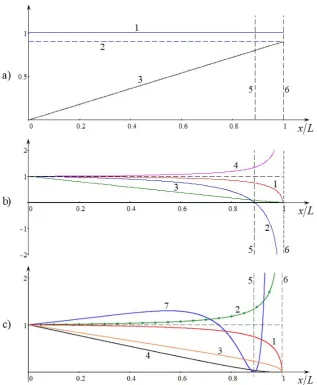
Figure 1.(Color online) Frame (a): line 1—free surface in the basin of the total depthH(0) =500 m; line 2—position of a pycnocline at the depthh1=50 m; line 3—normalised bottom profile as a function
ofx/L. Frame (b): Normalised coefficients of the time-like Ostrovsky Equation (3): line 1—c(x)/c(0); line 2—α(x)/α(0); line 3—β(x)/β(0); line 4—γ(x)/γ(0); line 5—vertical line showing the distance
where the upper and lower layers become equal; line 6—vertical line showing the distance where the thickness of the lower layer vanishes. Frame (c): Normalised coefficients of the TNLS Equation (7): line 1—c(x)/c(0); line 2—k(x)/k(0); line 3—cg(x)/cg(0); line 4—p(x)/p(0); line 7—q(x)/q(0).
The dependences of these coefficients on the distance are shown in Figure1b. The nonlinear coefficientαvanishes at some distance x1, whereh2(x1)becomes equal toh1. Then, it changes its sign and becomes positive. This effect is well-known (see, e.g., References [35,36] and the references therein). To avoid confusion, it should be kept in mind that the the nonlinear coefficient in this figure is presented in the normalised formα(x)/α(0), therefore this ratio is positive whenx=0 and becomes negative whenx1<x <L.
In the vicinity of distance x = x1 ≈ 0.889L (see vertical dashed line 5), the dispersion and nonlinear coefficients experience dramatic changes. The nonlinear coefficientqbecomes zero atx=x1, and then quickly increases in absolute value remaining negative for all x 6= x1. The dispersion coefficientpbecomes zero a bit further along, atx2≈0.947L, and then changes its sign from negative to positive; this is shown in details in Figure2, where the dispersion coefficient is multiplied by a factor of 50 to make it clearly visible (we remind you again that these coefficients are presented in the normalised forms in Figures1and2). Again in the Figure2, a normalised productp(x)q(x)(see line 8) is also shown, which determines the modulation stability/instability. The instability occurs when this product is positive (see, e.g., References [32–34]). In our case, the modulation instability providing the existence of NLS envelop solitons of Equation (10) occurs when eitherx < x1orx1 < x < x2. In the vicinity ofx =x1andx =x2, the TNLS equation is not valid and should be replaced by the generalised NLS Equation (18).
Figure 2. (Color online) A fragment of Frame (c) in Figure 1. Normalised coefficients of NLS Equation (7): line 4—50p(x)/p(0); line 7—q(x)/q(0); line 8—50p(x)q(x)/p(0)q(0); lines 5 and 6 are the same as in Figure1.
Now, let us estimate the key parameters of the NLS envelope soliton Equation (10). A carrier frequency (where the growth rate of modulation instability has a maximum) isωmax =c(9γ/4β)1/4≈ 1.42×10⁻³¹/s (the corresponding period isTmax ≈4.43×10³s), and the maximal spatial growth rate of Equation (32) for the initial amplitudea0=1 m isΓmax ≈1.94×10−51/m. The carrier wave number k(ωmax)where the growth rate of modulation instability has a maximum iskm ≈1.23×10⁻³¹/m (the corresponding wavelengthλm≈5.1 km), whereas the carrier wave numberk(ωm0), where the group velocity has a maximum iskc≈7.54×10−41/m (λc≈8.3 km).
The nonlinear coefficient in the time-like NLS Equation (7) atx = 0 isq(km) = −2.7×10⁻⁵ 1/(m2·s), and the dispersion coefficients at the same point isp(km) =−13.6 (m2/s).
If we assume that an NLS soliton of Equation (10) has the initial amplitude A0 = 2 m and velocityV0=0.5cg(0) =0.57 m/s, then we obtain that its characteristic duration is:∆T(0)≡1/Ω0=
p
2.5
103 1.25103 0 1.25 10 3 2.5 10 3
2.5
2.5 5 2.5
103 1.25103 0 1.25 10 3 2.5 10 3
3
0.5
2 4.5 2.5
103 1.25103 0 1.25 10 3 2.5 10 3
2.5
2.5
(s)
t
t
(s)
t
t
(s)
t
t
a)
b)
[image:9.595.136.462.83.516.2]c)
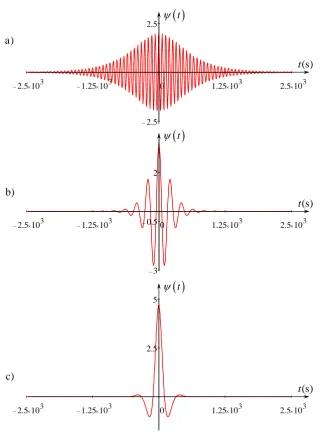
Figure 3. (Color online) An NLS envelope soliton of Equation (10) atx = 0 (frame (a)),x = 0.5L (frame (b)), andx=0.7L(frame (c)).
Whenxbecomes greater thanx1, the soliton amplitude and velocity formally increase again and go to infinity whenx→x2(this is not shown in the plot). However, the adiabatic theory breaks much earlier, whenx→x1, and the process of wave transformation in the vicinity of this point should be reconsidered more thoroughly, apparently, on the basis of primitive equations.
x L
2
1
3
( ),
( ),
( )
V x
x
N x
( ),
( )
A x
T x
4
1
x L
[image:10.595.84.514.155.339.2]5
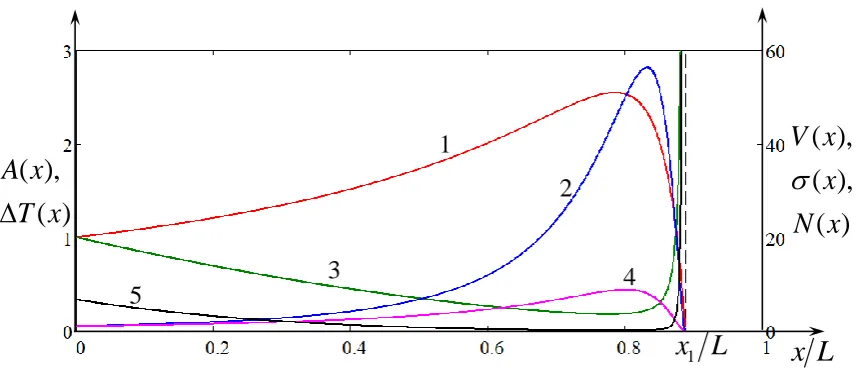
Figure 4. (Color online) Variations with the distance of normalised soliton amplitude A(x)/A(0)
(line 1), velocityV(x)/V(0)(line 2), duration∆T(x)/∆T(0)(line 3), carrier wave periodTc(x)/Tc(0)
(line 4), and the number of carrier wave periods on the half-durationN(x)(line 5) when a soliton moves towards the shore with the linearly decreasing depth, as shown in Figure1.
The soliton duration varies in an inversely proportional manner to the amplitude, therefore it decreases first, but then dramatically increases whenx →x1(see line 3 in Figure4). In contrast to that, the period of the carrier wave increases first, attains a maximal value and then quickly drops to zero, whenx →x1see line 4 in Figure4. In the result of this, the number of carrier wave periods within the soliton half-durationN(x)decreases first to zero and then formally increases again whenx→x1 (see line 5 in Figure4).
The transformation of soliton shape in the process of its propagation towards the coast is illustrated by Figure3. The soliton shape half-way to the coast when x =0.5Lis still close to that of the NLS envelope soliton (see Frame (b)). However, atx=0.7L, where the soliton amplitude becomes close to the maximal value, it looks rather like a solitary wave, but represents a non-stationary formation oscillating in time (see Frame (c)). Such a formation can hardly be described by the TNLS equation which presumes thatN(x)>>1.
Thus, in the process of soliton propagation towards the shoaling, it becomes narrower and transforms from the wave train shown in Frame (a) of Figure3to the pulse-type non-stationary solitary wave (a breather) as shown in Frame (c). To a certain extent, this behaviour is opposite to the transformation of the KdV solitary wave into the envelope soliton described, for example, in References [19–22].
7. Discussion and Conclusions
Equation (18). Soliton solutions to both these equations have been presented and the limiting cases when some coefficients vanish have been discussed.
If an internal envelope soliton has been formed in a homogeneous two-layer rotating ocean and then enters a coastal zone, where the bottom linearly increases with a small gradient, then it experiences an adiabatic transformation. This leads to an increase in the soliton amplitude, velocity, and period of the carrier wave, whereas its duration decreases. Therefore, it becomes taller and narrower. At some distance it looks like a breather, i.e., a narrow non-stationary solitary wave. Apparently, the TNLS equation is not quite appropriate for the description of its further evolution; a more advanced theory and/or numerical simulation is required to this end. This can be a theme for further study.
Funding: The author acknowledges the funding of this study from the State task program in the sphere of scientific activity of the Ministry of Education and Science of the Russian Federation (Project No. 5.1246.2017/4.6) and grant of the President of the Russian Federation for state support of leading scientific schools of the Russian Federation (NSH-2685.2018.5).
Conflicts of Interest:The authors declare no conflict of interest.
References
1. Grimshaw, R. Evolution equations for weakly nonlinear, long internal waves in a rotating fluid.Stud. Appl. Math.
1985,73, 1–33. [CrossRef]
2. Grimshaw, R. (Ed.) Internal solitary waves. InEnvironmental Stratified Flows; Kluwer Acad. Publ.: Dordrecht, The Netherlands, 2002; Chapter 1, pp. 1–27.
3. Grimshaw, R.H.J.; Ostrovsky, L.A.; Shrira, V.I.; Stepanyants, Y.A. Long nonlinear surface and internal gravity waves in a rotating ocean.Surv. Geophys.1998,19, 289–338. [CrossRef]
4. Grimshaw, R.; Guo, C.; Helfrich, K.; Vlasenko, V. Combined effect of rotation and topography on shoaling oceanic internal solitary waves.J. Phys. Oceanogr.2014,44, 1116–1132. [CrossRef]
5. Helfrich, K.R.; Melville, W.K. Long nonlinear internal waves. Annu. Rev. Fluid Mech. 2006,38, 395–425. [CrossRef]
6. Ostrovsky, L. Nonlinear internal waves in a rotating ocean.Oceanology1978,18, 119–125.
7. Ostrovsky, L.A.; Pelinovsky, E.N.; Shrira, V.I.; Stepanyants, Y.A. Beyond the KdV: Post-explosion development.Chaos2015,25, 097620. [CrossRef] [PubMed]
8. Stepanyants, Y.A. The effects of interplay between rotation and shoaling for a solitary wave on variable topography.Stud. Appl. Math.2019, 1–22. [CrossRef]
9. Boegman, L.; Imberger, J.; Ivey, G.; Antenucci, J. High-frequency internal waves in large stratified lakes. Limnol. Oceanogr.2003,48, 895–919. [CrossRef]
10. De la Fuente, A.; Shimizu, K.; Nino, Y.; Imberger, J. Nonlinear and weakly nonhydrostatic inviscid evolution of internal gravitational basin-scale waves in a large, deep lake: Lake Constance.J. Geophys. Res.2010,115, C12045. [CrossRef]
11. Preusse, M.; Freistuhler, H.; Peeters, F. Seasonal variation of solitary wave properties in Lake Constance. J. Geophys. Res.2012,117, C04026. [CrossRef]
12. Rojas, P.; Ulloa, H.N.; Nino, Y. Evolution and decay of gravity wavefield in weak-rotating environments: A laboratory study.Environ. Fluid Mech.2018,18, 1509–1531. [CrossRef]
13. Ulloa, H.; Winters, K.; De la Fuente, A.; Nino, Y. Degeneration of internal Kelvin waves in a continuous two-layer stratification.J. Fluid Mech.2015,777, 68–96. [CrossRef]
14. Galkin, V.M.; Stepanyants, Y.A. On the existence of stationary solitary waves in a rotating fluid. J. Appl. Maths. Mech.1991,55, 939–943. [CrossRef]
15. Leonov, A.I. The effect of the Earth’s rotation on the propagation of weak nonlinear surface and internal long oceanic waves.Ann. N. Y. Acad. Sci.1981,373, 150–159. [CrossRef]
16. Gilman, O.A.; Grimshaw, R.; Stepanyants, Y.A. Approximate analytical and numerical solutions of the stationary Ostrovsky equation.Stud. Appl. Math.1995,95, 115–126. [CrossRef]
18. Grimshaw, R.H.J.; He, J.-M.; Ostrovsky, L.A. Terminal damping of a solitary wave due to radiation in rotational systems.Stud. Appl. Math.1998,101, 197–210. [CrossRef]
19. Grimshaw, R.; Helfrich, K.R. Long-time solutions of the Ostrovsky equation.Stud. Appl. Math.2008,121, 71–88. [CrossRef]
20. Grimshaw, R.; Helfrich, K.R. The effect of rotation on internal solitary waves.IMA J. Appl. Math.2012,77, 326–339. [CrossRef]
21. Grimshaw, R.H.J.; Helfrich, K.R.; Johnson, E.R. Experimental study of the effect of rotation on nonlinear internal waves.Phys. Fluids2013,25, 056602. [CrossRef]
22. Grimshaw, R.; Stepanyants, Y.; Alias, A. Formation of wave packets in the Ostrovsky equation for both normal and anomalous dispersion.Proc. R. Soc. A2016,472, 20150416. [CrossRef] [PubMed]
23. Whitfield, A.J.; Johnson, E.R. Rotation-induced nonlinear wavepackets in internal waves.Phys. Fluids2014, 26, 056606. [CrossRef]
24. Whitfield, A.J.; Johnson, E.R. Wave-packet formation at the zero-dispersion point in the Gardner—Ostrovsky equation.Phys. Rev. E2015,91, 051201(R). [CrossRef]
25. Benilov, E.S.; Flanagan, J.D.; Howlin, C.P. Evolution of packets of surface gravity waves over smooth topography.J. Fluid Mech.2005,533, 171–181. [CrossRef]
26. Benilov, E.S.; Howlin, C.P. Evolution of packets of surface gravity waves over strong smooth topography. Stud. Appl. Math.2006,116, 289–301. [CrossRef]
27. Djordjevic, V.D.; Redekopp, L.G. The fission and disintegration of internal solitary waves moving over 2-dimensional topography.J. Phys. Oceanogr.1978,8, 1016–1024. [CrossRef]
28. Andronov, A.A.; Fabrikant, A.L. Landau damping, wind waves and whistle. InNonlinear Waves; Proc. Gorky School on Nonlinear Oscillations and Waves, Ed.; A.V. Gaponov-Grekhov: Moscow, Rusia, 1979; pp. 68–104. (In Russian)
29. Churilov, S.M. Envelope solitons in an inhomogeneous medium.Fizika Plazmy1982,8, 793–796. (In Russian) 30. Stepanyants, Y.A.; Fabrikant, A.L.Propagation of Waves in Shear Flows; Fizmatlit: Moscow, Rusia, 1992.
(In Russian); Fabrikant, A.L.; Stepanyants, Y.A. World Scientific: Singapore, 1998. (In English)
31. Karpman, V.I. Soliton evolution in the presence of perturbation.Phys. Scripta1979,20, 462–469. [CrossRef] 32. Karpman, V.I.Nonlinear Waves in Dispersive Media; Nauka: Moscow, Rusia, 1973. (In Russian)
33. Ostrovsky, L.A.; Potapov, A.I.Modulated Waves: Theory and Applications; World Scientific: Singapore, 1998. 34. Zakharov, V.E.; Ostrovsky, L.A. Modulation instability: The beginning. Physica D2009, 238, 540–548.
[CrossRef]
35. Apel, J.; Ostrovsky, L.A.; Stepanyants, Y.A.; Lynch, J.F. Internal solitons in the ocean and their effect on underwater sound.J. Acoust. Soc. Am.2007,121, 695–722. [CrossRef]
36. Stanton, T.P.; Ostrovsky, L.A. Observations of highly nonlinear internal solitons over the continental shelf. Geophys. Res. Lett.1998,25, 2695–2698. [CrossRef]
c