BORANG PENGESAHAN STATUS TESIS*
JUDUL: TILES DECISION SYSTEM (TDS) SESI PENGAJIAN: 1 -2008/2009
Saya NIK SAKINAH BINTI NIK AB AZIZ
mengaku membenarkan tesis ( P S M / C n , , n n n ) ini disimpan di Perpustakaan Fakulti Teknologi Maklumat dan Komunikasi dengan syarat-syarat kegunaan seperti berikut:
1. Tesis adalah hakmilik Universiti Teknikal Malaysia Melaka.
2. Perpustakaan Fakulti Teknologi Maklumat dan Komunikasi dibenarkan membuat salinan untuk tujuan pcngajian sahaja.
3. Perpustakaan Fakulti Teknologi Maklumat dan Komunikasi dibenarkan membuat salinan tesis ini sebagai bahan pertukaran antara institusi pengajian tinggi.
4.
**
Sila tandakan (I)SULIT (Mengandungi maklumat yang berdarjah keselamatan atau kepentingan Malaysia seperti yang termaktub di dalam
AKTA RAHSIA RASMI 1972)
TERHAD (Mengandungi maklumat TERHAD yang telah ditentukan oleh organisasilbadan di mana penyelidikan dijalankan) 1
-- TIDAK TERl1AD
I
V
(TANDATANGAN PENuLIs) (TANDATANGIN PENYELIA) Alamat tetap: Lot 600, Nama Penyelia : Puan Azlianor
Kaw. Perpindahan Tok Adis, Abdul Aziz 20400,Kuala Terengganu
Terengganu Darul Iman
Tarikh : Tarikh :
CATATAN: *Tesis dimaksudkan sebagai laporan Akhir Projek Sarjana Muda (PSM)
TILE'S DECISION SYSTEM (TDS)
NIK SAKINAH BINTI NIK AB AZIZ
This report is submitted in partial fulfillment of the requirements for the Bachelor of Computer Science (Software Development)
FACULTY OF INFORMATION AND COMMUNICATION TECHNOLOGY UMVERSITI TEKNIKAL MALAYSIA MELAKA
DECLARATION
I hereby declare that this project report entitled TILES DECISION SYSTEM (TDS)
is written by me and my own effort and that no part has been plagiarized without citations.
STUDENT : Date:
(NIK SAKINAH BINTI NIK AB AZIZ)
SUPERVISOR:
-
Date:as/
l x o ~
DEDICATION
ACKNOWLEDGEMENT
Praise to Allah Almighty for giving a chance to complete my final year project entitles "Tiles Decision System" and successfully complete this report. First of all, I would like to thankful to my beloved parents for their full support in my progress finishing this system.
I would also thankful to all UTeM's lecturers and staffs who were involved in this program especially to my supervisor, Pn. Azlianor Abdul Aziz who guides me on how to finish this project with flying colors.
ABSTRACT
ABSTRACT
ABSTRAK
Tajuk system ini ialah "Tiles Decision" system. Prosedur yang terlibat dalam menyiapkan tajuk ini ialah temuramah, mengedarkan kertas soalan dan perbincangan untuk mengetahui keperluan pengguna dalam memilih kemasan lantai. Kesemua maklumat pengedar diperolehi daripada Internet dan juga daripada pengeluar itu sendiri. Sepanjang kajian, beberapa ciri-ciri penting telah ditemui dalam memilih kemasan lantai iaitu saiz, harga, warna, corak dan juga ruangan yang ingin dipilih untuk memasang kemasan lantai tersebut. Tujuan sistem ini dibangunkan adalah untuk membantu pengguna dalam membuat keputusan dalam proses pembelian kemasan lantai. Mereka hanya perlu memasukkan maklurnat yang diperlukan ke dalam sistem dan sistem akan mengeluarkan senarai-senarai yang berkaitan dengan kreatirea yang telah dipilih. Pihak syarikat pula boleh menyenaraikan semua jenis kemasan lantai yang dijual di syarikat mereka ke dalam sistem ini. Sistem ini mempunyai beberapa modul iaitu modul Login yang akan digunakan oleh
Administrator dan juga pihak syarikat yang berdaftar. Modul Register dan Delete
Company yang digunakan oleh admin, modul Edit Company Detail, Add Tiles, Edit
TABLE OF CONTENT
CHAPTER SUBJECT
DEDICATION
ACKNOWLEDGMENT ABSTRACT
ABSTRAK
TABLE OF CONTENTS LST OF TABLES
LIST OF FIGURES
CHAPTER I INRODUCTION
1 . 1 Project Background 1.2 Problem Statements 1.3 Project Objective 1.4 Project Scopes 1.5 Project Significance 1.6 Expected Output
I 1.7 Conclusion ,
PAGE
. .
11
. . .
111
iv v vi
X
CHAPTER I1 LITERATURE REVIEW AND PROJECT METHODOLOGY
2.1 Introduction 2.2 Fact and Finding
2.2.1 Domain
2.2.2 Existing System 2.2.3 Technique
2.3 Project Methodology
2.3.1 Justification in Choosing Waterfall Methodology
2.4 Project Requirement
2.4.1 Software Requirement 2.4.2 Hardware Requirement 2.5 Project Schedule and Milestone 2.6 Conclusion
CHAPTER 111 ANALYSIS
3.1 Introduction 3.2 Problem analysis
3.2.1 Background of Current System
I
3.3 Problem Statement Analysis 3.4 Requirement Analysis
3.3.1 Data Requirement 3.3.2 Functional Requirement 3.3.3 Non-Functional Requirement 3.3.4 Other Requirement
CHAPTER IV DESIGN
...
V l l l
46
4.1 Introduction
4.2 High-Level DesignISystem Prototype 4.2.1 High-Level Logical View /
Architecture
4.2.2 User Interface Design 4.2.2.1 Navigation Design 4.2.2.2 Input Design 4.2.2.3 Output Design 4.2.3 Database Design
4.2.3.1 Conceptual and Logical Database Design 4.3 Detailed Design
4.3.1 Software Specification 4.3.2 Physical Database Design 4.4 Conclusion
CHAPTER V IMPLEMENTATION
5.1 Introduction
I
5.2 Software Development Environment Setup 5.3 Software Configuration Management
5.3.1 Configuration Environment Setup 5.3.2 Version Control Procedure 5.4 Implementation Status
CHAPTER V1 TESTING
6.1 Introduction 6.2 Test Plan
6.2.1 Test Organization 6.2.2 Test Environment 6.2.3 Test Schedule 6.3 Test Strategy
6.3.1 Classes of tests 6.4 Test Design
6.4.1 Test Description 6.4.2 Test Data
6.5 Test Result and Analysis 6.6 Conclusion
CHAPTER V1I CONCLUSION
7.1 Observation on Weaknesses and Strengths
7.2 Propositions for Improvement
7.3 Contribution
I
7.4 Conclusion
BIBLIOGRAPHY
LIST OF TABLES
TABLE TITLE PAGE
Table 2.1
Table 2.2
Table 3.1
Table 3.2
Table 3.3 Table 3.4
Table 3.5
Table 3.6
Table 3.7
Table 4.1
Table 4.2
Table 4.3
Table 4.4
Table 4.5
Table 4.6
Table 4.7
Table 4.8
Table 4.9
Table 4.10
Table 4.11
Table 4.12
Table 4.13
Table 4.14
Table 4.15
Table 4.16
Table 4.17
Analysis milestone Login Company Registry Tiles info DSS Module Non-functional Requirement Other Requirement Hardware Requirement Login Register Company Insert Tiles Details DSS Module Delete Company Add Promotion Delete News Output Design Login Company Registry Tiles Info DSS Module
Method operation for login Method operation for register Method Operation for Tiles Utilities
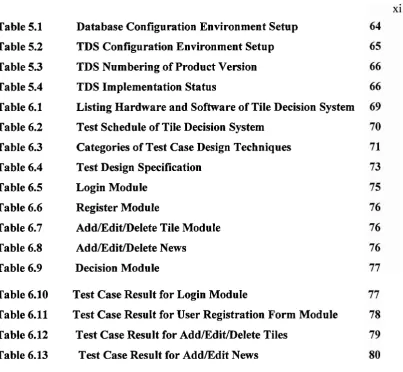
Table 5.1 Table 5.2 Table 5.3 Table 5.4 Table 6.1 Table 6.2 Table 6.3 Table 6.4 Table 6.5 Table 6.6 Table 6.7 Table 6.8 Table 6.9 Table 6.10 Table 6.11 Table 6.12 Table 6.13
Database Configuration Environment Setup TDS Configuration Environment Setup TDS Numbering of Product Version TDS Implementation Status
Listing Hardware and Software of Tile Decision System Test Schedule of Tile Decision System
Categories of Test Case Design Techniques Test Design Specification
Login Module Register Module
AddiEditDelete Tile Module Add/Edit/Delete News
Decision Module
Test Case Result for Login Module
Test Case Result for User Registration Form Module Test Case Result for AddiEditDelete Tiles
LIST OF FIGURES
FIGURE
Figure 2.1
Figure 3.1
Figure 3.2
Figure 3.3
Figure 3.4
Figure 3.5
Figure 4.1
Figure 4.2
Figure 4.3
Figure 4.4
Figure 4.5
Figure 5.1
TITLE
V-Model Methodology
Flowchart Diagram Current System Flowchart the new system (ADMIN) Flowchart the new system (Company) Flowchart the new system (user) Use case for new system
System Architecture for DSS Navigation Design for Admin Navigation Design for Company Navigation Design for User
Figure 4.5 E R Design for Company TDS Development Environment Setup
CHAPTER I
INTRODUCTION
1.1 Project Background
Nowadays, Information Technology (IT) is widely used in various domains and has helped us in accomplishing and alleviating our daily routine. In business field, technology becomes the most important things to enlarge their market and to encounter their target customers.
In this project, the technology used to help customer to make a decision making in choosing a product. This project is about Development of Decision Support System for tiles, entitle Tiles Decision System (TDS). It will help customer to choose the best tile for their house according to their requirements. Requirements that provided in this system are state they are want, such as pattern of the tiles, color, size, target room and prize for each tile. After they enter the requirements, system will generate and find a list of answers fox them to analyst. This system is not for make a decision for users but its help users to make a better decision by giving a list of details about the tile they wanted. Then users themselves need to make a decision according to the list given.
On the other hand, administrator used this system to add more info about tiles and the company that may produce or sell that tile. Admin needs to register their details before login. This is because to make sure that only person that is authenticated used this system. All data that have been insert, will be shown in users interface or modules.
1.2 Problem Statement
Communication Problems: Communication problems may occur when staff does not listen carehlly to what customer wants, or customer that are using different languages. This small mistake might become a big problem if it always happens. For example, customer request for a tile that are red in color but staff give them blue or orange tile. This miscommunication always occurs in daily life but if this happen in the business that company might be lost their customer forever.
Decision making problem: Some customer that come to the shop does not know what type of tile they want to buy actually. So they might takes lots of times to think and make a decision which one is the best. Staff may help, but not most of the time staff can be there. Sometimes, staff might give a suggestion that does not accomplish customer's requirements. There are lots of characteristics of each tiles that customer have to consider.
Difficult to find a perfect shop: This is another problem that always occurs when person wants to buy a tile. They do not know which shop is nearest to their house and they might go to the shop that is far from the house. They actually do not know if any shop that is fills their requirements exist in which area. Imagine that if someone that actually new residents in that place, it may waste their time or money to find a tile shop in that place.
1.3 Project Objective
The objectives of developing this project are:
Provides more comprehensive and faster outcomes for decision making: Using this system, customer can have a better choice in making a decision to buy a tile. This system gives them a list of company and tile information refers to their requirements. There is no miscommunication happen again and customer may have their decision before they are going to the shop.
Reduce customer's time: When decision can be done faster, there is no wasting time for customer. They can contact the company in many ways while doing their job. This system gives company information to the users so that users can contact the company. Customer also can go to the nearest shop from their house because they already have the information which is the nearest shop in that place.
1.4 Project Scope
Before the construction of the system commence, the scope of the project has to be determined in order to create the boundary of the system. This will keep the development of the system within a manageable scope. The scope is divided into two parts, which are target user and project module.
1.4.1 Target User
Person who wants to buy a tile.
This system is basically created for a customer to help them to make a better decision in choosing a tile. It is an easy system that only required user to enter their needs.
Tile's company.
This system also can be used by a company that sell and produce tiles to check customer requirements nowadays. So, they can use the information to improve their business strategy.
1.4.2 Project Module
The project will be focused in the development of Tiles decision making. The scopes of the projects are:
a) Resource Planning
Adding new resources. , '
In this part, Company can add a new information or resources and details into the database. Company also can delete or edit the information in the database. System may check the authentication whether the user is allowed to enter the module. Company need to register first before using this system.
Deleting Company
b) Report
This function will auto generate report that will support in making decision according to user needs.
c) Registration
This section required user to register as Company, so that they will manage to enter the Company module. To register, user just need to inform administrator and they will get password and username.
d) Decision Module
This module is used by customer. They do not need to login because this system is capable for everyone. This module is used to generate the list of decision that user may choose after entering the requirements.
e) Tile Module
This module has three parts; add tile, edit tile and delete tile. This session will be used by company.
f ) Promotion Module
This module has three parts; add promotion, edit promotion and delete promotion. This session will be used by company to announce their promotion to the customer.
1.5 Project Significance
r
Besides, tile's company may use this system to see the report that has been provided to analyst. That report might help them a lot in making a new strategy to sell their tiles and to produce tiles. Compare with current system, each company does not know the customer requirement for overall which means they just analyst according to their company report only.
For the administrator, they can update all information about tiles and the company to make sure that customer get the correct information. Administrator also can view reports, so they can generate any new report if it is needed.
Nevertheless, this application is secured with password. This will make sure that only authorize user can access their module because the data can not be change by every users. This system will be displayed in a very friendly graphical user interface to ease the users.
1.6 Expected Output
In TDS, the results will appear according to the user requirements. User can enter the list of requirement given in the system so that they don't have to search tile detail because the requirements part is a dropdown list. They just have to choose are their requirements to generate the results in the system.
1.7 Conclusion
In this chapter, the main idea of developing this system is to help customer to make a decision. The system is built for helping decision making with effective, efficient and less time. This system will solve the entire problems that have been state above.
CHAPTER I1
LITERATURE REVIEW AND PROJECT METHODOLOGY
2.1 Introduction
In this chapter, it will describe about the literature review and project methodology that use in developing Tiles Decision System (TDS). This chapter will be focus on the fact and finding, project methodology that is Object Oriented Analysis and Design (OOAD) methodology, and project requirements.
Literature review is searching, collecting, analyzing and drawing conclusion from all debates raised in relevant body of literature. It is important to give the explanations of choosing the project. In project methodology section, selected approach or methodology will be described and explain the activities that may do in every stage. The requirements that are requisite in this system will be explained in high-level project requirements and follow$ with project schedule and milestones.
2.2 Facts and findings
The role of the DSS is to provide support to maker on the "Structurable" portion the decision. This section contains domain that relates with project, review on journals, existing system and technique applied in project development.
2.2.1 Domain
Decision Support System will be used to accomplish this project, which gives a suggestion decision to the user on ceramic's design. As a result, it is a stand alone system and explanations the step of process in this DSS for ceramic's system project with domain, which is list as below:
i) Users open the website, login the system as users.
ii) Then they insert any requirement that they need into the system. Staff also can use that module if the users do not know how to use a computer.
iii) The requirements are; state, prize, color, pattern, target room, and size. iv) The system will automatically generate list of decision that user may choose. v) Users can make a booking using the link or address given in the website if
they satisfy with design listed.
2.2.2 Existing System
I) Research and references