City, University of London Institutional Repository
Citation
:
Andriopoulos, C. and Gotsi, M. (2017). Methods of Paradox. In: Smith, W. K., Lewis, M. W., Jarzabkowski, P. and Langley, A. (Eds.), The Oxford Handbook ofOrganizational Paradox. (pp. 513-529). Oxford University Press. ISBN 0198754426
This is the accepted version of the paper.
This version of the publication may differ from the final published
version.
Permanent repository link:
http://openaccess.city.ac.uk/id/eprint/18290/Link to published version
:
http://dx.doi.org/10.1093/oxfordhb/9780198754428.001.0001
Copyright and reuse:
City Research Online aims to make research
outputs of City, University of London available to a wider audience.
Copyright and Moral Rights remain with the author(s) and/or copyright
holders. URLs from City Research Online may be freely distributed and
linked to.
City Research Online: http://openaccess.city.ac.uk/ [email protected]
METHODS OF PARADOX
Constantine Andriopoulos Cass Business School, City University London 106 Bunhill Row, EC1Y 8TZ
London United Kingdom, T: +44(0)2070408460 F: +44(0)2070408328
Manto Gotsi
Westminster Business School, University of Westminster
35 Marylebone Road London NW1 5LS
UK
T: +44(0)2035067203
Abstract
Despite growing scholarly interest in paradoxes, few studies have expressly engaged with the
methodological mechanics of ‘doing’ paradox research. First, there are no clearly established
guidelines regarding what should count as paradox in research endeavors. Second, there is
uncertainty around who sees/thinks/experiences the paradox and what is relevant when it
comes to the emergence, choice, interpretation and appropriation of paradoxes in empirical
settings. Third, there is still confusion around where one can find evidence of paradoxes. This
book chapter aims to shed some light on these methodological shortcomings. We suggest that
paradox researchers can deal with these methodological challenges by 1) showing evidence
of contradictory, interrelated, simultaneous and persistent paradoxical tensions in the
empirical setting, 2) developing reliable and flexible protocols for paradox identification,
3) pushing for multi-level paradox studies, 4) practicing reflexivity, 5) staying close to the
context, and 6) leveraging multi-modality.
METHODS OF PARADOX
Introduction
Interest in the study of paradox within organizational research is steadily growing
(e.g. Lewis, 2000; Smith & Lewis, 2011). This interest is spurred by an increase in the
volume of theoretical and empirical work exploring tensions made salient through amplified
plurality, change and scarcity in organizational life. Contradictions abound in organizational
goals, structures, processes, cultures and identities, triggering paradoxical tensions among
performance, organization, belonging and learning (Lewis & Smith, 2014). Not surprisingly,
the work on paradoxes spans a range of phenomena—from identity (e.g., Huy, 2002;
O’Mahony & Bechky, 2006; Gotsi et al., 2010) and organizational identity (e.g., Albert &
Whetten, 1985; Jay 2013) to strategy (e.g., Smith, 2014; Smets et al., 2015) and innovation
(e.g., Andriopoulos & Lewis, 2009). Paradox studies also use an assortment of qualitative
and quantitative methodologies—from action research (e.g., Lüscher & Lewis, 2008) and
case studies (e.g. Jarzabkowski & Sillince, 2007) to surveys (e.g., Keller & Loewenstein,
2011) and experiments (e.g., Miron-Spektor et al., 2011b).
Interestingly, despite growing scholarly interest in paradoxes, few studies are
expressly engaging with the methodological mechanics of ‘doing’ paradox research. This is
an important gap, as empirically assessing paradox is challenging. To begin with, the field
lacks clearly established guidelines regarding what counts as paradox. Moreover, there is
uncertainty around who sees/thinks/experiences the paradox and what is relevant when it
comes to the emergence, choice, interpretation and appropriation of paradoxes in empirical
paradoxes. Despite widespread agreement that these challenges make the study, review and
publication of paradox work a perplexing process, we still lack good guides on how to
address them.
This book chapter aims to shed some light on this gap. We start by discussing how the
aforementioned challenges problematize methods of studying paradox. We then offer a
number of suggestions to aid paradox researchers in dealing with these methodological
challenges. These propositions include: 1) showing evidence of contradictory, interrelated,
simultaneous and persistent paradoxical tensions in the empirical setting, 2) developing
reliable and flexible protocols for paradox identification, 3) pushing for multi-level paradox
studies, 4) practicing reflexivity, 5) staying close to the context, and 6) leveraging
multi-modality.
Challenges of studying paradoxes
What is paradox? The empirical literature abounds with varying definitions of
paradox. Moreover, scholars often confuse definitions of paradox with similar
tension-oriented idioms such as dilemmas, dualities and dialectics (Putnam et al., 2016). Smith and
Lewis defined paradox as “contradictory yet interrelated elements that exist simultaneously
and persist over time.” This definition highlights two key constitutive elements—
contradiction and interdependence. Contradiction highlights the inconsistencies and conflicts
between dual elements, as in the opposing black and white slivers in the yin-yang. Paradox
theory asserts that these distinct elements persist over time. Interdependence describes
synergies, mutual-constitution, and the interwoven nature of these distinct elements. The
yin-yang depicts interdependence as an overarching circle that encompasses distinct slivers, as
well as the small dots enmeshed within their opposing hue. Such interdependence provokes
constitutive elements distinguish paradoxes from dilemmas, in which choices between
elements resolve the underlying dualities, and from dialectics, in which interactions over time
fundamentally morph and change the underlying dualities (Smith & Lewis, 2011).
Despite these constitutive elements, variance remains in how scholars operationalize
paradox in empirical studies. Some scholars emphasize contradiction between dual elements,
but obscure any interdependence. Others highlight static relationships between opposing
elements, but obscure the dynamic interplay between alternatives (Putnam et al., 2016; Schad
et al, 2016). The proliferation of definitional focus and variability in operationalization of
paradox diminishes internal validity, complicates the basis for making more broad-based
theoretical inferences about the frequency of paradoxes and makes it challenging to compare
across studies. Moreover, the lack of agreed-upon criteria for paradox identification confuses
reviewers and readers as they seek to evaluate theoretical claims. Such variation raises key
questions for scholars studying paradox:
What counts as evidence of paradox? What are the criteria for identifying paradoxes in
empirical settings?
What is the locus of paradox? While paradoxes may be inherent in our social world,
individual sense-making often reveals their contradictory and interdependent nature and
differentiates them from resolvable tensions, dilemmas and tradeoffs (Smith & Lewis, 2011).
In an empirical setting, this raises the question of who addresses these tensions—the scholars
conducting the study or the subjects of the investigation. That is, does the scholar ‘project’
his or her sense-making inductively or deductively in an empirical setting, or does the scholar
‘elicit’ paradoxes from the subjects of the study.
A ‘projected’ approach involves observing the contradictory and interdependent
situation. In this approach, scholars remain detached, neutral and objective as they measure
aspects of paradoxes, examine relevant evidence, and explore antecedents and consequences
of these paradoxes. For example, Lewis et al. (2002) investigated innovation–efficiency
paradoxes, exploring how contrasting management approaches impacted outcomes.
Miron-Spektor and colleagues (2011b) sought to understand how individual frames and cognitions
employed to address paradoxes between novelty and usefulness impacted creativity and
innovation. Keller and Loewenstein (2011) explored collaboration and cooperation, seeking
to understand whether distinctions in the national cultures of the US and China influenced
how the individual approaches to these paradoxes.
In contrast to ‘projecting’ paradoxes, the ‘eliciting’ paradox approach entails a focus
on processes by which people in their working life come to understand paradoxes, as well as
their vicious or virtuous responses and relevant management practices. Scholars observed
their subjects engaging with paradoxes through language, discourse, organizational text and
in situ artifacts (Putnam et al., 2016). The underpinning premise here is that “interpretations
of the social world can, and for certain purposes, must refer to the subjective meaning of the
actions of human beings from which social reality originates” (Schutz, 1973, p. 62). Michaud
(2014), for instance, showcased how numbers contribute to and mediate between different
forms of board governance over time. Longitudinal, ethnographic data, including observation
of board meetings and general assemblies, government related documents and
semi-structured interviews provided the in-depth data from which to observe paradoxes of
organizational governance. In another inductive study, Smith (2014) also followed an
‘elicitation’ approach through case study research. She observed how six top management
teams addressed tensions of exploration/exploitation and revealed how some saw them as
To empirically explore paradox, scholars must acknowledge whether their study
projects or elicits paradox. Each approach then exposes a number of key questions. Inductive
scholars projecting a paradox must them determine how they can validate the paradoxical
nature of tensions they see in their data. Deductive scholars must establish how they can
operationalize and/or manipulate the paradox in their settings. Scholars eliciting a paradox
must determine how they can validly demonstrate the paradoxical awareness or approaches
of their research subjects. Beyond this, paradox researchers have to figure out how to
conceptualize research questions that are relevant to participants’ experiences and also how
to understand often unfamiliar situations. To date, paradox studies have largely remained
cryptic about these issues while ‘projecting’ or ‘eliciting’ paradoxes. It is thus important to
shed some light on the following questions:
Who sees/thinks/experiences the paradox?
What is the role of the researcher in the study of paradoxes?
How does context inform paradoxical insights? Researchers have made a broad
methodological distinction between ‘contextual’ and ‘decontextual’ approaches in
empirically researching paradox, stemming from their deeper ontological and epistemological
assumptions. A contextual approach links paradoxes to the specific nature and setting of the
study. Such studies surface and theorize about particular tensions. This contextual sensitivity
adds richness and nuance to these studies, though at the expense of generalizability. For
instance, Kreiner et al.’s (2015) ten-year-long multiple method study described paradoxical
processes of identity work in response to changes in identity within the Episcopal Church.
Organizational members simultaneously stretched their identities while holding together
Decontextual studies explore paradoxes independent of their settings, or perhaps
irrespective of the specific tensions. Frequently rooted in positivist paradigms, these studies
often identify paradox meanings across actors and contexts. Such empirical studies more
easily enable abstractions from local occurrences of paradoxes to general ‘categories’ of
paradoxes. For instance, Khazanchi et al. (2007) examined the paradoxical interplay between
flexibility and control values across North American manufacturing plants. Looking at
Taiwanese strategic business units, Lin and McDonough (2014) found that ambidextrous
cognitive frames, featuring an independent and a reflective cognitive style, foster
ambidexterity. In their study of an R&D company, Miron-Spektor et al. (2011a) measured
cognitive styles in 41 teams. They found that including creative and conformist members
enhanced team radical innovation, while attentive-to-detail members had the opposite effect.
Amidst this distinction, scholarly discourse on how context informs the emergence,
choice, interpretation and appropriation of paradoxes remains limited. Little discussion exists
on how wider socio-cultural influences shape paradoxes, how multiple intra-organizational
interpretations can be considered and how other contextual factors such as time may mold
paradoxes. For instance, scholars often aggregate individual perspectives on tensions to a
collective level, with little insight about multi-level, individual-collective processes that
shape organizational paradoxes. Reviewers, thus, commonly argue that scholars often
extrapolate too readily from identified tensions in a text to generalized paradoxes across an
organization. And paradox researchers are largely puzzled about how to open up space to
unpack the socially constructed nature of paradoxes in their empirical settings. Grasping what
words or phrases actually mean cannot be achieved solely by an analysis of these words or
phrases (Giora, 1997). They embody different interests, are open to contradictions and
subject to multiple interpretations (Nicolini, 2009); context, thus, matters in understanding
detached from their context and their dynamic relationships with other elements of
organizational life. It is thus important to consider the following questions:
What role does context play in the empirical study?
How do we capture paradoxes and the terrain that shapes them?
Where can one find paradoxes? Historically, work on paradox in organizational
studies has primarily focused on paradoxes in discourse and text (through interviews,
studying discourse or observation) (e.g., Argyris, 1988; Putnam, 1986) or numbers (through
surveys and secondary data) (e.g., Michaud, 2014). This, however, is problematic. First, it
may miss paradoxes elsewhere in organizational life. Individuals, for instance, express
paradox broadly beyond their language, including through musical, spatial or kinesthetic
expression. Textual data, verbal descriptions and quantitative measures thus may offer only a
limited perspective on the phenomenon. Gestures, sounds, laughter, humor and other modes
of expression rarely feature as sources of paradox (see Jarzabkowski & Lê, forthcoming).
Moreover, even as paradoxes surface in and through feelings, relatively few studies explores
emotions (Schad et al., 2016; Vince & Broussine, 1996).
Second, overreliance on traditional data sources neglects the opportunity for
triangulation. Looking for paradoxes in a wider repertoire of options may not only help with
problems of measurement bias and construct validity in positivistic paradox studies, but may
also improve understanding of the phenomenon for more interpretivist paradox work (Brewer
& Hunter, 1989). Expanding the search for paradoxes in non-traditional sources can help
increase the depth and scope of inquiry in empirical studies.
Despite increased calls for a richer account of paradox-related processes in and
quantitative measures. The following question, thus, appears critical to the development of
the paradox field:
How can paradox scholars move beyond verbal, text-based descriptions and quantitative
measures of paradoxes?
Moving forward
The growing paradox field must pay greater attention to methodological issues around
what counts as paradox, who sees/thinks/experiences the paradox, what role context plays
and where one can find paradoxes. In concluding this chapter, we would like to put forward
some suggestions for advancing paradox research taking these issues into consideration (for a
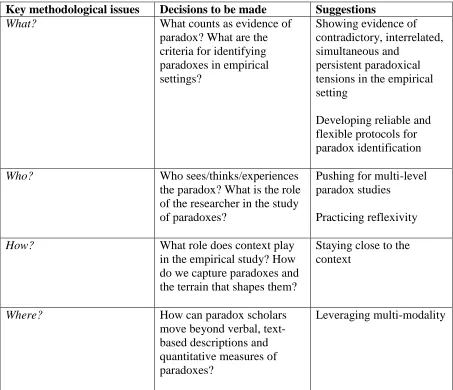
summary see Table 1 below).
--- Insert Table 1 here ---
Showing evidence of contradictory, interrelated, simultaneous and persistent
paradoxical tensions in the empirical setting. Scholars need to provide an in-depth account
of what they specify as paradoxical in their studies. The theoretical work of Lewis (2000) and
Smith and Lewis (2011) can serve as valuable guides in this process. As we noted earlier,
Smith and Lewis’s (2011) definition of paradox as “contradictory yet interrelated elements
that exist simultaneously and persist over time” (p. 382), highlights key features of paradox:
1) contradictory; 2) interdependent, 3) simultaneous and 4) persistent.
Operationalizing paradox must hence begin with an identification of contradictions.
This means thatresearchers need to search for opposing elements in their data. For instance,
ambidexterity scholars focus on the opposing sides of exploitation and exploration. In their
in-depth case study of a large Scandinavian based telecommunications company, Papachroni
orientation across organizational levels. These included simultaneous and interdependent
tensions around defending and growing existing business, while exploring new opportunities
for growth. In a similar vein, Jansen et al. (2008) asked executive directors to provide
information about exploratory and exploitative activities at their individual branches. Doing
so allowed them to capture variance in engaging competing demands across branches.
At the same time, paradox researchers need to capture the interdependent and
simultaneous nature of paradoxical tensions in their empirical studies. Unlike continua or
either/or choices, paradoxes denote opposing sides of the same coin. For example, Pascale
(1992) captured interdependence by questioning managers about their existing, polarized
frames to enable them to recognize relatedness and develop new and more insightful
understanding of paradoxical tensions. For example, they began to understand that attempts
to enhance group cohesion fueled desires for individual expression. In their survey of 80
product development projects, Lewis et al. (2002) found that contrasting project management
styles offer disparate but interwoven approaches to monitoring, evaluation and control
activities and enhance performance. Similarly, He and Wong (2004) investigated how
exploration and exploitation jointly influence firm performance. Using a sample of 206
manufacturing firms, they found that the interaction between explorative and exploitative
innovation strategies is positively related to sales growth rate, while the relative imbalance
between explorative and exploitative innovation strategies is negatively related to sales
growth rate.
Further, the interdependent nature of paradoxes should spur researchers to explore
paradoxical tensions across levels in their data. Multi-level paradox studies can elucidate how
tensions at one level of analysis may spark tensions in other levels. Such multi-level studies
can enhance our insight into paradoxes. Bottom-up emergent processes and top-down
(Kozlowski and Klein, 2000). For instance, Papachroni et al. (2016) identified a variety of
interpretations of the innovation–efficiency tension across levels, ultimately influencing how
ambidexterity is pursued in practice. Informants at the more operational and middle
management levels highlighted innovation as a means to higher efficiency, while informants
at higher organizational levels saw innovation and efficiency as interrelated yet conflicting.
In their comparative case studies of NPD consultancies, Andriopoulos and Lewis (2009)
interviewed with actors across levels and also demonstrated nested innovation tensions of
strategic intent (profit-breakthroughs) at the top management level, which cascaded to the
project level (tight-loose coupling), and to designers’ own personal drivers
(discipline-passion). Empirical paradox studies, thus, need to take an integrative perspective and aim to
analyze interrelations and interactions as a dynamic process (Teunissen, 1996).
Lastly, paradoxical tensions persist over time. Some studies may take a longitudinal
approach, depicting the persistence of underlying tensions (Jay, 2013). Other studies can
collect cross-sectional data across different points in time in their study. Gotsi et al. (2010),
for instance, argued that creative workers persistently grapple with their creative and business
identities, but can become better at managing this tension through paradoxical identity
regulation practices. Similarly, Miron-Spektor et al. (2011b) examined how the adoption of
paradoxical frames enhances creativity. They discussed the persistent conflict between
thinking outside the box and offering practical solutions that can be implemented within
organizational constraints. They proposed the positive influence of paradoxical frames as an
answer to this conundrum. Paradoxical tensions are dynamic – cyclical and constantly
shifting in their relationship to one another. Revealing evidence of the dynamic nature of
these tensions and their management, therefore, requires researchers to pay attention to
Developing reliable and flexible protocols for paradox identification. Published
studies are increasingly providing details on how they identify the aforementioned
characteristics of paradoxes in their empirical settings. For instance, in their interviews with
NPD professionals, Andriopoulos and Lewis (2009) identified patterns and variance in
descriptions of innovation tensions using language indicators such as tension, friction, yet,
but, on one hand…on the other hand, juggle, balance, it can swing both ways, there is a fine
line, how can you…and still. They also looked for contradictory statements within the same
transcript. Moreover, in their experimental study, Miron-Spektor et al. (2011b) discussed how
they manipulated cognitive frames by using a priming task in which participants read a
description of a product and then reported on the features that they thought made the product
successful. Miron-Spektor et al. (2011b) varied the product’s description, triggering a
creativity frame (stressing novelty), an efficiency frame (emphasizing low cost and efficient
production), a creativity–efficiency frame (creativity or efficiency features were noted) and a
paradoxical frame (creativity and emphasis focus). Yet, the field is far from having
established methodological guidelines on how to identify paradoxes in data.
What would greatly help, thus, is the development of reliable and flexible protocols
for paradox identification. Such protocols would start with a definition of paradox and then
highlight processes which researchers can use to go through transcribed text, archival
material, observation notes, artefacts, images, videos, etc. to identify words, expressions,
emotions, gestures, images, physical characteristics, etc. that signify paradoxical meanings.
The development of units (a ‘dictionary’ of words/expressions/ emotions/images/object
characteristics) to be used to identify reliably paradoxical meanings in different modalities
would be a great help. Researchers could then go through, for instance, a transcribed text and
Incorporating reliability assessments into this process would also help. While
identifying paradoxes, researchers can, for instance, measure the number of cases (words,
word combinations, expressions, emotions, images, object characteristics) that different
coders regard as paradoxical and then compare the cases. When differences are too great, the
reliability is problematic. The widely-used Cohen’s Kappa () (Cohen, 1960) could measure
reliability in categorizing paradoxes.
The benefits of paradox identification protocols would be threefold. First, they would
help minimize researchers’ biases regarding evidence of paradoxes in their research context.
This is an important benefit, taking into account growing pressures for objectivity, and
researchers’ perceptual and cognitive limitations. Second, definitional rigor would improve
precision in identifying paradoxes in speech, text, artefacts and other modalities. Third, a
commonly understood paradox ‘vocabulary’ would enable more direct comparisons of
different empirical analyses across different contexts.
Obviously, scholars employing paradox identification protocols would also encounter
challenges. Developing and applying such protocols would not be an easy or quick task. For
instance, the more empirical data move away from the purely written modality, the less
straightforward the process of paradox identification is likely to be. Moreover, although
external sources such as dictionaries are very helpful in establishing the basic meanings of
words, dictionaries can also vary in their descriptions of meanings. Cross-checking multiple
dictionaries is, thus, recommended to avoid such problems. In addition, multi-word units,
expressions, metaphors and idioms may pose greater challenges for paradox identification
than single word analyses. Further, researchers need to make decisions as to whether they are
observing/interpreting latent versus salient paradoxes. For instance, they will need to be clear
whether they have become salient due to changes in reward structures, cost-cutting or
increased competition.
Pushing for multi-level paradox studies.Paradoxes occur concurrently on several
intra- and extra-organizational levels (Andriopoulos & Lewis, 2009). Multiple ‘voices’ are
thus important when it comes to studying paradoxes empirically. For example, paradoxes
prevalent at the top management level can cascade downwards and influence, constrain or
shape paradoxes that are experienced by middle management, groups and individuals.
Empirical studies, thus, not only need to understand how paradoxes emerge at the top, but
also how they are understood by and how they influence those on lower organizational levels
and how they affect day-to-day practices (Raisch & Birkinshaw, 2008).
Practice research, for instance, can help to further understand not only how senior
management experiences and manages paradoxes, but also how these practices are perceived
by and how they influence those in lower organizational levels and translated into their daily
practices. Jarzabkowski and Le (forthcoming) conducted such a practice study, collecting
real-time longitudinal qualitative data from senior and middle managers (through
non-participant observation, interviews, archival material and impromptu interactions) over 24
months at a telecommunications company.
Paradox research questions can also focus on bottom up emergence, where dynamic
interactions among individuals, teams and organizational units may, over time, bring to the
surface paradoxes that manifest at higher levels. Interventions to manage these paradoxes
could elicit different interpretations and reactions across levels. Yet, we must acknowledge
that such complexity makes researching paradox challenging. Multiple levels and multiple
related processes may all impact the paradoxes under investigation. This quest for ‘nested’
explanations for the occurrence of paradoxes? What impact/effects do they have? Are there
any intervening conditions that seem to be playing a role?
We, therefore, encourage paradox scholars to use methods that enable them to go
beyond the formal, macro level and consider further the interaction between top-level
interventions and organizational responses from different levels. This also calls for a greater
repertoire of methods in studying paradox. Case studies and ethnography can only go part
way to generating depth and breadth in empirical paradox studies. Methods such as
dialogue-based group-level data gathering techniques may elicit valuable participant-generated
insights, not accessible through individual interviews. For example, limited-structure focus
groups, with limited structure, where participants interact, trigger each other and challenge
one another’s contributions can be a useful method for paradox studies. They can help
unearth organizational actors’ views, issues and experiences. Moreover, self-report methods
(such as diaries) and video data can also provide researchers with a more intimate view of
paradoxes in use, as experienced by different organizational actors. Diaries and videos will
allow paradox scholars to access events in real time, during times when paradoxes become
salient.
Practicing reflexivity.The importance of reflexivity as a process for making the
research process visible is also paramount while studying paradoxes. Researchers need to
situate themselves socially and emotionally in relation to the experience of their respondents
and reflect upon their biases, assumptions, even their personality, to ascertain whether what
they heard, read or saw conveys what respondents said, did or felt, rather than what the
researcher thought and felt. Making themselves deliberately aware of their biases is important
so that their ability to truly capture the voice of their respondents is not hampered (Mauther
experience may impact all stages of the research process: from sampling to data collection,
data analysis and drawing conclusions. A necessary balance between researchers’ own
experience and that of the study’s participants, thus, needs to be achieved.
An example is the work of Jay (2013) in hybrid organizations. To study how the
Cambridge Energy Alliance (CEA) changed over time, Jay (2013) conducted a two-year
ethnographic study, gathering participant observation, interviews and archival data. His
guiding research questions explored the challenges that CEA faced as a hybrid organization,
and how people thought about their hybridity and under what conditions and through what
practices they overcame the challenges. Throughout his empirical study, Jay (2013) sought to
be reflexive and transparent about his impact, to triangulate insights with multiple data
sources and reflect on his role when theorizing about the organizational processes observed.
Interestingly, his observations also revealed that organizational members became more
reflexive and aware of the paradox during the organizational change.
We advise paradox researchers to stay close to the words used by organizational
actors and seek feedback on their interpretations. Using a log to record what participants have
said or done, the interpretation, and what the researcher thought or felt about it can also help
(Berger, 2015). Other practical measures include reviewing material more than once during
the phase of data analysis. Involving more people in different stages of the project (from
collecting data to comparing analysis of more than one coder) can also aid the accuracy of the
study.
Staying close to the context.Paradox scholars also have to stay close to the
life-world of their subjects (or objects) when they interpret paradoxes in-use and the practices
employed to manage these paradoxes. This does not mean that paradox researchers should
laundry lists of paradoxes that are detached from their context may enable scholars to gain in
generality, but lose in accuracy and depth.
Researchers, thus, need to consider what is relevant within their paradox setting. This
involves uncovering reasons - factors and conditions that explain the emergence, choice,
interpretation and appropriation of particular paradoxes in their empirical setting. They must
put the emphasis on revealing the drivers and inhibitors of paradoxes and their management
within their settings and at particular points in time, and unveiling the temporal and spatial
contextual factors that are shaping the meanings, uses and management of these paradoxes.
Smith (2014), for instance, carried out her research in the SBUs of a Fortune 500 corporation,
drawing on their strategic commitments to exploit and explore in their annual budget plans.
To unveil contradictions, informants were asked to describe challenges in managing multiple
strategic domains and how they responded to these challenges. Smith (2014) discussed how
competitive contexts increasingly pose paradoxical demands on firms and their senior
leaders. Within the context of her study, she found that paradoxes and dilemmas were
interwoven, exposing issues related to resources, organizational design, and product design.
She, thus, proposed the value of dynamic decision making and leadership practices in
sustaining strategic paradoxes and facilitating an adaptive context.
Staying close to the context obviously requires suitable research methods. Research
questions focusing on how paradoxes emerge, how they develop, how they grow or how they
terminate over time, may be better suited, for example, to process studies. Here, the emphasis
is on how events unfold temporally and sequentially to cause different input variables to exert
their influence on one or more outcome variables. For example, in his in-depth field study of
the public–private Cambridge Energy Alliance, Jay (2013) unveiled a process model of
Longitudinal research designs are suited to research questions seeking to explain
virtuous and vicious cycles in managing paradoxes. Taking into account that extant paradox
research is predominantly static, researchers need to employ more methods that access the
dynamics of paradox across time and achieve more nuanced temporal theorizing about
cycles, pacing and event sequences. An example of a study that adopted a longitudinal
method showcasing rhythms of change and firm performance is the work of Klarner and
Raisch (2013). In their explorative analysis of 67 European insurance companies’ annual
reports between 1995 and 2004, they identified that corporate strategic changes take place in
distinct rhythms (regular or irregular): focused, punctuated and temporarily switching. They
showed that firms that change regularly outperform peers that change irregularly.
Researchers should also conduct paradox studies across contexts. Paradox studies
have rarely focused on national differences, for instance (see Keller & Loewenstein, 2011;
Li, 2014; Nisbett, 2010), perhaps because of the difficulty in conducting empirical work
across national contexts and the increasing emphasis on the universal over the particular. In a
rare cross-national empirical paradox study, Keller and Loewenstein (2011) argued that
understanding the cultural construction of organizations is important. They, thus, employed a
cultural consensus model analysis to assess what types of situations respondents categorized
as cooperative and whether these categorizations were consistent within and across China and
the United States.
Leveraging multi-modality. Despite the fact that paradoxes may occur in different
modalities, artefacts, text from archival material, signs, images, gestures, emotions, sounds or
even music, researcher have rarely studied them. We, thus, call for more multi-modal
research in paradox studies. In particular, we argue that non-traditional data sources can offer
observations and archival data. We encourage paradox scholars to move beyond these
modalities and start drawing insights from more diverse sources, including narratives,
photographs, organizational artifacts and non-verbal interactions.
The study of Vince and Broussine (1996), which focuses on organizational members’
emotions underlying organizational change, fostering forces of uncertainty and
defensiveness, is an example of one study that moved beyond traditional sources. In their
participative research process, the researchers used drawings with managers in six public
service organizations to tease out such paradoxical emotions, and work with these as part of
the management change process. In particular, the researchers asked participants in
workshops to draw pictures that expressed their feelings about changes at work. They were
then invited to reflect and set down notes on the reverse of their drawings. This was followed
by group reflections on each drawing and individual interpretations. Language certainly
played a key role in the articulation of paradoxes in the drawings. This multi-modal
perspective on paradox enabled Vince and Broussine (1996) to capture a deeper basis for
their interpretive analysis.
We also encourage researchers to study paradoxes in modes of expression, which may
extend language, as different modes of expression may instantiate or extend linguistic
paradoxes. Hatch and Ehrlich (1993), for instance, observed the laughing that took place
during a series of routine staff meetings held by senior managers of a unit within a large,
multinational computer company. They argued that laughter in these meetings pointed to
paradox and ambiguity, even when some group members failed to respond to remarks that
they did not find funny. Combining humor and laughing analysis with the study of paradox
enabled Hatch and Ehrlich (1993) to access everyday experiences in their case organization.
In a later study, Hatch (1997) also studied laughter and irony in the social construction of
involvement in the construction of ironic humor in her empirical setting. The cognitive and
emotional aspects of irony produced the experience of contradiction that materialized in
shared laughter. Interpretations of ironically humorous remarks reflected managers’
contradictory constructions of their everyday interactions as a management team. Similarly,
Jarzabkowski and Lê (forthcoming) also looked at laughter as a means of socially
constructing paradox, shaping the way managers formulated and legitimated their responses
to paradox. By adopting a practice approach, their study revealed that as managers joined the
laughter about the paradoxical nature of their tasks, they also joined constructions of ways to
perform those tasks.
Conclusion
The proliferation and complexity of paradox studies remains both exciting and
daunting. While these studies reinforce a core body of knowledge, they often obscure because
of the use of inadequate methodological approaches. Our goal in this chapter was to advance
paradox research by revealing and addressing key methodological challenges. We invite
paradox scholars to sharpen their methodological rigor and expand their methods and data
sources to further advance our understanding of organizational paradoxes.
References
Albert, S., & Whetten, D. (1985). “Organizational identity.” In L. L. Cummings & B. M. Staw (Eds.), Research in organizational behavior. An annual series of analytical essays and critical reviews: 263-295. Greenwich, CT: JAI Press.
Andriopoulos, C. & Lewis, M. (2009). “Exploitation-exploration tensions and organizational ambidexterity: Managing paradoxes of innovation”, Organization Science, 20(4): 696-717.
Berger, R. (2015). “Now I see it, now I don’t: researcher’s position and reflexivity in qualitative research”, Qualitative Research, 15(2): 219-234.
Brewer, J. & Hunter, A. (1989). Multimethod research: A synthesis of styles, Newbury Park, CA: Sage.
Cohen, J. (1960). “A coefficient of agreement for nominal scales”, Educational and Psychological Measurement, 20: 37-46.
Ford, J., & Backoff, R. (1988). “Organizational change in and out of dualities and paradox”. In R. Quinn & K. Cameron (Eds.), Paradox and transformation: Toward a theory of change
in organization and management:81–121. Cambridge, MA: Ballinger.
Gibson, C. & Birkinshaw, J. (2004). “The antecedents, consequences and mediating role of organizational ambidexterity”, Academy of Management Journal, 47(2): 209-226.
Giora, R. (1997). “Understanding figurative and literal language: the graded salience hypothesis”, Cognitive Linguistics, 8: 183-206.
Gotsi, M., Andriopoulos, C., Lewis, M. & Ingram, A. (2010). “Managing creative: Paradoxical approaches to identity regulation”, Human Relations, 63(6): 781-805.
Gylfe, P., Franck, H., Lebaron, C. and Mantere, S. (2016). “Video methods in strategy research: Focusing on embodied cognition”, Strategic Management Journal, 37: 133-148.
Hatch, M. (1997). “Irony and social construction of contradiction in the humor of a management team”, Organization Science, 8(3): 275-288.
Hatch, M. & Ehrlich, S. (1993). “Spontaneous humour as an indicator of paradox and ambiguity in organizations”, Organization Studies, 14(4), 505-526.
He, Z., & Wong, P. (2004). “Exploration vs. exploitation: An empirical test of the ambidexterity hypothesis”, Organization Science,15: 481–494.
Huy, Q. (2002). “Emotional balancing of organizational continuity and radical change: The contribution of middle managers”, Administrative Science Quarterly, 47: 31-69.
Ingram, A., Lewis, M., Barton, S. & Gartner, W. (2014). “Paradoxes and innovation in family firms: The role of paradoxical thinking”, Entrepreneurship Theory and Practice, 40(1): 161-176.
Jansen, J.J.P., George, G., Bosch, F.A.J. van den & Volberda, H.W. (2008). “Senior Team Attributes and Organizational Ambidexterity: The Moderating Role of Transformational Leadership”, Journal of Management Studies, 45(5): 982-1007.
Jarzabkowski, P. & Lê, J.K. (Forthcoming). “We have to do this and that? You must be joking: Constructing and responding to paradox through humour”, Organization Studies.
Jay, J. (2013). “Navigating paradox as a mechanism of change and innovation in hybrid organizations”, Academy of Management Journal, 56(1): 137–159.
Keller, J. & Loewenstein, J. (2011). “The cultural category of cooperation: A cultural consensus model analysis for China and the United States”, Organization Science, 22(2): 299-319.
Khazanchi, S., Lewis, M., & Boyer, K. (2007). “Innovation-Supportive Culture: The Impact of Values on Process Innovation”, Journal of Operations Management, 25(4):871-884.
Klarner, P. & Raisch, S. (2013). “Move to the beat – Rhythms of change and firm performance”, Academy of Management Journal, 56(1): 160-184.
Kozlowski, S. W. J., & Klein, K. J. (2000). “A multilevel approach to theory and research in organizations: Contextual, temporal, and emergent processes”. In K. J. Klein & S. W. J. Kozlowski (Eds.), Multilevel theory, research and methods in organizations: Foundations, extensions, and new directions: 3-90. San Francisco, CA: Jossey-Bass.
Kreiner, G., Hollensbe, E., Sheep, M., Smith, B., & Nataria, N. (2015), “Elasticity and the dialectic tensions of organizational identity: How can we hold together while we are pulling apart?”, Academy of Management Journal, 58(4): 981-1011.
Lampel, J., Lant, T. & Shamsie, J. (2000). “Balancing act: Learning from organizing practices in cultural industries”, Organization Science, 11(3): 263–269.
Lewis, M. W. (2000). “Exploring paradox: Toward a more comprehensive guide”, Academy of Management Review, 25: 760–776.
Lewis, M. & Smith, W. (2014). “Paradox as a metatheoretical perspective: Sharpening the focus and widening the scope”, The Journal of Applied Behavioral Science, 1-23.
Lewis, M., Welsh, M., Dehler, G., & Green, S. (2002). “Product development tensions: Exploring contrasting styles of project management”, Academy of Management Journal, 45(3): 546-564.
Li, P. P. (2014). The unique value of yin‐ yang balancing: A critical response. Management and Organization Review, 10(2): 321-332.
Lüscher, L. & Lewis, M. (2008). “Organizational change and managerial sensemaking: Working through paradox”, Academy of Management Journal, 51: 221–240.
Mauther, N.S. & Doucet, A. (2003). “Reflexive accounts and accounts of reflexivity in qualitative data analysis”, Sociology, 37: 413-431.
Miron-Spektor, E., Erez, M., & Naveh, E. (2011a), “The effect of conformist and attentive to detail members on team innovation: Reconciling the innovation paradox”, Academy of Management Journal, 54(4): 740-760.
Miron-Spektor, E., Gino, F., & Argote, L. (2011b). “Paradoxical frames and creative sparks: Enhancing individual creativity through conflict and integration”, Organizational Behavior and Human Decision Processes, 116: 229-240.
Nicolini, D. (2009). “Zooming in an out: studying practices by switching theoretical lenses and trailing connections”, Organization Studies, 30: 1391-1418.
Nisbett, R. (2010). The geography of thought: How Asians and Westerners think differently... and why, New York: Simon and Schuster.
O’Mahony, S. & Bechky, B. (2006). “Stretch work: Managing the career progression paradox in external labor markets”, Academy of Management Journal, 49: 918-941.
O’Reilly, C., & Tushman, M. (2008). “Ambidexterity as a dynamic capability: Resolving the innovator’s dilemma”, Research in Organizational Behavior,28: 185–206.
Papachroni, A., Heracleous, L., & Paroutis, S. (2016). “In pursuit of ambidexterity: managerial reactions to innovation-efficiency tensions”, Human Relations, forthcoming.
Pascale, R. (1992). Managing on the edge, Penguin Books.
Putnam, L. (1986). Contradictions and paradoxes in organizations. In L. Thayer (Ed.),
Organization communications: Emerging perspectives: 151-167. Norwood, NJ: Ablex.
Putnam, L.L., Fairhurst, G.T. & Banghart, S. (2016). “Contradictions, dialectics and
paradoxes in organizations: A constitutive approach”, The Academy of Management Annals, 10: 65-171.
Raisch, S., & Birkinshaw, J. (2008). “Organizational ambidexterity: Antecedents, outcomes, and moderators”, Journal of Management, 34: 375–409.
Schad, J., Lewis, M., Raisch, S. and Smith, W. (2016). “Paradox research in management science: Looking back to move forward”, The Academy of Management Annals, 10(1): 5-64.
Schutz, A. (1973). “Concept and theory formation in the social sciences” In M. Natanson (Ed.) Collected papers, 1: 48-66, The Hague: Martinus Nijhoff.
Smets, M., Jarzabkowski, P., Burke, G. & Spee, P. (2015). “Reinsurance trading in Lloyds’s of London: Balancing conflicting-yet-complementary logics in practice”, Academy of Management Journal, 58(3): 932-970.
Smith, W. (2014). “Dynamic decision making: A model of senior leaders managing strategic paradoxes”, Academy of Management Journal, 57(6): 1592-1623.
Sundaramurthy, C. & Lewis, M. (2003). “Control and collaboration: Paradoxes of governance”, Academy of Management Review, 28: 397-415.
Teunissen, J. (1996). Paradoxes in social science and research. In W. Koot, I. Sabelis & S. Ybema (Eds.), Contradictions in context: Puzzling over paradoxes in contemporary organizations. Amsterdam, Netherlands: VU University Press.
Table 1. Empirically studying paradoxes: Issues, decisions and suggestions
Key methodological issues Decisions to be made Suggestions
What? What counts as evidence of
paradox? What are the criteria for identifying paradoxes in empirical settings?
Showing evidence of contradictory, interrelated, simultaneous and
persistent paradoxical tensions in the empirical setting
Developing reliable and flexible protocols for paradox identification
Who? Who sees/thinks/experiences
the paradox? What is the role of the researcher in the study of paradoxes?
Pushing for multi-level paradox studies
Practicing reflexivity
How? What role does context play
in the empirical study? How do we capture paradoxes and the terrain that shapes them?
Staying close to the context
Where? How can paradox scholars
move beyond verbal, text-based descriptions and quantitative measures of paradoxes?