
City, University of London Institutional Repository
Citation
: Komninos, N., Saxena, N., Shen, H., Raymond Choo, K-K. and Chaudhari, N. S.
(2018). BVPSMS: A Batch Verification Protocol for End-to-End Secure SMS for Mobile
Users. IEEE Transactions on Dependable and Secure Computing, PP(99), doi:
10.1109/TDSC.2018.2799223
This is the accepted version of the paper.
This version of the publication may differ from the final published
version.
Permanent repository link:
http://openaccess.city.ac.uk/18944/
Link to published version
: http://dx.doi.org/10.1109/TDSC.2018.2799223
Copyright and reuse:
City Research Online aims to make research
outputs of City, University of London available to a wider audience.
Copyright and Moral Rights remain with the author(s) and/or copyright
holders. URLs from City Research Online may be freely distributed and
linked to.
City Research Online:
http://openaccess.city.ac.uk/
[email protected]
BVPSMS: A Batch Verification Protocol for
End-to-End Secure SMS for Mobile Users
Neetesh Saxena
Member, IEEE,
Hong Shen
Member, IEEE,
Nikos Komninos
Member, IEEE,
Kim-Kwang
Raymond Choo
Senior Member, IEEE,
and Narendra S. Chaudhari
Senior Member, IEEE
Abstract—Short Message Service (SMS) is a widely used communication medium, including by mobile applications, such as banking, social networking, and e-commerce. Applications ofSMSservices also include real-time broadcasting messages, such as notification of natural disasters (e.g. bushfires and hurricane) and terrorist attacks, and sharing the current whereabouts to a group of friends, such as notifying urgent business meeting information, transmitting quick information in the battlefield to multiple users, notifying current location to our friends, and sharing market information. However, traditionalSMSis not designed with security in mind (e.g.messages are not securely sent). It is also possible to extract International Mobile Subscriber Identity (IMSI) of the mobile user. In literature, there is no known protocol that could enable secure transmission ofSMSfrom one user to multiple users simultaneously. In this paper, we introduce a batch verification Authentication and Key Agreement (AKA) protocol,BVPSMS, which provides end-to-end message security over an insecure communication channel between different Mobile Subscribers (MSs). Specifically, the proposed protocol securely transmitsSMSfrom oneMSto multipleMSsimultaneously. The reliability of the protocol is discussed along with an algorithm to detect malicious user request in a batch. We then evaluate the performance of theBVPSMSprotocol in terms of communication and computation overheads, protocol execution time, and batch and re-batch verification times. The impacts of the user mobility, and the time, space, and cost complexity analysis are also discussed. We also present a formal proof of the security of the proposed protocol. To the best of our knowledge, this is the first provably-secure batch verificationAKAprotocol, which provides end-to-end security to the
SMSusing symmetric keys.
Index Terms—Authentication, Batch Verification, Mobile Subscriber, SMS, Symmetric Key Cryptosystem.
F
1
I
NTRODUCTIONC
ELLULARand mobile telecommunication industries are one of the fastest growing industries globally, partly due to the capability to provide a wide range of services to the Mobile Subscribers (MSs), such as health surveillance [1], health financing and health worker performance [2], and Short Message Service (SMS)-based web search [3]. However, the challenge for the server to handle multiple authentication requests at one time or in a very short time period (e.g.during the first few minutes of a major incident, such as a natural disaster or terrorist attack) is an area that has attracted the attention of researchers in recent years.• N. Saxena is with the School of Electrical and Computer Engineering, Georgia Institute of Technology, Atlanta, USA.
E-mail: [email protected]
• H. Shen is with the Department of Computer Science, University of Adelaide, Australia.
E-mail: [email protected]
• N. Komninos is with the Department of Computer Science, City Univer-sity London, UK.
E-mail: [email protected]
• K.-K. R. Choo is with the School of Information Technology and Mathe-matical Sciences, University of South Australia, Australia, and School of Computer Science, China University of Geosciences, Wuhan, China. E-mail: [email protected]
• N. S. Chaudhari is with the Discipline of Computer Science and Engi-neering, Indian Institute of Technology, Indore, India and also with the Visvesvarya National Institute of Technology, Nagpur, India.
E-mail: [email protected]
Manuscript received XXXX XX, 20XX; revised XXX XX, 20XX.
1.1 Research Problem
When an SMS is sent from oneMS to another, the infor-mation contained in the SMS is transmitted as plaintext.
SMSmay also contain confidential information such as PIN number and a link to a login page. Transmission of such con-fidential information as plaintext over an insecure network can be targeted by an adversary (e.g.intercepting, reading and modifying the SMS before it reaches the SMS-Center (SMSC). TraditionalSMSservice does not have a mechanism to transmit the message securely from one MS to another
MSor to a group ofMSs. TheEasySMSis the only protocol available in the literature that enables secure transmission of
SMSfrom oneMSto another [4]. However, there is no such protocol exists in the literature that can securely delivers an SMS to multiple recipients simultaneously. This is sur-prising, as in our increasingly interconnected society, there are various situations where secure transmission of batch
these applications, we should not compromise on security for the capability for batch dissemination ofSMS. For exam-ple, without an end-to-end (batch)SMSsecurity mechanism in place, a malicious attacker (e.g.hacktivist or ideologically-motivated individual) could hijack and replace a batchSMS
from the local authorities with one that will create social unrest (e.g. messages inciting racial hatred). In addition, the protocol should be sufficiently lightweight, suitable for deployment on resource-constrained devices (e.g. limited battery) [5].
1.2 Existing Solutions
Several batch verification-based solutions have been de-signed for different applications. For example, a number of protocols have been proposed for the value added services in Vehicular Ad-hoc Networks (VANET) [6], [7], [8], public-private key-based vehicular communication system [9], [10], [11], and digital signatures in batch to achieve high effi-ciency [12], [13]. SeveralSMS-based wireless protocols [14], [15], [16], [17], lightweightAKA[18] andSMS-based attacks and their countermeasures are discussed in [19]. Also, the protocols in [20], [21], [22], [23] are designed to provideSMS
security based on asymmetric key cryptography with the ex-ception in [22]. Other protocols in the literature include [24], [25] designed for the Global System for Mobile Communi-cations (GSM), [26], [27], [28], [29], [30] for the Universal Mobile Telecommunications System (UMTS), and [31], [32] for the Long-Term Evolution (LTE) networks. However, all these protocols do not consider simultaneous multiple au-thentication requests usingSMS. Group Authentication and Key Agreement (AKA) protocols are also available in theLTE
network [33], [34]. However, these protocols do not consider
SMS as a communication medium and require additional cost and storage for a group setup. Recently, a solution for user privacy in mobile telephony was proposed using the predefined multiple International Mobile Subscriber Identi-ties (IMSI) for each Universal Subscriber Identity Module (USIM) [35]. However, this solution requires a large storage space, generates a huge overhead for pseudo-identities, and utilizes significant bandwidth for sendingIMSIs to eachMS.
A literature review suggests that there is no known batch verification-based protocol that provides end-to-end SMS
security to many MS, although we observe that commer-cially available applications, such asSMSzipper,TextSecure,
moGile Secure SMS, and CryptoSMSprovide the facility to
send secure SMS. However, there are a number of limi-tations in these software solutions, such as (i) the need to install them on the phone’s memory/memory card, (ii) the need to provide a secret key to theSMS recipient, and (iii) the inability to support sending of anSMSto many users si-multaneously. Moreover, the security of the communications may also be affected by malware installed or vulnerabilities on the client devices. Therefore, a preferred solution is to develop a protocol that provides end-to-end security.
1.3 Our Contribution
In this paper, we propose a secure and efficient batch verification-based AKA protocol, hereafter referred to as
BVPSMS, which enables the transmission of an SMS to
multiple recipients at any one time.BVPSMSuses symmet-ric keys, since symmetsymmet-ric key encryptions are significantly faster than asymmetric key encryptions. The proposed pro-tocol has the following contributions:
1) TheBVPSMSprotocol:
• provides mutual authentications between the sender MS and the Authentication Server (AS), and between each recipientMSiand the
AS.
• maintains message confidentiality and in-tegrity usingAES-CTRand Message Authen-tication Code (MAC), respectively, during the messages transmission over an insecure net-work.
• allows the sending of only one of n-pieces of the secret code of the key by sender MS
to each recipient MS. It has the following advantages: (i) sending a partial code to each recipientMSimproves the overall security of the system, and (ii) reduces the total commu-nication overhead generated by the protocol.
2) Our protocol is secure against replay attack, Man-in-the-Middle (MITM) attack, impersonation attack,
SMSdisclosure, andSMSspoofing.
3) Each user’s original identity is kept secret during the authentication over the network. It protects the user againstIMSItracing andID-theft attacks.
We compare our protocol with four other related pro-tocols (ABAKA,RAISE,SPECS, andb-SPECS+). In a batch authentication when number of requests are 5, 10, 20, 50, 100, and the findings are as follows:
1) During first time (fresh) authentication, i.e.,
BVPSMS∗, reduces 6.1%, 23%, 12.5%, and 46.52%
of the communication overhead as compared to
ABAKA,RAISE,SPECS, andb-SPECS+, respectively,
and is equal of theBLSprotocol. However,BLSdoes not provide mutual authentication, user privacy, in-tegrity protection, and offers only partial resilience to impersonation attack.
2) During each subsequent authentication, i.e.,
BVPSMS∗∗, lowers the communication bandwidth
by 79.27%, 89.83%, 80.69%, and 88.2% in comparison
to ABAKA, RAISE, SPECS, and b-SPECS+,
respectively.
In addition, findings from the simulations (i.e. execu-tion time, verificaexecu-tion time, and re-batch verificaexecu-tion time) demonstrate the utility of our protocol in a real-world cellular network deployment.
The remainder of the paper is organized as follows. Section 2 describes the system and threat models for SMS
Sender Mobile User (MS)
Recipients Mobile User (MSi)
Authentication Server (AS)
(1) The MS sends SMS to
multiple users MSi
simultaneously. (2) All MSrequests to the AS for isend their the verification.
(3) The AS
authenticates the sender MS and all recipients MSi.
(4) The sender MS
authenticates the AS.
(5) All recipients MSi
[image:4.612.326.556.45.483.2]authenticate the AS.
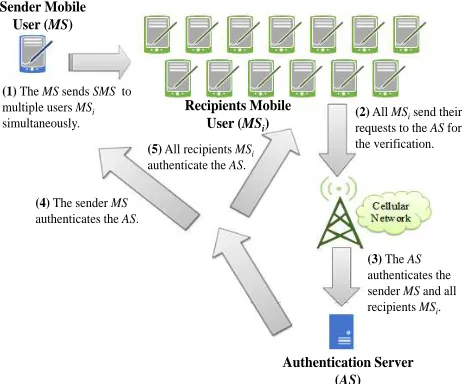
Fig. 1: Batch authentication requests from theMSto theAS.
5 and 6, respectively. Formal proofs ofBVPSMSusing
BAN-LogicandProverif are outlined in Section 7. Finally, section
8 concludes this work.
2
S
YSTEM ANDT
HREATM
ODELSIn this section, we present the system and threat models.
2.1 System Model
We introduce a scenario where the MS sends an SMS to multipleMSs simultaneously. Upon receiving theSMS, each
MS sends its authentication request to the AS for identity verification of the sender MS. The system model allows many such concurrent executions (e.g.severalMS sending
SMS to multiple recipients MS. A scenario is shown in Figure 1 where multiple MSs send their authentication requests to the AS for the identity verification of sender
MS at the same time. The AS handles the received au-thentication requests and authenticates all the MSs. The authentication request may be single or multiple. However, it would be uncommon to have only a single request at any point of time. When an SMS is sent from the sender
MS to the recipient MS over the2G/3G(GSM/UMTS) net-works, it follows the path shown in Figure 2(a) [36], [37]: Sender MS→Base Transceiver Station (BTS)→Base Station Controller (BSC)→Mobile Switching Center (MSC)→SMS -Gateway MSC (SMS-GMSC)→SMS-Center (SMSC)→ SMS-GMSC→MSC→BSC→BTS→RecipientMS. Similarly, Figure 2(b) and Figure 2(c) show a path ofSMStransmission over theSGs andIP/IMSin4G(LTE) networks. It is challenging for theASto verify and authenticate a large number ofMSs, based on its capacity to handle requests in an efficient way.
If the server can only handle one request at a time, then it requires a queue to manage all incoming requests. However, managing such a queue will result in increased overheads, time, and cost of authentication. In fact, the approach used for the authentication must be very efficient to handle all the requests in a very short time. To more efficiently
Other
MSC
Other BSC Other BTS Recipient MS
SMS Center
(SMSC)
Database
SMS Gateway MSC
(SMS-GMSC)
Mobile Switching Center (MSC)
Base Station Controller (BSC)
Base Transceiver Station (BTS)
Sender MS Equipment Identity
Register (EIR)
Home Location Register (HLR)
Visiting Location Register (VLR)
Authentication Center (AuC)
(a)SMStransmission in2G/3G(GSM/UMTS) system.
Other
MSC
Other MME Other eNodeB Recipient UE
SMS Center
(SMSC)
Database
SMS Gateway MSC
(SMS-GMSC)
Mobile Switching Center (MSC)
Mobility Management Entity (MME) eNodeB
Sender UE Equipment Identity
Register (EIR)
Home Subscriber Server (HSS)
Visiting Location Register (VLR)
Authentication Center (AuC) SGs Interface
(b)SMStransmission overSGs in4G(LTE) system.
Other
IP-SM-GW
Other MME Other eNodeB Recipient UE
SMS Center
(SMSC)
Database
IP Multimedia Subsystem
(IMS) Multimedia Telephony Service (MMTel)
IP Short Message
Gateway (IP-SM-GW)
Mobility Management Entity (MME) eNodeB
Sender UE Equipment Identity
Register (EIR)
Home Subscriber Server (HSS)
Visiting Location Register (VLR)
Authentication Center (AuC) SMS over IP
(SIP)
(c)SMStransmission overIP/IMSin4G(LTE) system.
Fig. 2:SMStransmission from the senderMS/UEto receiver
MS/UEin cellular systems.
handle multiple authentication requests, one solution is to perform a batch authentication for all incoming requests. However, there may be one or more malicious requests generated by the adversary. In such a case, we need to first identify the malicious requests and remove the identified malicious requests from the batch, then perform re-batch authentication. This comes at an additional cost to the re-batch authentication. However, the cost of authenticating each user is reduced. The notations used in the paper are presented in Table 1.
2.2 Threat Model
[image:4.612.55.288.48.240.2]TABLE 1: Notations
Symbol Description Size (bits)
MS Mobile station referring user –
UE User Equipment referring user –
AS Authentication server referringAuC –
IMSI International mobile subscriber identity 128
TID Temporary identity 128
ReqNo Request number 8
SK Shared secret key betweenMSandAS 128
DK Delegation key generated fromSK 128
H/MAC Hash/message authentication code 64
T /Ti/T1 Timestamp 64
K Random number 128
Y /P /Q/R Variable 128
Z Signature generated by theMS 128
SIMcode SIM card activation code ofSKkey 64
S-Actcode Sender generated code of theSKkey 64
Actcode Recipient generated code of theSKkey 64
ExpT Expiry time 64
f1() HMACSHA256is used to generateDK –
f2() AES-CTRis used to generateTID –
f3() HMACSHA1is used to generateMAC –
E{}DK Encryption function withDKkey –
D{}DK Decryption function withDKkey –
⊕ BitwiseXORoperation –
MS send incorrect outputs to the AS in a semi-honest MS
scenario. However, in thedishonest MS(maliciousMSto the network) scenario, majority of theMS(more than half) send fabricated information to the AS. Furthermore, malicious
MScomputes the required functions in a probabilistic poly-nomial time with auxiliary information. We do not consider these scenarios for the AS, as maliciousAS does not have the correct keys in its database. Therefore, we consider only the trustedASscenario where theASalways sends correct information to all theMSs. We also remark that an adversary can delay some or all the messages between theMSand the
ASunder a public channel.
In this paper, we consider two variations of the ad-versary models: non-adaptive and adaptive variations. In a non-adaptive or static variation of the model, a set of corrupted users are fixed, while in the adaptive variant, the adversary can choose any corrupted users in any numbers during run time. Furthermore, the adversary can choose any input for corrupted users. We also considerpassive as well as
active adversariesin the network.
i) Security and Privacy Attacks, and Integrity Violations:The
threat model describes different scenarios to capture various attacks in which a malicious MS can access the authentic information or misguide legitimate MS. Since the SMS is sent in plaintext, network operators can eavesdrop on the
SMScontent at theSMSC. This leads toSMSdisclosure and spoofing attacks. Currently, Over-the-Air (OTA) interface between the MS and the BTS is protected by a weak en-cryption algorithm. Hence, the adversary can compromise the messages in order to capture the information contained in the SMS. The unencrypted messages are sent over the Signaling System (SS7) networks, which does not secure the transmission medium.
ii) Security Goals:Our security goals are as follows:
1) Mutual Authentication:The proposed protocol must
provide mutual authentication between each MS
and theAS.
2) Data Confidentiality and Message Integrity: These are
two key properties to prevent the leakage or abuse of user data.
3) Other Security Properties: The protocol should be
secured against the following attacks:
a) Eavesdropping and Impersonation Attacks: The
adversary can eavesdrop the communication between the user and the server. The ad-versary may also pretend itself as legitimate user or the server and perform imperson-ation attacks.
b) MITM Attacks: An adversary can perform
MITM attack when theMS is connected to theBTSand eavesdrops the session initiated by a legitimateMS. IfIMSI is sent in clear-text, the adversary can compromise the sys-tem/user by tracing the user. Commercially available software, such asIMSIcatcher can be used to capture the user’s IMSI over a weak or unencrypted network.
c) Replay Attacks: The attacker may
fraudu-lently delay the conversation between both
MS, and captures or reuses the authenticated information contained in the previous mes-sages to facilitate or conduct a replay attack.
4) Session Key Security, Forward Secrecy, and
Non-linkability: It is common practice not to send the
session key over the network in a plaintext. The system must also defeat known key attacks and maintain forward secrecy. The protocol should be able to handle key generation, transmission, and its usage. The adversary must not be able to link current session information (messages and keys) with previous sessions,i.e.,non-linkability.
5) Privacy Preservation and Untraceability: The original
identity of each MS must be protected during its transmission over the network. Suchprivacy
preser-vation helps to secure the system against MITM
attacks and useruntreaceability.
3
P
ROPOSEDP
ROTOCOL: BVPSMS
In this section, we present the proposed efficient and se-cure batch verification-based protocolBVPSMSfor end-to-endSMSsecurity over an insecure network. The BVPSMS
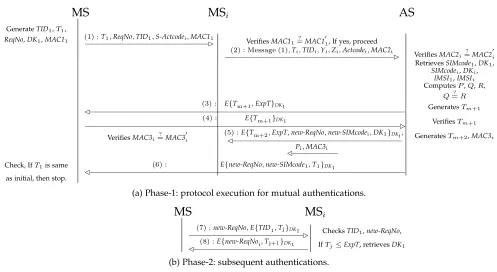
protocol is illustrated in Figure 3. The following subsections describe our protocol in detail.
3.1 System Assumptions
We make the following assumptions, similar to the tradi-tional cellular network, for our system implementation:
Assumption 1. An AS is deployed at the Authentication
Center (AuC) similar to the traditional cellular network.
Assumption 2. A Secret Key (SK) is stored in the AS’s
MS
MS
iAS
GenerateTID1,T1,
ReqNo,DK1,MAC11 −−−−−−−−−−−−−−−−−−−−−−−−−−−(1) :T1,ReqNo,TID1,S-Actcodei,MAC1B1 VerifiesMAC11 ?
=MAC101, If yes, proceed (2) : Message (1),Ti,TIDi,Yi,Zi,Actcodei,MAC2i
−−−−−−−−−−−−−−−−−−−−−−−−−−−−−−−−−−−−−B VerifiesMAC2i=?MAC2
0
i
RetrievesSIMcode1,DK1,
SIMcodei,DKi,
IMSI1,IMSIi
ComputesP,Q,R,
Q=? R
(3) : E{Tm+1,ExpT}DK1
C−−−−−−−−−−−−−−−−−−−−−−−−−−−−−−−−−−−−−−−−−−−−−−−−−−−−−−−−−−−−−−−−−−−−− GeneratesTm+1
(4) : E{Tm+1}DK1
−−−−−−−−−−−−−−−−−−−−−−−−−−−−−−−−−−−−−−−−−−−−−−−−−−−−−−−−−−−−−−−−−−−−−B VerifiesTm+1
VerifiesMAC3i
?
=MAC30i (5) :E{Tm+2,ExpT,new-ReqNo,new-SIMcodei,DK1}DKi,
C−−−−−−−−−−−−−−−−−−−−−−−−−−−−−−−−−−−−− GeneratesTm+2,MAC3i
Pi,MAC3i
C−−−−−−−−−−
Check, IfT1is same (6) : E{new-ReqNo,new-SIMcode1,T1}DK1
C−−−−−−−−−−−−−−−−−−−−−−−−−−−−−−−−−−−−−−−−−−−−−−−−−−−−−−−−−−−−−−−−−−−−−
as initial, then stop.
(a) Phase-1: protocol execution for mutual authentications.
MS
MS
i(7) :new-ReqNo,E{TID1,Tj}DK1
−−−−−−−−−−−−−−−−−−−−−−−−−B ChecksTID1,new-ReqNo, (8) :E{new-ReqNoi,Tj+1}DK1
C−−−−−−−−−−−−−−−−−−−−−−−−− IfTj≤ExpT, retrievesDK1
[image:6.612.57.554.36.308.2](b) Phase-2: subsequent authentications.
Fig. 3: BVPSMS protocol (a) phase-1 (b) phase-2.
Assumption 3.TheASnever discloses the stored secret keys
to any other entity in the network. Also, it does not illegally reuse the secret key of any one mobile user to other users.
Assumption 4. The process of generating Actcode and
re-trieval ofSIMcode(discussed later in user registration sub-section) is strictly kept secret and not publicly available. This is a realistic assumption as cellular network algorithms and functions are generally considered intellectual property.
3.2 Definition of the Functions Used
Our protocol uses different functions with standard nota-tions, such as f1(),f2(),f3(), andE/D{}, similar to used by existing cellular network authentication protocols. In the protocol, f1()and f3()functions are two different HMAC
functions to avoid any collision generated with the same input. We also considerAESwith Counter mode (AES-CTR) to implement f2() and E/D{}. However, inputs for f2()
andE/D{}are different. Modern mobile devices are fairly capable of computing these functions [4]. The structure of these functions as follows:
f1() Function: A one-way function, such as one-way hash function HMACSHA256, which takes input message of 512 bits withSKkey and generates 256 bits of hash code, out of which first 128 bits are used as theDKkey.
f2() Function: Any reversible symmetric encryption function, such asAES-CTRwhere the plaintext and shared key generate the ciphertext, and then ciphertext and the same key are able to produce the original plaintext. The key used in the function isDK, derived from theSKkey atMS
as well as atAS.
f3()Function:It is used to generateMACcodes, which can be implemented by a one-way MAC function, such
as HMACSHA1 that takes as input a multiple of 512 bits
message withDKkey and generates 160 bits of hash code, where the first 64 bits are used asMAC.
E/D{}DK Function: It is used to encrypt and decrypt the transmitted messages over the network.AES-CTRwith
DKkey is used for this purpose. The ModifiedAES(MAES) [4] with 256 bits ofDKkey can also be used as an alternative. However, a key expand function is required to generate 256 bits ofDKkey from 128 bits.
3.3 Detailed Description
Although the protocol is capable of supporting concurrent threads of different MSs sending their authentication re-quests withSMSs to several different MSs. For simplicity, in this section, we present a scenario where a MS sends multipleSMSs to differentMSs. This scenario can be easily extended with multiple sender MSs. The physical secu-rity (any personal access by the end user/mobile opera-tor/adversary) of the ASis assumed secure, similar to the existing traditional cellular networks. Hence, it is almost impossible to extract the secret key SK of a mobile user. Readers should not confuse theAuCwith theSMSC. At the
SMSC, mobile operator can easily access the content of each message. The AuCis secured against any personal access, and the keys stored at theAuCcan only be accessed by the protocol during its execution. Therefore, the AS is secure against any personal access.
We describe our protocol in four different parts: user reg-istration, pseudo-identity generation, protocol initialization, and protocol execution. The protocol maintains message integrity between eachMSand theASusingMACs.
SIM, the operator activatesSIMcard by establishing a con-nection between theSIMcard and theAS. TheASgenerates a randomSIMcode∈ Z∗
p (wherepis a large prime), stores
SIMcode in its database as a label to the secret key SK,
and also sends SIMcode to the SIM card during first use (e.g.when the card is activated). On receivingSIMcode, the
SIMcard stores it in the memory. TheActcodeis a one-time activation code sent to theASinstead of the actualSIMcode, when requesting for the authentication. The purpose of this code is to help theASto verifySIMcodeand retrieveSKkey from its database that belongs to a user requesting for the authentication. The ASsends a randomnew-SIMcode to all involvedMSs for subsequent authentication request.
In the proposed protocol, when a mobile user activates this module to send anSMSto multiple users, an automatic signal is sent to the respectiveAS, which sends a random k to the user’s device encrypted by its DK key. The user decrypts k and chooses n by its own. The selection of n is based on the average number of SMSs dropped by the network per unit time. Although there is no guarantee that anSMSwill actually be delivered to the recipient, but delay or complete loss of a message is uncommon, typically affecting less than 5 percent of messages [38]. Hence, our scheme uses n is at least 1.05×k. The need to generate and transmit activation code S-Actcode by the sender MS
and retrieval of actual SIMcodeby the ASis motivated by Shamir secret [39] as follows:
The goal is to divide the hash of secret SIMcodeof the sender MS into n-pieces as {S-Actcode1, S-Actcode2, ...,
S-Actcodei} such that: (i) knowledge of at least k pieces of
S-ActcodeihelpsASin the computation required to generate
the finalSIMcode, saySIMcode1’s hash, and (ii) knowledge of
any k-1 pieces ofS-Actcodei cannot help in the reconstruc-tion of the final SIMcode1’s hash (considering all possible
values are equally likely). Therefore, the senderMSsends
S-Actcodeiton-recipientsMSi. Alln-MSi(in the ideal case) or
at leastkout ofn-recipientsMSi(in case of error or network failure) forward their Actcodei to the AS along with the receivedS-Actcodei(part of senderMS). TheASobtains the actual hashedSIMcode1after receiving at leastk-S-Actcodei.
TheASwill then match the computed hashedSIMcode1with
the stored pre-computed hash ofSIMcode1of the senderMS.
Once the hashedSIMcode1 is known to theAS, it retrieves SK1key and derives a delegation keyDK1of the senderMS.
This entire process takeskpoints to define a polynomial of degreek-1 in a finite fieldFof sizepwhere0< k≤n < p,
SIMcode1< p, andpis a large prime.
The senderMSchooses at randomk-1 positive integers
{b1,b2, ..., bk−1}withbi < p, and computes a polynomial f(x) =b0+b1x+b2x2+...+bk−1xk−1, whereb0=SIMcode1.
The sender MS generates n S-Actcodei points (xi, yi) as
(i, f(i)modq)using the Lagrange basis polynomial, where q > n, q > bi. On receiving the message (from at least k-recipients MSi), the AS reconstructs a polynomial by computingf(x)as:
f(x) =
k
X
i=1
yili(x), whereli(x) =
Y
1≤j≤k j6=i
(x−xj)/(xi−xj).
Finally, theASretrieves the actualSIMcode1(=b0) from the
computed f(x). In our protocol, each recipient MSi also generates its ownActcodeias follows:
At the MSi:EachMSigeneratesActcodei=H(SIMcodei)and
is sent to the AS. We use first 64 bits of H() function as
Actcodei, which isSHA256.
At the AS: The AS pre-computes H(SIMcodei) from the
storedSIMcodei for eachMSi, and then verifiesActcodei
? =
H(SIMcodei). Thereafter, the AS extractsSKi key, and
de-rivesDKikey by referringSIMcodeiof eachMSi.
We keep the selection of k points dynamic by the AS
in each attempt to increase the difficulty of an adversary in correctly guessing the different pieces of the secretSIMcode1.
Also, in each such request,nis randomly generated, which is is at least1.05×k. For example, we can divide the hash of secretSIMcode1 into twenty parts (n= 20) ofS-Actcodei,
and any fifteen parts (k= 15) can sufficiently reconstruct the original SIMcode1. Note that the construction of SIMcode1
by an adversary is useless, as it cannot derive or extract meaningful information fromSIMcode1and the information
sent over the network. Later, in our protocol after verifying sender MS and all recipients MSi, the AS sends a new
new-SIMcode1 and new-SIMcodei to the MS and all MSi,
respectively, for subsequent authentication request.
2) Pseudo-Identity Generation: The generation of TID
and retrieval ofIMSIare not publicly available. We consider
IMSI 128-bit as defined in the 3GPP specifications [40], according to which the length of the compressed IMSI
and encrypted IMSI shall be 64 bits (8 octets) and 128 bits (16 octets), respectively. We use an encryption func-tion to generate a temporary identity of each participating user. Each MSi (including sender MS) computes TIDi as
TIDi = f2(IMSIi, Ti)DKi to prevent the transmission of the original IMSIi over the network that protects ID-theft, eavesdropping, and MITM attacks. Here, Ti is the current timestamp,DKiis a delegation key, andf2()is a reversible
symmetric encryption function (e.g. AES-CTR). The struc-ture of this function may be known; however, DKi key remains secret.
3. Protocol Initialization:Letmbe the total number of authentication requests generated by various mobile users
MSi (where i = 2, 3, ..., m+1) to the AS at the same time when they receive a request from the senderMS. Initially, each MSi (and sender MS) chooses a random number Ki ∈ Z∗p (where p is a large prime integer of 128 bits), generates current timestamp Ti, and derives a delegation key DKi, where DKi = f1(Ti)SKi and f1() is a hash-based MAC function, such as HMACSHA256. Thereafter, each MSi computes Yi = Ki ⊕IMSIi and a symmetric-signature Zi =(Ki +DKi ⊕ReqNo)modm, where ⊕is a bitwiseXORoperation. Each mobile user generates a valid symmetric-signature and fulfills the security properties with Assumption 3, such as authenticity (the signer itself signs the associated message with its key), unforgeability (only the signer can generate a valid symmetric-signature for the associated message, assuming an honestAS),non-reusability
(generated symmetric-signature cannot be reused),
non-repudiation (signer cannot deny the signing of a message,
(ensures that content has not been modified). Note that in symmetric key cryptography, both parties know the shared secret key. If they send messages to a third party, then it is difficult to determine the sender of the message received by a third party. In such a scenario, only two parties are involved. In other words, only the MSi (and sender MS) and theASknow the correspondingSKi key as well as the generatedDKikey.
4. Protocol Execution: The execution ofBVPSMSis di-vided into two phases: fresh authentication and subsequent authentication.
Phase-1: Batch Authentication: The proposed protocol performs the following six steps:
Step 1. [MS → MSi: T1, ReqNo, TID1, S-Actcodei,
MAC11]: The sender MS multicasts its
authentica-tion request as T1, ReqNo, TID1, S-Actcodei, and
MAC11 = f3(T1,ReqNo,TID1,S-Actcodei) to all targeted
MSi(message-1), wheref3()is a hash-basedMACfunction, such asHMACSHA1.
Step 2. [MSi →AS:T1, ReqNo, TID1, S-Actcodei, MAC11,
Actcodei, TIDi, Ti, Yi, Zi, MAC2i]: On receiving the request, all recipients MSi compute MAC1
0
1 and verify
MAC11
?
= MAC101. If it verifies, then the respective MSi proceeds; otherwise, the connection is terminated by the MSi. The MSi who successfully verify MAC11,
com-pute and send their activation codes Actcodei, temporary identity TIDi, timestamps Ti, variables Yi and Zi, and
MAC2i to theAS along with message-1 received from the
MS except MAC11 (message-2), where MAC2i = f3(T1, ReqNo,TID1,S-Actcodei, Ti,TIDi, Yi, Zi,Actcodei).
Step 3. [AS → MS: E{Tm+1,ExpT}DK1]: On receiving the
message, theAScomputesMAC20i for all the received mes-sages from differentMSi and comparesMAC2i
?
=MAC20i. If the verification returns false, then the AS terminates the connection for the MSi. Otherwise, the AS extracts the hashed SIMcodei and computesDKi key from the re-spective Actcodei and SKi, and IMSIi = f2(TIDi, Ti)DKi from the received TIDi for all valid MSi. The AS also computes the hashed SIMcode1, extracts SK1 key, derives DK1key, and retrievesIMSI1. Thereafter, theAScomputes
P = Pm
i=1(DKi ⊕IMSIi) and R = Pmi=1(Zi ⊕IMSIi)−
(ReqNo⊕P). IfPm
i=1(Yi
?
=R)is true at theAS, allMSiare successfully verified by theAS. Otherwise, one/more MSi are malicious, which requires a re-batch authentication.
Re-batch Authentication Process: In a re-batch authentication, the AS finds all invalid MSi using a detection algorithm and removes all invalid MSi from the batch. The AS detects malicious MSi using an algorithm “Malicious Requests Detection”, discussed in Section 4. After removing malicious MSi from a batch, the AS re-computes P = Pm−t
i=1 (DKi ⊕ IMSIi) and R = Pm−t
i=1 (Zi ⊕IMSIi)−(ReqNo ⊕P), where t is the
total number of maliciousMSi. Thereafter, theAScompares
Pm−t
i=1 (Yi
?
= R), and ensures that all legitimate MSi are authenticated. Finally, the AS sends E{Tm+1,ExpT}DK1
to the sender MS (message-3), where new-ReqNois a new request number assigned by theASfor subsequent request. Step 4. [MS → AS: E{Tm+1}DK1]: The MS replies
E{Tm+1}DK1 as an acknowledgment to theAS(message-4).
Step 5. [AS → MSi: Pi, E{Tm+2,new-ReqNo,ExpT,
new-SIMcodei,DK1}DKi, MAC3i]: The AS decrypts the message as D{E{Tm+1}DK1}DK1 and verifies Tm+1.
Furthermore, theASsends allPito the respectiveMSialong
with E{Tm+2,new-ReqNo,new-SIMcodei,ExpT,DK1}DKi
and MAC3i (message-5), where MAC3i = f3(Pi,
E{Tm+2,new-ReqNo,new-SIMcodei,ExpT,DK1}DKi). On
receiving the message, all MSi compute MAC3
0
i and compare MAC3i
?
= MAC30i. If it holds, all MSi compute
Pi0 and compare Pi
?
= Pi0, where P
0
i = (DKi⊕IMSIi). If it verification returns true, the AS is verified by all MSi. Otherwise, the particularMSiterminates the connection. Step 6. [AS→MS:E{T1,new-ReqNo, new-SIMcode1}DK1]:
Finally, the AS sends E{T1,new-ReqNo, new-SIMcode1}DK1
to the MS (message-6), where T1 (first timestamp) shows
the completion of authentication process. Thereafter, both ends can communicate with secure messages encrypted by
AES-CTRwith 128 bits key.
Phase-2: Subsequent Authentications: Any subsequent request made by senderMSwithin a pre-determined expiry time ofDK1executes as follows:
Step 7. [MS → MSi: new-ReqNo, E{TID1, Tj}DK1]: The MSsendsnew-ReqNo,E{TID1, Tj}DK1 to all respectiveMSi
(message-7).
Step 8. [MSi → MS: E{new-ReqNoi, Tj+1}DK1]: All MSi
checknew-ReqNo, retrieve the correspondingDK1from their
memory, and decrypt the received message. Furthermore, ifTj ≤ ExpT, all respectiveMSi compute another request number new-ReqNoi = f3(new-ReqNo,TID1, Tj) and sends
it to theMS along withTj+1 (message-8). The same
new-ReqNoiis computed by eachMSi. However,Tj+1is different
for eachMSi. Thereafter, theMSretrieves the message and storesnew-ReqNoiin its memory for the subsequent request.
4
D
ISCUSSIONIn this section, we discuss the reliability of the BVPSMS
protocol, an algorithm to detect malicious requests, and the impact of user mobility [8], [41].
Proposition 1.Hypergeometric distribution probability helps to predict malicious requests in a batch and determines the reliability of the proposed protocol.
If we can determine the approximate number of ma-licious user requests involved in the process, Hypergeo-metric distribution probability can help us determining the probability in detecting malicious requests in our system. Deploying an Intrusion Detection System (IDS), such as presented in [42] in the cellular network, can identify the suspicious malicious users. LetNM Sbe the maximum num-ber of authentication requests generated by mobile users at any point of time. Realistically, some of these requests may be malicious, denoted as NIN. Also, we assume that
NAS is the maximum capacity of the AS to authenticate
requests at any point of time. For the statistical analysis, we assume thatNMS= 100,NAS= 50, andNIN= 10% of the
Number of Authentication Requests (N
MS)
0 2 4 6 8 10
Probability of Hypergeometric Distribution
Pr(t)
0 0.05 0.1 0.15 0.2 0.25 0.3
[image:9.612.56.276.52.200.2]P(t)
Fig. 4: Reliability analysis of our protocol whent= [1-10].
authentication requests are sent to theAS. The probability of Hypergeometric distribution [43] is as follows:
Prob{t}=
NMS−NIN
NAS−t
NIN
t
NMS
NAS
, where t= 1,2, ...,10.
This indicates that (NAS − t) valid requests are sent
out of (NMS −NIN). Figure 4 shows the probability of
Hypergeometric distribution whenNMS = 100, NAS = 50, NIN = 10, and malicious requests are t = 1, 2, 3, ..., 10.
This probability is maximum (0.25) fort= 5 (half oft), and minimum (0.00059) fort= 10 (last oftvalues).
Proposition 2. There exists an algorithm that detects mali-cious requests in a batch.
In practice, few of the mobile participants may be dis-honest or malicious. A disdis-honest mobile participant will always lie about the true secret value. Our scheme assumes that all shares lie on a single polynomial of degree at most k−1. This might not hold if the sender mobile user is dishonest or malicious and sends bad shares to some of the mobile recipients. However, our system model has a honest sender mobile user. But a mobile user participant who lies about his share can cause reconstructing incorrect value of the secret (hash of SIMcode) at the server. Our scheme is a fault-tolerant scheme that allows the hash ofSIMcode to
Algorithm 1Malicious Requests Detection
Input: The AS receives a set (AR) of m-authentication
requests (Ri) asAR={R1, R2, R3, ..., Rm}at any time.
Output: Returns a set of malicious requests (MR),
other-wise returns True.
if(batch verification (AR,m) == 1)thenreturns True. else
while(batch verification (AR,m) != 1)do
AR1={R1, R2, R3, ..., Rdm/2e};
AR2={Rdm/2e+1, Rdm/2e+2, Rdm/2e+3, ..., Rm}; batch verification (AR1,dm/2e);
batch verification (AR2,m− dm/2e);
if(m== 1 && batch verification (AR,m) != 1)then returnsMR={IMSIi}
be correctly reconstructed, even in the presence of a certain number of corrupted shares.
We propose an algorithm to detect malicious requests of theMSi in a batch in at mostlog mverification rounds (O(log m)). The proposed algorithm, based on binary search approach, is explained as Algorithm 1. Only the hash-based search complexity is better than binary search. The hash-based searching is useful when you know the data, and even more efficient when the data is in sorted order (O(1)). However, in our protocol, theASneither knows the actual data nor stores any data until it is verified. In such case, the proposed algorithm for malicious detection is suitable. Note that “batch verification (AR,m)” is the batch verification process at theASinvolvingP,R, andYias explained in our protocol. Each invalidMSiis placed on a black-list and can only be removed once the predefined time is over. During this period, the request from particularMSiis discarded.
More generally, if there can be t malicious users with faked shares (S-Actcode0i,i= 1,2, ..., t), we can show that the secret can be recovered and the malicious users identified if k + 2t shares are available for reconstruction. In other words, we need at least k+t honest shares available (in addition to thetpossible malicious users) in order to recover the secret (hash of SIMcode) and identify the malicious users. We assume that there are t cheaters or malicious users participating at any time, where t ≤ k/2. In any secret sharing cheater or malicious identification scheme, the optimal cheating threshold isk = 2t+ 1. In [44], it is shown that in any such scheme, the following lower bound must be satisfied:|V| ≥(|S−Actcode| −1)/+ 1, where|V|
exactly matches the above bound is said to be optimal. Let k= 2t+ 1,p= 1/and|S−Actcode|=pi, wherei >1and S−Actcode= (S−Actcode1, S−Actcode2, ..., S−Actcodei) is a shared secret. We can identify up tot malicious users such that|V| = |S−Actcode|/3n [45]. Now, we assume thatj(n≥j ≥t)number of participants are involved in a secret reconstruction out ofn. Then, we havej−tlegitimate shares in a secret reconstruction. Whenj−t > t(j≥t+ 1), there are j−tt
cases that will construct the legitimate secret [46]. This attack of not being able to reconstruct the secret succeeds only whenj−t < t.
Proposition 3.There is a sustainable impact of mobility when a user moves out of range of the home AS.
5
S
ECURITYA
NALYSISThis section achieves the security goals outlined in Section 2.2.
Property 1.The proposed protocol provides mutual
authenti-cation between all MS/MSiand the AS.
TheBVPSMSprotocol provides mutual authentications
between the ASand the MS, and between theAS and the
MSi. TheASauthenticates allMSiby verifying
Pm
i=1(Yi ? =
R)while eachMSiauthenticates theASby comparingPi
? =
Pi0. The senderMSauthenticates theAS by decrypting the received message-3 usingDK1while theMSis authenticated
by theASby verifyingTm+1.
Property 2.The BVPSMS protocol initiates a secure session
key establishment between all MS/MSi and the AS. In fact,
Adversary A will not be successful in obtaining SK1/SKi or
DK1/DKikey, even if it captures S-Actcodei/Actcodeiof a MS.
A uniqueDKikey is used within the expiry of a session for each authentication between the AS and each MSi. A
is unable to generate DK1/DKi key as it does not know the SKi key and the key generation function f1(). Since
eachS-Actcodei/Actcodeiis sent over the network only once,
the protocol is secure even if A is able to capture
S-Actcodei/Actcodei. Moreover,A cannot derive any relation
among capturedS-Actcodei/Actcodei, asSIMcode1/SIMcodei are randomly generated at the AS. Moreover, after each authentication,new-SIMcode1/new-SIMcodeiare sent to each involved MS/MSi. Furthermore, ifA modifiesActcodei in message-2, the computed MAC20i will not match with the received MAC2i at the AS. Hence, the MSi will terminate the connection.
Property 3.Adversary Acannot trace the original identity of the MS/MSi. In fact,Ais not able to identify the actual user,
even if it captures the TID1/TIDiof a mobile user.
Our protocol preserves identity anonymity and untrace-ability properties.
Untraceability: Our protocol satisfies untraceability asA
cannot distinguish whether two TIDs correspond to the sameMS/MSior two differentMS/MSi.
Verify(publicChannel)[(IMSI1,IMSI2)|TIDi|MS/MSi|AS]
≈Verify(publicChannel)[IMSI1|IMSI2|TIDi|MS/MSi|AS].
In our protocol, privacy of each MSi (includingMS) is ensured. EachTIDi is computed from the originalIMSIi as
TIDi=f2(IMSIi, Ti)DKibefore a message is sent by eachMSi over the network. We implementf2()usingAES-CTRwith
DKi key since no practical full attack has revealed against onAES. AsTIDiis used by eachMSi over the network,A is unable to trace the original identity of the user.
IND-ANO: Indistinguishability under Anonymous Identity:
Our protocol isIND-ANOas no adversaryAat timetcan distinguish between two chosen identities TID1 and TID2
with a negligibleadvantage.
P r[A(TID1) = 1]−P r[A(TID2) = 1] ≤ .A cannot distinguish and relateTIDiand other messages withIDi, as eachTIDi is used only once over the network. For all sub-sequent requests, a differentnew-ReqNoi is used each time
when the senderMSconnects to theMSi. TheMSisends an encryptednew-ReqNoi to theMS that will be used for the next authentication within a session. Hence, untraceability and identity anonymity are ensured, asAcannot traceTIDi,
SIMcodei, andnew-ReqNoto link with users, and alsoIMSIi
would not be revealed toAand intermediate operators.
Property 4. AdversaryAcannot link current session infor-mation with previous sessions. Moreover, our protocol maintains perfect forward secrecy and Indistinguishability under Chosen Plaintext Attack (IND-CPA).
TheMSi (includingMS) and theASgenerate freshDKi keys with unique timestamps,TIDi,Actcodei, andKi. There-fore,Acannot retrieve the information based on linkability among users.
Forward Secrecy:Our protocol maintains forward secrecy
as noAcould obtain past keys and generate future keys.
TheSKiandDKikeys are never sent over the network, and a newDKi key is used in each fresh session to encrypt
IMSIiusingAES-CTR. Even compromising currentDKiwill not allowAto obtain or generate past and future keys. Also, the past keys cannot be used for future sessions, as both ends generate a freshDKikey.
IND-CPA: Our protocol isIND-CPA secure as no
adver-saryAin timetcan distinguish between two chosen mes-sagesmsg1andmsg2, and has no or negligible advantage.
P r DKi←SKi
[A(msg1) = 1]− P r
DKi←SKi
[A(msg2) = 1]≤.
Assuming thatAhas unlimited access to the encrypted data using a random oracle, the messages encrypted by the same key in our protocol generate different ciphertexts. Even encrypting the same plaintext with the same key generates different ciphertext, as at least one of the input parameters of the message is always different. The MSi generates TIDi as f2(IMSIi, Ti)DKi, where Ti changes for each fresh message. We useAES-CTRas f2() that encrypts
successive values of a counter with AES, and regurgitates concatenation of the encrypted blocks. AES-CTR stream never includes twice the same block and isIND-CPA.
Property 5. The proposed protocol defeats SMS disclosure, SMS spoofing, replay, MITM, and impersonation attacks between
the MS/MSi and the AS. Also, the protocol provides security
protection over the air and SS7 channel. Furthermore, adversary
Acannot compromise message confidentiality and integrity.
BVPSMS provides mutual authentication between the
ASand theMS/MSiby verifying(
Pm
i=1Xi)
?
=R, andPi
? =
Pi0. This process prevents the system against impersonation attack. Furthermore, transmitted messages are securely en-crypted usingAES-CTR, which protects the system against
SMSdisclosure andMITMattack.Ais unable capture actual
IMSIusingIMSIcatcher, as eachMS/MSisends itsTIDover the network. It also preventsSMSspoofing. Furthermore, a timestamp value sent with each message protects the system against replay attack. Our protocol provides end-to-end
SMSsecurity from the senderMSto all recipientsMSiover
TABLE 2: Requirements vs. Protocols
Prevention Goals ABAKA
[8]
RAISE
[6]
SPECS
[11]
b-SPECS+
[9]
BVPSMS
Mutual Authenti-cation
Yes No Yes Yes Yes
User Privacy Yes Yes No No Yes
Integrity Protection
No Yes No No Yes
Replay Attack Yes Yes No No Yes
MITMAttack Yes Yes Yes Yes Yes Impersonation
Attack
Yes Partial No Yes Yes
MACs are used for verification. The messages received after the threshold time will be lapsed.
Table 2 lists the security and privacy requirements achieved by existing protocols. These protocols are secure againstMITMattack, but do not provide integrity protection to the messages with the exception ofRAISE[6]. However,
RAISE [6] does not provide mutual authentication and is
partially secure against impersonation attacks. We remark that user privacy is preserved inABAKA[8] andRAISE[6].
TheSPECS[11] andb-SPECS+[9] suffer from replay attack.
Thus, our proposed protocol fulfills all the mentioned re-quirements.
Property 6.Our protocol is secure against both passive and active corruption attacks in the presence of non-adaptive and/or adaptive adversariesA.
In passive and active corruption attacks,Aobtains com-plete information held by the corruptedMSi (while a MSi still runs protocol correctly) and A takes over control of corrupted MSi, respectively. In both cases, our protocol maintains IND-CPA indistinguishability as well as perfect forward secrecy. Moreover, keys are never sent over the network, and delegation keys are generated only for a session. Furthermore, both passive and active adversaries can be non-adaptive (a set of corruptedMSiis chosen before the protocol starts) or adaptive (a corruptedMSiis selected at any time during protocol run). In any case,Aacting as corruptedMSidoes not affect the security of the protocol.
Property 7.The proposed protocol achieves fairness and
guar-antees that “no MSi(malicious or legitimate) has an advantage”.
A protocol is said to be fair if it ensures that no user can gain a significant advantage over other users, even if the protocol halts for any reason. In our protocol, theMS/MSi and theASlearn each others’ information. However, theMS
and theMSicannot learn any information about each other, as one user is unable to obtainDKikeys belonging to other users. Users are also unable to deriveIMSIi/TIDi of each others, as eachDKiis secret. Also,Acannot generate a valid symmetric-signatureSi, as it does not know the correctSKi and/or DKi keys, and Ki is randomly generated by each
MSi. Our protocol also maintains IND-CPA; therefore, no
MSihas an advantage over others.
Property 8. BVPSMS maintains fairness and correctness under honest, semi-honest, and dishonest majority scenarios.
Our protocol fairly works under all three scenarios. We consider these scenarios only for theMSi, not for theAS. The
reason is that theASkeepsSKikeys of allMSisecret. Hence, it cannot be dishonest or semi-dishonest. The effectiveness of our protocol under all three scenarios can be observed by re-batch verification delay. Our protocol maintains security properties under these scenarios, such asIND-CPA, forward secrecy, and fairness.
6
P
ERFORMANCEE
VALUATIONThis section presents the performance evaluation of
BVPSMS in terms of overheads, verification and re-batch
verification times, and the time, space, and cost analysis.
6.1 Analysis
This subsection analyzes the performance of the BVPSMS
protocol. We compare the communication overhead gener-ated byRAISE[6],ABAKA[8],SPECS[11], andb-SPECS+[9] along with theBVPSMSprotocol. There is no batch protocol forSMSsecurity in the literature. However, we compare the communication overhead generated by the protocols with our protocol, as all protocols are based on authentication considering the same wireless network communication sce-nario, and also the flow of information is same in all the pro-tocols. However, the computation overhead and verification delay are different in both types of the protocols because
VANET protocols have additional devices and road side
equipment to communicate information over the network.
6.1.1 Communication Overhead
Letmbe the number of recipientsMSi, andrbe the number of subsequent multiple authentication requests within the expiry time,i.e.,ExpT. The communication overhead can be defined as the total number of bits transmitted during the authentication process over the network. The transmission overhead generated by the BVPSMS protocol during m-authentication requests can be evaluated as:
Phase-1: Total number of transmitted bits = (1)+(2)+ (3)+(4)+(5)+(6) = (128+64+8+64+64)×m + (128+64+8+64+ 64+128+64+128+128+64+64)×m+ (64+64+8) + (64) + (128+ 64+64+8+64+64+128)×m+ (8+64+64) = 336+1752×mbits.
Phase-2: Total number of transmitted bits = ((7)+(8))×r = (128+8+64)×r+ (64+8)×r= 200×r.
Total overhead = 42+(219×m)+(25×r) bytes.
BVPSMSis our original protocol that provides integrity
[image:11.612.312.564.652.744.2]to each message in two phases. Since all the protocols
TABLE 3: Communication Overhead in Batch Authentica-tion by Different Protocols
Protocols Device-Server (bytes)
Intermediate Authority Server (bytes)
Server-Device (bytes)
Total (bytes)
ABAKA[8] 84×m – 80×m 164×m
RAISE[6] 200×m – – 200×m
SPECS[11] 48×m 96×m 32×m 176×m
b-SPECS+[9] 48×m 176×m 64×m 288×m
BVPSMS∗ 97×m – 57×m 154×m
Number of Recipients MS (m)
0 20 40 60 80 100
Communication Overhead (
bits
)
×104
0 0.5 1 1.5 2 2.5 3 3.5
[image:12.612.68.270.49.230.2]ABAKA BLS RAISE SPECS b-SPECS+ BOPSMS* BOPSMS**
Fig. 5: Communication overhead analysis.
RAISE [6] compared in Table 3 provide no integrity, we
use two variants of BVPSMS for comparison: BVPSMS∗
for fresh authentication without integrity protection (as phase-1), and BVPSMS∗∗ for each subsequent authentica-tion within the expiry time ofDK1key (as phase-2). For
m-authentication requests, BVPSMS∗ generates 154×m bytes
overhead, which is lowest among all the protocols discussed in the paper, while for all subsequent authentication re-quests, the overhead is only 34×rbytes.
From Figure 5, it is clear thatBVPSMS∗andBVPSMS∗∗
generate less communication overhead among all proto-cols. BVPSMS∗ reduces the communication overhead by 6.1%, 23%, 12.5%, and 46.52% in comparison to ABAKA,
RAISE, SPECS, and b-SPECS+, respectively, when m = 5,
10, 20, 50, 100. For any subsequent authentication request,
BVPSMS∗∗produces significantly low overhead in
compar-ison to all the protocols. It reduces the communication over-head by 79.27%, 89.83%, 80.69%, and 88.2% in comparison to
ABAKA,RAISE,SPECS, andb-SPECS+, respectively, when
r= 5, 10, 20, 50, 100.
6.1.2 Computation Overhead
The computation overhead generated by BVPSMS during m-authentication requests is shown in Table 4. We consider all functions as a single unit cost. Then, the computation at theMS,MSi, andASare as follows:
Phase-1:At theMS= 8, At theMSi= 11×m, and At the
AS= 6+14×m.
Phase-2:At theMS= 2×rand At theMSi= 2×r. Total computation overhead = 8 + (11×m) + (6+14×m) + (2×r) + (2×r) = 14+(25×m)+(4×r) bits.
[image:12.612.310.569.61.176.2]We compute the communication and computation over-heads (in bits) generated by our protocol whenm= 10, 20, 50, 100; r = 1, 2, 5, 10. Form=100, the generated commu-nication overheads are 2745.875 bytes and 2970.875 bytes, respectively, when r=1 and r=10. Similarly, when m=100, the computation overheads for r=1 and r=10 are 314.75 bytes and 319.25 bytes, respectively. This indicates that our
TABLE 4: Computation Overhead in Batch Authentication
Entity Name Total Computation (Time Computation)
Phase-1
At theMS Tf1(),Tf2(),2TD{}DK1,TE{}DK,Tf3(),TH(),TS-Actcode
At theMSi mTf1(),mTf2(),3mTXOR,mTAdd,mTD{}DK, 2mTf3(),mTActcode,mTH()
At theAS (m+ 1)Tf1(),(m+ 1)Tf2(),(m+ 1)TH(),3mTf3(), (3m−3)TAdd,TSub,(2m+ 1)TXOR,(m+ 2)TE{}DK,
TD{}DK,(m+ 1)TSIMcode Phase-2
At theMS rTE{}DK,rTD{}DK
At theMSi rTD{}DK,rTE{}DK
protocol is efficient even when a large number of subsequent authentication requests is executed.
6.2 Simulation
This section presents the simulation results of our protocol in terms of the total execution and verification times. We also perform time, space, and cost analysis of our protocol.
6.2.1 Protocol Execution Time
We implemented a client-server paradigm for our system, where theMS/MSi are the clients and the AS is a server. We performed various operations on an Intel Core i3-2330M 2.20GHz machine with Windows7 OS, 256 MB RAM, using JDK1.7 with J2ME WTK mobile emulator. On average, the execution time to perform addition,XOR, and subtraction are Tadd = 0.0009 milliseconds (ms), Txor = 0.03 ms, and Tsub= 0.0009 ms, respectively. We setup the system with 50
MSi(and oneMS) transmitting their messages to the server
AS, when theMSsends anSMSto theseMSi. The average value of 30 iterations is considered for each result.
Note that protocol execution time is the complete time for mutual authentication between all MS/MSi and the
AS. Table 5 shows simulation results obtained for various functions’ computations. Here, Ext, TUM, Enc, and Dec
are the execution time (ms), total used memory (bytes), encryption, and decryption process, respectively. The f2()
is implemented asAES-CTR, where encryption (generation ofTIDi) took 13.6 ms and decryption (generation ofIMSIi) is performed in 4.2 ms. The same results are obtained for E{}DK1/D{}DK1 using AES-CTR. The f1() and f3() are
implemented as HMACSHA256 and HMACSHA1, respec-tively. The output of HMACSHA1 and HMACSHA256 are truncated to 64 and 128 bits, respectively because the output off3() is 64 bits MAC, whereas the output of f1() is 128 bits, which is DKi key. The input to theHAMCSHA1 and
HMACSHA256 are 512 bits each (actual input size plus
TABLE 5: Computations of Various Used Functions
Function ExT(ms) TUM(bytes)
f1()=HMACSHA256 185 15204024
E{}DK1/f2()=AES-CTR 13.6 9139681
D{}DK1/f2()=AES-CTR 4.2 9124165
f3()=HMACSHA1 172 15211840
[image:12.612.312.563.678.744.2]trailing zeros to make it multiple of 512). Also, the execution time of SIMcode using a random number generation and hash generation time ofH()usingSHA256are 0.89 ms and 20 ms, respectively.
Total execution time of a single authentication:
Phase-1:Total time = transmission time for all messages in
phase-1 + time at the entities (MS, MSi, AS) = 2.98 sec. Hence, on average the execution time per user = 1.49 sec.
Phase-2:Total time = transmission time for all messages in
phase-2 + time at theMS,MSi,AS= 10.7+35.6 = 46.3 ms.
Total execution time of a batch authentication:
Phase-1:Total time = transmission time for all messages in
phase-1 + time at theMS,MSi,AS= 672.20+m×1330.41 ms.
Phase-2:Total time = transmission time for all messages in
phase-2 + time at theMS,MSi,AS=r×46.3 ms.
6.2.2 Verification Time
The verification delay in our protocol is evaluated between theMS/MSi and theAS. It is the time estimation between the sent messages and the received response or the comple-tion of the protocol.
BVPSMS Phase-1 (Time to verify): MSi by AS = 0.0282+391.55×mms,MS by AS= 236.40+172.89×mms,AS
by MSi= 172.03×mms, andAS by MS4.2 ms.
Total delay in phase-1 = 240.62+736.47×mms.
BVPSMS Phase-2(Time to verify): MS by MSi = 17.8×rms,
andMSiby MS4.2×rms.
Total verification delay in phase-2 = 32×rms.
Therefore, total verification delay in BVPSMS = 240.62+736.47×m+32×rms.
6.2.3 Re-batch Verification Time
If a batch authentication is not successful, it is expected to execute a re-batch authentication without including the malicious MSi. After detecting the malicious MSi, it is required to remove them from the batch and execute a re-batch authentication process. The delay in re-batch verification can be estimated as follows:
Total delay in a re-batch verification = 0.000933×3(m−1−t)
+ 0.030322 + 0.000933 = 0.028456+0.002799×(m−t)ms.
6.2.4 Simulation Results
The execution time of the BVPSMS protocol is observed when m = 10, 20, 50, 100; r = 1, 2, 5, 10. For m=100, the protocol execution times are 133.75 sec. and 134.17 sec., respectively, when r=1 and r=10, which are actually on average, 1.32 sec. and 1.21 sec. per user, respectively. It is clear that on average, the execution time per mobile user decreases whenrincreases. The execution time per mobile user also decreases when m increases and r is fixed. On average, the execution times of our protocol are 1.44, 1.38, 1.35, and 1.34 sec., respectively, whenr=10 (fix) andm=10, 20, 50, and 100. The verification times for 1 and phase-2 of our protocol are also evaluated whenm = 10, 20, 50, 100 and r = 1, 2, 5, 10, 50. For m=100, on average the verification time per user for batch authentication is 0.71
sec. Furthermore, for r=10 andr=50, the total verification times are 0.3 sec. and 1.6 sec., respectively, and on average, the verification time for each subsequent authentication per user is 0.03 sec. It is also clear that the increase in r lowers verification time, on average per mobile user. Re-batch verification time is also computed in our protocol when m = 10, 20, 50, 100 and malicious requests t = 2, 4, 6, 8, 10. Form=10, the re-batch verification times are 0.044 ms, 0.03 ms, and 0.028 ms, respectively, whent=2,t=9, and t=10. Similarly, for m=100, the times are 0.22 ms, 0.21 ms, and 0.20 ms, respectively, whent=2,t=9, andt=10.
6.3 Time, Space, and Cost Analysis
In both single and batch authentications, two functionsf3()
andf1()are implemented asHMACfunctions. The output
of HMACSHA1 and HMACSHA256 are 160 bits and 256
bits, respectively. The DK key requires 128 from 256 bits and aMAC needs 64 out of 160 bits. In total, 192 bits are required to be stored. Further, The time complexity of add, subtract, and XOR operations are constant, i.e., O(1). The costs for a single authentication (8 operations) and a batch authentication (9×m−1operations) are also O(1). The time to compute Actcode/SIMcode is constant, and total cost is O(1). The block cipher algorithm, such asAES, works with a fixed input size and has O(1) constant complexity. However, when the algorithm has variable length of input (say|m|), the time is O(m). The block size is still fixed (128 bits) as thef2()andE/D{}DK1 are implemented usingAES-CTR.
Therefore, the time complexity is independent of input and is constant O(1). Hence, the costs are O(1) for f2() and E/D{}DK1 in a single authentication (2 operations) as well
as batch authentication (2×m operations). The IMSIi and
TIDiof 128 bits each also need to be stored in the memory. Furthermore, the storage is also required for HMACSHA1,
HMACSHA256, andAES-CTRat theMS/MSi as well as at
theAS. For a re-batch verification, O(1) is only the extra cost need to be paid (for 3×m-3×t+2 operations). Therefore, the
BVPSMSprotocol is an efficient, secure, and cost effective
protocol that requires less storage.
7
F
ORMALP
ROOFThis section presents the formal proof of the proposed scheme usingProverif.Proverif is an online automated tool to verify whether the logical expressions and the protocol properties are correct and valid with different queries. We perform five adversary queries: (i) Can an adversary successfully recover confidential and useful information from the messages sent over the network?, (ii) Can an adversary successfully compute parameters generated by the MS?, (iii) Can an adversary successfully compute parameters generated by the AS?, (iv) Can an adversary successfully generate DK key of the MS?, and (v) Can an adversary successfully recover secret key of the MS?. Following is the output observed from theProverif tool:
N eetesh@N eetesh−P C /proverif1.88 $./proverif proof s/sms/BV P SM S.pv
– Query attacker(s[])==>event(enableEnc)

![Fig. 4: Reliability analysis of our protocol when t = [1-10].](https://thumb-us.123doks.com/thumbv2/123dok_us/1379443.91157/9.612.56.276.52.200/fig-reliability-analysis-protocol-t.webp)


