0022-538X/90/062716-09$02.00/0
Copyright© 1990,American SocietyforMicrobiology
Structural
Requirements in the Herpes Simplex Virus Type
1
Transactivator Vmw65
for Interaction with the Cellular
Octamer-Binding Protein and
Target
TAATGARAT Sequences
RICHARD F. GREAVES ANDPETER O'HARE*
Marie CurieResearch Institute, TheChart, Oxted, Surrey RH8 OTL, United Kingdom
Received21December1989/Accepted 12March1990
Herpes simplexvirustype1 virionproteinVmw65 forms acomplex(TRF.C)withTAATGARAT sequences and the cellular transcription factoroct-i, whichhas been implicated as anintermediatein the activation of gene expression by Vmw65. To examine structural requirements within Vmw65 for this interaction, we analyzed extracts of transfected cells that express mutant Vmw65 proteins by gel retardation assay and identified two regionsintheprimary sequence of Vmw65 whicharenecessaryforin vitroassembly ofTRF.C. The amino-terminal boundary for complexassemblyand transactivationmappedbetweenresidues49and75. At the carboxyl terminus, deletion asfar as residue 388 didnot affectin vitro TRF.C assembly, although trans-activating activity was abolished. Deletion beyondresidue388 rapidlyimpairedtheability oftheprotein toparticipate in theTRF.C complex,such that a truncated mutantof 380 residueswascompletelyinactive. These requirementstowards thecarboxylterminusoverlaparegion of stronglocalsequencesimilaritybetween Vmw65and terminalprotein p3ofbacteriophage
+29.
Althoughsubstitutionofcorrespondingp3 residuesinto Vmw65 failed to produce a functional chimera, site-directed mutagenesis within the region of similarity identified a number of single-point mutant proteins which were completely deficientfor TRF.C formation. Thesemutant proteins were also unable to trans activate expression fromimmediate-early promoters, despite the integrity of the acidic carboxyl terminus. The extreme sensitivity ofboth TRF.C formation and trans activationtosingle-residuesubstitutions within thisregion of Vmw65 suggeststhat it isdirectlyinvolved in the protein-protein or protein-DNA interactions required for assembly of a transcriptional complex containing oct-i.Expression of the immediate-early (IE) genes of herpes
simplex virus (HSV) is necessary for the progression to
delayed-earlyand late geneexpression during lytic infection
(23). Transcription from IE promoters is itself stimulated upon HSVinfection by a virion tegument component
iden-tified as the major late phosphorylated protein Vmw65,
known also as VP16 and a-TIF (3, 8, 38). Regulatory sequences in IE promoters which specify an IE pattern of expression have been identified upstream of constitutive promoterelements (24, 27, 49). Sequencing of the upstream
regions led toidentificationof a consensus element,
TAAT-GARAT, homologs of whicharepresentin all IE promoters (32, 49) andarerequired for Vmw65-mediated induction (7, 17, 24, 36, 39, 47).
Despite identificationof the virion trans-activating protein andits target sequences, Vmw65 has not been demonstrated tobind independentlyto DNA(28, 29),andinvestigators at several laboratories have sought to identify cellular factors which may bind the IE consensus and thus mediate trans
activation by Vmw65. Oligonucleotide probes containing TAATGARAT elements show sequence-specific binding in
gel retardation assays to a factor (TRF) from uninfected HeLa cell nuclei (33). It is likely that TRF is related to the ot-H1 andHC3 TAATGARAT-binding proteins identified in similar studies (25, 40). The presence of a good octamer motif consensus overlapping many TAATGARAT elements, theidenticalgel mobility of a complex formed using octamer domain probes, and the ability of such probes to compete for TRFled us to propose that TRF is the ubiquitous
octamer-binding protein. This transcription factor, known variously
* Correspondingauthor.
asoct-1, OTF-I and OBP100(5, 44-46), is indistinguishable from cellular factor NFIII,which is involvedinadenovirus
replication(37).Subsequentexperimentshavedemonstrated thatpurified oct-1-NFIII does indeed bindtoTAATGARAT elements (2, 4).
With either infected-cell nuclear extracts or uninfected nuclear extracts supplemented with Vmw65, a novel com-plex is formed by usingTAATGARAT probes in gel retar-dation assays (29, 34, 40). WetermthiscomplexTRF.C,and it isprobably identicaltothecomplextermeda-TIF-DNA, VIC,orIECby other researchers (19, 29, 40). The presence of Vmw65 in the complex has been demonstrated by
anti-body binding, andthe presence ofoctamer-binding protein has beeninferred by competitionexperiments (19, 29, 33, 34,
40). In studies using wild-type and mutant TAATGARAT elements placed upstream of reporter genes, we showed a correlation between TRF.C formation and Vmw65-mediated
inducibility(33, 34). The TRF.Ccomplexisthereforelikely to be a functional intermediate in trans activation by Vmw65.
There are several published studies which have
inves-tigated the relationship of the primary structure of the 490-residue Vmw65 protein to its functions intrans activa-tion. An initial result of these was to identify an acidic
carboxyl-terminal domain required fortransactivation (21, 47). This domaincanfunctionindependently ofthe remain-der of the Vmw65molecule, asdemonstratedbyitsabilityto activate gene expression when fused to the DNA-binding
domain of the yeast trans activator GAL4 (10, 44). A minimalregionactive in suchchimeras maps to residues 413 to 453 (R. Greaves, unpublished data). That the acidic domain is dispensable for interactions with the
octamer-2716
on November 10, 2019 by guest
http://jvi.asm.org/
binding protein and TAATGARAT elements was demon-strated directly by the ability of a 403-residue amino-terminal fragment of Vmw65 to form TRF.C (21). A similar truncated protein dominantly interferes with trans activation by wild-type Vmw65 (47), presumably by formation of nonfunctional complexes which lack an activatory domain, and expression of such a mutant protein in a stably transformed cell line can interfere with HSV replication (16). We have reported map-ping of a boundary of requirements for TRF.C formation to the region between residues 316 and 403 of Vmw65 (21), and Triezenberg and colleagues mapped the boundary of require-ments for interference with wild-type trans activation to residues 380 to 393 (47). With respect to the amino terminus, the same group has also reported mapping the limit of requirements for trans activation and for interference (by molecules lacking the acidic domain) to the region between residues 41 and 74. Expression of the more extensively deleted mutant proteins in this study could not, however, be demonstrated, and so the possibility remained that lack of activity was simply due to lack of a mutant protein. A further deletion study by Werstuck and Capone (48) used a similar dominant-interference assay and produced conflicting re-sults. They described interference activity for a much more minimal fragment of the protein than that found by Triezen-berg and colleagues. Specifically, the interfering fragment included only residues 1 to 25 and 141 to 189 of Vmw65.
In this study, we used a gel retardation assay to determine directly which regions of the Vmw65 protein are required for formation of the TRF.C complex. The amino-terminal boundary of a functional Vmw65 fragment was mapped to the region between residues 49 and 75, while the boundary towards the carboxyl terminus of the protein was mapped tightly to the region between residues 380 and 388. We noted with interest that this carboxyl-terminal boundary was lo-cated within a region of strong local sequence similarity to bacteriophage
4+29
protein p3. This region was therefore investigated more thoroughly by the introduction of single-point mutations and by the replacement of Vmw65 residues with corresponding residues from the bacteriophage protein. We identified point mutations in the region which completely abolish the ability of mutant Vmw65 proteins to participate in TRF.C, and we propose that this region is intimately involved in protein-protein or protein-DNA contacts within TRF.C.MATERIALS AND METHODS
Plasmid construction. Vectors expressing mutant forms of Vmw65 truncated at the carboxyl terminus were generated by digestion of plasmid pRG14 (21) with SstII, followed by limited digestion with Bal 31 exonuclease. Subsequent treat-ment with mung bean nuclease and blunt-end ligation to the triple frame stop linker
5'TAGCTAGCTAG 3'
3'ATCGATCGATCCTAG5'
was followed by digestion with
HindIlI.
This procedure generates fragments of the gene for Vmw65 spanning from aHindlIl linker at the EcoRV site in the leader to a BamHI end after stop codons in all three frames at the truncated 3' terminus of the gene. These fragments were then introduced between
Hindlll
and BamHI sites of vector pCMV-IL2 (11) to give plasmids pRG39 to pRG49. Deletion endpoints were determined by plasmid sequence analysis.Deletions close to the amino terminus of the protein were generated in plasmid pRG14 or pRG21 (21). Deletions were made from the unique
Sall
site in these plasmids to otherunique restrictionendonucleasesitesbyusingbacteriophage T4 polymerase or mung bean nuclease, as appropriate, to preserve thereadingframe, followed by blunt-endligation.
The SalI-EcoNI deletion in pRG56 and pRG66 does not preserve the reading frame. HindIII-PvuII or HindIII-SstII fragments from these deleted constructs were then intro-duced intopRG50, which otherwise directs theexpressionof full-length Vmw65, to giveplasmidspRG65 topRG69. The codingsequencedeletions present in eachofthese
plasmids
were verified by sequence analysis. pRG50 is identical to pRG4 (21), except for inclusion ofa BamHI linker down-stream of the genefor Vmw65. PlasmidspRG55and
pRG56
are the pRG14-derived precursors ofpRG65 and
pRG66,
respectively, and in addition to deletions at the amino terminus of the protein, the proteins encoded also have a 78-residue truncation at thecarboxylterminus.
Oligonucleotide-directed mutagenesis was
performed
on theHindIII-BamHI fragment ofpRG14 subcloned into vec-torpTZ18U (31) by using the Muta-Gene system(Bio-Rad
Laboratories). Hence,SphI andBglII siteswereintroduced atcodons 361 to 363 and381 to383,
respectively,
by
changes
which do not affect the coded Vmw65 peptide sequence. Excision of the SphI-Bg1I fragmentandreplacement
by
the oligonucleotide pair5'CCGCTAAGATAGCGAGGACTAAAAAGAAGTACGGGGTAGATCTAACTGCAGAGATA3'
3'GTACGGCGATTCTATCGCTCCTGATTTTTCTTCATGCCCCAGCTAGATTGACGTCTCTATCTAG5'
resulted inreplacementofcodingsequences foramino acids 364 to 380 by corresponding sequences from the bacterio-phage P29 DNA terminal protein p3. HindIII-SstII
frag-ments from the modified plasmids described above were then inserted into either pRG14 or pRG50 to
give
pRG64
(pRG14 plus new SphI andBglII sites),pRG71
(pRG64
plus
the P29 switch), pRG70 (pRG50 plus new
SphI
andBgiII
sites), and pRG72 (pRG70 plus the 4(29
switch).
The160-base-pairSphI-BamHI fragmentfrom
pRG64
was subcloned into pTZ18U to give the parent vector,pRG73,
foroligonucleotide-directedmutagenesis. Mostmutations in theVmw65-coding sequence weregenerated with the Muta-Gene system by using 15-mer
oligonucleotides
mismatchedat the central nucleotide. Mutant clones were identified
by
sequencing and SphI-BamHI fragments reintroduced into SphI- and BamHI-cutpRG64. TheSstII-BamHI
fragment
of pRG70 was subsequently introducedto restorethecarboxyl-terminal activatory domain and so
produce
the mutants in full-length form. Mutations in serine 375 weregenerated
differently, by insertion oftheoligonucleotide
pair
5'CGTACAGCCGCGCGCGTACGAAAAACAATTACGGGNCTACCATCGAAGGCCTGCTA3'
3'GTACGCATGTCGGCGCGCGCATGCTTTTTGTTAATGCCCNGATGGTAGCTTCCGGACGATCTAG5'
intoSphI- and BamHI-cutpRG64. Mutationswere identified bysequence analysisof the
resulting
plasmids.
Introduction ofthe SstII-BamHI fragment ofpRG70
was used to restore the carboxyl-terminalactivatory
domain to these mutant proteins.Plasmid pRG11, which directs
expression
ofa ,-galactosi-dase-Vmw65 fusion protein in Escherichiacoli,
wascon-structed by insertion oftheEcoRV-PstI
fragment
containing
theentireVmw65-coding sequenceinto theBamHI and
PstI
sites of pUR290 (42)by
using
aBamHI linkeratthe5'endof the Vmw65 sequence to preserve thereading
frame. The resulting fusionprotein includes the entire Vmw65primary
sequence.
Plasmid pAB5, which contains the
promoter-regulatory
sequences of the gene for the HSV type 1
(HSV-1)
IEllOK
protein fused to coding sequences for
chloramphenicol
ace-tyltransferase (CAT) has been
previously
described(33).
on November 10, 2019 by guest
http://jvi.asm.org/
All oligonucleotides were synthesized on an Applied Bio-systems381A synthesizer. Oligonucleotides for the Vmw65-p3 switch and for mutation of serine 375 were purified on a urea-acrylamide gel and eluted by soaking in distilled water. Complementary oligonucleotide pairs were annealed by be-ing cooled together from 70°C to 30°C over 60 min.
Fusion protein and antiserum production. E. coli BMH71-18containing plasmid pRG11 was grown with aeration in L broth containing 100 pLg ofampicillin per ml at 37°C to an optical density at 550 nm of 0.5 and then induced for2hwith
1mM
isopropyl-p-D-thiogalactopyranoside.
Thefusionpro-tein was then purified on Sepharose Cl-4B as described by Doorbar et al. (14). Fractions from the gel filtration column
containing purified fusion protein were dialyzed against
Tris-buffered saline to remove sodium dodecyl sulfate (SDS) and then againstphosphate-buffered saline. Pooleddialyzed fractions wereused toimmunize rabbits at Serotec Labora-tories Ltd. The resultant polyclonal sera(MC/2-1, MC/2-2,
and MC/2-3) showed strong reactivity against Vmw65 pro-duced in eucaryotic cells both by indirect immunofluores-cence of fixed COS cell layers transfected with pRG50 and
by Western blotting (immunoblotting) of transfected COS cell extracts.
Analysis of expression vector products. The protein prod-ucts produced by expression vectors in COS cells were analyzed by SDS-polyacrylamide gel electrophoresis (26), followed by Western blotting (6). Antiserum MC/2-3 was used together with monoclonal antibody LP-1 (30), kindly
supplied byT. Minson.
Western blotting on nitrocellulose sheets was performed as already described (21), except that the soluble extracts usedfor gel retardation analysis were usedassamples. The extract from approximately 2 x 10⁵ transfected cells was usedfor each sample. Incubation with antibodyLP-1ascites (1:5,000) or antiserum MC/2-3 (1:250) was followed by incubation with a goat anti-mouse (or anti-rabbit) immuno-globulin-horseradish peroxidase conjugate (Bio-Rad), and
nickel-enhanced diaminobenzidine was then used to detect bound peroxidase activity.
Extractpreparation and gel retardation analysis.COS cells transfected with expression vectors were prepared and har-vested as already described (21), and whole-cell extracts wereprepared by themethod of Wu (50). Nuclear extracts of
uninfectedandHSV-1-infected HeLa cells were prepared as
previously described (33). Incubations for gel retardation analysis were performed in 25 mM HEPES (N-2-hydroxy-ethylpiperazine-N'-2-ethanesulfonic acid; pH 7.9)-S50 mM
KCl-5mMdithiothreitol-1 mM sodiumEDTA-0.05% Noni-detP-40-10% glycerol in
20-pJ
volumes. End-labeled oligo-nucleotide probe TAAT24 was added after preincubation of extractsand nonspecific competitor DNA (10 ,g of sheared salmon sperm DNA) for 5 min at 20°C. Incubations were continued for 30 min at 20°C after addition of TAAT24, and samples were then loaded onto4%nondenaturing polyacryl-amide gels with a 19:1 acrylpolyacryl-amide-bisacrylpolyacryl-amide ratio. Elec-trophoresis was for 150 min at 200V. The gels were then processed as previously described (33).Oligonucleotide probe TAAT24 has been previously de-scribed (33, 34). It contains a TAATGARAT element from the HSV IEllOK promoter which has agood overlapping consensus octamer sequence (ATGCTAAT). The TAAT24 probe was end labeled with
[ax-32P]dATP
by using theKlenowfragment of DNA polymerase I.
Cells, transfection procedures, and transient expression assays.COS cells (20) were transfected for extract
prepara-tion and transient expression analysis by the
N,N-bis(2-hydroxyethyl)-2-aminoethanesulfonic acid-buffered saline method (9). The details of the cell culture and transfection procedures usedwere previously described (21). Transient
expressionassayswereperformed bythe method of O'Hare and Hayward (35), with total input DNA per 4 x
105
cells raisedto 2,ugbyaddition ofpUC19DNA.QuantitativeCATactivityestimateswereobtainedby liquidscintillation count-ing of the labeled substrate and products excised from
thin-layerchromatography plates.
RESULTS
Residues 46 to 75 of Vmw65 are required for TRF.C formationand fortransactivation. Mutant Vmw65 proteins wereexpressedfromplasmidscontainingthesimian virus 40
originofreplication, in which the altered codingsequences were linked to the human
cytomegalovirus
IEpromoter-regulatoryregion. The simianvirus 40
origin
allowsamplifi-cation of the plasmids in transfected COS cells which, togetherwith the very efficienttranscriptionfrom the human
cytomegalovirus IE promoter, results inexpressionofhigh
levelsofproteinfrom introducedcodingsequences(11,
21).
Five deletions ofincreasingsizesweregeneratedfrom the Sall sitejust inside the 5' end of the
coding
sequence ofVmw65 to otherrestriction enzyme sites within the
coding
sequence
(summarized
inFig.
la). Deletions to XmaIII, ApaI, MluI, and BalI sites were made in frame togive,
respectively,theconstructspRG65 (codons6to24deleted), pRG67 (6 to 75 deleted), pRG68 (6 to 116
deleted),
andpRG69 (6 to 172deleted). In addition, to refine the amino-terminalanalysis,aSalI-EcoNIdeletionwasused.
Although
thisdeletiondidnotpreservethe
reading
frame,itwasusedsince
previous
work by Campbell et al. (8) indicated that internal initiation mayoccurafterframeshiftattheSall site. The SaII-EcoNI deletion pRG66 does indeed express a proteinof the predicted size in Western blots (see below),andsoit wasincluded in the analysis.
The ability ofmutant
proteins
to form TRF.C was mea-sured by gel retardationanalysis usinganoctamer-GARATprobe (TAAT24) derived from the upstream region of the IEllOK promoter. The assays describedin this reportwere conducted with the mutantDNA-transfected COS cell ex-tract supplemented with a nuclear extract ofHeLa
cells,
whichproducesclearer results, presumablybecause of
lim-iting TRF in the whole-cell extract (21). All assays were,
however, repeated with COS cell extracts alone, giving essentially similar results. The results(Fig. 2a)demonstrate that the productsoffull-length pRG50 andmutants
pRG65
and pRG66were all competentfor assembly of the TRF.C
complex, identical tothat observed when a nuclearextract of HSV-1-infected HeLa cells was used
(inf).
The pRG66 producthas atleastresidues 1 to48deleted, andtherefore,these residues are not required for TRF.C formation. In contrast, TRF.C formation was completely undetectable withextractsfrom cells transfected withpRG67,pRG68, and
pRG69.TheproductofpRG67has residues 6to75deleted,
and we therefore conclude that residues within the region
from 49 to 75 are required for participation of Vmw65 in TRF.C. This may reflect either a requirement for correct protein foldingor a morespecificinvolvement inan interac-tive domain of Vmw65 which isrequiredfor TRF.C forma-tion.
Westernblots of the transfected cell extractsused in gel
retardationanalysis(Fig. lb,leftpanel)showed the presence of all of the mutant proteins, as detected by polyclonal
antiserum MC/2 3. The similar expression levels of the
on November 10, 2019 by guest
http://jvi.asm.org/
5 6
a) o:
66t
67E
es,
686L cc
69[
I5
556l_
I6
b)
25 49 76 117
I~~~~~~~~~~~~~~~~~~~~
73 4 12
,,_
i...
__oRG pRG>
U6C:~ In d1cocn
r LLl ~ l L o o C
__t 46 8k d
___
.~8
45kd
1Cz2 3 LP
FIG. 1. (a) Mutant Vmw65proteins expressed byvectorspRG65
to pRG69, pRG55 and pRG56. Shaded bars represent residues expected in theexpressed product, and gaps relative to the full-length pRG50 product represent residues deleted by removal of codingsequences.Plasmids pRG56 and pRG66 haveanout-of-frame
deletionafter codon 6, and translation of their products probably reinitiates ateither methionine 49 or methionine 54. (b) Western
blotsof theVmw65mutantssummarizedinpanelaafterseparation
oftransfected COS cell extractsin SDS-polyacrylamide gels. The left panel showsproteins recognized by apolyclonal anti-Vmw65
serum, the right panel shows proteins recognized by monoclonal
antibody LP-1. Molecular size standards are shown between the
panels (kd, kilodaltons).
pRG66andpRG67 productsdemonstrated thatfailure ofthe pRG67 producttoform TRF.Cwasnotduetoalow level of mutantprotein in theextract. The sizeof the pRG66 prod-uct, intermediate between those ofpRG65 and pRG67, is consistent with initiation at methionine 49 or 54, the first available AUG codons after frameshift. Translation initia-tionof wild-typeVmw65 isthoughttooccuratmethionine1
or12, anddeletionofcodon 12 inpRG66 could accountfor initiation atalater AUG codon. Monoclonal antibody LP-1 doesnotrecognizeeventheproductofpRG65 (Fig. lb, right panel),andtherefore, components of itsepitopemapwithin residues 6to 24whicharedeleted in this mutant.
The carboxyl-terminal activatory domain of Vmw65 has potential function if it can become attached to sequences
upstream of a promoter. This has been demonstrated by productionofafunctional chimerictransactivatorbyfusion ofthis acidic domain to the otherwise nonactivating DNA-binding domain of Saccharomyces cerevisiaeprotein GAL4 (10, 43).Wepredictedthat Vmw65mutantproteinsunableto form TRF.C, and thus unable to bind their IE promoter targets, should be incapable of trans activating via these targets, despite the integrity of their acidic activatory do-mains. This wasindeed the case(Fig. 2b). PlasmidspRG65 and pRG66, which encode mutant proteins still competent for TRF.Cformation, transactivated similarly towild-type pRG50. In contrast, pRG67, whose product did not form TRF.C, completelyfailed totrans activateexpression from pAB5. The activity reported here resulted from a single
approximately optimaldoseof 10ngof theeffectorplasmid. Alleffectors werealsoinvestigated indose-response
exper-a)
a)
pRG
3 , 0 to I- co
_n UD 0D D t t CL
4b I 104"dh *6a
TRF.C > "
10
TRFO i
1!8 0-q
b)
t6o e-t40 12 0 _-CAT
activ ity 3 'Do
i-cpm. 10
80 _
6C-"
- 50 65 66 67 68 69 55 56
pRG
FIG. 2. (a)Gel retardationanalysis of TRF.C formation bythe Vmw65 mutant protein containing extracts analyzed in Fig. lb. Lane HeLa shows theanalysis ofanuclear extract of uninfected HeLa cells. In the remaining lanes, a nuclear extractof HSV-1-infectedHeLacells(inf)orextractsof COScellstransfected bythe indicated vectors were supplemented with the nuclear extract of uninfected HeLa cells. The positions of the TRF and TRF.C complexes areindicated. TheunboundTAAT24probewas runoff the bottom of the gel. The pCMV19 plasmid should express no product and wasusedas anegative control. (b)transactivation of CATexpression fromIEllOK-CAThybrid pAB5upon cotransfec-tion with theexpressionvectorswhose productswereanalyzed in panela.pAB5 (50ng)wascotransfectedintoCOS cells with 10 ng of each expression vector. Expression ofthe gene for CAT was estimated by CATactivity in asoluble extract ofthe transfected cells,and the amountofthelabeled acetylated product is shown. The lane labeled with a minus sign shows basal CAT activity expressed by50ngofpAB5withoutcotransfected Vmw65 expres-sionplasmids.
iments (data not shown), andtransactivation by pRG67to
pRG69 was never seen.
trans activation by
pRG65
and pRG66 wasdependent
upon the integrity ofthe
carboxyl-terminal
acidic domain.This was shownby the failure of the equivalent constructs with stop linkers after codon 412 (Fig. la, pRG55 and
pRG56) to trans activate (Fig. 2b),
although
asexpected,
their products were still able to form TRF.C
(data
not shown).Requirement ofresidues 381 to 388 ofVmw65 forTRF.C complex formation. Previous results had demonstrated se-quence requirements between amino acid residues 316 (pRG21)and 403 (pRG17) ofVmw65 for the formationofa TRF.C complex. Our strategy was therefore to generate
C. .In I.: trl Q-0
IL1
on November 10, 2019 by guest
http://jvi.asm.org/
[image:4.612.338.532.76.398.2] [image:4.612.60.301.77.293.2]mutant vectors which express proteins truncated at points
between these two limits. Clones with suitable-size inserts were selected and used totransfect COS cells, and soluble extracts oftransfected cells were prepared.
Extracts of COS cells transfected with mutant protein-producing vectors were analyzed by gel retardation assay
(Fig. 3c). TRF.C formation by the 403-residue protein ex-pressed by pRG17 is shown next to the infected-cell extract (inf). Of the new mutant proteins, only the 388-residue product of pRG39 showed wild-type activity for TRF.C
formation. The 384-residue products of pRG46 and pRG48 had the ability to form TRF.C virtually abolished, while
380-residue and shorter products (pRG43, pRG49, pRG40, andpRG21) werecompletely inactive. These results, there-fore, revealed a very sharpcutoffin theability of truncated Vmw65 proteins to participate in TRF.C formation. This function was impaired by removal of residues 385 to 388 and undetectable in mutants lacking residues 381 onward. A Western blot of the extracts used in gel retardation experi-ments(Fig. 3b) showed that all of the mutantproteins were expressed at levels similar to that of the wild-type protein
expressed by pRG4. We can therefore conclude that there arerequirementswithin the short blockfrom residues 381 to 388 of Vmw65 for TRF.C formation. As with sequences towards the amino terminus, this requirement may result
from specific involvement of these residues in a domain
which interacts with other components of the TRF.C com-plex, or alternatively, it could reflect a broader requirement for these residues for correct folding of the protein.
Point mutations within a region of similarity to a phage terminal protein abolish the trans activating function of Vmw65.When theprimary sequence of the HSV-1 Vmw65 protein (12) was used to search for homologs in the available
proteindatabases, the only protein detected with significant extended homology was the varicella-zoster virus Vmw65
homolog ORF10 (13). We detected a number of local se-quencesimilarities to other proteins, and one of these is to three related DNA terminal proteins from bacteriophages
4)29
(15), nf, and pza. The region of similarity is located fromresidues 366 to 390 of Vmw65, and thus it shares its
carboxyl-terminal boundary with our demonstrated require-ments for TRF.C formation. The best alignment between Vmw65 and phage
029
protein p3 (Fig. 4) has 11 identities and 5 semiconservative changes in a continuous sequence of 25 residues. The similar residues are grouped into tworegions,abasic stretch of 8 residues from residues 366 to 373
ofVmw65 and an acidic stretch of 10 residues from 381 to 390. Inaddition toprimary sequence similarity, predictions of the secondary structures of the regions (18) revealed
potential similarity at this level (Fig. 4).
To address thepossibility of the functional importance of thisregion, residues within it were selected for point
muta-genesis.Identical and nonidentical residues between Vmw65 and p3 were chosen, and both conservative and semicon-servative changes were included to test the stringency of the
primarysequence requirements. Mutations were introduced
by oligonucleotide-directed mutagenesis of a single-strand phagemid, sequenced in the phagemid, and reintroduced into a vector that expresses a 412-residue amino-terminal frag-mentof Vmw65. Truncated 412-residue mutant proteins bear the suffix A413. Vectors that express full-length mutant
proteins were generated by replacement of carboxyl-ter-minal coding sequences. Mutants proteins were named by residue number, followed by the wild-type residue code,
followed by the mutant residue code. We investigated the
phenotypesof11such single-point mutant proteins both for
a) * 1@ *1 "' --'
r-. -',{ };i x,,F' 1xy--_f,LD:-'APmt)FAG' AAPRLSFLP
-~44'4..
b)
pRI
-403
pRG
(4.:i 4., 1i3 41 40
LP-pRG
c) -:. i t e., 0. 0- -.. Q)<
l, S
-TF<3r:
T aF3<
FIG. 3. (a)Endpoints ofthetruncated products of vectorswith stop codons insertedtowards the carboxyl terminus. The residue number given for each mutant protein refers to the last Vmw65 residue encoded by the vector. (b) Western blots of the truncated proteins summarized in panel a after separation oftransfected COS cell extracts in SDS-polyacrylamide gels. Monoclonal antibody LP-1 was used to detect theexpression products. pRG4 expresses full-length Vmw65. Molecular sizes of standards are shown to the left (kd,kilodaltons). (c) Gelretardationanalysis of TRF.C forma-tion by the extracts containing truncated proteins which were analyzedinpanelb. Lane HeLa shows TRF formation by a nuclear extractofuninfected HeLacells. In the remaining lanes, a nuclear extractofHSV-1-infectedHeLa cells(inf)orextractsofCOS cells transfected by the indicated vectors were supplemented with the nuclear extractof uninfected HeLa cells. The positions of the TRF andTRF.Ccomplexes areindicated. Theunbound TAAT24 probe was run off the bottom of the gel. Plasmid pRG21 expresses a 316-residue product deficient for TRF.C formation, and plasmid pCMV19 shouldexpress noproduct. Extracts transfected with these plasmidswere used asnegativecontrols.
TRF.C formation and for trans activation of the IE 110K promoter.Themutations were clustered within residues 373 to379 (Fig. 5a). Figure 6a shows a gel retardation assay in whichsoluble extracts of transfected COS cells were used to investigate theability of each 412-residue mutant protein to form TRF.C ona TAAT24probe. The mutant proteins can be broadly divided into three classes, those with a phenotype indistinguishable from that of the parent, pRG64, those for which TRF.C formation was impaired but still significant, and those whose ability to form TRF.C had been nearly or absolutely abolished. Mutant proteins 373YF, 379GC, and 375ST had anormal phenotype by this assay, while 373YS and 373YC were partially impaired for TRF.C formation. The mutantproteins for which TRF.C formation was nearly orabsolutely abolished were 375SP, 378EA, 374GA, 374GE, 378EG, and 375SA. AWestern blot (Fig.Sb)ofthe extracts used in the gel retardation assay showed that each of the
on November 10, 2019 by guest
http://jvi.asm.org/
[image:5.612.335.530.75.354.2]370
Carboxyl terminal limit of requirements for TRF.C formation
380 390
a)
Vm *xxx>>>> --I
V m w Xxxxxxxx>>»»>*
*-*>*-*xxxxXxXxxx--65 REHAYSRARTKNNYGSTIEGLLDLPDDDAPEEAGLAAPRL
1111.11
1
~I.
1111
029 KNTKAKIARTKKKYGVDLTAEIDIPDLDSFETRAQFNKWK p3 XXXXXXXXXX>>>--->***XXXXXXX*XX*
* * * 0
30 40 50 60
\41 3
s/euL CL < 8 w (U
-tC > 0 EL a >- w UtU >
-* _ a c, ., uc atc st CcO U* E
ccrr N r- 1- 1- r r-- - s I- rs u
a
._ S:L en r cs ro rn Mc n m C" X
[image:6.612.329.558.71.381.2]4a40 _b _t a - doMO_ e. *
TRF.C * I 1t |
TRF
lo
lo
N
wFIG. 4. Alignment of theprimary sequencesof Vmw65 (12) and bacteriophage
029
p3 (15) within the region of similarity. The carboxyl-terminal limit ofaregionrequired for TRF.C formation bytruncated Vmw65 proteins is shown. Solid vertical lines indicate identity, and broken lines indicate permitted substitutions. A
pre-diction for secondary structure(18)is shown outside each peptide
sequence. X indicates a-helical conformation, >indicatesaturn,*
indicatesarandom coil, and-indicatesan openstructure.Residue
numbersaregiven for each polypeptide.
pointmutantproteinswasexpressedatalevelsimilartothat of the normalequivalent expressed by pRG64.
Eachmutantproteinwasalso tested in full-length form for
its ability to trans activate expression from the IE 110K promoter. The resulting levels of chloramphenicol acetyl-transferaseactivity inCOS cells cotransfectedwithasingle dose of 10 ng of each mutant expression plasmid together with 10 ngofpAB5 are shown in Fig. 6b. Trans-activating
abilitycorrelated well with theability ofthemutantproteins to form TRF.C ingel retention assays, with thewild-type
phenotype shown only by mutant proteins 373YF and 379GC, which werefully competent for TRF.C formation. trans activation by mutant protein 375ST, wildtype by gel retardation assay, was slightly impaired (activity reduced
a) Residues mutated
380 3 9
A-gfAlaAhr TirLysAss AsntyrGySerThr[le Giu Gly Leu|Leu AspLeu ProAsp Asp Asp A:a|Pro Gl4
Extent ofhomology Residues required for to° 29 p3 protein TRF.C formation in
deletion mutants
A413 b)
C.D < wU o a < u.O.I C.)
CD >- a >- >- w a
c) er <e C us e cm
0. rc t S.) C-) at c. F- Ct P- C-t at
CL ew M cnen X c C,) X en co c
68kd
45kd
[image:6.612.61.305.77.210.2]LP-1
FIG. 5. (a) Residues whichweresubjected tomutagenesis. The
extentof thesimilaritytophage protein p3,and the determined limit for TRF.C formationareshown. (b)Western blot of Vmw65point
mutantproteinsand theproductof parentvectorpRG64.Extracts of
transfected COS cellswereseparatedonSDS-polyacrylamide gels,
and the products were detected after transfer with monoclonal
antibody LP-1. The nomenclature used for the mutant proteins is
explainedin thetext.Molecular sizes of standardsareshownto the
left(kd, kilodaltons).
b)
301
CAT
activity 201 ccpm. 1
ti~
101
O 1~ F Im
_-o e)u.LL XLC. L)0u CDU 0a.u (n
rs>- >- us uS >- w Us U1
Ca .) c u C of atv e c sco Ue uL
D: -t r P_ r- t- P- P_ r r_ r_
I-C S m C5 M co en Mn q
FIG. 6. (a) Gel retardation analysis using probe TAAT24 of
TRF.C formationbyextractscontaining the truncatedVmw65point
mutant proteins whichwere analyzed as shownin Fig. 5b. Lane
HeLa shows TRF formation by a nuclear extract of uninfected
HeLa cells. In the remaining lanes, a nuclear extract of
HSV-1-infected HeLa cells (inf) orextracts of COS cells expressingthe
mutations named were supplemented with the nuclearextract of
uninfected HeLa cells. The positions of the TRF and TRF.C complexesareindicated. The unbound TAAT24probewas runoff
the bottom of thegel. Plasmid pCMV19shouldexpressnoproduct andwasusedas anegative control;thepRG64 productis active for
TRF.C formation andwasincludedas awild-typecontrol.(b)trans activationof CATexpressionfromIEllOK-CAThybridpAB5upon cotransfectionwithvectorsthatexpressthefull-length pointmutant
proteins named. pRG70 is the parent of these plasmids and was
includedas awild-type control.pAB5(10 ng)wascotransfected into
COS cells with 10ngof eachexpressionvector. Expressionofthe
genesforCATwasestimatedbyCATactivityinasolubleextractof
the transfected cells, and the amount of the labeled acetylated product is shown. The lane labeledwith a minus sign shows the
basal CAT activity expressed by50 ngofpAB5 without
cotrans-fected Vmw65expression plasmids.
twofold). Mutantproteins 373YS and373YC, designatedas
partialTRF.C formers, showed partial trans-activating
ac-tivities which, although approximately 12-fold lower than that of the wild type, were still significantly above the background. All of the mutant proteins unable to form TRF.Cwere also virtuallyinactive astrans activators. The
mutantproteinswerealsotested fortrans-activating activity in dose-response experiments (data not shown). Optimal trans-activating doses for the mutant vectors did not differ significantly from that for the wild-type vector, with no
increase intransactivationathigherdoses.Thesingle-dose results presented are therefore representative of the best activities of the mutant proteins relative to the wild-type protein.
360
I
on November 10, 2019 by guest
http://jvi.asm.org/
[image:6.612.65.302.457.640.2]TRF.Cformation transactivation
\
/\~~Z/1
l
65+0 r125__
666+ 1499
pRG
67-0
175-68-0 1117
L69-O
173_I I
---360 370 380 390 4
REHAYSRARTKNNWTIfGLLDLPDDDAPEEAGLMPRLSFLP
pRG: 40 43 46 39 17
49 48
Complex: - --/+ + +
residues sensitive
to point
[image:7.612.126.484.73.227.2]mutation
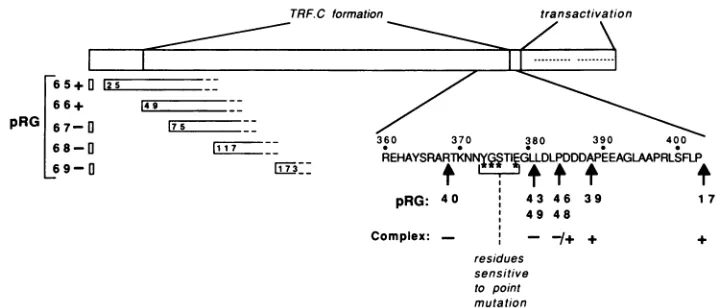
FIG. 7. Linear map of theprimarysequenceof Vmw65 showingthe acidic regionrequired fortranscription activationand the regions required forformationofTRF.C. Beneath, on theleft,are mutantproteinscontaining deletions towardstheaminoterminus, together with their phenotypesforTRF.C formation and transactivation(+,wild-typeactivity; -,lackofactivity).Totherightaretheendpoints ofmutant proteins truncated at thecarboxylterminus, togetherwith theirphenotypes for TRF.C formation. Notation is thesame, except that -/+ mutantproteins showed very low levels of TRF.Cformation.Theresidues at whichsite-directedpoint mutations producedmutantproteins incapable ofTRF.Cformation andtrans activation aremarked withasterisks.
These experiments demonstrate that single amino acid substitutions within residues 373 to 378 can completely abolish functional activity of Vmw65 for TRF.C formation and trans activation, and they reinforce our proposal that this region may be directly involved ininteractions required for TRF.C formation.
DISCUSSION
Inthiswork,wehaveidentifiedtworegionsof the Vmw65 proteinwhich are required for its participation ina nucleo-protein complex (TRF.C)which includesits target TAATGA RAT sequences and the cellularoctamer-binding protein.
The boundary of a required region close to the amino terminus of the Vmw65 protein maps between residues 49 and 75. Deletionof these residues results in proteins which areno longerabletoform TRF.C and cannottransactivate expression from IE promoters (Fig. 7). Deletions at the
amino terminus of the protein were also used to map components of the epitope for monoclonal antibody LP-1 (30)to residues 6 to 24.
The boundaryof a required region for TRF.C formation
previously identified (21) towards the carboxyl terminus of Vmw65wasmapped verytightly toresidues 381 to 388 (Fig.
7). A short region of strong similarity between the Vmw65
primary sequence and that of DNA terminal protein p3 of
bacteriophage
4)29
shares the same carboxyl-terminalboundary.
In thedouble-stranded lineargenome of
4)29,
p3 is cova-lently linked from serine 232 to a dAMP residue at the 5' end of each strand (22). The p3 protein interacts with both the DNA-p3 template and phage DNA polymerase p2 in theinitiation stepof4)29replication. Primary sequence require-ments in the free p3 substrate for this reaction in vitro
include a requirement for residues 14 onward (51). The region of homology to Vmw65 lies between residues 29 and 52 and may therefore be included in these requirements. There could be a related function, as either a protein-protein or aprotein-DNA interactivedomain, for the similar regions ofp3 and Vmw65. In this respect, it is interesting that TRF isprobably identical to the host cell factor NFIII, which is
involved in the formation of an initiation complex during
adenovirus DNA replication (37, 41). This process also
requiresaviralDNA terminalprotein,whichhasafunction similartothat ofprotein p3of4)29. We havenot,
however,
been able to identify any similarities to Vmw65 in the primarysequenceofthe adenovirus DNA terminalprotein.
A chimeric proteinin which 16p3 residues replaced similar residues in Vmw65was constructed, butwas itnot compe-tent for TRF.C formation. Although the two regions are thereforenot functionallyinterchangeable, we proposethat they may adopt similar conformations and may perform
related functions.
Directed mutagenesis of Vmw65 within the region of similarity demonstrated the extreme sensitivity of several residues to point mutation. TRF.C formation and trans activationwere abolished in 6 of 11 mutantstested. Single
mutationsatfourseparateresiduesproduced proteins whose function in bothassays was strongly impaired or abolished (Fig. 7). transactivationwasreducedtoless than 10% ofthe wild-type activity, and TRF.C formation was substantially
impaired when tyrosine 373 was changed to cysteine or serine. Phenylalanine could substitute functionally for ty-rosineatthis position, andsothehydroxylgroupoftyrosine
373 is unlikely to be important for TRF.C formation, for instance,as aphosphorylationsite. Incontrast,replacement of serine 375 with threonine preserved activity, whereas alanine or proline could not substitute. The tolerance of threonine but not alanine at this position could indicate a requirement for the phosphorylation ofresidue 375 before TRF.C formation. This hypothesis willbe tested both bio-chemically andby further mutagenesis. It is interesting that the 4)29 residues introduced into the chimeric protein in-cluded a valine residue rather than a serine residue at this position and that this alone could account for the lack of activity of the chimera in TRF.C formation. Changing gly-cine 374 even to the relatively small residue alanine com-pletely abolished function in bothassays, andso theremay be an absolute requirement for glycine in this position. Finally, the replacement of glutamic acid 378 by either alanine orglycine abolished activity.
The limits mapped in thisstudy for sequences which are requiredforbothTRF.Cformation and transactivationare inbroadagreementwiththosemapped byTriezenbergetal. (47)for theabilityof truncatedproteinslackinganactivatory
on November 10, 2019 by guest
http://jvi.asm.org/
domain tointerfere with trans activation. Two studies have detailed in-frame insertional mutagenesis of Vmw65 with shortlinkers.Ace etal. (1) reported two regions of sensitiv-ity to insertional mutagenesis. The sensitive insertions were at residues 172 and 177 and at residue 379, and in both
regions they led to abolition of IEC formation and
trans-activating activity. Insertion atresidue 379 maydisrupt the same required region that we characterized by point muta-genesis. Werstuck and Capone (48) reported sensitivity of
trans-activating activity to in-frame insertions at residues
178, 215, 335, 369, 379, and 471. The insertions at residues 369 and 379 may also disrupt the same region which we investigated in this study.
WhileVmw65 hasaclearhomologin theORF10protein of
varicella-zoster virus (13), the best alignment of the two primarysequencesintroducesagapinORF10corresponding to residues 372 to 393 of Vmw65. Since ORF10 lacks a carboxyl-terminal acidicdomain,it wouldnotbeexpectedto transactivate gene expression. The additional lack of resi-dues homologous tothose required forTRF.Cformationin Vmw65 suggests that it may also not form a DNA-binding complex with oct-1. Recent results obtained by using a varicella-zostervirus ORF10 expression systemidentical to that usedforVmw65indicatethatORF10isindeeddeficient
inbothofthesefunctions (R. F.Greaves,
unpublished
data).The identification of widely spaced
requirements
forTRF.C formation suggests that the
domain(s)
of Vmw65responsiblefor this function may notbeas simpletodissect as was theactivatory domain. The site-directed
mutagenesis
experiments described here imply strongly that residues in the p3-homologous region are directly involved in interac-tions necessary for TRF.C formation. This conclusion is
furthersupported byourdemonstration thatasmall
peptide
derived from this
region
caninterferewith TRF.Cassembly
invitro (21a). Althoughtherelativelycrude deletion
analysis
presented does not provide such direct
evidence,
aregion
towards the amino terminus of the
protein
may also bedirectlyinvolved in TRF.C. Thetwo
insertional-mutagenesis
studies (1, 48) indicate afurther
region
(residues
172to215)
which could be directly involved in TRF.C formation. If
such multiple
regions
exist in theprimary
sequence, it may be either that one large interactive site is formedby
thejuxtaposition of these
regions
in the foldedprotein
or that separate,multiple interactionsoccur.Inthislatter respect, it is interesting that several studies (2,19;
O'Hare,
unpub-lisheddata) indicatethat furthercellular
factors,
inaddition to theoctamer-bindingprotein,
may berequired
for TRF.Cformation. Itis
possible
that thevariousregions required
of Vmw65 interactseparately
with the various components ofthe TRF.C complex. This
complex
is one of the best-understood examples of selective gene activationby
modi-ficationofanexisting
DNA-transcription
factorcomplex
by
a further component(s). Identification of the nature of the
defects in the Vmw65 mutant
proteins
describedwill be ofparticular
valueofunderstanding
the mechanism ofprotein-protein interactions involvedin thecombinatorial control of
gene
expression.
ACKNOWLEDGMENTS
We thank Tony Minson for generously supplying monoclonal antibodies and Alison Haigh and Delia O'Rourke for invaluable technical assistance.
This workwasfundedbytheMarieCurieMemorialFoundation. LITERATURE CITED
1. Ace,C.I.,M. A.Dalrymple,F.H.Ramsay,V.G.Preston,and C. M. Preston. 1988.Mutationalanalysisoftheherpes
simplex
virus type 1 trans-inducing factor, Vmw65. J. Gen. Virol. 69:2595-2605.
2. ApRhys,C. M.J.,D. M.Ciufo, E. A.O'Neill,T.J.Kelly,and
G.S.Hayward.1989.
Overlapping
octamerandTAATGARAT motifs in the VF65-responseelements inherpessimplex
virusimmediate-earlypromoters representindependent
binding
sites for cellularnuclearfactor III.J. Virol.63:2798-2812.3. Batterson, W., and B. Roizman. 1983. Characterization ofthe
herpes simplex virion-associated factor
responsible
for the induction ofagenes. J. Virol. 46:371-377.4. Baumrucker, T., R.Sturm,andW. Herr. 1988. OBP100 binds
remarkably degenerateoctamermotifs
through
specific
interac-tionswithflankingsequences.Genes Dev. 2:1400-1413. 5. Bohmann, D.,W.Keller,T.Dale, H. R.Scholer,G.Tebb,andI. W. Mattaj. 1987. A
transcription
factor which bindsto the enhancers of SV40,immunoglobulin heavy
chain and U2sn-RNAgenes. Nature (London)325:268-272.
6. Burnette, W. N. 1981. "Western
blotting": electrophoretic
transfer ofproteins from sodium
dodecyl
sulphate
polyacryl-amide
gels
tounmodified nitrocellulose andradiograhic
detec-tion with antibody and radioiodinatedprotein
A. Anal. Bio-chem. 112:195-203.7. Bzik, D. J., and C. M. Preston. 1986.
Analysis
ofsequences whichregulatethetranscription
ofherpessimplex
virus imme-diateearly
gene 3: DNA sequencesrequired
forenhancer-like activity andresponse totrans-activationby
a virionpolypep-tide. NucleicAcids Res. 14:929-943.
8. Campbell, M. E. M., J. W.
Palfreyman,
and C. M. Preston. 1984. Identification ofherpes
simplex
virus DNA sequences which encodeatrans-acting
polypeptide responsible
for stimu-lationof immediateearly
transcription.
J. Mol.Biol. 180:1-19. 9. Chen, C., and H.Okayama.
1987.High-efficiency
transforma-tion of mammalian cellsby
plasmid
DNA. Mol. Cell. Biol. 7:2745-2752.10. Cousens,D. J.,R.Greaves,C.R.
Goding,
and P.O'Hare.1989. The C-terminal 79 amino acids of theherpes
simplex
virusregulatory
protein,
Vmw65,efficiently
activatetranscription
in yeastandmammalian cells inchimericDNA-binding
proteins.
EMBOJ. 8:2337-2342.
11. Cullen, B. R. 1986. trans-Activation of human
immunodefi-ciency
virusoccursviaabimodalmechanism. Cell 46:973-982.12. Dalrymple, M. A., D. J. McGeoch,A. J. Davison, and C. M.
Preston.1985. DNA sequence of the
herpes
simplex
virustype 1genewhoseproduct
isresponsible
fortranscriptional
activa-tion of immediateearly
promoters. Nucleic Acids Res. 13: 7865-7879.13.
Davison,
A. J., and J. E. Scott. 1986. Thecomplete
DNAsequenceofvaricella-zoster virus. J.Gen.Virol.67:1759-1816. 14. Doorbar,J.,D.
Campbell,
R.J.A.Grand,and P. H.Gallimore. 1986. Identification ofthe humanpapilloma
virus-lageneprod-ucts. EMBOJ. 5:355-362.
15. Escarmis, C., andM. Salas. 1982. Nucleotide sequence ofthe
early
genes 3 and4 ofbacteriophage 4029.
Nucleic Acids Res.10:5785-5798.
16. Friedman,A.D.,S.J. Triezenberg,and S. L.
McKnight.
1988.Expression
ofatruncated viral trans-activatorselectively
im-pedes
lytic
infectionby
its cognate virus. Nature(London)
335:452-454.
17. Gaffney, D. F., J. McLauchlan, J. L. Whitton, and J. B.
Clements.1985. Amodularsystem fortheassayof
transcription
regulatory signals:
the sequenceTAATGARAT isrequired
forherpes
simplex
virus immediateearly
geneactivation. NucleicAcids Res. 13:7847-7863.
18. Garnier, J.,D.J.Osguthorpe,andB. Robson.1978.
Analysis
of the accuracy andimplications
ofsimple
methods forpredicting
the secondary structure ofglobular proteins.
J. Mol. Biol. 120:97-120.19. Gerster, T., and R. G. Roeder. 1988. A
herpesvirus
trans-activating
protein
interacts withtranscription
factor OTF-1 and other cellularproteins.
Proc. Natl. Acad. Sci. USA 82:5265-5269.20. Gluzman,Y. 1981.
SV40-transformed
simian cells supportthereplication
ofearly
SV40mutants. Cell23:175-182.on November 10, 2019 by guest
http://jvi.asm.org/
21. Greaves, R., and P.O'Hare. 1989. Separation of requirements for protein-DNA complex assembly fromthose for functional activity in the herpes simplex virus regulatory protein Vmw65. J. Virol. 63:1641-1650.
21a.Haigh, A., R. Greaves, and P. O'Hare. 1990.Interference with
the assembly ofavirus-host transcription complex by peptide competition. Nature (London) 344:257-259.
22. Hermoso, J. M., E. Mendez, F. Soriano, and M. Salas. 1985. Location ofthe serine residue involved inthelinkage between theterminal protein and the DNA ofphage429.Nucleic Acids Res. 13:7715-7728.
23. Honess, R. W., and B. Roizman. 1974.Regulation of herpesvirus macromolecular synthesis. I. Cascade regulation of the
synthe-sis of threegroupsof viralproteins. J. Virol. 14:8-19. 24. Kristie, T. M., and B. Roizman. 1984. Separation ofsequences
defining basal expression from those conferringagene recogni-tion withinthe regulatory domains ofherpes simplex 1agenes.
Proc. Natl. Acad. Sci. USA81:4065-4069.
25. Kristie, T. M., and B. Roizman. 1988. Differentiation and DNA
contact points of host proteins binding at the cis site for
virion-mediated induction ofagenesofherpes simplex virus 1. J. Virol. 62:1145-1157.
26. Laemmli, U. K. 1970.Cleavage of structural proteins during the assembly of the head ofbacteriophage T4. Nature (London) 227:680-685.
27. Mackem, S., and B. Roizman. 1982. Structural features of the herpes simplex virus agene4, 0, and 27 promoter-regulatory sequences which confer a regulation on chimeric thymidine
kinasegenes. J. Virol. 44:939-949.
28. Marsden, H. S., M. E. M.Campbell, L.Haarr, M. C. Frame,
D. S. Parris,M. Murphy, R. G. Hope,M. T. Muller,andC.M.
Preston. 1987. The 65,000-Mr DNA-binding and virion trans-inducing proteins of herpes simplex virus type 1. J. Virol. 61:2428-2437.
29. McKnight, J. L. C., T. M. Kristie, and B. Roizman. 1987. Binding of the virion protein mediating a gene induction in herpes simplex 1-infected cells toits cis site requires cellular proteins. Proc. Natl. Acad. Sci. USA 84:7061-7065.
30. McLean, C., A. Buckmaster, D. Hancock, A. Buchan,A.Fuller, and T. Minson. 1982. Monoclonal antibodies to three
non-glycosylated antigens of herpes simplex virustype 2. J. Gen. Virol.63:297-305.
31. Mead, D. A., E. Szczesna-Skorupa, and B. Kemper. 1986.
Single-stranded DNA 'blue' T7promoterplasmids: aversatile
promotersystemforcloning andprotein engineering. Prot. Eng. 1:67-74.
32. Murchie, M. J., and D. J. McGeoch. 1982. DNA sequence
analysis ofanimmediate-earlygeneregion of the herpes simplex virus type 1 genome (map coordinates 0.950-0.978). J. Gen. Virol. 62:1-15.
33. O'Hare, P., and C. R. Goding. 1988. Herpes simplex virus regulatory elements and theimmunoglobulin octamerdomain bindacommonfactor andarebothtargetsfor virion transacti-vation.Cell 52:435-445.
34. O'Hare, P., C. R. Goding, and A. Haigh. 1988. Direct combina-torial interaction between a herpes simplex virus regulatory
protein andacellularoctamer-binding factor mediates specific inductionofvirus immediate-earlygene expression. EMBOJ.
7:4231-4238.
35. O'Hare, P., and G. S. Hayward. 1984. Expression of
recombi-nantgenes containing herpes simplex virus delayed-early and
immediate-early regulatory regions and trans-activation by her-pesvirus infection. J. Virol. 52:522-531.
36. O'Hare, P., andG. S. Hayward. 1987. Comparison ofupstream sequencerequirements for positive and negative regulation ofa
herpes simplex virus immediate-early gene by three virus-encodedtrans-acting factors. J. Virol.61:190-199.
37. O'Neill, E. A., C. Fletcher, C. R. Burrow, N. Heintz, R. G. Roeder, and T. J. Kelly. 1988. Transcription factor OTF-1 is functionally identical to the DNA replication factor NF-III. Science 241:1210-1213.
38. Post, L. E., S. Mackem, and B.Roizman. 1981. Regulation ofa
genes of herpes simplex virus: expression of chimeric genes produced by fusion of thymidine kinase with a gene promoters. Cell 24:555-565.
39. Preston, C. M., M. G. Cordingley, and N. D. Stow. 1984. Analysis of DNA sequences which regulate the transcription of a herpes simplex virus immediate early gene. J. Virol. 50: 708-716.
40. Preston, C. M., M. C. Frame, and M. E. M. Campbell. 1988. A complexformed between cell components andan HSV struc-turalpolypeptide binds to a viral immediate early gene regula-tory DNA sequence. Cell 52:425-434.
41. PruiJn, G. J. M., W. vanDriel,and P. C. van der Vliet. 1986. Nuclear factor III, a novel sequence-specific DNA-binding protein from HeLa cells stimulating adenovirus replication. Nature(London)322:656-659.
42. Ruther, U., and B. Muller-Hill. 1983. Easy identification of cDNAclones. EMBOJ. 2:1791-1794.
43. Sadowski, I., J. Ma, S. Triezenberg, and M. Ptashne. 1988. GAL4-VP16 is an unusually potent transcriptional activator. Nature(London)335:563-564.
44. Singh, H., R. Sen, D. Baltimore, and P. A. Sharp. 1986. A nuclear factor that binds to a conserved sequence motif in transcriptionalcontrol elements ofimmunoglobulingenes. Na-ture(London) 319:154-158.
45. Sive,H.L., and R. G. Roeder. 1986. Interaction ofacommon factor with conserved promoter and enhancer sequences in histone H2B,immunoglobulinand small nuclear RNA (snRNA) genes. Proc. Natl. Acad. Sci. USA83:6382-6386.
46. Sturm, R., T. Baumrucker, B. R. Franza, Jr., and W. Herr. 1987. A 100kd HeLa cell octamer binding protein (OBP100) interacts differently with two separate octamer-related se-quenceswithin theSV40 enhancer. Genes Dev. 1:1147-1160. 47. Triezenberg, S. J., R. C. Kingsbury, and S. L. McKnight.1988.
Functional dissection of VP16, the transactivator of herpes simplex virus immediate early gene expression. Genes Dev. 2:718-729.
48. Werstuck, G., and J. P. Capone. 1989.Mutationalanalysis of the herpes simplex virus trans-inducing factor Vmw65. Gene 75: 213-224.
49. Whitton,J. L., F. J. Rixon, A. J. Easton, and J. B. Clements. 1983.Immediate-earlymRNA-2of herpes simplex virusestypes 1 and 2 is unspliced: conserved signals around the 5' and 3' termini correspondtotranscriptionregulatory signals. Nucleic AcidsRes. 11:6271-6287.
50. Wu, C. 1984. Twoprotein-binding sitesinchromatinimplicated in the activation of heat-shock genes. Nature (London) 309: 229-234.
51. Zaballos, A., R. P. Meliado, and M. Salas. 1988. Initiation of phage +29 replication bymutantswith deletions atthe amino terminal endofthe terminalprotein.Gene 63:113-121.